Introduction
English for Special Subjects (ESP) course focuses on English for specific subjects, in which subjects are taught with professional terms and situations related to a professional background. This is an important factor in the transition period of the current market economy in Uzbekistan. The reason is that the language teaching at the university to produce young personnel is career-oriented, that is, whether it is the field of business, engineering, or medicine, the student will learn English words and phrases related to his future field, learn to write a letter, make a presentation and reason. Unlike general English courses, ESP focuses on specific vocabulary, context-specific communication skills, and real-life applications.
ESP courses are an effective pedagogical approach that bridges the gap between theoretical language learning and practical application. Case studies provide students with real-life scenarios that require them to use the language in context, making the learning process more meaningful and interesting. By analyzing and solving problems in a specific professional field, students not only improve their language skills, but also acquire critical thinking, problem-solving, and decision-making skills that are important for their future careers.
The main objective of these case studies is to improve language skills in the context of computer and electrical engineering by involving students in a real scenario that reflects the problems they face in their professional life. Through this case study, students develop important communication skills such as negotiating, presenting solutions, and collaborating effectively in professional settings. Applied research often bridges the gap between theoretical knowledge and practical application. For example, in an ESP course for computer and electrical engineering, students can analyze a case study of a company facing a specific problem. Through this process, they not only learn specific vocabulary and language structures, but also gain an understanding of the actual use of language in a professional context (Belcher, 2009). This practical focus increases the relevance of language learning. Also, many scientists emphasize that case studies are a powerful tool for developing cooperation among students.
In group settings, students can discuss different aspects of work, practice speaking, listening and writing in a professional context, and collaborate to find solutions. According to Paltridge and Starfield (2013), these interactive elements help students develop communication skills that are important for future careers. In addition, case studies help students apply critical thinking and problem-solving skills. Students practice the language while working through challenging, real-life scenarios relevant to their fields of study or future work, improving their analytical and decision-making skills. This is an ideal way for ESP courses to prepare students for professional communication in the real world. (Basturkmen, 2006). It is important to note that case studies provide authentic, context-rich scenarios that are directly relevant to students' professional or academic needs. According to Dudley-Evans and St. John (1998), this contextualization ensures that language learning is directly related to the specialized discourse of the target domain. It goes beyond abstract language practice and focuses on the type of communication students will encounter in their future workplaces.
Flowerdew (2013) advocates that in ESP courses, students are not only often required to read specialized texts, such as research articles, reports, or business correspondence. Case studies are an effective way to practice reading comprehension in the context of original texts, followed by writing tasks such as writing a report or drafting an email. These tasks mimic the writing they encounter in their fields and allow them to develop their writing skills in an appropriate context.
It should also be noted that the case study approach often contains cultural and contextual nuances that reflect the unique challenges or conventions of a particular profession or discipline. For example, case studies in an ESP course for computer and electrical engineering might explore negotiation strategies between different cultural groups. By engaging in these case studies, students not only improve their language skills, but also gain awareness of intercultural communication, which is crucial in a globalized work environment. (Hutchinson & Waters, 1987).
Another advantage highlighted by scientists is the active participation of students in case studies. By using current events or historical situations, students connect the topics to real-life problems as they study the topics in the classroom, which helps make the content more interesting and motivating (Nunan, 2004). This approach also encourages students to stay abreast of developments in their fields, which is especially important in fast-moving disciplines such as engineering.
In conclusion, scholars agree that case studies are an important tool in ESP courses to promote meaningful and contextual language acquisition. By encouraging critical thinking, application, and group learning, case studies help bridge the gap between language learning and professional practice, making them an essential component of contemporary ESP pedagogy.
Methodology
This case study uses a task-based approach within ESP aimed at improving professional communication skills in a computer and electrical engineering context. The main goal is to give students the opportunity to practice their language skills in real, realistic situations that reflect the professional challenges they face in their respective fields.
The case study approach was used in the classes of 2nd-year computer and electrical engineering students of Ajou University in Tashkent, who have a medium and high level of knowledge of the English language. Subjects such as "Inside the computer", "User Interface", "Images and Graphic Design", "Web Design VS Web Development", "Desktop Publishing" were passed according to the English language curriculum. Case studies on these topics were presented, and within the context, students studied life scenarios and considered the important aspects of decision-making and problem-solving.
When carrying out the case study, it is important that it corresponds to the objectives of the ESP course as indicated in the university curriculum and meets the skills and knowledge that students should acquire. To be clear, the main purpose of the research is:
To improve students' ability to analyze electrical and computer engineering problems in English;
Improve professional presentation skills by preparing reports;
Develop oral communication skills through professional presentation of case study solutions.
Oral and written presentations of students were evaluated to check and analyze whether these goals are being implemented in the course of the lesson. In addition, students' participation in group discussions was observed and recorded. After the research, feedback was collected from the survey.
The case approach was used in the course for 4 months, and teaching methods such as group work, role plays, debates and presentations were used to facilitate case studies. The first stage involved reading and analyzing case study materials, followed by the group. In the second round of discussions and brainstorming sessions, students presented their solutions to the class and received feedback from their peers and the teacher.
Real websites were used to provide students with a context that reflected the language in a professional environment. For example, in the topic of "User Interface" students compare an effective website (currently Amazon.com) and a website that is not user-friendly (healthcare.com), and after discussions, students see what a good website should look like. made presentations in order to show. This in turn provided students with examples of language and speech used in professional settings, enabling them to engage with specific terms and terminology.
Summative and formative methods were used to assess students' knowledge. Formative assessment was conducted during group discussions and presentations. For the summative assessment, the final project was evaluated through an oral presentation (See Appendix 1).
At the end of this case study, students are expected to demonstrate improved oral language skills, especially in the context of electrical and computer engineering. In addition, they improve their ability to think critically, work in groups with peers, and solve complex professional problems. These results help students cope with the challenges of their chosen profession and communicate effectively in the work environment.
Findings
The 2nd year students of Ajou University in Tashkent took part in the English course for special electrical engineering and computer engineers. In this course, the case study approach was widely used, and students' opinions about this approach were studied by conducting a survey through Google Form (See Appendix 2).
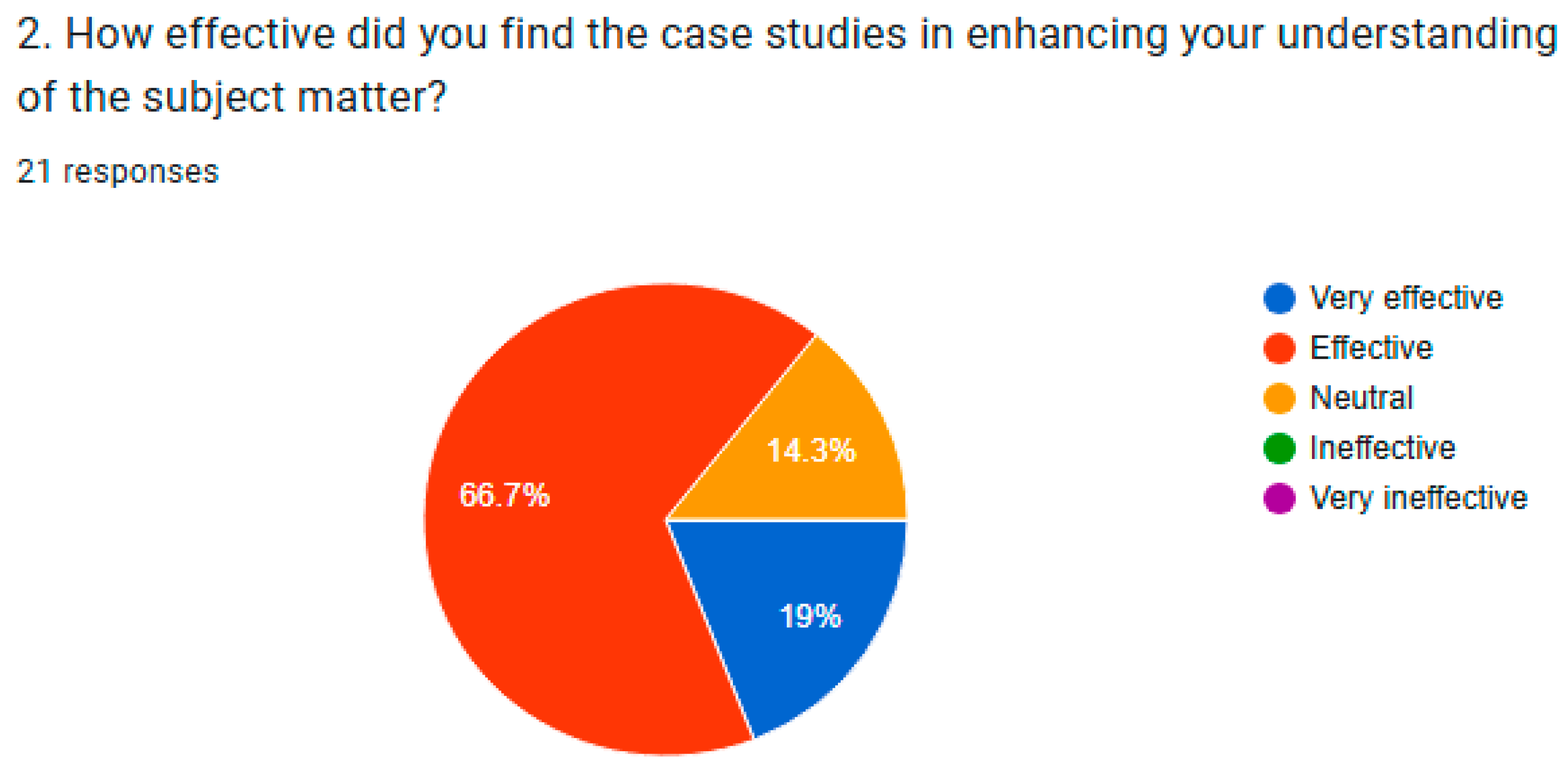
According to the questionnaire, the use of the case approach led to an increase in students' interest in the lesson, their involvement and better mastery of the topics.
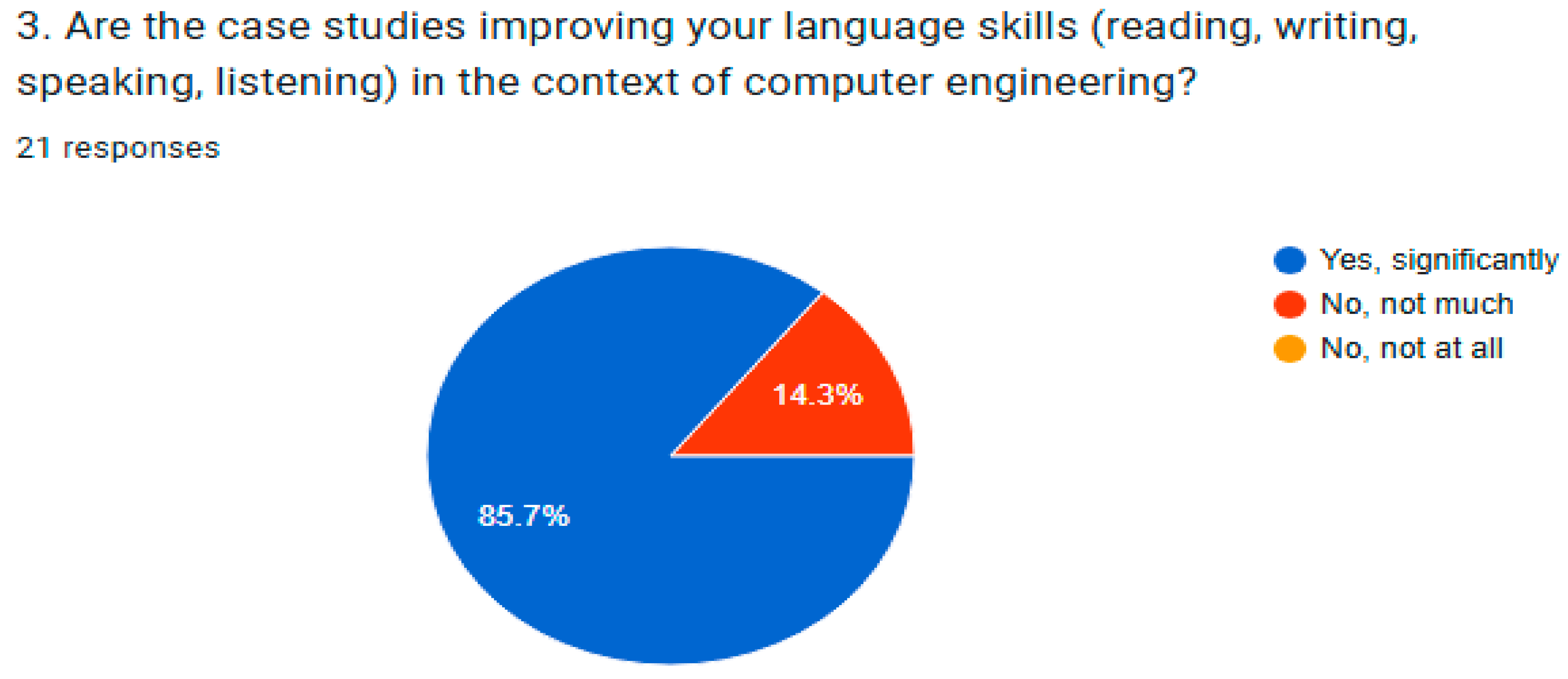
More than 85% of students acknowledged that this approach helped students improve their English language competencies (reading, listening, writing and speaking).
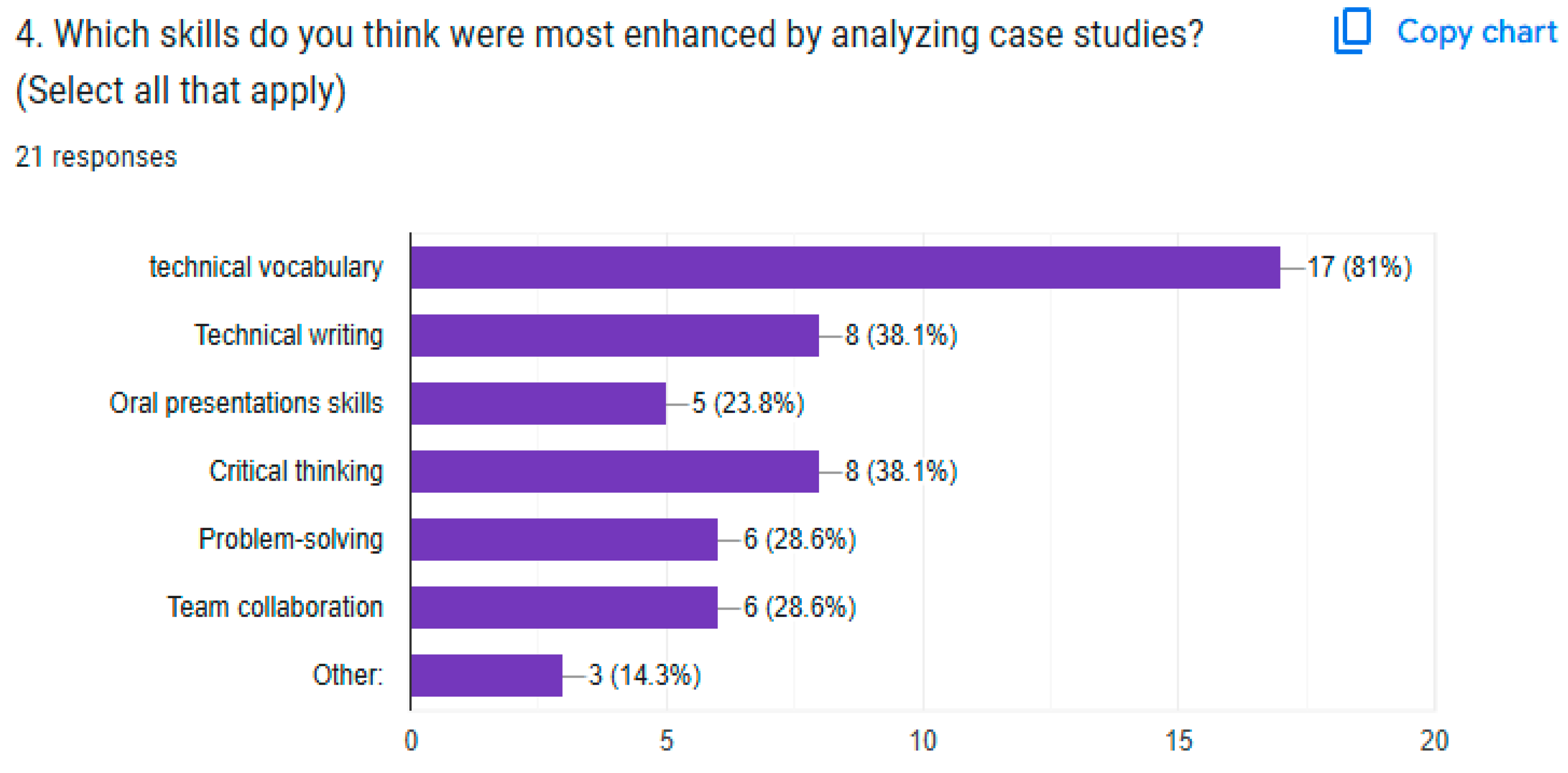
They also felt that their engineering vocabulary, technical writing, oral presentation, and critical thinking skills were more developed by analyzing case studies.
When asked what they liked most about teaching with a case study approach, most students answered that the teaching method and topics are related to real life.
Student 1: The case studies were very practical and helped me to understand real life scenarios related to the subject of this course. ("The case studies were very practical and helped me understand real world scenarios related to this course content").
Student 2: I really liked how teaching using case approaches made the topics interesting by connecting them from theoretical concepts to real life. ("I appreciated how case studies make the material relatable and engaging, providing real-world applications of theoretical concepts.")
Student 3: What I like most about teaching through case approaches is how these methods lead to real-life scenarios. ("What I love most about teaching Case Studies is how they lead to real-life scenarios.")
Question 6 of the survey asked what difficulties they encountered in learning through case approaches, and some students admitted that case studies were more difficult due to their lack of vocabulary related to electrical and computer engineering. In addition, some students admitted that they were embarrassed to share their research analysis in front of the public and were embarrassed by their insufficient level of English.
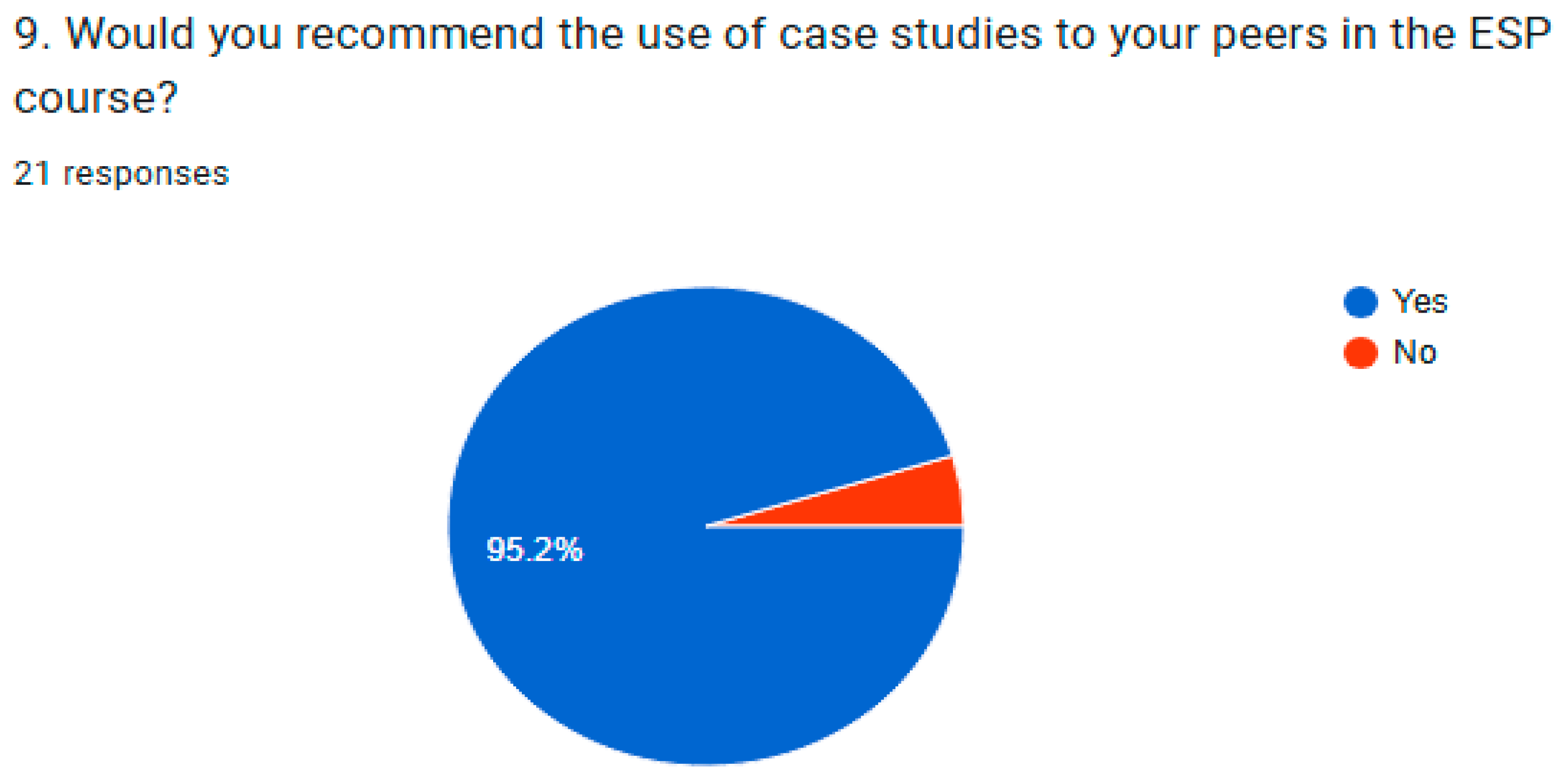
However, despite these difficulties, most students, that is, almost 95 percent, admitted that the use of this approach made them understand the topics better and increased their interest in the lessons (questions 7, 8), and they were satisfied that the case study approach was applied to the ESP course. They said that it
Discussion
The results of this study support the use of a case study approach in English for Special Purposes (ESP) courses for computer and electrical engineering students. This approach creates the basis for not only theoretical study of the language, but also practical application, allowing students to develop both language and professional competence with real-life examples in the context. Several key aspects of this approach warrant further research and discussion.
Case studies expose students to realistic scenarios that reflect challenges they may face in their future careers. By completing tasks such as presenting, presenting solutions, and working together as a group in a professional context, students gain practical skills that are directly applicable in their fields. The results show that students significantly improved their technical vocabulary, critical thinking and oral communication skills. These skills are essential for solving real-world engineering problems and effectively participating in the work environment.
In addition, case studies in a structured setting allow students to use professional discourse and improve language skills. For example, analyzing the usability of websites such as Amazon.com and Healthcare.com in the User Interface module will help students use technical terms in communication with confidence. Therefore, this approach not only enhances their understanding of subject-specific content, but also provides opportunities for professional use of English.
One of the great benefits of case studies is that they connect lesson topics to real-life examples. The feedback of the students through the questionnaire shows the relevance and practicality of the applied research approach. Many students appreciated the role of this approach in connecting theoretical concepts with more interesting and practical material. By analyzing real-life scenarios, such as comparing effective and ineffective website designs, students found the topics more interesting and were encouraged to actively participate in class discussions and group activities.
The connection to real-life contexts encourages students to stay abreast of developments in their fields. For example, the use of authentic materials and scenarios ensured that students practiced language skills relevant to the rapidly evolving demands of the engineering profession. Adapting to this professional reality is important in maintaining students' interest and developing a sense of purpose in their studies.
Case studies foster teamwork and cross-cultural communication. And this skill set is, in turn, a skill increasingly valued in today's engineering workplace. A. Khudaykulov and A. Doniyorov (2018) in their research on teaching intercultural communication in Uzbekistan emphasize the importance of cultural understanding in effective interactions. Their research shows that grammar, vocabulary, and phonology play a relatively minor role in intercultural communication, and effective interaction can be achieved by knowing and respecting each other's cultures.
Group discussions, debates, and collaborative problem solving gave students the opportunity to practice speaking and listening in a professional setting. These sessions also helped them learn cultural nuances and develop strategies for effective communication in diverse communities.
However, the study found that some students struggled in group settings due to limited technical vocabulary or lack of confidence in their language skills. Addressing these barriers through additional vocabulary-building exercises or peer support mechanisms may further enhance the effectiveness of this approach.
R. Ergashev (2024) Research on the effective development of the academic vocabulary of Uzbek master's students shows that the development of structural vocabulary can improve the students' language skills, thereby improving their ability to interact in groups by increasing their confidence.
This issue also emphasizes the need to gradually implement tasks, starting with smaller, low-stakes actions, before moving on to more complex presentations. Encouraging peer feedback and creating a supportive classroom environment can also ease anxiety and boost student confidence.
In conclusion, this approach not only enriches students with language tools necessary for their profession, but also prepares them for critical thinking and collaborative problem solving.
Future research could examine the effects of case-based ESP instruction on students' career success. Additionally, exploring the applicability of this approach to other technical domains or adapting it to online learning contexts could provide valuable insights for educators around the world.
The case study approach proved to be a powerful tool in improving professional communication skills of computer and electrical engineering students. By combining linguistic education with practical, real-life materials, this approach ensures that students are well prepared to meet the demands of future work activities in a globalized and interdisciplinary work environment.
Conclusion
The integration of case studies in ESP courses proves to be a very effective pedagogical tool, especially for computer and electrical engineering students. By bridging the gap between theoretical knowledge and real-life application, the use of case studies leads to the development of critical thinking, problem-solving and professional communication skills. These, in turn, are important competencies for students to succeed in future jobs. The results of the research conducted at the Adju University in Tashkent show that it is a good motivation for students to deal with real-life scenarios in the course of the lesson, to develop their technical vocabulary and improve their oral presentation skills.
Despite initial challenges, such as students' limited technical vocabulary and anxiety about working together in groups, positive feedback shows that they find the approach practical and motivating. In addition, a task-based methodology has been shown to foster collaboration and cross-cultural communication that matches the dynamic needs of the engineering field.
In order to overcome the problems identified in the future, it is necessary to develop a structured vocabulary and create a supportive classroom environment that encourages student feedback. Broad application of this approach to various ESP areas will enable students to perform professionally in their workplaces.
Appendix A
PROJECT WORK 1
Aim of the Project Work: to apply the principles of Desktop Publishing (DTP) learned in class to create a professional-looking brochure.
Guidelines
Topic: In a group of 3-4 members, choose a topic of your interest or select one provided by your instructor (e.g., promoting a local event, introducing a new product or service, an informational brochure about a place).
-
Requirements:
- ▪
Design a tri-fold brochure using DTP software (e.g., Adobe InDesign, Canva, Microsoft Publisher).
- ▪
Include at least three sections (front cover, inside panels, back cover).
- ▪
Utilize appropriate typography, color scheme, and layout composition to enhance readability and visual appeal.
- ▪
Incorporate relevant images or graphics that complement the content of the brochure.
- ▪
Ensure the brochure effectively communicates its purpose or message to the intended audience.
-
Submission:
- ▪
Save your final design in PDF format.
- ▪
Submit the PDF file electronically to your instructor by the specified deadline.
-
Evaluation Criteria:
- ▪
Adherence to design principles discussed in class (e.g., alignment, contrast, proximity) – 3 points
- ▪
Creativity and originality in design approach – 3 points
- ▪
Effectiveness in conveying the intended message through visual and textual elements by using public speaking skills – 3 points
- ▪
Overall quality of the layout, typography, and use of graphics/images – 3 points
- ▪
Effectiveness and engagement of the slides – 3 points
-
Additional Tips:
- ▪
Plan your design before starting. Consider sketching a rough layout to organize your content.
- ▪
Use high-resolution images and ensure they are properly formatted for print or digital viewing.
- ▪
Pay attention to consistency in typography (font styles, sizes) and color usage throughout the brochure.
Appendix B
Survey on the use of method of case studies in ESP course aimed for computer engineer students.
-
How familiar are you with the concept of case studies in learning?
- ◦
Very familiar
- ◦
Somewhat familiar
- ◦
Not familiar at all
-
How effective did you find the case studies in enhancing your understanding of the subject matter?
- ◦
Very effective
- ◦
Effective
- ◦
Neutral
- ◦
Ineffective
- ◦
Very ineffective
-
Are the case studies improving your language skills (reading, writing, speaking, listening) in the context of computer engineering?
- ◦
Yes, significantly
- ◦
No, not much
- ◦
No, not at all
-
Which skills do you think were most enhanced by analyzing case studies?
- ◦
(Select all that apply)
- ◦
Technical vocabulary
- ◦
Technical writing
- ◦
Oral presentations skills
- ◦
Critical thinking
- ◦
Problem-solving
- ◦
Team collaboration
- ◦
Other:__________________________
What did you like most about the teaching case studies?
What challenges did you face while working with the case studies?
Do you have any suggestions for improving the use of case studies in future ESP courses?
-
How satisfied are you with the integration of case studies in your ESP course?
- ◦
Very satisfied
- ◦
Satisfied
- ◦
Neutral
- ◦
Dissatisfied
- ◦
Very dissatisfied
-
Would you recommend the use of case studies to your peers in the ESP course?
References
- Basturkmen, H. (2006). Ideas and Options in English for Specific Purposes. Routledge.
- Belcher, D. (2009). English for Specific Purposes: Teaching to Learners’ Needs. TESOL Quarterly, 43(2), 408–413.
- Dudley-Evans, T., & St. John, M. J. (1998). Developments in English for Specific Purposes: A Multidisciplinary Approach. Cambridge University Press.
- Ergashev, R. (2024). Effectiveness of traditional vocabulary instruction for Academic Vocabulary in Uzbek master’s students. Science and Innovation journal. Volume 3.
- Flowerdew, J. (2013). English for Specific Purposes: An International Perspective. In C. A. Chapelle (Ed.), The Encyclopedia of Applied Linguistics.
- Hutchinson, T., & Waters, A. (1987). English for Specific Purposes: A Learning-Centered Approach. Cambridge University Press.
- Khudaykulov, A., & Doniyorov, A. (2018). Empirical analysis of intercultural communication and multicultural team performance: A case of Uzbek and Russian managers in Uzbekistan. International Journal of Innovation and Economic Development, 4(2), 32-50. [CrossRef]
- Nunan, D. (2004). Task-based Language Teaching. Cambridge University Press.
- Paltridge, B., & Starfield, S. (2013). The Handbook of English for Specific Purposes. Wiley-Blackwell.
|
Disclaimer/Publisher’s Note: The statements, opinions and data contained in all publications are solely those of the individual author(s) and contributor(s) and not of MDPI and/or the editor(s). MDPI and/or the editor(s) disclaim responsibility for any injury to people or property resulting from any ideas, methods, instructions or products referred to in the content. |
© 2025 by the authors. Licensee MDPI, Basel, Switzerland. This article is an open access article distributed under the terms and conditions of the Creative Commons Attribution (CC BY) license (http://creativecommons.org/licenses/by/4.0/).