

Submitted:
16 January 2025
Posted:
17 January 2025
You are already at the latest version
Abstract
This paper evaluates the performance of Saudi Arabian higher educational institutions (HEIs) in achieving the United Nations Sustainable Development Goals (UN-SDGs) as reflected in the Times Higher Education Impact Rankings (THE IR). It uses two benchmarking frameworks: the European Union Association (EUA) and the UN-KSA Cooperation 2022–26 frameworks, to identify achievements and gaps. Additionally, the alignment of HEIs' performance with Saudi Arabia's 2024 Sustainable Development Report (SDR) is assessed. Hierarchical Cluster Analysis (HCA) is conducted to group HEIs based on their targeted SDGs. The paper also identifies lead HEIs for each SDG, along with partner and supporting HEIs, to address strategic gaps in SDGs 9 and 16, and Priority Areas 2-4 under the UN-KSA Cooperation framework 2022-26. Finally, a SWOT analysis highlights strengths, weaknesses, opportunities, and threats, providing actionable recommendations to enhance the contributions of Saudi Arabian HEIs towards achieving the SDGs.
Keywords:
1. Introduction
2. Times Higher Education Impact Ranking (THE IR)
3. Methodology
3.1. Participation and Progress Evaluation of HEIs of KSA in THE IR
3.2. Top 100 Ranked HEIs of Saudi Arabia in THE IR
3.3. UN SDGs Coverage by B1 Ranked HEIs of KSA
4. Assessment of KSA HEIs’ Progress Based on EUA Framework
5. Assessment of KSA HEIs Progress Based on UN-KSA Cooperation Framework: 2022–2026
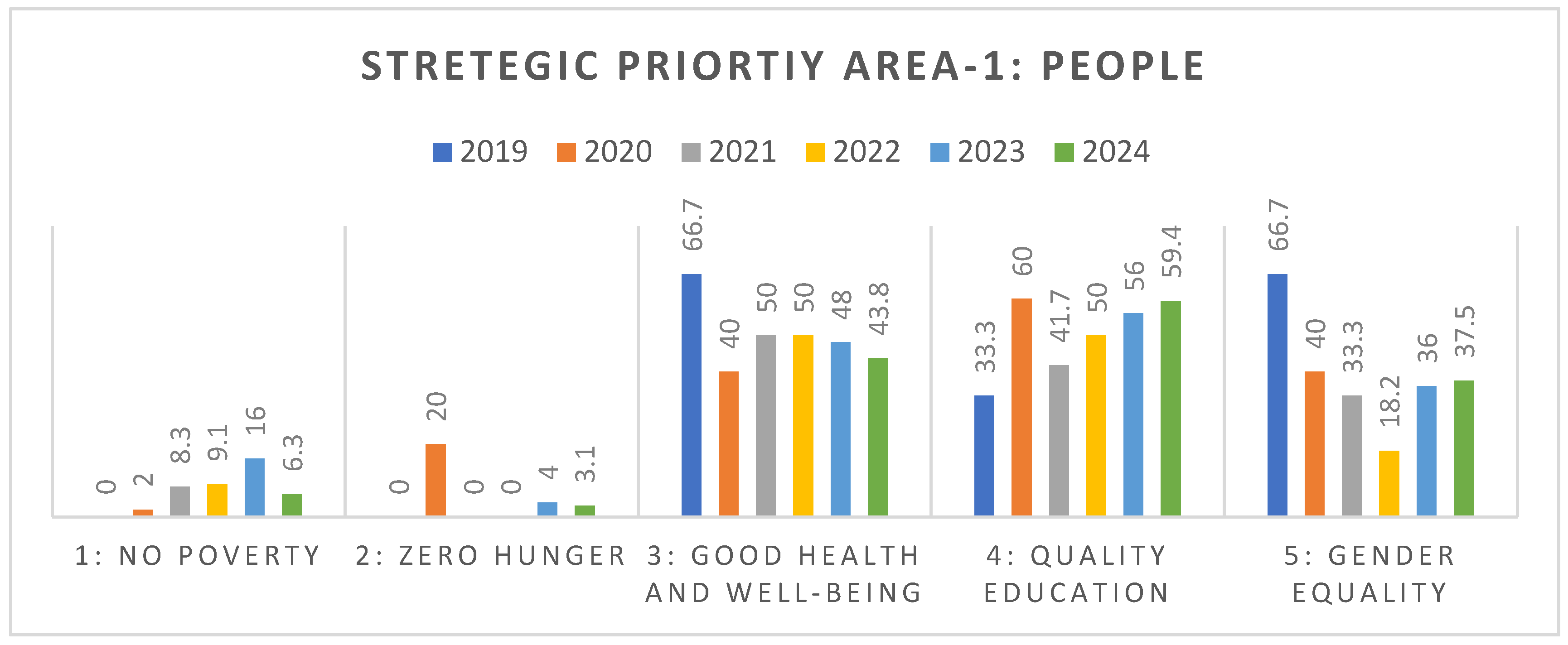
5.1. Strategic Priority Area-1: People
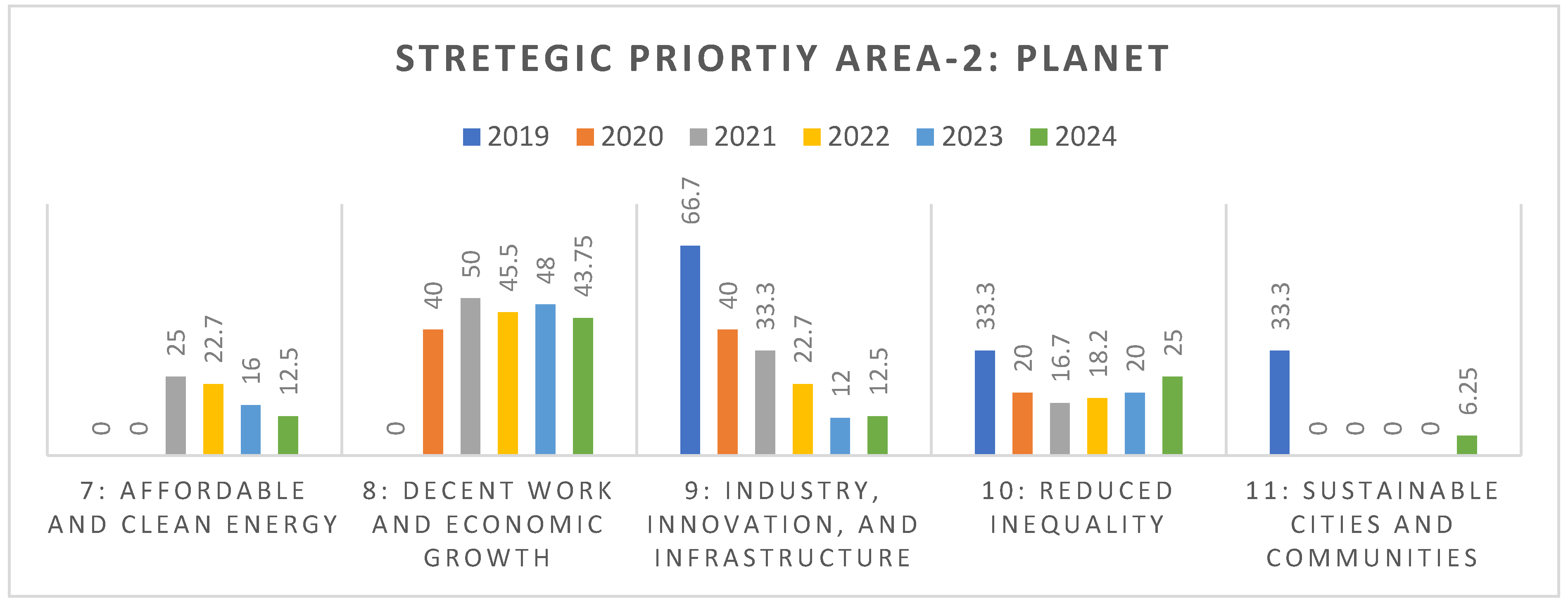
5.2. Strategic Priority Area-2: Planet
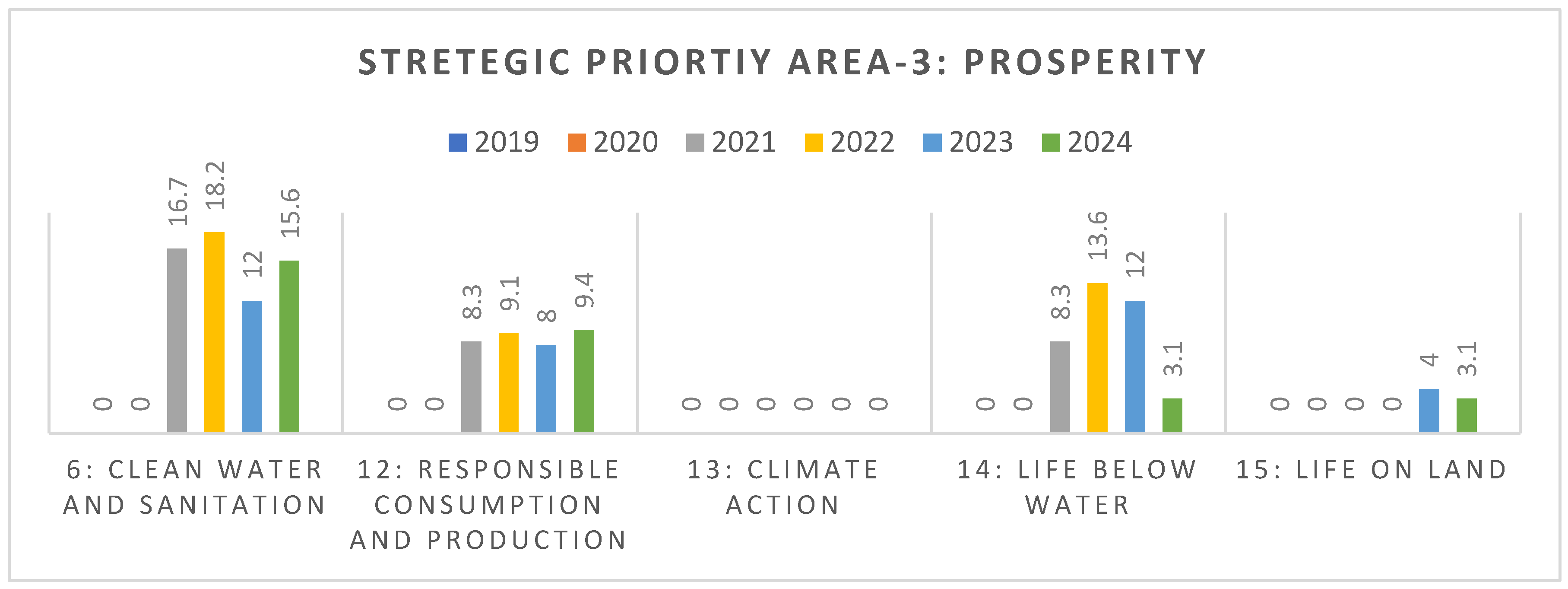
5.3. Strategic Priority Area-3: Prosperity
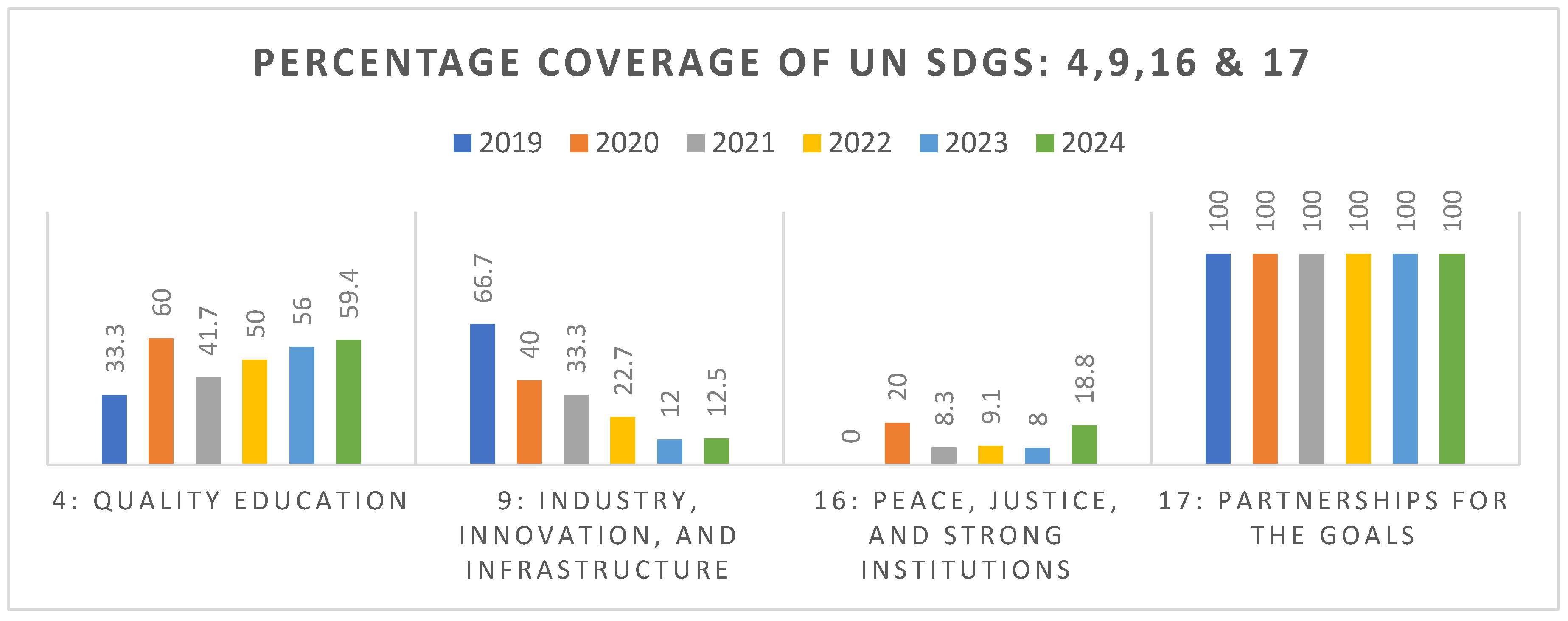
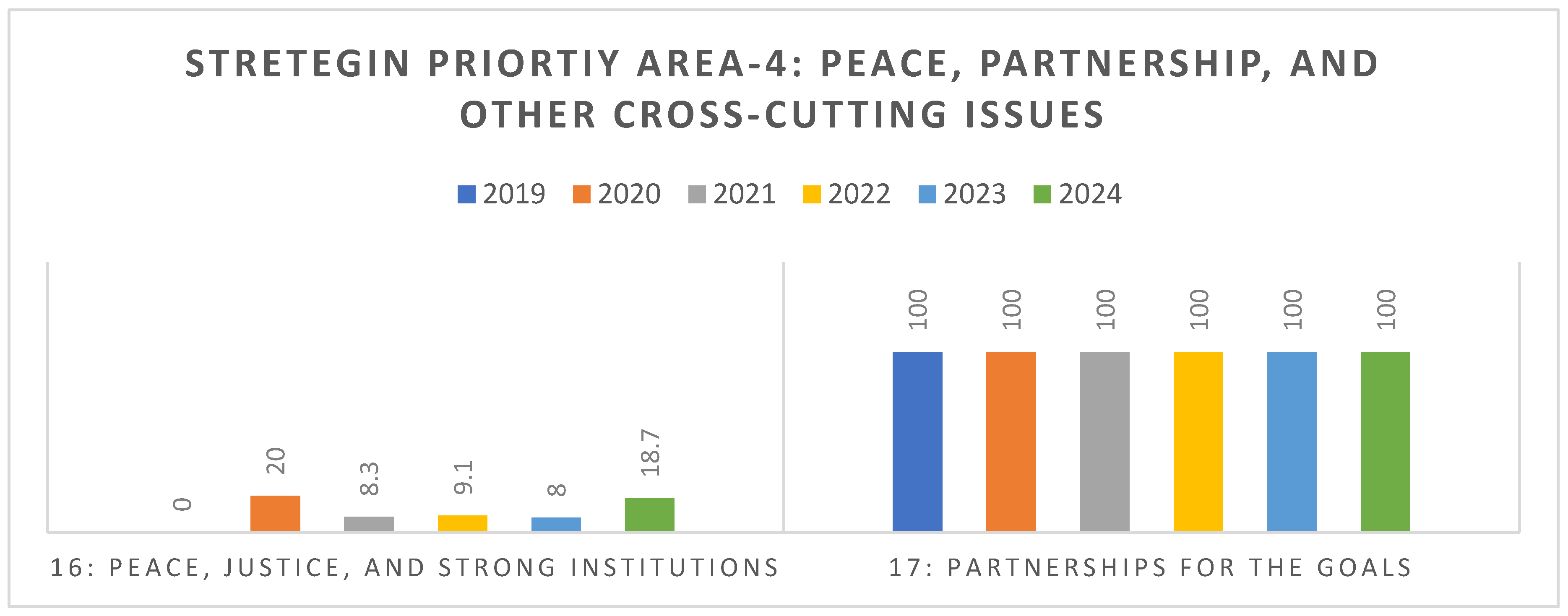
5.4. Strategic Priority Area-4: Peace, Partnership, and Other Cross-Cutting Issues
6. Comparative Analysis of UN SDG Attainment Insights from EUA and UN-KSA by KSA HEIs with 2024 Sustainable Development Report of Saudi Arabia
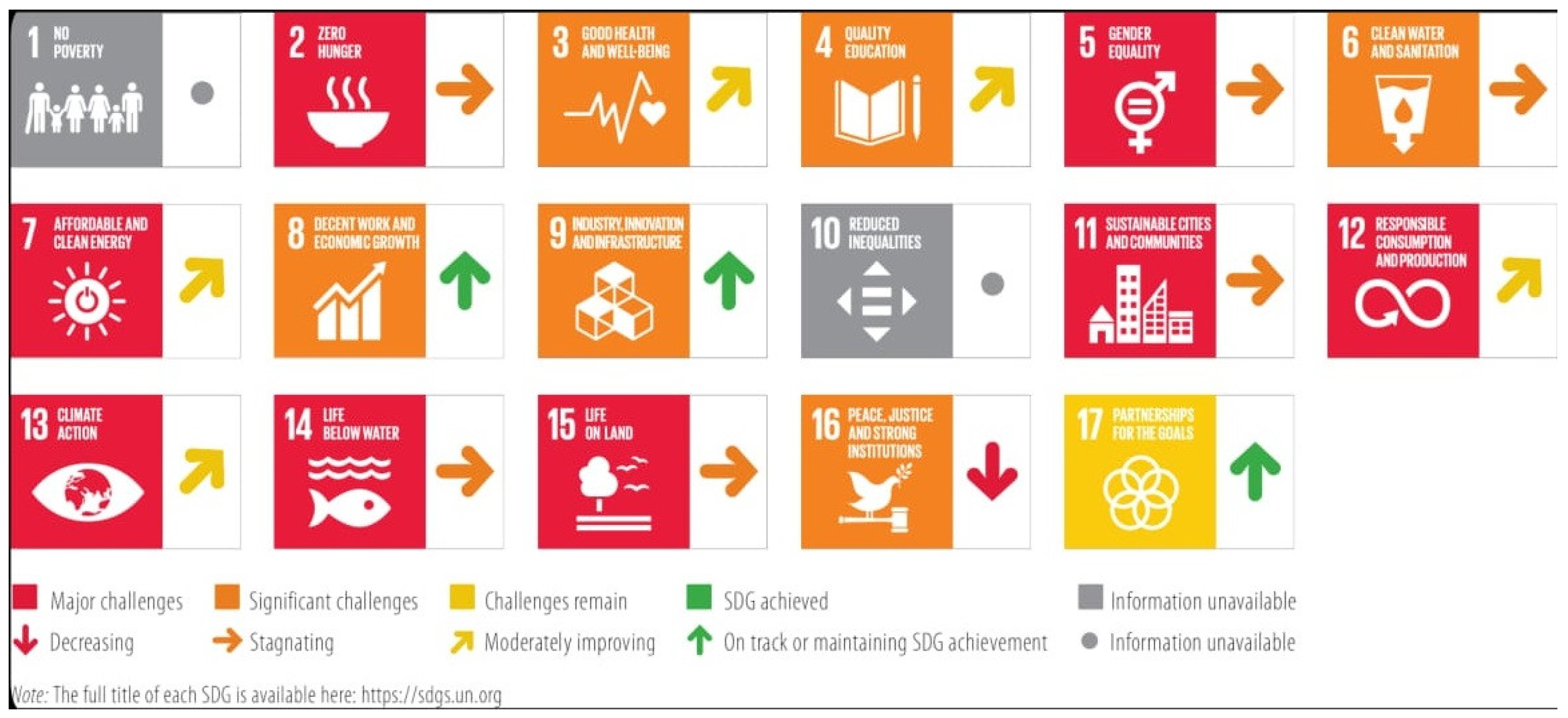
6.1. Comparison of EUA-Framework with SDR-2024 of KSA
6.2. Comparison of UN-KSA Framework with SDR-2024 of KSA
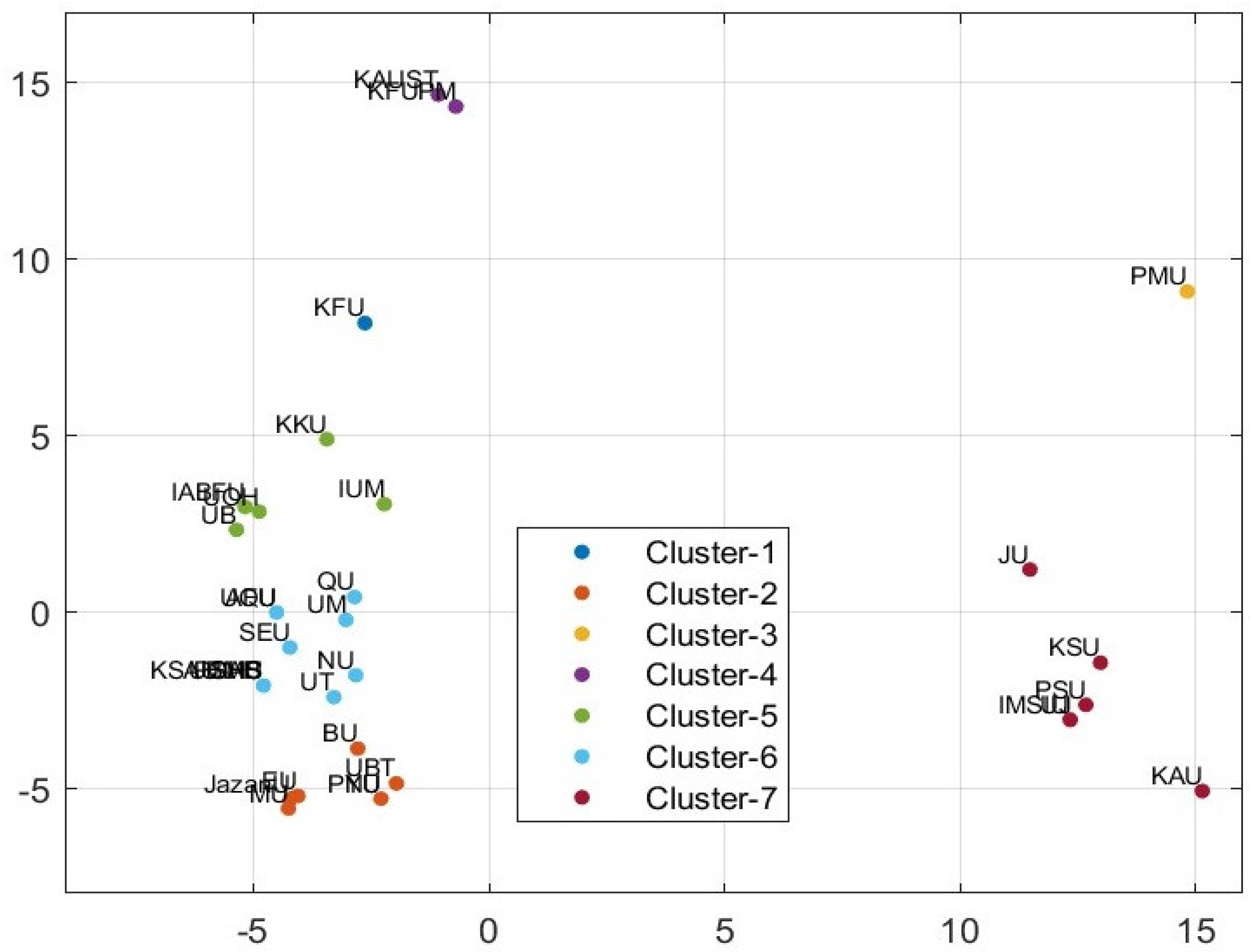
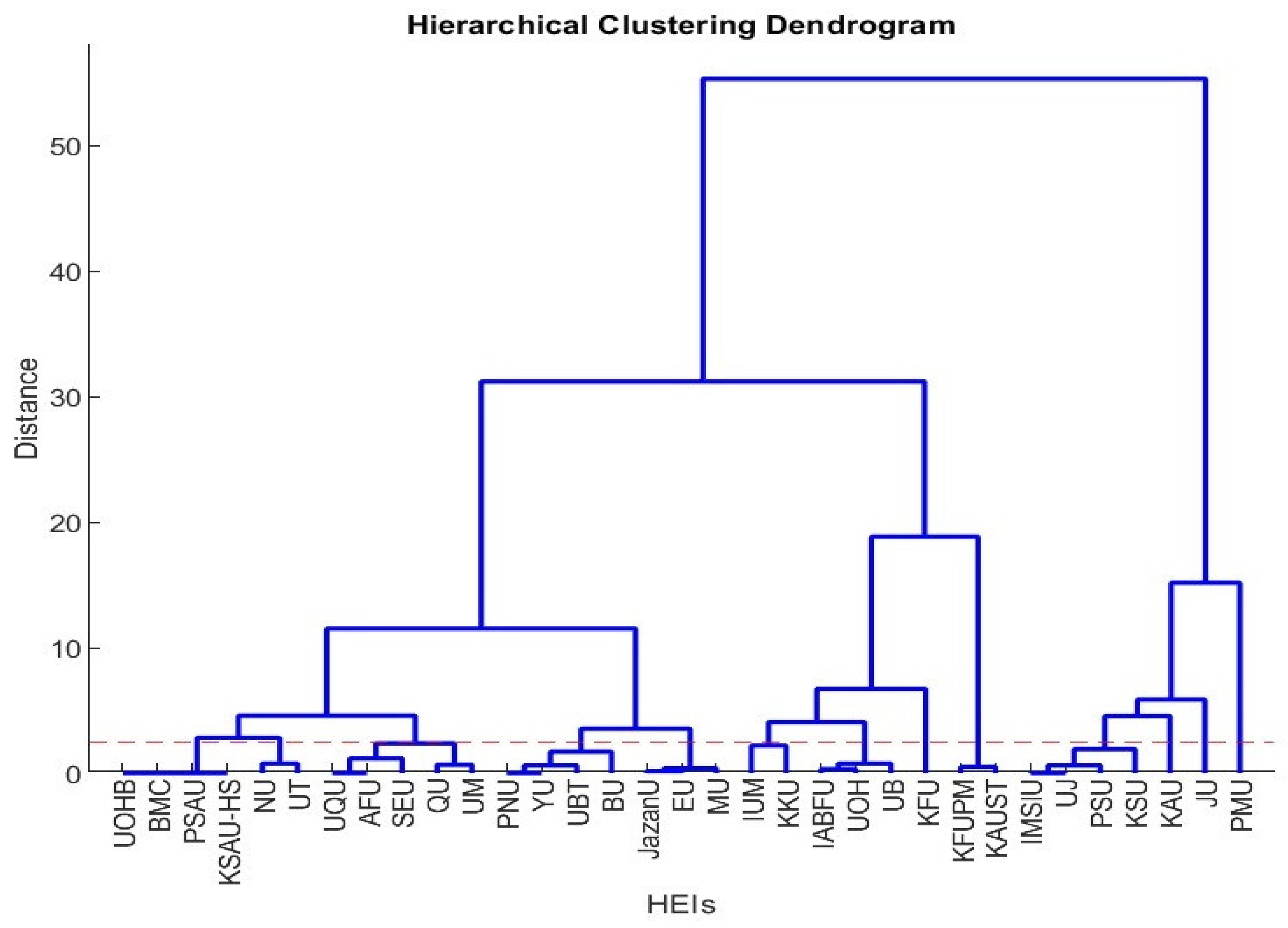
7. Cluster Identification of HEIs in Relation to UN-SDGs
7.1. Key Insights and Strengths
7.1.1. Fully Aligned Groups
- Group-1: PNU and YU covering SDGs 4, 5, 8, and 10.
- Group-2: KSAU-HS, PSAU, UOHB, and BMC, covering SDGs 3, 4, and 5.
- Group-3: UQU and AFU covering SDGs 3, 4, and 9.
- Group-4: IMSIU and UJ, covering SDGs 4, 5, 8, and 16.
7.1.2. Closely Aligned Groups
- Group-1: KFUPM and KAUST primarily focused on SDGs 3, 5, and 10.
- Group-2: EU and JazanU covering SDGs 3, 5, and 10.
- Group-3: NU and UT covering SDGs 3, 4, 5, and 8.
- Group-4: QU and UM covering SDGs 3, 4, and 8.
7.1.3. Diversified Groups
7.1.4. Focused Groups
- HEIs such as AFU and UQU excel in SDG 3, 4, and SDG 9.
- HEIs such as KSAU-HS, PSAU, UOHB, and BMC also show strong focus on SDGs 3, 4, and 5.
7.1.7. Consistently Performing HEIs
- AFU, consistently active for six years, covering SDGs 3, 4, and 9.
- UQU, consistently active for four years, covering SDGs 3, 4, and 9.
- PSU, consistently active for four years, covering SDGs 5, 8, and 16.
- UBT, consistently active for four years, covering SDGs 5, 8, and 10.
Proposed Grouping of HEIs for Enhanced and Advanced Coverage of UN-SDGs
8. Conclusions and Recommendations
8.1. Strengths
- Rising Participation in THE IR: There is a positive trend in KSA HEIs’ participation in THE Impact Rankings, with the goal of all 67 HEIs participating by 2030. Public sector institutions lead this trend, showing stronger engagement than private HEIs.
- Strong Performance in Top-Tier Rankings: Notable public sector HEIs like KAU, KFUPM, KFU, and PNU have achieved high ranks, with KAU securing the B1 band three times. These HEIs have demonstrated leadership in areas like Good Health and Well-being (SDG-3), Quality Education (SDG-4), Gender Equality (SDG-5).
- Focus on Key SDGs: Certain HEIs are positioned to lead in specific SDGs based on consistent performance, such as KFUPM and KFU in SDGs 6–8, and KAU and PNU in SDGs 4–5 and 10. PNU’s unique position allows it to inspire female-only campuses across KSA.
- Foundation for Sustainable Campuses: HEIs have shown interest in adopting green campus initiatives and contributing to sustainability, with an emphasis on SDGs essential for sustainability, such as SDG 4 (Quality Education), SDG 7 (Affordable and Clean Energy), and SDG 17 (Partnerships for the Goals).
8.2. Weaknesses
- Limited Top-Tier Participation Among Private HEIs: Only 6% of KSA HEIs have reached the top B1 ranking, and all of these are public sector HEIs, highlighting a lack of high-performing private HEIs.
- Lack of Focus on SDG-13 (Climate Action): None of the HEIs have yet prioritized SDG-13, reflecting a gap in addressing climate-related goals, which are critical for sustainable development.
- Gap in SDGs 1 and 10 Coverage: There is limited national and institutional information and engagement on SDG-1 (No Poverty) and SDG-10 (Reduced Inequalities), with only minimal coverage from a few top-ranked institutions like KFU and KAU.
- Inconsistent Prioritization of SDGs 9 and 16: Innovation (SDG-9) and institutional governance (SDG-16) show lower prioritization in HEI activities and EUA framework, reducing progress in these critical areas.
8.3. Opportunities
- Expanding Global Visibility and Collaboration: Increased participation in global rankings provides KSA HEIs with greater visibility, opening opportunities for international collaboration and partnerships.
- Leadership in Targeted SDGs: HEIs like KFUPM, KAU, and PNU can lead in specific SDGs by mobilizing other institutions and providing roadmaps for addressing SDGs 9 and 16, aligning with national frameworks and global goals.
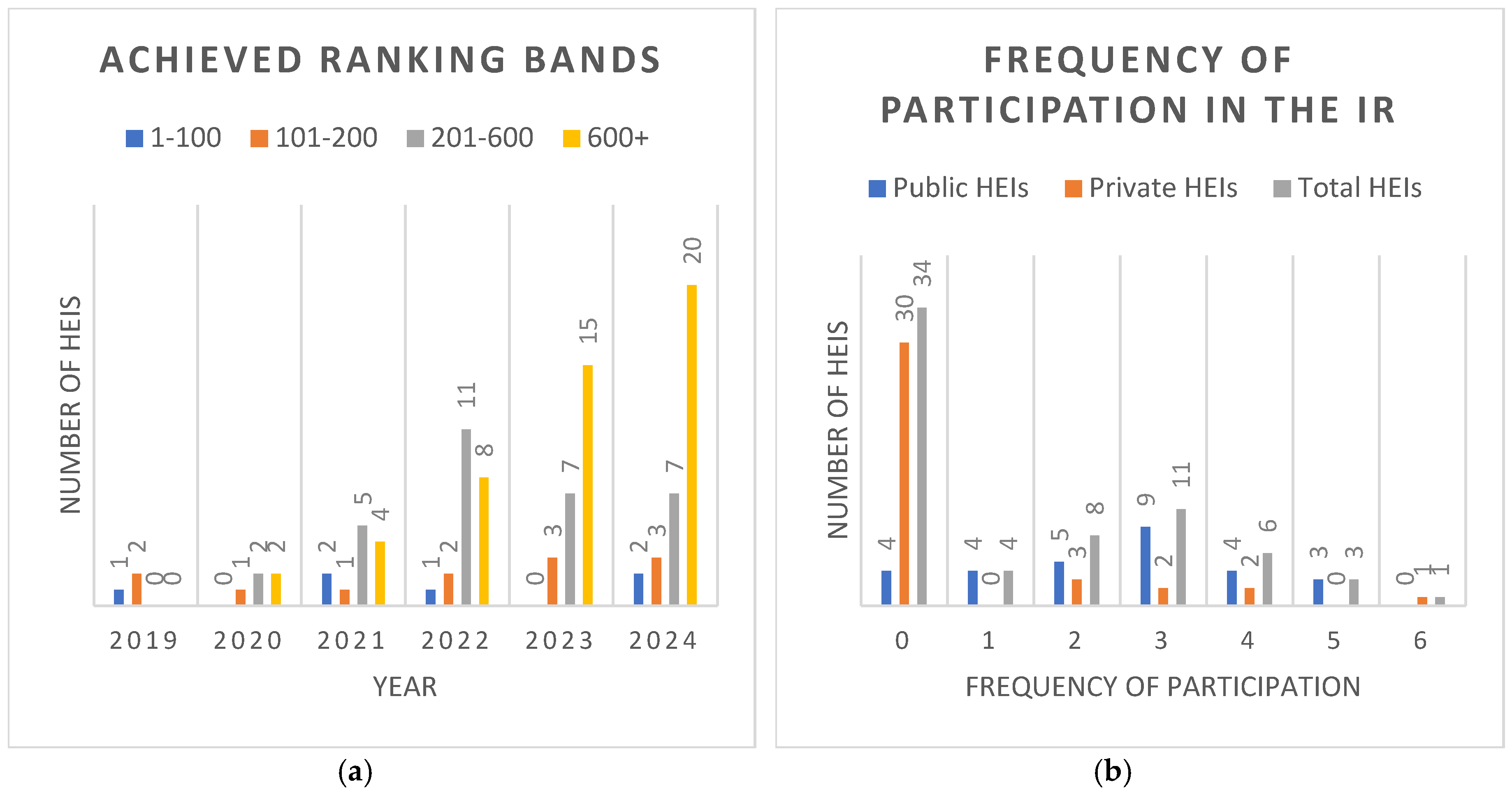
- Encouragement of non-participating HEIs: Engaging the 34 HEIs (4 public, 30 private) that are currently not participating in the rankings would amplify KSA’s overall progress on the UN SDGs.
- Potential for Green and Sustainable Campuses: HEIs can prioritize SDGs related to sustainability (SDGs 4, 7, 9, 11–13, 15, and 17) to develop sustainable campuses, engaging with global sustainability indexes like the Sustainable Campus Index (SCI) [43].
- Potential Candidates for Top-Tier Rankings: Four out of eight private sector HEIs (namely, AFU, PSU, PMU and BMC) being very consistent over the years are potential candidates to qualify for B1 rankings. Similarly, two public sector HEIs namely UQU and PSAU must plan for B1 band.
8.4. Threats
- Limited Participation from Private Sector HEIs: The low participation of private sector HEIs in high-impact rankings could create an imbalance in SDG contributions and impact Saudi Arabia’s overall SDG progress.
- Misalignment with Governmental Priorities: There is a noticeable gap in priority between HEIs and government entities, particularly for SDG-9 (Industry, Innovation, and Infrastructure), which could hinder collective SDG progress.
- Insufficient Data for SDGs 1 and 10: Lack of comprehensive data and participation related to SDGs 1 and 10 presents a threat to national and institutional efforts to reduce poverty and inequality.
- Resource Limitations for Long-Term Sustainability: The ongoing lack of resources and strategic emphasis on certain SDGs could prevent HEIs from achieving sustainable development, limiting their ability to meet both national and UN SDG targets by 2030.
Author Contributions
Funding
Institutional Review Board Statement
Informed Consent Statement
Data Availability Statement
Acknowledgments
Conflicts of Interest
Abbreviations
| HEIs | Higher Educational Institutions |
| UN-SDGs | United Nations Sustainable Development Goals |
| THE IR | Times Higher Education Impact Rankings |
| EUA | European Union Association |
| SDR | Sustainable Development Report |
| OECD | Organization for Economic Co-operation and Development |
| INES | Indicators of Education Systems |
Appendix A
Appendix A.1

| Achieved Bands | HEIs Name | UN SDGs Covered | ||||||
| 3 | 4 | 5 | 9 | 10 | 11 | 17 | ||
| 54th | KAU | ✔ | ✔ | ✔ | ✔ | |||
| 101-200 |
AFU | ✔ | ✔ | ✔ | ✔ | |||
| KSU | ✔ | ✔ | ✔ | ✔ | ||||
| Percentage Coverage by Participated HEIs | 67 | 33 | 68 | 67 | 33 | 33 | 100 | |
| Achieved Bands | HEIs Name | UN SDGs Covered | |||||||||
| 1 | 2 | 3 | 4 | 5 | 8 | 9 | 10 | 16 | 17 | ||
| 101-200 | KAU | ✔ | ✔ | ✔ | ✔ | ||||||
| 401-600 |
AFU | ✔ | ✔ | ✔ | ✔ | ||||||
| PNU | ✔ | ✔ | ✔ | ✔ | |||||||
| 601+ | KKU | ✔ | ✔ | ✔ | ✔ | ||||||
| QU | ✔ | ✔ | ✔ | ✔ | |||||||
| Percentage Coverage by Participated HEIs | 20 | 20 | 40 | 60 | 40 | 40 | 40 | 20 | 20 | 100 | |
| Achieved Bands | HEIs Name | UN SDGs Covered | ||||||||||||
| 1 | 3 | 4 | 5 | 6 | 7 | 8 | 9 | 10 | 12 | 14 | 16 | 17 | ||
| 27th | PNU | ✔ | ✔ | ✔ | ✔ | |||||||||
| 46th | KAU | ✔ | ✔ | ✔ | ✔ | |||||||||
| 101-200 | PMU | ✔ | ✔ | ✔ | ✔ | |||||||||
| 201-300 | UM | ✔ | ✔ | ✔ | ✔ | |||||||||
| 301-400 |
AFU | ✔ | ✔ | ✔ | ✔ | |||||||||
| KKU | ✔ | ✔ | ✔ | ✔ | ||||||||||
| UQU | ✔ | ✔ | ✔ | ✔ | ||||||||||
| 401-600 | PSU | ✔ | ✔ | ✔ | ✔ | |||||||||
| 601-800 |
IABFU | ✔ | ✔ | ✔ | ✔ | |||||||||
| KFU | ✔ | ✔ | ✔ | ✔ | ||||||||||
| 801-1000 | KFUPM | ✔ | ✔ | ✔ | ✔ | |||||||||
| QU | ✔ | ✔ | ✔ | ✔ | ||||||||||
| Percentage Coverage by Participated HEIs | 8 | 50 | 42 | 33 | 17 | 25 | 50 | 33 | 17 | 8 | 8 | 8 | 100 | |
| Achieved Bands | HEIs Name | UN SDGs Covered | ||||||||||||
| 1 | 3 | 4 | 5 | 6 | 7 | 8 | 9 | 10 | 12 | 14 | 16 | 17 | ||
| 4th | KAU | ✔ | ✔ | ✔ | ✔ | |||||||||
| 101-200 | PMU | ✔ | ✔ | ✔ | ✔ | |||||||||
| PNU | ✔ | ✔ | ✔ | ✔ | ||||||||||
| 201-300 |
IMSIU | ✔ | ✔ | ✔ | ✔ | |||||||||
| UM | ✔ | ✔ | ✔ | ✔ | ||||||||||
| KAUST | ✔ | ✔ | ✔ | ✔ | ||||||||||
| KFU | ✔ | ✔ | ✔ | ✔ | ||||||||||
| PSU | ✔ | ✔ | ✔ | ✔ | ||||||||||
| 301-400 |
KFUPM | ✔ | ✔ | ✔ | ✔ | |||||||||
| KKU | ✔ | ✔ | ✔ | ✔ | ||||||||||
| 401-600 |
IABFU | ✔ | ✔ | ✔ | ✔ | |||||||||
| JU | ✔ | ✔ | ✔ | ✔ | ||||||||||
| SEU | ✔ | ✔ | ✔ | ✔ | ||||||||||
| UQU | ✔ | ✔ | ✔ | ✔ | ||||||||||
| 601-800 |
AFU | ✔ | ✔ | ✔ | ✔ | |||||||||
| UOH | ✔ | ✔ | ✔ | ✔ | ||||||||||
| PSAU | ✔ | ✔ | ✔ | ✔ | ||||||||||
| 801-1000 |
BU | ✔ | ✔ | ✔ | ✔ | |||||||||
| QU | ✔ | ✔ | ✔ | ✔ | ||||||||||
| 1000+ |
UBT | ✔ | ✔ | ✔ | ✔ | |||||||||
| UJ | ✔ | ✔ | ✔ | ✔ | ||||||||||
| UT | ✔ | ✔ | ✔ | ✔ | ||||||||||
| Percentage Coverage by Participated HEIs | 9 | 36 | 50 | 50 | 18 | 23 | 46 | 23 | 18 | 9 | 14 | 9 | 100 | |
| Achieved Bands | HEIs Name | UN SDGs | ||||||||||||||
| 1 | 2 | 3 | 4 | 5 | 6 | 7 | 8 | 9 | 10 | 12 | 14 | 15 | 16 | 17 | ||
| 101-200 |
KAUST | ✔ | ✔ | ✔ | ✔ | |||||||||||
| KFU | ✔ | ✔ | ✔ | ✔ | ||||||||||||
| PMU | ✔ | ✔ | ✔ | ✔ | ||||||||||||
| 201-300 |
UM | ✔ | ✔ | ✔ | ✔ | |||||||||||
| IABFU | ✔ | ✔ | ✔ | ✔ | ||||||||||||
| IMSIU | ✔ | ✔ | ✔ | ✔ | ||||||||||||
| KFUPM | ✔ | ✔ | ✔ | ✔ | ||||||||||||
| 301-400 | PSU | ✔ | ✔ | ✔ | ✔ | |||||||||||
| 401-600 |
KKU | ✔ | ✔ | ✔ | ✔ | |||||||||||
| QU | ✔ | ✔ | ✔ | ✔ | ||||||||||||
| 601-800 |
AFU | ✔ | ✔ | ✔ | ✔ | |||||||||||
| BMC | ✔ | ✔ | ✔ | ✔ | ||||||||||||
| PSAU | ✔ | ✔ | ✔ | ✔ | ||||||||||||
| SEU | ✔ | ✔ | ✔ | ✔ | ||||||||||||
| 801-1000 |
BU | ✔ | ✔ | ✔ | ✔ | |||||||||||
| UB | ✔ | ✔ | ✔ | ✔ | ||||||||||||
| UOH | ✔ | ✔ | ✔ | ✔ | ||||||||||||
| UJ | ✔ | ✔ | ✔ | ✔ | ||||||||||||
| UQU | ✔ | ✔ | ✔ | ✔ | ||||||||||||
| 1001+ |
YU | ✔ | ✔ | ✔ | ✔ | |||||||||||
| UBT | ✔ | ✔ | ✔ | ✔ | ||||||||||||
| EU | ✔ | ✔ | ✔ | ✔ | ||||||||||||
| IUM | ✔ | ✔ | ✔ | ✔ | ||||||||||||
| NU | ✔ | ✔ | ✔ | ✔ | ||||||||||||
| UT | ✔ | ✔ | ✔ | ✔ | ||||||||||||
| Percentage Coverage by Participated HEIs | 16 | 4 | 48 | 56 | 36 | 12 | 16 | 48 | 12 | 20 | 8 | 12 | 4 | 8 | 100 | |
| Achieved Bands | HEIs Name | UN SDGs | |||||||||||||||
| 1 | 2 | 3 | 4 | 5 | 6 | 7 | 8 | 9 | 10 | 11 | 12 | 14 | 15 | 16 | 17 | ||
| 81 | KFUPM | ✔ | ✔ | ✔ | ✔ | ||||||||||||
| 99 | KFU | ✔ | ✔ | ✔ | ✔ | ||||||||||||
| 101-200 |
KAUST | ✔ | ✔ | ✔ | ✔ | ||||||||||||
| PMU | ✔ | ✔ | ✔ | ✔ | |||||||||||||
| IABFU | ✔ | ✔ | ✔ | ✔ | |||||||||||||
| 201-300 | KAU | ✔ | ✔ | ✔ | ✔ | ||||||||||||
| 301-400 |
QU | ✔ | ✔ | ✔ | ✔ | ||||||||||||
| IMSIU | ✔ | ✔ | ✔ | ✔ | |||||||||||||
| UM | ✔ | ✔ | ✔ | ✔ | |||||||||||||
| PSU | ✔ | ✔ | ✔ | ✔ | |||||||||||||
| 401-600 |
KKU | ✔ | ✔ | ✔ | ✔ | ||||||||||||
| AFU | ✔ | ✔ | ✔ | ✔ | |||||||||||||
| 601-800 |
UT | ✔ | ✔ | ✔ | ✔ | ||||||||||||
| BMC | ✔ | ✔ | ✔ | ✔ | |||||||||||||
| PSAU | ✔ | ✔ | ✔ | ✔ | |||||||||||||
| JU | ✔ | ✔ | ✔ | ✔ | |||||||||||||
| SEU | ✔ | ✔ | ✔ | ✔ | |||||||||||||
| 801-1000 |
KSAU-HS | ✔ | ✔ | ✔ | ✔ | ||||||||||||
| KSU | ✔ | ✔ | ✔ | ✔ | |||||||||||||
| MU | ✔ | ✔ | ✔ | ✔ | |||||||||||||
| UJ | ✔ | ✔ | ✔ | ✔ | |||||||||||||
| UQU | ✔ | ✔ | ✔ | ✔ | |||||||||||||
| 1001-1500 |
YU | ✔ | ✔ | ✔ | ✔ | ||||||||||||
| JazanU | ✔ | ✔ | ✔ | ✔ | |||||||||||||
| EU | ✔ | ✔ | ✔ | ✔ | |||||||||||||
| UB | ✔ | ✔ | ✔ | ✔ | |||||||||||||
| BU | ✔ | ✔ | ✔ | ✔ | |||||||||||||
| UOH | ✔ | ✔ | ✔ | ✔ | |||||||||||||
| UBT | ✔ | ✔ | ✔ | ✔ | |||||||||||||
| 1501+ |
IUM | ✔ | ✔ | ✔ | ✔ | ||||||||||||
| NU | ✔ | ✔ | ✔ | ✔ | |||||||||||||
| UOHB | ✔ | ✔ | ✔ | ✔ | |||||||||||||
| Percentage coverage by Participated HEIs | 6 | 3 | 44 | 59 | 38 | 16 | 13 | 44 | 13 | 25 | 6 | 9 | 3 | 3 | 19 | 100 | |
References
- Jenkins, Sulaiman. “Higher Education in Saudi Arabia: A Vehicle for Global Promotion and Advancement.” The Past, Present, and Future of Higher Education in the Arabian Gulf Region. Routledge, 2022. 143-158.
- Ryan, Marie. “Higher Education in Saudi Arabia: Challenges, Opportunities, and Future Directions.” Research in Higher Education Journal 43 (2023).
- Al-Ohali, M., and J. C. Shin. “Higher Education in Saudi Arabia; Achievements, Challenges and Opportunities.” Higher Education Dynamics. Knowledge-Based Innovation and Research Productivity in Saudi Arabia 40 (2013): 95-102.
- Alghamdi, Naif. “Larry Smith and Abdulrahman Aboummoh (eds): Higher education in Saudi Arabia: Achievements, challenges and opportunities: Springer, New York, 2013, 208 pp.” (2015): 1019-1021.
- Mohiuddin, Khalid, et al. “Potentialities and priorities for higher educational development in Saudi Arabia for the next decade: Critical reflections of the vision 2030 framework.” Heliyon 9.5 (2023). [CrossRef]
- “Saudi Vision 2030,” Kingdom of Saudi Arabia, https://www.vision2030.gov.sa/.
- Nurunnabi, Mohammad. “Transformation from an oil-based economy to a knowledge-based economy in Saudi Arabia: the direction of Saudi vision 2030.” Journal of the Knowledge Economy 8 (2017): 536-564. [CrossRef]
- www.moe.gov.sa.
- 2020; OECD (2020), Education in Saudi Arabia, Reviews of National Policies for Education, OECD Publishing, Paris. [CrossRef]
- https://gpseducation.oecd.org.
- UN, Transforming Our World: The 2030 Agenda for Sustainable Development, UN, New York, 2015.
- The SDGs in Action,” United Nations Development Programme, https://www.undp.org/sustainabledevelopment-goals.
- Nhamo, Godwell, and Vuyo Mjimba. “The context: SDGs and institutions of higher education.” Sustainable development goals and institutions of higher education (2020): 1-13.
- Chankseliani, Maia, and Tristan McCowan. “Higher education and the sustainable development goals.” Higher Education 81.1 (2021): 1-8. [CrossRef]
- Vázquez-Verdera, Victoria, et al. “The future we want: A learning experience to promote SDGs in higher education from the United Nations and University of Valencia.” Sustainability 13.15 (2021): 8550. [CrossRef]
- Leal Filho, Walter, Amanda Lange Salvia, and João Henrique Paulino Pires Eustachio. “An overview of the engagement of higher education institutions in the implementation of the UN Sustainable Development Goals.” Journal of Cleaner Production 386 (2023): 135694.
- https://english.alarabiya.net/News/gulf/2021/04/28/Transcript-Saudi-Crown-Prince-Mohammed-bin-Salman-s-full-interview-on-Vision-2030-.
- Jeffrey Sachs et al., Sustainable Development Report 2022 | From Crisis to Sustainable Development: the SDGs as Roadmap to 2030 and beyond. Cambridge: Cambridge University Press, 21 September 2022, https://dashboards.sdgindex.org/profiles/saudi-arabia.
- “Towards Saudi Arabia’s Sustainable Tomorrow: First Voluntary National Review,” United Nations Development Programme, 14 August 2018, https://www.undp.org/saudiarabia/publications/voluntary-national-review-vnr-saudi-arabia.
- 12 June 2022; “United Nations Sustainable Development Cooperation Framework with the Kingdom of Saudi Arabia 2022–2026,” United Nations Resident Coordinator Office in the KSA, 12 June 2022.
- The Role of Saudi Universities in Advancing the SDGs and Saudi Vision 2030, Reema Alanazi, 2022.
- Times Higher Education. (2024). World University Rankings 2024. Retrieved from Times Higher Education website.
- QS World University Rankings 2024. https://www.topuniversities.com/university-rankings/world-university-rankings/2024.
- ShanghaiRanking Consultancy. 2024. “Academic Ranking of World Universities 2024.” ShanghaiRanking. Accessed October 23, 2024. https://www.shanghairanking.com/rankings/arwu/2024.
- Abubakar, Ismaila Rimi. “Sustainable university accreditation and certification.” Encyclopedia of Sustainability in Higher Education. Cham: Springer International Publishing, 2019. 1853-1862.
- Aina, Yusuf A., Ismaila Rimi Abubakar, and Habib M. Alshuwaikhat. “Global Campus Sustainability Ranking.” Encyclopedia of Sustainability in Higher Education (2019): 743-752.
- Abubakar, Ismaila Rimi, Yusuf A. Aina, and Habib M. Alshuwaikhat. “Sustainable development at Saudi Arabian universities: An overview of institutional frameworks.” Sustainability 12.19 (2020): 8008. [CrossRef]
- STARS Report 2024. https://stars.aashe.org/institutions/participants-and-reports/.
- UI GreenMetric. 2024. “UI GreenMetric World University Rankings 2024.” https://greenmetric.ui.ac.id/rankings/2024.
- LIFE. 2024. “LIFE Ranking 2024.” LIFE. https://www.life-ranking.org/rankings/2024.
- Higher Education Sustainability Initiative. 2024. “HESI Report 2024.” HESI. Accessed October 23, 2024. https://sustainabledevelopment.un.org/sdinaction/hesi.
- SET4HEI. 2024. “Sustainability Evaluation Tool for Higher Education Institutions 2024.” SET4HEI. Accessed October 23, 2024. https://set4hei.org/.
- Machado, Carolina Feliciana, and J. Paulo Davim. “Sustainability in the Modernization of Higher Education: Curricular Transformation and Sustainable Campus—A Literature Review.” Sustainability 15.11 (2023): 8615. [CrossRef]
- Uzorka, Afam, Oluwole Akiyode, and Sulaiman Muhammad Isa. “Strategies for engaging students in sustainability initiatives and fostering a sense of ownership and responsibility towards sustainable development.” Discover Sustainability 5.1 (2024): 320. [CrossRef]
- H.M.; Abubakar, I. An integrated approach to achieving campus sustainability: Assessment of the current campus environmental management practices. J. Clean. Prod. 2008, 16, 1777–1785.
- Finlay, J.; Massey, J. Eco-campus: Applying the ecocity model to developed green university and colleges campuses. Int. J. Sustain. High. Educ. 2012, 13, 150–165. [CrossRef]
- Posner, S.M.; Stuart, R. Understanding and advancing campus sustainability using a systems framework. Int. J. Sustain. High. Educ. 2013, 14, 264–277. [CrossRef]
- White, S.S. Campus sustainability plans in the United States: Where, what, and how to evaluate? Int. J. Sustain. High. Educ. 2014, 15, 228–241. [CrossRef]
- Too, L.; Bajracharya, B. Sustainable campus: Engaging the community in sustainability. Int. J. Sustain. High. Educ. 2015, 16, 57–71. [CrossRef]
- Razman, R.; Abdullah, A.H.; Wahid, A.Z. Sustainable development in higher education institutions (HEIS): Towards sustainable campus operations (SCO). J. Eng. Appl. Sci. 2016, 11, 11823–11826.
- Lee, John Chi-Kin, and Colin Power. “Building a green and sustainable university: An international review.” Making the Sustainable University: Trials and Tribulations (2021): 269-286.
- Dawodu, Ayotunde, et al. “Campus sustainability research: Indicators and dimensions to consider for the design and assessment of a sustainable campus.” Heliyon 8.12 (2022). [CrossRef]
- Basheer, N.; Ahmed, V.; Bahroun, Z.; Anane, C. Exploring Sustainability Assessment Practices in Higher Education: A Comprehensive Review through Content and Bibliometric Analyses. Sustainability 2024, 16, 5799. [CrossRef]
- https://www.aashe.org/wp-content/uploads/2024/09/SCI-2024-Final.pdf.
- European University Association. 2024. “European University Association Framework for the Sustainable Development Goals.” EUA. Accessed October 23, 2024. https://eua.eu/.
- https://dashboards.sdgindex.org/.
- https://dashboards.sdgindex.org/static/profiles/pdfs/SDR-2024-saudi-arabia.pdf.
- https://www.cst.gov.sa/ar/mediacenter/Documents/sustainability_report_2024_en.pdf.
- Salvo, D. and all. (2021). Physical Activity Promotion and the United Nations Sustainable Development Goals: Building Synergies to Maximize Impact. Journal of Physical Activity and Health, 18(10), 1163-1180. [CrossRef]

| Assessment Platform |
Overview | Purpose | Regulatory Authority |
|---|---|---|---|
|
[28] STAR, 2006 Sustainability Tracking, Assessment and Rating System |
A transparent, self-reporting framework for HEIs to measure their sustainability performance | To provide a self-reporting tool for assessing sustainability | Association for the Advancement of Sustainability in Higher Education (AASHE) |
|
[29] UIGWUR, 2010 UI GreenMetric World University Ranking |
Evaluates HEIs based on sustainability efforts | To rank universities globally by sustainability practices | University of Indonesia |
|
[30] LiFE, 2011 Learning in Future Environments |
Supports managing and improving sustainability in HEIs | To promote continuous improvement and social responsibility | Environmental Association for Universities and Colleges (EAUC), UK |
|
[31] HESI, 2012 Higher Education Sustainability Initiative |
Enhances HEIs role in advancing sustainable development globally | To promote sustainable development commitments by universities | Partnership between various UN bodies (launched at Rio+20) |
|
[22] THE IR, 2019 Times Higher Education Impact Rankings |
Assesses HEIs on teaching, research, stewardship and outreach aligned with SDGs | To measure university societal impact through SDG metrics | Times Higher Education (THE) |
|
[32] SET4HEI, 2024 Sustainability Evaluation Tool for Higher Education Institutions |
An online resource for HEIs to map their contributions to SDGs | To help HEIs measure and improve their SDG impact | UNESCO IESALC in partnership with UNAI and other UN agencies |
| Sr. # | Public Sector HEI Name | Short Name | Frequency of Participation in THE IR | Established Year | Highest Achieved Ranking Band/Year |
|---|---|---|---|---|---|
| 1 | Umm Al-Qura University | UQU | 4 | 1950 | B3/2021 |
| 2 | Imam Muhammad bin Saud Islamic University | IMSIU | 3 | 1953 | B3/2022-23 |
| 3 | King Saud University | KSU | 2 | 1957 | B2/2019 |
| 4 | Islamic University of Medina | IUM | 2 | 1961 | B4/2023-24 |
| 5 | King Fahd University for Petroleum and Minerals | KFUPM | 4 | 1963 | B1/2024 |
| 6 | King Abdulaziz University | KAU | 5 | 1967 | B1/2019-20,2022 |
| 7 | Princess Nora bint Abdul Rahman University | PNU | 3 | 1970 | B1/20212 |
| 8 | Imam Abdulrahman Bin Faisal University | IABFU | 4 | 1975 | B2/2024 |
| 9 | King Faisal University | KFU | 4 | 1975 | B1/2024 |
| 10 | King Khalid University | KKU | 5 | 1998 | B3/2022 |
| 11 | Taibah University | TaibahU | 0 | 2003 | Not participated yet |
| 12 | Taif University | TU | 0 | 2004 | Not participated yet |
| 13 | Qassim University | QU | 5 | 2004 | B3/2024 |
| 14 | King Saud bin Abdulaziz University for Health Sciences | KSAU-HS | 1 | 2005 | B4/2024 |
| 15 | Al Jouf University | JU | 2 | 2005 | B3/2022 |
| 16 | Jazan University | JazanU | 1 | 2005 | B4/2024 |
| 17 | University of Hail | UOH | 3 | 2006 | B4/2024 |
| 18 | Al Baha University | BU | 3 | 2006 | B4/2024 |
| 19 | Najran University | NU | 2 | 2006 | B4/2023 |
| 20 | University of Tabuk | UT | 3 | 2006 | B4/2024 |
| 21 | Northern Borders University | NBU | 0 | 2007 | Not participated yet |
| 22 | Prince Sattam Bin Abdulaziz University | PSAU | 3 | 2008 | B4/2022 |
| 23 | King Abdullah University of Science and Technology | KAUST | 3 | 2009 | B2/2022-23 |
| 24 | Majmaah University | MU | 1 | 2010 | B4/2024 |
| 25 | Shaqra University | SU | 0 | 2010 | Not participated yet |
| 26 | Saudi Electronic University | SEU | 3 | 2011 | B3/2022 |
| 27 | University of Bisha | UB | 2 | 2014 | B4/2023 |
| 28 | University of Hafr Albatin | UOHB | 1 | 2014 | B4/2024 |
| 29 | University of Jeddah | UJ | 3 | 2014 | B4/2023 |
| Sr. # | Private Sector HEI Name | Short Name | Participation Frequency | Founding Year | Highest Achieved Ranking Band/Year |
|---|---|---|---|---|---|
| 1 | Prince Sultan University | PSU | 4 | 1998 | B3/2022 |
| 2 | Effat University | EU | 2 | 1999 | B4/2024 |
| 3 | University of Business and Technology | UBT | 3 | 2000 | B4/2022 |
| 4 | Al Yamamah University | YU | 2 | 2001 | B4/2023 |
| 5 | Alfaisal University | AFU | 6 | 2002 | B2/2019 |
| 6 | Batterjee Medical College | BMC | 2 | 2005 | B4/2023 |
| 7 | Prince Mohammad Bin Fahd University | PMU | 3 | 2006 | B2/2023-24 |
| 8 | AlMaarefa University | UM | 4 | 2009 | B3/2022-23 |
| 2019 | 2020 | 2021 | 2022 | 2023 | 2024 | |
|---|---|---|---|---|---|---|
| KAU | B1, 54th | B2 | B1, 46th | B1, 4th | --- | B3 |
| PNU | --- | B3 | B1, 27th | B2 | --- | --- |
| KFUPM | --- | --- | B4 | B3 | B3 | B1, 81st |
| KFU | --- | --- | B4 | B3 | B2 | B1, 99th |
| HEIs Name | UN SDGs Covered | |||||||||||||
| 1 | 2 | 4 | 5 | 6 | 7 | 8 | 9 | 10 | 11 | 12 | 14 | 16 | 17 | |
| KAU | ✔ | ✔ | ✔ | ✔ | ✔ | ✔ | ✔ | ✔ | ||||||
| PNU | ✔ | ✔ | ✔ | ✔ | ✔ | |||||||||
| KFUPM | ✔ | ✔ | ✔ | ✔ | ✔ | ✔ | ||||||||
| KFU | ✔ | ✔ | ✔ | ✔ | ✔ | ✔ | ✔ | ✔ | ✔ | |||||
| Percentage Coverage by participated HEIs |
25 | 25 | 75 | 50 | 50 | 50 | 100 | 50 | 50 | 50 | 25 | 25 | 25 | 100 |
| Cluster | No. of HEIs | Names of HEIs |
|---|---|---|
| 1 | 1 | KFU |
| 2 | 7 | PNU, JazanU, BU, MU, EU, UBT, YU |
| 3 | 1 | PMU |
| 4 | 2 | KFUPM, KAUST |
| 5 | 5 | IUM, IABFU, KKU, UOH, UB |
| 6 | 11 | UQU, QU, KSAU-HS, NU, UT, PSAU, SEU, UOHB, AFU, BMC, UM |
| 7 | 6 | IMSIU, KSU, KAU, JU, UJ, PSU |
| SDG | Lead HEIs | Role | Potential Group Members | Action |
|---|---|---|---|---|
| 1 | KFU, UM | Pioneering | UOH, KKU, IMSIU, QU, NU | A pioneering role is demanded from both KFU and UM nationwide, even though there is no data to measure progress (SDR-2024, KSA [47]) |
| 2 | KFU | Seek more Collaborators, Strengthen and Lead | KKU | Opportunity for all HEIs, with a specific invitation to private sector HEIs, as they have not yet addressed this SDG |
| 3 | AFU, IABFU | Strengthen and Lead | UQU, PSAU, BMC, BU, UB, KSAU-HS, UOHB, JazanU | There is a clear opportunity for a strong Public-Private HEIs Partnership, as these SDGs are extensively targeted by both public and private sector HEIs. HEIs should leverage this strength to qualify for the Top-Tier ranking band B1. SDG-5 demands a pioneering role from PNU, taking the forefront, initiating actions, and making a significant impact |
| 4 | QU, AFU | Strengthen and Lead | UQU, UT, SEU, IUM, BMC, PSAU, KSAU-HS, NU, UB | |
| 5 | PNU, PSU | Pioneering | EU, UBT, UJ, JazanU, MU, KSAU-HS, PSAU, UOHB | |
| 6 | KAUST, PMU | Pioneering | KFU, KKU, KFUPM, QU | KAUST must play pioneering role utilizing potential strong group members |
| 7 | KFU, KKU | Benchmarked | KFUPM, KAUST, IABFU, JU, UOH, UB | Opportunity for Impactable Partnerships. All Four B1 HEIs are listed. |
| 8 | PNU, UM | Benchmarked | KAU, IUM, PSU, UJ, UBT, BU, PMU, YU | |
| 9 | KAU, AFU | Benchmarked | KSU, KFUPM, UQU, UOH | |
| 10 | KAU, UBT | Benchmarked | PNU, BU, MU, SEU, EU, YU, PMU, JazanU | A strong group must address the data availability gap under the leadership of KAU through proper planning and initiatives. (SDR-2024, KSA [47]) |
| 11 | KAU | Strengthen and Lead | KSU, KAUST | Become sustainable campuses. Target SCI [43]. Demands more HEIs on board. Opportunity for all HEIs |
| 12 | KFU, PMU | Strengthen and Lead | IUM, SEU | |
| 13 | NOT COVERED YET | Invitation and Opportunity for all HEIs | ||
| 14 | KFUPM, PMU | Seek more Collaborators, Strengthen and Lead | KAUST | Joint Research Ventures with NEOM (Red Sea). Demands more HEIs on board |
| 15 | UT | Seek more Collaborators, Strengthen and Lead | None | Opportunity for all HEIs |
| 16 | KAU, PSU | Strengthen and Lead | IMISU, KSU, JU, UJ, PMU | There is a clear opportunity for a strong Public-Private HEIs Partnership. |
| 17 | Mandatory SDG covered by all HEIs | |||
Disclaimer/Publisher’s Note: The statements, opinions and data contained in all publications are solely those of the individual author(s) and contributor(s) and not of MDPI and/or the editor(s). MDPI and/or the editor(s) disclaim responsibility for any injury to people or property resulting from any ideas, methods, instructions or products referred to in the content. |
© 2025 by the authors. Licensee MDPI, Basel, Switzerland. This article is an open access article distributed under the terms and conditions of the Creative Commons Attribution (CC BY) license (http://creativecommons.org/licenses/by/4.0/).


