

Submitted:
03 December 2025
Posted:
03 December 2025
You are already at the latest version
Abstract
The ever-increasing use of diverse types of engineered nanoparticles (ENPs) in industries, medicine, and consumer products has resulted in their uncontrolled release into aquatic environments and soil-plant systems. ENPs may transform and release toxic by-products upon release, raising concerns about their environmental behavior and potential risks. However, accurately measuring the concentrations of ENP in these ecosystems remains challenging. Recent studies have highlighted the toxic effects of ENPs on various organisms, but assessing the risk in aquatic and soil-plant systems consists of a critical issue in nanoecotoxicology. ENPs interact with various environmental materials like organic matter, soil, sludge, and other pollutants. These interactions of ENPs can form complex assemblies, which may alter the toxicity and environmental fate. This study examines the interactions of ENPs in aquatic and soil-plant environments, focusing on their transformation, toxicity, and ecological impact. Identification of the knowledge gaps related to the ENP interaction and outlining the directions for future consideration for a better understanding of the environmental risks have been explained in this study. Additionally, the research addresses the challenges of evaluating nanotoxicity and highlights the need for improved environmental regulations and assessment techniques for engineered nanomaterials.
Keywords:
nanoparticle toxicity
; engineered nanoparticles
; aquatic environment
; soil-plant system
; risk of nanoparticles
1. Introduction
Engineered nanoparticles (ENPs) are deliberately manufactured materials characterized by particle sizes ranging from 1 to 100 nanometers in at least one dimension [1]. These particles can exist in various structural forms, including spherical shapes, nanowires, nanotubes, and nanorods [2]. ENPs can be categorized into several types as shown in Table 1 [3,4,5]. ENPs exhibit distinct physicochemical properties, such as a high surface area and enhanced optical, magnetic, and electrical behaviors, setting them apart from their bulk material equivalents. Due to these advantages, the past decade has seen a significant rise in their application across diverse industries, including cosmetics, textiles, coatings, and antibacterial products. The impact of ENPs on human life is growing and profound. This is partly due to the wide availability of ENP-containing products—over 1,800 globally [6]. Within the next 10–15 years, it is expected that the industrial production of nanotechnology will be worth over $1 trillion [7]. Another projection indicates that the global population will surpass 9 billion by 2050, creating substantial concerns regarding food security [8]. Nanotechnology can play a significant role in promising solutions to enhance agricultural productivity and ensure food security, safety, and sustainability [9]. For example, ENPs are being used to improve the efficiency of fertilizers, pesticides, herbicides, and plant growth regulators through mechanisms like controlled release [10]. Beyond agriculture, ENPs are integral in modern medicine, electronics, and environmental science, offering solutions that improve production efficiency and sustainability [11,12]. The precise control of size, shape, and synthesis conditions of these nanoparticles has revolutionized traditional sectors, fostering innovation and functionality [13].
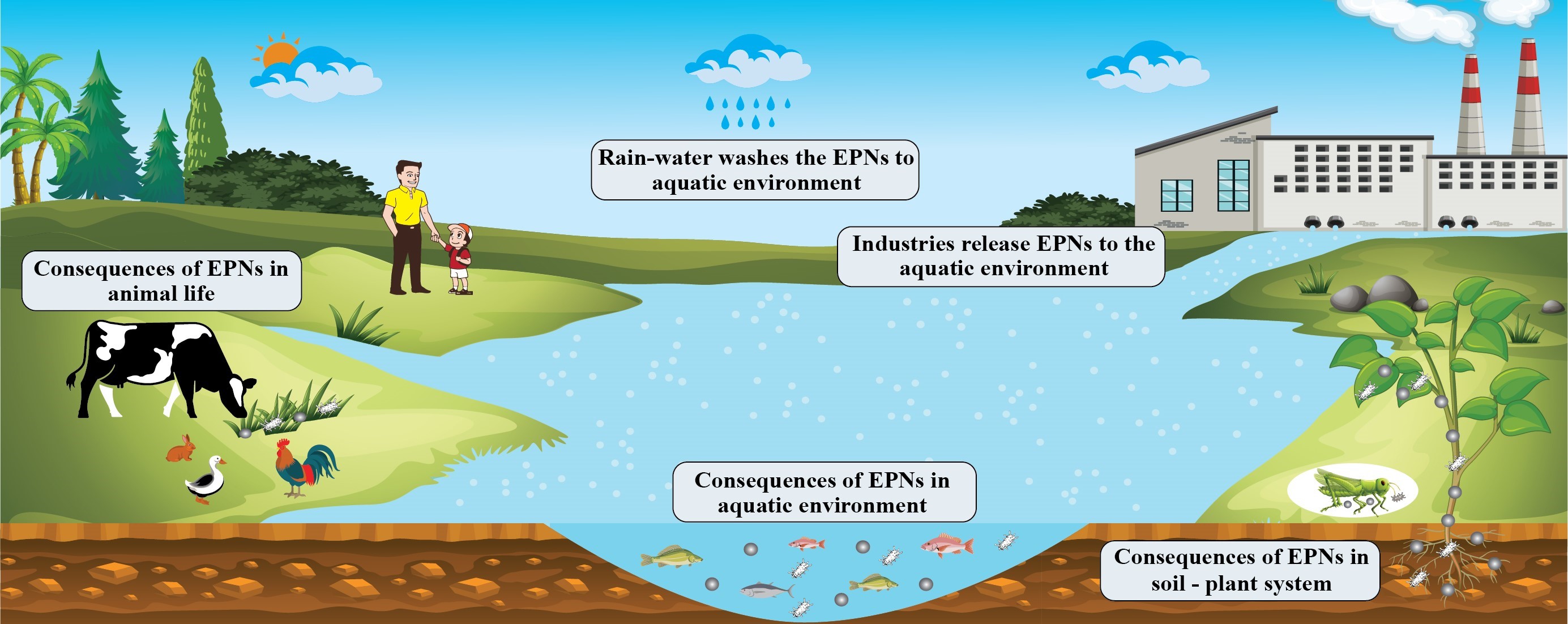
The rapid development of nanotechnologies in various industries lead to their release. The ever-expanding use of ENPs causes an intentional or unintentional release into the natural environment. The released ENPs can be found in aquatic environments and soil-plant systems [14,15]. This causes a potential threat to the aquatic environment and soil-plant systems, as well as humans [16] and other organisms [17]. However, ENPs show unique toxicity characteristics in the aquatic environment and soil-plant system compared with conventional inorganic and organic contaminants, including their colloidal and soluble forms [18,19]. Thus, it is an incredibly challenging task to regulate the release of ENP into the aquatic and soil-plant environments [20,21]. Moreover, there is a lack of established and documented standards to regulate the discharge of ENPs. Thus, it is critical to develop innovative approaches for standardizing the characterization and toxicity analysis of ENPs across the aquatic environment and soil-plant system.
ENPs interact with natural organic matter in the environment. These interactions influence their transformation rates, toxicity, and bioavailability in different environmental settings. Additionally, factors such as water chemistry, the movement of water, and physical and electrical characteristics play a significant role. ENPs undergo various transformations in the environment such as physical, chemical, and biological transformations that modify the behavior, fate, and toxicity of these materials [22]. Understanding these transformation processes is significant in controlling and characterizing the fate and toxicity of ENPs in aquatic and soil-plant systems. Among the numerous transformation processes, the leading reactions are redox reactions, dissolution/sedimentation, adsorption, photochemical and biologically mediated reactions, agglomeration/deagglomeration, etc. Recent environmental health and safety (EHS) research predominantly focuses on the fate, transport, and toxic effects of pristine or “as-manufactured” nanoparticles [23]. However, this does not explain the harmful effects of ENPs under various environmental exposure conditions. Therefore, it is necessary to fully understand the transformation-related toxic properties of ENPs in numerous environmental conditions. Assessing the potential toxicological effects of ENPs requires an understanding of these effects from acute and chronic exposures. Moreover, having a high surface area-to-volume ratio and reactivity makes them highly dynamic in the aquatic environment and soil-plant system. Recent research has found that if ENPs are present in high enough concentrations, they have the potential to harm aquatic organisms [24,25,26,27,28]. The environmental effects of ENPs have prompted research to estimate their concentrations in various ecosystems such as air, water, and soil-plant systems. These studies also aim to identify the threshold levels at which ENPs cause harmful ecological effects.
ENPs can enter aquatic systems and soil-plant environments in diverse ways. They may be released directly through fertilizers or plant protection products, or indirectly through land applications of sludge, biosolids, or industrial wastewater discharges. When ENPs dissolve in the environment, they emit toxic components. Furthermore, their tendency to aggregate with other nanoparticles or with naturally occurring mineral and organic colloids can greatly influence their environmental behavior and potential toxicity. Consequently, assessing the risks to aquatic systems and soil-plant ecosystems presents a critical challenge in nanoecotoxicology. Furthermore, reliably measuring ENPs at environmental concentrations remains difficult. The growing use of ENPs across various applications is expected to lead to increased environmental concentration in future. Gerner et al. [29] classified the risk of hazard into five categories, which were determined by comparing the maximum predicted environmental concentrations with the toxicity to the most sensitive species. The categories include instances where toxicity was observed: (i) at the maximum predicted environmental concentrations; (ii) at 100 times these concentrations; (ii) at any concentration up to 10 mg L-1; (iv) at concentrations greater than 10 mg L-1; and (v) no toxicity was observed across all tested concentrations. Study indicates that the estimated environmental concentrations of ENPs are significantly lower than the levels known to cause adverse effects on living organisms [30]. However, generating additional toxicity data under conditions that closely mimic real environmental scenarios is essential for conducting reliable risk assessments of nanomaterials and ensuring their safe use in the environment. Figure 1 presents the results of 61 ecotoxicity studies on ENPs in freshwater and seawater, based on predicted release concentrations, to estimate the level of risk [31]. The projected release concentrations for ENPs range from a lower level of 1×10⁻⁶ mg L-1 to a higher level of 1×10⁻³ mg L-1.
The soil and water act as natural sinks for the ENPs. The ENPs have the potential to build up in the sediments and biosolid-amended agricultural soils and thus enter the food chain through accumulation in plants [32]. The safe use of ENPs in the production of food crops largely depends on understanding the transformation of ENPs in both the soil and plants [33]. Soil pH, organic content, and redox conditions are key factors that influence the transformation of ENPs by affecting their surface charge, dissolution, and aggregation. The safe use of ENPs can be ensured through comprehensive risk assessment, which evaluates their exposure and toxicity, and by implementing strict regulatory frameworks that mandate reporting and testing. When ENPs are introduced to soil, the transformation that occurs dominates their behavior and therefore their bioavailability. Several factors of soils, such as soil components and properties, especially organic matter (OM), ionic strength, water regime, pH, and texture, influence ENP characteristics. Considering the transformation of silver nanoparticles (AgNPs) in soil and sediment within freshwater mesocosms, it was found that AgNPs primarily transformed into Silver Sulfide (Ag2S). The observed transformation rates were 52% in soil and 55% in subaquatic sediment [34]. However, until today, limited information is available about the characteristics of ENPs in natural soils, which makes it difficult to extrapolate and understand the behavior of ENPs under realistic field scenarios. Another potential pathway for the translocation of ENPs into the food web is through plants. In recent years, the biological uptake and accumulation of ENPs by plants have drawn great attention from researchers. The ENPs travel through different food webs and interact with different environments. ENPs interact with plants in two main ways: through their aboveground surfaces or via their belowground organs like roots and tubers. Once this interaction occurs, the plants absorb the nanoparticles. However, ENPs have both positive and negative effects on plants. ENPs cause harmful effects on biota. Studies [35,36,37] are conducted on the ecotoxicological evaluation on the biotic and abiotic processes. Those studies show that various mechanisms are involved for the interaction of the ENPs with biota. The toxic effects are not consistent across all NPs; each type often exhibits unique damaging mechanisms. ENPs cause the formation of reactive oxygen species (ROS), an ion release that affects the biological structures, as shown in Figure 2 [38,39]. Research by Moore [39] suggests that the ability of NPs to form ROS gives them the potential to cause detrimental effects on organisms by attacking their cellular structures. A study by Kicheeva et al. [40] examined the properties and effects of functionalized magnetite NPs, focusing on how they interact with living systems. The study highlighted the crucial role of ROS in mediating the biological effects of these NPs in both single-celled organisms and enzymatic systems.
The aims of this study are to provide a comprehensive summary of fate and all possible toxic forms of ENPs in the aquatic environment and soil-plant system. To ensure the credibility and robustness of this review, a systematic search strategy was employed. A comprehensive literature search was conducted in different prominent databases such as Scopus, Web of Science, and Google Scholar. The search was limited to the period from January 2005 to December 2025. The keywords and search strings were systematically used to retrieve relevant literatures are nanoparticle toxicity, engineered nanoparticles, impact of nanoparticles in aquatic environment and soil-plant system, risk of nanoparticles, and so on. Boolean operators (AND, OR) and phrase searching (using quotation marks) were employed to refine the results and ensure the most relevant articles were identified. The following criteria were applied during the screening process to determine which articles were included or excluded from the review: Inclusion criteria: (i) article type: peer-reviewed original research articles and review articles, (ii) relevance: studies focusing on the transformation, toxicity, and environmental challenges of ENPs in aquatic environments and/or soil-plant ecosystems. Exclusion criteria: (i) article type: conference abstracts, editorials, and magazines, (ii) relevance: studies that did not specifically focus on ENPs or their effects in the specified aquatic and soil-plant environments, (iii) completeness: articles for which only the abstract was available, or the full text could not be accessed, (iv) retracted articles. Based on the current knowledge, key recommendations are made by using the research findings and by addressing the technical challenges associated with evaluating nanotoxicity. Different risk assessment models and implications for stakeholder engagement in the regulatory policy of ENPs are discussed in the latter part of the study. This study also identifies key knowledge gaps and research questions that need to be addressed in future environmental studies of nanomaterials and for the safe use of ENPs. Finally, the future application of nanomaterials should fully consider the health, safety, and environmental impacts.
2. ENPs in the Aquatic Environment
2.1. ENP Interactions with Aquatic Organisms
The interactions of ENPs with aquatic organisms are not only complex but also dynamic. The amount and form of ENPs interacting with aquatic organisms are influenced by several physicochemical processes, as explained in this section. Fate, behavior, and transportation of ENPs in aquatic environments are controlled by their physical factors, such as size, shape, etc., and chemical factors, such as surface charge potential, surface coating, crystal structure, and composition. ENPs undergo various changes in aquatic systems due to both biotic and abiotic factors. These changes affect their bio-accessibility, bioavailability, uptake, and potential toxicity when interacting with aquatic organisms [41]. Therefore, as soon as released into aquatic environments, aquatic biota interacts with transformed ENPs rather than pure ENPs [42]. The metal-based ENPs go through several transformations in water media. However, dissolution potential is one of the key determinants of the environmental fate of metal-based ENPs. A chemical characteristic of ENPs is the release of dissolved ions or metallic forms, which is often improved by reducing the nanoscale size and thus increasing their potential reactivity [43]. Hence, metal-based ENPs interact with aquatic biota according to the following forms: (i) particulates; (ii) dissolved metals; and (iii) new chemical matters created through interacting with abiotic and biotic factors. So, it is needed to focus on the bio-accessible portions of metal-based ENPs due to their related implications for toxicity and uptake. In aqueous solutions, metal-based ENPs often agglomerate. When gravity overcomes buoyancy, the particles settle, leading to a decrease in exposure concentration. However, the opposite process—deagglomeration—is often overlooked, even though ENPs evolve in complex and dynamic ways. Additionally, chemical processes such as the reduction of metal ions (e.g., Ag⁺) can generate smaller secondary particles in suspension, introducing new bio-accessible sizes and shapes [44]. For identifying exposure, bio-accessibility, size, and endurance in aqueous systems, changes in the size and shape of ENPs are vital. While several studies [41,42,43,44] report antimicrobial effects, the reliability of these findings is often limited by a lack of rigorous characterization of ENP aggregation within the complex growth media, making it difficult to attribute the effect solely to the nano-size component.
The interaction of agglomeration, deagglomeration, deposition, and suspension of ENPs has effects on both free-floating and rooted plants of the aquatic environment, causing temporal and spatial distinctions in exposure scenarios. Aquatic systems may get purified from such contaminants by the settling of ENPs on sediments, but this argument ignores the reality that aquatic systems are multi-dimensional. For example, ENPs can de-agglomerate or dissolve and still interplay with pelagic biota during resuspension. In the transformation of ENPs, the properties of aquatic systems, such as ionic strength, pH, total organic matter, and inorganic constituents, are important. These physicochemical properties may change surface properties and bio-accessible size or control the rate of dissolution. In general, such transformations have an impact on the bio-accessible condition of ENPs to aquatic biota. The rate of dissolution of ENPs is dependent on pH, suggesting that changing pH states will also affect the different bio-accessibilities of metal-based ENPs to plants in aquatic environments [45].
Free metal activity, soluble metallic species, etc. are largely involved in the toxicity of metals in aquatic environments [46,47]. Indeed, the analysis of metal speciation is related to the identification of metal chemical forms, which include free metal ions, organometallic compounds, and both organic and inorganic complexes. For example, organic matter and electrolytes govern the stability of ENPs by altering characteristics like charge potential and the coating of the ENPs’ surface. In the case of ENPs interacting with aquatic higher plants, the bio-accessible size of ENPs can be increased by the dissolved organic carbon. Deposition, adsorption, and internalization are the processes through which ENPs, whether in dissolved or particulate form, interact with the aquatic environment’s higher plants.
Currently, there is growing interest in how ENPs interact with organic substances like fulvic acid (FA) and humic acids (HA) [46]. These interactions are being studied to better understand their effects on the stability of ENPs in water and their ability to bind to and transport other pollutants. This information pointed out that a complex interaction of ENPs and exposure to aquatic characteristics underlies the bioavailability and bio accessibility of metal-based ENPs to aquatic higher plants [47]. Therefore, while investigating the behavior of ENPs in aquatic environments, it is required to consider ENP characteristics and aqueous properties in an integrated manner, rather than treating them separately. Eventually, the complex interaction of the spatially and temporally dynamic processes helps determine the bioavailability of ENPs in aquatic systems. Components affecting the bio-accessibility of ENPs are important because, in turn, those components also determine the bioaccumulation, bioavailability, and toxicity of ENPs to aquatic higher plants.
2.2. Behavior and Fate of ENPs in the Aquatic Environment
The behavior of natural nanoparticles and colloidal matter in aquatic environments and soils has been studied for a long time. ENPs will thus become components of these colloids and their subsequent behaviors upon entering aquatic systems. Transportation of ENPs depends on both interactions with other colloidal components and the physicochemical nature of the aqueous medium. In recent times, several studies have been initiated to determine the role of physicochemical factors in the formation of aggregates relating to aquatic media as well as the size of ENP aggregates. ENP aggregate formation has constantly been found to be dependent on concentration in the medium (0.1–100 mM), the concentration of dissolved organic carbon, FA, HA, the pH of the aquatic medium, etc. For example- the concentration of FA plays a key role in the stability of CeO2 nanoparticles. It was found that a small amount (2 mg L−1) of FA is sufficient to stabilize CeO2 (50 mg L−1) [48].
Another agglomeration study by Topuz et al. [49] investigated the behavior of silver nanoparticles coated with citrate (AgNP-Cit) and TiO2 nanoparticles in various media over a one-week period. The constant ionic strength was maintained at 10 mM, and the media contained combinations of ions, natural organic matter (FA, HA), and surfactants like sodium dodecyl sulfate and alkyl ethoxylate. The research found that the degree of agglomeration for both nanoparticle types was primarily controlled by the concentration of calcium ions (Ca2+). Over the course of the week, the size of the nanoparticles significantly increased, reaching the micrometer scale. These factors have key implications for the exhibition of aquatic organisms, as sedimentation and aggregation of ENPs decrease the possibility of transportation inside the water column. This indicates minimal transportation of ENPs in cation-rich estuarine and marine environments, and hence benthic and sediment-dwelling species tend to be more exposed than pelagic species [50]. Changes in these situations, nevertheless, may help the stabilization of ENPs, providing them with the major potential for uptake and transport within aquatic systems. Standard models have yet to be developed that can predict this behavior. For determining the behavior of ENPs in aquatic environments, physicochemical characteristics are also vital elements. The zeta charge potential on the ENP’s surface has been found to affect aggregation behavior. When the values are closer to zero charges (i.e., 0 mV), aggregation increases [51]. Dogra eta al. [52] found that at optimized conditions the zeta potential of the suspension, the required range for stable colloidal dispersion (beyond -20 to 20 mV) at a constant particle concentration of 10 mg L-1. The coatings and functional groups on the surface of ENPs influence how they interact with each other and with other components in the water. These interactions affect the stability of ENPs in aquatic environments. Studies [53,54] have shown that colloidal substances in natural waters are often coated with organic material. Since surface charges and interactions between nanoparticles are affected by these adsorbed layers, they play a significant role in how colloids bind pollutants and trace elements. For example, the adsorption of HA onto zinc oxide (ZnO), titanium dioxide (TiO₂), or aluminum oxide (Al₂O₃) has been found to reduce their zeta potential. This indicates that HA-coated nano-oxides are more stable in suspension, as the increased electrostatic repulsion helps keep them dispersed [55]. A positive correlation exists between the pore size of mesoporous silica, its surface charge density, and its Cu²⁺ adsorption capacity, as suggested by recent research [54]. Within the 3-4.1 nm pore size range, a larger pore size is associated with an increase in both the surface charge density and the ability to adsorb Cu²⁺. This insight into how the physicochemical properties of mesoporous silica relate to the adsorption of Cu²⁺ is beneficial for applications in fields like environmental remediation and catalysis. In conclusion, the behavior, fate, and toxicity of ENPs vary with the type of aquatic environment, with significant differences observed in freshwater at higher dilutions compared to seawater.
2.3. Toxicological Effects of ENPs in the Aquatic Environment
Improving our knowledge of the ENP’s eco-toxicology requires better knowledge of the behavior and fate of ENPs in aquatic systems and their interactions with other particles in aquatic environments. Eventually, this will permit a better evaluation of the characteristics of the ENPs. However, most of the studies conducted on nano-toxicology have been focused on inhalation issues in terrestrial vertebrates, with considerably less concentration on exposure to various organisms residing in other environments. Recent studies have focused on understanding how ENPs affect aquatic organisms, including their uptake, movement, fate, and impact. Those studies also explain how the characteristics of ENPs and the surrounding exposure environment influence their uptake and effects.
In this section, an in-depth analysis of the findings for the effects of exposure to ENPs on vital organisms from aquatic environments such as microbes, algae, invertebrates, and vertebrates has been discussed. Factors that amplify the toxicity of ENPs in aquatic systems can be divided into three categories: (i) functional behavior of ENPs; (ii) physicochemical characteristics of ENPs; and (iii) interaction with other pollutants present in the same medium [56]. The production of ROS and the dissolution of ENPs into metal ions are some examples of functional behavior in aquatic media. For instance, some ENPs, such as copper-based nanoparticles, surface silver on silver nanoparticles, dissolve readily in water, releasing Cu2+, Ag+, and other oxidative stress radicals. It has been found in many previous studies that metal ions present greater toxicity than nanoparticles (NPs). In contrast, one of the vital parameters for analyzing the toxicity of ENPs in the aquatic system is the concentration of ENPs. Low concentrations, ranging from 5×10⁻³ to 50×10-3 mg L-1, cause oxidative stress, chromosomal alterations, and physiological changes. On the other hand, a higher concentration of about 1 mg L-1 was found as a direct cause of death [57]. Furthermore, the toxicity of ENPs in aquatic environments is highly dependent on the specific type of particle and the mechanism by which it enters the cells of organisms. Initially, ENPs attach to the cell membrane pores, then penetrate the cell through processes like endocytosis or ion transport. During this entry, ENPs can disrupt normal ion transport or produce ROS, which can lead to oxidative stress. These effects may damage essential cellular components, including the cell membrane, nucleic acids, and organelles, ultimately impairing cellular functions, reducing organism health, and potentially affecting entire aquatic ecosystems.
The toxicological effects of ENPs in aquatic environments are strongly influenced by both the duration of exposure and concentration. Longer exposure times allow ENPs to accumulate within aquatic organisms, increasing the potential for bioaccumulation and chronic toxicity. During prolonged exposure, even low concentrations can cause significant biological disruptions as particles interact continuously with cellular structures. Conversely, higher concentrations of ENPs can lead to acute toxicity by overwhelming the organism’s defense mechanisms, resulting in rapid cellular damage. Together, these factors affect the severity and type of toxic responses, such as oxidative stress, membrane damage, impaired metabolism, and disruption of normal physiological functions, ultimately impacting survival, growth, and reproduction in aquatic species. It is also found that the toxicity effects on a specific snail species, Lymnaea luteola, were dependent on both factors. Therefore, all the parameters that have a dominant effect on the toxicity of ENPs are summarized in Table 2. It is found from Table 2 that the impacts of toxicity vary on different parameters such as the size, crystal structure, surface charge, morphology, surface coating, co-pollutant etc.
2.3.1. Toxic Effects of ENPs on Microbes and Algae
Bacterial populations are responsible for a massive portion of the primary production and carbon flux within aquatic systems. They play a crucial role in regulating essential biogeochemical processes, including nutrient cycling, organic matter decomposition, and energy transfer through the food web. Disruption of these microbial communities—whether due to environmental stressors or exposure to ENPs—can alter these processes significantly. Such disturbances not only compromise ecosystem stability but also impact the health, survival, and reproductive success of other organisms that rely on these microbial functions for sustenance and ecological balance. There is some evidence that many carbon-based NPs display antibacterial activity. Fullerene (C60) suspensions in aqua have been proven to have negative effects on Bacillus subtilis when their concentrations are between 0.1 to 1 mg, Escherichia coli is at 1.4×10⁻⁴ m and these antibacterial effects have been attributed to the production of ROS [2]. In addition, carbon nanotubes have also exhibited antimicrobial activity with damage to the membrane because of direct contact with nanotubes having a single wall [64].
Moreover, it has been proven that the strain of bacteria also has an impact on the sensitivity to carbon nanotubes. When Escherichia coli is exposed to purified as well as unpurified carbon nanotubes with multiple walls at 100 mg L-1, the survival probability reduces to 50%, but in the same case, there is no change in the survival of Cupriavidus metallidurans. It has been well established that many metal oxide NPs, such as ZnO, TiO2, CeO2, and Al2O3, have antibacterial properties. It has also been suggested that the toxicity of such ENPs to bacteria in aquatic environments is dependent on size, shape, chemical composition, surface charge, ability to produce ROS, and photo-catalytic properties [65]. In a significant amount of research, it has been found that silver NPs have antibacterial properties, and the use of silver NPs in consumer products and industrial applications has been increasing. Just like the metal oxide NPs, the antibacterial nature of silver NPs has been interrelated with the production of ROS and with the existence of Silver (Ag+) ions on the surface of the particles [66]. However, not all sorts of bacteria are equally susceptive, and based on the strain of bacteria, nitrifying bacteria are particularly sensitive [67]. The exact mechanisms of toxicity have not been completely known for the maximum number of ENPs. Figure 3 shows the schematic of toxic behavior of ENPs in bacteria. While the full range of toxicity mechanisms for NPs remains to be completely elucidated, multiple pathways of damage have been identified. At the cellular level, these include physical and chemical assaults such as disrupting the integrity of the cell membrane and directly damaging the structure of DNA. Chemically, NPs are known to induce oxidative stress, primarily through the uncontrolled generation of ROS. This oxidative environment leads to the oxidation and denaturation of essential proteins and can seriously impair cellular function, including mitochondrial energy transduction. In some cases, the toxicity is linked to the release of inherently toxic components from the NP itself, triggering downstream effects like apoptosis.
The membrane disruption or membrane potential disruption, protein oxidation, genotoxicity, energy transduction interruption, ROS formation, and release of the metal-based ions are most common mechanism of toxicity by ENPs to bacteria. In contrast with this finding, a study investigating the antibacterial effects of silver NPs in the sediments of estuarine bodies found no proof of any changes in bacterial diversity due to exposure. Like bacterial populations, algal populations play a significant role as primary producers in the water environment. Most of the studies on algal populations have concentrated on demonstrating a dose-response relationship to toxicity. TiO2 NPs, at concentrations of about 1~5 mg L-1, are toxic to some algae, such as Pseudokirchneriella subcapitata, but for Desmodesmus subspicatus, the concentration must be around 44 mg L-1 [64]. In different studies, at comparable concentrations, no sign of algal toxicity has been reported for TiO2 exposure. These studies collectively illustrate the difference in insusceptibility of algal populations to TiO2 exposure as well as suggesting potential differences in exposure regimes. In addition to that, TiO2 NPs, according to their types, may strongly influence the level of toxicity for any algae. The studies conducted on Chlamydomonas reinhardtii and Pseudokirchneriella subcapitata, suggest that the dissolved ions originated from various metal NP types, but not from the ENPs themselves and are the root cause of toxicity. However, Navarro et al. [67] proved that all the toxicity in the exposure of Chlamydomonas reinhardtii to silver NPs could not be ascribed to Ag+. Collectively, this research on exposures of microbes and algae to ENPs establishes that many types of ENPs possess the potential to adversely affect and, in the case of microbes, interrupt population growth. Most importantly, the effects discussed so far could have serious implications for all the higher organisms existing in the same aquatic environments.
2.3.2. Toxic Effects of ENPs on Aquatic Vertebrates
Several experimental studies on the toxic effects of ENPs on aquatic vertebrates were completed on a laboratory level in several types of fish. The very first study was conducted on young largemouth bass in a colloid containing a particular type of ENP. It was observed that lipid peroxidation occurred in the largemouth bass brain [57]. Moreover, two other kinds of fish, i.e., Japanese Medaka and Fathead Minnow (Pimephales promelas) were studied by exposing them to a particular ENP for about 72 hours. A decrease in the 70-kDa peroxisomal membrane protein (PMP70) only happened in the case of Fathead Minnow. A succeeding study on the fully-grown Fathead Minnow preserved for about 6-18 hours with fullerene, prepared by tetrahydrofuran (THF), in a suspension of THF, exhibited a hundred percent mortality. On the contrary, zero mortality was recorded when the THF suspension was replaced by water; however, lipid peroxidation was detected. Therefore, it was clear that the method of solution preparation considerably influences toxic effects. Another study by Felix et al. [68], focusing on the rainbow trout (Oncorhynchus mykiss) found a concentration-dependent effect of ENP exposure, significantly impacting the liver and gills, with increases of up to 18% and 28%, respectively, in total glutathione levels. In some cases, pathologies in the brain, liver, and gills were observed, leading to the death of the specimens.
A study conducted by Souza et al. [69] on the organs of the fish Cyprinus carpio, has shown that exposure of fish to ENPs for an extended period causes necrosis and cellular damage. Additionally, in the zebrafish (Danio rerio), damage to the liver and gills, because of the stress of oxidative, was also observed, which is the result of exposing Danio rerio to ENPs for the long term. Yet, fish have comparatively stronger immune systems and hence, they are not as much at risk as the other organisms in aquatic environments. In a nutshell, ENP effects evaluations on microbes, algae, aquatic invertebrates, or aquatic vertebrates contrast extensively. The lack of dependability in various observations may come from the dissimilarities in the resources used in the laboratories where these studies are being conducted. Commonly there remains a shortage of comprehensive data on characterization to make a reliable comparative analysis of the exposure situations and all over, effects found to take place at concentrations more than anything is most likely to take place in aquatic environments.
2.3.3. Toxic Effects of ENPs on Aquatic Invertebrates
Exposure of aquatic invertebrates, to carbon-based NPs, is related to numerous detrimental effects. Those detrimental effects have not only been associated with the chemical properties of the NPs but also with the method used for preparing the NPs. For instance, it has been found that fullerenes cause a significant rate of mortality in bare Daphnia magna, whether it is being prepared by the exposure medium of sonication or through filtering in subsequently evaporable THF. Fullerenes, filtered in THF, were found to be more toxic in comparison with fullerenes prepared by sonication, causing 100% mortality at 0.8 ppm in aquatic environments. On the other hand, the sonicated fullerenes, at 9 ppm which is the maximum tested dose, caused a lower rate of mortality in the same environment. Suspensions of fullerene have also been discovered to create a hindrance in molting as well as a decreased amount of progeny at concentrations of about 2.5 and 5 ppm, respectively, after a three-week exposure. Just like carbon-based NPs, metal oxide-based NPs show similar characteristics. The toxicity that results from the exposure of Daphnia magna to TiO2 NPs changes primarily because of two factors: the physicochemical features of the NPs themselves and the method of preparation for the TiO2 NPs exposure. In a study, sonicated TiO2 NPs at 500 ppm were found to cause 9% mortality in Daphnia magna while TiO2 NPs, filtered in THF, at 10 ppm caused complete mortality [57]. The collective effects of combinations of metallic pollutants with ENPs and the environmentally significant aquatic species are presented in Figure 4 [64]. It shows that there are different methods for mixtures of ENPs and metallic pollutants such as - (i) aggregation, (ii) absorption, (iii) uptake, (iv) desorption, and (v) excretion. These different methods impact bioaccumulation toxicity in several ways.
Some other studies have shown an inconsiderable amount of effect on the exposure of Daphnia magna to TiO2 NPs. For example, exposure of Daphnia magna to 30 nm TiO2 NPs at 2 ppm didn’t cause any change in the set of behaviors and heart rates [70]. Similarly, exposure of Daphnia magna to either 7 nm or 20 nm TiO2 NPs at 1 mg mL-1 didn’t cause any effects on mortality or reproduction. In addition, it has also been found in the same research that contact with both 15 nm and 30 nm cerium oxide NPs was found to cause the breaking of DNA strands in Daphnia magna. Similar studies operated on Daphnia magna by implementing the same exposure concentrations. However, the studies found zero effect on breeding, aging, or mortality in Chironomus riparius, an aquatic midge. Very few studies have been done focusing on the probable effects of many other ENP types in invertebrates habituating in aquatic environments; nevertheless, for Ceriodaphnia dubia, exposure to quantum dots found zero mortality up to 0.11 ppm [2].
3. ENPs in the Soil-Plant System
3.1. Interactions of ENPs with Soil-Plant Systems
A considerable amount of ENPs is being released into the environment through industrial waste, consumer items, research labs, and regulatory bodies due to the rapid advancements in nanotechnology. In soil, there are primarily two categories of NPs. The first category is natural nanoparticles (NNPs), which are commonly found to be soil colloids. These include inorganic particles such as silicate clay minerals, aluminum or iron oxides and hydroxides, as well as organic materials like humic organic material, black carbon, and large biopolymers such as polysaccharides. The second category of NPs are ENPs or manufactured nanoparticles (MNPs) by humans for agricultural, medical, industrial, and other uses. These nanoparticles end up in soil and plant systems. Therefore, it is crucial to perform research on how nanoparticles change and interact with soil organic and inorganic colloids, microbial biofilms, and their transfer from soil to plants to understand the soil-plant continuum. In terrestrial ecosystems, plants serve as the primary producers. They have evolved in environments with high concentrations of naturally occurring nanomaterials, such as those close to active volcanoes [71]. The agriculture sector is more at risk of exposure to ENP than to naturally produced NPs. It has been revealed that the effects of metal-based, carbon-based, and quantum dots (QDs) ENPs on plants vary. These include food quality, production, physiological and biochemical features, accumulation, effects of growth, and more [72]. Thabet et al. [73] and Sodhi et al. [74] explored how nanoparticles can contribute to increased plant resilience against environmental stresses. They found that ENPs can improve plant resilience against stresses at a control mechanism. However, uncontrolled usage of the ENPs can be the cause for toxicity.
To evaluate the behavior and potential toxicity of ENPs within soil–plant systems, it is crucial to comprehensively understand the key processes. Those processes influence the bioavailability and movement of ENPs from soil into plants include precipitation–dissolution, adsorption–desorption, and complex formation [75]. As vital components of ecosystems, plants maintain close interactions with their surrounding environment. The widespread introduction of ENPs into natural settings leads to their movement within various plant tissues. Through processes such as uptake and bioaccumulation, plants play an essential role in influencing the transport and distribution of ENPs. Recently, it has been observed that physical and chemical toxic effects have been detected in various parts of plants.
The continuous accumulation of ENPs in soil and sediment accelerates the rise in nanotoxicity levels. A schematic of the several ways of the interactions of ENPs in soil-plant systems has been shown in Figure 5 [76]. Besides that, there is growing concern about the transfer of ENPs to other organisms, animals, and even humans, due to the regular consumption of various plant parts. In response, extensive research has been conducted to identify phytotoxic and nano-toxic effects in a range of plant species, including soybean, wheat, barley, tobacco, maize, etc. [70,77,78]. An additional major concern related to ENP exposure in plants is their ability to easily penetrate cellular barriers, owing to their nanoscale size [79]. These nanoparticles primarily enter plant systems through the roots, stomata, and leaf surfaces. The ability of each nanoparticle to infiltrate within plant cells is decided by the size of pores in cell walls which range from 5 to 20 nm. Despite several advancements in ENP characterization, the investigation of the process of accumulation, translocation, and generation of phytotoxic response by ENPs in plant species is still poorly correlated. Although certain ENPs have demonstrated toxic effects on plants, others have been shown to promote plant growth. Some studies have even reported the formation of nanoparticles within living plant tissues. However, the significant methodological differences in plant cultivation (hydroponics vs. soil) and exposure time (acute vs. chronic) complicate direct comparison, as the mobility and bioavailability of NPs are vastly different in these matrices.
Once ENPs are entered into the soil-plant system, they may go through a series of biotransformation, which eventually regulates the bioavailability, and produce toxicity and oxidative stress of ENPs. ENPs are absorbed by plants and thus pose a possible threat to our health through transmission in the mainstream food chain [80,81]. As far as soil and agro-systems are concerned, extensive applications of nano pesticides, nano fertilizers, hydroponic solutions, and seed treatment are likely to disclose new pathways for discharging ENPs into the cultivable soils. For instance, it is hypothesized that about 95% of copper (Cu) released in the environment would ultimately end up in the aquatic or soil sediments up to 0.5 mg kg-1 in concentration [82]. ENPs start to undergo a series of transformations once they are released into the soil and agro-environment to facilitate the accumulation of ENPs into the environment. However, the rate of transformations differs depending on the state of aggregation of ENPs. Properties of soil or constituents, such as organic substances, pH, water content, etc. can intervene in the dissolution activities of metal-based ENPs, being a possible source of free ions [83].
The transformation of NPs in soil largely controls the bioavailability of NPs. The dissolved NPs exhibited more bioavailability as well as an environmental risk. The environmental threat of ENPs mostly depends on two major factors, namely the bioavailability of NPs and their chemical characteristics in the soil-plant systems [84]. Nevertheless, fast, and precise evaluation of the bioavailability of ENPs in soil remains a critical matter that needs to be resolved. The ENPs are prevalent in soil and interact with the plants as shown in Figure 6 [85]. Accumulating in plants, ENPs come into the mainstream food chain through uptake and thus decide their fate in the terrestrial environment [86]. Inside soil-plant ecosystems, the deliberately applied waterborne NPs also interact with plant tissues [87]. Firstly, the plant roots encounter the NPs released from soil or wastewater relents containing soil used for crop nutrition. In this condition, the impact of NPs on plants and edible crops grown for an extended duration in soil ecosystems adulterated with NPs should be evaluated. For example, copper oxide (CuO) ENPs can be firmly adsorbed on the surface of the plant root, partly through mechanical adhesion. In these circumstances, the already absorbed CuO could not be reversed throughout the contest for ions [88]. A major study limitation is the difficulty in quantifying the speciation of transformed ENPs, meaning the true concentration of the most toxic species is often estimated rather than directly measured.
Several researchers assessed some ENPs and concluded that the accumulation of ENPs in plants happened through adsorption in plant roots subsequently distributed via plant tissues with the help of some adjustments, for example, the crystal phase dissolution, the bioaccumulation, and the biotransformation [89]. These evaluations recommend that both the shoot tissues and roots of plants are the ENPs receiving hosts. The accumulation rate of ENPs by the plant’s root can also be influenced by the environmental conditions and the properties of ENPs as well. The modern studies suggested that the siderophores exhibit an immense affinity to other metal-based ENPs such as Zn, Cu, and Ag [90]. As a result, the augmentation and dissolution of ENPs can be advanced by the correlation between siderophores and metals. Moreover, the roots of the plant often discharge exudates to enhance nutrient uptake from insoluble sources. In a particular study, it has been suggested that the exudates of the synthetic root can advance the CuNP’s rate of dissolution and enhance the bioavailability of free-ion Cu2+ in the soil [91].
3.2. Toxicological Effects of ENPs in Soil-Plant
ENPs can be categorized by their solubility into three main groups: highly soluble materials like silver (Ag), copper/copper oxide (Cu/CuO), iron oxide (FeO), QDs, and zinc/zinc oxide (Zn/ZnO); poorly soluble materials such as cerium oxide (CeO2) and titanium dioxide (TiO2); and insoluble materials including carbon black, carbon nanotubes (CNTs), graphene, and fullerenes. The process of dissolution and chemical transformation allows these ENPs to release soluble ions or molecules into water. The properties of ENPs influence the dissolution process as these regulate the available surface area for reactivity. Various types of contaminants, such as potentially toxic elements (PTEs), radioactive elements, polychlorinated compounds, and pesticides found in sediments, soil, or suspended as solids in water, bind to the surface of ENP through chemical bonding, van der Waals interaction (physical sorption), and ion-exchange reaction (chemical adsorption). According to a recent study by Sun et al. [92], the sorption of antibiotics like levofloxacin and ciprofloxacin to graphene oxide enhances their ability to move through porous media. This increased mobility raises the potential for groundwater contamination and poses a greater risk to ecological receptors. The transport of gold ENPs is facilitated and acts as a carrier in porous media by the pluronic acid-modified single-wall carbon nanotubes (PA-SWCNTs). ENPs can carry different pollutants and enter into the organism as a particle-contaminant complex. As a result, the complex pollutants are released inside the organism, increasing the bioavailability and toxicity of the contaminants due to the ENPs’ “Trojan horse effect” [93]. Prolonged existence, poor biodegradability, and enormous increments in the deposition of ENPs into the environment created additional survival stress on edible crops and plants. The dominance of NPs in the terrestrial environment and reciprocity with plants cause toxicity as shown in Figure 7.
Disregarding the pathways, bioaccumulation, transportation, and toxic effects of NPs on plants mostly depend on several factors. For plant genotypes, physiological activities, and growth stages are the deciding factors whereas size, shape, chemical composition, surface functionalization, exposure time, stability, etc. are the factors for NPs. Microbiological composition and physicochemical characteristics of soils also play a crucial role [94]. Another study by Strekalovskaya et al. [95] explains that the environment-friendly ZnO nanoparticles (NPs) have antimicrobial properties that can impact soil microbiota and key processes like nitrogen fixation and plant growth. While they positively influence plants and soil microorganisms at low concentrations, higher levels can lead to toxic effects [96]. The toxicity of ENPs as shown in Table 3 on various physiological processes and growth stages of several plants is evaluated and discussed briefly in the subsequent sections.
3.3. Toxic Effects of ENPs on Plant Growth
The accumulation of ENPs in plants usually changes physiological development by reducing photosynthesis and the rate of transpiration. Hassaan et al. [102] investigated experimentally and found that NPs has impact of biomethane production and digestion time of seaweeds. The research also explored the potential role of the NPs in direct electron transfer and ROS formation during the process. The accumulation of NPs can disturb the cellular integrity and affect growth rate and plant performance. In a few cases, reductions in the quantum yield of photosynthesis and rate of transpiration are also observed [89]. Several studies [103,104,105,106] suggested that the ENPs might affect crops by decreasing the germination rate, reducing shoot and root length, changing photosynthesis, producing antioxidants, and oxidative stress, and interrupting the balance of the nutrient content of edible crops and yield quality. It has been observed that ENPs enter the cells, either by accumulating in chloroplasts and vacuoles or by being confined in cell walls that remain in their novel form or as ions. Still, it could vary due to differing physicochemical factors [88]. In the case of plants, the uptake capabilities of ENPs differ since they have major diversification based on physiological and morphological factors. For instance, variable mechanisms of uptake could be caused by the diverse root as well as vascular morphologies through which ENPs enter the plant tissue. The ENP accumulation inside the plant tissues may also harmfully modify lipids, proteins, and nucleic acids by producing hydroxyl radicals. Figure 8 shows an illustration of ecotoxicological evaluation of ENPs on the biotic and abiotic processes.
3.4. Linkages of ENP Transformation with Bioavailability and Toxicity
The environmental transformation of ENPs is the primary governing factor dictating their ultimate toxicity, demanding a mechanistic framework to link environmental fate to biological effects. For instance, aggregation, driven by environmental ionic strength, reduces the accessible surface area and kinetic mobility, subsequently minimizing cellular internalization and significantly lowering particle-specific toxicity by inhibiting direct cell contact. Simultaneously, chemical changes like the sulfidation of Ag or CuNPs drastically lower the dissolution rate, thereby suppressing the release of highly toxic metal ions (Ag+, Cu2+) and effectively acting as a crucial detoxification pathway. Furthermore, the rapid adsorption of environmental macromolecules to form an eco-corona masks the pristine surface, fundamentally altering the charge and hydrophobicity, which then dictates the cellular uptake pathway (e.g., receptor-mediated endocytosis) and the particle’s fate within an organism, often resulting in a modified, rather than reduced, mode of toxicological action. Collectively, these interdependent transformation processes—physical, chemical, and biological—are the critical bridge that selects the specific biological pathway and determines the final extent of the ecotoxicological outcome.
3.5. Risk Assessment Models for ENPs
The risk assessment models for ENPs in aquatic systems are evolving to address the unique behaviors and impacts of these materials. The evaluation of the environmental fate and toxicity of chemicals, including ENPs, is underpinned by a global regulatory and policy infrastructure. Key frameworks, namely the European Union’s REACH (Registration, Evaluation, Authorisation and Restriction of Chemicals), the U.S. Environmental Protection Agency (EPA) regulations (primarily under the Toxic Substances Control Act, TSCA), and Organisation for Economic Co-operation and Development (OECD) guidelines, provide a foundational structure. However, their approaches, mandates, and effectiveness, particularly concerning the distinct properties of ENPs, present both strengths and critical limitations that warrant detailed comparison. The synergy between these three frameworks is essential for the effective regulation of ENPs, yet their inherent differences create a complex global landscape. Table 4 shows a critical comparison and strengths of these regulatory frameworks. The most significant gap remains the scientific uncertainty surrounding the long-term environmental fate and trophic transfer of ENPs. While OECD works to provide the tools, and REACH demands the data, the inherent limitations of current testing protocols—designed largely for bulk chemicals—continue to challenge regulators. To truly strengthen the framework, a push for new approach methodologies (NAMs) and integrated testing strategies (ITS) is required to more rapidly and accurately predict the behavior of ENPs in complex environmental matrices, thereby providing the robust, standardized scientific data that both REACH and the EPA can reliably incorporate into their distinct regulatory decision-making processes. Additionally, these models generally rely on traditional chemical assessment paradigms—such as dose-response relationships and environmental concentration predictions—but face significant limitations when applied to nanoparticles. For instance, ENPs exhibit dynamic behaviors like aggregation, dissolution, and interaction with natural organic matter, which conventional models often overlook. Studies [107,108,109] provide a comprehensive evaluation of the environmental risks posed by nanomaterials used in remediation processes, highlighting their potential ecotoxicological effects and the need for robust risk assessment frameworks. The standardized testing protocols under REACH and OECD may not accurately capture ENP-specific properties such as particle size, surface area, and reactivity. As a result, there is an urgent need for ENP-specific risk assessment approaches that integrate advanced characterization tools, realistic exposure scenarios, and mechanistic toxicity models to better predict the ecological risks of ENPs in aquatic environments.
3.6. Implications for Stakeholder Engagement in the Regulatory Policy of ENPs
The development of effective regulatory policies for ENPs in aquatic environments and soil-plant ecosystems requires the active engagement of diverse stakeholders, each with distinct roles and responsibilities. Regulators must ensure that policies are informed by the latest scientific evidence, incorporating adaptive frameworks that can respond to emerging data on nanoparticle behavior, toxicity, and bioaccumulation. For industrial users, regulatory engagement implies the need for transparent data sharing, standardized testing protocols, and investment in green nanotechnology practices that minimize environmental risks. Environmentalists, on the other hand, act as critical watchdogs and contributors to public discourse, emphasizing ecosystem preservation and long-term sustainability. Their involvement can help shape precautionary regulations and advocate for comprehensive environmental monitoring. Collaborative stakeholder engagement not only enhances regulatory legitimacy but also fosters innovation within safe and sustainable boundaries. Studies [110,111,112] related to the regulatory framework of nanotechnology and governance highlight the importance of coordinated efforts among industry, government, academia, and civil society, along with leveraging emerging technologies such as artificial intelligence to improve the effectiveness of governance mechanisms.
4. Outlook to Address the Impacts of ENPs
To address the impacts of ENPS on the aquatic environment and plant-soil systems, the following action items which can be considered in future.
4.1. Reuse and Recycle
Promoting the reuse and recycling of ENPs is vital for reducing resource wastage and environmental contamination. Unlike bulk materials, nano waste recycling is still a relatively new concept, with limited implementation in industrial and municipal waste management systems, where disposal often involves landfills or incineration. Developing efficient recovery techniques from industrial, agricultural, and wastewater sources, alongside designing ENPs for easier reuse, can advance sustainable practices. Establishing innovative recycling processes and integrating best practices into waste management systems can help recover ENPs for reuse in the same or diverse applications, promoting a circular and environmentally responsible approach to their management. Additionally, designing ENPs for easier recovery and reuse should be a priority for researchers and manufacturers. Several methods for reuse, recycling, and disposal have been described by Pandey et al. [113]. Those methods can be considered.
4.2. Development of Disposal Management Strategies
Effective waste management strategies for ENPs are essential to reduce their environmental and health impacts. Nano waste, originating from industrial, residential, and medical sources, contributes to pollution and bioavailability concerns. Current waste management systems face challenges in addressing the rising volume of nano waste. Advanced filtration, adsorption, and containment technologies, along with specialized disposal methods, can prevent ENP leaching into aquatic environments, soil-plant systems, and water sources. Establishing dedicated facilities for ENP waste treatment while assessing the environmental implications of novel materials will further mitigate risks to ecosystems and human health.
4.3. Need for Standardization: Comparing Exposure Protocols
The most significant barrier to constructing a cohesive understanding of ENP risk is the pervasive lack of standardized experimental protocols. This variability severely limits the comparability and utility of reported toxicity data. A critical point of divergence is the use of dosing metrics. Most early ecotoxicity studies relied on mass-based concentrations (mg/L or mg/kg), which do not account for the primary driver of nano-material reactivity: surface area. Since toxicity is often dependent on surface-area, studies report the same mass concentration but using materials of different primary sizes (e.g., 10 nm vs. 100 nm). This leads to conflicting results. The community needs a standardized shift toward reporting surface area concentration (m2/L or m2/kg) to facilitate meaningful cross-study comparison. Furthermore, the composition of the exposure medium introduces major discrepancies. Simple media (e.g., deionized water, standard culture broth) are used for controlled experiments but lead to rapid aggregation or dissolution that may not reflect natural conditions, resulting in an overestimation or misattribution of toxicity. Complex media (e.g., natural water, soil extracts) presents more realistic data. The natural organic matter (NOM) and various ions that act as stabilizers or transforming agents, which drastically alter the ENP’s surface charge and aggregation state. The presence of these agents means the effective dose of bioavailable ENPs is often much lower than the nominal concentration. This divergence in protocol extends to the duration and route of exposure (e.g., acute vs. chronic, hydroponics vs. soil).
4.4. Implementation of Regulatory Policy
Globally harmonized regulatory policies are essential to ensure the responsible production, application, and disposal of ENPs. Such policies should enforce stricter disposal standards, encourage sustainable practices, and incentivize research into safer alternatives. Equally important are public awareness campaigns and transparent communication about the risks and benefits of ENPs to enable informed decision-making by industries, consumers, and policymakers. Collaborative efforts among governments, industries, researchers, and stakeholders can bridge gaps between policy and practice, while social awareness programs can highlight ENP impacts on ecosystems, fostering safer and more sustainable nanotechnology practices.
4.5. Challenges In Situ Characterization and Data Reliability
Assessing the risk and fate of ENPs in natural settings is fundamentally hampered by the analytical challenge of distinguishing the ENP from the complex matrix (soil or water) and its own transformed products. This difficulty directly impacts the reliability of the conclusions drawn from ecotoxicity studies. A core reliability issue is the metal ion-specific problem for dissolvable ENPs (e.g., CuO, ZnO, AgNPs). Ecotoxicity observed in a system is often the result of the dissolved metal ion (Cu2+, Zn2+, Ag+), not the nanoparticle itself. Without advanced analytical methods (like single-particle ICP-MS) to precisely measure the proportion of pristine ENP versus dissolved ion over the course of the experiment, it is often impossible to definitively attribute toxicity to the nano-effect (surface reactivity) or the ion-effect (chemical toxicity). Studies that fail to perform this speciation analysis possess an inherent reliability limitation. Moreover, the environmental transformation processes (e.g., sulfidation, oxidation, coating by NOM) rapidly change the ENP’s identity upon release. The material that interacts with a plant or organism after 24 hours is rarely the same as the material initially introduced.
4.6. Understanding Toxicity and Transmission by Further Research
A deeper understanding of the toxicity and environmental transmission of ENPs is essential to address their impact on aquatic environments and soil-plant systems [114,115]. Although current studies rely heavily on modeling and concentration predictions, more comprehensive research is needed to evaluate the real-world effects of ENPs, particularly in relation to their transformation, aggregation, and degradation. Toxicity mechanisms, especially for nanoparticles like AgNPs, remain unclear, highlighting the need for thorough risk assessments before their widespread use. Developing high-precision analytical methods and real-time monitoring systems that integrate nanotechnology and digital tools is crucial to detect and quantify ENPs in environmental matrices. Future research should also prioritize the development of environmentally friendly, biodegradable ENPs through green synthesis methods, ensuring their reduced ecological impact and enhancing their sustainability from production to disposal.
4.7. Risk Assessment for ENP Life Cycle
As the deposition and accumulation of metal and metallic oxide ENPs in soils increase over time, their effects on soil properties, such as pH, electrical conductivity, and soil organic matter, become more significant. ENPs can compact soil particles, alter their rigidity and interact with nutrients, potentially forming complexes that modify nutrient availability. While the benefits of ENPs in agricultural systems are being explored, research into their potential risks, especially their impact on soil health and microbial communities, is still in its preliminary stages. Rigorous studies are essential in future to evaluate their long-term effects on soil quality, plant growth, and microbial ecosystems. To better understand these impacts, developing robust risk assessment models that consider the life cycle, bioavailability, and cumulative effects of ENPs is crucial. These frameworks should address ENPs’ unique properties, transformation behaviors, and their long-term risks to ecosystems.
4.8. Risk Assessment for ENP Life Cycle
The growing deployment of ENPs necessitates a rigorous socio-economic analysis to move from hazard identification to genuine risk management. This requires quantifying both the market value of nano-products and the potential external costs (or negative externalities) associated with their environmental release.
4.8.1. Cost-Benefit Analysis (CBA) of Applications vs. Risks
A fundamental economic challenge is performing a reliable cost-benefit analysis (CBA) for ENP technologies. The tangible benefits are straightforward, increased efficiency, durability, and novelty in sectors like medicine, electronics, and agriculture. The global market value of nano-enabled products already runs into hundreds of billions of dollars, representing clear economic growth. The intangible and external risks and cost are associated with quantifying the potential costs of environmental damage. These costs are often intangible, deferred, and dispersed, including environmental damage costs. The monetary value of lost ecosystem services (e.g., soil fertility, water purification) due to ENP-induced ecological harm. Also, the long-term healthcare expenses are associated with chronic exposure to ENPs. Current economic models struggle to assign reliable monetary values to these ecological and health risks, leading to a significant imbalance where the clear, immediate benefits often overshadow the uncertain, deferred costs.
4.8.2. Regulatory and Compliance Costs
Establishing effective environmental control over novel materials requires significant economic investment, which imposes a regulatory burden on manufacturers and governments. Compliance with regulations requires expensive, time-consuming new toxicity and exposure testing protocols. The regulatory frameworks designed for bulk chemicals are often inadequate for nanomaterials, necessitating costly updates (e.g., the specialized registration requirements added to the European REACH framework). Monitoring ENP release into aquatic and soil systems requires advanced, expensive analytical instrumentation (such as single-particle ICP-MS), leading to high costs for governmental monitoring agencies and compliance testing laboratories. These costs are ultimately borne by taxpayers and consumers.
4.8.3. Cleanup and Environmental Remediation Costs
The high costs of cleaning up ENP contamination stem from the technical difficulty of remediation. Unlike many organic contaminants that can be degraded, ENPs are recalcitrant (resistant to conventional breakdown) and chemically complex within environmental matrices. Removing ENPs from soil and water require advanced, expensive technologies such as membrane filtration, advanced oxidation processes. The cost associated with soil remediation including excavation, washing, or stabilization is prohibitively expensive for widespread contamination sites. Since the technology for large-scale, cost-effective ENiseanup is still immature, the estimated future costs for managing contaminated sites are highly uncertain but likely significant, representing a substantial financial liability passed onto future generations.
5. Conclusions
The aquatic environment and soil–plant systems are commonly exposed to complex mixtures of engineered nanoparticle (ENP) pollutants. While numerous studies have examined the interactions of ENPs with the environment—focusing on their transformation, fate, and toxicity, significant knowledge gaps and challenges remain in fully assessing their impacts upon environmental exposure. It is crucial to understand how ENPs behave under a wide range of environmental conditions and parameters. The interactions between ENPs and environmental components (i.e., air, water, soil, and plants) ultimately determine their ecological impacts. Although certain ENPs may promote plant growth in the agricultural sector, ENP-related pollutants can adversely affect ecosystems and the broader industry. ENPs can be beneficial to biota at controlled concentrations but may become highly toxic at elevated levels. Moreover, ENPs can penetrate plant cell walls, accumulate within plant tissues, and enter the food chain, thereby posing serious physiological risks to animals and humans. Given these concerns, it is essential to implement appropriate regulatory policies for the use and disposal of ENP-containing materials. Raising public awareness and engaging stakeholders are equally important to disseminate knowledge about the potential environmental and health risks associated with ENPs. Future research should focus on developing environmentally friendly ENPs and advancing sustainable nanotechnology practices.
Author Contributions
AKMNI: Writing – review & editing, Writing – original draft, Data curation, Formal analysis, Investigation, Methodology, Visualization. MNU: Writing – review & editing, Writing – original draft, Conceptualization, Formal analysis, Investigation, Methodology, Supervision, Project administration, Funding acquisition. AR: Writing – original draft, Data curation, Formal analysis, Investigation. AKN: Writing – original draft, Data curation, Formal analysis, Investigation. MFR: Writing – original draft, Data curation, Formal analysis, Investigation. All authors have read and agreed to the published version of the manuscript.
Data Availability Statement
The datasets generated and/or analyzed during the current study are available from the corresponding author on reasonable request. Any additional materials or resources used in this study are likewise available and may be shared upon request, ensuring compliance with any ethical and confidentiality guidelines.
Acknowledgments
The authors acknowledge Wichita State University for the financial and technical support of this study.
Conflicts of Interest
The authors declare that the research was conducted in the absence of any commercial or financial relationships that could be construed as a potential conflict of interest.
Nomenclature
The following abbreviations are used in this manuscript:
| Al2O3 | Aluminum oxide |
| AgNPs | Silver nanoparticles |
| CuO | Copper oxide |
| CuNPs | Copper nanoparticles |
| QDs | Quantum dots |
| ENP | Engineered nanoparticle |
| FA | Fulvic acid |
| HA | Humic acid |
| NPs | Nanoparticles |
| ROS | Reactive oxygen species |
| THF | Tetrahydrofuran |
| TiO2 | Titanium oxide |
| ZnO | Zinc oxide |
References
- Suazo-Hernández, J.; Arancibia-Miranda, N.; Mlih, R.; Cáceres-Jensen, L.; et al. Impact on some soil physical and chemical properties caused by metal and metallic oxide engineered nanoparticles: A review. Nanomaterials 2023, 13, 572. [Google Scholar] [CrossRef] [PubMed]
- Peng, C.; Zhang, W.; Gao, H.; Li, Y.; et al. Behavior and potential impacts of metal-based engineered nanoparticles in aquatic environments. Nanomaterials 2017, 7, 21. [Google Scholar] [CrossRef] [PubMed]
- Khan, I.; Saeed, K.; Khan, I. Nanoparticles: Properties, applications and toxicities. Arabian J. of Chem. 2019, 12, 908–931. [Google Scholar] [CrossRef]
- Vishwakarma, V.; Ogunkunle, C.O.; Rufai, A.B.; Okunlola, G.O.; et al. Nanoengineered particles for sustainable crop production: potentials and challenges. 3 Biotech 2023, 13, 163. [Google Scholar] [CrossRef] [PubMed]
- Perea Velez, Y.S.; Carrillo-González, R.; Gonzalez-Chavez, M.D.C.A. Interaction of metal nanoparticles–plants–microorganisms in agriculture and soil remediation. J. of Nanopar. Res. 2021, 23, 206. [Google Scholar] [CrossRef]
- Abbas, Q.; Yousaf, B.; Ullah, H.; Ali, M.U.; Ok, Y.S.; Rinklebe, J. Environmental transformation and nano-toxicity of engineered nano-particles (ENPs) in aquatic and terrestrial organisms. Crit. Rev. Environ. Sci. Technol. 2020, 3389, 2523–2581. [Google Scholar] [CrossRef]
- Khan, W.S.; Asmatulu, E.; Asmatulu, R. Nanotechnology emerging trends, markets and concerns. In Nanotechnology Safety, 2nd Ed.; Elsevier, 2025, 1-21.
- Pastrana-Pastrana, Á.J.; Rodríguez-Herrera, R.; Solanilla-Duque, J.F.; Flores-Gallegos, A.C. Plant proteins, insects, edible mushrooms and algae: more sustainable alternatives to conventional animal protein. J. of Future Foods 2025, 5, 248–256. [Google Scholar] [CrossRef]
- Gomte, S.S.; Jadhav, P.V.; Prasath, V.R.N.J.; Agnihotri, T.G.; Jain, A. From lab to ecosystem: Understanding the ecological footprints of engineered nanoparticles. J. Environ Sci. Health Part C 2023, 42, 33–73. [Google Scholar] [CrossRef]
- Bagariya, M.; Ghosh, A.; Pratihar, S. Life Cycle Risk Assessment and Fate of the Nanomaterials: An environmental safety perspective. In Occurrence, Distribution and Toxic Effects of Emerging Contaminants, Shanker, U.; Rani, M. (eds), CRC Press, 2024, 201-226.
- Gajewicz, A.; Rasulev, B.; Dinadayalane, T.C.; Urbaszek, P.; et al. Advancing risk assessment of engineered nanomaterials: application of computational approaches. Advanced Drug Delivery Rev. 2012, 64, 1663–1693. [Google Scholar] [CrossRef]
- Vijayaram, S.; Razafindralambo, H.; Sun, YZ.; Vasantharaj, S.; et al. Applications of green synthesized metal nanoparticles — a review. Biol. Trace. Elem. Res. 2024, 202, 360–386. [Google Scholar] [CrossRef]
- Lee, J.; Yang, J.; Kwon, S.G.; Hyeon, T. Nonclassical nucleation and growth of inorganic nanomaterials. Nat. Rev. Materials 2016, 1, 1–16. [Google Scholar]
- Gottschalk, F.; Lassen, C.; Kjoelholt, J.; Christensen, F.; Nowack, B. Modeling flows and concentrations of nine engineered nanomaterials in the Danish environment. Int. J. Environ. Res. Public Health. 2015, 12, 5581–5602. [Google Scholar] [CrossRef] [PubMed]
- Uddin, M.N.; Desai, F.; Asmatulu, E. Engineered nanomaterials in the environment: bioaccumulation, biomagnification, and biotransformation. Environ. Chem. Lett. 2020, 18, 1073–1083. [Google Scholar] [CrossRef]
- Amenta, V.; Aschberger, K.; Arena, M.; Bouwmeester, H.; et al. Regulatory aspects of nanotechnology in the agri/feed/food sector in EU and non-EU countries. Regul Toxicol Pharmacol. 2015, 73, 463–476. [Google Scholar] [CrossRef] [PubMed]
- Abbas, Q.; Liu, G.; Yousaf, B.; Ali, M.U.; Ullah, H.; Ahmed, R. Effects of biochar on uptake, acquisition and translocation of silver nanoparticles in rice (Oryza sativa L.) in relation to growth, photosynthetic traits and nutrients displacement. Environ. Pollut. 2019, 250, 728–736. [Google Scholar] [CrossRef]
- Gupta, S.; Kumar, D.; Aziz, A.; AbdelRahman, M.A.E.; et al. Nanoecology: Exploring engineered nanoparticles’ impact on soil ecosystem health and biodiversity. Egyptian J. of Soil Sci. 2024, 64, 1637–1655. [Google Scholar] [CrossRef]
- Bolan, S.; Sharma, S.; Mukherjee, S.; Zhou, J.; et al. The distribution, fate, and environmental impacts of food additive nanomaterials in soil and aquatic ecosystems. Sci. Total Environ. 2024, 916, 170013. [Google Scholar] [CrossRef]
- Schwirn, K.; Voelker, D.; Galert, W.; Quik, J.; Tietjen, L. Environmental risk assessment of nanomaterials in the light of new obligations under the REACH regulation: which challenges remain and how to approach them? Integr. Environ. Assess. Manag. 2020, 16, 706–717. [Google Scholar] [CrossRef]
- Cota-Ruiz, K.; Valdes, C.; Flores, K.; Yuqing, Y.; et al. Physiological and molecular responses of plants exposed to engineered nanomaterials. In Plant Exposure to Engineered Nanoparticles, Academic Press, 2022, 171-194.
- Dwivedi, A.D.; Dubey, S.P.; Sillanpää, M.; Kwon, Y.N.; Lee, C.; Varma, R.S. Fate of engineered nanoparticles: Implications in the environment. Coord. Chem. Rev. 2015, 287, 64–78. [Google Scholar] [CrossRef]
- National Research Council, Report of the Committee on Proposal Evaluation for Allocation of Supercomputing Time for the Study of Molecular Dynamics: Third Round, The National Academies Press, Washington, DC, USA, 2012.
- Akter, M.; Sikder, M.T.; Rahman, M.M.; Ullah, A.; et al. A systematic review on silver nanoparticles-induced cytotoxicity: Physicochemical properties and perspectives. J. Adv. Res. 2018, 9, 1–16. [Google Scholar] [CrossRef]
- Zhang, W.; Xiao, B.; Fang, T. Chemical transformation of silver nanoparticles in aquatic environments: Mechanism, morphology, and toxicity. Chemosphere 2018, 191, 324–334. [Google Scholar] [CrossRef]
- Joonas, E.; Aruoja, V.; Olli, K.; Kahru, A. Environmental safety data on CuO and TiO2 nanoparticles for multiple algal species in natural water: Filling the data gaps for risk assessment. Sci. Total Environ. 2019, 647, 973–980. [Google Scholar] [CrossRef]
- Lead, J.R.; Batley, G.E.; Alvarez, P.J.J.; Croteau, M.N.; Handy, R.D.; McLaughlin, M.J.; Judy, J.D.; Schirmer, K. Nanomaterials in the environment: Behavior, fate, bioavailability, and effects – An updated review. Environ. Toxicol. Chem. 2018, 37, 2029–2063. [Google Scholar] [CrossRef] [PubMed]
- Slaveykova, V.I.; Li, M.; Worms, I.A.; Liu, W. When environmental chemistry meets ecotoxicology: Bioavailability of inorganic nanoparticles to phytoplankton. Chimia 2020, 74, 115–121. [Google Scholar] [CrossRef] [PubMed]
- Garner, K.L.; Keller, A.A. Emerging patterns for engineered nanomaterials in the environment: a review of fate and toxicity studies. J. of Nanopart. Res. 2014, 16, 2503. [Google Scholar] [CrossRef]
- Li, G.; Liu, X.; Wang, H.; Liang, S.; et al. Detection, distribution and environmental risk of metal-based nanoparticles in a coastal bay. Water Res. 2023, 242, 120242. [Google Scholar] [CrossRef]
- Keller, A.A.; Lazareva, A. ; Predicted releases of engineered nanomaterials: from global to regional to local. Environ. Sci. Technol. Lett. 2013, 1, 65–70. [Google Scholar] [CrossRef]
- Zuverza-Mena, N.; Martínez-Fernandez, D.; Du, W.; Hernandez-Viezcas, J.A.; et al. Exposure of engineered nanomaterials to plants: Insights into the physiological and biochemical responses: A review. Plant Physiol. Biochem. 2017, 110, 236–264. [Google Scholar] [CrossRef]
- Lowry, G.V.; Gregory, K.B.; Apte, S.C.; Lead, J.R. Transformations of nanomaterials in the environment. Environ. Sci. Technol. 2012, 46, 6893–6899. [Google Scholar]
- Sohlot, M.; Khurana, S.M.P.; Das, S.; Debnath, N. Fate of engineered nanomaterials in soil and aquatic systems. In Green Nanobiotechnology, Thakur, A.; Thakur, P.; Suhag, D.; Khurana, S.M.P. (eds), CRC Press, Boca Raton, FL 33431, USA, 2025, 265-290.
- Mittal, D.; Kaur, G.; Singh, P.; Yadav, K.; Ali, S.A. Nanoparticle-based sustainable agriculture and food science: Recent advances and future outlook. Frontiers in Nanotechnol. 2020, 2, 579954. [Google Scholar]
- Li, S.; Ao, C.; Wu, M.; Zhang, P.; Pan, B.; Xing, B. Geochemical behavior of nanoparticles as affected by biotic and abiotic processes. Soil & Environ. Health 2025, 3, 100145. [Google Scholar]
- Suji, S.; Harikrishnan, M.; Vickram, A.; et al. Ecotoxicological evaluation of nanosized particles with emerging contaminants and their impact assessment in the aquatic environment: A review. J. Nanopart. Res. 2025, 27, 1–21. [Google Scholar]
- Hund-Rinke, K.; Simon, M. Ecotoxic effect of photocatalytic active nanoparticles (TiO2) on algae and daphnids. Env. Sci. Poll. Res. Int. 2006, 13, 225–232. [Google Scholar] [CrossRef] [PubMed]
- Moore, M.N. Do nanoparticles present ecotoxicological risks for the health of the aquatic environment? Environ. Int. 2006, 32, 967–976. [Google Scholar] [CrossRef]
- Kicheeva, A.G.; Sushko, E.S.; Bondarenko, L.S.; Kydralieva, K.A.; et al. Functionalized magnetite nanoparticles: characterization, bioeffects, and role of reactive oxygen species in unicellular and enzymatic systems. Int. J. of Molecular Sci. 2023, 24, 1133. [Google Scholar] [CrossRef]
- Delay, M.; Frimmel, F.H. Nanoparticles in aquatic systems. Anal Bioanal Chem. 2012, 402, 583–592. [Google Scholar] [CrossRef]
- Nowack, B.; Ranville, J.F.; Diamond, S.; Gallego-Urrea, J.A.; et al. Potential scenarios for nanomaterials release and subsequent alteration in the environment. Environ. Toxicol Chem. 2012, 31, 50–59. [Google Scholar] [CrossRef]
- Thwala, M.; Klaine, S.J.; Musee, N. Interactions of metal-based engineered nanoparticles with aquatic higher plants: A review of the state of current knowledge. Environ Toxicol Chem. 2016, 35, 1677–1694. [Google Scholar] [CrossRef]
- Stebounova, L.V.; Guio, E.; Grassian, V.H. Silver nanoparticles in simulated biological media: a study of aggregation, sedimentation, and dissolution. J. Nanopart Res. 2011, 13, 233–244. [Google Scholar] [CrossRef]
- Fatehah, M.O.; Aziz, H.A.; Stoll, S. Nanoparticle properties, behaviour, fate in aquatic systems and characterization methods. J. Coll. Sci. Biotechnol. 2014, 3, 1–30. [Google Scholar] [CrossRef]
- Bian, S.; Mudumkotuwa, I.A.; Rupasinghe, T.; Grassian, V.H. Aggregation and dissolution of 4nm ZnO nanoparticles in aqueous environments: influence of pH, ionic strength, size, and adsorption of humic acid. Langmuir 2011, 27, 6059–6068. [Google Scholar] [CrossRef] [PubMed]
- Isibor, P.O.; Kayode-Edwards, I.I.; Oyewole, O.A.; Olusanya, C.S.; et al. Aquatic ecotoxicity of nanoparticles. In Environmental nanotoxicology: Combatting the minute contaminants. Springer Nature, 2024, Cham, pp. 135–159.
- Oriekhova, O.; Stoll, S. Effects of pH and fulvic acids concentration on the stability of fulvic acids–cerium (IV) oxide nanoparticle complexes. Chemosphere 2016, 144, 131–137. [Google Scholar] [CrossRef]
- Topuz, E.; Sigg, L.; Talinli, I. A systematic evaluation of agglomeration of Ag and TiO2 nanoparticles under freshwater relevant conditions. Environ. Pollut. 2014, 193, 37–44. [Google Scholar] [CrossRef] [PubMed]
- Guo, Y.; Tang, N.; Guo, J.; Lu, L.; Li, N.; Hu, T.; Liang, J. The aggregation of natural inorganic colloids in aqueous environment: A review. Chemosphere 2022, 136805. [Google Scholar] [CrossRef] [PubMed]
- Ma, H.; Williams, P.L.; Diamond, S.A. Ecotoxicity of manufactured ZnO nanoparticles: A review. Environ. Poll. 2013, 172, 76–85. [Google Scholar] [CrossRef]
- Dogra, R.; Roverso, M.; Di Bernardo, G.; Zanut, A.; et al. Metallic functionalization of magnetic nanoparticles enhances the selective removal of glyphosate, AMPA, and glufosinate from surface water. Environ. Sci. Nano 2023, 10, 2399–2411. [Google Scholar] [CrossRef]
- Azeez, F.; Al-Hetlani, E.; Arafa, M.; Abdelmonem, Y.; et al. The effect of surface charge on photocatalytic degradation of methylene blue dye using chargeable titania nanoparticles. Sci. Rep. 2018, 8, 1–9. [Google Scholar] [CrossRef]
- Niu, Y.; Yu, W.; Yang, S.; Wan, Q. Understanding the relationship between pore size, surface charge density, and Cu2+ adsorption in mesoporous silica. Sci. Rep. 2024, 14, 13521. [Google Scholar] [CrossRef]
- Peijnenburg, W.J.G.M.; Baalousha, M.; Chen, J.; Chaudry, Q.; Kammer, F.; Kuhlbusch, T.A.J.; et al. A review of the properties and processes determining the fate of engineered nanomaterials in the aquatic environment. Critical Rev. Environ. Sci. and Technol. 2015, 45, 2084–2134. [Google Scholar] [CrossRef]
- Mahaye, N.; Thwala, M.; Cowan, D.; Musee, N. Genotoxicity of metal based engineered nanoparticles in aquatic organisms: A review. Mutation Res. Rev Mutation Res. 2017, 773, 134–160. [Google Scholar] [CrossRef]
- Turan, N.B.; Erkan, H.S.; Engin, G.O.; Bilgili, M.S. Nanoparticles in the aquatic environment: usage, properties, transformation and toxicity-A review. Process Safety Environ. Protection 2019, 130, 238–249. [Google Scholar] [CrossRef]
- Bhuvaneshwari, M.; Bairoliya, S.; Parashar, A.; Chandrasekaran, N.; Mukherjee, A. Differential toxicity of Al2O3 particles on Gram-positive and Gram-negative sediment bacterial isolates from freshwater. Environ. Sci. Pollut. Res. 2016, 23, 12095–12106. [Google Scholar] [CrossRef] [PubMed]
- Jin, C.; Tang, Y.; Yang, F.G.; Li, X.L.; Xu, S.; Fan, X.Y.; Huang, Y.Y.; Yang, Y.J. Cellular toxicity of TiO2 nanoparticles in anatase and rutile crystal phase. Biol. Trace. Elem. Res. 2011, 141, 3–15. [Google Scholar] [CrossRef] [PubMed]
- George, S.; Lin, S.; Ji, Z.; Thomas, C.R.; Li, L.; Mecklenburg, M.; Meng, H.; Wang, X.; Zhang, H.; Xia, T. Surface defects on plate-shaped silver nanoparticles contribute to its hazard potential in a fish gill cell line and zebrafish embryos. ACS nano 2012, 6, 3745–3759. [Google Scholar] [CrossRef]
- Kalman, J.; Paul, K.B.; Khan, F.R.; Stone, V.; Fernandes, T.F. Characterisation of bioaccumulation dynamics of three differently coated silver nanoparticles and aqueous silver in a simple freshwater food chain. Environ. Chem. 2015, 12, 662–672. [Google Scholar] [CrossRef]
- Farkas, J.; Bergum, S.; Nilsen, E.W.; Olsen, A.J.; et al. The impact of TiO2 nanoparticles on uptake and toxicity of benzo (a) pyrene in the blue mussel (Mytilus edulis). Sci. Total Environ. 2015, 511, 469–476. [Google Scholar] [CrossRef]
- Ali, D.; Alarifi, S.; Kumar, S.; Ahamed, M.; Siddiqui, M.A. Oxidative stress and genotoxic effect of zinc oxide nanoparticles in freshwater snail Lymnaea luteola L. Aquat. Toxicol. 2012, 124, 83–90. [Google Scholar]
- Li, M.; Liu, W.; Slaveykova, V.I. Effects of mixtures of engineered nanoparticles and metallic pollutants on aquatic organisms. Environ. 2020, 7, 27. [Google Scholar] [CrossRef]
- Navarro, E.; Piccapietra, F.; Wagner, B.; Marconi, F.; et al. Toxicity of silver nanoparticles to Chlamydomonas reinhardtii. Environ. Sci. Technol. 2008, 42, 8959–8964. [Google Scholar] [CrossRef]
- Ying, S.; Liu, Z.; Hu, Y.; Peng, R.; et al. Location-dependent occurrence and distribution of metal-based nanoparticles in bay environments. J. of Hazardous Materials 2024, 476, 134972. [Google Scholar] [CrossRef]
- Ruan, T.; Li, P.; Wang, H.; Li, T.; Jiang, G. Identification and prioritization of environmental organic pollutants: From an analytical and toxicological perspective. Chemical Reviews 2023, 123, 10584–10640. [Google Scholar] [CrossRef] [PubMed]
- Felix, L.C.; Ede, J.D.; Snell, D.A.; Oliveira, T.M.; et al. Physicochemical properties of functionalized carbon-based nanomaterials and their toxicity to fishes. Carbon 2016, 104, 78–89. [Google Scholar] [CrossRef]
- Souza, J.P.; Baretta, J.F.; Santos, F.; Paino, I.M.M.; Zucolotto, V. Toxicological effects of graphene oxide on adult zebrafish (Danio rerio). Aquatic Toxicol. 2017, 186, 11–18. [Google Scholar] [CrossRef] [PubMed]
- Sabo-Attwood, T.; Unrine, J.M.; Stone, J.W.; Murphy, C.J.; et al. Uptake, distribution and toxicity of gold nanoparticles in tobacco (Nicotiana xanthi) seedlings. Nanotoxicology 2012, 6, 353–360. [Google Scholar] [CrossRef]
- Rico, C.M.; Peralta-Videa, J.R.; Gardea-Torresdey, J.L. Chemistry, biochemistry of nanoparticles, and their role in antioxidant defense system in plants. In Nanotechnology and Plant Sciences, Siddiqui, M.H., Al-Whaibi, M., Mohammad, F. (eds). Springer, Cham., 2015, pp. 1–17.
- Gardea-Torresdey, J.L.; Rico, C.M.; White, J.C. Trophic transfer, transformation, and impact of engineered nanomaterials in terrestrial environments. Environ. Sci. Technol. 2014, 48, 2526–2540. [Google Scholar] [CrossRef]
- Sodhi, G.K.; Wijesekara, T.; Kumawat, K.C.; Adhikari, P.; et al. Nanomaterials–plants–microbes interaction: plant growth promotion and stress mitigation. Frontiers in Microbiology 2025, 15, 1516794. [Google Scholar] [CrossRef]
- Thabet, S.G.; Ahmad, M.A. Unraveling the role of nanoparticles in improving plant resilience under environmental stress condition. Plant and Soil 2024, 503, 313–330. [Google Scholar] [CrossRef]
- Shrivastava, M.; Srivastav, A.; Gandhi, S.; Rao, S.; et al. Monitoring of engineered nanoparticles in soil-plant system: A review. Environ. Nanotechnol. Monit. Manag. 2019, 11, 100218. [Google Scholar] [CrossRef]
- Murali, M.; Gowtham, H.G.; Singh, S.B.; Shilpa, N.; et al. Fate, bioaccumulation and toxicity of engineered nanomaterials in plants: Current challenges and future prospects. Sci. Total Environ. 2022, 811, 152249. [Google Scholar] [CrossRef]
- Priester, J.H.; Ge, Y.; Mielke, R.E.; Horst, A.M.; et al. Soybean susceptibility to manufactured nanomaterials with evidence for food quality and soil fertility interruption. Proc. Natl. Acad. Sci. 2012, 109, E2451–E2456. [Google Scholar] [CrossRef]
- Du, W.; Sun, Y.; Ji, R.; Zhu, J.; et al. TiO2 and ZnO nanoparticles negatively affect wheat growth and soil enzyme activities in agricultural soil. J. Environ. Monit. 2011, 13, 822–828. [Google Scholar] [CrossRef] [PubMed]
- Phogat, N.; Khan, S.A.; Shankar, S.; Ansary, A.A.; Uddin, I. Fate of inorganic nanoparticles in agriculture. Adv. Mat. Lett. 2016, 7, 3–12. [Google Scholar] [CrossRef]
- Chen, H. Metal based nanoparticles in agricultural system: behavior, transport, and interaction with plants. Chem. Speciat. Bioavailab. 2018, 30, 123–134. [Google Scholar] [CrossRef]
- Rajput, V.; Minkina, T.; Sushkova, S.; Behal, A.; et al. ZnO and CuO nanoparticles: a threat to soil organisms, plants, and human health. Environ. Geochem. Health. 2020, 42, 147–158. [Google Scholar] [CrossRef]
- Keller, A.A.; Adeleye, A.S.; Conway, J.R.; Garner, K.L.; et al. Comparative environmental fate and toxicity of copper nanomaterials. NanoImpact 2017, 7, 28–40. [Google Scholar] [CrossRef]
- Benoit, R.; Wilkinson, K.J.; Sauvé, S. Partitioning of silver and chemical speciation of free Ag in soils amended with nanoparticles. Chem. Cent. J. 2013, 7, 75. [Google Scholar] [CrossRef]
- Peng, C.; Tong, H.; Shen, C.; Sun, L.; et al. Bioavailability and translocation of metal oxide nanoparticles in the soil-rice plant system. Sci. Total Environ. 2020, 713, 136662. [Google Scholar] [CrossRef]
- Ahmed, B.; Rizvi, A.; Ali, K.; Lee, J.; et al. Nanoparticles in the soil–plant system: A review. Environ. Chem. Lett. 2021, 19, 1545–1609. [Google Scholar] [CrossRef]
- Rai, P.K.; Kumar, V.; Lee, S.; Raza, N.; et al. Nanoparticle-plant interaction: implications in energy, environment, and agriculture. Environ. Int. 2018, 119, 1–19. [Google Scholar] [CrossRef]
- Mauter, M.S.; Zucker, I.; Perreault, F.; Werber, J.R.; Kim, J.; Elimelech, M. The role of nanotechnology in tackling global water challenges. Nat. Sustain. 2018, 1, 166–175. [Google Scholar] [CrossRef]
- Minkina, T.; Rajput, V.; Fedorenko, G.; Fedorenko, A.; et al. Anatomical and ultrastructural responses of Hordeum sativum to the soil spiked by copper. Environ. Geochem. Health. 2020, 42, 45–58. [Google Scholar] [CrossRef] [PubMed]
- Rajput, V.; Minkina, T.; Fedorenko, A.; Sushkova, S.; et al. Toxicity of copper oxide nanoparticles on spring barley (Hordeum sativum distichum). Sci. Total Environ. 2018, 645, 1103–1113. [Google Scholar] [CrossRef] [PubMed]
- Patel, P.R.; Shaikh, S.S.; Sayyed, R.Z. Modified chrome azurol S method for detection and estimation of siderophores having affinity for metal ions other than iron. Environ. Sustain. 2018, 1, 81–87. [Google Scholar] [CrossRef]
- Huang, Y.; Zhao, L.; Keller, A.A. Interactions, transformations, and bioavailability of nano-copper exposed to root exudates. Environ. Sci. Technol. 2017, 51, 9774–9783. [Google Scholar] [CrossRef]
- Sun, K.; Dong, S.; Sun, Y.; Gao, B.; et al. Graphene oxide-facilitated transport of levofloxacin and ciprofloxacin in saturated and unsaturated porous media. J. Hazard. Mater. 2018, 348, 92–99. [Google Scholar] [CrossRef]
- Abbas, Q.; Yousaf, B.; Ali, M.U.; Munir, M.A.M.; et al. Transformation pathways and fate of engineered nanoparticles (ENPs) in distinct interactive environmental compartments: A review. Environ. Int. 2020, 138, 105646. [Google Scholar] [CrossRef]
- Gao, X.; Avellan, A.; Laughton, S.; Vaidya, R.; et al. CuO nanoparticle dissolution and toxicity to wheat (Triticum aestivum) in rhizosphere soil. Environ. Sci. Technol. 2018, 52, 2888–2897. [Google Scholar] [CrossRef]
- Strekalovskaya, E.I.; Perfileva, A.I.; Krutovsky, K.V. Zinc Oxide nanoparticles in the “Soil–Bacterial community–Plant” system: Impact on the stability of soil ecosystems. Agronomy 2024, 14, 1588. [Google Scholar] [CrossRef]
- Qarachal, J.F.; Yagoubi, A.; Moosawi-Jorf, S.A. Engineered nanoparticles in soil ecosystems: Impacts on micro and macro-organisms, benefits, and risks. J. of Engg. in Industrial Res. 2025, 6, 261–274. [Google Scholar]
- Pittol, M.; Tomacheski, D.; Simões, D.N.; Ribeiro, V.F.; Santana, R.M.C. Macroscopic effects of silver nanoparticles and titanium dioxide on edible plant growth. Environ. Nanotechnol Monitor. Manag. 2017, 8, 127–133. [Google Scholar]
- Keller, A.A.; Huang, Y.; Nelson, J. Detection of nanoparticles in edible plant tissues exposed to nano-copper using single-particle ICP-MS. J. Nanopart. Res. 2018, 20, 101. [Google Scholar] [CrossRef]
- García-Gómez, C.; Obrador, A.; González, D.; Babín, M.; Fernández, M.D. Comparative study of the phytotoxicity of ZnO nanoparticles and Zn accumulation in nine crops grown in a calcareous soil and an acidic soil. Sci. Total Environ. 2018, 644, 770–780. [Google Scholar] [CrossRef] [PubMed]
- Andersen, C.P.; King, G.; Plocher, M.M.; Storm, L.R.; et al. Germination and early plant development of ten plant species exposed to titanium dioxide and cerium oxide nanoparticles. Environ. Toxicol Chem. 2016, 35, 2223–2229. [Google Scholar] [CrossRef] [PubMed]
- Yanık, F.; Vardar, F. Oxidative stress response to aluminum oxide (Al2O3) nanoparticles in Triticum aestivum. Biology 2018, 73, 129–135. [Google Scholar] [CrossRef]
- Hassaan, M.A.; Elkatory, M.R.; El-Nemr, M.A.; et al. Optimization strategy of Co3O4 nanoparticles in biomethane production from seaweeds and its potential role in direct electron transfer and reactive oxygen species formation. Sci. Rep. 2024, 14, 5075. [Google Scholar] [CrossRef]
- Uddin, M.N.; Arifa, K.; Asmatulu, E. Methodologies of e-waste recycling and its major impacts on human health and the environment. Int. J. Environ. Waste Manag. 2021, 27, 159–182. [Google Scholar] [CrossRef]
- Swaminathan, P.D.; Uddin, M.N.; Wooley, P.; Asmatulu, R. Fabrication and biological analysis of highly porous PEEK bionanocomposites incorporated with carbon and hydroxyapatite nanoparticles for biological applications. Molecules 2020, 25, 3572. [Google Scholar] [CrossRef]
- Uddin, M.N.; Desai, F.; Asmatulu, E. Review of bioaccumulation, biomagnification, and biotransformation of engineered nanomaterials, In Nanotoxicology and Nanoecotoxicology Vol 2. Environmental Chemistry for a Sustainable World 67, Kumar, V.; Guleria, P.; Ranjan, S.; Dasgupta, N.; Lichtfouse, E. (eds), Springer, Cham, 2021, 133–164.
- Bhuyan, M.S.A.; Uddin, M.N.; Islam, M.M.; Bipasha, F.A.; Hossain, S.S. Synthesis of graphene. Int. Nano Letters, 2016, 6, 65–83. [Google Scholar] [CrossRef]
- Thakur, A.; Kumar, A. Ecotoxicity analysis and risk assessment of nanomaterials for the environmental remediation. Macromolecular Symposia 2023, 410, 2100438. [Google Scholar] [CrossRef]
- Rasmussen, K.; Bleeker, E.A.J.; Baker, J.; Bouillard, J.; et al. A roadmap to strengthen standardisation efforts in risk governance of nanotechnology. NanoImpact 2023, 32, 100483. [Google Scholar] [CrossRef]
- Zhang, L.; Wu, C.; Wang, Q. Toxicity of engineered nanoparticles in food: sources, mechanisms, contributing factors, and assessment techniques. J. Agric. Food Chem. 2025, 73, 13142–13158. [Google Scholar] [CrossRef]
- Ghosh, M.; Kumar, R. Regulatory issues in nanotechnology. In Nanotechnology theranostics in livestock diseases and management, Singapore, Springer Nature, Singapore, 2024, pp. 765–788.
- Isibor, P.O. Regulations and policy considerations for nanoparticle safety. In Environmental nanotoxicology: combatting the minute contaminants, Cham, 2024, Springer Nature Switzerland.
- Amutha, C.; Gopan, A.; Pushbalatatha, I.; Ragavi, M.; Reneese, J.A. Nanotechnology and governance: regulatory framework for responsible innovation. In Nanotechnology in Societal Development, Singapore, Springer Nature, Singapore, 2024, pp. 481–503.
- Pandey, J.K.; Bobde, P.; Patel, R.K.; Manna, S. Disposal and Recycling Strategies for Nano-engineered Materials, 1st ed.; Elsevier, Cambridge, MA 02139, United States, 2024, pp. 1–170.
- Alizadeh, M.; Qarachal, J.F.; Sheidaee, E. Understanding the ecological impacts of nanoparticles: risks, monitoring, and mitigation strategies. Nanotechnol Environ Eng 2025, 10, 1–19. [Google Scholar] [CrossRef]
- Yadav, A.; Yadav, K. Exploring the effect of engineered nanomaterials on soil microbial diversity and functions: A review. J. Environ. Nanotechnol 2024, 13, 48–62. [Google Scholar] [CrossRef]
Figure 1.
Toxicity of ENPs in freshwater and seawater [31].
Figure 1.
Toxicity of ENPs in freshwater and seawater [31].
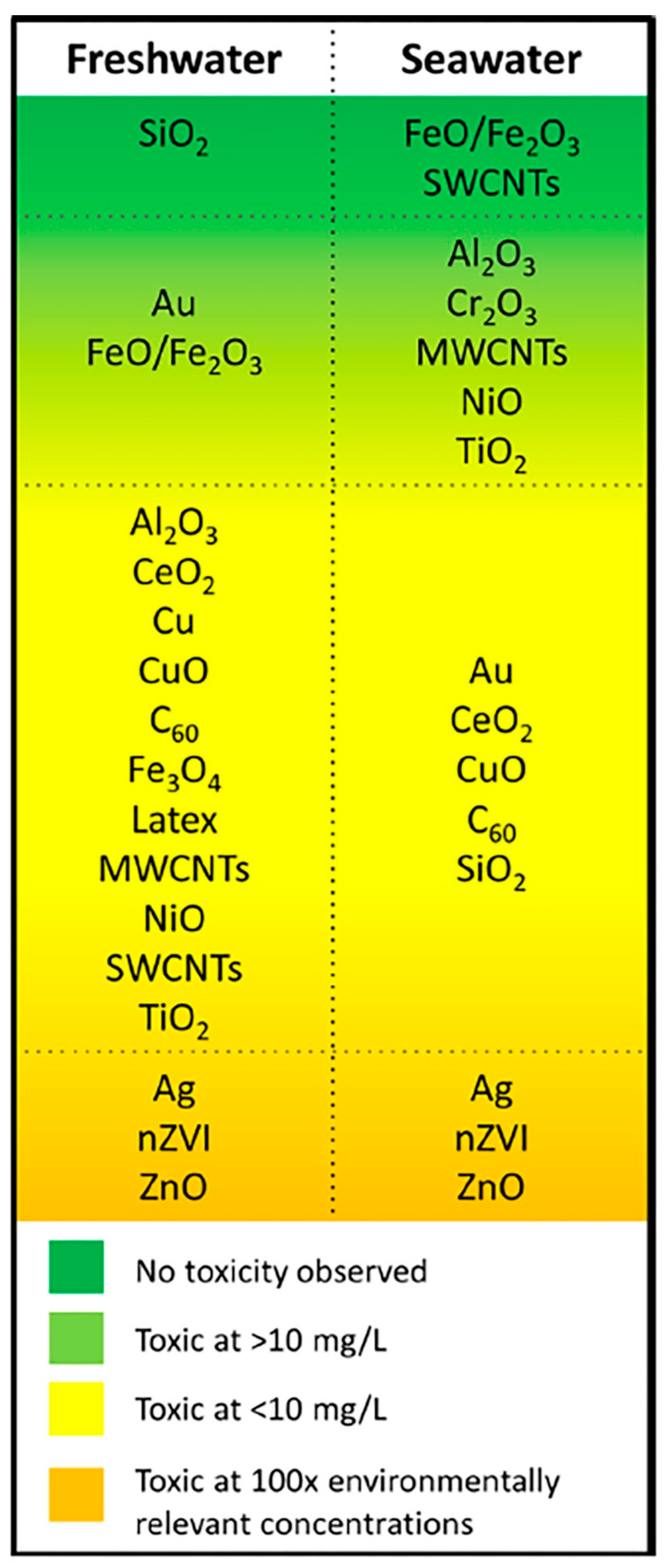
Figure 2.
Ecotoxicity of ENPs in aquatic and terrestrial regimes, showing the mechanisms as a) formation of ROS, b) ion release, c) internalization, and d) biological surface coating [38,39].
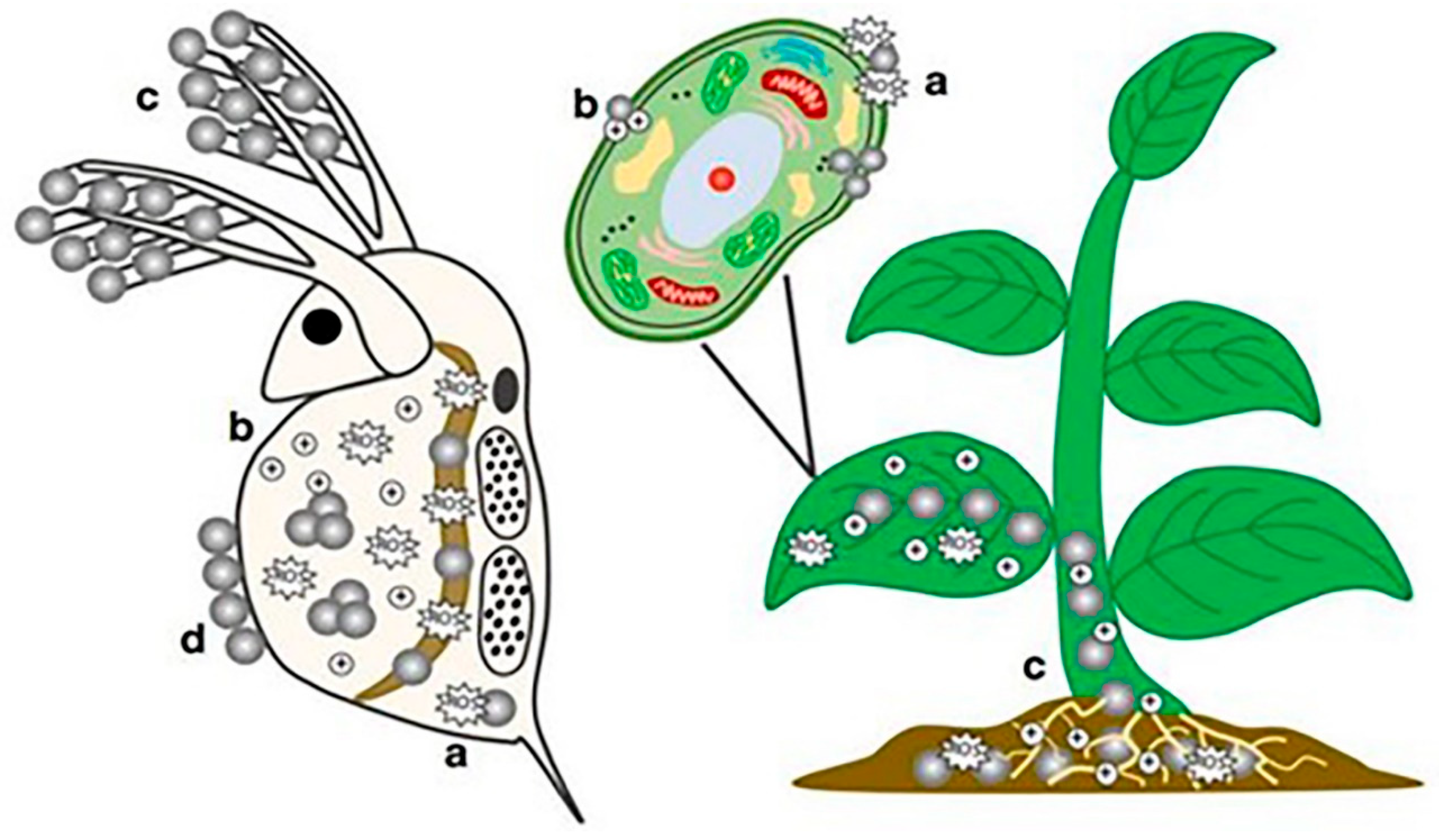
Figure 3.
Schematic of toxic behavior of ENPs in bacteria.
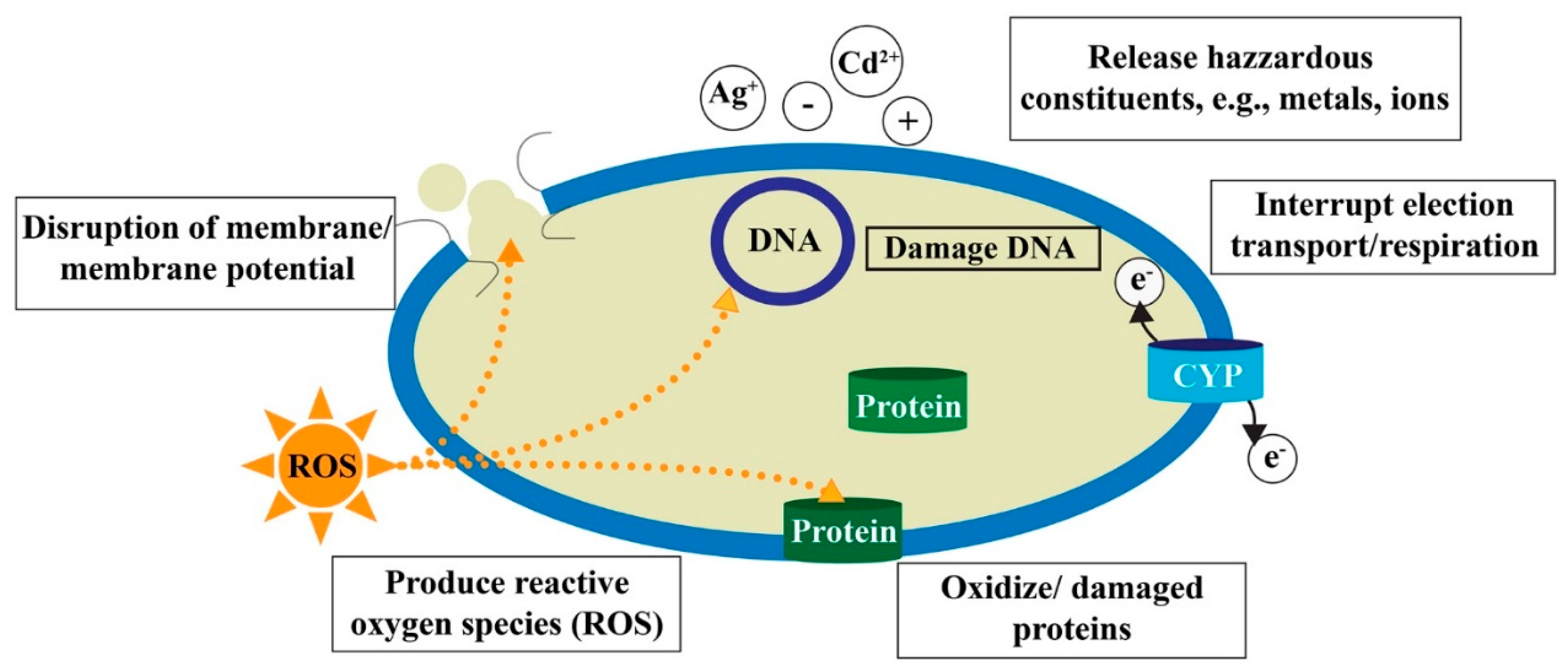
Figure 4.
Conceptual demonstration of various situations regarding collective effects of combinations of metallic pollutants with ENPs and to environmentally significant aquatic species Daphnia magna [64].
Figure 4.
Conceptual demonstration of various situations regarding collective effects of combinations of metallic pollutants with ENPs and to environmentally significant aquatic species Daphnia magna [64].
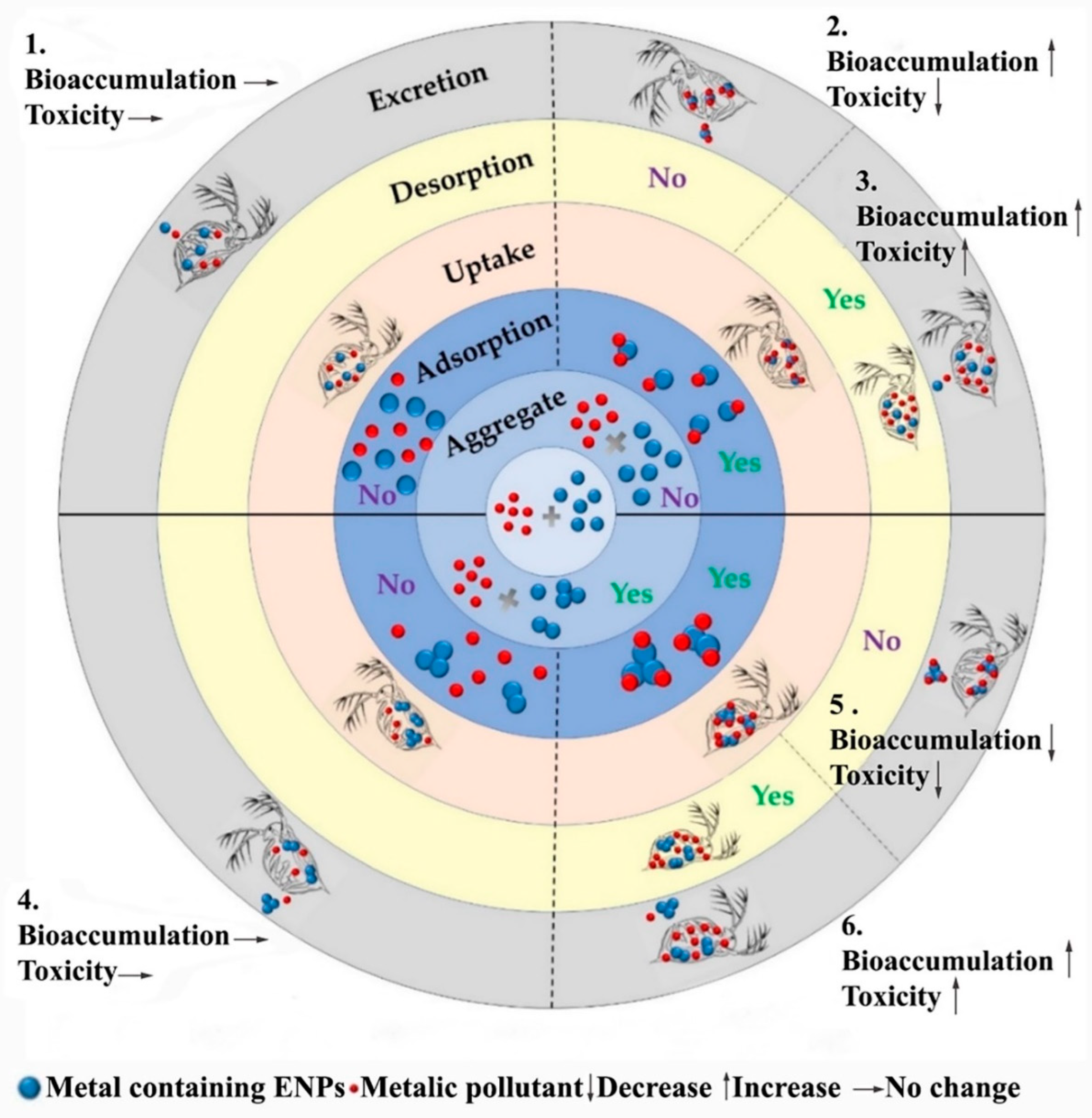
Figure 5.
Illustration of the fate of ENPs in Soil-Plant Systems [76].
Figure 5.
Illustration of the fate of ENPs in Soil-Plant Systems [76].
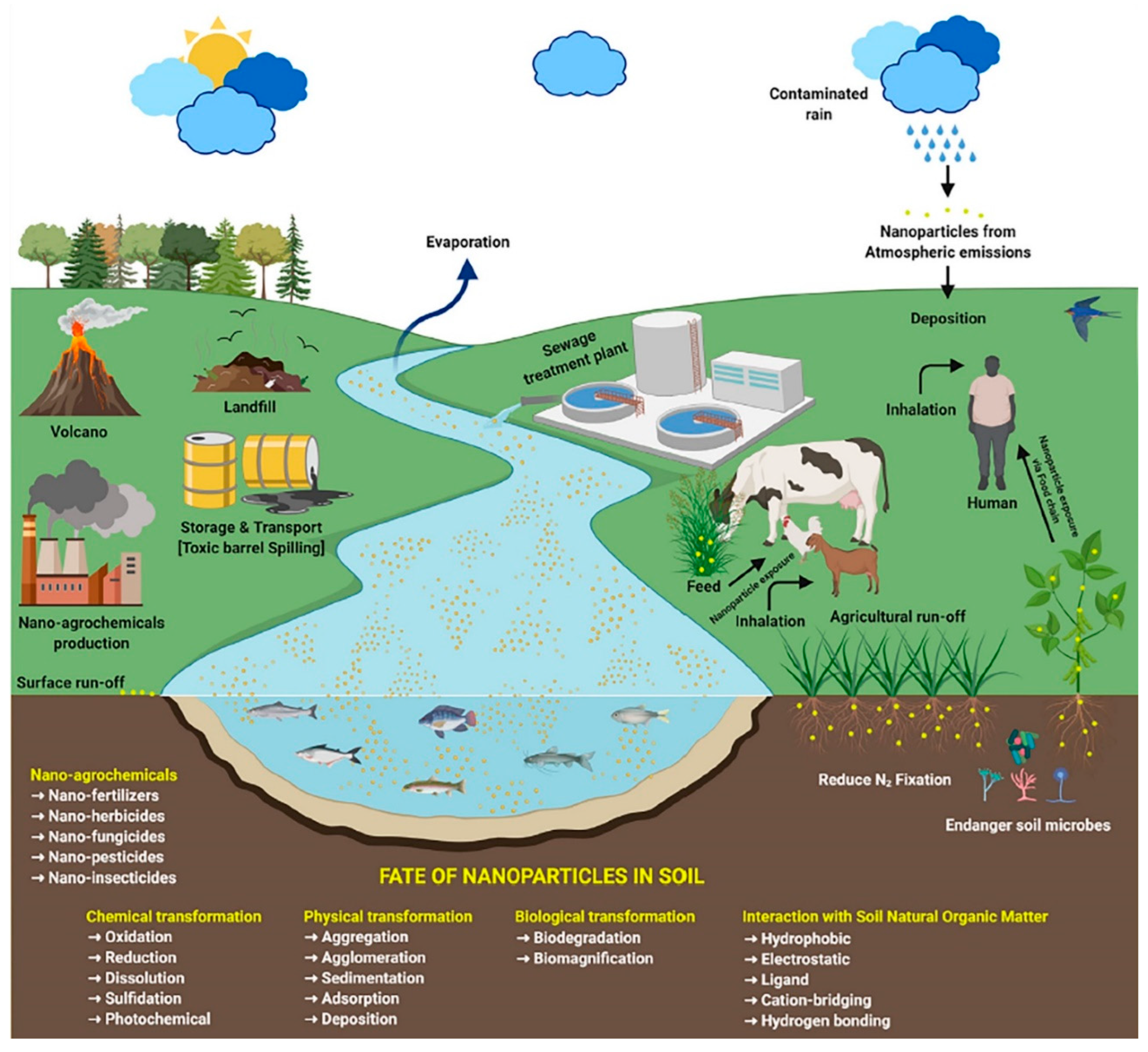
Figure 6.
Interactions of ENPs with three elements of soil- (i) soil itself, (ii) soil microflora, & (iii) plants. NPs and Plant interaction (panel A) showed the three factors by which phytotoxicity of NPs is governed which are: (i) plant: species type and growth stage (ii) experimental: temperature, time, and method of exposure, and finally (iii) physicochemical characteristics of NPs, i.e., size, concentration, aggregation, and chemical composition of NPs; NPs and soil microflora interaction (panel B) illustrated that the interaction mainly depends on soil type and exposure time. NPs and soil interaction (panel C) physicochemical characteristics of soil control the bioavailability and transportation of NPs in soil and the consequent impact of toxicity on plants [85].
Figure 6.
Interactions of ENPs with three elements of soil- (i) soil itself, (ii) soil microflora, & (iii) plants. NPs and Plant interaction (panel A) showed the three factors by which phytotoxicity of NPs is governed which are: (i) plant: species type and growth stage (ii) experimental: temperature, time, and method of exposure, and finally (iii) physicochemical characteristics of NPs, i.e., size, concentration, aggregation, and chemical composition of NPs; NPs and soil microflora interaction (panel B) illustrated that the interaction mainly depends on soil type and exposure time. NPs and soil interaction (panel C) physicochemical characteristics of soil control the bioavailability and transportation of NPs in soil and the consequent impact of toxicity on plants [85].
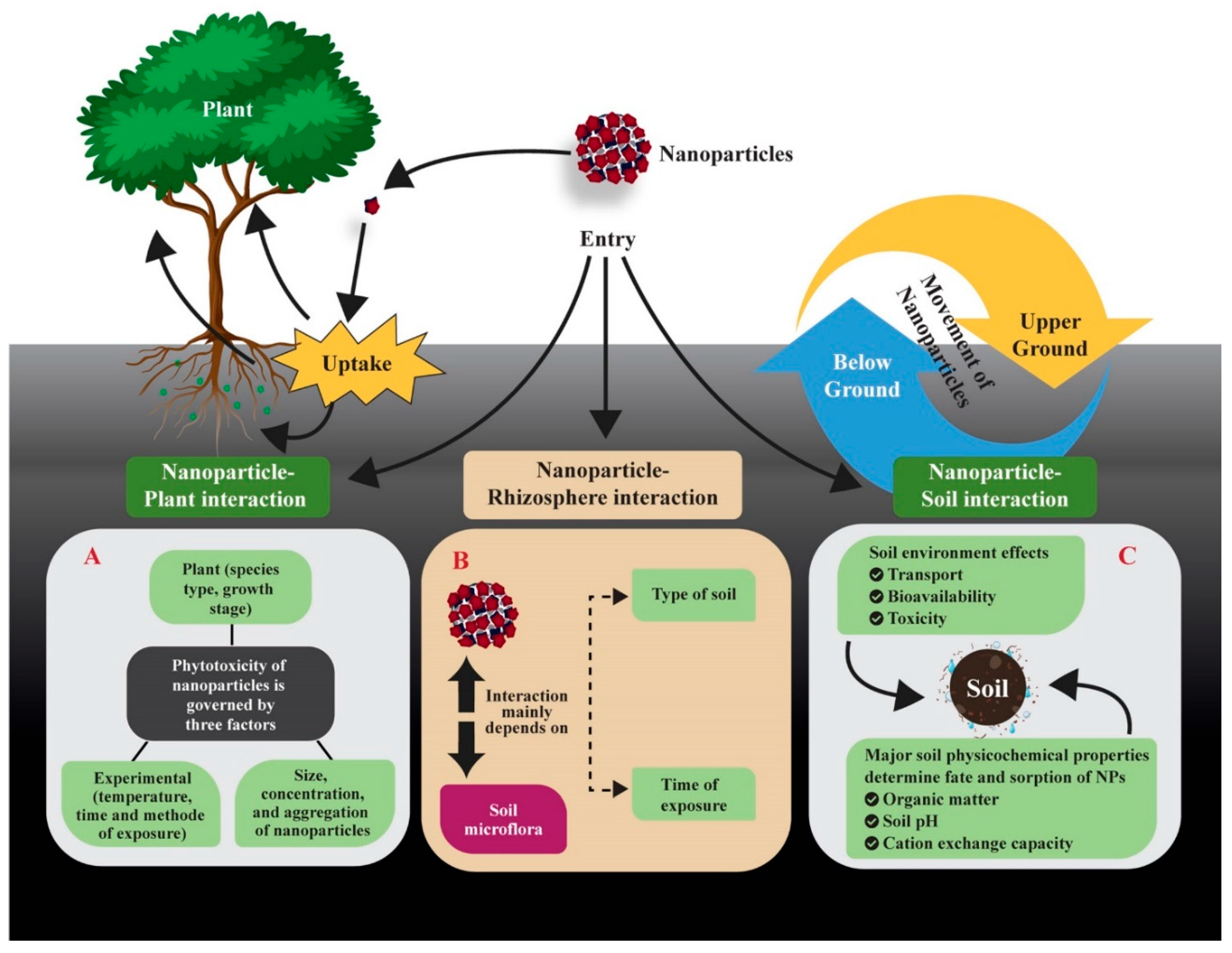
Figure 7.
Toxic effects of ENPs on the plant through ROS generation, peroxidation of the lipid membrane, and damage of mitochondria and chloroplasts (Panel-I). Oxidative stress creates an imbalance in enzymes (Panel-II); interaction of NPs with plant cells causes genotoxicity through disruption of the usual cell cycle, generation of micronuclei, anomalies of chromosomal, etc. (Panel-III). Disturbing effects of NPs on plants contain biomass reduction and water transpiration etc. (Panel-IV); interaction of NPs with cells of plant results in necrosis, apoptosis, and change in metabolome and proteome (Panel-V), which eventually lead to the death of plant cell. [85].
Figure 7.
Toxic effects of ENPs on the plant through ROS generation, peroxidation of the lipid membrane, and damage of mitochondria and chloroplasts (Panel-I). Oxidative stress creates an imbalance in enzymes (Panel-II); interaction of NPs with plant cells causes genotoxicity through disruption of the usual cell cycle, generation of micronuclei, anomalies of chromosomal, etc. (Panel-III). Disturbing effects of NPs on plants contain biomass reduction and water transpiration etc. (Panel-IV); interaction of NPs with cells of plant results in necrosis, apoptosis, and change in metabolome and proteome (Panel-V), which eventually lead to the death of plant cell. [85].
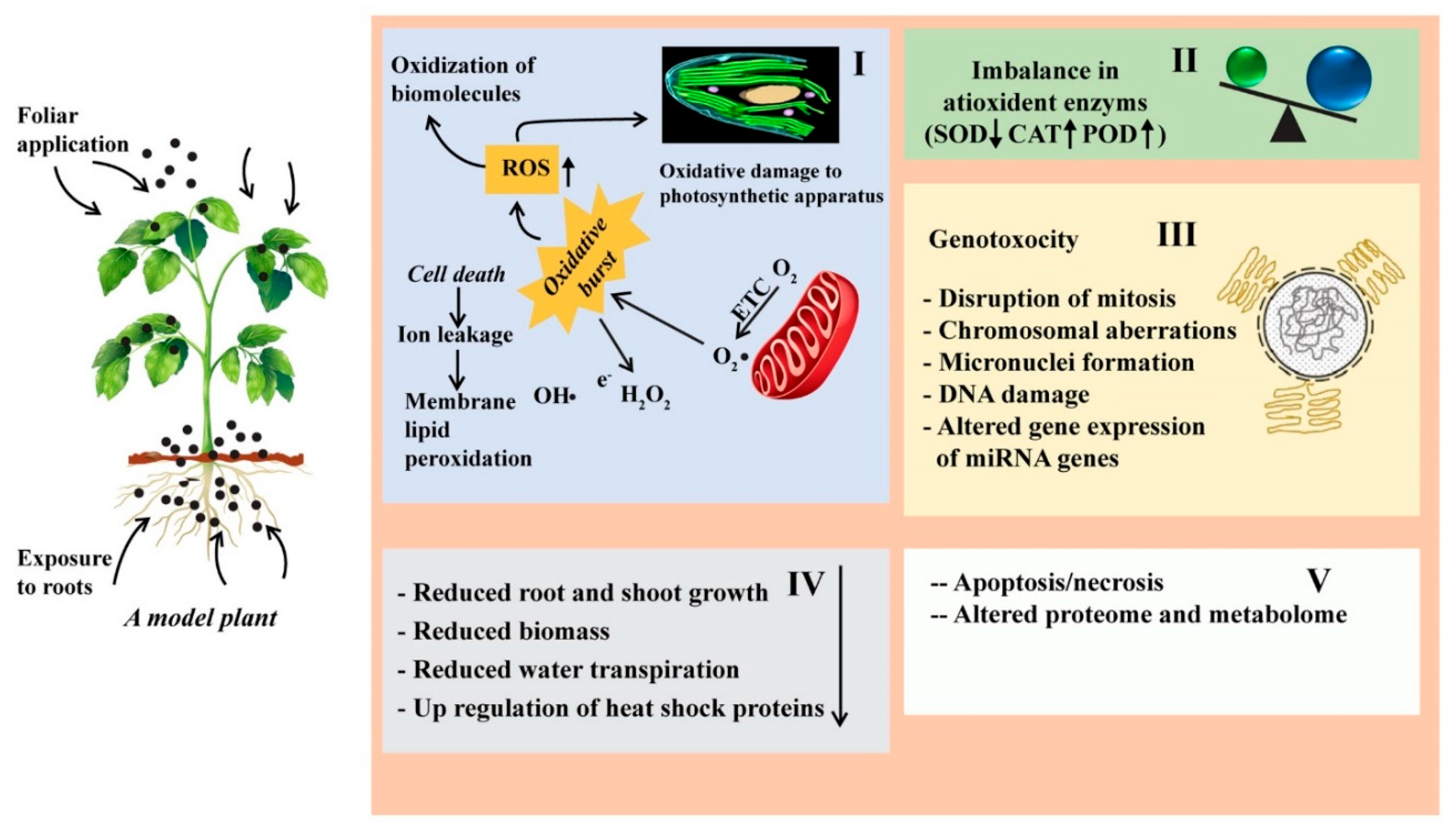
Figure 8.
Illustration of ecotoxicological evaluation of ENPs on the biotic and abiotic processes.
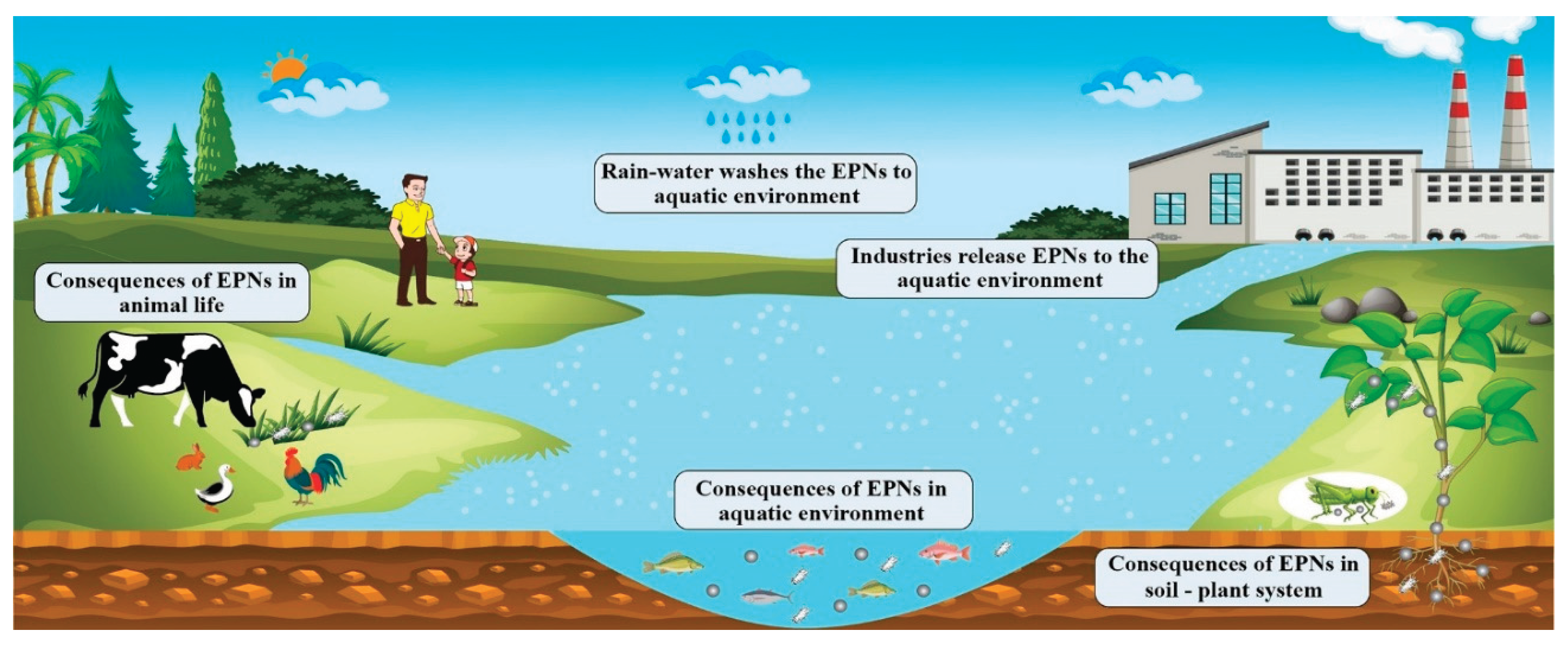

Table 1.
Classification of ENPs, their descriptions, and examples of each category of ENP.
| Type | Description | Example |
|---|---|---|
| Carbon-based ENPs | Carbon-based NPs are a class of engineered nanoparticles derived from carbon atoms, carbon nanotubes (CNTs), graphene, carbon quantum dots, and fullerenes. | CNTs, fullerenes, graphene, and nanodiamonds. |
| Metal/metal oxide-based ENPs | Metal-based ENPs are synthetic nanomaterial composed of pure metals or their compounds (e.g., metal oxides) with at least one dimension between 1 and 100 nanometers. | Gold NPs (AuNPs), Silver NPs (AgNPs), and Iron Oxide NPs. |
| Ceramic-based ENPs | Ceramic-based ENPs are synthetic inorganic materials, typically composed of ceramic compounds like metal oxides, carbides, and nitrides. These NPs made from silicon, titanium, or aluminum, are intentionally manufactured to possess distinct physical and chemical characteristics that are not found in larger ceramic structures. | Silicon Dioxide (SiO2) NPs, Alumina (Al2O3) NPs, and Titanium Dioxide (TiO2) NPs. |
| Semiconductor ENPs | Semiconductor ENPs are synthetically created nanomaterials (1–100 nm) designed to possess novel optical and electronic properties. These characteristics, which are absent in the parent bulk material, are a direct consequence of the quantum confinement effect—a phenomenon that allows for the precise control of a nanoparticle’s light-emitting and electronic features simply by manipulating its size. | Cadmium-based Quantum Dots (CdSe,CdS,CdTe), Indium Phosphide (InP) Quantum Dots, and Silicon (Si) Quantum Dots. |
| Polymeric-based ENPs | Polymers are used as building blocks to create a type of synthetic nanoparticle called a polymeric-based ENPs. These NPs are between 1-1000 nm in size and manufactured for a particular function, such as acting as a delivery vehicle for drugs, genes, or other therapeutic molecules. Their main goal is to shield the encapsulated substance and transport it to a precise location within the body for the treatments. | Poly (lactic-co-glycolic acid) (PLGA) NPs, Poly (ethylene glycol) (PEG) NPs, and Chitosan NPs. |
| Lipid-based ENPs | Lipid-based ENPs are a class of fabricated nanostructures (10–1,000 nm) that are purposefully built from lipid components. These spherical vesicles are manufactured to fulfill specific roles, often in drug delivery. | Liposomes, Pfizer-BioNTech COVID-19 Vaccine (Comirnaty®), and Moderna COVID-19 Vaccine (Spikevax®). |
| Composite ENPs | Composite ENPs are made of two or more distinct nanoscale components to create a single structure with special physical and chemical properties. Different components of these NPs interact at nanoscale, resulting in superior properties compared to the individual components alone. | Gold-Silica NPs (Au@SiO2), Iron Oxide NPs with polymer coating (Fe3O4@Polymer). |
Table 2.
The impact of various parameters on ENP toxicity in freshwater and seawater environments.
| Parameters | Impacts of toxicity | Summary of the study | Reference |
|---|---|---|---|
| Size of ENPs | The strength of toxicity is inversely related to the ENPs’ size. | Al2O3 NP was found to show low toxicity to bacteria in contrast with the same Al2O3 NPs of a size of less than 50 nm. | [58] |
| Crystal structure | Cytotoxicity and genotoxicity are associated with the ENPs’ crystal structure. | The toxicity of Anatase nTiO2 due to oxidative stress was found to be greater than that of rutile nTiO2. | [59] |
| Surface charge | Surface charge controls the toxicity of NPs by affecting the agglomeration rate. | The silver NPs’ toxicity was discovered to be dependent on surface charge. | [57] |
| Morphology | Surface charge controls the toxicity of NPs by affecting the agglomeration rate. | Plate-shaped silver NPs have higher toxicity effects on fish gills and zebrafish embryos in contrast with spheres or wire-shaped NPs. | [60] |
| Surface coating | The ENP’s toxicity effects increase or decrease according to the chemistry of their coatings of ENPs. | PVP or citrate-coated silver NPs were more toxic than PEG-coated silver NPs. | [61] |
| Co-pollutant | Inadequate information is found regarding the interaction of nanoparticles with other pollutants in the aquatic media. | Exposure of the blue mussel to both TiO2 and benzo (a) pyrene resulted in greater chromosomal damage while inducing lower results in individual exposure. | [62] |
| Exposure duration and concentration | Both the exposure duration and concentration influence the toxicity of ENPs in the aquatic system. | It is found that the toxicity effects on Lymnaea luteola, an aquatic snail, of exposure to nZnO have a dependency on the exposure duration and concentration. | [63] |
Table 3.
Toxic responses of nanoparticles to agriculturally important plants.
| ENPs | Size and Dose Rate | Test Crop(s) | Results | Reference |
|---|---|---|---|---|
| Ag | 10 nm and 0.001-10000 mg L-1 |
Raphanus sativus, Allium cepa | The growth of plant roots was inhibited. | [97] |
| CuO | 20-100 nm and 34.4 g m2 |
Brassica oleracea var. viridis, Brassica oleracea var. sabella & Lactuca sativa | Substantial amounts of CuO accumulated on the surface of lettuce leaves and subsequently on kale and collard greens. | [98] |
| ZnO | <100 nm and 20-900 mg kg-1 soil |
Triticum aestivum, Pisum sativum, Zea mays, Lactuca sativa, Raphanus sativus, Beta vulgaris, Solanum lycopersicum, and Crocus sativus | Toxic effects of ZnO NPs depend on plant species; ZnO NPs reduced the availability of Zine while interacting with calcareous soil and as a result toxicity to accumulate biomass by wheat, beet, and cucumber, whereas maize, pea, and wheat showed resistance in acidic type soil. | [99] |
| TiO2 | 25 nm and 250–1000 mg L-1 |
Crocus sativus, Brassica oleracea var. capitata, Avena sativa | Growth of roots of edible crops such as corn, oats, cabbage, lettuce, etc. were inhibited and germination of cucumber and soybean was reduced. | [100] |
| Al2O3 | 13 nm and 50 mg L-1 |
Triticum aestivum | H2O2 content, lipid peroxidation, and superoxide dismutase activities were increased; the production of anthocyanin and photosynthetic pigment was reduced. | [101] |
Table 4.
Critical comparison and strengthening the framework.
| Feature | REACH (EU) | EPA/TSCA (U.S.) | OECD (Global) |
|---|---|---|---|
| Primary role | Direct regulation/ market access |
Direct regulation/risk management | Test Method/policy harmonization |
| Core principle | Precautionary principle | Risk-based assessment | Mutual acceptance of data (MAD) |
| ENP requirements | Explicitly addressed with nano-specific amendments (mandatory data) | Case-by-case review, limited specific reporting rules (risk-triggered data) | Develops ENP-adapted test guidelines and guidance documents |
| Strength | Comprehensive data generation, mandatory nano-specific information | Flexible, fast control of new chemicals (consent orders) | Standardized methods, reduced animal testing, global consistency |
| Limitation | Resource-intensive, slow to adapt, potential for underestimation of complex hazards | Requires demonstration of “unreasonable risk” before full data is mandated, relies on regulatory discretion | No direct regulatory power, lag between guideline creation and national adoption |
Disclaimer/Publisher’s Note: The statements, opinions and data contained in all publications are solely those of the individual author(s) and contributor(s) and not of MDPI and/or the editor(s). MDPI and/or the editor(s) disclaim responsibility for any injury to people or property resulting from any ideas, methods, instructions or products referred to in the content. |
© 2025 by the authors. Licensee MDPI, Basel, Switzerland. This article is an open access article distributed under the terms and conditions of the Creative Commons Attribution (CC BY) license (http://creativecommons.org/licenses/by/4.0/).
Copyright: This open access article is published under a Creative Commons CC BY 4.0 license, which permit the free download, distribution, and reuse, provided that the author and preprint are cited in any reuse.


