

Submitted:
15 January 2025
Posted:
16 January 2025
You are already at the latest version
Abstract
In this paper, we revisit the Mesolithic–Neolithic transition in western Scotland and the links between Early European farmers and middens in light of new aDNA, radiocarbon, and stable isotopic evidence. New carbon and nitrogen stable isotopic data for food sources (plant and animal remains) from a Mesolithic site are presented, and dietary FRUITS models are recalculated based on these data. We also respond to recent criticisms of the Bayesian approach to diet reconstruction. Results support the view that Neolithic people had at most a minimal contribution of marine foods in diet and also point to a dual population model of transition in western Scotland. A significant aspect of the transition in coastal western Scotland is the co-occurrence of Neolithic human remains with shell-midden deposits, which appears to contradict stable isotopic evidence indicating a minimal contribution of marine resources to the diet of early farming communities in the region. Finally, we highlight the need for further research to fully address these issues, including 1) targeted isotopic analyses of potential plant and animal resources, 2) single-entity radiocarbon and ZooMS analyses of animal bones and artefacts from shell-middens, and 3) further aDNA analyses of the remains of Late Mesolithic and Neolithic people.
Keywords:
diet
; stable isotopes
; aDNA
; Mesolithic
; Neolithic
; western Scotland
1. Introduction
The precise nature and timing of the transition from hunting and gathering to farming in western Scotland have been the subject of longstanding debate (e.g., Bonsall et al. 2002; Schulting and Richards 2002; Sheridan 2010; Schulting and Borić 2017; Sheridan and Whittle 2023). This debate significantly reflects the wider archaeological discourse on the spread of farming across Europe. Various models have been proposed; however, these fall broadly into two categories: demic diffusion or indigenism/acculturation (see Ammerman 2020 and Schier 2022 for reviews). Indigenous development or adoption of agricultural practices (grouped here for simplicity, although the former has never been convincingly argued for western Scotland) should be evident in the archaeological record through a gradual and/or piecemeal transition to farming with the persistence, at least over the short to medium term, of some hunting and gathering behaviours (Zvelebil and Rowley-Conwy 1984; Thomas 1991; 2004). By contrast, a ‘revolution’ linked to demic diffusion (demographic expansion and dispersal of farmers) should be evidenced by a sudden and significant break from traditional hunter-gatherer activities and material culture, with the uniform and wholesale appearance of the Neolithic ‘package’ (Stevens and Fuller 2012).
One culturally determined behaviour – diet – has long been regarded as central to this debate for two reasons: it is one of the fundamental changes in behaviour associated with the introduction of farming and can be measured directly through stable isotope analysis.
Traditionally, the diets of prehistoric populations have been ‘reconstructed’ from carbon (δ13C) and nitrogen (δ15N) stable isotope ratios of human bone through visual parsing or ‘eyeballing’ (e.g., Tauber 1981) or by employing linear mixing models (LMMs) (e.g., Schwarcz 1991; Phillips and Koch 2002). Over the past two decades, the limitations of Linear Mixing Models (LMM) have been extensively discussed (e.g., Robbins et al. 2002; Fernandes et al. 2012; Fry 2013). Since the early 2010s, the use of Bayesian Mixing Models (BMM), which mitigate some of the drawbacks of LMMs, has become commonplace (e.g., Parnell 2010; Fernandes et al. 2014, 2015; and see Pickard and Bonsall 2022 for FRUITS modelling of Neolithic diet in western Scotland). However, the use of Bayesian approaches for modelling past diets has not been met with universal acclaim. For instance, Schulting and colleagues (2023) questioned the precision and accuracy of Bayesian models of Neolithic diets in western Scotland. Here, we examine how diet can enhance our understanding of the Mesolithic-Neolithic transition in western Scotland and explore the utility of the Bayesian modelling software FRUITS in this context.
2. Archaeological and Archaeogenetic Background
The debate surrounding the introduction of farming to Britain has followed a trajectory similar to the broader European discourse, with scholars favouring either demic diffusion or indigenism/acculturation as the primary driver of the transition to agriculture (see Sheridan and Whittle 2023 for a concise overview). The discussion has continued in western Scotland due to the equivocal nature of the archaeological record (Bonsall et al. 2002). Beginning around 4000 cal BCE (and possibly as early as 4300 BCE, based on the presence of a sherd of Armorican Castellic Ware in the Achnacreebeag chambered tomb), there were changes in subsistence practices, material culture, technology, architecture and monumentality, and land use across much of Scotland (Fairweather and Ralston 1993; Sheridan 2012; Thomas 2013; Sheridan and Schulting 2020) which had parallels in Continental Europe and therefore were consistent with demic diffusion as the cause of cultural change. By contrast, in western Scotland, the evidence arguably supported the continuity of hunter-gatherer lifeways, with activity at some sites seemingly spanning the transition, along with later reuse of Mesolithic locations by Neolithic communities, the persistence of certain chipped stone and bone technologies, and the exploitation of wild resources (Bonsall et al. 2002, Mithen et al. 2007). Most relevant to the current discussion are (i) the continued (but not necessarily continuous) accumulation of deposits of marine resources at shell-midden sites during the Neolithic, e.g., at An Corran on Skye and Carding Mill Bay 1 and 2 near Oban (Connock et al. 1991; Saville et al. 2012; Bownes et al. 2017); and (ii) finds of shells at megalithic sites, some of which may represent foundation deposits hinting at the continued symbolic significance of marine resources, e.g., at Crarae (Scott 1963).
Since the early 2010s, aDNA studies have become the cornerstone of resolving the debate. The DNA of European Mesolithic hunter-gatherers (WHG) compared to Early European Farmers (EEF) provides overwhelming support for demic diffusion – the first farmers in Europe were genetically distinct from the last hunter-gatherers (e.g., Haak et al. 2010; Mathieson et al. 2015; Olalde et al. 2018, 2019). In Britain, generally, there was a demographic transformation, the direct consequence of demic diffusion, such that by the Late Neolithic, little to no trace of indigenous hunter-gatherer ancestry remained (Brace et al. 2019; Brace and Booth 2023). However, in western Scotland, the population ‘replacement’ was not necessarily rapid and need not have been brought about by mass migration (Patterson et al. 2022; Brace and Booth 2023). Ammerman (2020) argued that contact between indigenous hunter-gatherers and incoming farmers likely occurred in many regions of Europe. This assertion is supported not only by the archaeological record (e.g., Fort 2012) but also by genomic evidence (e.g., Olalde et al. 2019; Brunel et al. 2020). The indicators of admixture between indigenous hunter-gatherers and incoming farmers in western Scotland are clear (Olalde et al. 2018; Brace et al. 2019; Patterson et al. 2022). Of the maximum of 20 west Scottish Neolithic individuals whose DNA has been sequenced (Figure 1, and see Table 1), eight exhibit recent (within the last ten generations or so, i.e., indigenous) hunter-gatherer ancestry. Five of these individuals (those with good coverage or ‘number of reads’ and a high count of SNPs) have been identified as genetic outliers, distinct from the broader Early Neolithic community of western Scotland (see Table 1 and the extended data fig. 2 in Patterson et al. 2022). Therefore, genetic evidence confirms that farming was introduced to Scotland by migrants from continental Europe. The question of the nature of the interactions between the first farmers and indigenous hunter-gatherers remains unresolved. Understanding the diets of both Mesolithic and Neolithic groups remains fundamental to this discussion.
3. Stable Isotope Analysis
Dietary changes have been used as a proxy measure for the timing and rapidity of the transition from hunting and gathering to farming in western Scotland, and thus, to distinguish between the two proposed models, acculturation versus demic diffusion. Diachronic patterns in dietary habits can be assessed in archaeological populations through stable isotope analysis. Diet reconstruction through the measurement of carbon (δ13C) and nitrogen (δ15N) stable isotope ratios is a well-established approach (e.g., Vogel and van der Merwe 1977).
Tauber (1981:333) performed the first comparative analysis of the δ13C values of Danish Mesolithic and Neolithic individuals, concluding that the hunter-gatherer groups had subsisted largely on marine resources, while the farmers consumed mainly terrestrial foods. The shift from Mesolithic to Neolithic consumption patterns appeared abrupt and uniform (Tauber 1981, fig. 2), in keeping with a demic diffusion model. A similar conclusion was later drawn from the isotope data for Scottish Neolithic individuals (Bonsall et al. 2002; Schulting and Richards 2002). Schulting and Richards, among others, championed a model of rapid and wholesale transition to dependence on terrestrial resources at the beginning of the Neolithic in western Scotland (e.g., Schulting 1998; Schulting and Richards 2002, 2006; Richards et al. 2003; Schulting and Borić 2017). Further, Schulting and Richards (2002: 155) argued that the relatively high human δ15N compared to the values of herbivores suggested that Neolithic diets were dominated by domesticated animal products and that the “animal protein (meat, blood or milk) is presumably from domestic stock, as it seems highly improbable that people would suddenly abandon marine foods in favour of wild terrestrial game at this juncture”. The focus on terrestrial resources was in sharp contrast to the diets of Scottish hunter-gatherers. Richards and Mellars (1998) estimated that individuals whose remains were recovered from the Mesolithic shell midden at Cnoc Coig on the Isle of Oronsay had derived over 90% of their dietary protein from marine food sources. In each of the aforementioned studies, the diet was interpreted through visual analysis of scatterplots (e.g., Schulting and Borić 2017) or ‘reconstructed’ using simple linear mixing models, based on a single dietary proxy (e.g., Richards and Mellars 1998). These models focused solely on sources of dietary protein and did not account for the impact of the varying concentrations of protein in different foodstuffs. The development of Bayesian approaches to modelling diets, along with advances in understanding macronutrient routing in collagen synthesis (Fernandes et al. 2012, 2014), offered an opportunity to revisit the stable isotope data and investigate whole diet.
Bownes et al. (2017) published the first Bayesian analysis of Neolithic diets in western Scotland, presenting data for four individuals from Carding Mill Bay 1. Bayesian mixing models such as FRUITS (Food Reconstruction Using Isotopic Transferred Signals) offer several advantages over linear mixing models (see Fernandes et al. 2014). These include the ability to incorporate more food sources (relative to the number of proxies), uncertainties (e.g., seasonal variation in food source isotope values), and priors (e.g., health-related limitations to protein intake). Diets were modelled from bone collagen δ13C and δ15N using FRUITS. Their model indicated a ‘modest’ contribution of seafood to dietary protein of between 15±11% and 21±14%. Bownes et al. (2017: 1292) noted that their findings did not align with previously published interpretations by Richards et al. (2003) and Richards and Schulting (2006), which had “suggested a complete absence of marine resources in the Neolithic diet”. In response to Bownes et al.’s (2017) paper, Schulting and colleagues (2023) claimed that their stance was misrepresented and that they had postulated a ‘minimal’ contribution of marine foods to diet.
Schulting et al. (2023) explored the discrepancies between published interpretations of the diets of the early farmers from Carding Mill Bay 1 and critiqued the following aspects of Bownes et al.’s (2017) model:
- The Δ15Ndiet-consumer diet consumer offset used, i.e., +5.5±0.5‰
- The Δ13Cdiet-consumer offset used, i.e., +1.0‰
- The inclusion of marine foods in the dietary model
- The omission of plant foods from the model
- Whether the faunal samples used to establish food source isotope values were contemporaneous with the human remains from the site.
To highlight these limitations, Schulting et al. (2023, fig. 1b) generated a revised model of protein intake for Carding Mill Bay 1 using the same parameters employed in Bownes et al. (2017), altering only the Δ13Cdiet-consumer offset from +1.0‰ to 4.8‰. Schulting et al. (2023: 54) concluded from the data generated in the revised model that the ‘most probable’ contribution of marine resources to diet was between 0% and 1%. Schulting et al. (2023) then generated two new models for one individual, Carding Mill Bay 1 OxA-7890, which incorporated three food sources: cereals, terrestrial herbivores and young herbivores (reportedly to account for the enrichment associated with nursing), while excluding marine resources. One model included a δ15N for manured plants (3.0±1.0‰), while the other incorporated a δ15N for non-manured plants (5.0±2.0‰).
The parameters employed by Schulting et al. (2023) for their revised models are summarized in Table 2. The models are expanded here using FRUITS (version 3.1 Beta) to encompass all four individuals included in Bownes et al.’s (2017) study. The results are presented in Table 3 and Table 4. Both models indicated that, for three of the four individuals, the mean estimated contribution of plant foods to dietary protein exceeds that from animal sources, with individual OxA-7664 being the exception, consuming nearly equal proportions of animal and plant protein. Notably, there is little difference between the manured and non-manured cereal models, which likely reflects the large standard deviations associated with the mean δ13C and δ15N values.
We agree with Schulting et al. (2023) that the dietary model for Carding Mill Bay 1, published by Bownes et al. (2017), is flawed. However, we contend that only two of the criticisms highlighted in Schulting et al. (2023) are valid (see also Pickard and Bonsall [2022], where some of these issues were addressed).
Firstly, the assumption that 100% of dietary protein was derived from one of two sources, either the meat of terrestrial animals or the flesh of marine organisms, is problematic. Bownes et al. (2018: 150) acknowledged that plant foods would have been exploited by both Mesolithic and Neolithic groups in Scotland but excluded this resource from dietary models on the basis that “plants contain very little … protein in relation to animal meat”. This assumption can be challenged. The macronutrient content of animal ‘meat’ and, consequently, the protein-to-lipid ratio, vary by species and also depend on the cut of meat or part of the animal consumed. Some cereals and wild plants have protein-to-energy concentrations that are similar to those of certain animal products (see Pickard and Bonsall 2022, table 8). Hazelnuts and barley, for instance, which are among the most commonly identified plant foods recovered from Scottish Neolithic sites (Bishop et al. 2010; see also Bishop et al. 2014), are relatively high in protein.
Deriving dietary protein exclusively from animal products is atypical (cf. Hedges and Reynard 2007). In modern developed countries, mean protein intake consists of 57% animal and 43% plant-derived sources. In contrast, developing countries have relative proportions of animal to plant protein at 30% and 70%, respectively. However, animal protein intake may be higher in groups that consume large quantities of dairy foods (Hedges and Reynard 2007).
Secondly, the Δ13Cdiet-consumer offset of +1‰ used by Bownes et al. (2017) is inappropriate. Although an offset of 0‰ to +2‰ has been demonstrated between herbivore and carnivore bone collagen values (Bocherens and Drucker 2003), this offset is not appropriate for modelling whole diet from bone collagen stable isotope values. The food web for the Carding Mill Bay 1 human population presents a more complex scenario. Plant foods (such as cereals and wild nuts) and shellfish should both be included in the dietary models of this group. It is essential to determine the macronutrients δ13C for the tissues consumed from each of the food sources that potentially contributed to diet and to employ an appropriate Δ13Cdiet-consumer offset, e.g., O’Connell et al. (2012).
There are also several problems with Schulting et al.’s (2023) approach. These broadly fall into three categories: (i) the offsets used, (ii) the food sources included (or excluded), and (iii) the critique of Bayesian models.
(i) Δ15Ndiet-consumer offset
Schulting et al. (2023) assumed a Δ15Ndiet-consumer of 4.6±0.5‰ rather than the more widely used 5.5±0.5‰ or higher offset (e.g., Fernandes et al. 2014; Bickle 2018; Pickard and Bonsall 2022). The lower offset is derived from O’Connell et al. (2012: 431), wherein it is described as “very conservative”. O’Connell et al. (2012) determined that the diet-collagen offset in their study population was c. 6‰ – significantly higher than the offset used by Bownes et al. (2017) – and lower than that observed in some other medium- to large mammals (e.g., Caut 2009). The 5.5±0.5‰ offset encompasses the variation between the higher and lower offsets of O’Connell et al. (2012) and Schulting et al. (2023), respectively. Schulting et al. (2023) argued that the conservative value was more realistic, in keeping with values determined in ecological food web studies. Schulting et al. (2023) cited Minagawa and Wada (1984), Post (2002) and Vanderklift and Ponsard (2003) in support of a small diet-consumer offset of 3‰ and Halffman et al. (2020), Newsome et al. (2004) and Piličiauskas et al. (2017) for an offset of 3−4‰. However, using ecological studies as comparators for human diet offsets is problematic. Vanderklift and Ponsard (2003) observed that diet–consumer offsets varied taxonomically. The mean offset reported by both Minagawa and Wada (1984) and Post (2002) was 3.4‰. However, both studies indicated large ranges in Δ15Ndiet-consumer, of up to +9.2‰ (Minagawa and Wada 1984). Furthermore, the diet-consumer food webs studied were not appropriate analogues for humans (large omnivores). Minagawa and Wada (1984) studied the food webs of a range of species, including wild fish, insects and molluscs, as well as controlled feeding studies of a guppy, shrimp and a mouse. No large omnivorous mammals were included in the study. Post (2002) investigated offsets in freshwater mussels and snails. Vanderklift and Ponsard’s (2003) offset was generated from a synthesis of published controlled feeding studies, but only two samples came from medium-sized terrestrial omnivores (pigs). Moreover, these specimens were part of a controlled feeding experiment and had diets that included only plant foods (Hare et al. 1991). In each of the studies mentioned, a variety of tissues were sampled, and in some instances, the data were derived from whole-body samples. These were then combined to generate a mean Δ15N offset, i.e., it is not directly comparable with O’Connell and colleagues’ (2012) diet to bone collagen offset. The Δ15N offset used in Newsome et al. (2004) was derived from other studies. Halffman et al.’s (2020) offset was derived from Bocherens’ (2015) prey-predator offset determined for herbivore to carnivore collagen to collagen values. Similarly, Piličiauskas et al. (2017) used the Δ15N offset published in Bocherens and Drucker (2003). Ecological studies of diet-consumer Δ15N offsets in large omnivorous mammals are few. Black bear (Ursus americanus) diet-plasma offset values were reported as +2.3, +4.1 and +4.2‰ (Hildebrand et al. 1996). This is consistent with a diet-collagen offset of 3.2–3.7‰, 5.0–5.4‰ and 5.1–5.5‰, respectively (cf. O’Connell et al. 2012). Notably, the diet−plasma offset in grizzly bears has been reported to be up to +6.30‰, i.e., a diet−collagen offset of 7.2–7.6‰ (Caut 2009).
(ii) Food sources
Schulting et al. (2023) critiqued the use of fauna from the Carding Mill Bay 1 midden to model the diets of Neolithic people, noting that the animal remains might have originated from an earlier chronological/cultural phase. Milner and Craig (2009) discussed this issue in their investigation of diet at An Corran, Skye, where the initial faunal samples analysed proved to date much earlier than the human remains from the midden. They subsequently analysed the δ13C and δ15N of bevel-ended tools made from animal bones that had been previously determined to be of Neolithic date, i.e., broadly contemporaneous with the human remains, and found little difference in the isotope values of the animals from the two distinct cultural phases.
Schulting et al. (2023) presented a model limited to three food categories: young and mature terrestrial herbivores, and cereals. Although they stated that this three-source model was “a heuristic exercise” and made “no claim to have ‘revealed’ the actual proportion of these three food groups consumed by the Neolithic communities around Carding Mill Bay”, Schulting et al. (2023: 54) reported that the results of this food-source-restricted model were “more in keeping with what might be expected of British Neolithic farming communities, known to have practised both cereal cultivation and animal husbandry from the outset”. The argument is circular – Schulting et al. (2023) hold a preconceived notion of what an early farming community in western Scotland would have subsisted on and then generate a model that seemingly confirms this. Furthermore, it is questionable whether adding young herbivores as a food source is meaningful. One of the prerequisites for high-quality outputs from FRUITS modelling is that the food sources must be isotopically distinct (Fernandes et al. 2014). The isotope values for young herbivores are only slightly higher than those of the adults, and food sources with overlapping isotope ranges should be aggregated (Philips et al. 2014; Fernandes et al. 2014).
Assuming a priori that marine resources did not contribute to diet—and therefore excluding them from subsequent modelling—is equally, if not more, problematic than including them in Bayesian (or indeed linear) mixing models. A more robust approach involves generating a model that includes all potential food sources appropriately grouped while ensuring that the credible interval is considered carefully when interpreting the data (Fernandes et al. 2014; Cheung and Szpak 2021).
(iii) Heuristics
Schulting et al. (2023: 54) urged caution before accepting the output of Bayesian palaeodietary models, implying that such models do not reflect “the actual proportion… of food groups consumed”. However, this critique could apply to any form of dietary modelling that utilizes proxies, such as LMMs and visual parsing. Weaknesses in dietary ‘reconstructions’ or models arise not only from Bayesian modelling generally, or specifically FRUITS, but rather reflect the GIGO principle (output is related to the quality of the input). Limitations on the quality of input, and consequently output, arise from the partial nature of the archaeological record and constraints on research (i.e., lack of isotopic data for food sources and diet-consumer offsets), poorly considered selection of parameters, and misinterpretation or over-interpretation of the data generated. Regardless of the modelling system employed, ‘modellers’ make assumptions about which food sources are likely to have contributed to diet and select other variables or parameters that are incorporated into the models – for example, which archaeological specimens to sample to establish food source baselines or ‘dietary endpoints’, and which diet-consumer offset values to use. It is not the case that when a food source is included in FRUITS, it is “assumed a priori to make a dietary contribution” (Schulting et al. 2022: 54). When a food source that was not consumed is included in the model, this is indicated by the credible interval, which will span 0. Bayesian models are not inherently more heuristic than other forms of dietary modelling, although their ability to accommodate a much broader range of food sources and to include more macronutrients and macronutrient concentrations, proxies, and a greater number of uncertainties and offsets, may make them appear so. As new data relating to one or more parameters become available, models should be updated. The capability of models to incorporate this breadth of inputs increases the accuracy of dietary models where inputs are carefully and critically evaluated. While Bayesian models may seem less precise than linear mixing models because they provide a credible interval or range rather than a unique solution or absolute value, the ‘true’ value or dietary contribution lies within this credible interval. Thus, the data are more accurate than simple linear mixing models or visual analysis of scatterplots (of course, this assumes high-quality input).
4. Discussion
Arguably, neither Bownes et al. (2017) nor Schulting et al.’s (2023) models are as robust or as detailed as current knowledge permits. Both used protein-routed models that assumed carbon in bone collagen was derived exclusively from dietary protein. While Schulting et al. (2023) pointed out that concentration-dependent modelling is necessary to model food source calorie contribution to diet, nutrient routing should also be incorporated. Fernandes et al. (2012) demonstrated that carbon from the three dietary macronutrients is routed to bone collagen (see also Hedges 2004). This information, namely the routing of consistent proportions of carbon from protein (74±4%) and energy (26±4%), can be used to determine the source of dietary calories (Fernandes et al. 2012, 2014). Modelling calorie contributions of food sources can significantly enhance our understanding of diet and subsistence activities. A concentration-dependent, nutrient-routed model with appropriate food source values, offsets, uncertainties and priors for west Scottish Neolithic populations was published by Pickard and Bonsall (2022). Using the Bayesian model FRUITS, the findings of that study were aligned with those of Schulting et al. (2023) on the contribution that marine resources made to diet. We concluded that marine resources “were at most, a minor component of the ‘lifetime’ diet” (Pickard and Bonsall 2022: 226). We also agreed with Schulting and Richards (2023) that the diets of the individuals from Carding Mill Bay 1 were overwhelmingly derived from terrestrial foods. However, we suggested that while terrestrial animals (including potentially dairy products) were a vital source of dietary protein, plant foods were likely the primary source of calories for west Scottish Neolithic people.
Since publishing our models in 2022, additional food source data have become available, summarized in Table 5 (see Figure 2 for locations). Therefore, the diets of Neolithic individuals from western Scotland are revisited here using updated food source data (with all food sources included and grouped where appropriate) but expanded to include three additional Neolithic individuals – one from Ulva Cave and two from Carding Mill Bay 2 (see Patterson et al. 2022). Table 6 presents the updated human isotope data, Table 7 shows the parameters used in our revised FRUITS models, and Table 8 displays the results of the FRUITS models. Wild and domesticated resources are included in the baseline food source isotope values. Both radiocarbon and botanical evidence suggest that dependence on cultivars to the total exclusion of wild plants is unlikely in Neolithic Scotland. Bishop et al. (2010) noted that no cereal grains have been recovered from Neolithic contexts in mainland coastal west Scotland or the Inner Hebrides. Stevens and Fuller (2012, 2015) demonstrated through radiocarbon summed probability distributions that wild plant foods, specifically hazelnuts, remained a crucial staple throughout the Neolithic in mainland Scotland, especially so from c. 3650 BCE, when a climatic downturn may have led to “a readjustment of existing subsistence systems in response to less predictable harvests, during which wild plant foods and pastoralism gained prominence” (Stevens et al. 2022: 11). A pilot study of modern and archaeological specimens from the Isle of Ulva suggests that hazelnuts have similar mean δ13C and δ15N values as unmanured Early Neolithic cereals. Although further work is necessary to confirm this and also to establish the variation in nutshell and kernel values (given that the number of samples analysed was small), the preliminary results suggest that mean stable isotope values of the two resources, namely cereals and hazelnuts, may be indistinguishable. The evidence for the continued exploitation of wild animals in Neolithic Scotland is limited. While remains of red deer and possibly roe deer were recovered (Bartosiewicz et al. 2010) from the upper midden deposit at Carding Mill Bay 2 in the absence of 14C dates, it is not certain that these originate from Neolithic contexts. Although ample evidence exists for stock raising, there are no published stable isotope data for domesticated mammals from western Scotland where identification to species is certain.
4.1. Revised dietary models
The outputs of the models, perhaps unsurprisingly given the narrow ranges of the δ13C and δ15N values, suggest that the diets of Neolithic individuals in western Scotland were homogeneous. The 68% credible interval for each food source is very similar across all the individuals analysed (see Figure 4). The model suggests that plant foods were likely the mainstay of dietary calories. The mean estimated contribution of plant calories is approximately 75±11%, with the lowest estimated CI range of 62–64% and the highest range of 87–94%. In contrast, dietary protein was likely sourced predominantly from terrestrial animal products, including meat and dairy (e.g., Cramp et al. 2014).
The mean estimated calorie contribution of fish varied from 1±1% to 2±2%, while for shellfish it ranged from 1±1% to 3±3%. This implies that marine resources represented, at most, a minor component of dietary calories. The mean estimated protein contributions of both fish and shellfish show a wider range of values, from 2±2% to 10±6% and 4±4% to 10±8%, respectively. This may indicate some variation, individually or between groups, in the consumption of, and nutrients derived from, marine resources. However, the credible intervals for all but two samples suggest that marine resources were not consumed – that is, the lower range of the fish and shellfish calorie contribution credible intervals is 0%. The credible intervals (68%) for two samples from An Corran (AC.04 and AC.05) indicate a small contribution of marine resources to diet, but at most, this constitutes a 6% contribution of both fish and shellfish to calories. Notably, these two samples may originate from a single individual; both were extracted from fragmentary bones, and both specimens were identified as the remains of a ‘mature’ adult (Milner and Craig 2009).
4.2. Diet, DNA and the Mesolithic–Neolithic Transition
Radiocarbon chronologies of Mesolithic and Neolithic sites on Islay point to the likely co-existence of hunter-gatherers and farmers on the island between c. 3790 and 3640 cal BCE and potentially into the latter half of the 4th millennium BCE (Mithen 2022). Mithen (2022) proposed three scenarios of indigenous hunter-gatherer and migrant farmer interaction on Islay: (a) swift succession, (b) dual populations, and (c) biocultural merger. Although developed for Islay, the scenarios serve as a valuable starting point for exploring the nature of immigrant farmer/indigenous hunter-gatherer interactions across the wider region of western Scotland.
The swift succession scenario proposes a short period of contact with some admixture or acculturation before the ‘extinction’ of hunter-gatherer groups, which Mithen (2022) argued did not wholly align with the archaeological evidence. The dual population model envisioned Neolithic and Mesolithic people coexisting in the same area, possibly even using the same locations, but with little or no contact for an extended period, possibly into the 2nd millennium BCE (Mithen 2022). The biocultural merger model proposed a genetic and cultural union with a mixed economy, including hunting, gathering, fishing, and pastoralism (Mithen 2022). Of the three scenarios, Mithen (2022) cautiously favoured the biocultural merger model.
All the west Scottish Neolithic individuals sampled for stable isotope analysis had diets largely, if not entirely, based on terrestrial resources. Moreover, their diets were remarkably uniform. This dietary emphasis is indicated not only by the biochemistry of human remains but is also supported by organic residue analysis of Neolithic pottery sherds from coastal locations in northern Britain, including the Northern and Western Isles, which show a “near-complete absence” of residues of aquatic origin (Cramp et al. 2014: 3). Arguably, therefore, the Neolithic individuals represent a single dietary population even though some individuals show mixed EEF and indigenous hunter-gatherer ancestry (cf. Bollongino et al. 2013). While modelling the relative proportions of wild terrestrial species versus domesticates in the diet is not feasible due to an overlap in δ13C and δ15N values of these food groups, the isotope data clearly indicate whether marine resources were exploited. At most, fish and shellfish contributed minimally to diet, marking a significant shift in dietary focus from the Mesolithic.
Mesolithic human remains are scarce in Scotland, comprising isolated finds of disarticulated and fragmented bones or teeth. Stable isotope data are available for only six samples from adults (modelling the diet of non-adults remains problematic) – five from Cnoc Coig and one from Caisteal nan Gillean II, both shell-midden locations on Oronsay. The diets of the individuals whose remains were recovered from these two sites comprised a mix of terrestrial and aquatic resources, typically with more than a third of calories drawn from marine resources (Pickard and Bonsall 2020, 2022). aDNA from only one Mesolithic individual from Cnoc Coig, Oronsay, has been sequenced (Figure 3) – a female who lived between c. 4450 and 4260 BCE (5492±36 BP, SUERC-69249). She had western hunter-gatherer (WHG) ancestry and presumably was an indigenous hunter-gatherer (Brace et al. 2019). This individual had among the highest δ13C and δ15N ratios of any of the human remains from Cnoc Coig that have been analysed (δ13C = -12.8‰ and δ15N=+16.6‰, GU41836). However, the collagen was extracted from the petrous portion of the temporal bone, which may reflect a combination of maternal, breastfeeding, and weaning/post-weaning diets as it begins to form in utero and does not remodel after approximately two years of age (Jørkov et al. 2009). The complex interplay between physiological effects, nursing and diet means that it is inadvisable to use these data to model ‘typical’ Mesolithic diets. However, it is entirely conceivable that the diet of the adult from whom the petrous sample was extracted was similar to that of the other individuals from Cnoc Coig for whom adult diet proxies are available (see Pickard and Bonsall 2022). While it is not certain that the diets of all west Scottish hunter-gatherers were similarly constituted, the broader evidence from Atlantic Europe (e.g., Richards and Hedges 1999; Bergsvik and Ritchie 2020; García-Escárzaga and Gutiérrez-Zugasti 2021) suggests that marine resources likely constituted an important element of the subsistence economy for coastal groups. While diet is only one culturally determined behaviour, turning away from the sea represents a distinct break with past traditions and habitus and, therefore, of social and symbolic significance. As Fornander (2011: 80–81) aptly summarizes, “social identity, is rooted in the practices of everyday life” and “is also about defining what one is not”. The dietary evidence strongly suggests that fishing was an infrequent activity; therefore, west Scottish Neolithic likely had a distinct socially constructed identity compared to earlier Mesolithic groups. Diachronic changes in diet are more consistent with either the dual population model or the swift succession model than with the biocultural merger model.
As Brace and Booth (2023: 133) observed, the aDNA evidence is inconsistent with a complete biocultural merger – migrant farmers “must have lived adjacent to people descended from local Mesolithic groups for hundreds of years but only had children with them some of the time”. In Figure 3 the Mesolithic individual from Cnoc Coig establishes the benchmark for indigenous hunter-gatherers with fully Western Hunter-Gatherer (WHG) ancestry, while the individual(s) from MacArthur Cave set the boundary for migrant farmer (or Early European Farmer) ancestry (see Patterson et al. [2022] and Brace and Booth [2023] for discussion of the MacArthur Cave samples and levels of WHG ancestry in Neolithic groups). It is striking that the median dates of those individuals with evidence for increased Mesolithic ancestry (notably never exceeding 30%) are clustered between c. 3700 and 3500 BCE, a timespan which some authorities would place at the end of the Early Neolithic and beginning of the Middle Neolithic, after which the genetic contribution reverts to the Neolithic ‘baseline’ (see the downward trend in Figure 3). As noted by Brace and Booth (2023), increases in hunter-gatherer ancestry in Middle Neolithic populations have been observed in several regions of continental Europe. However, only in rare cases does this reflect recent admixture between indigenous hunter-gatherers and migrant farmers in the Middle Neolithic, e.g., Blätterhöhle Cave, Germany, and likely among the Brześć Kujawski group, Poland (Bollongino et al. 2013; Lipson et al. 2017; Fernandes et al. 2018; Rivollat et al. 2020; Brace and Booth 2023). At Blätterhöhle, biomolecular evidence strongly suggests the presence of two groups of Neolithic people, one subsisting entirely on agricultural resources with EEF ancestry, the other by foraging and fishing with hunter-gatherer ancestry (Bollongino et al. 2013). This is quite distinct from the uniform diet of west Scottish Neolithic groups. Furthermore, there are no 4th millennium BC individuals who display a high level (i.e., ≥60%) of Mesolithic heritage (Brace and Booth 2023), suggesting asymmetric gene flow between hunter-gatherers and farmers in the region. According to the Hardy–Weinberg Principle, allele proportions in a population should remain constant over time unless (i) there is a significant selective advantage (in the case of Neolithic alleles); (ii) marriage practices distort the proportions (e.g., Zerjal et al. 2003), or (iii) there is a continuous influx of DNA into a population. The latter is most likely in this case, and such an influx of migrant farmers would dilute hunter-gatherer DNA allele frequency. Thus, based on both the dietary and DNA evidence, we propose a model of subsumption of Mesolithic genetic heritage along with cultural replacement followed by continued influx of Neolithic farmers, further diluting the Mesolithic signal to complete loss – i.e., a dual population model. This is suggested cautiously for three reasons. Firstly, there is still some uncertainty about where in continental Europe the first farmers originated (Sheridan and Whittle, 2023). Resolving this issue may result in a reconsideration of the extent to which hunter-gatherers and migrant farmers interacted within Britain (see Brace and Booth 2023). Second, there may be ascertainment bias – individuals with high levels of Mesolithic ancestry may have had mortuary rituals that leave little archaeological trace. Ultimately, in many instances, it is difficult to reconcile whether the individuals sampled for aDNA analysis are also those whose remains have undergone stable isotope analysis for dietary modelling.
4.3. Shell middens and Neolithic burials
Various explanations have been proposed to account for the co-occurrence of Neolithic human remains with shell middens. One explanation is the use of marine resources by farmers during times of hardship, such as crop failures. This has been suggested for an Early Neolithic site at Sumburgh (in Shetland), where the consumption of marine resources is evident only in dentine increments (which provide a record of diet during childhood and over short periods, i.e., weeks to months) rather than in bone collagen, which typically reflects average dietary intake over longer timescales (e.g., Montgomery et al. 2013). Further, Mithen (2022:19) proposed that the Middle Neolithic failure of farming (Stevens and Fuller 2012) may have led to a renewed impetus for hunting and gathering, “for which they may have required Mesolithic-type knowledge and technology” and thus served as a catalyst for increased contact with native hunter-gatherers. The use of wild resources, whether terrestrial or marine, does not require Mesolithic-type technology or skills. Marine resources can be harvested with minimal technology and experience (Groom et al., 2019). Despite their proximity and accessibility for coastal groups in western Scotland, marine resources did not feature prominently in the diets of Neolithic communities. Indeed, Schulting and Borić (2017:94) expressed their surprise that the Early Neolithic people of Sumburgh did not focus all their attention on fishing, given the marginality of farming in such a northerly location. They noted that this “speaks to the cultural importance of maintaining a farming identity”. Similarly, while wild plants were exploited in Neolithic Scotland and seem to have become a crucial staple during the Middle to Late Neolithic, this does not necessitate the continuance of hunter-gatherers or the direct transfer of knowledge – as Stephens and Fuller (2012:719) noted, “migrating farmers from the Continent already had a subsistence strategy encompassing both cultivated and wild foods”.
Another possibility is that farming communities were not responsible for 4th millennium BCE midden accumulations; rather, these could represent the activities of a coexisting hunter-gatherer population. While Mithen (2022: 18) suggested that population collapse “may have driven local communities to relax their marriage rules to allow interbreeding with local Mesolithic groups”, it is important not to assume that hunter-gatherers were passive bystanders in the transition to farming. There may have been some resistance to merger on both sides – hunter-gatherers may also have maintained strong connections to past customs, rituals and social structures (see Zilhão 2011).
This raises the question of why, if middens were associated with hunter-gatherer activities, Neolithic people chose to deposit the remains of their deceased in these locations. Brace and Booth (2023), highlighting similarities between the depositional contexts of human remains on Oronsay and at Carding Mill Bay, imply that the act of depositing human remains at shell midden sites signifies a continuation of hunter-gatherer mortuary traditions into the Neolithic. If that were indeed the case, it suggests the persistence of funerary customs shaped by hunter-gatherer social memory despite hunter-gatherer ancestry being at low levels or absent in the individuals whose remains have been recovered from these sites. None of the individuals from Raschoille Cave was genetically closely related (Patterson et al. 2022; Brace and Booth 2023), which suggests that placing the deceased in caves did not reflect the collective memory or practices of a small bioculturally-merged group.
Placing the remains of the dead in caves was not a Mesolithic tradition in western Scotland (Bonsall et al. 2012; Sheridan and Schulting 2020). However, this practice is observed throughout Neolithic Europe (e.g., Peterson 2019; Silvestri et al. 2020; Sparacello et al. 2020; Rivero et al. 2021). At Raschoille, the human remains were found in or beneath angular rock debris, stratigraphically separated from the shell-midden deposits in the cave. Distillery Cave was discovered during quarrying in the 19th century. The existence of the cave and its archaeological significance were only recognized after rock blasting disturbed the deposits; hence, the archaeological context of the human remains, and their stratigraphic relationship with the shell midden are uncertain (Turner 1895). Similarly, at An Corran, the funerary practices and the relationship between the shell midden and the human remains are uncertain. While the remains may have been intentionally inserted into pre-existing midden deposits, it has been suggested they were incidental intrusions, perhaps originally placed on a ledge of the rockshelter (Saville et al. 2012). At MacArthur Cave, the human remains were recovered from the surface of, and from within, a ‘black earth’ layer that overlay the shell-bearing deposits (Anderson 1895) – thus, post-dating the midden. Moreover, an AMS 14C date on a bone artefact from the midden (Bonsall and Smith 1989) is substantially older than the 14C dates obtained from Neolithic human remains from the cave.
At Ulva Cave, the entrance area featured a shell midden formed by the periodic deposition of food and other refuse over thousands of years, which had become highly compacted due to human and animal trampling. The midden dates back to before 7500 cal BCE (Russell et al. 1995) but was added to intermittently during the later Mesolithic and subsequent periods. A few disarticulated human bones (one dated to the Early Neolithic – Table 1) were found among mammalian remains recovered through hand excavation and fine sieving, but it could not be determined whether the human remains had been intentionally "buried."
Arguably, the most compelling evidence for the intentional burial of Neolithic human remains in shell-midden deposits comes from Carding Mill Bay in Oban, where disarticulated human bones were found in shell-midden deposits within two shallow fissure caves at the base of a raised marine cliff (CMB 1 and CMB 2). Both sites had suffered damage due to land development, prompting salvage excavations at Site 1 in 1988 (Connock et al. 1991) and at Site 2 from 1992 to 1996 (Bartosiewicz et al. 2010). At CMB 1, the radiocarbon dates for human bones were, on average, several centuries younger than those for ungulate bones and bone artefacts recovered from the shell-midden deposits (Connock et al. 1991; Bonsall and Smith 1992; Schulting and Richards 2002; Bownes et al. 2017). This evidence implies that Neolithic human remains were either deposited in an in-situ Late Mesolithic shell midden or that the shell-midden material had been brought to the site from another location specifically to conceal the human remains. At CMB 2, human remains were recovered from two distinct shell-rich layers separated by a layer of talus. Bones from two individuals with Early Farmer (EEF) ancestry excavated from the lower midden deposit were dated to the Early Neolithic (Table 1). The contrasting pedological and microfaunal characteristics of the two sets of midden deposits suggest that at least one, and possibly both, had not accumulated in situ but had been imported for the purpose of burying the human remains.
5. Conclusions
This paper was conceived as a contribution to discussions on how we can accurately model past diets, focusing on the nature of the transition from hunting and gathering to farming in western Scotland. FRUITS generates accurate models of past diets when appropriate parameters are input. Our FRUITS models indicate that plant foods were the primary source of dietary calories, while animal products provided the principal source of dietary protein for west Scottish Neolithic individuals. The results presented here support the long-standing view that marine resources constituted, at most, a minor component of Neolithic diets in western Scotland. Collectively, the dietary and aDNA evidence suggests subsumption with further influx dilution, that is, the dual population model of the Mesolithic–Neolithic transition in western Scotland best fits the current evidence. Extensive reliance on terrestrial resources in Neolithic western Scotland suggests deep-rooted connections to farming traditions.
The interpretations presented here are offered cautiously. We recognize that there remain significant gaps in food source isotope data that need to be addressed. While no 4th millennium BCE individuals with predominantly WHG ancestry have been identified so far, this may reflect the small number of individuals whose aDNA has been extracted and sequenced. It may also reflect ascertainment bias – hunter-gatherers might have disposed of their dead in a way that left little archaeological trace, either due to the nature of mortuary rituals or the poor preservation of bones in the acidic soils that are prevalent throughout Scotland.
To address the limitations in current dietary models, further biomolecular analyses and radiocarbon dating are essential, including (i) targeted isotope analyses of potential food sources, especially domestic animals and wild plants such as hazelnuts from sites in western Scotland; (ii) additional radiocarbon dates from sites like Ulva Cave and Carding Mill Bay 2 to enhance our understanding of shell midden chronology; and (iii) palaeoproteomics (ZooMS) of non-diagnostic large mammal remains, which also has the potential to identify remains of humans as well as domesticates, and expand both the isotope and aDNA datasets.
Supplementary Materials
The following supporting information can be downloaded at the website of this paper posted on Preprints.org. Methods Statement for Extraction and Stable Isotope Analysis of Bone Collagen; Methods Statement for Pre-Treatment and Stable Isotope Analysis of Carbonised Hazelnut Shells.
Methods Statement for Extraction and Stable Isotope Analysis of Bone Collagen
Bone samples were pre-treated and collagen was extracted in the wet chemistry lab of the School of History, Classics and Archaeology, at the University of Edinburgh. A sample of approximately 1 g of bone was taken from each specimen. Samples were cleaned by ultrasonication in Milli-Q® ultra-purified water for 20 minutes. Collagen was extracted from the bone samples by means of a modified Longin method using an acid-alkali-acid wash protocol (Longin 1971; Brown 1988). Each bone sample was placed in c. 100 ml of 1 N HCl at 20°C until completely demineralised. The organic portion of the bone was then washed to neutral pH in Milli-Q® ultra-purified water (carbon content < 3 ppb) and subsequently placed in c. 100 ml of 0.2 N NaOH at 20°C for 24 hours to remove any potential humic contaminants. Following the alkali wash the collagen was returned to a 1 N HCl solution for a period of 1 hour to remove any atmospheric CO2 absorbed during the alkali wash. The sample was then washed in ultra-purified water and then solubilised at 80°C in a pH=3 solution for 24 hours. The collagen solution was concentrated by evaporation and then lyophilised in a Christ freeze drier for 48 hours at -55°C.
Stable carbon (δ13C) and nitrogen (δ15N) isotopic compositions were determined on a Delta V Advantage continuous-flow isotope ratio mass spectrometer coupled via a ConfloIV to an IsoLink elemental analyser (Thermo Scientific, Bremen) at SUERC, East Kilbride, as described in Sayle et al. (2019). Bone collagen samples were combusted in the presence of oxygen in a single reactor containing tungstic oxide and copper wires at 1020°C to produce N2, and CO2. A magnesium perchlorate trap was used to eliminate water produced during the combustion process, and the gases were separated in a GC column heated between 70°C and 240°C. Helium was used as a carrier gas throughout the procedure. N2 and CO2 entered the mass spectrometer via an open split arrangement within the ConfloIV and were analysed against their corresponding reference gases. The International Atomic Energy Agency (IAEA) reference materials USGS40 (L-glutamic acid, δ13CVPDB = –26.39±0.04‰, δ15NAIR = –4.52±0.06‰) and USGS41a (L-glutamic acid, δ13CVPDB = 36.55±0.08‰, δ15NAIR = 47.55±0.15‰) were used to normalise δ13C and δ15N values. Results are reported as per mil (‰) relative to the internationally accepted standards VPDB and AIR. Normalisation was checked using the marine collagen USGS88 (δ13CVPDB = –16.06±0.07‰, δ15NAIR = 14.96±0.14‰) and the porcine collagen USGS89 (δ13CVPDB = –18.13±0.11‰ and δ15NAIR = 6.25±0.12‰). Precision is determined to be ±0.1‰ for δ13C and ±0.2‰ for δ15N is based on repeated measurements of the well characterised Elemental Microanalysis IRMS fish gelatin standard B2215.
Methods Statement for Pre-Treatment and Stable Isotope Analysis of Carbonised Hazelnut Shells
Carbonised hazelnut shell fragments were cleaned by washing in HCl and subsequent ultrasonication in Milli-Q® ultra-purified water for 20 minutes. Stable carbon (δ13C) and nitrogen (δ15N) isotopic compositions were determined by Elemental Analysis - Isotope Ratio Mass Spectrometry (EA-IRMS) at Iso-Analytical, Bramhall, Cheshire. Samples and references were weighed into tin capsules, sealed, and loaded into an auto-sampler on a Europa Scientific elemental analyser. From where they are dropped in sequence into a furnace held at 1000 °C and combusted in the presence of oxygen. The tin capsules were flash combusted – combusted gases were then swept in a helium stream over a combustion catalyst, Cr2O3 wires, and silver wool to remove sulphur and halides. Resultant gases, N2, NOx, and CO2, were swept through a reduction stage of pure copper wires held at 600 °C, to convert NOx species to N2. N2, NOx, and CO2 were separated using a packed column gas chromatograph held at a constant temperature of 65°C. The resultant nitrogen peak entered the ion source of the Europa Scientific 20-20 IRMS, where it was ionized and accelerated. Nitrogen gas species of different mass were separated in a magnetic field then simultaneously measured using a Faraday cup collector array to measure the isotopomers of N2 at m/z 28, 29, and 30. After a delay the carbon dioxide peak entered the ion source and was ionized and accelerated. Carbon dioxide gas species of different mass are separated in a magnetic field then simultaneously measured using a Faraday cup collector array to measure the isotopomers of CO2 at m/z 44, 45, and 46. Both references and samples were converted to N2 and CO2 and analysed using the same method. The analysis proceeds in a batch process by which a reference is analysed followed by a number of samples and then another reference. The reference material used for δ13C and δ15N analysis was IA-R001 (wheat flour, δ13CVPDB = -26.43‰ and δ15NAIR = 2.55‰). IA-R001, a mixture of IA-R005 (beet sugar, δ13CVPDB = -26.03‰) and IA-R045 (ammonium sulphate, δ15NAIR = -4.71‰) and a mixture of IA-R006 (cane sugar, δ13CVPDB = -11.64‰) and IA-R046 (ammonium sulphate, δ15NAIR = 22.04‰) were run as quality control check samples during analysis. IA-R001 is calibrated against and traceable to IAEA-CH-6 (sucrose, δ13CVPDB = -10.449‰) and IAEA-N-1 (ammonium sulphate, δ15NAIR = 0.40‰). IA-R005 and IA-R006 are calibrated against and traceable to IAEA-CH-6. IA-R045 and IA-R046 are calibrated against and traceable to IAEA-N-1. IAEA-CH-6 and IAEA-N-1 are inter-laboratory comparison standards distributed by the International Atomic Energy Agency, Vienna.
Author Contributions
Conceptualization, CP, ES and CB; Methodology, CP, AB and EG; Validation, CP, EG, ES, CB; Formal Analysis, CP; Investigation, CP, EG, ES, AB, and CB; Resources, CP and CB; Writing – Original Draft Preparation, CP; Writing – Review & Editing CP, ES and CB; Supervision, CP; Visualization, CP and CB; Validation, CP and CB; Funding Acquisition, CP and EG.
Funding
This research was funded by The Moray Endowment Fund, The Munro Fund, and the School of History, Classics and Archaeology, University of Edinburgh.
Acknowledgments
Thanks are extend to the North West Mull Community Woodland Company who gave permission for the excavations on Ulva, and also to those in the Ulva Community who supported the field projects: Andy Primrose; Ruiaridh Munro; Donny Munro. This work was supported by SUERC, University of Glasgow, and we thank Dr Kerry Sayle. This work is dedicated to the memory of Andy Barlow.
Conflicts of Interest
The authors declare no conflicts of interest. The funders had no role in the design of the study; in the collection, analyses, or interpretation of data; in the writing of the manuscript; or in the decision to publish the results.
References
- Ammerman, A. The Neolithic transition in Europe at 50 years. arXiv:2012.11713 [q-bio.PE], 2020. [CrossRef]
- Anderson, J. Notice of a cave recently discovered at Oban, containing human remains, and a refuse-heap of shells and bones of animals, and stone and bone implements. Proc. Soc. Antiq. Scot. 1895, 29, 211–230. [CrossRef]
- Barrett, J.H.; Orton, D.; Johnstone, C.; Harland, J.; Van Neer, W.; Ervynck, A.; Roberts, C.; Locker, A.; Amundsen, C.; Bødker Enghoff, I.; Hamilton-Dyer, S.; Heinrich, D.; Hufthammer, A.K.; Jones, A.K.G.; Jonsson, L.; Makowiecki, D.; Pope, P.; O’Connell, T.C.; de Roo, T.; Richards, M. Interpreting the expansion of sea fishing in medieval Europe using stable isotope analysis of archaeological cod bones. J. Archaeol. Sci. 2011, 38, 1516–1524. [CrossRef]
- Bartosiewicz, L.; Zapata, L.; Bonsall, C. A tale of two shell middens: the natural versus the cultural in ‘Obanian’ deposits at Carding Mill Bay, Oban, western Scotland. In Integrating Zooarchaeology and Paleoethnobotany: A Consideration of Issues, Methods, and Cases; VanDerwarker, A., Peres, T., Eds; Springer: New York, U.S.A., 2010; pp. 205–225.
- Bergsvik, K.A.; Ritchie, K. Mesolithic fishing landscapes in western Norway. In Coastal Landscapes of the Mesolithic. Human Engagement with the Coast from the Atlantic to the Baltic Sea; Schülke, A., Ed.; Routledge, London, U.K., 2020; pp. 229–263.
- Berryman, C.E.; Lieberman, H.R.; Fulgoni, V.L.; Pasiakos, S.M. Protein intake trends and conformity with the dietary reference intakes in the United States: Analysis of the National Health and Nutrition Examination Survey, 2001–2014. Am. J. Clin. Nutr. 2018, 108, 405–413. [CrossRef]
- Bickle, P. Stable isotopes and dynamic diets: The Mesolithic-Neolithic dietary transition in terrestrial Central Europe. J. Archaeol. Sci. Rep., 2018, 22, 444-451. [CrossRef]
- Bishop, R.; Church, M.; Rowley-Conwy, P. Cereals, fruits and nuts in the Scottish Neolithic. Proc. Soc. Antiq. Scot., 2010, 139, 47–103. [CrossRef]
- Bishop, R.; Church, M.; Rowley-Conwy, P. Seeds, fruits and nuts in the Scottish Mesolithic. Proc. Soc. Antiq. Scot., 2014, 143, 9–17. http://journals.socantscot.org/index.php/psas/article/view/9799.
- Bishop, R.; Gröcke, D.R.; Ralston, I.; Clarke, D.; Lee, D.H.J.; Shepherd, A.; Thomas, A.S.; Rowley-Conwy, P.A.; Church, M.J. Scotland’s first farmers: New insights into early farming practices in North-west Europe. Antiq., 2022, 96, 1087–1104. [CrossRef]
- Bocherens, H. Isotopic tracking of large carnivore palaeoecology in the mammoth steppe. Quat. Sci. Rev., 2015, 117, 42–71. [CrossRef]
- Bocherens, H., Drucker, D. Trophic level isotopic enrichment of carbon and nitrogen in bone collagen: Case studies from recent and ancient terrestrial ecosystems. Int. J. Osteoarchaeol., 2003, 13, 46–53. [CrossRef]
- Bollongino, R.; Nehlich, O.; Richards, M.P.; Orschiedt, J.; Thomas, M.G.; Sell, C.; Fajkošová, Z.; Powell, A.; Burger, J. Years of parallel societies in Stone Age Central Europe. Science 2000, 342, 479–481. [CrossRef]
- Bonsall, C.; Smith, C. Late Palaeolithic and Mesolithic bone and antler artifacts from Britain: first reactions to accelerator dates. Mesolithic Miscellany 1989, 10(1), 33–38.
- Bonsall, C.; Smith, C. New AMS 14C dates for antler and bone artifacts from Great Britain. Mesolithic Miscellany 1992, 13(1), 28–34.
- Bonsall, C.; Anderson, D.; Macklin, M. The Mesolithic–Neolithic transition in western Scotland and its European context. Doc. Praehistor. 2002, 29, 1–19. [CrossRef]
- Bonsall, C.; Pickard. C.; Ritchie, G. From Assynt to Oban: Some observations on prehistoric cave use in western Scotland. In Caves in Context: The Cultural Significance of Caves and Rockshelters in Europe; Bergsvik, K.A., Skeates, R., Eds; Oxbow Books, Oxford, U.K., 2012; pp. 10–21.
- Bownes, J. Reassessing the Scottish Mesolithic–Neolithic Transition: Questions of Diet and Chronology. PhD thesis, University of Glasgow 2018; https://theses.gla.ac.uk/8911/.
- Bownes, J.M.; Ascough, P.L.; Cook, G.T.; Murray, I.; Bonsall, C. Using stable isotopes and a Bayesian mixing model (FRUITS) to investigate diet at the Early Neolithic site of Carding Mill Bay, Scotland. Radiocarbon 2017, 59, 1275–1294. [CrossRef]
- Brace, S., Booth, T.J. The genetics of the inhabitants of Neolithic Britain: A review. In Ancient DNA and the European Neolithic, Relations and Descent, Whittle, A., Pollard, J., Greaney, S. Eds.; Oxbow Books, Oxford. U.K. 2023; pp. 123–146.
- Brace, S.; Diekmann, Y.; Booth, T.J.; et al. Ancient genomes indicate population replacement in Early Neolithic Britain. Nat. Ecol. Evol. 2019, 3, 765–771. [CrossRef]
- Bronk Ramsey, C. OxCal 4.4 Online. 2021. Available online: https://c14.arch.ox.ac.uk/oxcal/OxCal.html (accessed on 30 November 2024).
- Brunel, S; Bennett, E.A.; Cardin, L.; Pruvost, M. Ancient genomes from present-day France unveil 7,000 years of its demographic history. PNAS 2020, 117, 12791–12798. [CrossRef]
- Caut, S.; Angulo, E.; Courchamp, F. Variation in discrimination factors (Δ15N and Δ13C): the effect of diet isotopic values and applications for diet reconstruction. J. Appl. Ecol. 2009, 46, 443–453. [CrossRef]
- Charlton, S.; Alexander, M.; Collins, M.; Milner, N.; Mellars, P.; O'Connell, T.C.; Stevens, R.E.; Craig, O.E. Finding Britain's last hunter-gatherers: A new biomolecular approach to ‘unidentifiable’ bone fragments utilising bone collagen. J. Archaeol. Sci. 2016, 73, 55–61. [CrossRef]
- Cheung, C.; Szpak, P. Interpreting past human diets using stable isotope mixing models—best practices for data acquisition. J. Archaeol. Method Theory 2022, 29, 138–161. [CrossRef]
- Connock, K.D.; Finlayson, B.; Mills, A.C.M.; Boardman, S.J.; Crone, B.A.; Hamilton-Dyer, S.; McCormick, F.; Lorimer, D.H.; Morton, A.; Russell, N.J.; Carter, S. Excavation of a shell midden site at Carding Mill Bay near Oban, Scotland. Glasgow Archaeol. J. 1991, 17, 25–38. http://www.jstor.org/stable/27923592.
- Cramp, L.J.E.; Jones, J.; Sheridan, A.; Smyth, J.; Whelton, H.; Mulville, J; Sharples, N.; Evershed, R.P. Immediate replacement of fishing with dairying by the earliest farmers of the northeast Atlantic archipelagos. Proc. R. Soc. Lond. Ser. B, Biol. Sci. 2014, 281, 20132372. [CrossRef]
- Fairweather, A.D.; Ralston, I.B.M. The Neolithic timber hall at Balbridie, Grampian Region, Scotland: the building, the date, the plant macrofossils. Antiq. 1993, 67, 313–323. [CrossRef]
- Fernandes, D.M.; Strapagiel, D.; Borówka, P.; Marciniak, B.; Żądzińska, E; Sirak, K.; Siska, V.; Grygiel, R.; Carlsson, J.; Manica, A.; Lorkiewicz, W.; Pinhasi, R. A genomic Neolithic time transect of hunter-farmer admixture in central Poland. Sci. Rep. 2018, 8(1), 1–11. [CrossRef]
- Fernandes, R.; Grootes, P.M.; Nadeau, M-J.; Nehlich, O. Quantitative diet reconstruction of a Neolithic population using a Bayesian mixing model (FRUITS): The case study of Ostorf (Germany). Am. J. Phys. Anthropol. 2015, 158, 325–340. [CrossRef]
- Fernandes, R.; Millard, A.R.; Brabec, M.; Nadeau, M-J.; Grootes, P. Food Reconstruction Using Isotopic Transferred Signals (FRUITS): A Bayesian model for diet reconstruction. PLoS ONE 2014, 9(2), e87436. [CrossRef]
- Fernandes, R.; Nadeau M-J.; Grootes, P.M. Macronutrient-based model for dietary carbon routing in bone collagen and bioapatite. Archaeol. Anthropol. Sci. 2012, 4, 291–301. [CrossRef]
- Fornander, E. Consuming and communicating identities. Dietary diversity and interaction in Middle Neolithic Sweden. Theses and Papers in Scientific Archaeology 2011, 12. Stockholm University. https://www.diva-portal.org/smash/get/diva2:439410/FULLTEXT01.pdf.
- Fort, J. Synthesis between demic and cultural diffusion in the Neolithic transition in Europe. PNAS 2012, 109, 18669-18673. [CrossRef]
- Fry, B. Alternative approaches for solving underdetermined isotope mixing problems. Mar. Ecol. Prog. Ser. 2013, 472, 1–13. [CrossRef]
- García-Escárzaga, A.; Gutiérrez-Zugasti, I. The role of shellfish in human subsistence during the Mesolithic of Atlantic Europe: An approach from meat yield estimations. Quat. Int. 2021, 584, 9–19. [CrossRef]
- Groom, P.; Pickard, C.; Bonsall, C. Early Holocene sea fishing in western Scotland: An experimental study. JICA 2019, 14, 426-450. [CrossRef]
- Haak, W.; Balanovsky, O.; Sanchez, J.J.; Koshel, S.; Zaporozhchenko, V.; Adler, C.J.; et al., Ancient DNA from European Early Neolithic farmers reveals their Near Eastern affinities. PLoS Biol 2010, 8(11): e1000536. [CrossRef]
- Halffman, C.M.; Potter, B.A.; McKinney, H.J.; Tsutaya, T.; Finney, B.P.; Kemp, B.M.; Bartelink, E.J.; Wooller, M.J.; Buckley, M.; Clark, C.T.; Johnson, J.J.; Bingham, B.L.; Lanoё, B.; Sattler, R.A.; Reuther, J.D. Ancient Beringian paleodiets revealed through multiproxy stable isotope analyses. Sci. Adv. 2020, 6, 36. https://www.science.org/doi/10.1126/sciadv.abc1968.
- Hare, P.E.; Fogel, M.L.; Stafford, T.W.; Mitchell, A.D.; Hoering. T.C. The isotopic composition of carbon and nitrogen in individual amino acids isolated from modern and fossil proteins. J. Archaeol. Sci. 1991, 18, 277–292. [CrossRef]
- Hedges, R.E.M.; Reynard, L.M. Nitrogen isotopes and the trophic level of humans in archaeology. J. Archaeol. Sci. 2007, 34, 1240–1251. [CrossRef]
- Hildebrand, G.V.; Farley, S.D.; Robbins, C.T.; Hanley, T.A.; Titus, K.; Servheen, C. Use of stable isotopes to determine diets of living and extinct bears. Can. J. Zool. 1996, 74: 2080–2088. [CrossRef]
- Jørkov, M.L.S.; Heinemeier, J.; Lynnerup, N. The petrous bone—A new sampling site for identifying early dietary patterns in stable isotopic studies. Am. J. Phys. Anthropol. 2009, 138, 199–209. [CrossRef]
- Keeling, R.F.; Graven, H.D.; Welp, L.R.; Meijer, H.A.J. Atmospheric evidence for a global secular increase in carbon isotopic discrimination of land photosynthesis. PNAS 2017, 114, 10361–10366. [CrossRef]
- Knight, M.; Sheridan, A.; Skoglund, P.; Booth, T.; Brown, L.; Reich, D.; Armit, I.; Bonsall, C.; Anastasiadou, K.; Boyle, A.; Büster, L.S.; Oswald, M.; Carver, H.; Gilardet, A.; Kelly, M.; McCabe, J.; Montgomery, J.; Pickard, C.; Rhodes, D.; Silva, M.; Spall, C.; Williams, M. A summary round-up list of Scottish archaeological human remains that have been sampled/analysed for DNA between January 2019 and November 2021. DES 2021, 21, 201.
- Lipson, M.; Szécsényi-Nagy, A.; Mallick, S.; Pósa, A.; Stégmár, B.; Keerl, V.; Rohland, N.; Stewardson, K.; Ferry, M.; Michel, M.; et al. Parallel palaeogenomic transects reveal complex genetic history of early European farmers. Nature 2017, 551, 368–372. [CrossRef]
- Mathieson I, Lazaridis I, Rohland N, et al. Genome-wide patterns of selection in 230 ancient Eurasians. Nature 2015, 528, 499–503. [CrossRef]
- Milner, N.; Craig, O.E. Mysteries of the middens: change and continuity across the Mesolithic–Neolithic transition. In Allen MJ, Sharples N, O'Connor T, (eds) Land and People. Papers in Honour of John G. Evans. Prehistoric Society Research Paper No. 2. Oxbow Books, Oxford, pp. 169–180.
- Milner N, Craig OE, 2012. Isotope analyses. An Corran, Staffin, Skye: A rockshelter with Mesolithic and later occupation; Saville, A., Hardy, K., Miket, R., Ballin, T.B. SAIR 2009, 51, pp. 77–79. [CrossRef]
- Minagawa, M.; Wada, E. Stepwise enrichment of 15N along food chains: Further evidence and the relation between δ15N and animal age. GCA 1984, 48, 1135–1140. [CrossRef]
- Mithen, S. How long was the Mesolithic–Neolithic overlap in western Scotland? Evidence from the 4th millennium BC on the Isle of Islay and the evaluation of three scenarios for Mesolithic–Neolithic interaction. Proc. Prehist. Soc. 2022, 88, 53–77. [CrossRef]
- Mithen, S.; Pirie, A.; Smith, S.; Wicks, K. The Mesolithic–Neolithic transition in western Scotland: A review and new evidence from Tiree. In Whittle A, Cummings V, (eds) Going Over: The Mesolithic-Neolithic Transition in North-West Europe. Oxford University Press: Oxford, U.K., 2007; pp. 511–541.
- Montgomery, J.; Beaumont, J.; Jay, M.; Keefe, K.; Gledhill, A.R.; Cook, G.T.; Dockrill, S.J., Melton, N.D. Strategic and sporadic marine consumption at the onset of the Neolithic: Increasing temporal resolution in the isotope evidence. Antiquity 2013, 87, 1060–1072. [CrossRef]
- Newsome, S.D.; Phillips, D.L.; Culleton, B.J.; Guilderson, T.P.; Koch, P.L. Dietary reconstruction of an Early to Middle Holocene human population from the central California coast: Insights from advanced stable isotope mixing models. J. Archaeol. Sci. 2004, 31: 1101e1115. [CrossRef]
- O'Connell, T.C.; Kneale, C.J.; Tasevska, N.; Kuhnle, G.G.C. The diet-body offset in human nitrogen isotopic values: A controlled dietary study. Am. J. Phys. Anthropol. 2012, 149, 426–434. [CrossRef]
- Olalde, I.; Brace, S.; Allentoft, M.E.; Armit, I.; Kristiansen, K.; Booth, T.; Rohland, N.; Mallick, S.; Szécsényi-Nagy, A.; Mittnik, A.; et al. The Beaker phenomenon and the genomic transformation of Northwest Europe. Nature 2018, 555, 190–196.
- Olalde, I.; Mallick, S.; Patterson, N.; Rohland, N.; Villalba-Mouco, V.; Silva, M.; Dulias, K.; Edwards, C.J.; et al. The genomic history of the Iberian Peninsula over the past 8000 years. Science 2019, 363, 1230–1234. https://www.science.org/doi/10.1126/science.aav4040.
- Parnell, A.C.; Inger, R.; Bearhop, S.; Jackson, A.L. Source partitioning using stable isotopes: Coping with too much variation. PLoS ONE 2010, 5(3), e9672. [CrossRef]
- Patterson, N.; Isakov, M.; Booth, T.; Büster, L.; Fischer, C-E.; Olalde, I.; Ringbauer, H.; Akbari, A.; Cheronet, O.; Bleasdale, M.; et al. Large-scale migration into Britain during the Middle to Late Bronze Age. Nature 2022, 601, 588–594. [CrossRef]
- Peterson, R. Neolithic cave burials. Agency, Structure and Environment. Manchester University Press, Manchester, UK, 2019. [CrossRef]
- Phillips, D.L.; Koch, P.L. Incorporating concentration dependence in stable isotope mixing models. Oecologia 2002,130, 114–125. [CrossRef]
- Phillips, D.L.; Inger, R.; Bearhop, S.; Jackson, A.L.; Moore, J.W.; Parnell, A.C.; Semmens, B.X.;, Ward, E.J. Best practices for use of stable isotope mixing models in food-web studies. Can. J. Zool. 2014, 92, 823–835. [CrossRef]
- Pickard, C.; Bonsall, C. Post-glacial hunter-gatherer subsistence patterns in Britain: Dietary reconstruction using FRUITS. Anthropol. Archaeol. Sci. 2020, 12, 142. [CrossRef]
- Pickard C.; Bonsall C. 2022. Reassessing Neolithic diets in western Scotland. Humans 2022, 2, 226–250. [CrossRef]
- Piličiauskas, G.; Jankauskas, R.; Piličiauskienė, G.; Dupras, T. Reconstructing Subneolithic and Neolithic diets of the inhabitants of the SE Baltic coast (3100–2500 cal BC) using stable isotope analysis. Archaeol. Anthropol. Sci. 2017, 9, 1421–1437. [CrossRef]
- Post, D.M. Using stable isotopes to estimate trophic position: Models, methods, and assumptions. Ecology 2002, 83, 703–718. [CrossRef]
- Reimer, P.; Austin, W.; Bard, E.; Bayliss, A.; Blackwell, P.; Bronk Ramsey, C.; Butzin, M.; Cheng, H.; Edwards, R.; Friedrich, M.; et al. The IntCal20 Northern Hemisphere radiocarbon age calibration curve (0–55 cal kBP). Radiocarbon 2020, 62, 725–757.
- Richards, M.; Hedges, R.E.M. Stable isotope evidence for similarities in the types of marine foods used by Late Mesolithic humans at sites along the Atlantic coast of Europe. J. Archaeol. Sci. 1999, 26, 717–722. [CrossRef]
- Richards, M.; Mellars, P. Stable isotopes and the seasonality of the Oronsay middens. Antiquity 1998, 72, 178–184. [CrossRef]
- Richards, M.; Schulting, R.; Hedges, R. Sharp shift in diet at onset of Neolithic. Nature 2003, 425, 366. [CrossRef]
- Richards, M.P.; Schulting, R. Touch not the Fish: The Mesolithic–Neolithic change of diet and its significance. Antiquity 2006, 80, 444-456. [CrossRef]
- Rivero, D.G.; Taylor, R.; Umbelino, C.; Cubas, M.; Barrera Cruz, M.; Díaz Rodríguez, M.J. Early Neolithic ritual funerary behaviours in the western-most regions of the Mediterranean: New insights from Dehesilla Cave (southern Iberian Peninsula). Doc. Praehistor. 2021, 48, 298–327. [CrossRef]
- Rivollat, M.; Jeong, C.; Schiffels, S.; Küçükkalıpçı, İ.; Pemonge, M.H.; Rohrlach, A.B.; Alt, K.W.; Binder, D.; Friederich, S.; Ghesquière, E.; et al. Ancient genome-wide DNA from France highlights the complexity of interactions between Mesolithic hunter-gatherers and Neolithic farmers. Sci. Adv. 2020, 6, eaaz5344. [CrossRef]
- Robbins, C.T.; Hilderbrand, G.V.; Farley, S.D. Incorporating concentration dependence in stable isotope mixing models: A response to Phillips and Koch (2002). Oecologia 2002, 133, 10–13. [CrossRef]
- Russell, N.; Bonsall, C.; Sutherland, D.G. The role of shellfish-gathering in the Mesolithic of western Scotland: the evidence from Ulva Cave, Inner Hebrides. In Man and Sea in the Mesolithic. Coastal Settlement Above and Below the Present Sea Level; Fischer, A., Ed.; Oxbow Books, Oxford, U.K., 1995; pp. 273–288.
- Saville, A.; Hardy, K.; Miket, R.; Ballin, T.B. 2012. An Corran, Staffin, Skye: A Rockshelter with Mesolithic and Later Occupation. Scottish Archaeological Internet Reports 2012, 51. [CrossRef]
- Sayle, K.L.; Brodie, C.R.; Cook, G.T.; Hamilton, W.D. 2019. Sequential measurement of δ15N, δ13C and δ34S values in archaeological bone collagen at the Scottish Universities Environmental Research Centre (SUERC): a new analytical frontier. Rapid Commun. Mass Spectrom. 2019, 33, 1258–1266. [CrossRef]
- Schier, W. Modes and models of neolithization in Europe: Comments to an ongoing debate. In 6000 BC: Transformation and Change in the Near East and Europe; Biehl, P.F.; Rosenstock, E., Eds.; Cambridge University Press, Cambridge, UK, 2022; pp. 372–392.
- Schulting, R.J. Slighting the sea: Stable isotope evidence for the transition to farming in northwestern Europe. Doc. Praehistor. 1998, 25, 203–218.
- Schulting, R.J.; Borić, D. A tale of two processes of Neolithisation: Southeast Europe and Britain/Ireland. In The Neolithic of Europe: Papers in Honour of Alasdair Whittle; Bickle, P.; Cummings, V.; Hofmann, D.; Pollard, J., Eds.; Oxbow Books, Oxford, UK, 2017; pp. 82–106.
- Schulting, R.J.; MacDonald, R.; Richards, M.P. FRUITS of the sea? A cautionary tale regarding Bayesian modelling of palaeodiets using stable isotope data. Quat. Int. 2023, 650, 52-61. [CrossRef]
- Schulting, R.J.; Richards, M.P. 2002 The wet, the wild and the domesticated: The Mesolithic–Neolithic transition on the west coast of Scotland. Eur. J. Archaeol. 2002, 5, 147–189. [CrossRef]
- Schwarcz, H.P. Some theoretical aspects of isotope paleodiet studies. J. Archaeol. Sci. 1991, 18, 261–275. [CrossRef]
- Scott, J.G. The excavation of the chambered cairn at Crarae, Loch Fyneside, Mid Argyll. Proc. Soc. Antiq. Scot. 1963, 94, 1–27.
- Sheridan, A. The Neolithization of Britain and Ireland: The ‘Big Picture’. In Landscapes in Transition; Finlayson, B.; Warren, G. Eds.; Oxbow Books, Oxford, UK, 2010; pp. 89–105.
- Sheridan, A. Contextualising Kilmartin: Building a narrative for developments in western Scotland and beyond, from the Early Neolithic to the Late Bronze Age. In Image, Memory and Monumentality, Jones, A.M., Pollard, J., Allen, M.J., Gardiner, J., Eds; Prehistoric Society Research Paper No. 5, Oxbow Books, Oxford, UK, 2012; pp. 163–183.
- Sheridan, J.A.; Schulting, R.J. Making sense of Scottish Neolithic funerary monuments: tracing trajectories and understanding their rationale. In Monumentalising life in the Neolithic: Narratives of change and continuity, Gebauer, A.B., Sørensen, L., Teather, A., Valera, A.C., Eds.; Oxbow Books, Oxford, UK, 2020; pp. 195–215.
- Sheridan, A.; Whittle, A. aDNA and modelling the Mesolithic–Neolithic transition in Britain and Ireland. In Ancient DNA and the European Neolithic, Relations and Descent; Whittle, A., Pollard, J., Greaney, S., Eds; Oxbow Books, Oxford, UK; pp. 169–182.
- Silvestri, L.; Achino, K.F.; Gatta, M., Rolfo, M.F.; Salari L. Grotta Mora Cavorso: Physical, material and symbolic boundaries of life and death practices in a Neolithic cave of central Italy. Quat. Int. 2020, 539, 29–38. [CrossRef]
- Sparacello, V.S.; Varalli, A.; Rossi, S.; Panelli, C.; Goude, G.; Palstra, S.W.L.; Conventi, M.; Del Lucchese, A.; Arobba, D.; De Pascale, A.; et al. Dating the funerary use of caves in Liguria (northwestern Italy) from the Neolithic to historic times: Results from a large-scale AMS campaign on human skeletal series. Quat. Int. 2020, 536: 30–44. [CrossRef]
- Stevens, C.J.; Fuller, D.Q. Did Neolithic farming fail? The case for a Bronze Age agricultural revolution in the British Isles. Antiquity 2012, 86, 707–722. [CrossRef]
- Stevens, C.J.; Fuller, D.Q. Alternative strategies to agriculture: The evidence for climatic shocks and cereal declines during the British Neolithic and Bronze Age (a reply to Bishop). World Archaeology 2015, 47, 856–875. [CrossRef]
- Stevens, C.J.; Crema, E.R.; Shoda, S. The importance of wild resources as a reflection of the resilience and changing nature of early agricultural systems in East Asia and Europe. Front. Ecol. Evol. 2022, 10. [CrossRef]
- Tauber, H. 13C evidence for dietary habits of prehistoric man in Denmark. Nature 1981, 292, 332–333. [CrossRef]
- Thomas, J. Rethinking the Neolithic. Cambridge University Press, Cambridge, UK, 1991.
- Thomas, J. Recent debates on the Mesolithic–Neolithic transition in Britain and Ireland. Doc. Praehistor. 2004, 31, 113–130. [CrossRef]
- Thomas, J. The Birth of Neolithic Britain: An Interpretive Account. Oxford University Press, Oxford, UK, 2013. [CrossRef]
- Turner, W. On human and animal remains found in caves at Oban, Argyllshire. Proc. Soc. Antiq. Scot. 1895, 29: 410–438. [CrossRef]
- Vanderklift, M.A.; Ponsard, S. Sources of variation in consumer-diet δ15N enrichment: A meta-analysis. Oecologia 2003, 136, 169–182. [CrossRef]
- Vogel, J.C.; van der Merwe, N.J. Isotopic evidence for early maize cultivation in New York State. Am Antiq. 1977, 42, 238–242. https://www.jstor.org/stable/278984.
- Zerjal, T.; Xue, Y.; Bertorelle, G.; Wells, R.S.; Bao, W.; Zhu, S.; Qamar, R.; Ayub, Q.; Mohyuddin, A.; Fu, S.; et al. The genetic legacy of the Mongols. AJHG 2003, 72, 717–721. [CrossRef]
- Zilhão, J. Time is on my side. In Dynamics of Neolithisation in Europe. Studies in Honour of Andrew Sherratt, Hadjikoumis, A., Robinson, E., Viner, S. Eds.; Oxbow Books, Oxford, UK, 2011; pp. 46–65.
- Zvelebil, M.; Rowley-Conwy, P. Transition to farming in Northern Europe: A hunter-gatherer perspective. Nor. Archaeol. Rev. 1984, 17, 104–128. [CrossRef]
Figure 1.
Locations of western Scottish Neolithic individuals whose aDNA has been sequenced (cf. Table 1). C1 – Carding Mill Bay 1; C2 – Carding Mill Bay 2; D – Distillery Cave; M – MacArthur Cave; R – Raschoille Cave.
Figure 1.
Locations of western Scottish Neolithic individuals whose aDNA has been sequenced (cf. Table 1). C1 – Carding Mill Bay 1; C2 – Carding Mill Bay 2; D – Distillery Cave; M – MacArthur Cave; R – Raschoille Cave.
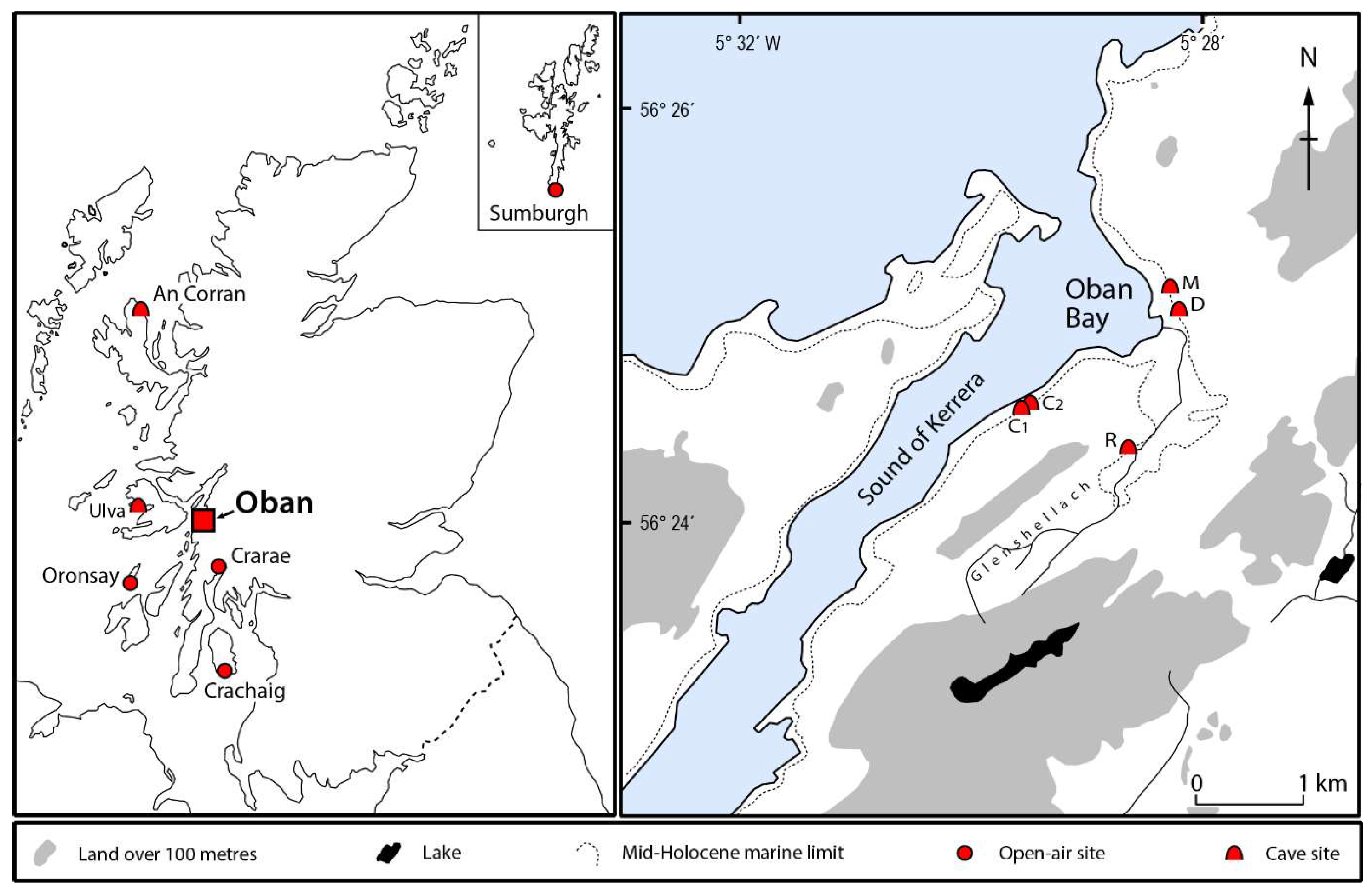
Figure 2.
Locations of sites providing the food source δ13C and δ15N data presented in Table 5. 1. Braes of Ha’Breck; 2. Skara Brae; 3. An Corran; 4. Balbridie, 5. Bornish; 6. Ulva Cave; 7. Aird’s Bay, Loch Etive; 8. Carding Mill Bay and Raschoille, Oban; 9. Caisteal nan Gillean and Cnoc Coig, Oronsay.
Figure 2.
Locations of sites providing the food source δ13C and δ15N data presented in Table 5. 1. Braes of Ha’Breck; 2. Skara Brae; 3. An Corran; 4. Balbridie, 5. Bornish; 6. Ulva Cave; 7. Aird’s Bay, Loch Etive; 8. Carding Mill Bay and Raschoille, Oban; 9. Caisteal nan Gillean and Cnoc Coig, Oronsay.
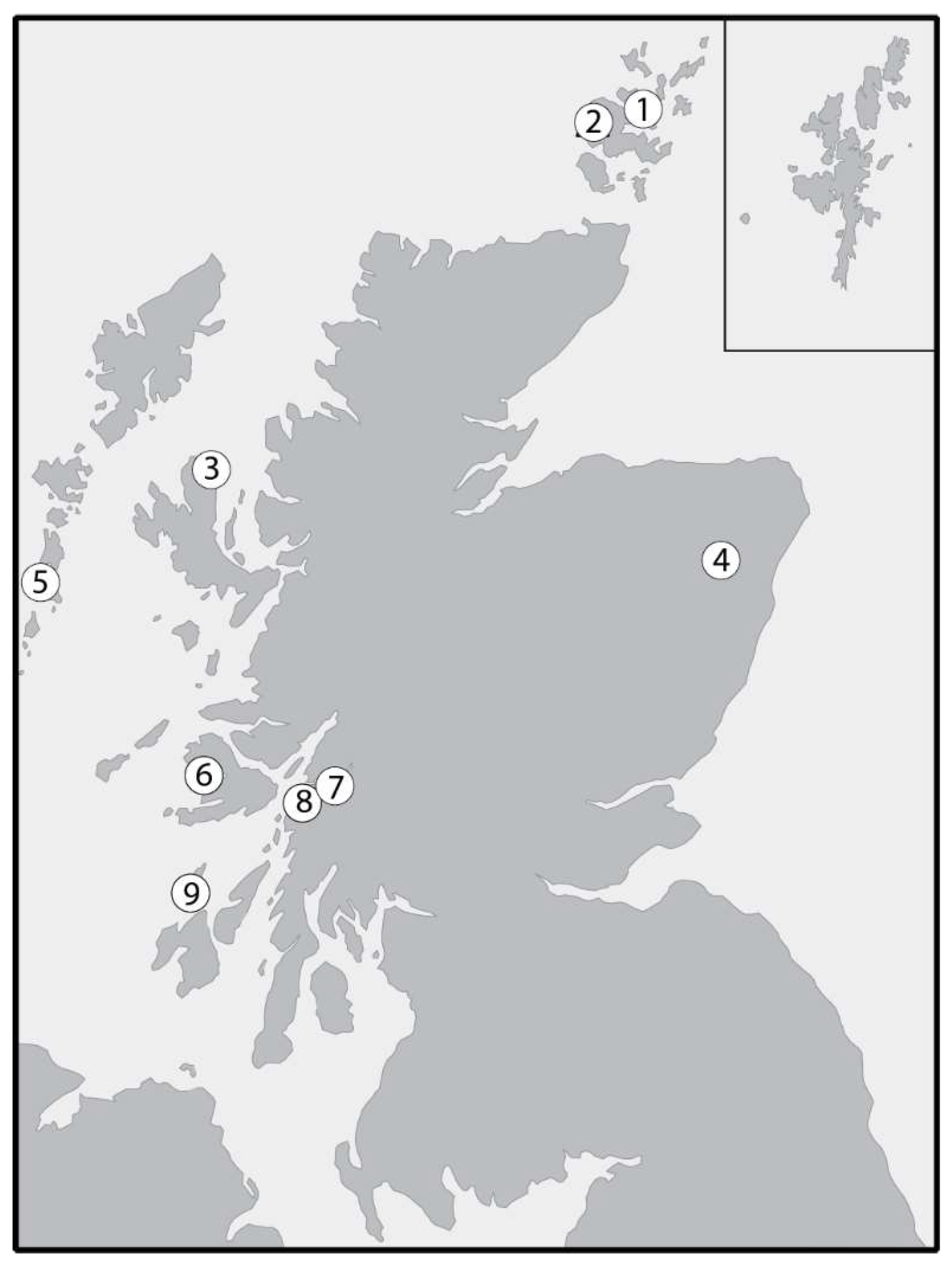
Figure 4.
FRUITS dietary models for Neolithic individuals from western Scotland grouped by food source. The solid line represents the median estimated food source contribution to dietary calories, the dotted line shows the mean estimated contribution, the box shows the 68% credible interval (CI); and the whiskers the 95% CI.
Figure 4.
FRUITS dietary models for Neolithic individuals from western Scotland grouped by food source. The solid line represents the median estimated food source contribution to dietary calories, the dotted line shows the mean estimated contribution, the box shows the 68% credible interval (CI); and the whiskers the 95% CI.
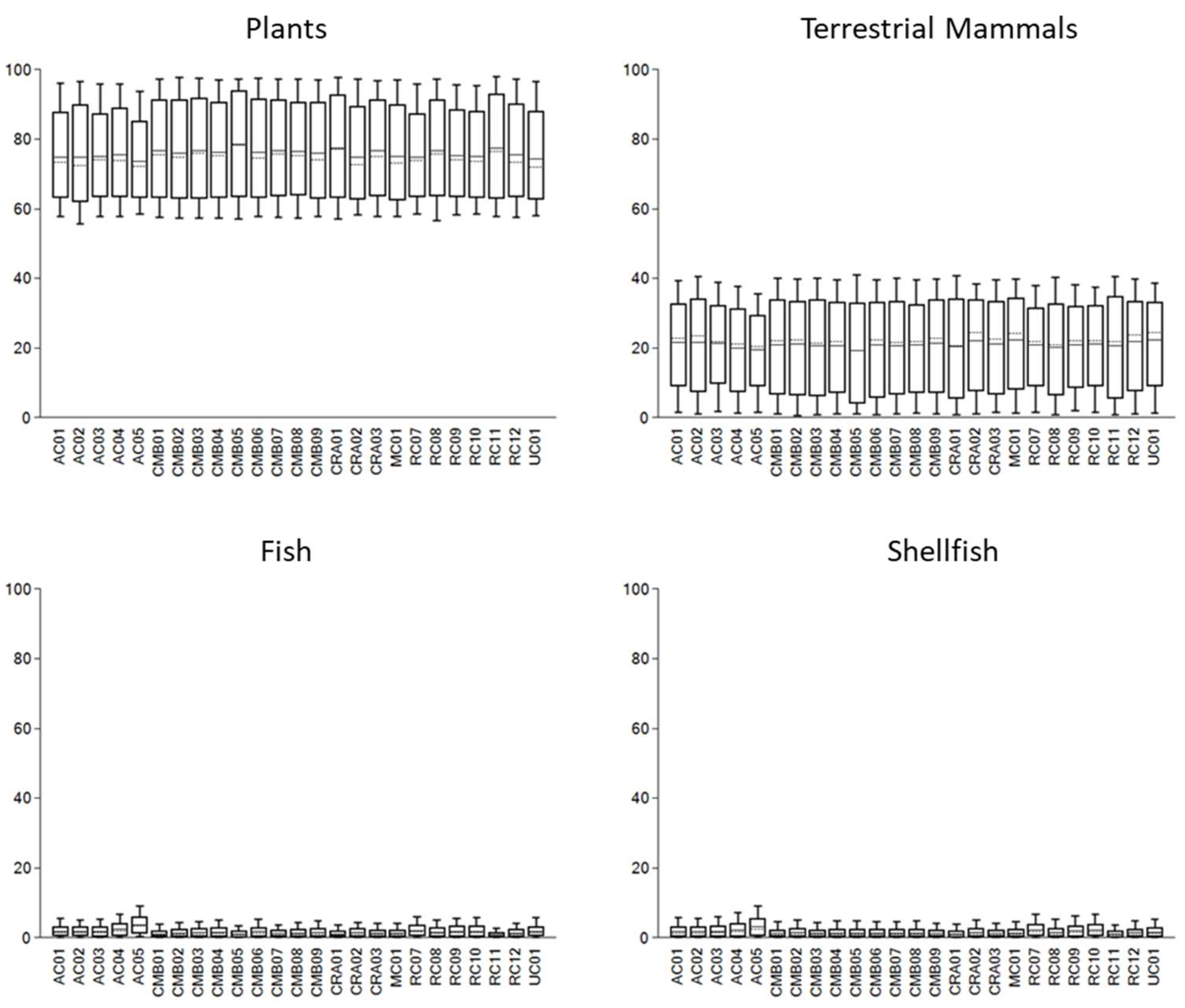
Figure 3.
The proportion of hunter-gatherer (WHG)/Early European Farmer (EEF) ancestry vs median date of the Mesolithic individual from Cnoc Coig (filled square) and Neolithic individuals (open circles) from western Scotland. Median 14C dates were calculated using OxCal 4.4 (Bronk Ramsey 2021) and the IntCal20 dataset (Reimer et al. 2020) and are the mean of the upper and lower boundaries for contextual dates.
Figure 3.
The proportion of hunter-gatherer (WHG)/Early European Farmer (EEF) ancestry vs median date of the Mesolithic individual from Cnoc Coig (filled square) and Neolithic individuals (open circles) from western Scotland. Median 14C dates were calculated using OxCal 4.4 (Bronk Ramsey 2021) and the IntCal20 dataset (Reimer et al. 2020) and are the mean of the upper and lower boundaries for contextual dates.
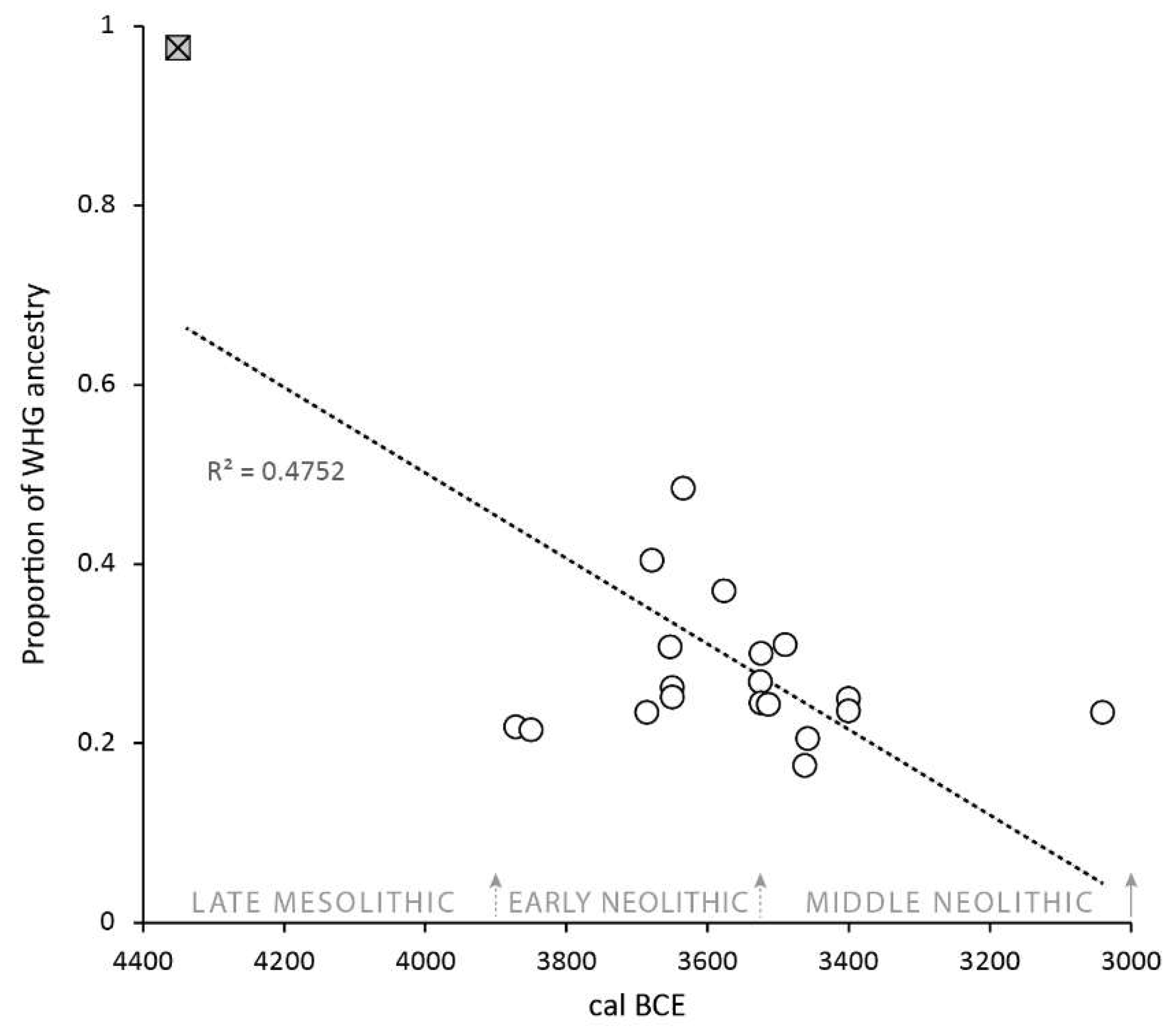

Table 1.
14C dates of Neolithic individuals for whom aDNA has been sequenced (data from Patterson et al. 2022; see also Olalde et al. 2018). The DNA of a minimum number of 19 individuals has been sequenced. While there are 20 samples listed, I2658 and I2657 from MacArthur Cave may be duplicates or, alternatively, first-degree relatives. Individuals I12314 and I12313 may be first-degree relatives. Individual I12313, from Carding Mill Bay 2, is dated by association with two other individuals for whom 14C determinations are available (I12314 and I12317). 14C dates are calibrated to 2σ (95.4% CI) and rounded outwards to the nearest 10 years. The median age is as reported by OxCal for the 14C dates and is the mean of the upper and lower limits for contextual/associated dates. See Figure 1 for site locations.
Table 1.
14C dates of Neolithic individuals for whom aDNA has been sequenced (data from Patterson et al. 2022; see also Olalde et al. 2018). The DNA of a minimum number of 19 individuals has been sequenced. While there are 20 samples listed, I2658 and I2657 from MacArthur Cave may be duplicates or, alternatively, first-degree relatives. Individuals I12314 and I12313 may be first-degree relatives. Individual I12313, from Carding Mill Bay 2, is dated by association with two other individuals for whom 14C determinations are available (I12314 and I12317). 14C dates are calibrated to 2σ (95.4% CI) and rounded outwards to the nearest 10 years. The median age is as reported by OxCal for the 14C dates and is the mean of the upper and lower limits for contextual/associated dates. See Figure 1 for site locations.
| Site | ID | Sex | Date type | Lab Code | 14C (BP) | Calendar years (cal BCE/BCE) | Median (cal BCE/BCE) | Ancestry |
| MacArthur Cave | I2657 | M | 14C | SUERC-68701 | 5052±30 | 3960-3770 | 3872 | Farmer |
| MacArthur Cave | I2658 | M | Contextual | n/a | n/a | 4000-3700 | 3850 | Farmer |
| Distillery Cave | I2659 | F | 14C | SUERC-68702 | 4914±27 | 3770-3640 | 3686 | Farmer |
| Ulva Cave | I12312 | M | 14C | PSUAMS-5771 | 4895±25 | 3760-3630 | 3679 | Admixed farmer/hunter-gatherer |
| Distillery Cave | I2691 | M | 14C | SUERC-68704 | 4881±25 | 3710-3630 | 3653 | Admixed farmer/hunter-gatherer |
| Raschoille Cave | I5370 | F | Contextual | n/a | n/a | 4000-3300 | 3650 | Farmer |
| Raschoille Cave | I5371 | F | Contextual | n/a | n/a | 4000-3300 | 3650 | Farmer |
| Carding Mill Bay 2 | I12314 | F | 14C | PSUAMS-5772 PSUAMS-5773 PSUAMS-5774 PSUAMS-5776 |
4832±14 | 3650-3530 | 3634 | Admixed farmer/hunter-gatherer |
| Raschoille Cave | I3135 | M | 14C | PSUAMS-2068 | 4770±30 | 3640-3380 | 3576 | Admixed farmer/hunter-gatherer |
| Carding Mill Bay 2 | I12313 | F | Contextual | n/a | n/a | 3700-3350 | 3525 | Admixed farmer/hunter-gatherer |
| Raschoille Cave | I3134 | M | 14C | PSUAMS-2155 | 4730±25 | 3630-3370 | 3524 | Farmer |
| Carding Mill Bay 2 | I12317 | M | 14C | PSUAMS-5775 | 4725±25 | 3630-3370 | 3524 | Admixed farmer/hunter-gatherer |
| Raschoille Cave | I3133 | M | 14C | PSUAMS-2154 | 4725±20 | 3630-3370 | 3514 | Farmer |
| Raschoille Cave | I3041 | M | Contextual | n/a | n/a | 3950-3030 | 3490 | Admixed farmer/hunter-gatherer |
| Raschoille Cave | I3136 | F | 14C | PSUAMS-2069 | 4665±30 | 3520-3370 | 3450 | Farmer |
| Clachaig | I2988 | F | 14C | SUERC-68711 | 4645±29 | 3520-3360 | 3458 | Farmer |
| Distillery Cave | I2660 | M | 14C | SUERC-68703 | 4631±29 | 3520-3350 | 3462 | Admixed farmer/hunter-gatherer |
| Raschoille Cave | I3137 | M | Contextual | n/a | n/a | 3800-3000 | 3400 | Farmer |
| Raschoille Cave | I3139_d | F | Contextual | n/a | n/a | 3800-3000 | 3400 | Admixed farmer/hunter-gatherer |
| Raschoille Cave | I3138 | F | 14C | PSUAMS-2156 | 4415±25 | 3320-2920 | 3040 | Farmer |
Table 2.
Parameters used by Schulting et al. (2023) to generate two dietary models (one using a manured cereal δ15N, the other using an unmanured cereal δ15N) for Late Neolithic individual Carding Mill Bay 1 OxA-7890. The young herbivore value was calculated from the terrestrial herbivore value with a ‘nursing’ offset applied – see Schulting et al. (2023: 3).
Table 2.
Parameters used by Schulting et al. (2023) to generate two dietary models (one using a manured cereal δ15N, the other using an unmanured cereal δ15N) for Late Neolithic individual Carding Mill Bay 1 OxA-7890. The young herbivore value was calculated from the terrestrial herbivore value with a ‘nursing’ offset applied – see Schulting et al. (2023: 3).
| Parameter | Model | Description |
| Δ15Ndiet-consumer | Both | 4.6±0.5‰ |
| Δ13Cdiet-consumer | Both | 4.8±0.5‰ |
| Manured cereals δ13C and δ15N | Model A | δ13Cprotein = 26±1.0‰ and δ15Nmanured = 5.0±2.0‰ |
| Unmanured cereals δ13C and δ15N | Model B | δ13Cprotein = 26±1.0‰ and δ15Nmanured = 3.0±1.0‰ |
| Terrestrial herbivores δ13C and δ15N | Both | Terrestrial herbivores δ13Cprotein = − 24.7 ± 0.1‰ and δ15N = 3.4 ± 0.1‰ |
| Young herbivores δ13C and δ15N | Both | Young herbivores δ13Cprotein = − 23.7 ± 0.1‰ and δ15N = 5.4 ± 0.1‰ |
Table 3.
Carding Mill Bay 1, Model A: Manured cereals. Protein sources routed to collagen (% mean estimate ± standard deviation and 68% credible intervals). Context information as presented by Connock et al. (1991).
Table 3.
Carding Mill Bay 1, Model A: Manured cereals. Protein sources routed to collagen (% mean estimate ± standard deviation and 68% credible intervals). Context information as presented by Connock et al. (1991).
| Site | Context | Individual | Terrestrial herbivore | Young herbivore | Cereals | |||
| Mean % | CI (68%) | Mean % | CI (68%) | Mean % | CI (68%) | |||
| CMB 1 | XXIII | OxA-7890 | 24±16 | 7-41 | 18±14 | 5-33 | 58±17 | 41-76 |
| CMB 1 | VII | OxA-7665 | 22±16 | 5-40 | 17±13 | 4-31 | 60±16 | 43-78 |
| CMB 1 | XV | OxA-7664 | 35±22 | 11-58 | 20±15 | 5-36 | 45±21 | 23-68 |
| CMB 1 | XIV | OxA-7663 | 26±19 | 7-46 | 16±13 | 4-29 | 58±19 | 38-77 |
Table 4.
Carding Mill Bay 1, Model B: Non-manured cereals. Protein sources routed to collagen (% mean estimate ± standard deviation and 68% credible intervals). Context information as presented by Connock et al. (1991).
Table 4.
Carding Mill Bay 1, Model B: Non-manured cereals. Protein sources routed to collagen (% mean estimate ± standard deviation and 68% credible intervals). Context information as presented by Connock et al. (1991).
| Site | Context | Individual | Terrestrial herbivore | Young herbivore | Cereals | |||
| Mean % | CI (68%) | Mean % | CI (68%) | Mean % | CI (68%) | |||
| CMB 1 | XXIII | OxA-7890 | 17±14 | 4-31 | 27±16 | 9-44 | 56±17 | 41-76 |
| CMB 1 | VII | OxA-7665 | 17±14 | 4-31 | 23±15 | 4-31 | 60±17 | 43-78 |
| CMB 1 | XV | OxA-7664 | 28±20 | 7-49 | 25±15 | 9-42 | 47±18 | 29-66 |
| CMB 1 | XIV | OxA-7663 | 22±17 | 5-41 | 20±14 | 6-35 | 57±17 | 40-76 |
Table 5.
Food source δ13C and δ15N data used in the FRUITS models. The δ13C and δ15N of the archaeological plant specimens have been corrected for charring, and the modern samples have been corrected for the Suess effect (Keeling 2017; and see Pickard and Bonsall 2022).
Table 5.
Food source δ13C and δ15N data used in the FRUITS models. The δ13C and δ15N of the archaeological plant specimens have been corrected for charring, and the modern samples have been corrected for the Suess effect (Keeling 2017; and see Pickard and Bonsall 2022).
| Site | Date | Species | Common Name | δ13C ‰ | δ15N ‰ | C:N | Lab/Specimen ID | Reference |
|---|---|---|---|---|---|---|---|---|
| TERRESTRIAL MAMMALS | ||||||||
| An Corran | Mesolithic/Neolithic | Bos | Cattle | -22.2 | 1.6 | Milner and Craig 2009 | ||
| An Corran | Mesolithic/Neolithic | Bos | Cattle | -22.0 | 1.7 | Milner and Craig 2009 | ||
| Carding Mill Bay 1 | Neolithic | Bos taurus (probable) | Cattle | -23.3 | 3.5 | 3.3 | GU39625 (XIV) | Bownes 2018 |
| Carding Mill Bay 1 | Neolithic | Bos taurus (probable) | Cattle | -23.2 | 3.3 | 3.3 | GU39626 (XIV) | Bownes 2018 |
| Carding Mill Bay 1 | Neolithic | Bos taurus (probable) | Cattle | -23.3 | 3.5 | 3.3 | GU39627 (XIV) | Bownes 2018 |
| Carding Mill Bay 1 | Neolithic | Bos taurus (probable) | Cattle | -23.4 | 3.4 | 3.3 | GU39628 (XIV) | Bownes 2018 |
| Carding Mill Bay 1 | Neolithic | Bos taurus (probable) | Cattle | -22.6 | 3.8 | 3.3 | GU39629 (XV) | Bownes 2018 |
| Carding Mill Bay 1 | Neolithic | Bos taurus (probable) | Cattle | -23.3 | 4.2 | 3.3 | GU39630 (XV) | Bownes 2018 |
| Carding Mill Bay 1 | Neolithic | Bos taurus (probable) | Cattle | -23.4 | 3.4 | 3.3 | GU39631 (XV) | Bownes 2018 |
| Carding Mill Bay 1 | Neolithic | Bos taurus (probable) | Cattle | -22.0 | 3.0 | 3.3 | GU39632 (XV) | Bownes 2018 |
| An Corran | Mesolithic/Neolithic | Cervus elaphus | Red deer | -21.2 | 1.0 | Milner and Craig 2009 | ||
| An Corran | Mesolithic/Neolithic | Cervus elaphus | Red deer | -22.5 | 2.4 | Milner and Craig 2009 | ||
| Carding Mill Bay 1 | Neolithic | Cervus elaphus | Red deer | -23.2 | 3.0 | 3.4 | GUsi3509 (XVII) | Bownes 2018 |
| Carding Mill Bay 1 | Neolithic | Cervus elaphus | Red deer | -21.9 | 2.0 | CVII:123 | Schulting and Richards 2002 | |
| Carding Mill Bay 1 | Neolithic | Cervus elaphus | Red deer | -22.9 | 2.5 | C XVII:4 | Schulting and Richards 2002 | |
| Raschoille Cave | 7640±80 BP | Cervus elaphus | Red deer | -21.8 | 2.9 | OxA-8396 | Pickard and Bonsall 2022 | |
| Raschoille Cave | 7575±75 BP | Cervus elaphus | Red deer | -21.5 | 2.8 | OxA-8397 | Pickard and Bonsall 2022 | |
| Raschoille Cave | 7480±75 BP | Cervus elaphus | Red deer | -21.6 | 2.6 | OxA-8398 | Pickard and Bonsall 2022 | |
| Ulva Cave | Mesolithic | Cervus elaphus | Red deer | -22.8 | 2.6 | 3.4 | GUsi8894 | this study |
| Carding Mill Bay 1 | Neolithic | Cervus elaphus/Bos taurus | Red deer/Cattle | -23.2 | 3.7 | 3.3 | GUsi3505 | Bownes et al. 2017 |
| Carding Mill Bay 1 | Neolithic | Cervus elaphus/Bos taurus | Red deer/Cattle | -22.5 | 2.4 | 3.2 | GUsi3506 | Bownes et al. 2017 |
| Carding Mill Bay 1 | Neolithic | Cervus elaphus/Bos taurus | Red deer/Cattle | -23.2 | 2.3 | 3.2 | GUsi3508 | Bownes et al. 2017 |
| Carding Mill Bay 1 | Neolithic | Cervus elaphus/Bos taurus | Red deer/Cattle | -22.8 | 3.9 | 3.2 | GUsi3511 | Bownes et al. 2017 |
| Carding Mill Bay 1 | Neolithic | Ovis aries/Capreolus capreolus | Sheep/Roe deer | -21.6 | 3.5 | 3.2 | GUsi3497 | Bownes et al. 2017 |
| Carding Mill Bay 1 | Neolithic | Ovis aries/Capreolus capreolus | Sheep/Roe deer | -22.9 | 3.7 | 3.2 | GUsi3507 | Bownes et al. 2017 |
| Carding Mill Bay 1 | Neolithic | Ovis aries/Capreolus capreolus | Sheep/Roe deer | -23.3 | 3.4 | 3.2 | GUsi3498 | Bownes et al. 2017 |
| Carding Mill Bay 1 | Neolithic | Ovis aries/Capreolus capreolus | Sheep/Roe deer | -22.8 | 2.8 | 3.5 | GUsi3500 | Bownes et al. 2017 |
| Carding Mill Bay 1 | Neolithic | Ovis aries/Capreolus capreolus | Sheep/Roe deer | -23.1 | 3.1 | 3.5 | GUsi3501 | Bownes et al. 2017 |
| Carding Mill Bay 1 | Neolithic | Ovis aries/Capreolus capreolus | Sheep/Roe deer | -22.8 | 2.8 | 3.6 | GUsi3502 | Bownes et al. 2017 |
| Carding Mill Bay 1 | Neolithic | Ovis aries/Capreolus capreolus | Sheep/Roe deer | -22.5 | 2.7 | 3.4 | GUsi3503 | Bownes et al. 2017 |
| Carding Mill Bay 1 | Neolithic | Ovis aries/Capreolus capreolus | Sheep/Roe deer | -22.5 | 3.1 | 3.2 | GUsi3504 | Bownes et al. 2017 |
| Ulva Cave | Mesolithic | Ovis aries/Capreolus capreolus | Sheep/Roe deer | -22.8 | 2.3 | 3.4 | GUsi8895 | this study |
| An Corran | Mesolithic/Neolithic | Sus | Pig | -22.3 | 2.3 | Milner and Craig 2009 | ||
| An Corran | Mesolithic/Neolithic | Sus | Pig | -22.6 | 3.3 | Milner and Craig 2009 | ||
| An Corran | Mesolithic/Neolithic | Sus | Pig | -21.7 | 4.1 | Milner and Craig 2009 | ||
| Carding Mill Bay 1 | Neolithic | Sus | Pig | -21.9 | 3.2 | C XXIV:2 | Schulting and Richards 2002 | |
| Cnoc Coig | Mesolithic | Sus | Pig | -21.2 | 4.3 | Charlton et al. 2016 | ||
| Cnoc Coig | Mesolithic | Sus | Pig | -21.0 | 4.6 | Charlton et al. 2016 | ||
| Cnoc Coig | Mesolithic | Sus | Pig | -18.8 | 10.2 | Charlton et al. 2016 | ||
| Ulva Cave | Mesolithic | Sus | Pig | -21.9 | 6.5 | 3.3 | GUsi8896 | this study |
| MARINE RESOURCES - ARCHAEOLOGICAL SPECIMENS | ||||||||
| Ulva Cave | Mesolithic | Dicentrarchus labrax | Seabass | -12.6 | 13.4 | 3.2 | GUsi8897 | this study |
| An Corran | Mesolithic/Neolithic | Gadus morhua | Cod | -13.6 | 15.3 | 0055-r | Milner and Craig 2012 | |
| Bornish | 12th-13th C. AD | Gadus morhua | Cod | -12.9 | 14.5 | 703 | Barrett et al. 2011 | |
| Bornish | 13th C. AD | Gadus morhua | Cod | -11.3 | 15.4 | 706 | Barrett et al. 2011 | |
| Bornish | 13th C. AD | Gadus morhua | Cod | -13.1 | 13.8 | 708 | Barrett et al. 2011 | |
| Bornish | 12th-13th C. AD | Gadus morhua | Cod | -13.2 | 13.8 | 713 | Barrett et al. 2011 | |
| Ulva Cave | Mesolithic | Labrus bergylta | Ballan wrasse | -16.0 | 11.8 | 3.4 | GUsi8900 | this study |
| Ulva Cave | Mesolithic | Labrus sp. | Wrasse | -12.6 | 14.1 | 3.3 | GUsi8898 | this study |
| Ulva Cave | Mesolithic | Labrus sp. | Wrasse | -12.1 | 14.6 | 3.2 | GUsi8902 | this study |
| Ulva Cave | Mesolithic | Pollachius virens | Saithe | -12.2 | 13.6 | 3.2 | GUsi8899 | this study |
| Ulva Cave | Mesolithic | Pollachius virens | Saithe | -13.4 | 12.1 | 3.2 | GUsi8901 | this study |
| Carding Mill Bay 1 | Mesolithic/Neolithic | Lutra lutra | Otter | -12.0 | 16.0 | C VI:21 | Schulting and Richards 2002 | |
| Caisteal nan Gillean | Mesolithic | Halichoerus grypus | Grey seal | -11.9 | 19.1 | n/a | Richards and Mellars 1998 | |
| Cnoc Coig | Mesolithic | Pinniped | Seal | -11.6 | 18.8 | 10502 | Charlton et al. 2016 | |
| Cnoc Coig | Mesolithic | Pinniped | Seal | -11.8 | 19.5 | 10420 | Charlton et al. 2016 | |
| Airds Bay, Loch Etive | Modern - flesh | Patella | Limpet | -14.1 | 6.3 | GUsi3201/3208 | Bownes 2018 | |
| Airds Bay, Loch Etive | Modern - flesh | Patella | Limpet | -15.0 | 6.7 | GUsi3202/3209 | Bownes 2018 | |
| Airds Bay, Loch Etive | Modern - flesh | Patella | Limpet | -15.1 | 6.3 | GUsi3204/3211 | Bownes 2018 | |
| Airds Bay, Loch Etive | Modern - flesh | Patella | Limpet | -15.0 | 7.1 | GUsi3205/3212 | Bownes 2018 | |
| Airds Bay, Loch Etive | Modern - flesh | Patella | Limpet | -14.0 | 7.0 | GUsi3206/3213 | Bownes 2018 | |
| Airds Bay, Loch Etive | Modern - flesh | Patella | Limpet | -15.2 | 6.7 | GUsi3207/3214 | Bownes 2018 | |
| Oban, Scotland | Modern - flesh | Patella | Limpet | -13.6 | 7.8 | GUsi3215/3221 | Bownes 2018 | |
| Oban, Scotland | Modern - flesh | Patella | Limpet | -15.5 | 6.9 | GUsi3216/3222 | Bownes 2018 | |
| Oban, Scotland | Modern - flesh | Patella | Limpet | -14.7 | 6.2 | GUsi3217/3223 | Bownes 2018 | |
| Oban, Scotland | Modern - flesh | Littorina | Periwinkle | -15.3 | 11.7 | GUsi3446/3598 | Bownes 2018 | |
| Oban, Scotland | Modern - flesh | Littorina | Periwinkle | -13.3 | 8.5 | GUsi3451/3603 | Bownes 2018 | |
| PLANTS | ||||||||
| Ulva Cave | Mesolithic | Corylus avellana | Hazelnut (shell) | -26.0 | 9.3 | UA1 | this study | |
| Ulva Cave | Mesolithic | Corylus avellana | Hazelnut (shell) | -24.9 | 7.4 | UA2 | this study | |
| Ulva Cave | Mesolithic | Corylus avellana | Hazelnut (shell) | -27.2 | 8.0 | UA3 | this study | |
| Ulva Cave | Mesolithic | Corylus avellana | Hazelnut (shell) | -25.6 | 5.6 | UA4 | this study | |
| Ulva Cave | Mesolithic | Corylus avellana | Hazelnut (shell) | -24.6 | 6.2 | UA5 | this study | |
| Ulva Cave | Mesolithic | Corylus avellana | Hazelnut (shell) | -25.1 | 5.7 | UMS1 RW | this study | |
| Ulva Cave | Mesolithic | Corylus avellana | Hazelnut (shell) | -23.9 | 0.9 | UMS2 RW | this study | |
| Ulva Cave | Mesolithic | Corylus avellana | Hazelnut (shell) | -25.0 | -1.2 | UMS3 RW | this study | |
| Ulva Cave | Mesolithic | Corylus avellana | Hazelnut (shell) | -27.9 | -1.0 | UMS4 RW | this study | |
| Ulva Cave | Mesolithic | Corylus avellana | Hazelnut (shell) | -27.0 | 0.5 | UMS5 RW | this study | |
| Ulva Cave | Mesolithic | Corylus avellana | Hazelnut (shell) | -25.0 | 3.4 | UMS6 RW | this study | |
| Balbridie | Neolithic | Hordeum vulgare | Naked barley | -24.6 | 0.6 | 24.4 | BB F40 IS.1 | Bishop et al. 2022 |
| Balbridie | Neolithic | Hordeum vulgare | Naked barley | -23.1 | 0.1 | 36.0 | BB F40 IS.2 | Bishop et al. 2022 |
| Balbridie | Neolithic | Hordeum vulgare | Naked barley | -24.5 | 0.8 | 32.0 | BB F40 IS.3 | Bishop et al. 2022 |
| Balbridie | Neolithic | Hordeum vulgare | Naked barley | -24.6 | -1.6 | 37.2 | BB F40 IS.4 | Bishop et al. 2022 |
| Balbridie | Neolithic | Hordeum vulgare | Naked barley | -23.8 | 2.3 | 30.2 | BB F40 IS.5 | Bishop et al. 2022 |
| Balbridie | Neolithic | Hordeum vulgare | Naked barley | -24.8 | 1.4 | 27.0 | BB F40 IS.6 | Bishop et al. 2022 |
| Balbridie | Neolithic | Hordeum vulgare | Naked barley | -24.4 | 1.1 | 25.4 | BB F40 IS.7 | Bishop et al. 2022 |
| Balbridie | Neolithic | Hordeum vulgare | Naked barley | -24.1 | 3.0 | 27.7 | BB F40 IS.8 | Bishop et al. 2022 |
| Balbridie | Neolithic | Hordeum vulgare | Naked barley | -25.2 | 1.4 | 29.3 | BB F40 IS.9 | Bishop et al. 2022 |
| Balbridie | Neolithic | Hordeum vulgare | Naked barley | -22.7 | 1.5 | 27.8 | BB F40 IS.10 | Bishop et al. 2022 |
| Balbridie | Neolithic | Hordeum vulgare | Naked barley | -24.4 | 0.4 | 30.0 | BB F294 IS.32 | Bishop et al. 2022 |
| Balbridie | Neolithic | Hordeum vulgare | Naked barley | -23.9 | 0.5 | 35.5 | BB F294 IS.33 | Bishop et al. 2022 |
| Balbridie | Neolithic | Hordeum vulgare | Naked barley | -25.2 | 0.5 | 26.1 | BB F294 IS.34 | Bishop et al. 2022 |
| Balbridie | Neolithic | Hordeum vulgare | Naked barley | -25.2 | 0.0 | 33.0 | BB F294 IS.35 | Bishop et al. 2022 |
| Balbridie | Neolithic | Hordeum vulgare | Naked barley | -25.2 | 1.3 | 31.0 | BB F294 IS.36 | Bishop et al. 2022 |
| Balbridie | Neolithic | Hordeum vulgare | Naked barley | -23.5 | -0.2 | 28.2 | BB F294 IS.37 | Bishop et al. 2022 |
| Balbridie | Neolithic | Hordeum vulgare | Naked barley | -23.5 | -1.6 | 27.5 | BB F294 IS.38 | Bishop et al. 2022 |
| Balbridie | Neolithic | Hordeum vulgare | Naked barley | -24.6 | 0.9 | 31.0 | BB F294 IS.39 | Bishop et al. 2022 |
| Balbridie | Neolithic | Hordeum vulgare | Naked barley | -24.6 | 2.4 | 27.7 | BB F294 IS.40 | Bishop et al. 2022 |
| Balbridie | Neolithic | Hordeum vulgare | Naked barley | -24.8 | -1.3 | 30.7 | BB F294 IS.41 | Bishop et al. 2022 |
| Skara Brae | Neolithic | Hordeum vulgare | Naked barley | -21.6 | 4.0 | 18.8 | SB C.168 IS.1 | Bishop et al. 2022 |
| Skara Brae | Neolithic | Hordeum vulgare | Naked barley | -23.0 | 2.5 | 25.9 | SB C.168 IS.2 | Bishop et al. 2022 |
| Skara Brae | Neolithic | Hordeum vulgare | Naked barley | -22.7 | 2.5 | 19.5 | SB C.168 IS.3 | Bishop et al. 2022 |
| Skara Brae | Neolithic | Hordeum vulgare | Naked barley | -23.1 | 4.0 | 17.7 | SB C.168 IS.4 | Bishop et al. 2022 |
| Skara Brae | Neolithic | Hordeum vulgare | Naked barley | -22.7 | 4.1 | 23.3 | SB C.168 IS.5 | Bishop et al. 2022 |
| Skara Brae | Neolithic | Hordeum vulgare | Naked barley | -21.0 | 3.1 | 12.3 | SB C.168 IS.6 | Bishop et al. 2022 |
| Skara Brae | Neolithic | Hordeum vulgare | Naked barley | -22.8 | 2.2 | 21.7 | SB C.168 IS.7 | Bishop et al. 2022 |
| Skara Brae | Neolithic | Hordeum vulgare | Naked barley | -22.4 | 5.3 | 17.0 | SB C.168 IS.8 | Bishop et al. 2022 |
| Skara Brae | Neolithic | Hordeum vulgare | Naked barley | -22.3 | 4.5 | 26.0 | SB C.168 IS.9 | Bishop et al. 2022 |
| Skara Brae | Neolithic | Hordeum vulgare | Naked barley | -23.8 | 3.2 | 19.7 | SB C.168 IS.10 | Bishop et al. 2022 |
| Braes of Ha'Breck | Neolithic | Hordeum vulgare | Naked barley | -23.1 | 7.3 | 17.0 | BOH S.506.8 IS1 | Bishop et al. 2022 |
| Braes of Ha'Breck | Neolithic | Hordeum vulgare | Naked barley | -22.1 | 0.2 | 24.7 | BOH S.506.8 IS2 | Bishop et al. 2022 |
| Braes of Ha'Breck | Neolithic | Hordeum vulgare | Naked barley | -24.0 | 1.1 | 22.7 | BOH S.506.8 IS3 | Bishop et al. 2022 |
| Braes of Ha'Breck | Neolithic | Hordeum vulgare | Naked barley | -24.3 | 1.2 | 27.0 | BOH S.506.8 IS4 | Bishop et al. 2022 |
| Braes of Ha'Breck | Neolithic | Hordeum vulgare | Naked barley | -24.1 | 3.8 | 19.8 | BOH S.506.8 IS5 | Bishop et al. 2022 |
| Braes of Ha'Breck | Neolithic | Hordeum vulgare | Naked barley | -24.3 | 1.5 | 30.8 | BOH S.506.8 IS6 | Bishop et al. 2022 |
| Braes of Ha'Breck | Neolithic | Hordeum vulgare | Naked barley | -23.4 | 3.9 | 17.8 | BOH S.506.8 IS7 | Bishop et al. 2022 |
| Braes of Ha'Breck | Neolithic | Hordeum vulgare | Naked barley | -23.3 | 5.9 | 20.1 | BOH S.506.8 IS8 | Bishop et al. 2022 |
| Braes of Ha'Breck | Neolithic | Hordeum vulgare | Naked barley | -25.3 | 5.9 | 28.7 | BOH S.506.8 IS9 | Bishop et al. 2022 |
| Braes of Ha'Breck | Neolithic | Hordeum vulgare | Naked barley | -24.1 | 3.3 | 18.7 | BOH S.506.8 IS10 | Bishop et al. 2022 |
| Braes of Ha'Breck | Neolithic | Hordeum vulgare | Naked barley | -24.0 | 1.7 | 31.7 | BOH S.124 IS1 | Bishop et al. 2022 |
| Braes of Ha'Breck | Neolithic | Hordeum vulgare | Naked barley | -23.2 | 5.1 | 28.1 | BOH S.124 IS2 | Bishop et al. 2022 |
| Braes of Ha'Breck | Neolithic | Hordeum vulgare | Naked barley | -22.5 | 4.0 | 27.6 | BOH S.124 IS3 | Bishop et al. 2022 |
| Braes of Ha'Breck | Neolithic | Hordeum vulgare | Naked barley | -23.2 | 3.5 | 25.2 | BOH S.124 IS4 | Bishop et al. 2022 |
| Braes of Ha'Breck | Neolithic | Hordeum vulgare | Naked barley | -23.9 | 2.6 | 31.3 | BOH S.124 IS5 | Bishop et al. 2022 |
| Braes of Ha'Breck | Neolithic | Hordeum vulgare | Naked barley | -23.2 | 3.0 | 22.8 | BOH S.124 IS6 | Bishop et al. 2022 |
| Braes of Ha'Breck | Neolithic | Hordeum vulgare | Naked barley | -23.9 | 4.1 | 30.5 | BOH S.124 IS7 | Bishop et al. 2022 |
| Braes of Ha'Breck | Neolithic | Hordeum vulgare | Naked barley | -24.2 | 2.2 | 22.1 | BOH S.124 IS8 | Bishop et al. 2022 |
| Braes of Ha'Breck | Neolithic | Hordeum vulgare | Naked barley | -23.9 | 1.0 | 21.8 | BOH S.124 IS9 | Bishop et al. 2022 |
| Braes of Ha'Breck | Neolithic | Hordeum vulgare | Naked barley | -24.0 | 2.7 | 21.9 | BOH S.124 IS10 | Bishop et al. 2022 |
| Braes of Ha'Breck | Neolithic | Hordeum vulgare | Naked barley | -23.1 | 5.7 | 14.0 | BOH S.168 IS1 | Bishop et al. 2022 |
| Braes of Ha'Breck | Neolithic | Hordeum vulgare | Naked barley | -22.9 | 3.8 | 21.4 | BOH S.168 IS2 | Bishop et al. 2022 |
| Braes of Ha'Breck | Neolithic | Hordeum vulgare | Naked barley | -24.2 | 6.1 | 19.3 | BOH S.168 IS3 | Bishop et al. 2022 |
| Braes of Ha'Breck | Neolithic | Hordeum vulgare | Naked barley | -24.9 | 4.5 | 27.3 | BOH S.168 IS4 | Bishop et al. 2022 |
| Braes of Ha'Breck | Neolithic | Hordeum vulgare | Naked barley | -24.0 | 3.5 | 11.6 | BOH S.168 IS5 | Bishop et al. 2022 |
| Braes of Ha'Breck | Neolithic | Hordeum vulgare | Naked barley | -24.5 | 3.8 | 22.7 | BOH S.168 IS6 | Bishop et al. 2022 |
| Braes of Ha'Breck | Neolithic | Hordeum vulgare | Naked barley | -23.8 | 7.6 | 15.7 | BOH S.168 IS7 | Bishop et al. 2022 |
| Braes of Ha'Breck | Neolithic | Hordeum vulgare | Naked barley | -25.1 | 4.1 | 28.8 | BOH S.168 IS8 | Bishop et al. 2022 |
| Braes of Ha'Breck | Neolithic | Hordeum vulgare | Naked barley | -22.9 | 2.3 | 27.9 | BOH S.168 IS9 | Bishop et al. 2022 |
| Braes of Ha'Breck | Neolithic | Hordeum vulgare | Naked barley | -23.9 | 1.7 | 29.7 | BOH S.168 IS10 | Bishop et al. 2022 |
| Braes of Ha'Breck | Neolithic | Hordeum vulgare | Naked barley | -24.1 | 0.3 | 23.6 | BOH S.24 IS1 | Bishop et al. 2022 |
| Braes of Ha'Breck | Neolithic | Hordeum vulgare | Naked barley | -23.1 | 3.9 | 27.5 | BOH S.24 IS2 | Bishop et al. 2022 |
| Braes of Ha'Breck | Neolithic | Hordeum vulgare | Naked barley | -23.2 | 3.9 | 21.4 | BOH S.24 IS3 | Bishop et al. 2022 |
| Braes of Ha'Breck | Neolithic | Hordeum vulgare | Naked barley | -23.9 | 4.5 | 18.7 | BOH S.24 IS4 | Bishop et al. 2022 |
| Braes of Ha'Breck | Neolithic | Hordeum vulgare | Naked barley | -25.2 | 2.7 | 19.9 | BOH S.24 IS5 | Bishop et al. 2022 |
| Braes of Ha'Breck | Neolithic | Hordeum vulgare | Naked barley | -24.1 | 6.3 | 30.2 | BOH S.24 IS6 | Bishop et al. 2022 |
| Braes of Ha'Breck | Neolithic | Hordeum vulgare | Naked barley | -25.4 | 7.0 | 28.2 | BOH S.24 IS7 | Bishop et al. 2022 |
| Braes of Ha'Breck | Neolithic | Hordeum vulgare | Naked barley | -24.1 | 3.6 | 29.4 | BOH S.24 IS8 | Bishop et al. 2022 |
| Braes of Ha'Breck | Neolithic | Hordeum vulgare | Naked barley | -22.4 | 8.0 | 25.0 | BOH S.24 IS9 | Bishop et al. 2022 |
| Braes of Ha'Breck | Neolithic | Hordeum vulgare | Naked barley | -22.9 | 1.9 | 25.9 | BOH S.24 IS10 | Bishop et al. 2022 |
| Braes of Ha'Breck | Neolithic | Hordeum vulgare | Naked barley | -25.2 | 4.5 | 20.3 | BOH S.41 IS1 | Bishop et al. 2022 |
| Braes of Ha'Breck | Neolithic | Hordeum vulgare | Naked barley | -23.6 | 4.2 | 26.7 | BOH S.41 IS2 | Bishop et al. 2022 |
| Braes of Ha'Breck | Neolithic | Hordeum vulgare | Naked barley | -24.7 | 8.3 | 31.3 | BOH S.41 IS3 | Bishop et al. 2022 |
| Braes of Ha'Breck | Neolithic | Hordeum vulgare | Naked barley | -23.4 | 2.8 | 25.6 | BOH S.41 IS4 | Bishop et al. 2022 |
| Braes of Ha'Breck | Neolithic | Hordeum vulgare | Naked barley | -23.8 | 13.7 | 20.4 | BOH S.41 IS5 | Bishop et al. 2022 |
| Braes of Ha'Breck | Neolithic | Hordeum vulgare | Naked barley | -22.3 | 8.8 | 24.2 | BOH S.41 IS6 | Bishop et al. 2022 |
| Braes of Ha'Breck | Neolithic | Hordeum vulgare | Naked barley | -22.5 | 1.4 | 24.1 | BOH S.41 IS7 | Bishop et al. 2022 |
| Braes of Ha'Breck | Neolithic | Hordeum vulgare | Naked barley | -23.8 | 2.9 | 24.0 | BOH S.41 IS8 | Bishop et al. 2022 |
| Braes of Ha'Breck | Neolithic | Hordeum vulgare | Naked barley | -23.7 | 2.6 | 28.0 | BOH S.41 IS9 | Bishop et al. 2022 |
| Braes of Ha'Breck | Neolithic | Hordeum vulgare | Naked barley | -23.4 | 4.2 | 28.6 | BOH S.41 IS10 | Bishop et al. 2022 |
| Braes of Ha'Breck | Neolithic | Hordeum vulgare | Naked barley | -23.1 | 3.4 | 14.2 | BOH S.112 IS1 | Bishop et al. 2022 |
| Braes of Ha'Breck | Neolithic | Hordeum vulgare | Naked barley | -24.3 | 1.2 | 32.2 | BOH S.112 IS2 | Bishop et al. 2022 |
| Braes of Ha'Breck | Neolithic | Hordeum vulgare | Naked barley | -24.0 | 4.7 | 22.0 | BOH S.112 IS3 | Bishop et al. 2022 |
| Braes of Ha'Breck | Neolithic | Hordeum vulgare | Naked barley | -22.6 | 3.7 | 20.2 | BOH S.112 IS4 | Bishop et al. 2022 |
| Braes of Ha'Breck | Neolithic | Hordeum vulgare | Naked barley | -22.8 | 3.1 | 19.0 | BOH S.112 IS5 | Bishop et al. 2022 |
| Braes of Ha'Breck | Neolithic | Hordeum vulgare | Naked barley | -25.7 | 2.8 | 33.7 | BOH S.112 IS6 | Bishop et al. 2022 |
| Braes of Ha'Breck | Neolithic | Hordeum vulgare | Naked barley | -24.2 | 2.4 | 22.2 | BOH S.112 IS7 | Bishop et al. 2022 |
| Braes of Ha'Breck | Neolithic | Hordeum vulgare | Naked barley | -24.5 | 3.1 | 19.9 | BOH S.112 IS8 | Bishop et al. 2022 |
| Braes of Ha'Breck | Neolithic | Hordeum vulgare | Naked barley | -23.3 | 2.9 | 19.6 | BOH S.112 IS9 | Bishop et al. 2022 |
| Braes of Ha'Breck | Neolithic | Hordeum vulgare | Naked barley | -24.4 | 2.7 | 21.7 | BOH S.112 IS10 | Bishop et al. 2022 |
| Balbridie | Neolithic | Triticum dicoccon | Emmer wheat grain | -23.7 | 1.4 | 28.8 | BB F40 IS.11 | Bishop et al. 2022 |
| Balbridie | Neolithic | Triticum dicoccon | Emmer wheat grain | -23.2 | 0.9 | 27.3 | BB F40 IS.12 | Bishop et al. 2022 |
| Balbridie | Neolithic | Triticum dicoccon | Emmer wheat grain | -23.6 | 1.0 | 23.7 | BB F40 IS.13 | Bishop et al. 2022 |
| Balbridie | Neolithic | Triticum dicoccon | Emmer wheat grain | -23.2 | -0.7 | 24.4 | BB F40 IS.14 | Bishop et al. 2022 |
| Balbridie | Neolithic | Triticum dicoccon | Emmer wheat grain | -23.4 | 0.5 | 26.0 | BB F40 IS.15 | Bishop et al. 2022 |
| Balbridie | Neolithic | Triticum dicoccon | Emmer wheat grain | -22.0 | -0.8 | 27.0 | BB F40 IS.16 | Bishop et al. 2022 |
| Balbridie | Neolithic | Triticum dicoccon | Emmer wheat grain | -23.2 | 1.0 | 34.0 | BB F40 IS.17 | Bishop et al. 2022 |
| Balbridie | Neolithic | Triticum dicoccon | Emmer wheat grain | -23.1 | 0.6 | 25.6 | BB F40 IS.18 | Bishop et al. 2022 |
| Balbridie | Neolithic | Triticum dicoccon | Emmer wheat grain | -23.2 | -0.5 | 25.8 | BB F40 IS.19 | Bishop et al. 2022 |
| Balbridie | Neolithic | Triticum dicoccon | Emmer wheat grain | -23.4 | 3.1 | 25.1 | BB F40 IS.20 | Bishop et al. 2022 |
| Balbridie | Neolithic | Triticum dicoccon | Emmer wheat grain | -23.1 | 0.6 | 25.1 | BB F294 IS.42 | Bishop et al. 2022 |
| Balbridie | Neolithic | Triticum dicoccon | Emmer wheat grain | -23.4 | 1.0 | 28.7 | BB F294 IS.43 | Bishop et al. 2022 |
| Balbridie | Neolithic | Triticum dicoccon | Emmer wheat grain | -22.7 | 0.8 | 27.1 | BB F294 IS.44 | Bishop et al. 2022 |
| Balbridie | Neolithic | Triticum dicoccon | Emmer wheat grain | -24.0 | -0.6 | 27.5 | BB F294 IS.45 | Bishop et al. 2022 |
| Balbridie | Neolithic | Triticum dicoccon | Emmer wheat grain | -23.4 | 0.7 | 24.3 | BB F294 IS.46 | Bishop et al. 2022 |
| Balbridie | Neolithic | Triticum dicoccon | Emmer wheat grain | -22.9 | 1.1 | 23.8 | BB F294 IS.47 | Bishop et al. 2022 |
| Balbridie | Neolithic | Triticum dicoccon | Emmer wheat grain | -22.6 | 1.4 | 24.4 | BB F294 IS.48 | Bishop et al. 2022 |
| Balbridie | Neolithic | Triticum dicoccon | Emmer wheat grain | -23.7 | -0.6 | 24.8 | BB F294 IS.49 | Bishop et al. 2022 |
| Balbridie | Neolithic | Triticum dicoccon | Emmer wheat grain | -23.5 | -0.2 | 28.0 | BB F294 IS.50 | Bishop et al. 2022 |
| Balbridie | Neolithic | Triticum dicoccon | Emmer wheat grain | -23.5 | 1.1 | 22.1 | BB F294 IS.51 | Bishop et al. 2022 |
| Skara Brae | Neolithic | Triticum dicoccon | Emmer wheat grain | -20.7 | 3.8 | 15.6 | SB C.168 IS.11 | Bishop et al. 2022 |
| Skara Brae | Neolithic | Triticum dicoccon | Emmer wheat grain | -20.8 | 1.6 | 16.0 | SB C.168 IS.12 | Bishop et al. 2022 |
| Skara Brae | Neolithic | Triticum dicoccon | Emmer wheat grain | -22.2 | 3.5 | 15.3 | SB C.168 IS.13 | Bishop et al. 2022 |
| Skara Brae | Neolithic | Triticum dicoccon | Emmer wheat grain | -22.5 | 0.9 | 13.7 | SB C.168 IS.14 | Bishop et al. 2022 |
| Skara Brae | Neolithic | Triticum dicoccon | Emmer wheat grain | -21.5 | 3.1 | 15.0 | SB C.168 IS.15 | Bishop et al. 2022 |
| Balbridie | Neolithic | Triticum | Free-threshing wheat | -24.1 | 0.5 | 32.2 | BB F40 IS.21 | Bishop et al. 2022 |
| Balbridie | Neolithic | Triticum | Free-threshing wheat | -22.7 | 0.2 | 25.0 | BB F40 IS.22 | Bishop et al. 2022 |
| Balbridie | Neolithic | Triticum | Free-threshing wheat | -22.7 | -0.3 | 25.6 | BB F40 IS.23 | Bishop et al. 2022 |
| Balbridie | Neolithic | Triticum | Free-threshing wheat | -23.1 | 0.1 | 26.8 | BB F40 IS.24 | Bishop et al. 2022 |
| Balbridie | Neolithic | Triticum | Free-threshing wheat | -22.9 | 1.2 | 29.0 | BB F40 IS.25 | Bishop et al. 2022 |
| Balbridie | Neolithic | Triticum | Free-threshing wheat | -23.8 | -0.6 | 25.8 | BB F40 IS.26 | Bishop et al. 2022 |
| Balbridie | Neolithic | Triticum | Free-threshing wheat | -23.1 | 0.6 | 28.2 | BB F40 IS.27 | Bishop et al. 2022 |
| Balbridie | Neolithic | Triticum | Free-threshing wheat | -23.5 | 0.2 | 29.6 | BB F40 IS.28 | Bishop et al. 2022 |
| Balbridie | Neolithic | Triticum | Free-threshing wheat | -22.8 | -0.7 | 30.8 | BB F40 IS.29 | Bishop et al. 2022 |
| Balbridie | Neolithic | Triticum | Free-threshing wheat | -22.4 | 2.0 | 27.9 | BB F40 IS.30 | Bishop et al. 2022 |
| Balbridie | Neolithic | Triticum | Free-threshing wheat | -22.5 | 0.8 | 28.4 | BB F294 IS.52 | Bishop et al. 2022 |
| Balbridie | Neolithic | Triticum | Free-threshing wheat | -23.5 | 0.5 | 30.6 | BB F294 IS.53 | Bishop et al. 2022 |
| Balbridie | Neolithic | Triticum | Free-threshing wheat | -22.9 | 0.8 | 21.6 | BB F294 IS.54 | Bishop et al. 2022 |
| Balbridie | Neolithic | Triticum | Free-threshing wheat | -23.0 | -0.3 | 23.5 | BB F294 IS.55 | Bishop et al. 2022 |
| Balbridie | Neolithic | Triticum | Free-threshing wheat | -22.7 | -0.7 | 30.3 | BB F294 IS.56 | Bishop et al. 2022 |
| Balbridie | Neolithic | Triticum | Free-threshing wheat | -22.2 | 0.3 | 21.9 | BB F294 IS.57 | Bishop et al. 2022 |
| Balbridie | Neolithic | Triticum | Free-threshing wheat | -22.9 | -0.2 | 24.2 | BB F294 IS.58 | Bishop et al. 2022 |
| Balbridie | Neolithic | Triticum | Free-threshing wheat | -22.6 | 0.0 | 22.8 | BB F294 IS.59 | Bishop et al. 2022 |
| Balbridie | Neolithic | Triticum | Free-threshing wheat | -24.5 | 3.7 | 24.1 | BB F294 IS.60 | Bishop et al. 2022 |
| Balbridie | Neolithic | Triticum | Free-threshing wheat | -22.9 | 2.3 | 33.8 | BB F294 IS.61 | Bishop et al. 2022 |
Table 6.
Neolithic human δ13C and δ15N data. The diets of only those individuals identified as adult are modelled.
Table 6.
Neolithic human δ13C and δ15N data. The diets of only those individuals identified as adult are modelled.
| ID | Site | Lab/Context ID | Skeletal element | Sex | Age | δ13C ‰ | δ15N ‰ | C/N | 14C Age BP | References |
| AC.01 | An Corran | Small adult | -20.7 | 9.8 | Milner and Craig 2009 | |||||
| AC.02 | An Corran | Mature adult (<35) | -20.6 | 9.8 | Milner and Craig 2009 | |||||
| AC.03 | An Corran | Small adult | -20.5 | 9.4 | Milner and Craig 2009 | |||||
| AC.04 | An Corran | Mature adult (>40) | -20.2 | 10.2 | Milner and Craig 2009 | |||||
| AC.05 | An Corran | Mature adult | -19.4 | 10.7 | Milner and Craig 2009 | |||||
| AC.06 | An Corran | n.d. | -21.2 | 11.1 | Milner and Craig 2009 | |||||
| AC.07 | An Corran | n.d. | -21.1 | 9.9 | Milner and Craig 2009 | |||||
| AC.08 | An Corran | n.d. | -21.0 | 10.1 | Milner and Craig 2009 | |||||
| AC.09 | An Corran | n.d. | -20.7 | 10.3 | Milner and Craig 2009 | |||||
| AC.10 | An Corran | n.d. | -20.8 | 9.8 | Milner and Craig 2009 | |||||
| AC.11 | An Corran | n.d. | -20.5 | 10.8 | Milner and Craig 2009 | |||||
| AC.12 | An Corran | n.d. | -20.2 | 11.4 | Milner and Craig 2009 | |||||
| AC.13 | An Corran | n.d. | -20.1 | 10.1 | Milner and Craig 2009 | |||||
| AC.14 | An Corran | n.d. | -19.9 | 9.7 | Milner and Craig 2009 | |||||
| AC.15 | An Corran | n.d. | -19.7 | 9.0 | Milner and Craig 2009 | |||||
| AC.16 | An Corran | n.d. | -19.7 | 10.2 | Milner and Craig 2009 | |||||
| AC.17 | An Corran | n.d. | -19.6 | 10.6 | Milner and Craig 2009 | |||||
| AC.18 | An Corran | n.d. | -22.9 | 2.6 | Milner and Craig 2009 | |||||
| CMB.01 | Carding Mill Bay 1 | C XIV:1 | Phalanx | Adult | -21.5 | 9.0 | 3.2 | Schulting and Richards 2002 | ||
| CMB.02 | Carding Mill Bay 1 | C XV:1 | Metacarpal | Adult | -21.0 | 8.9 | 3.1 | Schulting and Richards 2002 | ||
| CMB.03 | Carding Mill Bay 1 | C VII:130 | Parietal | Adult | -21.5 | 9.6 | 3.2 | Schulting and Richards 2002 | ||
| CMB.04 | Carding Mill Bay 1 | C XXIII | Metatarsus | Adult | -21.4 | 9.8 | 3.1 | Schulting and Richards 2002 | ||
| CMB.05 | Carding Mill Bay 1 | C III:74 | Humerus | Adult | -21.3 | 8.8 | 3.2 | Schulting and Richards 2002 | ||
| CMB.06 | Carding Mill Bay 1 | C IV:94 | Phalanx | Adult | -21.5 | 10.0 | 3.1 | Schulting and Richards 2002 | ||
| CMB.07 | Carding Mill Bay 1 | C V:105 | Femur | Adult | -21.3 | 8.9 | 3.2 | Schulting and Richards 2002 | ||
| CMB.08 | Carding Mill Bay 1 | C VII:112 | Metatarsal | Adult | -21.3 | 9.1 | 3.2 | Schulting and Richards 2002 | ||
| CMB.09 | Carding Mill Bay 1 | C XVII:1 | Phalanx | Adult | -21.5 | 9.9 | 3.1 | Schulting and Richards 2002 | ||
| CMB.10 | Carding Mill Bay 1 | C X:1 | Scapula | Non-adult | -21.3 | 9.5 | 3.1 | Schulting and Richards 2002 | ||
| CMB.11 | Carding Mill Bay 2 | Incisor | Non-adult | -21.2 | 8.5 | 3.3 | Patterson et al. 2022 | |||
| CMB.12 | Carding Mill Bay 2 | PSUAMS-5772/5773/5774/5776 | Phalanx | F | Adult | -21.7 | 9.6 | 3.3 | 4832±14 | Patterson et al. 2022 |
| CLA.01 | Clachaig | SUERC-68711/I2988 | Petrous | F | n.d. | -21.6 | 11.2 | 3.3 | 4645±29 | Olalde et al. 2018 |
| CRA.01 | Crarae | 45 NN 1186.1 | Pelvis | Adult | -21.8 | 9.0 | 3.3 | Schulting and Richards 2002 | ||
| CRA.02 | Crarae | 45 NN 1186.2 | Phalanx | Adult | -21.3 | 9.5 | 3.3 | Schulting and Richards 2002 | ||
| CRA.03 | Crarae | 59C NN 1123 | Patella | Adult? | -21.7 | 9.1 | 3.5 | Schulting and Richards 2002 | ||
| DC.01 | Distillery Cave | SUERC-68702/I2659 | Petrous | F | n.d. | -21.4 | 8.9 | 3.2 | 4914±27 | Olalde et al. 2018 |
| DC.02 | Distillery Cave | SUERC-68703/I2660 | Petrous | n.d. | -21.7 | 9.1 | 3.2 | 4631±29 | Olalde et al. 2018 | |
| DC.03 | Distillery Cave | SUERC-68704/I2691 | Petrous | M | n.d. | -21.8 | 8.6 | 3.2 | 4881±25 | Olalde et al. 2018 |
| MC.01 | MacArthur Cave | SUERC-68701/I2657 | Phalanx | M | Adult | -21.4 | 9.0 | 3.3 | 5052±30 | Olalde et al. 2018 |
| RC.01 | Raschoille Cave | OxA-8537 | L Humerus | 1-2 yr | -21.8 | 11.9 | 3.3 | 4535±50 | Bonsall 1999 | |
| RC.02 | Raschoille Cave | OxA-8434 | R Femur | c. 3 yr | -21.1 | 8.7 | 3.4 | 4720±50 | Bonsall 1999 | |
| RC.03 | Raschoille Cave | OxA-8431 | L Femur | ?3-5 yr | -20.6 | 8.6 | 3.3 | 4930±50 | Bonsall 1999 | |
| RC.04 | Raschoille Cave | OxA-8399/I3137 | Cervical vertebra | M | 3-7 yr | -21.4 | 10.2 | 3.4 | 4630±65 | Bonsall 1999; Patterson et al. 2022 |
| RC.05 | Raschoille Cave | OxA-8432 | R Humerus | 8-10 yr | -20.4 | 7.6 | 3.3 | 4980±50 | Bonsall 1999 | |
| RC.06 | Raschoille Cave | OxA-8401 | L Femur | ?10 yr | -21.1 | 9.1 | 3.3 | 4565±65 | Bonsall 1999 | |
| RC.07 | Raschoille Cave | OxA-8400 | Rib | Adult | -20.3 | 9.7 | 3.2 | 4640±65 | Bonsall 1999 | |
| RC.08 | Raschoille Cave | OxA-8444 | R Humerus | F | Adult | -21.1 | 9.6 | 3.5 | 4715±45 | Bonsall 1999 |
| RC.09 | Raschoille Cave | OxA-8443 | R Humerus | Adult | -20.4 | 9.4 | 3.2 | 4825±55 | Bonsall 1999 | |
| RC.10 | Raschoille Cave | OxA-8433 | L Humerus | M | Adult | -20.2 | 9.4 | 3.2 | 4920±50 | Bonsall 1999 |
| RC.11 | Raschoille Cave | OxA-8404 | R Humerus | Adult | -21.6 | 7.7 | 3.2 | 4850±70 | Bonsall 1999 | |
| RC.12 | Raschoille Cave | OxA-8441 | R Humerus | Adult? | -21.2 | 9.1 | 3.3 | 4900±45 | Bonsall 1999 | |
| RC.13 | Raschoille Cave | OxA-8435 | Humerus | -22.5 | 10.3 | 3.4 | 4680±50 | Bonsall 1999 | ||
| RC.14 | Raschoille Cave | OxA-8442 | R Humerus | -21.0 | 8.7 | 3.3 | 4890±45 | Bonsall 1999 | ||
| RC.15 | Raschoille Cave | PSUAMS-2068/I3135 | Petrous | M | -21.5 | 9.6 | 3.2 | 4770±30 | Olalde et al. 2018 | |
| RC.16 | Raschoille Cave | PSUAMS-2069/I3136 | Petrous | F | -21.0 | 9.0 | 3.3 | 4665±30 | Olalde et al. 2018 | |
| RC.17 | Raschoille Cave | PSUAMS-2154/I3133 | Petrous | M | -21.7 | 9.6 | 3.0 | 4725±20 | Olalde et al. 2018 | |
| RC.18 | Raschoille Cave | PSUAMS-2155/I3134 | Petrous | M | -22.2 | 11.0 | 3.2 | 4730±25 | Olalde et al. 2018 | |
| RC.19 | Raschoille Cave | PSUAMS-2156/I3138 | Petrous | F | -22.1 | 9.4 | 3.2 | 4415±25 | Olalde et al. 2018 | |
| RC.20 | Raschoille Cave | GU-40818/ SB 513A2/I3041 | Petrous | M | Adult | -21.9 | 8.4 | 3.5 | 4550±29 | Bownes et al. 2017; Knight et al. 2021 |
| RC.21 | Raschoille Cave | GU-40819/SUERC-67265/SB525A2 | Petrous | F | Adult? | -21.7 | 7.7 | 3.3 | 4738±31 | Bownes et al. 2017; Knight et al. 2021 |
| RC.22 | Raschoille Cave | GU-40820/SUERC-67266/SB526A | Petrous | F? | Adult | -21.6 | 7.7 | 3.3 | 4817±31 | Bownes et al. 2017; Knight et al. 2021 |
| RC.23 | Raschoille Cave | GU-40821/SUERC-67267/SB528A2/I5371 | Petrous | F | Indeterminate | -22.1 | 8.8 | 3.3 | 4490±29 | Bownes et al. 2017; Knight et al. 2021 |
| RC.24 | Raschoille Cave | GU-40822/SUERC-67268/SB527A1/ I5370 | Petrous | F | Adult? | -21.5 | 9.2 | 3.3 | 4499±29 | Bownes et al. 2017; Knight et al. 2021 |
| RC.25 | Raschoille Cave | GU-40823 | -21.9 | 9.5 | 3.3 | 4668±29 | Bownes et al. 2017; Knight et al. 2021 | |||
| RC.26 | Raschoille Cave | GU-40824 | -22.3 | 10.2 | 3.2 | 4432±31 | Bownes et al. 2017 | |||
| RC.27 | Raschoille Cave | GU-40825/SUERC-67271 | Petrous | Non-adult | -22.4 | 10.4 | 3.3 | 4731±29 | Bownes et al. 2017; Knight et al. 2021 | |
| RC.28 | Raschoille Cave | GU-40826/SUERC-67275 | Petrous | Non-adult | -22.2 | 9.3 | 3.3 | 4638±31 | Bownes et al. 2017; Knight et al. 2021 | |
| UC.01 | Ulva Cave | PSUAMS-5771 | Long bone | M | Adult | -21.0 | 9.9 | 3.2 | 4895±25 | Patterson et al. 2022 |
Table 7.
Parameters input to the FRUITS 4 food source model. Constraints on protein intake are based on modern reference intake guidelines (Berryman et al. 2018).
Table 7.
Parameters input to the FRUITS 4 food source model. Constraints on protein intake are based on modern reference intake guidelines (Berryman et al. 2018).
| Parameter | Description |
|---|---|
| Δ15Ndiet-consumer | 5.5±0.5‰ |
| Δ13Cdiet-consumer | 4.8±0.5‰ |
| Food source isotope values – Plants | δ13Cprotein = -26.4±1.0‰; δ13Cenergy= -24.1±1.0‰; δ15N = 2.8±1.0‰ |
| Food source isotope values – Terrestrial animals | δ13Cprotein = -24.4±1.0‰, δ13Cenergy= -30.4±1.0‰; δ15N = 3.3±1.0‰ |
| Food source isotope values – Fish | δ13Cprotein = -14.0±1.0‰, δ13Cenergy= -20.0±1.0‰; δ15N = 15.4±1.0‰ |
| Food source isotope values – Shellfish | δ13Cprotein = -14.6±1.0‰, δ13Cenergy= -18.1±1.0‰; δ15N = 7.4±1.0‰ |
| Food source nutrient concentrations – Plants | Protein:energy – 10:90 |
| Food source nutrient concentrations – Terrestrial animals | Protein:energy – 70:30 |
| Food source nutrient concentrations – Fish | Protein:energy – 75:25 |
| Food source nutrient concentrations – Shellfish | Protein:energy – 90:10 |
| Prior | 0.05 ≤ protein intake ≥ 0.35 |
Table 8.
Mean estimates (ME Cal) and credible intervals (CI, 68%) of calorie intake and a mean estimate of protein contribution (ME Pro) of four food groups, plants, terrestrial animals, fish and shellfish consumed by Neolithic people from western Scotland. Values are presented as % of whole dietary intake. Samples are labelled to be consistent with Pickard and Bonsall (2022).
Table 8.
Mean estimates (ME Cal) and credible intervals (CI, 68%) of calorie intake and a mean estimate of protein contribution (ME Pro) of four food groups, plants, terrestrial animals, fish and shellfish consumed by Neolithic people from western Scotland. Values are presented as % of whole dietary intake. Samples are labelled to be consistent with Pickard and Bonsall (2022).
| Sample | δ13C | δ15N | PLANTS | TERRESTRIAL ANIMAL | FISH | SHELLFISH | ||||||||
| ME (Cal) | CI (68%) | ME (Pro) | ME (Cal) | CI (68%) | ME (Pro) | ME (Cal) | CI (68%) | ME (Pro) | ME (Cal) | CI (68%) | ME (Pro) | |||
| AC.01 | -20.7 | 9.8 | 75±11 | 63-88 | 34±17 | 22±11 | 9-34 | 54±19 | 2±1 | 0-3 | 5±4 | 2±2 | 0-3 | 6±5 |
| AC.02 | -20.6 | 9.8 | 75±12 | 62-90 | 34±20 | 22±12 | 7-34 | 54±21 | 2±1 | 0-3 | 5±4 | 2±2 | 0-3 | 6±5 |
| AC.03 | -20.5 | 9.4 | 75±11 | 63-87 | 34±17 | 21±10 | 10-32 | 54±19 | 2±1 | 0-3 | 5±4 | 2±2 | 0-3 | 6±5 |
| AC.04 | -20.2 | 10.2 | 75±11 | 63-89 | 35±17 | 20±11 | 7-31 | 50±19 | 2±2 | 1-4 | 7±5 | 2±2 | 0-4 | 8±6 |
| AC.05 | -19.4 | 10.7 | 73±10 | 63-85 | 31±14 | 20±9 | 9-29 | 48±17 | 4±2 | 1-6 | 10±6 | 3±3 | 1-6 | 10±8 |
| CMB.01 | -21.5 | 9.0 | 77±12 | 63-91 | 38±20 | 21±12 | 7-34 | 54±22 | 1±1 | 0-2 | 4±3 | 1±1 | 0-2 | 5±4 |
| CMB.02 | -21.0 | 8.9 | 76±12 | 63-91 | 37±21 | 21±12 | 6-34 | 53±22 | 1±1 | 0-2 | 4±3 | 1±1 | 0-3 | 5±5 |
| CMB.03 | -21.5 | 9.6 | 77±12 | 63-92 | 38±20 | 21±12 | 6-34 | 52±22 | 1±1 | 0-3 | 5±4 | 1±1 | 0-2 | 5±4 |
| CMB.04 | -21.4 | 9.8 | 76±12 | 63-91 | 37±20 | 21±11 | 7-33 | 53±21 | 2±1 | 0-3 | 5±4 | 1±1 | 0-3 | 5±4 |
| CMB.05 | -21.3 | 8.8 | 78±13 | 64-94 | 42±22 | 19±12 | 4-33 | 50±23 | 1±1 | 0-2 | 3±3 | 1±1 | 0-2 | 5±4 |
| CMB.06 | -21.5 | 10.0 | 76±12 | 63-92 | 38±21 | 21±12 | 6-33 | 52±22 | 2±1 | 0-3 | 5±4 | 1±1 | 0-3 | 5±4 |
| CMB.07 | -21.3 | 8.9 | 77±12 | 64-91 | 38±20 | 21±12 | 7-33 | 53±21 | 1±1 | 0-2 | 4±3 | 1±1 | 0-2 | 5±4 |
| CMB.08 | -21.3 | 9.1 | 76±12 | 64-91 | 38±19 | 21±11 | 7-34 | 53±20 | 1±1 | 0-2 | 4±3 | 1±1 | 0-3 | 5±4 |
| CMB.09 | -21.5 | 9.9 | 76±12 | 63-91 | 37±20 | 21±12 | 7-34 | 54±21 | 1±1 | 0-3 | 4±4 | 1±1 | 0-2 | 4±4 |
| CRA.01 | -21.8 | 9.0 | 77±13 | 63-93 | 40±21 | 20±12 | 6-34 | 52±22 | 1±1 | 0-2 | 3±3 | 1±1 | 0-2 | 4±4 |
| CRA.02 | -21.3 | 9.5 | 75±12 | 63-90 | 36±20 | 22±11 | 8-34 | 55±21 | 1±1 | 0-3 | 4±3 | 1±1 | 0-3 | 5±5 |
| CRA.03 | -21.7 | 9.1 | 77±12 | 64-91 | 38±20 | 21±12 | 7-33 | 54±21 | 1±1 | 0-2 | 4±3 | 1±1 | 0-2 | 4±4 |
| MC.01 | -21.4 | 9.0 | 75±12 | 62-90 | 36±19 | 22±11 | 8-34 | 56±21 | 1±1 | 0-2 | 4±3 | 1±1 | 0-2 | 5±4 |
| RC.07 | -20.3 | 9.7 | 75±11 | 64-87 | 34±17 | 21±10 | 9-32 | 53±19 | 2±2 | 0-4 | 6±4 | 2±2 | 0-4 | 7±6 |
| RC.08 | -21.1 | 9.6 | 77±12 | 64-91 | 38±20 | 21±12 | 7-33 | 52±21 | 2±1 | 0-3 | 5±4 | 2±1 | 0-3 | 5±5 |
| RC.09 | -20.4 | 9.4 | 75±11 | 64-88 | 35±17 | 21±10 | 9-32 | 53±19 | 2±2 | 0-3 | 5±4 | 2±2 | 0-4 | 7±6 |
| RC.10 | -20.2 | 9.4 | 75±11 | 63-88 | 34±17 | 21±10 | 9-32 | 53±18 | 2±2 | 0-3 | 5±4 | 2±2 | 0-1 | 7±6 |
| RC.11 | -21.6 | 7.7 | 77±13 | 63-93 | 41±22 | 21±12 | 5-35 | 53±23 | 1±1 | 0-2 | 2±2 | 1±1 | 0-2 | 4±4 |
| RC.12 | -21.2 | 9.1 | 75±12 | 63-90 | 36±19 | 21±11 | 8-33 | 55±20 | 1±1 | 0-2 | 4±3 | 1±1 | 0-3 | 5±5 |
| UC.01 | -21 | 9.9 | 74±11 | 63-88 | 34±18 | 22±11 | 9-33 | 55±19 | 2±2 | 0-3 | 5±4 | 2±1 | 0-3 | 6±5 |
Disclaimer/Publisher’s Note: The statements, opinions and data contained in all publications are solely those of the individual author(s) and contributor(s) and not of MDPI and/or the editor(s). MDPI and/or the editor(s) disclaim responsibility for any injury to people or property resulting from any ideas, methods, instructions or products referred to in the content. |
© 2025 by the authors. Licensee MDPI, Basel, Switzerland. This article is an open access article distributed under the terms and conditions of the Creative Commons Attribution (CC BY) license (http://creativecommons.org/licenses/by/4.0/).
Copyright: This open access article is published under a Creative Commons CC BY 4.0 license, which permit the free download, distribution, and reuse, provided that the author and preprint are cited in any reuse.


