

Submitted:
16 January 2025
Posted:
16 January 2025
You are already at the latest version
Abstract
In low- and middle-income countries (LMICs), where healthcare resources may be limited, the elderly are especially vulnerable to the adverse effects of cardiovascular diseases (CVDs). The aging population in these regions presents unique challenges, highlighting the urgent need for effective, accessible, and culturally appropriate interventions to address this cardiovascular health challenge in older adults. This scoping review aimed to evaluate the impact of traditional dance and games on cardiovascular health outcomes in LMICs through a scoping review of existing literature. The review followed the Preferred Reporting Items for Systematic Reviews and Meta-Analyses Extension for Scoping Reviews (PRISMA-ScR) guidelines and Joanna Briggs Institute’s (JBI) methodology recommendations of conducting scoping reviews. PubMed, Scopus, ProQuest, EBSCO, SPORT Discuss, Web of Science, and grey literature were searched from 2000 until 20 September 2024. Two reviewers independently screened the titles, abstracts, and full text and conducted data extraction. All conflicts were resolved with a third reviewer. A total of 3,465 records were identified, of which 12 full-text articles were included in the review. The studies, 5 randomised clinical trials and 7 non- randomised clinical trials, included varied ages groups, populations including healthy, sedentary and obese. The interventions were traditional dance and games interventions with some extension to nutrition education. All the interventions were short term, with less than 6 months follow-up. Any traditional dance style and game that involve physical performance can induce positive health outcomes. Undertaking traditional dances and games (TDGs) are equally effective on cardiovascular, functional and metabolic adaptations and improvements in older adults than other forms of structured exercise. Collaboration of health practitioners, legislators, non-governmental agencies and local communities in LMICs in using TDGs may reduce the burden of CVDs.
Keywords:
aging
; cardiovascular health
; low-and middle-income countries
; physical activity
; interventions
; traditional dance and games
1. Introduction
In 2013, the World Health Organization (WHO) aimed to reduce the burden of premature death caused by non-communicable diseases (NCDs) by 25% by the year 2025 [1]. In this regard, cardiovascular diseases (CVDs) are the leading cause of morbidity and mortality worldwide [1, 2], with a particularly significant impact on the elderly population [3]. In 2021, 85% of the 17.9 million deaths from cardiovascular diseases were attributed to heart disease and stroke. As life expectancy increases globally, the prevalence of age-related cardiovascular conditions, such as hypertension, heart disease, and stroke, continues to rise [4], contributing to a growing public health burden [2]. In low- and middle-income countries (LMICs), where healthcare resources may be limited, the elderly are especially vulnerable to the adverse effects of CVDs due to factors such as inadequate healthcare access, poor nutrition, and a lack of preventive services [5, 6]. It is known that at least three quarters of deaths from CVDs are reported in LMICs, where the poorest are most affected due to catastrophic spending on healthcare and high self-paying expenditure [2, 7]. CVDs have threatened the LMICs, which are driven by the acquisition of behavioural risks of urbanisation and globalisation, socio-economic and climatic changes, and an ageing demographic [8, 9]. The aging population in these regions presents unique challenges, highlighting the urgent need for effective, accessible, and culturally appropriate interventions to address this public health challenge cardiovascular health in older adults [10, 11].
Maintaining physical activity (PA) in the latter stages of life is crucial for healthy ageing and quality of life (QoL), and the prevention and management of NCDs, such as CVDs [12]. This is because biological ageing and physical inactivity are both linked to significant declines in many physiological attributes, such as structural, physical, and functional deteriorations to the cardiovascular system [13]. In this regard, PA has primarily become a core target area for CVD prevention and many countries world-wide have considered PA recommendations among their main components of healthy lifestyle guidelines. Despite such efforts, PA levels across age groups remains low with 1 in 4 adults aged 65 years and older not meeting WHO recommendations of 150 minutes of moderate-intensity PA or 75 minutes of vigorous-intensity PA and at least 2 or more days per week major muscle-strengthening activities [14].
However, many LMICS, and especially rural communities in these countries, lack even the most basic healthcare access, including physical activity care, exacerbating health disparities, and leading to an increased prevalence of risk for and manifest CVD [7]. Immediate interventions are thus needed to address and curbing the expansion of CVDs and equitable healthcare in these LMICs [15].
Thankfully, many LMICs have existing traditional educational programmes and structures instituting traditional dance, games and sport that enshrine their social, cultural, ideological, and socio-political aims [16, 17]. Collaboration of healthcare systems with these indigenous communities may effectively promote a holistic approach to not only general well-being, but also the curbing of CVDs. Traditional dance and games are two forms of PA that are seen as enjoyable, easily accessible with lower cost, require minimal equipment, and have previously been recommended for older adults [13, 18,19]. Such traditional dance and games typically emphasise fun and enjoyment and are even be performed competitively in some cultures [17, 18]. From a lifestyle medicine aspect, traditional dance and games can be practised and performed individually or in groups with little equipment required for specific exercise environments, appealing to the different needs of participants with no exception to those with physical and health conditions assisting in long-term exercise development [13, 20, 21]. In addition, the limited research on traditional dance and games has demonstrated that both can provide safe adjustable exercise prescription to suit a target population’s age, interests, and physical limitations [22, 23]. While community-based CVD interventions are ideally suited for LMICs, and especially rural communities, to reduce the medical and national healthcare costs and burden exerted on the healthcare systems [11, 24]. Problematically, research has demonstrated that while many interventions including the community-lead prevention strategies for NCDs have been conducted and implemented among individuals with existing CVD risk factors, their results are not yet unequivocal calling for further research in this area [25]. Further, much of the research conducted on traditional dance and games has not focused on clinical or health-related outcomes related to CVD risk, especially in the elderly [24].
This study is necessary to influence public health policy and practice in LMICs by promoting culturally relevant, low-cost physical activities like traditional dance and games to improve cardiovascular health. These activities, deeply rooted in local cultures, could serve as cost-effective alternatives to conventional exercise programmes, addressing the growing burden of CVD in resource-limited settings. By engaging communities with familiar, social activities, traditional dance and games could increase participation in health programmes and promote preventive behaviours. The study could also inform future research and guide policymakers in integrating these practices into national health strategies, supporting health equity by providing accessible and culturally sensitive interventions for underserved populations.
Thus, the aim of this scoping review was to evaluate the impact of traditional dance and games on cardiovascular health outcomes in LMICs through a scoping review of existing literature. A scoping review is warranted for this study to systematically map and analyse the existing evidence on the impact of traditional dance and games on cardiovascular health across diverse LMICs. Given the variability in cultural practices, health outcomes, and regional contexts, a scoping review will provide a comprehensive overview of the available literature, identify gaps in current research, and highlight the diversity of outcomes. This approach allows for a broad exploration of different interventions, ensuring that the findings are relevant to a wide range of LMIC settings and can inform future research and public health policies effectively.
2. Methodology
This comparative scoping review followed the five steps supported by Preferred Reporting Items for Systematic reviews and Meta-Analyses (PRISMA) Extension for scoping reviews (PRISMA ScR) 2020 statement [26] (Appendix 1) and recommendations from the Joanna Briggs Institute’s (JBI) methodology of conducting scoping reviews [27]. The study protocol was registered on the Open Science Frame (OSF) (OSF.IO/8P2UH/). Following the PRISMA ScR guidelines, JBI’s recommendations and registration, underscores our commitment to transparency and the reproducibility of the research process. We combined findings from both qualitative and quantitative studies to address overlapping and or complementary information and identify gaps in current literature.
Step 1. Identifying research question
The main intention was to evaluate the scientific evidence on the impact of traditional dance and games on cardiovascular health across diverse LMICs. The following sub-research questions were identified:
- What is the evidence of the reported effects on cardiovascular health outcomes associated with traditional dance and games in diverse LMICs?
- b. What are quantitative and qualitative facets of these traditional dance and games across different demographic groups, settings and any specific population groups that show greater benefits from one of the interventions over the other and what are recommendations for future studies?
Step 2: Identifying relevant studies
Search strategy
Electronic sources were from the following databases were searched namely, PubMed, Scopus, ProQuest, EBSCO, SPORT Discuss, Web of Science. Grey literature was searched, and data were extracted using Google Scholar and Open Grey with supplemented by academic platforms ResearchGate and Academia.edu. databases were searched from inception with the last search occurring on 20 September 2024. Articles were mainly searched using MESH terms ‘‘Dance OR Dancing OR Dance Therapy OR Traditional dance OR Cultural dance OR Dance effectiveness OR Dance interventions’’ AND ‘‘Traditional games OR Indigenous games OR Cultural games OR Ancestral games OR Heritage games OR Native games OR Nature games’’ AND ‘‘Cardiovascular health OR Cardio OR Cardiorespiratory fitness OR Oxygen consumption OR Physical health OR Cardiovascular endurance OR Heart health OR Quality of life’’ Reference lists of identified articles were also searched in case there were studies not found in database search. The methodical quality of identified and screened studies was done independently by two authors and any discrepancies were thereof resolved by the third author.

Table 1.
Search Parameters.
| Abbreviation | Description | Question components |
| P | Population | Children, Adolescents, Youth, Adults, Older adults |
| I | Concept | Association between traditional dance improve cardiovascular health |
| C | Context | Low- and Middle-Income Countries (LMICs) |
| O | Outcomes | Cardiorespiratory fitness, body composition, blood biomarkers, physical function |
| S | Study designs | RCT or Non-RCT (i.e., Cross-sectional/Observational) |
Eligibility Criteria
Inclusion criteria: The articles in this review were full English original studies, reports, dissertations, book chapters selected by identification of the search terms. Geographical restrictions were imposed to cater for those classified as LMICs according to the World Bank definitions and categorisations [28]. All types of traditional dance, games, and age groups were included. This review was not limited to randomised controlled trials and empirical evidence to find answers for the raised questions.
Exclusion criteria: Systematic reviews and/or narrative reviews, virtual reality, and video games and those articles not in full text format were excluded from this study.
3. Results
3.1. Literature Search and Included Studies
A PRISMA flow chart (Figure 1) shows a total of 3465 potential studies were identified through databases, registers and other methods searching. After removal of duplicates, 599 studies were screened by title, abstract and 340 were excluded. Following the full text review of the remaining 197 articles and four hand search articles, 12 studies were included in this review.
3.2. Characteristics of Search and Included Studies
3.3. Characteristics of participants
From the 12 studies included, a total of 1076 participants from LMICs were involved with dance and traditional games interventions, control groups or culturally related exercise. Of these, 301 participants were included in dance intervention and control, [13, 29, 30, 31, 32, 33], 718 fully engaged in traditional games [19, 35, 36, 37], and 57 participants were engaged in both traditional dance and games and in neither preforming dance or games [24].
The participants were drawn from Brazil [13, 24, 37], China [30], Nigeria [31], Ethiopia [32], South Africa [33], Turkey [34], Indonesia [35, 36], Malaysia [19] Mozambique [24]. Their range of age was in between nine to 80 years old. This diverse population include 2 studies for older adults [13, 24], 2 studies adults [29, 34], 4 studies for children [19, 33, 35, 37], 1 study for adolescents [32], 2 studies with no age mentioning included women [30] and school students [36] and 1 study for old man [31]. Female gender was predominant across age groups [13, 19, 24, 29, 30, 32, 33, 34, 35, 36, 37] while males were from a single study [31]. See Table 2 and Table 3.
4. Discussion
Our primary aim was to evaluate the existing evidence on the impact of traditional dance and games on cardiovascular health across diverse LMICs. There is promising preliminary evidence from randomized controlled trials, cross-sectional studies, and observational studies suggesting that people who engage in active cultural activities, including traditional dance and games, are likely to lead healthier lives across various stages of the lifespan, irrespective of their socioeconomic status [14, 17, 18, 19, 20, 21, 23]. To the best of our knowledge, this is the first scoping review explicitly evaluating the impact of traditional dance and games on cardiovascular health outcomes in LMICs, providing an opportunity for discussion and future research in this area and context.
Various types of traditional dance have consistently shown improvements in cardiovascular fitness [13, 29, 31] and cardiorespiratory endurance [31] in healthy older adults and sedentary older adults. For instance, samba dance [29], simplified dance [30], and aerobic dance [31] notably increased VO₂max and VO₂peak after 8 and 12 weeks of intervention, respectively. All performed 3 sessions per week, lasting 45 to 60 minutes each. Ajala et al. [31], Wang et al. [30], and Malik et al. [19] suggested that dance and traditional games, which elicit moderate-intensity exercise at 60-70% of maximum heart rate achieved through progressive overload, are sufficient to improve the aerobic capacity of the elderly. These effects may be linked to mechanisms through which traditional games and dancing can enhance cardiovascular health [20]. In fact, the use of songs during traditional dances and games might have motivated participants and positively influenced cardiorespiratory responses.
Body composition changes were more pronounced in dances. Six interventions showed improvements in body composition, body fat percentage, lean body mass, and fat mass [13, 29, 30, 31, 33, 35]. However, Ajala et al. [31] evaluated obese young men, who may have greater potential for body composition improvements. Participants with different physical activity levels involved in traditional game interventions may have shown inconsistent statistical power to induce significant changes [33, 35]. This could contribute to a gap in the available literature on traditional game interventions compared to other forms of exercise examining cardiovascular function outcomes.
Two traditional game intervention studies found no significant improvements in muscular function strength and endurance [24, 33]. However, both studies did not specify whether muscle power was improved by traditional dance and game movements. Notably, the population studied by Rodrigues-Krause and colleagues [13], which consisted of sedentary older women, showed increase in lower body muscles power in dancing comparable results in body composition and cardiorespiratory fitness across various dance styles and walking. Despite these positive effects on muscular function and cardiovascular fitness, further research in more varied cohorts is needed to draw appropriate conclusions, particularly regarding traditional games for a broader population.
Currently, most studies included in the review have emerged from upper-middle-income countries (80%), with only twenty percent of studies from low-income countries. LMICs suffer the highest burden of CVDs [1, 4]. Considering Africa’s unique cultural, ethnic, and socio-political factors, as well as its status as a lower-income region, it disproportionately bears the rising burden of CVDs [7, 8, 9, 38, 39]. It is vital for physical activity and exercise researchers to conduct more studies investigating CVDs in Africa, using community-based, local cultural activities as cost-effective alternatives to conventional exercise programs to promote management and prevention interventions and behaviours in resource-limited settings. With existing literature on the inclusion of traditional dance and games in Physical Education curricula [17, 19], shifting priorities from the classroom to research funding, infrastructure, and relevant skills development could help bridge the literature gap in these countries and positively contribute to an active lifestyle, especially among adults.
Included studies show that metabolic measures positively responded to dance and traditional games. Notably, there is a balance of 4 RCTs and four non-RCTs for metabolic outcomes. Remarkable improvements were observed in blood biomarkers—total cholesterol, high-density lipoprotein, and markers of oxidative stress [24, 30, 32, 34], as well as surrogates—blood pressure and low-density lipoprotein cholesterol [24, 32, 36, 37]. Two RCT studies concurred with a non-RCT study that total cholesterol and triglycerides were significantly reduced after 12 weeks of simplified dance and culturally relevant activities [24, 30, 36]. In an observational study with a large sample of 600 participants, traditional games elicited sufficient moderate-to-vigorous physical activity (MVPA), based on metabolic equivalents (METs) and counts per minute [19]. Blood pressure, a surrogate endpoint metabolic outcome, responded to traditional dance and games interventions after 12 weeks [24, 32]. Indeed, moderate to vigorous traditional dance and games may be linked to reduced risks of CVD mortality [19, 34, 40], which might be beneficial for lifelong adherence to exercise, considering that these activities are community-available at little or no cost and can be passed down through generations. Further research that provides follow-up and allows for systematic and meta-analytic reviews of effectiveness would generate average results from several trials.
Traditional dancers and game participants experienced pleasure and enjoyment from these cultural activities, which might be essential in influencing regular PA participation and adherence to achieve long-term health benefits. This could explain improved quality of life in the included studies [13, 24, 29, 30, 33]. Two non-RCT studies demonstrated a direct link between intrinsic motivation for participation, socio-cultural connectedness, physical benefits, and overall quality of life brought by culturally relevant dances and games [19, 33]. It has been suggested that intrinsic motivation, consistent energy expenditure balance, and adherence to exercise programs play a vital role in long-term cardiovascular health. Thus, traditional dance and games are not only ideal alternative PA for improving individuals' health and well-being but also align well with individual or group preferences [3], are easily accessible, and culturally appropriate. These are key considerations for participants and practitioners in addressing CVDs.
4.1. Implications for Practice
It is important to consider immediate multi-strategy interventions that collaborate with healthcare and Indigenous communities in LMICs. Incorporating indigenous knowledge gained through engaging communities, and striking a balance between evidence-based medicine, conventional exercise training, and culturally sensitive interventions such as traditional dance and games, might be effective in fostering physical activity among underserved populations. Townsend highlighted the need to prioritize community-led prevention strategies for NCDs [25], to improve CVD outcomes [13], and suggested that incorporating cultural activities [24, 37] can enhance physical activity, lifelong participation, reduce health costs [11], and ultimately improve practice. Given that this review addressed different study populations, ages, genders, and multiple cardiovascular health outcomes, it is vital for sports and/ exercise scientists, exercise trainers, physical activity leaders, clinicians, and other healthcare providers to optimize the most effective health promotion and prevention strategies that are culturally relevant and cost-effective. This could be particularly useful in LMICs where existing traditional educational programs and structures incorporating traditional dance, games, and sport enshrine their deep socio-cultural values and socio-political ideologies.
4.2. Implications for Policy
Our review findings demonstrate critical evidence of limited studies on CVDs from LMICs, particularly in Africa, highlighting a significant gap in research. This is concerning given the rising deaths and threats posed by CVDs in these regions, which calls for urgent systematic approaches to address these gaps. To develop effective policies and interventions, there is a need to increase funding for research on CVDs in LMICs, contextualize policy and physical activity guidelines with cultural and socio-economic relevance, and consider healthcare system and infrastructure differences [40, 41, 42].
Traditional dance and games, as culturally relevant, community-based physical activity/exercise interventions, should be both theoretically informed and evidence-based, delivered by adequately trained coaches with related skills and knowledge. Furthermore, future research on traditional dance and games should focus on optimizing intensity, injury prevention, and clinical or health-related outcomes related to CVD risk, their management, and prevention strategies, particularly in the elderly population in LMICs. LMIC policymakers should promote community-led prevention strategies that are culturally relevant and effectively increase education that encourages PA participation and active healthy lifestyles. This must be complemented by strengthening healthcare systems and tailoring specific contexts to ensure the effective management of CVDs.
4.3. Strengths and Limitations
Our scoping review has several strengths. Firstly, it was conducted following the PRISMA ScR guidelines and JBI methodology, ensuring an in-depth inclusion of study designs and systematic exploration of study literature via databases and other methods. Secondly, databases with rich traditional dance and games literature from LMICs were selected to address the specific questions posed. The comprehensive nature of the review is another strength, as several CVD outcomes, including cardiorespiratory fitness, body composition, blood biomarkers, and physical function, were obtained and synthesized. Additionally, the inclusion of both RCTs and non-RCTs (e.g., cross-sectional and observational studies) from LMICs provides a broader and more accurate understanding of the effects of traditional dance and games interventions. Lastly, incorporating literature across different age groups ensured the review encompassed the most relevant data regarding the effects of traditional dance and games interventions, crucial for highlighting gaps in CVD prevention in LMICs.
However, there are limitations to consider. The inclusion of only English-language publications may have limited the scope, excluding studies in non-English literature. Additionally, most studies had small sample sizes, which may affect the ability to detect significant differences in the outcomes assessed. Furthermore, nine of the twelve studies lacked follow-up post-intervention, and only one study compared traditional dance and games with conventional exercise programs for older adults, meaning the results cannot be generalized. Addressing these limitations will be important for generating empirical data and informing future research on cost-effective alternatives to improving the health of populations in this region, especially older adults. Delivery of dance and game programs could ultimately improve the management and prevention of CVDs in LMICs.
5. Conclusions
Most studies fail to examine simultaneous improvements in multiple health outcomes or determinants. The findings of this review indicate that traditional dance and games are feasible alternatives to conventional exercise programs. Further, it provided substantial evidence supporting improvements in cardiovascular health across age groups. These improvements may be associated with better body composition, cardiorespiratory fitness, lipid profiles, and functionality. Moderate-intensity traditional dance and game interventions, which are community-based, culturally relevant, and cost-effective, can serve as an alternative form of physical activity to improve cardiovascular, metabolic, and functional health in the elderly. Also, findings are essential and have potential implications for economical and legislative support, healthy policy change, reconfiguration and subsequent implementation.
- Future Research
Future research should focus on exploring the long-term effects of traditional dance and games on cardiovascular health outcomes in diverse LMIC settings. Studies should prioritize larger sample sizes, extended follow-up periods, and comparisons with conventional exercise programs to enhance generalizability. Research should investigate the optimal intensity, frequency, and duration of interventions, while also assessing potential injury risks and strategies for injury prevention. Additionally, the influence of cultural factors on participation and adherence to these activities should be examined. A comprehensive understanding of these factors will guide the development of culturally tailored, sustainable physical activity interventions for cardiovascular disease prevention in LMICs.
Author Contributions
AD, IS, and BSS conceived the review; AD wrote the protocol, initial database search, screened titles, abstracts, and full texts; and did data extraction. BSS screened titles, abstracts, and full text. IS resolved conflicts through the screening process and provided guidance. AD, IS, and BSS wrote the initial draft of this manuscript. AD, IS, MLM, and BSS wrote subsequent drafts of the manuscript. All authors have read and agreed to the published version of the manuscript.
References
- WHO website World Health Organization. Global action plan for the prevention and control of noncommunicable diseases 2013–2020 Geneva: World Health Organization; 2013. https://www.who.int/nmh/events/ncd_action_plan/en (assessed 10 September 2024).
- World Heart Report 2023: Confronting the World’s Number One Killer. Geneva, Switzerland. World Heart Federation. 2023. Available online: https://world-heart-federation.org/news/deaths-from-cardiovascular-disease-surged-60-globally-over-the-last-30-years-report/ (accessed 10 September 2024).
- Fong Yan A, Cobley S, Chan C, Pappas E, Nicholson LL, Ward RE, Murdoch RE, Gu Y, Trevor BL, Vassallo AJ, Wewege MA, Hiller CE. The Effectiveness of Dance Interventions on Physical Health Outcomes Compared to Other Forms of Physical Activity: A Systematic Review and Meta-Analysis. Sports Med. 2018,48(4):933-951. [CrossRef]
- World Health Statistics 2024: Monitoring Health for the SDGs, Sustainable Development Goals Available online 2024. https://iris.who.int/bitstream/handle/10665/376869/9789240094703-eng.pdf?sequence=1 (accessed 10 September 2024).
- Tan MP. Healthcare for older people in lower- and middle-income countries. Age and Ageing. 2022, 51(4), afac016. [CrossRef]
- Shaw, B.S., Sandercock, GRH, Van Biljon, A. & Shaw, I. (2022). Moving beyond Cardio: The Value of Resistance Exercise Training for Cardiovascular Disease 2022. In: Gaze, D.C. (Ed.). Cardiovascular Disease. Intech Open Publishers; London, United Kingdom.
- Tulu, S.N.; Al Salmi, N.; Jones, J. Understanding cardiovascular disease in day-to-day living for African people: A qualitative meta-synthesis. BMC Public Health. 2021, 21, 745.
- Mutowo, M.P., Owen, A.J., Billah, B. et al. Burden attributable to Cardiometabolic Diseases in Zimbabwe: a retrospective cross-sectional study of national mortality data. BMC Public Health. 2015,15, 1213. [CrossRef]
- Yuyun, M. F., Sliwa, K., Kengne, A. P., Mocumbi, A. O., & Bukhman, G. Cardiovascular Diseases in Sub-Saharan Africa Compared to High-Income Countries: An Epidemiological Perspective. Global heart. 2020,15(1), 15. [CrossRef]
- Kämpfen, F., Wijemunige, N. & Evangelista, B. Aging, non-communicable diseases, and old-age disability in low- and middle-income countries: a challenge for global health. Int J Public Health. 2018, 63, 1011–1012. [CrossRef]
- Shandu, M.M, Mathunjwa, M.L.; Shaw, B.S.; Shaw, I. The Need for Indigenous Games to Combat Noncommunicable Diseases in South Africa: A Narrative Review. J Phys Med Rehabil Disabil. 2024,10: 089.
- Lim, S. E. R., Cox, N. J., Tan, Q. Y., Ibrahim, K., & Roberts, H. C. Volunteer-led physical activity interventions to improve health outcomes for community-dwelling older people: a systematic review. Aging Clinical and Experimental Research. 2021, 33(4), 843–853. [CrossRef]
- Rodrigues-Krause, J., Farinha, J. B., Ramis, T. R., Macedo, R. C. O., Boeno, F. P., Dos Santos, G. C., Vargas, J., Jr, Lopez, P., Grazioli, R., Costa, R. R., Pinto, R. S., Krause, M., & Reischak-Oliveira, A. Effects of dancing compared to walking on cardiovascular risk and functional capacity of older women: A randomized controlled trial. Experimental Gerontology, 2018,114, 67–77. [CrossRef]
- World Health Organization. Global status report on physical activity 2022: country profiles https://www.who.int/publications/i/item/9789240064119 (assessed on 27 October 2024.
- Godward S. Adult Public Health and Non-Communicable Diseases. In: Watson K, Yates J, Gillam S, eds. Essential Public Health: Theory and Practice. Cambridge University Press. 2023, 231-248.
- Bogopa, D, L. The importance of indigenous games: The selected cases of indigenous games in South Africa. Indilinga: African Journal of Indigenous Knowledge Systems. 2012, 11(2), 245-256. [CrossRef]
- Burnett C. Indigenous games of South African children: A rationale for categorization and taxonomy. South African Journal for Research in Sport, Physical Education and Recreation. 2006, 28(2): 1 -13.ISSN: 0379-9069.
- Ismoyo, I, Nasrulloh, A.., Ardiyanto Hermawan, H.., & Ihsan, F. Health benefits of traditional games - a systematic review. Retos. 2024, 59, 843–856.
- Malik, A.A; Jawis, M. N.; Hashim, H. A. Exercise intensity and enjoyment response of selected traditional games in children. Malaysian Journal of Movement, Health & Exercise. 2021;10(2), 93-98. [CrossRef]
- Rodrigues-Krause, J., Krause, M., & Reischak-Oliveira, A. Dancing for Healthy Aging: Functional and Metabolic Perspectives. Alternative Therapies in Health and Medicine, 2019,25(1), 44–63.
- Zhang Y, Guo Z, Liu Y, Zhou Y, Jing L Is dancing an effective intervention for fat loss? A systematic review and meta-analysis of dance interventions on body composition. PLoS ONE. 2024, 19(1), e0296089.
- Rodrigues-Krause, J., Farinha, J. B., Krause, M., & Reischak-Oliveira, Á. Effects of dance interventions on cardiovascular risk with ageing: Systematic review and meta-analysis. Complementary Therapies in Medicine. 2016,29, 16–28. [CrossRef]
- Tao, D., Gao, Y., Cole, A., Baker, J. S., Gu, Y., Supriya, R., Tong, T. K., Hu, Q., & Awan-Scully, R. The Physiological and Psychological Benefits of Dance and its Effects on Children and Adolescents: A Systematic Review. Frontiers in Physiology, 2022, 13, 925958. [CrossRef]
- Daca T, Prista A, Farinatti P, Maia Pacheco M, Drews R, Manyanga T, Damasceno A, Tani G. Biopsychosocial Effects of a Conventional Exercise Program and Culturally Relevant Activities in Older Women from Mozambique. J Phys Act Health. 2023, 21(1),51-58. [CrossRef]
- Townsend, N., Wilson, L., Bhatnagar, P., Wickramasinghe, K., Rayner, M., & Nichols, M. Cardiovascular disease in Europe: epidemiological update 2016. European Heart Journal. 2016, 37(42), 3232–3245. [CrossRef]
- Tricco, A. C., Lillie, E., Zarin, W., O'Brien, K. K., Colquhoun, H., Levac, D., Moher, D., Peters, M. D. J., Horsley, T., Weeks, L., Hempel, S., Akl, E. A., Chang, C., McGowan, J., Stewart, L., Hartling, L., Aldcroft, A., Wilson, M. G., Garritty, C., Lewin, S., … Straus, S. E. PRISMA Extension for Scoping Reviews (PRISMA-ScR): Checklist and Explanation. Annals of Internal Medicine. 2018, 169(7), 467–473. [CrossRef]
- Reviewers-Manual_Methodology-for-JBI-Scoping-Reviews_2015_v2.pdf n.d.
- Fantom, Neil James and Serajuddin, Umar, The World Bank's Classification of Countries by Income. World Bank Policy Research Working Paper No. 7528, 2016.Available at SSRN: https://ssrn.com/abstract=2741183 (assessed 10 September 2024.
- Duarte, C.C., Santos-Silva, P.R., Paludo, A.C., Grecco, M.V., & Greve, J. M. D. Effect of 12-week rehearsal on cardiorespiratory fitness and body composition in Brazilian samba dancers. einstein (Sao Paulo). 2023, 21,eAO0321. [CrossRef]
- Wang, Y., Liu, L., Chen, Q., Chen, Y., & Lam, W. K. Pilot testing of a simplified dance intervention for cardiorespiratory fitness and blood lipids in obese older women. Geriatric Nursing (New York, N.Y.). 2023,51, 40–48. [CrossRef]
- Ajala, R. B., Adedokun, K. I., Adedeji, O. C. and Ojo, O. R. Aerobic Dance Exercise and its Effect on Cardiorespiratory Variables and Body Composition of Obese Youth and Adolescents in College of Education Ila- Orangun, Nigeria. The International Journal of Humanities & Social Studies. 2020, 8(8)22-28. ISSN 2321 – 9203.
- Gebretensay, M.; Mondal, S.; Mathivanan, D.; Abdulkader, M.; Gebru, G. Effect of traditional dances on physiological variables among high school students in Ethiopia. 2018, 3(2), 1119-1123. ISSN:2456-0057.
- Nxumalo, S.A., Semple, S.J. & Longhurst, G.K. Effects of Zulu stick fighting on health-related physical fitness of prepubescent Zulu males. African Journal for Physical, Health Education, Recreation and Dance. 2015, 21(1:1), 32-45.
- Kin Isler, A., Koşar, S. N., & Korkusuz, F. Effects of step aerobics and aerobic dancing on serum lipids and lipoproteins. The Journal of Sports Medicine and Physical Fitness. 2001, 41(3), 380–385.
- Manihuruk, F., Nasrulloh, A., Nugroho, S., Sumaryanto, Guntur, Prasetyo, Y., Sulistiyono, Sumaryanti, & Galeko, J.P.The effect of traditional games of North Sumatra on increasing agility, balance, and endurance of badminton athletes. Fizjoterapia Polska. 2024, 24(3), 222-231.
- Yulia, C., Khomsan, A., Sukandar, D., & Riyadi, H. Effect of nutrition education and traditional game-based physical activity interventions, on lipid profile improvement in overweight and obese children in West Java Indonesia. Nutrition Research and Practice, 2021,15(4), 479–491. [CrossRef]
- Rauber, S. B., Boullosa, D. A., Carvalho, F. O., de Moraes, J. F., de Sousa, I. R., Simões, H. G., & Campbell, C. S. Traditional games resulted in post-exercise hypotension and a lower cardiovascular response to the cold pressor test in healthy children. Frontiers in Physiology, 2014,5, 235. [CrossRef]
- Anand, S., Bradshaw, C. & Prabhakaran, D. Prevention and management of CVD in LMICs: why do ethnicity, culture, and context matter? BMC Med. 2020,18, 7. [CrossRef]
- Minja, N. W., Nakagaayi, D., Aliku, T., Zhang, W., Ssinabulya, I., Nabaale, J., Amutuhaire, W., de Loizaga, S. R., Ndagire, E., Rwebembera, J., Okello, E., & Kayima, J. Cardiovascular diseases in Africa in the twenty-first century: Gaps and priorities going forward. Frontiers in Cardiovascular Medicine. (2022), 9, 1008335. [CrossRef]
- Shaw, I., Boshoff, V.E., Coetzee S. & Shaw B.S. Shaw, I., Boshoff, V.E., Coetzee S. & Shaw B.S. Efficacy of home-based callisthenic resistance training on cardiovascular disease risk in overweight compared to normal weight preadolescents. Asian Journal of Sports Medicine. 2021,12(1): 1–5, e106591.
- Mayowa Owolabi, Jaime J Miranda, Joseph Yaria, Bruce Ovbiagele - Controlling cardiovascular diseases in low- and middle-income countries by placing proof in pragmatism: BMJ Global Health. 2016;1:e000105. [CrossRef]
- Aminde, L.N., Takah, N.F., Zapata-Diomedi, B. et al. Primary and secondary prevention interventions for cardiovascular disease in low-income and middle-income countries: a systematic review of economic evaluations. Cost Eff Resour Alloc, 2018, 16, 22. [CrossRef]
Figure 1.
PRISMA flow chart of studies through searches.
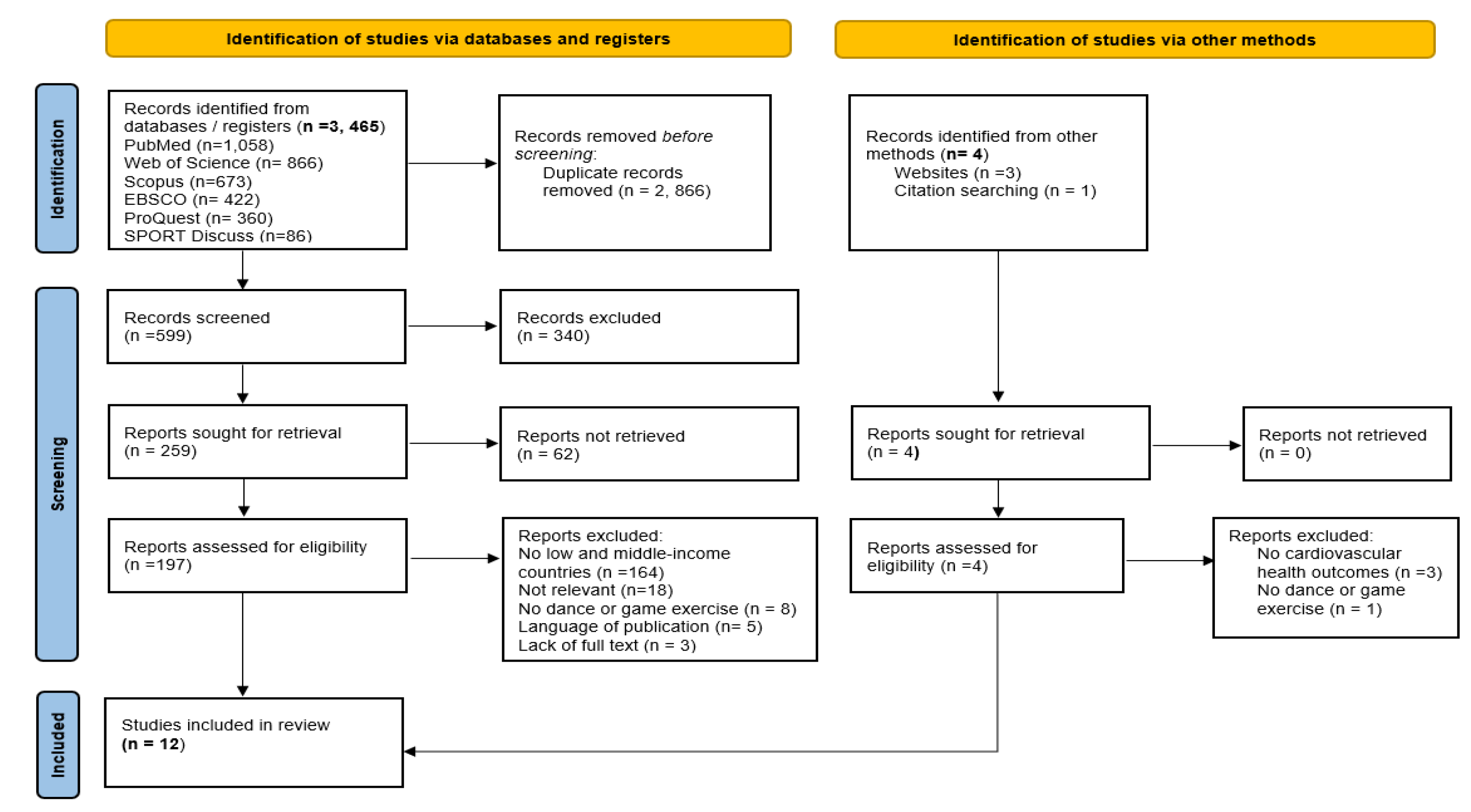
Table 2.
Impact of traditional dance on cardiovascular health across diverse low- and middle-income countries.
Table 2.
Impact of traditional dance on cardiovascular health across diverse low- and middle-income countries.
| Study | Participant Description | Study Aim | Intervention | Outcome and measures | Key Findings and Conlusions | Limitations |
| Duarte et al., 2023 [29] Non-RCT Brazil |
N=26 Women Age= 20- 40 years old |
To investigate the effect of 12 weeks of rehearsals on cardiorespiratory parameters and body composition in Brazil samba dancers belonging to a first-league samba school | Brazilian samba dance 12 weeks |
Cardiorespiratory parameters Body composition |
Samba dance can increase PA levels and positively affect the dancers’ health parameters. ↑ maximal oxygen uptake ↑ oxygen pulse ↑ lean body mass ↓ body fat % ↓ fat mass |
Only one Samba school with a small sample size was used. Samba schools practice different samba with different intensities, causing varying effects on cardiorespiratory parameters and body composition Evaluation of HR measurements during rehearsals and body composition evaluations were not performed with standard tools. |
| Wang et al., 2023 [30] RCT China |
N=26 Women Age - Not stated |
To examine the effects of simplified dance on body composition, cardiorespiratory fitness, and blood lipids in obese older women. | Simplified dance 12 weeks |
Anthropometric measures Cardiorespiratory fitness Blood lipids |
Simple dance interventions have potential to improve blood composition and aerobic fitness in obese older women. ↑VO₂ max ↑ High-Density lipoprotein (HDL-C) ↓ Total Cholesterol (TC) |
Sample only was for women with obesity and results cannot be generalised for other populations including men. Biomechanical evaluations were not performed in the current study. |
| Daca et al., 2023 [24] RCT Mozambique |
N=57 older women Age: 60 -80 years old |
To compare the effects of Conventional Exercise Program CEP) and Culturally Relevant Activities (CRA) on markers of risk factors cardiovascular diseases, body composition, functional fitness, and self confidence in older women in living in Maputo City, Mozambique. | CEP (CEP (stationary cycling, resistance circuit training) CRA (games and dances) 12 weeks |
Body fat Resting blood pressure Blood Glycemic, Cholesterol, Triglycerides, and High-Density lipoprotein Physical fitness Self-efficacy Self-esteem |
Both has positive effects on biological and psychological health of older women: ↑ cardiorespiratory fitness and ↑ Triglycerides ↑ physical fitness ↑ functional fitness ↑improved quality of life |
Relatively low sample size and only females. There was no control to training intensity and volume in CRA sessions - no equipment was used on individuals compared to CEP ergometric equipment The self-efficacy tool was not sensitive enough to detect changes. No follow up post intervention period. |
| Ajala et al., 2020 [31] RCT Nigeria |
N=30 Obese men Age=18 - 22 years old |
To find out the effect of aerobic dance training on selected health related fitness variables among obese men | Aerobic dance 8 weeks |
Cardiorespiratory endurance Body composition |
Aerobic dance improved body composition and cardiorespiratory endurance. |
Not stated |
| Gebretensay et al., 2018 [32] RCT Ethiopia |
N=100 Boys and Girls Age = 15 to 17 years old |
To evaluate the effect of Tigray dance on selected physiological variables among high school students. | Traditional dance of Tigray 16 weeks |
Heart rate Systolic Blood Pressure DBP |
Traditional dance treatment groups showed significant improvement physiological variables, resting HR, SBP, DBP |
Not stated |
| Rodrigues-Krause et al., 2018 [13] RCT Brazil |
N=30 Sedentary women Age= 60 -75 years old |
To compare the effects of dancing and walking on cardiovascular disease and functionality of older women. | Dancing – several styles 8 weeks |
Cardiorespiratory fitness Body composition Lipid profile VO₂ peak Balance |
In large clinical relevance. ↑ CRF in walking ↑ lower body muscle power in dancing Increased PA levels were noted. ↑VO₂peak ↓body composition ↑ lipid and inflammatory profile |
Small size sample to detect the differences on a variety of outcomes assessed. No follow up post intervention period. |
| Nxumalo et al., 2015 [33] Non-RCT South Africa |
N=44 Male children Age= 9 -10 years old |
To investigate the potential influence of the traditional Zulu stick fighting game on health-related physical fitness of prepubescent males. | Indigenous game- Zulu stick fighting 10 weeks |
Body composition Cardiovascular fitness Muscle endurance and strength |
Significant differences were noted. ↑ cardiovascular fitness ↓ body composition ↑ flexibility No significant change – muscle strength and endurance. |
Small sample size, limiting effect on statistical power of analysis. |
| Kin et al., 2001 [34] Non-RCT Turkey |
N=45 Female college students Age: SA=21.88±2.16; AD=20.23±0.16; Control =21.88±1.82 years old |
To examine the effects of 8-weeks of step aerobics and aerobic dancing on blood lipids and lipoproteins. | Aerobic Dance 8 weeks |
Cardiovascular risk factors Blood lipids Lipoproteins |
Step aerobics training had more benefits than aerobic dancing in; serum TC, HDL-C levels, and TC: HDL-C ratio. Favourable changes in serum TC levels resulted after aerobic dancing. |
The conclusions of the study must be limited to the studied population. |
RCT- Randomised control trial, Non-RCT- Non-randomised control trial, PA -Physical activity, CRF-Cardiorespiratory fitness, ↑ - increase, ↓- reduction, BP- Blood pressure, CVD -Cardiovascular disease, HR -Heart rate, SBP-systolic blood pressure, DBP-Diastolic blood pressure, TC - Total Cholesterol, HDL-C - High-Density lipoprotein
Table 3.
Impact of traditional games on cardiovascular health across diverse low- and middle-income countries.
Table 3.
Impact of traditional games on cardiovascular health across diverse low- and middle-income countries.
| Study | Participants | Aim | Intervention | Outcome | Key Findings | Limitations |
| Manihuruk et al., 2024 [35] Non-RCT Indonesia |
N=30, Children, Age: 9-11 years old |
Measure intensity of Malaysian traditional games | 5 traditional games, 7 weeks | Body measures, HR, METs, Vector magnitude | 3 games met MVPA standards for steps, HR, vector magnitude | Upper body motions not well assessed, findings limited to northern regions |
| Yulia et al., 2021 [36] | Non-RCT, Indonesia, N=72, Students, Age: Not stated | To check nutrition education and Javanese games on lipids in overweight kids | Traditional games, Nutrition education, 3 months | Cholesterol, Triglycerides, Lipid profiles (LDL-C, HDL-C) | Games lowered cholesterol and triglycerides but didn’t improve lipid profiles | Not stated |
| Malik et al., 2021 [19] | Non-RCT, Malaysia, N=600 (300 boys, 300 girls), Age: 10.2±0.8 years old | To measure exercise intensity and enjoyment | 5 games | Body measures, HR, METs, Enjoyment response | Games supported MVPA and boosted enjoyment, aiding health and exercise habits | HR results were post-game only, limited to 5 games |
| Rauber et al., 2014 [37] | Non-RCT, Brazil, N=16 (8 boys, 8 girls), Age: 9-10 years old | To check if BP stress reactions drop after play vs sedentary activity | Traditional games, Video games | Post-exercise BP, SBP, DBP | Games reduced BP stress response after one session | Small sample, gender comparison not possible, short monitoring time, genetics and ethnicity not considered |
RCT- Randomised control trial, Non-RCT- Non-randomised control trial, PA -Physical activity, CRF-Cardiorespiratory fitness, ↑ - increase, ↓- reduction, BP- Blood pressure, CVD - Cardiovascular disease, HR -Heart rate, SBP-systolic blood pressure, DBP-Diastolic blood pressure, HEP- Post-exercise hypotension, MEs- metabolic equivalents, MVPA – moderate-to-vigorous PA.
Disclaimer/Publisher’s Note: The statements, opinions and data contained in all publications are solely those of the individual author(s) and contributor(s) and not of MDPI and/or the editor(s). MDPI and/or the editor(s) disclaim responsibility for any injury to people or property resulting from any ideas, methods, instructions or products referred to in the content. |
© 2025 by the authors. Licensee MDPI, Basel, Switzerland. This article is an open access article distributed under the terms and conditions of the Creative Commons Attribution (CC BY) license (http://creativecommons.org/licenses/by/4.0/).
Copyright: This open access article is published under a Creative Commons CC BY 4.0 license, which permit the free download, distribution, and reuse, provided that the author and preprint are cited in any reuse.