

Submitted:
16 January 2025
Posted:
16 January 2025
You are already at the latest version
Abstract
This study provides a descriptive analysis of the Kombucha market in Portugal, which is its main objective. As this is a market on the rise, the period analysed covers the years from the resurgence of the industry in the 2000s to the present and the emergence of new companies in the European market in general and particularly in the Portuguese market. The analysis shows the general behaviour of the Kombucha market in Europe, where the main consumers are countries such as Germany, France and Italy. The study also shows how the kombucha market is concentrated worldwide, with the USA being the largest market in the world and also having the highest concentration of consumers. According to the analysis, there seems to be a correlation between consumers and prior knowledge of the beverage segment, with kombucha consumption initially being made by consumers with a tendency to have health problems, especially with intestinal health. On the other hand, there was also a direct relationship between the price of the drink and the purchasing power of individuals, and it was found that individuals with greater purchasing power are also the main consumers of the drink in this segment of the market. On the other hand, analysing the market share shows that the market is led by The Gutsy Captain Kombucha, with a 60% market share, thus showing consolidation in the functional drinks market in Portugal.
Keywords:
kombucha
; Portuguese market
; beverages
; functional & consumption
1. Introduction
Kombucha is an ancient beverage produced from fermented tea, known to few, although its beneficial effects on health have not yet been officially proven scientifically, it does have positive effects on intestinal health. The kombucha market is still quite restricted compared to drinks that belong to a different segment. This is due, on the one hand, to consumers in general and, on the other, to general knowledge of the drink itself.
Worldwide, kombucha is mostly commercialised in developed countries such as the USA and Canada in North America and in countries with a high average income. Because it is a little-known drink with a very limited number of consumers, it is consumed mainly by middle-class consumers, for two different reasons. The first has to do with the purchasing power that this type of consumer has, given the price of the drink. On the other hand, it's the question of knowledge of the drink itself, as mentioned in the previous paragraph. The largest segment of the market is North America, which accounted for 52.4% of the market in 2019, driven above all by the growing demand and supply of non-carbonated, low-calorie drinks such as flavoured kombucha. In 2019, the global size of the kombucha market was around 1.67 million.
Currently, the Kombucha market in general is on the rise, particularly in European countries such as Spain, Germany, France, the United Kingdom, Italy and the rest of Europe where (including Portugal) there has been great growth.
Sales to these countries totalled more than 200 million euros in 2019. In terms of the European market, its weak and slow growth may be linked to issues related to the main organic raw materials, such as green and black tea, mostly from China, and sugar from Brazil.
Por ser uma bebida recente e ocupando um nicho de mercado onde é notório a ausência de uma concorrência perfeita com os restantes segmentos do mercado, naturalmente é um mercado ainda por explorar, tendo em conta a escassa literatura existente que aborda sobre o tema em questão. Os principais intervenientes neste mercado são as empresas criadas recentemente, salvo exceção para algumas companhias que pertencem a um outro segmento de mercado e produzem a mesma bebida, como a Redbul Kombucha.
In Portugal, the Kombucha market is on the rise, with the emergence of companies such as The Gutsy Captain Kombucha (currently the market leader). As well as others that have been emerging such as Fiz Kombucha, Living Kombucha, Ok! Kombucha and Camellia.
Due to the scarcity of studies of this kind, this analysis will be descriptive and the main objectives are to analyse the Kombucha market in Portugal in detail, to understand how the market is structured, the main players, to analyse the market share and the CAGR of the global and European market in particular. In addition, the aim is to briefly analyse the behaviour of kombucha consumers in Portugal in particular and briefly consider the European level.
One of the aspects of the lack of awareness of Kombucha, worldwide in general and particularly in Portugal, has to do with the fact that it is a pro-biotic drink with a medicinal effect that is little known to most consumers of other drinks. On the other hand, it has to do with the lack of promotion of the drink in relation to drinks from another niche market, such as beer, for example. At the time of writing, the reader was probably unaware of the existence of Kombucha. Another relevant aspect to take into account in this type of market is related to the type of consumer. Consumers of kombucha have specific knowledge about the drink and its benefits, which makes this type of consumer different from others who are more likely to buy it in the first place.
Consumers of this type of drink only drink it because they need to in order to quench their thirst. It is also important to emphasise another important quality that consumers of kombucha have, by way of example, the lifestyle of consumers, usually this type of consumer is very selective and leads a healthy life.
As a drink in the health food segment, some consumers of this type of drink are vegan. This makes this type of consumer selective with the type of drink, thus justifying the high cost of the drink. In general terms, the consumption of kombucha is not associated with just any drink, it is mainly associated with the consumer's need for a healthy lifestyle.
In this article, an analysis will be made based on the main market indicators, so the main market players in Portugal will be analysed in general and in particular, the market share and the CAGR of the Portuguese market will also be analysed, as well as the market concentration rate. Another aspect that will be taken into account throughout this article has to do with the type of innovation applied during the Kombucha production process, with particular emphasis on the machinery used in the manufacturing process, which has been a difficult and complex process, as it requires a standard of technology that is sufficiently capable of providing an adequate response in the process of filtering the drink, the other issue that deserves attention has to do with the type of packaging and labelling, as this is a product that is produced from biological raw materials, which means that special attention needs to be paid to how the drink is transported.
The article is structured as follows Introduction, brief Literature Review, o mercado da Kombucha (do geral a particular), the main segments of the market, which include the quantitative analysis (the aim is to analyse the market share, the market concentration rate and the CAGR - Compound Annual Growth Rate), the methodological component itself is descriptive and finally there is the conclusion and references.
Literature Review
The aim of this section is to analyse in detail a brief review of the literature focused essentially on the kombucha market, bearing in mind that studies analysing the kombucha market have so far been scarce, especially because it is a recent topic and because it is a product that was relaunched less than 20 years ago. Most studies of the kombucha market have focused on analysing the importance and effects that this product has on the body and on well-being. This literature review seeks to analyse in detail the main contributions, focusing essentially on analysing the structure of the market itself and its main contributions.
In general terms, the classification of drinks by category is crucial to understanding how the different markets under analysis work, so it is important to analyse the market according to the classification. Without exception, Kombucha falls under the heading of functional drinks. (JOURNAL, 2007). According to the business newspaper, functional drinks were once aimed only at a certain niche of the population, but with changes in consumption habits and the various risks that people are subjected to on a daily basis, consumers are willing to pay more for a functional drink because of their concern for the health and well-being that these types of drinks provide. Functional drinks are classified into energy drinks, enriched drinks, sports drinks and nutraceutical drinks, analysed into (BAPTISTA, 2013).The functional drinks market in general has shown continuous growth, and is the largest among the other sectors of the industry, such as food and supplements. In 2010, the functional drinks market grew by 3% and in 2014 it grew by 7.8%, as seen in (Tolun & Altintas , 2019), Associated with this growth in the functional drinks market is the convenient content, size, shape and appearance of the containers, as well as the ease of distribution and storage conditions for chilled and stable products.
Also according to (Raman & Doble , 2019), In 2017, the global market for functional beverages totalled 1.347 billion dollars, and associated with this growth is urban growth, especially the growth of the middle class population, the increase in household income and the growing concern for health and the contribution to health promotion and reducing the risk of disease.
As the Kombucha market is a recent one, the analysis of the structure of the market starts from the general to the particular, with a greater focus on the Portuguese market, where there is a greater diversity of Kombucha and a greater number of consumers. Despite most studies essentially analysing the benefits that the product itself brings to the body, it is currently a product of great reference in the Functional Drinks segment, which makes the product of great value, especially with a wide advantage over other drinks in the same segment, however, another aspect of great relevance to take into account, is on the one hand, related to the treatment that many consumers give to the product, because it is a consumer who knows the main characteristics and properties of the product, information plays an important and crucial role in choosing the brand. Generally speaking, for the European market and particularly for Portugal, companies are mostly new and have less weight with consumers when it comes to the process of choosing a brand.
As mentioned in the previous paragraphs, the scarcity of market studies specifically aimed at analysing functional drinks such as Kombucha is by nature scarce, a study that provides details about the market is analysed in (Sousa et. al , 2020), where the authors show the characteristics of the main consumers of Kombucha, consumption, trends in the fast-growing industry and the commercialisation of the product in different regions.
The authors' study, like (Vieira , Pinto , Morais , & Santana , 2021) the analysis focuses on the benefits of kombucha, although it is not specifically aimed at analysing the market itself. The study shows evidence of kombucha being a source of a range of bioactive components that are digested, absorbed and metabolised by the body and exert their effects at the cellular level. The authors also highlight the importance of studying kombucha, where it provides important information on human health. (Sousa et. al, 2020), show the profile of kombucha consumers, through an online survey, the results indicate the use of alcohol by the respondents being represented by a rate of 66.4%, these respondents consume at least once a week, highlighting beer as the most consumed drink, with a rate of 55.7%, these results also show that the majority of consumers are aware of the benefits associated with kombucha, however, the authors emphasise that the drink is not available on the consumer market, 79.77% of the results of the study notwithstanding, the study shows that there is evidence of progress in the functional food segment.(Sofia & Lígia , 2021), analyse the beneficial effects of the probiotic drink Kombucha, where, according to the authors, its consumption has been associated with a wide variety of beneficial effects on health, ranging from immunostimulant, antioxidant, antimicrobial, hepatoprotective and anticancer effects.
As this is a recent market, studies relating to the structure of the market and the analysis itself are somewhat limited. For example, kombucha is included in the functional foods market in a generic way and particularly in the functional drinks segment. (Baptista , 2013) The results of the study also show that respondents are interested in consuming this type of drink for health reasons, with the greatest concern being the prevention of cardiovascular diseases and the regulation of intestinal function, the authors conclude.
3. The Kombucha Market, Perspectives
The Kombucha market currently presents a differentiated contrast, with the presence of the big players in the market, mostly located in North America, with the USA taking control of the largest market and naturally also being one of the countries with the highest incidence of consumption worldwide. With the resurgence of the drink, which is naturally unknown to many, producers have increasingly sought to incorporate innovations that allow them to have better advantages over the big producers in different segments of the market, which have become very competitive.
The analysis of this topic will be based above all on descriptive analyses of the main market indicators, from the general to the particular, thus allowing us to understand the functioning of the market and the main prospects in Europe in general and particularly in Portugal.
The European Kombucha market is growing steadily, driven above all by the increase in consumption in recent years and the increase in production in the world in general and particularly in the European market, with an emphasis on Portugal, strategic market of interest. Changing consumer habits have plausibly boosted the growth of the functional drinks market in general, and particularly the Kombucha segment.
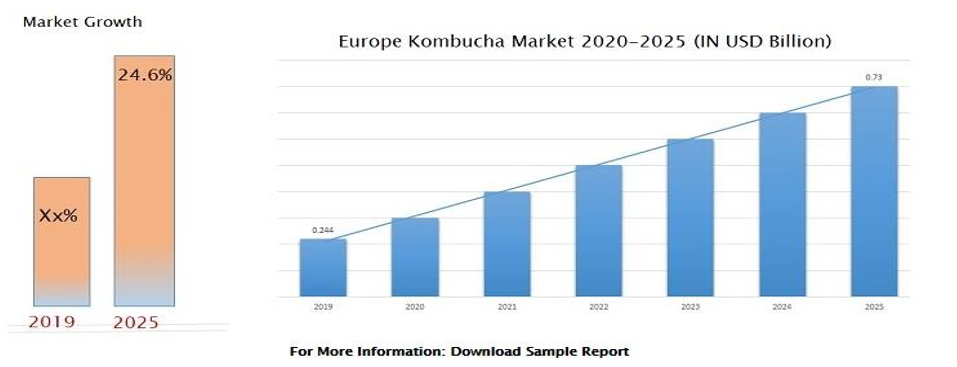
Currently, at European level, the market has a compound annual growth rate (CAGR) of 23.47 per cent, with a forecast for 2028. The biggest drivers of kombucha in the European market are countries such as Belgium, the United Kingdom, Italy, Russia, Poland, France and Germany. The growth of the market is mainly due to the change in consumer lifestyles, with the emphasis currently on consumers opting more for 100% organic products, with no exception, of course, in the case of kombucha. In Italy, for example, according to the Italian Society of General Medicine, the population is widely affected by acid reflux, with a significant increase from 6 per cent in 2006 to 18 per cent in 2016. This is mainly driven by the growing demand for healthy drinks such as Kombucha, as highlighted in (Report, 2020). With regard to the main players in the market, companies such as New age Beverages corporation (Bucha Kombucha), Go Kombucha, The Hain celestial group Inc and pepsico inc (kevita kombucha) stand out. The outlook for market developments can be seen in the Figure 1.
In Figure 1, the evolution of the kombucha market in europe is presented, where there has been continuous growth since 2019. This growth may be related to the increase in consumption of the drink in recent years, particularly in Nordic countries and other countries with a considerable annual income, taking into account the purchasing power that consumers in these countries have to buy, for example, a probiotic drink, which in terms of price is quite different from other segments of the market. On the other hand, with the emergence of the pandemic and the need for consumers to prevent themselves in the best possible way and strengthen their immune systems, the drink has properties that help strengthen the body, which makes it interesting on the one hand and in great demand by consumers on the other.
4. The Kombucha Market in Portugal
In line with what has been happening in the European Kombucha market, this market is also on the rise in Portugal, with some of the main players in this market segment standing out. Companies such as The Gutsy Captain Kombucha have been consolidating their position in the market. Despite this rise in the Portuguese market, for example, there is still little consumer awareness of this probiotic drink with extremely high health benefits for consumers in general.
The structural concept of the kombucha market in Portugal has, on the one hand, been quite diversified, based mainly on recent companies and some that, from an economic point of view, are extremely important in this segment of the market.
The main player in the Portuguese kombucha market is The Gutsy Captain Kombucha, with a large share of the national kombucha market, joined by others in the same segment with a smaller share of the market. The lack of information and studies of this kind is pointed out as a sufficient reason for the great scarcity of studies of this kind, especially studies aimed at the Portuguese market, as mentioned in the previous paragraphs. These reasons are naturally due to the limited literature on the subject and restricted access to data.
The market for functional drinks, particularly Kombucha, in addition to the enormous complexity described above, mostly related to the scarcity of studies, another reason has to do with the lack of consumption habits on the part of consumers, and the cost-benefit ratio can also be pointed to as one of the main causes. Always bearing in mind the demand for the drink among consumers, especially those in the upper middle class, which is related to their purchasing power.
In Portugal, the kombucha market is distributed heterogeneously in different regions, with an emphasis on the south of the country, where one of the country's first factories, The Gutsy Captain Kombucha, is located, and is the market leader in this beverage segment. Despite being the market leader, most of the production is exported to Nordic countries such as Switzerland, Denmark, Sweden and Finland. Even so, in the Portuguese market, the brand is a pioneer in the market and is very well received by consumers of probiotic and functional drinks.Além da The Gutsy Captain Kombucha a líder do mercado, há no mercado outras empresas com uma relativa expressão e aceitação, em termos da oferta do produto, permitindo desde já ter uma diversidade de produtos do mesmo segmento.
5. Kombucha Market Share in Portugal
As for the market share itself for the Portuguese market, the lack of studies of this kind and the availability of data make it difficult to accurately analyse the structure and understand the behaviour of the market. Therefore, in this analysis, approximate data is used and is drawn up taking into account estimates of existing data, with a view to having non-formal information, market share is analysed on the basis of existing statistics, , on the other hand, for example, market concentration is analysed on the basis of percentages of the functional drinks segment, which is a growing segment with its own characteristics, especially in the organic drinks market. As well as representing a fairly fragmented market, as analysed in (Mendonça, 2016 ), according to the author the market grew by 1.5% in 2013, reaching a value of 66.7 million euros. Table 1 shows the distribution of the market share of functional drinks in Portugal, which includes Kombucha. It is also important to emphasise the absence of some companies, such as The Gutsy Captain Kombucha, which is included in the category of others with a high market share.
In general terms, redbull has a market share of 13.9%, with a relatively smaller share, due on the one hand to the low production of the drink, particularly in the kombucha segment, redbull being responsible for the commercialisation and distribution of functional energy drinks. In second place comes The coca-cola company with a 5.9% share of the functional drinks market, kotsuka holdings co. Lda with a 5.1% share of the functional drinks market, the majority of the market is dominated by the other companies operating in the market, with a rate of 73.9%, naturally, this percentage presents on the one hand the companies producing kombucha and water for example. Assim, com o obejtivo de se ter uma melhor perceção relativamente a distribuição do mercado em si da kombucha particularmente. A Quota do mercado foi repartida, particularmente para o segmento do mercado da kombucha.
The graph in Figure 2 shows a diversified market structure with a share of companies in the kombucha segment, particularly the leading company, The Gutsy Captain Kombucha, which plays an important role and is the main player in this market segment, with a market share of 60%. It is important to emphasise that this share is not a real share, but is an adaptation based on the existing market share, which of course allows us to know what the real share of the kombucha market is in a particular way.
Innovations
Innovations in the kombucha market are a fundamental element, mainly in providing new flavours and ensuring efficiency in the production of different goods. As far as innovation itself is concerned, as well as promoting production efficiency, they also make it possible to optimise production and speed up orders. The main characteristics of innovation are mainly related to the technology used to filter the tea and the final production itself. The better the technology, the more it allows a significant quantity of litres of tea to be filtered in record time, which effectively allows the product to be preserved, guaranteeing production efficiency in the final product.
6. Principais Players do Mercado da Kombucha
The main players in the Kombucha market are mostly recent, but with the resurgence of the market itself, they have become very important players in the Portuguese Kombucha market, with a relatively smaller market share than the leading company, The Gutsy Captain Kombucha. The main players in the market are: The Gutsy Captain Kombucha, Amo Kombucha, Aquela kombucha, Fiz kombucha, Koji Kombucha, Living Food Kombucha, MAI Kombucha, Oh K! Kombucha and Camelia. In terms of market share, they have a share distributed among others, representing around 14 per cent of the market. This small share has to do, on the one hand, with the low levels of production that the companies have.
7. Segments of the Functional Drinks Market
Functional beverages, mostly dominated by water, juices and energy drinks, and recently with the inclusion of Kombucha, are playing a leading role in this growing market. The water segment, for example, has a significantly larger market share than the juice segment. This share is related to the high standard of water consumption in the world in general and particularly in the Portuguese market. Consumers in this market have their own characteristics that distinguish them from other consumers, for example, as we mentioned in the previous paragraphs, aspects related to prior knowledge of the brand itself and the main properties that the drink possesses. In addition, other relevant aspects need to be considered, such as the type of consumer in this market segment, which is not just any consumer from the outset, but their purchasing power. It is therefore important to define the kombucha market as the main one among the different segments of the functional drinks market.
8. Kombucha Distribution Channels
The main distribution channels for kombucha on a large scale are supermarkets, the main organic shops and internet sales, the latter of which has distinguished itself in recent years due to the great advances that have taken place, largely related to the sale of the product online, through orders. On the other hand, this distribution channel stands out for being the easiest to access anywhere, which on the one hand facilitates transactions and the management of logistics itself, the latter being important in distribution chains in the functional drinks sector. Having efficient logistics makes it possible to have distribution on time. Another very important distribution channel is the export sector. A large part of Kombucha's production is destined for export, i.e. by orders from the main customers, located largely in the Nordic countries, where kombucha is significantly more popular than in other European countries. Still on the main distribution channels for functional drinks, specifically kombucha, in Portugal, for example, the main distribution channels are concentrated in supermarkets.
concentrated in supermarkets, with a concentration rate of 70%, based on this fictitious rate, i.e. taking into account the market analysis itself, through the main indicators.
9. Perspectives on the Kombucha Market
The analysis allows us to understand how the kombucha market works in Portugal, in a particular way, where the main players in the market play a very important role, despite the fact that the market is dominated by a single company that holds most of the market share for functional drinks in general and particularly for the kombucha market. Given that the market is new, we can analyse it vertically, i.e. in terms of its structure, analysing the main market shares. In itself, it is an up-and-coming market, the players are new and have very little market share. The outlook is for considerable growth, given the growing number of consumers who are increasingly turning to drinks with functional properties. Another aspect worth highlighting has to do with the nutritional properties of the drink, which are considered therapeutic and of great importance for the functioning of the body. By increasing the level of knowledge of the drink itself, it will be possible to increase the levels of consumption of the drink, in turn increasing the demand for the drink and consequently expanding the market, from a horizontal analysis perspective.
Thus, according to the report on the growth and evolution of the Kombucha market, the segment of functional drinks, specifically kombucha, is expected to develop favourably and with growth trends. With regard to the main indicators, the market is expected to increase in size by 12.2 billion dollars by 2030 and with a compound annual growth rate of 25.1% (CAGR) in the period 2021-2030, this increase on the one hand is related to the forecast of the number of companies that could increase in the medium to long term, this expansion of the market has to do with the growth of the market expansion has to do with the increase in revenues from sales, on the one hand, and on the other hand has to do with the increase in consumers as mentioned in the previous paragraphs. The expansion of the relevant geographic market is intrinsically noticeable in a number of ways: the volume of sales in this market segment, particularly in Portugal, is relatively higher compared to the other market segments under analysis, such as water and juice, for example, analysed under
(marketreportworld, 2022). As it is a restricted-access report, it does not allow us to have additional information about some of the relevant indicators in this type of market in general and particularly in the market segment itself, for example.
A number of illnesses have been identified as the main factors behind the development of the Kombucha market in Portugal in particular and in Europe in general, where illnesses related to intestinal problems, such as constipation, stand out. According to some studies, kombucha is effective in treating constipation. Consumption of the drink is encouraged mainly in Nordic countries such as Finland, Denmark and Norway. In regional terms, the market is concentrated on the American continent, specifically in the United States, where sales totalled 405 million dollars, with GT being the market leader with sales of 275 million dollars a year. As for the European market, it currently has a turnover of 730 million dollars by 2024, with the main destinations for Production being the United Kingdom, Germany, Italy and Spain. According to the report analysed in (glass-catalog.com, 2019).
Implications
The aim of this section is to analyse some of the implications related to how the Kombucha market works, particularly for the Portuguese market and the European market in general. On the one hand, this implication is related to the levels of investment made in publicising the product, which is a major factor in the lack of awareness of the drink among the market's main consumers. Another implication is related to consumer acceptance of the drink itself. Consumers in this market are known for having specific knowledge of the product, i.e. a consumer in this market consumes the product not because they want to, but because they have specific knowledge of the drink's main nutritional properties and its main benefits for intestinal health.
Another implication that is also relevant has to do with the question of the product's acceptance at a regional level. For example, in poor countries, the product is not acceptable due to circumstances related to the level of in-depth knowledge about the functional beverage segment. For example, in poor countries such as those in sub-Saharan Africa, with the exception of South Africa, there is almost zero knowledge about functional beverages, which on the one hand discourages the consumption of kombucha in particular. Contrary to what can be seen, for example, in countries with a significantly acceptable level of income, in these countries, the product is accepted by consumers because, in addition to their purchasing power, they have an essentially different characteristic from that of poor countries. For example, a consumer in a rich country has a different characteristic from that of a poor country, mainly related to their constant concern for their health in general, which motivates them to consume kombucha, for example, in view of its main nutritional properties.The low consumption of Kombucha in Africa is due not only to a lack of knowledge of the functional drinks market, in this particular case kombucha, but also to the fact that in these regions, for example, the population is not generally concerned with well-being and often does not consume healthy food. Despite the potential that African countries have, there is still a huge deficit in the consumption of healthy drinks or organic products in general.
In wealthy countries such as the United States of America (USA), kombucha is frequently consumed, as is the case in countries such as Canada, Germany, France and Italy. One of the major challenges facing large kombucha producing companies is the acquisition of organic raw materials, such as sugar, which is naturally imported from large sugar cane producing countries such as Brazil, for example. Another important raw material is the organic tea used in the production of tea and for the fermentation process, for example.
The reason for the concentration of kombucha on the American continent has to do, on the one hand, with geographical location, i.e. it allows for efficiency in production. Another reason has to do with the logistics chain, mainly related to the production of raw materials such as sugar, which comes from Brazil, as it is close to the continent. As a result, the distance and costs related to transporting goods and freight are significantly reduced.
As for logistics itself, this is a major challenge for the main Kombucha Producers, especially when it comes to shipping orders to the main markets in Europe, especially countries like Germany and some Nordic countries like Norway. On the one hand, this requires great efficiency on the part of the company's logistics department, which avoids wastage, as has happened on many occasions in some companies. In any company, the logistics department plays a key role in optimising transport costs.
One of the important characteristics of the Kombucha market has to do, for example, with the issue of innovations. In this sense, innovations are particularly important when it comes to the introduction of new flavours, for example, in the specific case of The Gutsy Captain Kombucha Company, where zero flavours are already produced, a version of the drink aimed mainly at the segment of functional sugar-free drinks, which are usually aimed at consumers with diabetes problems, for example, and consumers with kidney problems. Markets usually tend to follow social dynamics and the dynamics of the international market. For example, certain diseases influence specific markets, and in the particular case of the kombucha market, covid-19 has had a significant impact on this market. The main implications are related to the significant increase in consumption, motivated above all by the rise in demand for drinks with the ability to increase probiotic levels, i.e. to strengthen the immune system.
What differentiates the Kombucha market from other market segments, for example, is the volume of sales and the number of litres of beverages produced, where the beer market transacts the largest volumes of business in the market. This is mainly due to the occurrence of the main trends in the market. Nowadays, the constant innovations in the markets are very visible, many of them due to changes in consumer habits and the need for companies to adapt to new markets. It is therefore essential to understand the emergence of a new market in the functional and non-alcoholic drinks segment.
As it is a new and growing market, there is justification for the small number of consumers in this market and, on the other hand, for the increase in the number of companies operating in this market segment. Understanding a market in general terms means on the one hand understanding consumer behaviour in general, taking into account the different characteristics of consumer preferences, it is natural for consumers to have a different tendency to consume, for example, than a consumer in the alcoholic drinks market.
10. Conclusion
The article provides a general analysis of the behaviour of the functional drinks market, focusing mainly on the Kombucha market in particular. However, this is a recent market segment in which the main players are mostly new and have a very small market share. The analysis shows that most of the market share, for example, is held by The Gutsy Captain Kombucha with a market share of 60%, in line with the market data previously analysed in the text.
The study also shows the relevance of consumers in this beverage segment, where consumers tend to have a relevant characteristic that differentiates them from other consumers in different market segments. According to the descriptive analysis carried out, kombucha consumers have prior knowledge of the drink itself, i.e. knowledge related mainly to the main nutritional properties of the drink and the health benefits in general and particularly for individuals with intestinal problems.
It was also observed that the main players in the global kombucha market are concentrated on the American continent, with the United States of America (USA) having the largest share of production, the largest number of companies and the largest number of consumers in the global market.
Alongside the European market, which is also showing a strong growth trend in terms of the main players in the market. The European market is also characterised by its large number of consumers, especially in countries such as France, Germany and Italy.
As it is a recent market, the analysis focused mainly on analysing the main indicators such as market share and the main players in the segment. Thus, the descriptive analysis produced relevant results that, from the point of view of the structure of the market itself, there is competition, although there is at least one company that assumes itself to be the main player in the market at a global level. According to the study, Red Bull assumes itself to be the main player in this beverage segment at a global level.
As for the main implications of the study itself, the analysis seems to point to the lack of studies of this kind aimed at the segment of the market being analysed, and also to the fact that most reports on the sector are inaccessible for public consultation. This, on the one hand, makes it difficult to have a more precise and in-depth analysis of the market, which is also a limitation of the study. For example, it is proposed that future research include information that can effectively serve as support and that may be relevant to the study. It is also proposed that a market analysis be carried out to analyse the main innovations in this segment and the main players, considering the continuous growth in the number of companies in the segment, it is important, for example, to understand how they share the market and the main characteristics of the healthy and functional drinks segment.
References
- Baptista, S. (2013). Tendências de Mercado de Bebidas Funcionais.
- glass-catalog.com. (2019). Kombucha: do começo hipster ao sucesso dominate em Vidro. Available online: https://glass-catalog.com/br- pt/news/kombucha-from-hipster-beginnings-to-mainstream- success-in-glass.
- JOURNAL, N. B. (2007). Trends in Functional Drinks: a Wider perspetive.
- marketreportworld. (2022). Kombucha, Mercado 2022 relatório de pesquisa de análise de fator de crescimento, participação e tamanho da Indústria global de 2030.
- Mendonça, M. (2016 ). Lançamento de um produto com características Relaxantes no sector das bebidas funcionais. Lisboa.
- Raman, M.; Doble, M. Nutrients in Beverages. 2019. [Google Scholar]
- Report, M. (2020). Previsão do mercado europeu da Kombucha 2019- 2028.
- Sofia, F.; Lígia, S. Efeitos Benéficos da Bebida probiótica Kombucha. BVS, Biblioteca Virtual em Saúde, 2021. [Google Scholar]
- Sousa et. al. Perfil dos Consumidores de Kombucha. Congresso Internacional da Agroindústria ciência, tecnologia e inovação: do campo a mesa, 2020. [Google Scholar]
- Tolun, A.; Altintas, Z. Functional and Medicinal Beverages. 2019. [Google Scholar]
- Vieira , E. P., Pinto , O. G., Morais , K.,; Santana , E. ANÁLISE DA AÇÃO DA KOMBUCHA E SUAS PROPRIEDADES. Enciclopédia Biosfera, centro científico conhecer - Jandaia-GO 2021, 64. [Google Scholar]
Figure 1.
Development of the Kombucha market in Europe. Notes: a figura apresenta, a evolução do mercado da Kombucha na Europa. Source: marketdataforecast.com
Figure 1.
Development of the Kombucha market in Europe. Notes: a figura apresenta, a evolução do mercado da Kombucha na Europa. Source: marketdataforecast.com
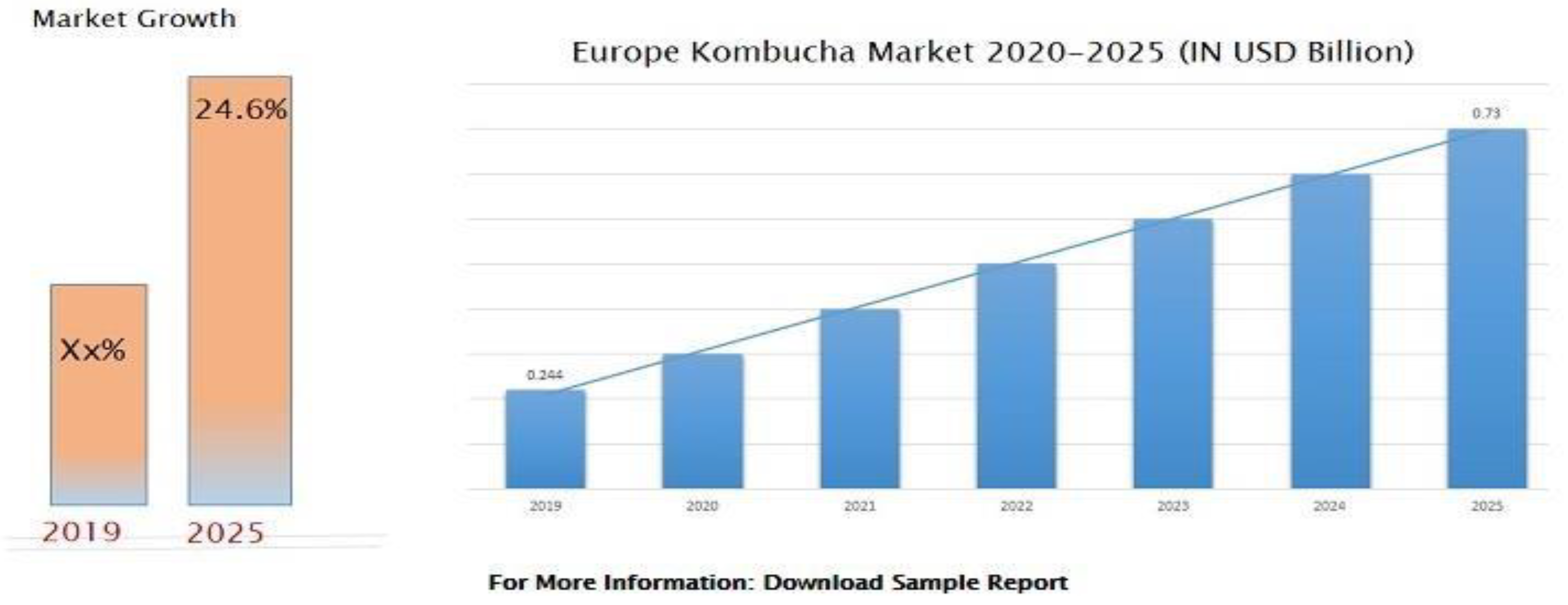
Figure 2.
Market share of functional drinks (particularly Kombucha). Notes: the graph shows the market share of Kombucha. Source: (Mendonça, 2016), adapted by the author.
Figure 2.
Market share of functional drinks (particularly Kombucha). Notes: the graph shows the market share of Kombucha. Source: (Mendonça, 2016), adapted by the author.
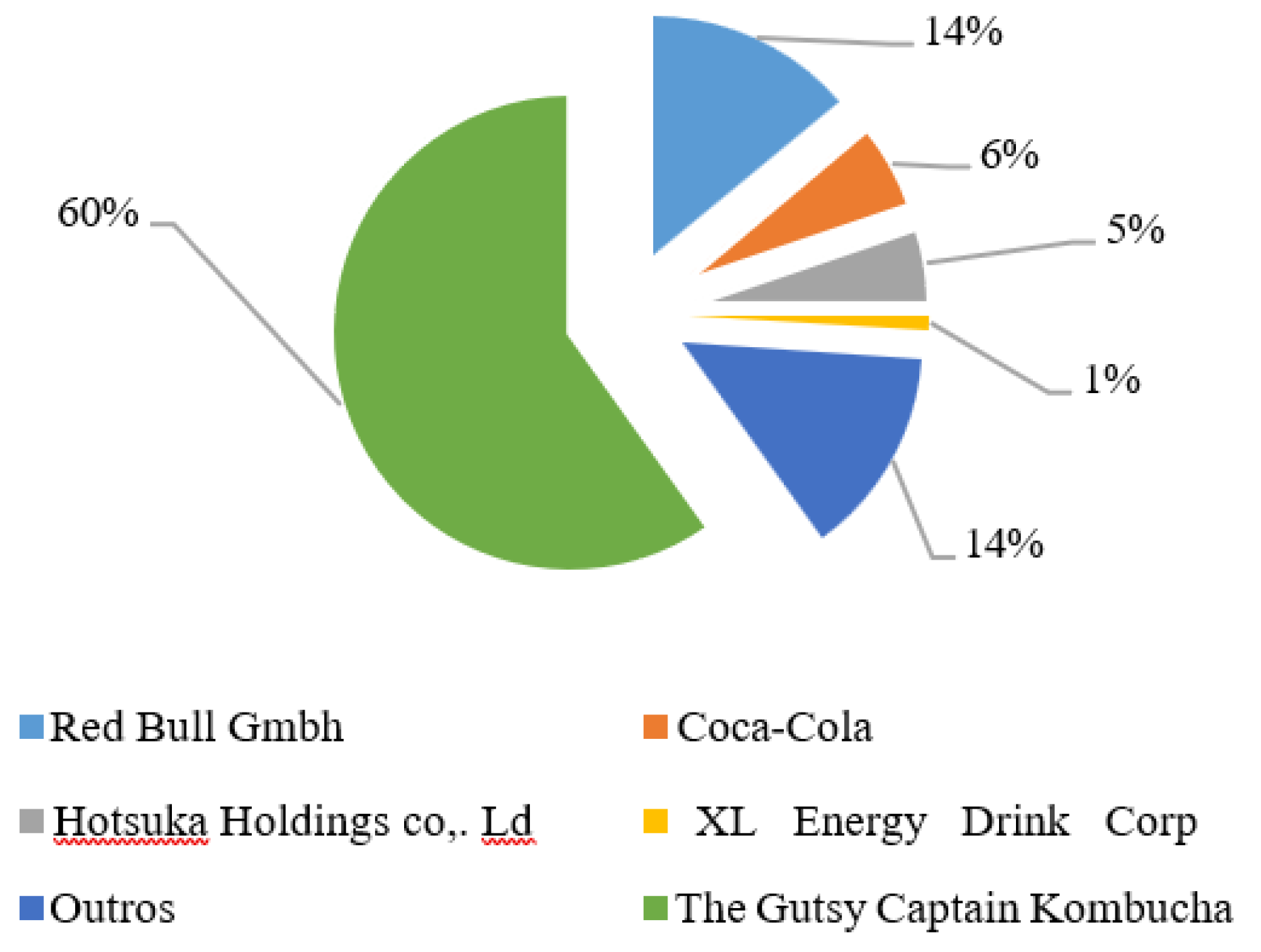

Table 1.
Functional drinks market share in Portugal.
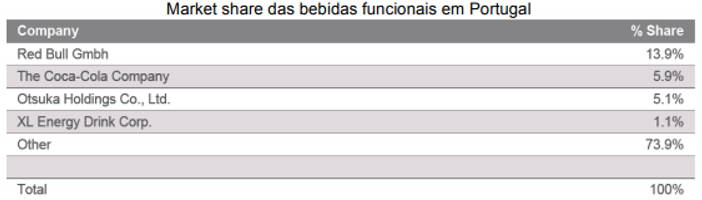 |
Notes: The table shows the distribution of the market share of functional drinks in Portugal. Source: (Mendonça, 2016 ).
Disclaimer/Publisher’s Note: The statements, opinions and data contained in all publications are solely those of the individual author(s) and contributor(s) and not of MDPI and/or the editor(s). MDPI and/or the editor(s) disclaim responsibility for any injury to people or property resulting from any ideas, methods, instructions or products referred to in the content. |
© 2025 by the authors. Licensee MDPI, Basel, Switzerland. This article is an open access article distributed under the terms and conditions of the Creative Commons Attribution (CC BY) license (http://creativecommons.org/licenses/by/4.0/).
Copyright: This open access article is published under a Creative Commons CC BY 4.0 license, which permit the free download, distribution, and reuse, provided that the author and preprint are cited in any reuse.


