

Submitted:
16 January 2025
Posted:
16 January 2025
You are already at the latest version
Abstract
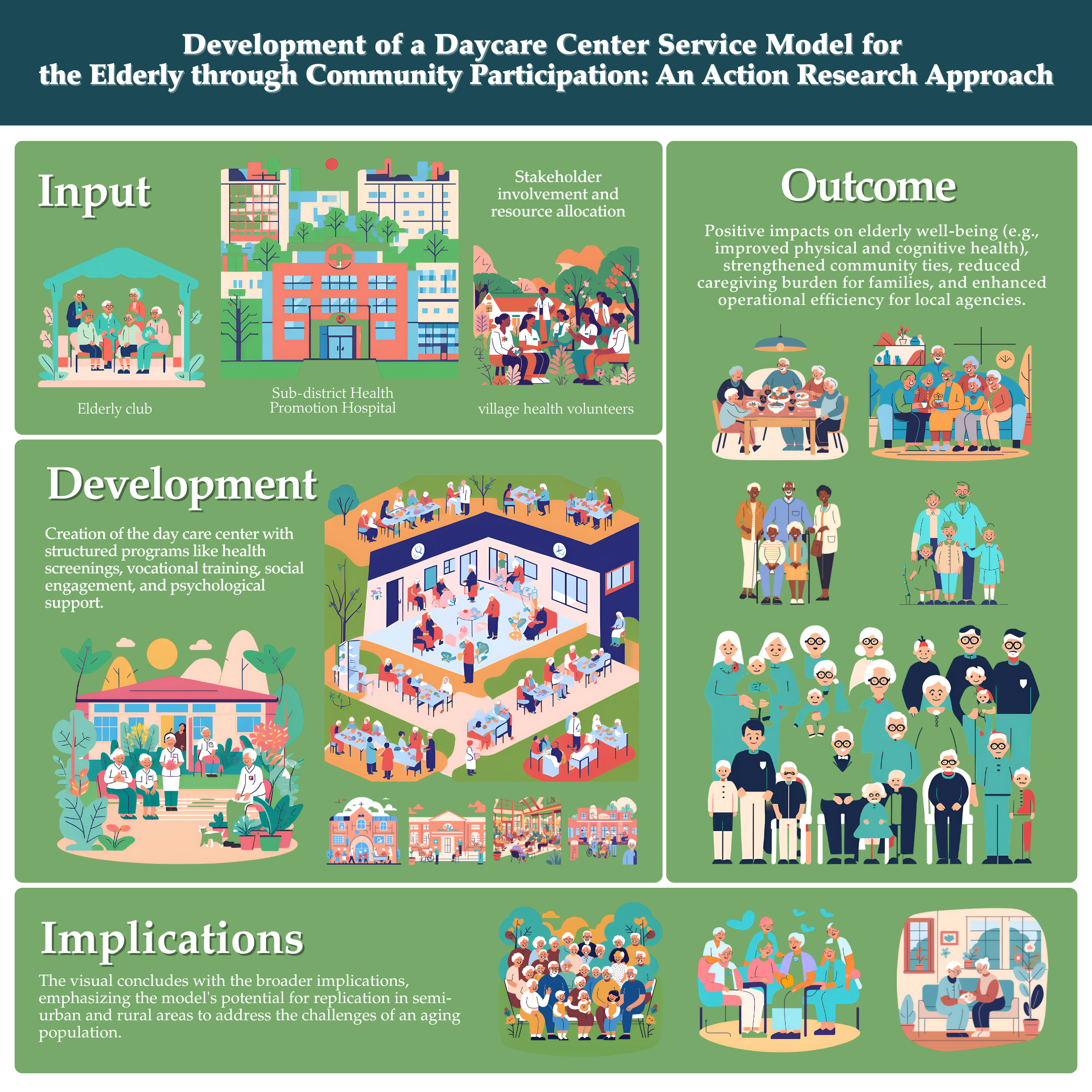
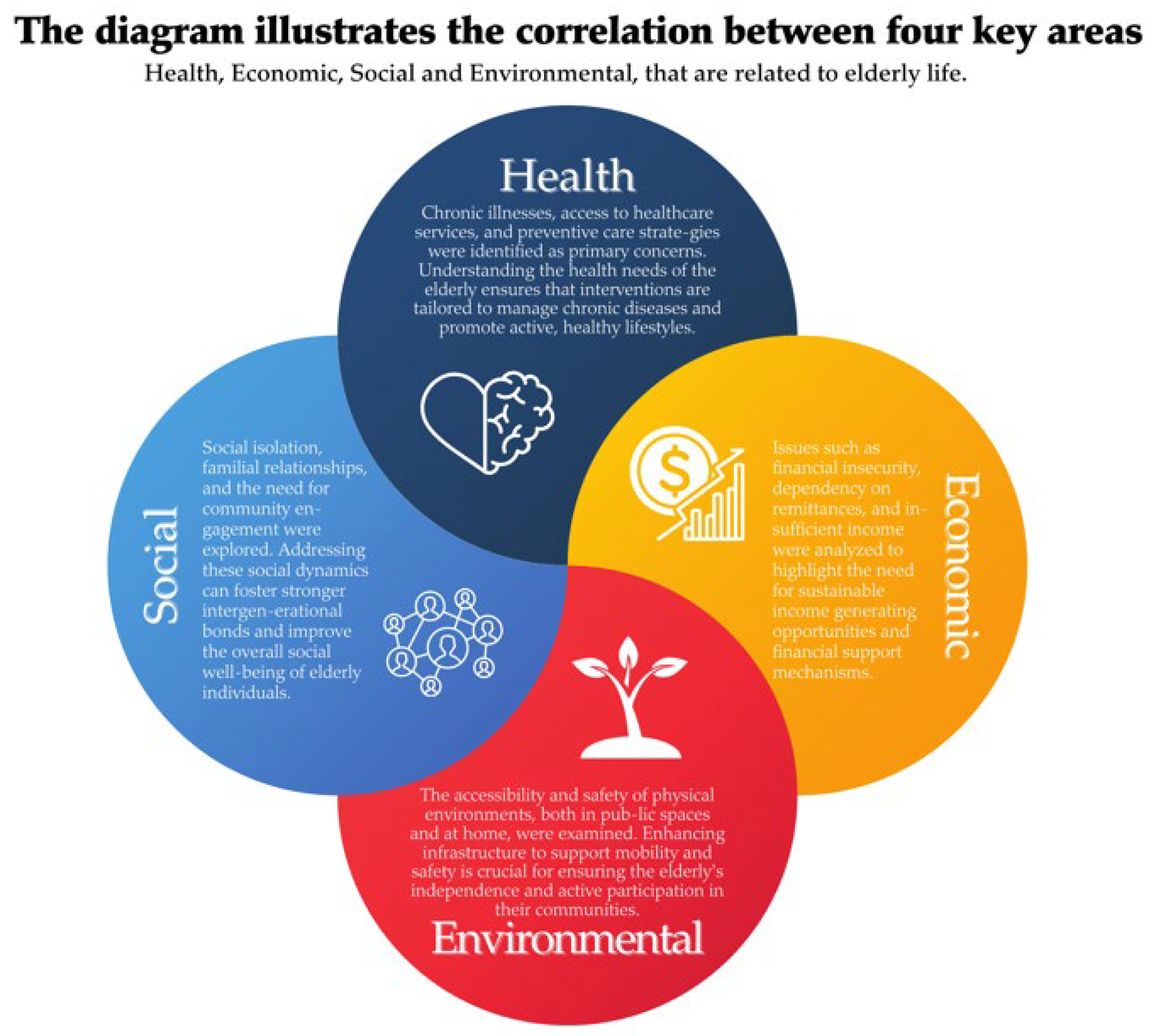
Introduction: This study aimed to develop a service model for daycare centers for the elderly through community participation using participatory action research methods. The objectives were threefold: (1) to investigate the current situation of the elderly in the community and their needs for daycare center services, (2) to develop a daycare center for the elderly with active community involvement, and (3) to evaluate the effectiveness of the service delivery at the daycare center for the elderly. Methods: The study was conducted in Ban Kho Sub district, Phon Sawan District, Nakhon Phanom Province. Research participants included 210 elderly individuals surveyed to assess their situation, and 15 key informants, including elderly club leaders, sub district health promotion hospital staff, volunteers, sub district administrative organization officers, and village health volunteers, were specifically selected for in-depth insights. The research process was structured into three phases: Phase 1 focused on studying the situation of the elderly in the community and their service needs; Phase 2 was dedicated to developing the daycare center with community participation; and Phase 3 involved evaluating the service delivery of the daycare center. Results: The results indicated that the development process of the daycare center service model for the elderly, through community participation, involved four key mechanisms: elderly clubs, sub district health promotion hospitals, volunteer teachers or technicians, and village volunteers. Additionally, the supporting mechanisms included academic institutions, hospitals, temples, village heads, the Non-Formal Education Center, foundations, and the sub district administrative organization. The comprehensive service model encompassed five components: health, social, psychological, economic, and environmental aspects. Conclusion: The study successfully developed a daycare center service model for the elderly through community participation, which can be expanded and adapted to other semi-urban and semi-rural contexts. This model demonstrates the importance of community involvement in providing holistic care for the elderly, addressing various aspects of their well-being.
Keywords:
1. Introduction
2. Methods
2.1. Population and Sample
- 1)
- Cluster Sampling: The sub-district was divided into 20 villages (Clusters 1-20).
- 2)
- Simple Random Sampling: Within each village, elderly individuals were randomly selected using computer-assisted randomization.
- 3)
- Inclusion and Exclusion Criteria: The study established specific inclusion and exclusion criteria to select the participants, ensuring the sample was representative of the target population. As following:
Inclusion Criteria
- Age: Elderly individuals aged 60 years and above residing in Ban Kho Subdistrict, Phon Sawan District, Nakhon Phanom Province.
- Residency: Permanent residents of the community.
- Health Status: Individuals with chronic illnesses who are ambulatory and can participate in activities (e.g., diabetes, hypertension) and Socially active elderly individuals as identified in the community health survey.
- Consent: Participants who provided informed consent to take part in the study.
- Community Involvement: Key informants such as elderly club leaders, subdistrict health promotion hospital staff, village health volunteers, and other community representatives involved in elderly care.
- Availability: Willingness to regularly attend activities and provide feedback during the study phases.
Exclusion Criteria
- Health Status: Bedridden or homebound elderly individuals unable to participate in community activities, Individuals with severe mental or cognitive impairments (e.g., advanced dementia) that limit their ability to engage in study activities.
- Residency: Temporary residents or individuals living outside the study area.
- Consent: Participants who declined to give consent or withdrew from the study during any phase.
- Other Barriers: Individuals facing logistical challenges that hinder participation, such as lack of transportation or assistance.
2.2. Research Tools
2.3. Data Collection and Reliability Concern
- 1)
- Preparation and Validation: The semi-structured interview tool was developed and reviewed by three experts. Feedback was incorporated to ensure content accuracy and appropriateness.
- 2)
- Pilot Testing: Pilot interviews were conducted with individuals resembling the study participants to refine the tool and ensure its effectiveness.
- 3)
- Training: The research team received extensive training in qualitative research methodologies and had substantial experience in conducting qualitative studies. This training ensured that the data collected would be reliable and valid.
- 1)
- Credibility: Ensuring the data accurately reflected participants' experiences by involving those with direct experience of the phenomena under investigation.
- 2)
- Transferability: Providing rich, detailed descriptions of the findings to enable other researchers to determine the applicability of the results to similar contexts.
- 3)
- Dependability: Meticulously documenting the research process to ensure consistent procedures and agreement among the research team.
- 4)
- Conformability: Using activity logs and reflective notes to allow verification by other researchers and employing triangulation techniques, which involved cross-checking information from multiple sources and methods, with data reviewed by two independent experts.
2.4. Ethical Considerations
2.5. Data Analysis
3. Results
3.1. Phase 1: Investigated the Current Situation and Specific Needs of the Elderly
3.1.1. The Socioeconomic Information and the Specific Needs of the Elderly
3.1.2. The Participants Approaching
3.1.3. Role of Community Leaders in Assisting the Elderly:
3.1.4. Role of the Elderly in Community Engagement:
3.1.5. Services Required in a Day Care Center for the Elderly:
- 1)
-
Facility Requirements: The physical environment of a day care center should prioritize accessibility and safety to accommodate the mobility challenges often faced by the elderly. Key requirements include:
- -
- Accessible Restrooms: Equipped with grab bars and non-slip surfaces to ensure safety and ease of use.
- -
- Open Spaces: Designated areas for communal gatherings and group activities.
- -
- Outdoor Areas: Spaces designed for light exercise, gardening, or simply enjoying nature.
- 2)
-
Activity Requirements: Comprehensive programming is essential to address the physical, mental, and social needs of the elderly. Such activities should include:
- -
- Health Services: Regular health screenings, exercise sessions, and wellness programs.
- -
- Vocational Training: Opportunities for skill development, such as handicrafts or agricultural techniques that allow the elderly to remain productive and engaged.
- -
- Social Engagement: Group activities, such as music therapy, storytelling sessions, or cultural events, to foster social connections and reduce isolation.
- 3)
-
Environmental Accommodations: To create a supportive and inclusive environment, the health center should:
- -
- Conduct home safety assessments for elderly participants to identify potential hazards and recommend modifications.
- -
- Integrate age-friendly design elements, such as ramps, handrails, and adjustable seating, to enhance mobility and comfort.
3.2. Phase 2: Development of a Day Care Center for the Elderly with Community Participation
- −
- Health Services: Regular health screenings, nutritional guidance, cooking demonstrations, shared meals, health rehabilitation sessions, brain exercises (e.g., making sandalwood flowers and traditional crafts), and access to traditional medicine.
- −
- Social Services: Activities such as folk music, music therapy, organic gardening, family support for household vegetable gardens, legal advice, and haircut services.
- −
- Psychological Services: Listening to Buddhist teachings, relationship-building activities with grandchildren, and participating in community religious events and festivals.
- −
- Economic Services: Vocational training, market linkage for product sales, selling community-made products, and establishing a savings fund.
- −
- Environmental Services: Conducting ICF (International Classification of Functioning, Disability, and Health) surveys for home modifications and designing adjustments to suit the elderly's specific needs.
- −
- Coordinating activities according to the schedule.
- −
- Engaging key community leaders and volunteers to ensure seamless execution.
- −
- Establishing communication channels to address immediate concerns during service delivery.
3.3. Phase 3: Evaluation of Day Care Services for the Elderly
- ○
- January 2021: Initial activities were held on temple grounds, which served as the first venue.
- ○
- February 2021: Activities were relocated to the SME Pavilion in the village, a space better suited to the nature of the center's operations and the elderly's needs.
- ○
- Activities were designed to be voluntary, ensuring that participation was based on interest and willingness.
- ○
- Retired professionals were encouraged to volunteer, contributing their expertise to the center’s programs.
- ○
- The center sought collaboration with external organizations for knowledge sharing and resource donations, enhancing its operational capacity.
- ○
- Provide activities tailored to the elderly’s physical, mental, and social needs.
- ○
- Promote cheerfulness and stress relief among the elderly.
- ○
- Serve as a daily activity center equipped with adequate facilities to support elderly engagement.
- −
-
Main Mechanisms: Four primary components were instrumental in establishing and sustaining the day care center:
- ○
- Elderly Club: Acted as the core group for coordinating activities and promoting participation.
- ○
- Sub-district Health Promotion Hospital (RPH): Provided health services and expertise.
- ○
- Volunteer Teachers/Artisans: Facilitated skill-building and vocational activities.
- ○
- Village Health Volunteers (VHVs): Supported health-related initiatives and outreach efforts.
- ○
- Supporting Mechanisms: A wide range of stakeholders contributed to the center’s development and operations, including:
- ○
- Academic institutions and hospitals for technical and financial support.
- ○
- Temples for spiritual and cultural activities.
- ○
- Village headmen and sub-district administrative organizations (SAOs) for administrative and logistical support.
- ○
- Non-formal education centers and foundations for additional resources and training.
4. Discussion
4.1. Lessons Learned from Developing the Day Care Center
4.2. Outcomes of the Day Care Center
4.3. Impact on the Community and Stakeholders
5. Conclusions
Author Contributions
Funding
Institutional Review Board Statement
Informed Consent Statement
Data Availability Statement
Acknowledgments
Conflicts of Interest
References
- Nations, U., World Population Prospects 2019: Highlights. 2019: New York.
- Bloom, D.E., D. Canning, and G. Fink, The greying of the global population and its macroeconomic consequences. Twenty-First Century Society, 2010. [CrossRef]
- (TGRI), F.o.T.G.R.a.D.i., Situation of the Thai elderly 2019, B. SIRIPHANICH, Editor. 2020.
- Anantanasuwong, D., Population Ageing in Thailand: Critical Issues in the Twenty-First Century, in Education in the Asia-Pacific Region: Issues, Concerns and Prospects, P. Narot, Kiettikunwong, N., Editor. 2021, 26 September 2021: Springer, Singapore.
- Knodel, J., Chayovan, N., Intergenerational Relationships and Family Care and Support for Thai Elderly. Ageing Int, 2008. 33: p. 15-27. [CrossRef]
- Pilayon, B., et al., Can Family Carer Groups Help People with Intellectual Disabilities? Applying Focused Ethnography Methods in Community Contexts of Northeastern Thailand. Malaysian Journal of Medicine & Health Sciences, 2022. 18(1).
- Laver, K., Cumming, R. G., Dyer, S. M., Agar, M. R., Anstey, K. J., Beattie, E., Brodaty, H., Broe, T., Clemson, L., Crotty, M., Dietz, M., Draper, B. M., Flicker, L., Friel, M., Heuzenroeder, L. M., Koch, S., Kurrle, S., Nay, R., Pond, C. D., Thompson, J., … Yates, M. W., Clinical practice guidelines for dementia in Australia. The Medical journal of Australia, 2016. 204(5): p. 191-193. [CrossRef]
- Ross, A., Arnold, J., Gormley, A., Locke, S., Shanske, S., & Tardiff, C., Care coordination in pediatric health care settings: the critical role of social work. Social work in health care, 2019. 58(1): p. 1-13. [CrossRef]
- Kemmis, S.a.M., R., Participatory Action Research, ed. N.K.a.L. Denzin, Y.S. 2000, London.
- Yamane, T., Statistics: An introductory analysis. 1973. [CrossRef]
- Hair, J., et al., Multivariate data analysis [Internet]. Analysis. 2009, NJ: Prentice Hall.
- Lincoln, Y.S., Naturalistic inquiry. Vol. 75. 1985: sage.
- Van Manen, M., Researching lived experience: Human science for an action sensitive pedagogy. 2016: Routledge.
- Lunt, C., C. Dowrick, and M. Lloyd-Williams, What is the impact of day care on older people with long-term conditions: A systematic review. Health & Social Care in the Community, 2021. 29(5): p. 1201-1221. [CrossRef]
- Orellana, K., J. Manthorpe, and A. Tinker, Day centres for older people: a systematically conducted scoping review of literature about their benefits, purposes and how they are perceived. Ageing & Society, 2020. 40(1): p. 73-104. [CrossRef]
- Nielsen, D.S., et al., “Caught in a generation gap”: a generation perspective on refugees getting old in Denmark—a qualitative study. Journal of Transcultural Nursing, 2018. 29(3): p. 265-273.

| Characteristics | N (%) |
| Male | 71 (33.81) |
| Female | 139 (66.19) |
| Age | |
| Young old (60-69 years old) | 304 (56.93) |
| Middle old (70-79 years old) | 175 (32.77) |
| Very old (80 years old and above) | 54 (10.11) |
| Nonelderly (Under 60 years of age) | 1 (0.19) |
| Marital status | |
| Single | 7 (3.33) |
| Marriage | 119 (56.67) |
| Widowed | 78 (37.14) |
| Divorce | 6 (2.86) |
| Education | |
| Bachelor's degree | 1 (0.48) |
| Secondary education | 4 (1.90) |
| Primary education | 195 (92.86) |
| Not educate | 10 (4.76) |
| Occupation | |
| Farmer | 153 (72.86) |
| Owner business | 14 (6.67) |
| Unemployed | 39 (18.57) |
| Not specified | 4 (1.90) |
| Income per month (baht) | |
| Less than 1,000 baht/month | 130 (61.90) |
| 1,001 – 3,000 baht/month | 71 (33.81) |
| 3,100 – 5,000 baht/month | 6 (2.86) |
| 5,001 – 10,000 baht/month | 2 (0.95) |
| More than 10,000 baht/month | 1 (0.48) |
| Issues | Health Problem | Health Needs of the Elderly | ||
| Mean (SD) | Interpretation | Mean (SD) | Interpretation | |
| Physical | 1.61 (0.85) | Very Low | 4.33 (0.90) | High |
| Mental | 1.57 (0.76) | Very Low | 4.21 (0.90) | High |
| Social & Economic | 2.77 (1.49) | Low | 4.27 (0.94) | High |
| Spiritual | 1.67 (0.84) | Very Low | - | - |
| Housing & Environment | 1.32 (0.60) | Very Low | 4.18 (0.89) | High |
| Overall Questionnaire | 1.79 (0.90) | Very Low | 4.25 (0.91) | High |
| Day Care Service Needs | Mean | Standard Deviation | Interpretation |
| Need for Day Care Center Establishment | 4.47 | 0.77 | High |
| Service Needs | 4.33 | 0.82 | High |
| | Facility Needs | 4.20 | 0.87 | High |
| Overall Questionnaire | 4.33 | 0.82 | High |
| Satisfaction with Services at Baan Kho Elderly Day Care Center | n | mean | SD | Mean Difference |
SE | 95% Mean difference | T | df | P value | |
| Lower | Upper | |||||||||
| After the test | 51 | 3.57 | 0.35 | -0.59 | 0.06 | -0.71 | -0.47 | -9.91 | 50 | .000 |
| Before the test | 51 | 4.16 | 0.29 | -0.59 | 0.06 | -0.71 | -0.47 | -9.91 | 50 | .000 |
| Health Data Before and After | Meandifferent | S.D. | t-value | df | Sig. |
| Weight | .64 | 1.18 | 3.83 | 49 | .00 |
| Body Mass Index (BMI) | .28 | 0.50 | 3.94 | 49 | .00 |
| Ability to perform daily living activities (Barthel ADL index) | -.20 | 0.61 | -2.33 | 49 | .02 |
| Dementia status | -4.66 | 2.98 | -11.06 | 49 | .00 |
Disclaimer/Publisher’s Note: The statements, opinions and data contained in all publications are solely those of the individual author(s) and contributor(s) and not of MDPI and/or the editor(s). MDPI and/or the editor(s) disclaim responsibility for any injury to people or property resulting from any ideas, methods, instructions or products referred to in the content. |
© 2025 by the authors. Licensee MDPI, Basel, Switzerland. This article is an open access article distributed under the terms and conditions of the Creative Commons Attribution (CC BY) license (http://creativecommons.org/licenses/by/4.0/).


