

Submitted:
13 January 2025
Posted:
14 January 2025
You are already at the latest version
Abstract
New technology that has the ability to reduce speed and hence improve safety has attracted researcher’s interest. To mitigate speeding behaviour on the Jordanian Sahrawi highway, a driving simulation study will be used to investigate potential countermeasures. Dynamic Warning Crash Fact Sign (DWCFS) will be proposed and its effectiveness will be examined on Sahrawi highway. To determine the effect of (DWCFS) on speeding behaviour, a driving simulator will be used to create a set of scenarios that allow changing driver speed behaviour. The scenarios are designed to simulate driving through a section of Sahrawi highway with high speed while interacting with (DWCFS), and create an environment that speed altering could happen. 60 participants will be asked to drive several experimental scenarios subdivided into four areas for data collection. The two experimental scenarios will include dynamic signs as follows: (1) ‘10 INJURIES OVER 2 YEARS SLOW DONWN SPEED KILLS’, and (2) ‘OVER 10 PEOPLE WERE KILLED LAST YEAR IN THIS ROAD’. The dynamic sign will be placed at different locations including the beginning of the residential area with an 80 km/h speed limit, and an uninterrupted section with 110 km/h. Comparison of the measures of effectiveness (speed, lane position, acceleration, deceleration, and gap) will be made to assess speed limit compliance and changes in driver behaviour. The DWCFS will expect to reduce the average speed, 85th percentage speed, and the percentage of vehicles exceeding the speed limit on Sahrawi highway.
Keywords:
1. Goals and Objectives
- Developing a data-driven methodology to assess the effectiveness of different digital message signs, message types and installation locations.
- Generating necessary results to allow better allocation of government resources by investing in effective DWCFS sign technologies for traffic improvement.
2. Introduction
- Review and Analysis of Related Work
- Significance of Work
- 1.
- The research team will gather all relevant literature that has evaluated the effectiveness of DWCFS messages. The specific focus when reviewing the papers/reports will be on the methods and results obtained from those studies. Further, the research team will collect and review other countries guidelines for DWCFS design and operational practices.
- 2.
- The research team plans to identify and select study sites that cover the suburban and rural area contexts of the Sahrawi Highway. These sites suffer from speeding beheavior as well as a high crash rate. These sites will be used to mimic the scenario in the driving simulator.
- 3.
- Various types of data will be needed to accomplish the specified project objectives. The main types of data that will be collected include stated preference human factors survey, traffic flow and speed data, and travel time data. Driver performance and responses based on DWCFS message applications and installation details using the human factors survey and a driving simulator study.
- 4.
-
Data Analyse:
- a)
- Stated preference human factors survey will be used to assess the DWCFS’s effectiveness and public perception towards them. The effectiveness of DWCFS information will be determined by examining the factors such as [12,13]: traveler’s awareness/familiarity with the DWCFS; traveler’s interpretation/understanding of the DWCFS information (i.e., comprehension); traveler’s perception towards the usefulness and credibility of DWCFS information, and traveler’s compliance with the recommended action.
- b)
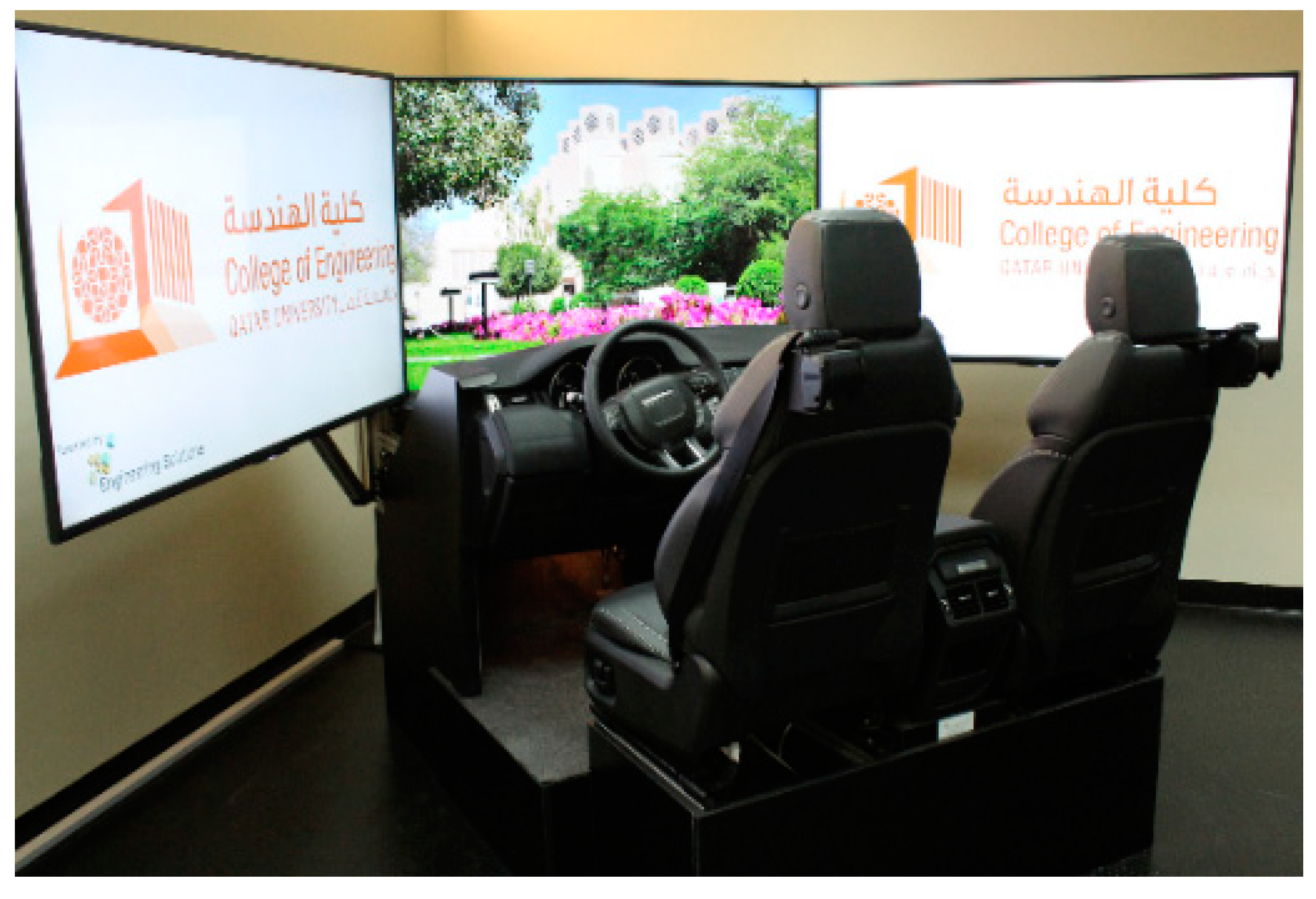
- A driving simulator will be utilized in this research as it has the capability of handling a large realistic network. A driving simulator can be used to generate and edit any road network by installing the map with signalized and unsignalized intersections, crossovers and interchanges, traffic signal poles and caps, horizontal and vertical, and merge and diverge areas.
- c)
- The research team will utilize traffic flow and speed data before the DWCFS installation to measure changes in traffic diversion rates and speed profiles. To complete this task, the research team will gather vehicle speed and traffic volume data from various sources including cido video camers and Bluetooth sensors.
- 2.
- Location and Safety Considerations:
- 3.
- Available Resources:
- 4.
- Expected Results/Outputs:
- Identification of best practice applications of Crash Fact Message Signs worldwide and recommendations for guideline updates.
- Evaluation of DWCFS effectiveness and public perception toward DWCFS.
- A value matrix of message and sign type per geographic area (urban, and rural).
- Recommendation to Ministry of public works and housing on sign type and message categories with the greatest driver compliance that can be automated to maximize their effectiveness.
References
- Davis, E. Hacker, P. T. Savolainen, and T. J. Gates, “Longitudinal Analysis of Rural Interstate Fatalities in Relation to Speed Limit Policies,” Transp. Res. Rec. J. Transp. Res. Board, 2015,. [CrossRef]
- W. Taylor, “The Impact of Raising the Speed Limit on Freeways in Michigan,” East Lnasing, 2000. [Online]. Available: https://www.michigan.gov/documents/mdot/RR771AUNIV_76A_539689_7.pdf.
- Alhomaidat, F., Kwigizile, V., Oh, J. S., & Van Houten, R. (2020). How does an increased freeway speed limit influence the frequency of crashes on adjacent roads?. Accident Analysis & Prevention, 136, 105433. [CrossRef]
- by Timothy Gates, P. Savolainen, J. Kay, J. Finkelman, and A. Davis, “Evaluating Outcomes of Raising Speed Limits on High Speed Non-Freeways MDOT Research Administration Project Number: RC-1609B FINAL REPORT,” 2015.
- MUTCD, Manual on Uniform Traffic Control Devices. 2009.
- Alhomaidat, Fadi Abdallah. Impacts of freeway speed limit on safety and operation speed of adjacent arterial roads. Western Michigan University, 2019.
- Al-Bayati, Ahmed Jalil, et al. "The Effects of Temporary Portable Rumble Strips on Vehicle Speeds in Road Work Zones." Safety 10.4 (2024): 105. [CrossRef]
- Hasan, Raed Abdullah, Fadi Alhomaidat, and Mohammad S. Albdour. "Social norms and perceptions of Saudis on active transportation." Frontiers in Built Environment 10 (2024): 1369704. [CrossRef]
- Alhomaidat, Fadi, and Lusanni Acosta-Rodriguez. "How Does Pedestrian-Driver Behavior Influence in the Number of Crashes? A Michigan’s Case Study." Transport and Telecommunication Journal 22.2 (2021): 152-162. [CrossRef]
- C. L. Dudek, “Changeable Message Sign Operation and Messaging Handbook,” 2004.
- Alhomaidat, Fadi, Valerian Kwigizile, and Jun-Seok Oh. "Impacts of freeway speed limit on operation speed of adjacent arterial roads." IATSS research 45.2 (2021): 161-168. [CrossRef]
- S. AlKheder, F. AlRukaibi, and A. Aiash, “Drivers’ response to variable message signs (VMS) in Kuwait,” Cogn. Technol. Work, 2019. [CrossRef]
- Eljufout, Tamer, and Fadi Alhomaidat. "Utilizing Waste Rocks from Phosphate Mining in Jordan as Concrete Aggregates." Results in Engineering (2024): 102350. [CrossRef]
- Alhomaidat, F., Hasan, R. A., Eljufout, T., & Abbas, A. H. (2023). User’s perceptions of electric, hybrid, and fuel-powered vehicles in Iraq and Jordan. Case Studies on Transport Policy, 12, 101004. [CrossRef]
- T. Roelofs and J. Schroeder, “ENTERPRISE Transportation Pooled Fund Study TPF-5 ( 231 ). The Future of DMS Messaging,” 2016.
- Alhomaidat, Fadi, and Monya Twaissi. "Unlocking insights from commercial vehicle data: A machine learning approach for predicting commercial vehicle classes using Michigan State data (1999–2017)." Results in Engineering 21 (2024): 101691. [CrossRef]
- P. Edara et al., “Evaluating the Benefits of Dynamic Message Signs on Missouri’s Rural Corridors,” 2011. [CrossRef]
- F. Bella, “Validation of a Driving Simulator for Work Zone Design,” Transp. Res. Rec. J. Transp. Res. Board, 2005, doi: 10.3141/1937-19. [CrossRef]
- Alhomaidat, Fadi, and Tamer Eljufout. "Perception of cycling risks and needs associated with skill level, gender, and age." Archives of transport 59.3 (2021).
- D. Llopis-Castelló, F. J. Camacho-Torregrosa, J. Marín-Morales, A. M. Pérez-Zuriaga, A. García, and J. F. Dols, “Validation of a Low-Cost Driving Simulator Based on Continuous Speed Profiles,” Transp. Res. Rec. J. Transp. Res. Board, 2016,. [CrossRef]
- Alhomaidat, Fadi, et al. "The relationship between cycling risk perception and skill level of different age groups." Proceedings of the 6th Annual International Cycling Safety Conference, Davis, CA. Vol. 10. 2017.
- Oh, Jun-Seok, et al. Effect of Cycling Skills on Bicycle Safety and Comfort Associated with Bicycle Infrastructure and Environment. No. TRCLC 15-01. Western Michigan University. Transportation Research Center for Livable Communities, 2017.
- Oh, Jun-Seok, et al. "15-01 Effect of Cycling Skills on Bicycle Safety and Comfort Associated with Bicycle Infrastructure and Environment." (2017).
- Alhomaidat, Fadi, and Siamak Ardekani. "A statistical comparison of traffic measurements from the moving versus stationary observer methods." Journal of Transportation Technologies 5.4 (2015): 204-213.
- 25. F. Bella, “Driver perception hypothesis: Driving simulator study,” Transp. Res. Part F Traffic Psychol. Behav., 2014, doi: 10.1016/j.trf.2014.04.007. [CrossRef]
- Alhomaidat, Fadi, et al. "User’s perceptions of electric, hybrid, and fuel-powered vehicles in Iraq and Jordan." Case Studies on Transport Policy 12 (2023): 101004. [CrossRef]
- J.-S. Oh et al., “Costs and Benefits of MDOT Intelligent Transportation System Deployments,” p. 203p, 2015.
- J.-S. Oh, Dynamic Route Guidance and Network Traffic Management: Theoretical Evaluation and and Practical Application Issues. 2001.
- Alhomaidat, Fadi, et al. "Using driving simulator to study the effect of crash fact signs on speeding behaviour along freeways." International journal of injury control and safety promotion 30.1 (2023): 15-25. [CrossRef]
- Alhomaidat, Fadi, et al. "Investigating the interaction between age and liability for crashes at stop-sign-controlled intersections." Transportation research interdisciplinary perspectives 14 (2022): 100612.
- Hanandeh, Shadi, et al. "Modelling the free flow speed and 85th percentile speed using artificial neural network (ANN) and genetic algorithm." International review of civil engineering 13.4 (2022): 296-308.
- Khliefat, Ibrahim, et al. "Improving the capacity and level of service at the sixth circle in Jordan by using traffic signals and roundabout metering approach." The Open Transportation Journal 15.1 (2021).
Disclaimer/Publisher’s Note: The statements, opinions and data contained in all publications are solely those of the individual author(s) and contributor(s) and not of MDPI and/or the editor(s). MDPI and/or the editor(s) disclaim responsibility for any injury to people or property resulting from any ideas, methods, instructions or products referred to in the content. |
© 2025 by the authors. Licensee MDPI, Basel, Switzerland. This article is an open access article distributed under the terms and conditions of the Creative Commons Attribution (CC BY) license (http://creativecommons.org/licenses/by/4.0/).


