Preprint
Article

This version is not peer-reviewed.

Trends in the Use of Non-Pharmaceutical Interventions in Schools During the COVID-19 Pandemic, February 2021 to December 2023: A Mixed Methods Study

A peer-reviewed article of this preprint also exists.

Submitted:

13 January 2025

Posted:

14 January 2025

You are already at the latest version

Abstract

The use of non-pharmaceutical interventions (NPIs) was imperative to avoid prolonged school closures during the COVID-19 pandemic. The purpose of this study was to understand the levels of adherence to and attitudes towards NPIs from February 2021 to December 2023 in schools in Ontario, Canada. Participants reported how frequently they, their coworkers, and their students used five NPIs: hand hygiene, covering coughs, staying home when ill, wearing a mask, and physically distancing. Open text comments provided participants with the option to provide additional details. A mixed methods approach incorporated a series of descriptive statistics calculated at consecutive time points and thematic analysis. Participants reported higher adherence to NPIs than their coworkers and students, with less than perfect adherence that declined over time. Six themes emerged from the analysis on NPI use in schools: 1) the influence of time; 2) managing competing priorities; 3) lack of enabling factors; 4) lack of reinforcing factors; 5) responsive use of NPIs; and 6) emotional toll. Poor use of hand hygiene, covering coughs, and staying home when ill indicate a need to improve these in schools as it would help reduce the transmission of communicable diseases and thereby reduce sick days for staff and students.

Keywords: 
;  ;  ;  ;  ;  

1. Introduction

A novel strain of a coronavirus (2019-nCoV) was identified in Wuhan, China in December 2019 and later termed severe acute respiratory virus coronavirus 2 (SARS-CoV-2) [1]. Schools are meant to provide a safe and supportive learning environment for students [2]; the spread of SARS-CoV-2 threatened this environment. Responses intended to disrupt the transmission of SARS-CoV-2 caused significant disruptions within the education system and contributed to learning losses, exacerbated educational inequalities, and changed the way we approach public education [3,4,5,6].
In Canada, the first case of the illness caused by SARS-CoV-2, coronavirus disease 2019 (COVID-19) was detected on January 25, 2020 [7]. The province of Ontario, Canada declared a state of emergency on March 17, 2020 [8] and announced a two-week closure of schools that was ultimately extended and remote learning was instituted until June 30, 2020 [9,10,11]. The following school year was also subject to temporary closures in response to heightened community transmission of COVID-19 [12]. In total, Ontario schools were closed for a minimum of 27 weeks, longer than any other Canadian province or territory [13].
Although school closures were only one of several mitigation strategies implemented to attempt to control the spread of COVID-19, it was acknowledged that they were detrimental to students’ learning and overall well-being [14,15]. As a strategy to keep students attending in-person classes, non-pharmaceutical interventions (NPIs), measures to reduce the transmission of infectious agents that do not rely on vaccines or treatments, were used prior to, and as a complement to, COVID-19 vaccines [16]. No NPI is 100% effective at stopping the transmission of SARS-CoV-2 or other directly transmitted pathogens on its own and some NPIs (e.g. lockdowns and school closures) are more socially disruptive than others. As such, the adoption of a suitable combination of NPIs, or layers of protection, is recommended to reduce the spread of COVID-19 and other infectious illnesses [17,18]. Although NPIs such as masking and physical distancing can be implemented temporarily in response to changes in rates of illness in the community or school, covering coughs, hand washing, and staying home when ill are universal NPIs that should be used at all times, without regard to epidemics or pandemics [5,14].
To promote the safe reopening of schools in September 2020, the Government of Ontario proposed a layered approach emphasizing both universal (hand hygiene, respiratory etiquette, and staying home when symptomatic), and temporary (mask wearing and physical distancing) NPIs [19]. Mask mandates were implemented in September 2020 for staff and students in grades 4-12 and extended to students in grades 1-3 in March 2021 [19,20]. The updated plan for the 2021-2022 school year maintained these requirements [20]. See supplemental Figure S1 for a timeline.
Several studies have investigated the impacts of, or adherence to, NPIs in school settings during the COVID-19 pandemic that focused, largely, on students [12,21,22,23,24,25,26,27,28,29,30,31]. Jarnig et al. [21] found that middle and high school students more frequently wore their masks correctly in the presence of teachers than among other students. Mickells et al. [31] reported that considerable effort by teachers was required to maintain adherence to masking in pre-kindergarten to second grade students. Lin et al. [29] presented reports from teachers on the challenging nature of monitoring students’ mask-wearing, physical distancing, and hand hygiene. Amin-Chowdhury et al. [22] found that educational staff reported that students struggled most with physical distancing in both primary and secondary schools and that hand hygiene was easier to implement in primary than in secondary schools. These findings suggest that education workers are already playing an important role in the promotion of NPIs among students and, given the challenges, supports a layered approach to make up for failures of individual interventions.
Most studies of NPI use in schools have been cross-sectional in design. To date, few have investigated the temporal trends in the use of, or attitudes/perceptions about the use of, NPIs. The COVID-19 Cohort Study for Teachers and Education Workers (CCS-2) collected data from education workers between February 2021 and December 2023, a period that encompassed many scientific advances (e.g., vaccine development) and policy and attitude changes [32], including the rescinding of mask mandates in Ontario schools in March 2022 [33]. This study analyzes patterns of adherence to NPIs in the school setting throughout that period. In this study, we aimed to use both quantitative and qualitative methods to better understand the patterns of adherence to NPIs over time and to situate them within the context of the COVID-19 pandemic, as experienced in Ontario schools, through a pragmatic world view.

2. Materials and Methods

2.1. Design and Participants

This study was conducted as part of the CCS-2, a 35-month long prospective cohort study conducted with teachers and other education workers employed with elementary or secondary schools or school boards in Ontario [34]. This substudy used a concurrent embedded mixed methods research design composed of a series of anonymized cross-sectional surveys, integrating both open- and closed-ended questions, completed annually over the duration of the study.
Recruitment began on February 18, 2021, following approval from the Research Ethics Board at Sinai Health, with rolling recruitment ending on May 31, 2023. Recruitment, consent, and data collection were conducted electronically due to COVID-19 restrictions on in-person research activities. Data collection ended upon their withdrawal or on December 22, 2023, whichever occurred first.
Participants were eligible for inclusion in these analyses if they were employed in any capacity by an Ontario public, Catholic or independent school board, were 18-74 years old, and completed >50% of at least one baseline questionnaire. Reports were not eligible for analysis if participants reported that they worked remotely, worked at a school board office, or were on leave/retired.

2.2. Data Collection and Preparation

Following consent, participants were asked to complete a baseline questionnaire that captured all data used in these analyses. This included demographic characteristics, school/workplace characteristics, frequency of personal use of NPIs, and estimated use of NPIs by coworkers and students as well as the opportunity to provide general comments. Of note, the open-text “comments” opportunity was presented at the end of the questionnaire following the questions about NPIs (i.e., it was not specifically asking about NPI use). Participants were asked to complete an update of the questionnaire at the beginning of every new school year (September) to capture changes in information.
The outcome for the quantitative analysis was the use of each of the five NPIs during the school year in which the baseline report was assigned. Data were collected by asking participants “While at work (since the beginning of the school year) how often do you…1) physically distance from others, 2) wear a mask in others' presence, 3) cover coughs, 4) wash hands thoroughly and regularly, and 5) stay home when you have symptoms, even if they are mild”. Participants were also asked “how often do your co-workers/students in your school…” use the NPIs listed above. Responses were on a four-point Likert-like scale (never, occasionally, usually, or always) that were dichotomized into always versus not always for statistical analyses. If more than two of five responses to NPI use were missing for any of the three groupings (self, coworkers, students), the report was excluded. Missing responses were not included in the denominator.
For quantitative analyses, baseline questionnaires were assigned to the academic half year in which they were submitted (i.e., September to January or February to August). Although questions asked respondents to estimate the use of NPIs “since the start of the school year”, responses were split into half years to reduce the influence of recency bias.

2.3. Analyses

Mixed methods research involves philosophical assumptions and the integration of both quantitative and qualitative data analyses thus improving the results of the study beyond what would be achieved by using either component alone [35,36]. A pragmatic worldview was used in these analyses aimed at providing a practical solution in the context of the social, historical, political, and cultural background [35,37].
Quantitative data used to investigate patterns in the use of NPIs over the data collection period were supplemented with qualitative data on the attitudes and motivations behind the use of NPIs and changes in use, motivation, and/or attitudes over time. Descriptive statistics were calculated for sociodemographic characteristics. Outcomes for each of the five NPIs include frequency counts, percentages, and 95% confidence intervals calculated for each academic half-year and demonstrated graphically.
Open text responses were initially reviewed and excerpts that were not applicable to NPI use were removed. The body of qualitative data was analysed using thematic analysis and reviewed to determine if or when behaviours and attitudes underwent a discernable shift during the data collection period. A hybrid approach of inductive and deductive coding, as outlined by Fereday and Muir-Cochrane [38], that integrates both data-driven and theory-driven codes was used to develop an analytical codebook. A preliminary codebook (deductive component) was developed based on the research objectives, the literature review, the quantitative patterns observed through the use of descriptive statistics, and a preliminary scan of the open text responses [38,39,40]. An inductive approach was then applied using open text responses to identify and capture previously unidentified themes [38,40,41], enhancing the themes identified in the deductive component and giving voice to the education workers in our study during this extraordinary pedagogical period [42]. After the first round of inductive coding, the research team reviewed and approved the proposed themes and subthemes; two rounds of inductive coding were completed. Data preparation and analyses were conducted using Stata/SE 18.5 software [43] while the thematic analysis was conducted using Dedoose 9.2.22 software [44].

3. Results

Of the 3876 education workers enrolled in the CCS-2, 3617 (93.3%) were eligible for inclusion in the quantitative data analysis; see Supplemental Figure 2 for specific exclusions. The mean age of the eligible education workers was 45.3 years, 3091 (85.5%) identified themselves as female, and 2923 (80.8%) as a teacher or instructor (see Table 1 for further details). Demographic details by each half-year period are available in Supplemental Table 1.

3.1. Quantitative Results: Reported Use Over Time

Self-reported personal use and estimated use by coworkers and students of the five investigated NPIs declined over the data collection period (February 2021 to December 2023). Participants reported that they always adhered to each of the five NPIs more often than they reported that their coworkers or the students in their schools did.
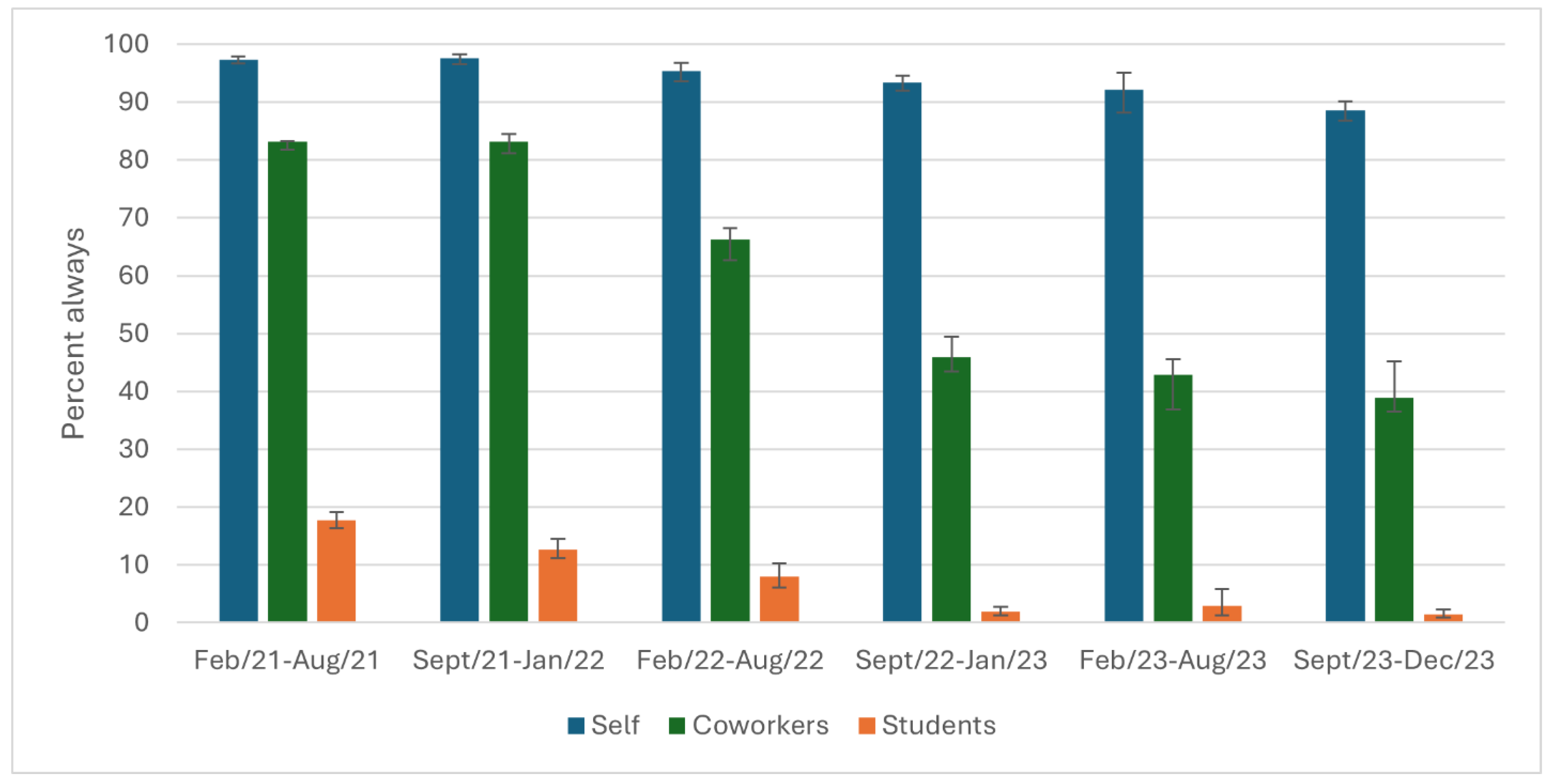
The largest decline in use of NPIs was for mask usage (Figure 1). In the first half year (spring 2021), when mask mandates were in effect, 79% of participants reported they always wore their masks while at work as did 57% and 33% of their coworkers and students, respectively. The reported percentage dropped to 20%, 0.5% and 0.1% for themselves, their coworkers, and their students, respectively, in the fall/winter 2022/2023 (the first data collection following the March 2022 lifting of the mask mandate). By the end of the data collection period (fall 2023), these estimates had dropped to 6%, 0.4% and 0, respectively.
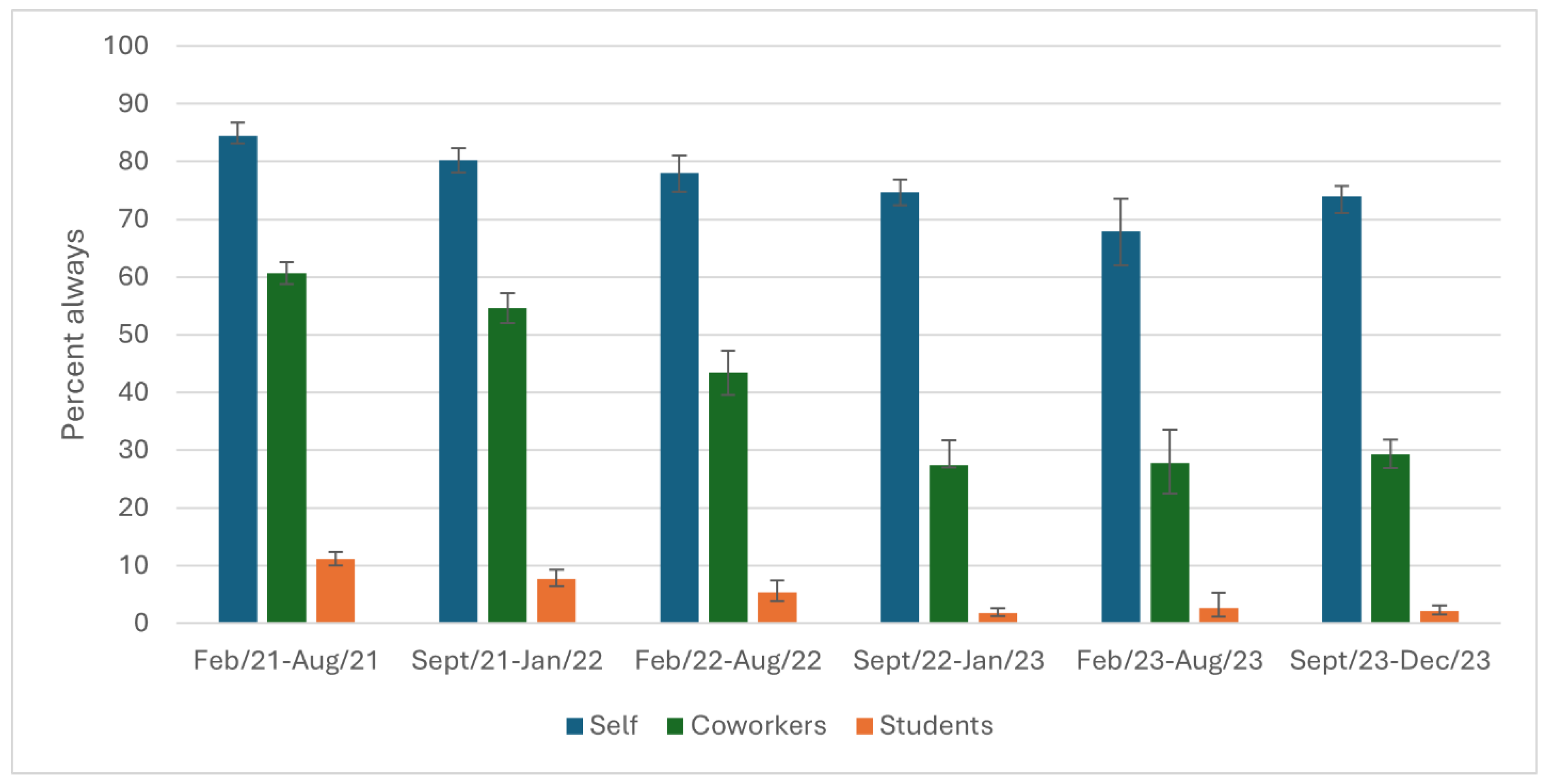
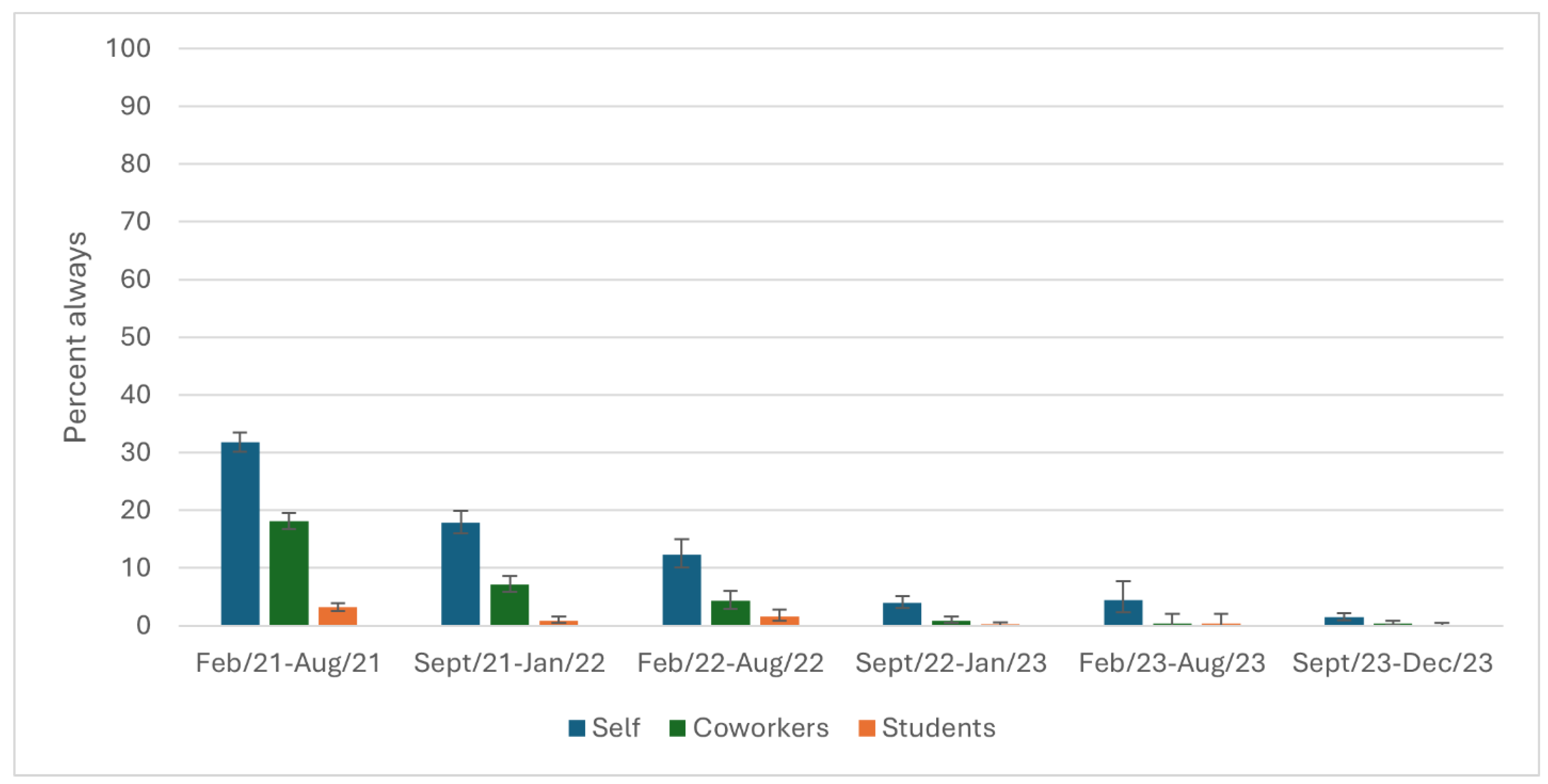
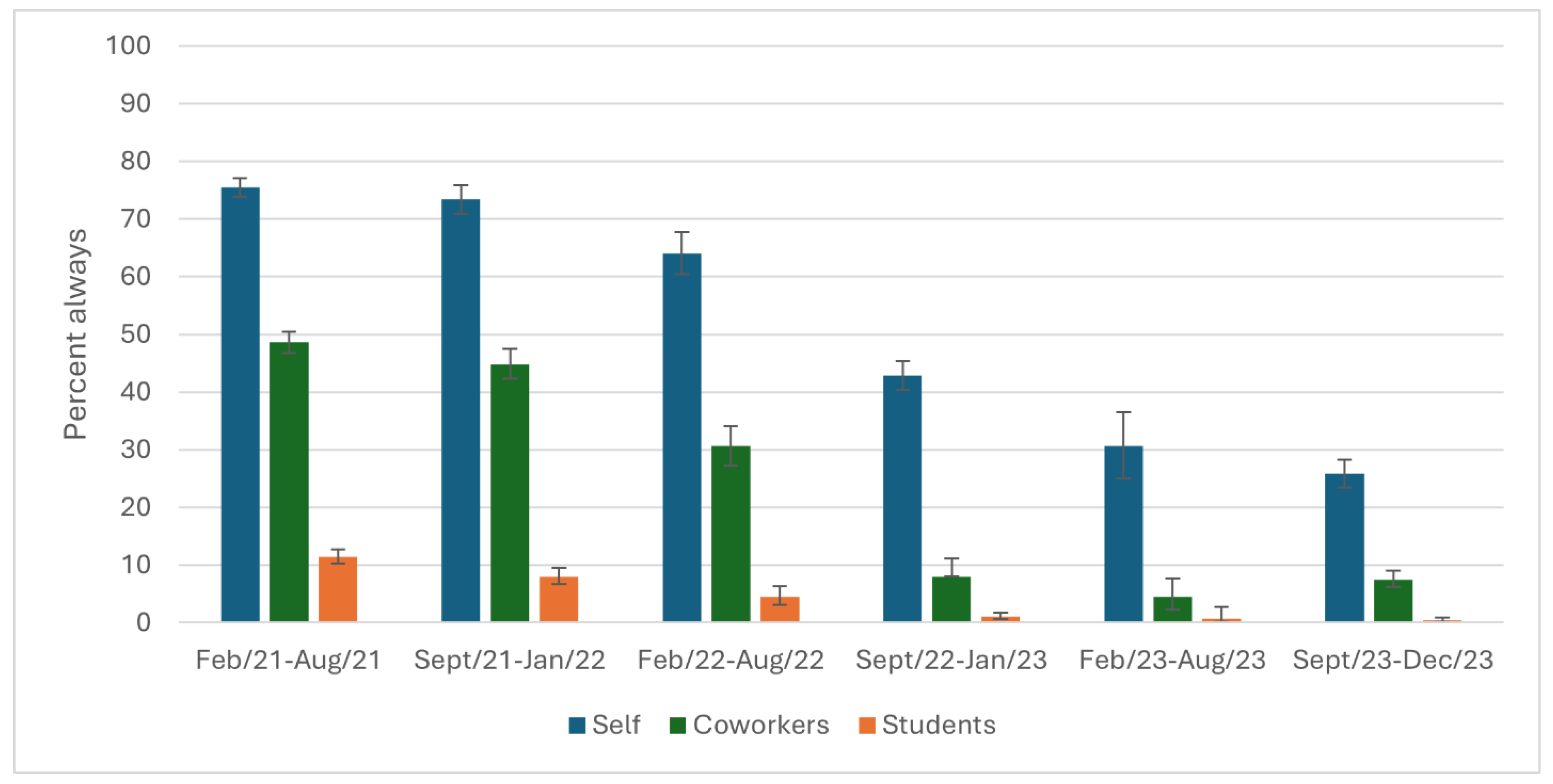
High percentages of participants reported they always covered their coughs (≥88%) and washed their hands (≥68%) throughout the study period (Figure 2 and Figure 3); however, there was a ~10% drop from study start to end. Reported ability to always physically distance was low among participants (32% at the height) throughout the entire study period (Figure 4). Participants who reported always staying home when ill decreased by 50 percentage points, from 75% to 26%, during the study (Figure 5) with similar declines reported for coworkers and students. Reported use of NPIs by school setting (elementary and secondary school) is available in Supplemental Figures S3-S12.

3.2. Qualitative Results: Themes

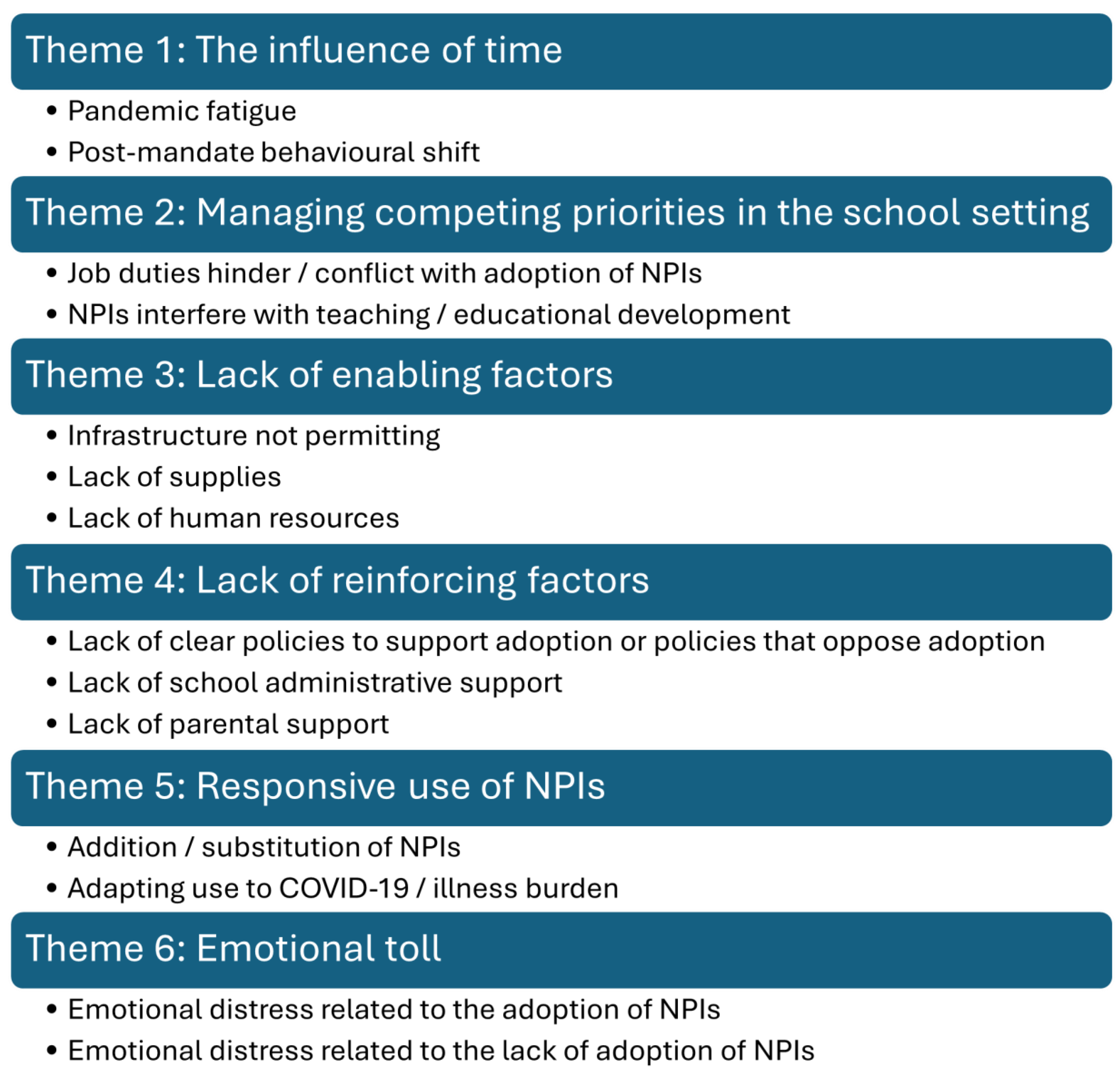
For open text responses, 945 comments from 718 participants were related to the use of NPIs in the school setting and were eligible for thematic analysis. The thematic analysis resulted in six themes and 14 subthemes as illustrated in Figure 6. While some themes were omnipresent or recurrent over the duration of the data collection, other themes were more apparent during certain periods. Barriers to high levels of NPI use were common among comments.

3.2.1. Theme 1: The Influence of Time

The influence of time was split into two subthemes: pandemic fatigue and post-mandate behavioural shift. Pandemic fatigue referred to the changing landscape of the adoption of NPIs as the pandemic continued. Consistent with close-ended question responses, participants described observing a “fatigue towards” or gradual waning in the use of NPIs over time among coworkers and students.
“I can say that students have become less and less likely to use hand sanitizer regularly as the pandemic continues. Additionally, they are becoming more and more relaxed about masks and the new thing is to wear them under their noses." (Teacher, mixed elementary and secondary school, April 2021)
“The majority of staff and students comply but I have noticed a difference in the strict adherence to physically distancing and masking. They are more relaxed." (Administration, elementary school, December 2021)
The subtheme of a behavioural shift emerged after mask mandates were lifted in schools in March 2022; this was mirrored by the quantitative data, above. Participants noted a dramatic change in the use of, and attitudes towards the use of, NPIs with a worsening since the start of the pandemic.
“There was a big change in masking when mandate was dropped. Out of twenty students in June, there was only one that continued masking until the end of the school year. About half the staff (maybe as much as 75%) stopped masking when the mandate was removed." (Teacher, elementary school, July 2022)
“Due to the lifting of isolation requirements when ill, many in my school (including adults & students) still come to school when they have mild to moderate symptoms such as hacking coughs, runny noses, sore throats, fatigue..etc. (Teacher, elementary school, October 2022)
Other educators commented that their coworkers and/or students appeared to have dismissed fundamental transmission-limiting behaviours that were better than usual earlier in the pandemic.
“Once the mask mandate was lifted, I really feel like people stopped covering their mouths when they coughed and people came to work sick again.” (Teacher, secondary school, August 2022)
“It seems everything we learned during the pandemic about how to keep each other healthy has been lost.” (Teacher, secondary school, May 2023)

3.2.2. Theme 2: Managing Competing Priorities in the School Setting

This theme encompassed priorities that conflicted with supporting the academic development and general well-being of students due to the need to adopt NPIs. The subtheme of job duties hinder/conflict with the adoption of NPIs refers to the day-to-day tasks that conflicted with the ability to consistently employ NPIs. It was more frequently mentioned regarding an inability to physically distance from young students and students with exceptionalities than other NPIs.
“I teach students with special needs, so physically distancing myself is impossible. In order to provide the necessary support, I need to touch their hands, their learning materials, the food containers etc. (Teacher, secondary school, April 2021)
“Close contact is required with unmasked children to assist with opening containers in lunches during nutrition break. Close contact is also required when assistance is required, for example dressing for outside, helping with shoe, packing or unpacking backpacks, and assisting with toileting accidents.” (Early childhood educator, elementary school, April 2021)
Other job duty-related exceptions, such as providing guidance and working with students with hearing loss, were noted to interfere with their and/or their students’ ability to always mask.
“Physical distancing is tough with my job-guidance deals with private, often confidential information and sometimes upset and/or emotional students. I physical [sic] distance when I can. Sometimes panic attacks etc (very prevalent now) require student to remove mask to breath and calm down.” (Teacher, secondary school, October 2021)
“I want to wear a mask at work, but I cannot as I have students who read lips. They are hard of hearing.” (Teacher, secondary school, September 2023)
The subtheme of NPI use interfering with teaching/educational development referred specifically to the ability to proficiently deliver the curriculum to students and for students to be able to receive said instruction. Although comments within this subtheme were mentioned consistently across the data collection period, the use of different NPIs were mentioned more often at different times. Education workers were concerned that what they were expected to do to reduce the risk of COVID-19 in schools (masking, distancing) conflicted with what they understood to be beneficial to the learning and development of children.
“Covid safety requirements in classrooms are not in line with "best practices" pedagogically-speaking; meaning, what we must do for our health/safety is in direct contrast to what we know is best for kids' learning in K and Gr. 1. It's challenging and stressful." (Teacher, elementary school, August 2021)
Educators were also concerned about juggling priorities to also monitor the use of NPIs in their setting.
“There were many protocols we had to ensure in our schools (handwashing, hand sanitizing, monitoring physical distance, teaching and monitoring protocols) at the same time as being expected to teach all of the curriculum.” (Teacher, elementary school July 2021)
They also noted that as the pandemic progressed, more children were coming to school when they were unwell.
“Students are often coming to school sick; I have had several students who seem very ill in class but have come back to school because "they've missed too much already." (Teacher, secondary school, October 2022)

3.3.3. Theme 3: Lack of Enabling Factors

The term enabling factors was used to describe the conditions necessary for the adoption of NPIs such as infrastructure, supplies and human resources; absence of a necessary condition would make it next to impossible to adopt the corresponding NPI. The subthemes of infrastructure and lack of supplies were consistently observed across the study period while a lack of human resources was more common after the lifting of mask mandates. One of the more frequently reported barriers to successfully adopting NPIs was the lack of space to practice physical distancing.
“We do not have enough space to physically distance in a school. This is impossible with class sizes. Let's stop pretending this is a reality.” (Teacher, elementary school, March 2021)
“Students would love to physically distance themselves from me, but there is no room in the classroom for them to do so. Class sizes are larger than they've ever been. Even before the pandemic.” (Teacher, elementary school, October 2021)
A lack of handwashing facilities was also noted by several participants.
“I am a kindergarten teacher who was in person until the lockdowns. I was in a room with no sink or bathroom. I was left to only use hand sanitizer for washing hands.” (Teacher, elementary school, May 2021)
“I'm in a portable. Time is tight and the washroom is far. Handwashing feels like a luxury.” (Teacher, elementary school, October 2023)
Some described a lack of necessary supplies such as warm water and soap/hand sanitizer, and/or proper fitting masks.
“We have everyone sanitize as best we can- but often we are out of sanitizer and are looking for more.” (Educational assistant, elementary school, February 2021)
“Students are required to wear masks but often the masks are ill-fitting and slip off their noses.” (Teacher, secondary school, April 2021)
The water available for the kids to wash their hands is ice cold. Truly ice cold. It is painful (even as an adult) to wash hands for a full 20 seconds.” (Teacher, elementary school, January 2022)
After the lifting of mask mandates, the subtheme of a lack of human resources was identified as a major barrier to education workers staying home when ill. Many participants noted that there was heightened pressure from the administration to be present despite being unwell, as there were not enough staff to cover absences.
“We have almost no supply teachers so staying home makes it challenging for the rest of the school team. Many staff come in sick because they don't want to strain a system that is already running on duct tape and hope.” (Teacher, elementary school, October 2022)
"We have a severe supply teacher shortage so many, including myself, are coming to school sick because the impact on other staff and the students is so high when we can't get a supply teacher! I taught 1.5 days last week when I should have been home sick for this reason!” (Teacher, elementary school, October 2022)

3.3.4. Theme 4: Lack of Reinforcing Factors

The term reinforcing factors was used to describe conditions that strengthened or supported the ability to adopt NPIs in the school setting. These have been further categorized as a lack of clear policies to support adoption or policies that oppose adoption; lack of school administrative support; and lack of parental support. While all three subthemes were present for the full duration of the study, they were commented on more frequently as the pandemic continued.
Participants noted an absence of strict policies to support NPI adoption, policies that were difficult to interpret and thus difficult to adhere to, or those that conflicted with best practices for reducing COVID-19 transmission in schools. Staying home when ill was the NPI most often commented upon in this subtheme.
“I have been directed to return to work on Monday if my result is negative even though Hospital Test Centre says I should isolate.” (Teacher, elementary school, March 2021)
“There is much confusion from the families we teach about when to stay home and for how long. Very little clarity has been given by the board or our union.” (Teacher, elementary school, March 2021)
“Very mixed messages between school boards and what Health Unit recommendations are in situations that cause stress.” (Educational assistant, elementary school, May 2021)
“The [school board] staff ‘attendance program' has also discouraged sick staff from staying home when ill, in fear, which also may impact medically fragile people.” (Teacher, elementary school, November 2023)
Participants also noted confusion regarding the use of masks after mandates were lifted and reported that guidelines for masking were frequently ignored by both staff and students.
“Even staff who have been off with COVID do not mask upon their return as it is "guidance only.” (Teacher, elementary school, December 2022)
Several participants conveyed a perceived lack of support from their school’s administration when attempting to adopt NPIs or to monitor/enforce adherence to NPIs. Some participants noted a disinterest by their administration or senior leadership in sending children home when they were ill, while others noted a lack of role modeling and/or disregard for public health advice by senior leadership.
"One of my students was sick with a cough and cold and on medication. He was crying and not able to cope with school. My principal would not send the student home." (Teacher, elementary school, October 2021)
“Our school board has decided that anything related to keeping staff or students safe is a "political issue" and I am quite literally the ONLY person wearing a respirator in my schools... Principals and system administrators refuse to wear a mask, even when clearly symptomatic.” (Teacher, elementary school, October 2023)
A lack of parental support was one of the more prevalent subthemes throughout the study. This was predominantly related to the ability to keep ill children home from school in the elementary school setting. Many participants noted that parents sent ill children to school despite policies in place to prevent such, while some described methods used to mitigate the appearance of symptoms that would result in being sent home.
“Poverty and affordable child care affects families differently. Many of our families can't afford to keep their kids at home or stay home from work if they are feeling unwell." (Teacher, elementary school, July 2021)
“MANY parents send the kids to school deliberately ill and noticeably sick (some with child care needs due to work and some at home parents) in December 2021 at least 1/2 of my class reported being given medication (the pink one- the bubblegum flavour one etc in the AM before school)." (Teacher, elementary school, February 2022)
Participants also reported an increase in the frequency of ill children being sent to school after the lifting of mask mandates.
“It appears that parents believe COVID is over and this year [2022,2023] so many kids are coming to school very sick.” (Teacher, elementary school, October 2022)

3.3.5. Theme 5: Responsive Use of NPIs

Responsive use of NPIs referred to the addition, substitution, or adaptation of NPIs in response to other influences. The first subtheme, addition/substitution of NPIs, was mentioned throughout the duration of the study. Participants said they used an additional layer of protection to mitigate instances where the use of another NPI was not possible or satisfactory.
“If we need to be closer to them (to give instructions or explain paperwork), then I always wear a face shield on top of my mask." (Teacher, secondary school, March 2021)
“Last year 99% of my students masked all day. This year 4/27 mask. We have a HEPA filter running in the middle of the classroom. I religiously turn it up to max when they are gone and keep 2+ windows open throughout the entire day.” (Teacher, elementary school, February 2023)
Some education workers proposed additional measures that were not supplied by the schools that they felt would help overcome difficulties.
“I use a microphone, but teachers and both administrators (principal and VP) frequently hold their masks off of their faces to project into the room. All should be issued microphones to discourage this behaviour.” (Teacher, elementary school, October 2021)
The subtheme of adapting NPIs became prominent after the lifting of mask mandates in March 2022. The most common adaptation was the use of a mask when most others were not using them.
“I have noticed an uptick in students who are off sick returning and wearing a mask for a few days after their return... the same goes for staff members... I am not currently masking, though I plan to begin again during cold and flu season, especially before I receive my flu shot." (Teacher, secondary school, September 2023)
“I have worn a mask and distanced at school when positive for COVID. Once I tested negative on RAT test and symptoms subsided, I stopped wearing a mask at work." (Teacher, elementary school, September 2023)

3.3.6. Theme 6: Emotional Toll

The sixth theme that emerged was the emotional toll experienced by education workers and their students during the COVID-19 pandemic as it related to the adoption (or lack thereof) of NPIs in schools. Two subthemes emerged: emotional distress related to the adoption of NPIs and distress related to the lack of adoption of NPIs. Both subthemes emerged as adherence to NPIs was waning. Participants noted that the ongoing use of NPIs was perceived negatively by coworkers and students and often resulted in the users feeling isolated.
“I used to wear my mask regularly last year but this year I feel some social pressure to not wear the mask as much.” (Teacher, secondary school, October 2023)
“I am the only masking member of staff, and it is deeply unpopular with my colleagues, who talk about my “paranoia” and speculate, publicly, about my mental health.” (Teacher, secondary school, October 2023)
Given the widespread lack of mask usage after the lifting of the mandate, participants noted that their use of masks signified illness and infectiousness to peers, causing fear.
“I stayed home 3 days (+2 days from the weekend), because the internet said it was less contagious after 5 days, and wore a mask the first day back, but that alarmed students because they thought I had COVID, so I didn't wear a mask the Friday." (Teacher, secondary school, October 2023)
Alternatively, participants conveyed distress associated with the lack of NPI use; this was more frequent as NPI use waned.
“We have no choice but to risk health for employment. Many in schools refuse to follow public health measures.” (Teacher, secondary school, March 2021)
“Very few other teachers or students wearing masks at school. Lots of people coming into school when sick, it feels very dangerous and stressful.” (Teacher, elementary school, October 2022)
Some conveyed dismay that little was being done to protect staff and students and their right to a safe learning environment.
“It seems so bizarre to me that with the 6th wave here and being recommended to continue wearing masks (indoors with people) that schools and people inside no longer are mandated to do so? I do not feel safe in this environment!” (Educational assistant, secondary school, April 2022)
“The complete disregard for the health and safety of the medically vulnerable (including myself) during this time of the pandemic has been disheartening and a complete failure of the provincial government and public health.” (Teacher, elementary school, January 2023)

4. Discussion

This study of elementary and secondary school education workers in Ontario, Canada described the use of, and experiences associated with, the adoption of NPIs in schools from February 2021 to December 2023. Quantitative analyses demonstrated less than ideal use of NPIs (i.e., masking, physical distancing, hand hygiene, covering coughs, and staying home when sick) and declining trends in use over time among education workers, their coworkers, and their students. Barriers to the use of NPIs included time/priority setting; the lack of infrastructure, human resources, supplies, and supportive policies; and lack of support from school administration and/or parents.
Three areas of opportunities for improvement were raised from our analyses: 1) reducing barriers that impeded the ability to adopt NPIs among education workers and students; 2) the necessity of using and supporting the use of hand hygiene, covering coughs, and staying home when sick on a permanent basis; and 3) the need to institute the use of NPIs, such as masks, on a short-term basis during periods of increased respiratory illnesses.
The establishment and enforcement of policies in which a workplace safety climate is promoted would reduce, among other things, the barriers to the use and promotion of use of NPIs by education workers. The concept of a safety climate refers to the perceptions that employees share about the many aspects of safety within their working environment [45,46]. Education workers in this study frequently noted the need for policies and/or the enforcement of existing policies to increase the use of NPIs. Likewise, in a 2020-2021 study, Serrano et al. [47] reported that education workers in Ontario felt that their work environment was inadequately safe and that students and staff were unable to fully follow COVID-19 protocols. A study conducted in the same era (December 2020) found that two-thirds of almost 5000 educators in Ontario felt that they had less than half of the needed infection control protocols in place and noted deficits in physical distancing measures, screening of students, and masking requirements for students [48]. In a separate survey among the education workers in this cohort, done in December 2022, similar sentiments were reported, with over 50% of comments suggesting that masks be mandatory for all staff and students and 25% stating that principals and superintendents enforce the stay-at-home rules [34]. The establishment of workplace safety climates in education systems may help address many concerns, including concerns about infectious disease transmission.
Personal protective measures such as hand hygiene, covering coughs/sneezes, and staying home when ill are an integral part of preventing illnesses caused by infectious agents. They are proven strategies to prevent illness that will continue to be important beyond the end of the COVID-19 pandemic [49]. In the school setting, the optimization of the health and safety of education workers and students requires that these universal measures are in place and are supplemented with other measures such as adequate ventilation, environmental cleaning, and vaccination [5,50]. Hand hygiene and covering coughs and sneezes are easily-actionable core prevention strategies to limit the spread of infections. School-based and early education programs that promote hygiene can reduce the incidence of COVID-19 and other common infections that circulate within schools and reduce illness-related absenteeism [2,50,51]. The early formation of hygienic habits has been associated with higher adherence to pandemic preventive practices among adolescents, suggesting that early intervention also promotes sustainability in hygienic habits [52,53]. Schools can teach and reinforce good hygiene to students but must be equipped with the necessary tools to do so. In this study, barriers to the use of hand hygiene included a lack of infrastructure and/or supplies. A program that supports education workers to model and teach hygiene according to the children’s developmental stages would be beneficial [54] as would policies to ensure that schools have the facilities and supplies to support them.
Steps need to be taken to reduce presenteeism (i.e., attending school/work while ill) because it increases morbidity and diminishes productivity and the quality of work of education workers [55,56] and negatively impacts the educational attainment and mental and physical health of students [57]. There is a large body of evidence to support school and workplace exclusion policies [58,59,60]. However, the prolonged nature of the COVID-19 pandemic introduced new considerations for absenteeism in the school setting (i.e., learning losses). Study participants described the lack of human resources as a strong driving force behind feeling unable to stay home when ill. This issue requires a two-fold solution: reducing worker productivity losses associated with absenteeism among currently employed education workers by identifying and reducing risk factors for illness [55] and assuring adequate human resources to replace workers who need to stay home [61].
It is understood that allowing ill students to attend school perpetuates the spread of infections in schools [62,63]. Further, studies among university students found that students attending classes while ill frequently reported difficulty concentrating in class, being tired and distracted, and studying slower [64] while being negatively correlated with general health, well-being, and the overall ability to study [65]. Participants of this study noted several barriers that prevented students from staying home when ill, many of which extended beyond the classroom/school system. The most frequently cited barrier was a lack of childcare/inability for a parent to stay home with an ill child. A systematic review by Woodland et al. [57] highlighted factors in parents’ decisions to send children to school while ill including not recognizing symptoms of illness, considering factors external to illness (e.g., the school’s sick policy), the child’s attendance history, and the ability to arrange for childcare and/or to stay home themselves. That review also noted that parents used medications to mask symptoms of illness in their children, a behaviour also mentioned by our study’s participants. It is important to have robust measures in place to reduce illnesses (e.g., use of NPIs) while supporting absences [57] including clear and consistent communication among involved parties reinforced by the fair and equitable enforcement of existing policies [2].
Masking and physical distancing can be challenging to implement and may impact social connectedness in the school setting [5]. Despite this, they remain important NPIs that can be used as part of a layered approach to infection prevention. The reintroduction of these measures can be beneficial in periods of increased transmission of respiratory infections within the school and the wider community. With the lifting of mask mandates, wearing a mask in school remained a personal choice that was influenced by complex social norms, peer influence, and local policies [66,67]. In December 2022, calls to re-introduce widespread masking in schools occurred as surges in seasonal respiratory illnesses, such as influenza and respiratory syncytial virus, occurred along with ongoing SARS-CoV-2 transmission, causing overcrowding of children’s hospitals across Canada [68]. And yet, as reported by participants in this study, the majority of staff and students chose not to mask when given the choice, even when masks were strongly recommended (e.g., when symptomatic or recovering from COVID-19). This may be indicative of the ongoing politicization of mask wearing in North America [69,70]. Study participants who chose to continue to wear their masks or wore them when symptomatic noted feelings of isolation and judgement from their peers. Further research on how best to support those who choose to wear masks in schools and how to successfully re-introduce masking during periods of heightened transmission of respiratory viruses, that is attentive to social and behavioural norms, is needed.
Physical distancing was the most poorly performed NPI in this study. Participants reported that attempts were quickly abandoned and that they felt frustrated over the expectation to physically distance while not being positioned to do so. In addition to the lack of space required to physically distance in the classroom, participants also noted instances when distancing was not well understood by young students and of job duties interfering with their ability to distance; others noted that group work and social interactions important for learning and development were not possible if physically distancing. Given this, other strategies are likely to be prioritized over physical distancing in school settings.
Participants alluded to both a pandemic fatigue, described by the World Health Organization [71] as the “demotivation to follow recommended protective behaviours, emerging gradually over time and affected by a number of emotions, experiences and perceptions” (p.4), and a general shift in adherence after the lifting of mask mandates in Ontario. The decline in the percentage reporting they, their coworkers, and their students always used/adhered to the investigated NPIs supports this. While several longitudinal studies have investigated the concept of pandemic fatigue with regards to the adoption of NPIs in the community [72,73,74,75,76,77,78], few extend beyond 2021. Emphasis in the literature was on temporary NPIs such as mask wearing, physical distancing, and reducing social interactions; few considered changes in universal NPI use. Brankston et al. [72] found increasing precautionary behaviours in the context of increasing disease incidence between June and November 2020 in Canada while Rader et al. [77] noted a high uptake of temporary NPIs among American adults until they were fully vaccinated. Crane et al. [73] noted a reduction in hand hygiene use similar to that observed in this study. Our study observed an ongoing fatigue in all measures, universal and temporary. COVID-19 recovery actions should give attention to reinvigorating the use of universal NPIs to reduce the transmission of infectious diseases.
A gradual easing of COVID-19 induced restrictions commenced after the peak of the Omicron BA.1 wave and culminated with dropping mask mandates in Ontario schools (and most other public settings) in March 2022 [33]. Participants attributed the abrupt decline in NPI use to the lifting of mask mandates, with several describing attitudes or behaviours that may have signified the widespread belief that the COVID-19 pandemic had ended. Authors of other studies have suggested that policies people perceive as restrictive and/or polarizing, such as mask and vaccine mandates, may result in negative long-term impacts such as a decline in trust in governments and scientific institutions and a reduction in the uptake of future public health measures [79]. While the arguments for or against the use of mandates and other restrictive measures are beyond the scope of this paper, it would be amiss to ignore the consequences that may have resulted from them. As such, a multidisciplinary approach that includes behavioural scientists, child educators, and public health officials is required to reestablish the importance and utility of NPIs for the prevention of infectious agents beyond COVID-19.

6. Study Strengths and Limitations

This data for this study were collected over almost three-years enabling the review of trends over time, including the lifting of mask mandates in the Ontario school system. This study includes many occupations within the school setting with differing levels of exposure to staff and students providing a more complete picture than those that only capture teaching roles. To our knowledge, our study is the first longitudinal study to describe pandemic fatigue of both universal and temporary NPIs among education workers and students.
This study relied on voluntary participation making it unlikely that participants were representative of all education workers. However, participants were recruited from across the province among both public and private school systems making findings more generalizable to the whole of Ontario and to jurisdictions outside of the province and country. Also, the dynamic nature of participation in the CCS-2 increases the potential for differences among participants over time. It did, however, allow for the inclusion of participants throughout the data collection period, without a sudden drop-off due to participation fatigue. Given the ad hoc decision to use open text comments for thematic analysis, we acknowledge that responses may not be representative of all participants in the study or of all education workers in Ontario. It is likely that those expressing comments were different in some way than those who did not. Despite this, giving voice to study participants is important since they have firsthand knowledge and experiences that cannot be understated or replicated. Finally, despite the use of anonymized surveys, it is possible that social desirability bias resulted in inflated estimates of the personal use of NPIs.

7. Conclusions

The results of our study indicated that the use of NPIs during the COVID-19 pandemic was less than ideal in schools. Reasons gleaned from the data, and possible areas for improvement, included the need to manage competing priorities, a lack of enabling factors (infrastructure, supplies, and human resources), and a lack of reinforcing factors (clear policies and administrative and parental support). Pandemic fatigue and a behavioural shift following the revocation of mask mandates were likely the driving forces behind waning adherence to NPIs during this study.

Supplementary Materials

The following supporting information can be downloaded at the website of this paper posted on Preprints.org.

Author Contributions

Conceptualization, N.R., and B.L.C.; methods, N.R. and B.L.C.; validation, N.R. and B.L.C.; formal analysis, N.R.; investigation, B.L.C. and N.R.; resources, B.L.C.; data curation, B.L.C. and N.R.; writing—original draft preparation, N.R. and B.L.C.; writing—review and editing, N.R., B.L.C., I.G., K.F. R.G.M., S.S., S.J.B., and V.Z.; supervision, B.L.C.; project administration, B.L.C. and K.F.; funding acquisition, B.L.C., S.J.B., S.S., and R.G.M. All authors have read and agreed to the published version of the manuscript.

Funding

This research was funded by the Public Health Agency of Canada through the COVID-19 Immunity Task Force (grant number 2021-HQ-000149) and the Canadian Institutes of Health Research (grant number 181116).

Institutional Review Board Statement

This study was conducted in accordance with the Declaration of Helsinki and approved by the Sinai Health Research Ethics Board (REB: 20-0343-A; 26 January 2021).

Informed Consent Statement

Informed consent was obtained from all participants involved in this study.

Data Availability Statement

The datasets generated and/or analyzed during the current study are not publicly available due to information that could compromise the privacy of research participants but are available from the corresponding author on reasonable request.

Acknowledgments

The investigators thank the education workers who participated in this study while also working through the COVID-19 pandemic. We also thank the associations/federations of educators that helped promote the study among their members. We thank the CCS-2 Working Group. Allison McGeer, Sinai Health, 600 University Ave, Toronto, ON, M5G 1X5, Canada; Laboratory Medicine & School of Public Health University of Toronto, 1 King’s College Circle, Toronto, ON, M5S 1A8, Canada; Allison.McGeer@sinaihealth.ca Robert G Maunder, Sinai Health, 600 University Ave, Toronto, ON, M5G 1X5, Canada; Robert.Maunder@sinaihealth.ca Susan J Bondy, School of Public Health, University of Toronto, 155 College St, Toronto, ON M5T 3M7, Canada; sue.bondy@utoronto.ca Sharon Straus, Unity Health Toronto, 30 Bond Street, Toronto ON, M5B 1W8, Canada; University of Toronto, 27 King’s College Cir, Toronto, ON, M5S 1A1, Canada; sharon.straus@utoronto.ca.

Conflicts of Interest

The authors declare no conflicts of interest. The funders had no role in the design of the study, in the collection, analyses, or interpretation of data, in the writing of the manuscript, or in the decision to publish the results.

References

  1. World Health Organization. Novel Coronavirus (2019-nCoV): Situation report - 1: 21 January 2020 [Internet]. 2020 [cited 2024 Oct 30]. Available from: https://www.who.int/publications/m/item/situation-report---1.
  2. U.S. Centers for Disease Control and Prevention. Preventing spread of infections in K-12 schools [Internet]. 2024 [cited 2024 Dec 9]. Available from: https://www.cdc.gov/orr/school-preparedness/infection-prevention/index.html.
  3. Hoofman J, Secord E. The Effect of COVID-19 on Education. Pediatr Clin North Am. 2021;68(5):1071-9. [CrossRef]
  4. Mazrekaj D, De Witte K. The Impact of School Closures on Learning and Mental Health of Children: Lessons From the COVID-19 Pandemic. Perspect Psychol Sci. 2024;19(4):686-93. [CrossRef]
  5. Science M, Thampi N, Bitnun A, Born KB, Blackman N, Cohen E, et al. Infection prevention and control considerations for schools during the 2022-2023 academic year. Science Briefs of the Ontario COVID-19 Science Advisory Table. 2022;3(64). [CrossRef]
  6. Whitley J, Beauchamp MH, Brown C. The impact of COVID-19 on the learning and achievement of vulnerable Canadian children and youth. FACETS. 2021;6:1693-713. [CrossRef]
  7. Government of Ontario Newsroom. Ontario Confirms First Case of Wuhan Novel Coronavirus [Internet]. 2020 [cited 2024 Nov 1]. Available from: https://news.ontario.ca/en/release/55486/ontario-confirms-first-case-of-wuhan-novel-coronavirus.
  8. Office of the Premier, Government of Ontario Newsroom. Ontario Enacts Declaration of Emergency to Protect the Public [Internet]. 2020 [cited 2024 Nov 1]. Available from: https://news.ontario.ca/en/release/56356/ontario-enacts-declaration-of-emergency-to-protect-the-public.
  9. Office of the Premier, Government of Ontario Newsroom. School Closures Extended to Keep Students, Staff and Families Safe 2020 [Available from: https://news.ontario.ca/en/release/56776/school-closures-extended-to-keep-students-staff-and-families-safe.
  10. Office of the Premier, Government of Ontario Newsroom. Ontario Extends School and Child Care Closures to Fight Spread of COVID-19 [Internet]. 2020 [cited 2024 Nov 1]. Available from: https://news.ontario.ca/en/release/56529/ontario-extends-school-and-child-care-closures-to-fight-spread-of-covid-19.
  11. Office of the Premier, Government of Ontario Newsroom. Health and Safety Top Priority as Schools Remain Closed [Internet]. 2020 [cited 2024 Nov 1]. Available from: https://news.ontario.ca/en/release/56971/health-and-safety-top-priority-as-schools-remain-closed.
  12. Gallagher-Mackay K, Srivastava P, Underwood K, Dhuey E, McCready L, Born KB, et al. COVID-19 and Education Disruption in Ontario: Emerging Evidence on Impacts. Science Briefs of the Ontario COVID-19 Science Advisory Table. 2021;2(34). [CrossRef]
  13. Ontario COVID-19 Science Advisory Table. Ontario Returns to School: An Overview of the Science [Internet]. 2022 [cited 2024 Nov 11]. Available from: https://covid19-sciencetable.ca/wp-content/uploads/2022/01/Ontario-Returns-to-School-An-Overview-of-the-Science_20220112-1.pdf.
  14. Science M, Thampi N, Bitnun A, Allen U, Birken C, Blackman N, et al. School Operation for the 2021-2022 Academic Year in the Context of the COVID-19 Pandemic. Science Briefs of the Ontario COVID-19 Science Advisory Table. 2021;2(38). [CrossRef]
  15. Viner R, Russell S, Saulle R, Croker H, Stansfield C, Packer J, et al. School Closures During Social Lockdown and Mental Health, Health Behaviors, and Well-being Among Children and Adolescents During the First COVID-19 Wave: A Systematic Review. JAMA Pediatr. 2022;176(4):400-9. [CrossRef]
  16. Public Health Agency of Canada. Non-pharmaceutical interventions to reduce SARS-CoV-2 and COVID-19 with relative hospitalization rates [Internet]. 2022 [cited 2024 Nov 1]. Available from: https://www.canada.ca/en/public-health/services/reports-publications/canada-communicable-disease-report-ccdr/monthly-issue/2022-48/issue-10-october-2022/effectiveness-non-pharmaceutical-interventions-reduce-sars-cov-2-transmission-canada-association-covid-19-hospitalization-rates.html.
  17. Mossong J, Hens N, Jit M, Beutels P, Auranen K, Mikolajczyk R, et al. Social Contacts and Mixing Patterns Relevant to the Spread of Infectious Diseases. PLoS Med. 2008;5(3):e74. [CrossRef]
  18. Haug N, Geyrhofer L, Londei A, Dervic E, Desvars-Larrive A, Loreto V, et al. Ranking the effectiveness of worldwide COVID-19 government interventions. Nat Hum Behav. 2020;4(12):1303-12. [CrossRef]
  19. Ontario Ministry of Education. Archived - Approach to reopening schools for the 2020-2021 school year [Internet]. 2020 [cited 2024 Nov 1]. Available from: https://www.ontario.ca/page/approach-reopening-schools-2020-2021-school-year#section-5.
  20. Ontario Ministry of Education. Archived - COVID-19: Health, safety and operational guidance for schools (2021-2022) [Internet]. 2021 [cited 2024 Nov 1]. Available from: https://www.ontario.ca/document/covid-19-health-safety-and-operational-guidance-schools-2021-2022.
  21. Jarnig G, Kerbl R, van Poppel MNM. How Middle and High School Students Wear Their Face Masks in Classrooms and School Buildings. Healthcare. 2022;10(9). [CrossRef]
  22. Amin-Chowdhury Z, Bertran M, Kall M, Ireland G, Aiano F, Powell A, et al. Parents' and teachers' attitudes to and experiences of the implementation of COVID-19 preventive measures in primary and secondary schools following reopening of schools in autumn 2020: a descriptive cross-sectional survey. BMJ Open. 2022;12(9):e052171. [CrossRef]
  23. España G, Cavany S, Oidtman R, Barbera C, Costello A, Lerch A, et al. Impacts of K-12 school reopening on the COVID-19 epidemic in Indiana, USA. Epidemics. 2021;37:100487. [CrossRef]
  24. Hast M, Swanson M, Scott C, Oraka E, Espinosa C, Burnett E, et al. Prevalence of risk behaviors and correlates of SARS-CoV-2 positivity among in-school contacts of confirmed cases in a Georgia school district in the pre-vaccine era, December 2020-January 2021. BMC Public Health. 2022;22(1):101. [CrossRef]
  25. Heinsohn T, Lange B, Vanella P, Rodiah I, Glöckner S, Joachim A, et al. Infection and transmission risks of COVID-19 in schools and their contribution to population infections in Germany: A retrospective observational study using nationwide and regional health and education agency notification data. PLoS Med. 2022;19(12):e1003913. [CrossRef]
  26. Jain S, Bajaj A, Mohanty V, Arora S, Gangil N, Grover S. Assessing Social Distancing Strategies in Government Schools of Delhi, India: A Formative Research Study. Int J Clin Pediatr Dent. 2023;16(1):101-6. [CrossRef]
  27. Kratzer S, Pfadenhauer LM, Biallas RL, Featherstone R, Klinger C, Movsisyan A, et al. Unintended consequences of measures implemented in the school setting to contain the COVID-19 pandemic: a scoping review. Cochrane Database Syst Rev. 2022;6(6):Cd015397. [CrossRef]
  28. Krishnaratne S, Littlecott H, Sell K, Burns J, Rabe JE, Stratil JM, et al. Measures implemented in the school setting to contain the COVID-19 pandemic. Cochrane Database Syst Rev. 2022;1(1):Cd015029. [CrossRef]
  29. Lin J, Pol SJ, Korczak DJ, Coelho S, Segovia A, Matava CT, et al. Impact of COVID-19 Public Health Protocols on Teachers Instructing Children and Adolescents During an In-Person Simulation. J Can Acad Child Adolesc Psychiatry. 2022;31(2):52-63.
  30. Littlecott H, Krishnaratne S, Burns J, Rehfuess E, Sell K, Klinger C, et al. Measures implemented in the school setting to contain the COVID-19 pandemic. Cochrane Database Syst Rev. 2024;5(5):Cd015029. [CrossRef]
  31. Mickells GE, Figueroa J, West KW, Wood A, McElhanon BO. Adherence to Masking Requirement During the COVID-19 Pandemic by Early Elementary School Children. J Sch Health. 2021;91(7):555-61. [CrossRef]
  32. Statistics Canada. Research to Insights: A look at Canada’s economy and society three years after the start of the COVID-19 pandemic [Internet]. 2023 [cited 2024 Sept 15]. Available from: https://www150.statcan.gc.ca/n1/pub/11-631-x/11-631-x2023004-eng.htm.
  33. Government of Ontario. Statement from Ontario’s Chief Medical Officer of Health [Internet]. 2022 [cited 2024 Dec 5]. Available from: https://news.ontario.ca/en/statement/1001732/statement-from-ontarios-chief-medical-officer-of-health.
  34. Coleman BL, Gutmanis I, Bondy SJ, Harrison R, Langley J, Fischer K, et al. Canadian health care providers' and education workers' hesitance to receive original and bivalent COVID-19 vaccines. Vaccine. 2024;42(24):126271. [CrossRef]
  35. Creswell JW. Research design: Qualitative, quantitative, and mixed methods approaches. 3rd ed. Thousand Oaks, California: SAGE Publications, Inc.; 2009.
  36. Creswell JW, Plano-Clark VL. Designing and conducting mixed methods research. Thousand Oaks, California: SAGE Publications; 2007.
  37. Rossman GB, Wilson BL. Numbers and Words:Combining Quantitative and Qualitative Methods in a Single Large-Scale Evaluation Study. Eval Rev. 1985;9(5):627-43. [CrossRef]
  38. Fereday J, Muir-Cochrane E. Demonstrating Rigor Using Thematic Analysis: A Hybrid Approach of Inductive and Deductive Coding and Theme Development. Int J Qual Methods. 2006;5(1):80-92. [CrossRef]
  39. Crabtree BF, Miller WF. A template approach to text analysis: Developing and using codebooks. Doing qualitative research. Research methods for primary care, Vol. 3. Thousand Oaks, CA, US: Sage Publications, Inc; 1992. p. 93-109.
  40. Roberts K, Dowell A, Nie J-B. Attempting rigour and replicability in thematic analysis of qualitative research data; a case study of codebook development. BMC Med Res Methodol. 2019;19(1):66. [CrossRef]
  41. Boyatzis R. Transforming qualitative information: Thematic analysis and code development: Sage; 1998.
  42. Proudfoot K. Inductive/Deductive Hybrid Thematic Analysis in Mixed Methods Research. J Mix Methods Res. 2023;17(3):308-26. [CrossRef]
  43. StataCorp. Stata Statistical Software: Release 18.5. College Station, TX 2024.
  44. SocioCultural Research Consultants LLC. Dedoose Version 9.2.22, cloud application for managing, analyzing, and presenting qualitative and mixed method research data. Los Angeles, CA2024.
  45. Gershon RRM, Karkashian CD, Grosch JW, Murphy LR, Escamilla-Cejudo A, Flanagan PA, et al. Hospital safety climate and its relationship with safe work practices and workplace exposure incidents. Am J Infect Control. 2000;28(3):211-21. [CrossRef]
  46. Zohair D. Safety climate in industrial organizations: Theoretical and applied implications. J Appl Psychol. 1980;65(1):96-102. [CrossRef]
  47. Serrano F, Saragosa M, Nowrouzi-Kia B, Woodford L, Casole J, Gohar B. Understanding Education Workers' Stressors after Lockdowns in Ontario, Canada: A Qualitative Study. Eur J Investig Health Psychol Educ. 2023;13(5):836-49. [CrossRef]
  48. Smith PM, Oudyk J, Cedillo L, Inouye K, Potter G, Mustard C. Perceived Adequacy of Infection Control Practices and Symptoms of Anxiety Among In-Person Elementary School Educators in Ontario. J Occup Environ Med. 2022;64(11). [CrossRef]
  49. Public Health Agency of Canada. Respiratory infectious diseases: How to reduce the spread with personal protective measures [Internet ]. 2024 [cited 2024 Dec 12]. Available from: https://www.canada.ca/en/public-health/services/diseases/respiratory-infectious-diseases-reduce-spread-personal-protective-measures.html.
  50. U.S. Centers for Disease Control and Prevention. Hygiene and Respiratory Viruses Prevention [Internet ]. 2024 [cited 2024 Dec 11]. Available from: https://www.cdc.gov/respiratory-viruses/prevention/hygiene.html.
  51. Lau CH, Springston EE, Sohn MW, Mason I, Gadola E, Damitz M, et al. Hand hygiene instruction decreases illness-related absenteeism in elementary schools: a prospective cohort study. BMC Pediatr. 2012;12:52. [CrossRef]
  52. Chang LY, Wang CJ, Chiang TL. Childhood Handwashing Habit Formation and Later COVID-19 Preventive Practices: A Cohort Study. Acad Pediatr. 2022;22(8):1390-8. [CrossRef]
  53. U.S. Centers for Disease Control and Prevention. About Hand Hygiene as a Family Activity [Internet]. 2024 [cited 2024 Nov 13]. Available from: https://www.cdc.gov/clean-hands/prevention/index.html.
  54. Kim J, Oh S. The relationship between mothers' knowledge and practice level of cough etiquette and their children's practice level in South Korea. Child Health Nurs Res. 2021;27(4):385-94. [CrossRef]
  55. Howard JT, Howard KJ. The effect of perceived stress on absenteeism and presenteeism in public school teachers. J Workplace Behav Health. 2020;35(2):100-16. [CrossRef]
  56. Kim J, Suh EE, Ju S, Choo H, Bae H, Choi H. Sickness Experiences of Korean Registered Nurses at Work: A Qualitative Study on Presenteeism. Asian Nurs Res (Korean Soc Nurs Sci). 2016;10(1):32-8. [CrossRef]
  57. Woodland L, Brooks SK, Webster RK, Amlôt R, Rubin GJ. Risk factors for school-based presenteeism in children: a systematic review. BMC Psychol. 2023;11(1):169. [CrossRef]
  58. Czumbel I, Quinten C, Lopalco P, Semenza JC. Management and control of communicable diseases in schools and other child care settings: systematic review on the incubation period and period of infectiousness. BMC Infect Dis. 2018;18(1):199. [CrossRef]
  59. Richardson M, Elliman D, Maguire H, Simpson J, Nicoll A. Evidence base of incubation periods, periods of infectiousness and exclusion policies for the control of communicable diseases in schools and preschools. Pediatr Infect Dis J. 2001;20(4).
  60. Gravina N, Nastasi JA, Sleiman AA, Matey N, Simmons DE. Behavioral strategies for reducing disease transmission in the workplace. J Appl Behav Anal. 2020;53(4):1935-54. [CrossRef]
  61. McIntyre F, Ontario College of Teachers. Transition to Teaching 2021: 20th annual survey of Ontario’s early-career elementary and secondary teachers [Internet]. 2021 [cited 2024 Dec 10]. Available from: https://www.oct.ca/-/media/PDF/transition_to_teaching_2021/2021T2Ten.pdf.
  62. Woodland L, Smith LE, Webster RK, Amlôt R, Rubin JG. Why do children attend school, engage in other activities or socialise when they have symptoms of an infectious illness? A cross-sectional survey. BMJ Open. 2023;13(11):e071599. [CrossRef]
  63. Donaldson AL, Harris JP, Vivancos R, O'Brien SJ. Risk factors associated with outbreaks of seasonal infectious disease in school settings, England, UK. Epidemiol Infect. 2020;148:e287. [CrossRef]
  64. Chafloque Céspedes R, Vara-Horna A, Lopez-Odar D, Santi-Huaranca I, Diaz-Rosillo A, Asencios-Gonzalez Z. Absenteeism, Presentism and Academic Performance in Students from Peruvian Universities. Propósitos y Representaciones. 2018;6(1):109-33. [CrossRef]
  65. Komp R, Kauffeld S, Ianiro-Dahm P. Student Presenteeism in Digital Times-A Mixed Methods Approach. Int J Environ Res Public Health. 2022;19(24). [CrossRef]
  66. Bornand E, Letourneux F, Deschanvres C, Boutoille D, Lucet J-C, Lepelletier D, et al. Social representations of mask wearing in the general population during the COVID-19 pandemic. Front Public Health. 2023;11. [CrossRef]
  67. Yang L, Constantino SM, Grenfell BT, Weber EU, Levin SA, Vasconcelos VV. Sociocultural determinants of global mask-wearing behavior. Proc Natl Acad Sci U S A. 2022;119(41):e2213525119. [CrossRef]
  68. Duong D. Calls for masking in schools as respiratory infections overwhelm children’s hospitals. CMAJ. 2022;194(47):E1619. [CrossRef]
  69. Neumann M, Moore ST, Baum LM, Oleinikov P, Xu Y, Niederdeppe J, et al. Politicizing Masks? Examining the Volume and Content of Local News Coverage of Face Coverings in the U.S. Through the COVID-19 Pandemic. Polit Commun. 2024;41(1):66-106. [CrossRef]
  70. Scoville C, McCumber A, Amironesei R, Jeon J. Mask Refusal Backlash: The Politicization of Face Masks in the American Public Sphere during the Early Stages of the COVID-19 Pandemic. Socius. 2022;8:23780231221093158. [CrossRef]
  71. WHO Regional Office for Europe. Pandemic fatigue: Reinvigorating the public to prevent COVID-19 [Internet]. 2020 [cited 2024 Nov 1]. Available from: https://iris.who.int/bitstream/handle/10665/337574/WHO-EURO-2020-1573-41324-56242-eng.pdf?sequence=1.
  72. Brankston G, Merkley E, Loewen PJ, Avery BP, Carson CA, Dougherty BP, et al. Pandemic fatigue or enduring precautionary behaviours? Canadians’ long-term response to COVID-19 public health measures. Preventive Medicine Reports. 2022;30:101993. [CrossRef]
  73. Crane MA, Shermock KM, Omer SB, Romley JA. Change in Reported Adherence to Nonpharmaceutical Interventions During the COVID-19 Pandemic, April-November 2020. JAMA. 2021;325(9):883-5. [CrossRef]
  74. Delussu F, Tizzoni M, Gauvin L. Evidence of pandemic fatigue associated with stricter tiered COVID-19 restrictions. PLOS Digit Health. 2022;1(5):e0000035. [CrossRef]
  75. Keeley JM, Sato A, Marizen RR, Gillian AMT. Psychological distress as a driver of early COVID-19 pandemic fatigue: a longitudinal analysis of the time-varying relationship between distress and physical distancing adherence among families with children and older adults. BMJ Public Health. 2024;2(2):e001256. [CrossRef]
  76. Petherick A, Goldszmidt R, Andrade EB, Furst R, Hale T, Pott A, et al. A worldwide assessment of changes in adherence to COVID-19 protective behaviours and hypothesized pandemic fatigue. Nat Hum Behav. 2021;5(9):1145-60. [CrossRef]
  77. Rader B, Sehgal NKR, Michelman J, Mellem S, Schultheiss MD, Hoddes T, et al. Adherence to non-pharmaceutical interventions following COVID-19 vaccination: a federated cohort study. NPJ Digit Med. 2024;7(1):241. [CrossRef]
  78. Wu X, Lu Y, Jiang B. Built environment factors moderate pandemic fatigue in social distance during the COVID-19 pandemic: A nationwide longitudinal study in the United States. Landsc Urban Plan. 2023;233:104690. [CrossRef]
  79. Bardosh K, Figueiredo Ad, Gur-Arie R, Jamrozik E, Doidge J, Lemmens T, et al. The unintended consequences of COVID-19 vaccine policy: why mandates, passports and restrictions may cause more harm than good. BMJ Glob Health. 2022;7(5):e008684. [CrossRef]
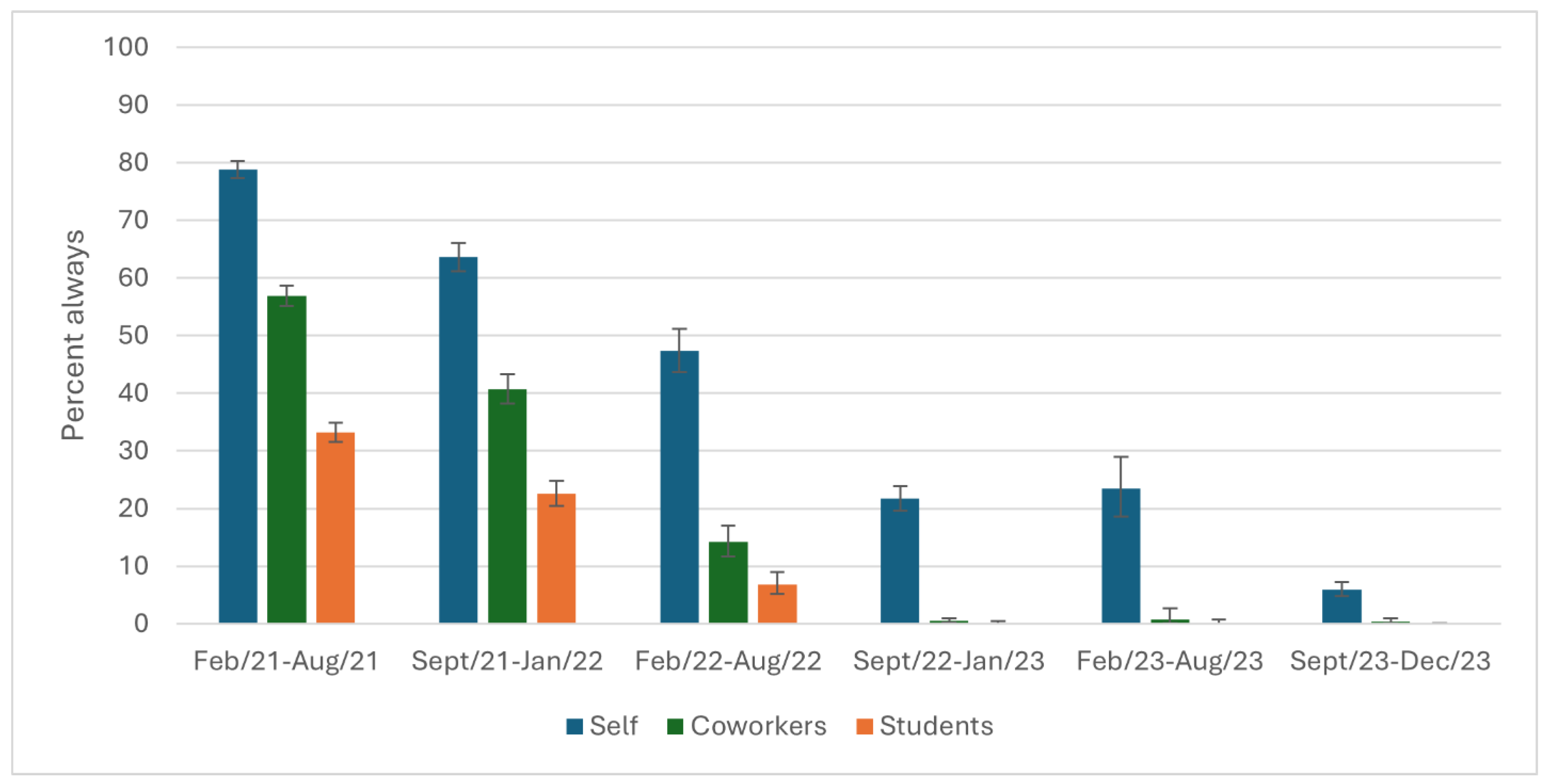
Figure 1. Wear a mask in others' presence while at work as reported by Ontario education workers for themselves, their coworkers, and their students; COVID-19 Cohort Study for Teachers and Education Workers (February 2021 to December 2023).
Preprints 146035 g001
Figure 2. Cover coughs while at work as reported by Ontario education workers for themselves, their coworkers, and their students; COVID-19 Cohort Study for Teachers and Education Workers (February 2021 to December 2023).
Preprints 146035 g002
Figure 3. Wash hands, thoroughly and regularly while at work as reported by Ontario education workers for themselves, their coworkers, and their students; COVID-19 Cohort Study for Teachers and Education Workers (February 2021 to December 2023).
Preprints 146035 g003
Figure 4. Physically distance from others while at work as reported by Ontario education workers for themselves, their coworkers, and their students; COVID-19 Cohort Study for Teachers and Education Workers (February 2021 to December 2023).
Preprints 146035 g004
Figure 5. Stay home from work when they have symptoms, even if they are mild as reported by Ontario education workers for themselves, their coworkers, and their students; COVID-19 Cohort Study for Teachers and Education Workers (February 2021 to December 2023).
Preprints 146035 g005
Figure 6. Thematic map with six themes and their subthemes; COVID-19 Cohort Study for Teachers and Education Workers; Ontario, Canada; February 2021 to December 2023.
Preprints 146035 g006
Table 1. Characteristics of Ontario education workers at the time of their first baseline report; COVID-19 Cohort Study for Teachers and Education Workers (February 2021 to December 2023), Number (percent) unless otherwise noted.
Characteristic Participants
N = 3617
Age in years, mean (95% CI) 45.3 (45.0, 46.0)
Gender
Female
Male
Other
3091 (85.5)
517 (14.3)
9 (0.2)
Education, highest achieved
Diploma, college, or less
Bachelor's degree/teaching certification
Graduate school (Master's or PhD)
341 (9.4)
2441 (67.5)
835 (23.1)
Occupation
Teacher
Educational assistant
Early childhood educator
Principal / vice principal
Administration1
Professional student services roles2
Support staff3
2923 (80.8)
224 (6.2)
80 (2.2)
133 (3.7)
87 (2.4)
130 (3.6)
40 (1.1)
Chronic illness4
Yes
No
921 (25.5)
2696 (74.5)
Postal district
Eastern Ontario
Central Ontario
Metropolitan Toronto
Southwestern Ontario
Northern Ontario
643 (17.8)
1251 (34.6)
721 (19.9)
831 (23.0)
171 (4.7)
School setting
Elementary
Secondary
Both / mixed setting
2227 (61.6)
1103 (30.5)
287 (7.9)
CI: confidence interval.1 Office/clerical staff, superintendents2 Psychologist, social worker, therapist, librarian, nurse3 Technicians, bus drivers, custodians, building maintenance, cafeteria staff, lunchroom assistant4 Asthma, chronic obstructive pulmonary disease or other chronic lung condition, diabetes, heart disease, cancer treated in the past five years, liver or kidney disease, HIV/AIDS or other immune suppressing disease/condition, chronic neurological disorder, or other long-term chronic conditions.
Disclaimer/Publisher’s Note: The statements, opinions and data contained in all publications are solely those of the individual author(s) and contributor(s) and not of MDPI and/or the editor(s). MDPI and/or the editor(s) disclaim responsibility for any injury to people or property resulting from any ideas, methods, instructions or products referred to in the content.
Copyright: This open access article is published under a Creative Commons CC BY 4.0 license, which permit the free download, distribution, and reuse, provided that the author and preprint are cited in any reuse.
Prerpints.org logo

Preprints.org is a free preprint server supported by MDPI in Basel, Switzerland.

Subscribe

Disclaimer

Terms of Use

Privacy Policy

Privacy Settings

© 2025 MDPI (Basel, Switzerland) unless otherwise stated