
Submitted:
05 January 2025
Posted:
10 January 2025
You are already at the latest version
Abstract
This research study seeks to solve the inefficiencies in the existing restaurant software of Jom Tarik, situated in Taylor's University Campus, since it requires customers to go physically and scan the QR code located on their tables to access the system. This tends to be rather inconvenient for some customers, mainly students who might have to attend to their schoolwork and academic obligations. Additionally, there are various important features that the current system does not support, but these features are included in modern restaurant software. The paper does have suggestions for improving the system, which basically aims to smooth life for the users and also smooth operations. The improved versions shall support remote ordering, customization of the order, making online payments, tracking in real-time, hence convenience and increasing customer satisfaction. These changes are foreseen to raise revenues from restaurants, too, since more customers will be reached. Further work, therefore, would need to involve feedback from a broader range of stakeholders, including restaurant staff and independent delivery riders, so that the software can meet all parties' needs. In the end, this enhanced software represents the leap into employing modern technology for solving real-life problems with the objective of enhancing students' dining experiences in Taylor's University and motivating the greater community towards embracing technological change for societal good.
Keywords:
Taylor's University
; Restaurant software
; Jom Tarik
1. Introduction
When people of similar mindsets come together, the horizon of creative thinking and its use for society and public welfare becomes endless. Most modern tech giants had very humble beginnings, growing from small-scale ventures to worldwide power players through innovation and persistence. We draw inspiration from that arc and want to give something back to society by revolutionizing systems and aligning ourselves with the Global Shift towards the Fifth Industrial Revolution. This revolution represents a fusion of advanced technology with a focus on human-centric and sustainable practices, marking a shift from an agrarian and handicraft economy to one dominated by industrial and technological innovation [1,2]. It has now emerged as one of the key drivers for the transformation of several industries, such as media, retail, tourism, hospitality, advertising, and banking. Such digitalization, though highly advantageous, provides efficiency, better experiences for customers, less environmental footprint, and resilience in bad times like the COVID-19 pandemic [3,4,5]. However, inconsistent digitalization is noted in the restaurant industry in developing regions. Most of these areas still lack all the resources, support, and infrastructure to fully embrace this transformation [6,7,8,9,10].
Our mission is to bridge such gaps by furthering the digitalization of the restaurant industry. Though it may seem like the restaurant system is already in place worldwide, many local and regional businesses still have to find a way of effectively implementing digital solutions. Our idea of empowering these businesses is the invention of new technologies and frameworks boosting their operational efficiencies for better consumer experiences. As a matter of fact, this was an essential initiative that would keep restaurants running in today's digital world [11,12,13].
2. Problem of Statement:
The current ordering system at Jom Tarik Restaurant has some key limitations: it lacks a website or mobile application for ordering, online payment is not an option, and home delivery is not available. These issues will inconvenience customers, especially students with limited time, and restrict business growth. An integrated online platform is the proposed solution to these challenges, providing the ability for remote ordering, secure online payments, customization, and cancellation of orders, including home delivery services. This adds convenience for the customer, smooths operations, and increases revenue potential for the restaurant. [14,15,16,17,18] Figure 1 shows the Jom Tarik Bistro website, Brickfields Branch in Kuala Lumpur. There is currently no website available like this for the Campus Branch here in Taylor's University. Their current system requires scanning a QR code for customers to view the menu and access the services. It has three important options on top to the right, including "Get Quote," for customer testimonials; "Call Now," for direct contact through phone; and "Get Directions" for getting directions to the branch on a map. Figure 2 shows the gallery and sidebar, as viewed on the same page by scrolling down. On the left-hand sidebar, three options are shown: "Testimonials" (leading to customer reviews, similar to Figure 1), "Gallery" (images or other media showcasing the restaurant), and "Contact" (with the contact information of the restaurant). Figure 3 shows the bottom part of the website, which shows the contact details of the Brickfields Branch. Furthermore, it presents the address and operational hours of the branch for easy understanding of the viewers when to visit or call the restaurant [19,20,21,22,23].
3. Proposed Methodology
A comprehensive methodology has been proposed in order to improve customer experience and operational efficiency. The first step involves the development of a user-friendly website and mobile application. These will enable the customer to order while far away, show them an elaborate menu with the dish descriptions and images, change the orders by adding or removing ingredients or selecting sizes, and track orders in real time. The website will be responsive enough to address desktop and laptop users, and the mobile application targets smartphone users. Additionally, the platforms will enable order cancellations within a specified timeframe, ensuring flexibility for customers.
The next important feature that will be used is the online payment option security. This will allow for easy payment through credit cards, debit cards, and online e-wallets, as it will make the payment process intuitive and reliable for users. In addition, the methodology consists of a home delivery service to efficiently deliver orders to customers' specified locations. Delivery management includes status tracking to inform customers and maintain reliability. It will be user-friendly in design, thus easy to navigate, and the content will also be available in several languages to reach a wider audience. Secondly, there will be a customer loyalty program in place that will incentivize repeated orders through rewards, such as points or discounts for frequent purchases and referrals. Gamification includes milestones and badges.
It would also entail a number of other integrations: push notifications for order status updates, special offers; review and rating feature for receiving feedback with a view to enhancing the service quality. Order history will let users access past orders for easy reorder and personalized suggestions. Multi-language customer support will be provided via chat or over the phone to respond to inquiries and get feedback. The proposed methodology will implement solutions for the pitfalls of the present system at Jom Tarik Restaurant and greatly enhance customer experience and operational efficiency. This will also allow the restaurant to reach out to more customers, serve a wider audience, and increase revenue potential. Additional Modifications for User-Friendlies that will be done or can be done are as follows:
Push Notifications: Incorporate push notifications regarding order updates and promotions to retain customers.
Reviews and Ratings: Allow reviews and ratings on the app/platform about the services provided. The more transparency, the more attraction of new customers.
Order History: Allow access to order history for easy reordering and personalization suggestions.
Multilingual Customer Support: Offer multilingual customer support through chat or over the phone to guide and collect feedback. Hence, these would be the solutions based on the problems in the system of Jom Tarik restaurant and should be implemented according to the instructions and modifications.
3.1. Impact of Solution
3.1.1. Solving Current Problems
The proposed solutions will go a long way in improving the customer experience at Jom Tarik by addressing the limitations of the present system. It will be more convenient and flexible for customers to order, and they can trace their orders in real time. They will be able to predict exactly what time their delivery will arrive, hence adding value to the customers with reliability. It will also include allowing customers to make orders in the comfort of their house instead of going to the restaurant to scan the QR codes that are placed all around the establishment. This will aid the customers staying in DK Senza, D'Latour, and Taylor's University Hostel, because they are in extremely busy schedules, and this will save them lots of time and energy.
This also includes an order cancelation feature to enhance their convenience. Where it differs from the current system, which has some messy cancellations here and there, the new software allows for easy cancellations by customers. This relieves the customers from stress and will cut down on food wastage by not preparing cancelled orders, thus smoothing operations as it saves staff resources. Secondly, payment integrations like Touch 'n Go, bank transfers, and credit cards make transaction processing easy. This means customers can pay without reaching for their devices, avoid using cash completely, and make faster transactions. This is modern and customer-friendly compared to the present system, whereby all the pay is done upon the cashier's counter.
The new system also introduces a "Customize Order" feature, allowing customers to personalize their meals according to preference, such as adjusting spice levels or ingredient choices. This ascertains that the customers get meals that best suit their tastes and satisfaction. The feedback and rating system will also help customers to express their experiences for management to act upon in terms of food quality and service. While positive feedback may pin up popular dishes, complaints related to issues in delivery-a damaged order in transit, for instance-can quickly evoke corrective remedies, such as refunds or replacements.
Adding order tracking will be a great enhancement. Customers can be able to track their orders using status updates such as "In-Progress," "Cancelled," "Delivered," or "Enroute," thus making everything transparent and much easier for users. It goes in line with comfort at home while placing the order, and the customer can keep themselves updated at every step of his order.
3.1.2. Social Impacts
The enhanced system ensures a number of social impacts. With increased accessibility, customers can even order food at places like DK Senza, D'Latour, or Taylor's University Hostel without necessarily physically visiting the restaurants. This saves great amounts of time, especially since students often end up with tight schedules. The enriched customer experience is another critical return where services such as ordering food online include cancellation of orders and customization of the meal that lower stress and increase satisfaction. These features will economically attract more customers, improving the sales and customer database of Jom Tarik. It creates employment opportunities through the need for app and web developers for maintenance and more delivery riders to cope with increased demand.
3.1.3. Comparison with Competitors
Within Taylor's University campus, Jom Tarik faces restaurants like Billy Boys, My Choice, and Classic Bowls. Both Billy Boys and Classic Bowls do not have websites, thus forcing their customers to order at their outlets physically. Thus, Jom Tarik gains the upper hand through its home delivery and comprehensive online platform, with the customer convenience aspect in mind. My Choice does have a website, but no integrated ordering system; just a menu and a contact number where all customers have to call and confirm items. In contrast, the enhanced system of Jom Tarik will provide ease of ordering, reflecting real-time availability of dishes, customization options, tracking, and hence it would stand among the most convenient and innovative services on campus as shown in Figure 4 and Table 1, Table 2, Table 3 and Table 4.
4. SWOT Analysis
4.1. SWOT Analysis of Billy Boys
4.2. SWOT Analysis of Classic Bowls
4.3. SWOT Analysis of My Choice
4.3.1. Generalized SWOT Analysis
4.4. Business Viability Analysis to Update Software of Jom Tarik Restaurant
This assignment has been provided as part of the unending effort to enhance efficiency and customer satisfaction by upgrading the existing software of Jom Tarik, a local restaurant. The research aims at ascertaining the economic condition of the proposed update of the software and the possibility for realistic commercial use of the technology. Improvement of technologies is extremely important as far as the current corporate operations are concerned.
4.5. Technical Viability Assessment:
First is the technical viability of the upgrade; this shall constitute what will make the existing software easier to use and more visually appealing. It covers a comprehensive test of its conformity to expand in the future and more interactivity with the people in possession of the same systems. Additionally, the upgrade should overcome any flaws detected in the existing program, such as navigational complexity or operational inefficiencies. The redesigned software guests, eating experiences by utilizing creative design ideas and improve user interfaces.
4.6. Economic Viability Evaluation:
Apart from immediately applying at Jom Tarik, the developed program has enormous commercial potential. Primarily, while enhancing operational efficiency in general and restaurant customers' dining experiences is a main point of this task, concepts supporting such enhancement may well serve as a foundation for implementations elsewhere in the service industry. Moreover, this software upgrade benefits the same consumers, expecting seamless digital interfaces and personalized experiences. For these reasons, it is practically viable for business purposes both today and in the near future. Because updated answers the call for the times and positions Jom Tarik, among others, for leadership success now and well into the foreseeable future.
The suggested upgrade to the Jom Tarik restaurant software is thus highly viable from a business perspective, both technically and economically. By addressing user interface improvements and operational inefficacy, the upgrade improves not only the restaurant's internal procedures but also the eating experience of the guests. Besides, its potential for wider commercial use underlines its value as a strategic asset in driving corporate growth and competitiveness. It is from this improvement and continued innovation in the software that several benefits will occur to Jom Tarik and lead to long-term success in the dynamic business environment.
In Figure 5, We tried to gather some more information about the average sales statistics throughout the year for Jom Tarik restaurant. According to our research, we have noticed that in the month of the start of a semester which is January, April and September, the sales are evidently higher than the normal month's sales. On the other hand, at the end of the semester or even during the middle, the sales rate goes extremely low. The main objective of this application is to spread an efficient ordering system which can maintain the sales rate for the whole year to maintain the company’s overall profit.
In Figure 6, We have dived deep to gather information about the dine-in and takeaway ordering percentage of the restaurant. We came to know that the percentage of dine-in is fairly higher than the percentage of takeaway. So, we wanted to develop such a system which will increase the rate of takeaway and home delivery too, making the whole process much more efficient for the customers. If customers can get food ordered from places that are far from university territory, it will increase the time efficiency in their life, as much more time is saved.
5. System Requirements
The systems requirements are the descriptions of the system services and constraints that are generated during the requirement engineering process. User requirements can be collected from the statements in natural language plus diagrams of the services the system provides and its operational constraints. Therefore, system requirements refer to structured documentation which sets out detailed descriptions of the system’s functions, services and operational constraints. The stages of system requirements are:
- Requirements Discovery
- Requirements classification and organization
- Requirements prioritization and negotiation
- Requirement specification
5.1. Requirements Gathering Elicitation
To ensure our end product’s viability and versatility, we must ensure a well-documented requirements gathering process. It’s very necessary to get feedback directly from the people who use or serve in the system. If we contact some students who regularly order from their restaurant, we can get some important points and factors to meet up with. Again, we can consult with the staff who provide the service and what can be better and easier for them to serve through this digitized system. Other than interviews, discussing scenarios and user stories are real-life examples of how a system can be used. This defines how a system may be used for a particular task. Again, prototyping can be a process where a simple version of a program is created and tested on a small group of users. Prototyping gives a wireframe that maps out the layout to know which options are functioning and which are not as shown in Figure 7. So, the summary of gathering requirements is:
- Interviews with User and staff
- Surveys
- Real Life scenarios and stories
- Prototyping a layout and testing it on a small group
We did a little survey through generating a google form link and spread them to the users, specially to the students and talked with some random customer in the restaurant about their whole experience and the satisfaction or dissatisfaction in the whole system and asked what sector could be better if it was updated as shown in Figure 7. The survey link is below: https://docs.google.com/forms/d/1lmjSByVcdawQw7bnxDbfhXdjIOgrg7Vx2QQBtuH2qwc/edit And here are the reviews mentioned by the customers whom our team interviewed:
We were figuring out the answers to the following questions through our research:
- What details must a consumer provide to create a new account?
- How is the website's login process made easier?
- What part does the corporation play in managing its operations and factories?
- Do you have any trouble offering a certain service? In what way do you speak with them?
- Do you depend on any system?
- How does your system satisfy user needs completely?
- What are the specialties of the branches that make up Solen Company?
- How do you ensure that orders are delivered on time?
- How do you keep your items' quality high?
- Do you frequently experience shipping loss or delays? How do you deal with them?
- What are the primary positions in the organization?
- How is the delivery process structured?
- What data management system do you employ?
- In what ways do you protect privacy and maintain data integrity?
- Do you offer customized services to meet the needs of your customers?
- Regarding delivery problems, what are your protocols?
- To increase operational efficiency, do you employ any specific technologies?
- Regarding client complaints about the quality of the service, how do you respond?
- What marketing techniques do you use?
- Which obstacles must you overcome to deliver top-notch goods?
Expected Functions
- Allows user to create an account (Sign up)
- Allows user to Login (Sign In)
- Coherent with Login, there will be Log out (Sign out) option too
- Allows user to manage their profile - as in change profile picture and add another email address or phone number.
- Allows user to see the various food sections for choosing a particular food item (such as drinks option, rice item sections, roti and naan sections)
- Allows users to customize their order - such as request their food to be really spicy or keep spices low in case the customer is fond of spicy food or intolerant to it.
- Allows user to select the option of “Dine in” or “Takeaway” - in case of the latter their order will be packaged whereas in case of the former they can collect it at the counter
- Allows users to book a table in case they choose the “Dine in” option along with a time range - so basically the customer books a table and mentions the time they will be coming at. This way there will be a table for the customer once he/she arrives.
- Allows user to order from their home for food delivery or for dine in - it saves time so instead of coming over and ordering they can simply order from home and their order will be ready for them when they arrive
- Banking API integration for secure monetary transactions and an incentive system that maximizes user engagement
- Allows user to see the day-to-day offers and bonus
- Allows user to track their order in which they chose “Food Delivery”
- GPS service integration to the system to track the order
- Allows user to see their order and transaction history
- Allows user to issue a complaint or any feedback
5.2. Functional and Non-functional Requirements
There are two types of requirements which are functional and non-functional requirements. Functional requirements are the behaviors we expect the system to have like the simplest basic features a program has. On the other hand, non-functional requirements are the features to which the system must conform like the system’s performance issue, security, availability, scalability, user interface issues and many more of which the quality needs to be ensured due to maintaining overall system quality as shown in Table 5 and Table 6.

Table 5.
Table of Functional Requirements.
| Functional Requirement | Description |
|---|---|
| FR1 - User Registration and Login | User can register as a customer and log in to the site or app anytime to make use of it |
| FR-2 User Profile | User can access his profile and inquire about his profile’s details and reset password and many extended necessary features also |
| FR-3 Place Order | Users can place food orders distant from the restaurant or inside the restaurant. There will be some different options:
|
| FR-4 Make Dining Choice | Users can choose:
|
| FR-5 Customize Order | User can customize their own menu according to their preference |
| FR- 6 Cancel Order | Users can cancel their order if they want to change their mind |
| FR-7 Make Payment | Users can make payment from the software or in person by choosing their payment option from the software. The modes can be: |
|
|
| FR-8 Rating and Feedback | This is an optional requirement where users can rate and give
feedback about their whole experience about the whole process. |
| FR-9 Get Discount | Users will get discounts on their regular order basis or on a weekly basis. They'll even get a discount on the special yearly events. |
| FR-10 Post Available Food Information | Website can update the available food items time to by the branch manager |
Non-functional Requirements
Table 6.
Table of Non-functional Requirements.
| Non-functional requirement | Description |
|---|---|
| NFR-1 Usability | The system is user-friendly, allowing waiters and customers to easily navigate through order and payment processes. The interface for the chef is straightforward, enabling quick access to new orders and status updates |
| NFR-2 Performance | The system processes orders and payments quickly, minimizing wait times |
| NFR-3 Reliability | The system is reliable, with minimal downtime to avoid disrupting restaurant operators |
| NFR-4 Security | The system securely handles customer payment information for privacy and data protection Access control measures should be placed to ensure that only authorized personnel can access sensitive information and functionalities. |
| NFR-5 Scalability | The system is scalable to accommodate peak dining times and future expansions of the restaurant, including menu updates and increased customer flow |
| NFR-6 Maintainability | The system is easy to maintain and update, allowing for quick adjustments to the menu, pricing and operational settings without significant downtime. |
6. Architectural Overview
6.1. Platform
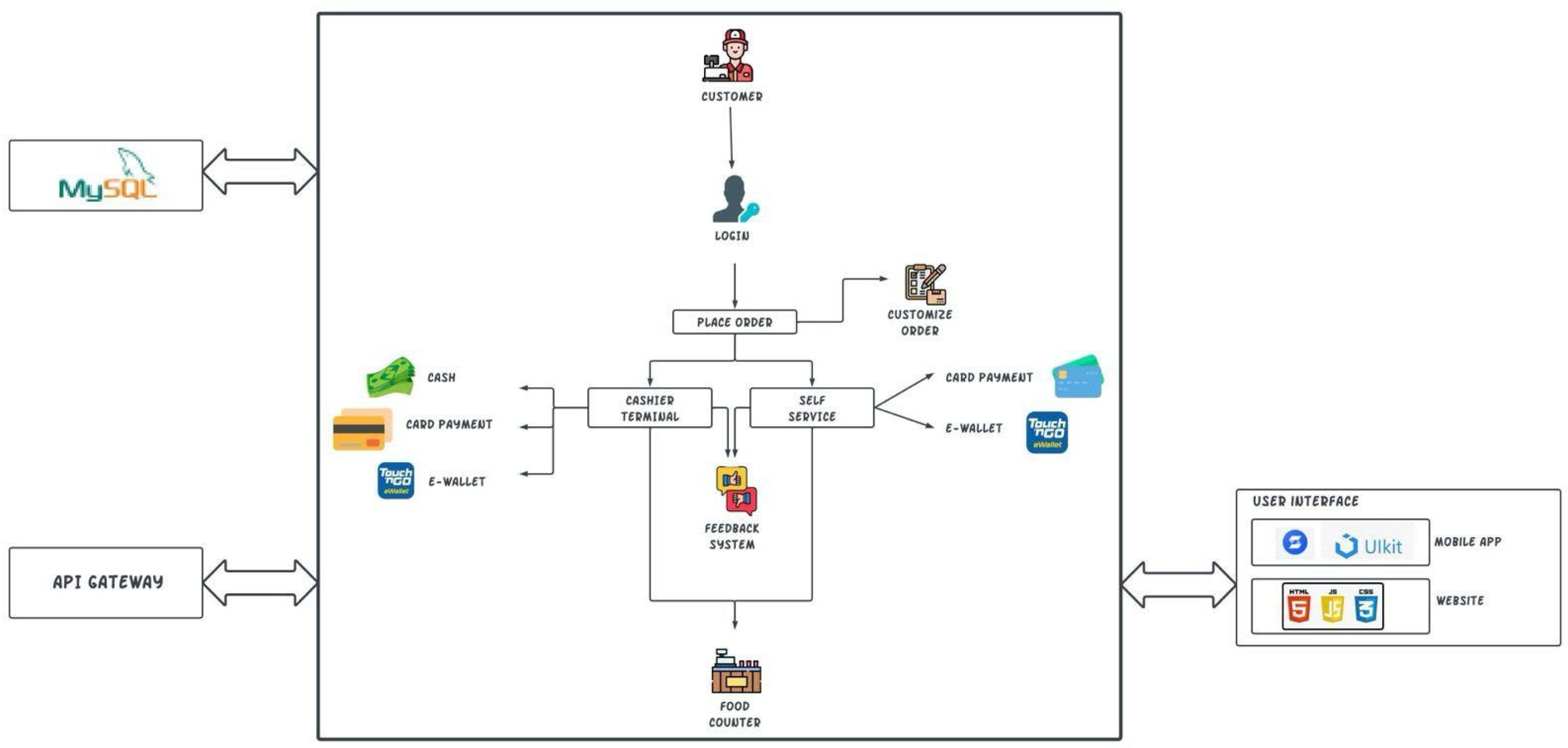
The platform we are using in our proposed system implies within websites, IOS and Android. We have decided to build both a website and mobile apps for our system, as they each have their different advantages. This will offer customers access to the system even if they don't have the app installed. On the other hand, mobile apps can take advantage of features that websites don't like GPS and phone calling, order tracking etc. These features can make our system more convenient and user-friendly. By offering both a website and mobile apps, we can reach a wider audience and provide the best possible experience for everyone. Websites will make it user-friendly by making it accessible from a wide range of devices, also making it easy for users as they don't have to install anything and convenient for users and customers who don't have smartphones and prefer to use computers or laptops. With mobile app users can take advantage of camera or scanning QR and GPS for tracking also can provide other features that a website can’t.
Figure 8.
The Architectural Diagram.
6.2. Logical Chunks of System Architecture
Our enhancement will include architectures such as, A user interface which will contain a website with a responsive web interface which the users can access from everywhere and from various devices such as laptops, tablets, smartphones etc. And mobile apps containing native Android & IOS apps allowing the utilization of specific app features such GPS, etc. Functionality with core features is also included which will provide certain features such as it will be accessible through website and app including browsing menus, placing orders, order tracking and many more. Keeping in mind data management will be a great aspect of our system, which will include a centralized database which will store all users, their orders, and their transaction data securely and can be accessible by both website and app. Also an API-Gateway which facilitates communication between different components and ensures data safety and consistency. Also it will contain a backend system with Centralized database, API-Gateway, Order Management System and Customer Relation Management, along with security and scalability.
6.3. Technologies Used
As mentioned above and onwards we will implement a website for the proposed system enhancement, it will contain a Front-end system in which we will use HTML5 for structure and the content, CSS3 for styling and responsiveness of the website and then JavaScript for the interactivity and functionality in the enhancement of the developing website. For the Back-end system it will conclude programming languages such as Python, Java, or node.js for server-side logic and API development also for storing user data, orders and other information we will use Database Management system such MySQL server. Next comes the enhancement and development in the mobile apps (Native android and IOS). It will conclude development of frameworks for a great user-friendly application which will be easier to use for every user, so for the framework development we will use Java or Kotlin for android, Swift or Objective-C for IOS depending on desired performance and speed. And for the API enhancement we will conclude restful APIs for communication between mobile apps and the back-end server and there will be device specific APIs for accessing native features such as GPS, camera and push etc.
Concluding there will be additional technologies for the enhancement on the website and the mobile apps as stated: -
6.3.1. For Website :-
- Responsive web design framework for ensuring user-friendly experiences across the website into any device.
- Content Delivery Network (CDN) for faster loading time
- Security measures such as firewall for data protection ensuring no data is lost or hacked.
6.3.2. For Mobile apps (Native Android and IOS):-
- User interface libraries such as Material Design, UI kit for native look and user-friendly look on each platform.
- Offline storage solutions such as Indexed DB or Core Data for smooth user experience even without internet connection.
6.4. Interfaces
6.4.1. User Interfaces
- 6.4.1.1.
-
For Website: -
- 6.4.1.1.1
- Home Page: The starting/landing page with key features, calls to action, and navigation options.
- 6.4.1.1.2
- Browsing: Interface for browsing menus, products etc.
- 6.4.1.1.3
- Sign in/Sign up: Interface for user authentication and account management.
- 6.4.1.1.4
- Profile: Interface for accessing and managing user information.
- 6.4.1.1.5
- Checkout: Interface for processing orders and payments
- 6.4.1.1.6
- Order History: Interface for viewing past orders and tracking their status.
- 6.4.1.1.7
- Contact: Interface for providing feedback and contacting customer support.
- 6.4.1.2.
-
For Mobile App (Android and IOS) :-
- 6.4.1.1.8
- Splash screen: Initial screen displayed while the app launches.
- 6.4.1.1.9
- Onboarding screens: Screens guiding new users through the app's features.
- 6.4.1.1.10
- Home screen: Similar to the website homepage, providing key features and navigation.
- 6.4.1.1.11
- Menu: Interface for accessing various app functionalities.
- 6.4.1.1.12
- Search: Interface for searching for specific products, services, or information.
- 6.4.1.1.13
- Location-based features (optional): Interfaces for utilizing GPS functionalities like maps, directions, and nearby offers.
- 6.4.1.1.14
- Order tracking: Interface for viewing and tracking the status of orders.
- 6.4.1.1.15
- Payment processing: Interface for secure and convenient in-app payments.
- 6.4.1.1.16
- Settings: Interface for managing app preferences and user information.
6.4.2. Internal Interfaces
- API Gateway: Interface for managing communication between websites, mobile apps, and back-end services.
- RESTful APIs: Interfaces for exchanging data between different system components.
- Database Management System: Interface for accessing and manipulating user data, orders, and other information.
- Order Management System: Interface for managing order processing, fulfillment, and tracking.
- Customer Relationship Management: Interface for managing customer interactions, communication, and support.
6.4.3. Additional Interfaces
- Content Delivery Network (CDN) interface: For managing and delivering website content across distributed servers.
- Payment gateway interfaces: For securely processing online payments.
6.5. Possible Evolution Ideas
6.5.1. Enhancing User Experience
Evolution can be possible in many ways, we can propose enhancing user experience such as Personalization, Gamification and Omnichannel Experience.
- Personalization- Implement features that personalize the user experience based on individual preferences, purchase history, or browsing behaviour.
- Gamification- Incorporate gamification elements like points, badges, or leaderboards to encourage user engagement and loyalty.
- Omnichannel Experience- Ensure a seamless experience across all touchpoints, whether website, mobile app, or other platforms.
6.5.2. Improving Data management and Security
- Real-time data analytics: Leverage real-time data insights to optimize operations, personalize offerings, and identify potential issues.
- Advanced security measures: Implement robust security measures like multi-factor authentication and encryption to protect user data and privacy.
- Data compliance: Ensure adherence to relevant data privacy regulations and best practices.
6.5.3. Scaling and Optimizing
- Cloud infrastructure: Migrate to a cloud infrastructure to enable scalability and improved performance as your user base grows.
- Microservices architecture: Refactor your system into microservices for better maintainability, scalability, and independent development of features.
- Performance optimization: Continuously monitor and optimize system performance to ensure smooth user experience and fast loading times.
6.5.4. Exploring New Business Models
- Subscription-based services: Consider offering subscription models for accessing premium features or content.
- Marketplace integration: Explore integrating with existing marketplaces to expand your reach and attract new customers.
- Partnering with other businesses: Partner with complementary businesses to offer bundled services or reach new market segments.
Figure 9.
Our enhanced version of the existing software.
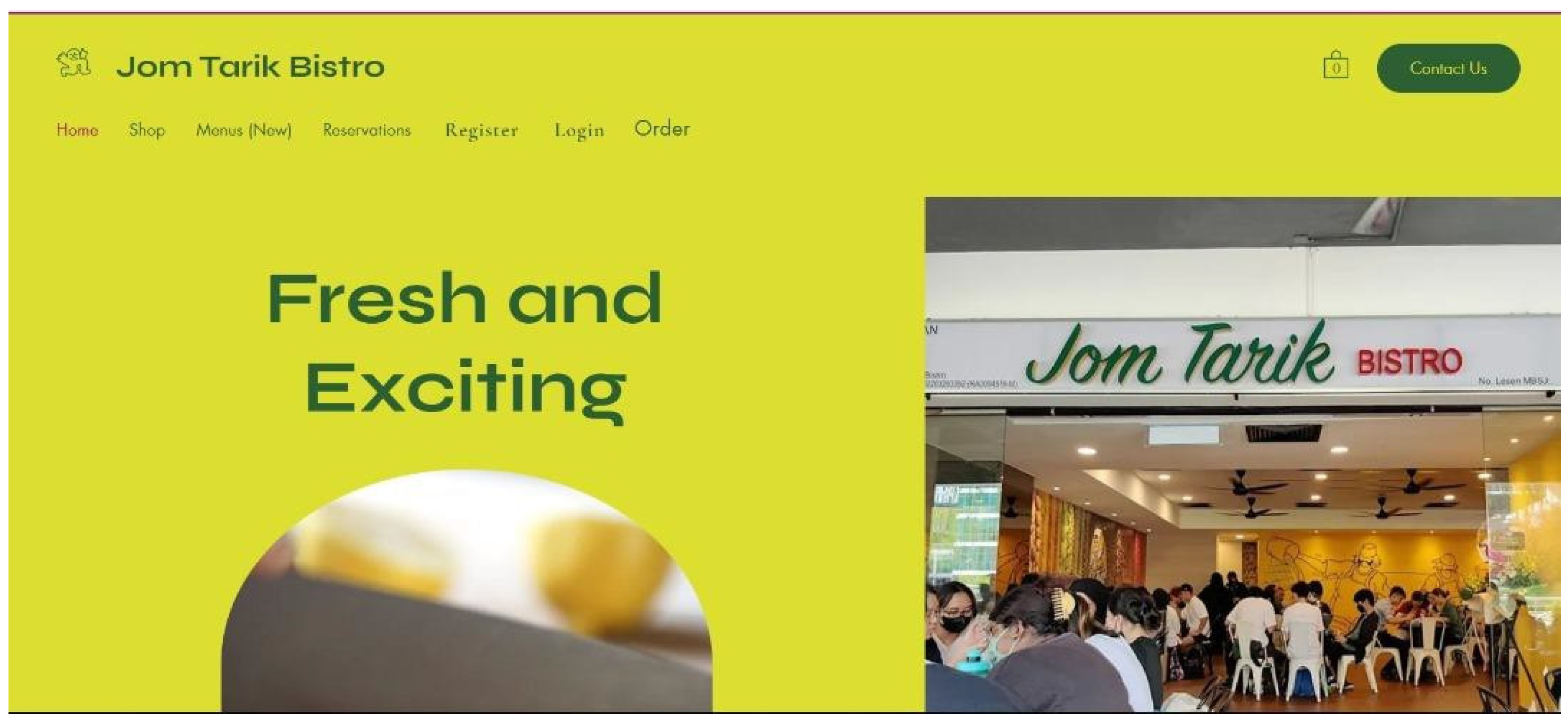
Figure 10.
Our enhanced version of the existing software.
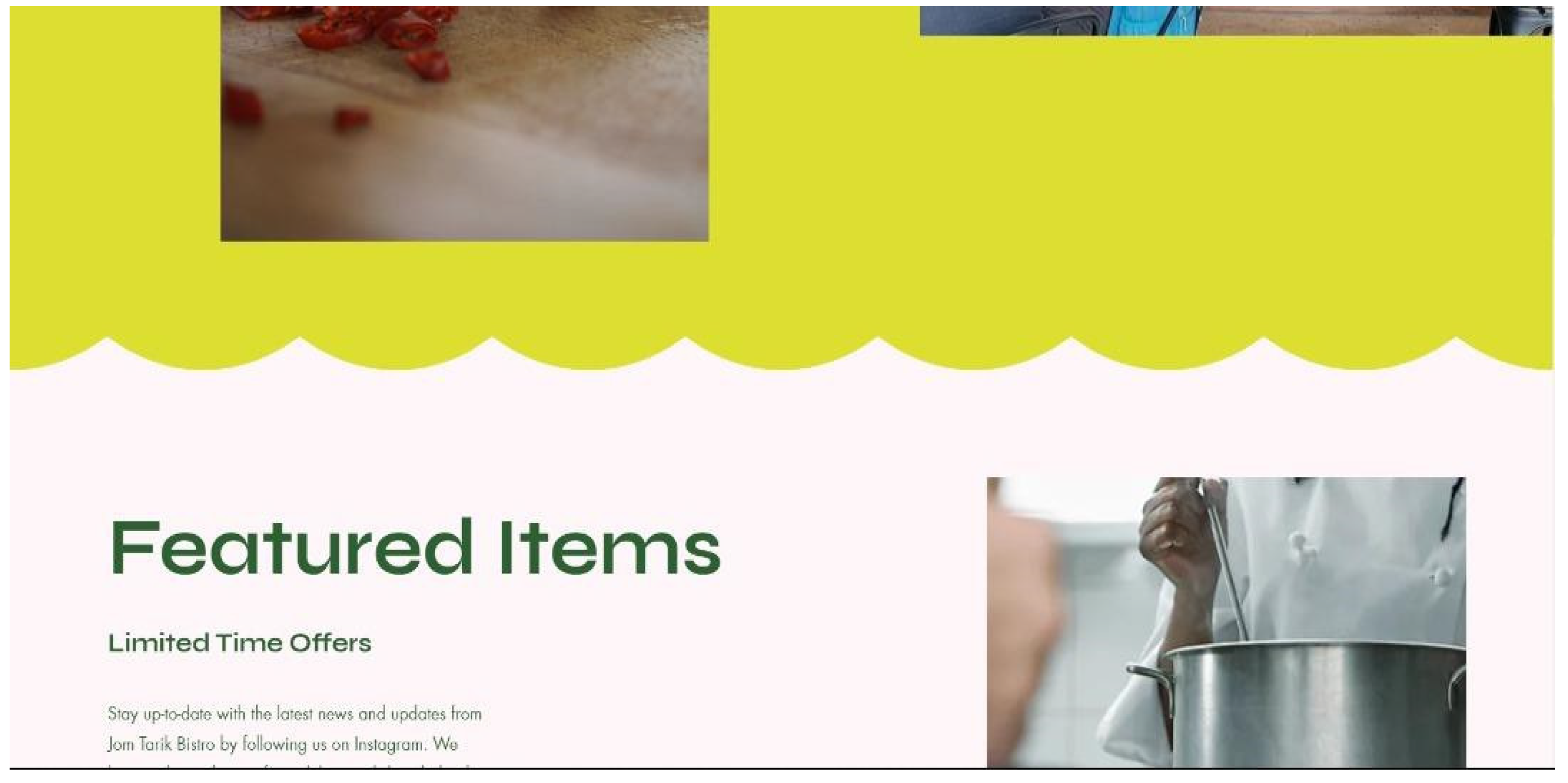
Figure 11.
Our enhanced version of the existing software.

Figure 12.
Our enhanced version of the existing software.
7. System Analysis and Design
7.1. UML Use Case Diagram for the Current Jom Tarik Software
7.2. UML Use Case Diagram for the Enhanced Jom Tarik Software
7.3. UML Class Diagram
7.4. UML Object Diagrams
The various figures included in the document describe different aspects of the UML diagrams used for analysis and design of the Jom Tarik Software. Figure 9 shows the UML Use Case diagram for the existing Jom Tarik Software. This diagram shows the interaction between users, such as customers, staff, and the system, and the system's functionalities to provide an overview of the processes involved in the existing software. Figure 10 shows the UML Use Case diagram for the enhanced version of the Jom Tarik Software. This diagram shows the improvement and additional features that have been added to the software, indicating an extended interaction and functionality from what is currently in the system. Figure 11 shows the UML Class diagram for the enhanced software. The Class diagram describes the structure of the system, showing the different classes that make up the system, along with their attributes and methods and the relationships between them. This helps with understanding how the system is organized. Figure 12 shows the Dining Customer Object Diagram. The Dining Customer Object Diagram shows the relationship and characteristics of customers dining in the restaurant. This diagram represents the objects participating in relationships, and how customer-related data is handled within the software. Figure 13 shows the Table Reservation and Customization Object Diagram. This describes how the system will perform dining table reservations and customizations, including how objects will interact with one another in the course of a reservation process. Figure 14 shows the Delivery Process Object Diagram. It is the representation of objects and interactions involved in the delivery of food orders, showing how the system will control the delivery process. Figure 15 shows Chef Preparing Order Object Diagram. This diagram represents the objects involved in the chef's preparation of an order, showing the interaction between kitchen staff and the system to correctly prepare the food. These figures collectively show the analysis and design for both the current and enhanced versions of the Jom Tarik Software.
8. Conclusion and Future Enhancement
Jom Tarik restaurant software at Taylor's University Campus has created a system where customers have to walk up to the restaurant to scan the QR code on their tables for accessing the system. The solution is quite inconvenient for students who may be in a rush, probably for some academic engagement. Besides this, the present system lacks a host of features associated with restaurant software.
This research puts forward improvements in view of these shortcomings, which would make the interaction of customers with Jom Tarik easier and more convenient. The enhanced version of the software is aimed at improving user experience and smoothing operations by introducing remote ordering, customization of orders, online payment, and real-time tracking. These updates will not only increase customer satisfaction but also open up opportunities for increasing the restaurant's revenue by attracting a larger customer base.
Future efforts shall be made to learn from a wider section of stakeholders to fine-tune and enhance the software. This will not only involve customers but also restaurant staff and independent delivery riders, who will have a better understanding of their needs and challenges. The expansion in the scope of feedback will then help in finding areas of continued innovation and development.
In the end, this upgraded Jom Tarik software means a leap toward implementing modern technology to solve real-life problems. It reflects the concern and the desire to make students' dining experiences in Taylor's University better by making it more efficient and convenient. This, in turn, we hope will inspire others to embrace the power of technology in solving everyday problems and bringing forth positive changes to our community.
8.1. Future Enhancement
In the future, we will continuously improve our software so that it is up-to-date and user-friendly. As a matter of fact, a lot of new features will be integrated into it in order to enhance customer experience. Among all, personalization would be very important, where the user experience could be optimized on the basis of individual preference, purchase history, and browsing behavior. It further ascertains gamification through the use of points, badges, and leaderboards that increase customer interactions with it. The next aspect is providing an omnichannel experience-in the context that this study views an easier way to ensure that user interface interactions go from a page through a Mobile application and beyond hassle-free. Moreover, we will be using chatbots as the live agent for each customer in helping him or her locate options fast while inside the webpage. At last, but not least, multilingual support will be provided to accommodate a more diverse audience in order to help non-English-speaking customers go through the platform with ease. These features will create a more inclusive, engaging, and efficient user experience for all.
References
- Idenedo, O.; Kemkamma, W. Service digitalization: A marketing tool for post-Covid-19 competitiveness among fast-food restaurants in Port Harcourt. Innovative Journal of Accounting and Management Research 2021, 7, 139–149. [Google Scholar]
- Alt, R. Digital transformation in the restaurant industry: Current developments and implications. Smart Tourism 2021, 1, 69–74. [Google Scholar] [CrossRef]
- The Restaurant Store. (n.d.). 3 ways digitalization changed the restaurant industry in an (almost) post-Covid world. The Restaurant Store. Available at https://www.therestaurantstore.com/digitalization-and-restaurants.
- Saeed, S.; Haron, H. Improve correlation matrix of discrete Fourier transformation (CM-DFT) technique for finding the missing values of MRI images. Mathematical Biosciences and Engineering 2021, 1–22. [Google Scholar] [CrossRef]
- Saeed, S. (2017). Implementation of failure enterprise systems in organizational perspective framework. International Journal of Advanced...
- Daradkeh, F.M.; Hassan, T.H.; Palei, T.; Helal, M.Y.; Mabrouk, S.; Saleh, M.I.; Salem, A.E.; Elshawarbi, N.N. Enhancing digital presence for maximizing customer value in fast-food restaurants. Sustainability 2023, 15, 5690. [Google Scholar] [CrossRef]
- LinkedIn. (n.d.). Revolutionizing dining: The restaurant digitalization market’s transformative journey. Available at https://www.linkedin.com/pulse/restaurant-digitalization-market-markets-us/.
- Alferidah, D.K.; Jhanjhi, N.Z. (2020, October). Cybersecurity impact over big data and IoT growth. In 2020 International Conference on Computational Intelligence (ICCI) (pp. 103–108). IEEE.
- Jena, K.K.; Bhoi, S.K.; Malik, T.K.; Sahoo, K.S.; Jhanjhi, N.Z.; Bhatia, S.; Amsaad, F. E-learning course recommender system using collaborative filtering models. Electronics 2022, 12, 157. [Google Scholar] [CrossRef]
- Aherwadi, N.; Mittal, U.; Singla, J.; Jhanjhi, N.Z.; Yassine, A.; Hossain, M.S. Prediction of fruit maturity, quality, and its life using deep learning algorithms. Electronics 2022, 11, 4100. [Google Scholar] [CrossRef]
- SlideShare. (2018). IRJET- Online food ordering system. Available at https://www.slideshare.net/irjetjournal/irjet-online-food-ordering-system.
- Alkinani, M.H.; Almazroi, A.A.; Jhanjhi, N.Z.; Khan, N.A. 5G and IoT-based reporting and accident detection (RAD) system to deliver first aid box using unmanned aerial vehicle. Sensors 2021, 21, 6905. [Google Scholar] [CrossRef] [PubMed]
- Babbar, H.; Rani, S.; Masud, M.; Verma, S.; Anand, D.; Jhanjhi, N. Load balancing algorithm for migrating switches in software-defined vehicular networks. Computers, Materials & Continua 2021, 67, 1301–1316. [Google Scholar]
- Studylib.net. (n.d.). IRJET- Data centric smart restaurant management system. Available at https://studylib.net/doc/25321636/irjet-data-centric-smart-restaurant-management-system [Accessed 19 Feb. 2024].
- Shaikh, A.M.; Shetgaonkar, A.C.; Dalvi, S.S.; Sawant, S.S.; Singh, K.V.; Naik, P.S.K.; Gauns, P.R.K. Food ordering management using recommendations. International Journal of Advanced Engineering Research and Science 2019, 6, 163, Available at https://www.academia.edu/39635568/Food_Ordering_Management_using_Recommendations. [Google Scholar] [CrossRef]
- Schwab, K. (2019). Shaping the Fourth Industrial Revolution. Crown Business.
- Yoo, Y.; Boland, R.J.; Lyytinen, K.; Majchrzak, A. Organizing for innovation in the digitized world. Organization Science 2020, 31, 923–940. [Google Scholar] [CrossRef]
- Kumar, M.S.; Vimal, S.; Jhanjhi, N.Z.; Dhanabalan, S.S.; Alhumyani, H.A. Blockchain-based peer-to-peer communication in autonomous drone operation. Energy Reports 2021, 7, 7925–7939. [Google Scholar] [CrossRef]
- Jhanjhi, N.Z.; Humayun, M.; Almuayqil, S.N. Cybersecurity and privacy issues in industrial internet of things. Computer Systems Science & Engineering 2021, 37. [Google Scholar]
- Lee, S.; Abdullah, A.; Jhanjhi, N.Z. A review on honeypot-based botnet detection models for smart factory. International Journal of Advanced Computer Science and Applications 2020, 11. [Google Scholar]
- Saeed, S.; Abdullah, A. Hybrid graph cut hidden Markov model of K-mean cluster technique. CMC-Computers, Materials & Continua 2022, 1–15. [Google Scholar] [CrossRef]
- Saeed, S.; Abdullah, A.; Jhanjhi, N.Z.; Naqvi, M.; Nayyar, A. New techniques for efficiently k-NN algorithm for brain tumor detection. Multimedia Tools and Applications 2022, 81, 18595–18616. [Google Scholar] [CrossRef]
- Saeed, S.; Humayun, M. Disparaging the barriers of journal citation reports (JCR). IJCSNS: International Journal of Computer Science and Network Security 2019, 19, 156–175. [Google Scholar]
- Shah, I.A.; Jhanjhi, N.Z. (Eds.). (2024). Cybersecurity Issues and Challenges in the Drone Industry. IGI Global. [CrossRef]
- Wassan, S.; Dongyan, H.; Suhail, B.; Jhanjhi, N.Z.; Xiao, G.; Ahmed, S.; Murugesan, R.K. Deep convolutional neural network and IoT technology for healthcare. Digital Health 2024, 10, 20552076231220123. [Google Scholar] [CrossRef]
- Jabeen, T.; Jabeen, I.; Ashraf, H.; Ullah, A.; Jhanjhi, N.Z.; Ghoniem, R.M.; Ray, S.K. Smart Wireless Sensor Technology for Healthcare Monitoring System Using Cognitive Radio Networks. Sensors 2023, 23, 6104. [Google Scholar] [CrossRef] [PubMed]
- Ashraf, H.; Khan, F.; Ihsan, U.; Al-Quayed, F.; Jhanjhi, N.Z.; Humayun, M. "MABPD: Mobile Agent-Based Prevention and Black Hole Attack Detection in Wireless Sensor Networks," 2023 International Conference on Business Analytics for Technology and Security (ICBATS), Dubai, United Arab Emirates, 2023, pp. 1–11. [CrossRef]
- Mohan, C.R.; Chouhan, K.; Rout, R.K.; Sahoo, K.S.; Jhanjhi, N.Z.; Ibrahim, A.O.; Abdelmaboud, A. Improved procedure for multi-focus images using image fusion with qshiftN DTCWT and MPCA in Laplacian pyramid domain. Applied Sciences 2022, 12, 9495. [Google Scholar] [CrossRef]
- Diwaker, C.; Tomar, P.; Solanki, A.; Nayyar, A.; Jhanjhi, N.Z.; Abdullah, A.; Supramaniam, M. A new model for predicting component-based software reliability using soft computing. IEEE Access 2019, 7, 147191–147203. [Google Scholar] [CrossRef]
- Saeed, S.; Jhanjhi, N.Z.; Naqvi, M.; Humayun, M. Analysis of software development methodologies. International Journal of Computing and Digital Systems 2019, 8, 446–460. [Google Scholar]
Figure 1.
Jom Tarik Bistro (a type of Restaurant)’s website for the Brickfields Branch in Kuala Lumpur. The Campus Branch does not have a website like this yet and the existing one can only be accessed by scanning the QR code, which we couldn’t do. The 3 options on the top-right corner are: Get Quote (which finds us a particular testimonial), Call now and Get Directions (which guides the user to the branch on maps).
Figure 1.
Jom Tarik Bistro (a type of Restaurant)’s website for the Brickfields Branch in Kuala Lumpur. The Campus Branch does not have a website like this yet and the existing one can only be accessed by scanning the QR code, which we couldn’t do. The 3 options on the top-right corner are: Get Quote (which finds us a particular testimonial), Call now and Get Directions (which guides the user to the branch on maps).
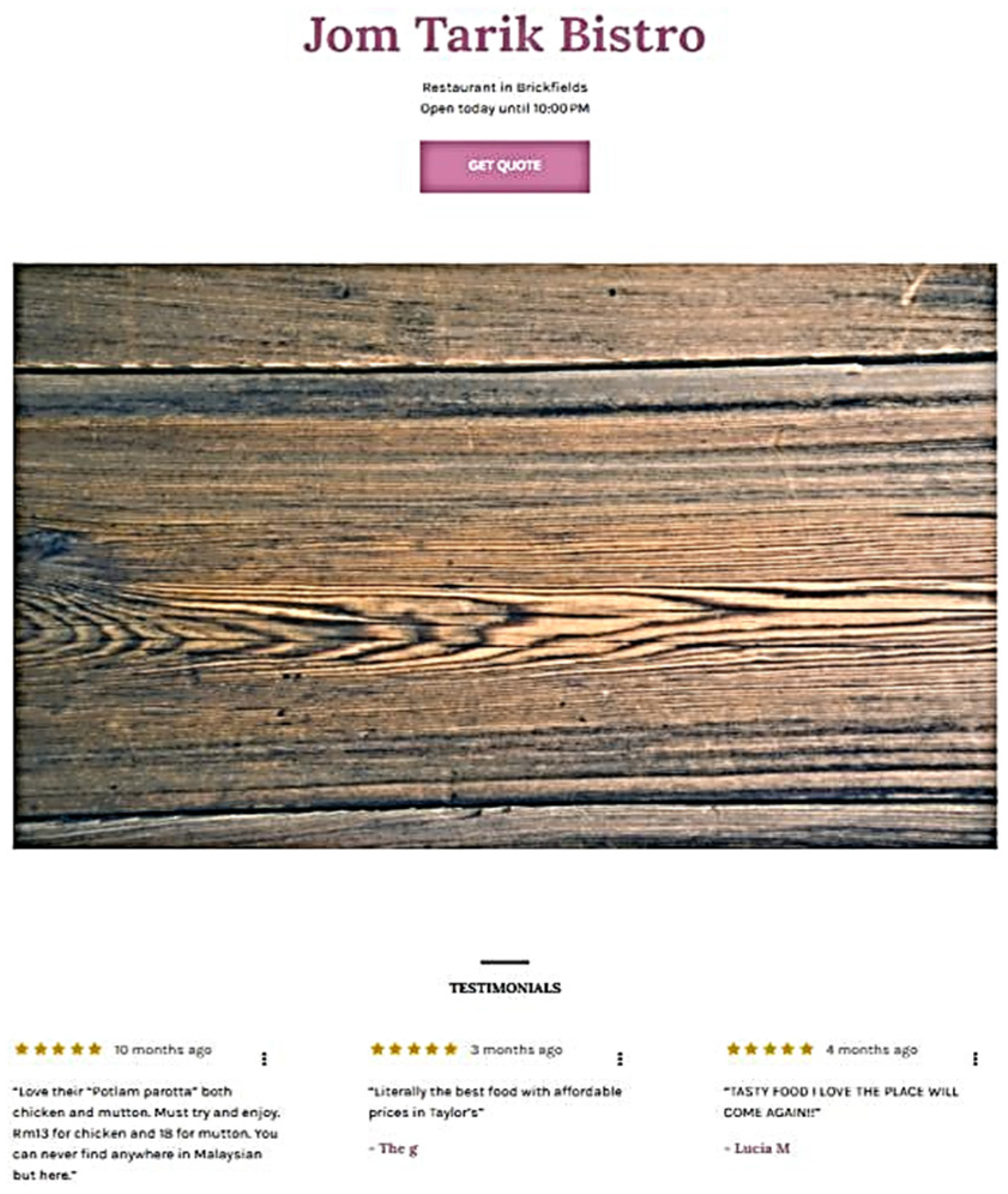
Figure 2.
Scrolling down on the same page we see the gallery and a sidebar. As mentioned in the side bar on the left-hand side, there are three options: Testimonials (reviews; mentioned in Figure 1), Gallery, and Contact.
Figure 2.
Scrolling down on the same page we see the gallery and a sidebar. As mentioned in the side bar on the left-hand side, there are three options: Testimonials (reviews; mentioned in Figure 1), Gallery, and Contact.
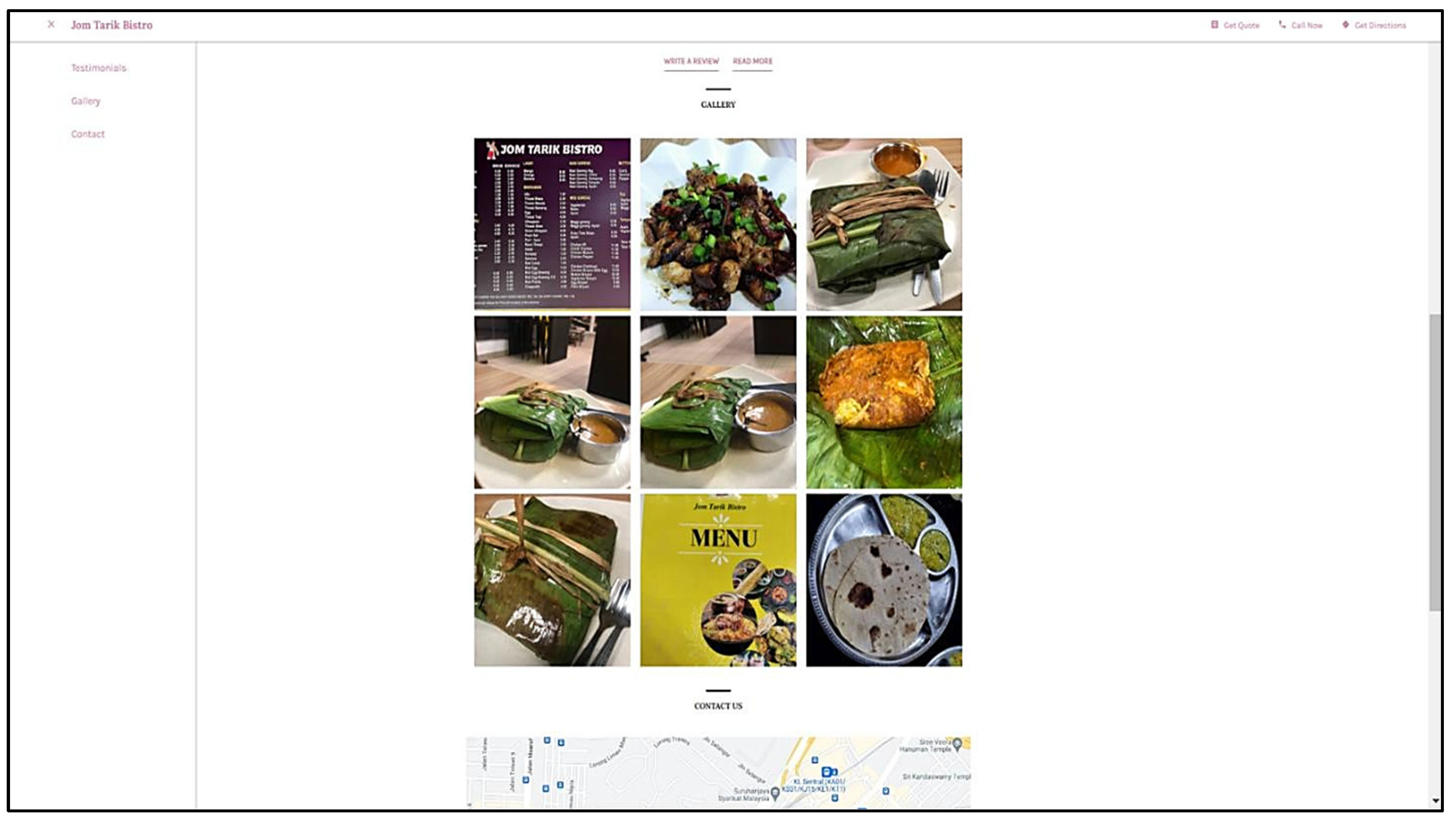
Figure 3.
Scrolling toward the bottom of the one-page website we see the contact details as well as the location of this branch and its business hours.
Figure 3.
Scrolling toward the bottom of the one-page website we see the contact details as well as the location of this branch and its business hours.
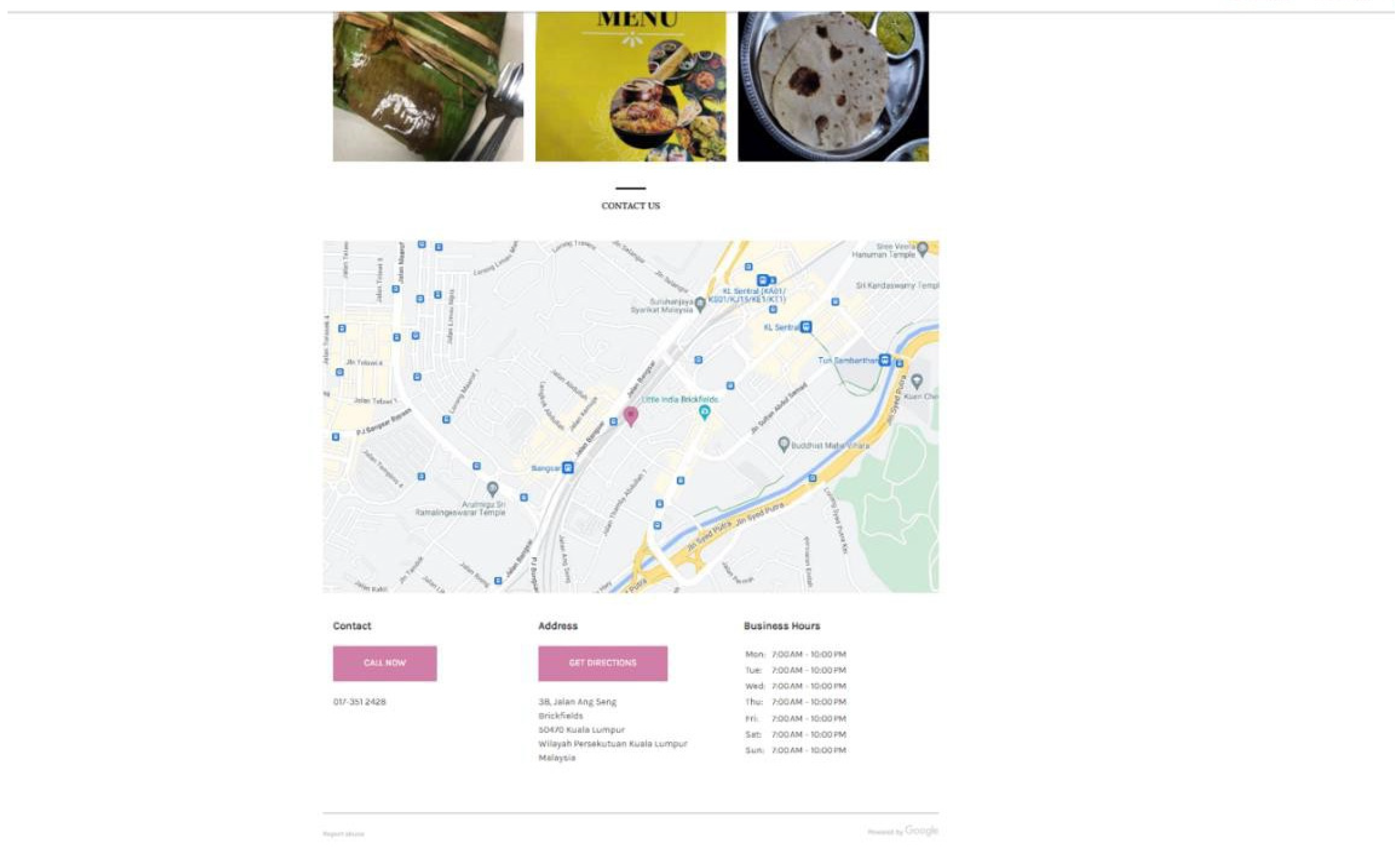
Figure 4.
Generalized SWOT Analysis diagram.
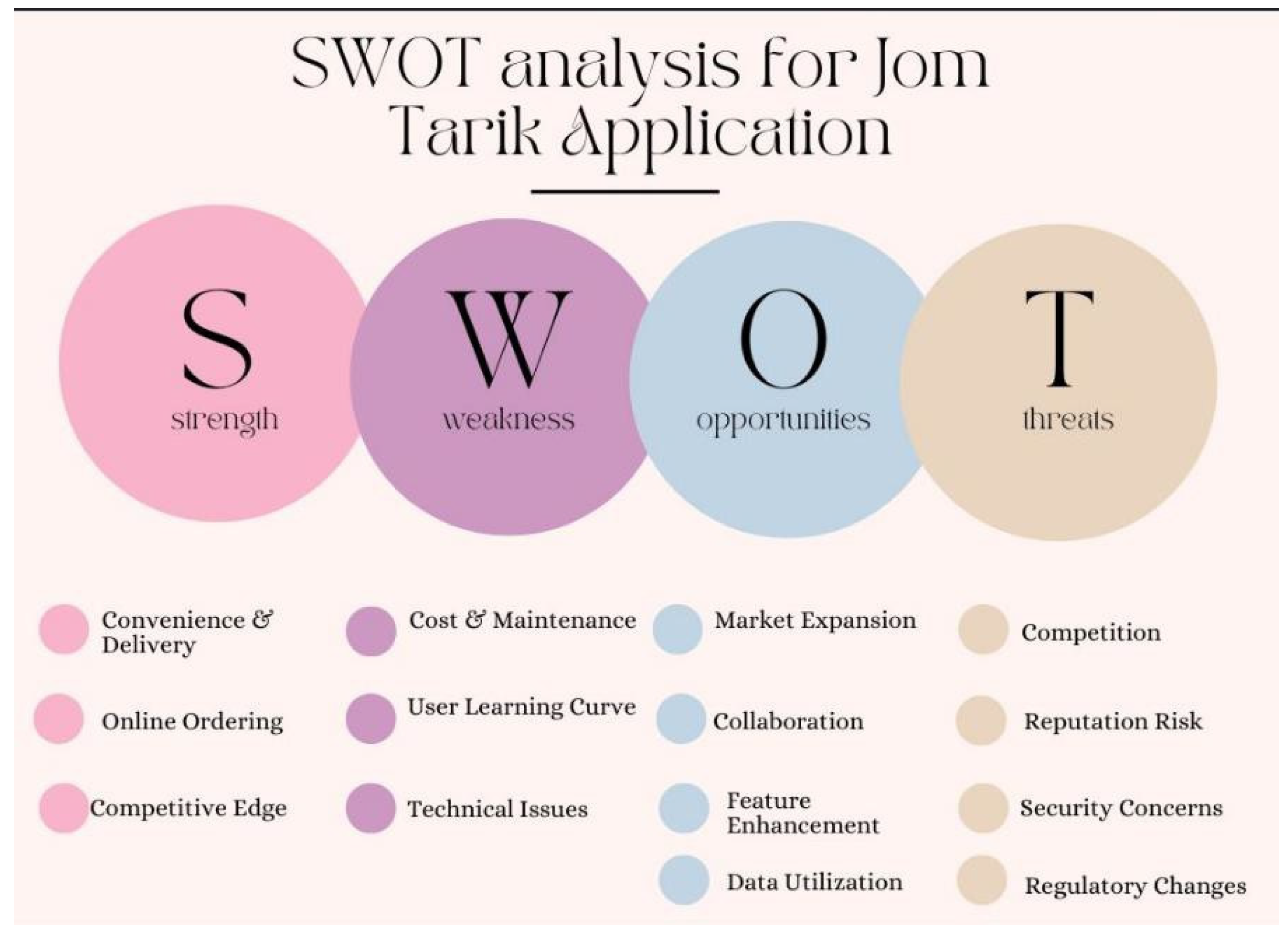
Figure 5.
Bar chart showing average sales statistics per week for Jom Tarik Bistro (in Thousands Ringgit).
Figure 5.
Bar chart showing average sales statistics per week for Jom Tarik Bistro (in Thousands Ringgit).
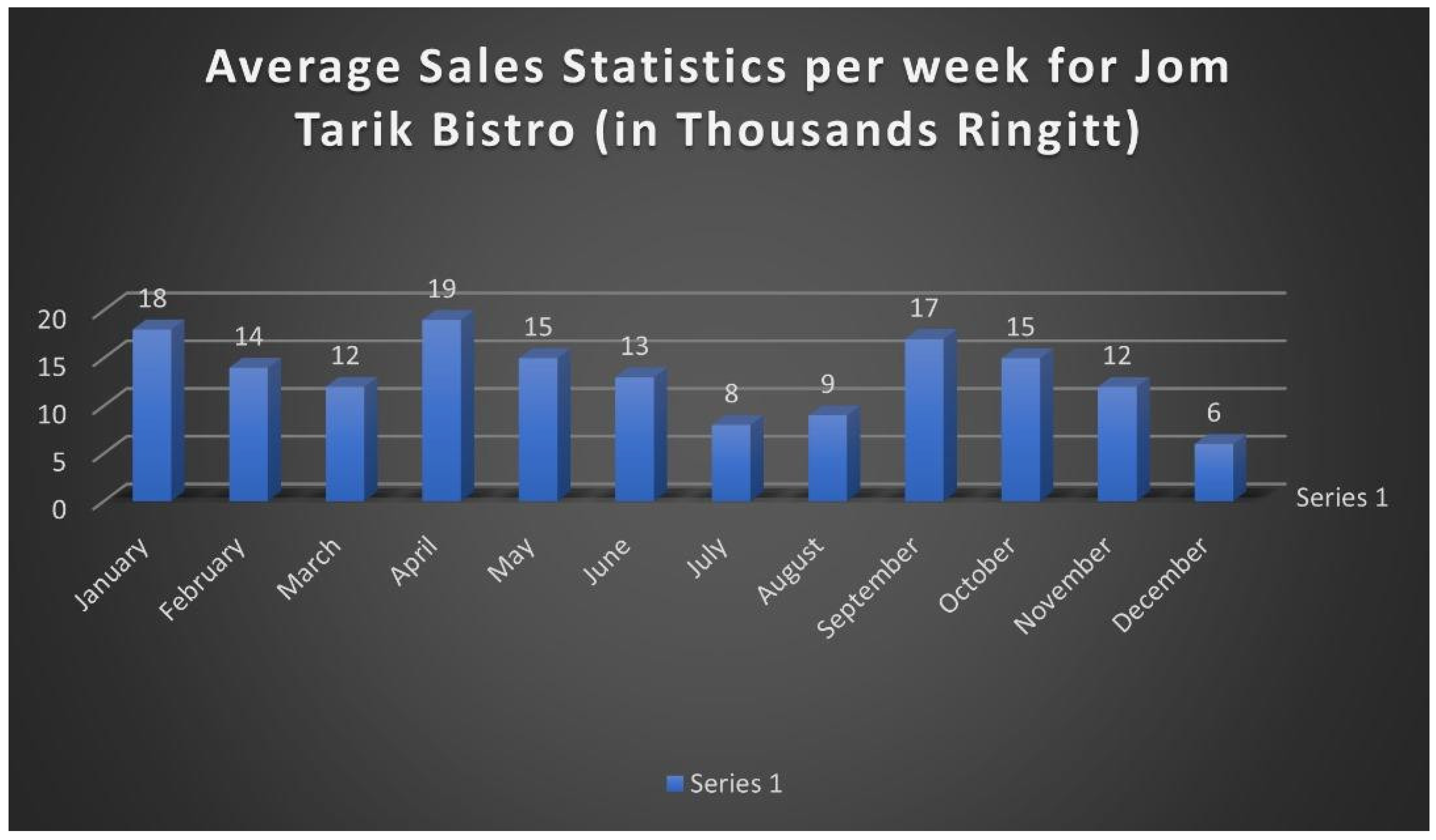
Figure 6.
Pie chart diagram showing the percentage of Takeaway and Dine in orders.
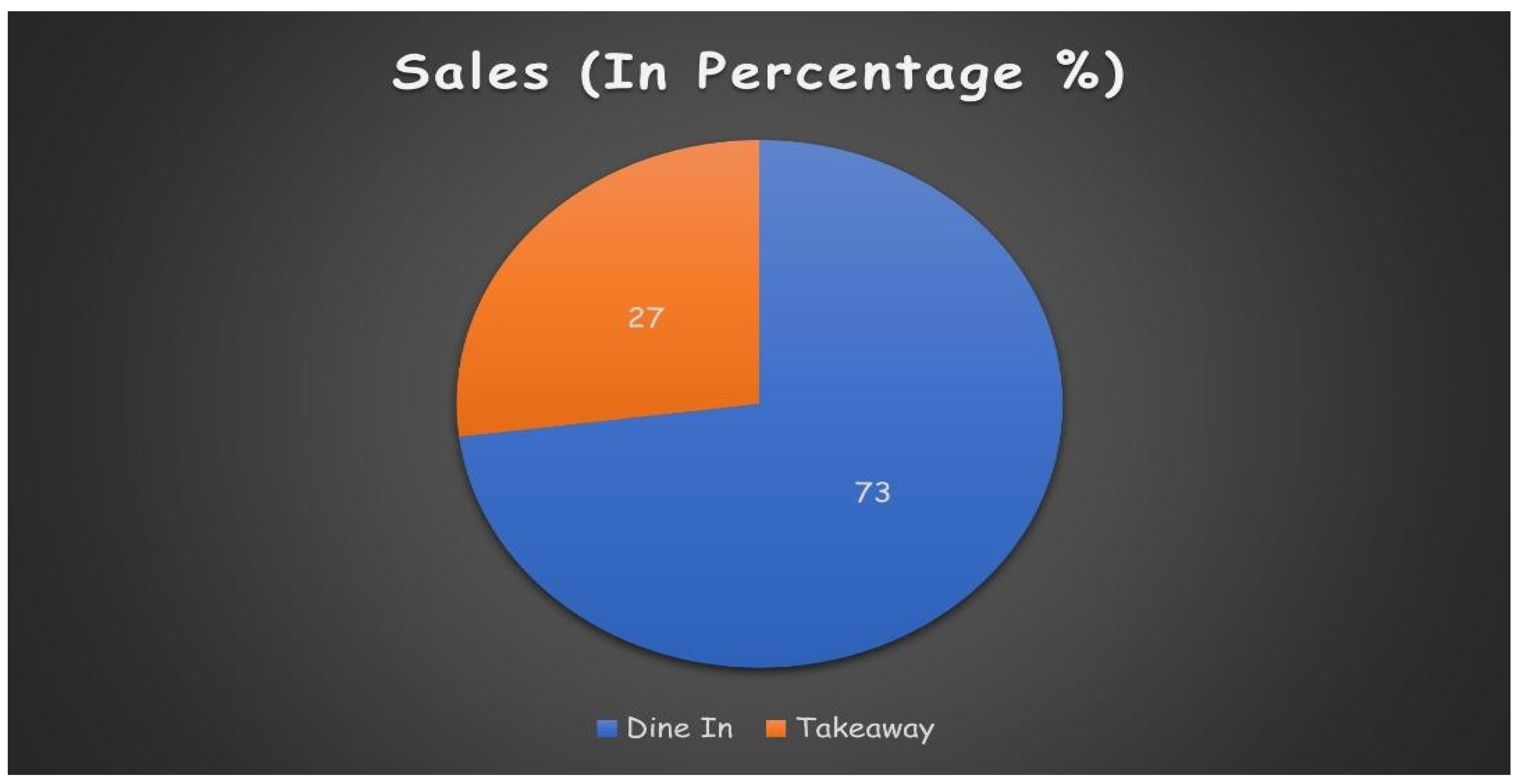
Figure 7.
Suggestions for improvement given by the customers interviewed in our survey. It’s worth mentioning that since the restaurant is located on the campus, which is a busy place, only a handful of customers agreed to participate in our survey, hence the limited number of responses.
Figure 7.
Suggestions for improvement given by the customers interviewed in our survey. It’s worth mentioning that since the restaurant is located on the campus, which is a busy place, only a handful of customers agreed to participate in our survey, hence the limited number of responses.
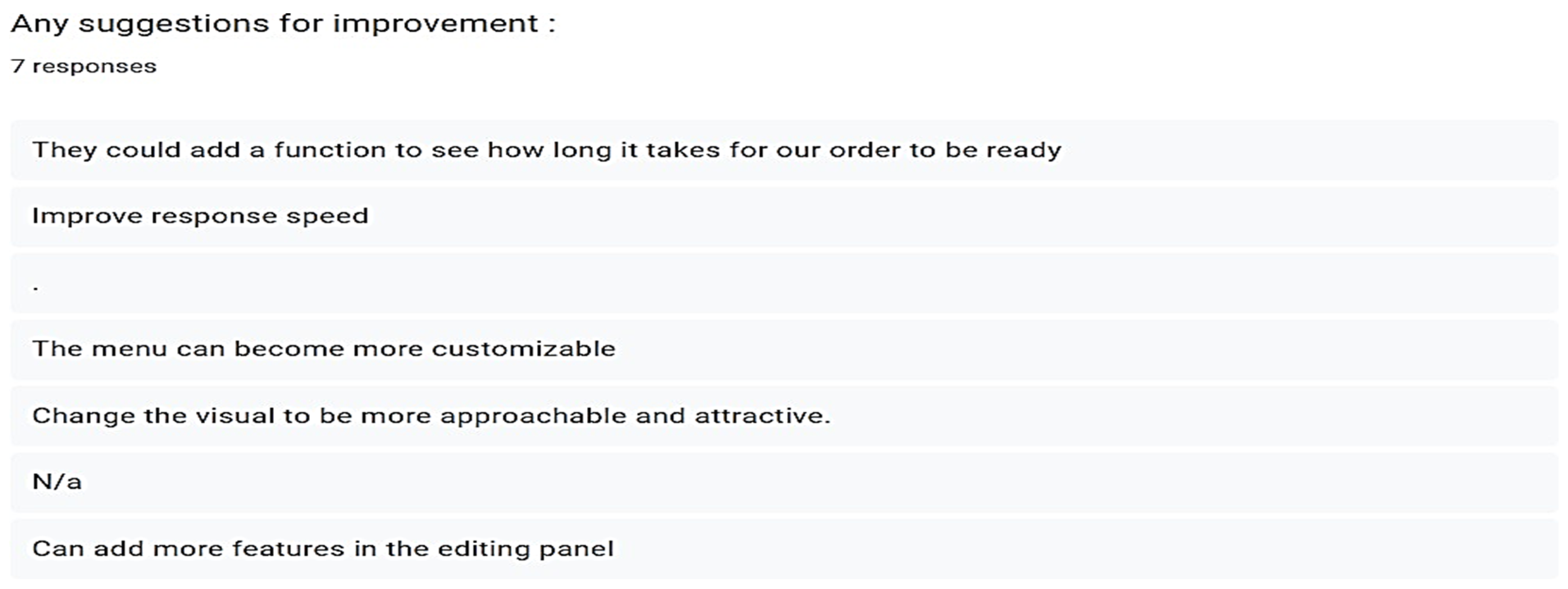
Figure 9.
UML Use Case diagram for the current Jom Tarik Software.
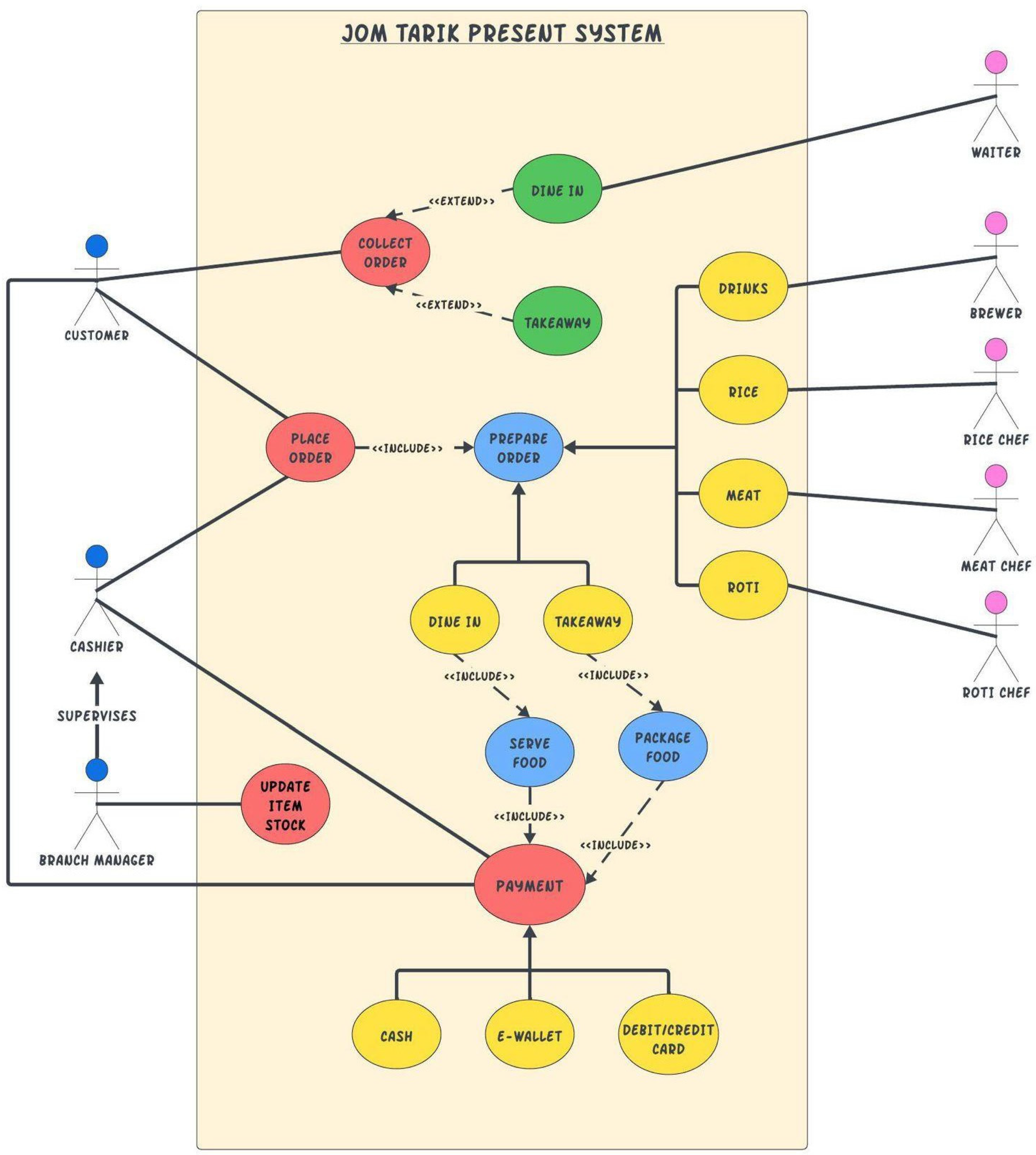
Figure 10.
UML Use Case diagram for our enhanced software.
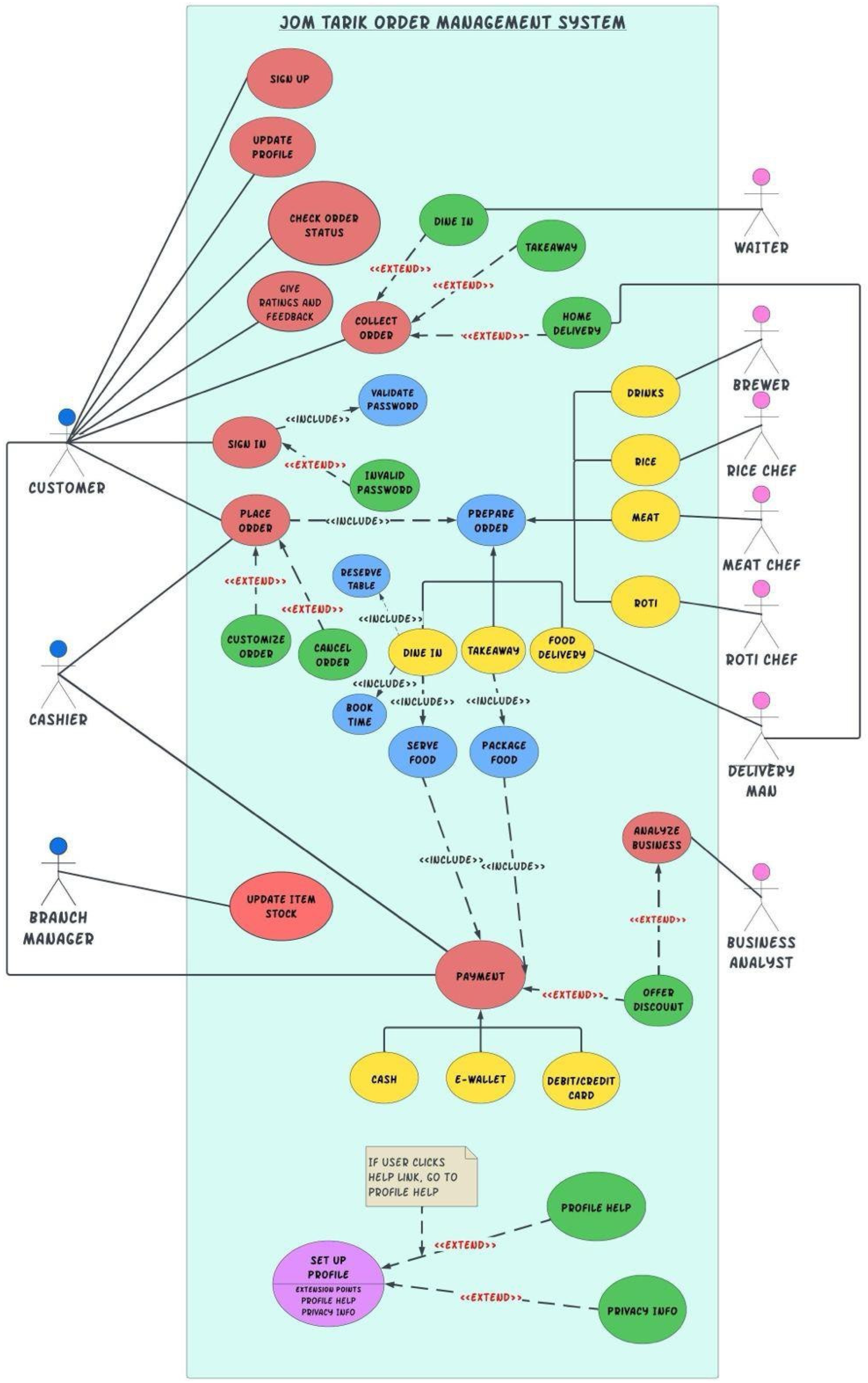
Figure 11.
UML Class diagram for our enhanced software.
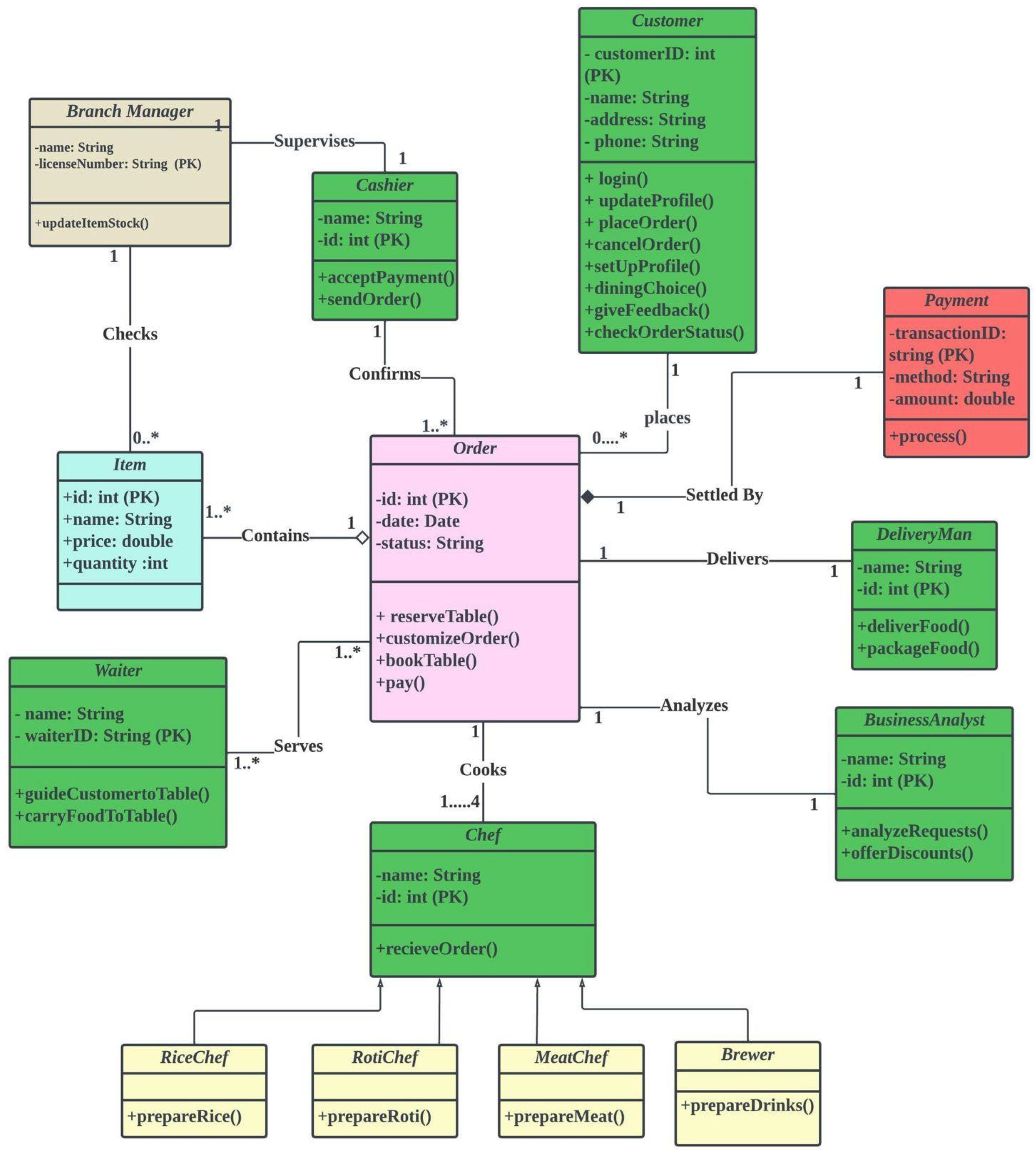
Figure 12.
Dining Customer Object Diagram.
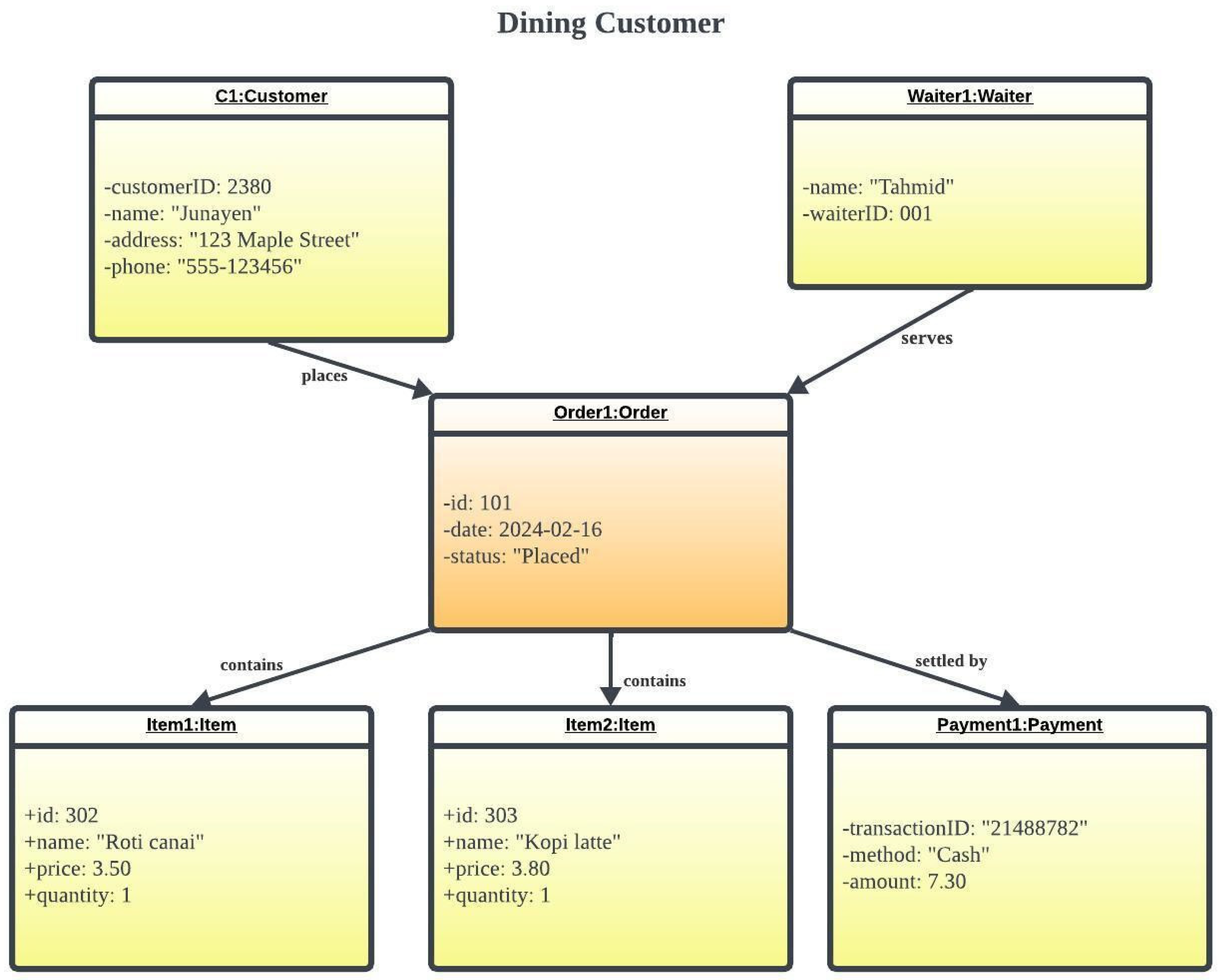
Figure 13.
Table Reservation and Customization Object diagram.
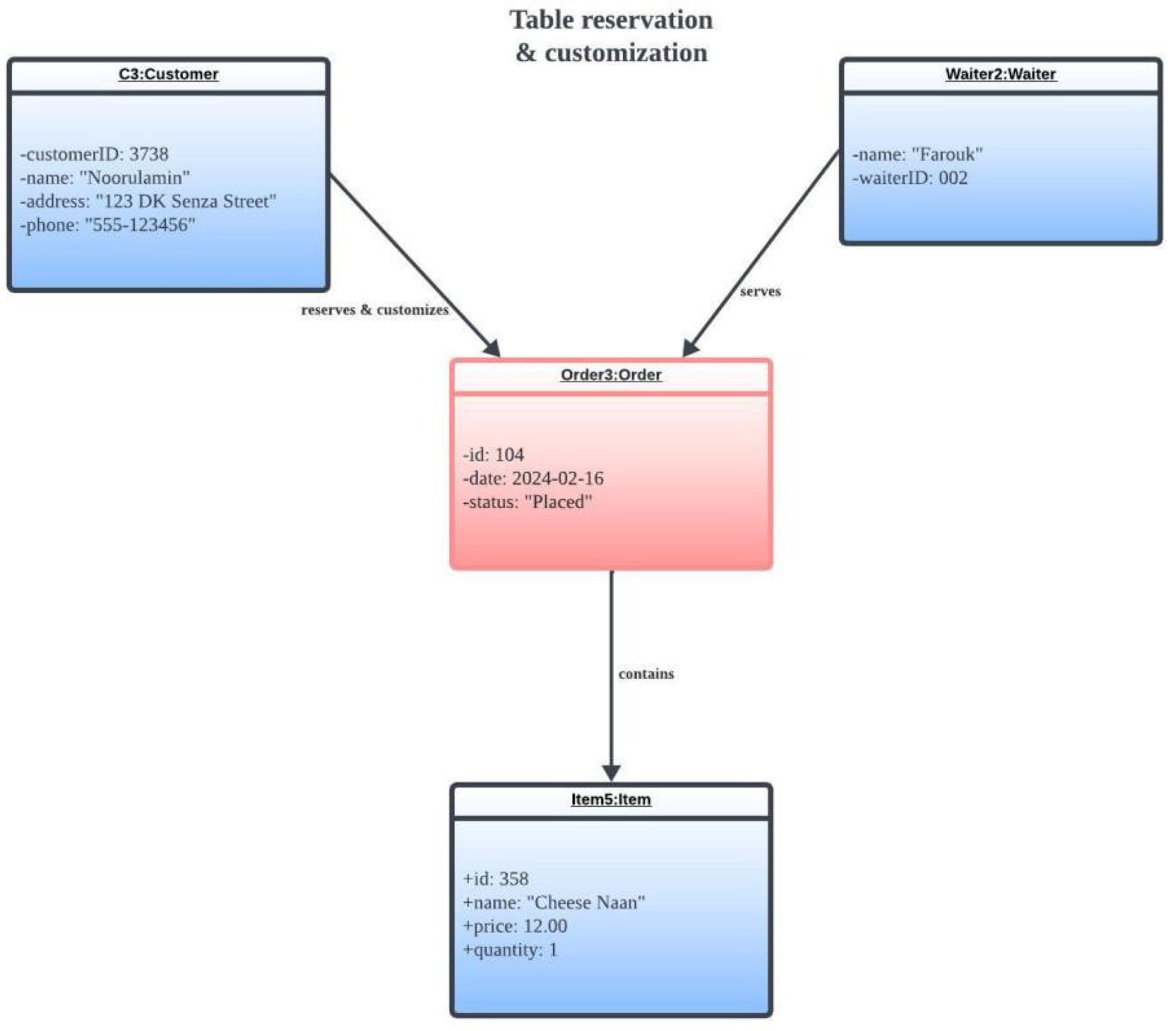
Figure 14.
Delivery Process Object Diagram.
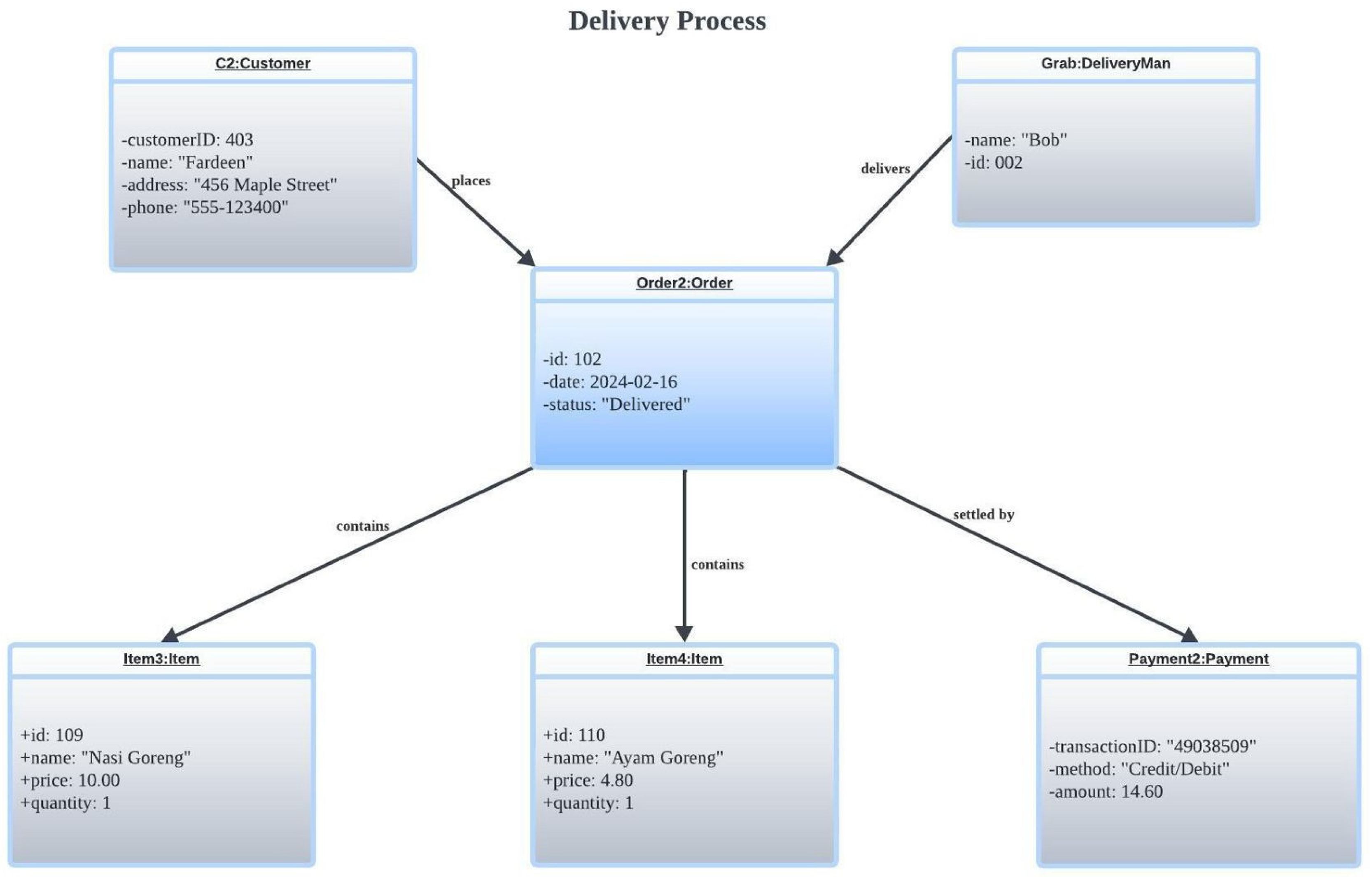
Figure 15.
Chef preparing order Object diagram.
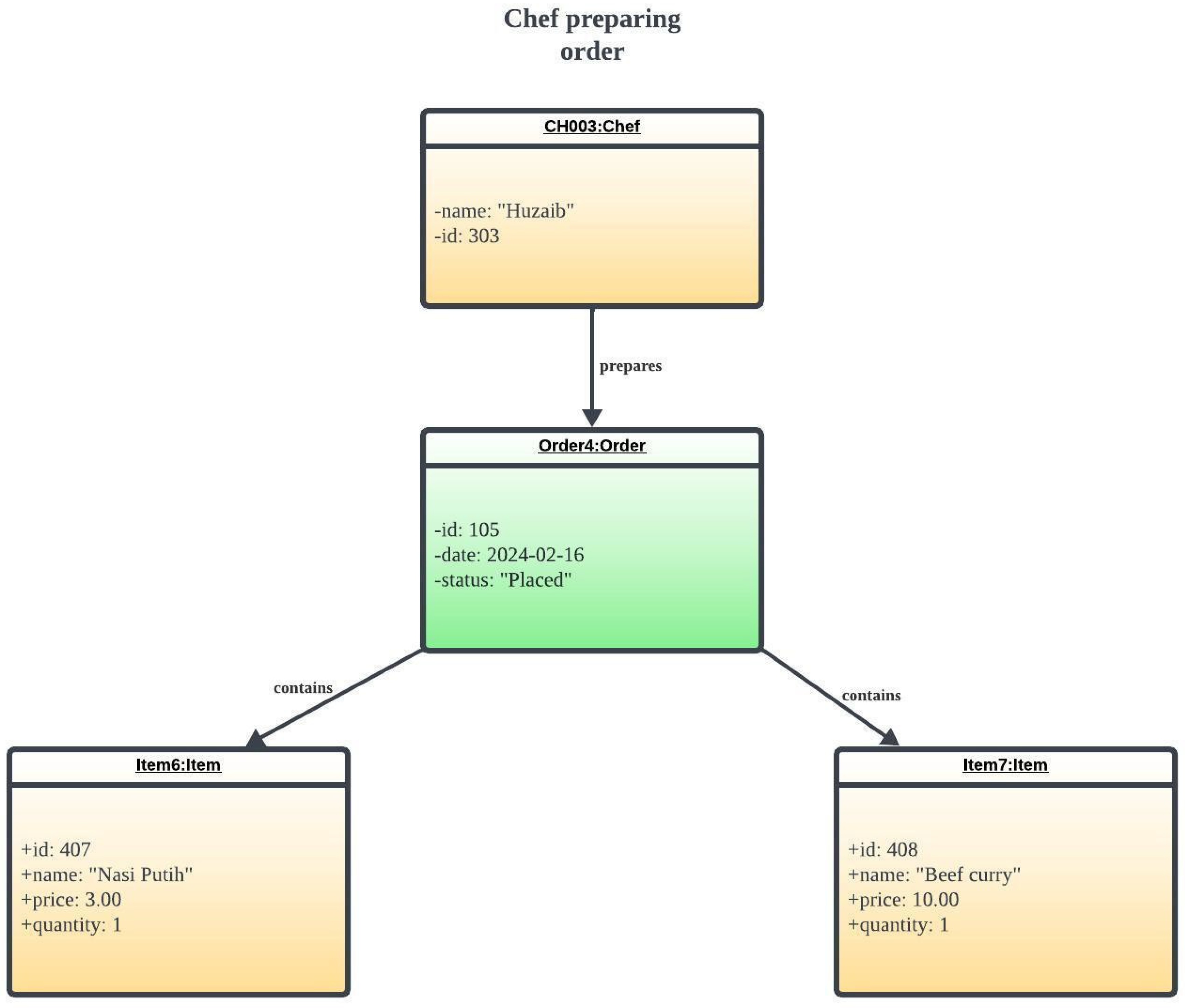
Table 1.
SWOT analysis of Billy Boys.
| STRENGTHS |
|
| WEAKNESSES |
|
| OPPORTUNITIES |
|
| THREATS |
|
Table 2.
SWOT Analysis of Classic Bowls.
| STRENGTHS |
|
| WEAKNESSES |
|
| OPPORTUNITIES |
|
| THREATS |
|
Table 3.
SWOT Analysis of My Choice.
| STRENGTHS |
|
| WEAKNESSES |
|
| OPPORTUNITIES |
|
| THREATS |
|
Table 4.
Generalized SWOT Analysis table.
| STRENGTHS |
|
|
| WEAKNESSES |
|
|
| OPPORTUNITIES |
|
|
| THREATS |
|
|
Disclaimer/Publisher’s Note: The statements, opinions and data contained in all publications are solely those of the individual author(s) and contributor(s) and not of MDPI and/or the editor(s). MDPI and/or the editor(s) disclaim responsibility for any injury to people or property resulting from any ideas, methods, instructions or products referred to in the content. |
© 2025 by the authors. Licensee MDPI, Basel, Switzerland. This article is an open access article distributed under the terms and conditions of the Creative Commons Attribution (CC BY) license (http://creativecommons.org/licenses/by/4.0/).
Copyright: This open access article is published under a Creative Commons CC BY 4.0 license, which permit the free download, distribution, and reuse, provided that the author and preprint are cited in any reuse.


