Preprint
Article

This version is not peer-reviewed.

Comparative study of Diagnostic Accuracy of Ultrasonography vs. Digital Mamography vs. Digital Breast Tomosynthesis vs. Breast MRI in Screening of Women with Dense Breasts

Submitted:

09 January 2025

Posted:

10 January 2025

You are already at the latest version

Abstract

Background: The aim of this study was to assess the diagnostic accuracy for digital mammography, digital breast tomosynthesis, ultrasonography and breast MRI, as a screening methods in dense breasts, applied individually and in combination in detection of an early cancer. Methods: The retrospective study was conducted from January 2021 to september 2024 at the Oncology Institute of Vojvodina in Serbia, which included 168 women with dense breasts who were referred for an examination because of regular control or objective findings in breasts, and who underwent all 4 diagnostics imaging: digital mammography (DM), digital breast tomosynthesis (DBT), ultrasonography (US) and breast MRI. According to the 5th edition of ACR BIRADS atlas, suspicious malignancy was categorized as BIRADS 4 and 5, and benign findings as BIRADS 1, 2 and 3. The reference standard for checking the diagnostic accuracy of these methods was the result of histopathology, if the biopsy is done, or stable radiological finding in the next 12-24 months. Results: The examined women were aged from 28 to 77 years. Histopathology analysis revealed malignancy in 89 women, while 67 had a benign finding (19 was biopsy verified). DM has the lowest sensitivity (87.7%) and specificity (49.3%) in an early cancer detection. Adding of DBT to DM, sensitivity increased to 88.9%, and specificity to 56%. US has a high sensitivity of 90.1%, but a very low specificity of 48%. Breast MRI has the highest sensitivity 95.1%, and specificity 78.7%. Combination of DM+DBT and US yield increased the sensitivity, but decrease the specificity because of high rate of false positive findings. The highest PPV and NPV had breast MRI, 82.8% and 93.7% respectively, and the lowest digital mammography, 65.1% and 78.7% respectively. Adding of breast MRI to DM+DBT+US didnot significant change results in a sensitivity of 97.5%, but it has decreased specificity to 29.3%. Conclusions: US in combination with DM and DBT, can significantly improve the diagnostic accuracy in screening of dense breasts, similar as breast MRI, in regions where there are no magnetic resonance units. Limiting factors are low specificity and high PPV.

Keywords: 
;  ;  ;  ;  ;  ;  ;  

1. Introduction

Finding of the best imaging algorithm for early detection of breast cancer in dense breasts is very present in literature today. When digital breast tomosynthesis (DBT) was added to digital mammography (DM) as a baseline breast cancer screening modality, the options for breast cancer screening in women with dense breasts have broadened, including the use of supplemental ultrasound (US). The performance of DBT compared with DM and supplemental US in matched cohorts has not been well investigated [1]. Despite the widespread use of tools DM, DBT, US and breast MRI, only a few studies have compared the perfomance of all four diagnostics in dense breasts. According to the last 5th edition of the ACR BI-RADS (American College of Radiology Breast Imaging Reporting and Data System) atlas from 2013, the term dense breast refers to the mammographic composition of breasts tissue that contain a relatively larger amount of fibroglandular tissue than fatty tissue, which can mask a small non-calcified cancer; and thus reduce the sensitivity of screening mammography [2]. They are categorized into heterogenous dense breast or ACR C and extremely dense breast or ACR D breast type. About 42% of the female population have dense breasts [3]. It has been noticed that this type of breasts has an increased risk of developing breast cancer, and interval cancers are 13-18 times more common in women with extremely dense breast versus fatty breasts [4]. Today, in some developed countries, it is regulated by law that women must be informed by radiologists about the density of their breasts and the need for additional screening. Currently, screening mammography is standard for the early detection of breast cancer in women at average risk [5]. From the literature data, the sensitivity of DM for heterogeneously dense breasts is 69–81%, and for extremly dense breasts 57–71% [3]. DBT is a relatively new technology that was created to improve the detection and characterization of small non-calcified lesions especially in dense breasts. It is designed to eliminate overlapping and summation effects of breast tissue and this way reduce the number of false negative findings in dense breasts. The synthetic DM images exported from DBT can replace conventional DM images and reduce radiation dose on breast [6,7]. US is used as supplementary tool to DM and DBT in dense breast, to reduce the recall rates and number of interval cancers. But the limitation is increasing of number of false positive findings, operator-dependence and low sensitivity in calcifications [8,9]. Breast MRI, due to application of contrast medium has the highest specificity and sensitivity, reduces the number of false negative findings and number of deaths from advanced disease. According to European Society of Breast imaging (EUSOBI), it is recommended as a supplemental screening for extremely dense breast once in every 2-4 years in women from age 50 to 70 years [10,11]. Many countries in the world are not able to provide a sufficient number of magnetic resonance units, and because of that, is necessary to find the best alternative diagnostic protocol that would have a similar predictive value as MRI for detecting clinically occult breast cancers in dense breasts, as well as reducing the detection rate of interval cancers. The aim of our study was todetermine the diagnostic accuracy of DM, DBT, US and breast MRI applied alone and in combination, in early cancer detection at women with dense breasts.

2. Materials and Methods

2.1. Study Design and Patient Selection
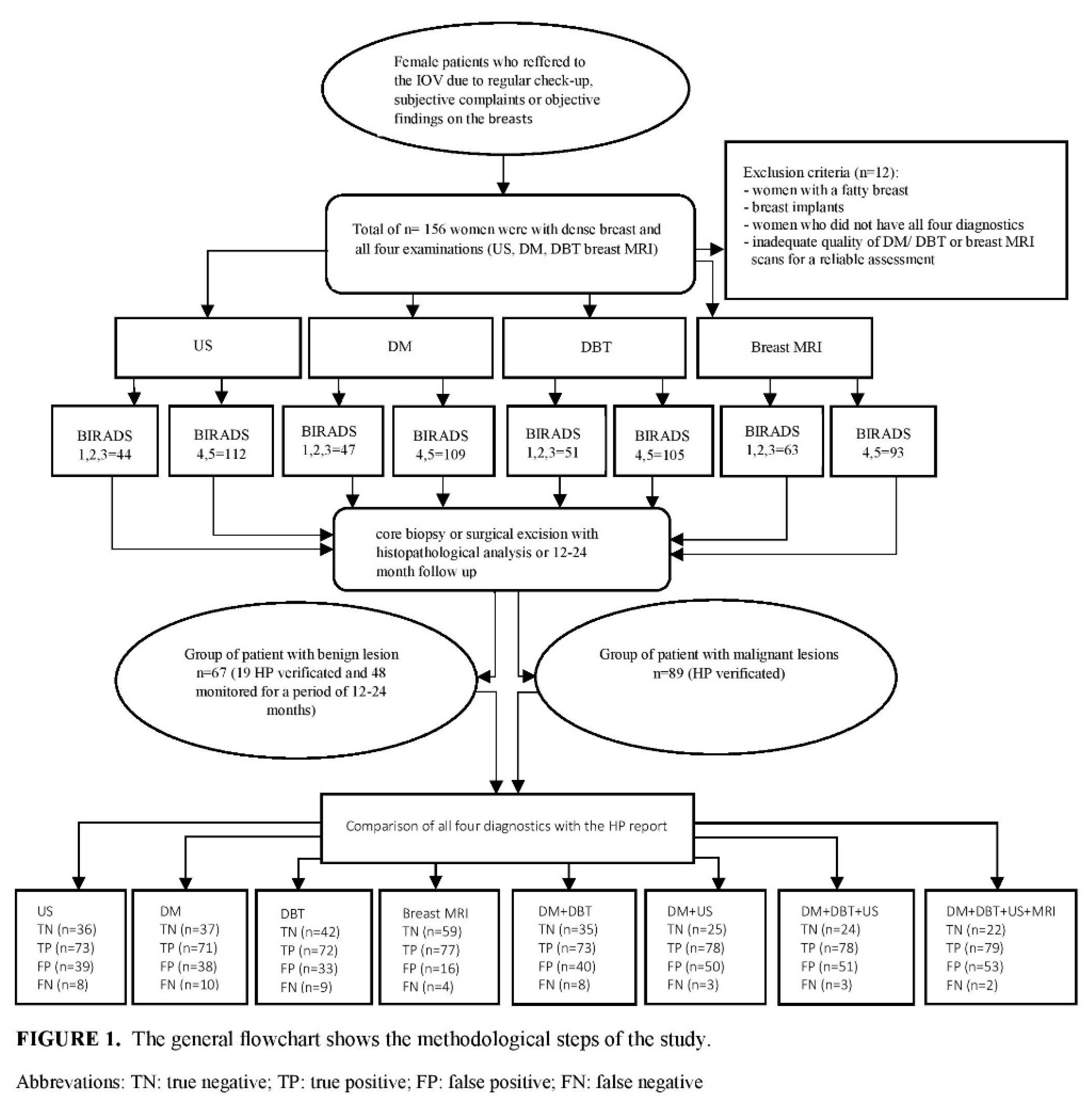
Our clinical research was conducted as a cross sectional retrospective study at Department of Radiological Diagnostics of Oncology Institute of Vojvodina (IOV) in the period from January 2021 to September 2024. The research was approved by the Institutional ethics committee. The research included a sample of 168 asymptomatic women and women with objective breast findings who had dense breasts determined on DM categorized as ACR C and D. Each selected women underwent DBT in the same act, and then US and breast MRI within a period of 6 weeks. Based on the exclusion criteria, 12 patients were excluded from the study, and the total number of patients was 156 women. A needle or surgical biopsy were perfomed in suspicious findings who are categorized according to the BI RADS atlas into BI RADS 4 and 5. The breasts classified as BI RADS 1, 2 and 3 were followed by the appropriate radiological method within a period of 12 to 24 months and compared with the previous ones, and those who were radiologically stable were considered final after 12-24 monts. Histopathology (HP) was the gold standard for accuracy assessment for all four diagnostic methods and it was performed at the Department for Histopathology of Oncology Institute of Vojvodina.
The exclusion criteria were: contraindications for MRI examination; women with breast implants; fatty breasts; women who did not have all four diagnostics; inadequate quality of DM/DBT or breast MRI for reliable assessment.
The following flowchart presents methodological steps from patients’ selection, diagnostic examination and evaluation (BI RADS categorisation) to HP analysis and comparison with radiological findings (Figure 1.).
Preprints 145668 i001

2.2. Imaging Protocols:

DM and DBT was obtained on a digital mammography unit (Selenia Dimension FFDM Hologic, Bedford, MA, USA)with 70 micron Selenium detector (pixel peech 240x290 mm, pixel size 70μm) and Rhodium and Silver filters (tungsten x-ray tube).Standard projection was made in cranio-caudal (CC) and medio-lateral oblique (MLO) projection (25-49kVp, max. 20mA). Under the same conditions of compression and position, bilateral DBT was made on the same digital mammography unit with x-ray tube rotation with an angular range of 15° in both CC and MLO projections (25-49kVp, max. 200mA, Al filter, SE detector 24x29cm, pixel size 140μm). Image reconstruction was perfomed with 1mm image slice thickness and reconstruction time of 5 sec. Supplemental US was made with ultrasonography unit (Resona 7; Mindray, China), using a high-resolution L14-4,5 MHz probe with a patient in supine position. Transverse and longitudinal scans of breasts were performed. Breast MRI was perfomed using a 3,0 T MR imaging unit (Simens Medical System, Erlangen, Germany). Images were acquired with a dedicated 16-channel breast array coil and the patient placed in prone position. Imaging was done with standard Institutional imaging protocols, which included: T2- weighted turbo spin-echo sequence in axial plane, T2- weighted STIR sequence in sagital plane, diffusion-weighted/apparent diffusion coefficient maps generated (DWI/ADC) sequence in axial plane. This was followed by dynamic contrast study with total of 7 dynamic T1-weighted 3D FLASH fat saturated (FS) sequences in axial plane, one before and 6 after an intravenous administration of bolus contrast media injection (Gadovist, Bayer Shering Pharma, Berlin, Germany) based on 0,1mmol/kg body weight, with a slice thickness of 2mm and aquisition matrix of 380x320. With this parameter settings we acquired a voxel size of 0,4x0,4x2 mm and a temporal resolution of 80 sec per dynamic aquisition. Postprocessing included subtraction and maximum intensity projection (MIP). Morphology and kinetic curves of the lesions were analysed. MR protocols used at our Institution are presented in Table 1.

2.3. Image Interpretation

All images were interpreted independently for DM, DBT and breast MRI, and then in combination: DM+DBT, DM+DBT in combination with US, and DM+DBT+US with breast MRI. Finally, all modalities were compared with HP finding whenever feasible. Patients which did not demand a biopsy, are followed by appropriate imaging in the next 12 to 24 months, and if findings were stablein comparison with previous images, this breastswere finally considered benign.
Quantitative and qualitative analysis of the images was not blind. Breasts MR images were interpreted with knowledge of other three imaging findings by 2 experienced radiologists (one with 12 years experience and other with 5 years experience in breast MRI). DM, DBT and US were independently interpreted by 4 radiologists with a knowledge of previous examination findings (2 radiologists with 18 and 10 years of experience in DM, DBT, US and breast MRI , and other 2 with 5-year experience in DM, DBT and US). Image analysis and measurements of DM and DBT was done on a Clinical Picture Archiving And Communication System workstation monitor manufactured by Hologic with a monitor resolution of 5MP, while the evaluation of MR tomograms was performed on a diagnostic workstation manufactured by Barco with a monitor resolution of 2 MP. All images were analysed according to ACR BI-RADS 5th Edition atlas criteria.
All lesions detected during image analysis were evaluated for morphologic (shape, margins, density/echogenicity, size and type of calcifications, etc.) and kinetic characteristics (enhancement curves and peak enhancement).

2.4. Statistical Methods

The analysed group consisted of participants who received all four modalities. The study sample size was 156 women. All four diagnostic methods were tested with Cochran's K test and compared with McNemar's test. The sensitivity, specificity, positive and negative predictive value (PPV and NPV respectively) and accuracy of the test were calculated based on the data obtained using Crosstabs tables. A ROC (Receiver operating characteristic) curve was created in accordance with the BI-RADS classification for the examined discriminative abilities of the diagnostic methods in relation to the HP reports. Cancer diagnosis is based on HP examination of the biopsy sample. Statistical significance was assessed at p˂0.05. Statistical software analysis was performed using the IBM SPSS Statistics 20 package (Statistical Package for the Social Sciences, version - International Business Machines Corporation, New York).

3. Results

3.1. Patient Characteristics
In this research 156 patients were statistically processed. All patients were women with dense breastswith mean age of 51.32±9.82 years (age range 28 to 77 years). The most women were premenopausal (Figure 2.).
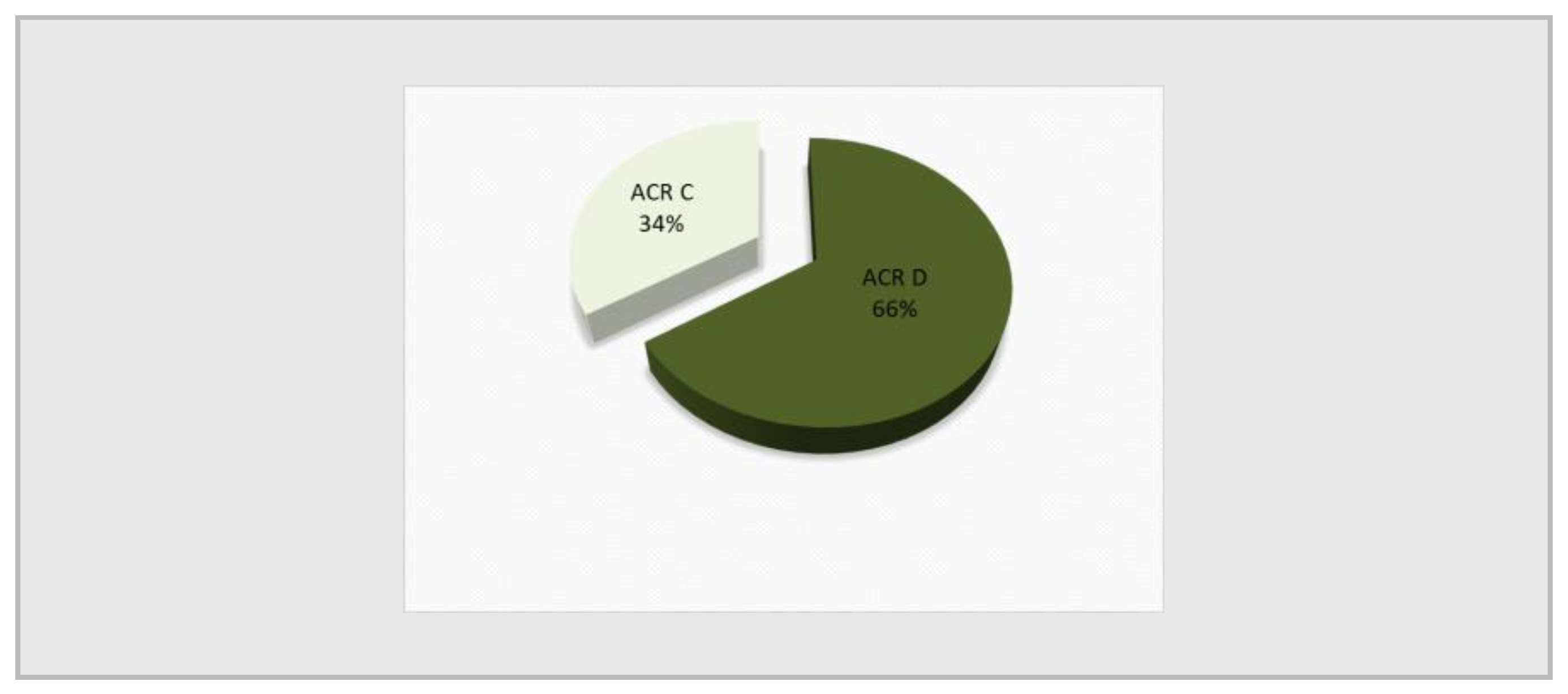
In our study sample of female patients, 34% (n=53) were with breasts classified as ACR C, and 66% (n=103) as ACR D (Figure 3.).
Figure 3. Percentage of women according to breast type: ACR C and D.
Preprints 145668 g003a

3.2. Analysis of Histopathological findings of needle/surgical biopsies

From the total of 156 patients, 108 breasts lesions are HP verified. The detailed distribution of HP diagnosis of breast lesions is summarized in Table 2. The other 48 women were monitored at predefined time intervals and finally categorized as benign breasts.
Out of total HP verified, 89 (82.4%) were malignant and 19 (17.6%) were benign lesions. From 89 malignant tumors, 80 (89.8%) were invasive carcinoma and 9 (10.1%) were carcinoma in situ. From 80 invasive cancers, 61 (76.2%) were invasive ductal carcinoma, 12 (15%) invasive lobular carcinoma, 3 (3.75%) papillary carcinoma, 2 (2.5%) mucinous carcinoma and 2 (2.5%) were metastasis. The majority of benign lesions were fibroadenoma (47.3%) and FCC (31.5%).

3.3. Statistical Analysis of Four Radiological Diagnostics US, DM, DBT and Breast MRI in Correlation with HP Results
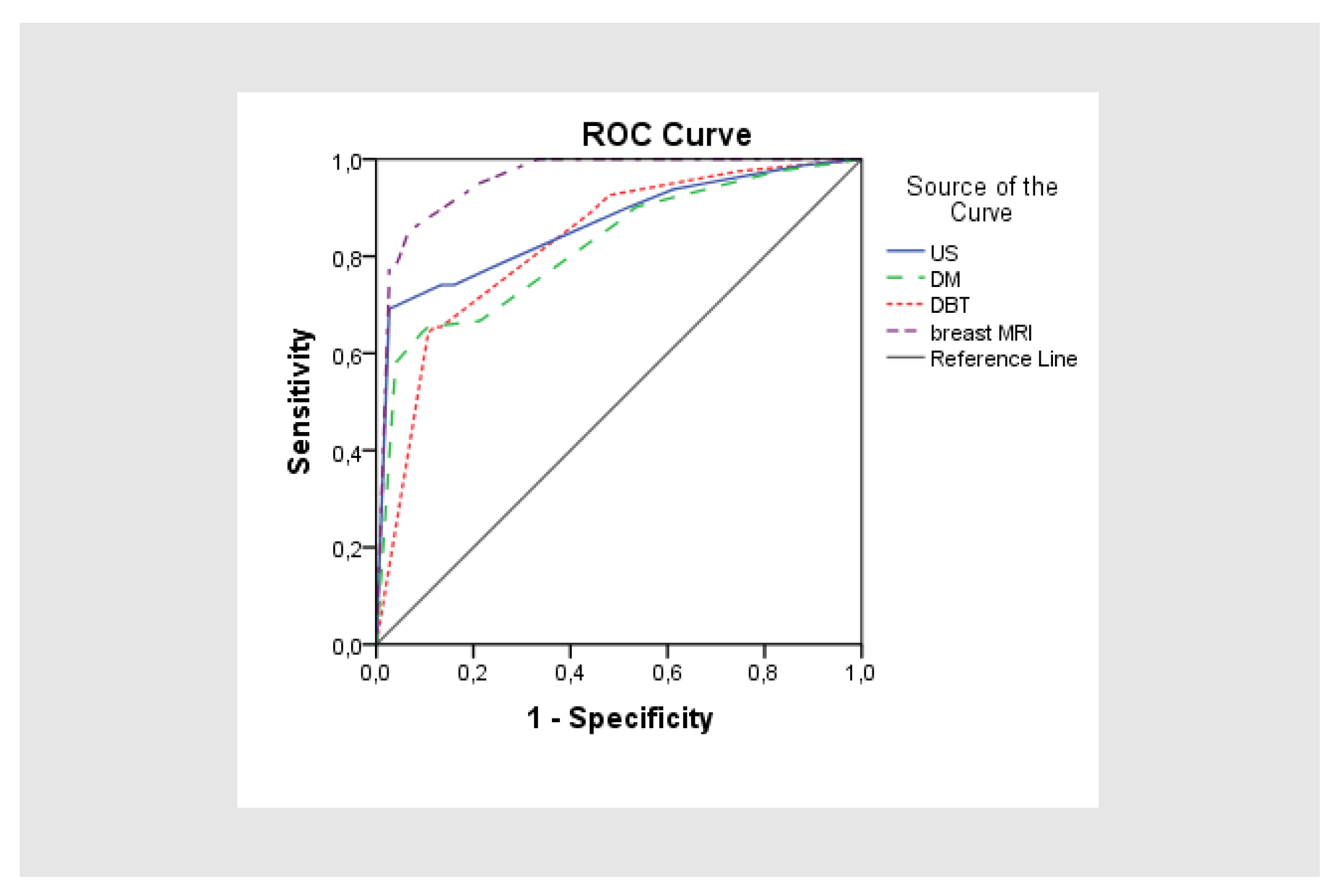
Table 3. and Table 4. have showed correlation and comparison of all four radiological findings with HP results.
In Table 3. is showed that the majority of women are categorized with BI RADS 5 in all four examinations. The number of women with categories 4, 4a and 4b was higher in all scans with proven benign lesions compared to malignant ones.
From Table 4. it could be seen that MRI imaging had 4 false negative findings, US 8, DBT 9 and DM 10. US had the most false positives findings (n=39), and MRI had at least (n=16). The combination of DM and DBT has reduced the number of false negatives, but it has increased the number of false positives findings. When US is added, the number of false negatives has decreased from 8 to 3, and false positives has increased from 40 to 51. The additional combination with breast MRI has reduced the number of false negatives to 2, but has increased false positives to 53. Concordance between imaging and HP examination of the lesion was the highest in MR 136/156 (87.2%), and the lowest in DM 108/156 (69.2%).
The McNemar test showed a statistically significant difference in assessment of cancer detection in all four examinations in relation to HP, where the significance is at the P˂0.000 level. Cochran test also showed that there is a significant difference in cancer diagnosis between the four analyzed diagnostic methods (Cochran's Q=12.101; df=3; P=0,007).
In Table 5. is showed the values of sensitivity, specificity, PPV, NPV and the accuracy of the test calculated on the basis from data of Table 4.
DM had the lowest sensitivity (87.7%) and specificity (49.3%) for dense breasts. The combination of DM+DBT+US had a higher sensitivity (96.3%) than the combination of DM+DBT (90.1%) or DM, DBT and US used alone (87.7%, 88.9% and 90.1% respectively). However, the specificity was 32%, which is less than 46.7%, 48%, 49.3% and 56% for the combination of DM+DBT, and DM, DBT, US alone, respectively. By adding MRI sensitivity was increasedto 95.5% but specificity was decreased to 29.3%. MRI alone had a sensitivity of 95.1%, a specificity of 78.7%, which is better than any of three other single examinations.
The results of our study showed that the highest PPV and NPV is for breast MRI in dense breasts (82.8% and 93.8% respectively), and the lowest is for DM (65.1% and 78.7% respectively). With combination of all four methods of breast imaging in dense breasts, we obtained sensitivity of 97.5%, but a very low specificity of 29.3%. We got the best diagnostic accuracy for breast MRI (87.2%), and the lowest for the combination of all four combined diagnostics methods (64.7%).
ROC curve analysis which presenting sensitivity and specificity of US, DM, DBT and breast MRI in distinction between malignant and benign lesions is shown in Figure 3 and results from ROC curves are presented in Table 6.
Figure 3. Comparison of ROC curves for US, DM, DBT and breast MRI.
Preprints 145668 g003b
Based on the results from Table 6. and Figure 3., breast MRI had excellent predictive power (AUC=0.958; SE=0.015). The other three diagnostics methods had good prediction with AUC higher than 0.800. DM had the lowest discrimination power with an AUC of 0.820.

3.4. Selected Interesting Examples from Our Study

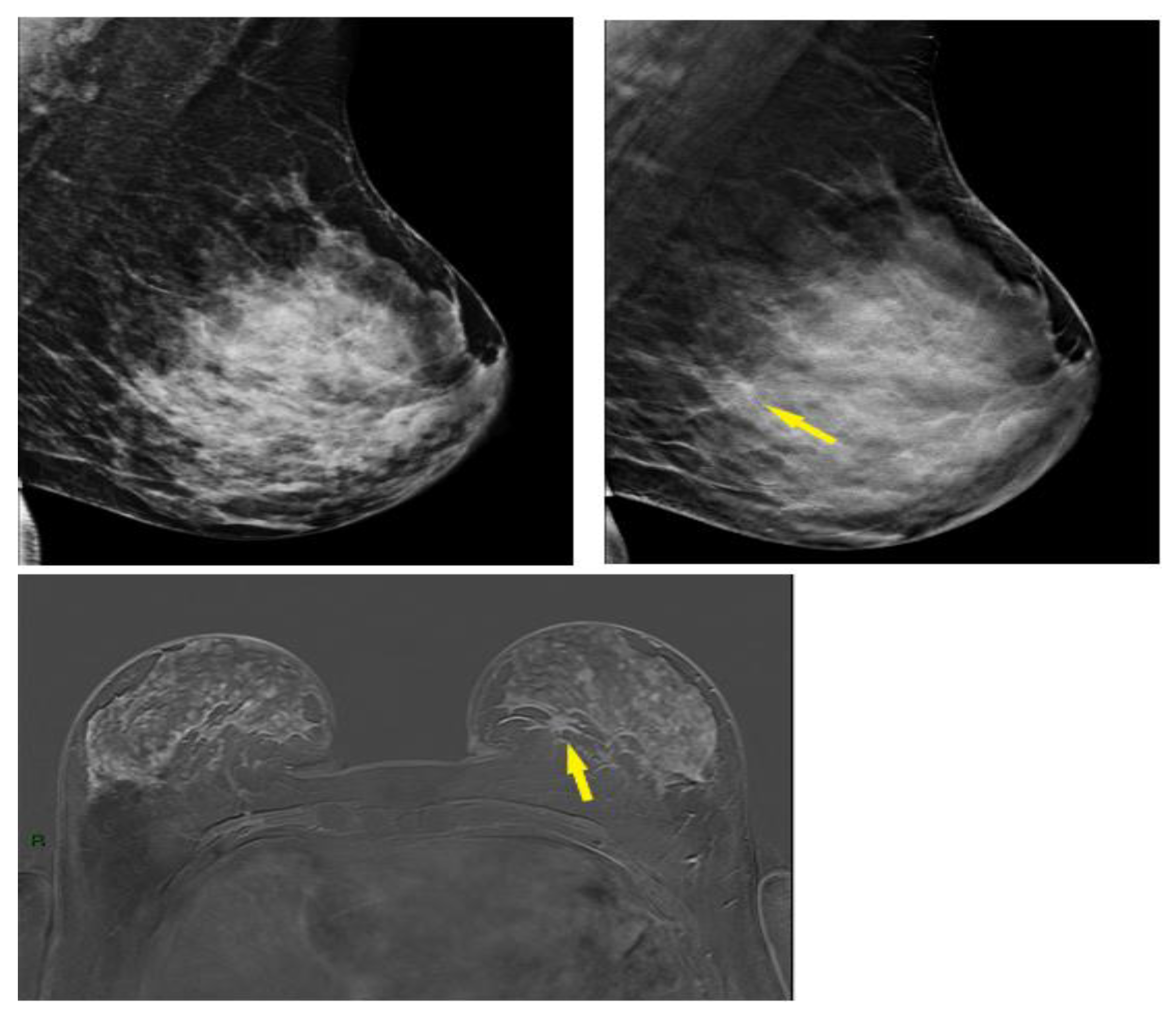
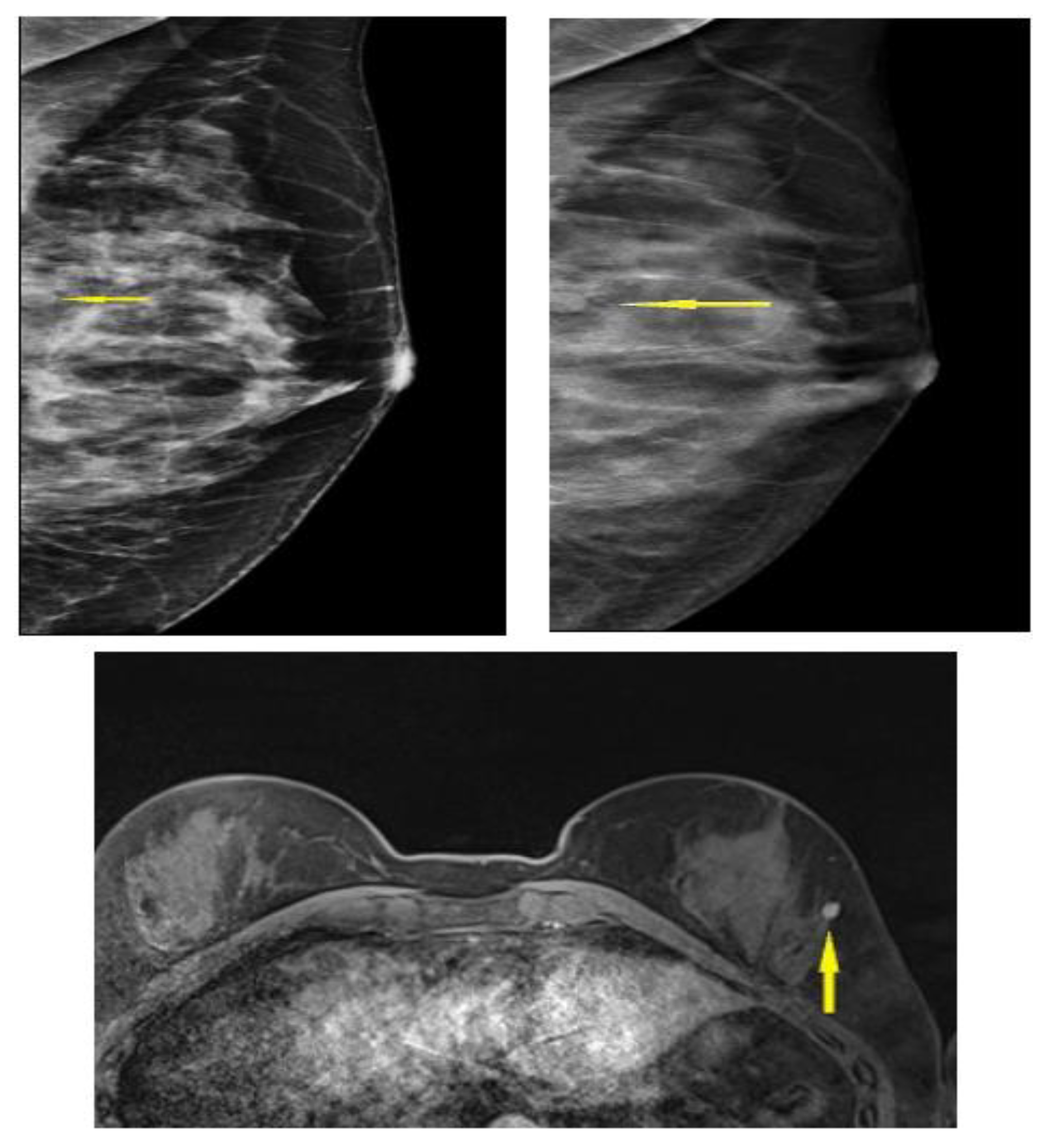
We showed a two examples from the samples of our female patients with HP proved malignant lesions in dense breast identified on MRI, DM, DBT and US demonstrated in Figure 4. and Figure 5.

4. Discussion

The majority of researches in the last years have showed that women with dense breasts are underdiagnosed with DM applied alone. DBT is became the inescapableas breast cancer screening tool in dense breasts. The sufficiency of DBT alone for women with extremely dense breasts and the incremental value of supplemental screening US remains unclear and requires further investigation [11]. Therefore, there is a constant need to improve the diagnostic algorithm for this group of women in early detection of breast cancer and reducing the rate of interval cancers.
In this study, four diagnostic imaging techniques: DM, DBT, US and breast MRI were evaluated and their diagnostic performances were compared among 156 patients with dense breast tissue.
Based on ROC curve analysis, we found that breast MRI is yet the best diagnostic technique for detecting small malignant lesions in dense breasts.But, this study also showed that combination of other three techniques hada comparative predictive valueto MRI. This is important because these diagnostics are widespread and can easily be implemented into routine clinical practice, especially in regions who are lack with MRI units.
Our research showed that DM applied alone in women with dense breasts had a lowest sensitivity and specificity which correlates with literature data. The sensitivity of DM was 87.7% and NPV 78.7% and increased to 90.1% and 81.4% with the addition of DBT. However, the specificity and PPV decreased from 49.3%, 65.1% to 46.7%, 64.6% which can be explained by the increased number of false positive findings.
The study published by Sudhir, et al. are compared contrast enchanced digital mammography (CEDM) with synthetic DM, DBT and US in 166 lesion in 130 female patients with dense breasts and reported that synthetic DM had the lowest sensitivity, specificity, PPV and accuracy, 75.6%, 63.3%, 69.1% and 69.7%, respectively; DBT had 82.8% sensitivity, 84.8% specificity, 85.7% PPV and 83.7% accuracy. The authors showed that sensitivity, specificity and accuracy of CEDM was 96.5%, 81% and 89.2% comparable with our results of breast MRI 95.1%, 78.7% and 87.2% respectively [12]. These results indicate the need for further research in our Institution of benefits of CEDM and comparability with breast MRI.
Romeih, et al. reported in their research on 90 female with dense breasts the diagnostic accuracy of DM and DBT in characterization of breast lesions in dense breasts: DBT had sensitivity of 98%, specificity of 87%, PPV of 88%, NPV of 98% and accuracy 92%, while DM had sensitivity of 58%, specificity 80%, PPV 74%, NPV 65% and accuracy 69% [13].
The present study showed that a combination of DM and DBT has statistically significantly increased the number of detected lesions compared to methods applied individually, because it reduced overlapping of breast parenchyma. Sensitivity of combinedDM+DBTwas 90.1%, vs. DBT 88.9%, and DM 87.7% alone. Specificity and accuracy were lower (46.7% and 69.2%, respectively), because of higher number of false positive findings, possible of irregulartechnical positioning, perception error, subtle features of lesions or slow growth of malignancies.
In a recent study from Joshi, et al. is presented diagnostic accuracy of 84.8% for DM in combination with DBT, while sensitivity, specificity, PPV and NPV were 92%, 56.5%, 89% and 65%, respectively [14]. Our study showed higher sensitivity, NPV and the same test accuracy of combined DM and DBT compared to DM alone.
Mansour et al. also evaluated the benefit of DBT added to DM in finding and characterizing of different breast lesions in dense breasts and found that the sensitivity, specificity, and accuracy of DM have significantly enhanced on applying DBT from 60%, 20.7% and 48% respectively to be 94.5%, 74% and 89.7% respectively [15]. These results are comparable to those reported by other previous studies of Skaane, Østerås and Hassan [16,17,18].
A meta-analysis of seven studies revealed a higher sensitivity of combined DBT and DM compared to DM alone [19]. In contrast to some studies that reported a significantly higher sensitivity for the addition of DBT (54.2% for DM vs. 70.4% for the combination of DM+DBT and 61% for DM vs. 83% for DM+DBT respectively), the increase in this study was only 2.4% [20,21]. Our findings have been added to previous evidence that DBT combined with DM is superior to DM alone in breast cancer detection and support the adoption of DBT in clinical practice for breast cancer screening in dense breasts [22,23,24,25,26,27].
Hadadi, et al. have compared in their study the diagnostic confidence in dense and non-dense breasts of mammogram readers in DM and DBT.Results were that diagnostic confidence was higher in DBT when compared to DM. In contrast, other performance metrics appeared to be similar or better with DM and may be influenced by the lack of experience of the reader cohort in reading DBT [28].
In the research conducted by Ha SM, et al., a significantly higher sensitivity and specificity of combined DM+DBT+US was observed in the detection of breast cancer with dense breasts compared to DM+DBT alone[1]. In our research adding US to the combination of DM and DBT sensitivity increased to 96.3%, while specificity and accuracy decreased to 32% and 65.4% respectively. A higher sensitivity of the combination of these three modalities than DM alone was reported by Mariscotti et al. [29].
In Keymeulens, et al. study MRIis found to be better than DM in detecting breast malignancy [30]. The best discriminating power for detecting breast cancer in our study was for breast MRI (0.958), which is better than the earlier results (0.884) obtained by Roganović, et al. [31].
The agreement between DM, US, DBT and breast MRI and HP results in this study was 69.2%, 69.9%, 73.1% and 87.2% respectively. In an earlier study from Pereira et al., concordance for DM, US and breast MRI with HP findings was 71.9%, 46.9% and 75%[32].
There were 112 lesions with a malignant feature on US in our study, of which 73 (65.2%) were true positive and 39 (34.8%) were false positive. Out of 44 benign lesions diagnosed by US, HP findings registered 8 (18.2%) false negative, and 36 was (81.8%) true benign. In the earlier research, there were no false negative values and 16.1% were false positives, so a sensitivity of 100% and a specificity of 80.4% were obtained with a PPV of 83.9% and a NPV of 100% [33]. In our study, the sensitivity for US was 90.1%, specificity 48%, PPV 65.2%, and the NPV 81.8%. The accuracy of US was 69.9%. Kolb et al. obtained a much higher specificity (96.8%) than sensitivity (75.3%), thus a higher PPV (99.7%) than NPV (20.5%), accuracy of the test was very high at 96.6%[34]. Kim et al obtained a 40% higher sensitivity for US compared to DM in women with dense breasts[35]. In our research, that difference is much smaller, 12.4%. It has been confirmed in the literature that US is more sensitive than DM in detecting lesions with dense breasts [34].
Breast MRI is the gold standard for breast imaging against which all other new technologies are compared, especially in terms of sensitivity of more than 95% [36]. In our study, the sensitivity for breast MRI was 95.3%, and the specificity was more limited at 78.2%. In most studies, the sensitivity of breast MR is very high at 90%, but the specificity is variable, range from 37% to 97% [37,38,39]. In a meta-analysis by Zhang and Ren the specificity is 70% attributed to the fact that many benign lesions and normal tissue can be highlighted with paramagnetic contrast agents, showing overlap with malignant lesions, both in kinetic and morphological terms [40,41].The lowest rate of false positive biopsies is 21.3%, for breast MRI, while the highest was 52% for US.
In a prospective evaluation in predicting the malignancy of HP borderline lesions diagnosed by needle biopsy, the sensitivity of MRI was 92%, specificity 91%, PPV 78% and NPV 96% [41].
Our study had several limitations.The most important are that the study was retrospective and conducted in one academic institution, and it had a small sample of participants so results can not be generalized. The study was not blind, and the radiologist knew the results of the previous examinations. Since ours is a tertiary care cancer hospital,our dataset consists of selected patients who have already been diagnosed with a breast lesion at another institution and are reffered to our Institute for further diagnostics, which is why there is a selection bias. The next study should be conducted on larger sample size and be multicentric, with integrated artificial intelligence in DM and DBT readingdue to the effect on the reduction of perception error and false negative and false positive findings.

5. Conclusions

The ultimate goal of this study was to evaluate which combination of diagnostics has the best predictive power in detecting cancer in an early stage, thereby reducing the rate of false positive findings, unnecessary examinations and the number of invasive diagnostic procedures. The results of this study confirmed, as in most previous studies, that breast MRI still has superiority in discrimination of clinically occult breast cancer in dense breasts. Results of our study have also implied that the combination of DM and DBT with supplemental US has a good diagnostic accuracy, similar to breast MRI in early cancer detection.

Author Contributions

Conceptualization, D.P.; methodology, D.P.; software, B.Š.; validation,M.DJ.,N.P.B. and M.S; formal analysis, B.Š.; investigation, D.P.; resources, D.P.; data curation, D.P.; writing—original draft preparation, D.P.; writing—review and editing, B.Š. and M.DJ; visualization, N.P.B andM.S; supervision, M.S.project administration, D.P. All authors have read and agreed to the published version of the manuscript.

Funding

This research received no external funding.

Institutional Review Board Statement

The study was conducted in accordance with the Declaration of Helsinki, and approved by the Institutional Ethics Committee of Oncology Institute of Vojvodina, Serbia (protocol code: 4/20/2-2406/2-8, date of approval: 20 august 2020.).

Informed Consent Statement

Due to the retrospective study design, additional informed consent was not required.

Data Availability Statement

The data that support the finding of this study are available from the corresponding author (DP) upon reasonable request.

Conflicts of Interest

The authors declare no conflicts of interest.

References

  1. Ha, S.M.; Yi, A.;Yim D.: Jang, M.; Kwon, B.R.; Shin S.U.; et al. Digital Breast Tomosynthesis Plus Ultrasound Versus Digital Mammography Plus Ultrasound For Screening Breast Cancer in Women With Dense Breasts. Korean J Radiol 2023, 24, 274-283. PMCID: PMC10067692. [CrossRef]
  2. Winkler,N.S.; Raza, S.;Mackesy, M.; Birdwell R.L. Breast density: clinical implications and assessment methods. Radiographics 2015, 35, 316-324. [CrossRef]
  3. Sprague, BL.; Gangnon, R.E.; Burt, V.; Trentham-Dietz, A.; Hampton, J.M.; Wellman, R.D.; Kerlikowske, K.; Miglioretti, D.L. Prevalence of mammographically dense breasts in the United States. J Natl Cancer Inst 2014, 12, 106(10):dju255. [CrossRef]
  4. Berg, W.A.; Rafferty, E.A.; Friedewald, S.M.; Hruska, C.B.; Rahbar, H. Screening Algorithms in Dense Breasts: AJR Expert Panel Narrative Review. AJR Am J Roentgenol 2021, 216, 275–294. [Google Scholar] [CrossRef] [PubMed]
  5. Mann, R.M.; Athanasiou, A.; Baltzer, P.A.T.; Camps-Herrero, J.; Clauser, P.; Fallenberg, E.M.; Forrai, G.; Fuchsjäger, M.H.; Helbich, T.H.; Killburn-Toppin, F.; Lesaru, M.; Panizza, P.; Pediconi, F.; Pijnappel, R.M.; Pinker, K.; Sardanelli, F.; Sella, T.; Thomassin-Naggara, I.; Zackrisson, S.; Gilbert, F.J.; Kuhl, C.K. European Society of Breast Imaging (EUSOBI). Breast cancer screening in women with extremely dense breasts recommendations of the European Society of Breast Imaging (EUSOBI). EurRadiol, 4036. [Google Scholar] [CrossRef]
  6. Gao, Y.; Moy, L.; Heller, S.L. Digital Breast Tomosynthesis: Update on Technology, Evidence, and Clinical Practice. Radiographics 2021, 41, 321–337. [Google Scholar] [CrossRef]
  7. Kassis, I.; Lederman, D.; Ben-Arie, G.; Rosenthal, M.G.; Shelef, I.; Zigel, Y. Detection of breast cancer in digital breast tomosynthesis with vision transformers. Sci Rep 14 2024, 22149, 14. [CrossRef]
  8. Hadadi, I.; Clarke, J.; Rae, W.; McEntee, M.; Vincent, W.; Ekpo, E. Diagnostic Efficacy across Dense and Non-Dense Breasts during Digital Breast Tomosynthesis and Ultrasound Assessment for Recalled Women. Diagnostics 2022, 12, 1477. [Google Scholar] [CrossRef] [PubMed]
  9. Upadhyay, N.; Wolska, J. Imaging the dense breast. J SurgOncol 2024, 130, 29–35. [Google Scholar] [CrossRef] [PubMed]
  10. Sardanelli, F.; Magni, V.; Rossini, G.;Kilburn-Toppin, F.; Healy, N.A.; Gilbert, F.J. The paradox of MRI for breast cancer screening: high-risk and dense breasts—available evidence and current practice. Insights Imaging 2024, 15, 96. [CrossRef]
  11. Yi, A.; Jang, M.; Yim, D.; Kwon, BR.; Shin, SU.; Chang JM. Addition of Screening Breast US to Digital Mammography and Digital Breast Tomosynthesis for Breast Cancer Screening in Women at Average Risk. Radiology 2021, 298, 568-575. [CrossRef]
  12. Sudhir, R.; Sannapareddy, K.;Potlapalli, A.; Krishnamurthy, PB.; Buddha, S.; Koppula, V. Diagnostic accuracy of contrast-enhanced digital mammography in breast cancer detection in comparison to tomosynthesis, synthetic 2D mammography and tomosynthesis combined with ultrasound in women with dense breast. British Journal of Radiology 2021, 94, 20201046. [CrossRef]
  13. Romeih, M.; Raafat, T.A.; Ahmed, G.; Shalaby, SAM.; Ahmed, W.A.H. Value of digital breast tomosynthesis in characterization of breast lesions in dense breast. Egypt J RadiolNucl Med 2024, 55, 131. [CrossRef]
  14. Joshi, P.; Singh, N.; Raj, G.; Singh, R.; Malhotra, K.P.; Awasthi, N.P. Performance evaluation of digital mammography, digital breast tomosynthesis and ultrasound in the detection of breast cancer using pathology as gold standard: an institutional experience. Egypt J RadiolNucl Med 2022, 53, 1-11. [CrossRef]
  15. Mansour, S.; Adel, L.; Mokhtar, O.; Omar O.S. Comparative study between breast tomosynthesis and classic digital mammography in the evaluation of different breast lesions. Egypt J RadiolNucl Med 2014, 45, 1053-61. [CrossRef]
  16. Skaane, P.; Bandos, AI.; Gullien, R.; Eben, EB.; Ekseth, U.; Haakenaasen, U.; Haakenaasen, U.; Izadi, M.; Jebsen, I.N.; Jahr, G.; Krager, M.; Niklason, L.T.; Hofvind, S.; Gur, D. Comparison of digital mammography alone and digital mammography plus tomosynthesis in a population-based screening program. Radiology 2013, 267, 47–56. [Google Scholar] [CrossRef] [PubMed]
  17. Østerås,B.H.; Martinsen, A.C.T.; Gullien, R.; Skaane, P. Digital Mammography versus Breast Tomosynthesis: Impact of Breast Density on Diagnostic Performance in Population-based Screening. Radiology 2019, 293, 60-68. [CrossRef]
  18. Hassan, R.M.; Almalki, Y.E.; Basha, M.A.A.; Alduraibi, S.K.; Aboualkheir, M.; Almushayti, Z.A.; Aldhilan, A.S.; Aly, S.A.; Alshamy, A.A. The Impact of Adding Digital Breast Tomosynthesis to BI-RADS Categorization of Mammographically Equivocal Breast Lesions. Diagnostics 2023, 13, 1423. [Google Scholar] [CrossRef] [PubMed]
  19. Lei, J.; Yang, P.; Zhang, L.; Wang, Y.; Yang, K. Diagnostic accuracy of digital breast tomosynthesis versus digital mammography for benign and malignant lesions in breasts: a meta-analysis. Eur Radio 2014, 24(3), 595–602. [Google Scholar] [CrossRef]
  20. Skaane, P.; Bandos, A.I.; Niklason, L.T.; Sebuødegård, S.; Østerås, B.H.; Gullien, R.; Gur, D.; Hofvind, S.. Digital mammography versus digital mammography plus tomosynthesis in breast cancer screening: the Oslo Tomosynthesis Screening Trial. Radiology 2019, 291(1), 23–30. Epub 2019 Feb 19. PMID: 30777808. [CrossRef]
  21. Ohashi, R.; Nagao, M.; Nakamura, I.; Okamoto, T.; Sakai, S. Improvement in diagnostic performance of breast cancer: comparison between conventional digital mammography alone and conventional mammography plus digital breast tomosynthesis. Breast Cancer 2018, 25, 590–596. [Google Scholar] [CrossRef] [PubMed]
  22. Friedewald, S.M.; Rafferty, E.A.; Rose, S.L.; Durand, M.A.; Plecha, D.M.; Greenberg, J.S.; Hayes, M.K.; Copit, D.S.; Carlson, K.L.; Cink, T.M.; Barke, L.D.; Greer, L.N.; Miller, D.P.; Conant, E.F. Breast cancer screening using tomosynthesis in combination with digital mammography. JAMA 2014, 311, 2499–2507. [Google Scholar] [CrossRef] [PubMed]
  23. Alabousi, M.; Zha, N.; Salameh, J.P.; Samoilov, L.; Sharifabadi, A.D.; Pozdnyakov, A.; Sadeghirad, B.; Freitas, V.; McInnes, M.D.F.; Alabousi, A. Digital breast tomosynthesis for breast cancer detection: a diagnostic test accuracy systematic review and meta-analysis. EurRadiol 2020, 30, 2058-2071. Epub 2020 Jan 3. PMID: 31900699. [CrossRef]
  24. Marinovich, M.L.; Hunter, K.E.; Macaskill, P.; Houssami, N. Breast cancer screening using tomosynthesis or mammography: a meta-analysis of cancer detection and recall. J Natl Cancer Inst 2018, 110, 942–949. [Google Scholar] [CrossRef] [PubMed]
  25. Sardanelli, F.; Fallenberg, E.M.; Clauser, P.; Trimboli, R.M.; Camps-Herrero, J.; Helbich, T.H.; Forrai, G. European Society of Breast Imaging (EUSOBI), with language review by Europa Donna–The European Breast Cancer Coalition. Mammography: an update of the EUSOBI recommendations on information for women. Insights Imaging 2017, 8, 11-18. Epub 2016 Nov 16. PMID: 27854006; PMCID: PMC5265195.26. [CrossRef]
  26. Boroumand, G.;Teberian, I.; Parker, L.; Rao, V.M.; Levin D.C. Screening mammography and digital breast tomosynthesis: utilization updates. Am J Roentgenol 2018, 210, 1092–1096. Epub 2018 Mar 23. PMID: 29570370. [CrossRef]
  27. Alsheik, N.H.; Dabbous, F.; Pohlman, S.K.; Troeger, K.M.; Gliklich, R.E.; Donadio, G.M.; Su, Z.; Menon, V.; Conant, E.F. Comparison of resource utilization and clinical outcomes following screening with digital breast tomosynthesis versus digital mammography: findings from a learning health system. AcadRadiol 2019, 26, 597–605. Epub 2018 Jul 26. PMID: 30057195. [CrossRef]
  28. Hadadi, I.; Rae, W.; Clarke, J.; McEntee, M.; Ekpo, E. Breast cancer detection across dense and non-dense breasts: Markers of diagnostic confidence and efficacy. ActaRadiol Open 2022, 11, 20584601211072279. [Google Scholar] [CrossRef] [PubMed]
  29. Mariscotti, G.; Houssami, N.; Durando, M.; Bergamasco, L.; Campanino, P.P.; Ruggieri, C.; Regini, E.; Luparia, A.; Bussone, R.; Sapino, A.; Fonio, P.; Gandini, G. Accuracy of mammography, digital breast tomosynthesis, ultrasound and MR imaging in preoperativeassessment of breast cancer. Anticancer Res 2014, 34, 1219–1225. [Google Scholar] [PubMed]
  30. Keymeulen K.B.I.M.; Geurts S.M.E.; Kooreman LFS.; Duijm L.E.M.; Engeles S.; Vanwetswinkel S.; et al. Clinical value of contralateral breast cancers detected by pre-operative MRI in patients diagnosed with DCIS: a population-based cohort study. EurRadiol 2023, 33, 2209–2217. Epub 2022 Sep 30. PMID: 36180645; PMCID: PMC9935702. [CrossRef]
  31. Roganovic, D.; Djilas, D.; Vujnovic, S.; Pavic, D.; Stojanov D. Breast MRI, digital mammography and breast tomosynthesis: Comparison of three methods for early detection of breast cancer. Bos J Basic Med Sci 2015, 15, 64–68. PMID: 26614855; PMCID: PMC4690445. [CrossRef]
  32. Pereira, R.O.; Luz, L.A.D.; Chagas, D.C.; Amorim, J.R.; Nery-Júnior, E.J.; Alves, A.C.B.R.; Abreu-Neto, FT.; Oliveira, M.D.C.B.; Silva, D.R.C.; Soares-Júnior, J.M.; Silva, B.B.D. Evaluation of the accuracy of mammography, ultrasound and magnetic resonance imaging in suspect breast lesions. Clinics (Sao Paulo) 2020, 75, e1805. [Google Scholar] [CrossRef] [PubMed]
  33. Badu-Peprah, A.; Adu-Sarkodie, Y. Accuracy of clinical diagnosis, mammography and ultrasonography in preoperative assessment of breast cancer. Ghan Med J 2018, 52, 133-139. PMID: 30602798; PMCID: PMC6303551. [CrossRef]
  34. Kolb,T.M.; Lichy, J.; Newhouse, J.H. Comparison of the performance of screening mammography, physical examination, and breast US and evaluation of factors that influence them: an analysis of 27,825 patient evaluations. Radiology 2002, 225, 165–175. PMID: 12355001. [CrossRef]
  35. Kim, H.; Yang, S.Y.; Ahn, J.H.; Ko, E.Y.; Ko, E.S.; Han, B.K.; Choi, J.S . Digital Breast Tomosynthesis versus MRI as an Adjunct to Full-Field Digital Mammography for Preoperative Evaluation of Breast Cancer according to Mammographic Density. Korean J Radiol 2022, 23, 1031-1043. Epub 2022 Sep 16. PMID: 36126953; PMCID: PMC9614296. [CrossRef]
  36. Jochelson, M.S.; Pinker, K.; Dershaw, D.D.; Hughes, M.; Gibbons, G.F.; Rahbar, K.; Robson, M.E.; Mangino, D.A.; Goldman, D.; Moskowitz, C.S.; Morris, E.A.; Sung, JS. Comparison of screening CEDM and MRI for women at increased risk for breast cancer: A pilot study. Eur J Radiol 2017, 97, 37–43. [Google Scholar] [CrossRef]
  37. Lee, C.H. Problem solving MR imaging of the breast. RadiolClin North Am 2004, 42, 919–934. [Google Scholar] [CrossRef] [PubMed]
  38. Bluemke, D.A.; Gatsonis, C.A.; Chen, M.H.; DeAngelis, G.A.; DeBruhl, N.; Harms, S.; Heywang-Köbrunner, S.H.; Hylton, N.; Kuhl, C.K.; Lehman, C.; Pisano, E.D.; Causer, P.; Schnitt, S.J.; Smazal, S.F.; Stelling, C.B.; Weatherall, P.T.; Schnall, M.D. Magnetic resonance imaging of the breast prior to biopsy. JAMA 2004, 292, 2735–2742. [Google Scholar] [CrossRef] [PubMed]
  39. Orel, S.G.; Schnall, M.D.; LiVolsi, V.A.; Troupin, R.H. Suspicious breast lesions: MR imaging with radiologic-pathologic correlation. Radiology 1994, 190, 485–93. [Google Scholar] [CrossRef] [PubMed]
  40. Zhang,Y., Ren, H. Meta-analysis of diagnostic accuracy of magnetic resonance imaging and mammography for breast cancer. J Cancer Res Ther 2017, 13, 862-868. [CrossRef]
  41. Pediconi, F.; Padula, S.; Dominelli, V.; Luciani, M.; Telesca, M.; Casali, V.; Kirchin, M.A.; Passariello, R.; Catalano.; C. Role of breast MR imaging for predicting malignancy of histologically borderline lesions diagnosed at core needle biopsy: prospective evaluation. Radiology 2010 , 257, 653-661. Epub 2010 Sep 30. PMID: 20884914. [CrossRef]
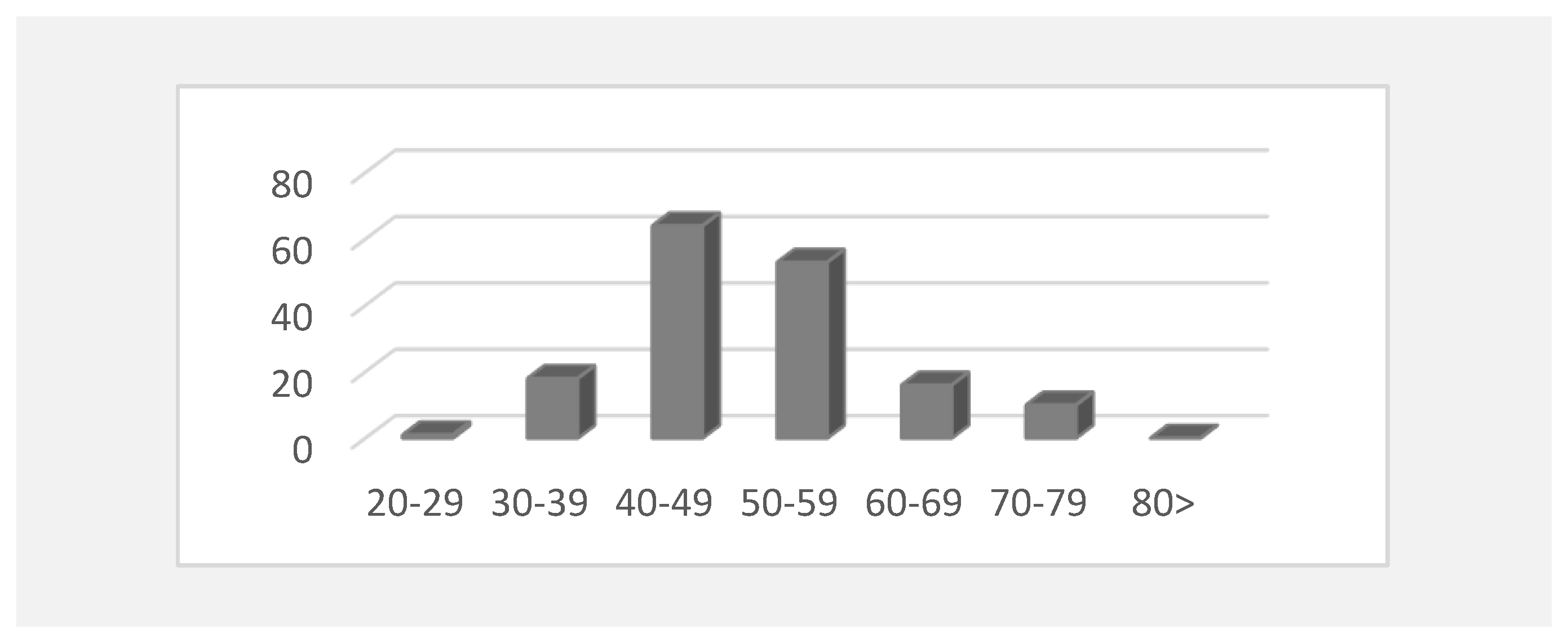
Figure 2. Female distribution by age.
Preprints 145668 g002
Figure 4. A case of a 47-years old women with a extremly dense breasts (ACR D) and a HP verificated radial scar. A) DM in MLO projection image does not show any lesions in left breast, B) DBT image in MLO projection shows a spiculated lesion prepectoral in lower inner quadrant of left breast, C) MR axial 3D T1W FLASH FS image shows a spiculated mild hyperintense lesion prepectoral in inner quadrant.*Ultrasound images are not available because there is not an archive of ultrasound images at our Institution.
Preprints 145668 g004
Figure 5. A case of a 34-year old women with dense breasts (ACR D), and HP proven metastasis in left breast from primary neuroendocrine cancer of lung: A) DM and B) DBT in MLO projection images show a small isodense lesion at the junction of the lateral quadrants of left breast, C) MR axial 3D T1W FLASH FS image shows a small solid hyperintense lesion in lateral quadrant of left breast, D) US image shows a hypoechoic nodule in left breast. *Ultrasound images are not available because there is not an archive of ultrasound images at our Institution.
Preprints 145668 g005
Table 1. The parameters of MRI sequences acquisition
Sequence T2W TSE T2WSTIR DWI(EPI) T1W 3D FLASH FS before and after bolus injection of contrast media
Imaging plane axial sagital axial axial
TR/TE (ms)
(Time to repeat/time to echo)
4900/76 6800/70 3700/60/80 5/3
FA (0)
(flip angle)
 
120
 
120
 
150
 
10
FOV (mm)
(Field of view)
340 240 340 340
Matrix size 380x380 320x290 220/220 380x320
Slice thickness (mm) 2 4 4 2
Number of slices 60 40 30 80
Voxel size (mm) 1x1x2 0,7x0,7x4 1,5x1,5x4 0,4x0,4x2
Time of acquisition (s)/number of aquisition 120/2 120/2 180/1 80/7
B value(s/mm2) - - 50;400;800 -
Scan time (s) 222 206 179 592
Table 2. Histopathological diagnosis of benign and malignant lesions.
 
Histopathological finding
Benign lesions Malignant lesions
n n
Invasive ductal carcinoma 0
0
0
0
0
0
0
0
9
6
1
1
1
1
61
12
17
3
3
1
2
2
0
0
0
0
0
0
Invasive lobular carcinoma
DCIS
LCIS
Papillary carcinoma
PCIS
Mucinous carcinoma
Metastases
Fibroadenoma
Fibrocystic breast changes (FCC)
Adenosis
Granulomatous mastitis
Papilloma
Mucocoela like lesions
TOTAL 19 89
Abbrevations: DCIS: ductal carcinoma in situ; LCIS: lobular carcinoma in situ; PCIS: papillary carcinoma in situ.
Table 3. Correlation of HP findings and BI RADS categorization for all four made diagnostics.
BI RADS category US Digital mammography DBT Breast MRI
Malignant Benign Malignant Benign Malignant Benign Malignant Benign
1 1 9 2 13 2 19 0 14
2 4 20 6 22 4 20 0 36
3 3 7 2 2 3 3 4 9
4 10 21 17 22 19 23 8 11
4A 3 6 1 8 0 0 6 2
4B 0 2 1 1 0 1 0 1
4C 4 8 5 4 1 1 2 0
5 56 2 47 3 52 8 61 2
Table 4. Comparison of US, DM, DBT and breast MRI results with HP diagnosis.
Type of lesion Histopathology
Malignant Benign Total McNemar Test
US P<0.000
Malignant 73 (TP) 39(FP) 112
Benign 8(FN) 36(TN) 44
DM P<0.000
Malignant 71(TP) 38(FP) 109
Benign 10(FN) 37(TN) 47
DBT P<0.000
Malignant 72(TP) 33(FP) 105
Benign 9(FN) 42(TN) 51
Breast MRI P<0.000
Malignant 77(TP) 16(FP) 93
Benign 4(FN) 59(TN) 63
DM+US P<0.000
Malignant 78(TP) 50(FP) 128
Benign 3(FN) 25(TN) 28
DM+DBT P<0.000
Malignant 73(TP) 40(FP) 113
Benign 8(FN) 35(TN) 43
DM+DBT+US P<0.000
Malignant 78(TP) 51(FP) 129
Benign 3(FN) 24(TN) 27
DM+DBT+US with breast MRI P<0.000
Malignant 79(TP) 53(FP) 132
Benign 2(FN) 22(TN) 24
Total 81 75 156
Abbrevations: TP: true positive; FP: false positive; TN: true negative; FN: false negative
Table 5. Diagnostic performance in 156 proven lesions (89 malignant and 67 benign breasts).
Sensitivity Specificity PPV NPV Overall accuracy
US 0,901 0,480 0,652 0,818 0,699
DM 0,877 0,493 0,651 0,787 0,692
DBT 0,889 0,560 0,686 0,824 0,731
Breast MRI 0,951 0,787 0,828 0,937 0,872
DM+DBT 0,901 0,467 0,646 0,814 0,692
DM+DBT+US 0,963 0,320 0,605 0,889 0,654
DM+DBT+US+MRI 0,975 0,293 0,598 0,917 0,647
Abbrevations: PPV: positive predictive value; NPV: negative predictive value
Table 6. Results from ROC curve analysis.
AUC SE P 95% CI
US 0.863 0.030 0.000 0.805-0.921
DM 0.820 0.034 0.000 0.754-0.886
DBT 0.828 0.033 0.000 0.763-0.893
Breast MRI 0.958 0.015 0.000 0.928-0.988
Abbrevations: AUC: area under the receiver operating characteristic curve; SE: standard error; P: significance; 95% CI: 95% coefficient interval
Disclaimer/Publisher’s Note: The statements, opinions and data contained in all publications are solely those of the individual author(s) and contributor(s) and not of MDPI and/or the editor(s). MDPI and/or the editor(s) disclaim responsibility for any injury to people or property resulting from any ideas, methods, instructions or products referred to in the content.
Copyright: This open access article is published under a Creative Commons CC BY 4.0 license, which permit the free download, distribution, and reuse, provided that the author and preprint are cited in any reuse.
Prerpints.org logo

Preprints.org is a free preprint server supported by MDPI in Basel, Switzerland.

Subscribe

Disclaimer

Terms of Use

Privacy Policy

Privacy Settings

© 2025 MDPI (Basel, Switzerland) unless otherwise stated