
Preprint
Communication

This version is not peer-reviewed.

A Facile and Rapid Synthetic Method for Indole-Chalcone Hybrids

A peer-reviewed article of this preprint also exists.

Submitted:

08 January 2025

Posted:

08 January 2025

You are already at the latest version

Abstract

Indole-chalcone hybrids are a large group of compounds known for their excellent biological properties against diverse pathogens. The current research describes a rapid synthetic pathway for the synthesis of ten (10) indole-chalcone hybrids 3(a-j), from 1-Boc-3-formylindole (1) and acetophenone derivatives (2), in a one-pot approach. The Boc was deprotected during the reaction and occurred automatically at the end of the reaction. 1H-NMR, 13C-NMR, and MS were used to elucidate the structures of the compounds. Contrary to previous methods for the synthesis of indole-chalcone hybrids, this novel synthetic method, which involves using a Boc-protected indole via microwave-assisted synthesis, is advantageous because it is a one-pot approach making it facile, and rapid.

Keywords: 
;  ;  ;  ;  ;  

1. Introduction

Chalcones, also referred to as 1,3-diaryl-2-propen-1-ones, are widely distributed in naturally occurring compounds produced by bacteria, fungi, and numerous plant species [1,2]. The term “chalcone” was coined by Kostanecki and Tambor for compounds with two aryl moieties (rings A and B) linked by a highly electrophilic α,β-unsaturated carbonyl system, given the trans (E) and cis (Z) forms [1,3,4] (Figure 1). Chalcones and their derivatives are known for their diversity in biological and pharmacological properties, including antibacterial, antimalarial, anti-inflammatory, antihistamine, anticancer, antileishmanial, antiulcer, antimicrobial, antiviral, antioxidant, and antidiabetic activities [5,6,7,8,9,10]. They are a sub-class of flavonoids known to be predecessors of other flavonoid sub-classes and other important natural products [11]. There are several chalcones reported to have been isolated from natural sources such as 3- deoxysapanchalcone, echinatin, licochalcone B, licochalcone E [12]. It has been previously reported that the fusion of a phenyl ring in the chalcone structure with another chemical structure will lead to more biologically active compounds, e.g. indoles, oxathiole, etc. [13].
Indoles are aromatic heterocyclic compounds widely distributed in nature, notably the amino acid tryptophan, the neurotransmitter serotonin. In the literature, the indole fragment is often seen as a building block for various compounds with potent pharmacological activities [14,15,16]
When chalcones and indoles form hybrids, the indole-chalcone derivatives display a broad spectrum of biological activities, such as antimicrobial, anti-HIV, analgesic, antitumor, hypoglycemic, etc. [17]. Over the years, natural and synthetic indole chalcone hybrids isolated and designed around the indole fragment have shown notable biological activities against several diseases [18,19,20]. Therefore, molecular hybridization of this privileged scaffold could be a potential breakthrough point for searching for novel pharmaceuticals relative to an improved or novel biological property.
Several indole hybrids have been reported in literature with different synthetic approaches [21]. In most of these methods, long reaction times (often > 24 hours), exorbitant use of solvents, and, in some cases, multiple reaction steps that necessitate purification were used [22,23,24]. This work has focused on developing a more facile synthetic approach to combining these privileged scaffolds. Here, we report a novel, facile, and more efficient microwave-assisted synthesis of ten indole-chalcones starting from 1-Boc-3-formylindole.

2. Results and Discussion

2.1. Chemistry

2.1.1. Unsuccessful Synthetic Approaches
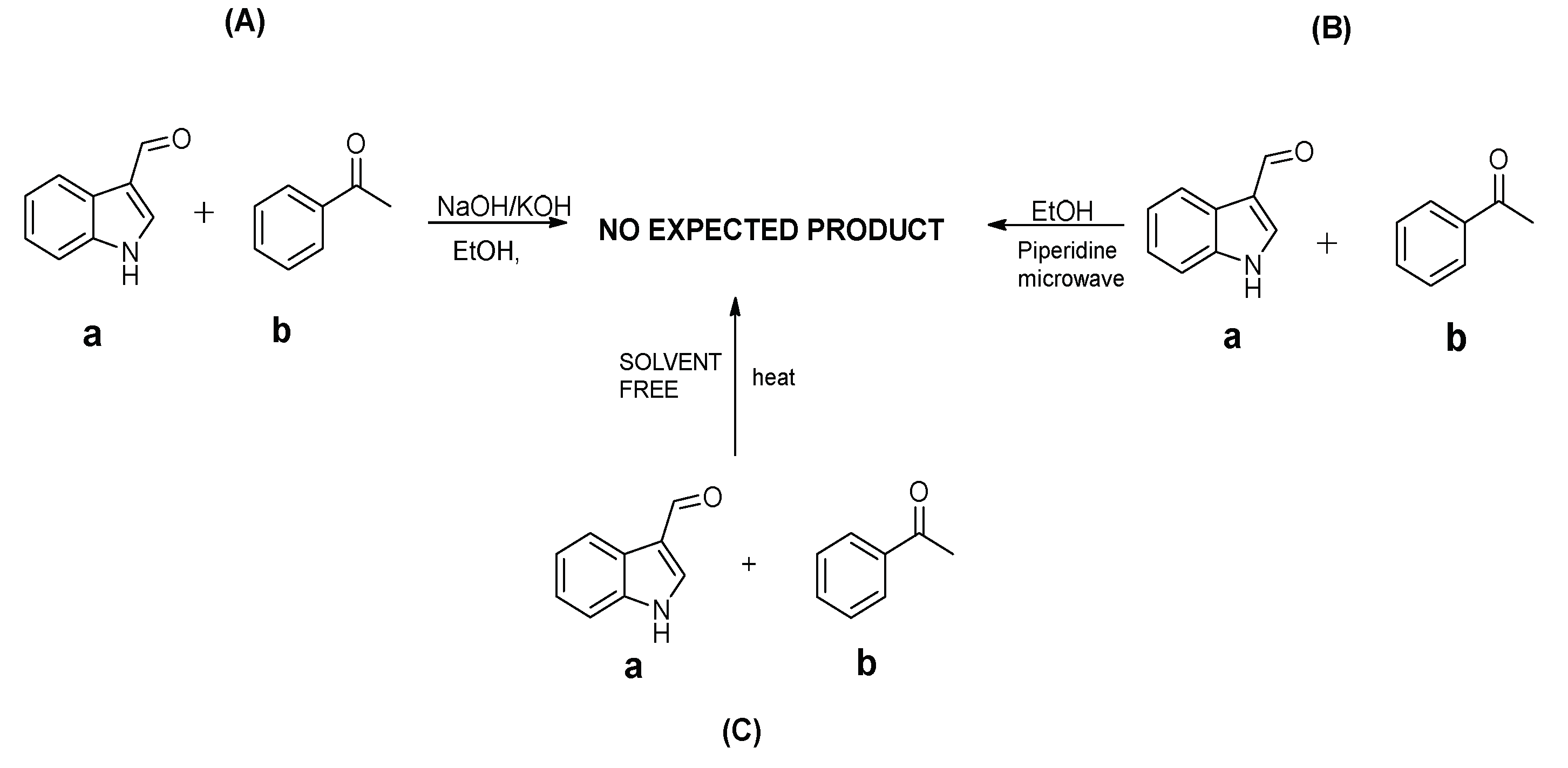
Several synthetic methods were attempted, aiming to obtain the target compounds. 1H-indole-3-carboxaldehyde (a, 200 mg, 0.82 mmol) and acetophenone (b, 120 mg, 0.97 mmol) were reacted as described in Scheme 1.
Scheme 1. Failed synthesis of indole-chalcones (trial reactions). (A) Base catalyzed aldol condensation of 1H-indole-3-carboxaldehyde (a) and acetophenone (b). (B) Microwave-assisted synthesis of 1H-indole-3-carboxaldehyde and acetophenone. (C) Solvent-free synthesis of 1H-indole-3-carboxaldehyde and acetophenone.
Preprints 145585 sch001

2.1.2. The Successful Synthetic Approach
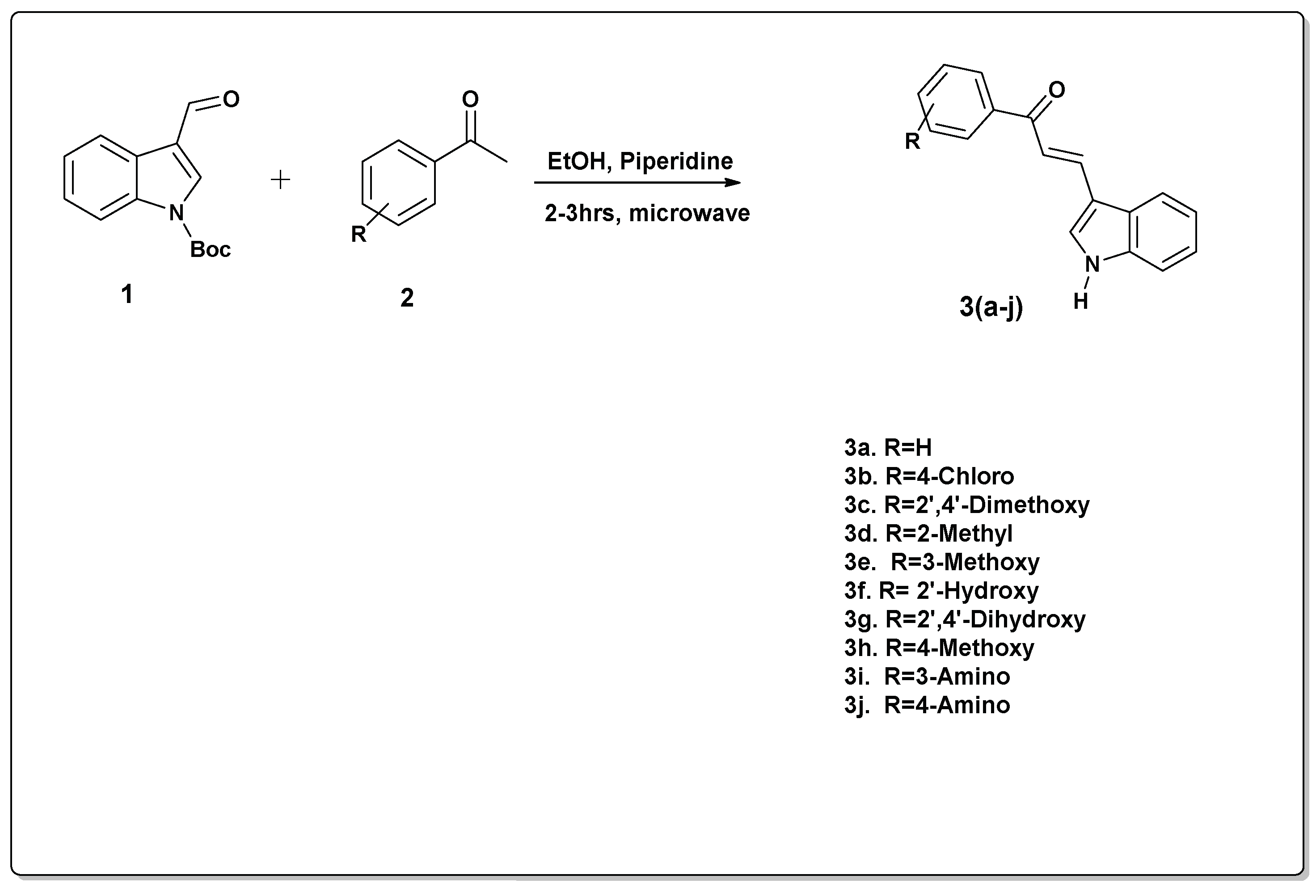
The proposed synthetic strategy was used to obtain the desired compounds as shown in Scheme 2. The approach involves using a Boc-protected indole, 1-Boc-3-formylindole with different acetophenones. Interestingly, the expected compound was obtained in a one-step reaction. The reaction mixture was placed in a microwave at 180°C for three hours (3 hours) using ethanol as the solvent with a few drops of piperidine. Boc was automatically deprotected during the reaction releasing the free indole-chalcones.
Scheme 2. The successful synthetic pathway towards the eleven indole-chalcone hybrids. 1 = 1-Boc-3-formylindole. 2 = Acetophenones. 3(a-j) = indole-chalcones.
Preprints 145585 sch002

3. Material and Methods

3.1. General Experimental Information

All the chemical reagents and solvents were purchased from commercial sources and were used without further purification [Sigma-Aldrich Co., Ltd. (Darmstadt, Germany) and abcr GmbH (Karlsruhe, Germany)]. Thin layer chromatography was carried out on aluminum sheets coated with silica gel 60 F254 (Merck, Darmstadt, Germany). For medium-pressure liquid chromatography (MPLC), silica gel 60 (0.036e0.200 mm) was used. Melting points were determined without correction on a Büchi capillary melting point apparatus (Büchi Labortechnik AG, University of Buea). Purity was measured by UV absorbance at 254 nm. The HPLC consisted of a LiChrosorb® RP-18 (5 m) 100-4.6 Merck column (Merck, Darmstadt, Germany), two LC-10AD pumps, a SPD-M10A VP PDA detector, and a SIL-HT autosampler, all from the manufacturer Shimadzu (Kyoto, Japan). Mass spectrometry was measured on an Advion expression CMS (Advion Interchim Scientific, Ithaca, NY, USA). The 1H NMR and 13C NMR spectra were recorded at 400 MHz, on a Varian Inova 400 Spectrometer (Bruker, Germany) in deuterated dimethyl sulfoxide (DMSO-d6). Peak multiplicities were expressed as follows: singlet (s), doublet (d), triplet (t), quartet (q), multiplet (m), broad singlet (br s), doublet of doublets (dd), doublet of triplets (dt), and quartet of doublets (qd).

3.2. Experimental Procedures and Characterization of Compounds

General Synthetic Method
1-Boc-3-formylindole (1 equiv.) and the appropriate acetophenone derivative (1.2 equiv.) were dissolved in 5 mL ethanol and a catalytic amount of piperidine was added. The mixture was heated in a microwave reactor, Monowave 450 (Anton Paar) at 180 °C for 3 hours with constant stirring. After the completion of the reaction, the mixture was cooled to room temperature. The product was purified by chromatography on silica gel (heptane/ethyl acetate).

3.2.1. Synthesis of (E)-3-(1H-indol-3-yl)-1-phenylprop-2-en-1-one (S1-01)

Orange solid; yield 33.7%; mp: >339 °C; 1H NMR (400 MHz, DMSO-d6) δ ppm 11.87 (s, 1H), 8.11 – 7.98 (m, 5H), 7.67 – 7.57 (m, 2H), 7.56 – 7.50 (m, 2H), 7.48 – 7.43 (m, 1H), 7.25 – 7.16 (m, 2H). 13C NMR (100 MHz, DMSO-d6) δ ppm 189.27, 139.48, 138.95, 137.95, 133.71, 132.79, 129.11, 128.54, 125.57, 123.14, 121.60, 120.81, 115.82, 113.21, 112.88.MS(APCI): cald for C17H13NO [M-H]+ 248.10, found 248.1; HPLC(): tR 14.423 mins, purity 98%.

3.2.2. Synthesis of (E)-1-(4-chlorophenyl)-3-(1H-indol-3-yl)prop-2-en-1-one (S1-03)

Gold solid; yield 44.7%; mp: 195.1 °C; 1H NMR (400 MHz, DMSO-d6) δ ppm 11.90 (s, 1H), 8.14 – 8.07 (m, 3H), 8.10 – 7.99 (m, 2H), 7.63 – 7.52 (m, 3H), 7.50 – 7.42 (m, 1H), 7.30 – 7.15 (m, 2H). 13C NMR (100 MHz, DMSO-d6) δ ppm 188.07, 140.02, 137.97, 137.66, 137.59, 134.06, 130.49, 129.18, 125.54, 123.21, 121.65, 120.88, 115.35, 113.25, 112.91. MS(APCI): cald for C17H12ClNO [M-H]+ 282.2, found 281.2; HPLC: tR 15.469 mins, purity 92%.

3.2.3. Synthesis of (E)-1-(2,4-dimethoxyphenyl)-3-(1H-indol-3-yl)prop-2-en-1-one (S1-04)

Bronze solid; yield 25.8%; mp: 184.7°C; 1H NMR (400 MHz, DMSO-d6) δ ppm 11.75 (s, 1H), 7.92 (d, J =2.9 Hz, 1H), 7.88 - 7.83 (m, 1H), 7.79 (d, J = 15.8 Hz, 1H), 7.59 (d, J = 8.5 Hz, 1H), 7.50 – 7.42 (m, 2H), 7.23 – 7.14 (m, 2H), 6.66 (d, J = 2.3 Hz, 1H), 6.61 (dd, J=8.6, 2.3Hz, 1H), 3.90 (s, 3H), 3.82 (s, 3H). 13C NMR (100 MHz, DMSO-d6) δ ppm 189.50, 163.77, 160.27, 138.00, 137.20, 133.03, 132.25, 125.43, 122.54, 121.87, 121.47, 120.31, 113.12, 112.93, 106.29, 99.17, 56.34, 55.98. MS(APCI): cald for C19H17NO3 [M-H]+ 307.35, found 307.30; HPLC: tR 14.167 mins, purity 94%.

3.2.4. Synthesis of (E)-3-(1H-indol-3-yl)-1-(o-tolyl)prop-2-en-1-one (S1-05)

Lemon solid; yield 32%; mp:338.4 °C; 1H NMR (400 MHz, DMSO-d6) δ 11.86 (s, 1H), 7.98 (s, 1H), 7.90 – 7.83 (m, 1H), 7.65 (d, J = 15.9 Hz, 1H), 7.51 – 7.10 (m, 8H), 7.06 (d, J = 15.9 Hz, 1H), 2.32 (s, 3H). 13C NMR (100 MHz, DMSO-d6) δ ppm 195.88, 140.76, 140.44, 137.99, 136.01, 133.67, 131.34, 130.23, 128.02, 126.08, 125.38, 123.18, 121.67, 120.96, 120.50, 112.93, 112.66, 20.14. MS(APCI): cald for C18H16NO [M-H]+ 262.0, found 261.0; HPLC: tR 14.340 mins, purity 98%.

3.2.5. Synthesis of (E)-3-(1H-indol-3-yl)-1-(3′-Methoxyphenyl)prop-2-en-1-one (S1-06)

Lemon solid; yield 5%; mp: 167.5 °C; 1H NMR (400 MHz, DMSO-d6) δ ppm 11.87 (s, 1H), 8.09 (s, 1H), 8.05 – 7.97 (m, 2H), 7.68 (d, J = 7.6 Hz, 1H), 7.60 – 7.49 (m, 2H), 7.48 – 7.42 (m, 2H), 7.25 – 7.12 (m, 3H), 3.81 (s, 3H). 13C NMR (100 MHz, DMSO-d6) δ ppm 189.09, 159.92, 140.45, 139.52, 137.92, 133.61, 130.28, 125.60, 123.16, 121.64, 121.04, 120.72, 118.75, 115.94, 113.18, 113.11, 112.89, 55.73. MS(APCI): cald for C17H15NO2 [M-H]+ 262.0, found 261.0; HPLC(): tR 14.736 mins, purity 97%.

3.2.6. Synthesis of (E)-1-(4-hydroxyphenyl)-3-(1H-indol-3-yl)prop-2-en-1-one (S1-07)

Yellow solid; yield 15%; mp: 196.7 °C; 1H NMR (400 MHz, DMSO-d6) δ ppm 11.79 (s, 1H), 10.22 (s, 1H), 8.92 – 7.99 (m, 3H), 7.95 (d, J = 15.5 Hz, 1H), 7.60 (d, J=15.5Hz, 1H), 7.49 – 7.34 (m, 1H),7.19 (m, 2H), 6.87 (d, J = 2.0Hz, 1H), 6.86 (m, 1H). 13C NMR (100 MHz, DMSO-d6) δ ppm 207.21, 187.43, 162.01, 138.06, 137.89, 132.93, 131.05, 130.26, 125.59, 122.99, 121.40, 120.75, 115.89, 115.70, 113.21, 112.79. MS(APCI): cald for C17H13NO2 [M-H]+ 262.0, found 261.0; HPLC(): tR 14.340 mins, purity 95%.

3.2.7. Synthesis of (E)-1-(2,4-dihydroxyphenyl)-3-(1H-indol-3-yl)prop-2-en-1-one (S1-08)

Orange solid; yield 5%; mp: >339 °C; 1H NMR (400 MHz, DMSO-d6) δ 11.86 (s, 1H), 7.98 (s, 1H), 7.90 – 7.83 (m, 1H), 7.65 (d, J = 15.9 Hz, 1H), 7.51 – 7.10 (m, 8H), 7.06 (d, J = 15.9 Hz, 1H), 2.32 (s, 3H). 13C NMR (100 MHz, DMSO-d6) δ ppm 195.88, 140.76, 140.44, 137.99, 136.01, 133.67, 131.34, 130.23, 128.02, 126.08, 125.38, 123.18, 121.67, 120.96, 120.50, 112.93, 112.66, 20.14. MS(APCI): cald for C18H16NO [M-H]+ 280.0, found 279.0; HPLC(): tR 13.748 mins, purity 91 %.

3.2.8. Synthesis of (E)-3-(1H-indol-3-yl)-1-(4-methoxyphenyl)prop-2-en-1-one (S1-09)

Yellow solid; yield 21%; mp: 185.8 °C; 1H NMR (400 MHz, DMSO-d6) δ 11.88 – 11.77 (m, 1H), 8.12 – 8.07 (m, 2H), 8.04 (dd, J = 8.5, 2.7 Hz, 2H), 7.96 (s, 1H), 7.62 (d, J = 15.5 Hz, 1H), 7.48 – 7.41 (m, 1H), 7.24 – 7.15 (m, 2H), 7.03 – 7.00 (m, 2H), 3.83 (s, 3H). 13C NMR (100 MHz, DMSO-d6) δ ppm 187.64, 163.10, 138.52, 137.91, 133.17, 131.69, 130.82, 125.60, 123.05, 121.47, 120.76, 115.81, 114.33, 113.21, 112.83, 55.91. MS(APCI): cald for C18H15NO2 [M-H]+ 277.32, found 277.10; HPLC(): tR 14.340 mins, purity 95%.

3.2.9. Synthesis of (E)-1-(3-aminophenyl)-3-(1H-indol-3-yl)prop-2-en-1-one (S1-10)

Yellow solid; yield 25.8%; mp: >339 °C; 1H NMR (400 MHz, DMSO-d6) δ ppm 11.83 (s, 1H), 8.08 – 7.89 (m, 3H), 7.55 – 7.43 (m, 2H), 7.26 – 7.12 (m, 5H), 6.77 (ddd, J = 7.8, 2.3, 1.1 Hz, 1H), 5.29 (s, 2H). 13C NMR (100 MHz, DMSO-d6) δ ppm 189.74, 149.45, 139.79, 138.79, 137.96, 133.41, 129.50, 125.52, 123.09, 121.53, 120.65, 118.24, 116.29, 116.19, 113.40, 113.16, 112.90.MS(APCI): cald for C17H14N2O [M-H]+ 263.12, found 263.3; HPLC(): tR 11.345 mins, purity 93%.

3.2.10. Synthesis of (E)-1-(4-aminophenyl)-3-(1H-indol-3-yl)prop-2-en-1-one (S1-11)

Yellow solid; yield 32%; mp: >339 °C; 1H NMR (400 MHz, DMSO-d6) δ ppm 11.83 (s, 1H), 8.08 – 7.89 (m, 3H), 7.55 – 7.43 (m, 2H), 7.26 – 7.12 (m, 5H), 6.77 (ddd, J = 7.8, 2.3, 1.1 Hz, 1H), 5.29 (s, 2H). 13C NMR (100 MHz, DMSO-d6) δ ppm 189.74, 149.45, 139.79, 138.79, 137.96, 133.41, 129.50, 125.52, 123.09, 121.53, 120.65, 118.24, 116.29, 116.19, 113.40, 113.16, 112.90.MS(APCI): cald for C17H14N2O [M-H]+ 262.1, found 262.1; HPLC(): tR 12.111 mins, purity 97%.

Conclusion

The successful synthesis of 11 indole-chalcone hybrid compounds has been described using a one-step method not previously described. The reaction was quite rapid and easy to carry out when compared to previously described approaches for the synthesis of chalcones and the end products were in relatively high yields.

Supplementary Materials

The following supporting information can be downloaded at the website of this paper posted on Preprints.org. Structures of the compounds, copies of 1H-NMR, 13C-NMR, HPLC, and MS.

Author Contributions

Conceptualization, W.S. and F.N.K.; validation, W.S., M.S. and F.N.K.; investigation, S.A.T., E.G., D.B.E., and M.A.; writing—original draft preparation, S.A.T., E.G., F.N.K., and D.B.E.; writing—review and editing, S.A.T., E.G., D.B.E., W.S., M.S. and F.N.K.; funding acquisition, W.S., M.S. and F.N.K. supervision, W.S., M.S. and F.N.K. All authors have read and agreed to the published version of the manuscript.

Funding

We acknowledge financial support from the Bill & Melinda Gates Foundation through the Calestous Juma Science Leadership Fellowship awarded to FNK (grant award number: INV-036848 through the University of Buea). FNK also acknowledges joint funding from the Bill & Melinda Gates Foundation (award number: INV-055897) and LifeArc (Grant ID: 10646) under the African Drug Discovery Accelerator program. FNK and WS acknowledge further funding from the Alexander von Humboldt Foundation for a Research Group Linkage project (Ref 3.4-1156361-CMR-IP). We acknowledge the technical support of Dr. Ehab Ghazy.

Conflicts of Interest

The authors declare no conflicts of interest.

References

  1. Rammohan, A.; Reddy, J. S.; Sravya, G.; Rao, C. N.; and Zyryanov, G. V. Chalcone Synthesis, Properties and Medicinal Applications: A Review. Environ. Chem. Lett. 2020 18(2), 433-458. [CrossRef]
  2. Urbonavičius, A.; Fortunato, G.; Ambrazaitytė, E.; Plytninkienė, E.; Bieliauskas, A.; Milišiūnaitė, V.; Luisi, R.; Arbačiauskienė, E.; Krikštolaitytė, S.; and Šačkus, A. Synthesis and Characterization of Novel Heterocyclic Chalcones from 1-Phenyl-1H-pyrazol-3-ol. Molecules. 2022 27(12), 3752. [CrossRef]
  3. Mukhtar, S. S.; Morsy, N. M.; Hassan, A. S.; Hafez, T. S.; Hassaneen, H. M.; and Saleh, F. M. A Review of Chalcones: Synthesis, Reactions, and Biological Importance. Egypt. J. Chem. 2022 65(8), 379-395. [CrossRef]
  4. Shalaby, M.A.; Rizk, S. A.; and Fahim, A.M. Synthesis, Reactions and Application of Chalcones: A Systematic Review. Org. Biomol. Chem. 2023 21(26), 5317-5346. [CrossRef]
  5. Jasim, H. A.; Nahar, L.; Jasim, M. A.; Moore, S. A.; Ritchie, K. J.; and Sarker, S. D. Chalcones: Synthetic Chemistry Follows Where Nature Leads. Biomolecules. 2021 11(8), 1203. [CrossRef]
  6. Goyal, K.; Kaur, R.; Goyal, A.; and Awasthi, R. Chalcones: A Review on Synthesis and Pharmacological Activities. J. Appl. Pharm. Sci. 2021 11(1), 001-014. [CrossRef]
  7. Vijayakumar, B. G.; Ramesh, D.; Joji, A.; Jayachandra P. J.; and Kannan, T. In Silico Pharmacokinetic and Molecular Docking Studies of Natural Flavonoids and Synthetic Indole Chalcones against Essential Proteins of SARS-CoV-2. Eur. J. Pharmacol. 2020 886, 173448. [CrossRef]
  8. Bułakowska, A.; Sławiński, J.; Hering, A.; Gucwa, M.; Ochocka, J. R.; Hałasa, R.; Balewski, Ł.; and Stefanowicz-Hajduk, J. New Chalcone Derivatives Containing 2,4-Dichlorobenzenesulfonamide Moiety with Anticancer and Antioxidant Properties. Int J Mol Sci. 2023 25(1), 274. [CrossRef]
  9. Ugwu, D. I.; Ezema, B. E.; Okoro, U. C.; Eze, F. U.; Ekoh, O. C.; Egbujor, M. C.; and Ugwuja, D. I. Synthesis and Pharmacological Applications of Chalcones: A Review. Int. J. Chem. Sci. 2015 13(1), 459-500.
  10. Pereira, R.; Silva, A. M. S.; Ribeiro, D.; Silva, V. L. M.; and Fernandes, E. Bis-chalcones: A Review of Synthetic Methodologies and Anti-Inflammatory Effects. Eur J. Med. Chem. 2023 252, 115280. [CrossRef]
  11. Thapa, P.; Upadhyay, S. P.; Suo, W. Z.; Singh, V.; Gurung, P.; Lee, E. S.; Sharma, R.; and Sharma, M. Chalcone and its Analogs: Therapeutic and Diagnostic Applications in Alzheimer’s Disease. Bioorg. Chem. 2021 108, 104681. [CrossRef]
  12. Rozmer, Z.; and Perjési, P. Naturally occurring chalcones and their biological activities. Phytochemistry Reviews. 2016 15(1), 87-120. [CrossRef]
  13. Kudličková, Z.; Michalková, R.; Salayová, A.; Ksiažek, M.; Vilková, M.; Bekešová, S.; and Mojžiš, J. Design, Synthesis, and Evaluation of Novel Indole Hybrid Chalcones and Their Antiproliferative and Antioxidant Activity. Molecules. 2023 28(18), 6583. [CrossRef]
  14. Yan, J.; Chen, J.; Zhang, S.; Hu, J.; Huang, L.; and Li, X. Synthesis, Evaluation, and Mechanism Study of Novel Indole-Chalcone Derivatives Exerting Effective Antitumor Activity Through Microtubule Destabilization in Vitro and in Vivo. J Med. Chem. 2016 59(11), 5264-5283. [CrossRef]
  15. Badria, F. A.; Soliman, S. M.; Atef, S.; Islam, M. S.; Al-Majid, A. M.; Dege, N.; Ghabbour, H. A.; Ali, M.; El-Senduny, F. F.; and Barakat, A. Anticancer Indole-Based Chalcones: A Structural and Theoretical Analysis. Molecules. 2019 24(20), 3728. [CrossRef]
  16. Sayed, M.; Kamal El-Dean, A. M.; Ahmed, M.; and Hassanien, R. Synthesis, Characterization, and Screening for Anti-inflammatory and Antimicrobial Activity of Novel Indolyl Chalcone Derivatives. J. Het. Chem. 2018 55(5), 1166-1175. [CrossRef]
  17. Sunil, T.; Samson, M.; Ofentse, P.; Shivaji, T.; Pravin, K.; and Rajandra, P. Biological Role of Chalcones in Medicinal Chemistry, In Vector Borne Diseases. In C. David, B. Sujit, & R. Syamal (Eds.). 2020 (pp. Ch. 9). IntechOpen. [CrossRef]
  18. Chen, X.; Li, H.; Wang, M.; Sun, D.; Lu, J.; Zhu, T.; Chen, H.; Chen, L.; and Liu, S. Discovery of Chalcone Derivatives as Bifunctional Molecules with Anti-SARS-CoV-2 and Anti-inflammatory Activities. Journal of Natural Products. 2024 87(12), 2680-2694. [CrossRef]
  19. Tyagi, R.; Yadav, K.; Khanna, A.; Mishra, S. K.; and Sagar, R. Efficient synthesis of indole-chalcones based glycohybrids and their anticancer activity. Bioorganic & Medicinal Chemistry, 2024 109, 117778. [CrossRef]
  20. Karaman, B.; Alhalabi, Z.; Swyter, S.; Mihigo, S. O.; Andrae-Marobela, K.; Jung, M.; Sippl, W.; and Ntie-Kang, F. Identification of Bichalcones as Sirtuin Inhibitors by Virtual Screening and In Vitro Testing. Molecules. 2018 23(2), 416. [CrossRef]
  21. Robinson, M. W.; Overmeyer, J. H.; Young, A. M.; Erhardt, P. W.; and Maltese, W. A. Synthesis and evaluation of indole-based chalcones as inducers of methuosis, a novel type of nonapoptotic cell death. J Med Chem. 2012 55(5), 1940-1956. [CrossRef]
  22. Ramesh, D.; Joji, A.; Vijayakumar, B. G.; Sethumadhavan, A.; Mani, M.; and Kannan, T. Indole chalcones: Design, synthesis, in vitro and in silico evaluation against Mycobacterium tuberculosis. Eur J. Med. Chem. 2020 198, 112358. [CrossRef]
  23. Elkanzi, N. A. A.; Hrichi, H.; Alolayan, R. A.; Derafa, W.; Zahou, F. M.; and Bakr, R. B. Synthesis of Chalcones Derivatives and Their Biological Activities: A Review. ACS Omega, 2022 7(32), 27769-27786. [CrossRef]
  24. Chauhan, R.; Dwivedi, J.; Siddiqi Anees, A.A.; and Kishore, D. Synthesis and antimicrobial activity of chalcone derivatives of indole nucleus. Pharm. Chem. J. 2011 44, 542–550. [CrossRef]
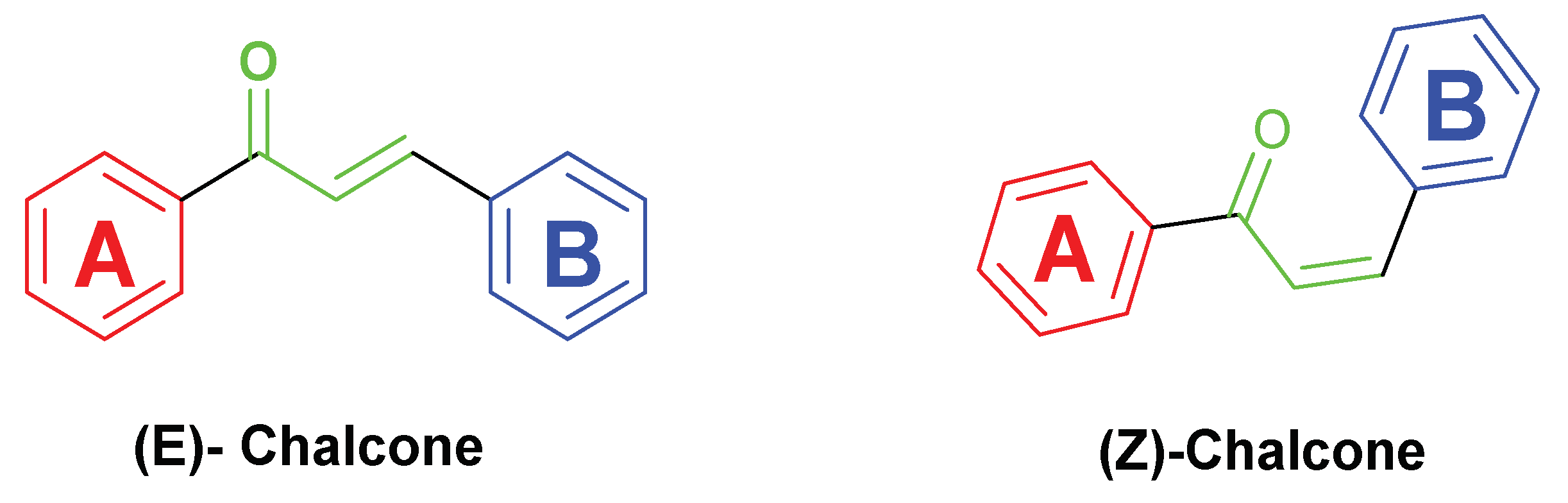
Figure 1. General structure of chalcones.
Preprints 145585 g001
Disclaimer/Publisher’s Note: The statements, opinions and data contained in all publications are solely those of the individual author(s) and contributor(s) and not of MDPI and/or the editor(s). MDPI and/or the editor(s) disclaim responsibility for any injury to people or property resulting from any ideas, methods, instructions or products referred to in the content.
Copyright: This open access article is published under a Creative Commons CC BY 4.0 license, which permit the free download, distribution, and reuse, provided that the author and preprint are cited in any reuse.
Prerpints.org logo

Preprints.org is a free preprint server supported by MDPI in Basel, Switzerland.

Subscribe

Disclaimer

Terms of Use

Privacy Policy

Privacy Settings

© 2025 MDPI (Basel, Switzerland) unless otherwise stated