Preprint
Article

This version is not peer-reviewed.

Electronic Correlations in Ferromagnetic Heusler Alloy ln2MnW: Insights from First-Principles Calculations

A peer-reviewed article of this preprint also exists.

Submitted:

08 January 2025

Posted:

09 January 2025

You are already at the latest version

Abstract

First-principles calculations are performed to examine the physical features of full Heusler ln2MnW. The WIEN2K code is utilized with the variety of approximations, including the GGA and GGA + U, to examine the structural, electronic, and magnetic properties. The unit cell is optimized to achieve the ground state energy level. The calculated ΔH for In2MnW is -0.189 eV. This negative ΔH value signifies the thermodynamic stability of the compound. The metallic behavior of the investigated compound is confirmed by the calculated band structure (BS) with both potentials. These potentials are also used to calculate the total density of the state, which confirm their metallic nature. Total magnetic moment value is recorded as 4.3 µB while addition of U parameter slightly enhances its value to 4.4 µB. These studied properties indicate that ln2MnW has a metallic ferromagnetic character and is ideally appropriate for the usage of mass storage devices as a ferromagnetic material.

Keywords: 
;  ;  ;  ;  

1. Introduction

The Heusler alloys, first discovered in 1903 [1], have demonstrated remarkable properties that have led to widespread commercial applications in various devices, including energy harvesters [2] and magnetic read access memories (MRAM) [3], sensors, spintronics, actuators [4,5], thermoelectric materials [6,7,8], solar cells [9,10], and semiconductor materials [11]. Heusler materials are also promising for gadgets such as hard disks, optical discs, and magnetic disk drives[12]. Heusler alloys typically consist of two parts manganese, one section copper, and other tin. These materials belong to the family of Heusler alloys, characterized by the empirical formula X2YZ, comprising three intersecting FCC sublattices (in space group Fm3m) [13]. Symmetry breaking (in the non-centrosymmetric space group F-43m) divides the X2 lattice, originally with a multiplicity of 8, into two sublattices with a multiplicity of 4 each, wherein one sublattice remains unoccupied, leading to the formula XYZ in half-Heusler phases [14].
The pursuit of novel materials is witnessing an exponential surge as scientists strive to advance technology for the betterment of humanity. Among these materials, Heusler alloys stand out, captivating researchers’ attention. Dahal and Kaphle [15] studied the physical features of XYZ-type half-Heusler materials. They found that most spin channels exhibit certain band gaps (Eg), such as 0.38 eV for FeMnGe and 0.95 eV for CoMnSb, indicating that present Heusler alloys possess half-metallic nature. Fiedler and Kratzer [16] conducted first-principles calculations utilizing the PBE and HSE06 exchange functionals on ternary NiZrSn and CoZrBi semiconductors with the C1b crystal structure. Their study involved calculating the fundamental structural, electronic, and phonon properties using density functional theory. Wakeel at el. investigated the physical features of Pd2AZ (A = Cu, Hf, Mn, Ti, Zr; Z = Al, Ga, In, Sn) by utilizing the DFT computations. All these Heusler materials were found to be metallic due to the overlapping of valence and conduction bands [17].
As our study progressed, we uncovered a wealth of insights into the physical properties of Heusler In2MnW. From its magnetic behavior to its electronic structure, each revelation added a new layer to our understanding. With each discovery, the allure of this compound grew, beckoning us to delve deeper into its complexities. Our findings not only shed light on the fundamental properties of Heusler In2MnW but also opened doors to a multitude of potential applications. With this newfound knowledge, we stand on the brink of a new era in Heusler In2MnW research, poised to unlock its full potential and explore the boundless possibilities it holds.
The entire metallic cubic structure of the Heusler ln2MnW combination served as the basis for our investigation. According to our estimates, magnetic moment is essential to making the ln2MnW combination workable for magnetic materials. Up until our literature review of the material, the theoretical ln2MnW compound had never been studied. This paper’s remaining material is broken up into multiple sections. Section 2 defines the computational examination of a chemical. The structural, lattice parameters, electrical, and magnetic characteristics of the ln2MnW compound are examined in Sect. 3. Finally, Sect. 4 describes the conclusions.

2. Computational Method

First-principles computations were performed to investigate the physical features of the full Heusler In2MnW using the WIEN2K code [18]within DFT. The full potential linearized augmented plane wave (FP-LAPW) [19]method was employed in these calculations. The Kohn-Sham equation was solved to determine the ground state characteristics, focusing on the minority electrons necessary for calculating these parameters. The Generalized Gradient Approximation (GGA) [20] and GGA+U potentials were used to in the study. The GGA+U potential, incorporating an intramolecular Coulombic repulsion term, was found to be the best method for accurately unfolding the localized d and f electrons. For the In2MnW, an effective U (Ueff) value of 7 eV was used to handle the d and f states. This approach accounts for the self-interaction error in the d states of the orbitals, particularly for the partially filled d states in In and Mn (transition elements). The calculation method involves dividing the entire crystal into distinct muffin-tin (MT) spheres divided by an interstitial region. Within the MT spheres, a basis set is expanded using spherical harmonic functions, while plane waves are used in the interstitial region. The RMT were calculated to be 2.5 atomic units (au) for Mn, W, and In. A core-valence separation energy of -11 Rydberg (Ry) was used to prevent charge diffusion from the MT spheres [21]. For energy convergence, the wave function cut-off parameter was set to KmaxRMT = 5, where RMT is the smallest muffin-tin radius and Kmax is the plane wave expansion parameter. A mesh of 1000 k-points was also used for the Brillouin zone (BZ) to ensure accurate results. The total energy convergence criterion was set to less than 10-6 Ry.

3. Results and Discussion

3.1. Structural Properties

The Heusler compound In2MnW has a cubic crystal structure with the space group Fm-3m (No. 225) as described by Graf et al. (2009) [22]. In this structure, the In atoms are positioned at coordinates (0.25, 0.25, 0.25) and (0.75, 0.75, 0.75), while Mn and W atoms are positioned at (0, 0, 0) and (0.50, 0.50, 0.50) correspondingly within the unit cell. Figure 1(a) illustrates the atomic positions within the primitive cell. The compound exhibits a three-dimensional Heusler structure and an L21-type configuration. In this FM Heusler alloy, W is bonded to four equivalent Mn atoms and ten In atoms in a distorted body-centered cubic arrangement. The bond lengths between W and Mn atoms are 2.86 Å and 2.88 Å, while the W-In bond lengths range from 2.86 Å to 3.33 Å. Mn is bonded to four equivalent W atoms and four equivalents In-atoms, with Mn-In bond lengths ranging from 2.86 Å to 2.87 Å. There are two distinct In sites in the structure. In the first site, In is bonded to four equivalent W atoms and four equivalent In atoms, forming distorted edge-sharing InIn4W4 tetrahedra. In the second site, In is bonded in a 4-coordinate geometry to six equivalent W atoms, four equivalent Mn atoms, and four equivalent In atoms. Optimization of the crystal structure is crucial for determining the stability, band gap structure, and carrier transport properties of the material. The lattice parameters are optimized by minimizing the total energy within the Fm-3m symmetry space group. The energy-volume optimization curve is shown in Figure 1. The primary goal of this optimization is to confirm the stability of the selected compounds and ensure their suitability for the properties being studied. Additionally, optimizing the compounds is essential as density functional theory (DFT) provides accurate results at the ground state, making it necessary to refine the structures under investigation. To determine the structural parameters, we used the Birch-Murnaghan equation. Additionally, we examined the lattice atomic positions and cell dimensions to determine the compound’s structural morphology. The Birch-Murnaghan equation is given as [23]:
E V = E 0 + 9 V o B o 16 V o V 2 / 3 1 2 B + V o V 2 / 3 1 2 6 4 V o V 2 / 3
Our optimization results indicate that the ferromagnetic (FM) phase is the most favorable for In2MnW compared to the paramagnetic (PM) and antiferromagnetic (AFM) phases. The formation energy (ΔH) is calculated as the difference between the total energy (E0) of In2MnW and the sum of the individual energies of In, Mn, and W (EIn, EMn, and EW, respectively). It can be computed as [24]:
H = E I n 2 M n W 2 E I n E M n E W
where, EIn2MnW signifies the total energy of In2MnW, while EIn, EMn and EW represent the optimized total energy of the respective atom. The value of ΔH was computed as -0.189 eV for In2MnW. The negative value of the ΔH indicates that it is thermodynamically stable [21].

3.1.1. Lattice Parameters

We have optimized the structure of ln2MnW to study the ground state properties. The theoretical lattice constants were obtained by minimizing the total energy (ETOT) with respect to the lattice parameter. The purpose of optimization is to make a compound stable in order to make our calculation in ground state energy. The value of lattice parameters for optimized structure are found to be 6.33 Å. We estimated the total energy for dissimilar volumes in the vicinity of the calculated experimental volume to optimize the unit cell and to obtain the ground state energy. Figure 1 (b) shows the optimization curve for total energy against volume. To determine the structural and optimize parameters of material, Birch Murnaghan’s is used. This equation shows a relation between volume and pressure of body and gives the material energy as a function of volume. Further the compound structural morphology is determined by examining both the lattice atomic positions and cell dimensions. The ferromagnetic phase (FM) is the most favorable phase for ln2MnW In addition, available experimental results, up to our literature review, concluded that the most appropriate phase is ferromagnetic for the material.
The value of formation energy for this compound is negative, which means it is ther- modynamically stable. Where total energy of full Heusler ln2MnW, and individual energy of ln2, Mn and W is Eln2, EMn and Ew respectively. The difference of the total energy Eo of the compound and individual energy of each element of that compound is known as formation energy. From calculated formation energy, we can predict that our compound is stable. The optimized parameters such as unit cell energy (Eo), bulk modulus B(GPa), lattice constant (Å) and pressure derivation of bulk modulus (BP) are given in Table 1.

3.2. Electronic Characteristics

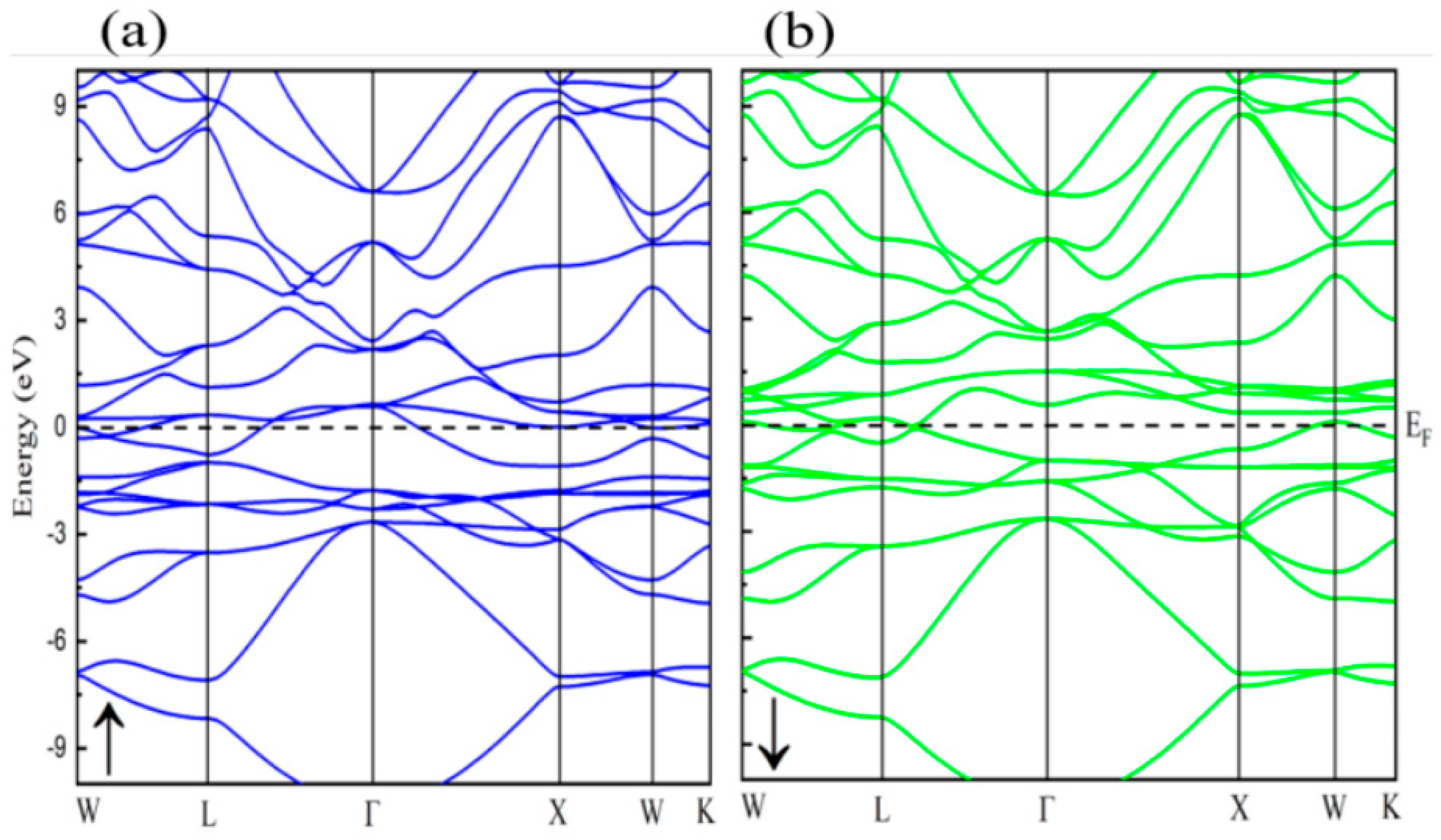
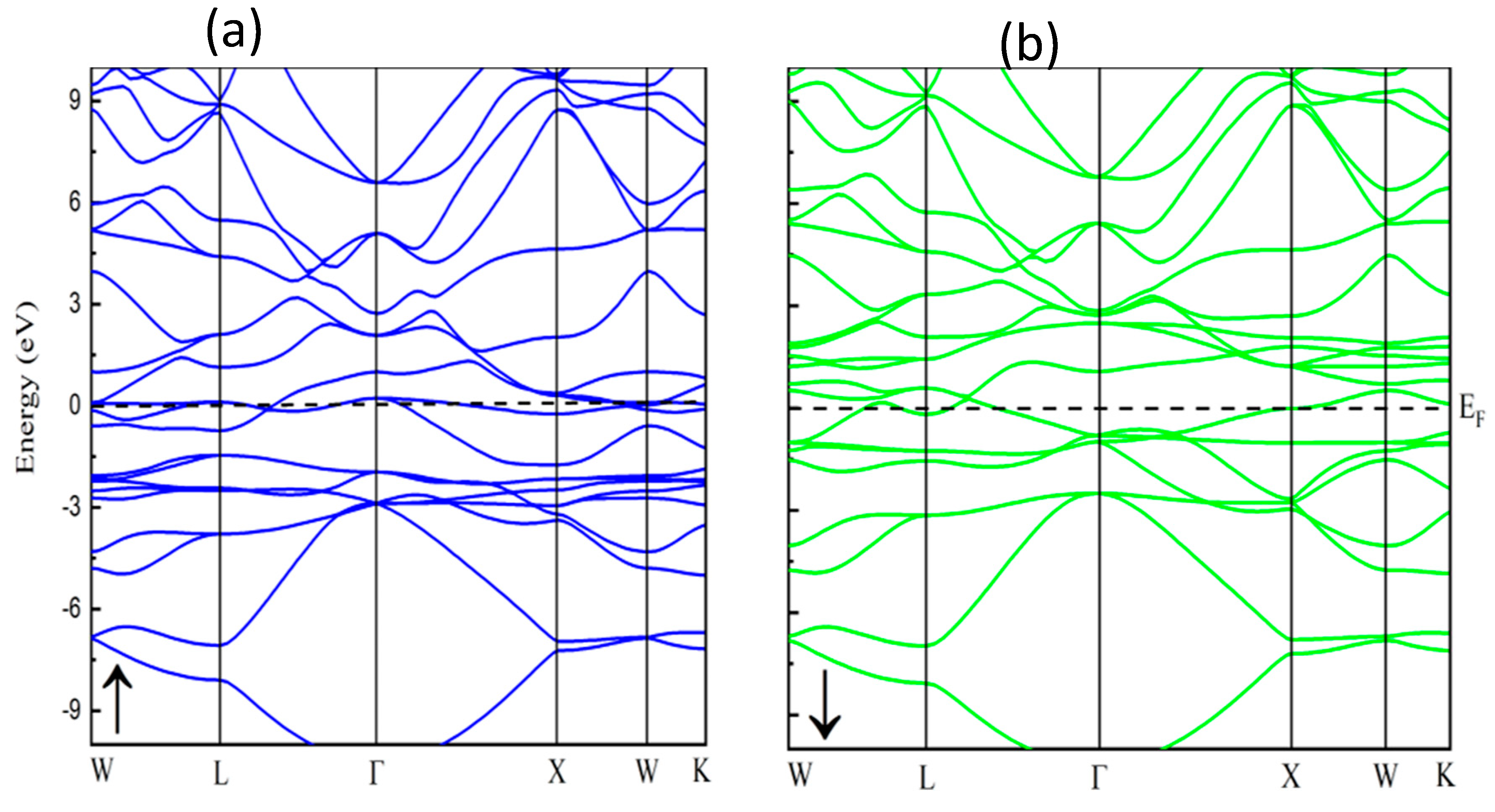
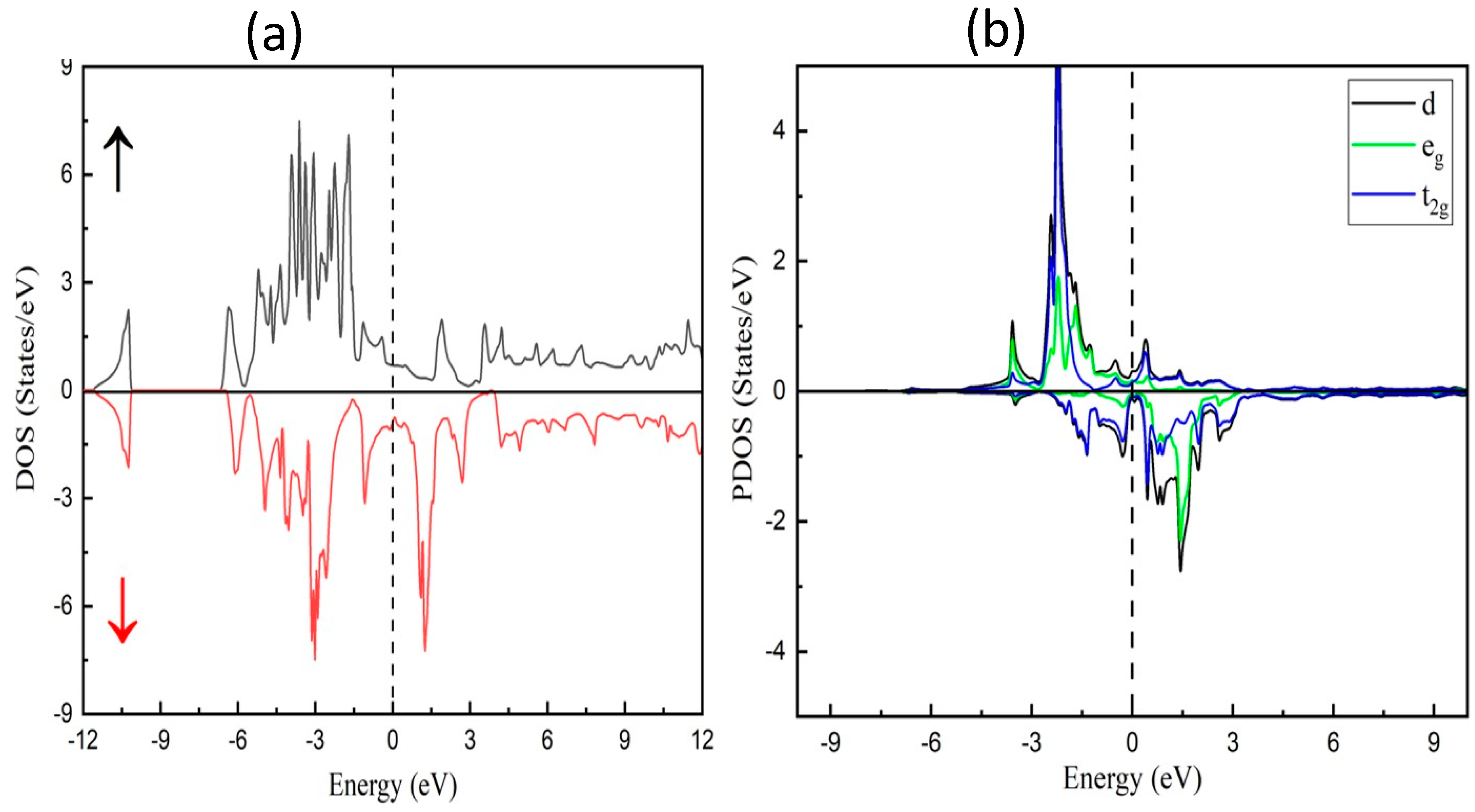
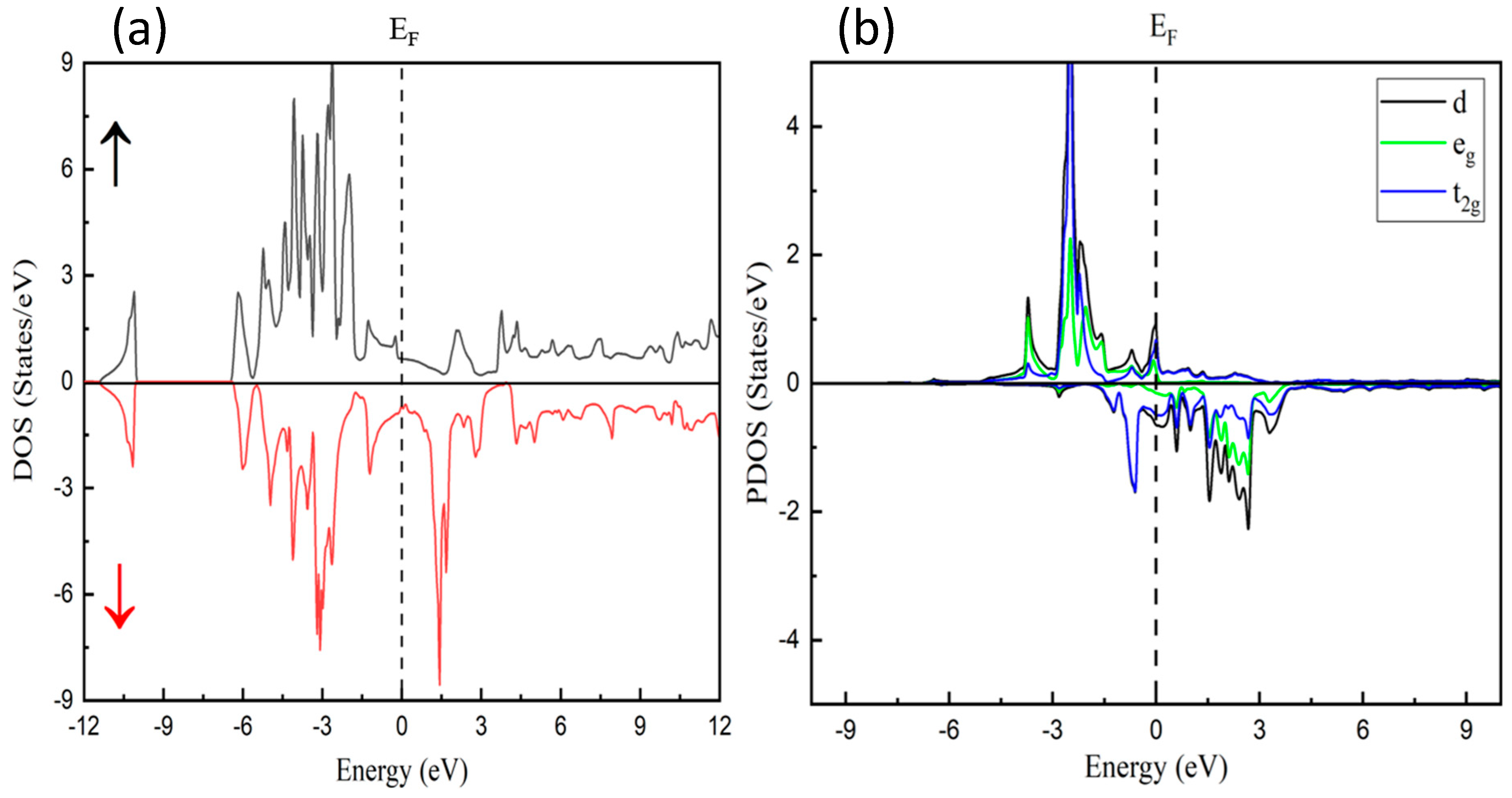
To gain a detailed comprehension of material’s characteristics, the band gap is a crucial factor for visualizing the material’s nature. In this section, we present the comparative analysis of GGA and GGA+U computed electronic properties of In2MnW Heusler alloy. Previously, no studies have been investigated for both electronic and magnetic properties of In2MnW. For this purpose, we computed the spin-dependent band dispersions, total (T) and projected (P) density of states for In2MnW to explore its potential for various electronic devices. Figure 2 and Figure 3 show that the bands profile of the compound under investigation, it can be seen that the band structure of compound lies on asymmetry lines Γ→M→K→Γ→A of the first Brillouin zone. The metallic nature of the compound is evident from these figures. For both spin channels, states overlap the Fermi energy levels, indicating metallic behavior with the respective potentials. This overlap between the VB and CB confirms the compound’s metallic nature. The presence of metallic nature in both spin channels predicts that In2MnW exhibits full metallic ferromagnetic properties. TDOS results indicate that both majority and minority charge carriers are well-aligned with the band structure results. The metallic character enhances the transport of spin-asymmetric current which leads to high spin polarization ratio in the compound which is widely used in ferromagnetic materials.
Furthermore, the interstitial and individual atoms (Mn and In) contribute to the net μB of the In2MnW compound, while the W site opposes it. This observation is based on the measured μB values via both approximations. The frequent emergence of Mn/In-d states explains this behavior. The PDOS shows the impact of projected states of Mn, W, and In, highlighting the dominant contributions from these atoms. The p state of In crosses Fermi level in up spin orientation, ensuing the compound’s metallic character. The higher peaks in the vicinity of Fermi level are primarily influenced by d states of Mn and W. It can be concluded that In-p and Mn-d states are the significant contributors to the compound’s electronic properties.
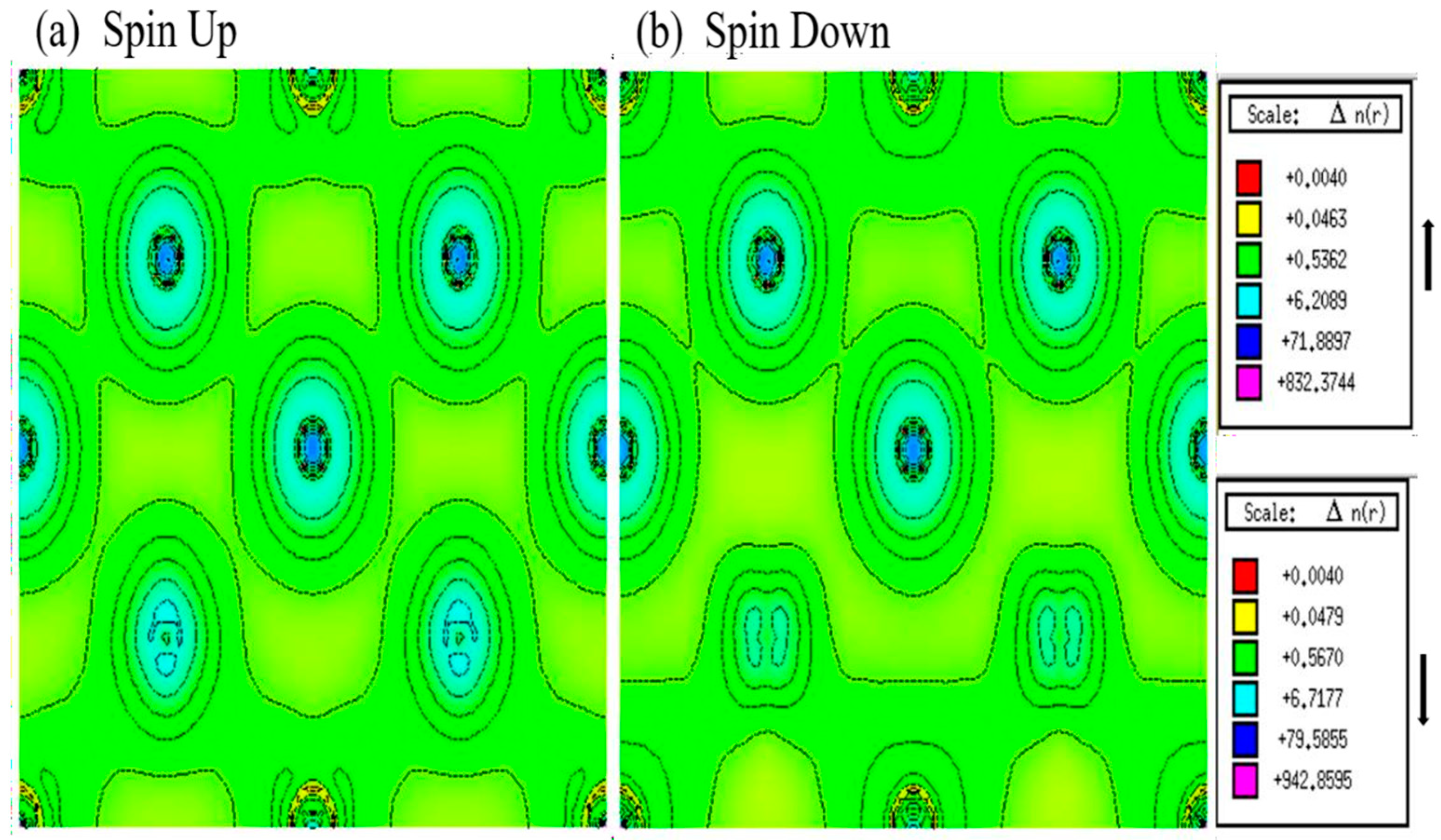
The spin-polarized electron densities of In2MnW have been plotted along the (110) plane to determine the type of bonding among their constituent atoms, as shown in Figure 4. The spin-up states reveal a covalent link between Mn and In atoms, whereas the bond between Mn and W is ionic. In the spin-down channel, substantial covalency is observed between Mn and In bonds, while the ionic character of Mn and W bonds decreases from Mn to W, which is expected due to changes in atomic size. As the d-bands transition from nearly filled to partially filled, the electron density of Mn changes from a spherical to a dumbbell shape as it moves from spin-up to spin-down.
Calculating the partial density of states (PDOS) provides a clear understanding of the magnetic characteristics. Its magnetic character is indicated by the asymmetric nature of the up and down spins DOS. As can be seen from partial DOS, the orbitals of Mn, ln, and W atoms have made a dominant contribution to the contribution of individuals.
Figure 2. The calculated band structure of In2MnW with spin up and spin down-states by using PBE-GGA potential.
Preprints 145540 g002
Figure 3. The calculated band structure of In2MnW with spin up and spin down by using GGA+U potential.
Preprints 145540 g003
Figure 4. Calculated (a) total and (b) partial densities of states of In2Mn with GGA spin up and down.
Preprints 145540 g004
Figure 5. Calculated (a) total and (b) partial densities of states of In2MnW (illustrating the high exchange splitting) calculated with GGA +U spin up and down.
Preprints 145540 g005
Figure 6. Illustration the Contour plot of In2MnW.
Preprints 145540 g006

3.3. Magnetic Properties

The magnetic characteristics of ln2MnW compound have been examined in light of spin based asymmetric electronic states as predicted in electronic properties by discussing TDOS and PDOS plots. The magnetic moments (μB) of W, Mn, and ln were computed separately using both GGA and GGA+U. The magnetic moment value shows the magnetic characteristics of ln2MnW. The total, interstitial, and individual μB of ln2MnW atoms (ln, Mn, and W) are summarized in Table 2. The calculated moment values of ln2MnW are ~4.30 and ~4.40 with respective GGA and GGA+U employed is close in comparsion with the experimental measurnment. In Heusler compounds, μB alignment results from two competing effects: intraatomic energy state’s splitting d-orbitals and covalent bonding between atoms. As observed, initial In cation is a close neighbor to the second In atom, leading to a minimal separation distance and a significant direct correlation between d orbitals both metals. In Heusler materials, the introduction of two X cations increases complexity of their physical attributes. PDOS for ln2MnW indicates that Mn exhibits strong hybridization with W. This incorporation induces band restructuring, mainly driven by the hybridized states consisting of d orbitals of Mn and W transition metals. It is widely recognized that a greater μB correlates with a strengthened exchange coupling [25]. Mn atoms exhibit a significantly stronger μB compared to ln and W atoms. The negative μB of ln atoms is responsible for their diamagnetic behavior, indicating an anti-parallel alignment that affects the overall ferromagnetic direction [26,27]. Consequently, W atoms influence the ferromagnetic nature of the ln2MnW compound. The opposite signs of the μB of the interstitial site, Mn, W, and ln atoms compared to the total μB of the ln2MnW, suggest that electrons VB interact in an anti-parallel manner with the total μB of the compound. The results show that ln2MnW exhibits FM behavior due to its strong magnetic features.

4. Conclusions

This study employs DFT calculations using with and without Hubbard potential to investigate the structural, electronic, and magnetic properties of the In2MnW. We confirm that the In2MnW compound has a cubic geometry exhibiting Fm3m space group. Further, we calculated the electronic properties with GGA and GGA+ U that revealed the metallic behavior of In2MnW. We calculated the partial density of states to investigate the particular contribution of different states. A key property of interest is the compound’s ability to achieve pronounced magnetization under the influence of an applied magnetic force, owing to its metallic characteristics and strong μB. The μB of In2MnW is calculated to be 4.33 μB with GGA and 4.408 μB with GGA + U, demonstrating its ferromagnetic characteristics in nature. These characteristics make In2MnW highly suitable for advanced magnetic storage devices.

Data Availability Statement

Data will be made available on request.

Conflict of Interest

Authors declare that there is not any conflict of interest.

References

  1. T. Graf, C. Felser, S.S.P. Parkin, Heusler Compounds: Applications in Spintronics, in: Handbook of Spintronics, Springer Netherlands, Dordrecht, 2016: pp. 335–364. [CrossRef]
  2. G. Bulman, B. Cook, High-efficiency energy harvesting using TAGS-85/half-Heusler thermoelectric devices, in: N.K. Dhar, P. Balaya, A.K. Dutta (Eds.), 2014: p. 911507. [CrossRef]
  3. A. Erkisi, G. Surucu, The investigation of electronic, magnetic, mechanical, and lattice dynamical properties of Pd MX ( M  = Cr, Fe and X  = Si and Ge) ferromagnetic half-Heusler metallics: an ab initio study, Mater Res Express 4 (2017) 066504. [CrossRef]
  4. Wang, J. Meyer, N. Teichert, A. Auge, E. Rausch, B. Balke, A. Hütten, G.H. Fecher, C. Felser, Heusler nanoparticles for spintronics and ferromagnetic shape memory alloys, Journal of Vacuum Science & Technology B, Nanotechnology and Microelectronics: Materials, Processing, Measurement, and Phenomena 32 (2014). [CrossRef]
  5. Hirohata, H. Sukegawa, H. Yanagihara, I. Zutic, T. Seki, S. Mizukami, R. Swaminathan, Roadmap for Emerging Materials for Spintronic Device Applications, IEEE Trans Magn 51 (2015) 1–11. [CrossRef]
  6. N.S. Chauhan, Y. N.S. Chauhan, Y. Miyazaki, Contrasting role of bismuth doping on the thermoelectric performance of VFeSb half-Heusler, J Alloys Compd 908 (2022) 164623. [CrossRef]
  7. R.O. Agbaoye, P.O. R.O. Agbaoye, P.O. Adebambo, B.I. Adetunji, O. Osafile, G.A. Adebayo, Thermoelectric properties, optimal doping levels and high figure of merit in Cobalt-based Half/Full Heusler alloys by First-Principles calculations, Materials Science and Engineering: B 248 (2019) 114409. [CrossRef]
  8. P.O. Adebambo, O.E. P.O. Adebambo, O.E. Osafile, J.A. Laoye, M.A. Idowu, G.A. Adebayo, Electronic fitness function, effective mass and thermoelectric properties of Rh-based (-ScTe; -TiSb; -VSn) alloys for thermoelectric generator applications, Computational Condensed Matter 26 (2021) e00523. [CrossRef]
  9. T. Graf, S.S.P. T. Graf, S.S.P. Parkin, C. Felser, Heusler Compounds—A Material Class With Exceptional Properties, IEEE Trans Magn 47 (2011) 367–373. [CrossRef]
  10. W. Xie, A. W. Xie, A. Weidenkaff, X. Tang, Q. Zhang, J. Poon, T. Tritt, Recent Advances in Nanostructured Thermoelectric Half-Heusler Compounds, Nanomaterials 2 (2012) 379–412. [CrossRef]
  11. Osafile, J.O. Azi, Structural, electronic, elastic and mechanical properties of novel ZrMnAs half Heusler alloy from first principles, Physica B Condens Matter 571 (2019) 41–49. [CrossRef]
  12. B.D. Terris, T. B.D. Terris, T. Thomson, Nanofabricated and self-assembled magnetic structures as data storage media, J Phys D Appl Phys 38 (2005) R199–R222. [CrossRef]
  13. Page, C. Uher, P.F. Poudeu, A. Van der Ven, Phase separation of full-Heusler nanostructures in half-Heusler thermoelectrics and vibrational properties from first-principles calculations, Phys Rev B 92 (2015) 174102. [CrossRef]
  14. G. Rogl, A. G. Rogl, A. Grytsiv, M. Gürth, A. Tavassoli, C. Ebner, A. Wünschek, S. Puchegger, V. Soprunyuk, W. Schranz, E. Bauer, H. Müller, M. Zehetbauer, P. Rogl, Mechanical properties of half-Heusler alloys, Acta Mater 107 (2016) 178–195. [CrossRef]
  15. R. Dahal, G. R. Dahal, G. Chandra Kaphle, V. Kumar Jha Binod Adhikari Kapil Adhikari, STRUCTURAL, ELECTRONIC AND MAGNETIC PROPERTIES OF XYZ TYPE HALF-HEUSLER ALLOYS, 2019.
  16. G. Fiedler, P. G. Fiedler, P. Kratzer, Ternary Semiconductors NiZrSn and CoZrBi with half-Heusler structure: a first-principles study, (2016). [CrossRef]
  17. M. Wakeel, G. M. Wakeel, G. Murtaza, H. Ullah, S. Khan, A. Laref, Z. Ameer, S.A. Khan, Structural, electronic, and magnetic properties of palladium based full Heusler compounds: DFT study, Physica B Condens Matter 608 (2021) 412716. [CrossRef]
  18. K. Schwarz, P. K. Schwarz, P. Blaha, G.K.H. Madsen, Electronic structure calculations of solids using the WIEN2k package for material sciences, Comput Phys Commun 147 (2002) 71–76. [CrossRef]
  19. P. Blaha, K. P. Blaha, K. Schwarz, P. Sorantin, S.B. Trickey, Full-potential, linearized augmented plane wave programs for crystalline systems, Comput Phys Commun 59 (1990) 399–415. [CrossRef]
  20. J.P. Perdew, K. J.P. Perdew, K. Burke, M. Ernzerhof, Generalized gradient approximation made simple, Phys Rev Lett 77 (1996) 3865–3868. [CrossRef]
  21. Nasarullah, M. Yaseen, S.A. Aldaghfag, M. Zahid, Misbah, Physical characteristics of X2NaMoBr6 (X= K, Rb): A DFT study, Mater Sci Semicond Process 147 (2022). [CrossRef]
  22. T. Graf, F. T. Graf, F. Casper, J. Winterlik, B. Balke, G.H. Fecher, C. Felser, al Crystal, Crystal Structure of New Heusler Compounds, 635 (2009). [CrossRef]
  23. F. Birch, The effect of pressure upon the elastic parameters of isotropic solids, according to Murnaghan’s theory of finite strain, J Appl Phys 9 (1938) 279–288. [CrossRef]
  24. Osafile, J.O. Azi, Structural, electronic, elastic and mechanical properties of novel ZrMnAs half Heusler alloy from first principles, Physica B Condens Matter 571 (2019) 41–49. [CrossRef]
  25. S. Rauf, S. S. Rauf, S. Arif, M. Haneef, B. Amin, The first principle study of magnetic properties of Mn2WSn, Fe2YSn (Y=Ti, V), Co2YSn (Y=Ti, Zr, Hf, V, Mn) and Ni2YSn (Y=Ti, Zr, Hf, V, Mn) heusler alloys, Journal of Physics and Chemistry of Solids 76 (2015) 153–169. [CrossRef]
  26. M. Nazar, Nasarullah, S.A. Aldaghfag, M. Yaseen, M. Waqas, M.K. Butt, I. Boukhris, Electronic, Structural, Optical, and Magnetic Characteristics A2MgS4 of (A=Dy, Er) Spinel Sulfides: A Density Functional Theory Study, Phys Status Solidi B Basic Res (2023). [CrossRef]
  27. M. Nazar, Nasarullah, M.I. Shatha A. Aldaghfag, Muhammad Yaseen, S.N. Rasheed Ahmed Khera, M.H. Abdellattif, First-principles calculations to investigate structural, magnetic, optical, electronic and thermoelectric properties of X2MgS4(X=Gd, Tm) spinel sulfides, Journal of Physics and Chemistry of Solids 166 (2022). [CrossRef]
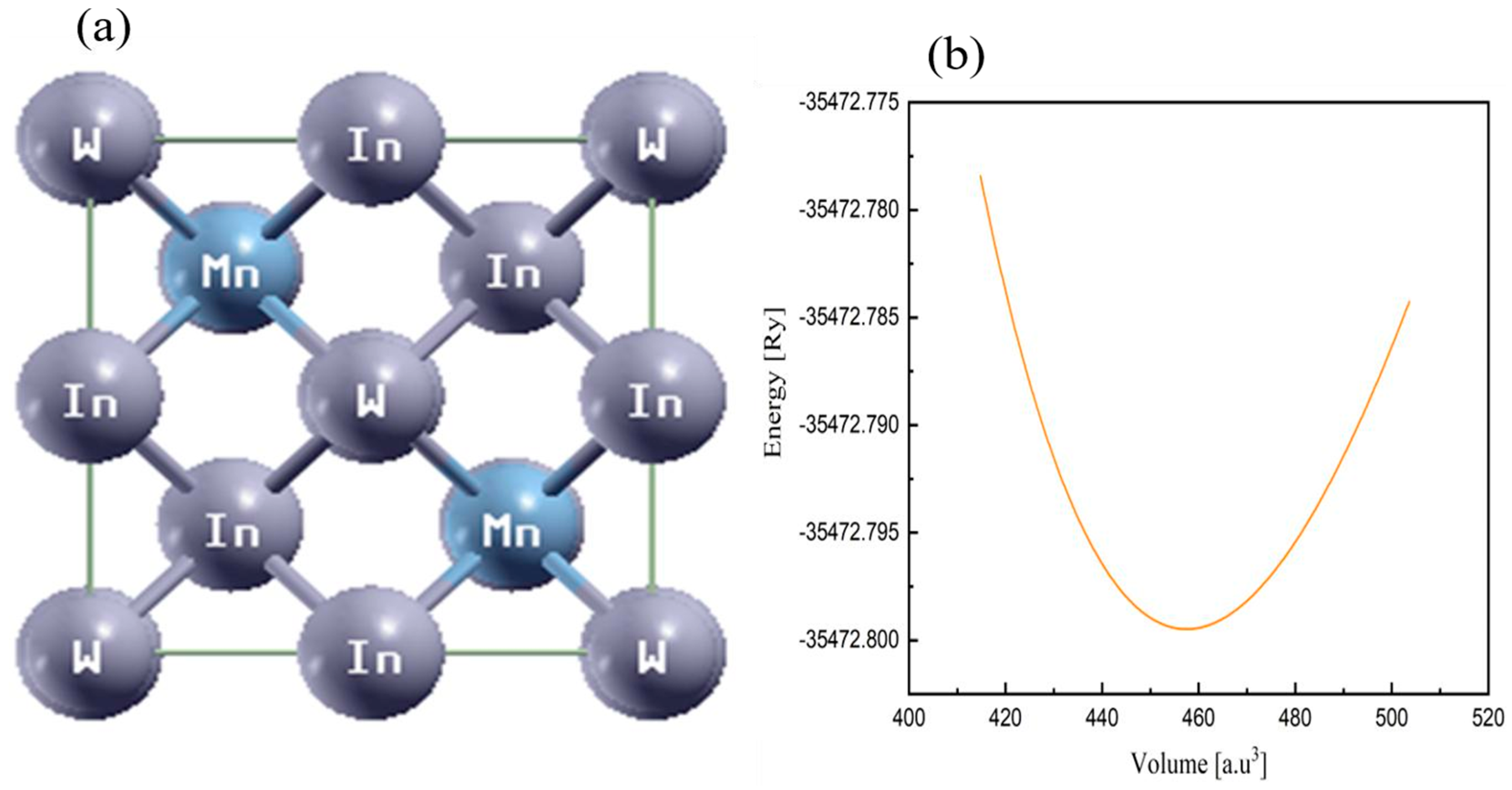
Figure 1. Illustration of (a) compound structure and (b) volume optimization curve of In2MnW.
Preprints 145540 g001
Table 1. Optimized lattice parameters of ln2MnW compound.
Lattice parameters Lattice constant Vo BP B (Gpa) E0
PM FM AFM
Pd2MnSb
Exp.a,b
6.33
6.413a
6.420c
490.1032
-----------
5.00
-----------
203.9194
---------
-58182.48
-------------
-58182.51
-------------
-581821.51
--------------
Table 2. Total, interstitial, and localized magnetic moment values for ln2MnW.
Parameter GGA GGA +U
Total magnetic moment 4.33 4.408
Magnetic moment of Mn 4.1 4.1
Magnetic moment of W -0.02600 -0.02500
Magnetic moment of ln 0.17218 0.15
Interstitial 0.17218 0.083
Disclaimer/Publisher’s Note: The statements, opinions and data contained in all publications are solely those of the individual author(s) and contributor(s) and not of MDPI and/or the editor(s). MDPI and/or the editor(s) disclaim responsibility for any injury to people or property resulting from any ideas, methods, instructions or products referred to in the content.
Copyright: This open access article is published under a Creative Commons CC BY 4.0 license, which permit the free download, distribution, and reuse, provided that the author and preprint are cited in any reuse.
Prerpints.org logo

Preprints.org is a free preprint server supported by MDPI in Basel, Switzerland.

Subscribe

Disclaimer

Terms of Use

Privacy Policy

Privacy Settings

© 2026 MDPI (Basel, Switzerland) unless otherwise stated