

Submitted:
06 January 2025
Posted:
07 January 2025
You are already at the latest version
Abstract
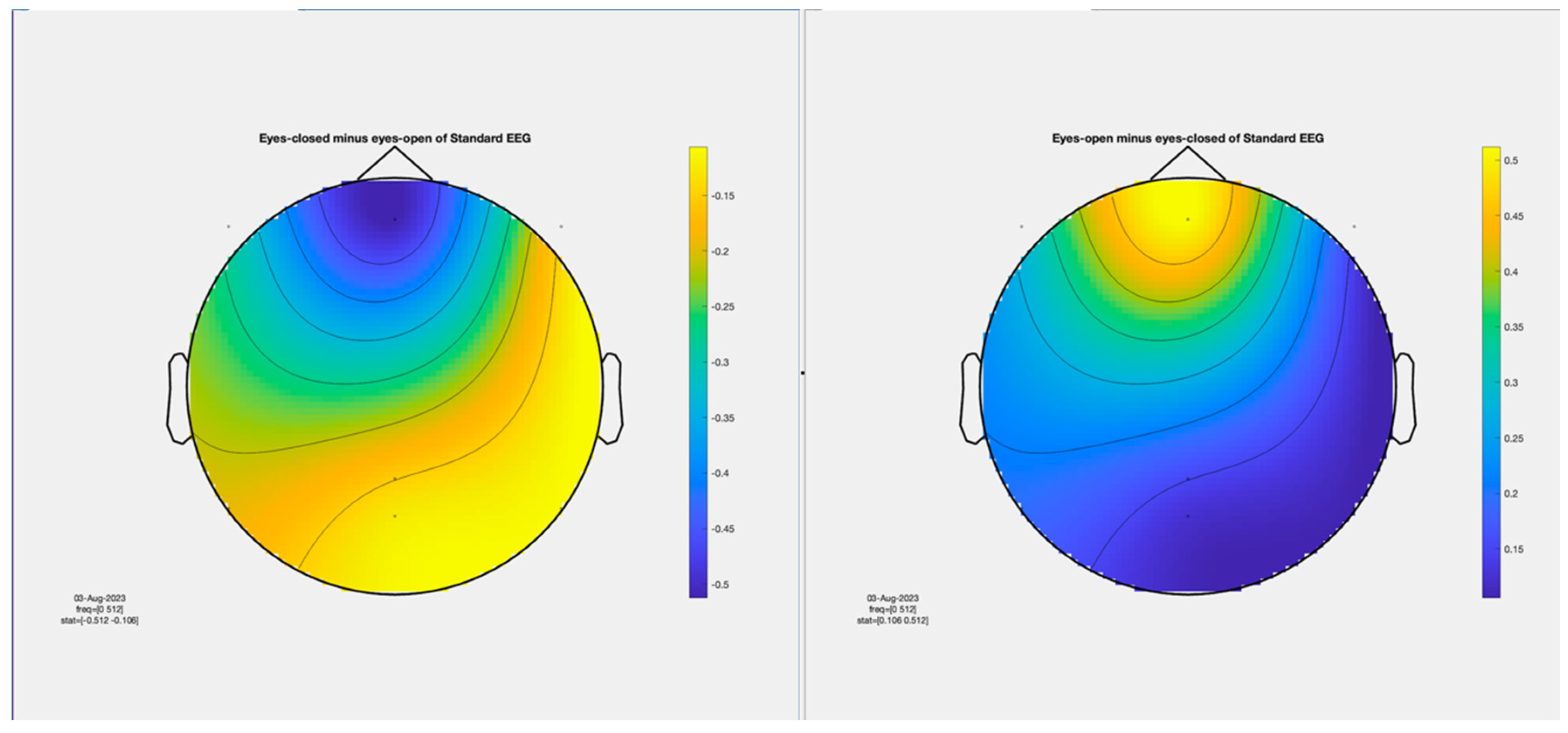
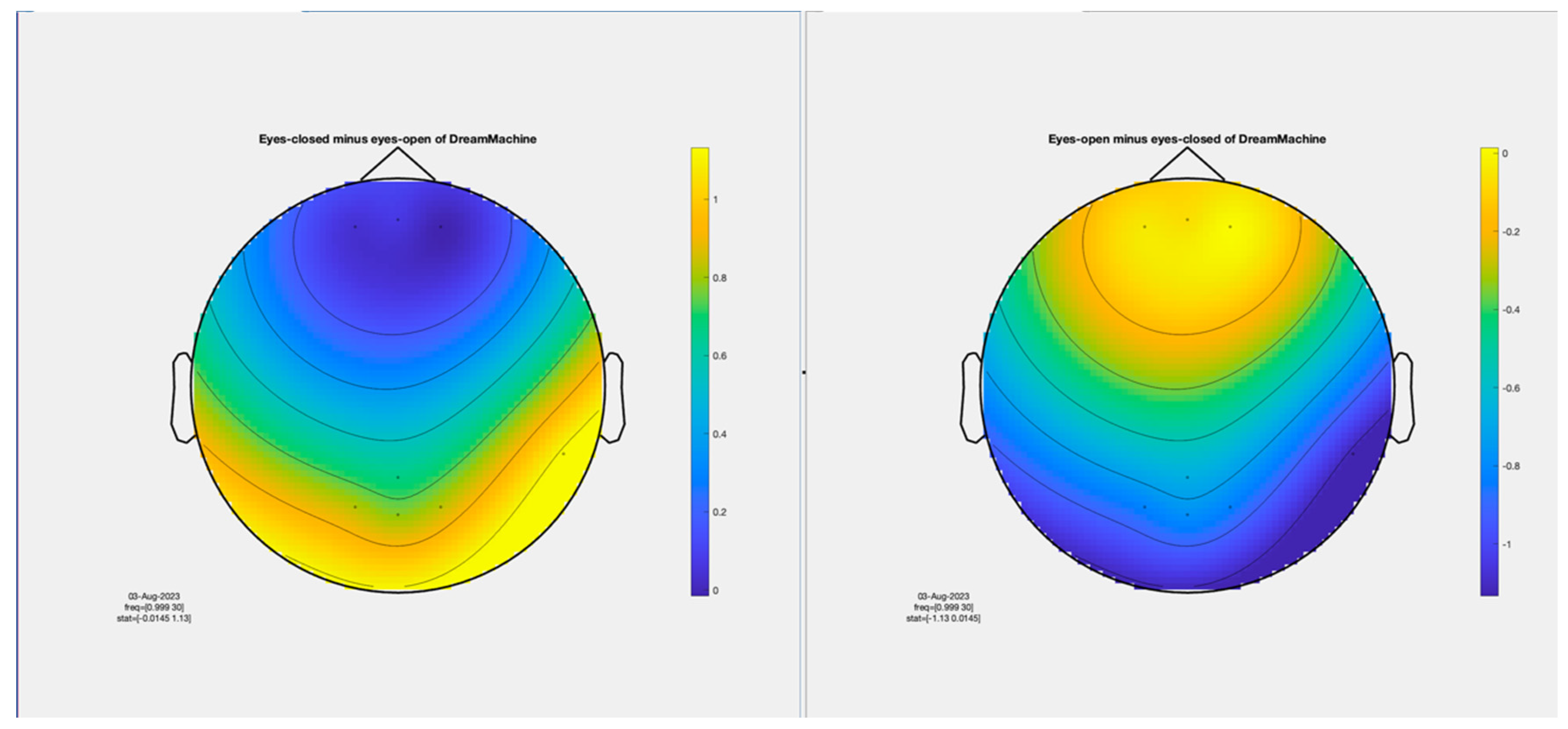
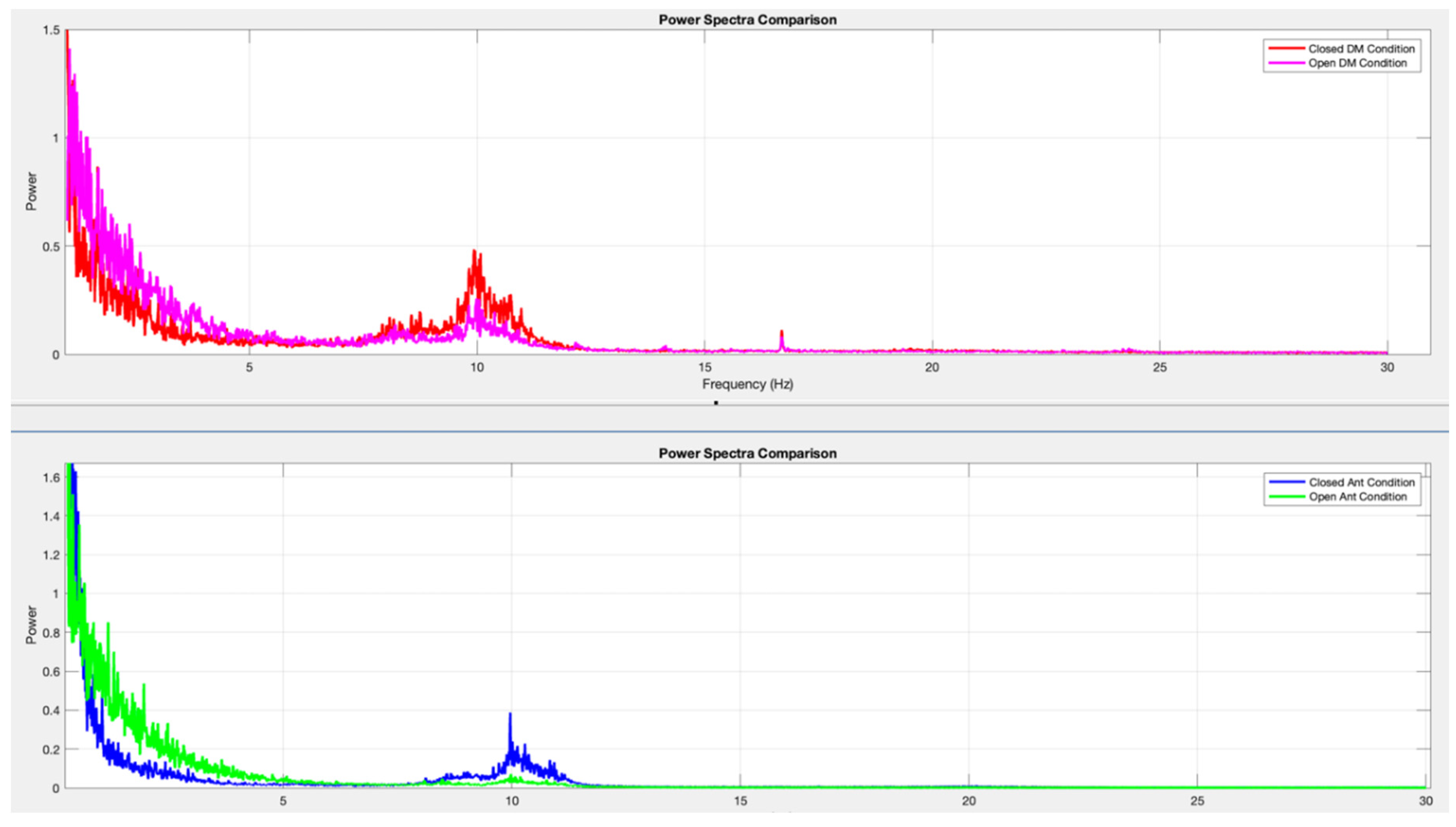
Electroencephalography (EEG) is an essential method used across diverse fields, including neurological diagnosis, cognitive neuroscience, sleep research, and mental health studies. It enables the investigation of neurophysiological functions by recording the brain's electrical activity. A wide variety of EEG and mobile-EEG systems are available on the market. However, adherence to the standards set by the International Federation of Clinical Neurophysiology (IFCN) is essential for ensuring high-quality data collection in clinical environments. The DreamMachine, a mobile EEG device that fully meets these standards, offers 24-channel recordings at a 250 Hz sampling rate, Bluetooth Low Energy (BLE), and additional capabilities to capture electrooculography (EOG) and electrocardiography (ECG) signals. With its low cost, it presents an affordable solution for EEG recording. The software architecture of the open-source DreamMachine is detailed in this study. Focus is placed on data compression and communication between the device and its companion Android application. The details of the Android application's features, including gain settings, bits per channel, filters, bit-shifting, and safety factors are investigated. Subsequently, the system's performance is evaluated through a standard eyes open/closed experiment, comparing its results with a laboratory EEG system across a significant number of participants to assess the performance of the DreamMachine system.
Keywords:
Specifications Table
| Hardware name | DreamMachine |
| Subject area |
|
| Hardware type |
|
| Closest commercial analog | OpenBCI, Emotiv, SMARTING mobi |
| Open-source license | GNU General Public License v3.0 |
| Cost of hardware | Around 150 Euro |
| Source file repository | https://github.com/neuroinfo-os/dream-machine-eeg |
1. Hardware in Context
1.1. State of the Art Mobile Smartphone-Based EEG Devices
2. Hardware Description
2.1. Data Transmission
2.2. Bluetooth
2.3. Android Application (EEGDroid)
2.3.1. Gain and Bits per Channel
2.3.2. Filtering
2.3.3. Bitshift and Safety Factor
2.3.4. Data Formats
2.4. Package Loss
3. Design Files Summary
Design Files Summary
| Design file name | File type | Open-source license | Location of the file |
| PCB design | .brd, .sch, .pdf | GNU General Public License v3.0 | https://github.com/neuroinfo-os/dream-machine-eeg/tree/main/Board%20Design |
| Firmware code | Source code | GNU General Public License v3.0 | https://github.com/paria-samimi/Traumschreiber/tree/master/Traumschreiber_BLE_Code |
| App Source code | Source code | GNU General Public License v3.0 | https://github.com/mvidaldp/pylsl-keyboard-trigger/tree/0fafb58d2fed61b4e99d7929e7fb66c1639cb003 https://github.com/denizmgun/EEG-Droid/tree/d72ffb9ea78de1f27fe0690aa12f09323f0b82c2 |
4. Bill of Materials Summary
5. Build Instructions
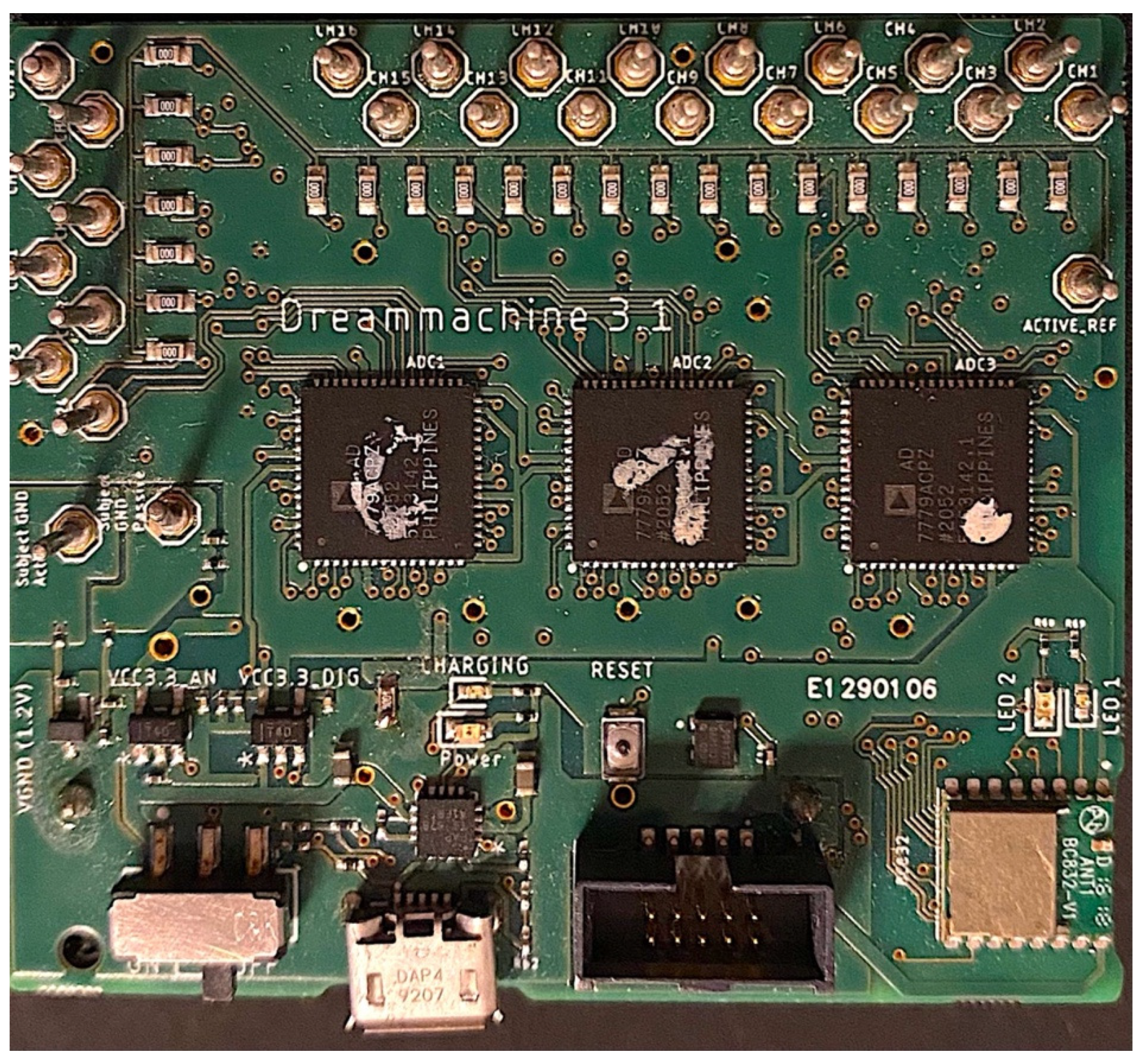
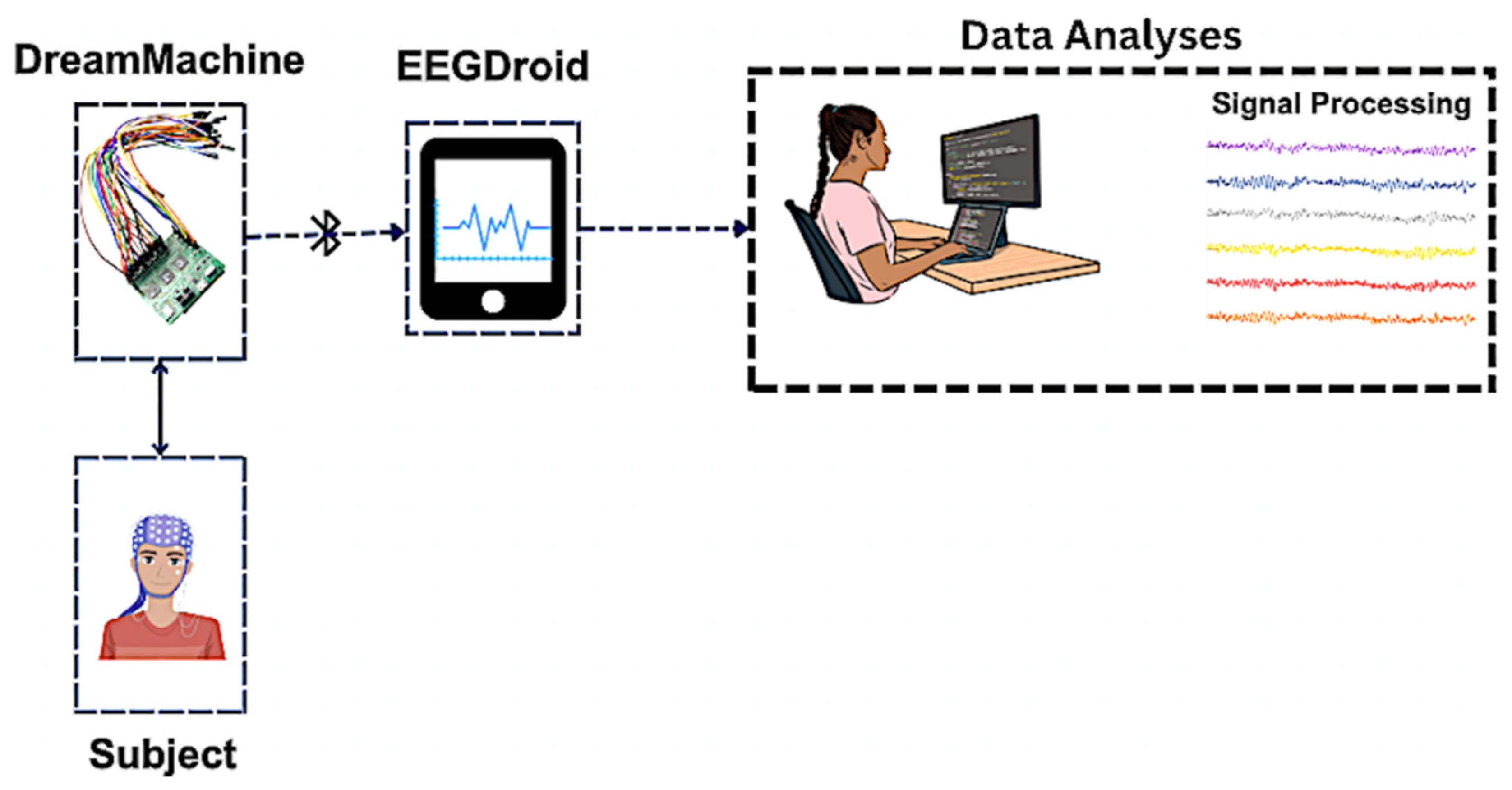
- PCB Design and Assembly: The printed circuit board (PCB) is designed and assembled with key components, including three analog-to-digital converters (ADC) and a BLE transmitter. These components enable the DreamMachine to digitize EEG signals and transmit data wirelessly to the Android application, EEGDroid.
- Firmware Programming: The firmware is flashed onto the microcontroller to enable communication with the EEGDroid application. This step involves programming the device to process and transmit EEG data effectively.
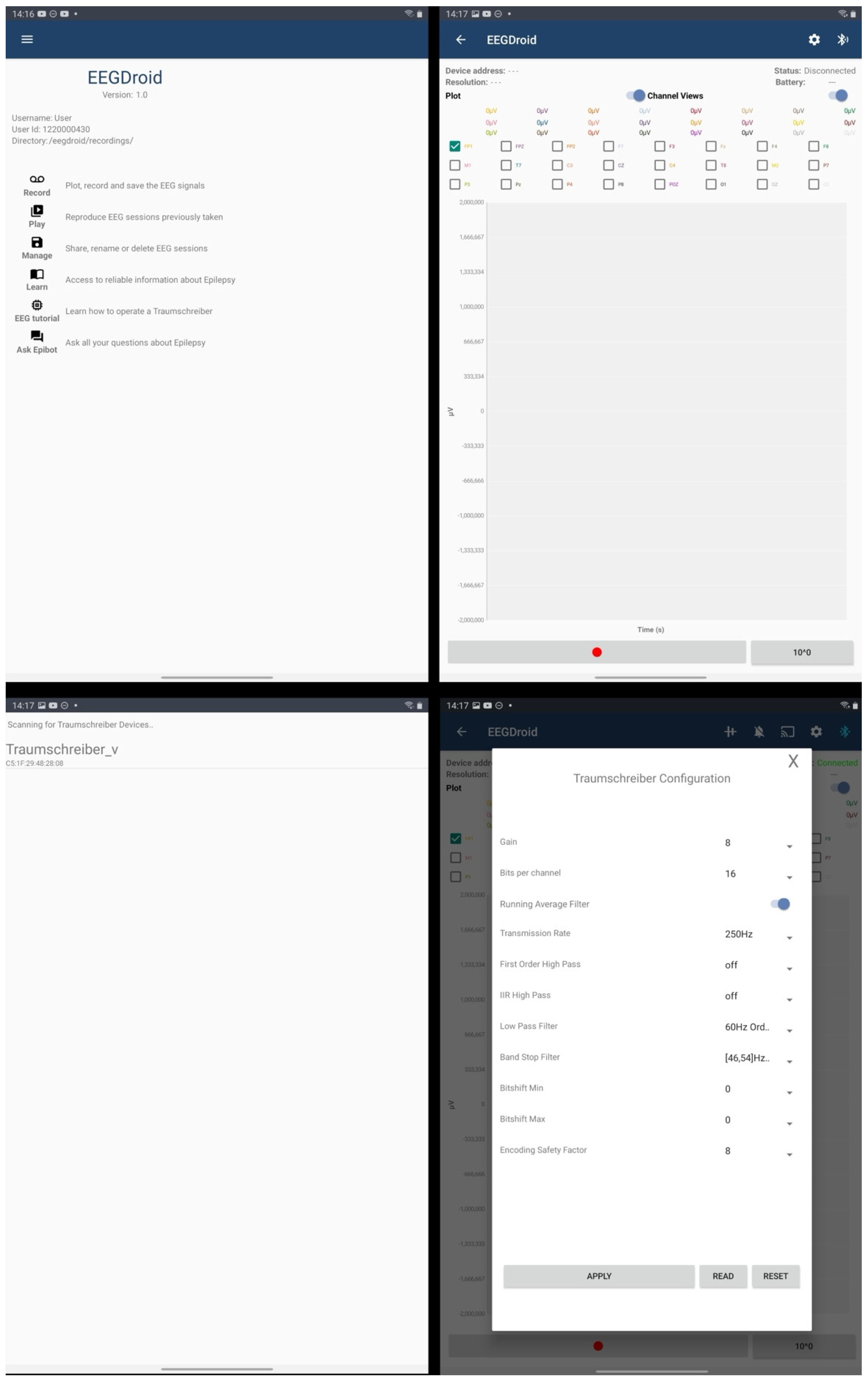
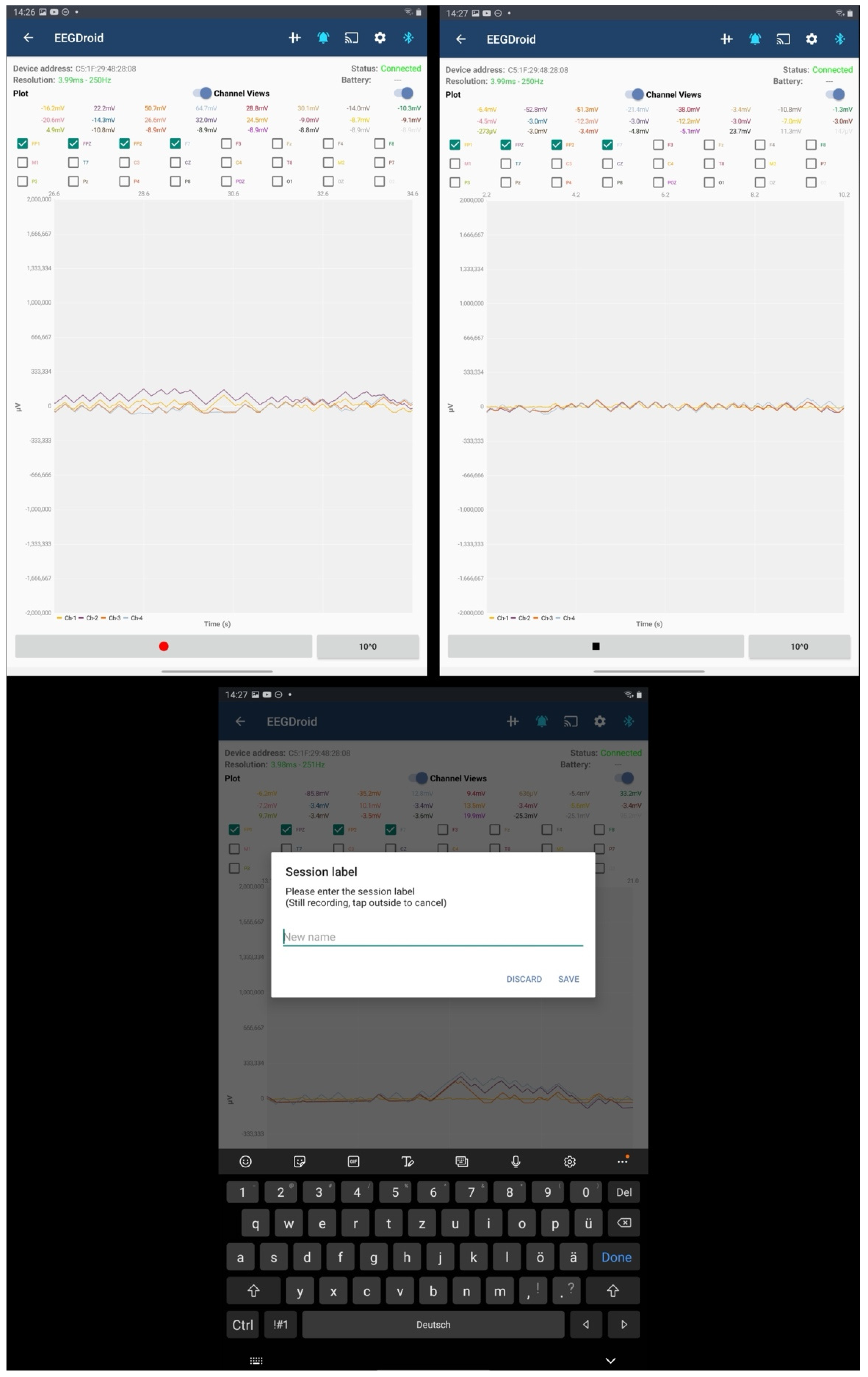
- EEGDroid Application Installation: The EEGDroid application is installed on an Android device. This app is designed to record and store EEG signals, allowing users to pair the DreamMachine hardware system with the Android device via Bluetooth.
6. Operation Instructions
7. Validation and Characterization
7.1. Methodology
7.2. Data Extraction
7.3. Data Analysis
7.4. Results
8. Discussion
Acknowledgements
Human Rights
References
- Monllor, P.; Cervera-Ferri, A.; Lloret, M.A.; Esteve, D.; Lopez, B.; Leon, J.L.; Lloret, A. Electroencephalography as a non-invasive biomarker of Alzheimer’s disease: a forgotten candidate to substitute CSF molecules? International Journal of Molecular Sciences 2021, 22, 10889. [Google Scholar] [CrossRef]
- Biondi, A.; Santoro, V.; Viana, P.F.; Laiou, P.; Pal, D.K.; Bruno, E.; Richardson, M.P. Noninvasive mobile EEG as a tool for seizure monitoring and management: A systematic review. Epilepsia 2022, 63, 1041–1063. [Google Scholar] [CrossRef] [PubMed]
- He, C.; Chen, Y.Y.; Phang, C.R.; Stevenson, C.; Chen, I.P.; Jung, T.P.; Ko, L.W. Diversity and suitability of the state-of-the-art wearable and wireless EEG systems review. IEEE Journal of Biomedical and Health Informatics 2023, 27, 3830–3843. [Google Scholar] [CrossRef] [PubMed]
- Sarrett, M.E.; McMurray, B.; Kapnoula, E.C. Dynamic EEG analysis during language comprehension reveals interactive cascades between perceptual processing and sentential expectations. Brain and Language 2020, 211, 104875. [Google Scholar] [CrossRef] [PubMed]
- Darfler, M.; Cruz-Garza, J.G.; Kalantari, S. An EEG-based investigation of the effect of perceived observation on visual memory in virtual environments. Brain Sciences 2022, 12, 269. [Google Scholar] [CrossRef]
- Toa, C.K.; Sim, K.S.; Tan, S.C. Electroencephalogram-based attention level classification using convolution attention memory neural network. IEEE Access 2021, 9, 58870–58881. [Google Scholar] [CrossRef]
- Supriya, S.; Siuly, S.; Wang, H.; Zhang, Y. Epilepsy detection from EEG using complex network techniques: A review. IEEE Reviews in Biomedical Engineering 2021, 16, 292–306. [Google Scholar] [CrossRef] [PubMed]
- Kataoka, H.; Takatani, T.; Sugie, K. Two-Channel Portable Biopotential Recording System Can Detect REM Sleep Behavioral Disorder: Validation Study with a Comparison of Polysomnography. Parkinson’s Disease 2022, 2022, 1888682. [Google Scholar] [CrossRef] [PubMed]
- Alkhachroum, A.; Appavu, B.; Egawa, S.; Foreman, B.; Gaspard, N.; Gilmore, E.J.; Hirsch, L.J.; Kurtz, P.; Lambrecq, V.; Kromm, J.; et al. Electroencephalogram in the intensive care unit: a focused look at acute brain injury. Intensive care medicine 2022, 48, 1443–1462. [Google Scholar] [CrossRef]
- Micoulaud-Franchi, J.; Jeunet, C.; Pelissolo, A.; Ros, T. EEG neurofeedback for anxiety disorders and post-traumatic stress disorders: A blueprint for a promising brain-based therapy. Current psychiatry reports 2021, 23, 1–14. [Google Scholar] [CrossRef]
- Wang, S.; Zhang, D.; Fang, B.; Liu, X.; Yan, G.; Sui, G.; Huang, Q.; Sun, L.; Wang, S. A study on resting EEG effective connectivity difference before and after neurofeedback for children with ADHD. Neuroscience 2021, 457, 103–113. [Google Scholar] [CrossRef]
- Douibi, K.; Le Bars, S.; Lemontey, A.; Nag, L.; Balp, R.; Breda, G. Toward EEG-based BCI applications for industry 4.0: Challenges and possible applications. Frontiers in Human Neuroscience 2021, 15, 705064. [Google Scholar] [CrossRef]
- Värbu, K.; Muhammad, N.; Muhammad, Y. Past, present, and future of EEG-based BCI applications. Sensors 2022, 22, 3331. [Google Scholar] [CrossRef] [PubMed]
- Mai, N.D.; Lee, B.G.; Chung, W.Y. Affective computing on machine learning-based emotion recognition using a self-made EEG device. Sensors 2021, 21, 5135. [Google Scholar] [CrossRef] [PubMed]
- Bashir, F.; Ali, A.; Soomro, T.A.; Marouf, M.; Bilal, M.; Chowdhry, B.S. Electroencephalogram (EEG) Signals for Modern Educational Research. In Innovative Education Technologies for 21st Century Teaching and Learning; CRC Press, 2021; pp. 149–171.
- Samimisabet, L.K.P. DreamMachine Mobile-EEG. https://github.com/neuroinfo-os/dream-machine-eeg, 2022.
- Cortes, P.M.; García-Hernández, J.P.; Iribe-Burgos, F.A.; Hernández-González, M.; Sotelo-Tapia, C.; Guevara, M.A. Temporal division of the decision-making process: An EEG study. Brain Research 2021, 1769, 147592. [Google Scholar] [CrossRef]
- Bitner, R.; Le, N.T. Can EEG-devices differentiate attention values between incorrect and correct solutions for problem-solving tasks? Journal of Information and Telecommunication 2022, 6, 121–140. [Google Scholar] [CrossRef]
- Oomen, D.; Cracco, E.; Brass, M.; Wiersema, J.R. EEG frequency tagging evidence of social interaction recognition. Social Cognitive and Affective Neuroscience 2022, 17, 1044–1053. [Google Scholar] [CrossRef]
- Johnson, E.L.; Kam, J.W.; Tzovara, A.; Knight, R.T. Insights into human cognition from intracranial EEG: a review of audition, memory, internal cognition, and causality. Journal of neural engineering 2020, 17, 051001. [Google Scholar] [CrossRef]
- Anaby-Tavor, A.; Carmeli, B.; Goldbraich, E.; Kantor, A.; Kour, G.; Shlomov, S.; Tepper, N.; Zwerdling, N. Do not have enough data? Deep learning to the rescue! In Proceedings of the Proceedings of the AAAI conference on artificial intelligence, 2020, Vol. 34, pp. 7383–7390.
- Guger, C. OpenBCI,Cyton Daisy Biosensing Boards—16 Channel. https://shop.openbci.com/products/cyton-daisy-biosensing-boards-16-channel, 2013.
- Zhang, L.; Cui, H. Reliability of MUSE 2 and Tobii Pro Nano at capturing mobile application users’ real-time cognitive workload changes. Frontiers in Neuroscience 2022, 16, 1011475. [Google Scholar] [CrossRef]
- Duvinage, M.; Castermans, T.; Petieau, M.; Hoellinger, T.; Cheron, G.; Dutoit, T. Performance of the Emotiv Epoc headset for P300-based applications. Biomedical engineering online 2013, 12, 1–15. [Google Scholar] [CrossRef] [PubMed]
- Groppa, S.; Oliviero, A.; Eisen, A.; Quartarone, A.; Cohen, L.; Mall, V.; Kaelin-Lang, A.; Mima, T.; Rossi, S.; Thickbroom, G.; et al. A practical guide to diagnostic transcranial magnetic stimulation: report of an IFCN committee. Clinical Neurophysiology 2012, 123, 858–882. [Google Scholar] [CrossRef] [PubMed]
- Neuro, A. asalab™ (ANT Neuro). https://www.ant-neuro.com.
- Bateson, A.D.; Baseler, H.A.; Paulson, K.S.; Ahmed, F.; Asghar, A.U. Categorisation of mobile EEG: a researcher’s perspective. BioMed research international 2017, 2017. [Google Scholar] [CrossRef] [PubMed]
- University, N. Most Popular Programming Languages. https://graduate.northeastern.edu/resources/most-popular-programming-languages/, 2023.
- Nuwer, M.R.; Comi, G.; Emerson, R.; Fuglsang-Frederiksen, A.; Guérit, J.M.; Hinrichs, H.; Ikeda, A.; Luccas, F.J.C.; Rappelsburger, P. IFCN standards for digital recording of clinical EEG. Electroencephalography and clinical Neurophysiology 1998, 106, 259–261. [Google Scholar] [CrossRef]
- Chen, X.; Cao, L.; Haendel, B.F. Differential effects of walking across visual cortical processing stages. Cortex 2022, 149, 16–28. [Google Scholar] [CrossRef]
- Blum, S.; Debener, S.; Emkes, R.; Volkening, N.; Fudickar, S.; Bleichner, M.G. EEG recording and online signal processing on android: A multiapp framework for brain-computer interfaces on smartphone. BioMed research international 2017, 2017. [Google Scholar] [CrossRef]
- Medical, S. SMARTING mobi. https://soterixmedical.com/research/mobile-eeg/smarting-mobi.
- Lightbody, G.; Galway, L.; McCullagh, P. The brain computer interface: Barriers to becoming pervasive. Pervasive Health: State-of-the-art and Beyond 2014, pp. 101–129.
- Badcock, N.A.; Mousikou, P.; Mahajan, Y.; De Lissa, P.; Thie, J.; McArthur, G. Validation of the Emotiv EPOC® EEG gaming system for measuring research quality auditory ERPs. PeerJ 2013, 1, e38. [Google Scholar] [CrossRef] [PubMed]
- Campbell, A.; Choudhury, T.; Hu, S.; Lu, H.; Mukerjee, M.K.; Rabbi, M.; Raizada, R.D. NeuroPhone: brain-mobile phone interface using a wireless EEG headset. In Proceedings of the Proceedings of the second ACM SIGCOMM workshop on Networking, systems, and applications on mobile handhelds, 2010, pp. 3–8.
- Stopczynski, A.; Stahlhut, C.; Larsen, J.E.; Petersen, M.K.; Hansen, L.K. The smartphone brain scanner: a portable real-time neuroimaging system. PloS one 2014, 9, e86733. [Google Scholar] [CrossRef] [PubMed]
- McKenzie, E.D.; Lim, A.S.; Leung, E.C.; Cole, A.J.; Lam, A.D.; Eloyan, A.; Nirola, D.K.; Tshering, L.; Thibert, R.; Garcia, R.Z.; et al. Validation of a smartphone-based EEG among people with epilepsy: A prospective study. Scientific reports 2017, 7, 1–8. [Google Scholar] [CrossRef]
- Bateson, A.D.; Asghar, A.U. Development and evaluation of a smartphone-based electroencephalography (EEG) system. IEEE Access 2021, 9, 75650–75667. [Google Scholar] [CrossRef]
- O’Neal Jr, J. Predictive quantizing systems (differential pulse code modulation) for the transmission of television signals. Bell System Technical Journal 1966, 45, 689–721. [Google Scholar] [CrossRef]
- Buchanan, W.; Buchanan, W. Pulse coded modulation (PCM). Applied Data Communications and Networks 1996, pp. 191–208.
- Oostenveld, R.; Fries, P.; Maris, E.; Schoffelen, J.M. FieldTrip: open source software for advanced analysis of MEG, EEG, and invasive electrophysiological data. Computational intelligence and neuroscience 2011, 2011, 1–9. [Google Scholar] [CrossRef] [PubMed]
- Delorme, A.; Makeig, S. EEGLAB: an open source toolbox for analysis of single-trial EEG dynamics including independent component analysis. Journal of neuroscience methods 2004, 134, 9–21. [Google Scholar] [CrossRef]
- Melnik, A.; Legkov, P.; Izdebski, K.; Kärcher, S.M.; Hairston, W.D.; Ferris, D.P.; König, P. Systems, subjects, sessions: to what extent do these factors influence EEG data? Frontiers in human neuroscience 2017, 11, 150. [Google Scholar] [CrossRef]
- Gargiulo, G.; Bifulco, P.; Calvo, R.A.; Cesarelli, M.; Jin, C.; van Schaik, A. A mobile EEG system with dry electrodes. In Proceedings of the 2008 IEEE biomedical circuits and systems conference; IEEE, 2008; pp. 273–276. [Google Scholar]
- Krukow, P.; Rodríguez-González, V.; Kopis´-Posiej, N.; Gómez, C.; Poza, J. Tracking EEG network dynamics through transitions between eyes-closed, eyes-open, and task states. Scientific Reports 2024, 14, 17442. [Google Scholar] [CrossRef]
- Palol, M.V.D. pylsl-keyboard-trigger. https://github.com/mvidaldp/pylsl-keyboard-trigger, 2022.
- Moreno-Castillo, M.; Manjarrez, E. Reduction of low-frequency oscillations in cerebral circulation correlates with pupil dilation during cognition: an fNIRS study. bioRxiv 2023, pp. 2023–11.
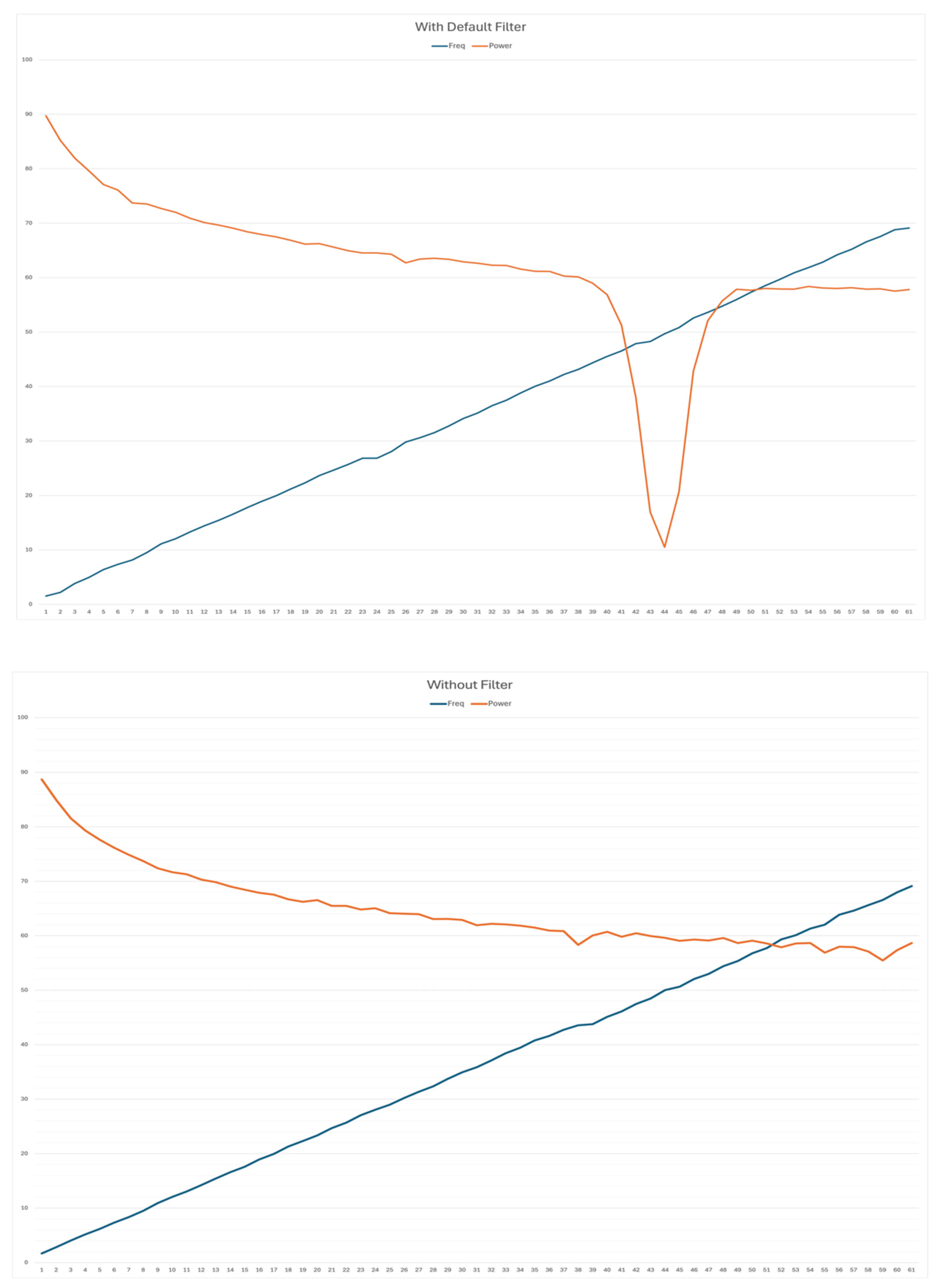


| High-pass Filter | Low-pass Filter | Band-stop Filter |
|---|---|---|
| 0.8 Hz order 2 | 45 Hz order 4 | 46-54 Hz order 6 |
| 1.0 Hz order 4 | 60 Hz order 6 | 46-54 Hz order 4 |
| 1.7 Hz order 4 | - | 48-52 Hz order 6 |
| 1.7 Hz order 2 | - | 48-52 Hz order 4 |
Disclaimer/Publisher’s Note: The statements, opinions and data contained in all publications are solely those of the individual author(s) and contributor(s) and not of MDPI and/or the editor(s). MDPI and/or the editor(s) disclaim responsibility for any injury to people or property resulting from any ideas, methods, instructions or products referred to in the content. |
© 2025 by the authors. Licensee MDPI, Basel, Switzerland. This article is an open access article distributed under the terms and conditions of the Creative Commons Attribution (CC BY) license (http://creativecommons.org/licenses/by/4.0/).


