

Submitted:
03 January 2025
Posted:
06 January 2025
You are already at the latest version
Abstract
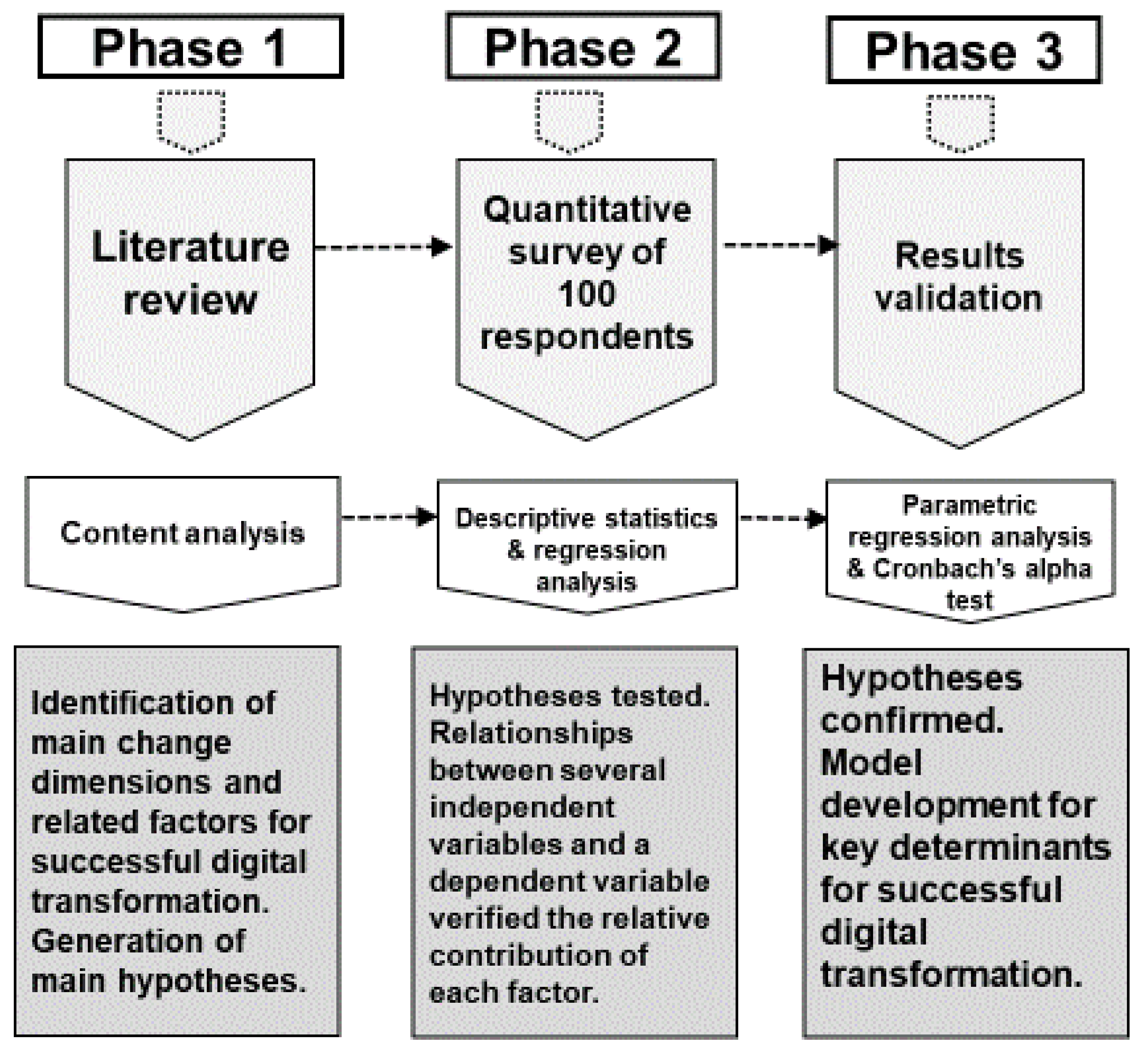
Digital transformation (DT) has become an imperative for companies seeking to evolve in a constantly changing industrial ecosystem, driven by the continual development and application of innovative digital technologies. Nevertheless, the success rate of DT initiatives remains surprisingly low, which only serves to highlight the need for a deeper understanding of the factors that determine the success of these initiatives. This study adopts a quantitative methodological approach to address this challenge, focusing on the Moroccan insurance industry. First a systematic literature review was undertaken to identify the key change dimensions and related factors that influence DT acceptance, at both individual and corporate levels, as well as the potential risks associated with the adoption of DT. A survey of 100 employees of insurance companies in Morocco was then undertaken, to statistically establish the key factors that determine the success of DT in these companies. Research results reveal that planned behavioral factors, as well as the innovative features of digital technologies, exert a positive influence on the attitude towards acceptance of DT. Furthermore, this positivity translates into greater personal acceptance of new technologies within the Moroccan organizations studied. Although the paper focuses on one industry sector in one country, the authors believe the results make a valid contribution to both theory and practice. The findings indicate a clear distinction between individual acceptance of innovation and acceptance at a social level, an approach that has scarcely been addressed in previous research. It also offers valuable insights for leaders and organizational managers seeking to succeed in their DT projects by highlighting key determining factors to effectively guide this complex process.
Keywords:
1. Introduction
2. Literature Review
2.1. Introduction
2.2. Digital Transformation: Definition and Importance
2.3. The Acceptance of Digital Transformation
2.4. Key Determinants and Hypothesis Development
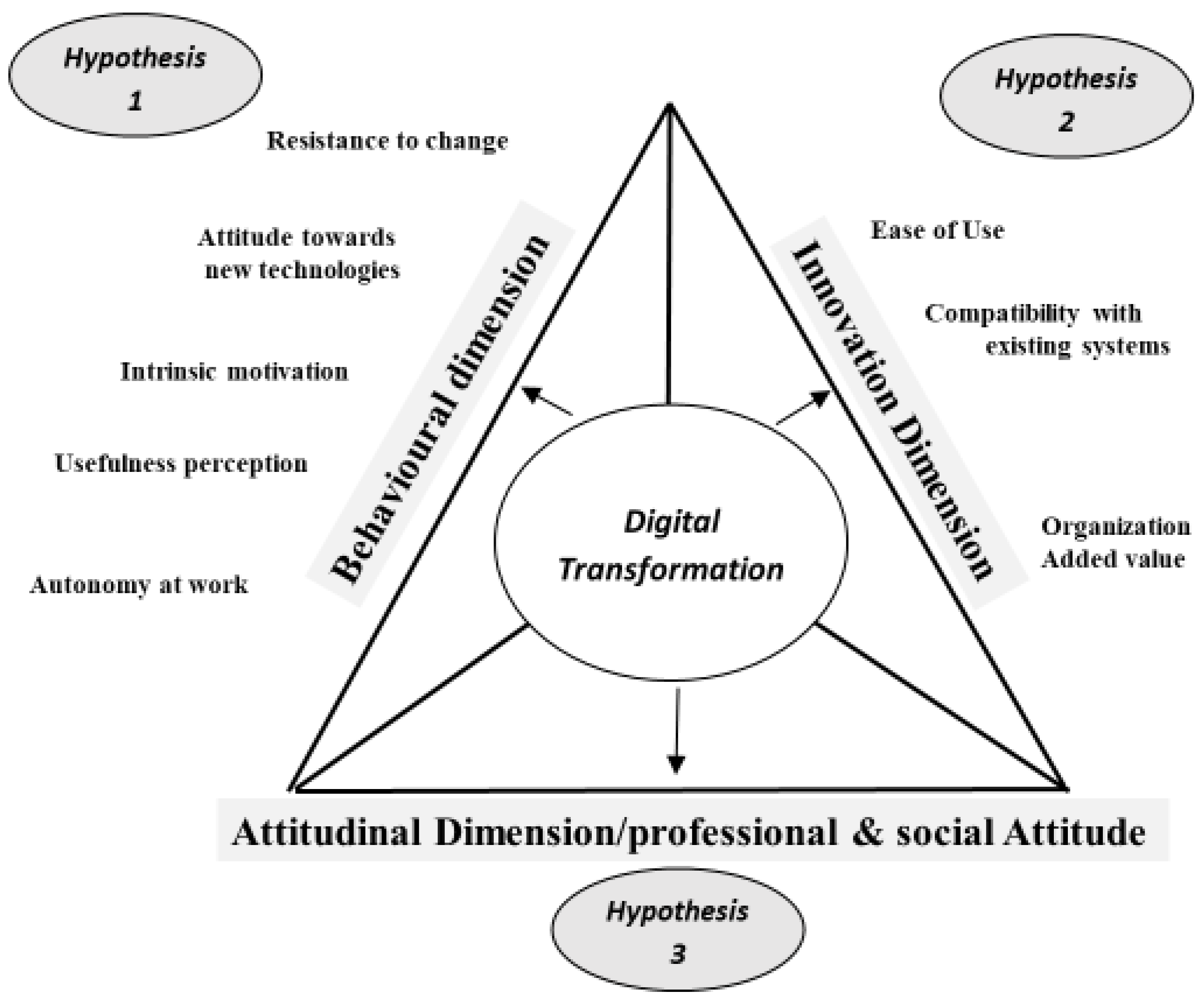
- : Resistance to change has a significant impact on the acceptance behavior of insurance employees towards DT.
- : Attitude towards new technologies has a significant impact on the acceptance behaviour of insurance employees towards DT.
- : Intrinsic motivation has a significant impact on the acceptance behavior of insurance employees towards DT.
- : The perceived usefulness of technologies has a determining effect on the acceptance behavior of insurance employees with regard to DT.
- : Autonomy at work significantly influences the acceptance behavior of insurance employees towards DT.
- : The ease of use of technologies has a significant impact on the acceptance behavior of insurance employees with regard to DT.
- : Compatibility with existing devices suggests a significant impact on employees’ acceptance behavior towards DT.
- : Organizational added value contributes significantly to employees’ acceptance behavior towards DT.
- : Professional attitude has a significant influence on employees’ acceptance of DT.
- : Social attitude plays a determining role in employees’ acceptance of DT.
3. Research Method
3.1. Research Design
4. Results
4.1. Demographic Characteristics of Respondents
4.2. Descriptive Statistics of the Main Variables

| Dimension | Variables | Coding | ||
| Behavioral | Resistance to change | RES-CH | 3.20 | 0.85 |
| Attitude towards new technologies | ATT-TC | 4.80 | 0.72 | |
| Intrinsic motivation | INT-MT | 4.50 | 0.65 | |
| Perceived usefulness of technologies | PER-TC | 4.90 | 0.78 | |
| Autonomy at work | SE-USE | 3.80 | 0.80 | |
| Innovative | Ease of use | EASE-USE | 5.10 | 0.75 |
| Compatibility with existing devices | COMP-PR | 4.70 | 0.68 | |
| Organizational added value | VAL-ORG | 5.20 | 0.80 | |
| Attitudinal | Professional attitude | PRO-ATT | 4.72 | 0.41 |
| Social attitude | SOC-ATT | 4.65 | 0.38 |
4.3. Responses of Respondents on “Intention to Accept Digital Transformation”
| Dimension | Variables | Frequencies | ||||
| * | ** | *** | **** | ***** | ||
| Behavioral | Resistance to change | - | - | 4% | 10% | 86% |
| Attitude towards new technologies | - | - | 9% | 15% | 76% | |
| Intrinsic motivation | - | - | 7% | 21% | 72% | |
| Perceived usefulness of technologies | - | - | 1% | 10% | 89% | |
| Autonomy at work | - | - | 2% | 21% | 77% | |
| Innovative | Ease of use | - | - | 3% | 23% | 74% |
| Compatibility with existing devices | - | - | - | 21% | 79% | |
| Organizational added value | - | - | 2% | 10% | 88% | |
| Attitudinal | Professional attitude | - | - | 6% | 10% | 84% |
| Social attitude | - | - | 7% | 13% | 80% | |
4.4. Model Adjustment
| R |
adjusted |
Standard error of the estimate | Modify statistics |
|||||
| Variation of R-two | Change in F | ddl1 | ddl2 | Sign. Variation in F |
||||
| 0.92 | 0.94 | 0.91 | 0.081 | 0.02 | 0.137 | 99 | 891 | 0.000 |
4.5. Assessment of Regression Model Quality (ANOVA)
4.6. Non-Standardized Coefficients
4.7. Parametric Regression Analysis
5. Discussion
6. Conclusions
Author Contributions
Funding
Institutional Review Board Statement
Data Availability Statement
Conflicts of Interest
Appendix A. Synthesis of Key Variables Derived from the TAM, UTAUT and DOI Models
| Variable | UTAUT | TAM | DIO | Authors |
|---|---|---|---|---|
| Resistance to change | linked to Facilitating Conditions and Effort Expectancy, which address perceived barriers to adoption | Potential negative influence on attitude towards use and intention | Mentioned in the categorization of adopters, particularly for late adopters | [25,28,32,71,72] |
| Attitude towards new technologies | Approached via Intent to Use, influenced by factors such as Performance Expectancy | Central variable: attitude towards use determines intention to use | linked to the notions of compatibility and relative advantage | [25,28,32,73,74,75] |
| Intrinsic motivation | Associated with Effort Expectancy and the role of moderators | Included in attitude towards use, influenced by ease of use | Not directly mentioned in the model. | [25,26,28,76] |
| Perceived usefulness of technologies | Corresponds to Performance Expectancy, one of the main determinants of acceptance | One of the two main variables under the name of Perceived Usefulness | Equivalent to Relative Advantage, a key adoption factor | [25,28,32,73,76] |
| Autonomy at work | Addressed appears in the Facilitating Conditions that facilitate the autonomous use of technologies | Not mentioned, but may influence attitude. | Not directly mentioned. | [28,77] |
| Ease of use | Corresponds to Effort Expectancy, a key determinant of adoption | Central variable under the name of Perceived Ease of Use, directly influencing the attitude | Similar to the concept of complexity, one of the five main factors | [25,28,32] |
| Compatibility with existing devices | Indirectly covered by the Facilitating Conditions, which include integration with existing systems | directly can influence Perceived Usefulness | Mentioned as one of the main variables under the name of compatibility | [28,32] |
| Organizational added value | Addressed in Performance Expectancy, which includes organizational benefits | Can be included in Perceived Usefulness, if the benefits are organizational | Related to relative advantage, which considers organizational benefits | [25,28,32] |
| Professional attitude | Influence via moderators such as professional experience | Influence on attitude towards use and intention | Not directly mentioned. | [25,28] |
| Social attitude | Corresponds directly to Social Influence, a major determinant | Explicitly can influence attitude towards use. | Related to observability, which depends on social context | [28,32] |
Appendix B. The Multiple Linear Regression Model Used in the Research Project
References
- I. Park, D. Kim, J. Moon, S. Kim, Y. Kang, et S. Bae, « Searching for New Technology Acceptance Model under Social Context: Analyzing the Determinants of Acceptance of Intelligent Information Technology in Digital Transformation and Implications for the Requisites of Digital Sustainability », Sustainability, vol. 14, no 1, Art. no 1, janv. 2022. [CrossRef]
- T. Hess, C. Matt, A. Benlian, et F. Wiesböck, « Options for formulating a digital transformation strategy », in Strategic information management, Routledge, 2020, p. 151-173. Consulté le: 29 décembre 2024. [En ligne]. Disponible sur: https://www.taylorfrancis.com/chapters/edit/10.4324/9780429286797-7/options-formulating-digital-transformation-strategy-thomas-hess-christian-matt-alexander-benlian-florian-wiesb%C3%B6ck.
- J. Bughin, J. Deakin, et B. O’beirne, « Digital transformation: Improving the odds of success », McKinsey Q., vol. 22, p. 1-5, 2019.
- G. Vial, « Understanding digital transformation: A review and a research agenda », J. Strateg. Inf. Syst., vol. 28, no 2, p. 118-144, juin 2019. [CrossRef]
- L. Wessel, A. Baiyere, R. Ologeanu-Taddei, J. Cha, et T. Blegind-Jensen, « Unpacking the difference between digital transformation and IT-enabled organizational transformation », J. Assoc. Inf. Syst., vol. 22, no 1, p. 102-129, 2021.
- K. S. Warner et M. Wäger, « Building dynamic capabilities for digital transformation: An ongoing process of strategic renewal », Long Range Plann., vol. 52, no 3, p. 326-349, 2019.
- I.M. Sebastian, J. W. Ross, C. Beath, M. Mocker, K. G. Moloney, et N. O. Fonstad, « How big old companies navigate digital transformation », in Strategic information management, Routledge, 2020, p. 133-150. Consulté le: 29 décembre 2024. [En ligne]. Disponible sur: https://www.taylorfrancis.com/chapters/edit/10.4324/9780429286797-6/big-old-companies-navigate-digital-transformation-ina-sebastian-jeanne-ross-cynthia-beath-martin-mocker-kate-moloney-nils-fonstad.
- M. Fitzgerald, N. Kruschwitz, D. Bonnet, et M. Welch, « Embracing digital technology: A new strategic imperative », MIT Sloan Manag. Rev., vol. 55, no 2, p. 1, 2014.
- J. Wang et T. Bai, « How digitalization affects the effectiveness of turnaround actions for firms in decline », Long Range Plann., vol. 57, no 1, p. 102140, 2024.
- X. Fang et M. Liu, « How does the digital transformation drive digital technology innovation of enterprises? Evidence from enterprise’s digital patents », Technol. Forecast. Soc. Change, vol. 204, p. 123428, 2024.
- F. Almeida, J. D. Santos, et J. A. Monteiro, « The challenges and opportunities in the digitalization of companies in a post-COVID-19 World », IEEE Eng. Manag. Rev., vol. 48, no 3, p. 97-103, 2020.
- B. Metin, F. G. Özhan, et M. Wynn, « Digitalisation and Cybersecurity: Towards an Operational Framework », Electronics, vol. 13, no 21, p. 4226, 2024.
- S. Ziyadin, S. Suieubayeva, et A. Utegenova, « Digital Transformation in Business », in Digital Age: Chances, Challenges and Future, vol. 84, S. I. Ashmarina, M. Vochozka, et V. V. Mantulenko, Éd., in Lecture Notes in Networks and Systems, vol. 84. , Cham: Springer International Publishing, 2020, p. 408-415. [CrossRef]
- J. Kleinert, « Digital transformation », Empirica, vol. 48, no 1, p. 1-3, févr. 2021. [CrossRef]
- H. E. Adama et C. D. Okeke, « Digital transformation as a catalyst for business model innovation: A critical review of impact and implementation strategies », Magna Sci. Adv. Res. Rev., vol. 10, no 02, p. 256-264, 2024.
- L. Li, « Digital transformation and sustainable performance: The moderating role of market turbulence », Ind. Mark. Manag., vol. 104, p. 28-37, 2022.
- J. Fernandez-Vidal, F. A. Perotti, R. Gonzalez, et J. Gasco, « Managing digital transformation: The view from the top », J. Bus. Res., vol. 152, p. 29-41, 2022.
- S. Nambisan, M. Wright, et M. Feldman, « The digital transformation of innovation and entrepreneurship: Progress, challenges and key themes », Res. Policy, vol. 48, no 8, p. 103773, 2019.
- R. Kohli et N. P. Melville, « Digital innovation: A review and synthesis », 2019, Consulté le: 29 décembre 2024. [En ligne]. Disponible sur: https://deepblue.lib.umich.edu/handle/2027.42/146990.
- S. Abdallah-Ou-Moussa, M. Wynn, O. Kharbouch, et Z. Rouaine, « Digitalization and Corporate Social Responsibility: A Case Study of the Moroccan Auto Insurance Sector », Adm. Sci., vol. 14, no 11, p. 282, 2024.
- T. T. Sousa-Zomer, A. Neely, et V. Martinez, « Digital transforming capability and performance: a microfoundational perspective », Int. J. Oper. Prod. Manag., vol. 40, no 7/8, p. 1095-1128, 2020.
- C. Xu, G. Sun, et T. Kong, « The impact of digital transformation on enterprise green innovation », Int. Rev. Econ. Finance, vol. 90, p. 1-12, 2024.
- A. Baird et L. M. Maruping, « The Next Generation of Research on IS Use: A Theoretical Framework of Delegation to and from Agentic IS Artifacts. », MIS Q., vol. 45, no 1, 2021, Consulté le: 29 décembre 2024. [En ligne]. Disponible sur: https://search.ebscohost.com/login.aspx?direct=true&profile=ehost&scope=site&authtype=crawler&jrnl=02767783&AN=149296195&h=DVYdWe0JBWknkL6JeNDoE2UtZaSaAxjABNdSqx%2Ff%2B9vKEh03AAfL9UUDufiG2GSNJIZj63lOgRWNXphK2iD5bQ%3D%3D&crl=c.
- S. Faraj et S. Pachidi, « Beyond Uberization: The co-constitution of technology and organizing », Organ. Theory, vol. 2, no 1, p. 2631787721995205, janv. 2021. [CrossRef]
- F. D. Davis, « Perceived usefulness, perceived ease of use, and user acceptance of information technology », MIS Q., p. 319-340, 1989.
- V. Venkatesh et H. Bala, « Technology Acceptance Model 3 and a Research Agenda on Interventions », Decis. Sci., vol. 39, no 2, p. 273-315, mai 2008. [CrossRef]
- K. Oh, H. Kho, Y. Choi, et S. Lee, « Determinants for successful digital transformation », Sustainability, vol. 14, no 3, p. 1215, 2022.
- V. Venkatesh, M. G. Morris, G. B. Davis, et F. D. Davis, « User acceptance of information technology: Toward a unified view », MIS Q., p. 425-478, 2003.
- B. Trenerry et al., « Preparing workplaces for digital transformation: An integrative review and framework of multi-level factors », Front. Psychol., vol. 12, p. 620766, 2021.
- M. Slavković, K. Pavlović, T. Mamula Nikolić, T. Vučenović, et M. Bugarčić, « Impact of digital capabilities on digital transformation: The mediating role of digital citizenship », Systems, vol. 11, no 4, p. 172, 2023.
- M. Wynn et C. Lam, « Digitalisation and IT strategy in the hospitality industry », Systems, vol. 11, no 10, p. 501, 2023.
- E. M. Rogers, A. Singhal, et M. M. Quinlan, « Diffusion of innovations », in An integrated approach to communication theory and research, Routledge, 2014, p. 432-448. Consulté le: 29 décembre 2024. [En ligne]. Disponible sur: https://www.taylorfrancis.com/chapters/edit/10.4324/9780203887011-36/diffusion-innovations-everett-rogers-arvind-singhal-margaret-quinlan.
- A. Steiber, S. Alänge, S. Ghosh, et D. Goncalves, « Digital transformation of industrial firms: an innovation diffusion perspective », Eur. J. Innov. Manag., vol. 24, no 3, p. 799-819, 2021.
- S. ElMassah et M. Mohieldin, « Digital transformation and localizing the sustainable development goals (SDGs) », Ecol. Econ., vol. 169, p. 106490, 2020.
- J. Benitez, A. Arenas, A. Castillo, et J. Esteves, « Impact of digital leadership capability on innovation performance: The role of platform digitization capability », Inf. Manage., vol. 59, no 2, p. 103590, 2022.
- H. Schildt, « The institutional logic of digitalization », in Digital transformation and institutional theory, Emerald Publishing Limited, 2022, p. 235-251. Consulté le: 29 décembre 2024. [En ligne]. Disponible sur: https://www.emerald.com/insight/content/doi/10.1108/S0733-558X20220000083010/full/html.
- « Komi, A. K. (2019). Le management des résistances... - Google Scholar ». Consulté le: 29 décembre 2024. [En ligne]. Disponible sur: https://scholar.google.com/scholar?hl=fr&as_sdt=0%2C5&q=Komi%2C+A.+K.+%282019%29.+Le+management+des+r%C3%A9sistances+%C3%A0+un+projet+d%E2%80%99innovation+par+l%E2%80%99intelligence+artificielle+dans+une+perspective+de+changement.+RIMHE%3A+Revue+Interdisciplinaire+Management%2C+Homme+%28s%29+%26+Entreprise%2C+%283%29%2C+29-54.&btnG=.
- J. Ricou et V. Moissonnier, « Outil 25. Les causes de résistance au changement », En, vol. 2, p. 78-79, 2022.
- B. Rusu, C. B. Sandu, S. Avasilcai, et I. David, « Acceptance of Digital Transformation: Evidence from Romania », Sustainability, vol. 15, no 21, p. 15268, 2023.
- P. C. Endrejat, F. E. Klonek, L. C. Müller-Frommeyer, et S. Kauffeld, « Turning change resistance into readiness: How change agents’ communication shapes recipient reactions », Eur. Manag. J., vol. 39, no 5, p. 595-604, oct. 2021. [CrossRef]
- « Kupiek, M. (2021). Digital leadership, agile change... - Google Scholar ». Consulté le: 29 décembre 2024. [En ligne]. Disponible sur: https://scholar.google.com/scholar?hl=fr&as_sdt=0%2C5&q=Kupiek%2C+M.+%282021%29.+Digital+leadership%2C+agile+change+and+the+emotional+organization%3A+Emotion+as+a+success+factor+for+digital+transformation+projects.+Springer+Nature.&btnG=.
- C. Guzmán-Ortiz, N. Navarro-Acosta, W. Florez-Garcia, et W. Vicente-Ramos, « Impact of digital transformation on the individual job performance of insurance companies in Peru », Int. J. Data Netw. Sci., vol. 4, no 4, p. 337-346, 2020.
- J. Allouche et R. Zerbib, « La transformation digitale : enjeux et perspectives », Rev. Sci. Gest., vol. 301302, no 1, p. 75-76, oct. 2020. [CrossRef]
- A. García-Jurado, J. J. Pérez-Barea, et F. Fernández-Navarro, « Towards Digital Sustainability: Profiles of Millennial Reviewers, Reputation Scores and Intrinsic Motivation Matter », Sustainability, vol. 13, no 6, Art. no 6, janv. 2021. [CrossRef]
- F. Kitsios, I. Giatsidis, et M. Kamariotou, « Digital transformation and strategy in the banking sector: Evaluating the acceptance rate of e-services », J. Open Innov. Technol. Mark. Complex., vol. 7, no 3, p. 204, 2021.
- B. Alturas, « Models of Acceptance and Use of Technology Research Trends: Literature Review and Exploratory Bibliometric Study », in Recent Advances in Technology Acceptance Models and Theories, vol. 335, M. Al-Emran et K. Shaalan, Éd., in Studies in Systems, Decision and Control, vol. 335. , Cham: Springer International Publishing, 2021, p. 13-28. [CrossRef]
- E. Y. Wong, R. T. Hui, et H. Kong, « Perceived usefulness of, engagement with, and effectiveness of virtual reality environments in learning industrial operations: the moderating role of openness to experience », Virtual Real., vol. 27, no 3, p. 2149-2165, sept. 2023. [CrossRef]
- P. T. Huu, « Impact of employee digital competence on the relationship between digital autonomy and innovative work behavior: a systematic review », Artif. Intell. Rev., vol. 56, no 12, p. 14193-14222, déc. 2023. [CrossRef]
- M. M. Siruri et S. Cheche, « Revisiting the Hackman and Oldham job characteristics model and Herzberg’s two factor theory: Propositions on how to make job enrichment effective in today’s organizations », Eur. J. Bus. Manag. Res., vol. 6, no 2, p. 162-167, 2021.
- J. R. Hackman, « Work redesign », ReadingAddison-Wesley, 1980.
- V. Venkatesh, F. D. Davis, et Y. Zhu, « Competing roles of intention and habit in predicting behavior: A comprehensive literature review, synthesis, and longitudinal field study », Int. J. Inf. Manag., vol. 71, p. 102644, août 2023. [CrossRef]
- L. M. Maruping, H. Bala, V. Venkatesh, et S. A. Brown, « Going beyond intention: Integrating behavioral expectation into the unified theory of acceptance and use of technology », J. Assoc. Inf. Sci. Technol., vol. 68, no 3, p. 623-637, mars 2017. [CrossRef]
- V. Venkatesh, H. Bala, et T. A. Sykes, « Impacts of Information and Communication Technology Implementations on Employees’ Jobs in Service Organizations in India: A Multi-Method Longitudinal Field Study », Prod. Oper. Manag., vol. 19, no 5, p. 591-613, sept. 2010. [CrossRef]
- M. Liu et al., « What influences consumer AI chatbot use intention? An application of the extended technology acceptance model », J. Hosp. Tour. Technol., vol. 15, no 4, p. 667-689, 2024.
- M. Molino, C. G. Cortese, et C. Ghislieri, « The promotion of technology acceptance and work engagement in industry 4.0: From personal resources to information and training », Int. J. Environ. Res. Public. Health, vol. 17, no 7, p. 2438, 2020.
- R. Martínez-Peláez et al., « Role of Digital Transformation for Achieving Sustainability: Mediated Role of Stakeholders, Key Capabilities, and Technology », Sustainability, vol. 15, no 14, Art. no 14, janv. 2023. [CrossRef]
- R. Kemp, « Technology and the transition to environmental sustainability: The problem of technological regime shifts », Futures, vol. 26, no 10, p. 1023-1046, déc. 1994. [CrossRef]
- S. Leroy, A. M. Schmidt, et N. Madjar, « Interruptions and Task Transitions: Understanding Their Characteristics, Processes, and Consequences », Acad. Manag. Ann., vol. 14, no 2, p. 661-694, juill. 2020. [CrossRef]
- M. Amini et N. Jahanbakhsh Javid, « A Multi-Perspective Framework Established on Diffusion of Innovation (DOI) Theory and Technology, Organization and Environment (TOE) Framework Toward Supply Chain Management System Based on Cloud Computing Technology for Small and Medium Enterprises », 1 janvier 2023, Social Science Research Network, Rochester, NY: 4340207. Consulté le: 30 décembre 2024. [En ligne]. Disponible sur: https://papers.ssrn.com/abstract=4340207.
- R. Chaudhuri, S. Chatterjee, M. M. Mariani, et S. F. Wamba, « Assessing the influence of emerging technologies on organizational data driven culture and innovation capabilities: A sustainability performance perspective », Technol. Forecast. Soc. Change, vol. 200, p. 123165, mars 2024. [CrossRef]
- M. Rožman, D. Oreški, et P. Tominc, « Artificial-Intelligence-Supported Reduction of Employees’ Workload to Increase the Company’s Performance in Today’s VUCA Environment », Sustainability, vol. 15, no 6, Art. no 6, janv. 2023. [CrossRef]
- A. I. Stoumpos, F. Kitsios, et M. A. Talias, « Digital Transformation in Healthcare: Technology Acceptance and Its Applications », Int. J. Environ. Res. Public. Health, vol. 20, no 4, Art. no 4, janv. 2023. [CrossRef]
- M. Fishbein, Prédire et modifier le comportement: L’approche de l’action raisonnée. [CrossRef]
- L. Kolb, « Keynote: The Triple E Framework: Using Research-Based Strategies for Technology Integration », présenté à SITE - Society for Information Technology & Teacher Education International Conference, Association for the Advancement of Computing in Education (AACE), 2020. Consulté le: 29 décembre 2024. [En ligne]. Disponible sur: https://www.learntechlib.org/primary/p/216133/.
- Y. K. Dwivedi et al., « Setting the future of digital and social media marketing research: Perspectives and research propositions », Int. J. Inf. Manag., vol. 59, p. 102168, 2021.
- M. Gerlich, « Perceptions and Acceptance of Artificial Intelligence: A Multi-Dimensional Study », Soc. Sci., vol. 12, no 9, Art. no 9, sept. 2023. [CrossRef]
- S. Jierasup et A. Leelasantitham, « A Change from Negative to Positive of Later Adoption Using the Innovation Decision Process to Imply Sustainability for HR Chatbots of Private Companies in Thailand », Sustainability, vol. 16, no 13, Art. no 13, janv. 2024. [CrossRef]
- J. Fernandez-Vidal, R. Gonzalez, J. Gasco, et J. Llopis, « Digitalization and corporate transformation: The case of European oil & gas firms », Technol. Forecast. Soc. Change, vol. 174, p. 121293, 2022.
- Y. Zhang et S. Jin, « How does digital transformation increase corporate sustainability? The moderating role of top management teams », Systems, vol. 11, no 7, p. 355, 2023.
- E. Bell, A. Bryman, et B. Harley, Business research methods. Oxford university press, 2022. Consulté le: 29 décembre 2024. [En ligne]. Disponible sur: https://books.google.com/books?hl=fr&lr=&id=hptjEAAAQBAJ&oi=fnd&pg=PP1&dq=Bell,+E.,+Bryman,+A.,+%26+Harley,+B.+(2022).+Business+research+methods.+Oxford+University+Press.&ots=Ddmi37A20C&sig=KkqdaSRmg8NFAfE63ujfZ2F4DzI.
- « SolvInnov ». Consulté le: 30 décembre 2024. [En ligne]. Disponible sur: https://solvinnov.com/literature/a-model-of-innovation-resistance/.
- J. N. Sheth et W. H. Stellner, Psychology of innovation resistance: The less developed concept (LDC) in diffusion research. College of Commerce and Business Administration, University of Illinois at …, 1979. Consulté le: 30 décembre 2024. [En ligne]. Disponible sur: https://www.researchgate.net/profile/Jagdish-Sheth/publication/237065197_Psychology_of_Innovation_Resistance_The_Less_Developed_Concept_in_Diffusion_Research/links/0046351b1f0eb33955000000/Psychology-of-Innovation-Resistance-The-Less-Developed-Concept-in-Diffusion-Research.pdf.
- V. Venkatesh, H. Bala, et T. A. Sykes, « Impacts of Information and Communication Technology Implementations on Employees’ Jobs in Service Organizations in India: A Multi-Method Longitudinal Field Study », Prod. Oper. Manag., vol. 19, no 5, p. 591-613, sept. 2010. [CrossRef]
- I. Ajzen, « The Theory of planned behavior », Organ. Behav. Hum. Decis. Process., 1991, Consulté le: 30 décembre 2024. [En ligne]. Disponible sur: https://sk.sagepub.com/hnbk/edvol/hdbk_socialpsychtheories1/chpt/theory-planned-behavior.
- M. Sherif et C. I. Hovland, « Social judgment: Assimilation and contrast effects in communication and attitude change. », 1961, Consulté le: 30 décembre 2024. [En ligne]. Disponible sur: https://psycnet.apa.org/record/1963-06591-000.
- G. C. Moore et I. Benbasat, « Development of an Instrument to Measure the Perceptions of Adopting an Information Technology Innovation », Inf. Syst. Res., vol. 2, no 3, p. 192-222, sept. 1991. [CrossRef]
- J. Ellul, « The autonomy of technology », Technol. Values Essent. Read., p. 67-75, 1964.
| Variable | Category | Frequency (n) | Percentage (%) |
| Age | 18-25 years old | 15 | 15% |
| 26-35 years old | 45 | 45% | |
| 36-45 years old | 30 | 30% | |
| 46 years and over | 10 | 10% | |
| Sex | Male | 60 | 60% |
| Female | 40 | 40% | |
| Education level | Baccalaureate | 30 | 30% |
| Undergraduate degree | 50 | 50% | |
| Masters or higher | 20 | 20% | |
| Professional seniority | 0-5 years | 25 | 25% |
| 6-10 years old | 40 | 40% | |
| 11-15 years old | 20 | 20% | |
| 16 years or older | 15 | 15% |
| Source | Sum of squares | ddl | F | Sig. |
| Regression (SSR) | 653.157 | 99 | 56.16 | 0.000 |
| Residue (SSE) | 0.00 | 0 | - | - |
| Total (SST) | 653.157 | 99 | - | - |
| Unstandardized Coefficients | t | Sig | 95.0% Confidence Interval for β | |||
| β | Standard error | Lower | Upper | |||
| Constant | 4,811 | 0,780 | 6,167 | 0.000 | 3,262 | 6,360 |
| RES-CH | -3,079 | 0,056 | -1,425 | 0.008 | -0,031 | 0,190 |
| ATT-TC | 2,089 | 0,056 | 1,587 | 0.006 | 1,980 | 2,422 |
| INT-MT | 3,067 | 0,059 | 1, 135 | 0.009 | 2,990 | 3,726 |
| PER-TC | 5,022 | 0,066 | 0.333 | 0.000 | 4,874 | 5,735 |
| SE-USE | 4,028 | 0,064 | 0.431 | 0.000 | 3,951 | 4, 680 |
| EASE-USE | 2,177 | 0,018 | 1,115 | 0.000 | 1,917 | 2,837 |
| COMP-PR | 1,019 | 0,042 | 1,587 | 0.011 | 0,790 | 1,724 |
| VAL-ORG | 2,017 | 0,027 | 1, 135 | 0.013 | 1,879 | 2,398 |
| PRO-ATT | 1,291 | 0,085 | 0.333 | 0.007 | 0,942 | 1, 792 |
| SOC-ATT | 1,028 | 0,020 | 0.431 | 0.000 | 0,916 | 1,437 |
| Independent variables (X) | Unstandardized coefficients (β) | Standard error | t value | p-value (Sig.) | Meaning |
| Constant | 4,811 | 0.780 | 6,167 | 0.000 | Highly significant |
| RES-CH | -3,079 | 0.056 | -1,425 | 0.008 | Significant inhibitor |
| ATT-TC | 2,089 | 0.056 | 1,587 | 0.006 | Significant contributor |
| INT-MT | 3,067 | 0.059 | 1, 135 | 0.009 | Significant contributor |
| PER-TC | 5,022 | 0.066 | 0.333 | 0.000 | Major Contributor |
| SE-USE | 4,028 | 0.064 | 0.431 | 0.000 | Significant contributor |
| EASE-USE | 2,177 | 0.018 | 1,115 | 0.000 | Significant contributor |
| COMP-PR | 1,019 | 0.042 | 1,587 | 0.011 | Significant contributor |
| VAL-ORG | 2,017 | 0.027 | 1, 135 | 0.013 | Significant contributor |
| PRO-ATT | 1,291 | 0.085 | 0.333 | 0.007 | Significant contributor |
| SOC-ATT | 1,028 | 0.020 | 0.431 | 0.000 | Significant contributor |
Disclaimer/Publisher’s Note: The statements, opinions and data contained in all publications are solely those of the individual author(s) and contributor(s) and not of MDPI and/or the editor(s). MDPI and/or the editor(s) disclaim responsibility for any injury to people or property resulting from any ideas, methods, instructions or products referred to in the content. |
© 2025 by the authors. Licensee MDPI, Basel, Switzerland. This article is an open access article distributed under the terms and conditions of the Creative Commons Attribution (CC BY) license (http://creativecommons.org/licenses/by/4.0/).