Introduction
The Anglophone crisis in Cameroon, which escalated into widespread conflict in 2016, is emblematic of the country's enduring structural maladies, underpinned by historical, political, socio-economic, and cultural dynamics. At its core, the crisis is a product of historical injustices ; specifically the colonial legacy of divide-and-rule tactics and the subsequent marginalization of the Anglophone population in post-independence governance structures. The failure of successive governments to address the unique needs and grievances of the Anglophone regions has precipitated a deepening sense of alienation. Politically, the centralization of power and the imposition of a unilingual Francophone identity have exacerbated Anglophone demands for autonomy. Socio-economically, systemic inequities in resource distribution and development have fueled resentment, creating a sharp divide between the Anglophone and Francophone regions. Culturally, the marginalization of Anglophone identity and values has compounded the alienation felt by these communities. This essay critically engages with the literature on the conflict, drawing on a multi-disciplinary framework that integrates historical analysis, political theory, and socio-economic critique. It evaluates proposed solutions, examining their practical viability within Cameroon’s complex political context. Ultimately, the essay seeks to offer nuanced, actionable recommendations for conflict resolution, emphasizing the need for structural reforms, equitable governance, and genuine dialogue between all stakeholders.
Historical Context and the Roots of Discontent
The historical origins of the Anglophone crisis in Cameroon are deeply rooted in the country's colonial history, which shaped the political and social landscape that continues to influence its present-day struggles. After World War I, Cameroon was divided between Britain and France under the League of Nations mandate, leading to the imposition of distinct administrative systems by the two colonial powers. The British administration, primarily focused on indirect rule, left the Anglophone regions with greater local autonomy and an education system influenced by the British model, including the use of English as the official language. In contrast, the French administration implemented direct control, centralizing power and imposing the French language and legal system. These contrasting colonial legacies fostered significant disparities in language, culture, and legal frameworks between the Anglophone and Francophone regions.
Following Cameroon’s independence in 1960 and reunification in 1961, the federal structure was designed to accommodate the dual colonial heritage of the country, with two distinct regions of the Anglophone and Francophone ; preserving their cultural and linguistic identities. However, this federal arrangement was dismantled in 1972 under President Ahmadou Ahidjo, a move that centralized power in Yaounde and severely marginalized the English-speaking regions. This dissolution of federalism was not merely an administrative adjustment but rather a deliberate political strategy aimed at consolidating power, particularly in the hands of the Francophone elite. As a result, Anglophone communities were left feeling alienated, their aspirations for autonomy dismissed by a government increasingly dominated by Francophone interests.
This centralization of power ignited deep resentment among Anglophone populations, who viewed it as a systematic erosion of their identity, autonomy, and political relevance. The imposition of a French-language curriculum in schools, the appointment of Francophone judges to preside over common law courts, and the underrepresentation of Anglophones in the national administration became key symbols of this marginalization (Che,2019). These grievances, while well-documented in the literature, are often treated in isolation, without a critical analysis of why these injustices have persisted despite a series of political reforms. The persistence of these issues suggests that the root causes of Anglophone discontent are not merely historical missteps but deeply entrenched in the political and governance structures of the state.
Konings, (2009) critiqued the dissolution of federalism as emblematic of a broader postcolonial governance failure, where the drive for national unity overshadows the recognition of ethnic and regional diversity. However, while these critiques offer valuable insights into the dynamics of postcolonial African governance, they often fail to fully explore the intersections between colonial legacies and local political dynamics. The persistence of Anglophone marginalization is not only a consequence of centralization but also the result of an ongoing process of power consolidation that disregards the pluralistic nature of Cameroonian society. In this light, the Anglophone crisis must be understood not only as a legacy of colonial division but also as a manifestation of the failure to address systemic inequalities in postcolonial state-building efforts.
Thus, the historical roots of the Anglophone crisis are not confined to the mere dissolution of federalism but are intricately linked to a broader pattern of exclusion, systemic governance failures, and the lasting impact of colonial rule. To understand the crisis fully, it is crucial to interrogate not only the political decisions of the post-independence period but also how these decisions have been shaped by and continue to perpetuate colonial legacies. Only through such a critical historical lens can we begin to unpack the complexities of the Anglophone crisis and explore pathways toward a more equitable and inclusive Cameroonian society.
Political Centralization and Governance Failures
Since 1985, Cameroon’s political landscape has been dominated by the Cameroon People’s Democratic Movement (CPDM), fostering an authoritarian system of governance characterized by systemic corruption, political repression, and exclusionary practices. This dominance has entrenched political centralization, consolidating power in the hands of the executive and undermining the principles of democratic governance. The highly centralized state apparatus has disproportionately marginalized the Anglophone regions, particularly the Northwest and Southwest, which have been subjected to severe underinvestment in critical infrastructure, education, and social services. This structural neglect has exacerbated the socio-economic disparities between the Anglophone and Francophone regions, fueling widespread discontent.
The government’s response to Anglophone grievances has been marked by increasing militarization and violent repression. Peaceful protests, which began as calls for greater autonomy and recognition, have been met with force, and security forces have been implicated in numerous human rights abuses, including extrajudicial killings, arbitrary arrests, and widespread torture (Bang and Balgah, 2022). This brutal crackdown has intensified mistrust between the Anglophone population and the government, driving many into the arms of separatist movements that advocate for the secession of the Anglophone regions. While scholars like Menyoli (2021) critique the government’s handling of the crisis, there remains limited analysis of the structural and institutional factors that perpetuate this repressive governance. The absence of effective accountability mechanisms within the political system has allowed the perpetuation of human rights abuses and has hindered meaningful political reform.
The persistent governance failures in Cameroon raise significant questions about the underlying causes of the state’s inability to address Anglophone grievances. Although decentralization has been proposed as a potential solution, its implementation has been inconsistent and largely superficial. According to Talla (2024), decentralization efforts enshrined in the 1996 constitution have failed to bring about meaningful changes due to systematic resistance from the central government, which perceives decentralization as a threat to its control. The devolution of power has been limited to the creation of local councils with minimal authority, leaving the central government firmly in control of political and economic decision-making. This failure highlights the need for more substantive institutional reforms, which go beyond the mere restructuring of administrative divisions and address the deeper issues of authoritarianism and political centralization.
To understand the persistence of these governance failures, one must critically examine the mechanisms that enable such authoritarianism to thrive. The absence of checks and balances, the concentration of power in the executive branch, and the lack of political competition create an environment where dissent is stifled and opposition is marginalized. Moreover, the political system is marked by widespread patronage networks that reward loyalty to the ruling party rather than competence or democratic values. These structural dynamics contribute to the state’s inability to respond effectively to the legitimate concerns of marginalized groups, including the Anglophone population. The centralization of power in the hands of a single political party not only entrenches political exclusion but also undermines the potential for inclusive governance and sustainable peace.
In light of these challenges, the proposed reforms, particularly decentralization, must go beyond surface-level changes. Genuine political reform in Cameroon requires a rethinking of the structures of governance, including the decentralization of power to local and regional governments with real authority, the establishment of robust accountability mechanisms, and the promotion of a more inclusive political system that genuinely respects the diversity of Cameroon’s citizens. Only through such comprehensive reform can the root causes of the Anglophone crisis be addressed, and a pathway to lasting peace and political stability be established.
Economic marginalization lies at the heart of the Anglophone crisis in Cameroon, with the Northwest and Southwest regions, despite their resource wealth they are conspicuously underdeveloped. These regions, rich in agricultural, forestry, and oil resources, significantly contribute to Cameroon’s national economy, yet the benefits of this wealth have not been equitably shared. The lack of reinvestment in Anglophone areas, where these resources are extracted, has fostered a deep sense of alienation and exploitation. This economic disparity is not only a cause of local grievances but also a broader reflection of the systemic inequalities entrenched within the nation’s political and economic structures. As Bang and Balgah (2022) suggest, the perception of being economically marginalized is compounded by the fact that much of the wealth generated from these regions is siphoned off to other parts of the country, particularly the Francophone-majority regions.
The consequences of these economic inequalities are visible in a range of indicators, including poverty rates, unemployment levels, and access to basic services. Despite their resource wealth, the Anglophone regions experience higher levels of poverty, lower rates of infrastructure development, and inadequate access to healthcare and education. These disparities have contributed to a growing discontent among Anglophone populations, who view the state’s economic policies as perpetuating their marginalization. However, existing literature often fails to critically engage with the structural mechanisms that allow such inequalities to persist. How, for instance, do the centralized resource management policies disproportionately favor the Francophone regions? How do national economic policies systematically overlook the developmental needs of the Anglophone areas?
Moreover, the works of Mwangi and Cirella (2022) provide an insightful perspective, positing that the economic underdevelopment in the Anglophone regions is symptomatic of a broader fragility within postcolonial African states. They argue that the lack of inclusive development is not just a result of regional neglect but is indicative of a systemic failure to address the structural imbalances that characterize these states. The centralization of power, coupled with elite-driven economic policies, leads to uneven development that exacerbates regional inequalities. The Anglophone regions, while contributing significantly to the national economy, remain entrenched in a cycle of underdevelopment due to a political system that prioritizes central control over equitable resource distribution. This dynamic perpetuates economic fragility, hindering the region’s ability to achieve sustainable development and exacerbating the root causes of discontent.
Addressing these economic disparities requires comprehensive reforms that target both regional and national inequities. Targeted investments in the Anglophone regions, particularly in infrastructure, education, and healthcare, could help alleviate some of the economic challenges faced by these communities. However, for such initiatives to be effective, they must be coupled with transparent governance mechanisms and equitable resource distribution policies. Without these safeguards, there is a risk that economic interventions will be co-opted by corrupt elites, perpetuating the very inequalities they seek to address. The history of resource exploitation and centralized control suggests that any economic development initiatives must be underpinned by a commitment to accountability, transparency, and the decentralization of power. Only through such systemic reforms can the economic marginalization of the Anglophone regions be addressed, and the broader issues of inequality and discontent within Cameroon be meaningfully tackled.
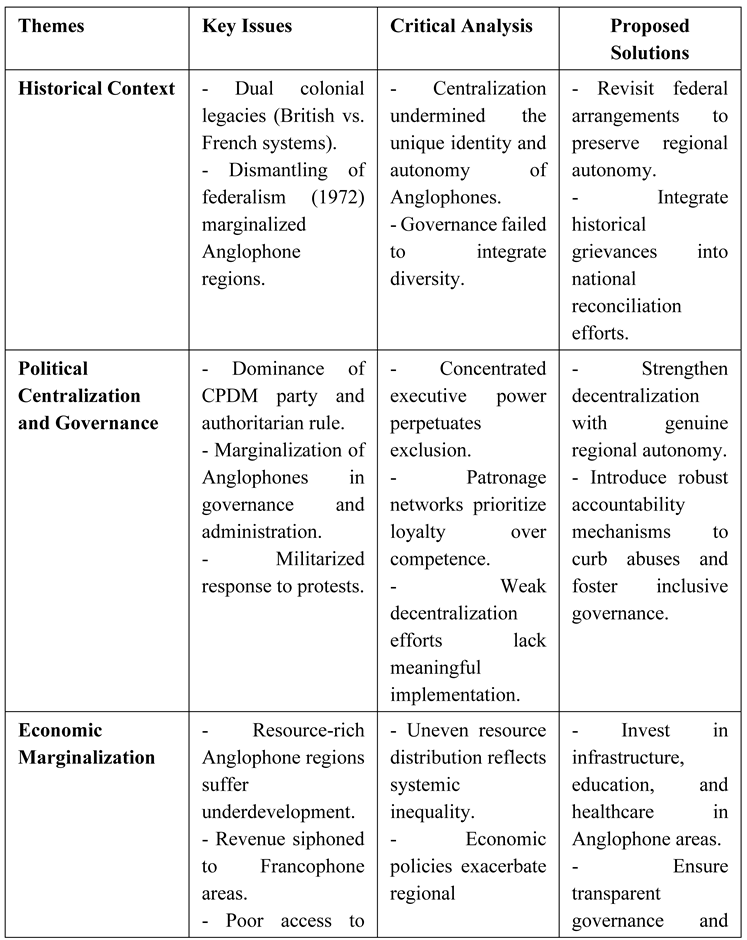
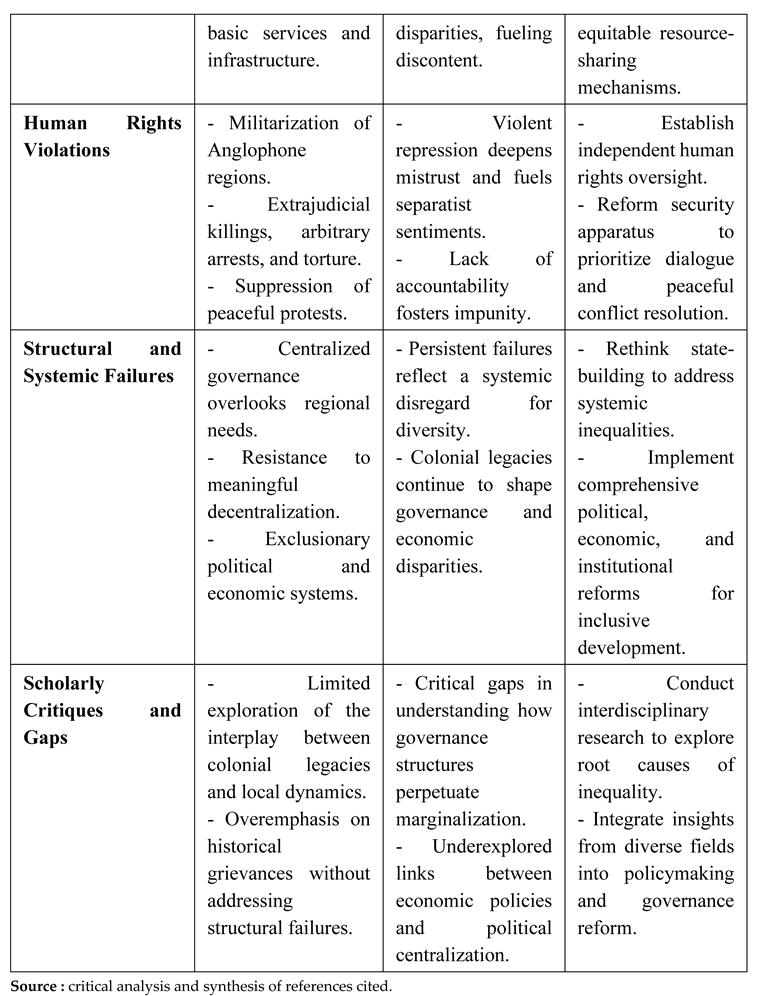
Table 1.
Key Aspects of the Anglophone Crisis in Cameroon.
Table 1.
Key Aspects of the Anglophone Crisis in Cameroon.
The table provides a critical analysis of the Anglophone crisis in Cameroon, examining its historical, political, economic, and governance dimensions. It highlights the roots of the crisis in colonial legacies and the dismantling of federalism, leading to Anglophone marginalization. Key issues include political centralization, economic disparities, human rights violations, and governance failures that have entrenched systemic inequalities. The analysis underscores how authoritarian practices, weak decentralization, and exclusionary policies exacerbate grievances, while the economic exploitation of resource-rich Anglophone regions deepens discontent. Proposed solutions emphasize meaningful decentralization, equitable resource distribution, human rights reforms, and interdisciplinary research to address the crisis’s structural causes and foster sustainable peace.
Identity Politics and the Struggle for Recognition
At the heart of the Anglophone crisis lies a profound struggle for recognition and the preservation of cultural and linguistic identity. Anglophones in Cameroon, particularly those from the Northwest and Southwest regions, have long felt marginalized within the broader Francophone-dominated national framework. Their demands for federalism or even independence are driven by a desire to safeguard their distinct cultural heritage, which they perceive as under threat from the forces of assimilation. This struggle for identity preservation is not unique to Cameroon but reflects broader challenges faced by postcolonial African states, where nation-building efforts often clash with the legacies of arbitrary colonial boundaries that ignored ethnic and linguistic diversity (Yenshu and Ngwa, 2001). The Anglophone crisis, in this sense, represents an attempt to reconcile the modern nation-state with its fragmented, pluralistic social fabric.
The politics of identity in Cameroon is both a symptom of and a driver for the ongoing crisis. The state’s failure to construct an inclusive national identity, particularly one that accommodates the linguistic and cultural diversity of its people than provide fertile ground for division. National unity, as envisaged by the government, has often been framed through the lens of a unilingual, Francophone identity, which has marginalized the Anglophone community. The state’s insistence on the assimilation of Anglophones into a Francophone-dominated system has resulted in a deep sense of alienation, exacerbating ethnic and regional tensions. While existing literature explores identity politics within Cameroon, it often treats it as a static and essentialist concept, rather than a dynamic process shaped by both historical legacies and contemporary forces. For example, how have broader global trends, such as the rise of transnational identity movements, influenced Anglophone separatism? Addressing this question could offer a more nuanced understanding of the Anglophone struggle, placing it within the context of global debates over identity, autonomy, and postcolonial statehood.
Moreover, the role of cultural preservation in conflict resolution has been insufficiently explored in scholarly discourse. Policies that advocate for bilingualism and the promotion of cultural diversity are often put forward as potential solutions to the Anglophone crisis. However, the implementation of these policies has been inconsistent and largely symbolic, rather than substantive. Kouega and Dempowo (2022) critiques the government’s approach to bilingualism, arguing that it is more a matter of political convenience than a genuine effort to foster cultural inclusion. This critique highlights the need for more meaningful reforms that not only promote linguistic diversity but also ensure that the cultural rights of Anglophone communities are respected and protected within the national framework.
The failure of Cameroon’s nation-building project lies in its inability to recognize and integrate the country’s diverse identities. By prioritizing unity over diversity, the state has alienated its Anglophone citizens and driven them to demand recognition through separatist movements. Therefore, resolving the Anglophone crisis requires more than just political or economic solutions; it demands a profound rethinking of the national identity itself, one that embraces the diversity of the country’s peoples. Only through the creation of a genuinely inclusive framework ; one that respects linguistic and cultural differences can address the tensions surrounding identity politics. This approach, however, requires more than symbolic gestures: it necessitates deep structural changes in both governance and public policy to ensure that all citizens, regardless of their linguistic or cultural background, feel recognized and valued in the national project.
Pathways to Resolution: A Critical Appraisal of the Anglophone Crisis in Cameroon
The Anglophone crisis in Cameroon remains a deeply entrenched challenge with historical, political, socio-economic, and cultural roots. Its persistence and complexity underscore the need for a holistic and nuanced approach to resolution, one that extends beyond superficial measures to tackle the fundamental grievances of the Anglophone population and address systemic governance shortcomings. This analysis examines the various proposed pathways to resolution, focusing on their feasibility, limitations, and potential to achieve sustainable peace and national cohesion.
One of the central dimensions of the crisis lies in the historical marginalization of the Anglophone regions. This grievance stems from perceived and actual inequalities in governance and resource allocation following the reunification of the formerly British Southern Cameroons and French Cameroun in 1961. Any pathway to resolution must, therefore, acknowledge and address this historical imbalance. Federalism has frequently been proposed as a viable solution, offering a framework for decentralized governance that respects the unique linguistic, cultural, and administrative characteristics of the Anglophone regions. While federalism promises to empower local governance structures, its implementation requires significant political will and constitutional reforms to ensure equity and fairness for all regions.
A second dimension involves the political and socio-economic exclusion experienced by Anglophones. Long-standing disparities in political representation, infrastructure development, and access to education and healthcare have fueled frustration. Inclusive dialogue, therefore, becomes a cornerstone of any resolution process. Genuine engagement of all stakeholders, including separatist factions, civil society, traditional authorities, and women’s groups, is imperative. However, the dialogue must go beyond symbolic gestures to embrace substantive discussions on decentralization, political participation, and mechanisms for equitable resource distribution.
Economic equity also plays a pivotal role in resolving the crisis. The Anglophone regions, despite their resource wealth, particularly in oil and agricultural sectors, have not enjoyed proportional economic benefits. Transparent resource management and equitable revenue-sharing models can address some of these economic grievances. Furthermore, targeted investments in infrastructure, education, and employment creation in the Anglophone regions can help reduce the socio-economic divide. These measures, however, require robust governance frameworks to combat corruption and inefficiency.
Cultural preservation emerges as another critical pillar for resolution. The unique linguistic and cultural identity of Anglophones is a source of pride and a key aspect of their grievances. Policies that recognize and protect these identities within the framework of national unity can build trust and foster a sense of belonging. The promotion of bilingualism, as enshrined in Cameroon’s constitution, must transition from rhetoric to practical implementation, ensuring that both English and French are equally valued in public life.
Ultimately, the resolution of the Anglophone crisis demands substantial political reform and the establishment of a new social contract built on justice, equity, and inclusivity. While the challenges are formidable, a comprehensive and multi-pronged approach that combines political dialogue, economic reforms, and cultural respect holds the greatest promise for lasting peace. By addressing both the immediate grievances and the underlying systemic issues, Cameroon can begin to navigate its way toward a more unified and equitable future.
Dialogue and Reconciliation
The path to peace in Cameroon lies in inclusive and meaningful dialogue. The role of dialogue in resolving the Anglophone crisis has been extensively discussed in the literature, with most scholars recognizing it as a critical component of the resolution process. However, the practical challenges of facilitating such dialogue are often underestimated. One of the key obstacles to effective dialogue is the lack of trust between the various parties involved, including the government, separatist groups, and civil society organizations. Begealawuh, (2024) emphasize the importance of CSOs in facilitating dialogue, but their capacity is often constrained by limited resources, the repressive political environment, and the lack of political space for open discourse.
To address these challenges, it is essential to strengthen the capacity of CSOs, enabling them to play a more prominent role in fostering dialogue. This could be achieved through capacity-building programs, improved funding, and greater political space for civil society. Additionally, international mediation could play a critical role in building trust and facilitating negotiations. International actors, including the United Nations or regional organizations such as the African Union, could offer impartial platforms for dialogue, mediate between parties, and provide guarantees to ensure that agreements are respected. While international involvement cannot replace domestic ownership of the peace process, it can provide essential support for building trust and creating a conducive environment for negotiations.
Economic Equity
Economic disparity is a central driver of the Anglophone crisis. The Northwest and Southwest regions, despite their resource wealth, have historically been neglected in terms of development and investment. Addressing these economic inequalities requires targeted investments in infrastructure, healthcare, education, and other essential services. However, investments alone are not sufficient; they must be accompanied by systemic reforms to ensure equitable resource distribution. Transparency in resource management is crucial to rebuilding trust between the Anglophone regions and the central government. Without transparency, there is a risk that any economic interventions will be co-opted by corrupt elites, perpetuating the inequalities they seek to address.
One possible solution is the establishment of equitable revenue-sharing mechanisms. The revenues generated from resource-rich areas such as oil and timber in the Anglophone regions should be reinvested into those regions to fund infrastructure projects, improve public services, and reduce poverty. Furthermore, anti-corruption measures must be a central feature of these reforms. Corruption remains one of the most significant barriers to equitable development in Cameroon, and without robust anti-corruption mechanisms, any economic policy is likely to fail. A more transparent and accountable system would not only address economic inequalities but also help restore confidence in the state’s commitment to resolving the Anglophone crisis.
Cultural Preservation
Cultural and linguistic identity plays a central role in the Anglophone struggle. The Anglophone communities in Cameroon have long fought to preserve their unique cultural heritage in the face of perceived assimilation by the Francophone majority. While policies promoting bilingualism and cultural diversity have been introduced, these efforts have often been superficial and insufficient. For instance, bilingualism policies in Cameroon often serve as symbolic gestures rather than substantive reforms. The government must go beyond rhetoric and implement policies that ensure the meaningful coexistence of French and English in education, governance, and public life.
Furthermore, peace education should be integrated into the school curricula to address underlying cultural tensions and promote reconciliation. Mbatna Taiwe (2022) has advocated for the incorporation of peace education into the national curriculum, arguing that this would foster understanding and tolerance among different linguistic and cultural groups. By teaching young people the value of diversity and the importance of peaceful coexistence, Cameroon can lay the foundation for long-term peace and social cohesion.
Resolving the Anglophone crisis is a challenging but necessary task that requires a multifaceted approach. Addressing the historical, political, socio-economic, and cultural dimensions of the crisis will require concerted efforts on the part of both the Cameroonian government and civil society. Decentralization, dialogue, economic equity, and cultural preservation all play crucial roles in creating the conditions for peace. However, these solutions must be implemented with political will, transparency, and a genuine commitment to inclusivity and equity. Only by addressing the root causes of the crisis can Cameroon begin to heal its divisions and build a more peaceful and just society for all its citizens.
Conclusion
The Anglophone crisis in Cameroon serves as a poignant reminder of the deep-seated systemic challenges that have long been embedded within the country's political and social fabric. These challenges rooted in historical injustices, governance failures, economic disparities, and cultural marginalization continue to shape the contemporary realities faced by Anglophone communities. At its core, the crisis underscores the enduring consequences of a historically centralized governance system that has systematically neglected the Anglophone regions, thereby amplifying sentiments of alienation and disenfranchisement. The resulting tensions are not simply a reaction to contemporary political issues, but a manifestation of long-standing grievances that have been exacerbated over time.
Addressing the Anglophone crisis requires a holistic and multifaceted approach that confronts its root causes. This approach must integrate the historical, political, socio-economic, and cultural dimensions of the conflict, while also fostering inclusive governance, equitable development, and the preservation of cultural diversity. A mere surface-level solution will not suffice; instead, a sustained commitment to reforming the political structure, ensuring fair economic redistribution, and upholding cultural autonomy is essential.
Through a critical engagement with existing literature, this essay highlights the complexity of the crisis and stresses the importance of implementing practical, actionable reforms such as decentralization, economic equity, inclusive dialogue, and cultural preservation. Nonetheless, the success of these reforms hinges on a foundation of transparency, accountability, and inclusivity. Without these guiding principles, any attempt to resolve the crisis risks perpetuating the divisions that have fueled it. Thus, only by embracing these values can Cameroon pave the way for lasting peace, national cohesion, and a truly inclusive future for all its citizens, regardless of their linguistic or regional identity.
Title of Research:
The Anglophone Crisis: A Modern Manifestation of Systemic Challenges in Cameroon
Purpose of the Study:
This questionnaire is designed to gather nuanced insights into the socio-political, economic, and cultural dimensions of the Anglophone crisis in Cameroon, with a view to proposing sustainable solutions.
Section A: Participant Information and Consent
1. Participation Consent
◦ I understand the purpose of this study and voluntarily agree to participate.
☐ Yes ☐ No
2. Confidentiality Agreement
◦ I understand that my responses will remain confidential and will be anonymized in published results.
☐ Yes ☐ No
3. Permission for Follow-up (Optional)
◦ I agree to be contacted for further clarification or follow-up questions if needed.
☐ Yes ☐ No
4. Demographics (Optional)
◦ Age: _________________
◦ Gender: _________________
◦ Region of Residence: _________________
◦ Occupation: _________________
Section B: Historical and Sociocultural Dimensions
1. How do you perceive the influence of colonial administrative systems (British/French) on current governance structures in Cameroon?
2. To what extent do you think cultural and linguistic differences contribute to the crisis?
3. In your view, how has the dissolution of federalism affected Anglophone-Francophone relations?
Section C: Political Dynamics and Governance
1. How would you assess the government's approach to decentralization policies?
2. What are your thoughts on the political representation of Anglophones in national governance structures?
3. How do you perceive the role of international organizations in mediating the crisis?
Section D: Economic Disparities and Development
1. How would you describe the economic disparities between Anglophone and Francophone regions?
2. Do you believe resource wealth in Anglophone regions is equitably reinvested? Why or why not?
3. What infrastructure or services do you think require immediate attention in Anglophone areas?
Section E: Human Rights and Security
1. Have you witnessed or heard about human rights violations in the Anglophone regions? If so, please specify.
2. How has the militarization of the crisis impacted daily life and community cohesion?
3. What measures would you recommend to ensure accountability for human rights abuses?
Section F: Solutions and Recommendations
1. What governance reforms do you think are critical for resolving the Anglophone crisis?
2. How can cultural and linguistic diversity be better managed to foster unity in Cameroon?
3. What role should civil society and local leaders play in the resolution of this crisis?
Section G: Feedback and Additional Input
1. Are there any other aspects of the Anglophone crisis that you feel should be addressed in this research?
2. Do you have any recommendations for further studies on this topic?
Ethical Assurance:
This questionnaire adheres to ethical research principles, including voluntary participation, confidentiality, and the right to withdraw at any point. Participants are encouraged to answer honestly, as their perspectives will contribute to scholarly understanding and potential policy interventions.
Researcher Contact Information:
For any inquiries or concerns about this research, please contact:
Nouridin Melo
University of Maroua
nouridinmelo@gmail.com
Thank you for your valuable participation!
References
- AZONGA, T. M. (n.d.). Political communication: The shifting paradigm of Cameroon Anglophone self-expression (1961-2018).
- Bang, H. N. (2024). Displacement-induced destitution in Cameroon: Seeking durable livelihood solutions for internally displaced persons from the Anglophone crisis. Cogent Social Sciences, 10(1), 2411861.
- Bang, H. N., & Balgah, R. A. (2022). The ramification of Cameroon’s Anglophone crisis: Conceptual analysis of a looming “complex disaster emergency”. Journal of International Humanitarian Action, 7(1), 6.
- Begealawuh, N. C. (2024). Missed or misused opportunity? Social cohesion, national dialogue and peacebuilding in Cameroon. African Security Review, 33(4), 497-513.
- Che, C. A. C. (2019). An analysis of decentralisation under the 1996 constitution of Cameroon. University of Pretoria (South Africa).
- EKO, L. (2024). The Anglophone Question. The Anglophone question and postcolonial hegemony in Cameroon: The past that did not pass (pp. 31).
- Fouopi Djiogap, C., Amougou Manga, J. R., Onana, S. P., & Ewolo Bitoto, F. (2024). Does fiscal decentralization improve people's access to health and education services in Cameroon? African Development Review. [CrossRef]
- Identity, C. (2024). Cameroon and the crisis of constitutional identity. Constitutional identity and constitutionalism in Africa (p. 214).
- Konings, P. (2009). Neoliberal bandwagonism: Civil society and the politics of belonging in Anglophone Cameroon. African Books Collective.
- Kouega, J.-P., & Dempowo, S. (2022). The implementation of Cameroon’s French-English official bilingualism policy: The case of the Special Bilingual Education Programme in secondary level education institutions. Open Access Library Journal, 9(1). [CrossRef]
- Lo-oh, J. (2024). Internalised and externalised problems and perspectives for wellbeing during emergency: Reflections on the psychological impacts of the Anglophone crisis in Cameroon. Social Science and Humanities Journal (SSHJ, 8)(12), 6159-6184.
- Mbatna Taiwe, T. A. (2022). Peacebuilding through education: The case of Cameroon's schools amid the Anglophone crisis. Marquette University ePublications. Retrieved from https://epublications.marquette.edu.
- Talla, D. T. (2024). Culture or power: The eruption of the Anglophone crisis in Cameroon (Master's thesis, Portland State University).
- Yenshu Vubo, E., & Ngwa, G. A. (2001). Changing intercommunity relations and the politics of identity in the Northern Mezam area, Cameroon. Cahiers d’études africaines, 161, 163–190
. [CrossRef]
|
Disclaimer/Publisher’s Note: The statements, opinions and data contained in all publications are solely those of the individual author(s) and contributor(s) and not of MDPI and/or the editor(s). MDPI and/or the editor(s) disclaim responsibility for any injury to people or property resulting from any ideas, methods, instructions or products referred to in the content. |
© 2025 by the authors. Licensee MDPI, Basel, Switzerland. This article is an open access article distributed under the terms and conditions of the Creative Commons Attribution (CC BY) license (http://creativecommons.org/licenses/by/4.0/).