

Submitted:
31 December 2024
Posted:
03 January 2025
You are already at the latest version
Abstract
Background/Objectives: There are no empirical data available on non-pathological determinants of the body image (BI) among adult women. The importance of the BI for sense of well-being prompted authors to study its relationships with sociodemographic (age, education level, professional, marital, material status), morphologic (body mass index – BMI) and behavioral (habitual physical activity) variables.. Methods: A cross-sectional study of a cohort of volunteer women was conducted with the one-time measurement of the dependent variables – individual components of the BI – using the standard Body Esteem Scale (BES) questionnaire. Seven hundred and forty respondents participated. Results: The BMI was a factor differentiating all domains BES. Among the analysed sociodemographic variables, intergroup comparisons showed significant effects of education and material status in BES domains: sexual attractiveness and weight concern. The physical condition domain showed differences between categories of professional and material status influenced the domain of physical condition. The level of physical activity differentiated respondents in the domains of weight concern and physical condition. Conclusions: Adult women are generally critical about their BI. A factor that adversely affects BES is excessive BMI. Sociodemographic factors influence the BI to a lesser degree. Physical activity is a strong moderator of physical condition, especially in young women.
Keywords:
body image
; physical activity
; self-esteem
1. Introduction
Body image (BI) is defined as a multidimensional construct concerning the individual perception and attitude towards one’s own body, its physical appearance and functional aspects [1,2]. In other words, it is “the picture we have in our minds of the size, shape, and form of our bodies” [3]. Body image may change with time. At different time intervals, the BI shaping factors, i.e.,: individual, biological, social, cultural or historical; act with different intensity. Due to the multiplicity of factors influencing BI, various conceptualizations of this term have arisen. However, their synthesis allows for the conclusion that BI multidimensionality its concerns perceptual, affective and behavioural aspects [4,5].
Body image reflects attitudes and interactions with others, as well. There is a stereotype of linking physical attractiveness with positive features of a given individual. This stereotype is characteristic not only to the Western culture, but is typical to the whole world [6]. Researchers using a socio-cultural approach explain that it is cultural values that shape the perception of others within the framework of applicable standards of attractiveness and associated expectations. Perception of others influences how individuals perceive themselves [7].
Body image can assume either positive or negative character. When it is positive, an individual appreciates its uniqueness, has feelings for it and respects it [8,9]. At the same time, he or she accepts those aspects that are inconsistent with the socially imposed patterns [10,11,12]. Acceptance of the body is associated with a general self-esteem [13,14,15]. From the perspective of interactions with others, empirical research has shown that people with a positive body image also surround themselves with people who accept their bodies and have a positive attitude towards them [16]. On the other hand, negative body image is associated with mental stress [17]. Its consequences, examined so far, may concern not only a reduced assessment of one’s own physical attractiveness [18] but also a general low self-esteem [19], occurrence of depressive symptoms [20], sexual dysfunctions [21] or eating disorders [19,22,23]. It is assumed that the factors shaping a negative body image arise due to interaction of the individual personality traits with socio-cultural factors [17,24].
Nowadays, a strong pressure on shaping BI is exerted by the media, promoting rather skinny people, which may be a source of problems for those who, according to their perception, differ from the ideals [25,26,27,28,29,30]. Since BI is an element of self-identity, feelings about the body can influence the way individuals think about themselves and their own abilities [31]. It affects self-esteem, quality of life and overall sense of well-being [32,33,34].
The review of the literature indicates a certain orientation of researchers towards the negative aspects of BI, related primarily to various types of diseases, disorders, or unfavorable social conditions. There are no empirical studies on non-pathological BI determinants among adult women. The importance of BI and the complex relationships with the sense of well-being, general functioning as well as quality of life justify the study of BI in the context of sociodemographic (e.g., age, education level, professional, marital, material status) morphologic (e.g., body mass index—BMI) and behavioral (e.g., physical activity) variables.
2. Materials and Methods
2.1. Design
This was a cross-sectional study of s cohort of volunteer women with the one-time measurement of the dependent variables—individual components of the BI—using standardized questionnaire.
2.2. Participants
Seven hundred and forty women aged 18-60 years were examined (mean 27.73 ± 8.66). The respondents were recruited from the Silesian voivodship (southern Poland). The study sample was a sample of convenience—trained recruiters provided proper information for the people from their environment—family, friends, student groups, work-mates, fitness/sport clubs—and asked for their e-mail address. A link to the research questionnaire was sent to those addresses. This procedure ensured two criteria for selection for research: voluntarility and anonymity. The age criterion was dictated by law (legally adult persons). The upper limit, 59 years, was the threshold for the “old age” as defined by WHO. In total, 1012 women were recruited, and 740 questionnaires (73%) meeting the age (mean 27.73 ±8.66, 19-59 years) and completeness criteria were returned. These data were analyzed. All procedures were conducted in accordance to the Declaration of Helsinki as revised in 2013.
2.3. Method
The method used was a questionnaire consisting of a metric part and standardized questionnaires. In the metric part, the subjects reported their age, body height and mass. Based on the given mass and height, the body mass index (BMI) was calculated. Sociodemographic data on education level (basic professional, high school, university), professional status (student, working person, not working), marital status (single, in relationship) and self-assessment of material status (low, average, high) was collected, as well. All these were regarded independent variables.
In the questionnaires part The Body Esteem Scale (BES) [35] was used to study the level of BI-related self-esteem (dependent variable), and The Subjective Experience of Work Load (SEWL) [36,37]—to evaluate the level of physical activity (PA). The BES consists of 35 elements representing the parts and functions of the body. The examined person determines her feelings about them and assigns a score: 1—definitely negative; 2—medium negative; 3—undefined (neither negative nor positive); 4—moderately positive; 5—definitely positive feelings. Individual items are assigned to the following domains: sexual attractiveness, weight concern, physical condition. A domain score is the average of the items assigned to it—the higher the score, the better self-esteem.
The SEWL consists of 16 items. Among them, one is related to the subjects’ work-related physical activity, two are related to the sport physical activity. Depending on the physical effort required for these activities, appropriate points are assigned to them. The remaining closed statements concern the frequency of the physical activity and the assessment of the perceived physical load. The answers assigned to them are scored, and the calculation algorithms allow to present the “amount” of physical activity in the three domains: work-related, sport, leisure time. The summarized score of these three domains represents global habitual PA. Outcomes of the SEWL were also regarded independent variables.
2.4. Statistical Analysis
In some analyses respondents were divided into age groups as follows: 18-29, 30-39, 40-49, and 50-59 years (see Table 3). For PA, a categorization also was performed. Women showing systematic physical activity at least once a week, for at least 1.5 hour, lasting at least one year were considered active. Otherwise they fell into a category: inactive. For BMI, the following categories were distinguished: underweight, normal, overweight, and obese.
Descriptive statistics (numbers, percentages, and medians) were calculated for all variables. Internal consistency of the questionnaires was checked by means of the Cronbach’s alpha coefficients.
Relationships between BES domains and other quantitative variables were checked using Pearson’s correlation coefficient. In one-dimensional analyses, non-parametric statistics were used (Mann-Whitney test and Kruskal-Wallis ANOVA with its own post hoc test). Backward stepwise regression was used for multivariate analyses. The critical p-level was set at 0.05.
3. Results
3.1. Internal Consistency
Results obtained in the individual domains of the BES showed good internal consistency with the following Cronbach’s alpha coefficients: sexual attractiveness—0.83, weight concern—0.91, physical condition—0.91. So were the SEWL questionnaire results with the Cronbach’s alpha of 0.92.
3.2. Body Mass Index
Negative, weak-to-moderate correlations were noted between all individual BES domains and BMI. These tendencies were most clearly visible with in the age groups 18-29, and 30-39 years. The strongest correlations occurred between weight concern and BMI (Table 1, Figure 1).
The performed categorization of BMI returned a number of 51 (6.89%; mean 17.89 ±0.48) of underweight, 572 (77.30%; mean 21.48 ±1.65) of normal, 91 (12.30%; mean 26.99 ±1.45) of overweight, and 26 (3.51%; mean 34.33 ±5.55) of obese women (Kruskal-Wallis ANOVA and all post hoc comparisons p<0.001).
3.3. Sociodemographic Variables
Among the analyzed sociodemographic variables, intergroup comparisons showed that education and material status were factors significantly differentiating sexual attractiveness domain of BES. Differences for the weight concerns domain were revealed only for age categories between the groups of 18-29 and 30-39 years of age. In turn, the outcomes in the physical condition domain showed differences between categories of professional status as well as material status (Table 3).
3.4. Physical Activity
The correlations between individual domains of BES and SEWL questionnaire outcomes were weak-to-moderate, positive and occasionally significant (Table 4). They were mainly visible in the total group of participants, in age category 18-29 years, and in the physical condition domain of BES.
The SEWL-score-based categorization of PA returned a number of 538 (72.70%; mean 9.22 ±1.80) active women and of 202 of (27.30%; mean 7.99 ±1.92) of inactive women (Mann-Whitney test p<0.001). The comparison of the subjects according to the adopted criterion of activity showed differences in weight concern and physical condition domains of BES. They were present in the analysis performed for the total group, as well as in age subgroup 30-39 years. In the subgroup 18-29 years Differences were revealed only in case of the physical condition domain (Table 5, Figure 2).
3.5. Regression Analysis
The backward stepwise regression analysis showed that the strongest predictors for the BES outcome in the sexual attractiveness domain A (R2 = 0.03) were: BMI (ß = -0.14; p <0.001) and education level (ß = 0.12; p <0.01), in the weight concern domain (R2 = 0.19)—BMI (ß = -0.44; p <0.0001) and professional status (ß = 0.11; p <0.05), and finally in the physical condition domain (R2 = 0.11)—BMI (ß = -0.30; p <0.0001), material status (ß = 0.09; p <0.05), professional status (ß = 0.13; p <0.001), and physical activity (ß = 0.26; p <0.0001).This section may be divided by subheadings. It should provide a concise and precise description of the experimental results, their interpretation, as well as the experimental conclusions that can be drawn.
4. Discussion
The analysis of the results indicates a quite critical self-evaluation of BI in the participants group—the medians (Table 2) and the means (Figure 1) ranged between indeterminate and medium-positive. On the one hand, it suggests the factual nature of BI self-evaluation, on the other, it might be regarded a measure of distance from one’s own expectations. This is typical for the most socio-economically developed environments, where the importance of physical appearance is emphasized and the female ideal requires constant work on the body [38,39,40].
There was no difference in sexual attractiveness between active and inactive women (Table 2). Explanations should be sought in historical conditions, primarily regarding social roles [41]. In men, functional aspects of the body related to physical fitness and activity play a much greater role than in women [42]. Researchers interpret it as a legacy of social roles fulfilled for centuries. The role of men was primarily to ensure safety, which in turn depended on physical fitness and activity. Thus, an active and fit man was a more attractive partner. Also today, these attributes are one of the most important motives for male physical activity [43,44]. Historically, the role of women in most cultures was different. The key indicators of sexual attractiveness were and are these areas of the body which are important from reproductive perspective: breasts and abdomen, pelvic region, face [45,46]. From the point of view of reproductive attractiveness, the proportions of the waist and hips as well as the size of the breasts are particularly important in women [47]. This anthropometric data was not collected in the present study. One can only indirectly conclude that these proportions were the most favorable in women with underweight and normal BMI—some studies show that higher BMI is correlated with abdominal obesity [48]. Such a speculation, of course, applies only to one particular aspect of the sexual attractiveness. The differences revealed for sexual attractiveness between categories of BMI constitute a strong argument here (Figure 1).
An interesting observation is the lack of statistically significant correlation between age and sexual attractiveness (p >0.05). Previous reports showed that indicators related to fertility (body shape, facial features, voice height) can largely explain the attractiveness of a woman [49]. It is true that the medians of sexual attractiveness in age groups I and II were slightly higher than in groups III and IV, however, the thesis that age should adversely affect the level of sexual attractiveness was not confirmed in this study. In fact, there is an opinion that physical attractiveness and sexual attractiveness (based to a greater extent on biological basis) are different constructs [50]. This is to some extent consistent with the view that critical BI assessment is most intense in the perimenopause period, and then in the pre- and postmenopausal periods remains almost identical [51]. The explanation can be both changes related to the extension of human life—and thus its all individual stages, as well as the growing influence of extra-biological factors, i.e., the ongoing social and moral changes. Sexual activity is not only used for procreation, it is an element of the current quality of life [52]. This might be confirmed by the effects of education and material status on sexual attractiveness (Table 3 and regression analysis).
Today, weight concern is an important element of BI. As it is known, self-perception is influenced by many factors, including emotional, social, cultural and interpersonal. Nowadays, the media also started to play an important role here, promoting the “perfect body” [53]. Success, health and sexual attractiveness are associated with a slender figure [54]. From the public health perspective, this promotion has both positive and negative consequences. On the one hand, weight concern may be a factor limiting to some extent the global obesity epidemic [55].On the other, especially among young women and girls with a healthy BMI, it may lead to a risky behaviors: excessively restrictive diets, very intense exercise, or even the use of drugs to lose weight [56]. The aforementioned “cult of thinness” is clearly noticeable in all three analyzed BES domains (Figure 1). Along with the increasing BMI the dynamics of the decrease in the BES mean values is different, however, this phenomenon is most clearly visible in case of weight concern domain.
Taking into account the physical activity, differences in weight concern between active and inactive women were noted only in age group II, i.e.,in the fourth decade of life. It seems that in this age range, physical activity is considered by women to be the most effective means of weight control. Comparisons of results obtained in the weight concern domain between categories of the education level, professional, marital and material status, did not show any differences. It should be also noted that of the three BES domains studied, weight concern was the most critically rated which suggests, in many cases, an excessive criticism towards one’s body weight and may be the result of the “cult of thinness” mentioned above. There is an opinion that women are in general more critical of their body weight than men [57]. It should be noted, however, that it does not apply to all ethnic groups and cultures [58,59]. Regression analysis showed that professional status is to some extent the predictor of the weight concern. Presumably, it is related to the professional position of women in the western culture, however, requires further research.
The presented results showed that the physical condition of women underweight and of normal weight is almost at the same level. As BMI increases, it drops sharply, which confirms the known fact that excess body weight has a negative effect on functional capabilities. Taking into account physical activity—differences between active and inactive women were noted for the total group of respondents. However, when individual’s age is taken into account, the effect of activity on physical condition occurred stronger in younger women. This shows that the needs and expectations regarding the physical condition are diminishing with age. It seems, however, that due to the dynamics of social and cultural changes, this problem will require further attention. Previous reports indicate that activity is a factor positively influencing the shape and improvement of BI [60].
Physical condition domain of BES showed significant differences between students and working women. The explanation may be that young women are temporarily overloaded with studies. It limits their possibilities for active lifestyle and thus negatively affects the physical condition. We were able to notice the significant difference between women declaring average and high material status, however, in the light of other studies the relationship between material status and BI is not clear. There are reports indicating that people with a lower financial status are not satisfied with their body figure [61]. There are also works presenting the thesis that dissatisfaction with BI was mostly visible among people declaring higher socio-economic stats [62]. Probably this discrepancy is also due to cultural differences.
Limitations of the study include reduced possibilities of generalization, since the local factors of social, economic, cultural and religious typical for middle European country and possibly influencing the BI should be taken into account. They may work differently in other regions of the world. Moreover the numbers of respondents in the distinguished age, BMI, PA categories was largely uneven, which might have had its effect on statistical analysis. Readers should pay attention to this fact. However, the primary goal was to gather a large cohort of participants, and all categorizations were performed retrospectively, and compared to the primary goal were of second importance.
5. Conclusions
Adult women are generally quite critical about their BI. A crucial factor that adversely affects all three domains of BES is excessive BMI. Sexual attractiveness is related to the level of education, but not related to age and physical activity level. Professional status contributes to some extent to the self-esteem of weight concern and physical condition. Physical activity is a strong moderator of physical condition, especially in young women.
Author Contributions
Conceptualization, A.K., R.P. and R.G.; methodology, A.K. and R.G.; software, R.G.; validation, A.K. and R.G.; formal analysis, R.G.; investigation A.K. and R.P.; resources, R.P.; data curation, R.G.; writing—original draft preparation, A.K., R.P. and R.G.; writing—review and editing, A.K., R.P. and R.G.; visualization, R.G.; supervision, A.K.; project administration, A.K. All authors have read and agreed to the published version of the manuscript.
Funding
This research received no external funding.
Institutional Review Board Statement
The study was conducted in accordance with the Declaration of Helsinki, and approved by the Institutional Ethics Committee of Academy of Physical Education in Katowice (8/2020 25.09.2020).
Informed Consent Statement
Informed consent was obtained from all subjects involved in the study.
Data Availability Statement
Data available on request from the authors.
Conflicts of Interest
The authors declare no conflicts of interest.
Abbreviations
The following abbreviations are used in this manuscript:
| BI | Body Image |
| BMI | Body Mass Index |
| BES | Body Esteem Scale |
| SEWL | Subjective Experience of Work Load |
| PA | Physical Activity |
References
- Abbott, B.D. & Barber B.L. (2011). Differences in functional and aesthetic body image between sedentary girls and girls involved in sports and physical activity: Does sport type make a difference? Psychology of Sport and Exercise 12(3), 333-342. [CrossRef]
- Alleva, J.M. (2017). Shapeshifting: Focusing on body functionality to improve body image. Journal of Aesthetic Nursing, 6(6), 300-301. [CrossRef]
- Jackson, K.L., Janssen, I., Appelhans, B.M., Kazlauskaite, R., Karavolos, K., Dugan, S.A., Avery, E.A., Shipp-Johnson, K.J., Powell, L.H., & Kravitz, H.M. (2014). Body image satisfaction and depression in midlife women: the Study of Women’s Health Across the Nation (SWAN). Archives of Womens Mental Health, 17, 177-187. [CrossRef]
- Cash, T.F., Theriault, J.E., & Annis, N.M. (2004). Body image in an interpersonal context: Adult attachment, fear of intimacy, and social anxiety. Journal of Social and Clinical Psychology, 23, 89-102.
- Krawczyk, R., Menzel, J., & Thompson, J.K. (2012). Methodological issues in the study of body image and appearance. In N. Rumsey & D. Harcourt (Eds.), The Oxford handbook of the psychology of appearance (pp. 605-619). Oxford University Press. [CrossRef]
- Pop, CL. (2017). Physical Activity, Body Image, and Subjective Well-Being. Well-being and Quality of Life—Medical Perspective, Mukadder Mollaoglu, Intech Open. [CrossRef]
- Jackson, L.A. (2004). Physical attractiveness: A sociocultural perspective. In T.F. Cash & T. Pruzinsky (Eds.), Body Images: A handbook of theory, research, and clinical practice (pp. 13-21). Guilford Press.
- Avalos, L., Tylka, T.L., & Wood-Barcalow, N. (2005).The Body Appreciation Scale: Development and psychometric evaluation. Body Image, 2, 285-297. [CrossRef]
- Wood-Barcalow, N.L., Tylka, T.L., & Augustus-Horvath, C.L. (2010).“But I like my body”: Positive body image characteristics and a holistic model for young-adult women. Body Image, 7, 106-116. [CrossRef]
- Tylka, T.L. (2012). Positive psychology perspectives on body image. In T.F. Cash (Ed.). Encyclopedia of body image and human appearance. (vol.2, pp: 657-663). San Diego Academic Press.
- Tylka, T.L., & Wood-Barcalow, N.L. (2015). What is and what is not positive body image? Conceptual foundations and construct definition. Body Image, 14, 118-129. [CrossRef]
- Swami, V., Weis, L., Barron, D., Furnham, A. (2018). Positive body image is positively associated with hedonic (emotional) and eudaimonic (psychological and social) well-being in british adults. The Journal of Social Psychology, 158(5), 541-552. [CrossRef]
- Swami, V., Airs, N., Chouhan, B., Leon, M.A.P., & Towell, T. (2009). Are there ethnic differences in positive body image among female British undergraduates? European Psychologist, 14, 288-296. [CrossRef]
- Swami, V., Campana, A.N., & Coles, R. (2012). Acceptance of cosmetic surgery among British female university students: Are there ethnic differences? European Psychologist, 17, 55-62. [CrossRef]
- Tylka, T.L., & Kroon Van Diest, A.M. (2013).The Intuitive Eating Scale—2: Item refinement and psychometric evaluation with college women and men. Journal of Counseling Psychology, 60, 137-153. [CrossRef]
- Alleva, J.M., Medoch, M.M., Priestley, K., Philippi, J.L., Hamaekers, J., Salvinho, E.N., Sanne, H., Custers, M. (2021). “I appreciate your body, because…” Does promoting positive body image to a friend affect one’s own positive body image? Body image, 3(36), 134-138. [CrossRef]
- Allen, M.S., & Walter, E.E. (2016). Personality and body image: A systematic review. Body Image, 19, 79-88. [CrossRef]
- Bessenoff, G.R. (2006). Can the media affect us? Social comparison, self-discrepancy, and the thin ideal. Psychology of Women Quarterly, 30, 239-251. [CrossRef]
- Johnson, F., & Wardle, J. (2005). Dietary restraint, body image dissatisfaction, and psychological distress: a prospective analysis. Journal of Abnormal Psychology, 114, 119. [CrossRef]
- Przezdziecki, A., Sherman, K. A., Baillie, A., Taylor, A., Foley, E., & Stalgis-Bilinski, K. (2013). My changed body: Breast cancer, body image, distress and self-compassion. Psycho-Oncology, 22, 1872-1879. [CrossRef]
- Woertman, L., & van den Brink, F. (2012). Body image and female sexual functioningand behavior: A review. Journal of Sex Research, 49, 184-211. [CrossRef]
- Levine, M. P., & Piran, N. (2004). The role of body image in the prevention of eating disorders. Body Image 1, 57-70. [CrossRef]
- Menzel, J.E., Schaefer, L.M., Burke, N.L., Mayhew, L.L., Brannick, M.T., & Thompson, J.K. (2010). Appearance-related teasing, body dissatisfaction, and disorder edeating: A meta-analysis. Body Image, 7, 261-270. [CrossRef]
- Dionne, M.M., & Davis, C. (2012). Body image and personality. In T.F. Cash (Ed.). Encyclopedia of body image and human appearance (pp. 136-140). Elsevier.
- Grabe, S., Ward, L.M., & Hyde, J.S. (2008). The role of the media in body image concerns among women: A meta-analysis of experimental and correlational studies. Psychological Bulletin, 134, 460-476. [CrossRef]
- Bell, B.T., & Dittmar, H. (2011). Does media type matter? The role of identification in adolescent girls’ media consumption and the impact of different thin-ideal media on body image. Sex Roles, 65, 478. [CrossRef]
- Ferguson, C.J., Munoz, M.E., Contreras, S., & Velasquez, K. (2011). Mirror, mirror on the wall: peer competition, television influences, and body image dissatisfaction. Journal of Social and Clinical Psychology, 30, 458-483. [CrossRef]
- Levine, M.P., & Chapman, K. (2011). Media influences on body image. In T.F. Cash, & L. Smolak (Eds.). Body Image: A Handbook of science, practice, and prevention (2nd ed., pp. 101-109). Guilford Press.
- McCabe, M.P., & McGreevy, S.J. (2011). Role of media and peers on body change strategies among adult men: is body size important? European Eating Disorders Review, 19, 438-446. [CrossRef]
- Abraczinskas, M., Fisak, B., & Barnes, R.D. (2012). The relation between parental influence, body image, and eating behaviors in a nonclinical female sample. Body Image 9, 93-100. [CrossRef]
- Chrisler, J.C., & Ghiz, L. (1993). Body image issues of older women. Women & Therapy, 14(1), 67-75.
- Mercurio, A.E., & Landry, L.J. (2008). Self-objectification and well-being: The impact of self-objectification on women’s overall sense of self-worth and life satisfaction. Sex Roles, 58, 458-466. [CrossRef]
- Choma, B. L., Shove, C., Busseri, M. A., Sadava, S. W., & Hosker, A. (2009). Assessing the role of body image coping strategies as mediators or moderators of the links between self-objectification, body shame, and well-being. Sex Roles, 61, 699-713. [CrossRef]
- Albawardi, N.M., AlTamimi, A.A., AlMarzooqi, M.A., Alrasheed, L., & Al-Hazzaa, H.M. (2021). Associations of body dissatisfaction with lifestyle behaviors and socio-demographic factors among saudi females attending fitness centers. Frontiers in Psychology, 12, 611472. [CrossRef]
- Mendelson, B.K., Mendelson, M.J., & White, D.R. (2001). Body Esteem Scale for adolescents and adults. Journal of Personality Assessment, 76(1), 90-106. [CrossRef]
- Baecke, J.A., Burema, J., & Frijters, J.E. (1982). A short questionnaire for the measurement of habitual physical activity in epidemiological studies. The American Journal of Clinical Nutrition, 36, 936-42.
- Hertogh, E.M., Monninkhof, E.M., Schouten, E.G. et al. (2008). Validity of the Modified Baecke Questionnaire: comparison with energy expenditure according to the doubly labeled water method. International Journal of Behavioral Nutrition & Physical Activity, 5, 30. [CrossRef]
- Ahern, A.L., Bennett, K.M., Kelly, M., & Hetherington, M.M. (2011). A qualitative exploration of young women’s attitudes towards the thin ideal. Journal of Health Psychology, 16(1),70-9. [CrossRef]
- Swami, V., & Smith, J.-M. (2012). How not to feel good naked? The effects of television programs that use ‘real women’ on female viewers’ body image and mood. Journal of Social and Clinical Psychology, 31, 151-68. [CrossRef]
- Swami, V., Tran, U.S., Stieger, S., Voracek, M. (2015). Associations between women’s body image and happiness: Results of the YouBeauty.com Body Image Survey (YBIS). Journal of Happiness Studies, 16, 705-718. [CrossRef]
- Diekman, A.B., & Goodfiernd, W.(2006). Rolling with the changes: A role congruity perspective on gender norms. Psychology of Women Quarterly. 30, 369-383. [CrossRef]
- Hὂnekopp, J., Rudolph, U., Beier, L., Liebert, A., & Mὕller, C. (2007). Physical attractiveness of face and body as indicators of physical fitness in men. Evolution and Human Behavior, 28, 106-111. [CrossRef]
- Henss, R. (2000). Waist-to-hip ratio and female attractiveness. Evidence from photographic stimuli and methodological considerations. Personality and Individual Diferences 28, 501-513. [CrossRef]
- Agliata, D., & Tantleff-Dunn, S. (2004). The impact of media exposure on males’ body image. Journal of Social and Clinical Psychology, 23, 7-22. [CrossRef]
- Platek, S.M., & Singh, D. (2010). Optimal Waist-to-Hip Ratios in Women Activate Neural Reward Centers in Men. PLoS ONE, 5(2), e9042. [CrossRef]
- Garza, R., Heredia, R.R., Cieslicka, A.B. (2016). Male and Female Perception of Physical Attractiveness: An Eye Movement Study. Evolutionary Psychology, 14(1). [CrossRef]
- Ladabaum, U., Mannalithara, A., Myer, P.A., Singh, G. (2014). Obesity, abdominal obesity, physical activity, and caloric intake in US adults: 1988 to 2010. The American Journal of Medicine, 127(8), 717-727. [CrossRef]
- Feinberg, D.R., Jones, B.C., DeBruine, L.M., Moore, F.R., Law Smith, M.J., Cornwell, E., Tiddeman, B.P., Boothroyd, L.G., & Perrett, D.I. (2005). The voice and face of woman: One ornament that signals quality?, Evolution and Human Behavior,26(5) 398-408. [CrossRef]
- Bovet, J., Barkat-Defradas, M., Durand, V., Faurie, C., & Raymond, M. (2018), Women’s attractiveness is linked to expected age at menopause. Journal of Evolutionary Biology, 31, 229-238. [CrossRef]
- Cutler, W.B., & Genovese, E. (2009). Pheromones, sexual attractiveness and quality of life in menopausal women, Climacteric, 5(2), 112-121. [CrossRef]
- Séjourné. N., Got, F., Solans, C., & Raynal, P. (2019). Body image, satisfaction with sexual life, self-esteem, and anxiodepressive symptoms: A comparative study between premenopausal, perimenopausal, and postmenopausal women. Journal of Women Aging. 31(1), 18-29. [CrossRef]
- Jiannine, L.M. (2018). An investigation of the relationship between physical fitness, self-concept, and sexual functioning. Journal of Education and Health Promotion, 7(1), 57. [CrossRef]
- Graff Low, K., Charanasomboon, S., Brown, C., Hiltunen, G., Long, K., Reinhalter, K., & Jones, H. (2003). Internalization of the thin ideal, weight, and body image concerns. Social Behavior and Personality: An international journal, 31(1), 81-90. [CrossRef]
- Wronka, I., Suliga, E., Pawlińska-Chmara, R. (2013). Perceived and desired body weight among female university students in relation to BMI-based weight status and socio-economic factors. Annals of Agricultural and Environmental Medicine, 20(3), 533-538.
- World Health Organization. (2021). Obesity and overweight. Available online: https://www.who.int/news-room/fact-sheets/detail/obesity-and-overweight.
- Zaborskis, A., Petronyte, G., Sumskas, L., Kuzman, M., & Iannotti, R.J. (2008). Body image and weight control among adolescents in Lithuania, Croatia, and the United States in the context of global obesity. Croatian medical journal, 49(2), 233-242. [CrossRef]
- Park, E. (2011). Overestimation and underestimation: adolescents’ weight perception in comparison to BMI-based weight status and how it varies across socio-demographic factors. Journal of School Health, 81(2), 57-64. [CrossRef]
- Metcalf, P.A., Scragg, R.K.R., Willoughby, P., Finau, S., & Tipene-Leach, D. (2000). Ethnic differences in perceptions of body size in middle-aged European, Maori and Pacific People living in New Zealand. International Journal of Obesity, 24(5), 593-599. [CrossRef]
- Rahman, M., & Berenson, A.B. (2010). Self-perception of weight and its association with weight-related behaviors in young, reproductive-aged women. Obstetrics and gynecology, 116(6), 1274-1280. [CrossRef]
- Hausenblas, A.A., & Fallon, E.A. (2006). Exercise and body image: A meta-analysis, Psychology & Health, 21(1), 33-47. [CrossRef]
- Silva, D.A.S., Nahas, M.V., Sousa, T.F., Del Duca, G.F., & Peres, K.G. (2011). Prevalence and associated factors with body image dissatisfaction among adults in southern Brazil: a population-based study. Body Image, 8, 427-431. [CrossRef]
- Holmqvist, K., & Frisen, A. (2010). Body dissatisfaction across cultures: findings and research problems. European Eat Disorder Reviev 18, 133-146. [CrossRef]
Figure 1.
Body Esteem Scale domains and Body Mass Index (BMI) categories in the total group of respondents.
Figure 1.
Body Esteem Scale domains and Body Mass Index (BMI) categories in the total group of respondents.
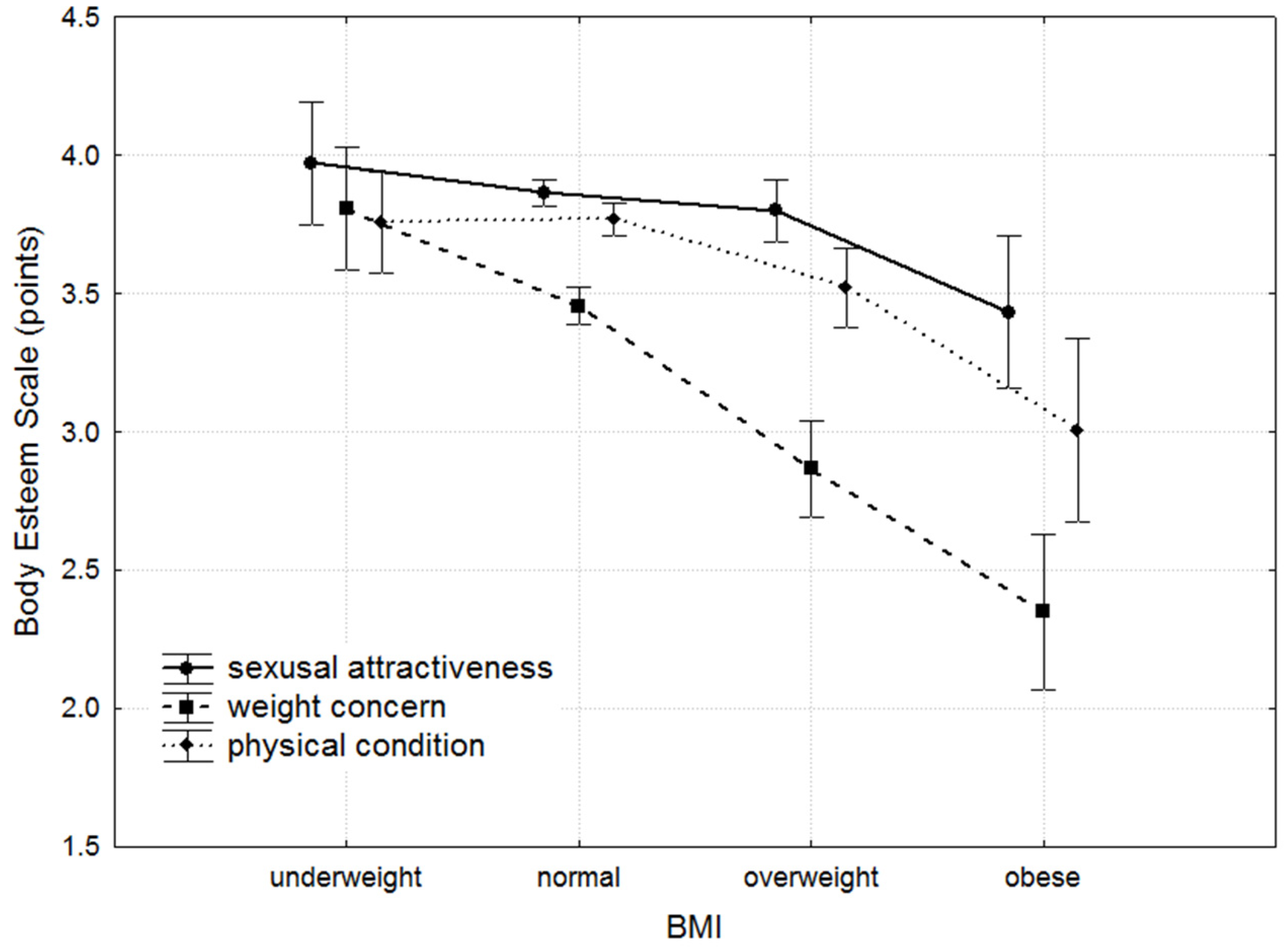
Figure 2.
Body Esteem Scale domains and physical activity categories in the total group of respondents.
Figure 2.
Body Esteem Scale domains and physical activity categories in the total group of respondents.
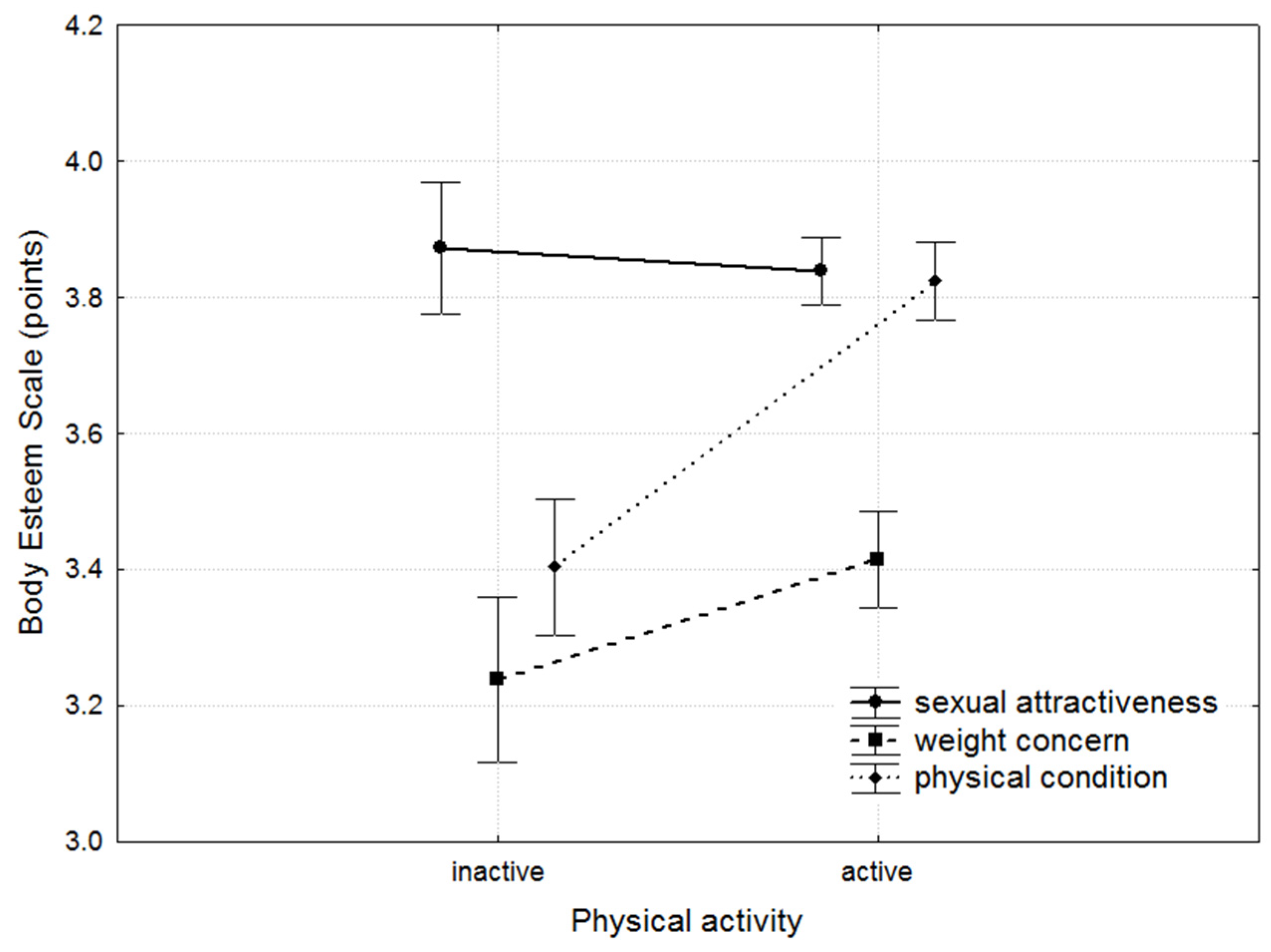

Table 1.
Correlations between Body Esteem Scale domains and Body Mass Index (BMI). Age groups (years) are also considered.
Table 1.
Correlations between Body Esteem Scale domains and Body Mass Index (BMI). Age groups (years) are also considered.
| Variable | Age group | Total | ||||||||
| 18-29 | 30-39 | 40-49 | 50-59 | |||||||
| r | p | r | p | r | p | r | p | r | p | |
| SA | -0.02 | ns | -0.34 | *** | -0.05 | ns | -0.12 | ns | -0.12 | ** |
| WC | -0.42 | *** | -0.54 | *** | -0.30 | * | -0.26 | ns | -0.42 | *** |
| PC | -0.14 | ** | -0.37 | *** | -0.50 | *** | -0.33 | ns | -0.24 | *** |
SA—sexual attractiveness, WC—weight concern; PC—physical condition; r—Pearson’s correlation coefficient; ns—non-significant; *p<0.05; **p<0.01; ***p<0.001.
Table 2.
Body Esteem Scale and Body Mass Index (BMI) categories. Age groups (years) are also considered.
Table 2.
Body Esteem Scale and Body Mass Index (BMI) categories. Age groups (years) are also considered.
| Variable | BMI | Age group | Total | ||||||||
| 18-29 | 30-39 | 40-49 | 50-59 | ||||||||
| Me | p | Me | p | Me | p | Me | p | Me | p | ||
| SA | a: U | 3.85 | 3.54 | 4.62 | 3.69 | 3.85 | |||||
| b: N | 3.92 | 4.08 | 3.62 | 3.85 | 3.92 | ||||||
| c: OV | 3.92 | 3.85 | 3.58 | 3.58 | 3.77 | a-d* | |||||
| d: OB | 3.69 | ns | 3.27 | b-d** | 3.73 | ns | 2.69 | ns | 3.62 | b-d** | |
| WC | a-b* | a-b* | |||||||||
| a: U | 4.00 | a-c** | 3.60 | 4.30 | 3.40 | 4.00 | a-c*** | ||||
| b: N | 3.50 | a-d*** | 3.40 | a-d* | 3.60 | 3.50 | 3.50 | a-d*** | |||
| c: OV | 2.50 | b-c*** | 2.90 | b-c* | 2.85 | 3.60 | 2.80 | b-c*** | |||
| d: OB | 2.20 | b-d* | 2.00 | b-d*** | 3.05 | ns | 2.30 | ns | 2.30 | b-d*** | |
| PC | a: U | 3.67 | 4.50 | 4.33 | 4.22 | 3.78 | |||||
| b: N | 3.89 | 4.00 | 4.00 | 3.78 | 3.89 | a-d*** | |||||
| c: OV | 3.50 | 3.44 | 3.39 | 3.89 | 3.56 | b-c** | |||||
| d: OB | 3.06 | ns | 2.83 | b-d* | 3.50 | ns | 2.83 | ns | 3.17 | b-d*** | |
U—underweight, N—normal, OV—overweight, OB—obese, SA—sexual attractiveness, WC—weight concern; PC—physical condition; Me—median; ns—non-significant; *p<0.05; **p<0.01; ***p<0.001 (post hoc for Kruskal-Wallis ANOVA).
Table 3.
Body Esteem Scale domains and sociodemographic variables.
| Variable | Category | n (%) | SA | WC | PC | |||
| Me | p | Me | p | Me | p | |||
| education level (n=740) |
a:basic professional | 62 (8.38 | 3.54 | a-b*** a-c*** |
3.30 | ns | 3.89 | ns |
| b: high school | 220 (29.73) | 3.92 | 3.50 | 3.67 | ||||
| c: university | 458 (61.89) | 3.92 | 3.40 | 3.78 | ||||
| professional status (n=740) |
d: student | 345 (46.62) | 3.85 | ns | 3.40 | ns | 3.67 | d-e* |
| e: working | 296 (40.00) | 3.85 | 3.50 | 3.89 | ||||
| f:not working | 99 (13.38) | 3.77 | 3.40 | 3.88 | ||||
| marital status (n=656) |
g: single | 174 (26.52) | 3.77 | ns | 3.30 | ns | 3.78 | ns |
| h: in relationship | 482 (73.48) | 3.92 | 3.40 | 3.67 | ||||
| material status (n=581) |
i:low | 160 (27.54) | 3.96 | i-j** | 3.50 | ns | 3.89 | j-k* |
| j: average | 223 (38.38) | 3.77 | 3.40 | 3.67 | ||||
| k: high | 198 (34.08) | 3.92 | 3.60 | 3.89 | ||||
| age (years) (n=740) |
l: 18-29 | 551 (74.46) | 3.92 | 3.50 | 3.78 | |||
| m: 30-39 | 106 (14.32) | 3.85 | 3.10 | 3.67 | ||||
| n: 40-49 | 50 (6.76) | 3.62 | 3.40 | 3.67 | ||||
| o: 50-59 | 33 (4.46) | 3.69 | ns | 3.50 | a-b* | 3.78 | ns | |
SA—sexual attractiveness, WC—weight concern; PC—physical condition; Me—median; ns—non-significant; *p<0.05; **p<0.01; ***p<0.001 (marital status—Mann-Whitney test, other variables—post hoc for Kruskal-Wallis ANOVA).
Table 4.
Body Esteem Scale and physical activity (SEWL total score). Age groups (years) are also considered.
Table 4.
Body Esteem Scale and physical activity (SEWL total score). Age groups (years) are also considered.
| Variable | Age group | Total | ||||||||
| 18-29 | 30-39 | 40-49 | 50-59 | |||||||
| r | p | r | p | r | p | r | p | r | p | |
| SA | 0.13 | ** | 0.02 | ns | 0.16 | ns | 0.35 | * | 0.13 | ** |
| WC | 0.12 | * | 0.09 | ns | 0.20 | ns | 0.16 | ns | 0.13 | ** |
| PC | 0.43 | *** | 0.32 | ** | 0.34 | * | 0.32 | ns | 0.40 | *** |
SA—sexual attractiveness, WC—weight concern; PC—physical condition; r—Pearson’s correlation coefficient; ns—non-significant; *p<0.05; **p<0.01; ***p<0.001.
Table 5.
Body Esteem Scale and physical activity (SEWL categories). Age groups (years) are also considered.
Table 5.
Body Esteem Scale and physical activity (SEWL categories). Age groups (years) are also considered.
| Variable | Activity | Age group | Total | ||||||||
| 18-29 | 30-39 | 40-49 | 50-59 | ||||||||
| Me | p | Me | p | Me | p | Me | p | Me | p | ||
| SA | A | 3.85 | ns | 3.77 | ns | 3.62 | ns | 3.65 | ns | 3.85 | ns |
| IN | 3.92 | 4.00 | 3.62 | 3.69 | 3.92 | ||||||
| WC | A | 3.50 | ns | 3.10 | * | 3.40 | ns | 3.50 | ns | 3.50 | * |
| IN | 3.40 | 3.00 | 3.90 | 3.40 | 3.30 | ||||||
| PC | A | 3.89 | *** | 3.89 | ** | 3.67 | ns | 3.89 | ns | 3.89 | *** |
| IN | 3.33 | 3.33 | 3.67 | 3.33 | 3.33 | ||||||
A—active women, IA—inactive women, SA—sexual attractiveness, WC—weight concern; PC—physical condition; Me—median; ns—non-significant; *p<0.05; **p<0.01; ***p<0.001 (Mann-Whitney test).
Disclaimer/Publisher’s Note: The statements, opinions and data contained in all publications are solely those of the individual author(s) and contributor(s) and not of MDPI and/or the editor(s). MDPI and/or the editor(s) disclaim responsibility for any injury to people or property resulting from any ideas, methods, instructions or products referred to in the content. |
© 2025 by the authors. Licensee MDPI, Basel, Switzerland. This article is an open access article distributed under the terms and conditions of the Creative Commons Attribution (CC BY) license (https://creativecommons.org/licenses/by/4.0/).
Copyright: This open access article is published under a Creative Commons CC BY 4.0 license, which permit the free download, distribution, and reuse, provided that the author and preprint are cited in any reuse.


