

Submitted:
31 December 2024
Posted:
02 January 2025
You are already at the latest version
Abstract
Recurrent pregnancy loss (RPL) is defined as the occurrence of two or more consecutive pregnancy losses before 24 weeks of gestation. It affects 3-5% of women who are attempting to conceive. RPL can stem from a variety of causes and is frequently associated with psychological distress and a diminished quality of life. In contrast, recurrent implantation failure (RIF) refers to the inability to achieve a successful pregnancy after three or more high-quality embryo transfers or at least two instances of egg donation. RIF shares several causative factors with RPL. The immunological underpinnings of these conditions involve alterations in uterine NK cells, a reduction in M2 macrophages and myeloid-derived suppressor cells, an increased Th1/Th2 ratio, a decreased Treg/Th17 ratio, the presence of shared ≥3 HLA alleles between partners, and auto-immune disorders. Various therapeutic approaches have been employed to address these immunological concerns, achieving varying degrees of success, although some therapies remain contentious within the medical community. This review intends to explore the immunological factors implicated in RPL and RIF and to analyze the immunological treatments employed for these conditions, which may include steroids, intravenous immunoglobulins, calcineurin inhibitors, anti-TNF antibodies, intralipid infusions, granulocyte colony-stimulating factor, and lymphocyte immunotherapy
Keywords:
recurrent pregnancy loss
; recurrent implantation failure
; NK cells
; T regulatory cells
; Th17
; Th1
; Th2
; macrophages
; cytokines
; HLA
1. Introduction
Recurrent pregnancy loss (RPL) or recurrent spontaneous abortion (RSA) is defined as two or more consecutive pregnancy losses before 20 weeks (or 24) of gestation defined by the American College of Obstetrics and Gynecology and ESHRE Guideline Group on RPL, and three or more losses by the World Health Organization [1,2,3,4]. It affects approximately 3 - 5% of women trying to conceive [1,2,3,4]. RPL can be primary, patients with no successful pregnancy, or secondary, unsuccessful pregnancies after a successful one [1,2,3,4]. The likelihood of a successful pregnancy depends on maternal age and the number of previous losses [1,2,3,4]. The pathophysiology of RPL is complex and involves maternal and fetal factors, possibly with more than one underlying factor [1]. There are many causes of RPL: endocrine dysfunctions, uterine pathologies (uterus malformation, polyps, myomas, and adhesions), hydrosalpinx (accumulation of fluid in the fallopian tube), chromosomal abnormalities (quality of embryos), endometrial dysfunction, endometriosis, thrombophilia, chronic stress, high body mass index, male factor (sperm quality), infections, as well as immunological factors [5,6,7,8,9]. RPL, like other pregnancy disorders, is characterized by a loss of maternal-fetal immune tolerance [10]. The pathogenesis of RPL is unknown in almost 50% of women, and the condition is termed ‘idiopathic’ [11].
Recurrent implantation failure (RIF) refers to the unsuccessful implantation of three or more high-quality embryos or at least two egg donations [12]. Some causes of RIF are similar to those of RPL [12]. There are several risk factors for RIF, including advanced maternal age, smoking status of both parents, elevated body mass index, stress levels, vaginal microbiome dysbiosis, immunological factors (such as cytokine levels and autoantibodies), chronic endometritis (infection of the endometrium), hydrosalpinx, uterine polyps, myomas, congenital anatomical anomalies of the uterus, quality of sperm and embryos (genetic and epigenetic factors), endometrial receptivity, vitamin D deficiency, and genetic polymorphisms (HLA-G, p53, VEGF) [12,13,14,15,16,17,18,19]. miRNA, and long-non-coding RNA (lcnRNA) have also been involved [20,21,22].
The immune system plays an essential role in normal implantation, maternal-placental fetal crosstalk, and embryo development [23]; thus, immunological alterations can be responsible for RPL and RIF. The local immune response can also be impaired by vaginal dysbiosis (VD). VB has been involved in several pregnancy complications, such as miscarriage, preterm birth, and adverse outcomes in vitro fertilization (IVF) [16,23,24,25,26]. A non-Lactobacillus dominant microbiota in the endometrium was associated with reduced embryo implantation rate, pregnancy/continued pregnancy, and live birth rate [16,23,24,25,26].
It is important to note that RPL is linked to an increased risk of various medical conditions observed during pregnancy in those women who have conceived spontaneously [5]. These conditions include gestational diabetes, preeclampsia, placenta previa, placental abruption, miscarriage, preterm birth, cesarean section, perinatal death, and admission to the neonatal intensive care unit [27,28]. RPL is also a predictor of long-term cardiovascular disease and venous thromboembolism. Research has shown that patients with implantation failure have a significantly higher risk of early spontaneous abortion compared to those who have had successful implantations [29]. Despite the use of euploid blastocysts, the live birth rate per embryo transfer is generally reported to be around 50-60% [30].
RPL is also associated with psychological morbidity, poor quality of life of the affected couple, and a higher rate of marital problems [31] since it is highly frustrating to both couples and clinicians [32]. Psychological consequences of abortion are not exclusive to one of the partners and include increased anxiety, depression, post-traumatic stress disorder, and suicide [33,34]. This psychological condition may affect hormonal and circadian rhythm and immune response [35].
This review explores the contribution of various immunological factors to RPL and RIF and discusses immunological interventions that may be employed in managing these conditions.
2. Innate Immune Response in RPL and RIF
2.1. Natural Killer (NK) Cells.
NK cells are large and granulate lymphocytes without antigen T cell receptor (TCR) or B cell receptor (BCR) [36,37]. There are two different types of NK cells: CD56dim/CD 16+ (pNK) and CD56bright/CD16- (uNK) [36]. pNKs are found in peripheral blood and are the most cytotoxic of the two, unlike uNK, which are present in the uterus, produce more cytokines, and have regulatory functions [36,37]. Endometrial eNK and decidual dNK cells are also present [36]. The different subpopulations differ in their immune regulatory activity [36]. The eNK cells constitute 30% of the total endometrial lymphocyte population before pregnancy, while dNK cells are up to 70% of the total lymphocytes of the decidual. dNK cells produce angiopoietin-2, placental growth factor, and vascular endothelial growth factor, expressing NKD2G, NKp44, NKp46, and NKp30 [36,37,38].
Abnormalities in NK cell activity were observed in most patients with RPL. Peripheral blood NK cell levels significantly increase in women with RPL compared to controls [36,38,39]. Peripheral blood NK cell quantity was considerably higher in women with RIF (>18 % of the lymphocyte count) than in fertile controls, activated considerably NK cells (CD56dim/CD69+) [39,40]. In women with RPL, there are higher numbers of the cytotoxic CD56dim subtype and fewer CD56 bright cells, even if the total cell population is unchanged [36,41]. The activation level of peripheral blood NK cells (CD69+) can predict pregnancy outcomes [42,43,44,45]. Type 1 cytokines such as IL-1, IL-2, and TNFα increase the expression of CD16 on uNK cells and induce cytotoxicity against the trophoblast [46]. Both non-pregnant fertile and normal pregnant women had significantly lower NK cytotoxic responses, measured by flow cytometry at an effector-to-target cell ratio (E:T) of 50:1 compared to women with RPL and RIF [47].
Several studies have indicated an association between an increased population of uterine uNK cells in RPL and RIF [48,49]. A significantly higher frequency of endometrial CD56+ cells was reported in the mid-luteal phase of women with idiopathic RIF [48,499]. However, other studies show no correlation between uNK cell count and RPL pathology [50].
It is generally assumed that in RPL, there is an uncontrolled NK cell endometrial recruitment and/or failed CD56dim cell conversion to the less cytotoxic CD56bright cells may occur in women with RPL [36,51]. However, a meta-analysis that evaluated uNK cells showed no significant difference in women with RPL compared to controls [52]. CD16-CD56bright NK cell subset, predominant in normal decidua and endometrium, was significantly decreased in favor of an essential contingent of CD16+CD56dim NK cells in RPL patients [53]. Noteworthy, the percentages of CD56+ cells and CD16+CD56+ cells in the peripheral blood on the day of embryo transfer were significantly higher in the failed group than in the implanted group of infertile women who underwent IVF after intravenous immunoglobulin treatment [54]. In the endometrium, the increase in the percentage of CD16+CD56dim cells and the decrease of CD16-CD56bright cells in the aborted group were significant compared to those of the delivered group [55]. Strobel et al. [56] showed that patients with secondary RPL had lower numbers of circulating CD56dimCD16brightNKG2D+ and CD56dimCD16brightNKp46+ than controls, suggesting that cytotoxicity receptors are also crucial in the process.
In non-pregnant women with idiopathic RPL or implantation failures, there is an increase of intracellular IFN-γ/TNF-α (defined as NK1 or inflammatory) and a decrease of IL-4/IL-10 (defined as NK2 or anti-inflammatory) in CD56brightpNK cells [57]. Pregnant women with recurrent miscarriages had a higher NK1/NK2 ratio, indicating a pro-inflammatory environment in the endometrium, which is detrimental to pregnancy [6,38]. Also, an increase in NK-CD8 expression (>60%) was predictive of IVF failures, while a decrease in expression (<40%) was significantly predictive of subsequent pregnancy failure [43]. Higher expression levels of NK-CD8+ were associated with elevated NK frequency, NK cytotoxicity levels, and CD158a expression in NK cells [43]. In women with RPL or implantation failure, the expression of natural cytotoxicity receptors (NKp46, NKp44, NKp30) and a2V-ATPase on CD56bright NK cells was significantly up-regulated compared to that of CD56dim NK cells [57]. The differential expression of natural cytotoxicity receptors and a2V-ATPase in NK cell subsets may suggest dysregulation of NK cytotoxicity and cytokine production in women with RPL and implantation failure [57].
Proper interaction between maternal KIR and their HLA class I, expressed by the extravillous trophoblast cells, is crucial for the implantation and remodeling of uterine spiral arterioles [58]. Polymorphisms of KIR and HLA affect NK cell reactivity and susceptibility to recurrent miscarriage and preeclampsia. KIR 2DL2 expression is increased in RPL patients [59], and the association was stronger when there was an increased HLA-C2 allele frequency [60]. In a meta-analysis, KIR2DS2 and KIR2DS3 were significant risk factors for RPL, whereas the inhibitory gene KIR3DL1 was a protective factor [61]. A high frequency of KIR AA haplotypes that lack activating KIR was found in women with RPL [62,63,64,65]. Moreover, patients with a KIR AA haplotype had significantly more risk of miscarriage if they underwent an IVF procedure compared to those who spontaneously achieved pregnancy [66]. The presence of HLA C2C2 in the fetus and the KIR AA haplotypes in the mother correlate with implantation failure, recurrent miscarriage, and preeclampsia [61]. The balance of all activating and inhibiting signals between NK cells in the decidua and trophoblast is an essential factor and may influence embryo implantation [66]. In another study, KIR A haplotype carriers experienced fewer pregnancy losses than KIR B haplotype carriers after euploid single-embryo transfer. However, this risk was modified when HLA-C alleles were present in the embryo. High-risk combinations (KIR A + homozygous C2 and KIR B + homozygous C1) resulted in a 51% increased risk of loss over all other combinations [67].
NKT cells, which express CD3 and CD56 markers, are increased in RPL [66]. Also, Tγδ cells may play a role in the process, as described by Xu and coworkers 2021 [68]. These cells were shown to produce IL-10 upon stimulation with chorionic gonadotrophin Li et al. 2024 [69]. However, the role of NKT and Tγδ cells in RIF and RPL is still unknown based on the complexity of the different possible subpopulations and the small number of circulating cells. More research is needed in this area.
2.2. Macrophages and Dendritic Cells
During pregnancy, macrophages and Treg cells maintain immune tolerance between the mother and fetus. Macrophages can change the decidual microenvironment in ways that contribute to RIF and RPL [70]. Two subpopulations of macrophages have been described: M1 (classically activated, induces inflammation and activates immunity) and M2 (alternatively activated, suppresses inflammation). M2 macrophages are abundant in the endometrium during the luteal phase and in healthy pregnancies. An M1/M2 macrophage ratio imbalance can lead to complications like preeclampsia, intrauterine growth restriction, RPL, and RIF [70,71,72,73,74]. In patients with unexplained RPL, macrophages in the decidua show higher expression of CD80 and CD86 (costimulatory molecules) and lower expression of IL-10 compared to controls. Treg cells can inhibit the expression of CD80, CD86, and IFNγ in macrophages while increasing the expression of IL-10 [74]. Macrophages (labeled with CD14) in the endometrium were significantly more abundant in patients with RPL than in controls [74,75,76,77]. In patients with RIF, the presence of diffuse adenomyosis (endometrial tissue in the myometrium) was associated with a marked increase in the density of macrophages and natural killer cells in the endometrial stroma compared to women with mild focal adenomyosis or no disease [77].
Dendritic cells (DC) play a crucial role in embryo implantation by regulating the immune response and aiding tissue remodeling [78,79]. They exhibit a tolerogenic phenotype and produce indoleamine 2,3-dioxygenase, which boosts the number of Treg cells while reducing Th1 cell survival and the cytotoxic activity of CD8+ T cells [78,79]. CD80/86 complexes on DCs in the uterus are downregulated and lead to the unresponsiveness of T cells, resulting in immune tolerance of the fetus. During implantation, artificial depletion of DCs, or high inflammatory milieu, is associated with implantation failure [78,79]. A lower frequency of ILT4+ DCs was observed in the peripheral blood and endometrium of patients with RIF or RPL compared to the fertile control group [80]. Also, plasmacytoid dendritic cells were reduced in the decidual and peripheral blood of patients with RPL [81]. On the other hand, total DC and myeloid DC in peripheral blood were higher in patients with RPL than controls [82]. In another study, there was no difference in peripheral DC between RPL patients and control in the first trimester of pregnancy [83].
2.3. Polymorphonuclear Cells.
Endometrial mast cells are essential components of tissular immune cells and play a role in endometrial tissue physiology and physiopathology [84,85]. Mast cells interact with macrophages in the female reproductive system [86]. Its presence is increased when RPL is activated [87] and is highly responsive to estrogen in endometriosis [88]. Recently, since macrophage-colony stimulating factor 1 receptor (CSF1R) and mast/stem cell growth factor receptor KIT (KIT) are overexpressed in endometriotic lesions, treatment with pexidartinib, a tyrosine kinase inhibitor, decreased inflammation in endometrial tissue [89].
Eosinophils are scarcely present in the normal endometrium; however, they are present in endometriosis and involved in tissue repair and remodeling [90]. The migration of eosinophils is then due to the increase in eotaxin [91]. Chemokine is also present in the inflammatory profile of menstrual effluent [92], suggesting that eosinophils probably migrate to the tissue for a short time during the normal hormonal cycle. Its role in RIF and RPL is not well known.
Neutrophils are absent in the normal endometrium except during menstruation [93]. However, they can be recruited under inflammatory conditions (infections, injuries), with increased chemokines and IL-17 affecting the endometrial tissue, hampering implantation, fetal survival, and preeclampsia/eclampsia [94].
2.4. T Cells
T lymphocytes are a crucial element of adaptive immunity. Both subpopulations, T helper (CD3+/CD4+) cells and T cytotoxic/suppressor (CD3+/CD8+) cells, play an essential role in fetal antigen recognition and modulation of local immunity [11]. The balance between Th1, Th2, and Th3 guides immune responses during pregnancy [36,38,41].
The proportion of CD8+ T lymphocytes in the endometrium was significantly reduced in patients with RPL, and the CD4+:CD8+ ratio increased [53]. Conversely, the percentage of CD8+ T cells in peripheral blood was notably higher in women with RPL compared to the control group. The CD4+/CD8+ ratio was lower in women with RPL than in their healthy counterparts [95]. Furthermore, the total proportion of decidual effector memory CD8+ cells lacking PD-1 expression was elevated in cases of miscarriage [96].
Women with recurrent miscarriages had significantly higher absolute counts of central memory CD4+ T-cells and CD8+DR+ T-cells (activated cytotoxic cells) [97]. The frequency of NKG2D+ γδ-T cells in lymphocytes was negatively correlated with the live birth rate in patients with RIF [98]. In a genetic study, the RIF group had a higher proportion of activated memory CD4+ T cells and a lower proportion of γδ T cells in the endometrium [99].
Women experiencing recurrent pregnancy loss (RPL) exhibited a higher frequency of the variable TCR beta (BV)-chain 19 of T-cell receptors and a lower frequency of BV5.2 compared to the control group. This observation suggests that the specific skewed usage of TCR-BV may be associated with an increased susceptibility to RPL [100].
Regulatory T cells (Treg), CD4+ CD25+ Foxp3+, have essential roles in the uterus, particularly during the peri-implantation period, and they are associated with the anti-inflammatory transition required for embryo receptivity [101]. Treg cells in the decidua and peripheral blood in unexplained RPL patients were statistically lower than those in control women [88,89], which may induce maternal lymphocyte activation to the fetal allograft [99,100,101]. Therefore, deficits in the number and/or function of Treg cells have been documented in cases of miscarriage and unexplained RPL [101,102,103,104,105]. Fewer Treg cells are associated with implantation failure [87,92] and have an altered phenotype in RPL and RIF [106,107,108]. Thus, CD4+ CD25+ Foxp3+ T regulatory cells may serve as a superior pregnancy marker for assessing miscarriage risk in pregnant women [109].
In decidual tissues from human miscarriage, the mRNA expression of CD28 is increased, while the expression of CTLA-4 mRNA (the checkpoint marker) is decreased. Therefore, the ratios of CTLA-4+/CD28+ in miscarriage were significantly lower than in normal pregnancy, both in peripheral blood and the decidua [110].
The balance between Th17 cells and Treg cells is believed to be crucial for pregnancy outcomes. Patients with unexplained RPL have higher levels of Th17 cells that secrete IL-17, GM-CSF, IL-21, and IL-22 in their peripheral blood and decidua [111,112]. There is a link between the elevated Th17 cells and decreased CD4+ CD25+ Treg cells, which could contribute to developing unexplained RPL [102,107,108,109,111,112] and in RIF patients [113,114]. The FoxP3/ RORγt ratio in fertile women is higher than in RIF patients [114].
Patients with RPL and positive anti-thyroid peroxidase (anti-TPO) antibodies showed a higher Th17 frequency than healthy controls and anti-TPO + controls groups [1115]. The PD-1+Th1 and PD-1+ Th17 cells are significantly lower in the RPL group than in controls, indicating a potential increase in Th1 and Th17 activity in women with RPL [116].
Wang and coworkers [117] reviewed the different T cell populations, including Th9, Th22, and T follicular cells (Tf), that were not discussed before. Th9 is along Th2 and is essential in providing a tolerogenic milieu for the implantation phase [117]. Th22 protects trophoblasts from infections but also enhances trophoblast survival [117]. The role of Tf cells is partially known since the regulatory Tf helpers have been proposed to aid in implantation and pregnancy. Still, the role of the other subpopulations is not well described in humans. In summary, the cytokines produced in the endometrial microenvironment during implantation and the decidua formation are crucial for zygote survival. More research is required to understand the process of implantation.
2.5. B Cells
The role of B lymphocytes in RPL has been less studied. B cells are believed to contribute to the success of pregnancy by decreasing the secretion of poly-reactive natural antibodies and producing protective blocking asymmetric antibodies [11]. A decreased protective IgG maternal cytotoxic antibodies have been linked to RPL [118,119]. Additionally, anti-phospholipid antibodies are associated with RPL and preeclampsia [120]. Antibodies from women with RPL recognize specific endometrial antigens, which is not observed in normal multiparous women [119,120]. For more information, please refer to the autoimmunity section. On the other hand, B lymphocytes (CD20+) were increased in the endometrium of patients with RPL [53,121], and infertile patients have significantly decreased CD27+ B-cells in peripheral blood [121,122].
B cells have been associated with RPL [123]. However, the mechanism by which B cells are increased in the endometrium and peripheral blood of RPL is unknown. A decreased number of IL-10-positive B cells in the endometrial cavity has been related to RPL [123,124]. Even though IL-10 secretion in the endometrium may be protective for the fetus, there are still questions about the role of B1 and B2 cells in normal pregnancy and RPL [123]. B1 cells are usually protective in tissue-producing IgM, while B2 cells are peripheral B cells that generate IgG and IgE antibodies [123]. The changes in B cell populations in the endometrial cavity may also be critical in producing deleterious antibodies to the fetus [123]. B cells may also present T-cell antigens, generating an allogeneic response. In summary, many of the functions of B cells in the endometrial cavity are unknown; however, they may become an interesting pharmacological target to increase fertility and pregnancy success.
2.6. Myeloid Suppressor Cells.
Myeloid-derived suppressor cells (MDSCs) are a diverse group of cells of myeloid origin with an immature state and immunosuppressive function. There are two groups of MDSCs: monocytic MDSCs (M-MDSCs) expressing CD33+HLA-DR-/lowCD11b+CD14+CD15- and polymorphonuclear MDSCs (PMN-MDSCs) expressing CD33+HLA-DR-/lowCD11b+CD14-CD15+ [125]. MDSCs increase in the uterus and peripheral blood during gestation [125]. In humans, PMN-MDSCs accumulate in the peripheral circulation of healthy pregnant women compared to non-pregnant controls [126,127]. In addition, in the peripheral blood of pregnant women, M-MDSCs were elevated [128]. On the contrary, in patients with RPL, MDSCs are reduced in the decidua and peripheral blood [126] and the progesterone response [129]. Besides, patients with RIF showed significant reductions in blood PMN-MDSCs and M-MDSCs [130]. However, other authors found an increase of M-MDSCs in the peripheral blood of patients with RIF or RPL compared to controls and a negative correlation between M-MDSCs and Treg in patients with RIF [131,132]. The screening by flow cytometry of these cell populations is not routinary in RPL patients; however, it may be recommended to include the analysis of peripheral blood cells as T regulatory cells, Th17, and NK cells [132]. If possible, confirm the presence of the cells in local tissue.
3. Cytokines
Dysregulation of the interleukin network jeopardizes implantation, leading to RIF [133]. The overexpression of TNF-α and NF-κB also adversely affects implantation and leads to RIF. High ratios of IFNγ/IL-4, IFN-γ/IL-10, and IFN-γ/TGFβ have been observed in RIF and associated with adverse outcomes of implantation [133,134,135]. TH1-type (TNF-α, IFN-γ, IL-2) immunity to the trophoblast seems to be associated with unexplained recurrent abortion. It may play a role in reproductive failure, whereas T-helper 2 (TH 2, IL-4, IL-5)-type immunity may be a natural response to the trophoblast contributing to a successful pregnancy [117,133,134,135,136,137,138]. In the peripheral blood and decidua of patients with RPL, the secretion of type-2 cytokines decreases [139]. Similarly, the Th1/Th2 cytokine ratio is significantly higher in women with RIF than healthy ones [136,140].
In previous studies, elevated levels of Th17/Treg ratios were reported during the implantation window in patients with RPL [141]. We observed increased serum levels IL-17 in patients with RPL compared to control [103]. Additionally, high levels of IL-1β were observed in the uterine fluid of patients with RIF compared to fertile controls. At the same time, concentrations of IFN-γ and IL-10 were significantly lower [142]. Furthermore, IL-10 and TGF-β secretion were markedly lower in RIF patients, while IL-17 and IL-23 secretion were considerably higher in these patients than controls [143]. Also, IL1-β, IL-6, IL-17, TNF-α, and the frequency of Th17 cells were increased in RIF patients with metabolic syndrome compared to RIF women without MS and the control group [144]. Endometrial stromal cells and whole endometrial cells of normal fertile women produced higher levels of IL-6, IL-8, and TGF-β than the RIF group. Additionally, endometrial stromal cells of normal fertile women produced lower levels of IL-10 compared to the RIF group [114,133].
Patients with RPL were found to have lower levels of IL-22 in the uterine decidua, which may contribute to a disruption of decidual homeostasis and ultimately lead to early pregnancy loss [145]. Similarly, the expression of IL-27 was lower in patients with RPL deciduas than in control subjects. IL-27 inhibited IL-17 expression and enhanced IL-10 expression dose-dependently [146]. Gene polymorphisms of IL-17 and IL-27 have also been associated with preeclampsia [147].
A study by Zhao et al. [148] found that Serum IL-33 and soluble IL-33 receptor ST2 concentrations were higher in women with RPL. This suggests that these biomarkers could be used to predict and treat RPL. Additionally, research by Yue et al. [149] showed that levels of serum IL-35 were significantly lower in women with RPL compared to those in early normal pregnancy.
Leukemia inhibitor factor (LIF) plays a vital role in various physiological processes during pregnancy, and its decrease is associated with RIF, as highlighted in a review by Mrozikiewicz et al. [17]. Similarly, LIF expression was altered in women with RPL, as reported by Karaer et al. [150].
A study conducted by Raghupathy et al. [151] demonstrated that ex vivo exposure to progesterone-induced blocking factor (PIBF) significantly increased the production of type 2 cytokines IL-4, IL-6, and IL-10 in lymphocytes from the RPL as compared with IL-4 and IL-10 in lymphocytes from healthy pregnant women without affecting type 1 cytokine levels. PIBF decreased the type 1:type 2 cytokine ratio, indicating a shift towards a Th2 bias [151]. PIBF did not influence cytokine production in non-pregnant women, highlighting its role in inducing a type 1 to type 2 cytokine shift in pregnancy. Moreover, Kashyap and coworkers [152] showed that the levels of PIBF were reduced in women with RPL probably due to a decreased transcription of progesterone receptor isoform B. Probably the down-regulation of the receptors does not only affect the cytokine ratio Th2/Th1 but also can affect other immune cells as NK cells; more research is required in this topic.
Data analysis using PCR array found significantly higher expression of various cytokines and related factors (IL-6, IFN-γ, IL17A, IL23A, IFN-α1, IFN-β1, CD40 L, CCR4, CCR5, CCR6, CXR3, CCL2, IL2, TLR4, IRF3, STAT3, RAG1, IFNAR1) in women with unexplained RIF compared to controls [153]. The study found lower expression of other factors (IL1β, IL8, NFkB, HLA-A, HLA-E, CD80, CD40) in the unexplained RIF group compared to controls [153]. The authors concluded that the inflammatory responses based on pNK cells, the Th17 signaling pathway, and the TLR signaling pathway are activated in RIF [153]. Other factors may also be involved in the process since local secretion of cytokines involves not only stromal cells, lymphocytes, and epithelial cells. Moreover, the impact of local microbiota can also affect cytokine secretion [26].
4. HLA in RPL and RIF
Haplotype analysis revealed that couples dealing with RPL had a significantly higher level of sharing MHC fragments among partners than control families [154,155,156,157]. In the Chinese population, the DQB1*0604/0605 allele may confer susceptibility to unexplained RPL, while the DQB1 * 0501/0502 allele may protect women from it [157]. Nevertheless, it has been found that a high rate (3 or more) of HLA gene loci sharing (HLA-A, B, C, DR, DQ) in couples is associated with RIF [155,156,157,158,159,160].
Killing inhibitory receptors (KIR) are critical in several pathologies. When the receptors bind the counterpart HLA ligand, a cytotoxic response may be decreased (L long KIRL) compared to others that may activate the cells (S short KIRS) [161]. Decreased ligands for inhibitory KIRs could lead to insufficient inhibition of maternal uterine NK cells toward the trophoblast, thereby contributing to the pathogenesis of RPL [65,161,162]. The authors showed [162] that KIR 2DL2 (an inhibitory KIR) positive Caucasian women with RPL and their partners had lower allele frequencies of HLA-C1 (the ligand for KIR2DL2) and a higher frequency of HLAC2 (ligand for another KIR receptor) as compared to KIR2DL2 negative women; thus, there is no KIR-related inhibition of cell killing [163–,462]. These studies prompted the analysis of KIR genetics and its relationship with alloimmune reproductive failure. However, only a recent report has shed some light on the possible benefits of genetic screening [164].
The human leukocyte antigen G is a nonclassical HLA protein, displaying limited polymorphism, and is expressed in trophoblasts [165]. HLA-G has several splice variants (four membrane-bound and three soluble isoforms) and immunomodulatory functions during pregnancy [165]. HLA-G 14-bp insertion in the 3′UTR allele may increase the risk of RIF in Caucasians [166]. Soluble serum HLA-G (sHLA-G) levels are associated with RIF [167]. Patients carrying particular haplotypes differed in the secretion of sHLA-G [168]. A decrease in sHLA-G level after embryo transfer was observed when embryo transfer resulted in a lack of pregnancy [168].
While HLA analysis may not be at the forefront of research in RIF and RPL right now, it's an intriguing field brimming with unanswered questions that are just waiting to be explored. The potential for groundbreaking discoveries is immense.
5. Immune Checkpoints in RPL and RIF
Cell expression and soluble forms of immune checkpoint proteins in RPL and RIF have recently gained attention [169,170]. Not only PD-1/PD-L1/PDL2 but also, OX-40/OX-40L, TIM-3, TGIT and LAG-3 [169,170,171,172,173]. The rationale is that the expression of checkpoint inhibitors is related to tolerance in the implantation site, and its decrease is related to cell activation, consequent inflammation, and cytotoxicity. The expression of these markers in circulating lymphocytes or the assessment of the soluble molecules could be good biological markers to determine the severity of the disease and the effectiveness of the therapeutic response.
6. Autoimmunity
Autoimmune diseases are characterized by immune system dysregulation, leading to humoral or cell-mediated immune responses against self-antigens. Several autoimmune diseases have been linked to RPL and RIF, particularly antiphospholipid syndrome, systemic lupus erythematosus, thyroid autoimmunity, and celiac disease. Furthermore, antinuclear antibodies, anti-thyroid peroxidase antibodies, and anti-phospholipid antibodies have been associated with recurrent pregnancy loss. [174,175,176,177].
6.1. Antiphospholipid Antibodies (aPL) and Antiphospholipid Syndrome
Antiphospholipid syndrome is an autoimmune disease characterized by vascular thrombosis (venous or arterial) and/or pregnancy morbidity (pregnancy loss, fetal demise, premature birth before week 34 of gestation due to preeclampsia or placental insufficiency) associated with persistent antiphospholipid antibody positivity [178].
The presence of antiphospholipid antibodies, such as lupus anticoagulant (LAC) and anticardiolipin (aCL), has been closely linked to RPL [179,180,181,182,183]. The prevalence of aPL among women with RPL is about three times higher compared to fertile women [184]. Embryonic loss is more common in women with aCL IgM and women with two positive aPL (aCL + anti-β2-glycoprotein I or/and LAC). Clinical pregnancy loss is more common in women with positive anti-β2-glycoprotein I IgM. However, positive levels of aPL are rare in women with one or two prior pregnancy losses and are not associated with an increased rate of subsequent loss [185].
The presence of antiphospholipid antibodies (aPL) is linked to increased implantation failure after IVF, according to studies by Papadimitriou et al. [186] and Jarne-Borràs et al. [187]. However, a meta-analysis by Tan XF et al. [188] showed that although aPL positivity did not decrease clinical pregnancy or live birth rates, it also did not increase the miscarriage rate in women undergoing IVF. The presence of aPL may inhibit the expression of LIF and homeobox A 10 (HOXA10) in the endometrium and influence pinopode development. This indicates that aPL positivity is associated with impaired endometrial receptivity, resulting in RIF, as found by Tan X and coworkers [189].
6.2. Systemic Lupus Erythematosus and Other Autoimmune Diseases
Women diagnosed with systemic lupus erythematosus (SLE), pemphigus, scleroderma, undifferentiated connective tissue disease, and rheumatoid arthritis face an elevated risk of fetal loss [190]. Specifically, women with SLE exhibit an increased likelihood of experiencing various pregnancy-related complications, including but not limited to pregnancy loss, intrauterine fetal demise, preterm birth, fetal intrauterine growth restriction, and fetal congenital heart block [191,192]. In patients with SLE, diminished levels of complement C3 and C4 during the first trimester are correlated with a heightened risk of pregnancy loss. Notably, the risk of pregnancy loss may precede both the diagnosis and the manifestation of SLE [193].
Antinuclear antibodies (ANA) penetrate cell membranes and produce cytotoxic effects. These effects are related to interrupting mitosis and damaging embryo quality, which can result in RIF [194]. The presence of ANA in patients is correlated with an increased possibility of RIF after IVF, especially in older patients [195,196]. ANAs found in patients without defined autoimmune diseases increase the risk of RPL [177]. A meta-analysis showed a statistically significantly higher risk of RPL (more than threefold higher) in patients who were ANA-positive compared with those who were ANA-negative [194].
Primary Sjögren's syndrome is responsible for an increased risk of spontaneous abortion [199]. Also, this disease is related to preterm delivery, congenital heart block, and pre-eclampsia [199,200].
A retrospective cohort study utilizing the TriNetX research network indicated that a prior diagnosis of RPL is linked to an increased risk of a subsequent diagnosis of an autoimmune condition, typically occurring between one and ten years following the diagnosis of RPL [201]. This study suggests a possible link between abnormal antigen presentation and RPL.
6.3. Celiac Disease
Celiac patients, irrespective of their nutritional status (normal or under/overweight), presented a higher percentage of spontaneous abortions [202,203]. The incidence of idiopathic RPL doubles in patients suffering from celiac disease compared to healthy populations [202,203]. In a meta-analysis, the odds ratio value for celiac disease was 5.82 for women experiencing RPL [204]. Also, women with celiac disease had a significantly higher risk of the development of preterm birth, intrauterine growth restriction, stillbirth, low birth weight, and small for gestational age [205].
The pathogenic mechanisms that explain RPL in celiac disease could be nutrient deficiency (lack of elements like zinc, selenium, and folic acid) and the ability of anti-transglutaminase antibodies (which are present in celiac patients) to impair trophoblast invasiveness and increase its apoptosis and alteration of endometrial endothelial cells differentiation by inhibiting the activation of metalloprotease-2, disorganizing cytoskeleton fibers, changing the physical and mechanical properties of cell membranes [206,207].
The HLA-DQ2/DQ8 polymorphism, which is associated with celiac disease, was more common in patients with RPL without a history of celiac disease than in control women without a history of miscarriage (52.6 % vs 26,6%) [208]. Patients with RPL and HLA-DQ2/DQ8 polymorphism have higher levels of anticardiolipin IgG and anti-peroxidase antibodies in comparison with patients with RPL without HLA-DQ2/DQ8 polymorphism [209]. Also, D'Ippolito et al. [198] found a statistically significant association between ANA and HLA DQ2/DQ8 positivity in women with RPL. Still, they didn’t observe the relationship between this polymorphism and positivity in anticardiolipin, anti-thyroglobulin, anti-thyroid peroxidase, anti-β2-glycoprotein and anti-prothrombin antibodies [208,209].
6.4. Thyroid Autoimmunity
Thyroid autoimmunity, defined by the presence of autoantibodies against thyroid peroxidase and/or thyroglobulin (ATAs), is associated with RIF and RPL. This disorder causes thyroid function abnormalities and immune system imbalances [190,210]. ATAs can bind to the embryo's surface and interfere with its development [210]. The cross-reactivity of ATAs with antigenic determinants of the egg, embryo, and placenta is another suggested mechanism leading to implantation and pregnancy complications [210]. Patients who test positive for ATAs exhibit significantly lower rates of fertilization, implantation, and pregnancy compared to those without these autoantibodies. In patients with RPL, the prevalence of anti-thyroglobulin antibodies was higher than in women without RPL [211]. In addition, the abortion rate is significantly higher in patients with ATAs [212,213]. The presence of ATAs may serve as a secondary marker for potential autoimmune disease rather than being the actual cause of pregnancy loss [190]. Moreover, an increase in the population of endometrial T cells and INF-ɣ and a decrease in IL-4 and IL-10 have been observed in women with autoimmune thyroid diseases who experienced reduced fertility and had ATAs compared to controls with no ATAs [214].
In two randomized controlled trials, the use of levothyroxine in euthyroid women with thyroid peroxidase antibodies did not result in a higher rate of live births compared to the placebo [215,216]. However, another clinical trial showed that treatment with levothyroxine decreased the risk of pregnancy loss and increased the live birth rate in RPL pregnant women who were positive for thyroid peroxidase antibodies or subclinical hypothyroidism [217]. More research is required to understand the importance of these autoantibodies in RIF and RPL.
7. MicroRNAs (miRNAs) and RPL.
MicroRNAs (miRNAs) affect immune cells' differentiation, proliferation, and function [218]. They are short, non-coding RNAs, typically 22–24 nucleotides in length, that regulate protein production by inhibiting mRNA translation or inducing mRNA degradation through binding to the 3′ —untranslated region of mRNA (UTR) [218]. They play a critical role in differentiating T helper cells and developing Treg cells [219,220].
The dysregulation of miRNA expression is associated with RPL [221,222]. In a recent review, 75 different miRNAs showed a significant difference in expression between women with RPL and the control group. 53.33% of these miRNAs had an increase in their expression, 28% had decreased expression, and 18.66% had both an increased and decreased expression, depending on the studies [222]. In a study using plasma samples, 77 miRNAs were upregulated, and 31 were downregulated in the RPL group compared with the regular pregnancy group [223].
In women who have experienced miscarriages but have normal karyotypes, there is a noted overexpression of miRNA-133a [224]. This overexpression may lead to a reduction in HLA-G protein expression [224]. This reduction may affect the protection of the fetus from possible aggression from immune cells [224]. Additionally, miR-30e, miR-34a-3p/5p, miR-141-3p/5p, miR-24, miR-486-3p, miR-6126, and miR-6754-3p are found to be dysregulated in the decidual natural killer (dNK) and peripheral natural killer (pNK) cells of RPL patients [225].
Specific single nucleotide polymorphisms (SNPs), such as miR-21 rs1292037 and miR-155-5p rs767649, have been linked to higher rates of RPL [225].
Twelve differentially expressed miRNAs were identified in the sperm of male partners of idiopathic RPL patients, eight miRNAs (hsa-miR-4454, hsa-miR-142-3p, hsa-miR-145-5p, hsa-miR-1290, hsa-miR-1246, hsa-miR-7977, hsa-miR-449c-5p, and hsa-miR-92b-3p) were upregulated and four (hsa-miR-29c-3p, hsa-miR-30b-5p, hsa-miR-519a-2-5p, and hsa-miR-520b-5p) were downregulated [226].
This topic is relatively new, and there is still room for improvement; the roles of extracellular vesicles and the modulation of different types of RNA in aging and senescence can be crucial for implantation and fetus survival [227].
8. Microbiota in RPL and RIF
Despite uncertainty in the causal relationship between the endometrial microbiota and early pregnancy loss, there is some evidence that the endometrial microbiota may be predictive of RPL [228]. RIF and RPL are associated with increased microbiome diversity and a loss of Lactobacillus dominance in the lower female reproductive system [26,228,229,230]. First-trimester miscarriage has been associated with a reduced prevalence of Lactobacillus spp.-(which dominates normal vaginal microbiota) [231]. Vaginal microbiota depleted of Lactobacillus spp. was related to pro-inflammatory cytokine (IL-1β, IL-6, IL-8) levels most strongly in euploid miscarriage compared to viable term pregnancy [232].
In a study by Peuranpää et al. [233], it was found that Lactobacillus crispatus was less abundant in the endometrial samples of women with RPL compared to the control group. Additionally, Gardnerella vaginalis was found to be more abundant in the RPL group than in the controls in both endometrial and vaginal samples. Furthermore, Vomstein et al. [234] observed a lower abundance of Lactobacillaceae in RPL and RIF patients at three points of the menstrual cycle. They found an increase in Proteobacteria in the RPL and RIF groups towards the end of the menstrual cycle [223]. On the other hand, the RIF group exhibited a remarkably diverse composition, unlike the control and RPL groups [235].
The presence of a non-Lactobacillus-dominated endometrial microbiota, <90% Lactobacillus spp and > 10% of other bacterial taxa, in a receptive endometrium has been associated with significant decreases in rates of implantation, pregnancy, ongoing pregnancy, and live birth among infertile patients undergoing in IVF [235]. The increased abundance of specific taxa—such as Gardnerella, Haemophilus, Klebsiella, Neisseria, Staphylococcus, Streptococcus, Atopobium, Bifidobacterium, and Chryseobacterium—in endometrial samples were linked to instances of abortion or absence of pregnancy [235].
A relative dominance rate of Ureaplasma species in the endometrial microbiome was an independent risk factor for subsequent miscarriage with normal karyotype in a cohort of patients with a history of RPL [236]. Proteobacteria and Firmicutes were significantly elevated in RPL patients compared to women requesting termination of normal pregnancy [234,236]. On the other hand, the abundance of Bacteroides and Helicobacter in the vagina in the early embryonic arrest group was higher than in the normal pregnancy, and the abundance of Lactobacilli in the normal pregnancy was higher than in the embryonic arrest group. In this last group, the abundance of Lactobacillus inners was significantly lower than in the normal pregnancy group [237].
In light of the compelling evidence presented, it is recommended that screening for vaginal and endometrial microbiota, as well as for papillomavirus, which influences the local microbiota, be conducted routinely in patients who are preparing to undergo medical treatment for infertility and IVF.
9. Immunological Treatment of RPL and RIF
Different treatments have been used in both RIF and RPL. Table 1 summarizes the various therapies.
9.1. Corticosteroids
Prednisolone is beneficial for women who have experienced miscarriage and have increased numbers of NK cells. This steroid reduces the frequency and function of NK cells [120,238,239]. However, one study reported a live birth rate of 60% with prednisolone compared to 40% with a placebo, but this difference was not statistically significant [240]. The difference may be related to Tang and coworkers' general screening and follow-up [240].
Prednisolone has also improved implantation in IVF patients with high peripheral CD69+ NK cells [241]. In a retrospective study involving RPL and RIF, prednisolone significantly reduced uterine NK cells, although normalization was achieved in only 48.3% of patients [242]. Furthermore, there was no significant difference in pregnancy outcomes or complications between women who received prednisolone and those who did not [242]. However, a meta-analysis provides evidence that prednisolone therapy improves pregnancy outcomes in women with RPL [243]. Likewise, a network meta-analysis found that aspirin combined with glucocorticoids improved the miscarriage rate in patients with RIF [244]. Patients with RIF prednisone treatment increased Treg cells and improved Th17/Treg ratio [245,246].
In a randomized controlled trial, fertilization, pregnancy, and implantation rates were significantly higher in patients with RIF and positive for antinuclear antibodies treated with prednisone (10 mg/day) and aspirin (100 mg/day). In comparison, the abortion rate was markedly higher in the non-treatment group [247]. Low-dose corticosteroids can be effective for autoantibody (antinuclear antibodies, anti-DNA, or lupus anticoagulant) positive women with RIF, reaching significant increases in pregnancy and implantation rates [248]. However, among patients with recurrent implantation failure without autoimmunity, treatment with prednisone did not improve the live birth rate compared to placebo, and the use of prednisone may increase the risk of preterm delivery and biochemical pregnancy loss [249].
In refractory antiphospholipid antibody-related pregnancy loss, using first-trimester low-dose prednisolone (10 mg/day) alongside conventional treatments such as aspirin and heparin may be beneficial [250,251]. For patients with previous IVF failure and significant serum anti-ovarian antibody levels, prednisolone (0.5 mg/kg) has been shown to improve pregnancy, implantation, and live birth rates [252]. However, it's essential to be aware of the potential side effects of steroids, which include insomnia, increased appetite, headache, palpitations, hirsutism, nausea, and mood alterations [240,241]. Furthermore, the use of steroids can increase the risk of gestational diabetes mellitus, preeclampsia, preterm birth, and low birth weight [253,254].
9.2. Hydroxychloroquine
Hydroxychloroquine has been found to have anti-thrombotic, anti-inflammatory, and immunomodulatory properties [255]. Studies have shown that in patients with antiphospholipid syndrome (APS) and miscarriage, the addition of hydroxychloroquine to conventional treatment has improved live birth rates and reduced pregnancy loss [255,256,257,258,259]. It was observed that the effects of hydroxychloroquine on live birth rates are dose-dependent, with the best rate at 400 mg daily (94%) compared to 200 mg daily (79.5%) in patients with refractory APS [259]. Furthermore, patients with persistent positivity for aPL antibodies who received hydroxychloroquine (200–400 mg/day) had reduced adverse pregnancy outcomes, especially fetal losses at > 10 weeks of gestation and placenta-mediated complications such as preeclampsia, placental abruption, and intrauterine growth retardation [260,261].
In RIF women, hydroxychloroquine enhanced Treg and diminished Th17 responses. However, it did not improve the pregnancy outcomes [262]. In a recent non-randomized study, exposure to hydroxychloroquine in early pregnancy for women with a history of RPL does not seem to prevent further miscarriages [263].
There is still room for improvement in corticosteroid therapy in women with an autoimmunity spectrum.
9.3. Calcineurin Inhibitors
Calcineurin inhibitors are a group of immunosuppressive agents that specifically inhibit calcium/calmodulin-dependent phosphatase calcineurin in blocking T-cell activation, cytotoxicity, B-cell growth, and antibody production. Tacrolimus and cyclosporine A are calcineurin inhibitors. Tacrolimus binds to FK binding protein-12 to produce a complex that inhibits calcineurin, while Cyclosporine A binds to cyclophilin to generate a complex that does the same [264]. These drugs have not been associated with an increased risk of birth defects [265].
In a meta-analysis study, treatment with calcineurin inhibitors (cyclosporine and tacrolimus) in patients with RPL or RIF increased live birth rate and clinical pregnancy rate and decreased miscarriage rate compared to the control group [266,267]. Treatment with low-dose cyclosporine A (100 mg or 150 mg/day for 30 days or 6 months, initiated after a positive pregnancy test) increased the live birth rate in RPL patients and reduced the miscarriage rate [268,269]. In the cyclosporine group, there was a significant decrease in Th1 frequency, Th1/Th2 ratio, T-bet mRNA expression (Th1 marker), INF-γ (Th1 cytokine), and TNF-α (Th1 cytokine). Moreover, there were significant increases in Th2 frequency, mRNA expression of GATA binding protein 3 (Th2 marker), and IL-10 secretion in the cyclosporine group [269]. In addition, in a nonrandomized trial, cyclosporine achieved a 77% live birth rate in RPL patients who did not respond to other therapies (aspirin, prednisone, heparin, and immunotherapy with their husband's mononuclear cells). However, a significant group of patients had hypertensive disorders (without symptoms of preeclampsia) and preterm delivery [270]. On the contrary, for patients with RIF not selected by immunological profile, there was no difference in the adjusted odds ratio of implantation, clinical pregnancy, chemical pregnancy, take-home baby and multiple births rates, preterm birth, abnormal birth weight, or sex ratio between the cyclosporine-treated group (150 mg/day for 2 weeks) and the control group [271].
It has been found that using tacrolimus in low doses improved pregnancy outcomes for women with immune disorders and RPL [272,273]. Tacrolimus is more effective than a placebo in reducing pregnancy complications [272,273,274]. Additionally, tacrolimus has been found to improve reproductive outcomes in women with repeated implantation failure and elevated peripheral blood TH1/TH2 cell ratios [275]. In another study, treating RPL women with high TH1/TH2 cell ratios with vitamin D and tacrolimus has resulted in significantly higher clinical pregnancy and live birth rates [276]. Furthermore, the combination of tacrolimus and low molecular weight heparin has improved pregnancy outcomes for patients with elevated peripheral NK cells [275]. It has also been noted that using cyclosporine and tacrolimus in low doses and for a short time appears safe. It does not lead to serious side effects nor increases the risk of obstetric and neonatal complications [276,277,278].
Sirolimus (rapamycin) is an mTOR (mammalian target of Rapamycin) inhibitor and autophagy inducer mTOR is a serine/threonine kinase that plays a regulatory role in cell metabolism, proliferation, and differentiation, while autophagy is a process involved in the decomposition and recycling of cells [279]. It degrades proteins, organelles, and extracellular invasive substances during cell stress and lack of nutrition. Autophagy is involved in endometrial decidualization and trophoblast invasion, and mTOR can inhibit the autophagy process [279]. Sirolimus may reduce the risk of miscarriage by enhancing endometrial and macrophage autophagy. However, this medication could be deleterious to the pregnancy [279,280]. Also, sirolimus may reduce the occurrence of RPL and RIF by reversing the abnormality of mTOR/ autophagy axis and regulating immunity [279,280].
In a double-blind, phase II randomized clinical trial, Sirolimus treatment (2 mg/day for 17 days) increased Treg cell number and function in the treated group of patients with RIF and altered Th17/Treg ratio. Moreover, there were higher clinical pregnancy rates (55.81%) in Sirolimus-treated patients compared to control (24.24%) and increased live birth rates (48.83%) in RIF women who received Sirolimus compared to control (21.21%) [279]. Since this study refers to a clinical trial published in 2019, it isn't easy to envision that the drug is safe to use in complex cases of RIF and RPL.
9.4. Intravenous Immunoglobulins (IVIGs)
IVIGs have multiple mechanisms of action. They reduce the activity of NK cells, increase the activity of Treg cells, block anti-HLA antibodies, prevent complement activation, down-regulate stimulatory Fc receptors (FcγRI and FcγRIII), and up-regulate inhibitory receptors (FcγRIIB) on the surface of different immune cells [280,281,282,283]. IVIGs can significantly increase the live birth rate of RPL. Higher doses of IVIG in the presence of autoimmunity tended to increase the success rate of pregnancy. However, more high-quality randomized controlled trials, suitable for different populations, races, dosages, and timings of IVIGs in the treatment of recurrent abortion, are needed to confirm their effectiveness. [284,285,286,287,288]. Administration of IVIGs at a dose of 400mg/kg per treatment spaced every 3 to 4 weeks is likely to have clinical efficacy in women with RPL and cellular immune abnormality [284,285,286,287,288]. In a retrospective study, IVIGs at a dose of 600 mg-800 mg/kg before conception and monthly during pregnancy until 16-20 weeks' gestation were associated with a higher live birth rate, especially in those with five or more abortions and primary RPL [289]. A retrospective study involving RPL patients found that administering IVIG at a dose of 200 mg/kg every 2 to 3 weeks during the first trimester, followed by monthly doses until the end of the second trimester, in conjunction with low-dose aspirin treatment, resulted in a live birth rate of 73.5% [290]. Additionally, this study found no significant correlation between NK cell counts and the live birth rate [290]. In RPL patients, a substantial reduction in Th1 lymphocyte frequency, transcription factor expression, and cytokine levels was observed in the IVIG-treated group with an increment of NK cells. The Th1/Th2 ratio decreased significantly after treatment, and 87.5% of women in the IVIG-treated group had live births compared to 41.6% of the untreated group [280].
IVIGs might be more effective in a subgroup of women with an aberrant immunological profile. The effect of IVIGs was particularly marked in a subset of studies that included patients based on the presence of elevated NK-cell percentage (> 12%) and the time of intervention (before or during the cycle of conception). Treatment with IVIGs may improve live birth rates in women with RPL and underlying immune conditions. However, these results should be interpreted cautiously as studies are limited by a low number of participants and non-randomized designs [269].
In patients with RIF, the use of IVIGs was associated with a higher implantation rate compared to the placebo. Clinical pregnancy and live birth rates significantly increased in patients randomized to IVIGs. Moreover, the miscarriage rate was significantly lower in patients randomized to IVIGs [291,292,293]. The administration of IVIGs has been indicated to reduce Th1/Th2 ratios and effectively boost the reproductive outcome of RIF patients with high levels of Th1/Th2 or a low Treg/Th17 ratio [293,294,295]. Furthermore, IVIGs down-regulated the Th17 cell population and up-regulated the Treg cell population in women with RPL [294]. In addition, IVIGs decrease NK cell levels and cytotoxicity in patients with RPL or RIF [295,296]. In one study, the live birth rate was significantly higher when IVIGs were administered before conception but not after implantation [297]. Therefore, pre-conception treatment with IVIGs should be considered in women with RIF of immune etiologies [297]. A meta-analysis found that IVIG treatment was associated with a relative risk (RR) for a live birth rate of 1.26 in secondary RPL versus an RR of 0.88 in primary RPL [297].
In subfertile women with high preconception Th1/Th2 ratios and/or an increase of NK cells (CD56+/CD16+), the IVF success rate significantly improved after IVIG therapy compared to no treatment [298,299]. In patients with typical Th1/Th2 ratios and normal CD56+ cell levels, IVF success rates were no further improved with IVIG therapy [298,299]. Therefore, IVIGs may be helpful for patients with previous IVF failure and elevated preconception Th1/Th2 ratios and/or NK cells [298,299]. In a meta-analysis of patients with RPL or RIF and elevated NK cells, the results pooled from IVIG studies, which included 557 women (312 interventions and 245 controls), showed a risk ratio favoring the group that received intervention; however, there was significant heterogeneity and a moderate to severe risk of bias in the included studies [300]. Nevertheless, a Cochrane review reported no significant effect of IVIGs on live birth rates in patients with RPL [301]; several authors doubt the report [297,298,299,300].
In a recent double-blind, randomized, placebo-controlled trial in patients with four or more RPL and unknown risk factors, the IVIGs group had a higher live birth rate (58.0 %) than the placebo group (34.7 %). In this trial, high doses of IVIGs (400 mg/kg/day for 5 days) increased Treg cells and decreased natural killer cell activity [302]. IVIGs are an effective and safe treatment for pregnant patients affected with SLE and RPL [302]. IVIGs have been used in patients with antiphospholipid syndrome and a history of stillbirth, plus low doses of aspirin, low molecular weight heparin, hydroxychloroquine, and prednisone, with good results [303,304]. Couples with recurrent IVF failure and HLA similarity (at least 3 HLA loci) may benefit from IVIG treatment [304].
Despite the number of reports favoring IVIF treatment in RIF and RPL, some patients still do not respond to treatment, and it is challenging to determine the causes of such an effect. On the other hand, the decrease in blood products may further affect the possibility of treatment in these complicated patients.
9.5. Granulocyte Colony-Stimulating Factor (G-CSF)
G-CSF can increase IL-10 synthesis by Treg cells and promote transplantation tolerance, thereby improving endometrial remodeling and receptivity [305,306]. In a randomized controlled trial, 82.8% of women with RPL treated with subcutaneous G-CSF delivered a healthy baby, compared to 48.5% for the placebo group (p = 0.006) [307]. However, in another randomized controlled trial, there was no difference in the live birth rate between women with RPL and G-CSF treatment and women on placebo [308].
In a meta-analysis, subcutaneous G-CSF administration was beneficial for clinical pregnancy rates in women with RIF [309]. Furthermore, in the RIF population, administration of G-CSF was associated with a significantly higher clinical pregnancy rate than no intervention [310]. On the contrary, a single dose of subcutaneous G-CSF 30 minutes before embryo transfer in patients with RIF had no significant differences compared to controls in the abortion rate, clinical pregnancy rate, or live birth rate [311]. In another meta-analysis, subcutaneous G-CSF was more effective than the intrauterine administration of G-CSF [312]. The use of intrauterine G-CSF was associated with significantly higher biochemical and clinical pregnancy rates among women with thin endometrium or repeated IVF failures in comparison with no treatment or placebo [313]. More clinical trials are required to ascertain the role of G-CSF in RIF and RPL.
9.6. Tumor Necrosis Factor (TNF)-α Inhibitors
TNF inhibitors work by blocking TNF-α from binding to its receptors (TNFRI and TNFRII), thus suppressing the immune response [15]. These inhibitors also reduce the activity of transcription factors, proteases, and protein kinases (such as NF-κB, caspases, and MAPK) and decrease the release of pro-inflammatory cytokines, chemokines, and adhesion molecules. Additionally, they suppress the development of CD4+ T cells into Th1 and Th17 cells [15]. TNF-α inhibitors have been used to treat RPL to reduce the rate of immune rejection. Females with RPL who were treated with TNF inhibitors experienced better pregnancy outcomes. However, there is still insufficient data to fully support the use of TNF inhibitors in treating RPL [15].
A randomized controlled trial enrolling RPL patients (>3 abortions) with innate immune disorders reported that etanercept (a TNF inhibitor), 25 mg per week starting from the first day after menstruation, significantly reduced TNF-α and NK cell activity. Moreover, female patients treated with etanercept had higher live birth rates than those treated with placebo [314]. In a prospective study of a single arm in patients with RIF, etanercept was associated with 75.9 % of the cohort that reported successful implantation [314]. In another study, 62% of the cohort achieved a live birth or their ongoing pregnancies; however, 56.7 % of the live births were preterm (<37 weeks), and 60.5 % were underweight (<2500 g) [315].
Adalimumab (another TNF-α inhibitor) and IVIGs significantly improved IVF outcomes in young infertile women with Th1/Th2 cytokine elevation [314,315]. Conversely, there was no significant difference between IVIGs alone [316,317]. Anti-TNF-α (adalimumab or certolizumab) have been used in refractory antiphospholipid syndrome with good obstetric results in 70% of patients [318]. Moreover, TNF-α blockers can be safely used during implantation and pregnancy [318]. Anti-TNFα is probably suitable only in RPL patients with autoimmune diseases that respond well to the therapy in normal conditions.
9.7. Allogenic Peripheral Blood Mononuclear Cell (PBMC) Immunotherapy
PBMC therapy or lymphocyte immunotherapy (LIT) consists of collecting peripheral blood mononuclear cells from the husband or a third party and injecting them intradermically (in the forearm or thigh) into the prospective mother to prepare the immune system to tolerate the embryo's antigens [319,320]. Various mechanisms have been suggested for the effectiveness of LIT, such as enhancing the expression of anti-paternal cytotoxic antibodies (APCA), progesterone-induced blocking factor (PIBF), anti-idiotypic antibodies (Ab2), and mixed lymphocyte reaction blocking antibodies (MLR-Bf), as well as a reduction in Th1/Th2 ratios and a deviation in the pattern of cytokine production [319]. Allogeneic PBMC therapy could enhance the percentage of CD4+ CD25+ Treg cells [320] and shift the balance of Th1/Th2 toward Th2 immunity in peripheral blood that favors pregnancy. Besides, PBMC therapy significantly reduces the frequency of Th17 and NK cells while enhancing the frequency of Treg cells. PBMC therapy can substantially modulate the maternal immune system by improving the Treg/Th17 paradigm and regulating the expression of Treg and Th17 cell-associated cytokines, transcription factors, and miRNAs. This treatment can also increase the live birth rate in RPL patients [321].
In a prospective study, LIT improved the pregnancy and live birth rates in RPL patients [322]. In another retrospective analysis, live birth was significantly higher in the LIT group with RPL compared to no therapy [323]. A retrospective analysis of a multicenter, observational study that enrolled 1096 couples with a history of two or more spontaneous miscarriages showed higher gestation success in the LIT group (60.1% vs. 33.1%; p < 0.001) [301]. In another study with RPL patients, the abortion rate was significantly lower in the LIT group than in the control group, which only received progesterone [324]. An investigation showed the effectiveness of LIT in primary but not secondary RPL patients [325]. On the other hand, paternal lymphocytes are more effective than third-party lymphocytes in RPL patients [326].
The REMIS study, a double-blinded, multicenter, randomized clinical trial, showed that immunization with paternal PBMC does not improve pregnancy outcomes in women with RPL. Still, this study used only one immunization, and most cells were injected intravenously (the route less immunogenic) [327]. Two meta-analyses didn’t find significant differences in patients who received paternal cell immunization [328,329]. However, another meta-analysis showed a significantly higher success rate in the allogeneic PBMC immunotherapy group with RPL. Administration of the therapy before and during pregnancy dramatically improved the live birth rate in women with RPL and was superior to PBMC immunotherapy given only before pregnancy [330]. In a different meta-analysis, paternal cell immunization showed a significant difference in outcome compared to autologous vaccination, although the studies were small and at high risk of bias [331].
9.8. Intrauterine Peripheral Blood Mononuclear Cells
In patients with RIF, the implantation rate was significantly higher when they received intrauterine administration of autologous PBMCs (a mix of T and B lymphocytes and monocytes) activated by human chorionic gonadotropin (hCG) in vitro (23.66% vs. 11.43% in the control group) [334]. Similar results were observed in a study by Li et al. [335]. Implantation, clinical pregnancy, and live birth rate were significantly higher in women with four or more implantation failures compared to the control group (22.00 % vs. 4.88 %, 39.58 % vs. 14.29 %, and 33.33 % vs. 9.58 %, respectively) [334].
Various meta-analyses showed that intrauterine autologous PBMC infusion benefits clinical pregnancy and life birth rates [14,309,336,337,338]. However, other meta-analyses did not demonstrate an association between administering PBMCs into the uterine cavity before fresh or frozen-thawed embryo transfer and live birth rates in women with RIF [337].
In a retrospective study, women with RPL and low endometrial FoxP3+ Tregs received intrauterine Tregs infusion. Patients in the Treg group had higher live birth rates and lower miscarriage rates than women who did not have intrauterine Treg infusion [339].
9.9. Intrauterine Autologous Platelet-Rich Plasma (PRP)
Intrauterine platelet-rich plasma (PRP) treatment may improve pregnancy outcomes in patients with RIF. In a retrospective study by Ban Y et al. [340], it was found that the β-hCG-positive rate, clinical pregnancy rate, and live birth rate were higher in the PRP group compared to the control group. A meta-analysis that included seven randomized control trials (with 861 patients experiencing thin endometrium, implantation issues, or pregnancy failure) also showed that women who received PRP infusion had significantly higher rates of clinical pregnancy, chemical pregnancy, live births, and implantation compared to the control group [340]. However, there was no significant difference in miscarriage rates [340]. Two other meta-analyses also found that PRP could significantly increase live birth rates in patients with RIF compared to blank and placebo groups [341,342]. In a recent clinical trial, intrauterine PRP was superior to intrauterine G-CSF in patients with RIF [343].
9.10. Lipid Emulsion (Intralipid) Intravenous Therapy
Evidence supports the administration of intralipid (parenteral fat emulsion containing soybean oil, glycerin, and egg phospholipids) in certain patients with RPL where standard treatments have failed [344]. Intralipid therapy is effective in suppressing in vivo abnormal NK-cell function. It usually consists of a solution combining 4 ml of intralipid at a 20% dilution with 250 ml of saline solution. The effects of this therapy on the function and number of NK cells take up to 6 weeks [345]. In a single-blinded randomized controlled trial, the use of intralipid therapy in patients with previously failed IVF compared to controls was associated with a significant increase in biochemical pregnancy rates (40.38% vs. 16%) and take-home baby rates (28.8% vs. 10%) [346]. Moreover, a double-blind, randomized controlled trial showed that intralipid administration in women with unexplained RPL and positive NK cell activity undergoing IVF/ICSI cycles increased both the ongoing pregnancy rate and the live birth rate [346]. However, in another study, intralipid administration was associated with a non-significant increase in the chemical pregnancy rate and the clinical pregnancy rate and a non-significant reduction in the spontaneous abortion rate [347].
A meta-analysis of five randomized controlled trials (RCTs) including 840 patients (3 RCTs: women with repeated implantation failure, 1 RCT: women with recurrent spontaneous abortion, 1 RCT: women who had experienced implantation failure more than once) showed that intralipid administration significantly improved the clinical pregnancy rate, ongoing pregnancy rate, and live birth rate in comparison to controls [348]. However, intralipid therapy had no beneficial effect on the miscarriage rate [348]. In another meta-analysis of twelve studies, intralipid administration in patients with RPL or RIF improved implantation ratio, pregnancy rate, and live birth rate, with a reduction in miscarriage [344]. The meta-analysis of Rimmer et al. [349], which evaluated 843 women with RIF, included five randomized trials with a moderate risk of bias. The intalipid group had a higher chance of clinical pregnancy and live birth compared to no intervention [349]. A more recent meta-analysis that included randomized control trials, intralipid increased clinical pregnancy rates, ongoing pregnancy, and live birth rates in women with RPL or RIF compared to the control group. However, there was no difference in the miscarriage rate [350]. Intralipid treatment is effective in patients with RIF and RPL who have elevated Th1 cells in their endometrial biopsy [351]. In a retrospective study with historical control, Intralipid therapy did not improve live birth rates and was not cost-effective in RPL or RIF patients with elevated NK cells [352]. Intralipid therapy may be only effective in a well-defined subgroup of patients [353].
9.11. Omega 3 Fatty Acids Supplementation
Supplementation of omega-3 fatty acids was successfully used in RPL patients with antiphospholipid syndrome [354]. As described by Mu and coworkers [355] in a recent review, the rationale behind the use of omega-3 fatty acids is to decrease the formation of radicals, the decrease in proinflammatory lipid products with a concomitant increase in resolvins which in turn modulate immune cells to a tolerogenic response. In addition, the use of omega-3 fatty acids modulates gut microbiota and the production of metabolites, which decrease the general proinflammatory response observed in RPL patients [26]. Canela and coworkers [356] analyzed the phospholipid of the lipid emulsion-treated patients and concluded that significant changes were observed in patients with RIF and RPL. These changes can be used as biomarkers. More clinical trials are required to determine the importance of this treatment in RPL and RIF.
9.11. Low Molecular Weight Heparin (LMWH)
International professional guidelines recommend heparin treatment for antiphospholipid syndrome [357,358]. Combining heparin plus aspirin during pregnancy may increase the live birth rate in women with persistent antiphospholipid antibodies and RPL compared to the aspirin treatment alone [359,360].
Several studies have found that LMWH is associated with an increased chance of live birth in women with thrombophilia and pregnancy loss [361,362]. A randomized study of women with RPL and negative antiphospholipid antibodies showed a significantly higher take-home baby rate in the LMWH group compared to the control group [363]. A meta-analysis of 8 randomized control trials also demonstrated that LMWH significantly improved live births and reduced miscarriage rates in patients with RPL compared to the control group [364]. Similarly, another meta-analysis, including RPL patients, showed that the number of live births was significantly higher in the group treated with LMWH and aspirin than in the group treated with aspirin alone [365]. However, a meta-analysis comparing LMWH with no LMWH during pregnancy in women with inherited thrombophilia and heterogeneous pregnancy morbidity did not show a significant difference in live birth rates with the use of LMWH [366]. Likewise, a meta-analysis did not demonstrate the beneficial effect of heparin, aspirin, or both on live birth in patients with a history of RPL [367], and another randomized control trial showed that daily LMWH injections did not increase ongoing pregnancy or live birth rates in women with unexplained RPL [368]. Patients with RPL and factor V mutation (Leiden), low-dose aspirin alone, LMWH plus aspirin, or LMWH alone had comparable live birth rates [369].
A meta-analysis that included three small, randomized control trials showed no differences in live births, miscarriage rate, gestational age, or birth weight between patients with RPL who received heparin and patients without treatment [370]. In another meta-analysis involving women with unexplained RPL (5 studies, 1452 participants), LMWH reduced the risk of miscarriage of women suffering ≥3 miscarriages. Still, no substantial influence was found on the live birth rates, preterm birth, preeclampsia, or small for gestational age [371]. A recent meta-analysis, including studies with RPL and using LMWH with or without low-dose aspirin, didn’t demonstrate benefits in live birth rates [372]. This analysis contrasts with the previous report of the same group in a retrospective study; the use of heparin reduced the rate of miscarriage in patients with unexplained RPL and patients with antiphospholipid syndrome or thrombophilia [373].
The ALIFE2 trial, a prospective randomized study that included 326 patients with inherited thrombophilia and RPL, didn’t find differences in livebirth rate between patients treated with LMWH and controls (72% vs 71%) [374]. Thus, it is necessary to analyze the reasons for the discrepancies in all the trials.
9.12. Low Doses of Acetylsalicylic Acid
Low-dose aspirin and heparin are indicated for treating antiphospholipid syndrome [375]. Aspirin alone had a lower live birth rate than LMWH administered with aspirin in RPL and antiphospholipid syndrome [375]. In the OPTIMUM treatment strategy, RPL or RIF patients with thrombophilia (altered lupus anticoagulant, anticardiolipin antibody, anti-β2-GP1 antibody levels, protein C and S activities, and factor XII levels) received 81 mg/day of aspirin with no heparin. [273,376,377]. In patients with RPL, the live birth rate was 77.1% in the group treated with low-dose aspirin alone compared to 78% of those who received LMWH [378].
In a randomized study in patients with RPL without thrombophilia, low-dose aspirin (100 mg/day) had the same live birth rate as enoxaparin (40 mg/day). In primary RPL (women who have never given birth to a live infant), 94% of pregnancies treated by enoxaparin terminated in live births, compared to 81% treated with aspirin [379]. Nami and coworkers reported [380] that in patients with one or two previous pregnancy losses, aspirin led to more human chorionic gonadotropin-detected pregnancies, fewer pregnancy losses, and more live births compared to a placebo.
On the other hand, Mumford et al. reported that in women with a history of one to two prior losses, the administration of low-dose aspirin before conception did not show a significant difference in abortion rates compared to a placebo [381}. Aspirin did not prevent recurrent miscarriage in women with at least three consecutive miscarriages in the first trimester. In this trial, the live birth rate was high in the aspirin and placebo groups (83.0% and 85.5%, respectively) [382].
Aspirin monotherapy cannot be considered for patients with RPL and RIF and a possible subclinical autoimmune or thrombophilia component.
9.13. Vitamin D
An in vitro study demonstrated that vitamin D therapy regulates T-helper cell populations by inhibiting cytotoxic Th1 cell proliferation, promoting Th2 cells, suppressing Th17, and inducing Treg cells [383]. Also, vitamin D has immune regulatory effects on NK cell cytotoxicity, cytokine secretion, and degranulation process [384].
Vitamin D deficiency and insufficiency are associated with miscarriage [385], and 64.6% of individuals with RPL also had vitamin D insufficiency or deficiency [386]. Vitamin D supplementation is recommended in obstetric antiphospholipid syndrome [318]. Strangely, a meta-analysis concluded that whether preconception treatment of vitamin D deficiency protects against pregnancy loss in women at risk of miscarriage remains unknown [387]. In patients with RPL, the prevalence of aPL antibodies, ANA, anti-ssDNA, and thyroperoxidase antibodies was significantly higher in those with low vitamin D levels than in those with normal levels [387].
Since vitamin D has been shown to regulate immune cell responses, it is unsurprising that the deficiency is involved in RPL and RIF. More well-designed trials should focus on the possible deficiency of vitamin D.
9.14. Progesterone
Progesterone is an immunosuppressive hormone that can regulate the NK cell activity and cytokine balance during trophoblast invasion and lead to the expansion of the CD56bright population. Progesterone-induced blocking factor (PIBF) by lymphocytes expressing progesterone receptors and trophoblast cells shifts the balance to a Th2-type immune response [388]. Progesterone effectively suppresses the mTOR pathway in generating Th1 and Th17 cells and induces Treg cell differentiation [388,389,390]. A Cochrane meta-analysis demonstrated the benefit of progesterone for reducing recurrent miscarriage risk in women [391]. Another meta-analysis suggests that progesterone or similar molecules make little to no difference to the live birth rate for women with threatened or recurrent miscarriages. However, in the same meta-analysis, vaginal micronized progesterone may increase the live birth rate in women with a history of one or more previous miscarriages and early pregnancy bleeding [392]. In a recent meta-analysis, progesterone in women at increased risk of pregnancy loss probably increases live births. In patients with threatened miscarriage, this therapy is more effective if there is a history of previous abortions [393]. Progesterone was more successful when administered during the luteal phase in RPL patients [332].
Even though progesterone has been used in the clinic for many years, well-designed clinical trials define the best pharmacological combination to increase fertility rate and pregnancy success.
9.15. Intrauterine Human Chorionic Gonadotropin (hCG) Infusion
In a meta-analysis, intrauterine hCG infusion was significantly better than the blank and placebo groups in clinical pregnancy rates but not in live birth rates [394]. In another meta-analysis, in women who experienced two or more implantation failures, the clinical pregnancy and live birth rates were significantly improved in the hCG group compared to the control group [395]. On the other hand, intrauterine hCG (500 IU) was inferior to intrauterine GM-CSF in terms of implantation, chemical pregnancy, and clinical pregnancy rates in patients with RIF who underwent intra-cytoplasmic sperm injection [396].
The use of cGC is still preliminary, and several different alternative routes should probably be used to validate its effects.
9.16. Anti-Obesity Drugs to Increase Fertility.
The increase in overweight and obesity incidence in recent years may have significant consequences on fertility rates. Obesity has been shown to have a negative impact on endometrial receptivity, modifying the window of implantation [397,398]. It has been postulated that the link between obesity and subclinical inflammation, as described in metabolic syndrome, is responsible for the high rate of implantation failure and recurrent pregnancy loss in obese women [399]. Therefore, since metabolic changes like insulin resistance are associated with an array of responses of immune and endocrine responses, the use of treatment to decrease obesity and insulin resistance may increase the fertility rate and decrease recurrent abortion incidence.
Metformin has been used to treat women with polycystic ovary syndrome (PCOS), which has a higher rate of RIF and RPL [400]. The drug has also been used to treat gestational diabetes and seems to benefit other pregnancy complications in obese women [401,402]. It is assumed that metformin, besides decreasing insulin resistance, modulates immune response, which may affect adipose tissue response and adipokine secretion and function.
Recently, glucagon-like peptide-1 receptor agonists (GLP-1a) have been used to treat diabetes and obesity [403]. It has been proposed that decreasing adipose tissue increases fertility [403,404]. However, well-designed clinical trials are needed to determine the effectiveness of the treatment before programmed pregnancy or IVF procedures.
10. Future Perspectives
There is a growing necessity to thoroughly comprehend the physiological and pathophysiological processes associated with RIF and RPL, both primary and secondary. Recent advancements in reproductive medicine, particularly concerning the modulation of adipose tissue response and adipokines, may play a pivotal role in identifying patients affected by these conditions. Furthermore, new insights into endometriosis and endometritis are likely significant factors in both RIF and RPL. Implementing innovative strategies to reduce the inflammatory burden within the endometrium may enhance current therapeutic options for these conditions. As highlighted in the review, the array of approaches has been varied, leading to complex and often challenging interpretations of the results.
Also, specific guidelines are needed to analyze and treat patients without a clear spectrum of autoimmune disorders. General progress has been made for patients with known autoimmune conditions, and good immunological screening and individualized use of immunomodulating therapy can probably be useful for RIF and RPL.
Microbiota analysis should be performed routinely in patients who attend the fertility clinic since the presence of dysbiosis has been associated with decreased implantation and fetal survival. In addition, molecular mimicry of pathogens can be crucial in developing the autoimmune spectrum.
11. Conclusions
Alterations of NK cells, Treg cells, Th2, and cytokines play a major immunological role in RPL and RIF. Therapies that correct NK cell disorders inhibit the Th17 and Th1 pattern and promote Treg and Th2 lymphocytes may improve live birth rates.
RPL and RIF are complex conditions with multifactorial etiologies. Patients are a heterogeneous group with diverse immunological and non-immunological factors. Patients should be better classified depending on their immunological and endocrinological factors to design treatment approaches and achieve positive outcomes. In summary, individualized therapy should be considered.
Since infectious diseases and microbiota dysbiosis are increasing, medical screenings considering both factors are suggested.
Figure 1 summarizes the general point of the review.
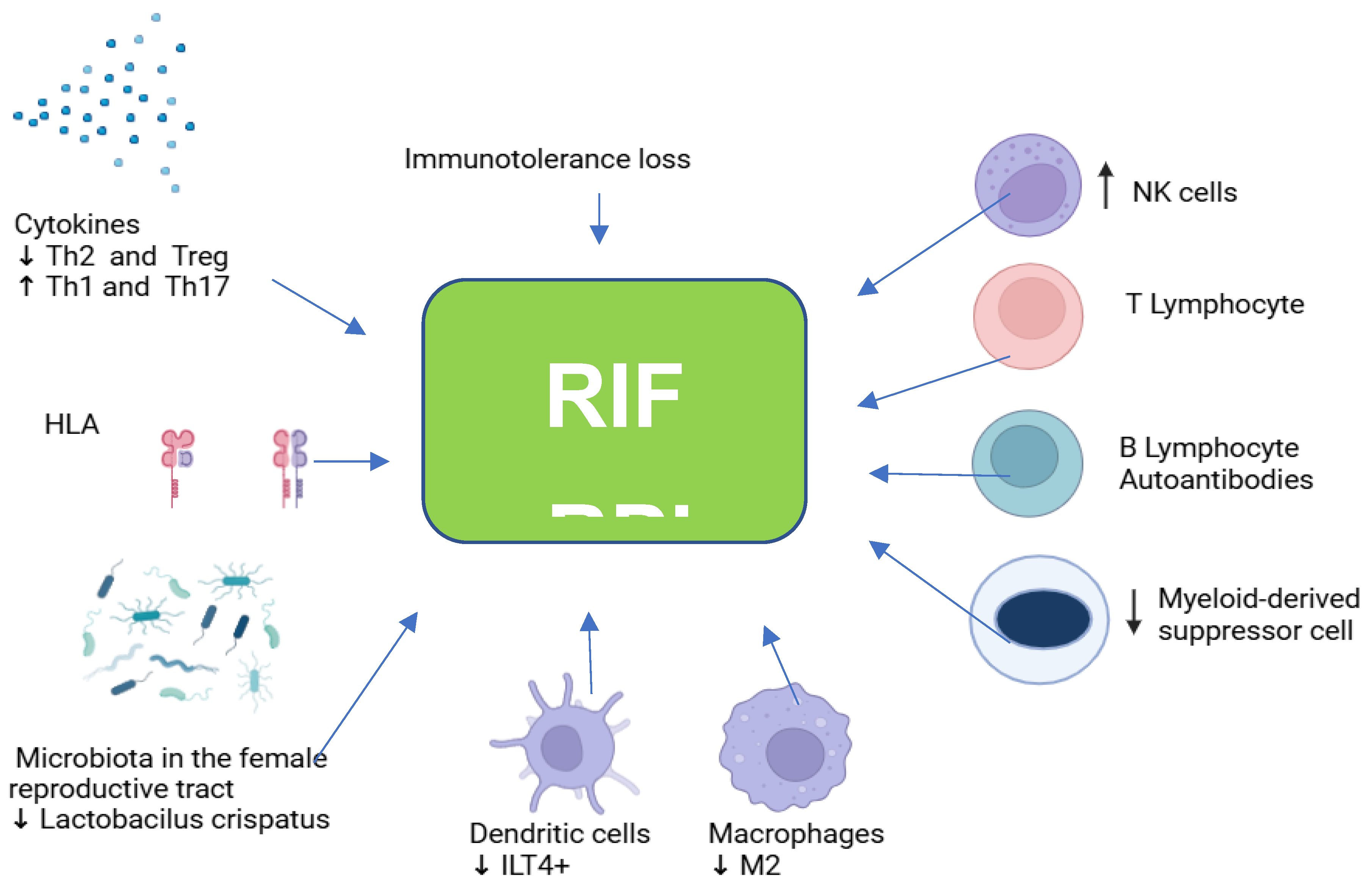
The figure illustrates the major elements studied in RIF and RPL.
Author Contributions
Conceptualization, J.V.G., C.V.D.S. and J.B.D.S.; methodology, J.V.G., C.V.D.S., and J.B.D.S.; validation, J.V.G., C.V.D.S., and J.B.D.S.; investigation, J.V.G., C.V.D.S., and J.B.D.S.; resources, M.H., J.B.D.S.; writing—original draft preparation, J.V.G., C.V.D.S.; writing—review and editing, J.V.G., C.V.D.S., M.H., J.B.D.S.; supervision, J.V.G., J.B.D.S..; project administration, M.H..; funding acquisition, M.H. All authors have read and agreed to the published version of the manuscript.
Funding
Partially supported by a grant from the Ministry of Education, Youth, and Sport, Czech Republic: Molecular and Cellular Clinical Approach to Healthy Ageing, ENOCH (European Regional Development Fund Project No. CZ.02.1.01/0.0/0.0/16_019/0000868, IMTM #869/V19). JBDS is partially financed by the National Institute of Virology and Bacteriology [Program EX-CELES, ID Project No. LX22NPO5103]—Funded by the European Union—Next Generation EU from the Ministry of Education, Youth, and Sports of the Czech Republic (MEYS)].
Conflicts of Interest
The authors declare no conflicts of interest.
References
- Tomkiewicz, J.; Darmochwał-Kolarz, D The Diagnostics and Treatment of Recurrent Pregnancy Loss. J Clin Med. 2023;12(14):4768. [CrossRef]
- ESHRE Guideline Group on R.P.L, Bender Atik, R.; Christiansen, O.B.; Elson, J.; Kolte, A.M.; Lewis, S.; Middeldorp, S.; et al. ESHRE guideline: recurrent pregnancy loss. Hum. Reprod. Open, 2018 (2018): 1-12. [CrossRef]
- Practice Committee of the American Society for Reproductive Medicine. Evaluation and treatment of recurrent pregnancy loss: a committee opinion. Fertil Steril. 2012;98(5):1103-11. [CrossRef]
- WHO: Recommended Definitions, Terminology, and Format for Statistical Tables Related to The Perinatal Period And Use of A New Certificate For the Cause of Perinatal Deaths. Acta Obstet Gynecol Scand 1977, 56: 247-256. [CrossRef]
- Dimitriadis, E.; Menkhorst, E.; Saito, S.; Kutteh, W.H.; Brosens, J.J.. Recurrent pregnancy loss. Nat Rev Dis Primers. 2020; 6(1):98. [CrossRef]
- Dong, P.; Wen, X.Z.; Liu, J.; Yan, C.; Yuan, J.; Luo, L.; Hu, Q.F.; Li J. Simultaneous detection of decidual Th1/Th2 and NK1/NK2 immunophenotyping in unknown recurrent miscarriage using 8-color flow cytometry with FSC/Vt extended strategy. Biosci Rep 2017;37(3): BSR20170150. [CrossRef]
- Kohl Schwartz, A.S.; Wölfler, M.M.; Mitter, V.; Rauchfuss, M.; Haeberlin, F.; Eberhard, M.; von Orelli, S.; Imthurn, B.; Imesch, P.; Fink, D.; Leeners, B. Endometriosis, especially mild disease: a risk factor for miscarriages. Fertil Steril. 2017;108(5), pp.806-814.e2. [CrossRef]
- Harb, H.M.; Ghosh, J.; Al-Rshoud. F.; Karunakaran, B.; Gallos, I.D.; Coomarasamy, A. Hydrosalpinx and pregnancy loss: a systematic review and meta-analysis. Reprod Biomed Online. 2019;38(3):427–441. [CrossRef]
- Zhang, L.; Li, H.; Han, L.; Zhang, L.; Zu, Z,; Zhang, J. Association between semen parameters and recurrent pregnancy loss: An umbrella review of meta-analyses. J Obstet Gynaecol Res. 2024;50(4):545-556 . [CrossRef]
- Deshmukh, H.; Way, S.S. Immunological Basis for Recurrent Fetal Loss and Pregnancy Complications. Annu Rev Pathol. 2019;14(1):185–210. [CrossRef]
- Bagkou Dimakou, D.; Lissauer, D.; Tamblyn, J.; Coomarasamy, A.; Richter, A. Understanding human immunity in idiopathic recurrent pregnancy loss. Eur J Obstet Gynecol Reprod Biol. 2022; 270:17–29. [CrossRef]
- Bashiri, A.; Halper, K.I.; Orvieto, R. Recurrent Implantation Failure-update overview on etiology, diagnosis, treatment and future directions. Reprod Biol and Endocrinol. 2018;16(1):121. [CrossRef]
- Comins Boo, A.; Segovia, A.G.; del Prado, N.N.; de la Fuente, L; Alonso, J.; Ramon, S.S. Evidence-based Update: Immunological Evaluation of Recurrent Implantation Failure. Reprod Immunol: Open Access. 2016; 01(04). [CrossRef]
- Wu, Y.; Li, L.; Liu, L.; Yang, X.; Yan, P.; Yang, K.; Zhang, X. Autologous peripheral blood mononuclear cells intrauterine instillation to improve pregnancy outcomes after recurrent implantation failure: a systematic review and meta-analysis. Arch Gynecol Obstet. 2019;300(5):1445–1459. [CrossRef]
- Wu, H.; You, Q.; Jiang, Y.; Mu, F. Tumor necrosis factor inhibitors as therapeutic agents for recurrent spontaneous abortion Mol Med Rep. 2021;24(6):847. [CrossRef]
- Saadaoui, M,; Singh, P.; Ortashi, O.; Al Khodor, S. Role of the vaginal microbiome in miscarriage: exploring the relationship. Front Cell Infect Microbiol. 2023;13:1232825. [CrossRef]
- Mrozikiewicz, A.E.; Ożarowski, M.; Jędrzejczak, P. Biomolecular Markers of Recurrent Implantation Failure—A Review. Int J Mol Sci. 2021;22(18):10082. [CrossRef]
- Wang, Q.; Sun, Y.; Fan, R.; Wang, M.; Ren, C.; Jiang, A.; Yang, T. Role of inflammatory factors in the etiology and treatment of recurrent implantation failure. Reprod Biol. 2022;22(4):100698. [CrossRef]
- Ma, J.; Gao, W.; Li, D. Recurrent implantation failure: A comprehensive summary from etiology to treatment. Frontiers Endocrinol, 2023; 13, 1061766. [CrossRef]
- Fathi, M.; Omrani, M. A.; Kadkhoda, S.; Ghahghaei-Nezamabadi, A.; Ghafouri-Fard, S. Impact of miRNAs in the pathoetiology of recurrent implantation failure. Mol cell probes, 2024; 74, 101955. DOI: 10.1016/j.mcp.2024.101955.
- Liu, L.; Liu, Y.; Tian, Y.; Cao, Y.; Wang, T.; Mi, S.; Yang, R.; Liu, S.; Ma, X.; Wang, J. Identification of Differentially Expressed mRNAs and lncRNAs Contributes to Elucidation of Underlying Pathogenesis and Therapeutic Strategy of Recurrent Implantation Failure. Reproductive sciences, 2024; 10.1007/s43032-024-01630-8.
- Zahir, M.; Tavakoli, B.; Zaki-Dizaji, M.; Hantoushzadeh, S.; Majidi Zolbin, M. Non-coding RNAs in Recurrent implantation failure. Clinica chimica acta; 2024, 553, 117731. [CrossRef]
- Colamatteo, A.; Fusco, C.; Micillo, T.; D'Hooghe, T.; de Candia, P.; Alviggi, C.; Longobardi, S.; Matarese, G. Immunobiology of pregnancy: from basic science to translational medicine. Trends Mol Med, 2023; 29(9), 711–725. [CrossRef]
- Zhao, F.; Hu, X.; Ying C. Advances in Research on the Relationship between Vaginal Microbiota and Adverse Pregnancy Outcomes and Gynecological Diseases. Microorganisms. 2023;11(4):991. /. [CrossRef]
- Moreno, I.; Codoñer, F.M.; Vilella, F.; Valbuena, D.; Martinez-Blanch, J.F.; et al. Evidence that the endometrial microbiota has an effect on implantation success or failure. Am J Obstet Gynecol. 2016;215(6):684–703. [CrossRef]
- Garmendia, J.V.; De Sanctis, C.V.; Hajdúch, M.; De Sanctis, J.B. Microbiota and Recurrent Pregnancy Loss (RPL); More than a Simple Connection. Microorganisms. 2024 Aug 10;12(8):1641. [CrossRef]
- Jia, D.; Sun, F.; Han, S.; Lu, L.; Sun, Y.; Song, Q. Adverse outcomes in subsequent pregnancies in women with a history of recurrent spontaneous abortion: A meta-analysis. J Obstet Gynaecol Res. 2024; 50(3):281-297 . [CrossRef]
- Field, K.; Murphy, D.J. Perinatal outcomes in a subsequent pregnancy among women who have experienced recurrent miscarriage: a retrospective cohort study. Hum Reprod. 2015;30(5):1239–1245. [CrossRef]
- Fang, Y.; Jingjing, F.; Tiantain, C.; Huanhuan, X.; Qiaohua H. Impact of the number of previous embryo implantation failures on IVF/ICSI-ET pregnancy outcomes in patients younger than 40 years: a retrospective cohort study. Front Endocrinol. 2023;14: 1243402. [CrossRef]
- Cimadomo, D.; Rienzi, L.; Conforti, A.; Forman, E.; Canosa, S.; Innocenti, F.; et al. Opening the black box: why do euploid blastocysts fail to implant? A systematic review and meta-analysis. Hum Reprod Update. 2023;29(5):570–633. [CrossRef]
- Nitu, R.; Neamtu, R.; Lordache, O.; Stelea, L.; Dahma, G.; Sacarin, G.; et al. Cross-Sectional Analysis of Intimacy Problems, Stress Levels, and Couple Satisfaction among Women with Thrombophilia Affected by Recurrent Pregnancy Loss. Int J Environ Res Public Health. 2023;20(2);1208. [CrossRef]
- Chen, S.; Chang, S.; Kuo, P.; Chen, C. Stress, anxiety and depression perceived by couples with recurrent miscarriage. Int J Nurs Pract. 2020;26(2): e12796. [CrossRef]
- Quenby, S.; Gallos, I.D.; Dhillon-Smith, R.K.; Podesek, M.; Stephenson, M.D.; Fisher, J.; et al. Miscarriage matters: the epidemiological, physical, psychological, and economic costs of early pregnancy loss. Lancet. 2021;397(10285):1658–1667. [CrossRef]
- Voss, P.; Schick, M.; Langer, L.; Ainsworth, A.; Ditzen, B.; Strowitzki, T.; Wischmann, T.; Kuon, R.J. Recurrent pregnancy loss: a shared stressor---couple-orientated psychological research findings. Fertil Steril. 2020; 114(6):1288–1296. 10.1016/j.fertnstert.2020.08.1421.
- Mínguez-Alarcón, L.; Williams, P. L.; Souter, I.; Ford, J.B.; Hauser, R.; Chavarro, J.E. Women's preconception psychological stress and birth outcomes in a fertility clinic: the EARTH study. Front Glob Womens Health. 2024 ;5:1293255. [CrossRef]
- Garmendia, J.V.; De Sanctis, J.B. A Brief Analysis of Tissue-Resident NK Cells in Pregnancy and Endometrial Diseases: The Importance of Pharmacologic Modulation. Immuno. 2021, 1(3):174–193. [CrossRef]
- Lanier L. L. Five decades of natural killer cell discovery. J Exper Med 2024, 221(8), e20231222. [CrossRef]
- Rao, V.A.; Kurian, N.K.; Rao, K.A. Cytokines, NK cells, and regulatory T cell functions in normal pregnancy and reproductive failures. Am J Reprod Immunol. 2023;89(2): e13667. [CrossRef]
- Cavalcante, M.B.; da Silva, P.H.A.; Carvalho, T.R.; Sampaio, O.G.M.; Câmara, F.E.A.; et al. Peripheral blood natural killer cell cytotoxicity in recurrent miscarriage: a systematic review and meta-analysis. J Reprod Immunol. 2023;158:103956. [CrossRef]
- Sacks, G.; Yang, Y.; Gowen, E.; Smith, S.; Fay, L.; Chapman, M. Detailed Analysis of Peripheral Blood Natural Killer Cells in Women with Repeated IVF Failure. Am J Reprod Immunol. 2012;67(5):434–442. [CrossRef]
- Cai, J. Y.; Tang, Y. Y.; Deng, X. H.; Li, Y. J.; Liang, G.; Meng, Y. Q.; Zhou, H. Recurrent Implantation Failure May Be Identified by a Combination of Diagnostic Biomarkers: An Analysis of Peripheral Blood Lymphocyte Subsets. Front Endocrinol, 2024; 13, 865807. [CrossRef]
- Sacks, G. Enough! Stop the arguments and get on with the science of natural killer cell testing. Hum Reprod. 2015;30(7):1526–1531. [CrossRef]
- Dons’koi, B.V. Accentuated hypo- and hyper-NK lymphocyte CD8 expression is a marker of NK subsets’ misbalance and is predictive for reproductive failures. Immunobiol. 2015; 220(5):649–655. [CrossRef]
- Dons’koi, B.V.; Chernyshov, V.P.; Sirenko, V.Y.; Strelko, G.V.; Osypchuk, D.V. Peripheral blood natural killer cells activation status determined by CD69 upregulation predicts implantation outcome in IVF. Immunobiol 2014;219(3):167–171. [CrossRef]
- Gothe, J. P.; de Mattos, A. C.; Silveira, C. F.; Malavazi, K. C. Exploring Natural Killer Cell Testing in Embryo Implantation and Reproductive Failure: An Overview of Techniques and Controversies. Reproductive Sciences 2024; 31(3), 603–632. [CrossRef]
- Zhang, J.; Lye, S. J. The immune potential of decidua-resident CD16+CD56+ NK cells in human pregnancy. Human Immunol, 2021; 82(5), 332–339. [CrossRef]
- Salazar, M. D.; Wang, W. J.; Skariah, A.; He, Q.; Field, K.; Nixon, M.; et al. Post-hoc evaluation of peripheral blood natural killer cell cytotoxicity in predicting the risk of recurrent pregnancy losses and repeated implantation failures. J Reprod Immunol, 2022: 150, 103487. [CrossRef]
- Singh, N.; Dogra, Y.; Kumar, P.; Mathur, S.; Sharma, A.; Patel, G. Establishment of Cut-off Values for Uterine and Peripheral Blood Natural Killer Cells During the Peri-implantation Period in Fertile Controls and Women with Unexplained Recurrent Implantation Failure. J Reprod Infert, 2023; 24(4), 248–256. [CrossRef]
- Santillán, I.; Fernández Lozano, I.; Illán. J.; Verdú, V.; Coca, S.; Bajo-Arenas, J.; Martinez F. Where and when should natural killer cells be tested in women with repeated implantation failure? Journal Reprod Immunol. 2015 ;108:142–148. [CrossRef]
- Sfakianoudis, K.; Rapani, A.; Grigoriadis, S.; Pantou, A.; Maziotis, E.; et al. The Role of Uterine Natural Killer Cells on Recurrent Miscarriage and Recurrent Implantation Failure: From Pathophysiology to Treatment. Biomed. 2021; 9(10):1425. [CrossRef]
- Bagkou Dimakou, D.; Tamblyn, J.; Justin, C.; Coomarasamy, A.; Richter, A. Diagnosis and management of idiopathic recurrent pregnancy loss (RPL): Current immune testing and immunomodulatory treatment practice in the United Kingdom. J Reprod Immunol, 2022; 153, 103662. [CrossRef]
- Seshadri, S.; Sunkara, S.K. Natural killer cells in female infertility and recurrent miscarriage: a systematic review and meta-analysis. Hum Reprod Update. 2013;20(3):429–438. [CrossRef]
- Lachapelle, M.; Miron, P.; Hemmings, R.; Roy, D. Endometrial T, B, and NK cells in patients with recurrent spontaneous abortion. Altered profile and pregnancy outcome. J Immunol. 1996;156(10):4027–34.
- Ho, Y. K.; Chen, H. H.; Huang, C. C.; Lee, C. I.; Lin, P. Y.; Lee, M. S.; Lee, T. H. Peripheral CD56+CD16+ NK Cell Populations in the Early Follicular Phase Are Associated With Successful Clinical Outcomes of Intravenous Immunoglobulin Treatment in Women With Repeated Implantation Failure. Front Endocrinol, 2020; 10, 937. [CrossRef]
- Fukui, A.; Fujii, S.; Yamaguchi, E.; Kimura, H.; Sato, S.; Saito, Y. Natural Killer Cell Subpopulations and Cytotoxicity for Infertile Patients Undergoing In Vitro Fertilization. Am J Reprod Immunol. 1999;41(6): 413–422. [CrossRef]
- Strobel, L.; Vomstein, K.; Kyvelidou, C.; Hofer-Tollinger, S.; Feil, K.; Kuon, R. J.; Ebner, S.; Troppmair, J.; Toth, B. Different Background: Natural Killer Cell Profiles in Secondary versus Primary Recurrent Pregnancy Loss. J Clin Med, 2021; 10(2), 194. [CrossRef]
- Fukui, A.; Kwak-Kim, J.; Ntrivalas, E.; Gilman-Sachs, A.; Lee, S.K.; Beaman, K. Intracellular cytokine expression of peripheral blood natural killer cell subsets in women with recurrent spontaneous abortions and implantation failures. Fertil Steril. 2008;89(1):157–165. [CrossRef]
- Díaz-Peña, R.; de Los Santos, M. J.; Lucia, A.; Castro-Santos, P. Understanding the role of killer cell immunoglobulin-like receptors in pregnancy complications. J Assisted Reprod genetics, 2019, 36(5), 827–835. [CrossRef]
- Lin, Q.D.; Qiu, L.H. Pathogenesis, diagnosis, and treatment of recurrent spontaneous abortion with immune type. Front Med China. 2010;4(3):275–279. [CrossRef]
- Dambaeva, S. V.; Lee, D. H.; Sung, N.; Chen, C. Y.; Bao, S.; Gilman-Sachs, A.; Kwak-Kim, J.; Beaman, K. D. (2016). Recurrent Pregnancy Loss in Women with Killer Cell Immunoglobulin-Like Receptor KIR2DS1 is Associated with an Increased HLA-C2 Allelic Frequency. Am J Reprod Immunol. 2016; 75(2), 94–103. [CrossRef]
- Akbari, S.; Shahsavar, F.; Karami, R.; Yari, F.; Anbari, K.; Ahmadi, S.A.Y. Recurrent Spontaneous Abortion (RPL) and Maternal KIR Genes: A Comprehensive Meta-Analysis. JBRA Assist Reprod 2020;24(2), 197–213. [CrossRef]
- Yang, X.; Yang, E.; Wang, W.; He, Q.; Jubiz, G.; Dimantha Katukurundage, Dambaeva S.; Beaman, K.D.; Kwak-Kim, J. Decreased HLA-C1 alleles in couples of KIR2DL2 positive women with recurrent pregnancy loss. J Reprod Immunol. 2020 ;142:103186–103186. [CrossRef]
- Feyaerts, D.; Benner, M.; Comitini, G;, Shadmanfar, W.; van der Heijden, O. W. H.; Joosten, I.; van der Molen, R. G. NK cell receptor profiling of endometrial and decidual NK cells reveals pregnancy-induced adaptations. Front Immunol, 2024 15, 1353556. [CrossRef]
- Maftei, R.; Doroftei, B.; Popa, R.; Harabor, V.; Adam, A.M.; Popa, C.; et al. The Influence of Maternal KIR Haplotype on the Reproductive Outcomes after Single Embryo Transfer in IVF Cycles in Patients with Recurrent Pregnancy Loss and Implantation Failure—A Single Center Experience. J Clin Med. 2023;12(5):1905. [CrossRef]
- Nowak, I.; Wilczyńska, K.; Wilczyński, J.R.; Malinowski, A.; Radwan, P.; Radwan, M.; Kuśnierczyk, P. KIR, LILRB and their Ligands’ Genes as Potential Biomarkers in Recurrent Implantation Failure. Arch Immunol Ther Exp (Warsz). 2017;65(5):391-399 (2017). [CrossRef]
- Braun, A. S.; Vomstein, K.; Reiser, E.; Tollinger, S.; Kyvelidou, C.; Feil, K.; Toth, B. NK and T Cell Subtypes in the Endometrium of Patients with Recurrent Pregnancy Loss and Recurrent Implantation Failure: Implications for Pregnancy Success. J Clin Med, 2023; 12(17), 5585. [CrossRef]
- Morin, S. J.; Treff, N. R.; Tao, X.; Scott, R. T.; 3rd, Franasiak, J. M.; Juneau, C. R.; Maguire, M.; Scott, R. T. Combination of uterine natural killer cell immunoglobulin receptor haplotype and trophoblastic HLA-C ligand influences the risk of pregnancy loss: a retrospective cohort analysis of direct embryo genotyping data from euploid transfers. Fertility and sterility, 2017; 107(3), 677–683.e2. [CrossRef]
- Xu, Q. H.; Liu, H.; Wang, L. L.; Zhu, Q.; Zhang, Y. J.; Muyayalo, K. P.; Liao, A. H. Roles of γδT cells in pregnancy and pregnancy-related complications. Am J Reprod Immunol. 2021; 86(5), e13487. [CrossRef]
- Li, L.; Liu, Y.; Zhou, W.; Yang, C.; Feng, T.; Li, H. Human chorionic gonadotrophin indirectly activates peripheral γδT cells to produce interleukin-10 during early pregnancy. Immun Inflamm Dis, 2024 12(1), e1119. [CrossRef]
- Zhang, D.; Yu, Y.; Duan, T.; Zhou, Q. The role of macrophages in reproductive-related diseases. Heliyon. 2022;8(11):e11686–e11686. [CrossRef]
- Nagamatsu, T.; Schust, D.J. The Contribution of Macrophages to Normal and Pathological Pregnancies. Am J Reprod Immunol. 2010;63(6):460–471. [CrossRef]
- Tsao, F.Y.; Wu, M.Y.; Chang, Y.L.; Wu, C.T.; Ho H.N. M1 macrophages decrease in the deciduae from normal pregnancies but not from spontaneous abortions or unexplained recurrent spontaneous abortions. J Formo Med Assoc. 2018;117(3):204–211. [CrossRef]
- Robertson, S.A.; Moldenhauer, L.M.; Green, E.S.; Care, A.S.; Hull, M.L. Immune determinants of endometrial receptivity: a biological perspective. Fertil Steril. 2022;117(6):1107–1120. [CrossRef]
- Wang, W.J.; Hao, C.F.; Lin, Q.D. Dysregulation of macrophage activation by decidual regulatory T cells in unexplained recurrent miscarriage patients. J Reprod Immunol. 2011;92(1-2):97-102. [CrossRef]
- Quenby, S.; Bates, M.; Doig, T.; Brewster, J.; Lewis-Jones, D.I.; Johnson, P.M.; Vince, G. Pre-implantation endometrial leukocytes in women with recurrent miscarriage. Hum Reprod 1999;14(9):2386–2391. [CrossRef]
- Krop, J.; Tian, X.; van der Hoorn, M. L.; Eikmans, M. The Mac Is Back: The Role of Macrophages in Human Healthy and Complicated Pregnancies. Int J Mol Sci, 2023; 24(6), 5300. [CrossRef]
- Tremellen, K.P.; Russell, P. The distribution of immune cells and macrophages in the endometrium of women with recurrent reproductive failure. II: adenomyosis and macrophages. J Reprod Immunol. 2012;93(1):58–63.
- Wei, R.; Lai, N.; Zhao, L.; Zhang, Z.; Zhu, X.; Guo, Q.; Chu, C.; Fu, X.; Li, X. Dendritic cells in pregnancy and pregnancy-associated diseases. Biomed Pharmacother 2021; 133, 110921. [CrossRef]
- Saito, S. Role of immune cells in the establishment of implantation and maintenance of pregnancy and immunomodulatory therapies for patients with repeated implantation failure and recurrent pregnancy loss. Reprod Med Biol. 2024;23(1):e12600. [CrossRef]
- Liu, S.; Wei, H., Li, Y.; Huang, C.; Lian, R.; Xu, J.; Chen, L.; Zeng, Y. Downregulation of ILT4+dendritic cells in recurrent miscarriage and recurrent implantation failure. Am J Reprod Immunol. 2018;80(4):e12998. [CrossRef]
- Zhu, X.X.; Yin, X.Q.; Hei, G.Z.; Wei, R.; Guo, Q.; Zhao, L.; Zhang, Z.; Chu, C.; Fu, X.X.; Xu, K.; Li, X. Increased miR-6875-5p inhibits plasmacytoid dendritic cell differentiation via the STAT3/E2-2 pathway in recurrent spontaneous abortion. Mol Hum Reprod. 2021;27(8):gaab044. [CrossRef]
- Huang, C.; Zhang, H.; Chen, X.; Diao, L.; Lian, R.; Zhang, X.; Hu, L.; Zeng, Y. Association of peripheral blood dendritic cells with recurrent pregnancy loss: a case-controlled study. Am J Reprod Immunol. 2016;76(4):326-32. [CrossRef]
- Kwiatek, M.; Gęca, T.; Krzyżanowski, A.; Malec, A.; Kwaśniewska, A. Peripheral Dendritic Cells and CD4+CD25+Foxp3+ Regulatory T Cells in the First Trimester of Normal Pregnancy and in Women with Recurrent Miscarriage. PLoS One. 2015;10(5):e0124747. [CrossRef]
- Sivridis, E.; Giatromanolaki, A.; Agnantis, N.; Anastasiadis, P. Mast cell distribution and density in the normal uterus--metachromatic staining using lectins. Europ J Obst Gynecol Reprod Biol, 2001 98(1), 109–113. [CrossRef]
- Norrby, K. On Connective Tissue Mast Cells as Protectors of Life, Reproduction, and Progeny. Int J Mol Sci, 2024; 25(8), 4499. [CrossRef]
- Lampiasi, N. Interactions between Macrophages and Mast Cells in the Female Reproductive System. Int J Mol Sci. 2022 May 12;23(10):5414. [CrossRef]
- Derbala, Y.; Elazzamy, H.; Bilal, M.; Reed R.; Salazar Garcia, M,D,; Skariah, A.; et al. Mast cell-induced immunopathology in recurrent pregnancy losses. Am J Reprod Immunol. 2019 Jul;82(1):e13128. [CrossRef]
- McCallion, A.; Nasirzadeh, Y.; Lingegowda, H.; Miller, J.E.; Khalaj, K.; Ahn, S.; et al. Estrogen mediates inflammatory role of mast cells in endometriosis pathophysiology. Front Immunol. 2022 Aug 9;13:961599. [CrossRef]
- Dunn, T.N.; Cope, D.I.; Tang, S.; Sirupangi, T.; Parks, S.E.; et al. . Inhibition of CSF1R and KIT With Pexidartinib Reduces Inflammatory Signaling and Cell Viability in Endometriosis. Endocrinology. 2024; 165(4):bqae003. [CrossRef]
- Blumenthal, R. D.; Samoszuk, M.; Taylor, A. P.; Brown, G.; Alisauskas, R.; Goldenberg, D. M. Degranulating eosinophils in human endometriosis. Am J Pathol, 2020; 156(5), 1581–1588. [CrossRef]
- Hornung, D.; Dohrn, K.; Sotlar, K.; Greb, R. R.; Wallwiener, D.; Kiesel, L.; Taylor, R. N. Localization in tissues and secretion of eotaxin by cells from normal endometrium and endometriosis. J Clin Endocrinol Met 2000; 85(7), 2604–2608. [CrossRef]
- Naseri, S.; Rosenberg-Hasson, Y.; Maecker, H. T.; Avrutsky, M. I.; Blumenthal, P. D. A cross-sectional study comparing the inflammatory profile of menstrual effluent vs. peripheral blood. Health Sci Rep, 2023; 6(1), e1038. [CrossRef]
- Wang, X.; Jia, Y.; Li, D.; Guo, X.; Zhou, Z.; Qi, M.; Wang, G.; Wang, F. The Abundance and Function of Neutrophils in the Endometriosis Systemic and Pelvic Microenvironment. Mediators Inflamm. 2023 Jan 31;2023:1481489.
- Hebeda, C. B.; Savioli, A. C.; Scharf, P.; de Paula-Silva, M.; Gil, C. D.; Farsky, S. H. P.; Sandri, S. Neutrophil depletion in the pre-implantation phase impairs pregnancy index, placenta and fetus development. Front Immunol, 2022; 13, 969336. [CrossRef]
- Ghafourian, M.; Abuhamidy, A.; Karami, N. Increase of peripheral blood TCD8+cells in women with recurrent miscarriage. J Obstet Gynaecol. 2013;34(1):36–39. [CrossRef]
- Morita, K.; Tsuda, S.; Kobayashi, E.; Hamana, H.; Tsuda, K.; Shima, T.; Nakashima, A.; Ushijima, A.; Kishi, H.; Saito, S. Analysis of TCR Repertoire and PD-1 Expression in Decidual and Peripheral CD8+ T Cells Reveals Distinct Immune Mechanisms in Miscarriage and Preeclampsia. Front Immunol. 2020; 11:1082. [CrossRef]
- Carbone, J.; Sarmiento, E.; Gallego, A.; Lanio, N.; Navarro, J.; Garcia, S.; Fernández-Cruz, E. Peripheral blood T- and B-cell immunophenotypic abnormalities in selected women with unexplained recurrent miscarriage. J Reprod Immunol. 2016; 113:50–53. [CrossRef]
- Huang, C.; Xiang, Z.; Zhang, Y.; Li, Y.; Xu, J.; Zhang, H.; Zeng, Y.; Tu, W. NKG2D as a Cell Surface Marker on γδ-T Cells for Predicting Pregnancy Outcomes in Patients With Unexplained Repeated Implantation Failure. Front Immunol, 2021; 12, 631077. [CrossRef]
- Yu, L.; Wang, L.; Wang, L.; Yan, S.; Chen, S.; Xu, Q.; Su, D.; Wang, X. Identification and validation of immune cells and hub genes alterations in recurrent implantation failure: A GEO data mining study. Front Genet. 2023 Jan 9;13:1094978. [CrossRef]
- Wang, X.; Ma, Z.; Hong, Y.; Zhao, A.; Qiu, L.; Lu, P.; Lin,, Q. The Skewed TCR-BV Repertoire Displayed at the Maternal-Fetal Interface of Women with Unexplained Pregnancy Loss. Am J Reprod Immunol. 2005;54(2):84–95.
- Robertson, S.A.; Care, A.S.; Moldenhauer, L.M. Regulatory T cells in embryo implantation and the immune response to pregnancy. J Clin Invest. 2018 Oct 1;128(10):4224-4235. [CrossRef]
- Yang, H.; Qiu, L.; Chen, G.; Ye, Z.; Lü, C.; Lin, Q. Proportional change of CD4+CD25+ regulatory T cells in decidua and peripheral blood in unexplained recurrent spontaneous abortion patients. Fertil Steril. 2008;89(3):656–661.
- Li, Q. H.; Zhao, Q. Y.; Yang, W. J.; Jiang, A. F.; Ren, C. E.; Meng, Y. H. Beyond Immune Balance: The Pivotal Role of Decidual Regulatory T Cells in Unexplained Recurrent Spontaneous Abortion. J Inflamm Res 2024, 17, 2697–2710. [CrossRef]
- Wang, W.J.; Hao, C.F.; Qu, Q.L.; Wang, X.; Qiu, L.H.; Lin, Q.D. The deregulation of regulatory T cells on interleukin-17-producing T helper cells in patients with unexplained early recurrent miscarriage. Hum Reprod 2010; 25(10):2591–2596. [CrossRef]
- Garmendia, J.V.; Blanca, I.; Peña, M.J.; De Sanctis, C.V.; De Sanctis, J.B. Unlocking the Puzzle: Investigating the Role of Interleukin 17 Genetic Polymorphisms, Circulating Lymphocytes, and Serum Levels in Venezuelan Women with Recurrent Pregnancy Loss. Immuno 2024; 4: 301–311. [CrossRef]
- Heitmann, R. J.; Weitzel, R. P.; Feng, Y.; Segars, J. H.; Tisdale, J. F.; Wolff, E. F. Maternal T Regulatory Cell Depletion Impairs Embryo Implantation Which Can Be Corrected With Adoptive T Regulatory Cell Transfer. Reproductive sciences 2017; 24(7), 1014–1024. [CrossRef]
- Granne, I.; Shen, M.; Rodriguez-Caro, H.; Chadha, G.; O'Donnell, E.; Brosens, J.J.; Quenby, S.; Child, T.; Southcombe, J.H. Characterisation of peri-implantation endometrial Treg and identification of an altered phenotype in recurrent pregnancy loss. Mucosal Immunol. 2022 Jan;15(1):120-129. [CrossRef]
- Moldenhauer, L.M.; Foyle, K.L.; Wilson, J.J.; Wong, Y.Y.; Sharkey. D.J.; Green, E.S.; Barry, S.C.; Hull, M.L.; Robertson, S.A. A disrupted FOXP3 transcriptional signature underpins systemic regulatory T cell insufficiency in early pregnancy failure. iScience. 2024;27(2):108994. [CrossRef]
- Winger, E.E.; Reed, J.L. Low Circulating CD4+ CD25+ Foxp3+ T Regulatory Cell Levels Predict Miscarriage Risk in Newly Pregnant Women with a History of Failure. Am J Reprod Immunol. 2011;66(4):320–328. [CrossRef]
- Jin, L.P.; Chen, Q.Y.; Zhang, T.; Guo, P.F.; Li, D.J. The CD4+CD25 bright regulatory T cells and CTLA-4 expression in peripheral and decidual lymphocytes are down-regulated in human miscarriage. Clin Immunol. 2009;133(3):402–410. [CrossRef]
- Tang, C.; Hu, W. The role of Th17 and Treg cells in normal pregnancy and unexplained recurrent spontaneous abortion (URSA): New insights into immune mechanisms. Placenta. 2023;142:18-26. [CrossRef]
- Farshchi, M.; Abdollahi, E.; Saghafi, N.; Hosseini, A.; Fallahi, S.; Rostami, S.; Rostami, P.; Rafatpanah, H.; Habibagahi, M. Evaluation of Th17 and Treg cytokines in patients with unexplained recurrent pregnancy loss. J Clin Transl Res. 2022 May 25;8(3):256-265.
- Ma, J.; Gao, W.; Li, D. Recurrent implantation failure: A comprehensive summary from etiology to treatment. Front Endocrinol, 2023; 13, 1061766. [CrossRef]
- Berdiaki, A.; Vergadi, E.; Makrygiannakis, F.; Vrekoussis, T.; Makrigiannakis, A. Title: Repeated implantation failure is associated with increased Th17/Treg cell ratio, during the secretory phase of the human endometrium. J Reprod Immunol. 2024 Feb;161:104170. [CrossRef]
- Niafar, M.; Samaie, V.; Soltani-Zangbar, M.S.; Motavalli, R.; Dolati, S.; Danaii, S.; Mehdizadeh, A.; Yousefi, M. The association of Treg and Th17 cells development factors and anti-TPO autoantibodies in patients with recurrent pregnancy loss. BMC Res Notes. 2023;16(1):302. [CrossRef]
- Wang, W.J.; Salazar Garcia, M.D.; Deutsch, G.; Sung, N.; Yang, X.; et al. PD-1 and PD-L1 expression on T-cell subsets in women with unexplained recurrent pregnancy losses. Am J Reprod Immunol. 2020 May;83(5):e13230. [CrossRef]
- Wang, W.; Sung, N;, Gilman-Sachs, A.; Kwak-Kim, J. T Helper (Th) Cell Profiles in Pregnancy and Recurrent Pregnancy Losses: Th1/Th2/Th9/Th17/Th22/Tfh Cells. Front Immunol, 2020; 11, 2025. [CrossRef]
- Weng, J.; Couture, C.; Girard, S. Innate and Adaptive Immune Systems in Physiological and Pathological Pregnancy. Biology (Basel). 2023;12(3):402. [CrossRef]
- Muzzio, D.; Zenclussen, A.C.; Jensen, F. The Role of B Cells in Pregnancy: the Good and the Bad. Am J Reprod Immunol. 2013;69(4):408–412. [CrossRef]
- Eblen, A.C.; Gercel-Taylor, C.; Shields, L.B.E.; Sanfilippo, J.S.; Nakajima, S.T.; Taylor, D.D. Alterations in humoral immune responses associated with recurrent pregnancy loss. Fertil Steril. 2000;73(2):305–313. [CrossRef]
- Marron, K.; Walsh, D.; Harrity, C. Detailed endometrial immune assessment of both normal and adverse reproductive outcome populations. J Assisted Reprod Genetics, 2019; 36(2), 199–210. [CrossRef]
- Vujisić, S.; Lepej, S.Ž.; Akšamija, A.; Jerković. L.; Sokolić, B.; Kupešić, S.; Vince, A. B- and T-cells in the Follicular Fluid and Peripheral Blood of Patients Undergoing IVF/ET Procedures. Am J Reprod Immunol. 2004; 52(6):379–385. [CrossRef]
- Liu, J. C.; Zeng, Q.; Duan, Y. G.; Yeung, W. S. B.; Li, R. H. W.; Ng, E. H. Y.; Cheung, K. W.; Zhang, Q.; Chiu, P. C. N. B cells: roles in physiology and pathology of pregnancy. Front Immunol, 2024 15, 1456171. [CrossRef]
- Danaii, S.; Ghorbani, F.; Ahmadi, M.; Abbaszadeh, H.; Koushaeian, L.; Soltani-Zangbar, M. S.; et al. IL-10-producing B cells play important role in the pathogenesis of recurrent pregnancy loss. Internat Immunopharmacol, 2020; 87, 106806. [CrossRef]
- Bronte, V.; Brandau, S.; Chen, S.H.; Colombo, M.P.; Frey, A.B.; Greten, T.F.; et al. Recommendations for myeloid-derived suppressor cell nomenclature and characterization standards. Nat Commun. 2016;7(1):12150. [CrossRef]
- Ostrand-Rosenberg, S.; Sinha, P.; Figley, C.; Long, R.; Park, D.; Carter, D.; Clements, V.K. Frontline Science: Myeloid-derived suppressor cells (MDSCs) facilitate maternal–fetal tolerance in mice. J Leukoc Biol. 2016;101(5):1091–1101. [CrossRef]
- Köstlin, N.; Hofstädter, K.; Ostermeir, A.L.; Spring, B.; Leiber, A.; et al. Granulocytic Myeloid-Derived Suppressor Cells Accumulate in Human Placenta and Polarize toward a Th2 Phenotype. J Immunol. 2016;196(3):1132-45. [CrossRef]
- Bartmann, C.; Junker, M.; Segerer, S.E.; Häusler, S.F.; Krockenberger, M.; Kämmerer, U. CD33+/HLA-DRnegand CD33+/HLA-DR+/−Cells: Rare Populations in the Human Decidua with Characteristics of MDSC. Am J Reprod Immunol. 2016;75(5):539–556. [CrossRef]
- Pan, T.; Zhong, L.; Wu, S.; Cao, Y.; Yang, Q.; Cai, Z.; et al. 17β-Oestradiol enhances the expansion and activation of myeloid-derived suppressor cells via signal transducer and activator of transcription (STAT)-3 signalling in human pregnancy. Clin Exp Immunol. 2016;185(1):86-97. [CrossRef]
- Li, C.; Zhang, X.; Kang, X.; Chen, C.; Guo, F.; Wang, Q.; Zhao, A. Upregulated TRAIL and Reduced DcR2 Mediate Apoptosis of Decidual PMN-MDSC in Unexplained Recurrent Pregnancy Loss. Front Immunol. 2020;11: 1345. [CrossRef]
- Jiang, H.; Zhu, M.; Guo, P.; Bi, K.; Lu, Z.; Li, C.; Zhai, M.; Wang, K.; Cao, Y. Impaired myeloid-derived suppressor cells are associated with recurrent implantation failure: A case-control study. J Reprod Immunol. 2021 ;145:103316–103316. [CrossRef]
- Marin, N.S.; Fuente-Muñoz, E.; Gil-Laborda, R.; Villegas, Á.; Alonso-Arenilla, B.; et al. Myeloid-derived suppressor cells as a potential biomarker for recurrent pregnancy loss and recurrent implantation failure. Am J Reprod Immunol. 2023;90(5):e13783. [CrossRef]
- Pantos, K.; Grigoriadis, S.; Maziotis, E.; Pistola K.; Xystra, P.; Pantou, A.; et al. The Role of Interleukins in Recurrent Implantation Failure: A Comprehensive Review of the Literature. Int J of Mol Sci. 2022;23(4):2198. [CrossRef]
- Dong, X.; Zhou, M.; Li, X.; Huang, H.; Sun, Y. Gene profiling reveals the role of inflammation, abnormal uterine muscle contraction and vascularity in recurrent implantation failure. Front Genet 2023;14: 1108805 . [CrossRef]
- Kalu, E.; Bhaskaran, S.; Thum, M.Y.; Vishwanatha, R.; Croucher, C.; Sherriff, E.; Ford, B.; Bansal, A.S. Serial Estimation of Th1:Th2 Cytokines Profile in Women Undergoing In-Vitro Fertilization-Embryo Transfer. Am J Reprod Immunol. 2008;59(3):206–211. [CrossRef]
- Piekarska, K..; Dratwa, M.; Radwan, P.; Radwan, M.; Bogunia-Kubik, K.; Nowak, I. Pro- and anti-inflammatory cytokines and growth factors in patients undergoing in vitro fertilization procedure treated with prednisone. Front Immunol, 2023; 14, 1250488. [CrossRef]
- Mukherjee, N.; Sharma, R.; Modi, D. Immune alterations in recurrent implantation failure. Am J Reprod Immunol 2022;89(2). [CrossRef]
- Guo, L.; Guo, A.; Yang, F.; Li, L.; Yan, J.; Deng, X.; Dai, C.; Li, Y. Alterations of Cytokine Profiles in Patients With Recurrent Implantation Failure. Front Endocrinol. 2022 ;13:949123. [CrossRef]
- Yang, X,; Tian, Y.; Zheng, L.; Luu, T.; Kwak-Kim, J. The Update Immune-Regulatory Role of Pro- and Anti-Inflammatory Cytokines in Recurrent Pregnancy Losses. Int J Mol Sci. 2023;24(1):132. [CrossRef]
- Kwak-Kim, J.Y.H.; Chung-Bang, H.; Ng, S.; Ntrivalas, E.; Mangubat, C.; Beaman, K.; Beer, A.; Gilman-Sachs, A. Increased T helper 1 cytokine responses by circulating T cells are present in women with recurrent pregnancy losses and in infertile women with multiple implantation failures after IVF. Hum Reprod. 2003;18(4):767–773. [CrossRef]
- Sereshki, N.; Gharagozloo, M.; Ostadi, V.; Ghahiri, A.; Roghaei, M.; Mehrabian, F.; Andalib, A.; Hassanzadeh, A.; Hosseini, H.; Rezaei, A.A. Variations in T-helper 17 and Regulatory T Cells during The Menstrual Cycle in Peripheral Blood of Women with Recurrent Spontaneous Abortion. Int J Fertil Steril. 2014;8(1):59–66.
- Inagaki, N.; Stern, C.; McBain, J.; Lopata, A.; Kornman, L.; Wilkinson, D. Analysis of intra-uterine cytokine concentration and matrix-metalloproteinase activity in women with recurrent failed embryo transfer. Hum Reprod. 2003;18(3):608–615. [CrossRef]
- Wang, W.J.; Zhang, H.; Chen, Z.Q.; Zhang, W.; Liu, X.M.; Fang, J.Y.; Liu, F.J.; Kwak-Kim, J. Endometrial TGF-β, IL-10, IL-17 and autophagy are dysregulated in women with recurrent implantation failure with chronic endometritis. Reprod Biol Endocrinol. 2019 Jan 3;17(1):2. [CrossRef]
- Sheikhansari, G.; Soltani-Zangbar, M.S.; Pourmoghadam, Z.; Kamrani, A.; Azizi, R.; Aghebati-Maleki, L.; et al. Oxidative stress, inflammatory settings, and microRNA regulation in the recurrent implantation failure patients with metabolic syndrome. Am J Reprod Immunol. 2019;82(4): e13170. DOI: 10.1111/aji.13170.
- O’Hern Perfetto, C.; Fan, X.; Dahl, S.; Krieg, S.A.; Westphal, L.M.; Lathi, R.B.; Nayak, N.R. Expression of interleukin-22 in decidua of patients with early pregnancy and unexplained recurrent pregnancy loss. J Assist Reprod Genet 2015;32(6):977–984. [CrossRef]
- Wang, W.J.; Liu, F.J.; Qu, H.M.; Hao, C.F.; Qu, Q.L.; Xiong-Wang, Bao H.C.; Wang, X.R. Regulation of the expression of Th17 cells and regulatory T cells by IL-27 in patients with unexplained early recurrent miscarriage. J Reprod Immunol. 2013;99(1-2):39–45. [CrossRef]
- Ma, Y.; Ma, M.; Ye, S.; Liu, Y.; Zhao, X.; Wang, Y. Association of IL-17 and IL-27 polymorphisms with susceptibility to recurrent pregnancy loss and pre-eclampsia: A systematic review and meta-analysis. Immun Inflamm Dis. 2023 Oct;11(10):e1057. [CrossRef]
- Zhao, L.; Fu, J.; Ding, F.; Liu, J.; Li, L.; Song, Q.; Fu, Y. IL-33 and Soluble ST2 Are Associated With Recurrent Spontaneous Abortion in Early Pregnancy. Front Physiol. 2021:12:789829. [CrossRef]
- Yue, C.; Zhang, B.; Ying, C. Elevated Serum Level of IL-35 Associated with the Maintenance of Maternal-Fetal Immune Tolerance in Normal Pregnancy. PLOS ONE. 2015;10(6):e0128219. [CrossRef]
- Karaer, A.; Cigremis, Y.; Celik, E.; Urhan Gonullu, R. Prokineticin 1 and leukemia inhibitory factor mRNA expression in the endometrium of women with idiopathic recurrent pregnancy loss. Fertil Steril 2014; 102(4):1091-1095.e1. [CrossRef]
- Raghupathy, R.; Al-Mutawa, E.; Al-Azemi, M.; Makhseed, M.; Azizieh, F.; Szekeres-Bartho, J. (2009). Progesterone-induced blocking factor (PIBF) modulates cytokine production by lymphocytes from women with recurrent miscarriage or preterm delivery. J Reproductive Immunology, 2009; 80(1-2), 91–99. [CrossRef]
- Kashyap, N.; Begum, A.; Ray Das, C.; Datta, R.; Verma, M. K.; Dongre, A.; Husain, S. A.; Ahmad Khan, L.; Deka Bose, P. Aberrations in the progesterone pathway and the Th1/Th2 cytokine dichotomy - An evaluation of RPL predisposition in the northeast Indian population. Am Reprod Immunol, 2023 90(2), e13745. [CrossRef]
- Amjadi, F.; Zandieh, Z.; Mehdizadeh, M.; Aghajanpour, S.; Raoufi, E.; Aghamajidi, A.; Aflatoonian, R. The uterine immunological changes may be responsible for repeated implantation failure. J Reprod Immunol. 2020;138:103080–103080. [CrossRef]
- Laitinen, T. A Set of MHC Haplotypes Found Among Finnish Couples Suffering From Recurrent Spontaneous Abortions. Am J Reprod Immunol. 1993;29(3):148–154. [CrossRef]
- Hsiao, T.W.; Chung, M.T.; Wen, J.Y.; Lin, Y.; Lin, L.Y.; Tsai Y. HLA sharing and maternal HLA expression in couples with recurrent pregnancy loss in Taiwan. Taiwan J Obstet Gynecol. 2022;61(5):854–857. [CrossRef]
- Gharesi-Fard, B.; Askarinejad-Behbahani, R.; Behdin, S. The effect of HLA-DRB1 sharing between the couples with recurrent pregnancy loss on the pregnancy outcome after leukocyte therapy. Iran J Immunol 2014;11(1):13–20.
- Wang, X.P.; Lin, Q.; Peng, L.; Ma, Z.; Zhao, A. Association of HLA-DQB1 coding region with unexplained recurrent spontaneous abortion. Chin Med J. 2004;117(4):492–497.
- Ho, H.N.; Yang, Y.S.; Hsieh, R.P.; Lin, H.R.; Chen, S.; Huang, S.; Lee, T.Y.; Gill, T.J. Sharing of human leukocyte antigens in couples with unexplained infertility affects the success of in vitro fertilization and tubal embryo transfer. Am J Obstet Gynecol 1994;170(1):63–71. [CrossRef]
- Weckstein, L.N.; Patrizio, P.; Balmaceda, J.P.; Asch, R.H.; Branch, D.W. Human leukocyte antigen compatibility and failure to achieve a viable pregnancy with assisted reproductive technology. Acta Eur fertile. 1991;22(2):103–107.
- Balasch, J.; Jové, I.; Martorell, J.; Gayà, A.; Vanrell, J.A. Histocompatibility in in vitro fertilization couples. Fertil Steril.1993;59(2):456–458. [CrossRef]
- Hiby, S. E.; Regan, L.; Lo, W.; Farrell, L.; Carrington, M.; Moffett, A. Association of maternal killer-cell immunoglobulin-like receptors and parental HLA-C genotypes with recurrent miscarriage. Human reproduction 2008, 23(4), 972–976. [CrossRef]
- Hiby, S. E.; Apps, R.; Sharkey, A. M.; Farrell, L. E.; Gardner, L.; Mulder, A.; et al. Maternal activating KIRs protect against human reproductive failure mediated by fetal HLA-C2. J Clin Invest, 2010; 120(11), 4102–4110. [CrossRef]
- Yang, X.; Yang, E.; Wang, W. J.; He, Q.; Jubiz, G.; Katukurundage, D.; Dambaeva, S.; Beaman, K.; Kwak-Kim, J. Decreased HLA-C1 alleles in couples of KIR2DL2 positive women with recurrent pregnancy loss. J Reprod Immunol 2020, 142, 103186. [CrossRef]
- Gil Laborda, R.; de Frías, E. R.; Subhi-Issa, N.; de Albornoz, E. C.; Meliá, E.; Órdenes, M.; et al. Centromeric AA motif in KIR as an optimal surrogate marker for precision definition of alloimmune reproductive failure. Scientific reports, 2024; 14(1), 3354. [CrossRef]
- Dahl, M.; Djurisic, S.; Hviid, T.V. The many faces of human leukocyte antigen-G: relevance to the fate of pregnancy. J Immunol Res. 2014;2014:591489. [CrossRef]
- Fan, W.; Huang, Z.; Li, S.; Xiao, Z. The HLA-G 14-bp polymorphism and recurrent implantation failure: a meta-analysis. J Assist Reprod and Genet. 2017;34(11):1559–1565. [CrossRef]
- Hu, L.; He, D.; Zeng, H. Association of parental HLA-G polymorphisms with soluble HLA-G expressions and their roles on recurrent implantation failure: A systematic review and meta-analysis. Front Immunol 2022, 13, 988370. [CrossRef]
- Nowak, I.; Wilczyńska, K.; Radwan, P.; Wiśniewski, A.; Krasiński, R.; Radwan, M.; Wilczyński, J.R.; Malinowski, A.; Kuśnierczyk, P. Association of Soluble HLA-G Plasma Level and HLA-G Genetic Polymorphism With Pregnancy Outcome of Patients Undergoing in vitro Fertilization Embryo Transfer. Front Immunol 2020;10: 2982. [CrossRef]
- Zych, M.; Roszczyk, A.; Kniotek, M.; Dąbrowski, F.; Zagożdżon, R. Differences in Immune Checkpoints Expression (TIM-3 and PD-1) on T Cells in Women with Recurrent Miscarriages-Preliminary Studies. J Clin Med, 2021 10(18), 4182. [CrossRef]
- Zych, M.; Roszczyk, A.; Dąbrowski, F.; Kniotek, M.; Zagożdżon, R. Soluble Forms of Immune Checkpoints and Their Ligands as Potential Biomarkers in the Diagnosis of Recurrent Pregnancy Loss-A Preliminary Study. Int J Mol Sci, 2023 25(1), 499. [CrossRef]
- Esparvarinha, M.; Madadi, S.; Aslanian-Kalkhoran, L.; Nickho, H.; Dolati, S.; Pia, H.; Danaii, S.; Taghavi, S.; Yousefi, M. Dominant immune cells in pregnancy and pregnancy complications: T helper cells (TH1/TH2, TH17/Treg cells), NK cells, MDSCs, and the immune checkpoints. Cell Biology International, 2023 47(3), 507–519. [CrossRef]
- Qian, C.; Pan, C.; Liu, J.; Wu, L.; Pan, J.; Liu, C.; Zhang, H. Differential expression of immune checkpoints (OX40/OX40L and PD-1/PD-L1) in decidua of unexplained recurrent spontaneous abortion women. Human immunology, 2024 85(1), 110745. [CrossRef]
- Zych, M.; Kniotek, M.; Roszczyk, A.; Dąbrowski, F.; Jędra, R.; Zagożdżon, R. Surface Immune Checkpoints as Potential Biomarkers in Physiological Pregnancy and Recurrent Pregnancy Loss. Int J Mol Sci, 2024; 25(17), 9378. [CrossRef]
- Opatrny, L.; David, M.; Kahn, S.R.; Shrier, I.; Rey, E. Association between antiphospholipid antibodies and recurrent fetal loss in women without autoimmune disease: A metaanalysis. J Rheumatol. 2006; 33(11):2214–21.
- Thangaratinam, S.; Tan, A.; Knox, E.; Kilby, M.D.; Franklyn, J.; Coomarasamy, A. Association between thyroid autoantibodies and miscarriage and preterm birth: Metaanalysis of evidence. BMJ. 2011;342(7806):1–8. [CrossRef]
- Cavalcante, M.B.; Cavalgante, C.T.; Sarno, M.; Da Silva, A.; Barini, R. Antinuclear antibodies and recurrent miscarriage: Systematic review and meta-analysis. Am J Reprod Immunol. 2020;83(3):13215. [CrossRef]
- Chen, S.; Yang, G.; Wu, P.; Sun, Y.; Dai, F.; He, Y.; Qian, H.; Liu, Y.; Shi, G. Antinuclear antibodies positivity is a risk factor of recurrent pregnancy loss: A meta-analysis. Semin Arthritis Rheum. 2020 Aug;50(4):534-543. [CrossRef]
- Alijotas-Reig, J.; Esteve-Valverde, E.; Ferrer-Oliveras, R.; Llurba, E.; Gris, J.M. Tumor Necrosis Factor-Alpha and Pregnancy: Focus on Biologics. An Updated and Comprehensive Review. Clin Rev Allergy Immunol 2017; 53(1):40–53. [CrossRef]
- Lockwood, C.J.; Romero, R.; Feinberg, R.F.; Clyne, L.P.; Coster, B.; Hobbins, J.C. The prevalence and biologic significance of lupus anticoagulant and antic ardiolipin antibodies in a general obstetric population. Am J Obstet Gynecol. 1989:161(2):369–373. [CrossRef]
- Bahar, A.M.; Kwak, J.Y.H.; Beer, A.E.; Kim, J.H.; Nelson, L.A.; Beaman, K.D.; Gilman-Sachs, A. Antibodies to phospholipids and nuclear antigens in non-pregnant women with unexplained spontaneous recurrent abortions. J Reprod Immunol. 1993;24(3):213–222. [CrossRef]
- Kwak, J.Y.H.; Beer, A.E.; Cubillos, J.; Muñoz Sandoval, P.; Mendoza, J.; Espinel, F. Biological Basis of Fetoplacental Antigenic Determinants in the Induction of the Antiphospholipid Antibody Syndrome and Recurrent Pregnancy Loss. Ann N Y Acad Sci. 1994;731(1):242–245. [CrossRef]
- Rai, R.S.; Regan, L.; Clifford, K.; Pickering, W.; Dave, M.; Mackie, I.; McNally, T.; Cohen, H. Immunology: Antiphospholipid antibodies and β2-glycoprotein-I in 500 women with recurrent miscarriage: results of a comprehensive screening approach. Hum Reprod. 1995;10(8):2001–2005. [CrossRef]
- Del Porto, F.; Ferrero, S.; Cifani, N.; Sesti, G.; Proietta, M. Antiphospholipid antibodies and idiopathic infertility. Lupus. 2022 Mar;31(3):347-353. [CrossRef]
- D’Ippolito, S.; Ticconi, C.; Tersigni, C.; Garofalo, S.; Martino, C.; Lanzone, A.; Scambia, G.; Di Simone, N. The pathogenic role of autoantibodies in recurrent pregnancy loss. Am J Reprod Immunol. 2019;83(1): e13200.
- Gibbins, K.J.; Mumford, S.L.; Sjaarda, L.A.; Branch, D.W.; Perkins, N.J.; Ye, A.; Schisterman, E.F.; Silver R.M. Preconception antiphospholipid antibodies and risk of subsequent early pregnancy loss. Lupus. 2018; 27(9):1437–1445. [CrossRef]
- Papadimitriou, E.; Boutzios, G.; Mathioudakis, A.G.; Vlahos, N.F.; Vlachoyiannopoulos, P.; Mastorakos, G. Presence of antiphospholipid antibodies is associated with increased implantation failure following in vitro fertilization technique and embryo transfer: A systematic review and meta-analysis. PloS One. 2022;17(7):e0260759. [CrossRef]
- Jarne-Borràs, M.; Miró-Mur, F.; Anunciación-Llunell, A.; Alijotas-Reig, J. Antiphospholipid antibodies in women with recurrent embryo implantation failure: A systematic review and meta-analysis. Autoimmun Rev 2022;21(6):103101. [CrossRef]
- Tan, X.F.; Xu, L.; Li, T.T.; Wu, Y.T.; Ma, W.W.; Ding, J.Y.; Dong, H.L. Serum antiphospholipid antibody status may not be associated with the pregnancy outcomes of patients undergoing in vitro fertilization. Medicine. 2022; 101(12):e29146. [CrossRef]
- Tan, X.; Ding, J.; Pu, D.; Wu, J. Anti-phospholipid antibody may reduce endometrial receptivity during the window of embryo implantation. J Gynecol Obstet Hum Reprod. 2021;50(6):101912–101912. [CrossRef]
- Matalon, S.T.; Blank, M.B.; Ornoy, A.; Shoenfeld, Y. The Association Between Anti-Thyroid Antibodies and Pregnancy Loss. Am J Reprod Immunol microbiol. 2001;45(2):72–77. [CrossRef]
- Valeff, N.J.; Ventimiglia, M.S.; Diao, L.; Jensen, F. Lupus and recurrent pregnancy loss: the role of female sex hormones and B cells. Front Endocrinol. 2023; 14:1233883. [CrossRef]
- Gao, R.; Zeng, X.; Qin, L. Systemic autoimmune diseases and recurrent pregnancy loss: research progress in diagnosis and treatment. Chin Med J 2021 134(17):2140–2. [CrossRef]
- Mankee, A.; Petri, M.; Magder, L.S. Lupus anticoagulant, disease activity and low complement in the first trimester are predictive of pregnancy loss. Lupus Sci Med. 2015;2(1):e000095. [CrossRef]
- Ticconi, C.; Inversetti, A.; Logruosso, E.; Ghio, M.; Casadei, L.; Selmi, C.; Di Simone, N. Antinuclear antibodies positivity in women in reproductive age: From infertility to adverse obstetrical outcomes - A meta-analysis. J Reprod Immunol, 2023 155, 103794. [CrossRef]
- Hardy, C.J.; Palmer, B.P.; Morton, S.J.; Muir, K.R.; Powell R.J. Pregnancy outcome and family size in systemic lupus erythematosus: a case-control study. Rheumatology 1999;38(6):559–563. [CrossRef]
- Singh, M.; Fayaz, F.F.A.; Wang, J.; Wambua, S.; Subramanian, A.; Reynolds, J.A.; Nirantharakumar, K.; Crowe, F. MuM-PreDiCT. Pregnancy complications and autoimmune diseases in women: systematic review and meta-analysis. BMC Med. 2024 Aug 26;22(1):339. [CrossRef]
- Motak-Pochrzest, H.; Malinowski, A. Does autoimmunity play a role in the risk of implantation failures? Neuro Endocrinol Lett. 2018 Feb;38(8):575-578.
- Salmeri, N.; Gennarelli, G.; Vanni, V.S.; Ferrari, S.; Ruffa, A.; Rovere-Querini, P.; Pagliardini, L.; Candiani, M.; Papaleo, E. Concomitant Autoimmunity in Endometriosis Impairs Endometrium-Embryo Crosstalk at the Implantation Site: A Multicenter Case-Control Study. J Clin Med. 2023 May 19;12(10):3557. [CrossRef]
- Ballester, C.; Grobost, V.; Roblot, P.; Pourrat, O.; Pierre, F.; Laurichesse-Delmas, H.; Gallot, D.; Aubard, Y.; Bezanahary, H.; Fauchais, A.L. Pregnancy and primary Sjögren's syndrome: management and outcomes in a multicentre retrospective study of 54 pregnancies. Scand J Rheumatol. 2017;46(1):56-63. [CrossRef]
- Gupta S, Gupta N. Sjögren Syndrome and Pregnancy: A Literature Review. Perm J. 2017 ;21:16-047. [CrossRef]
- Imbroane, M. R.; LeMoine, F.; Gibson, K. S. Autoimmune Condition Diagnosis Following Recurrent Pregnancy Loss. Am J Reprod Immunol, 2024; 92(4), e70006. [CrossRef]
- Masucci, L.; D’Ippolito, S.; De Maio, F.; Quaranta, G.; Mazzarella, R.; Bianco, D.M. et al. Celiac Disease Predisposition and Genital Tract Microbiota in Women Affected by Recurrent Pregnancy Loss. Nutrients. 2023;15(1):221–221. [CrossRef]
- Arvanitakis, K.; Siargkas, A.; Germanidis, G.; Dagklis, T.; Tsakiridis, I. Adverse pregnancy outcomes in women with celiac disease: a systematic review and meta-analysis. Ann Gastroenterol. 2023;36(1):12-24. [CrossRef]
- Tersigni, C.; Castellani, R.; de Waure, C.; Fattorossi, A.; De Spirito, M.; Gasbarrini, A.; Scambia, G.; Di Simone, N. Celiac disease and reproductive disorders: meta-analysis of epidemiologic associations and potential pathogenic mechanisms. Hum Reprod Update. 2014;20(4):582-93. [CrossRef]
- Saccone, G.; Berghella, V.; Sarno, L.; Maruotti, G.M.; Cetin, I.; Greco, L.; et al. Celiac disease and obstetric complications: a systematic review and meta-analysis. Am J Obstet Gynecol. 2016;214(2):225-234. [CrossRef]
- Di Simone, N.; Silano, M.; Castellani, R.; Di Nicuolo, F.; D'Alessio, M.C.; Franceschi, F.; et al.. Anti-tissue transglutaminase antibodies from celiac patients are responsible for trophoblast damage via apoptosis in vitro. Am J Gastroenterol. 2010;105(10):2254-61. [CrossRef]
- Di Simone, N.; De Spirito, M.; Di Nicuolo, F.; Tersigni, C.; Castellani, R.; Silano, M.; et al. Potential new mechanisms of placental damage in celiac disease: anti-transglutaminase antibodies impair human endometrial angiogenesis. Biol Reprod. 2013;17;89(4):88. [CrossRef]
- D'Ippolito, S.; Gasbarrini, A.; Castellani, R.; Rocchetti, S.; Sisti, L.G.; Scambia, G.; Di Simone, N. Human leukocyte antigen (HLA) DQ2/DQ8 prevalence in recurrent pregnancy loss women. Autoimmun Rev. 2016 Jul;15(7):638-43. [CrossRef]
- Królik, M.; Wrześniak, M.; Jezela-Stanek, A. Possible effect of the HLA-DQ2/DQ8 polymorphism on autoimmune parameters and lymphocyte subpopulation in recurrent pregnancy losses. J Reprod Immunol. 2022;149:103467. [CrossRef]
- Huang, C.; Liang, P.; Diao, L.; Liu, C.; Chen, X.; Li, G.; Chen, C.; Zeng, Y. Thyroid Autoimmunity is Associated with Decreased Cytotoxicity T Cells in Women with Repeated Implantation Failure. Int J Environ Res Public Health. 2015;12(9):10352–10361. [CrossRef]
- Huisman, P.; Krogh, J.; Nielsen, C.H.; Nielsen, H.S.; Feldt-Rasmussen, U.; Bliddal, S. Thyroglobulin antibodies in women with recurrent pregnancy loss: A Systematic Review and Meta-Analysis. Thyroid. 2023;33(11):1287-1301. [CrossRef]
- Zhong, Y.; Ying, Y.; Wu, H.; Zhou, C.; Xu, Y.; Wang, Q.; Li, J.; Shen, X.; Jin, L. Relationship between Antithyroid Antibody and Pregnancy Outcome following in Vitro Fertilization and Embryo Transfer. Int J Med Sci. 2012;9(2):121–125. [CrossRef]
- Abdolmohammadi-Vahid, S.; Danaii, S., Hamdi, K.; Jadidi-Niaragh, F.; Ahmadi, M.; Yousefi, M. Novel immunotherapeutic approaches for treatment of infertility. Biomed Pharmacother, 2016; 84: 1449–1459. [CrossRef]
- Stewart-Akers, A.M.; Krasnow, J.S.; Brekosky, J.; Deloia, J.A. Endometrial Leukocytes Are Altered Numerically and Functionally in Women with Implantation Defects. Am J Reprod Immunol. 1998;39(1):1–11. [CrossRef]
- Dhillon-Smith, R.K.; Middleton, L.J.; Sunner, K.K.; Cheed, V.; Baker, K.; et al. Levothyroxine in Women with Thyroid Peroxidase Antibodies before Conception. N England J Med. 2019;380(14):1316–1325. [CrossRef]
- van Dijk, M.M;, Vissenberg, R.; Fliers, E.; van der Post, J.A.M.; van der Hoorn, M.P.; de Weerd, S.; et al. Levothyroxine in euthyroid thyroid peroxidase antibody positive women with recurrent pregnancy loss (T4LIFE trial): a multicentre, randomised, double-blind, placebo-controlled, phase 3 trial. Lancet Diabetes Endocrinol. 2022;10(5):322-329. [CrossRef]
- Leng, T.; Li, X.; Zhang, H. Levothyroxine treatment for subclinical hypothyroidism improves the rate of live births in pregnant women with recurrent pregnancy loss: a randomized clinical trial. Gynecol Endocrinol. 2022;38(6):488-494. [CrossRef]
- Gaál, Z. Role of microRNAs in Immune Regulation with Translational and Clinical Applications. Int. J. Mol. Sci. 2024, 25, 1942. [CrossRef]
- Dong, J.; Warner, L. M.; Lin, L. L.; Chen, M. C.; O'Connell, R. M.; Lu, L. F. miR-155 promotes T reg cell development by safeguarding medullary thymic epithelial cell maturation. J Exper Med, 2021 218(2), e20192423. [CrossRef]
- Zolfaghari, M.A.; Motavalli, R.; Soltani-Zangbar, M.S.; Parhizkar, F.; Danaii, S.; Aghebati-Maleki, L.; et al. A new approach to the preeclampsia puzzle; MicroRNA-326 in CD4+ lymphocytes might be as a potential suspect. J Reprod Immunol. 2021;145:103317. [CrossRef]
- Winger, E.E.; Reed, J.L.; Ji, X. First-trimester maternal cell microRNA is a superior pregnancy marker to immunological testing for predicting adverse pregnancy outcome. J Reprod Immunol. 2015;110:22–35. [CrossRef]
- Patronia, M.M.; Potiris, A.; Mavrogianni, D.; Drakaki, E.; Karampitsakos, T.; Machairoudias, P.; et al. The Expression of microRNAs and Their Involvement in Recurrent Pregnancy Loss. J Clin Med. 2024;13(12):3361. [CrossRef]
- Xu, N.; Zhou, X.; Shi, W.; Ye, M.; Cao, X.; Chen, S.; Xu, C. Integrative analysis of circulating microRNAs and the placental transcriptome in recurrent pregnancy loss. Front Physiol. 2022;13:893744. [CrossRef]
- Wang, X.; Li, B.; Wang, J.; Lei, J.; Liu, C.; Ma, Y.; Zhao, H. Evidence that miR-133a causes recurrent spontaneous abortion by reducing HLA-G expression. Reprod Biomed Online. 2012;25(4):415–424. [CrossRef]
- Li, L.; Feng, T.; Zhou, W.; Liu, Y.; Li, H. miRNAs in decidual NK cells: regulators worthy of attention during pregnancy. Reprod Biol Endocrinol. 2021;19(1):150. [CrossRef]
- Guo, C,; Yin, X.; Yao, S. The effect of MicroRNAs variants on idiopathic recurrent pregnancy loss. J Assist Reprod Genet. 2023;40(7):1589–1595. [CrossRef]
- Thapliyal, A.; Tomar, A.K.; Naglot, S.; Dhiman, S.; Datta, S.K.; Sharma, J.B.; Singh, N.; Yadav, S. Exploring Differentially Expressed Sperm miRNAs in Idiopathic Recurrent Pregnancy Loss and Their Association with Early Embryonic Development. Noncoding RNA. 2024;10(4):41. [CrossRef]
- Odendaal, J.; Black, N.; Bennett, P.R.; Brosens, J.; Quenby, S.; MacIntyre, D.A. The endometrial microbiota and early pregnancy loss. Hum Reprod. 2024;39(4):638–646. [CrossRef]
- Gao, X.; Louwers, Y.V.; Laven, E.; Schoenmakers, S. Clinical Relevance of Vaginal and Endometrial Microbiome Investigation in Women with Repeated Implantation Failure and Recurrent Pregnancy Loss. Inter J Mol Sci. 2024;25(1):622–622. [CrossRef]
- Soyer Caliskan, C.; Yurtcu, N.; Celik, S.; Sezer, O.; Kilic, S.S.; Cetin, A. Derangements of vaginal and cervical canal microbiota determined with real-time PCR in women with recurrent miscarriages. J Obstet Gynaecol. 2022 Aug;42(6):2105-2114. [CrossRef]
- Al-Memar, M.; Bobdiwala, S.; Fourie, H.; Mannino, R.; Lee, Y.S.; Smith, A.; et al. The association between vaginal bacterial composition and miscarriage: a nested case-control study. BJOG. 2020; 127(2):264–274. [CrossRef]
- Grewal, K.; Lee, Y.S.; Smith, A.; Brosens, J.J.; Bourne, T.; Al-Memar, M.; Kundu, S.; MacIntyre, D.A.; Bennett P.R. Chromosomally normal miscarriage is associated with vaginal dysbiosis and local inflammation. BMC Med. 2022;20(1):38. [CrossRef]
- Peuranpää, P.; Holster, T.; Saqib, S.; Kalliala, I.; Tiitinen, A.; Salonen, A.; Hautamäki, H. Female reproductive tract microbiota and recurrent pregnancy loss: a nested case-control study. Reprod BioMed Online. 2022;45(5):1021–1031. [CrossRef]
- Vomstein, K.; Reider, S.; Böttcher, B.; Watschinger, C.; Kyvelidou, C.; Tilg, H.; Moschen, A.R.; Toth, B. Uterine microbiota plasticity during the menstrual cycle: Differences between healthy controls and patients with recurrent miscarriage or implantation failure. J Reprod Immunol. 2022 Jun;151:103634. [CrossRef]
- Moreno, I.; Garcia-Grau, I.; Perez-Villaroya, D.; Gonzalez-Monfort, M.; Bahçeci, M.; et al.. Endometrial microbiota composition is associated with reproductive outcome in infertile patients. Microbiome 2022;10(1):1. [CrossRef]
- Shi, Y.; Yamada, H.; Sasagawa, Y.; Tanimura, K.; Deguchi, M. Uterine endometrium microbiota and pregnancy outcome in women with recurrent pregnancy loss. J Reprod Immunol. 2022;152:103653. [CrossRef]
- Wang, L.; Chen, J.; He, L.; Liu, H.; Liu, Y.; et al. Association between the vaginal and uterine microbiota and the risk of early embryonic arrest. Front Microbiol. 2023;14:1137869. [CrossRef]
- Quenby, S.; Kalumbi, C.; Bates, M.; Farquharson, R.; Vince, G. Prednisolone reduces preconceptual endometrial natural killer cells in women with recurrent miscarriage. Fertil Steril. 2005;84(4):980–984. [CrossRef]
- Gomaa, M.F.; Elkholy, A.G.; El-Said, M.M.; Abdel-Salam, N.E. Combined oral prednisolone and heparin versus heparin: the effect on peripheral NK cells and clinical outcome in patients with unexplained recurrent miscarriage. A double-blind placebo randomized controlled trial. Arch Gynecol Obstet 2014;290(4):757–762. [CrossRef]
- Rezayat, F.; Esmaeil, N.; Rezaei, A,; Sherkat, R. Contradictory Effect of Lymphocyte Therapy and Prednisolone Therapy on CD3+CD8+CD56+ Natural Killer T Population in Women with Recurrent Spontaneous Abortion. J Hum Reprod Sci. 2023;16(3):246–246. [CrossRef]
- Tang, A.W.; Alfirevic, Z.; Turner, M.A.; Drury, J.A.; Small, R.; Quenby, S. A feasibility trial of screening women with idiopathic recurrent miscarriage for high uterine natural killer cell density and randomizing to prednisolone or placebo when pregnant. Hum Reprod. 2013;28(7):1743–1752. [CrossRef]
- Boomsma, C.M.; Kamath, M.S.; Keay, S.D.; Macklon, N.S. Peri-implantation glucocorticoid administration for assisted reproductive technology cycles. Cochrane Database Syst Rev. 2022 Jun 30;6(6):CD005996. [CrossRef]
- Cooper, S.; Laird, S.M.; Mariee, N.; Li, T.C.; Metwally, M. The effect of prednisolone on endometrial uterine NK cell concentrations and pregnancy outcome in women with reproductive failure. A retrospective cohort study. J Reprod Immunol. 2019;131:1–6. [CrossRef]
- Dan, S.; Wei, W.; Yichao, S.; Hongbo, C.; Shenmin, Y.; Jiaxiong, W.; Hong, L. Effect of Prednisolone Administration on Patients with Unexplained Recurrent Miscarriage and in Routine Intracytoplasmic Sperm Injection: A Meta-Analysis. Am J Reprod Immunol 2015;74(1):89–97. [CrossRef]
- He, Y.; Tang, R.; Yu, H.; Mu, H.; Jin, H.; Dong. J.; Wang, W.; Wang, L.; Chen, S.; Wang, X. Comparative effectiveness and safety of 36 therapies or interventions for pregnancy outcomes with recurrent implantation failure: a systematic review and network meta-analysis. J Assist Reprod Genet. 2023;40(10):2343–2356. [CrossRef]
- Huang, Q.; Wu. H.; Li, M.; Yang, Y.; Fu, X. Prednisone improves pregnancy outcome in repeated implantation failure by enhance regulatory T cells bias. J Reprod Immunol. 2021;143:103245. [CrossRef]
- Hasegawa, I.; Yamanoto, Y.; Suzuki, M.; Murakawa, H.; Kurabayashi, T.; Takakuwa, K.; Tanaka, K. Prednisolone plus low-dose aspirin improves the implantation rate in women with autoimmune conditions who are undergoing in vitro fertilization. Fertil Steril. 1998;70(6):pp.1044–1048. [CrossRef]
- Fan, J.; Zhong, Y.; Chen, C. Combined treatment of prednisone and aspirin, starting before ovulation induction, may improve reproductive outcomes in ANA-positive patients. Am J Reprod Immunol. 2016; 76(5):391–395. [CrossRef]
- Ando, T.; Suganuma, N.; Furuhashi, M.; Asada, Y.; Kondo, I.; Tsutsumi, Y. Successful glucocorticoid treatment for patients with abnormal autoimmunity on in vitro fertilization and embryo transfer. J Assist Reprod Genet. 1996; 13(10):776–781. [CrossRef]
- Sun, Y.; Cui, L.; Lu, Y.; Tan, J.; Dong, X.; et al. Prednisone vs Placebo and Live Birth in Patients With Recurrent Implantation Failure Undergoing In Vitro Fertilization. JAMA. 2023;329(17):1460–1460. [CrossRef]
- Bramham, K.; Thomas, M.; Nelson-Piercy, C.; Khamashta, M.; Hunt, B.J. First-trimester low-dose prednisolone in refractory antiphospholipid antibody-related pregnancy loss. Blood. 2011;117(25):6948–6951. [CrossRef]
- Riancho-Zarrabeitia, L.; Lopez-Marin, L.; Cacho, P.M.; López-Hoyos, M.; Barrio, R.D.; Haya, A.; Martínez-Taboada, V.M. Treatment with low-dose prednisone in refractory obstetric antiphospholipid syndrome: A retrospective cohort study and meta-analysis. Lupus. 2022;31(7):808–819. [CrossRef]
- Forges, T.; Monnier-Barbarino, P.; Guillet-May, F.; Faure, G.C.; Béné, M.C. Corticosteroids in patients with antiovarian antibodies undergoing in vitro fertilization: a prospective pilot study. Eur J Clin Pharmacol. 2006;62(9):699–705. [CrossRef]
- Bandoli, G.; Palmsten, K.; Forbess Smith, C.J.; Chambers, C.D. A review of systemic corticosteroid use in pregnancy and the risk of select pregnancy and birth outcomes. Rheum Dis Clin North Am. 2017; 43(3):489–502. [CrossRef]
- Hooper, A.; Bacal, V.; Bedaiwy, M.A. Does adding hydroxychloroquine to empiric treatment improve the live birth rate in refractory obstetrical antiphospholipid syndrome? A systematic review. Am J Reprod Immunol. 2023 Sep;90(3):e13761. [CrossRef]
- Mekinian, A.; Lazzaroni, M.G.; Kuzenko, A.; Alijotas-Reig, J.; Ruffatti, A.; Levy, P.; et al. The efficacy of hydroxychloroquine for obstetrical outcome in anti-phospholipid syndrome: Data from a European multicenter retrospective study. Autoimmun Rev 2015;14(6):498–502. [CrossRef]
- Mekinian, A.; Alijotas-Reig, J.; Carrat, F.; Costedoat-Chalumeau, N.; Ruffatti, A.; Lazzaroni, M.G.; et al. Refractory obstetrical antiphospholipid syndrome: Features, treatment and outcome in a European multicenter retrospective study. Autoimmun Rev. 2017;16(7):730–734. [CrossRef]
- Ye, S.L.; Gu, X.K.; Tao, L.Y.; Cong, J.M.; Wang, Y.Q. Efficacy of Different Treatment Regimens for Antiphospholipid Syndrome-related Recurrent Spontaneous Abortion. Chin Med J 2017;130(12):1395–1399. [CrossRef]
- Gerde, M.; Ibarra, E.; Mac Kenzie, R.; Fernandez Suarez, C.; Heer, C.; Alvarez, R.; Iglesias, M.; Balparda, J.; Beruti, E.; Rubinstein, F. The impact of hydroxychloroquine on obstetric outcomes in refractory obstetric antiphospholipid syndrome. Thromb. Res. 2021;206:104–110. [CrossRef]
- Ruffatti, A.; Tonello, M.; Hoxha, A.; Sciascia, S.; Cuadrado, M.J.; Latino, J.O.; et al. Effect of Additional Treatments Combined with Conventional Therapies in Pregnant Patients with High-Risk Antiphospholipid Syndrome: A Multicentre Study. Thromb Haemost. 2018;47(04):639–646. [CrossRef]
- Sciascia, S.; Hunt, B.J.; Talavera-Garcia, E.; Lliso, G.; Khamashta, M.A.; Cuadrado, M.J. The impact of hydroxychloroquine treatment on pregnancy outcome in women with antiphospholipid antibodies. Am J Obstet Gynecol. 2016;214(2):273.e1–273.e8. [CrossRef]
- Sadeghpour, S.; Ghasemnejad Berenji, M.; Nazarian, H.; Ghasemnejad, T.; Nematollahi, M.H.; Abroon, S.; et al. Effects of treatment with hydroxychloroquine on the modulation of Th17/Treg ratio and pregnancy outcomes in women with recurrent implantation failure: clinical trial. Immunopharmacol Immunotoxicol. 2020;42(6):632-642. [CrossRef]
- Dernoncourt, A.; Hedhli, K.; Abisror, N.; Cheloufi, M.; Cohen, J. et al. Hydroxychloroquine in recurrent pregnancy loss: data from a French prospective multicenter registry. Hum Reprod. 2024 Jun 28:deae146. [CrossRef]
- Halloran, P.F. Molecular mechanisms of new immunosuppressants. Clin Transplant 1996;10:118-123.
- Saad, A.F.; Pacheco, L.D, Saade GR. Immunosuppressant Medications in Pregnancy. Obstet Gynecol. 2024;143(4):e94-e106. [CrossRef]
- Cavalcante, M.B.; Tavares, A.C.M.; Rocha, C.A.; de Souza, G.F.; Lima, E.M.; Simões, J.M.L.; et al. Calcineurin inhibitors in the management of recurrent miscarriage and recurrent implantation failure: Systematic review and meta-analysis. J Reprod Immunol. 2023 Dec;160:104157. [CrossRef]
- Nakagawa, K.; Sugiyama, R. Tacrolimus treatment in women with repeated implantation failures. Reproductive medicine and biology, 2024 23(1), e12558. [CrossRef]
- Ling, Y.; Huang, Y.; Chen, C.; Mao, J.; Zhang, H. Low dose Cyclosporin A treatment increases live birth rate of unexplained recurrent abortion - initial cohort study. Clin Exp Obst Gynecol. 2017;44(2):230–235. [CrossRef]
- Azizi, R.; Ahmadi, M.; Danaii, S.; Abdollahi-Fard, S.; Mosapour, P.; Eghbal-Fard, S.; et al. Cyclosporine A improves pregnancy outcomes in women with recurrent pregnancy loss and elevated Th1/Th2 ratio. J Cell Physiol.2019;234(10):19039–19047. [CrossRef]
- Fu, J.H. Analysis of the use of cyclosporin A to treat refractory immune recurrent spontaneous abortion. Clin Exp Obstet Gynecol. 2015;42(6):739–742. [CrossRef]
- Qu, D.; Tian, X.; Ding, L.; Li, Y.; Zhou, W. Impacts of Cyclosporin A on clinical pregnancy outcomes of patients with a history of unexplained transfer failure: a retrospective cohort study. Reprod Biol Endocrinol. 2021;19(1):44. [CrossRef]
- Liu, J.; Li, M.; Fu, J.; Yuan, G.; Li, N.; Fu, Y., Zhao, L. Tacrolimus improved the pregnancy outcomes of patients with refractory recurrent spontaneous abortion and immune bias disorders: a randomized controlled trial. Eur J Clin Pharmacol. 2023;79(5):627-634. [CrossRef]
- Kuroda, K.; Ikemoto, Y.; Horikawa, T.; Moriyama, A.; Ojiro, Y.; Takamizawa, S.; Uchida, T.; Nojiri, S.; Nakagawa, K.; Sugiyama, R. Novel approaches to the management of recurrent pregnancy loss: The OPTIMUM (OPtimization of Thyroid function, Thrombophilia, Immunity, and Uterine Milieu) treatment strategy. Reprod Med Biol. 2021;20(4):524-536. [CrossRef]
- Nakagawa, K.; Kuroda, K.; Sugiyama, R.; Yamaguchi, K. After 12 consecutive miscarriages, a patient received immunosuppressive treatment and delivered an intact baby. Reprod Med Biol. 2017;16(3):297-301. [CrossRef]
- Shen, P.; Zhang, T.; Han, R.; Xie, H.; Lv, Q. Co-administration of tacrolimus and low molecular weight heparin in patients with a history of implantation failure and elevated peripheral blood natural killer cell proportion. J Obstet Gynaecol Res. 2022;49(2):649–657. [CrossRef]
- Nakagawa, K.; Kwak-Kim, J.; Hisano, M.; Kasahara, Y.; Kuroda, K.; Sugiyama, R.; Yamaguchi, K. Obstetric and perinatal outcome of the women with repeated implantation failures or recurrent pregnancy losses who received pre- and post-conception tacrolimus treatment. Am J Reprod Immunol. 2019;82(2):e13142. [CrossRef]
- Nakamura, A.; Tanaka, Y.; Amano, T.; Takebayashi, A.; Takahashi, A.; Hanada, T.; Tsuji, S.; Murakami, T. mTOR inhibitors as potential therapeutics for endometriosis: a narrative review. Molecular human reproduction, 2024; 30(12), gaae041. [CrossRef]
- Li, M.Y.; Shen, H.H.; Cao, X.Y.; Gao, X.X.; Xu, F.Y.; Ha, S.Y.; Sun, J.S.; Liu, S.P.; Xie, F.; Li, M.Q. Targeting a mTOR/autophagy axis: a double-edged sword of rapamycin in spontaneous miscarriage. Biomed Pharmacother. 2024;177:116976. [CrossRef]
- Ahmadi, M.; Abdolmohamadi-Vahid, S.; Ghaebi, M.; Dolati, S.; Abbaspour-Aghdam, S.; Danaii, S.; et al. Sirolimus as a new drug to treat RIF patients with elevated Th17/Treg ratio: A double-blind, phase II randomized clinical trial. Int Immunopharmacol 2019;74:105730–105730. [CrossRef]
- Kwak, J.Y.H.; Kwak, F.M.Y.; Ainbinder, S.W.; Ruiz, A.M.; Beer A.E. Elevated Peripheral Blood Natural Killer Cells Are Effectively Downregulated by Immunoglobulin G Infusion in Women With Recurrent Spontaneous Abortions. Am J of Reprod Immunol. 1996;35(4):363–369. [CrossRef]
- Ahmadi, M.; Abdolmohammadi-Vahid, S.; Ghaebi, M.; Aghebati-Maleki, L.; Afkham, A.; Danaii, S.; et al. Effect of Intravenous immunoglobulin on Th1 and Th2 lymphocytes and improvement of pregnancy outcome in recurrent pregnancy loss (RPL). Biomed Pharmacother 2017a;92:1095–1102. [CrossRef]
- Ahmadi, M.; Abdolmohammadi-Vahid, S.; Ghaebi, M.; Aghebati-Maleki, L.; Dolati, S.; Farzadi, L.; et al. Regulatory T cells improve pregnancy rate in RIF patients after additional IVIG treatment. Syst Biol Reprod Med 2017b;63(6):350–359. [CrossRef]
- Yamada, H.; Deguchi, M.; Saito, S.; Takeshita, T.; Mitsui, M.; Saito, T.; et al. High doses of intravenous immunoglobulin stimulate regulatory T cell and suppress natural killer cell in women with recurrent pregnancy loss. J Reprod Immunol. 2023;158:103977. [CrossRef]
- Shi, Y.; Tan, D.; Hao, B.; Zhang, X.; Geng, W.; Wang, Y.; Sun, J.; Zhao Y. Efficacy of intravenous immunoglobulin in the treatment of recurrent spontaneous abortion: A systematic review and meta-analysis. Am J Reprod Immunol. 2022;88(5): e13615. [CrossRef]
- Christiansen, O.B.; Kolte, A.M.; Krog, M.C.; Nielsen, H.S.; Egerup, P. Treatment with intravenous immunoglobulin in patients with recurrent pregnancy loss: An update. J Reprod Immunol. 2019; 133:37–42. [CrossRef]
- Yamada, H.; Deguchi, M.; Saito, S.; Takeshita, T.; Mitsui, M.; Saito, T.; et Intravenous immunoglobulin treatment in women with four or more recurrent pregnancy losses: A double-blind, randomised, placebo-controlled trial. EClinicalMedicine, 2022; 50, 101527. [CrossRef]
- Ramos-Medina, R.; García-Segovia, A.; Gil, J.; Carbone, J.; Aguarón de la Cruz, A.; Seyfferth, A.; et al. Experience in IVIg Therapy for Selected Women with Recurrent Reproductive Failure and NK Cell Expansion. Am J Reprod Immunol. 2014;71(5):458–466. [CrossRef]
- Lee, S.K.; Kim, J.Y.; Han, A.R.; Hur, S.E.; Kim, C.J.; Kim, T.H.; Cho, B.R.; Han, J.W.; Han, S.G.; Na, B.J.; Kwak-Kim, J. Intravenous Immunoglobulin G Improves Pregnancy Outcome in Women with Recurrent Pregnancy Losses with Cellular Immune Abnormalities. Am J Reprod Immunol. 2016;75(1):59–68. [CrossRef]
- Banjar, S.; Kadour, E.; Khoudja, R.; Ton-Leclerc, S.; Beauchamp, C.; Beltempo, M.; et al. Intravenous immunoglobulin use in patients with unexplained recurrent pregnancy loss. Am J Reprod Immunol. 2023 Aug;90(2):e13737. [CrossRef]
- Kim, J.H.; Kim, S.H.; Yang, N.; Ko, Y.; Lee, S.R.; Chae, H.D. Outcomes of Empirical Treatment With Intravenous Immunoglobulin G Combined With Low-Dose Aspirin in Women With Unexplained Recurrent Pregnancy Loss. J Korean Med Sci. 2022 Jun 27;37(25):e200. [CrossRef]
- Habets, D.H.J.; Pelzner, K.; Wieten, L.; Spaanderman, M.E.A.; Villamor, E.; Al-Nasiry, S. Intravenous immunoglobulins improve live birth rate among women with underlying immune conditions and recurrent pregnancy loss: a systematic review and meta-analysis. Allergy Asthma Clin Immunol. 2022; 18(1):23. [CrossRef]
- Clark, D.A.; Coulam, C.B.; Stricker, R.B. Is intravenous immunoglobulins (IVIG) efficacious in early pregnancy failure? A critical review and meta-analysis for patients who fail in vitro fertilization and embryo transfer (IVF). J Assist Reprod Genet 2006;23(1):1–13. [CrossRef]
- Kumar, P.; Philip, C. E.; Eskandar, K.; Marron, K.; Harrity, C. Effect of intravenous immunoglobulin therapy in recurrent implantation failure: A Systematic review and meta-analysis. J Reprod Immunol, 2024 166, 104323. [CrossRef]
- Park, J. S.; Song, A. Y.; Bae, J. Y.; Han, J. W.; Kim, T. H.; Kim, C. J.; Lee, S. K. IL-17 Producing T to Foxp3+CD4+ Regulatory T Cell Ratio as a Diagnostic and Prognostic Marker in Women With Recurrent Pregnancy Loss and Its Implications for Intravenous Immunoglobulin Therapy. Am J Reprod Immunol, 2024 92(5), e70020. [CrossRef]
- Velikova, T.; Sekulovski, M.; Bogdanova, S.; Vasilev, G.; Peshevska-Sekulovska, M.; Miteva, D.; Georgiev, T. Intravenous Immunoglobulins as Immunomodulators in Autoimmune Diseases and Reproductive Medicine. Antibodies (Basel). 2023 Mar 2;12(1):20. [CrossRef]
- Perricone, R.; De Carolis, K.B.; Greco, E.; Giacomelli, R.; Cipriani, P.; Fontana, L.; Perricone, C. Intravenous immunoglobulin therapy in pregnant patients affected with systemic lupus erythematosus and recurrent spontaneous abortion. Rheumatology (Oxford). 2008;47(5):646–651. [CrossRef]
- Wang, S.W.; Zhong, S.Y.; Lou, L.J.; Hu, Z.F.; Sun, H.Y.; Zhu, H.Y. The effect of intravenous immunoglobulin passive immunotherapy on unexplained recurrent spontaneous abortion: a meta-analysis. Reprod BioMed Online. 2016;33(6):720–736. [CrossRef]
- Winger, E.E.; Reed, J.L.; Ashoush, S.; El-Toukhy, T.; Ahuja, S.; Taranissi, M. Elevated Preconception CD56+16+ and/or Th1:Th2 Levels Predict Benefit from IVIG Therapy in Subfertile Women Undergoing IVF. Am J Reprod Immunol. 2011;66(5):394–403. [CrossRef]
- Sung, N.; Han, A.R.; Park, C.W.; Park, D.W.; Park, J.C.; Kim, N.Y.; Lim, K.S., Shin, J.E.; Joo, C.W.; Lee, S.E.; Kim, J.W.; Lee, S.K.; IVIG Task Force, Korean Society for Reproductive Immunology. Intravenous immunoglobulin G in women with reproductive failure: The Korean Society for Reproductive Immunology practice guidelines. Clin Exp Reprod Med. 2017 Mar;44(1):1-7. [CrossRef]
- Woon, E.V.; Day, A.; Bracewell-Milnes, T.; Male, V.; Johnson, M. Immunotherapy to improve pregnancy outcome in women with abnormal natural killer cell levels/activity and recurrent miscarriage or implantation failure: A systematic review and meta-analysis. J Reprod Immunol. 2020;142:103189. [CrossRef]
- Porter, T.A.; Lacoursiere, Y.; Scott, J. Immunotherapy for recurrent miscarriage. Cochrane Database Syst Rev. 2006;(2):CD000112. [CrossRef]
- Urban, M.L.; Bettiol, A.; Serena, C.; Comito, C.; Turrini, I.; Fruttuoso, S.; et al. Intravenous immunoglobulin for the secondary prevention of stillbirth in obstetric antiphospholipid syndrome: A case series and systematic review of literature. Autoimmun Rev. 2020;19(9):102620. [CrossRef]
- Perricone, R.; Di Muzio, G.; Perricone, C.; Giacomelli, R.; De Nardo, D.; Fontana, L.; De Carolis, C. High Levels of Peripheral Blood NK Cells in Women Suffering from Recurrent Spontaneous Abortion are Reverted from High-Dose Intravenous Immunoglobulins. Am J Reprod Immunol. 2006;55(3):232–239. [CrossRef]
- Elram, T.; Simon, A.; Israel, S.; Revel, A.; Shveiky, D.; Laufer, N. Treatment of recurrent IVF failure and human leukocyte antigen similarity by intravenous immunoglobulin. Reproduc BioMed Online. 2005;11(6):745–749. [CrossRef]
- Rutella, S. Granulocyte Colony-Stimulating Factor for the Induction of T-Cell Tolerance. Transplantation. 2007;84(Supplement):S26–S30. [CrossRef]
- Perobelli, S. M.; Mercadante, A. C.; Galvani, R. G.; Gonçalves-Silva, T.; Alves, A. P.; Pereira-Neves, A.; Benchimol, M.; Nóbrega, A.; Bonomo, A. G-CSF-Induced Suppressor IL-10+ Neutrophils Promote Regulatory T Cells That Inhibit Graft-Versus-Host Disease in a Long-Lasting and Specific Way. J Immunol 2016; 197(9), 3725–3734. [CrossRef]
- Scarpellini, F.; Sbracia, M. Use of granulocyte colony-stimulating factor for the treatment of unexplained recurrent miscarriage: a randomised controlled trial. Hum Reprod. 2009;24(11):2703–2708. [CrossRef]
- Eapen, A.; Joing, M.; Kwon, P.; Tong, J.; Maneta, E.; Santo, C.D.; Mussai, F.; Lissauer, D.; Carter, D.; De Santo, C.; RESPONSE study group. Recombinant human granulocyte- colony stimulating factor in women with unexplained recurrent pregnancy losses: a randomized clinical trial. Hum Reprod 2019;34(3):424–432. [CrossRef]
- Busnelli, A.; Somigliana, E.; Cirillo, F.; Baggiani, A.; Levi-Setti, P.E. Efficacy of therapies and interventions for repeated embryo implantation failure: a systematic review and meta-analysis. Sci Rep. 2021;11(1):1747. [CrossRef]
- Kamath, M.S.; Chittawar, P.B.; Kirubakaran, R.; Mascarenhas, M. Use of granulocyte-colony stimulating factor in assisted reproductive technology: A systematic review and meta-analysis. Eur J Obstet Gynecol Reprod Biol. 2017;214:16–24. [CrossRef]
- Arefi, S.; Fazeli, E.; Esfahani, M.; Borhani, N.; Yamini, N.; Hosseini, A.; Farifteh, F. Granulocyte-colony stimulating factor may improve pregnancy outcome in patients with history of unexplained recurrent implantation failure: An RCT. Int J Reprod Biomed. 2018, 16(5):299–304. [CrossRef]
- Liu, M.; Yuan, Y.; Qiao, Y.; Tang, Y.; Sui, X.; Yin, P.; Yang, D. The effectiveness of immunomodulatory therapies for patients with repeated implantation failure: a systematic review and network meta-analysis. Sci Rep. 2022;12(1):18434. [CrossRef]
- Li, J.; Mo, S.; Chen, Y. The effect of G-CSF on infertile women undergoing IVF treatment: A meta-analysis. Syst Biol Reprod Med. 2017:63(4):239–247. [CrossRef]
- Fu, J.; Li, L.; Qi, L.; Zhao, L. A randomized controlled trial of etanercept in the treatment of refractory recurrent spontaneous abortion with innate immune disorders. Taiwan J Obstet Gynecol. 2019;58(5):621–625. [CrossRef]
- Santiago, K.Y.; Porchia, L.M.; López-Bayghen, E. Endometrial preparation with etanercept increased embryo implantation and live birth rates in women suffering from recurrent implantation failure during IVF. Reprod Biol. 2021;21(1):100480. [CrossRef]
- Winger, E,E,; Reed, J.L. Treatment with Tumor Necrosis Factor Inhibitors and Intravenous Immunoglobulin Improves Live Birth Rates in Women with Recurrent Spontaneous Abortion. Am J Reprod Immunol. 2008;60(1):8–16. [CrossRef]
- Winger, E.E.; Reed, J.L.; Ashoush, S.; Ahuja, S.; El-Toukhy, T.; Taranissi, M. Treatment with Adalimumab (Humira®) and Intravenous Immunoglobulin Improves Pregnancy Rates in Women Undergoing IVF. Am J Reprod Immunol. 2008;61(2):113–120. [CrossRef]
- Alijotas-Reig, J.; Esteve-Valverde, E.; Anunciación-Llunell, A.; Marques-Soares, J.; Pardos-Gea, J.; Miró-Mur, F. Pathogenesis, Diagnosis and Management of Obstetric Antiphospholipid Syndrome: A Comprehensive Review. J Clin Med. 2022 Jan 28;11(3):675. [CrossRef]
- Hajipour, H.; Nejabati, H.R.; Latifi, Z.; Hamdi, K.; Bahrami-Asl, Z.; Fattahi, A.; Nouri, M. Lymphocytes immunotherapy for preserving pregnancy: Mechanisms and Challenges. Am J Reprod Immunol 2018., 80(3):12853–e12853. [CrossRef]
- Yang, H.; Qiu, L.; Di, W.; Zhao, A.; Chen, G.; Hu, K.; Lin, Q. Proportional change of CD4+CD25+ regulatory T cells after lymphocyte therapy in unexplained recurrent spontaneous abortion patients. Fertil Steril. 2009; 92(1):301–305. [CrossRef]
- Sarkesh, A.; Sorkhabi, A.D.; Parhizkar, F.; Soltani-Zangbar, M.S.; Yousefi, M.; Aghebati-Maleki, L. The immunomodulatory effect of intradermal allogeneic PBMC therapy in patients with recurrent spontaneous abortion. J Reprod Immunol. 2023;156:103818–103818. [CrossRef]
- Liu, S.; Gu, X.; Weng, R. Clinical effect of lymphocyte immunotherapy on patients with unexplained recurrent spontaneous abortion. Immun Inflamm Dis. 2021 Dec;9(4):1272-1278. [CrossRef]
- Fainboim, L.; Belén, S.; González, V.; Fernández, P. Evaluation of paternal lymphocyte immunotherapy and potential biomarker mixed lymphocyte reaction-blocking factor in an Argentinian cohort of women with unexplained recurrent spontaneous abortion and unexplained infertility. Am J Reprod Immunol. 2021 Aug;86(2):e13422. [CrossRef]
- Sarno, M.; Cavalcante, M.B.; Niag, M.; Pimentel, K.; Luzm I.; Figueiredom B.; et al. Gestational and perinatal outcomes in recurrent miscarriages couples treated with lymphocyte immunotherapy. Eur J Obstet Gynecol Reprod Biol X. 2019;3:100036. [CrossRef]
- Chen, J.L.; Yang, J.M.; Huang, Y.Z.; Li, Y. Clinical observation of lymphocyte active immunotherapy in 380 patients with unexplained recurrent spontaneous abortion. Int Immunopharmacol. 2016;40:347–350. [CrossRef]
- Gharesi-Fard, B.; Zolghadri, J.; Foroughinia, L.; Tavazoo, F.; Samsami Dehaghani, A. Effectiveness of leukocyte immunotherapy in primary recurrent spontaneous abortion (RPL). Iran J Immunol. 2007;4(3):173–8.
- Pandey, M.K.; Agrawal, S. Induction of MLR-Bf and protection of fetal loss: a current double blind randomized trial of paternal lymphocyte immunization for women with recurrent spontaneous abortion. Int Immunopharmacol. 2004;4(2):289–298. [CrossRef]
- Ober, C.; Karrison, T.; Odem, R.R.; Barnes, R.B.; Branch, DW, Stephenson MD, Baron B, Walker MA, Scott JR, Schreiber JR. Mononuclear-cell immunisation in prevention of recurrent miscarriages: a randomised trial. Lancet. 1999;354(9176):365-9. [CrossRef]
- Wong, L.F.; Porter, T.F.; Scott, J.R. Immunotherapy for recurrent miscarriage. Cochrane Database Syst Rev. 2014;2014(10):CD000112. [CrossRef]
- Günther, V.; Alkatout, I.; Meyerholz, L.; Maass, N.; Görg, S.; von Otte, S.; Ziemann, M. Live Birth Rates after Active Immunization with Partner Lymphocytes. Biomedicines. 2021 Sep 29;9(10):1350. [CrossRef]
- Liu, Z.; Xu, H.; Kang, X.; Wang, T.; He, L.; Zhao, A. Allogenic Lymphocyte Immunotherapy for Unexplained Recurrent Spontaneous Abortion: A Meta-Analysis. Am J Reprod Immunol. 2016; 76(6):443–453. [CrossRef]
- Rasmark Roepke, E.; Hellgren, M.; Hjertberg, R.; Blomqvist, L.; Matthiesen, L.; Henic, E.; Lalitkumar, S.; Strandell, A. Treatment efficacy for idiopathic recurrent pregnancy loss - a systematic review and meta-analyses. Acta Obstet Gynecol Scand. 2018;97(8):921–941. [CrossRef]
- Ma, J.; Gao, W,; Li, D. Recurrent implantation failure: A comprehensive summary from etiology to treatment. Front Endocrinol (Lausanne). 2023;13:1061766. [CrossRef]
- Yu, N.; Zhang, B.; Xu, M.; Wang, S.; Liu, R.; Wu, J.; Yang, J.; Feng, L Intrauterine administration of autologous peripheral blood mononuclear cells (PBMCs) activated by HCG improves the implantation and pregnancy rates in patients with repeated implantation failure: a prospective randomized study. Am J Reprod Immunol. 2016;76(3):212–216. [CrossRef]
- Li, S.; Wang, J.; Cheng, Y.; Zhou, D.; Yin, T.; Xu, W.; Yu, N.; Yang, J. Intrauterine administration of hCG-activated autologous human peripheral blood mononuclear cells (PBMC) promotes live birth rates in frozen/thawed embryo transfer cycles of patients with repeated implantation failure. J Reprod Immunol 2017;119:15–22. [CrossRef]
- Maleki-Hajiagha, A.; Razavi, M.; Rezaeinejad, M.; Rouholamin, S.; Almasi-Hashiani, A.; Pirjani, R.; Sepidarkish, M. Intrauterine administration of autologous peripheral blood mononuclear cells in patients with recurrent implantation failure: A systematic review and meta-analysis. J Reprod Immunol. 2019;131:50–56. [CrossRef]
- Pourmoghadam, Z.; Abdolmohammadi-Vahid, S.; Pashazadeh, F.; Aghebati-Maleki, L.; Ansari, F.; Yousefi, M. Efficacy of intrauterine administration of autologous peripheral blood mononuclear cells on the pregnancy outcomes in patients with recurrent implantation failure: A systematic review and meta-analysis. J Reprod Immunol. 2020;137:103077. [CrossRef]
- Yakin, K.; Oktem, O. Urman B. Intrauterine administration of peripheral mononuclear cells in recurrent implantation failure: a systematic review and meta-analysis. Sci Rep. 2019;9(1):3897. [CrossRef]
- Cai, S.; Dai, S.; Lin, R.; Huang, C.; Zeng, Y.; Diao, L.; Lian, R.; Tu, W. The effectiveness and safety of intrauterine infusion of autologous regulatory T cells (Tregs) in patients with recurrent pregnancy loss and low levels of endometrial FoxP3+ cells: A retrospective cohort study. Am J Reprod Immunol. 2023 Aug;90(2):e13735. [CrossRef]
- Ban, Y.; Yang, X.; Xing, Y.; Que, W.; Yu, Z.; Gui, W.; Chen, Y.; Liu, X. Intrauterine Infusion of Leukocyte-Poor Platelet-Rich Plasma Is an Effective Therapeutic Protocol for Patients with Recurrent Implantation Failure: A Retrospective Cohort Study. J Clin Med. 2023;12(8):2823–2823. [CrossRef]
- Kong, X.; Tang, G.; Liu, Y.; Zheng, Z.; Li, Y.; Yan, F. Efficacy of intrauterine infusion therapy before embryo transfer in recurrent implantation failure: A systematic review and network meta-analysis. J Reprod Immunol. 2023;156:103819. [CrossRef]
- Deng, H.; Wang, S.; Li, Z.; Xiao, L.; Mao, Y. Effect of intrauterine infusion of platelet-rich plasma for women with recurrent implantation failure: a systematic review and meta-analysis. J Obstet Gynaecol. 2023;43(1):2144177. [CrossRef]
- Mehrafza, M.; Pourseify, G.; Zare Yousefi, T.; Azadeh, R.; Saghati Jalali, S.; Hosseinzadeh, E.; Samadnia, S.; Habibdoost, M.; Tamimi, A.; Hosseini, A. The Efficiency of Introducing Intrauterine Infusion of Autologous Platelet-Rich Plasma versus Granulocyte Colony-Stimulating Factor in Repeated Implantation Failure Patients: An Unblinded Randomised Clinical Trial. Int J Fertil Steril. 2024;18(Suppl 1):30-34. [CrossRef]
- Kumar, P.; Marron, K.; Harrity, C. Intralipid therapy and adverse reproductive outcome: is there any evidence? Reprod Fertil. 2021;2(3):173–186. [CrossRef]
- Roussev, R.G.; Acacio, B.; Ng, S.C.; Coulam, C.B. Duration of Intralipid’s Suppressive Effect on NK Cell’s Functional Activity. Am J Reprod Immunol. 2008;60(3):258–263. [CrossRef]
- Singh, N.; Davis, A.A.; Kumar, S.; Kriplani, A. The effect of administration of intravenous intralipid on pregnancy outcomes in women with implantation failure after IVF/ICSI with non-donor oocytes: A randomised controlled trial. Eur J Obstet Gynecol Reprod Biol. 2019;240:45–51. [CrossRef]
- Dakhly, D.M.R.; Bayoumi, Y.A.; Sharkawy, M.; Gad Allah, S.H.; Hassan, M.A.; Gouda, H.M.; Hashem, A.T.; Hatem, D.L.; Ahmed, M.F.; El-Khayat, W. Intralipid supplementation in women with recurrent spontaneous abortion and elevated levels of natural killer cells. Inter J Gynecol Obstet 2016;135(3):324–327. [CrossRef]
- Han, E.J.; Lee, H.N.; Kim, M.K.; Lyu, S.W.; Lee, W.S. Efficacy of intralipid administration to improve in vitro fertilization outcomes: A systematic review and meta-analysis. Clin Exp Reprod Med. 2021;48(3): 203–210. [CrossRef]
- Rimmer, M.P.; Black, N.; Keay, S.; Quenby, S.; Al Wattar, B.H. Intralipid infusion at time of embryo transfer in women with history of recurrent implantation failure: A systematic review and meta-analysis. J Obstet and Gynaecol Res. 2021;47(6):2149–2156. [CrossRef]
- Marchand, G.J.; Masoud, A.T.; Ulibarri, H.; Arroyo, A.; Coriell, C.; Goetz, S.; Moir, C.; Moberly, A.; Gonzalez, D.; Blanco, M.; Craig, H.R. Effect of a 20% intravenous fat emulsion therapy on pregnancy outcomes in women with RPL or RIF undergoing IVF/ICSI: a systematic review and meta-analysis. J Clin Transl Res. 2023 Jul 12;9(4):236-245.
- Ndukwe, G. Recurrent embryo implantation failure after in vitro fertilisation: improved outcome following intralipid infusion in women with elevated T Helper 1 response. Hum. Fertil. (Camb.). 2011; 14(2):1–8.
- Coulam, C,B. Intralipid treatment for women with reproductive failures. Am J Reprod Immunol. 2021;85(4):e13290. [CrossRef]
- Martini, A.; Jasulaitis, S.; Fogg, L.; Uhler, M.; Hirshfeld-Cytron, J. Evaluating the utility of intralipid infusion to improve live birth rates in patients with recurrent pregnancy loss or recurrent implantation failure. J Hum Reproductive Sciences. 2018;11(3):261. [CrossRef]
- Carta, G.; Iovenitti, P.; Falciglia, K. Recurrent miscarriage associated with antiphospholipid antibodies: prophylactic treatment with low-dose aspirin and fish oil derivates. Clin Exper Obstetrics Gynecol, 2005: 32(1), 49–51.
- Mu, F.; Huo, H.; Wang, M.; Wang, F. Omega-3 fatty acid supplements and recurrent miscarriage: A perspective on potential mechanisms and clinical evidence. Food Sci Nutr. 2023 Jun 1;11(8):4460-4471. [CrossRef]
- Canella, P. R. B. C.; Vinces, S. S.; Silva, Á. A. R.; Sanches, P. H. G.; Barini, R.; Porcari, A. M.; Razolli, D. S.; Carvalho, P. O. Altered profile of plasma phospholipids in woman with recurrent pregnancy loss and recurrent implantation failure treated with lipid emulsion therapy. Am J Reprod Immunol, 2023; 89(3), e13673. [CrossRef]
- Bender Atik, R.; Christiansen, O.B.; Elson, J.; Kolte, A.M.; Lewis, S.; Middeldorp, S.; et al. ESHRE guideline: recurrent pregnancy loss: an update in 2022. Hum Reprod Open, 2023(1):hoad002. [CrossRef]
- Royal College of Obstetricians and Gynaecologists. The Investigation and Treatment of Couples with Recurrent First- trimester and Second-trimester Miscarriage Green-top Guideline No. 17, 2022. Available at: https://www.rcog.org.uk/media/3cbgonl0/gtg_17.pdf. Assessed December 8, 2024.
- Hamulyák, E.N.; Scheres, L.J.; Marijnen, M.C.; Goddijn, M.; Middeldorp, S. Aspirin or heparin or both for improving pregnancy outcomes in women with persistent antiphospholipid antibodies and recurrent pregnancy loss. Cochrane Database Syst Rev. 2020;5(5):CD012852. [CrossRef]
- Liu, X.; Qiu, Y.; Yu, E.D.; Xiang, S.; Meng, R.; Niu, K.F.; Zhu, H. Comparison of therapeutic interventions for recurrent pregnancy loss in association with antiphospholipid syndrome: A systematic review and network meta-analysis. Am J Reprod Immunol. 2020;83(4):e13219. [CrossRef]
- Grandone, E.; Tiscia, G.L.; Mastroianno, M.; Larciprete, G.; Kovač, M.; Tamborini Permunian, E.; et al. Findings from a multicentre, observational study on reproductive outcomes in women with unexplained recurrent pregnancy loss: the OTTILIA registry. Human Reproduction. 2021;36(8):2083–2090. [CrossRef]
- Aynıoglu, O.; Isik. H.; Sahbaz, A.; Alptekın, H.; Bayar, U. Does anticoagulant therapy improve adverse pregnancy outcomes in patients with history of recurrent pregnancy loss? Ginekol Pol. 2016; 87(8):585–591. [CrossRef]
- Shaaban, O.M.; Abbas, A.M.; Zahran, K.M.; Fathalla, M.M.; Anan, M.A.; Salman, S.A. Low-Molecular-Weight Heparin for the Treatment of Unexplained Recurrent Miscarriage With Negative Antiphospholipid Antibodies: A Randomized Controlled Trial. Clin Appl Thromb Hemost. 2016;23(6):567–572. [CrossRef]
- Jiang, F.; Hu, X.; Jiang, K.; Pi, H.; He, Q.; Chen, X. The role of low molecular weight heparin on recurrent pregnancy loss: A systematic review and meta-analysis. Taiwan J Obstet Gynecol. 2021;60(1):1–8. [CrossRef]
- Li, J.; Gao, Y.H.; Xu, L.; Li, Z.Y. Meta-analysis of heparin combined with aspirin versus aspirin alone for unexplained recurrent spontaneous abortion. Int J Gynaecol Obstet. 2020;151(1):23-32. [CrossRef]
- Skeith, L.; Carrier, M.; Kaaja, R.; Martinelli, I.; Petroff, D.; Schleußner, E.; Laskin, C.A.; Rodger, M.A. A meta-analysis of low-molecular-weight heparin to prevent pregnancy loss in women with inherited thrombophilia. Blood. 2016;127(13):1650–1655. [CrossRef]
- de Jong, P.; Kaandorp, S.; Di Nisio, M.; Goddijn, M.; Middeldorp, S. Aspirin and/or heparin for women with unexplained recurrent miscarriage with or without inherited thrombophilia. Cochrane Database Syst Rev. 2014;(7):CD004734.
- Schleussner, E.; Kamin, G.; Seliger, G.; Rogenhofer, N.; Ebner, S.; Toth, B.; et al. Low-Molecular-Weight Heparin for Women With Unexplained Recurrent Pregnancy Loss. Ann Intern Med. 2015;162(9):601–609. [CrossRef]
- Karadağ, C.; Akar, B.; Gönenç, G.; Aslancan, R.; Yılmaz, N.; Çalışkan, E. Aspirin, low molecular weight heparin, or both in preventing pregnancy complications in women with recurrent pregnancy loss and factor V Leiden mutation. J Matern Fetal Neonatal Med. 2020, 33(11):1934–1939. [CrossRef]
- Lin, T.; Chen, Y.; Cheng, X.; Li, N.; Sheng, X. Enoxaparin (or plus aspirin) for the prevention of recurrent miscarriage: A meta-analysis of randomized controlled studies. Eur J Obstet Gynecol Reprod Biol. 2019;234:53–57. [CrossRef]
- Wang, G.; Zhang, R.; Li, C.; Chen, A. Evaluation of the effect of low molecular weight heparin in unexplained recurrent pregnancy loss: a meta-analysis of randomized controlled trials. J Matern Fetal Neonatal Med. 2021;35(25):7601–7608. [CrossRef]
- Scarrone, M.; Salmeri, N.; Buzzaccarini, G.; Canti, V.; Pasi, F.; Papaleo, E.; Rovere-Querini, P.; Candiani, M.; Alteri, A.; Busnelli, A.; Vanni, V.S. Low-molecular-weight heparin in the prevention of unexplained recurrent miscarriage: a systematic review and meta-analysis. Sci Rep. 2024 Jun 19;14(1):14168. [CrossRef]
- Scarrone, M.; Canti, V.; Vanni, V.S.; Bordoli, S.; Pasi, F.; Quaranta, L; et al. Treating unexplained recurrent pregnancy loss based on lessons learned from obstetric antiphospholipid syndrome and inherited thrombophilia: A propensity-score adjusted retrospective study. J Reprod Immunol. 2022;154:103760. [CrossRef]
- Quenby, S.; Booth K, Hiller, L.; Coomarasamy, A.; de Jong, P.G.; Hamulyák, E.N.; et al. Heparin for women with recurrent miscarriage and inherited thrombophilia (ALIFE2): an international open-label, randomised controlled trial. Lancet 2023;402(10395):54–61. [CrossRef]
- Giouleka, S.: Tsakiridis, I.; Arsenaki, E.; Kalogiannidis, I.; Mamopoulos, A.; Papanikolaou, E.; Athanasiadis, A.; Dagklis, T. Investigation and Management of Recurrent Pregnancy Loss: A Comprehensive Review of Guidelines. Obstet Gynecol Surv. 2023 May;78(5):287-301. [CrossRef]
- Kuroda K, Matsumura Y, Ikemoto Y, Segawa T, Hashimoto T, Fukuda J, Nakagawa K, Uchida T, Ochiai A, Horimoto Y, Arakawa A, Nojiri S, Itakura A, Sugiyama R. Analysis of the risk factors and treatment for repeated implantation failure: OPtimization of Thyroid function, IMmunity, and Uterine Milieu (OPTIMUM) treatment strategy. Am J Reprod Immunol. 2021;85(5):e13376. [CrossRef]
- Kuroda, K.; Horikawa, T.; Moriyama, A.; Ojiro, Y.; Takamizawa, S.; Watanabe, H.; Maruyama, T.; Nojiri, S.; Nakagawa, K.; Sugiyama, R. Therapeutic efficacy of the optimization of thyroid function, thrombophilia, immunity and uterine milieu (OPTIMUM) treatment strategy on pregnancy outcomes after single euploid blastocyst transfer in advanced age women with recurrent reproductive failure. Reprod Med Biol. 2023;22(1):e12554. [CrossRef]
- Mohammad-Akbari, A.; Mohazzab, A.; Tavakoli, M.; Karimi, A.; Zafardoust, S.; Zolghadri, Z.; Shahali, S.; Tokhmechi, R.; Ansaripour, S. The effect of low-molecular-weight heparin on live birth rate of patients with unexplained early recurrent pregnancy loss: A two-arm randomized clinical trial. J Res Med Sci. 2022;27:78. [CrossRef] [PubMed]
- Dolitzky, M.; Inbal, A.; Segal, Y.; Weiss, A.; Brenner, B.; Carp, H. A randomized study of thromboprophylaxis in women with unexplained consecutive recurrent miscarriages. Fertil Steril. 2006 Aug;86(2):362-6. [CrossRef]
- Naimi, A.I.; Perkins, N.J.; Sjaarda, L.A.; Mumford, S.L.; Platt, R.W,; Silver, R.M.; Schisterman, E.F. The Effect of Preconception-Initiated Low-Dose Aspirin on Human Chorionic Gonadotropin-Detected Pregnancy, Pregnancy Loss, and Live Birth: Per Protocol Analysis of a Randomized Trial. Ann Intern Med. 2021;174(5):595-601. [CrossRef]
- Mumford, S.L.; Silver, R.M.; Sjaarda, L.A.; Wactawski-Wende, J.; Townsend, J.M.; Lynch, A.M.; et al. Expanded findings from a randomized controlled trial of preconception low-dose aspirin and pregnancy loss. Hum Reprod. 2016;31(3):657-65. [CrossRef]
- Blomqvist, L.; Hellgren, M.; Strandell, A. Acetylsalicylic acid does not prevent first-trimester unexplained recurrent pregnancy loss: A randomized controlled trial. Acta Obstet Gynecol Scand. 2018 Nov;97(11):1365-1372. [CrossRef]
- Ikemoto, Y.; Kuroda, K.; Nakagawa, K.; Ochiai, A.: Ozaki, R.; Murakami, K.; Jinushi, M.: Matsumoto, A.; Sugiyama, R.; Takeda, S. Vitamin D Regulates Maternal T-Helper Cytokine Production in Infertile Women. Nutrients. 2018 Jul 13;10(7):902. [CrossRef]
- Ota, K.; Dambaeva, S.; Kim, M.W.; Han, A.R.; Fukui, A.; Gilman-Sachs, A.; Beaman, K.; Kwak-Kim, J. 1,25-Dihydroxy-vitamin D3 regulates NK-cell cytotoxicity, cytokine secretion, and degranulation in women with recurrent pregnancy losses. Eur J Immunol. 2015;45(11):3188-99. [CrossRef]
- Ichikawa, T.; Toyoshima, M.; Watanabe, T.; Negishi, Y.; Kuwabara, Y.; Takeshita, T.; Suzuki, S. Associations of Nutrients and Dietary Preferences with Recurrent Pregnancy Loss and Infertility. J Nippon Med Sch. 2024;91(3):254-260. [CrossRef]
- Chen, X.; Yin, B.; Lian, R.C.; Zhang, T.; Zhang, H.Z.; Diao, L.H.; Li, Y.Y.; Huang, C.Y.; Liang, D.S.; Zeng, Y. Modulatory effects of vitamin D on peripheral cellular immunity in patients with recurrent miscarriage. Am J Reprod Immunol. 2016 Dec;76(6):432-438. [CrossRef]
- Tamblyn, J.A.; Pilarski, N.S.P.; Markland, A.D.; Marson, E.J.; Devall, A.; Hewison, M.; Morris, R.K.; Coomarasamy, A. Vitamin D and miscarriage: a systematic review and meta-analysis. Fertil Steril. 2022;118(1), pp.111–122. [CrossRef]
- Raghupathy, R.; Szekeres-Bartho, J. Progesterone: A Unique Hormone with Immunomodulatory Roles in Pregnancy. Int J Mol Sci, 2022; 23(3), 1333. [CrossRef]
- Lee, J.H.; Lydon, J.P.; Kim, C.H. Progesterone suppresses the mTOR pathway and promotes generation of induced regulatory T cells with increased stability. Eur J of Immunol. 2012;42(10):2683–2696. [CrossRef]
- Green, E. S.; Moldenhauer, L. M.; Groome, H. M.; Sharkey, D. J., Chin, P. Y.; Care, A. S.; Robker, R. L.; McColl, S. R.; Robertson, S. A. Regulatory T cells are paramount effectors in progesterone regulation of embryo implantation and fetal growth. JCI insight, 2023; 8(11), e162995. [CrossRef]
- Haas, D. M.; Hathaway, T. J.; Ramsey, P. S. Progestogen for preventing miscarriage in women with recurrent miscarriage of unclear etiology. The Cochrane database of systematic reviews, 2019(11), CD003511. [CrossRef]
- Devall, A.J.; Papadopoulou, A.; Haas, D.M.; Price, M.J.; Coomarasamy, A.; Gallos, I.D. Progestogens for preventing miscarriage: a network meta-analysis. Cochrane Database of Syst Rev. 2021;4(4):CD013792. [CrossRef]
- Zhao, Y.; D'Souza, R.; Gao, Y.; Hao, Q.; Kallas-Silva, L.; Steen, J.P.; Guyatt, G. Progestogens in women with threatened miscarriage or recurrent miscarriage: A meta-analysis. Acta Obstet Gynecol Scand. 2024;103(9):1689-1701. [CrossRef]
- Xie, H.; Zeng, H.; He, D.; Liu, N. Effect of intrauterine perfusion of human chorionic gonadotropin before embryo transfer after two or more implantation failures: A systematic review and meta-analysis. Eur J Obstet Gynecol Reprod Biol. 2019;243:133–138. [CrossRef]
- Bakry, M.S.; Eldesouky, E.; Alghazaly, M.M.; Farag, E.; Sultan, E.E.K.; Elazzazy, H.; Mohamed, A.; Ali, S.M.S.; Anwar, A.; Elrashedy, A.A.; Abdelmonem, M.; Abd-ElGawad, M.A.H. Granulocyte colony stimulating factor versus human chorionic gonadotropin for recurrent implantation failure in intra cytoplasmic sperm injection: a randomized clinical trial. BMC Pregnancy and Childbirth. 2022; 22(1):881. [CrossRef]
- Torky, H.; El-Desouky, E.S.; El-Baz, A.; Aly, R.; El-Taher, O.; Shata, A.; Hussein, A.; Marie, H.; Deif, O.; Eldemery, A.; Abo-Louz, A. Effect of Intra Uterine Granulocyte Colony Stimulating Factor vs. Human Chorionic Gonadotropin at Ovum Pick Up Day on Pregnancy Rate in IVF/ICSI Cases With Recurrent Implantation Failure. JBRA Assist Reprod. 2021;26(2):274–279. [CrossRef]
- Bellver, J.; Marín, C.; Lathi, R. B.; Murugappan, G.; Labarta, E.; Vidal, C.; et al. Obesity Affects Endometrial Receptivity by Displacing the Window of Implantation. Reproductive Sci 2021, 28(11), 3171–3180. [CrossRef]
- Gonnella, F., Konstantinidou, F.; Donato, M.; Gatta, D. M. P.; Peserico, A.; Barboni, B.; Stuppia, L.; Nothnick, W. B.; Gatta, V. The Molecular Link between Obesity and the Endometrial Environment: A Starting Point for Female Infertility. Int J Mol Sci, 2024 25(13), 6855. [CrossRef]
- Gonçalves, C. C. R. A.; Feitosa, B. M.; Cavalcante, B. V.; Lima, A. L. G. S. B.; de Souza, C. M.; Joventino, L. B.; Cavalcante, M. B. Obesity and recurrent miscarriage: The interconnections between adipose tissue and the immune system. Am J Reprod Immunol, 2023 90(3), e13757. [CrossRef]
- Ramidi, G.; Khan, N.; Glueck, C. J.; Wang, P.; Goldenberg, N. Enoxaparin-metformin and enoxaparin alone may safely reduce pregnancy loss. Trans Res J Lab Clin Med, 2009 153(1), 33–43. [CrossRef]
- Silverii, G. A. Optimizing metformin therapy in practice: Tailoring therapy in specific patient groups to improve tolerability, efficacy and outcomes. Diabetes, obesity & metabolism, 2024; 26 Suppl 3, 42–54. [CrossRef]
- Rajeev, D.; MacIver, N. J. Metformin as a Therapeutic Agent for Obesity-Associated Immune Dysfunction. The Journal of Nutrition, 2024; 154(8), 2534–2542. [CrossRef]
- Sola-Leyva, A.; Pathare, A.D.S.; Apostolov, A,; Aleksejeva, E.; Kask, K.; Tammiste, T.; Ruiz-Durán, S.; Risal, S.; Acharya, G.; Salumets, A. The hidden impact of GLP-1 receptor agonists on endometrial receptivity and implantation. Acta Obstet Gynecol Scand. 2024 Dec 18. [CrossRef]
- Maslin, K.; Alkutbe, R.; Gilbert, J.; Pinkney, J.; Shawe, J. What is known about the use of weight loss medication in women with overweight/obesity on fertility and reproductive health outcomes? A scoping review. Clinical obesity, 2024; 14(6), e12690. [CrossRef]

Table 1.
Summary of the different treatments used in RIF and RPL.
| Treatment | Rationale | Effect | References |
| Corticosteroids | Decrease peripheral NK cells and increase tolerogenic activity. Combined with aspirin in patients with autoimmune antibodies. Combined with aspirin and heparin in antiphospholipid syndrome. |
Decrease cytotoxic function. No suppressive effect. Increase implantation rate in IVF. Increase implantation rate and pregnancy success. No increase in live births. Increase implantation and pregnancy success. |
[238,239,241,243] [240] [244,245,246] [247,248] [249] [250,251,252,253,254] |
| Hydroxy- chloroquine |
Anti-thrombotic and immunomodulatory properties Combined with conventional treatment in antiphospholipid syndrome |
Decrease pregnancy loss. Effect dependent on dose. Enhanced Treg diminished Th17. Does not prevent further miscarriage. |
[255,256,257,258,259] [259,260,261] [262] [263] |
| Calcineurin inhibitors | Cyclosporine and Tacrolimus. Immunosuppressive agents with risk of birth defects [264,265]. Tacrolimus low dose in women with immune disorders alone or combined with heparin. Low side effects Sirolimus (rapamycin) inhibits the mTOR pathway altered in some RIF and RPL patients [279,280] |
Increase implantation and pregnancy rate. Hypertensive disorders with treatment No increase in implantation rate Increase implantation success and pregnancy outcome. Decrease Th1/Th2 ratio. Phase II clinical in altered Th17/Treg patients. Increase implantation and pregnancy success. |
[266–269 [270] [271] [272,273,274] [275,276] [277,278] [279] |
| Intravenous immunoglobulins | Inhibition of HLA antibodies decreases Fc receptor expression and modulates NK cells. | Increase pregnancy success. Better efficiency at high doses. Effective in women with immunological |
[280,281,282,283,284,285,286,287,288,289,290] [291,292,293,294,295,296,297,298,299,300,301,302,303,304] |
| Granulocyte colony-stimulating factor (G-CSF) | Tolerogenic response. Increase in Treg/IL-10 [305,306]. | Increase in pregnancy success. There is no difference compared to placebo. Subcutaneous G-CSF increases implantation success in RIF patients. Subcutaneous injections have a better effect on women's ongoing procedures. |
[307] [308] [309] [310,311,312,313] |
| Anti-TNFα | Inhibition of TNFα decreases local inflammatory milieu. | Benefit for RPL and RIF patients with autoimmune spectrum. Combined with IVIG, it increases pregnancy success. |
[314,315] [318 |
| Allogenic peripheral blood mononuclear cell (PBMC) immunotherapy | Generation of tolerogenic response to HLA antigens from the father and fetus. [319,320,321] | Increased in successful pregnancies in some trials. Benefit in primary RPL only. No beneficial effect Therapy may have complications. |
[322,323,324,326,327,330,331] [325] [328–329 [332,333] |
| Autologous Intrauterine (PBMC) | PBMC is activated by human chorionic gonadotropin to generate a local tolerogenic response. | Increase in successful pregnancy in RPL patients. Increase in Treg in patients with low endometrial Treg. |
[334,335,336,337,338] [339] |
| Intrauterine autologous platelet-rich plasma (PRP) | Decrease local inflammatory response. | No significant effects. Improved live pregnancy in RIF patients. PRP therapy was superior to G-CSF infusion. |
[340] [341,342] [343] |
| Intralipid/Intravenous lipid emulsions | Suppression of NK cytotoxic function [344,345] and probably T CD8 cells. | Increased pregnancy rate in previously failed IVF. No effect on pregnancy rate. Effective in patients with high Th1 in endometrial biopsy. No effect in patients with high endometrial NK cells |
[344,346,349] [347,348,350] [351] [352] |
| Omega-3 fatty acid oral supplementation | Decreases peroxide formation—generation of resolvins to decrease the inflammatory response. | Positive effect in antiphospholipid syndrome RPL patients with conventional treatment. | [354] |
| Low molecular weight heparin (LMWH). | Decreases thrombotic risk in patients with antiphospholipid syndrome. Used as a guideline [357,358]. |
Increase in live birth rate in RPL patients with persistent antiphospholipid antibodies. Increase in live births in patients with thrombophilia and RPL. There are no significant differences in the patients with inherited thrombophilia and heterogeneous pregnancy morbidity. No beneficial effects |
[359,360,363,364,365] [361,362,373,374] [366,370,371,372] |
| Low dose acetylsalicylic acid | A co-treatment in antiphospholipid syndrome. | Combination treatment with LMWH enhances birth rates as compared to aspirin monotherapy. | [375–380 [381,382] |
| Vitamin D | Deficiency in vitamin D is related to impaired immune response. Decreases Th17 cell population | Vitamin D deficiency is observed in RPL patients. Decrease of vitamin D in antiphospholipid syndrome |
[385] [318,387] |
| Progesterone | Decreases inflammatory response—decreases macrophage, NK, and T cell activation [388,389,390]. Suppresses mTOR pathway. | Increases pregnancy rate. No effect |
[391,393] [392] |
| Intrauterine human chorionic gonadotropin (hCG) | Induces tolerogenic milieu | Increases fertility rate, but not live birth. Lower effect than GM-CSF |
[394,396,397] [395] |
| Anti-obesity drugs | Obesity decreases fertility rates. Subclinical inflammation may be responsible for decreased implantation rate and pregnancy success [397,398,399]. | Metformin increases pregnancy success in polycystic ovary syndrome patients. |
[400,401,402] |
Disclaimer/Publisher’s Note: The statements, opinions and data contained in all publications are solely those of the individual author(s) and contributor(s) and not of MDPI and/or the editor(s). MDPI and/or the editor(s) disclaim responsibility for any injury to people or property resulting from any ideas, methods, instructions or products referred to in the content. |
© 2025 by the authors. Licensee MDPI, Basel, Switzerland. This article is an open access article distributed under the terms and conditions of the Creative Commons Attribution (CC BY) license (http://creativecommons.org/licenses/by/4.0/).
Copyright: This open access article is published under a Creative Commons CC BY 4.0 license, which permit the free download, distribution, and reuse, provided that the author and preprint are cited in any reuse.


