Preprint
Article

This version is not peer-reviewed.

Development of a Risk Assessment System for Navigational Obstacles Considering Collision and Pollution Risks

A peer-reviewed article of this preprint also exists.

Submitted:

30 December 2024

Posted:

02 January 2025

You are already at the latest version

Abstract

Navigational obstacles can impede safe vessel operation and cause secondary accidents, neces-sitating their rapid removal. To conduct these removal operations efficiently, it is necessary to comprehensively assess the effects of obstacles on both collision and pollution risks. However, comprehensive risk assessments that simultaneously consider both collision and pollution risks are lacking. In this study, a navigational obstacle risk assessment system based on the fuzzy set theory was developed to support the rapid removal of obstacles. The system comprises three main components: (i) a collision risk assessment model utilizing Monte Carlo simulation, (ii) a pollution risk assessment model employing a hazard management structure for sinking vessels, and (iii) a fuzzy set-based evaluation system that integrates risk indices derived from these models to infer the comprehensive risk. The results of the simulation-based case study confirm that the developed system provides reliable risk assessment by comprehensively considering both the collision and pollution risks. The system is sensitive to changes in the risk levels and effectively reflects the realistic conditions, thereby overcoming the limitations of existing research. This demonstrates its potential as a valuable tool for decision making for rapid removal of navigational obstacles.

Keywords: 
;  ;  ;  ;  ;  ;  

1. Introduction

The movements of seafaring vessels are impeded by navigational obstacles, which include the following: an object that has fallen into water from a vessel; a vessel that has sunk, run aground, or is in the process of sinking or running aground; a vessel that is at imminent risk of sinking or for which sinking or grounding is reasonably foreseeable; an object on a sunken or grounded vessel; or a part of a vessel that has become detached from a sunken or grounded vessel [1].
The Korea Maritime Safety Tribunal reports that between 2017 and 2023, there were approximately 2,439 entanglement accidents caused by navigational obstacles, averaging 348.4 accidents per year [2]. These accidents have resulted in significant loss of life, pollution, and economic losses. In 1985, Japan reported 23,848 accidents caused by fishing vessels colliding with navigational obstacles, blockage of cooling water intakes, or entangled propellers, which led to economic losses of approximately 4.4 billion yen [3]. A study conducted in the early 1990s in the coastal areas of Southeast Asia found through field surveys and interviews that discarded navigational obstacles became entangled in ship propellers, causing crew injuries and equipment damage [4]. In 1993, a 110-ton passenger ferry capsized and sank in the waters off the west coast of South Korea when a navigational obstacle became entangled in the vessel’s shaft and propeller, resulting in the deaths of 292 of the 362 passengers on board [5]. Another study found that adverse weather conditions, grounding, collisions, and entanglement in navigational obstacles were among the leading causes of fatalities in fishing boat crews [6]. As these obstacles hinder the safe operation of vessels and contribute to secondary accidents, their prompt removal is critical. To achieve this, it is necessary to assess the hazards posed by the obstacles, considering the magnitude of the risk of collision or pollution [7].
Existing research has assessed the risk of navigational obstacles from two main perspectives. The first is the collision risk, which refers to the risk posed by floating objects falling from ships (including sunken and grounded ships). The second is the pollution risk, which relates to the ecological hazards posed by the sunken and grounded ships. Regarding the first perspective, Lincoln et al. [8] analyzed the link between climate change and navigational obstacles, whereas Haarr et al. [9] conducted a geographical and methodological study on navigational obstacles worldwide. Subsequent studies have focused on specific regions to examine the local conditions [10,11,12,13,14,15]. Topouzelis et al. [16] and Garcia-Garin et al. [17] investigated the optical remote sensing of navigational obstacles, providing insights into various detection methodologies and approaches. Hong et al. [18] calculated the economic losses resulting from warship accidents by investigating the frequency of accidents and quantity of floating obstacles. Regarding the second perspective, the potential hazards posed by sunken ships were identified and risk assessment tools were used to manage these risks. In the U.K., the Maritime and Coastguard Agency (MCA) categorizes sunken ships into three risk categories: "High risk: a sunken ship poses a significant risk to humans and the environment and requires further work to reduce the risk," "Medium risk: a sunken ship poses a low risk to humans and the environment and requires ongoing monitoring," and "Low risk: the impact of a sunken ship is so minor that no further action is required" [19]. The Scandinavian risk assessment model, developed by Denmark's National Environmental Research Institute and Sweden's Chalmers University of Technology, also assesses the risk in three categories: "Unacceptable risk: unacceptable under any circumstances," "As Low As Reasonably Possible (ALARP) risk: acceptable if the risk level can be reduced from an economic and technical point of view," and "Acceptable risk: a risk level that is considered acceptable" [19]. The Development of European Guidelines for Potentially Polluting Shipwrecks (DEEPP), developed by Italy, France, and Monaco, assesses the risk of sunken ships based on eleven risk levels. It considers factors such as the "amount of pollutants," "distance from coastline or sensitive waters," and "age of the ship" [20,21]. The National Maritime Research Institute (NMRI) in Tokyo, Japan, developed a hazard model to assess the risk of oil leakage from sunken ships and to make informed decisions on hazard reduction measures [19]. However, existing studies do not simultaneously consider both collision and pollution risks; instead, they address navigational obstacles from each perspective separately. This approach limits the comprehensive assessment of the overall risk posed by these obstacles.
Therefore, this study proposes a fuzzy set theory-based navigational obstacle risk assessment system that simultaneously considers both collision and pollution risks to facilitate the rapid removal of navigational obstacles. Fuzzy set theory is well suited for handling uncertainty and ambiguity and offers a flexible approach for addressing complex problems that involve both collision and pollution risks. It can rapidly assess the risks associated with navigational obstacles by integrating qualitative information with quantitative data [22,23,24,25,26,27,28]. The study was conducted in three phases. First, a collision risk assessment model was developed using Monte Carlo simulations. Second, a pollution risk assessment model was developed based on a risk management framework for sunken ships. Third, a fuzzy set-based navigational obstacle risk assessment system was developed to assess the comprehensive risk by integrating the risk indices derived from both the collision and pollution risk assessment models.
The proposed system is expected to address the limitations of previous studies by simultaneously considering both collision and pollution risks. Furthermore, it is anticipated to demonstrate its potential as a practical decision-making tool for the efficient and timely removal of navigational obstacles. The remainder of this paper is organized as follows: Section 2 describes the theoretical background. In Section 3, we present a fuzzy set theory-based navigational obstacle risk assessment system that considers both collision and pollution risks simultaneously. Section 4 evaluates the performance of the model from both the micro- and macro-level perspectives, and Section 5 summarizes the conclusions.

2. Theoretical Background

2.1. Determinants of Navigational Obstacle Hazards

Article 24 of the Enforcement Rules of the Maritime Traffic Safety Act (Assessment of the Danger of Navigational Obstacles) specifies the factors for determining the danger posed by navigational obstacles, which are categorized into twelve classes [29], as follows: (1) size, shape, and structure, (2) condition and type of damage, (3) nature and quantity of cargo onboard the obstacle, including the type and quantity of oil (fuel oil, lubricating oil, etc.), (4) state of submersion (for sunken ships), (5) water depth and seabed topography of the area, (6) hydrographic survey results, including the tidal range, currents, and weather conditions, (7) proximity to nearby marine facilities, (8) proximity to navigation zones and routes used for international ship navigation, (9) ship traffic density and frequency, (10) ship navigation methods, (11) safety of port facilities, and (12) Particularly Sensitive Sea Areas (PSSAs) as designated by the International Maritime Organization (IMO).

2.2. Hazard Management Structure for Sunken Ships

Sunken ships pose a potential risk to the marine environment and safety and require scientific and systematic management. In 2013, the Korean government established Article 83(2) of the Marine Environment Management Act, which provides a legal basis for measures to prevent marine pollution accidents caused by sunken ships. These measures include (1) systematic management of information on sunken ships, (2) risk assessment of the potential for sunken ships to cause marine accidents, and (3) implementation of risk reduction measures for sunken ships.
The Enforcement Regulations [30] for each of the above measures considered in the Marine Environment Management Act stipulate the following:
  • Article 47.2 of the Enforcement Rules of the Marine Environment Management Act (Risk Assessment, etc.).
  • Article 47.3 of the Enforcement Rules of the Marine Environment Management Act (Implementation of Risk Reduction Measures).
  • Article 47.4 of the Enforcement Rules of the Marine Environment Management Act (Calculation and Imposition of Costs for Implementation of Risk Reduction Measures).
  • Article 47.5 of the Enforcement Rules of the Marine Environment Management Act (Management of Information on Sunken Ships).
  • Sunken Ship Management Regulations (Decree of the Ministry of Oceans and Fisheries).
The hazard management system for sunken ships in accordance with the aforementioned enforcement rules and administrative regulations is illustrated in Figure 1.
Sunken ship hazard assessment involves nine factors that comprehensively evaluate the potential hazards, including the likelihood of marine pollution owing to residual oil spills from the hull, possibility of navigational obstacles, potential destruction of marine ecosystems and natural environments, and likelihood of obstacles in major fishing grounds. Table 1 lists each factor and its corresponding risk assessment index, which was calculated by adding the scores for each assessment item. Appendix A details the nine evaluation factors and their assigned evaluation scores.

3. Fuzzy Set Theory-Based Risk Assessment System for Navigational Obstacles

3.1. Development Of Framework for Risk Assessment System

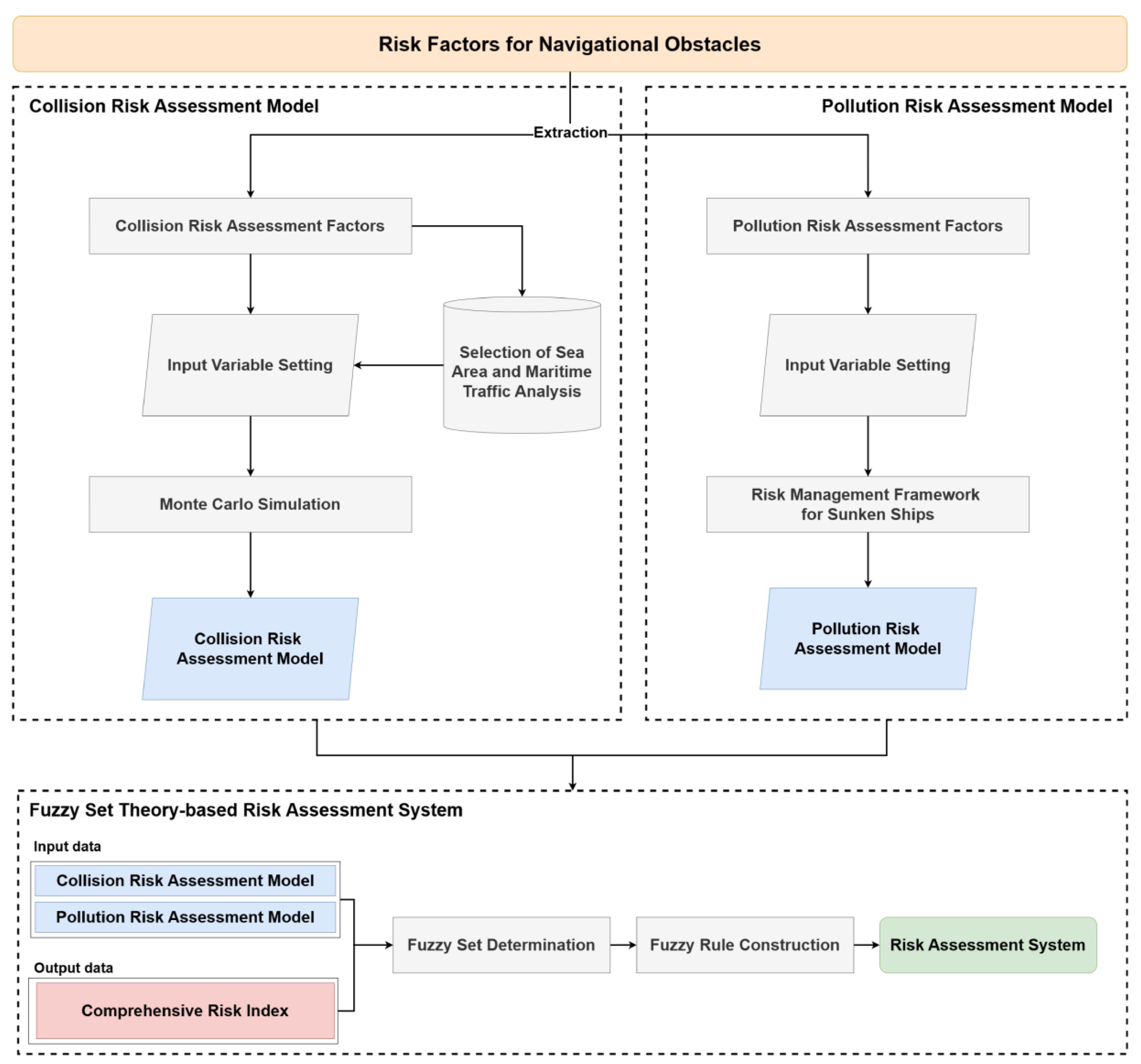
Figure 2 illustrates the development framework of a fuzzy set theory-based navigational obstacle risk assessment system that considers both the collision and pollution risks. The system comprises two models: a collision risk assessment model and pollution risk assessment model. First, the evaluation factors for the collision and pollution risks were extracted and defined using relevant laws and regulations, expert interviews, and ship transit data. Second, the respective assessment models were developed as follows. For the collision risk assessment model, the probability of a collision between a ship and a navigational obstacle was calculated using Monte Carlo simulation, and a regression model was built to establish the risk management criteria. The pollution risk assessment model identifies an evaluation index that focuses on the hazards presented by sunken ships and assesses the risk in stages. Finally, the risk indices derived from these two models were integrated to create a system that infers the comprehensive risk using the fuzzy set theory.

3.2. Risk Factors for Navigational Obstacles

The risk assessment factors reflected in the navigational obstacle risk assessment model were determined based on the previously mentioned twelve factors that define the risks related to navigational obstacles. Relevant laws, regulations, expert interviews, and ship traffic data were used to derive the collision and pollution risk assessment factors. These laws and regulations include the Maritime Traffic Safety Act, Enforcement Rules of the Maritime Traffic Safety Act, and Enforcement Rules of the Maritime Recovery Management Act [1,29,30]. Additionally, expert interviews were conducted by visiting organizations that monitor navigational obstacles, such as the Korea Marine Environment Management Corporation (KOEM) and Korea Fisheries Infrastructure Public Agency (FIPA). Vessel traffic data over a specific period and region are required to assess the risk of navigational obstacles. Accordingly, we researched and collected data containing dynamic and static information on vessels by using systems such as the Automatic Identification System (AIS) and V-Pass. The following information was gathered through expert interviews.
  • Types of major floating debris and whether they can be detected by radar or the naked eye.
  • Maximum, minimum, and average sizes of the major floating debris.
  • Types of floating debris collected at the study site.
  • Mobility of debris influenced by the current and weather conditions.
  • Major collection sites, debris generation sites, and vessel traffic in and around these areas.
  • Disposal procedures and recording methods after debris collection.
Based on the aforementioned information, the collision and pollution risk assessment factors were extracted and defined from the twelve determinants for the navigational obstacle risk, as listed in Table 2. The collision risk assessment factors include five items: (1) size, shape, and structure of the obstacle, (2) tidal range, currents, and weather conditions, (3) proximity to navigational zones and routes, (4) ship traffic density and frequency, (5) ship navigation methods. The pollution risk assessment factors are (1) size, shape, and structure of the obstacle, (2) condition and type of damage, (3) type and quantity of oil, (4) state of submersion (for sunken ships), (5) water depth and seafloor topography, (6) tidal range, currents, and weather conditions, (7) proximity to nearby marine facilities, (8) proximity to navigational zones and routes, (9) safety of port facilities, (10) PSSAs.

3.3. Collision Risk Assessment Model

3.3.1. Selection of Simulation Waters and Analysis of Ship Traffic

The process of analyzing the vessel traffic in the target waters involved the following steps: data preprocessing, defining the grid size and data structure, analyzing the grid-space traffic patterns, and interpreting the results of the grid-space traffic pattern analysis.
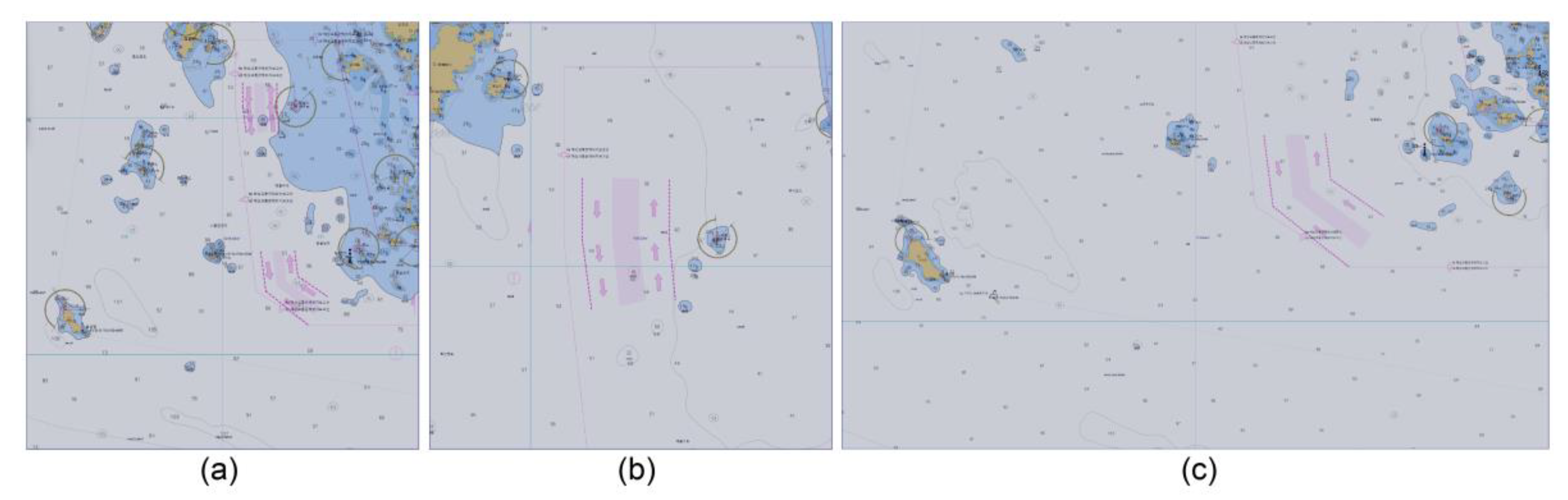
Data preprocessing was performed as follows: AIS data for the target waters (lat_min = 33.8, lat_max = 34.7, lon_min = 125.0, lon_max = 126.0) for the 30-day period from June 1 to June 30, 2023, were filtered by removing duplicates and outliers and excluding vessels that were stopped or anchored from the analysis. As illustrated in Figure 3, the target waters, located off the southwestern and southern coasts of South Korea, were divided into three areas for simulation purposes: (a) all waters, (b) simulation 1 waters, and (c) simulation 2 waters.
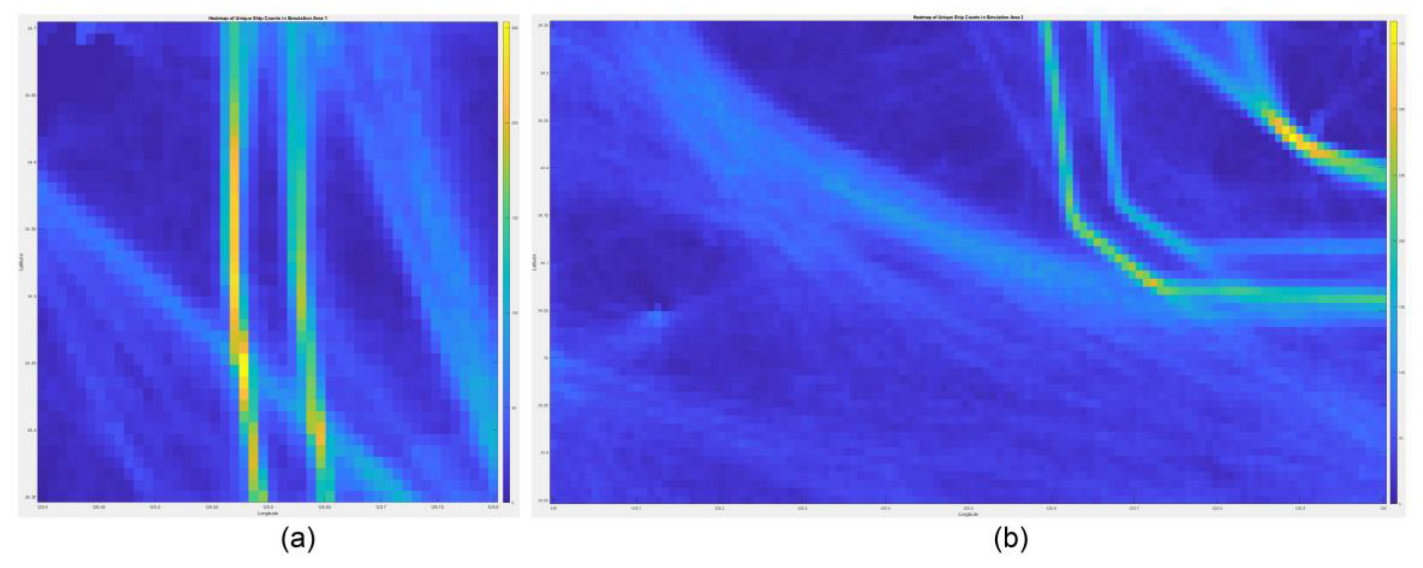
The grid size and data structure are defined as follows. The grid structure was set up using four grid steps (approximately 2.3 × 2.8 km) [31], as proposed by the Ministry of Oceans and Fisheries. The data structure was defined based on the Maritime Mobile Service Identity (MMSI), latitude, longitude, time, Course Over Ground (COG), and Speed Over Ground (SOG) for simulations 1 and 2 to properly allocate the data. The MMSIs of ships sailing within each grid space were then extracted, and the ship traffic was analyzed and visualized in the form of a heat map. Figure 4 shows a visualization of the areas occupied by ships in the 4-level grid for each simulation.
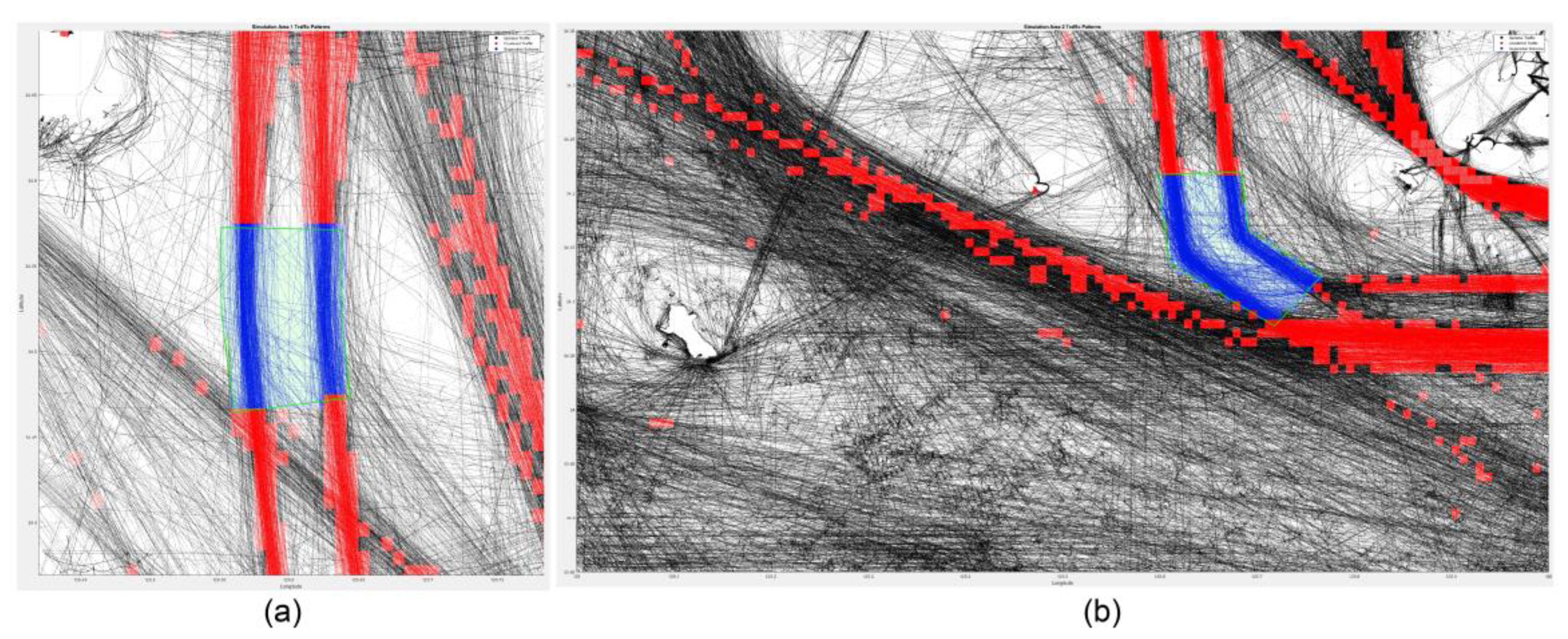
Grid-space traffic pattern analysis was performed as follows: to extract maritime traffic patterns, the dynamic data of the vessels, including the latitude, longitude, and COGs, were clustered within a four-level grid space using Density-Based Spatial Clustering of Applications with Noise (DBSCAN) [32,33]. In addition, polygon objects reflecting the grid space and traffic separation schemes for the target waters were created. New variables were assigned by determining whether the traffic separation schemes were applied to the waters. This was to ensure the application of "Proximity to Navigation Zones and Routes" (#8) and "Ship Navigation Methods" (#10) in Table 2. Figure 5 shows the results of the grid-space variable assignment and visualization, where the ship traffic in the transit zone is represented by the blue area.
Table 3 presents the results of the analysis of ship passage patterns in the four-stage grid space. The metrics include the average number of ships per separated cell, average number of ships per clustered cell, and average number of ships per cell of another type. As a result, the normalized traffic volume was six normalized ships per separate cell, three normalized ships per clustered cell, and one normalized ship per other type of cell in area 1. In area 2, the traffic volume was nine normalized ships per separate cell, five normalized ships per clustered cell, and one normalized ship per other type of cell.

3.3.2. Calculation of Collision Probability

Seven input variables were used for calculating the probability of collision: number of simulations (num_trials, N), size of the four-level grid (grid_size_level_4, L), number of drifting obstacles (num_drip_objects, D), size of the drifting obstacles (drip_level_size, S), speed of the drifting obstacles (V), number of moving ships (num_moving_objects, M), and whether the direction of movement of the ships is fixed (direction_fixed, F).
The positions and movements of the obstacles and ships are defined as follows. First, the initial position of each drifting obstacle is given by:
O 0 = L × r a n d ( D , 2 ) ,
where L×rand(D,2) generates x, y coordinates for D obstacles, ensuring they are randomly distributed within a grid of size L.
Next, the path of each ship, denoted as P i , is defined by random start and end points given by:
P i = L × r a n d ( M , 2,2 )
where L×rand(M,2,2) generates random x, y coordinates for the start and end points of M ships within a grid of size L.
The drift direction of each obstacle is expressed as:
ψ i = r a n d 1,2 0.5
where rand(1,2)−0.5 generates random values between -0.5 and 0.5 for the x and y components of the direction, which are then normalized to a unit vector.
Assuming constant direction and speed, the position of an obstacle at each new step (Oi+1) is updated by adding the product between its movement direction ( ψ i ) and speed (V) to its current position (Oi​), as follows:
O i + 1 = O i + ψ i × V ,
Subsequently, the shortest distance between the path of a moving ship (passing through the start and end points) and a drifting obstacle is calculated as:
d i s t a n c e = d e t P j , e n d P j , s t a r t ,   P j , s t a r t O i P j , e n d P j , s t a r t
where distance is the perpendicular distance between the obstacle and the ship's path. The determinant is used to compute the area of the parallelogram formed by two vectors: the vector representing the direction of the ship's movement, P j ,   e n d P j ,     s t a r , and the vector traced from the starting point of the ship's path to the obstacle's position, Pj,start​−Oi​. This area is then divided by the length of the path vector, P j ,   e n d P j ,     s t a r .
d i s t a n c e     S .
Finally, a collision condition is considered to occur if distance is less than or equal to the obstacle size S:
The collision probability is calculated as the number of collisions that occur over N simulation runs:
P = c o l l i s i o n s N  

3.3.3. Monte Carlo Simulation Results

Monte Carlo simulations were performed to estimate the probability of collision by accounting for uncertain variables in situations where statistical data were insufficient because of the small number of collisions between navigational obstacles and ships. This method allows more realistic collision probabilities to be calculated by repeatedly simulating various scenarios. Additionally, it helps to derive the risk management criteria by effectively providing the data required for the regression model [34,35].
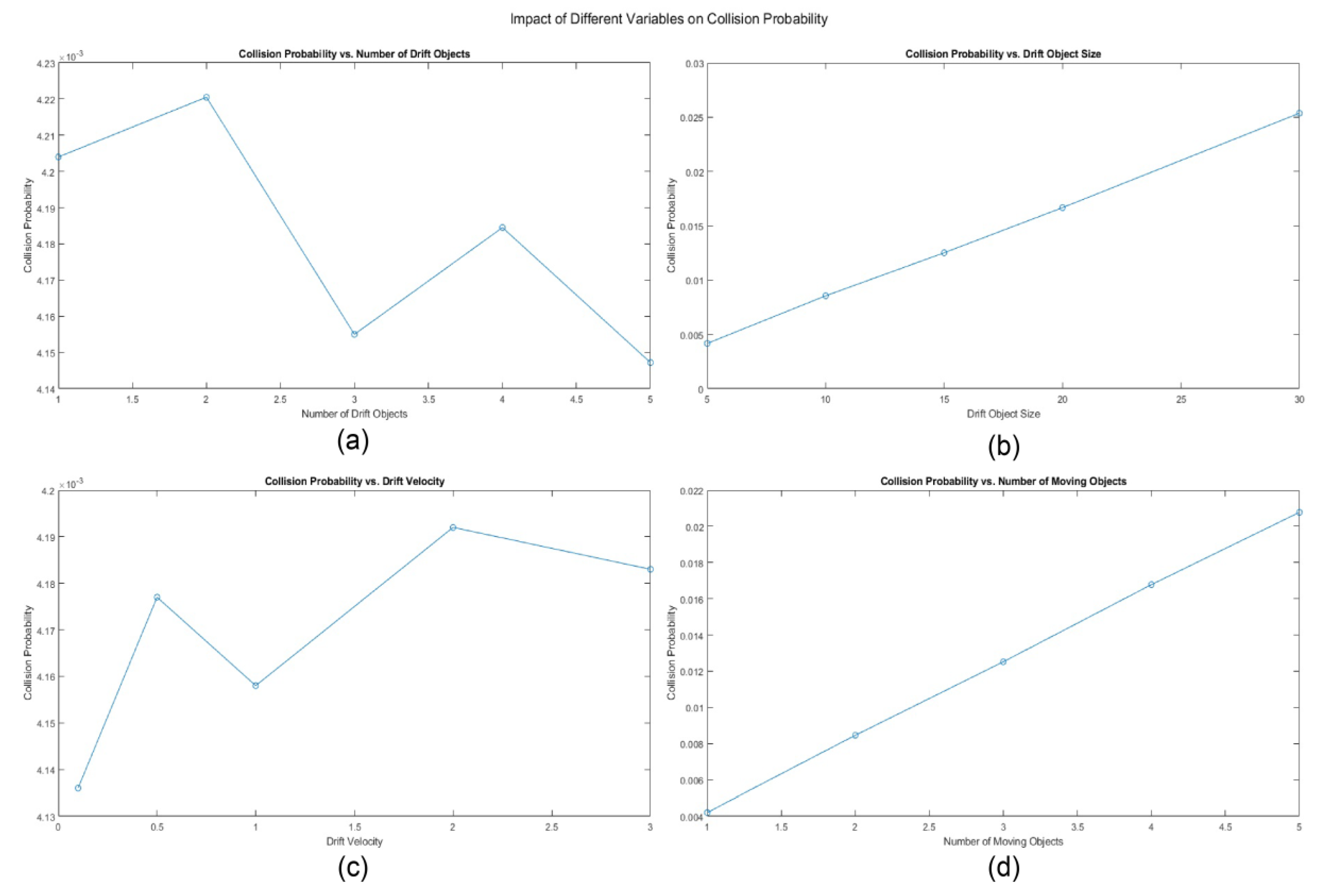
The initial simulation environment for measuring the influence of each variable was as follows: N = 1,000,000, L = 1,000, D = 1, S = 5, V = 0.1, and M = 1. Based on this setup, the probability of collision according to the variable range was calculated using (1)–(7), as shown in Figure 6. The variable ranges were determined according to Table 3.
From the Monte Carlo simulation, S (size of drifting obstacle) and M (number of moving ships) were found to be variables that significantly affect the probability of collision, whereas DDD (number of drifting obstacles) and V (speed of drifting obstacles) were found to have no significant effect. Additionally, the R-squared value of the model was very high at 0.888, indicating that the model explains a large portion of the variance in the probability of collision. The regression model was derived from the Monte Carlo simulation, as shown below. The regression equation for the variables is:
c o l l i s i o n   p r o b a b i l i t y = β 0 + β 1 D + β 2 S + β 3 V + β 4 M
Here, the estimated coefficients of the model are β 0 = 0.040041 , β 1 = 7.1868 × 10 7 , β 2 = 0.0025018 , β 3 = 3.7425 × 10 6 , β 4 = 0.013346 .
Therefore, the regression equation for predicting the collision probability by applying the estimated coefficients is:
c o l l i s i o n   p r o b a b i l i t y = 0.040041 7.1868 × 10 7 D + 0.0025018 S + 3.7425 × 10 6 V + 0.013346 M
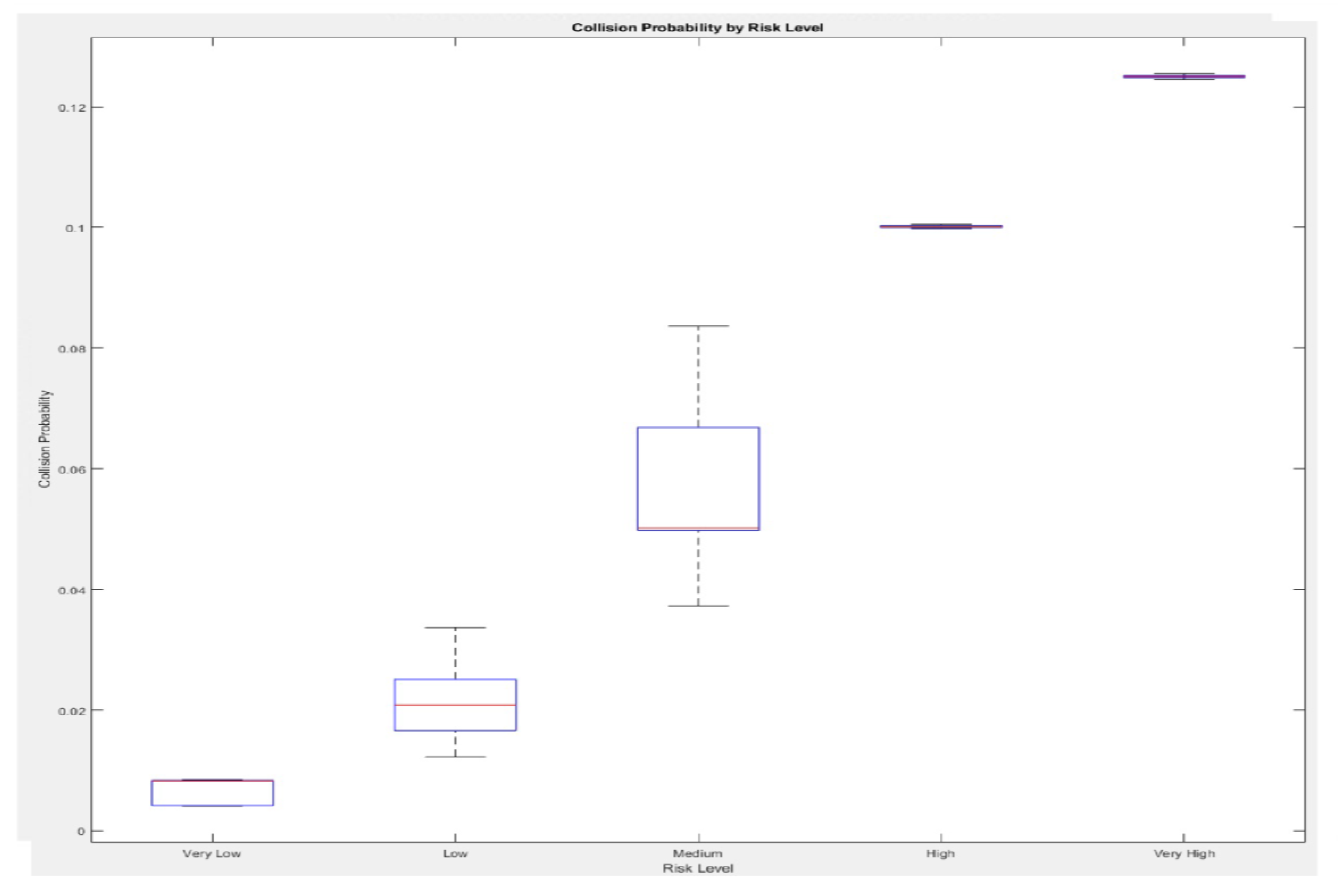
Five risk stages were set based on the collision probability values, and the range for each risk stage was defined by considering the distribution of the collision probabilities. The risk management criteria were derived from this. The range of the collision probabilities was determined by identifying the minimum and maximum values from the data collected from the simulation results and prediction range analysis. The boundaries of each risk level were calculated as percentiles based on the minimum and maximum collision probability values. Table 4 lists the ranges of the risk stage according to the collision probability, and Figure 7 illustrates the distribution and frequency of the collision probabilities. Table 5 presents the risk level sections calculated using the minimum and maximum values.

3.4. Pollution Risk Assessment Model

3.4.1. Determination Process of Pollution Risk Assessment Index

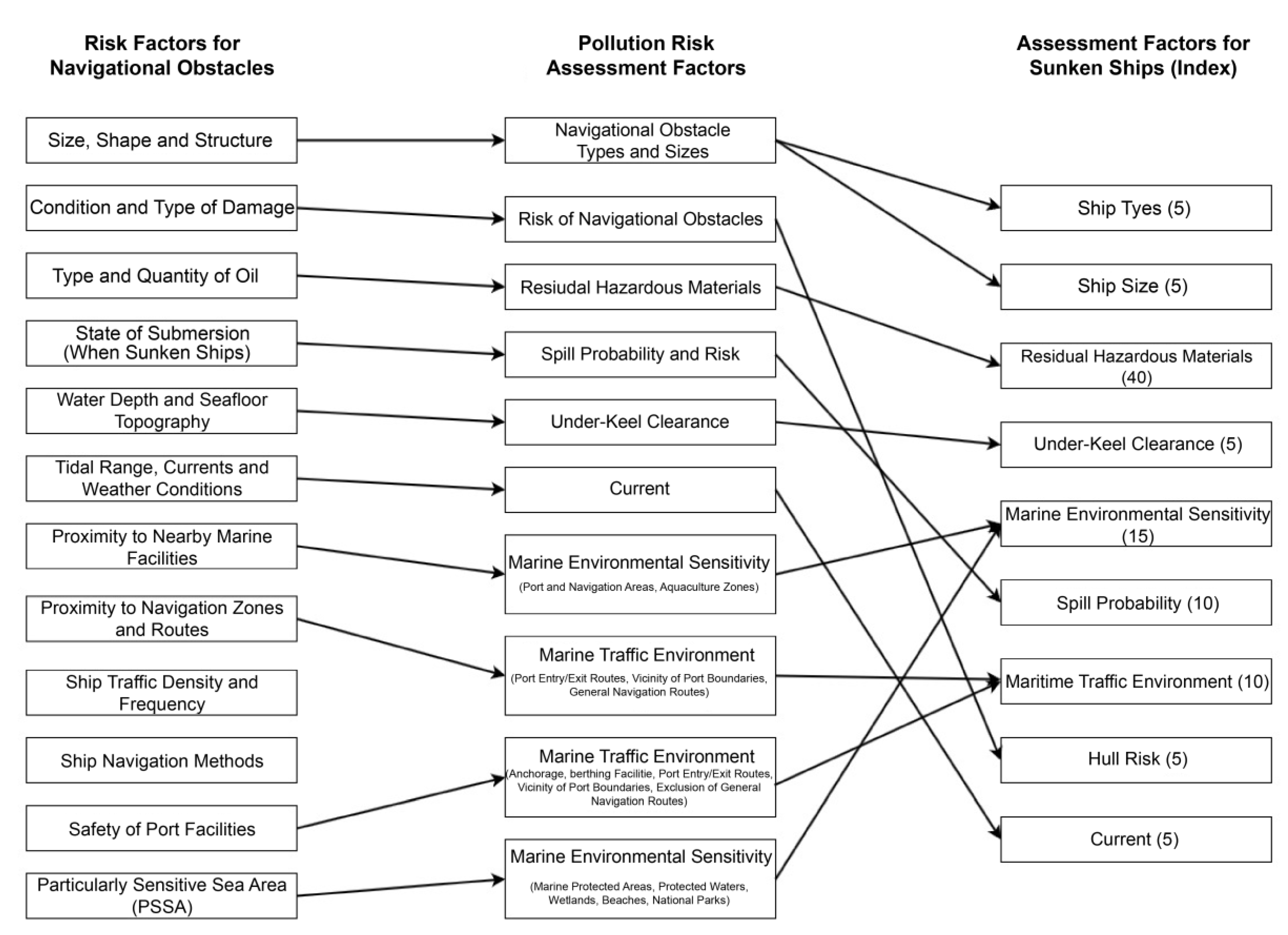
The process used to determine the pollution risk assessment index is shown in Figure 8. First, ten pollution risk assessment factors were extracted from the twelve factors that determine the risk of navigational obstacles. Next, nine items corresponding to the risk assessment factors related to sunken ships were identified from these evaluation factors. Finally, a pollution risk assessment index was determined by applying the sunken ship risk assessment index to the corresponding items.

3.4.2. Pollution Risk Assessment Model

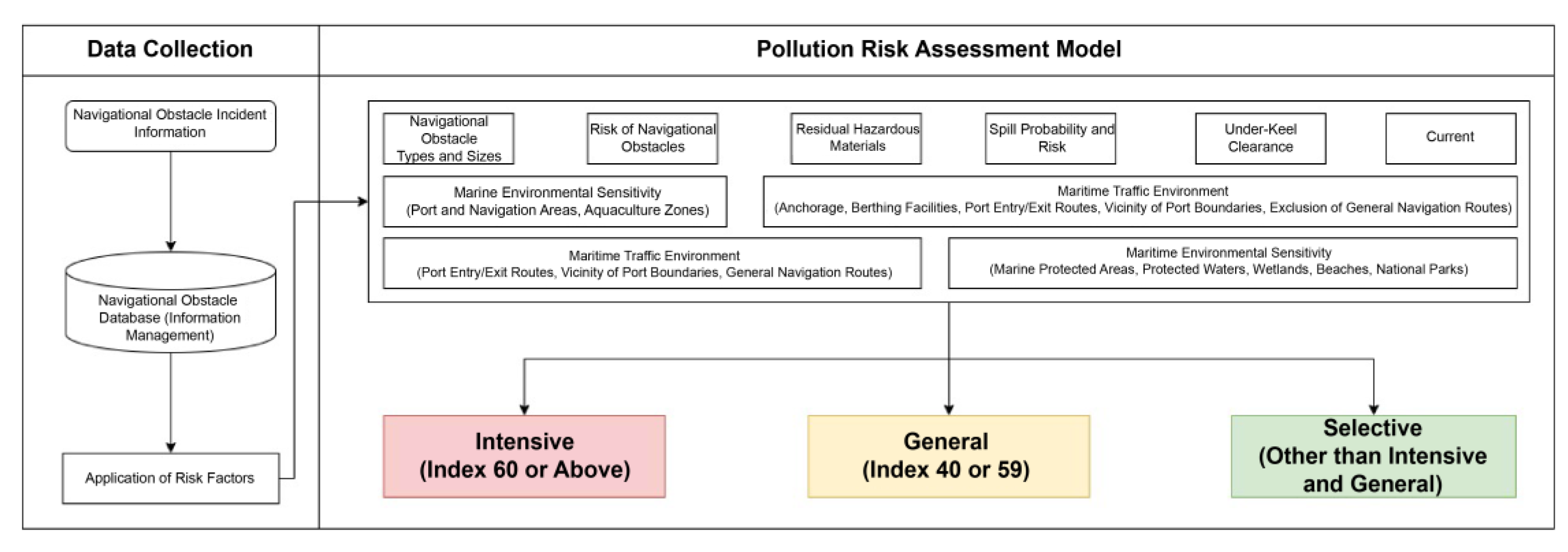
Based on the risk management structure for sunken ships shown in Figure 1, a pollution risk assessment model was developed by systematically managing the information on sunken ships and assessing the risk of potential accidents caused by them. According to the procedure outlined in Figure 9, (1) the information on accidents due to navigational obstacles was collected, (2) an index based on the defined pollution risk assessment factors was calculated, and (3) the pollution risk was evaluated by summing these indices. At this stage, the maximum score obtained by summing all the indices for each evaluation item was set to 100 points. The risk was classified into the following three levels:
  • Red (Intensive) if the combined index is more than 60 points,
  • Yellow (General) if it is between 40 and 60 points,
  • Green (Selective) if it is less than 40 points.
The index of each evaluation item is summed, as shown in (10), to calculate the final R i s k   i n d e x p ​:
R i s k   I n d e x p = i = 1 n I i
where n denotes the number of evaluation items and I i ​ represents the score of each evaluation item i . In this case, the number of evaluation items was limited to a maximum of ten.
The risk class based on the calculated R i s k   i n d e x p ​ is classified as shown in (11):
I n t e n s i v e :   R i s k   I n d e x p 60 G e n e r a l :   40     R i s k   I n d e x p < 60 S e l e c t i v e :   R i s k   I n d e x p < 40

3.5. System Development

3.5.1. Development Process

First, the fuzzy set was determined by considering the range of the risk index based on the linguistic variables defined in the collision and pollution risk assessment models. Second, a fuzzy rule was constructed and derived using two input variables (collision risk index and pollution risk index) and one output variable (comprehensive risk index). Finally, a system capable of inferring the comprehensive risk (risk index and risk level) of navigational obstacles by utilizing the determined fuzzy set and configured fuzzy rules was developed.

3.5.2. Determination of Fuzzy Set

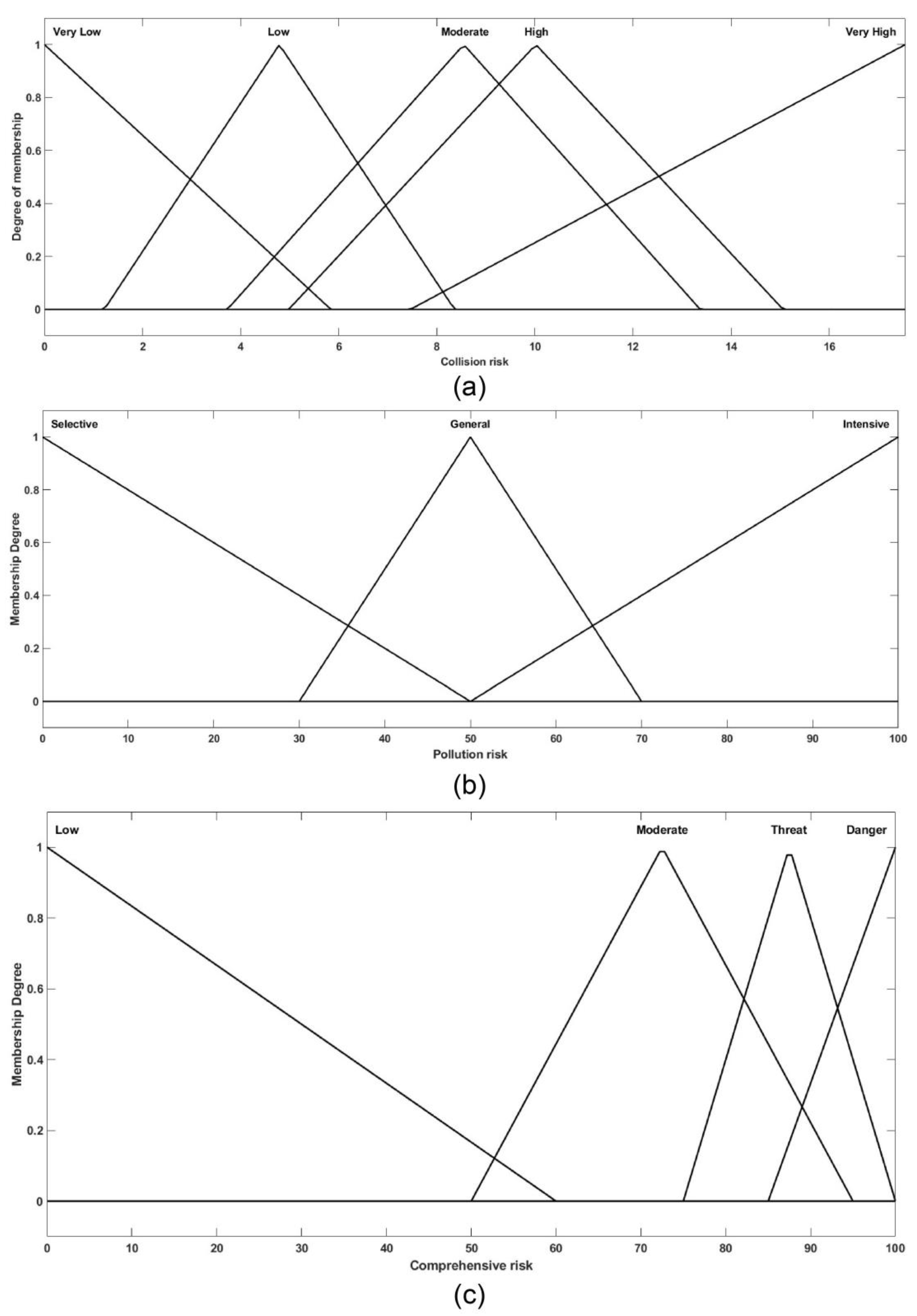
A collision risk assessment model was created using Monte Carlo simulation. An error of 5–10% occurs when this technique is applied [34]. Therefore, it was applied to the ranges of the collision risk index, pollution risk index, and comprehensive risk index of the collision risk assessment model under the assumption that this error introduces fuzziness. The accident risk level [31] defined in the Marine Traffic Safety Information System (MTIS) of the Korea Maritime Traffic Safety Authority was used as the linguistic variable corresponding to the overall risk and index range of the system:
  • Low: Accident risk is less than 50%.
  • Moderate (yellow): Accident risk is greater than 50% and less than 85%.
  • Threat: Accident risk is greater than 85% but less than 95%.
  • Danger (red): Risk of accident is at least 95%.
The following fuzzy sets were determined, as shown in Figure 10: (a) fuzzy set for the collision risk assessment model, (b) fuzzy set for the pollution risk assessment model, and (c) fuzzy set theory-based navigational obstacle risk assessment system that simultaneously considers both the collision risk and pollution risk.
Table 6 lists the range and shape of the membership function (MF) according to the linguistic variables corresponding to each fuzzy set.

3.5.3. Fuzzy Rule Composition

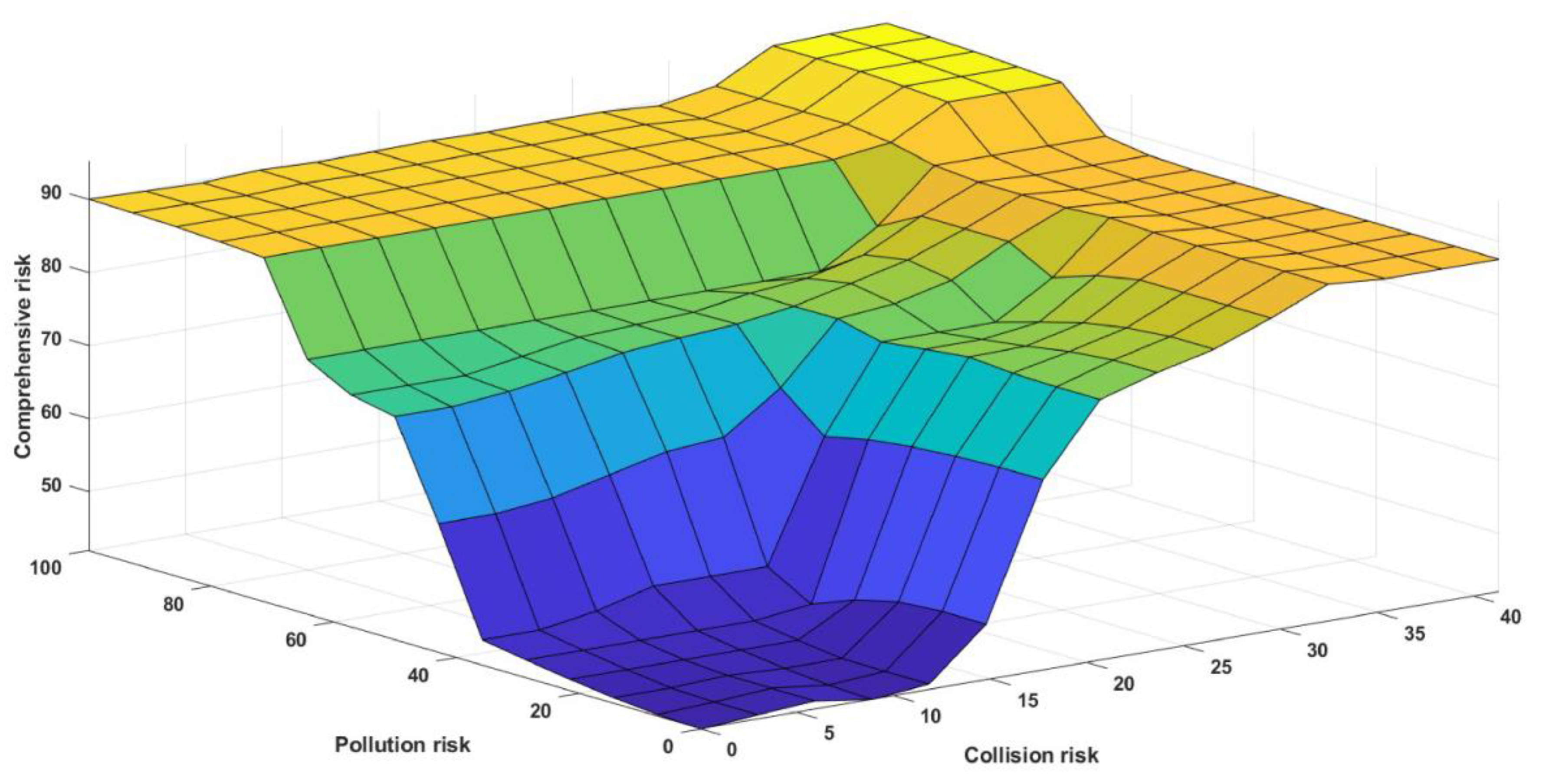
To construct a 2 × 1 system (two inputs and one output), two inputs (collision and pollution risks) were applied to the input side and one output (comprehensive risk) was applied to the output side. For the integrated obstacle risk assessment model, 24 fuzzy rules (using AND operations) were created, as shown in Table 7, and a three-dimensional visualization was derived, as shown in Figure 11.

3.5.4. Risk Assessment System

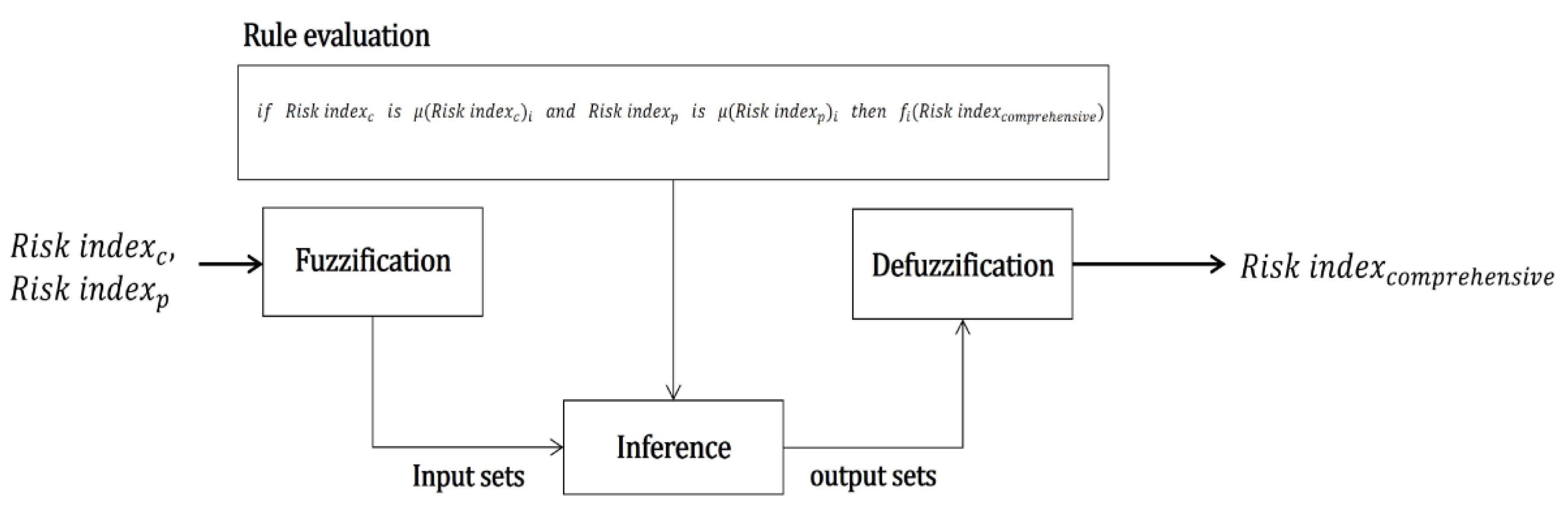
The system for evaluating the risk of navigational obstacles is based on a fuzzy inference system and primarily utilizes fuzzy sets and rules. The operation of this system is illustrated in Figure 12.
First, in the fuzzification step, the input values R i s k   i n d e x c ​ and R i s k   i n d e x p , which are provided as crisp values, are received, and each value is assessed to determine the degree to which they belong to the appropriate fuzzy set. In the second step involving the rule evaluation, these fuzzy inputs are applied to 24 rules, and the evaluation results for all the rules are numerically represented. This value is then applied to the MF on the output side of the rule. Subsequently, the fuzzy sets corresponding to the outputs of all rules are integrated. Finally, the output is calculated by synthesizing the results of all the rules, as shown in (12). This process involves defuzzification using the "centroid" defuzzification method.
R i s k   i n d e x c o m p r e h e n s i v e = i = 1 24 μ R u l e i ( R i s k   i n d e x c o m p r e h e n s i v e ) × R i s k   i n d e x c o m p r e h e n s i v e i i = 1 24 μ R u l e i ( R i s k   i n d e x c o m p r e h e n s i v e )
Here, R i s k   i n d e x c o m p r e h e n s i v e i is a value within the output range selected according to each rule. Each rule calculates the result for a given input, and all the results are then synthesized to calculate the final output value.

4. Case Study

4.1. Numerical Simulation Results

The fuzzy set theory-based navigational obstacle risk assessment system that considers both collision and pollution risks was applied to both micro- and macro-level case studies to verify its performance. In the micro-level case study, the collision and pollution risks were evaluated for virtual drifting fishing boats, and a comprehensive risk was inferred using the developed system. In the macro-level case study, the comprehensive risk was inferred by adding a random index based on the collision risk level after calculating the pollution risk index for each location using data on the status of sunken ships from the Korea Maritime Environment Corporation [36].

4.1.1. Micro-Level Results

For the micro-level case study, it was assumed that a drifting fishing boat incident occurred on August 13, 2024, at 33° 33 min 01 s N, 127° 39 min 13 s E, approximately 36 nautical miles from Seongsanpo Port on Jeju Island, as shown in Figure 13.
The data for the five determinants affecting the collision risk and ten determinants affecting the pollution risk are summarized in Table 8 and Table 9, respectively.
The collision risk was evaluated as shown in Table 10 by applying the data from Table 8 to (9). In this process, ObjectSize was calculated using the Pythagorean theorem for a ship length of 30 m and width of 5 m. For moving ships, the maximum number of ship passages per hour within the grid at the drift point was considered.
Table 11 presents the results of applying the data in Table 10 to the pollution risk assessment model.
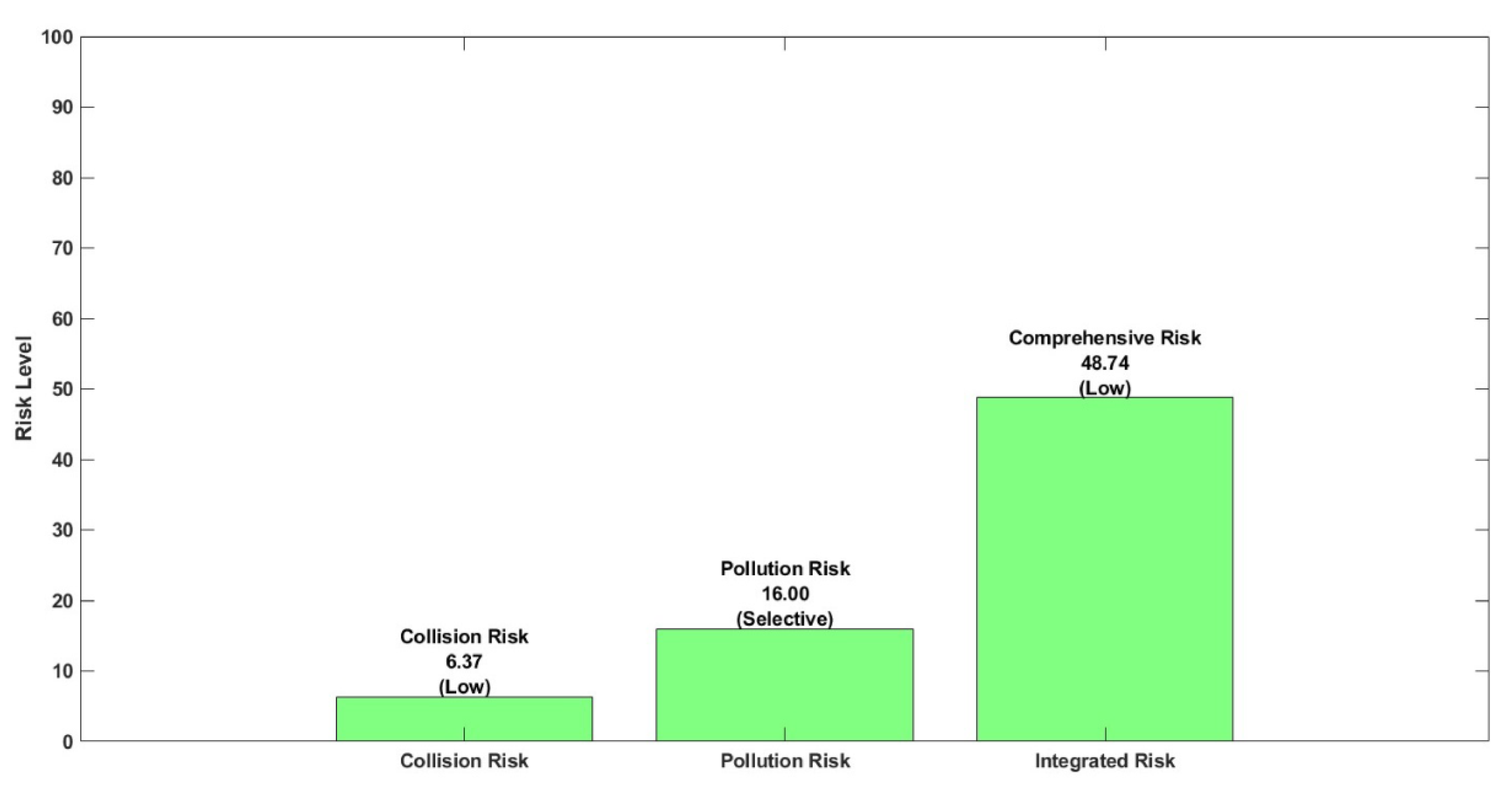
The collision risk index (level) and pollution risk index (level) were calculated as 6.37% (medium) and 16% (selective), respectively. By inputting these values into the fuzzy set theory-based navigational obstacle risk assessment system, the comprehensive risk index (level) was inferred and evaluated as 48.74% (low), as shown in Figure 14.

4.1.2. Macro-Level Results

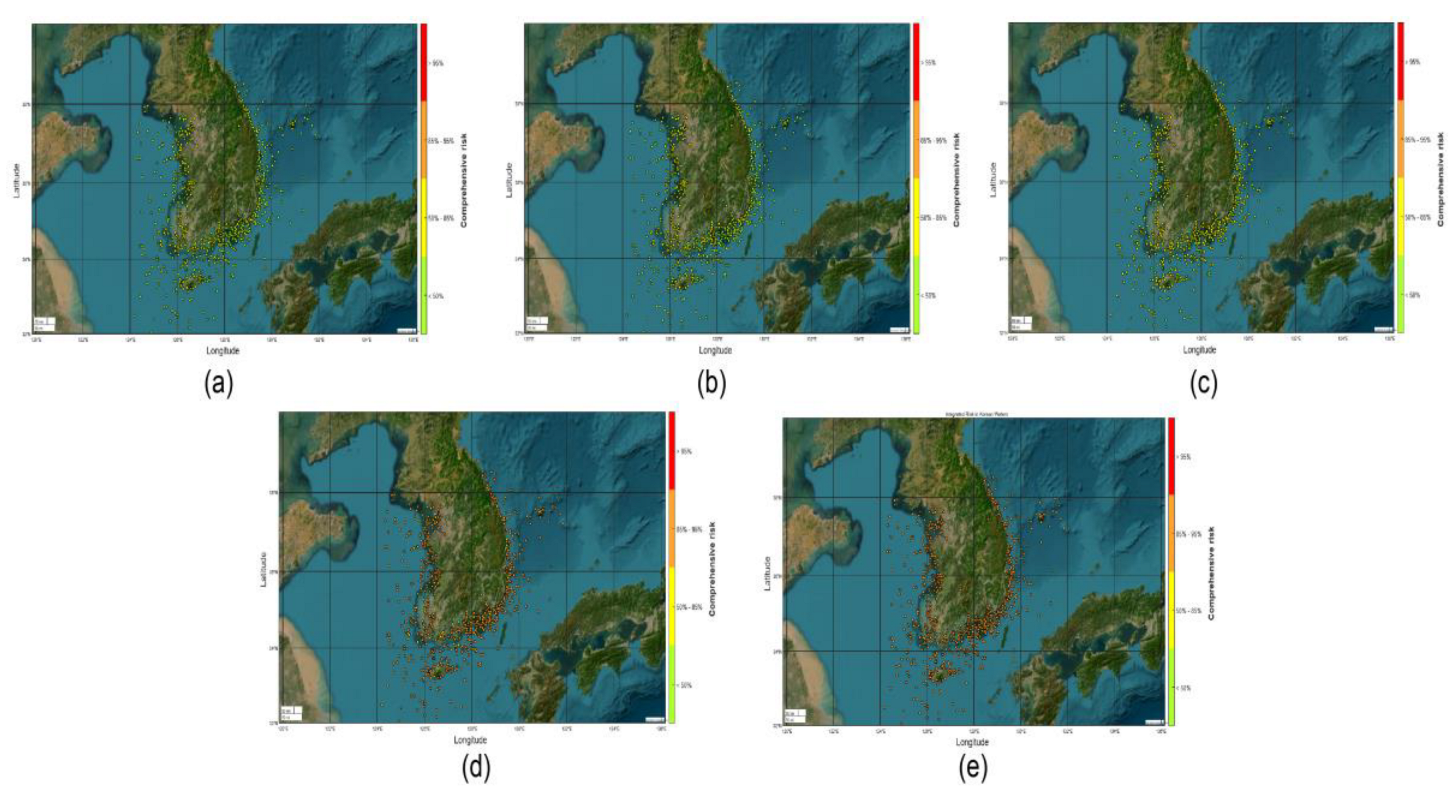
The Korea Maritime Environment Corporation systematically manages the information on sunken ships and maintains the status data to assess the potential for marine pollution accidents. These data include the name of the sunken ship, date of sinking, ship type, accident type, depth, hazardous material mass, latitude, and longitude [36]. The data provided on August 28, 2023, were used for the macro-level case study. These included the data of 2,287 sunken ships, recorded from 1983 to 2023, which included fishing boats, cargo ships, oil tankers, tugboats, and buoys, with fishing boats accounting for approximately 82% of the total.
The pollution risk index was calculated by inputting the data into a pollution risk assessment model. However, because the comprehensive risk cannot be inferred using only the pollution risk index, a random index was added based on the collision risk level to calculate the comprehensive risk. Figure 15 shows the distribution of the comprehensive risk at each location for various levels of the collision risk index. The results confirmed that the comprehensive risk level tended to increase with increasing collision risk level.

4.2. Discussion

From the results of the simulation based on the micro- and macro-level case studies, the comprehensive risk was inferred using a fuzzy set theory-based obstacle risk assessment system that simultaneously considers both the collision and pollution risks. This system was designed to infer comprehensive risk by evaluating both the collision and pollution risks in an integrated manner. Through this approach, the system aims to support decision making for the prompt removal of navigational obstacles.
In the micro-level case study, the collision risk index calculated from the collision risk assessment model and pollution risk index calculated from the pollution risk assessment were input into the developed model. The comprehensive risk was inferred using fuzzy rules by applying 24 AND operations. Because of the nature of the AND operation, the final result is considered true only when all conditions are true, allowing for more accurate results by returning an outcome only when all conditions are satisfied [22]. The models calculated the collision and pollution risks as 6.37% and 16.00%, respectively. When these risk factors were analyzed using the fuzzy rule with AND operations, a low comprehensive risk state of 48.74% was inferred. This indicates that the system can provide reliable risk assessment by comprehensively considering both the collision and pollution risks.
In the macro-level case study, the comprehensive risk was inferred by calculating the pollution risk index for each location using data on the current status of sunken ships from the Korea Maritime Environment Corporation and by adding an arbitrary index according to the collision risk level. In this process, it was confirmed that the comprehensive risk tended to increase as the collision risk level increased. This indicates that collision risk is an important variable for the evaluation of the comprehensive risk. Therefore, the developed fuzzy set theory-based evaluation system responds sensitively to changes in risk and can effectively reflect the actual risk conditions.
The reliability of the system was verified by comprehensively evaluating the collision risk index and pollution risk index in various situations and inferring the comprehensive risk index and level. In particular, the developed system not only overcomes the limitations of previous research, which failed to simultaneously consider the collision and pollution risks, but also demonstrates its potential as an effective decision-making tool for the prompt removal of navigational obstacles.

5. Conclusions

This study developed a fuzzy set theory-based navigational obstacle risk assessment system that considers both the collision and pollution risks with the goal of facilitating the rapid removal of navigational obstacles. The system was designed as a tool to infer comprehensive risk by integrating the collision and pollution risk assessment models. We confirmed through both micro- and macro-level case studies that the system can provide reliable risk assessments, respond sensitively to changes in risk, and effectively reflect the realistic site conditions. Therefore, it has been demonstrated that this system can overcome the limitations of existing research and serve as a useful decision-making tool for the rapid removal of navigational obstacles. This study represents the first step toward the swift removal of navigational obstacles. Future research will focus on using this system to develop specific strategies for determining the timing and methods of obstacle removal.

Author Contributions

Conceptualization, D.-H. Lee and H. Namgung; methodology, D.-H. Lee and H. Namgung; software, D.-H. Lee; validation, D.-H Lee and H. Namgung; formal analysis, D.-H. Lee; investigation, D.-H. Lee; resources, H. Namgung; data curation, S.-L. Yoo; writing—original draft preparation, D.-H Lee; writing—review and editing, H. Namgung; visualization, S.-L. Yoo; supervision, H. Namgung. All authors have read and agreed to the published version of the manuscript.

Funding

This research was supported by the National Research Foundation of Korea (NRF), funded by the Ministry of Education (MOE) through the “Regional Innovation Strategy (RIS)” (Grant No. 2023RIS-009).

Data Availability Statement

The original contributions presented in this study are included in the article/supplementary material. Further inquiries can be directed to the corresponding author(s).

Acknowledgments

The authors would like to extend their deep gratitude to Professor Joo Sung Kim of Mokpo National Maritime University for his invaluable assistance throughout the progress of this research.

Conflicts of Interest

The authors declare no conflicts of interest.

Appendix A

1)
Ship Types
Ship type Oil tanker,
Hazardous material carrier
General cargo ship Tugboats and work vessels, Fishing vessels Barges and other vessels Unknown
Assessment index 5 4 3 2 1
2)
Ship Size
Gross tonnage 10,000 tons or more 5,000 to less than 10,000 tons 3,000 to less than 5,000 tons 1,000 to less than 3,000 tons 500 to less than 1,000 tons 100 to less than 500 tons Less than 100 tons
Assessment index 5 4.5 4 3 2 1.5 1
3)
Residual Hazardous Materials
Residual quantity
Hazardous materials
1,000 ㎘ or more 500 to less than 1,000 ㎘ 100 to less than 500 ㎘ 50 to less than 100 ㎘ 10 to less than 50 ㎘ Less than 10 ㎘ None
Oil 24° API or below [Heavy fuel oil (HFO)] 40 35 20 15 10 5 0
24° to 34° API [Intermediate fuel oil (IFO)] 32 28 16 12 8 4 0
34° to 44° API [Marine diesel oil (MFO)] 16 14 8 6 4 2 0
44° API or above [Marine gas oil (MGO)] 8 7 4 3 2 1 0
Hazardous liquid substances X 40 35 20 15 10 5 0
Y 32 28 16 12 8 4 0
Z 16 14 8 6 4 2 0
Other substances 8 7 4 3 2 1 0
Radioactive materials 40 0
4)
Under-Keel Clearance
Under-keel clearance Less than 15 m 15 m to less than 20 m 20 m to less than 25 m 25 m to less than 30 m 30 m or more
Assessment index 5 4 3 2 1
5)
Marine Environmental Sensitivity
Distance from shoreline or sensitive area Less than 1 nautical mile 1 to less than 5 nautical miles 5 to less than 12 nautical miles 12 to less than 25 nautical miles 25 nautical miles or more
Assessment index 15 10 7 4 1
6)
Spill Probability
(a)
Age of Ship Before the Incident
Ship age 20 years or more 10 to less than 20 years 5 to less than 10 years Less than 5 years
Assessment index 4 3 2 1
  • (b) Elapsed time since the incident
Elapsed time 25 years or more 20 to less than 25 years 15 to less than 20 years 10 to less than 15 years 5 to less than 10 years Less than 5 years
Assessment index 6 5 4 3 2 1
7)
Maritime Traffic Environment
Traffic environment Port entry/
Exit routes
Vicinity of port boundaries Anchorage General navigation routes Others
Assessment index 10 8 6 4 2
8)
Hull risk
Hull risk (Accident type) Sinking due to hull damage from external forces (e.g., fire, explosion, collision, grounding, etc.) Sinking without hull damage (e.g., flooding, capsizing, etc.)
Assessment index 5 1
9)
Currents
Current speed Above 2 knots 1 to less than 2 knots Below 1 knot
Assessment index 5 3 1

References

  1. Maritime Traffic Safety Act. Available online: https://law.go.kr/LSW//lsInfoP.do?lsId=014483&ancYnChk=0#0000 (accessed on 11 Nov. 2024).
  2. Marine accident statistics 2023. Available online: https://www.kmst.go.kr/web/board.do?menuIdx=135 (accessed on 11 Nov. 2024).
  3. Takehama, S. Estimation of damage to fishing vessels caused by marine debris, based on insurance statistics. In Proceeding of the Second International Conference on Marine Debris, Honolulu, Hawaii, 2-7 April 1989. [Google Scholar]
  4. Nash, A.D. Impacts of marine debris on subsistence fishermen an exploratory study. Mar. Pollut. Bull. 1992, 24, 150–156. [Google Scholar] [CrossRef]
  5. Cho, D.O. Challenges to marine debris management in Korea. Coast. Manag. 2005, 33, 89–409. [Google Scholar] [CrossRef]
  6. Byard, R.W. Commercial fishing industry deaths – forensic issues. J. Forensic Leg. Med. 2013, 20, 129–132. [Google Scholar] [CrossRef]
  7. Maritime Traffic Safety Act. Available online: https://www.law.go.kr/%EB%B2%95%EB%A0%B9/%ED%95%B4%EC%83%81%EA%B5%90%ED%86%B5%EC%95%88%EC%A0%84%EB%B2%95 (accessed on 11 Nov. 2024).
  8. Lincoln, S.; Andrews, B.; Birchenough, S.N.R.; Chowdhury, P.; Engelhard, G.H.; Harrod, O.; Pinnegar, J.K.; Townhill, B.L. Marine litter and climate change: inextricably connected threats to the world’s oceans. Sci. Total Environ. 2022, 837, 155709. [Google Scholar] [CrossRef] [PubMed]
  9. Haarr, M.L.; Falk-Andersson, J.; Fabres, J. Global marine litter research 2015–2020: geographical and methodological trends. Sci. Total Environ. 2022, 820, 153162. [Google Scholar] [CrossRef]
  10. González-Fernández, D.; Hanke, G. Floating marine macro litter in the Black Sea: toward baselines for large scale assessment. Environ. Pollut. 2020, 309, 119816. [Google Scholar] [CrossRef]
  11. Chiu, C.C.; Liao, C.P.; Kuo, T.C.; Huang, H.W. Using citizen science to investigate the spatial-temporal distribution of floating marine litter in the waters around Taiwan. Mar. Pollut. Bull. 2020, 157, 111301. [Google Scholar] [CrossRef] [PubMed]
  12. Pogojeva, M.; Zhdanov, I.; Berezina, A.; Lapenkov, A.; Kosmach, D.; Osadchiev, A.; Hanke, G.; Semiletov, I.; Yakushev, E. Distribution of floating marine macro-litter in relation to oceanographic characteristics in the Russian Arctic Seas. Mar. Pollut. Bull. 2021, 166, 112201. [Google Scholar] [CrossRef]
  13. Sá, S.; Bastos-Santos, J. Floating marine litter and their risks to cetaceans off Portugal. Mar. Pollut. Bull. 2021, 170, 112603. [Google Scholar] [CrossRef] [PubMed]
  14. Ruiz, I.; Burgoa, I.; Santos, M.; Basurko, O.C.; García-Barón, I.; Louzao, M.; Beldarrain, B.; Kukul, D.; Valle, C.; Uriarte, A.; et al. First assessment of floating marine litter abundance and distribution in the Bay of Biscay from an integrated ecosystem survey. Mar. Pollut. Bull. 2022, 174, 113266. [Google Scholar] [CrossRef] [PubMed]
  15. Andrés, M.; Delpey, M.; Ruiz, I.; Declerck, A.; Sarrade, C.; Bergeron, P.; Basurko, O.C. Measuring and comparing solutions for floating marine litter removal: lessons learned in the south-east coast of the Bay of Biscay from an economic perspective. Mar. Policy 2021, 127, 104450. [Google Scholar] [CrossRef]
  16. Topouzelis, K.; Papageorgiou, D.; Suaria, G.; Aliani, S. Floating marine litter detection algorithms and techniques using optical remote sensing data: a review. Mar. Pollut. Bull. 2021, 170, 112675. [Google Scholar] [CrossRef]
  17. Garcia-Garin, O.; Monleón-Getino, T.; López-Brosa, P.; Borrell, A.; Aguilar, A.; Borja-Robalino, R.; Cardona, L.; Vighi, M. Automatic detection and quantification of floating marine macro-litter in aerial images: introducing a novel deep learning approach connected to a web application in R. Environ. Pollut. 2021, 273, 116490. [Google Scholar] [CrossRef] [PubMed]
  18. Hong, S.; Lee, J.; Lim, S. Navigational threats by derelict fishing gear to navy ships in the Korean seas. Mar. Pollut. Bull. 2017, 119, 100–105. [Google Scholar] [CrossRef] [PubMed]
  19. NOAA. Risk Assessment for Potentially Polluting Wrecks in U.S. Waters. Silver Spring, MD: National Oceanic and Atmospheric Administration, 2013.
  20. Alcaro, L. The DEEPP project, PPSWs within the Mediterranean cetacean sanctuary. Europe First Adriatic Oil Spill Conf. 2010. [Google Scholar]
  21. Alcaro, L. , et al. DEEPP Project Development of European Guidelines for Potentially Polluting Shipwrecks. Rome: EU DG Environment, Civil Protection Unit, 2007.
  22. Zadeh, L.A. The concept of a linguistic variable and its application to approximate reasoning-I. Inf. Sci. 1975, 8, 199–249. [Google Scholar] [CrossRef]
  23. Ohn, S.W.; Namgung, H. Interval type-2 fuzzy inference system based on closest point of approach for collision avoidance between ships. Appl. Sci. 2020, 10. [Google Scholar] [CrossRef]
  24. Namgung, H.; Kim, J.S. Collision risk inference system for maritime autonomous surface ships using COLREGs rules compliant collision avoidance. IEEE Access 2021, 9, 7823–7835. [Google Scholar] [CrossRef]
  25. Namgung, H.; Jeong, J.-S.; Kim, J.-S.; Kim, K.-I. Inference model of collision risk index based on artificial neural network using ship near-collision data. J. Phys. Conf. Ser. 2019, 1357, 012044. [Google Scholar] [CrossRef]
  26. Namgung, H.; Ohn, S.-W. Fuzzy inference and sequence model-based collision risk prediction system for stand-on vessel. Sensors (Basel) 2022, 22. [Google Scholar] [CrossRef] [PubMed]
  27. Zhen, R.; Lv, P.; Shi, Z.; Chen, G. A novel fuzzy multi-factor navigational risk assessment method for ship route optimization in coastal offshore wind farm waters. Ocean Coast. Manag. 2023, 232, 106428. [Google Scholar] [CrossRef]
  28. Shi, Z.; Zhen, R.; Liu, J. Fuzzy logic-based modeling method for regional multi-ship collision risk assessment considering impacts of ship crossing angle and navigational environment. Ocean Eng. 2022, 259, 111847. [Google Scholar] [CrossRef]
  29. Enforcement Rules of the Maritime Traffic Safety Act. Available online: https://www.law.go.kr/lsInfoP.do?lsiSeq=260107&efYd=20240726#0000 (accessed on 11 Nov. 2024).
  30. Enforcement Rules of the Marine Environment Management Act. Available online: https://law.go.kr/%EB%B2%95%EB%A0%B9/%ED%95%B4%EC%96%91%ED%99%98%EA%B2%BD%EA%B4%80%EB%A6%AC%EB%B2%95%EC%8B%9C%ED%96%89%EA%B7%9C%EC%B9%99 (accessed on 11 Nov. 2024).
  31. Maritime Traffic Safety Information System. Available online: https://mtis.komsa.or.kr/traffic/focst/acdntRisk (accessed on 11 Nov. 2024).
  32. Ester, M.; Kriegel, H.-P.; Sander, J.; Xu, X. A density-based algorithm for discovering clusters in large spatial databases with noise. In Proceedings of the 2nd International Conference on Knowledge Discovery and Data Mining (KDD’96), Portland, OR, USA, 2–4 Aug. 1996. [Google Scholar]
  33. Namgung, H.; Kim, J.-S. Regional collision risk prediction system at a collision area considering spatial pattern. J. Mar. Sci. Eng. 2021, 9. [Google Scholar] [CrossRef]
  34. Banack, H.R.; Hayes-Larson, E.; Mayeda, E.R. Monte Carlo simulation approaches for quantitative bias analysis: A tutorial. Epidemiol. Rev. 2022, 43, 106–117. [Google Scholar] [CrossRef]
  35. Namgung, H.; Kim, J.-S. Vessel trajectory analysis in designated harbor route considering the influence of external forces. J. Mar. Sci. Eng. 2020, 8, 860. [Google Scholar] [CrossRef]
  36. Current status of ships sinking at the Korea maritime environment corporation. Available online: https://www.data.go.kr/data/15004149/fileData.do?recommendDataYn=Y (accessed on 11 Nov. 2024).
Figure 1. Risk management framework for sunken ships.
Preprints 144576 g001
Figure 2. Development framework for fuzzy set theory-based risk assessment system for navigational obstacles.
Preprints 144576 g002
Figure 3. Study area for simulation. (a) Entire study area, (b) Area for simulation 1, and (c) Area for simulation 2.
Preprints 144576 g003
Figure 4. Visualization results of the vessel occupancy area in the gridded space. (a) Area for simulation 1 and (b) area for simulation 2.
Preprints 144576 g004
Figure 5. Results of the grid-space variable assignment and visualization. (a) Area for simulation 1 and (b) Area for simulation 2.
Preprints 144576 g005
Figure 6. Collision Probability based on variable range. (a) Collision probability relative to the number of drifting objects, (b) Collision probability relative to the drift object size, (c) Collision probability relative to the drift velocity, and (d) Collision probability relative to the number of moving objects.
Preprints 144576 g006
Figure 7. Risk level boundaries based on the minimum and maximum collision probabilities. Collision probability distribution.
Preprints 144576 g007
Figure 8. Determination process for pollution risk assessment index.
Preprints 144576 g008
Figure 9. Pollution risk assessment model.
Preprints 144576 g009
Figure 10. Fuzzy membership function of the risk assessment system for navigational obstacles. (a) Collision risk, (b) Pollution risk, and (c) Comprehensive risk.
Preprints 144576 g010
Figure 11. Visualization of risk assessment system for navigational obstacles.
Preprints 144576 g011
Figure 12. Risk assessment process for navigational obstacles.
Preprints 144576 g012
Figure 13. Drifting fishing vessel incident for micro-level case study.
Preprints 144576 g013
Figure 14. Fuzzy set theory-based risk assessment for micro-level case study.
Preprints 144576 g014
Figure 15. Distribution of comprehensive risk by location for (a) very low, (b) low, (c) medium, (d) high, and (e) very high collision risk index.
Preprints 144576 g015
Table 1. Assessment factors for sunken ships.
Number Assessment factor Assessment index
1 Ship type 5
2 Ship size 5
3 Residual hazardous materials 40
4 Under-keel clearance 5
5 Marine environmental sensitivity 15
6 Spill probability 10
7 Maritime Traffic Environment 10
8 Hull Risk 5
9 Currents 5
Table 2. Risk factors and definitions for navigational obstacles.
Number Risk Factor for Navigational Obstacles Collision Risk
Assessment Factor
Pollution Risk
Assessment Factor
1 Size, shape, and structure Obstacle size and quantity Navigational obstacle
type and size
2 Condition and type of damage Not applicable Risk of navigational obstacles
3 Type and quantity of oil Not applicable Residual hazardous materials
4 State of submersion
(for sunken ships)
Not applicable Spill probability and risk
5 Water depth and seafloor topography Not applicable Under-keel clearance
6 Tidal range, currents, and weather conditions Current direction and force Current
7 Proximity to nearby marine facilities Not applicable Marine environmental sensitivity (Port and navigation areas, Aquaculture zones)
8 Proximity to navigation zones and routes Weighting based on proximity to or presence within a traffic scheme or grid Maritime traffic environment
(Port entry/exit routes, Vicinity of port boundaries, General navigation routes)
9 Ship traffic density and frequency Number of navigating ships Not applicable
10 Ship navigation methods Weighting based on presence of specific traffic patterns
within a grid
Not applicable
11 Safety of port facilities Not applicable Maritime traffic environment
(Anchorage, berthing facilities, Port entry/exit routes, Vicinity of port boundaries, Exclusion of general navigation routes)
12 Particularly sensitive sea area (PSSA) Not applicable Marine environmental sensitivity (Marine protected areas, Protected waters, Wetlands, Beaches, National parks)
Table 3. Results of ship traffic pattern analysis in the 4th-level grid space.
Results of Ship Traffic Pattern Analysis Area 1 Area 2
Traffic volume Number of separated cells 16 22
Number of ships in separated cells 590 672
Avg. number of ships per separated cell 36.88 30.55
Number of clustered cells 61 105
Number of ships in clustered cells 994 1,712
Avg. number of ships per clustered cell 16.30 16.39
Number of other types of cells 146 673
Number of ships in other types of cells 855 2,234
Avg. number of ships per other type of cell 5.86 3.32
Normalized traffic volume Normalized number of ships per separate cell 6 9
Normalized number of ships per clustered cell 3 5
Normalized number of ships per other type of cell 1 1
Table 4. Risk level range determination based on collision probability.
Risk Level Range
Level 1 (Green) Very low Collision probability within the bottom 5% of the overall range
Level 2 (Green) Low Collision probability in the 5th to 25th percentile range
Level 3 (Yellow) Medium Collision probability in the 25th to 75th percentile range
Level 4 (Red) High Collision probability in the 75th to 95th percentile range
Level 5 (Red) Very High Collision probability within the top 5%
Table 5. Risk level range determination based on collision probability.
Risk Level Min. Probability Max. Probability
Very low 0.0041 0.0084
Low 0.0122 0.0336
Medium 0.0373 0.0837
High
Very High
0.0998
0.1246
0.1006
0.1255
Table 6. Fuzzy set intervals in a four-level grid.
Input 1 Input 2 Input 3
Name='Collision risk'
Range=[0 41.27]
NumMFs=5
MF1='Very Low':'trianglemf',[0 0 12.11]
MF2='Low':'trianglemf',[0 9.19 18.38]
MF3='Moderate':'trianglemf',[4.36 17.63 30.9]
MF4='High':'trianglemf',[14.91 24.98 35.05]
MF5='Very High':'trianglemf',[21.17 41.28 41.28]
Name='Pollution risk'
Range=[0 100]
NumMFs=3
MF1='Selective':'trianglemf',[0 0 50]
MF2='General':'trianglemf', [30,50,70]
MF3='Intensive':'trianglemf',[50 100 100]
Name='Comprehensive risk'
Range=[0 100]
NumMFs=4
MF1='Low':'trianglemf',[0 0 60]
MF2='Moderate':'trianglemf',[50 72.5 95]
MF3='Threat':'trianglemf',[75 87.5 100]
MF4='Danger':'trianglemf',[85 100 100]
Table 7. Fuzzy set intervals in a four-level grid.
R u l e i Rule
R u l e 1 If Collision risk is Very Low and Pollution risk is Selective, then Comprehensive risk is Low
R u l e 2 If Collision risk is Very Low and Pollution risk is Selective, then Comprehensive risk is Moderate
R u l e 3 If Collision risk is Very Low and Pollution risk is General, then Comprehensive risk is Moderate
R u l e 4 If Collision risk is Very Low and Pollution risk is Intensive, then Comprehensive risk is Threat
R u l e 5 If Collision risk is Very Low and Pollution risk is Intensive, then Comprehensive risk is Danger
R u l e 6 If Collision risk is Low and Pollution risk is Selective, then Comprehensive risk is Low
R u l e 7 If Collision risk is Low and Pollution risk is Selective, then Comprehensive risk is Moderate
R u l e 8 If Collision risk is Low and Pollution risk is General, then Comprehensive risk is Moderate
R u l e 9 If Collision risk is Low and Pollution risk is Intensive, then Comprehensive risk is Threat
R u l e 10 If Collision risk is Low and Pollution risk is Intensive, then Comprehensive risk is Danger
R u l e 11 If Collision risk is Moderate and Pollution risk is Selective, then Comprehensive risk is Moderate
R u l e 12 If Collision risk is Moderate and Pollution risk is General, then Comprehensive risk is Moderate
R u l e 13 If Collision risk is Moderate and Pollution risk is General, then Comprehensive risk is Threat
R u l e 14 If Collision risk is Moderate and Pollution risk is Intensive, then Comprehensive risk is Threat
R u l e 15 If Collision risk is Moderate and Pollution risk is Intensive, then Comprehensive risk is Danger
R u l e 16 If Collision risk is High and Pollution risk is Selective, then Comprehensive risk is Threat
R u l e 17 If Collision risk is High and Pollution risk is Selective, then Comprehensive risk is Danger
R u l e 18 If Collision risk is High and Pollution risk is General, then Comprehensive risk is Threat
R u l e 19 If Collision risk is High and Pollution risk is General, then Comprehensive risk is Danger
R u l e 20 If Collision risk is High and Pollution risk is Intensive, then Comprehensive risk is Threat
R u l e 21 If Collision risk is High and Pollution risk is Intensive, then Comprehensive risk is Danger
R u l e 22 If Collision risk is Very High and Pollution risk is Selective, then Comprehensive risk is Threat
R u l e 23 If Collision risk is Very High and Pollution risk is General, then Comprehensive risk is Threat
R u l e 24 If Collision risk is Very High and Pollution risk is Intensive, then Comprehensive risk is Danger
Table 8. Collision risk assessment factors for micro-level case study.
Collision Risk Assessment Factors Collected Data
Tidal range, currents, and weather conditions Current: 0.2 knot
Proximity to navigation zones and routes 36 nautical miles from Seongsan Port, Jeju Island
Ship traffic density and frequency Maximum of two vessels per hour within the grid at the drifting location
Ship navigation methods Not applicable
Table 9. Pollution risk assessment factors for micro-level case study.
Pollution Risk Assessment Factor Collected Data
Navigational obstacle
Type and size
Fishing boat
68.9 tonnage
Risk of navigational obstacles Not applicable
Residual hazardous materials Oil: Estimated to be less than 10 kL of MFO
Hazardous liquid substances: Not applicable
Radioactive materials: Not applicable
Spill probability and risk Age of ship before the incident: Unknown
Elapsed time since the incident: less than 1 year
Under-keel clearance Above 30 m
Current 0.2 knot
Marine environmental sensitivity 36 nautical miles from Seongsan Port, Jeju Island
Maritime traffic environment General navigation routes
Table 10. Collision risk assessment for micro-level case study.
Input Variables Input Data Collision Risk
Number of navigational obstacles One obstacle Risk index: 6.37%
Risk level: Low
Size of navigational obstacle Size, shape, and structure Approximately 30.41 m
Velocity of navigational obstacle Tidal range, current, and weather conditions 0.2 knot
Moving object Ship traffic density and frequency Two vessels
Table 11. Pollution risk assessment for micro-level case study.
Input Variables Index Pollution Risk
Type Fishing boat 3 Risk index 16%
Risk level: selective
Size 68.9 ton 1
Risk of navigational obstacles Not applicable 0
Residual hazardous materials Oil: Estimated to be less than 10 kL of MFO
Hazardous liquid substances: Not applicable
Radioactive materials: Not applicable
4
Spill probability and risk Age of ship before the incident: Unknown
Elapsed time since the incident: less than 1 year
1
Under-keel clearance Above 30 m 1
Current 0.2 knot 1
Marine environmental sensitivity 36 nautical miles from Seongsan Port, Jeju Island 1
Maritime traffic environment General navigation routes 4
Disclaimer/Publisher’s Note: The statements, opinions and data contained in all publications are solely those of the individual author(s) and contributor(s) and not of MDPI and/or the editor(s). MDPI and/or the editor(s) disclaim responsibility for any injury to people or property resulting from any ideas, methods, instructions or products referred to in the content.
Copyright: This open access article is published under a Creative Commons CC BY 4.0 license, which permit the free download, distribution, and reuse, provided that the author and preprint are cited in any reuse.
Prerpints.org logo

Preprints.org is a free preprint server supported by MDPI in Basel, Switzerland.

Subscribe

Disclaimer

Terms of Use

Privacy Policy

Privacy Settings

© 2025 MDPI (Basel, Switzerland) unless otherwise stated