

Submitted:
30 December 2024
Posted:
31 December 2024
Read the latest preprint version here
Abstract
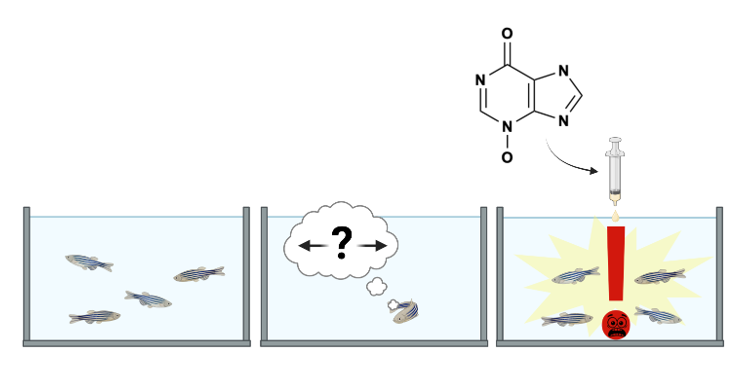
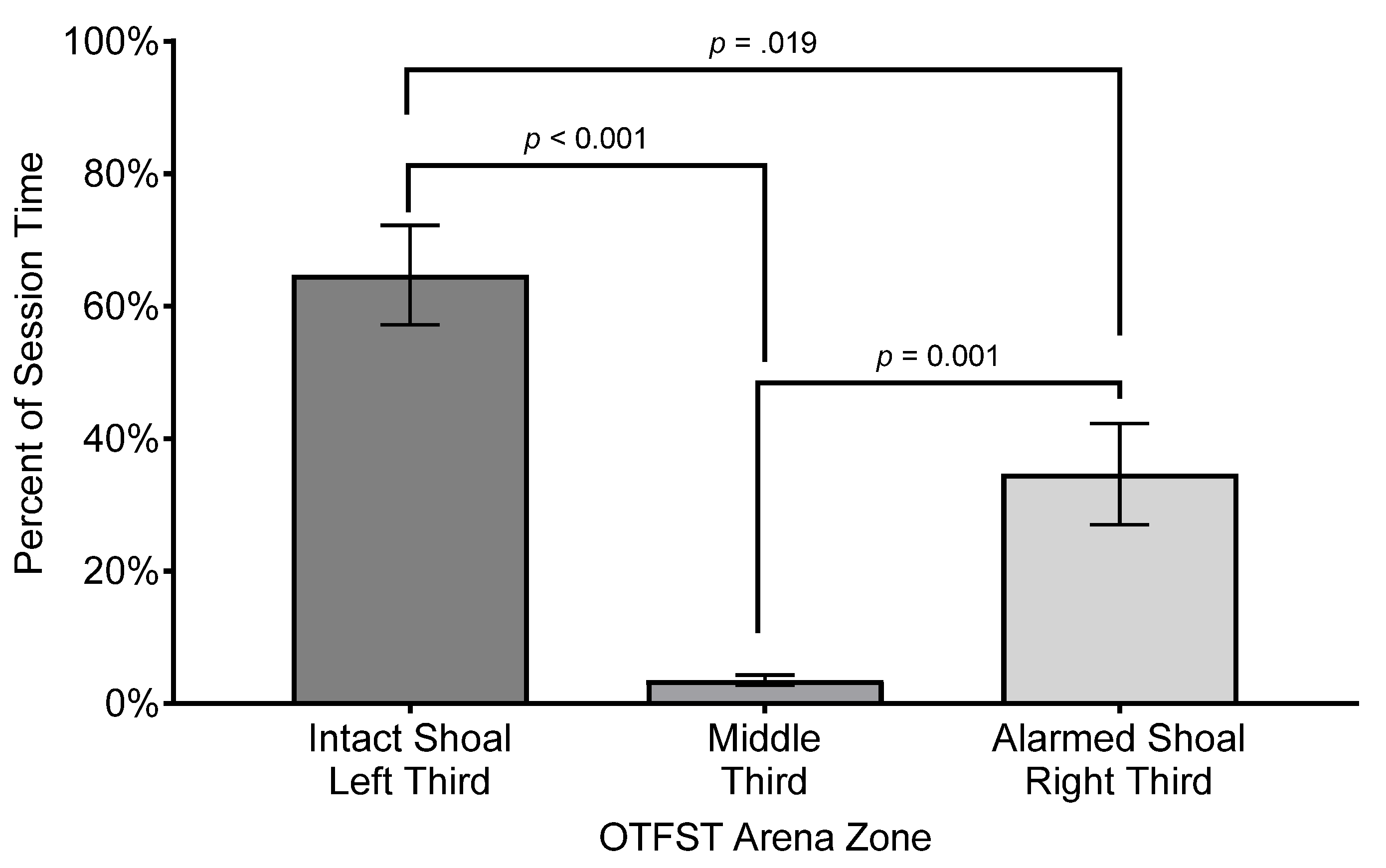
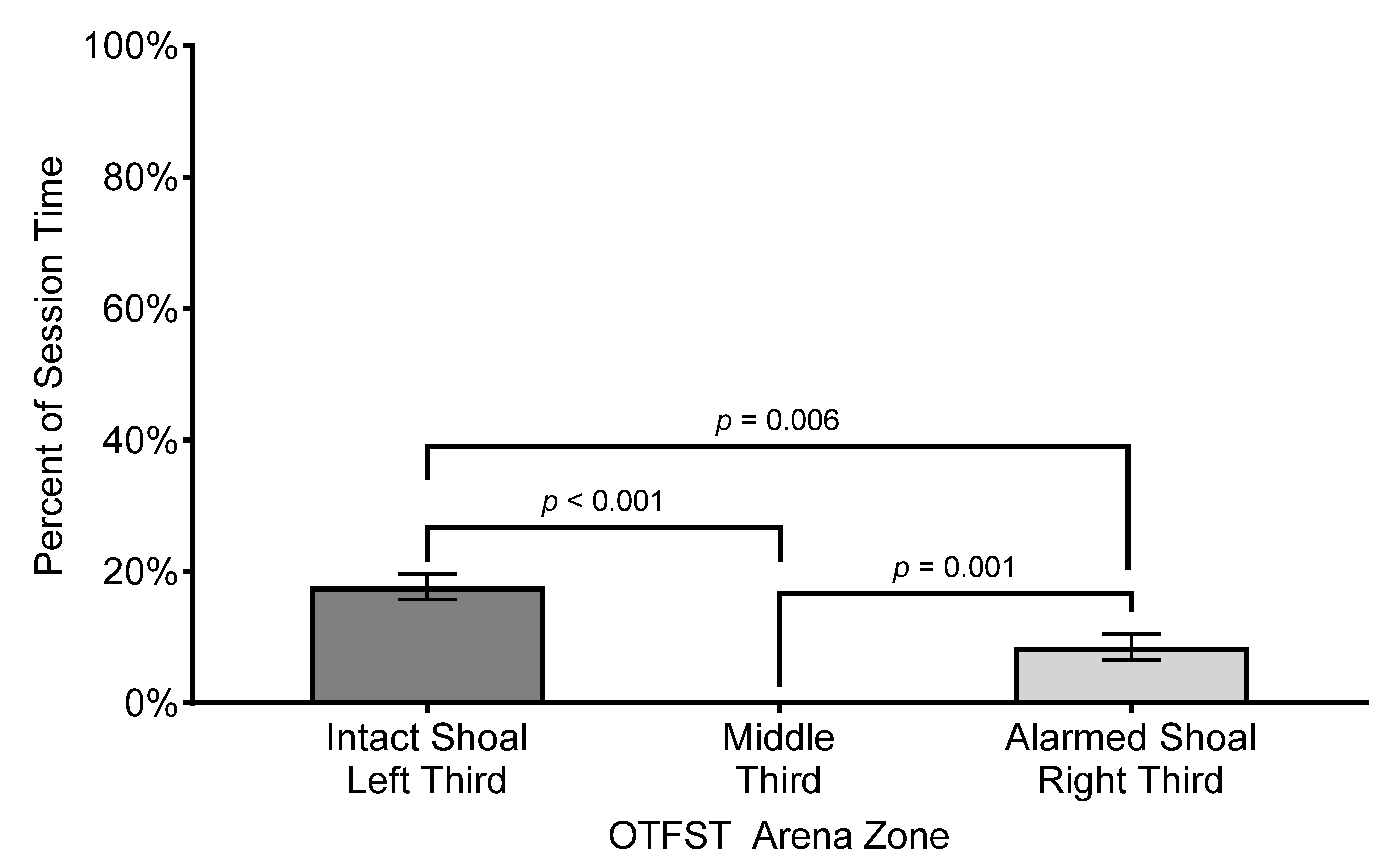
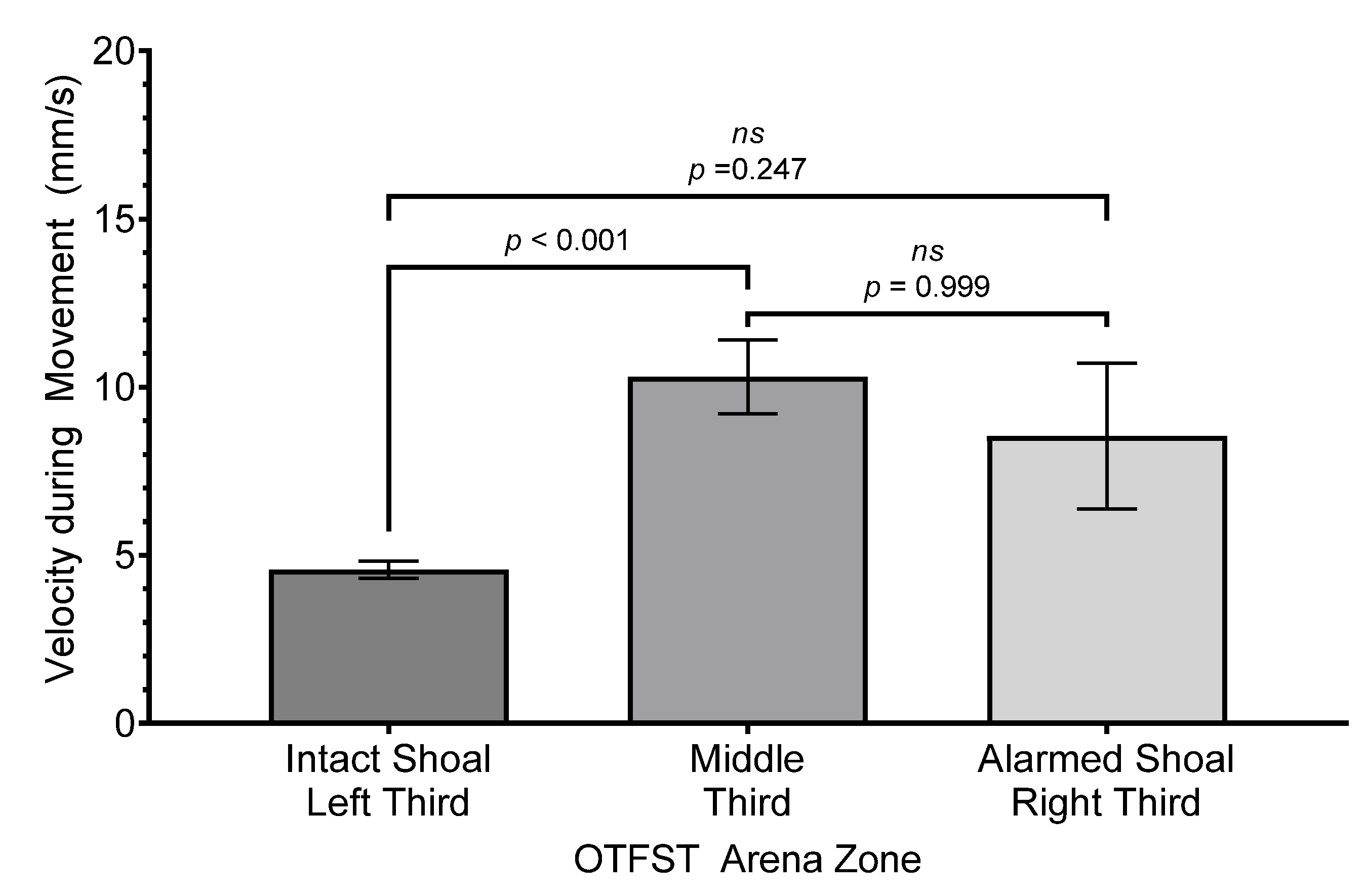
As an anti-predation behavior, shoaling enhances survival among prey species by reducing individual predation risk through mechanisms like the dilution effect and collective vigilance. Zebrafish – a highly social and genetically tractable species – are valuable for studying these behaviors. The present study examined zebrafish social preferences in a 3-chamber open-tank free-swim task, assessing whether visual cues alone could distinguish between an intact and an alarmed shoal exposed to the synthetic alarm substance H3NO. Subjects were allowed to freely associate with either shoal while their behavior was recorded and analyzed. Results revealed a significant preference for proximity to the intact shoal, indicating zebrafish’s ability to visually discern threat levels. Subjects spent nearly twice as much time in the zone near the intact shoal, with reduced freezing and faster movement velocities compared to the alarmed shoal zone. Males exhibited more freezing behavior than females, consistent with sex-specific strategies in threat response. These findings underscore zebrafish’s reliance on visual cues for social responding under predatory threat and highlight sex-based differences in threat perception. This research expands the understanding of zebrafish social dynamics and provides a robust framework for future exploration of the neural mechanisms underlying social behavior and threat assessment in zebrafish.
Keywords:
1. Introduction
2. Materials and Methods
2.1. Animals and Housing
2.2. H3NO Solution Preparation
2.3. Apparatus and Software
2.4. Experimental Procedure
2.5. Design and Analysis of Subjects’ Responding During the 3-Chamber OTFST
- Percent duration within each zone: The relative amount of total time each subject spent in each zone during the entire session.
- Percent of session time spent moving: The relative amount of time each subject was moving at any velocity in each zone
- Percent of session time spent freezing: The relative amount of time each subject had ceased any detectable movement for a minimum of 3 seconds in each zone.
- Average movement velocity: The average movement speed in mm/s for each subject’s movement within each zone.
3. Results
3.1. Manipulation Check
3.2. Percent of Session Time in Zones
3.3. Percent of Time in Motion
3.4. Percent of Time Without Motion (Freezing)
3.5. Velocity During Movement
4. Discussion
5. Conclusions
Author Contributions
Funding
Institutional Review Board Statement
Data Availability Statement
Acknowledgments
Conflicts of Interest
References
- Vidal-García, M.; O'Hanlon, J.C.; Svenson, G.J.; Umbers, K.D. The evolution of startle displays: A case study in praying mantises. Proc. R. Soc. B., 2020, 287, 20201016. [Google Scholar] [CrossRef]
- Humphreys, R.K.; Ruxton, G.D. A review of thanatosis (death feigning) as an anti-predator behaviour. Behav. Ecol. Sociobiol. 2018, 72, 1–16. [Google Scholar] [CrossRef] [PubMed]
- Ortega, J.C.; Figueiredo, B.R.; da Graça, W.J.; Agostinho, A.A.; Bini, L.M. Negative effect of turbidity on prey capture for both visual and non-visual aquatic predators. J. Anim. Ecol. 2020, 89, 2427–2439. [Google Scholar] [CrossRef] [PubMed]
- Majolo, B.; de Bortoli Vizioli, A.; Schino, G. Costs and benefits of group living in primates: group size effects on behaviour and demography. Animal Behaviour. 2008, 76, 1235–1247. [Google Scholar] [CrossRef]
- Ioannou, C.C.; Guttal, V.; Couzin, I.D. Predatory fish select for coordinated collective motion in virtual prey. Science 2012, 337, 1212–1215. [Google Scholar] [CrossRef]
- Ioannou, C.C.; Krause, J. Searching for prey: the effects of group size and number. Anim. Behav. 2008, 75, 1383–1388. [Google Scholar] [CrossRef]
- Kruuk, H. Predators and anti-predator behaviour of the black-headed gull (Larus ridibundus L.). Behaviour: Supplement 11, 1964, 1–129. https://www.jstor.org/stable/30039149.
- Kruuk, H. The biological function of gulls' attraction towards predators. Anim. Behav. 1976, 24, 146–153. [Google Scholar] [CrossRef]
- Rubenstein, D. Animal Behavior, 12th ed.; Oxford University Press: Sinauer Associates: Oxford, England, 2022.
- Lehtonen, J.; Jaatinen, K. Safety in numbers: the dilution effect and other drivers of group life in the face of danger. Behav. Ecol. Sociobiol. 2016, 70, 449–458. [Google Scholar] [CrossRef]
- Hammer, T.L.; Bize, P.; Gineste, B.; Robin, J.P.; Groscolas, R.; Viblanc, V.A. Disentangling the “many-eyes”,“dilution effect”,“selfish herd”, and “distracted prey” hypotheses in shaping alert and flight initiation distance in a colonial seabird. Behav. Proc. 2023, 210, 104919. [Google Scholar] [CrossRef]
- Ward, A.; Webster, M. Chapter 4: Social Foraging and Predator-Prey Interactions. In Sociality: The Behaviour of Group-Living Animals. Ward, A., Webster, M., Eds; Springer International, Cham, Switzerland; 2016, pp. 55–87. [CrossRef]
- Tan, M.; Zhang, S.; Stevens, M.; Li, D.; Tan, E.J. Antipredator defences in motion: animals reduce predation risks by concealing or misleading motion signals. Biol. Rev. 2024, 99, 778–96. [Google Scholar] [CrossRef]
- Cattelan, S.; Griggio, M. Within-shoal phenotypic homogeneity overrides familiarity in a social fish. Behav. Ecol. Sociobiol. 2020, 74, 48. [Google Scholar] [CrossRef]
- Pitcher, T.J. Chapter 12, Functions of shoaling behaviour in teleosts. In The Behavior of Teleost Fishes. Springer: Boston, MA, USA; 1986; pp. 294–337. [CrossRef]
- Lima, S.L.; Dill, L.M. Behavioral decisions made under the risk of predation: A review and prospectus. Can. J. Zool. 1990, 68, 619–640. [Google Scholar] [CrossRef]
- Burbano, D.; Senthilkumar, S.; Manzini, M.C. Exploring emotional contagion in zebrafish: A virtual-demonstrator study of positive and negative emotions. Behav. Processes 2023, 213, 104961. [Google Scholar] [CrossRef]
- Thapa, H.; Salahinejad, A.; Crane, A.L.; Ghobeishavi, A.; Ferrari, M.C. Background predation risk induces anxiety-like behaviour and predator neophobia in zebrafish. Anim. Cogn. 2024, 27, 69. [Google Scholar] [CrossRef]
- Chivers, D.P.; Smith, R.J. Chemical alarm signalling in aquatic predator-prey systems: A review and prospectus. Ecoscience 1998, 1, 338–352. [Google Scholar] [CrossRef]
- Crane, A.L.; Bairos-Novak, K.R.; Goldman, J.A.; Brown, G.E. Chemical disturbance cues in aquatic systems: A review and prospectus. Ecol. Monogr. 2022, 92, e01487. [Google Scholar] [CrossRef]
- Li, Y.; Yan, Z.; Lin, A.; Yang, X.; Li, X.; Yin, X.; Li, W.; Li, K. Epidermal oxysterols function as alarm substances in zebrafish. iScience, 2024, 27, 109660. [Google Scholar] [CrossRef]
- Masuda, M.; Ihara, S.; Mori, N.; Koide, T.; Miyasaka, N.; Wakisaka, N.; Yoshikawa, K.; Watanabe, H.; Touhara, K.; Yoshihara, Y. Identification of olfactory alarm substances in zebrafish. Current Biology, 2024, 34, 1377–1389. [Google Scholar] [CrossRef]
- Wisenden, B.D.; Rugg, M.L.; Korpi, N.L.; Fuselier, L.C. Lab and field estimates of active time of chemical alarm cues of a cyprinid fish and an amphipod crustacean. Behav., 2009, 1, 1423–42. [Google Scholar] [CrossRef]
- Crane, A.L.; Achtymichuk, G.H.; Rivera-Hernández, I.A.E.; Preagola, A.A.; Thapa, H.; Ferrari, M.C.O. Uncertainty about old information results in differential predator memory in tadpoles. Proc. R. Soc. B, 2023, 290, 20230746. [Google Scholar] [CrossRef]
- Chivers, D.P.; Dixson, D.L.; White, J.R.; McCormick, M.I.; Ferrari, M.C. . Degradation of chemical alarm cues and assessment of risk throughout the day. Ecol. Evol., 2013, 3, 3925–3934. [Google Scholar] [CrossRef] [PubMed]
- Michaelis, B.T.; Leathers, K.W.; Bobkov, Y.V.; Ache, B.W.; Principe, J.C.; Baharloo, R.; Park, I.M.; Reidenbach, M.A. Odor tracking in aquatic organisms: The importance of temporal and spatial intermittency of the turbulent plume. Sci. Rep. 2020, 10, 7961. [Google Scholar] [CrossRef] [PubMed]
- Fontana, B.D.; Mezzomo, N.J.; Kalueff, A.V.; Rosemberg, D.B. The developing utility of zebrafish models of neurological and neuropsychiatric disorders: A critical review. Exp. Neuro. 2018, 299, 157–171. [Google Scholar] [CrossRef] [PubMed]
- Gerlai, R. Zebrafish (Danio rerio): A newcomer with great promise in behavioral neuroscience. Neurosci. Biobehav. Rev. 2023, 144, 104978. [Google Scholar] [CrossRef] [PubMed]
- Choi, T.Y.; Choi, T.I.; Lee, Y.R.; Choe, S.K.; Kim, C.H. Zebrafish as an animal model for biomedical research. Exp. Mol. Med. 2021, 53, 310–317. [Google Scholar] [CrossRef]
- Aleström, P.; D’Angelo, L.; Midtlyng, P.J.; Schorderet, D.F.; Schulte-Merker, S.; Sohm, F.; Warner, S. Zebrafish: Housing and husbandry recommendations. Lab. Anim. 2020, 54, 213–224. [Google Scholar] [CrossRef]
- Castranova, D.; Wang, C. Chapter 31: Zebrafish breeding and colony management. In The Zebrafish in Biomedical Research; Cartner, S.C., Eisen, J.S., Farmer, S.C., Guillemin, K.J., Kent, M.L., Sanders, G.E., Eds.; Eds.; Elsevier Academic Press: Cambridge, MA, USA, 2020. [Google Scholar] [CrossRef]
- Stewart, A.M.; Braubach, O.; Spitsbergen, J.; Gerlai, R.; Kalueff, A.V. Zebrafish models for translational neuroscience research: from tank to bedside. Trends Neurosci. 2014, 37, 264–278. [Google Scholar] [CrossRef]
- Chahardehi, A.M.; Hosseini, Y.; Mahdavi, S.M.; Naseh, I. Zebrafish, a biological model for pharmaceutical research for the management of anxiety. Mol. Biol. Rep. 2023, 50, 3863–3872. [Google Scholar] [CrossRef]
- Lachowicz, J.; Niedziałek, K.; Rostkowska, E.; Szopa, A.; Świąder, K.; Szponar, J.; Serefko, A. Zebrafish as an animal model for testing agents with antidepressant potential. Life 2021, 11, 792. [Google Scholar] [CrossRef]
- Rea, V.; Van Raay, T.J. Using zebrafish to model autism spectrum disorder: A comparison of ASD risk genes between zebrafish and their mammalian counterparts. Front. Mol. Neurosci., 2020, 13, 575575. [Google Scholar] [CrossRef]
- Mathur, P.; Guo, S. Use of zebrafish as a model to understand mechanisms of addiction and complex neurobehavioral phenotypes. Neurobiol. Dis. 2010, 40, 66–72. [Google Scholar] [CrossRef] [PubMed]
- Ruhl, N.; McRobert, S.P. The effect of sex and shoal size on shoaling behaviour in Danio rerio. J. Fish Biol. 2005, 67, 1318–1326. [Google Scholar] [CrossRef]
- Pyke, G.H. Optimal foraging theory: A critical review. Annu. Rev. Ecol. Evol. Syst. 1984, 15, 523–575. [Google Scholar] [CrossRef]
- Miller, N.Y.; Gerlai, R. Shoaling in zebrafish: What we don't know. Rev. Neurosci., 2011, 22, 17–25. [Google Scholar] [CrossRef]
- Etinger, A.; Lebron, J.; Palestis, B.G. ; Sex-assortative shoaling in zebrafish (Danio rerio). Bios. 2009, 80, 153–158. [Google Scholar] [CrossRef]
- Von Frisch, K. Zur psychologie des fisch-schwarmes [Psychology of preference in fish]. Naturwissenschaften, 1938, 26, 601–606. [Google Scholar] [CrossRef]
- Mathuru, A.S.; Kibat, C.; Cheong, W.F.; Shui, G.; Wenk, M.R.; Friedrich, R.W.; Jesuthasan, S. Chondroitin fragments are odorants that trigger fear behavior in fish. Curr. Biol. 2012, 22, 538–544. [Google Scholar] [CrossRef]
- Goodall, J.; Rincón-Camacho, L.; Pozzi, A.G. ; Epidermal club cells in the cardinal tetra (Paracheirodon axelrodi): Presence, distribution, and relationship to antipredator behavior. J. Zool. 2024, 164, 126170. [Google Scholar] [CrossRef]
- Pfeiffer, W. Über die schreckreaktion bei fischen und die herkunft des schreckstoffes [On the fear reaction in fish and the origin of alarm substance]. Z. Vgl. Physiol. 1960, 43, 578–614. [Google Scholar] [CrossRef]
- Blaser, R.E.; Chadwick, L.; McGinnis, G.C. Behavioral measures of anxiety in zebrafish (Danio Rerio). Behav. Brain Res. 2010, 208, 56–62. [Google Scholar] [CrossRef]
- Suboski, M.D.; Bain, S.; Carty, A.E.; McQuoid, L.M.; Seelen, M.I.; Seifert, M. Alarm reaction in acquisition and social transmission of simulated-predator recognition by zebra danio fish (Brachydanio rerio). J. Comp. Psychol. 1990, 104, 101–112. [Google Scholar] [CrossRef]
- Speedie, N.; Gerlai, R. Alarm substance induced behavioral responses in zebrafish (Danio rerio). Behav. Brain Res. 2008, 188, 168–177. [Google Scholar] [CrossRef]
- Parra, K.V.; Adrian, J.C.; Gerlai, R. The synthetic substance hypoxanthine 3-N-oxide elicits alarm reactions in Zebrafish (Danio rerio). Behav. Brain Res. 2009, 205, 336–341. [Google Scholar] [CrossRef] [PubMed]
- Wisenden, B.D.; Andebrhan, A.A.; Anderson, C.M.; Angus, J.M.; Coffman, I.C.; Cloutier, M.E.; et al. Olfactory cues of risk and visual cues of safety interact with sympatry and phylogeny in shaping behavioral responses by littoral fishes. Behav. Ecol. Sociobiol., 2023, 77, 91. [Google Scholar] [CrossRef]
- Ogi, A.; Licitra, R.; Naef, V.; Marchese, M.; Fronte, B.; Gazzano, A.; Santorelli, F.M. Social preference tests in zebrafish: A systematic review. Front. Vet. Sci., 2021, 7, 590057. [CrossRef]
- Rosa, L.V.; Costa, F.V.; Canzian, J.; Borba, J.V.; Quadros, V.A.; Rosemberg, D.B. Three- and bi-dimensional analyses of the shoaling behavior in Zebrafish: Influence of modulators of anxiety-like responses. Prog. Neuropsychopharmacol. Biol. Psychiatry 2020, 102. [Google Scholar] [CrossRef]
- Akinrinade, I.D.; Varela, S.A.M.; Oliveira, R.F. Sex differences in social buffering and social contagion of alarm responses in zebrafish. Animal Cognition 2023, 26, 1307–1318. [Google Scholar] [CrossRef]
- Kuroda, T.; Ritchey, C.M.; Podlesnik, C.A. Selective effects of conspecific movement on social preference in zebrafish (Danio rerio) using real-time 3D tracking and 3D animation. Scientific Reports 2023, 13, 10502. [Google Scholar] [CrossRef]
- Faustino, A.I.; Tacão-Monteiro, A.; Oliveira, R.F. Mechanisms of social buffering of fear in zebrafish. Sci. Rep. 2017, 7, 44329. [Google Scholar] [CrossRef]
- Ariyasiri, K.; Choi, T.-I.; Kim, O.-H.; Hong, T.-I.; Gerlai, R.; Kim, C.-H. Pharmacological (ethanol) and mutation (sam2 KO) induced impairment of novelty preference in zebrafish quantified using a new three-chamber social choice task. Prog. Neuropsychopharmacol. Biol. Psychiatry 2019, 88, 53–65. [Google Scholar] [CrossRef]
- Velkey, A.J.; Boles, J.; Betts, T.K.; Kay, H.; Henenlotter, R.; Wiens, K.M. High fidelity: Assessing Zebrafish (Danio rerio) responses to social stimuli across several levels of realism. Behav. Processes, 2019, 164, 100–108. [Google Scholar] [CrossRef] [PubMed]
- Velkey, A.J.; Koon, C.H.; Danstrom, I.A.; Wiens, K.M. Female zebrafish (Danio rerio) demonstrate stronger preference for established shoals over newly-formed shoals in the three-tank open-swim preference test. Plos one, 2022, 17, e0265703. [Google Scholar] [CrossRef] [PubMed]
- Canzian, J.; Fontana, B.D.; Quadros, V.A.; Rosemberg, D.B. Conspecific alarm substance differently alters group behavior of zebrafish populations: Putative involvement of vholinergic and purinergic signaling in anxiety- and fear-like responses. Behav. Brain Res. 2017, 320, 255–263. [Google Scholar] [CrossRef] [PubMed]
- Sison, M.; Gerlai, R. Behavioral performance altering effects of MK-801 in zebrafish (Danio rerio). Behav. Brain Res., 2011, 220, 331–337. [Google Scholar] [CrossRef]
- do Nascimento, B.G.; Maximino, C. Social investigation and social novelty in zebrafish: Roles of salience and novelty. Behav. Processes 2023, 210, 104903. [Google Scholar] [CrossRef]
- National Research Council. Guide for the Care and Use of Laboratory Animals: 8th ed.; The National Academies Press: Washington, DC, USA, 2011. [CrossRef]
- Ariyasiri, K.; Choi, T.-I.; Kim, O.-H.; Hong, T.-I.; Gerlai, R.; Kim, C.-H. Pharmacological (ethanol) and mutation (sam2 KO) induced impairment of novelty preference in zebrafish quantified using a new three-chamber social choice task. Prog. Neuropsychopharmacol. Biol. Psychiatry 2019, 88, 53–65. [Google Scholar] [CrossRef]
- Tsang, B.; Gerlai, R. Nature versus laboratory: How to optimize housing conditions for zebrafish neuroscience research. Trends Neurosci. 2024, 47, 985–993. [Google Scholar] [CrossRef]
- Shishis, S.; Tsang, B.; Ren, G.J.; Gerlai, R. Effects of different handling methods on the behavior of adult zebrafish. Physiol. Behav., 2023, 262, 114106. [Google Scholar] [CrossRef]
- Brown, G.E.; Adrian, Jr., J.C.; Lewis, M.G.; Tower, J.M. The effects of reduced pH on clark73.
- chemical alarm signalling in Ostariophysan fishes. Can. J. Fish. Aquat. Sci. 2002, 59, 1331–1338. [CrossRef]
- MacArthur Clark, J. The 3Rs in research: A contemporary approach to replacement, reduction and refinement. Br. J. Nutr., 2017, 120, S1–S7. [Google Scholar] [CrossRef]
- Tadich, T.; Tarazona, A.M.. Replacement, Reduction and Refinement: Ethical Considerations in the Current Applications of the 3Rs. In Handbook of Ethical Decisions; Springer eBooks. 2023, Volume 1, pp. 667–683. [CrossRef]
- Zhang, T.; Zhang, N.; Feng, R.; Wang, H.; Bi, F.; Wang, S. Promoting the welfare of animals utilized in neuroscience research. Brain-X, 2024, 2, E70002. [Google Scholar] [CrossRef]
- Bolker, B.M.; Brooks, M.E.; Clark, C.J.; Geange, S.W.; Poulsen, J.R.; Stevens, M.H.H.; White, J.S.S. Generalized linear mixed models: A practical guide for ecology and evolution. Trends Ecol. Evol. 2009, 24, 127–135. [Google Scholar] [CrossRef] [PubMed]
- Miller, N.; Gerlai, R. Quantification of shoaling behaviour in zebrafish (Danio rerio). Behav. Brain Res. 2007, 184, 157–166. [Google Scholar] [CrossRef]
- Cohen, J. Statistical Power Analysis for the Behavioral Sciences, 2nd Ed. ed; Routledge: New York, NY, USA, 1988; pp. 284–288. [Google Scholar] [CrossRef]
- Clark, C.W. Antipredator behavior and the asset-protection principle. Beh. Ecol. 1994, 5, 159–170. [Google Scholar] [CrossRef]
- Roy, T.; Shukla, R.; Bhat, A. Risk-taking during feeding: Between- and within-population variation and repeatability across contexts among wild zebrafish. Zebrafish, 2017, 14, 393–403. [Google Scholar] [CrossRef]
- Roy, T.; Bhat, A. Repeatability in boldness and aggression among wild zebrafish (Danio rerio) from two differing predation and flow regimes. J. Comp. Psychol. 2018, 132, 349–360. [Google Scholar] [CrossRef]
Disclaimer/Publisher’s Note: The statements, opinions and data contained in all publications are solely those of the individual author(s) and contributor(s) and not of MDPI and/or the editor(s). MDPI and/or the editor(s) disclaim responsibility for any injury to people or property resulting from any ideas, methods, instructions or products referred to in the content. |
© 2024 by the authors. Licensee MDPI, Basel, Switzerland. This article is an open access article distributed under the terms and conditions of the Creative Commons Attribution (CC BY) license (http://creativecommons.org/licenses/by/4.0/).


