

Submitted:
30 December 2024
Posted:
31 December 2024
You are already at the latest version
Abstract
Background: Unicompartmental knee arthroplasty (UKA) is a viable treatment option for patients with isolated knee osteoarthritis. This study evaluated the clinical outcomes of the JUK II (Smith & Nephew, Memphis, TN, US) hypoallergenic, fixed-bearing UKA implant in a medium cohort of patients undergoing both medial and lateral procedures with a short-term follow-up.
Methods: A retrospective review was conducted on 257 consecutive patients who underwent primary UKA using the JUK II implant between December 2020 and December 2022. Clinical outcomes were assessed using the Knee Society Score (KSS), Knee Society Function Score (KSFS), Oxford Knee Score (OKS), UCLA Activity Score, Forgotten Joint Score (FJS-12) and the satisfaction. Survivorship analysis was performed, and complications were recorded.
Results: At a 2-year follow-up, the implant survival rate was 99.61%. Statistical significant improvements were observed in all clinical scores, with high patient satisfaction. The mean UCLA Activity Score increased from 4.53 preoperatively to 7.3 at 24 months.
Conclusions: This study demonstrates promising short-term clinical outcomes for the hypoallergenic fixed-bearing medial and lateral UKA implant, with high patient satisfaction and a low complication rate. Further studies with longer follow-up periods are warranted to confirm these findings.
Keywords:
unicompartmental knee arthroplasty
; oxinium
; oxidized zirconium
; return to sport
; patient-reported outcome measures
; satisfaction
; lateral
; survivorship
; fixed-bearing
; UKA
1. Introduction
Osteoarthritis (OA) of the knee is a degenerative joint disease that occurs when the cartilage in the knee joint gradually wears down. This can lead to pain, swelling, stiffness, and decreased mobility. It has been shown by recent studies that the prevalence of knee osteoarthritis worldwide is approximately 15% [1,2].
Its frequency increases with age, female sex, and other described characteristics. It represents a major cause of disability and source of societal costs in older adults [3].
Although OA is recognized as a tricompartmental disease of the entire knee [4], it is estimated that as many as 50% of the population experience unicompartmental disease. The medial tibio-femoral compartment is the most affected, with an incidence of 27%, followed by the patello-femoral compartment at 18% and lastly the lateral tibio-femoral compartment at 5% [5].
The vast majority of unicompartmental OA of the knee is located within the medial compartment, but about 10% is represented by osteoarthritis affecting the lateral compartment [6].
There is ongoing debate about the most appropriate treatment for patients with end-stage unicompartmental osteoarthritis, but unicompartmental knee arthroplasty (UKA) has proven to be a viable option for young and active individuals but also for older patients [7,8].
The Italian Arthroplasty Registry records a 22.2% (50,857) prevalence of primary unicompartmental knee arthroplasty (UKA) among all knee surgeries performed from 2007 to 2022. These findings demonstrate a rising trend in the utilization of unicompartmental knee replacements, which had a prevalence of approximately 15% in preceding years [9].
While UKA has gained popularity thanks to the development of new minimally invasive techniques, its rapid recovery after surgery and the bone stock preservation [10], careful patient selection is paramount to achieving successful outcomes [11].
Through rigorous patient selection and continuous refinement of surgical techniques, UKA has demonstrated excellent long-term clinical outcomes, with high survival rates and significant improvements in patients’ quality of life, with a mean 10-year survival rate of approximately 94% for medial UKAs [12,13,14].
Even for the lateral compartment, which is traditionally considered more challenging, excellent long-term results have been achieved thanks to implant manufacturing advancements and careful patient selection, with a mean 10-year survival rate of approximately 93% for lateral UKAs [15,16,17].
The literature consistently reports higher failure rates for UKA compared to Total Knee Arthroplasty (TKA). [18] [19] Failure etiologies vary between medial and lateral UKAs, with aseptic loosening, progressive osteoarthritis, polyethylene wear, and mobile dislocation being frequently observed [20,21].
Another cause of revision is metal hypersensitivity, which is extensively described in literature but still remains poorly regulated by guidelines [22,23,24].
A new fixed-bearing implant (Journey II UK Unicondylar Knee System or JUK, Smith & Nephew, Memphis, TN, US) has been launched in 2019. This implant achieves compatibility with a wide range of patients through the presence of components for both the medial and lateral compartments, a feature not always available in other implants, and an increased range of sizes, particularly smaller ones.
The introduction of a simpler instrument set allows to enhance and accelerate the timing of surgical technique due to the presence of a tibial guide that facilitates re-cutting and the ability to adjust the mediolateral position of the femoral component to allow for greater congruency with the tibial component.
The JUK II implant’s femoral component (Smith & Nephew, Memphis, TN, US) is composed of Oxinium™ and articulates against a cross-linked polyethylene surface via a round-on-flat bearing design, making it compatible with patients who have metal hypersensitivity.
Oxidized Zirconium (OxZr, Oxinium™, Smith & Nephew, Memphis, TN, US) is a biocompatible material that consists of a ceramic surface layer on an internal component of cobalt chrome. This process results in a material with enhanced properties, including minimized wear, increased strength and stability, and resistance to fretting and corrosion [25,26,27].
The previously cited combined characteristics have the potential to offer increased implant survivorship and improved clinical outcomes compared to currently available implants [28,29,30], owing to their greater patient-specific customization.
Following the introduction of a new implant, it is crucial to study its short-term performance to understand the implant’s survivorship, impact on clinical patient outcomes and to identify any potential weaknesses.
The objective of this study is to assess the functional outcomes, evaluate the survivorship and identify the reasons for failure a hypoallergenic, fixed-bearing medial and lateral UKA implant, during a short-term follow-up. All surgeries were conducted by a single surgeon at one institution between 2020 and 2022. This series is a follow-up to a cohort previously described by our group [31].
2. Materials and Methods
2.1. Patient Selection
Patients’ data for this single-center retrospective study were extracted from the database of Humanitas San Pio X Hospital systems (Milan, Italy). Upon collection, the data were deposited in a restricted-access online storage.
Data from UKA procedures, using medial or lateral JUK II implants (Smith & Nephew, Memphis, TN, US) performed from December 2020 to December 2022, were analyzed.
The data collected from the institutional database included demographic information, the body mass index (BMI), American Society of Anesthesiologists (ASA) class, duration of the surgical procedure, duration of hospitalization, any surgical revisions, any intra-operative, peri-operative and post-operative complications.
This study adheres to the ethical principles outlined in the 2013 revision of the Declaration of Helsinki. Prior to data collection, informed consent was obtained from all subjects involved in the study.
2.2. Surgical Indication and Inclusion and Exclusion Criteria
From a clinical standpoint, surgical intervention was proposed to patients who met the Kozinn and Scott criteria [32], including a coronal plane deformity of less than 10 degrees of varus and 5 degrees of valgus, and a sagittal plane flexion deformity no greater than 15 degrees. Additionally, patients were required to have an intact anterior cruciate ligament, an unaffected contralateral compartment, and patellofemoral changes not exceeding grade II or III on the Ahlbäck classification [33]. Trochlear cartilage damage up to grade IV was permissible, provided it was centrally located. Patients with neurological diseases, ataxia, symptomatic osteoarthritis in two or more compartments, or those who did not meet the aforementioned deformity criterias, were excluded.
Furthermore, surgical intervention was only proposed to patients who radiographically presented with isolated medial or lateral compartment osteoarthritis with a cartilage wear loss of Kellgren-Lawrence grade of 3 or higher [34], or those with spontaneous femoral osteonecrosis visible on X-ray as a cartilage damage of Kellgren-Lawrence grade 3 or higher, or on MRI. Prior to surgical intervention, patients underwent a 3-month course of conservative treatment including physiotherapy, hyaluronic acid or corticosteroid injections, and rest from physical activity. Surgical intervention was proposed only if pain and disability persisted after this conservative treatment period
The study included patients who underwent a primary medial or lateral UKA using the JUK II (Smith &Nephew, Memphis, TN, US) implant and had a minimum 2-year follow-up.
Patients were excluded if they had undergone bilateral UKA, concomitant surgical procedures on the same knee (e.g., ACL reconstruction or osteotomy), had a concurrent inflammatory rheumatic disease, had not a minimum 2-year follow-up and refused to the informed consent.
2.3. Surgical Procedure
All surgical procedures were performed by a single, high-volume senior surgeon (F.D.A.).
All patients received prophylactic antibiotic somministration of 2g of Cefazolin intravenously 30 minutes prior to the procedure. If the patient is allergic or has a hypersensitivity to penicillins, 600 mg of Clarithromycin is administered intravenously, 30 minutes prior to incision. All surgical procedures were performed under spinal anesthesia, with the addition of an adductor canal block when deemed necessary. No tourniquet was used during any procedure.
While the technique for medial UKAs has been extensively described in a previous article [31], there are some differences in the lateral UKA technique. The skin incision in the latter case is in the lateral region of the knee, utilizing a parapatellar approach. The tibial cut was not made along the tibial epiphyseal axis but rather aimed for a cut perpendicular to the mechanical axis or slightly valgus, with a neutral slope [Figure 1]. The surgical steps followed the manufacturer’s recommendations. After performing the tibial cut, a trial 8mm spacer block was used to prevent flexion deformity, and the distal femoral cut was made using a specific template. If the 8mm trial spacer block does not fully fit within the joint, the instrumentation includes the use of a tibial re-cutting guide. The proximal femoral cut was then completed by aligning the component with the tibial component. Within this surgical instrument set, femoral cutting guides are categorized into groups ranging from 1 to 3, 4 to 7, and 8 to 10. Following the identification of the appropriate size based on the cartilaginous line, the femoral cutting component can be precisely adjusted medially or laterally by approximately 1 to 3 millimeters to accommodate individual anatomical variations. Once the trial components were positioned and the final sizes determined, the articular surface was roughened with multiple saw cuts to improve cement penetration. [31] Before cementation, the surface was washed with a pulsed lavage to remove debris, and the entire surgical team changed gloves. The prepared cement was applied to both the bone surface and the components. After implantation, excess cement was removed, paying particular attention to the posterior region, the patellofemoral joint, and the contralateral compartment. A trial polyethylene component was used to re-assess stability and limb alignment. If these characteristics were deemed satisfactory by the primary surgeon, the final polyethylene component was implanted. Following hemostasis, the wound is thoroughly irrigated and closed in layers. The deep fascia is sutured with a waterproof material, and the skin is closed primarily with staples or an intradermal suture. When clinically indicated, a 3-gram intra-articular injection of tranexamic acid was administered following closure of the articular capsule. Following surgery, postoperative radiographs are obtained to verify component placement.
2.4. Postoperative Care
Adhering to a fast-track protocol, patients are mobilized on the same day and commence physiotherapy under the guidance of a physiotherapist with a partial progressive weight-bearing. As thromboprophylaxis, all patients receive 4000 IU of low-molecular-weight heparin starting 12 hours post-surgery and continuing for 5 weeks. Post-operative follow-up includes weight-bearing anteroposterior and lateral radiographs at 1, 3, 6, 12, and 24 months.
Radiographic assessment of the knee joint was conducted utilizing the Knee Society Roentgenographic Evaluation system [35]. This system enabled the evaluation of the femoro-tibial angle and the identification of any radiolucent areas within the femur and tibia on both anteroposterior and lateral radiographic projections.
The decision to revise the surgical intervention was informed by a comprehensive assessment encompassing patient symptomatology, documented medical history, diagnostic imaging results, and intraoperative observations.
2.5. Clinical Outcomes
Outcomes Patient-reported outcome measures (PROMS) were analyzed at baseline, 12, and 24 months. These included the Knee Society Knee Score (KSKS), the Knee Society Function Score (KSFS) [36], the Oxford Knee Score (OKS) [37], and the University of California, Los Angeles Activity Score (UCLA) [38].
Physical Component Summary (PCS) and the Mental Component Summary (MCS) of the Short Form 36 Health Survey (SF-36) [39] and the Forgotten Joint Score-12 (FJS-12) [40] were analyzed too. This last score was collected at 12 and 24-month follow-up. Patient satisfaction (rated from 1, not satisfied, to 10, completely satisfied) was collected at the last follow-up visit.
2.6. Statistical Analysis
All analyses were carried out using R (version 4.4.2). The Shapiro–Wilk test was employed to assess whether the data exhibited a non-parametric distribution. Calculated mean values were provided for all continuous data, while percentage frequencies were used for qualitative variables. Baseline and postoperative clinical scores were compared using the non-parametric Friedman test, a method for repeated measures analysis. This test was applied to evaluate differences in the KSKS, KSFS, OKS, UCLA, PCS, and MCS scores between baseline and the next two time points (12 and 24 months). The test was also applied to evaluate the FJS-12 at 12 and 24 months. A p-value < 0.05 was considered statistically significant.
3. Results
3.1. Demographics
The demographics data are reported in Table 1.
3.2. Clinical Outcomes
The clinical and functional outcomes of the patients and the result of the statistical analyses are reported in Table 2.
3.3. Complications and Revisions
Analysis of 257 cases revealed a 99.61% implant survival rate at 24 months using re-surgery for any reason as an endpoint. There was a single adverse event related to aseptic loosening of the tibial component. The patient underwent a conversion to TKA 12 months after the UKA.
No additional intraoperative or rehabilitation-related complications were encountered.
4. Discussion
The new hypoallergenic fixed-bearing medial and lateral UKA implant provided excellent clinical results with low rate of complications. Statistical analysis demonstrated highly significant improvements in all clinical outcome scores (p < 0.05) between preoperative and postoperative assessments.
By preserving a larger portion of the articular surface, UKA allows for more natural and fluid knee motion [4][43]. This translates into an improved body image and greater patient satisfaction, as demonstrated by the result of the patients’ satisfaction with a mean of 9.17 ± 1.16 at the last follow-up.
We compared the FJS-12 at 12 months and at the last follow-up of 24 months demonstrating a statistically significant improvement from 81.64 ± 16.77 to 85.47 ± 15.38 (p < 0.05) showing patient’s successful adaptation to life with the artificial joint. The data obtained in our study are superior to those found in literature [44,45].
The preservation of bone stock and the reproduction of a native-like knee biomechanics results in higher UKAs FJS-12 scores when compared to TKA [46]. Of the 257 patients, only one case of aseptic loosening of the medial tibial component was observed after 1 year from surgery, with no intraoperative complications reported on the other patients. The data obtained thus far suggest that our results are at least on par with, and potentially better than, those previously published [47,48,49,50].
Following a comprehensive literature review, only one additional study was identified that evaluated the outcomes of both medial and lateral JUKII [51]. Similar to our study, only primary medial and lateral UKAs performed by high-volume surgeons were retrospectively analyzed. The total cohort comprised 944 UKAs, with 370 reaching at least 1.75 years of follow-up, comparable to our cohort. Using re-operation for any reason as an endpoint, 2-year survival was 98.2%. Of the 9 re-operations, however, only 3 required conversion to TKA. Clinical outcomes demonstrated progressive improvements; however, only 81 patients completed all KOOS assessment stages. While the KOOS showed a positive effect in this subgroup, no statistically significant difference was found compared to patients who did not complete all follow-up stages [51].
It is well-established that engaging in any level of physical activity, even at a low intensity, is a protective factor against many diseases, particularly cardiovascular conditions. Moreover, maintaining adequate muscle tone helps to reduce the incidence of musculoskeletal injuries. In patients with knee osteoarthritis, the role of physical activity is even more pronounced. Given the increasing number of patients undergoing UKA, including younger individuals, the proportion of patients who return to sport (RTS) is a crucial indicator of the procedure’s success, as it also leads to improved PROMs.
A meta-analysis conducted in 2022 revealed that, with a mean follow-up of 48 months, over 90% of patients returned to sports, a finding consistent with our study [52]. RTS was linked to improved PROMs, despite being undertaken at reduced intensities compared to pre-surgery levels [52].
The mean preoperative UCLA score of our patients improved from 4.53 ± 1.6 to 7.3 ± 1.65 after 24 months of follow-up. Similarly, a 2021 study by Panzram et al. demonstrated a statistically significant increase in UCLA scores from a pre-operative mean of 2.9 ± 1.7 to a post-operative mean of 6.3 ± 1.4 at a minimum 2-year follow-up [53]. Furthermore, it is noteworthy that the proportion of high-impact sports activities post-surgery is not substantial, and elevated BMI levels negatively impact these characteristics [53].
A cohort of 85 patients with a minimum follow-up of 2 years, found no significant difference in RTS (amateur level) between medial and lateral UKA, aligning with our findings [54]. Consequently, both procedures can be considered for younger patients with high functional demands.
Our cohort consisted exclusively of patients receiving hypoallergenic implants. These findings align with the existing literature indicating that the selection of hypoallergenic implants does not compromise return to sports (RTS) compared to traditional chromium-cobalt implants or with other materials, even in patients with metal hypersensitivity [55,56].
All hypoallergenic implants used in this study had an Oxinium™ component. The study of D’Ambrosi et al. in 2022, does not demonstrate any inferiority of this component compared to other materials used in other UKAs [57].
Despite the positive outcomes observed with Oxinium™ in our cohort and other studies previously cited, it is important to recognize that the scientific literature also describes adverse clinical cases characterized by complications like metallosis and polyethylene dislocations both in UKAs and TKAs [58,59,60,61].
This study has several limitations. Firstly, conducted at a high-volume tertiary referral center, its findings may not be generalizable to institutions with lower UKA volumes. Secondly, the retrospective design, the lack of a control group and the inclusion of both medial and lateral UKAs within the same study introduce potential biases. Thirdly, the relatively short 2-year follow-up period is a limitation.
5. Conclusions
Our study of the new Oxinium™ metal-backed fixed-bearing medial and lateral UKA implant demonstrated favorable clinical outcomes, along with excellent 2-year survival rates, successful return to sports activity, and high patient satisfaction. However, randomized controlled trials with extended follow-up periods are necessary to validate these findings with a higher level of evidence.
Author Contributions
All authors contributed to the study conceptualization; methodology, U.V.; validation: F.D. and M.L.; formal analysis and investigation, U.V., F.D.D., A.C. and L.R.; writing—original draft preparation, U.V.; writing—review and editing, F.D. and M.L.; supervision, F.D. and M.L. All authors have read and agreed to the published version of the manuscript.
Funding
This research received no external funding.
Institutional Review Board Statement
The study was conducted in accordance with the Declaration of Helsinki and approved by the Institutional Review Board. This is a retrospective study. No ethical approval was required.
Informed Consent Statement
Written informed consent was obtained from all subjects involved in the study to the use of medical records and personal data.
Data Availability Statement
The datasets generated during the current study are available from the corresponding author upon reasonable request.
Acknowledgments
In this section, you can acknowledge any support given which is not covered by the author contribution or funding sections. This may include administrative and technical support, or donations in kind (e.g., materials used for experiments).
Conflicts of Interest
F.D.A. is a consultant for Zimmer Biomet and Smith & Nephew. U.V., F.D.D., A.C., L.R. declare that they have no conflicts of interest. M.L. has received financial support for attending symposia, educational programs, and post marketing studies from Zimmer Biomet. He is also Scientific Director of the Livio Sciutto Foundation Biomedical Research in Orthopaedics—ONLUS.
References
- D. Li, S. Li, Q. Chen, e X. Xie, «The Prevalence of Symptomatic Knee Osteoarthritis in Relation to Age, Sex, Area, Region, and Body Mass Index in China: A Systematic Review and Meta-Analysis», Front. Med., vol. 7, p. 304, 2020. [CrossRef]
- H. Long et al., «Prevalence Trends of Site-Specific Osteoarthritis From 1990 to 2019: Findings From the Global Burden of Disease Study 2019», Arthritis Rheumatol. Hoboken NJ, vol. 74, fasc. 7, pp. 1172–1183, lug. 2022. [CrossRef]
- R. Giorgino, D. Albano, S. Fusco, G. M. Peretti, L. Mangiavini, e C. Messina, «Knee Osteoarthritis: Epidemiology, Pathogenesis, and Mesenchymal Stem Cells: What Else Is New? An Update», Int. J. Mol. Sci., vol. 24, fasc. 7, p. 6405, mar. 2023. [CrossRef]
- D. J. Hunter e S. Bierma-Zeinstra, «Osteoarthritis», Lancet Lond. Engl., vol. 393, fasc. 10182, pp. 1745–1759, apr. 2019. [CrossRef]
- J. C. Stoddart, O. Dandridge, A. Garner, J. Cobb, e R. J. van Arkel, «The compartmental distribution of knee osteoarthritis—a systematic review and meta-analysis», Osteoarthritis Cartilage, vol. 29, fasc. 4, pp. 445–455, apr. 2021. [CrossRef]
- M. Ollivier, M. P. Abdel, S. Parratte, e J.-N. Argenson, «Lateral unicondylar knee arthroplasty (UKA): contemporary indications, surgical technique, and results», Int. Orthop., vol. 38, fasc. 2, pp. 449–455, feb. 2014. [CrossRef]
- T. Kyriakidis, V. Asopa, M. Baums, R. Verdonk, e T. Totlis, «Unicompartmental knee arthroplasty in patients under the age of 60 years provides excellent clinical outcomes and 10-year implant survival: a systematic review: A study performed by the Early Osteoarthritis group of ESSKA-European Knee Associates section», Knee Surg. Sports Traumatol. Arthrosc. Off. J. ESSKA, vol. 31, fasc. 3, pp. 922–932, mar. 2023. [CrossRef]
- M. Ollivier, S. Parratte, e J. Argenson, «Results and outcomes of unicompartmental knee arthroplasty», Orthop. Clin. North Am., vol. 44, fasc. 3, pp. 287–300, vii–viii, lug. 2013. [CrossRef]
- «RIAP—Registro Italiano ArtroProtesi», RIAP. Consultato: 13 dicembre 2024. [Online]. Disponibile su: https://riap.iss.it/riap/it/.
- J.-Y. Jenny, «Minimally invasive unicompartmental knee arthroplasty», Eur. J. Orthop. Surg. Traumatol. Orthop. Traumatol., vol. 28, fasc. 5, pp. 793–797, lug. 2018. [CrossRef]
- J. Shatrov e P. Neyret, «Patient Selection in UKA: How to Make the Diagnosis for Success in the Clinic», J. ISAKOS Jt. Disord. Orthop. Sports Med., p. 100348, ott. 2024. [CrossRef]
- E. C. Rodríguez-Merchán e P. Gómez-Cardero, «Unicompartmental knee arthroplasty: Current indications, technical issues and results», EFORT Open Rev., vol. 3, fasc. 6, pp. 363–373, giu. 2018. [CrossRef]
- M. Ollivier, C. Jacquet, A. Lucet, S. Parratte, e J.-N. Argenson, «Long-Term Results of Medial Unicompartmental Knee Arthroplasty for Knee Avascular Necrosis», J. Arthroplasty, vol. 34, fasc. 3, pp. 465–468, mar. 2019. [CrossRef]
- U. C. Svärd e A. J. Price, «Oxford medial unicompartmental knee arthroplasty. A survival analysis of an independent series», J. Bone Joint Surg. Br., vol. 83, fasc. 2, pp. 191–194, mar. 2001. [CrossRef]
- R. Sangaletti, L. Andriollo, A. Montagna, L. Are, F. Benazzo, e S. M. P. Rossi, «Lateral UKA can be a safe solution in a young patients’ population: a 10-year follow-up report», Arch. Orthop. Trauma Surg., vol. 144, fasc. 9, pp. 4029–4035, set. 2024. [CrossRef]
- M. Marullo, A. Russo, A. Spreafico, e S. Romagnoli, «Lateral Unicompartmental Knee Arthroplasty for Osteoarthritis Secondary to Lateral Meniscectomy: High Functional Results and Survivorship and Low Osteoarthritis Progression at a Mean 10 Years of Follow-up», J. Bone Joint Surg. Am., vol. 106, fasc. 11, pp. 992–999, giu. 2024. [CrossRef]
- J.-N. A. Argenson, S. Parratte, A. Bertani, X. Flecher, e J.-M. Aubaniac, «Long-term results with a lateral unicondylar replacement», Clin. Orthop., vol. 466, fasc. 11, pp. 2686–2693, nov. 2008. [CrossRef]
- J. Straub et al., «Unicondylar knee arthroplasty demonstrating a significant increased risk for aseptic revisions compared to unconstrained and constrained total knee arthroplasty: An analysis of aseptic revisions after unicondylar and primary total knee arthroplasty of the German Arthroplasty Registry», Knee Surg. Sports Traumatol. Arthrosc. Off. J. ESSKA, vol. 32, fasc. 7, pp. 1775–1784, lug. 2024. [CrossRef]
- A. R. Agarwal, J. S. Cohen, S. I. Fuller, A. Malyavko, G. Golladay, e S. C. Thakkar, «Analysis of revision rates and complication rates among patients undergoing unicompartmental and bicompartmental knee Arthroplasties when compared to Total knee arthroplasty», The Knee, vol. 40, pp. 166–173, gen. 2023. [CrossRef]
- J. P. van der List, H. A. Zuiderbaan, e A. D. Pearle, «Why Do Medial Unicompartmental Knee Arthroplasties Fail Today?», J. Arthroplasty, vol. 31, fasc. 5, pp. 1016–1021, mag. 2016. [CrossRef]
- M. L. Tay, B. G. Matthews, A. P. Monk, e S. W. Young, «Disease progression, aseptic loosening and bearing dislocations are the main revision indications after lateral unicompartmental knee arthroplasty: a systematic review», J. ISAKOS Jt. Disord. Orthop. Sports Med., vol. 7, fasc. 5, pp. 132–141, ott. 2022. [CrossRef]
- N. Hallab, K. Merritt, e J. J. Jacobs, «Metal sensitivity in patients with orthopaedic implants», J. Bone Joint Surg. Am., vol. 83, fasc. 3, pp. 428–436, mar. 2001. [CrossRef]
- M. Innocenti, B. Vieri, T. Melani, T. Paoli, e C. Carulli, «Metal hypersensitivity after knee arthroplasty: fact or fiction?», Acta Bio-Medica Atenei Parm., vol. 88, fasc. 2S, pp. 78–83, giu. 2017. [CrossRef]
- S. Middleton e A. Toms, «Allergy in total knee arthroplasty: a review of the facts», Bone Jt. J., vol. 98-B, fasc. 4, pp. 437–441, apr. 2016. [CrossRef]
- V. Good, M. Ries, R. L. Barrack, K. Widding, G. Hunter, e D. Heuer, «Reduced wear with oxidized zirconium femoral heads», J. Bone Joint Surg. Am., vol. 85-A Suppl 4, pp. 105–110, 2003. [CrossRef]
- A. V. Carli et al., «Long-term performance of oxidized zirconium on conventional and highly cross-linked polyethylene in total hip arthroplasty», SICOT-J, vol. 6, p. 10, 2020. [CrossRef]
- C. J. Vertullo, P. L. Lewis, S. Graves, L. Kelly, M. Lorimer, e P. Myers, «Twelve-Year Outcomes of an Oxinium Total Knee Replacement Compared with the Same Cobalt-Chromium Design: An Analysis of 17,577 Prostheses from the Australian Orthopaedic Association National Joint Replacement Registry», J. Bone Joint Surg. Am., vol. 99, fasc. 4, pp. 275–283, feb. 2017. [CrossRef]
- S. J. van Langeveld, S. J. Janssen, K. L. M. Koenraadt, L. H. G. J. Elmans, L. N. van Steenbergen, e R. C. I. van Geenen, «Reduced 5-Year Risk for Revision of the Oxford UKA Using New Instrumentation versus Conventional Instrumentation: A Registry Study of 12,867 UKAs», J. Knee Surg., vol. 36, fasc. 14, pp. 1447–1453, dic. 2023. [CrossRef]
- J. R. Gill e P. Nicolai, «Clinical results and 12-year survivorship of the Physica ZUK unicompartmental knee replacement», The Knee, vol. 26, fasc. 3, pp. 750–758, giu. 2019. [CrossRef]
- J. H. Pasma, B. Hesseling, N. De Esch, H. Verburg, D. D. Niesten, e N. M. C. Mathijssen, «Early migration in unicompartmental knee arthroplasty: a radiostereometric study of 26 patients with 24 months of follow-up», Acta Orthop., vol. 93, pp. 914–921, dic. 2022. [CrossRef]
- F. D’Amario, L. De Berardinis, G. Zanon, F. Qordja, U. Vitale, e A. P. Gigante, «First Italian Experience with the Oxinium Metal-Backed Fixed-Bearing Medial Journey II Unicompartmental Knee System: Promising Short-Term Outcomes of 145 Cases», J. Clin. Med., vol. 13, fasc. 5, p. 1303, feb. 2024. [CrossRef]
- S. C. Kozinn e R. Scott, «Unicondylar knee arthroplasty», J. Bone Joint Surg. Am., vol. 71, fasc. 1, pp. 145–150, gen. 1989.
- Ahlbäck, S., «Osteoarthrosis of the Knee. A Radiographic Investigation.», Acta Radiol. Diagn., vol. 277, fasc. 7–72., 1968.
- J. H. Kellgren e J. S. Lawrence, «Radiological Assessment of Osteo-Arthrosis», Ann. Rheum. Dis., vol. 16, fasc. 4, pp. 494–502, dic. 1957. [CrossRef]
- F. C. Ewald, «The Knee Society total knee arthroplasty roentgenographic evaluation and scoring system», Clin. Orthop., fasc. 248, pp. 9–12, nov. 1989.
- F. A. Miralles-Muñoz et al., «A validated outcome categorization of the knee society score for total knee arthroplasty», Knee Surg. Sports Traumatol. Arthrosc. Off. J. ESSKA, vol. 30, fasc. 4, pp. 1266–1272, apr. 2022. [CrossRef]
- «Questionnaire on the perceptions of patients about total knee replacement | Bone & Joint». Consultato: 9 dicembre 2024. [Online]. Disponibile su: https://boneandjoint.org.uk/Article/10.1302/0301-620X.80B1.0800063.
- A. Calistri, L. Di Martino, M. D. Gurzì, M. Bove, K. De Smet, e C. Villani, «Italian version of University of California at Los Angeles (UCLA) Activity Score: cross-cultural adaptation», J. Arthroplasty, vol. 29, fasc. 9, pp. 1733–1735, set. 2014. [CrossRef]
- N. C. Laucis, R. D. Hays, e T. Bhattacharyya, «Scoring the SF-36 in Orthopaedics: A Brief Guide», J. Bone Joint Surg. Am., vol. 97, fasc. 19, pp. 1628–1634, ott. 2015. [CrossRef]
- V. Sansone et al., «Translation, cross-cultural adaptation, and validation of the Italian language Forgotten Joint Score-12 (FJS-12) as an outcome measure for total knee arthroplasty in an Italian population», BMC Musculoskelet. Disord., vol. 21, fasc. 1, p. 23, gen. 2020. [CrossRef]
- J. M. Jennings, L. T. Kleeman-Forsthuber, e M. P. Bolognesi, «Medial Unicompartmental Arthroplasty of the Knee», J. Am. Acad. Orthop. Surg., vol. 27, fasc. 5, pp. 166–176, mar. 2019. [CrossRef]
- S. Johal, N. Nakano, M. Baxter, I. Hujazi, H. Pandit, e V. Khanduja, «Unicompartmental Knee Arthroplasty: The Past, Current Controversies, and Future Perspectives», J. Knee Surg., vol. 31, fasc. 10, pp. 992–998, nov. 2018. [CrossRef]
- L. Yue et al., «Evaluation of Knee Kinematics and Moments during Active Deep Flexion Activity after Oxford Mobile-Bearing Medial UKA-A Two-Year Follow-Up Study», J. Knee Surg., vol. 35, fasc. 8, pp. 896–903, lug. 2022. [CrossRef]
- M. A. Gaudiani et al., «5-Year Survivorship and Outcomes of Robotic-Arm-Assisted Medial Unicompartmental Knee Arthroplasty», Appl. Bionics Biomech., vol. 2022, p. 8995358, 2022. [CrossRef]
- M. A. Gaudiani et al., «Robotic-arm assisted lateral unicompartmental knee arthroplasty: 5-Year outcomes & survivorship», J. Orthop. Surg. Hong Kong, vol. 31, fasc. 1, p. 10225536221138986, 2023. [CrossRef]
- J. R. Gill, J. A. Corbett, E. Wastnedge, e P. Nicolai, «Forgotten Joint Score: Comparison between total and unicondylar knee arthroplasty», The Knee, vol. 29, pp. 26–32, mar. 2021. [CrossRef]
- T. Bonanzinga, F. M. Adravanti, U. Vitale, G. Anzillotti, F. Iacono, e M. Marcacci, «All-Polyethylene Tibial Component in Unicompartmental Knee Arthroplasty Offers Excellent Survivorship and Clinical Outcomes at Short-Term Follow-Up: A Multicenter Retrospective Clinical Study», Med. Kaunas Lith., vol. 60, fasc. 9, p. 1451, set. 2024. [CrossRef]
- A. J. Pearse, G. J. Hooper, A. Rothwell, e C. Frampton, «Survival and functional outcome after revision of a unicompartmental to a total knee replacement: the New Zealand National Joint Registry», J. Bone Joint Surg. Br., vol. 92, fasc. 4, pp. 508–512, apr. 2010. [CrossRef]
- J. P. van der List, L. S. McDonald, e A. D. Pearle, «Systematic review of medial versus lateral survivorship in unicompartmental knee arthroplasty», The Knee, vol. 22, fasc. 6, pp. 454–460, dic. 2015. [CrossRef]
- T. Bonanzinga, P. Tanzi, D. Altomare, A. Dorotei, F. Iacono, e M. Marcacci, «High survivorship rate and good clinical outcomes at mid-term follow-up for lateral UKA: a systematic literature review», Knee Surg. Sports Traumatol. Arthrosc. Off. J. ESSKA, vol. 29, fasc. 10, pp. 3262–3271, ott. 2021. [CrossRef]
- K. B. Fricka, A. V. Strait, H. Ho, R. H. Hopper, e C. J. McAsey, «Early Outcome of a Contemporary Unicondylar Knee System», Cureus, vol. 16, fasc. 11, p. e74596, nov. 2024. [CrossRef]
- G. T. Radhakrishnan, A. Magan, B. Kayani, A. Asokan, F. Ronca, e F. S. Haddad, «Return to Sport After Unicompartmental Knee Arthroplasty: A Systematic Review and Meta-analysis», Orthop. J. Sports Med., vol. 10, fasc. 3, p. 23259671221079285, mar. 2022. [CrossRef]
- B. Panzram, M. Mandery, T. Reiner, T. Walker, C. Merle, e T. Gotterbarm, «Fast Return to Sports and High Level of Activity after Cementless Oxford Unicompartmental Knee Arthroplasty», J. Knee Surg., vol. 34, fasc. 11, pp. 1212–1219, set. 2021. [CrossRef]
- R. D’Ambrosi et al., «No difference in return to amateur sports after medial and lateral unicompartmental knee arthroplasty in patients younger than 65 years», Knee Surg. Sports Traumatol. Arthrosc. Off. J. ESSKA, vol. 30, fasc. 3, pp. 1050–1056, mar. 2022. [CrossRef]
- R. D’Ambrosi et al., «Similar rates of return to sports and BMI reduction regardless of age, gender and preoperative BMI as seen in matched cohort of hypoallergenic and standard Cobalt Chromium medial unicompartmental knee arthroplasty», Knee Surg. Sports Traumatol. Arthrosc. Off. J. ESSKA, vol. 30, fasc. 3, pp. 890–898, mar. 2022. [CrossRef]
- L. Monti et al., «Hypoallergenic unicompartmental knee arthroplasty and return to sport: comparison between Oxidized Zirconium and Titanium Niobium Nitride», Acta Bio-Medica Atenei Parm., vol. 93, fasc. 3, p. e2022160, lug. 2022. [CrossRef]
- R. D’Ambrosi et al., «Similar clinical and radiographic outcomes after two different hypoallergenic medial unicompartmental knee in patients with metal allergy», Eur. J. Orthop. Surg. Traumatol. Orthop. Traumatol., vol. 33, fasc. 4, pp. 1315–1328, mag. 2023. [CrossRef]
- N. Greco e K. Berend, «Polyethylene liner dislocation of fixed-bearing medial oxinium unicompartmental arthroplasty with severe metallosis», The Knee, vol. 25, fasc. 2, pp. 341–345, mar. 2018. [CrossRef]
- L. A. Pontoh, I. H. Dilogo, A. F. Kamal, W. Widodo, e J. Fiolin, «A rare case of oxidized zirconium—All polyethylene tibia unicompartmental arthroplasty failure: A case report», Int. J. Surg. Case Rep., vol. 94, p. 107042, mag. 2022. [CrossRef]
- N. A. Mufarreh, O. Amadasu, C. Abadir, M. Matias, e S. Bedikian, «Oxidized Zirconium Bearing Surface Failure in Total Knee Arthroplasty: A Unique Case Report of Isolated Medial Compartment with Catastrophic Results», J. Orthop. Case Rep., vol. 13, fasc. 11, pp. 89–93, nov. 2023. [CrossRef]
- S. Cañizares, G. C. Carrera Barriga, F. Valencia Jarrín, e C. D. Poveda Freire, «Metallosis After Oxinium Total Knee Arthroplasty in a Patient With Rheumatoid Arthritis: A Case Report», Cureus, vol. 15, fasc. 2, p. e34541, feb. 2023. [CrossRef]
Figure 1.
Placement of the lateral tibial and femoral components on both the coronal (on the left) and sagittal (on the right) planes.
Figure 1.
Placement of the lateral tibial and femoral components on both the coronal (on the left) and sagittal (on the right) planes.
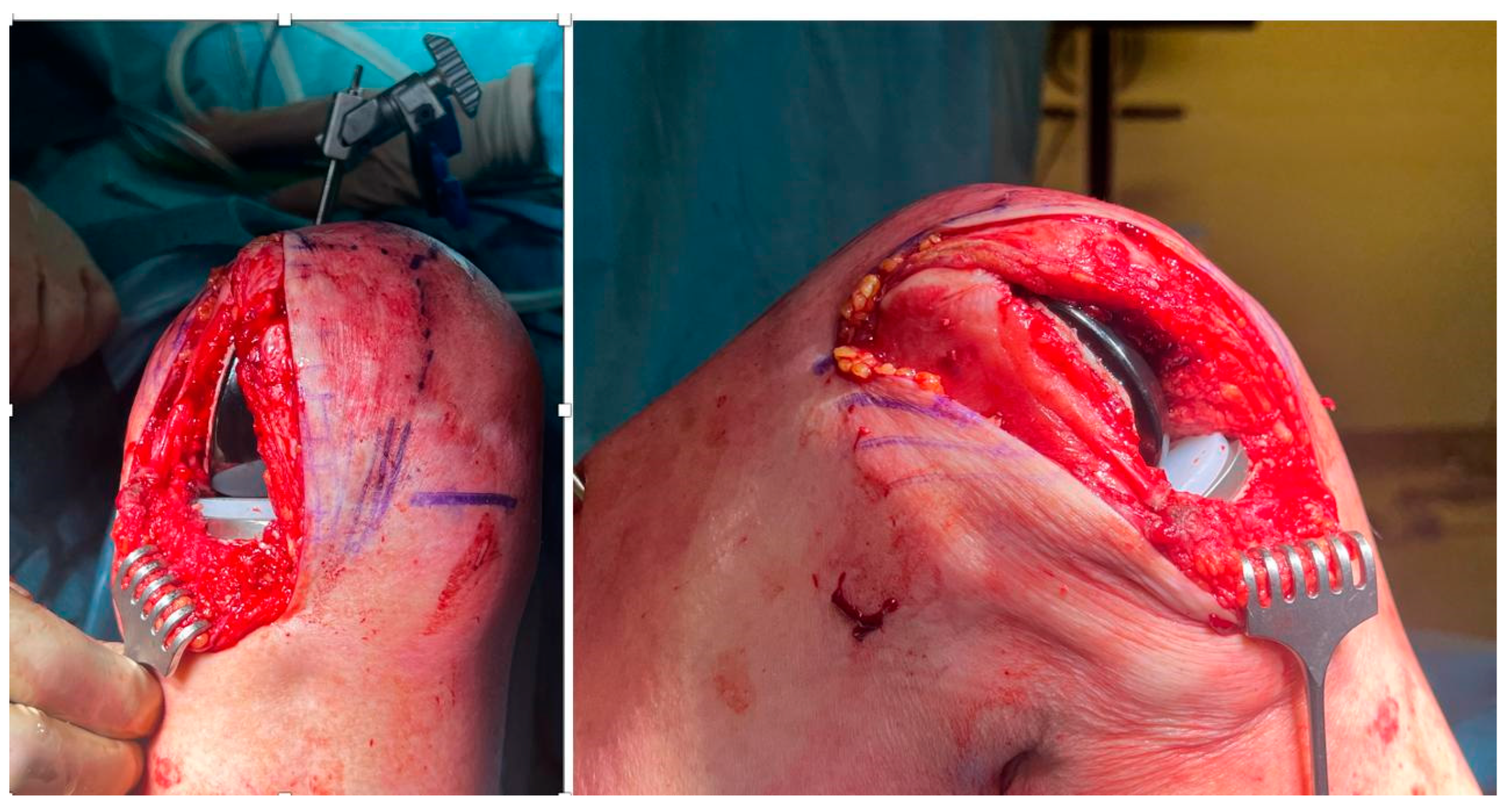

Table 1.
Key data of the 257 UKA patients.
| Variable | Patients |
|---|---|
| Age, mean (SD) [range] | 67.46 (10.33) [32–96] |
| Gender | |
| Male (%) | 107 (41.80%) |
| Female (%) | 150 (58.37%) |
| BMI (kg/m²), mean (SD) [range] | 26.58 (4.61) [16.33–39.26] |
| ASA class (%) | |
| ASA 1 | 59 (22.96%) |
| ASA 2 | 159 (61.87%) |
| ASA 3 | 39 (15.18%) |
| Operative time (min), mean (SD) [range] | 39.47 (8.56) [20–73] |
| Side | |
| Right (%) | 124 (48.25%) |
| Left (%) | 133 (51.75%) |
| Hospital stay (days), mean (SD) [range] | 3.95 (1.73) [2–20] |
UKA: unicompartmental knee arthroplasty; SD: standard deviation; BMI: body mass index; ASA: American Society of Anesthesiology.
Table 2.
Preoperative and postoperative clinical and functional data and outcome satisfaction.
| Variable | Patients | p-Value | |
|---|---|---|---|
| KSKS | Preoperative, mean (SD) [range] | 44.53 (14.76) [20–70] | <0.001 |
| 12 months, mean (SD) [range] | 86.17 (11.92) [56–99] | ||
| 24 months, mean (SD) [range] | 89.31 (10.48) [56–100] | ||
| KSFS | Preoperative, mean (SD) [range] | 53.12 (15.6) [15–80] | <0.001 |
| 12 months, mean (SD) [range] | 87.78 (10.76) [45–100] | ||
| 24 months, mean (SD) [range] | 90.44 (11.08) [45–100] | ||
| PCS | Preoperative, mean (SD) [range] | 31.51 (10.65) [6–48] | <0.001 |
| 12 months, mean (SD) [range] | 42.54 (10.46) [11–67] | ||
| 24 months, mean (SD) [range] | 51.86 (8.78) [26–76] | ||
| MCS | Preoperative, mean (SD) [range] | 47.04 (10.44) [15–74] | <0.001 |
| 12 months, mean (SD) [range] | 52.35 (10.43) [24–72] | ||
| 24 months, mean (SD) [range] | 56.41 (10.11) [19–78] | ||
| OKS | Preoperative, mean (SD) [range] | 35.69 (9.13) [6–48] | <0.001 |
| 12 months, mean (SD) [range] | 22.43 (7.96) [3–40] | ||
| 24 months, mean (SD) [range] | 17.94 (8.19) [0–45] | ||
| FJS-12 | 12 months, mean (SD) [range] | 81.64 (16.77) [15–100] | 0.0196 |
| 24 months, mean (SD) [range] | 85.47 (15.38) [15–100] | ||
| UCLA | Preoperative, mean (SD) [range] | 4.53 (1.6) [1–9] | <0.001 |
| 12 months, mean (SD) [range] | 6.3 (1.45) [3–9] | ||
| 24 months, mean (SD) [range] | 7.3 (1.65) [3–10] | ||
| Satisfaction | 24 months, mean (SD) [range] | 9.17 (1.16) [2–10] |
KSKS: Knee Society Knee Score; SD: standard deviation; KSFS: Knee Society Function Score; OKS: Oxford. Knee Society; UCLA: University of California, Los Angeles Activity Score; PCS: Physical Component Summary; MCS: Mental Component Summary; FJS-12: Forgotten Joint Score.
Disclaimer/Publisher’s Note: The statements, opinions and data contained in all publications are solely those of the individual author(s) and contributor(s) and not of MDPI and/or the editor(s). MDPI and/or the editor(s) disclaim responsibility for any injury to people or property resulting from any ideas, methods, instructions or products referred to in the content. |
© 2024 by the authors. Licensee MDPI, Basel, Switzerland. This article is an open access article distributed under the terms and conditions of the Creative Commons Attribution (CC BY) license (http://creativecommons.org/licenses/by/4.0/).
Copyright: This open access article is published under a Creative Commons CC BY 4.0 license, which permit the free download, distribution, and reuse, provided that the author and preprint are cited in any reuse.


