

Submitted:
27 December 2024
Posted:
30 December 2024
You are already at the latest version
Abstract
School nurses play a crucial role in promoting student health, addressing issues such as substance use, mental health, physical health, violence, and sexual health. However, their job satisfaction has been understudied, particularly in relation to the challenges they face. This study evaluates job satisfaction and professional quality of life among school nurses and nurses working in educational settings in Spain. Methods: A descriptive cross-sectional study was conducted (November 2023 - February 2024) with 553 nurses from various regions of Spain, using the Font-Roja Job Satisfaction and CPV-35 Professional Quality of Life questionnaires. Results showed significant differences in job satisfaction between nurses in healthcare and educational settings, influenced by factors such as workload and institutional support. Most participants (97.5% women, median age ~40 years) had less than 5 years of experience. The lack of a dedicated nurse in half of the schools highlights disparities in service provision. Discussion: This study emphasizes the need for supportive policies and work environments to improve the well-being and job satisfaction of nurses in school settings.
Keywords:
School nursing
; job satisfaction
; professional quality of life
; work factors
; educational settings
Abstract School nurses play a crucial role in promoting student health, addressing issues such as substance use, mental health, physical health, violence, and sexual health. However, their job satisfaction has been understudied, particularly in relation to the challenges they face. This study evaluates job satisfaction and professional quality of life among school nurses and nurses working in educational settings in Spain. Methods: A descriptive cross-sectional study was conducted (November 2023 - February 2024) with 553 nurses from various regions of Spain, using the Font-Roja Job Satisfaction and CPV-35 Professional Quality of Life questionnaires. Results showed significant differences in job satisfaction between nurses in healthcare and educational settings, influenced by factors such as workload and institutional support. Most participants (97.5% women, median age ~40 years) had less than 5 years of experience. The lack of a dedicated nurse in half of the schools highlights disparities in service provision. Discussion: This study emphasizes the need for supportive policies and work environments to improve the well-being and job satisfaction of nurses in school settings.
1. Introduction
School nurses in Spain are healthcare professionals dedicated to promoting the physical and emotional well-being of students. Their role is not limited to working directly within educational institutions; it also includes nurses who provide school health services through community/public health settings and private organizations [1]. These professionals possess a general nursing education obtained through a university degree, and many have further enhanced their qualifications with specialized master's degrees in school, community, or public health nursing. Their diverse work environments enable them to manage a wide range of responsibilities, from providing immediate emergency care to promoting healthy habits and managing chronic conditions such as type 1 diabetes and asthma [2,3,4]. For example, school nurses monitor the blood glucose levels of students with diabetes, administer insulin when necessary, and educate both students and staff on proper disease management. In the case of asthma, they help students identify and avoid triggers, administer rescue medications, and develop individualized action plans to manage asthma exacerbations during school hours. [2,3,4].
However, despite their essential role, school nurses in Spain may face challenges related to job satisfaction and quality of life due to the specific demands of their work environment [5,6,7,8].
Job satisfaction in nursing, and specifically in school nursing, is a concept that has been studied in various contexts. Generally, job satisfaction refers to the degree to which nurses' professional expectations and needs align with their work reality [9,10,11]. Key determinants of job satisfaction include workload, resource availability, professional recognition, and organizational support.
In hospital settings, these factors have been extensively studied, revealing that nurses often experience significant levels of stress, workload, and emotional demands, which affect their job satisfaction [12,13]. However, it is important to recognize that school nurses operate within a unique context that differs substantially from hospital environments. School nurses are frequently the only healthcare professionals within a school, leading to potential professional isolation. Their roles focus primarily on public health, health promotion, and preventive care, in contrast to hospital nurses who provide secondary and tertiary care within multidisciplinary teams [14,15]. Therefore, the factors influencing job satisfaction among school nurses may differ from those affecting hospital nurses, necessitating dedicated research to understand their specific challenges and needs. Moreover, the extent of professional interaction among school nurses can significantly influence their job satisfaction. Nurses working in isolation, particularly those employed by community or private organizations—may have fewer opportunities for peer support and collaboration [16]. This lack of interaction can lead to feelings of professional isolation, reducing job satisfaction and potentially impacting the quality of care provided to students.
Professional quality of life is another critical aspect that directly influences nurses' well-being and the quality of care they provide. This concept encompasses not only job satisfaction but also the physical, emotional, and social well-being of professionals [16,17,18,19]. Maintaining a proper balance between work responsibilities and personal life, along with access to supportive resources and a healthy work environment, is essential for a good quality of life. In hospital settings, it has been shown that quality of life is closely linked to job satisfaction and, ultimately, to the quality-of-care nurses can provide to their patients [20,21]. In the school context, although studies are more limited, it is reasonable to assume that similar factors influence the quality of life of school nurses and, consequently, their ability to care for students [22]. Despite the relevance of these issues, there is a notable gap in research on job satisfaction and quality of life among school nurses in Spain. While extensively explored in other contexts, such as hospitals, the school setting has received less attention in the scientific literature. This gap is concerning, as the working conditions and well-being of school nurses affect not only their performance but also the quality of care that students receive. Therefore, conducting studies that analyze the factors influencing job satisfaction and quality of life among school nurses in Spain is important, as it may help identify areas for improvement in their working conditions, which could potentially have a positive impact on the educational health care environment [23,24].
The role of the school nurse is unique and multifaceted, encompassing direct student care, health promotion, and health education. School nurses must adapt to diverse educational environments, collaborate with educational professionals, and often manage limited resources [26,27,28]. This variety of responsibilities and the context in which they operate can significantly influence their job satisfaction. Factors such as autonomy in decision-making, professional recognition within the educational setting, opportunities for professional development, and the quality of interpersonal relationships with teaching and administrative staff are key determinants in the perception of job satisfaction among school nurses [28,29,30,31,32]. Understanding how these specific aspects of the role affect their professional well-being is essential for improving not only their quality of work life but also the quality of care provided to students [28,34].
This study aims to assess the perception of job satisfaction and professional quality of life among school nurses in Spain. Specifically, it seeks to measure the levels of job satisfaction and professional quality of life and identify how various aspects of the work environment, such as work experience and institutional support, influence these outcomes. Identifying these factors will help design strategies to improve the working conditions of these professionals, thereby optimizing healthcare within the educational context.
2. Materials and Methods
2.1. Study Design
A cross-sectional descriptive study with a quantitative approach was conducted in Spain between November 2023 and February 2024. This design was chosen to provide an overview of the job satisfaction and quality of working life of school nurses at a specific point in time. The cross-sectional approach allows for identifying patterns and associations within a diverse sample, facilitating comparisons with future studies. This design was selected for its efficiency in collecting data from a large sample within a short timeframe.
2.2. Study Population
In Spain, school health services are a collaborative effort involving nurses working directly within schools and those from community and public health sectors. For this study, all nurses providing health services to students, regardless of their primary workplace, were classified as "school nurses."
The study population included school nurses from various geographical regions and educational settings across Spain, as defined by the National School Nursing Observatory of the General Nursing Council of Spain [25]. This population encompassed nurses employed directly by educational institutions (primary, secondary, and special education schools) and those working in community/public health settings or private companies that provide school health services. By including nurses from these diverse settings, the study aimed to capture the full spectrum of professionals involved in school health care in Spain, reflecting the country’s integrated approach to student health services.
2.3. Inclusion Criteria
Nurses included in the study were those providing health services to educational centers, regardless of their primary workplace. This group consisted of:
1.Nurses employed directly by educational institutions, such as primary, secondary, and special education schools, who work on-site as part of the school team.
2.Nurses contracted by external entities, such as community organizations, public health services, or private companies, who regularly deliver healthcare services to students in schools under formal agreements.
Additionally, all participants were required to have at least one year of professional experience in this field to ensure sufficient adaptation and familiarity with their work environment. This criterion was designed to ensure that responses reflected a consolidated perception of their job satisfaction and quality of working life.
2.4. Sample Size and Participants
A power calculation was conducted to determine the required sample size to detect significant differences in job satisfaction and professional quality of life, with a 95% confidence level and a 5% margin of error. The initial calculation indicated a requirement of 328 participants. Ultimately, 553 school nurses were recruited using convenience sampling to enhance the robustness of the study and improve the external validity of the results.
Informed consent was obtained from all participants, adhering to the principles of the Declaration of Helsinki and the Belmont Report. The study was approved by the Professional Ethics Committee of the University of Vic-UCC (code 303/2023). Participation was entirely voluntary, and anonymity and data confidentiality were ensured.
The increased sample size aimed to minimize potential biases, address heterogeneity within the target population, and improve the precision of confidence intervals, thereby reinforcing the reliability and representativeness of the findings.
2.5. Ethical Procedures
Participants were fully informed about the study's objectives and procedures, as well as their right to withdraw at any time without repercussions. Informed consent was obtained prior to participation, emphasizing the voluntary and anonymous nature of their involvement. Data were used exclusively for research purposes, and mechanisms were implemented to minimize any inconvenience or time burden for participants. From an ethical perspective, recruiting a larger sample size was justified to achieve more precise and generalizable results.
2.6. Instruments
Font-Roja Job Satisfaction Questionnaire: This validated instrument measures job satisfaction using 26 items across nine dimensions: job satisfaction, work-related tension, professional competence, work pressure, opportunities for improvement, interpersonal relationships with supervisors, interpersonal relationships with colleagues, extrinsic status characteristics, and job monotony. Responses are rated on a Likert scale ranging from 1 (minimal satisfaction) to 5 (maximum satisfaction). It has been validated in nursing contexts with a Cronbach’s alpha coefficient exceeding 0.80 [26].
CPV-35 Professional Quality of Life Questionnaire: Designed for healthcare professionals, the CPV-35 assesses professional quality of life using a 7-point Likert scale. It evaluates dimensions such as psychological well-being, social support at work, satisfaction with the work environment, and work-life balance. Key aspects include supervisor support, workload, salary satisfaction, recognition, interpersonal relationships, autonomy, and opportunities for professional development. It has been validated with a Cronbach’s alpha coefficient exceeding 0.85 [10].
2.7. Data Collection Procedure
Questionnaire Design: In addition to the Font-Roja and CPV-35 instruments, demographic and occupational questions (e.g., age, gender, years of experience, and weekly working hours) were included.
Administration: Surveys were distributed electronically via links shared through school nursing groups and associations, ensuring confidentiality and anonymity of responses.Quality Control: Procedures included pre-distribution validation of the questionnaires and reviewing collected data to address missing or inconsistent responses. Data collection took place between November 2023 and February 2024.
2.8. Statistical Analysis
Descriptive Statistics: Sample characteristics were described using absolute and relative frequencies for categorical variables and medians with interquartile ranges (IQR) for numerical variables. Font-Roja and CPV-35 scores were presented in tables using medians [IQR] and means with standard deviations (SD).
Comparative Analysis: Scores were compared based on contracting entity and years of experience using chi-square tests for categorical variables, Kruskal-Wallis tests for medians [IQR], and ANOVA for means (SD).
Regression Models: Multivariate regression models were developed to explain the total scores of the Font-Roja and CPV-35 questionnaires using variables such as gender, age, experience, employment status, contracting entity, inter-institutional relationships, and weekly working hours. Backward stepwise variable selection based on the Akaike Information Criterion was applied to obtain reduced models with optimal explanatory power.
Non-linear Associations: Associations between CPV-35 factors and the total Font-Roja score were analyzed using spline regression models, with p-values calculated via Likelihood Ratio Tests. Similar analyses explored the relationship between Font-Roja factors and the CPV-35 score.
Categories of Contracting Entities
Participants were classified into four contracting categories: 'Global,' 'Health,' 'Education,' and 'Others.' This classification enabled comparisons across different contexts: 'Global' included all participants, providing an overview of the results.'Health' encompassed nurses employed by health sector entities, such as hospitals and public health centers.'Education' included nurses hired by public and private educational institutions.'Others' referred to nurses employed by NGOs or private companies providing school nursing services.
2.8. Theoretical Framework
This study integrates personal attributes, job characteristics, and organizational factors into its theoretical framework:Personal Attributes: Demographic and professional variables (e.g., age, gender, years of experience).Job Characteristics: Intrinsic aspects of the nursing role, such as workload, autonomy, professional development opportunities, and interpersonal relationships.Organizational Factors: Broader employment contexts, including employment status, contracting entity, and inter-institutional collaboration.
This framework provided a comprehensive perspective for examining how individual and organizational factors influence job satisfaction and professional quality of life. It guided variable selection, hypothesis formulation, and result interpretation, offering a nuanced understanding of the dynamics within school nursing in Spain.
3. Results
The study included 553 school nurses, with 63.3% employed by the Education sector, 12.1% by the health sector, and 24.6% by other entities. As shown in Table 1, the majority of participants were female (97.5%), with no significant differences across employing entities (p = 0.474). The average age of participants was consistent across sectors, approximately 40 years, with no statistically significant differences (p = 0.824).
Regarding work experience, the mean was 4 years, and most nurses had less than 5 years of experience (91.9%), with no significant differences among the entities (p = 0.402). Although a trend in experience distribution was noted, it was not statistically significant (p = 0.087).
Employment status differed significantly by employing entity (p < 0.001). In the Health sector, 25.4% were permanent employees, compared to 8.0% in Education and 58.8% in other entities. Temporary employment was most common in Health (49.3%) and nearly absent in other entities.
There were also significant differences in the hiring authority depending on the employing entity (p < 0.001). In the Health sector, 89.6% were employed by the Ministry of Health, while 41.4% in Education were employed by the Ministry of Education, and 46.3% in other entities were employed directly by their educational institution.
Collaboration with other institutions showed significant variation (p = 0.023). In Health, 78.6% collaborated with Primary Care, compared to 58.0% in Education and 51.7% in other entities. Additionally, 48.3% of those in other entities reported relationships with various institutions. Weekly working hours were consistent across entities, averaging 37.5 hours, with no significant differences (p = 0.362).
Table 2 presents descriptive characteristics of the sample centers, broken down by contracting entity. The analysis shows significant variation in the number of students across different entities (p = 0.037). The majority of schools (59.8%) have between 501 and 1500 students. This distribution does not show significant differences among the Health, Education, and other entities, reflecting a wide range of school sizes within the study sample. However, schools with more than 1500 students are more common in the "Others" category (22.1%). The type of school shows significant differences among contracting entities (p < 0.001). Schools focused on Early Childhood and Primary Education are predominantly found in the Education sector (42.6%). In contrast, schools offering Early Childhood, Primary, and Secondary Education are more common in the "Others" category (55.9%). This indicates that the "Others" category includes a broader range of educational levels. Ownership of the school varies significantly by entity (p = 0.003). Public schools are the most common in the Education sector (76.6%), whereas privately funded schools are more prevalent in the "Others" category (22.1%).
Regarding the characteristics of the educational institution, there are no significant differences among the entities (p = 0.131). The majority of schools across all entities are located in urban areas, with 89.7% of schools being urban and 10.3% rural.
In Table 3, significant differences are observed between contracting entities in two specific factors. Factor 8, which assesses extrinsic status characteristics, shows a statistically significant difference (p = 0.025). This suggests that perceptions of job status vary across different entities, with notable distinctions in how job status is perceived. Similarly, Factor 9, which measures perceptions of job monotony, also exhibits a significant difference (p = 0.038). These findings indicate that job monotony is perceived differently depending on the contracting entity. In contrast, the other factors analyzed—Factor 1: Job Satisfaction, Factor 2: Work-Related Tension, Factor 3: Professional Competence, Factor 4: Work Pressure, Factor 5: Improvement Opportunities, Factor 6: Interpersonal Relationship with Superiors, Factor 7: Interpersonal Relationship with Colleagues, and the overall Font-Roja questionnaire score—do not show statistically significant differences between contracting entities. This consistency suggests a uniform perception regarding job satisfaction, work-related tension, professional competence, work pressure, opportunities for improvement, and interpersonal relationships across the evaluated entities.
Table 4 highlights several important findings regarding the Professional Quality of Life questionnaire (CVP-35) by contracting entity. The perceived workload was significantly higher in the "Others" sector (7.79) compared to healthcare (7.16) and education (7.45) (p=0.026). Satisfaction with salary was notably higher in the education sector (6.55) than in healthcare (5.93) and other sectors (5.67) (p=0.020). The pressure to maintain the quantity of work was also higher in healthcare (5.64) compared to other sectors (4.81) (p=0.044), and similarly, the pressure to maintain quality of work was higher in healthcare (5.63) compared to other sectors (5.35) (p=0.037). Support from supervisors was greater in the education sector (6.53) compared to other sectors (7.06) (p=0.032). Additionally, the perception of a lack of time for personal life was higher in the education sector (4.16) compared to other sectors (3.78) (p=0.022). Receiving information about work results was higher in the "Others" sector (5.19) compared to healthcare (4.93) and education (4.39) (p=0.012). The importance of work to the lives of others was notably higher in the education sector (9.15) compared to healthcare (8.67) and other sectors (8.68) (p=0.003). Finally, the necessity for training was greater in the "Others" sector (7.89) compared to healthcare (7.36) and education (7.91) (p=0.032).
The multivariate regression analysis In Table 5, on the total scores of the Font-Roja and CVP-35 questionnaires revealed significant associations, providing relevant insights into job satisfaction and professional quality of life.
Font-Roja Questionnaire Analysis: The analysis indicated that age and weekly working hours are significantly associated with the total score of the Font-Roja questionnaire. Specifically, individuals aged between 30 and 40 years showed a decrease in the total questionnaire score, with a p-value of 0.045, indicating an average reduction of 0.084 points (95% CI: -0.166, -0.002). This suggests that in this age group, job satisfaction and professional quality of life may be negatively affected.
Furthermore, those working more than 37.5 hours per week also showed a decrease in the total score, with a p-value of 0.076, which is close to the conventional significance threshold of 0.05. The observed reduction was 17.1% compared to those working less than 15 hours per week (95% CI: -0.359, 0.018). This negative association suggests that working many hours could be related to lower job satisfaction and professional quality of life.
It is important to note that, although the p-value for weekly working hours (0.076) does not reach the traditional level of statistical significance, it is close enough to suggest a possible trend that might be significant with a larger sample size or in other contexts. In practical terms, both age and working hours seem to negatively influence the Font-Roja questionnaire scores, highlighting the need to consider these factors in managing workplace well-being.
CVP-35 Questionnaire Analysis: In the analysis of the CVP-35, it was found that the relationship with institutions such as the City Council was negatively associated with the total score, with this association being highly significant (p=0.002). This suggests that individuals whose employment relationship is with these public institutions tend to have a more negative perception of their job satisfaction and professional quality of life.
Additionally, the "non-binary" gender category showed a significant negative association with the total CVP-35 score (p=0.048). Specifically, non-binary individuals had a decrease of 1.616 points in the total questionnaire score (95% CI: -3.218, -0.013). This finding indicates that non-binary individuals may experience lower job satisfaction and professional quality of life compared to their male and female counterparts.
These associations underscore the importance of considering institutional relationships and gender identity when evaluating job satisfaction and professional quality of life. Specifically, the policies and practices of the City Council, as well as the recognition and support of non-binary individuals, can have a significant impact on these aspects.
It was also found that individuals working between 15 and 30 hours per week showed a significant positive association with the total score in the reduced model (p=0.035), with an increase of 0.537 points compared to those working less than 15 hours per week (95% CI: 0.037, 1.037). Similarly, those working more than 37.5 hours per week showed a significant positive association (p=0.011), with an increase of 0.591 points compared to those working less than 15 hours per week (95% CI: 0.134, 1.048).
Model Details: The reduced model is the one that achieves the best balance of likelihood by the number of variables, as a result of a stepwise backward variable selection process based on the Akaike Information Criterion (AIC). Although the p-values of the marginal effects may not always present p<0.05, the model without those variables had a worse AIC. No reduced model is presented for Font-Roja since none of the explanatory variables provided sufficient likelihood when trying to explain the total Font-Roja score.
In Figure 1, it is observed that Factor 5, "Improvement Options," from the Font-Roja job satisfaction questionnaire is the only one that shows a statistically significant association with the total score of the professional quality of life questionnaire CVP-35, with a p-value of 0.016. Other factors, such as Factor 1, "Job Satisfaction," also approach statistical significance with a p-value of 0.063. When applying a reduced multivariate regression model, which includes the nonlinear relationship detected in Factor 5 and other factors with linear effects, significant associations are identified with Factors 1 and 9, with p-values of 0.046 and 0.008, respectively. In this model, Factor 1 has a proportional association and Factor 9 an inverse association with professional quality of life. The model that best explains the total CVP-35 score, according to the Akaike Information Criterion (AIC), includes Factors 1, 2, 5, 8, and 9. Although Factors 2 and 8 do not reach statistical significance due to their p-values (>0.05), their inclusion in the model remains relevant, with Factor 5 showing a predominant nonlinear relationship.
4. Discussion
The average score of some factors related to job satisfaction and professional quality of life for school nurses shows significant differences based on their employing entity.
The findings indicate that, overall, school nurses have a mean score of 3.129, consistent with previous studies reporting medium-high levels of satisfaction [27]. However, significant variations are observed in specific factors, such as perceived status and job monotony across different sectors. Nurses in the Healthcare sector perceive higher job status, likely due to the formal recognition and structure of the healthcare system. In contrast, those in the Education sector experience greater job monotony, potentially influenced by routine tasks and limited variety in the school environment [8,28].
Work-related stress is a common experience among school nurses across all sectors, reflecting the inherently demanding nature of the profession. In our study, this aspect was assessed using Factor 2: Work-Related Tension from the Font-Roja Job Satisfaction Questionnaire, which yielded a mean score of 2.45 (Table 3). This result indicates moderate levels of tension among the nurses, aligning with existing literature that highlights the stress inherent in school nursing [29,30]. The perception of professional competence is homogeneous nationwide, suggesting that the training and skills acquired are adequate. Professional competence is crucial for job satisfaction and overall well-being [31].
The pressure to maintain both the quantity and quality of work is a consistent concern, with a mean score of 2.97 in Factor 4: Work Pressure (Table 3). This suggests that, despite relatively high job satisfaction (mean score of 3.85 in Factor 1: Job Satisfaction), nurses face considerable demands that can affect their satisfaction and professional quality of life. The "Others" sector shows a more positive perception regarding improvement opportunities, possibly due to greater flexibility compared to the Healthcare and Education sectors. This highlights the need for developing and communicating development opportunities across all sectors to enhance satisfaction and professional quality of life [32].
Interpersonal relationships with supervisors and colleagues are generally positive and similar across sectors, suggesting a uniform collaborative culture. However, greater job monotony in the Education sector underscores the need to diversify roles to reduce monotony and improve job satisfaction [33].
Moreover, our findings suggest that nurses who are less integrated within the educational sphere and have limited interaction with other school nurses may experience lower job satisfaction. This could be due to a lack of involvement in educational activities, reduced opportunities for collaboration with educational staff, and fewer chances to engage with professional peers. These factors may contribute to feelings of marginalization and professional isolation, which are known to negatively affect job satisfaction [44].
Our findings underscore the unique challenges faced by school nurses. The professional isolation inherent in being the sole healthcare provider in a school can contribute to feelings of marginalization and impact job satisfaction [45,46,47]. Additionally, the focus on public health and preventive care requires a different set of skills and may not receive the same recognition as acute care provided in hospitals. These factors highlight the need for specialized support and resources tailored to the school nursing context [48,49,50].
Professional quality of life varies by sector. The perceived workload is higher in the "Others" sector, potentially due to the diversity of tasks and less regulation compared to more structured sectors. Job satisfaction with salary is higher in the Education sector, which may reflect better salary conditions or benefits. The pressure to maintain the quantity and quality of work is significantly higher in the Healthcare sector, reflecting the demanding nature of the healthcare environment. Higher supervisor support in the Education sector suggests a more collaborative and less hierarchical work environment [33,34].
Collaboration with Primary Care is more frequent in the Healthcare sector, aligning with the integration of the healthcare system. In contrast, collaboration in the Education and "Others" sectors is less frequent, which may limit the support and resources available to school nurses in these settings. Additionally, the presence of larger educational centers in the "Others" sector affects the workload and work dynamics of school nurses [34] .
Nurses with 5 to 10 years of experience report lower professional quality of life, possibly due to unmet expectations and job realities that generate dissatisfaction. This finding is consistent with previous studies suggesting that less experienced nurses are generally more satisfied [33]. Employment relationships with the City Council are negatively associated with satisfaction, likely due to differences in management policies and support. Working more than 37.5 hours a week is positively associated with overall professional quality of life, although it also shows a more pronounced negative association with job satisfaction, highlighting the importance of addressing excessive workloads and promoting work-life balance [7].
Age significantly impacts job satisfaction, with individuals aged 30 to 40 exhibiting lower satisfaction levels. This finding suggests that this age group may face specific challenges in their work environment, warranting targeted interventions to improve their job satisfaction [35].
Practical Implications and Recommendations
The study underscores the importance of tailoring support policies and programs to the specific needs of each sector. For instance, in the Education sector, diversifying responsibilities and formally recognizing nurses' contributions could address job monotony and improve status perception. Furthermore, strengthening collaboration between the Education and Healthcare sectors could enhance support and resources available to school nurses, while implementing professional development programs and promotion opportunities could improve motivation and reduce monotony.
Limitations of the Study
This study has several limitations. The cross-sectional design prevents establishing causal relationships between variables, limiting conclusions about the direct influence of certain factors on job satisfaction. Additionally, while the sample size was robust, data were collected only in Spain, which may restrict the generalizability of the findings to other international contexts. Self-selection of participants and the use of self-reported questionnaires introduce risks of bias, such as social desirability and the potential underrepresentation of more burdened nurses. Finally, the lack of longitudinal follow-up restricts the ability to observe how job satisfaction and professional quality of life evolve over time.
Future Research Directions and Implications
Future research should explore contextual factors affecting school nurses' job satisfaction, design and implement targeted interventions to enhance their work well-being and examine how job satisfaction impacts the quality of school health services. Comparative studies across countries, longitudinal research, and analyses of how job satisfaction influences service quality could provide a more comprehensive understanding and contribute to international improvements in school health care. Additionally, qualitative research is needed to gain deeper insights into the specific experiences and needs of these health professionals, as well as to identify barriers and facilitators of job satisfaction. Combining qualitative and quantitative methods will offer a more holistic and nuanced view, facilitating the development of more effective strategies to support school nurses.
5. Conclusion
School nurses in Spain generally report a moderately high level of job satisfaction, although this varies across employment sectors—Healthcare, Education, and Others. These differences are linked to specific working conditions and challenges within each sector. While the overall professional quality of life, measured by the CPV-35 scale, averages 6.000, common work-related pressures are observed across all sectors.
Nurses in the Healthcare sector perceive higher job status and face greater pressure to maintain work quantity and quality, reflecting the demanding nature of the healthcare environment. In contrast, the Education sector shows greater job monotony, affecting job satisfaction, though this is somewhat mitigated by higher perceived support from supervisors. The "Others" sector reports a higher perceived workload but also more opportunities for improvement, possibly due to a less regulated work environment.
Experienced nurses place significant value on recognition and professional competitiveness. Working more than 37.5 hours per week is associated with better professional quality of life, although it may negatively impact job satisfaction due to potential overwork.
The variability in the presence of school nurses across different models, where only about half of schools have a dedicated nurse—highlights the need for policies that ensure equitable distribution of nursing services. Additionally, providing health training to teaching staff and strengthening collaboration between the educational and healthcare sectors could enhance support for nurses and student health.
To improve the well-being of school nurses, it is crucial to enhance their integration within the educational system and foster professional networks. Developing programs that promote collaboration with educational staff and facilitate interaction among school nurses can address feelings of isolation and improve job satisfaction. Future research should focus on exploring these contextual factors and designing interventions that enhance both occupational well-being and the quality of school health services. This will contribute to a more comprehensive understanding of school nursing dynamics and support the development of effective policies and practices.
Author Contributions
Conceptualization, methodology, and formal analysis, Zafra-Agea, José Antonio; formal investigation, all authors; data curation, Zafra-Agea, José Antonio; writing—original draft preparation and final writing, all authors. All authors have read and approved the published version of the manuscript.
Institutional Review Board Statement
The protocol was approved by the Ethics Committee of the ética profesional de la Universidad de Vic-UCC number 303/2023.), and each participant signed a written informed consent.
Informed Consent Statement
Informed consent was obtained from all subjects involved in the study.
Data Availability Statement
The data presented in this study are available upon request to the corresponding author.
Conflicts of Interest
The authors declare no conflict of interest.
References
- Ayuso Murillo, D. Implantación de La Enfermería Escolar En España, Una Prioridad Para El Consejo General de Enfermería. ESE Enfermeria en Salud Escolar 2021, 1. [Google Scholar]
- Gómez, M.; Rodríguez, A.; Fernández, S. El Papel de La Enfermería En La Promoción de La Salud Escolar: Evidencias Desde La Práctica. Enfermería Educativa 2020, 12(3), 45–58. [Google Scholar]
- Pawils, S.; Heumann, S.; Schneider, S. A.; Metzner, F.; Mays, D. The Current State of International Research on the Effectiveness of School Nurses in Promoting the Health of Children and Adolescents: An Overview of Reviews; 2023; Vol. 18. [CrossRef]
- Daily, S. M.; Smith, M. L.; Lilly, C. L.; Davidov, D. M.; Mann, M. J.; Kristjansson, A. L. Using School Climate to Improve Attendance and Grades: Understanding the Importance of School Satisfaction Among Middle and High School Students. Journal of School Health 2020, 90(9), 683–693. [Google Scholar] [CrossRef] [PubMed]
- Armas Junco, L.; Alonso Martínez, L.; Fernández Hawrylak, M. School Nursing Practice in Education Settings in Spain. The Journal of School Nursing 2024. [Google Scholar] [CrossRef]
- Lorber, M.; Skela Savič, B. Job Satisfaction of Nurses and Identifying Factors of Job Satisfaction in Slovenian Hospitals. Croat Med J 2012, 53(3), 263–270. [Google Scholar] [CrossRef]
- Khai-Lee, O.; Woan-Ching, C.; Bit-Lian, Y. PERCEPTION OF JOB SATISFACTION AMONG OPERATION ROOM NURSES IN A TERTIARY HOSPITAL, SAUDI ARABIA. The Malaysian Journal of Nursing 2020, 12(1), 3–9. [Google Scholar] [CrossRef]
- Atefi, N.; Abdullah, K. L.; Wong, L. P.; Mazlom, R. Factors Influencing Registered Nurses Perception of Their Overall Job Satisfaction: A Qualitative Study. Int Nurs Rev 2014, 61(3), 352–360. [Google Scholar] [CrossRef]
- Foley, M.; Lee, J.; Wilson, L.; Young Cureton, V.; Canham, D. A Multi-Factor Analysis of Job Satisfaction among School Nurses. J Sch Nurs 2004, 20(2), 94–100. [Google Scholar] [CrossRef]
- Martín, J.; Cortés, J. A.; Morente, M.; Caboblanco, M.; Garijo, J.; Rodríguez, A. Características Métricas Del Cuestionario de Calidad de Vida Profesional. Gac Sanit 2004, 18(6), 489–489. [Google Scholar] [CrossRef]
- Cueva-Pila, G.; Valenzuela Suazo, S.; Alvarado Alvarado, A. L.; Hidalgo Ortiz, J. P. Revisión Integrativa de La Calidad de Vida En El Trabajo de Enfermeras Latinoamericanas. Enfermería: Cuidados Humanizados 2022, 11(2), e2905. [Google Scholar] [CrossRef]
- Rose, I. D.; Lesesne, C. A.; Sun, J.; Johns, M. M.; Zhang, X.; Hertz, M. The Relationship of School Connectedness to Adolescents’ Engagement in Co-Occurring Health Risks: A Meta-Analytic Review. J Sch Nurs 2024, 40(1), 58–73. [Google Scholar] [CrossRef] [PubMed]
- Mohammed Yasin, H. Estudio Exploratorio de La Percepción de Padres, Directores de Escuelas y Maestros Acerca de La Enfermera Escolar. TDX (Tesis Doctorals en Xarxa) 2017.
- Bergren, M. School Nursing and Population Health: Past, Present, and Future. OJIN: The Online Journal of Issues in Nursing 2017, 22(3). [Google Scholar] [CrossRef]
- Yasin, Y. M.; Kerr, M. S.; Wong, C. A.; Bélanger, C. H. Factors Affecting Nurses’ Job Satisfaction in Rural and Urban Acute Care Settings: A PRISMA Systematic Review. J Adv Nurs 2020, 76(4), 963–979. [Google Scholar] [CrossRef] [PubMed]
- Montoya-Cáceres, P.; Bello-Escamilla, N.; Neira, J. Relación Entre Calidad de Vida Laboral y Satisfacción Laboral En El Equipo de Atención Primaria de Salud Relationship. Med Segur Trab (Madr) 2020, 66(261), 220–229. [Google Scholar] [CrossRef]
- Núñez González, E.; Estévez Guerra, G. J.; Hernández Marrero, P.; Marrero Medina, C. D. Una Propuesta Destinada a Complementar El Cuestionario Font-Roja de Satisfacción Laboral. Gac Sanit 2007, 21(2), 136–141. [Google Scholar] [CrossRef]
- García-Martín, M.; García-Peña, I. M.; Morales-Asencio, J. M. Calidad de Vida Laboral En Enfermería: Revisión Integrativa de La Literatura. Rev Esp Salud Publica 2020, 94. [Google Scholar]
- Díaz-Rodríguez, L.; Á., D.-H. M.; Ruiz-Fernández, M. D.; Haidar, A. L. (2020). Calidad de Vida Relacionada Con La Salud Percibida Por Los/Las Profesionales de Enfermería de Unidades de Hospitalización. Enferm Clin 2020, 30 (3), 177–182.
- Kocoglu, D.; Emiroglu, O. N. The Impact of Comprehensive School Nursing Services on Students’ Academic Performance. J Caring Sci 2017, 6(1), 5–17. [Google Scholar] [CrossRef]
- Hoekstra, B. A.; Young, V. L.; Eley, C. V.; Hawking, M. K. D.; McNulty, C. A. M. School Nurses’ Perspectives on the Role of the School Nurse in Health Education and Health Promotion in England: A Qualitative Study. BMC Nurs 2016, 15(1), 73. [Google Scholar] [CrossRef]
- Cabezas Peña, C. La Calidad de Vida de Los Profesionales. FMC 2000, 7(Suppl), 53–68.
- Lee, K.; Brown, C.; Singerhouse, E.; Martin, L.; McMorris, B. J. School Nurses and Chronic Absenteeism in Schools: A Qualitative Study on Experiences, Perspectives, and Roles. The Journal of School Nursing 2023. [CrossRef]
- Maughan, E. D.; Cowell, J.; Engelke, M. K.; McCarthy, A. M.; Bergren, M. D.; Murphy, M. K.; Barry, C.; Krause-Parello, C. A.; Luthy, K. B.; Kintner, E. K.; Vessey, J. A. The Vital Role of School Nurses in Ensuring the Health of Our Nation’s Youth. Nurs Outlook 2018, 66(1), 94–96. [Google Scholar] [CrossRef]
- General de Enfermería, C. Marco de Competencias Del Profesional de Enfermería Experto En El Ámbito Escolar, CONSEJO GE.; Madrid, 2018.
- Aranaz Andrés, J. Cuestionario Font Roja. Un Instrumento de Medida de La Satisfacción En El Medio Hospitalario. Todo Hospital 1988, 52, 63–68. [Google Scholar]
- Portero de la Cruz, S.; Cebrino, J.; Herruzo, J.; Vaquero-Abellán, M. A Multicenter Study into Burnout, Perceived Stress, Job Satisfaction, Coping Strategies, and General Health among Emergency Department Nursing Staff. J Clin Med 2020, 9(4), 1007. [Google Scholar] [CrossRef] [PubMed]
- Caricati, L.; Sala, R. La; Marletta, G.; Pelosi, G.; Ampollini, M.; Fabbri, A.; Ricchi, A.; Scardino, M.; Artioli, G.; Mancini, T. Work Climate, Work Values and Professional Commitment as Predictors of Job Satisfaction in Nurses. J Nurs Manag 2014, 22(8), 984–994. [Google Scholar] [CrossRef] [PubMed]
- Boamah, S. A.; Kalu, M. E.; Havaei, F.; McMillan, K.; Belita, E. Predictors of Nursing Faculty Job and Career Satisfaction, Turnover Intentions, and Professional Outlook: A National Survey. Healthcare 2023, 11(14), 2099. [Google Scholar] [CrossRef] [PubMed]
- Kim, E.; Kim, H.; Lee, T. How Are New Nurses Satisfied with Their Jobs? From the Work Value Perspective of Generations Y and Z Nurses. BMC Nurs 2024, 23(1). [Google Scholar] [CrossRef] [PubMed]
- Kagan, I.; Hendel, T.; Savitsky, B. Personal Initiative and Work Environment as Predictors of Job Satisfaction among Nurses: Cross-Sectional Study. BMC Nurs 2021, 20(1), 87. [Google Scholar] [CrossRef] [PubMed]
- Dall’Ora, C.; Ball, J.; Reinius, M.; Griffiths, P. Burnout in Nursing: A Theoretical Review. Hum Resour Health 2020, 18(1), 41. [Google Scholar] [CrossRef]
- Hudays, A.; Gary, F.; Voss, J. G.; Zhang, A. Y.; Alghamdi, A. Utilizing the Social Determinants of Health Model to Explore Factors Affecting Nurses’ Job Satisfaction in Saudi Arabian Hospitals: A Systematic Review. Healthcare 2023, 11(17), 2394. [Google Scholar] [CrossRef]
- Al-Sabhan, T. F.; Ahmad, N.; Rasdi, I.; Mahmud, A. JOB SATISFACTION AMONG FOREIGN NURSES IN SAUDI ARABIA: THE CONTRIBUTION OF INTRINSIC AND EXTRINSIC MOTIVATION FACTORS. Malaysian Journal of Public Health Medicine 2022, 22(1), 275–283. [Google Scholar] [CrossRef]
- Burgos, L.; Martínez, L.; Sánchez, P. Impacto de La Enfermería Escolar En La Salud y El Rendimiento Académico de Los Estudiantes. Revista de Salud Escolar 2019, 7(2), 112–125. [Google Scholar]
Figure 1.
Association between the factors of the Font-Roja job satisfaction questionnaire and the total score of the professional quality of life questionnaire CVP-35.
Figure 1.
Association between the factors of the Font-Roja job satisfaction questionnaire and the total score of the professional quality of life questionnaire CVP-35.
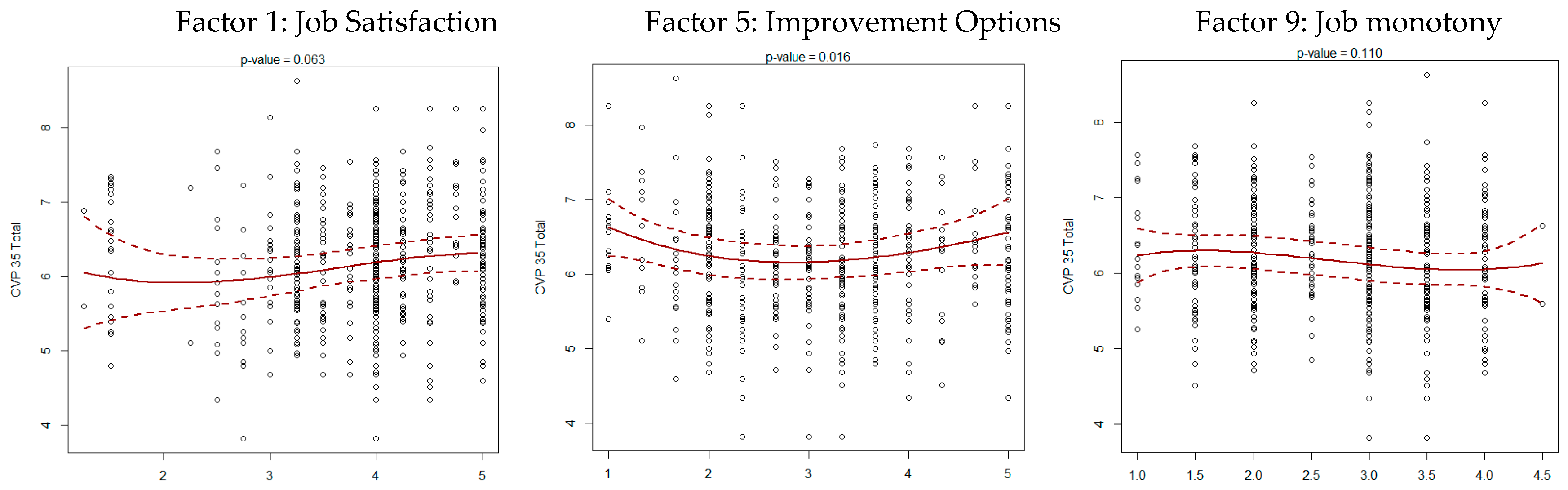

Table 1.
Characteristics of Participants According to Employing Entity.
| Characteristic |
Global (n=553) |
Health (n=67) |
Education (n=350) |
Others* (n=136) |
p-value |
| Gender (n=553) | 0.474 | ||||
| Male | 13 (2.4%) | 3 (4.5%) | 9 (2.6%) | 1 (0.7%) | |
| Female | 539 (97.5%) | 64 (95.5%) | 340 (97.1%) | 135 (99.3%) | |
| Non-binary | 1 (0.2%) | 0 (0.0%) | 1 (0.3%) | 0 (0.0%) | |
| Age (n=553) | 40.0 [33.0; 46.0] | 40.0 [34.0; 45.0] | 41.0 [33.3; 45.2] | 40.0 [33.0; 46.0] | 0.824 |
| Experience (years) (n=553) | 4.0 [2.0; 7.0] | 4.0 [2.0; 7.5] | 4.0 [2.0; 6.0] | 4.0 [3.0; 8.0] | 0.402 |
| Experience (years, categorized) (n=553) | 0.087 | ||||
| <5 years | 508 (91.9%) | 63 (94.0%) | 322 (92.0%) | 123 (90.4%) | |
| 5 to 10 years | 30 (5.4%) | 1 (1.5%) | 20 (5.7%) | 9 (6.6%) | |
| 10 to 15 years | 7 (1.3%) | 0 (0.0%) | 4 (1.1%) | 3 (2.2%) | |
| 15 to 20 years | 6 (1.1%) | 3 (4.5%) | 3 (0.9%) | 0 (0.0%) | |
| > 20 years | 2 (0.4%) | 0 (0.0%) | 1 (0.3%) | 1 (0.7%) | |
| Employed Status (n 553) | <0.001 | ||||
| Discontinuous** | 266 (48.1%) | 17 (25.4%) | 204 (58.3%) | 45 (33.1%) | |
| Permanent | 125 (22.6%) | 17 (25.4%) | 28 (8.0%) | 80 (58.8%) | |
| Temporary | 130 (23.5%) | 33 (49.3%) | 97 (27.7%) | 0 (0.0%) | |
| Non-permanent/Occasional | 32 (5.8%) | 0 (0.0%) | 21 (6.0%) | 11 (8.1%) | |
| Hiring authority (n 553) | <0.001 | ||||
| City Council | 7 (1.3%) | 0 (0.0%) | 0 (0.0%) | 7 (5.1%) | |
| Education Department | 145 (26.2%) | 0 (0.0%) | 145 (41.4%) | 0 (0.0%) | |
| Health Department | 60 (10.8%) | 60 (89.6%) | 0 (0.0%) | 0 (0.0%) | |
| Education | 205 (37.1%) | 0 (0.0%) | 205 (58.6%) | 0 (0.0%) | |
| School Nursing Company | 31 (5.6%) | 0 (0.0%) | 0 (0.0%) | 31 (22.8%) | |
| others | 35 (6.3%) | 0 (0.0%) | 0 (0.0%) | 35 (25.7%) | |
| Own educational center | 63 (11.4%) | 0 (0.0%) | 0 (0.0%) | 63 (46.3%) | |
| Health | 7 (1.3%) | 7 (10.4%) | 0 (0.0%) | 0 (0.0%) | |
| Relationship with other institutions (n=124) | 0.023 | ||||
| Primary Care | 73 (58.9%) | 11 (78.6%) | 47 (58.0%) | 15 (51.7%) | |
| City Council | 11 (8.9%) | 0 (0.0%) | 11 (13.6%) | 0 (0.0%) | |
| Others | 38 (30.6%) | 2 (14.3%) | 22 (27.2%) | 14 (48.3%) | |
| Social Services | 2 (1.6%) | 1 (7.1%) | 1 (1.2%) | 0 (0.0%) | |
| Weekly hours (n=227) | 37.5 [35.0; 37.5] | 37.5 [30.0; 37.5] | 37.5 [35.0; 37.5] | 37.0 [33.8; 38.5] | 0.362 |
*Others : private health companies in the healthcare sector, associations. **Discontinuous work involves employment with irregular or intermittent hours.
Table 2.
Descriptive Characteristics of Sample Centers, Globally and by Contracting Entity.
| Global (n=553) |
Health (n=67) |
Education (n=350) |
Others* (n=136) |
p-value | |
| Number of Students in the Center (n=552) | 0.037 | ||||
| ≤ 500 | 144 (26.1%) | 19 (28.8%) | 91 (26.0%) | 34 (25.0%) | |
| 501 to 1500 | 330 (59.8%) | 38 (57.6%) | 220 (62.9%) | 72 (52.9%) | |
| > 1500 | 78 (14.1%) | 9 (13.6%) | 39 (11.1%) | 30 (22.1%) | |
| Type of Center | <0.001 | ||||
| High School | 6 (1.1%) | 0 (0.0%) | 5 (1.4%) | 1 (0.7%) | |
| Special Education Center | 45 (8.1%) | 14 (20.9%) | 25 (7.1%) | 6 (4.4%) | |
| Early Childhood and Primary | 205 (37.1%) | 20 (29.9%) | 149 (42.6%) | 36 (26.5%) | |
| Early Childhood, Primary, and Secondary | 209 (37.8%) | 20 (29.9%) | 113 (32.3%) | 76 (55.9%) | |
| Primary Education | 32 (5.8%) | 6 (9.0%) | 19 (5.4%) | 7 (5.1%) | |
| Nursery School | 4 (0.7%) | 1 (1.5%) | 3 (0.9%) | 0 (0.0%) | |
| Regular School with Special Education | 4 (0.7%) | 0 (0.0%) | 2 (0.6%) | 2 (1.5%) | |
| Secondary Education Institute | 48 (8.7% | 6 (9.0%) | 34 (9.7%) | 8 (5.9%) | |
| Ownership of the Center | 0.003 | ||||
| State-subsidized Private School | 80 (14.5%) | 8 (11.9%) | 42 (12.0%) | 30 (22.1%) | |
| Private School | 69 (12.5%) | 5 (7.5%) | 40 (11.4%) | 24 (17.6%) | |
| Public School | 404 (73.1%) | 54 (80.6%) | 268 (76.6%) | 82 (60.3%) | |
| Center Characteristics | 0.131 | ||||
| Rural | 57 (10.3%) | 9 (13.4%) | 40 (11.4%) | 8 (5.9%) | |
| Urban | 496 (89.7%) | 58 (86.6%) | 310 (88.6%) | 128 (94.1%) |
Others*: private health companies in the healthcare sector, associations, etc.
Table 3.
Average Font-Roja Job Satisfaction Questionnaire Scores by Contracting Entity.
| Variables | Global |
Health (n=67) |
Education (n=350) |
Others* (n=136) |
p-value |
| Factor 1: Job Satisfaction | 3.85 (0.83) | 3.74 (0.87) | 3.85 (0.84) | 3.93 (0.80) | 0.302 |
| Factor 2: Work-Related Tension | 2.45 (0.51) | 2.47 (0.51) | 2.45 (0.51) | 2.44 (0.50) | 0.925 |
| Factor 3: Professional Competence | 1.55 (0.73) | 1.58 (0.65) | 1.57 (0.76) | 1.49 (0.69) | 0.511 |
| Factor 4: Work Pressure | 2.97 (0.76) | 3.13 (0.76) | 2.96 (0.76) | 2.95 (0.76) | 0.200 |
| Factor 5: Improvement Opportunities | 3.11 (1.05) | 3.30 (1.07) | 3.04 (1.03) | 3.19 (1.07) | 0.096 |
| Factor 6: Interpersonal Relationship with Superiors | 3.20 (1.13) | 3.28 (1.13) | 3.21 (1.11) | 3.15 (1.19) | 0.748 |
| Factor 7: Interpersonal Relationship with Colleagues | 2.49 (1.12) | 2.45 (1.06) | 2.49 (1.13) | 2.52 (1.14) | 0.911 |
| Factor 8: Extrinsic Status Characteristics | 2.78 (0.89) | 3.03 (0.84) | 2.72 (0.93) | 2.82 (0.81) | 0.025 |
| Factor 9: Job Monotony | 2.74 (0.83) | 2.59 (0.76) | 2.81 (0.82) | 2.64 (0.87) | 0.038 |
| Total Font-Roja Score | 2.86 (0.31) | 2.91 (0.28) | 2.85 (0.32) | 2.87 (0.31) | 0.39 |
Others*: private health companies in the healthcare sector, associations, etc.
Table 4.
Professional Quality of Life (CVP-35) Questionnaire Scores, Overall and by Contracting Entity (Mean (SD)).
Table 4.
Professional Quality of Life (CVP-35) Questionnaire Scores, Overall and by Contracting Entity (Mean (SD)).
| Variables | Global |
Health (n=67) |
Education (n=350) |
Others* (n=136) |
p-value |
| Amount of work I have | 7.50 (1.67) | 7.16 (1.76) | 7.45 (1.63) | 7.79 (1.67) | 0.026 |
| Satisfaction with the type of work | 7.87 (1.78) | 7.82 (1.56) | 7.89 (1.79) | 7.86 (1.86) | 0.960 |
| Satisfaction with salary | 5.94 (2.12) | 6.55 (2.01) | 5.93 (2.08) | 5.67 (2.21) | 0.020 |
| Opportunity for promotion | 2.83 (2.42) | 3.33 (2.81) | 2.69 (2.34) | 2.95 (2.43) | 0.117 |
| Recognition of my effort | 5.68 (2.51) | 5.67 (2.55) | 5.57 (2.52) | 5.96 (2.47) | 0.304 |
| Pressure to maintain quantity of work | 4.92 (2.53) | 5.64 (2.32) | 4.81 (2.52) | 4.86 (2.62) | 0.044 |
| Pressure to maintain quality of work | 5.09 (2.55) | 5.63 (2.37) | 4.89 (2.53) | 5.35 (2.63) | 0.037 |
| Hurry and stress due to lack of time for my work | 5.55 (2.59) | 5.64 (2.54) | 5.32 (2.55) | 6.10 (2.67) | 0.011 |
| Motivation (willingness to exert effort) | 7.75 (2.05) | 7.78 (1.98) | 7.71 (2.04) | 7.85 (2.11) | 0.807 |
| Support from my supervisors | 6.61 (2.58) | 6.12 (2.66) | 6.53 (2.62) | 7.06 (2.37) | 0.032 |
| Due to support from my colleagues, I feel I am at the limit in several aspects | 4.59 (2.62) | 4.63 (2.68) | 4.48 (2.60) | 4.85 (2.65) | 0.378 |
| Support from my family | 8.54 (2.15) | 8.57 (2.08) | 8.60 (2.10) | 8.38 (2.30) | 0.574 |
| Desire to be creative | 8.07 (2.09) | 8.27 (1.86) | 8.05 (2.11) | 8.01 (2.14) | 0.695 |
| Opportunity to be creative | 6.21 (2.54) | 6.36 (2.46) | 6.16 (2.56) | 6.26 (2.56) | 0.809 |
| Disconnecting after work | 6.29 (2.72) | 6.16 (2.77) | 6.37 (2.70) | 6.15 (2.77) | 0.675 |
| Receiving information about the results of my work | 4.65 (2.81) | 4.93 (2.85) | 4.39 (2.74) | 5.19 (2.90) | 0.012 |
| Conflicts with other people at work | 3.03 (2.39) | 3.10 (2.52) | 2.98 (2.35) | 3.12 (2.43) | 0.825 |
| Lack of time for my personal life | 3.56 (2.41) | 4.16 (2.54) | 3.37 (2.34) | 3.78 (2.48) | 0.022 |
| Physical discomfort at work | 3.62 (2.59) | 3.75 (2.66) | 3.54 (2.50) | 3.76 (2.79) | 0.639 |
| Opportunity to express what I think and need | 6.35 (2.49) | 6.16 (2.54) | 6.39 (2.55) | 6.32 (2.31) | 0.785 |
| Responsibility load | 8.41 (1.82) | 8.09 (2.27) | 8.54 (1.64) | 8.24 (2.00) | 0.085 |
| My organization tries to improve the quality of life in my position | 4.51 (2.74) | 4.37 (2.42) | 4.40 (2.78) | 4.88 (2.79) | 0.196 |
| I have autonomy or freedom of decision | 6.86 (2.31) | 6.84 (2.46) | 6.81 (2.31) | 7.01 (2.23) | 0.680 |
| Annoying interruptions | 5.55 (2.71) | 5.13 (2.72) | 5.67 (2.66) | 5.44 (2.84) | 0.284 |
| Stress (emotional effort) | 6.08 (2.55) | 6.06 (2.55) | 5.93 (2.57) | 6.46 (2.46) | 0.121 |
| Necessary training to do my job | 7.89 (1.90) | 7.36 (2.09) | 7.91 (1.84) | 8.10 (1.94) | 0.032 |
| I am capable of doing my current job | 8.71 (1.40) | 8.34 (1.57) | 8.73 (1.39) | 8.85 (1.32) | 0.051 |
| Variety in my work | 6.68 (2.34) | 6.22 (2.55) | 6.64 (2.28) | 6.99 (2.34) | 0.078 |
| My work is important to the lives of others | 8.98 (1.60) | 8.67 (2.27) | 9.15 (1.28) | 8.68 (1.86) | 0.003 |
| It is possible that my responses are heard and applied | 6.35 (2.50) | 6.04 (2.57) | 6.40 (2.49) | 6.39 (2.52) | 0.559 |
| What I have to do is clear | 6.75 (2.49) | 6.99 (2.32) | 6.71 (2.46) | 6.75 (2.65) | 0.712 |
| I am proud of my work | 8.67 (1.58) | 8.39 (1.49) | 8.70 (1.57) | 8.74 (1.62) | 0.283 |
| My work has negative consequences for my health | 3.72 (2.55) | 3.93 (2.48) | 3.64 (2.57) | 3.82 (2.54) | 0.616 |
Others*: private health companies in the healthcare sector, associations, etc.
Table 5.
Multivariate Regression Models on Total Scores of Font-Roja and CVP-35 Questionnaires.
| Total Font-Roja Score | Total CVP-35 Score | Total CVP-35 Score | |||||
| Reduced Model | |||||||
| Marginal Effect (IC95%) | p-value | Marginal Effect (IC95%) | p-value | Marginal Effect (IC95%) | p-value | ||
| Independent Term | 3.129 (2.819, 3.440) | <0.001 | 6.000 (5.236, 6.763) | <0.001 | 5.781 (5.201, 6.362) | <0.001 | |
| Gender | Male | -ref.- | -ref.- | -ref.- | |||
| Female | -0.104 (-0.281, 0.072) | 0.247 | 0.138 (-0.296, 0.573) | 0.532 | 0.166 (-0.263, 0.596) | 0.447 | |
| Non-binary | 0.150 (-0.501, 0.802) | 0.651 | -1.616 (-3.218, -0.013) | 0.048 | -1.601 (-3.192, -0.010) | 0.049 | |
| Age | <=30 years | -ref.- | -ref.- | -ref.- | |||
| (30, 40] years | -0.084 (-0.166, -0.002) | 0.045 | 0.013 (-0.189, 0.215) | 0.900 | 0.010 (-0.191, 0.211) | 0.921 | |
| (40, 50] years | -0.042 (-0.125, 0.040) | 0.314 | 0.103 (-0.100, 0.306) | 0.318 | 0.086 (-0.115, 0.287) | 0.403 | |
| >50 years | -0.070 (-0.179, 0.039) | 0.207 | -0.260 (-0.529, 0.008) | 0.057 | -0.217 (-0.479, 0.045) | 0.104 | |
| Experience | <5 years | -ref.- | -ref.- | ||||
| 5 to 10 years | 0.057 (-0.064, 0.178) | 0.356 | -0.090 (-0.387, 0.208) | 0.554 | |||
| 10 to 15 years | -0.076 (-0.318, 0.165) | 0.535 | 0.104 (-0.490, 0.698) | 0.731 | |||
| 15 to 20 years | 0.093 (-0.175, 0.360) | 0.497 | -0.249 (-0.907, 0.409) | 0.458 | |||
| > 20 years | 0.083 (-0.363, 0.530) | 0.714 | 0.391 (-0.707, 1.490) | 0.485 | |||
| Employment Status | Discontinuous | -ref.- | -ref.- | ||||
| Permanent | 0.035 (-0.043, 0.113) | 0.377 | 0.125 (-0.066, 0.317) | 0.199 | |||
| Interim | 0.025 (-0.044, 0.094) | 0.481 | -0.053 (-0.224, 0.117) | 0.540 | |||
| Non-permanent/temporary | -0.032 (-0.149, 0.085) | 0.590 | -0.115 (-0.403, 0.173) | 0.433 | |||
| Hiring Authority | Healthcare | -ref.- | -ref.- | ||||
| Education | -0.045 (-0.132, 0.042) | 0.309 | -0.021 (-0.235, 0.193) | 0.847 | |||
| Others | -0.030 (-0.133, 0.073) | 0.564 | -0.002 (-0.255, 0.251) | 0.990 | |||
| Relationship with other institutions | Primary Care | -ref.- | -ref.- | -ref.- | |||
| City Council | 0.190 (-0.013, 0.393) | 0.067 | -0.801 (-1.301, -0.302) | 0.002 | -0.825 (-1.316, -0.333) | 0.001 | |
| Other | 0.026 (-0.099, 0.151) | 0.683 | -0.157 (-0.465, 0.152) | 0.319 | -0.184 (-0.483, 0.114) | 0.226 | |
| No response | 0.072 (-0.023, 0.166) | 0.136 | 0.032 (-0.199, 0.264) | 0.783 | 0.042 (-0.184, 0.269) | 0.714 | |
| Own Records | -0.022 (-0.206, 0.163) | 0.817 | -0.147 (-0.601, 0.306) | 0.524 | |||
| Weekly Hours | <=15 hours | -ref.- | -ref.- | -ref.- | |||
| (15, 30] hours | -0.102 (-0.309, 0.105) | 0.333 | 0.453 (-0.057, 0.963) | 0.082 | 0.537 (0.037, 1.037) | 0.035 | |
| (30, 37.5] hours | -0.146 (-0.314, 0.022) | 0.089 | 0.234 (-0.180, 0.647) | 0.268 | 0.268 (-0.142, 0.677) | 0.199 | |
| >37.5 hours | -0.171 (-0.359, 0.018) | 0.076 | 0.538 (0.074, 1.003) | 0.023 | 0.591 (0.134, 1.048) | 0.011 | |
| No response | -0.129 (-0.296, 0.039) | 0.132 | 0.168 (-0.244, 0.580) | 0.423 | 0.200 (-0.209, 0.608) | 0.338 | |
The reduced model is the one that achieves the best balance of likelihood by the number of variables, as a result of a stepwise backward variable selection process based on the Akaike Information Criterion (AIC). Although the p-values of the marginal effects may not present in some cases p<0.05, the model without that variable had a worse AIC. No reduced model is presented for Font-Roja since none of the explanatory variables provided sufficient likelihood when trying to explain the total Font-Roja score.
Disclaimer/Publisher’s Note: The statements, opinions and data contained in all publications are solely those of the individual author(s) and contributor(s) and not of MDPI and/or the editor(s). MDPI and/or the editor(s) disclaim responsibility for any injury to people or property resulting from any ideas, methods, instructions or products referred to in the content. |
© 2024 by the authors. Licensee MDPI, Basel, Switzerland. This article is an open access article distributed under the terms and conditions of the Creative Commons Attribution (CC BY) license (http://creativecommons.org/licenses/by/4.0/).
Copyright: This open access article is published under a Creative Commons CC BY 4.0 license, which permit the free download, distribution, and reuse, provided that the author and preprint are cited in any reuse.


