

Submitted:
25 December 2024
Posted:
31 December 2024
You are already at the latest version
Abstract
Attendance is an important aspect of the daily classroom evaluation. When using traditional methods such as calling out roll calls or taking a student's signature, managing attendance can be a time-consuming task. The teacher normally checks it, although it's possible that a teacher will miss someone or some students' answers many times. Face recognition-based attendance system is a solution to the problem of recognizing faces for the purpose of collecting attendance by utilizing face recognition technology based on high-definition monitor video and other information technology. Instead of depending on time-consuming approaches, we present a real-time Face Recognition System for tracking student attendance in class in this work. The suggested method included identifying human faces from a webcam using the Viola-Jones technique, resizing the identified face to the desired size, and then processing the resized face using a basic Local Binary Patterns Histogram algorithm. After the recognition is completed, the attendance will be immediately updated in a database with the relevant information. Many institutions will profit greatly from this endeavor. As a result, the amount of time it takes and the number of human errors it makes are minimized, making it more efficient.
Keywords:
Introduction
Related Work
Existing Problem
Components
- Attendance Face Recognition Algorithm: This is the core component of the system, responsible for identifying and verifying the facial features of an individual with those stored in the system’s database.
- Camera:A high-resolution camera is used to capture images of individuals’ faces.This camera can be mounted at strategic locations, such as entrances or exits, to ensure that all attendees are captured.
- Database:The system’s database stores the facial features of all registered individuals.This database is used to compare the captured images with the stored features to determine if the individuals are present in the system.
- Display: A display screen or monitor is used to show the system’s status, such as whether an individual has been detected and marked as present or absent.
Experiments and Results
- Registration: We need to register their facial features in the system's database. This can be done by taking a photo of their face and storing it in the database.
- Capture: When an individual enters or exits the premises, their face is captured by the camera.
- Comparison: The captured image is compared with the images stored in the database to find a match.
- Verification: If a match is found, the system verifies the student's identity by comparing their facial features with the stored features.
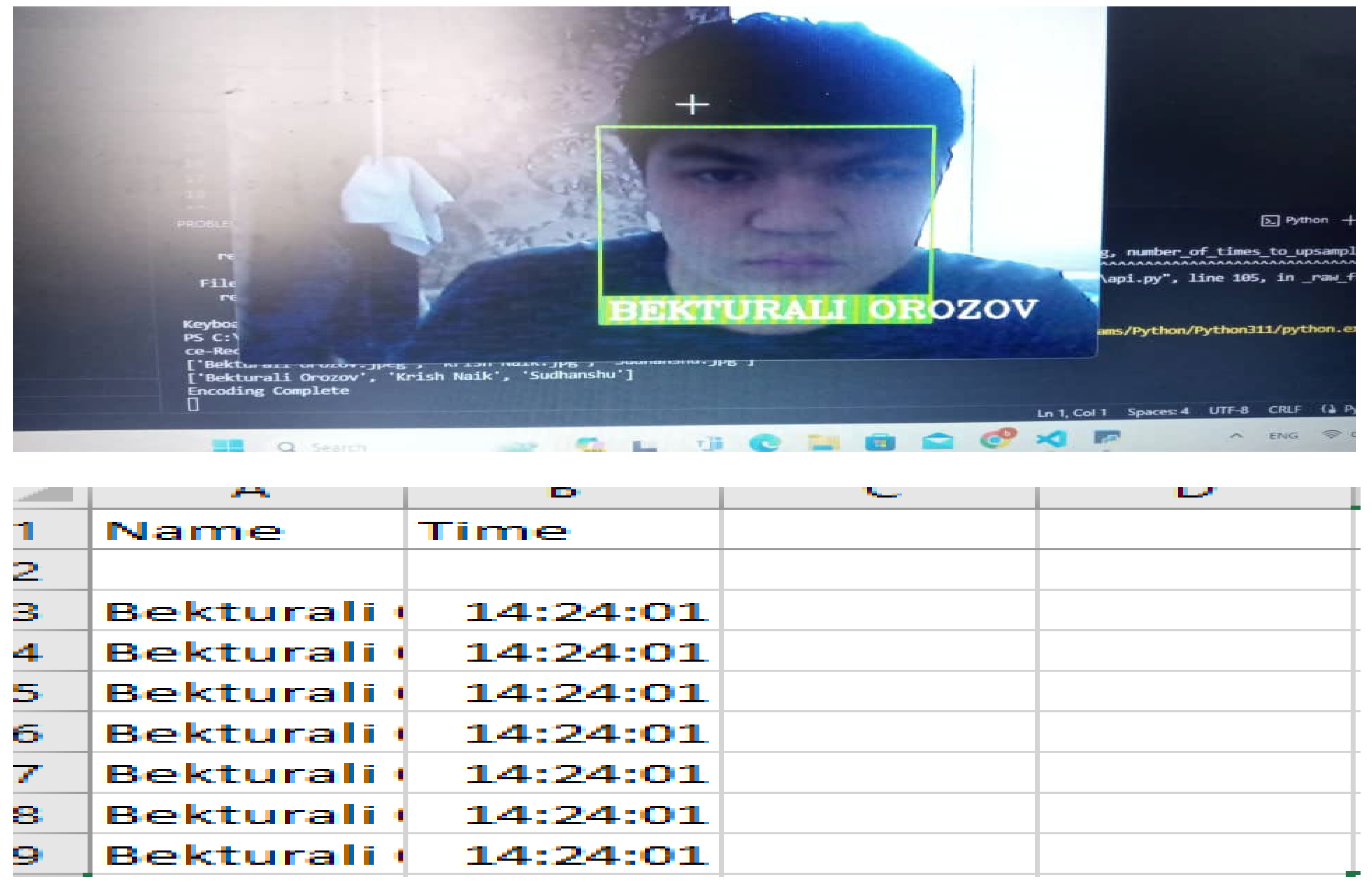
- Recording: If the verification is successful, the system records the individual's attendance status in the database.
- Save: The system saves in the excel sheet the status of the Student's attendance with the time, whether they have been present or absent.
Conclusions
References
- B. K. Mohamed and C. Raghu, "Fingerprint attendance system for classroom needs,” in India Conference (INDICON), 2012 Annual IEEE. IEEE, pp. 433-438, 2012. [CrossRef]
- K. Sun, Q. Zhao, J. Zou and X. Ma, "Attendance and security system based on building video surveillance", International Conference on Smart City and Intelligent Building, pp. 153- 162, 2018. [CrossRef]
- Lim, S. Sim, and M. Mansor, "Rfid based attendance system, " in Industrial Electronics & Applications, ISIEA,IEEE Symposium on, vol. 2. IEEE, pp. 778-782, 2009. [CrossRef]
- W. Zhao, R. Chellappa, P. J. Phillips, and A. Rosenfeld, "Face recognition: A literature survey, " Acm Computing Surveys (CSUR), vol. 35, no. 4, pp. 399-458, 2003. [CrossRef]
- Radhika C, Damale, Prof. Bageshree, V.Pathak.,“Face Recognition Based Attendance System Using Machine Learning Algorithms ", Proceedings of the Second In-ternational Conference On Intelligent Computing And Control Systems (ICICI 2018) IEEEXplore Compli-ant Part Number: CFP18K74- ART;ISBN:978-1-5386-2842-3.IEEE 2018. [CrossRef]
- Face Recognition using SURF algorithm by Roberto Morales Caporal, Federico Ramirez Cruz conf. paper 2015.
- Yusuf Perwej, Firoj Parwej, Mumdouh Mirghani Mohamed Hassan, Nikhat Akhtar, “The Internet-of-Things (IoT) Security: A Technological Perspective and Review”, International Journal of Scientific Research in Computer Science Engineering and Information Technology (IJSRCSEIT), ISSN : 2456-3307, Volume 5, Issue 1, Pages 462-482, February 2019. [CrossRef]
- Md Shafiqul, Islam, et al. "A Combined Feature Extraction Method for Automated Face Recognition in Classroom Environment", International Symposium on Signal Processing and Intelligent Recognition Systems, 2017. [CrossRef]
Disclaimer/Publisher’s Note: The statements, opinions and data contained in all publications are solely those of the individual author(s) and contributor(s) and not of MDPI and/or the editor(s). MDPI and/or the editor(s) disclaim responsibility for any injury to people or property resulting from any ideas, methods, instructions or products referred to in the content. |
© 2024 by the authors. Licensee MDPI, Basel, Switzerland. This article is an open access article distributed under the terms and conditions of the Creative Commons Attribution (CC BY) license (http://creativecommons.org/licenses/by/4.0/).


