

Submitted:
27 December 2024
Posted:
30 December 2024
You are already at the latest version
Abstract
Bioreactors are essential for the scalable production of cell-based therapies, providing controlled environments necessary for the expansion and differentiation of therapeutic cells. As demand grows for advanced treatments like CAR-T cells, tumor-infiltrating lymphocytes (TILs), and regenerative medicine, the development of cost-effective manufacturing systems that comply with stringent quality standards has become a key focus. This review explores the integration of emerging technologies such as microfluidic bioreactors, automation, and quality-by-design (QbD) frameworks in optimizing the production of CAR-T cells. It highlights recent innovations in process scalability, control, and optimization, underscoring the potential for next-generation bioreactors to revolutionize cell therapy manufacturing. By improving efficiency, consistency, and quality, these technologies are poised to play a pivotal role in advancing personalized and precision medicine.
Keywords:
bioreactors
; cell therapy
; CAR-T cells
; microfluidics
; automation
; quality-by-design
; GMP compliance
1. Introduction
Cell-based therapies, particularly CAR-T cell therapies, have emerged as transformative treatments for cancer, autoimmune diseases, and degenerative conditions. These therapies require sophisticated manufacturing processes that can meet both clinical and commercial demands, presenting challenges related to scalability, reproducibility, and stringent quality control. Bioreactors are central to addressing these challenges, providing precisely controlled environments for the expansion and differentiation of therapeutic cells. Recent advancements in bioreactor technology, including closed-system designs, real-time monitoring, and automation, have significantly enhanced manufacturing efficiency while reducing process variability. Innovations tailored to CAR-T therapy are especially crucial for ensuring the consistent production of high-quality cell-based products, marking a major milestone in the fields of regenerative medicine and immunotherapy. As the complexity of cell therapies increases, bioreactors will continue to play a vital role in enabling the widespread adoption of these personalized treatments.
2. Types of Bioreactors for Cell Therapy
2.1. Stirred-Tank Bioreactors (STRs)
Stirred-tank bioreactors are among the most widely adopted systems in biomanufacturing, prized for their scalability, versatility, and robust design. Modern STRs incorporate advanced computational fluid dynamics (CFD) to simulate flow patterns and optimize impeller configurations. These designs minimize shear forces while ensuring homogeneous mixing, critical for maintaining CAR-T cell viability and uniform growth conditions. Systems like the Ambr® 250 High Throughput have enhanced process efficiency through automation and real-time parameter monitoring, enabling precise control over critical variables such as oxygen levels, pH, and agitation rates. Additionally, single-use technologies in STRs have reduced contamination risks and increased operational flexibility, making them indispensable for CAR-T therapy production.
2.2. Hollow-Fiber Bioreactors
Hollow-fiber bioreactors feature bundles of semi-permeable membranes, creating a high surface area-to-volume ratio that supports dense cell cultures. These systems are particularly advantageous for CAR-T cell expansion and cytokine production, which require extended culture periods. Innovations include adaptive flow control mechanisms that optimize nutrient delivery and waste removal, ensuring the metabolic health of cultured cells. Advanced materials have improved membrane permeability and durability, enhancing reliability. Hollow-fiber systems are also suited for producing cell-derived products, maintaining high product concentrations essential for CAR-T applications.
2.3. Rocking-Motion Bioreactors
Rocking-motion bioreactors provide a low-shear environment ideal for sensitive cell types, such as T cells and natural killer (NK) cells. These systems rely on a wave-like motion to achieve gentle mixing and efficient gas exchange, reducing the risk of mechanical stress on cells. Recent developments have integrated advanced sensor arrays for continuous monitoring of critical parameters, including dissolved oxygen, CO2, and pH. Their scalability and ease of operation make rocking-motion bioreactors a popular choice for early-phase CAR-T cell production and small-batch applications.
2.4. Microfluidic Bioreactors
Microfluidic bioreactors represent a cutting-edge approach to miniaturized and precision-controlled biomanufacturing. These systems leverage micro-scale channels and chambers to cultivate cells under tightly regulated conditions. Innovations like the Mobius Breez have demonstrated the feasibility of producing clinical-grade CAR-T cells in as little as 2 mL of culture volume. Microfluidic platforms offer unparalleled control over factors such as nutrient gradients, shear stress, and gas exchange. Their small footprint and high level of automation make them particularly attractive for decentralized CAR-T manufacturing and personalized therapies.
3. Automated Bioreactor Systems in Cell Therapy Manufacturing
3.1. CliniMACS Prodigy (Miltenyi Biotec)
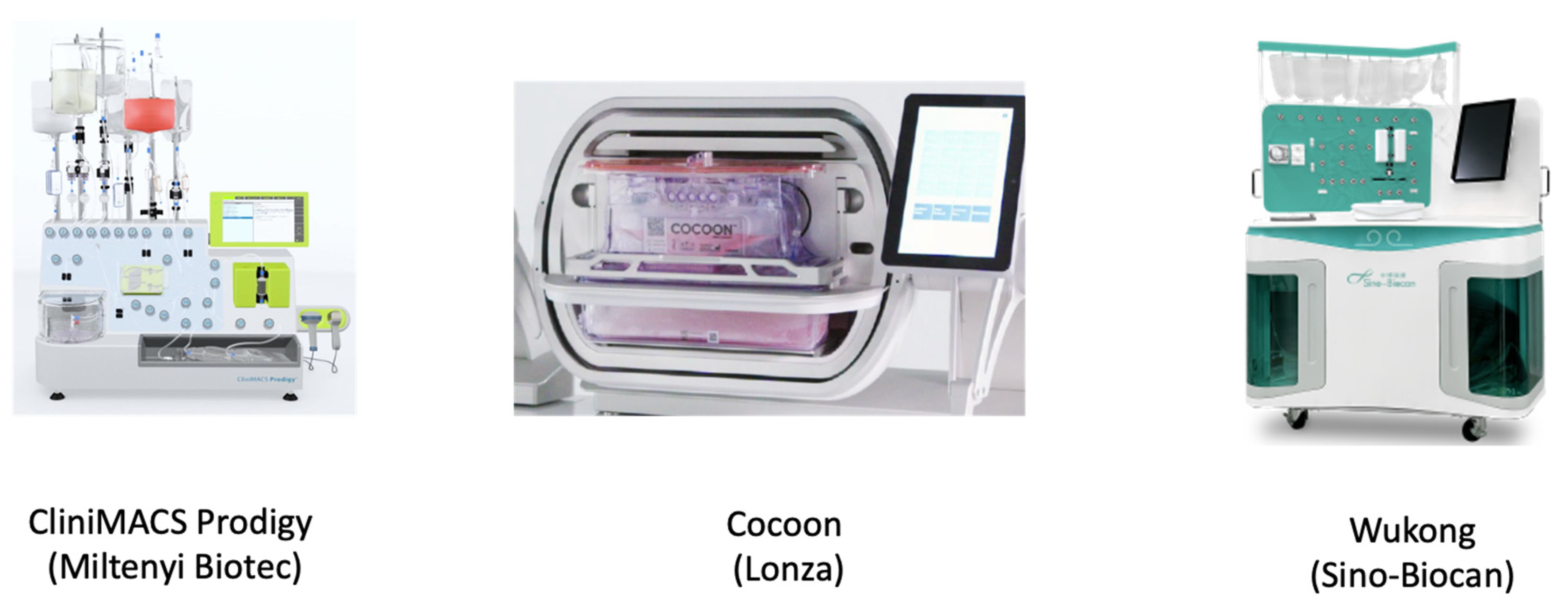
The CliniMACS Prodigy is a fully automated, closed-system bioreactor designed specifically for cell therapy manufacturing. It integrates multiple processes, including cell expansion, washing, and harvesting, into a single platform. This system is particularly well-suited for CAR-T cell production, providing a seamless workflow from cell collection to final product formulation. Key features of the CliniMACS Prodigy include the automation of the entire process, reducing manual labor and minimizing contamination risks. It automates critical steps such as cell isolation, activation, transduction, expansion, and formulation, all within a closed environment. Advanced sensors continuously monitor key parameters such as temperature, pH, oxygen, and nutrient levels, allowing for precise control over the culture environment. The system is also scalable, accommodating both small-batch clinical research and large-scale commercial production, making it highly versatile. Furthermore, its closed-system design ensures GMP compliance by minimizing manual handling and reducing cross-contamination risks.
3.2. Cocoon (Lonza)
The Cocoon is a leading automated bioreactor system used in the production of cell therapies, including CAR-T cells. It provides a fully enclosed, automated platform that covers all stages of the cell manufacturing process, from cell isolation to final product formulation. The Cocoon system automates the entire production workflow, including cell culture, transduction, expansion, and harvesting, reducing the need for manual interventions and ensuring greater consistency across production runs. Equipped with advanced sensors, it continuously monitors critical parameters like temperature, pH, and dissolved oxygen, allowing for tight control over the culture environment and ensuring optimal growth conditions for CAR-T cells. Operating within a closed-loop system, the Cocoon platform ensures a controlled, sterile environment that minimizes contamination risks and simplifies regulatory compliance. Its highly modular design allows for scalability, from small-scale clinical batches to large-scale commercial production, and its seamless integration with quality control tools enables in-line monitoring and real-time adjustments to ensure that the final product meets stringent regulatory standards.
3.3. Wukong (Sino-Biocan)
The Wukong system is an advanced, fully automated cell manufacturing platform designed to optimize the production of cellular therapies, including CAR-T cells. It offers a comprehensive solution for the entire CAR-T cell production process, integrating cell cultivation, washing, and genetic modification into one streamlined, automated system. Equipped with real-time data acquisition capabilities, the Wukong system continuously monitors key process parameters and allows for immediate adjustments to ensure optimal conditions for cell growth and expansion. It utilizes a closed-loop feedback mechanism to automatically adjust nutrient levels, temperature, and gas concentrations, maintaining ideal culture conditions throughout the production cycle. Additionally, the Wukong system is highly modular, offering scalability from preclinical studies to large-scale production while retaining flexibility to meet specific production requirements. The system is also designed to integrate seamlessly with downstream processes such as cryopreservation and product release testing, providing an end-to-end solution for CAR-T therapy production. Its closed-system design, along with advanced monitoring features, ensures the reproducibility and high quality of the final cell products.
Figure 1.
Automated bioreactor systems for CAR-T cell therapy manufacturing. (Left) CliniMACS Prodigy (Miltenyi Biotec): A fully automated, closed-system platform integrating cell isolation, activation, genetic modification, expansion, and harvesting, ensuring scalability and GMP compliance. (Middle) Cocoon (Lonza): A modular, closed-loop system that automates all stages of CAR-T production, from cell isolation to formulation, with integrated sensors for real-time monitoring. (Right) Wukong (Sino-Biocan): An advanced automated system offering end-to-end solutions for CAR-T cell manufacturing, with closed-loop control, real-time data acquisition, and seamless integration with downstream processes such as cryopreservation.
Figure 1.
Automated bioreactor systems for CAR-T cell therapy manufacturing. (Left) CliniMACS Prodigy (Miltenyi Biotec): A fully automated, closed-system platform integrating cell isolation, activation, genetic modification, expansion, and harvesting, ensuring scalability and GMP compliance. (Middle) Cocoon (Lonza): A modular, closed-loop system that automates all stages of CAR-T production, from cell isolation to formulation, with integrated sensors for real-time monitoring. (Right) Wukong (Sino-Biocan): An advanced automated system offering end-to-end solutions for CAR-T cell manufacturing, with closed-loop control, real-time data acquisition, and seamless integration with downstream processes such as cryopreservation.

| Bioreactor Type | Key Features | Advantages | Challenges | Application in CAR-T Therapy |
|---|---|---|---|---|
| Stirred-Tank Bioreactors (STRs) | - Widely adopted, scalable design- Advanced CFD to optimize flow- Single-use technologies | - Scalability for large-scale production- Robust design with high versatility | - Potential shear stress on sensitive cells- Complexity in flow optimization | - Large-scale expansion of CAR-T cells- High-throughput production |
| Hollow-Fiber Bioreactors | - High surface area-to-volume ratio- Semi-permeable membranes- Long-term culture support | - Suitable for dense cell cultures- Extended culture periods for cytokine production | - Potential for membrane clogging- Need for precise control of nutrient flow | - CAR-T cell expansion and cytokine production |
| Rocking-Motion Bioreactors | - Low-shear environment- Wave-like motion for gentle mixing- Integration with sensors | - Ideal for sensitive cells like T and NK cells- Easier for small-batch, early-phase production | - Limited scalability for large-scale production- Less efficient nutrient delivery | - Early-phase CAR-T production- Small-batch and research-scale |
| Microfluidic Bioreactors | - Miniaturized, precision-controlled- Micro-scale channels for cell cultivation | - Precise control over culture environment- Small footprint for decentralized manufacturing | - Scalability challenges for large production- Complex design and maintenance | - Personalized CAR-T therapy- Decentralized, on-demand production |
| Automated Systems (e.g., CliniMACS Prodigy, Cocoon, Wukong) | - Fully automated bioreactor platforms- Closed-loop systems for real-time monitoring and control- Integration of multiple processes (e.g., cell isolation, expansion, harvesting) | - Minimizes human intervention- Consistent and reproducible results- Scalable from clinical to commercial production | - High initial cost- Complexity in setup and maintenance- Potential for system malfunctions | - End-to-end CAR-T production (from collection to final product)- High consistency and GMP compliance- Suitable for both small-scale and large-scale production |
4. Recent Advances in Bioreactor Technologies
4.1. Automation and Process Control
Automation is transforming CAR-T manufacturing by incorporating advanced technologies such as artificial intelligence (AI), machine learning, and sensor-based systems. These enable predictive adjustments and adaptive control of bioprocesses, optimizing parameters like oxygen levels, nutrient supply, and pH in real-time. Robotics for sampling and monitoring has further reduced manual interventions, enhancing reproducibility and minimizing contamination risks. Notable advancements include closed-loop systems that autonomously adjust culture conditions based on continuous feedback, thereby increasing scalability and reducing variability in CAR-T production.
4.2. Quality-by-Design (QbD) Approaches
The QbD framework is a systematic methodology that enhances process understanding by linking critical process parameters (CPPs) to critical quality attributes (CQAs). This approach uses design of experiments (DOE) to evaluate and optimize factors such as activation protocols, seeding densities, nutrient concentrations, and agitation speeds. QbD ensures consistent CAR-T cell yield and therapeutic efficacy while meeting stringent regulatory requirements. AI-driven analytics further enhance the robustness and scalability of QbD workflows in CAR-T manufacturing.
4.3. Modularity and Scalability
Modular systems represent a significant advancement, allowing flexible scaling from research to clinical CAR-T production. These systems consist of interchangeable components, such as culture vessels and sensors, configured to suit specific production needs. Single-use technologies in modular setups enhance GMP compliance and simplify operational logistics by reducing cleaning and validation requirements. The development of modular platforms compatible with advanced automation enables seamless scaling while maintaining consistent CAR-T product quality across different production scales.
5. Challenges in Bioreactor-Based CAR-T Manufacturing
5.1. Process Variability
Variability in starting materials, such as patient-derived cells, and manual processes often lead to inconsistencies in CAR-T product quality and yield. Donor material heterogeneity introduces variability in cell proliferation rates, metabolic activity, and phenotypic stability. Automated systems with advanced real-time monitoring and control mechanisms address these challenges by enabling precise adjustments to culture conditions, ensuring consistency across production batches. AI and machine learning algorithms further enhance process predictability and robustness in CAR-T manufacturing.
5.2. Optimization for Diverse Cell Types
Cellular heterogeneity across CAR-T therapy applications necessitates highly specialized bioreactor designs and protocols. For instance, shear sensitivity varies significantly between CAR-T cells and other therapeutic cell types. Advances in CFD modeling optimize shear stress profiles and nutrient gradients within bioreactors, minimizing cellular damage while maximizing viability. The QbD approach tailors CPPs to specific metabolic needs and growth characteristics of CAR-T cells, enhancing production efficiency and therapeutic outcomes.
5.3. Integration with Downstream Processes
Integrating bioreactors with downstream processes such as cell harvesting, cryopreservation, and quality control is a significant challenge. These steps require maintaining sterility and minimizing cell loss, often difficult in traditional open systems. Recent closed-loop manufacturing platforms incorporate automated workflows linking upstream CAR-T production with downstream analytics, enabling real-time quality assurance. Innovative bioreactor designs now support direct connection to cryopreservation units and inline characterization tools, reducing contamination risks and improving efficiency.
6. Future Perspectives
Emerging technologies, such as digital twin modeling, create virtual replicas of bioprocesses for real-time monitoring and optimization. These models enable predictive simulations of process dynamics, allowing proactive adjustments to enhance efficiency, reduce errors, and minimize resource usage. Innovations in microfluidic bioreactors continue to reshape CAR-T precision manufacturing, integrating micro-scale channels and sensors to offer unparalleled control over critical parameters, ensuring high-throughput personalized therapy production.
Decentralized, point-of-care manufacturing units bring production capabilities closer to patients, reducing logistical challenges. These units use modular bioreactor platforms and single-use technologies to produce CAR-T therapies on-demand, significantly lowering costs and turnaround times while maintaining GMP compliance.
To fully realize these advancements, interdisciplinary collaboration across bioengineering, computational modeling, and regulatory science is essential. Addressing challenges, such as downstream process integration and regulatory compliance, ensures bioreactors meet the demands of next-generation CAR-T therapies. By embracing innovations, bioreactors will remain at the forefront of regenerative medicine and immunotherapy advancements.
7. Conclusions
Bioreactors are central to scalable and efficient CAR-T production, advancing regenerative medicine and immunotherapy. They provide precise control over parameters required for therapeutic cell expansion and differentiation. Technological advancements, including QbD frameworks, automation, and microfluidic platforms, address challenges in consistency, scalability, and regulatory compliance. However, the rapid evolution of CAR-T therapies necessitates ongoing innovation in bioreactor design and operation.
Integrating AI for predictive modeling, digital twin simulations for real-time optimization, and closed-loop control systems for process standardization will overcome current limitations. These innovations, coupled with interdisciplinary collaboration, ensure bioreactors meet the demands of complex CAR-T applications.
Decentralizing manufacturing with modular, point-of-care systems democratizes access to personalized therapies, reducing costs and increasing global reach. By addressing current and emerging challenges, bioreactors remain pivotal in shaping the future of CAR-T medicine, ensuring their role as a cornerstone of therapeutic innovation.
Funding
This work was funded by the subsidy allocated to Kazan Federal University for the state assignment in the sphere of scientific activities (project number FZSM-2022-0016).
Conflicts of Interest
The authors declare no conflicts of interest.
References
- Ganeeva, I.; Zmievskaya, E.; Valiullina, A.; Kudriaeva, A.; Miftakhova, R.; Rybalov, A.; Bulatov, E. Recent Advances in the Development of Bioreactors for Manufacturing of Adoptive Cell Immunotherapies. Bioengineering 2022, 9(12), 808. [Google Scholar] [CrossRef] [PubMed]
- Atanasova, G.G.; Micheletti, M.; Ducci, A. Fluid Flow and Mixing in a Novel Intermittently Rotating Bioreactor for CAR-T Cell Therapy Manufacturing. Chemical Engineering Science 2023, 281, 119175. [Google Scholar] [CrossRef]
- Hulme, C.H.; Mennan, C.; McCarthy, H.S.; Davies, R.; Lan, T.; Rix, L.; Perry, J.; Wright, K. A Comprehensive Review of Quantum Bioreactor Cell Manufacture: Research and Clinical Applications. Cytotherapy 2023, 25(10), 1017–1026. [Google Scholar] [CrossRef] [PubMed]
- Iurashev, D.; Jones, P.A.; Andreev, N.; Wang, Y.; Iwata-Kajihara, T.; Kraus, B.; Hernandez Bort, J.A. Scaling Strategy for Cell and Gene Therapy Bioreactors Based on Turbulent Parameters. Biotechnology Journal 2024, 19(1), 2300235. [Google Scholar] [CrossRef]
- Hood, T.; Slingsby, F.; Sandner, V.; Geis, W.; Schmidberger, T.; Bevan, N.; Vicard, Q.; Hengst, J.; Springuel, P.; Dianat, N.; Rafiq, Q.A. A Quality-by-Design Approach to Improve Process Understanding and Optimise the Production and Quality of CAR-T Cells in Automated Stirred-Tank Bioreactors. Frontiers in Immunology 2024, 15, 1335932. [Google Scholar] [CrossRef] [PubMed]
Disclaimer/Publisher’s Note: The statements, opinions and data contained in all publications are solely those of the individual author(s) and contributor(s) and not of MDPI and/or the editor(s). MDPI and/or the editor(s) disclaim responsibility for any injury to people or property resulting from any ideas, methods, instructions or products referred to in the content. |
© 2024 by the authors. Licensee MDPI, Basel, Switzerland. This article is an open access article distributed under the terms and conditions of the Creative Commons Attribution (CC BY) license (http://creativecommons.org/licenses/by/4.0/).
Copyright: This open access article is published under a Creative Commons CC BY 4.0 license, which permit the free download, distribution, and reuse, provided that the author and preprint are cited in any reuse.