Preprint
Article

This version is not peer-reviewed.

Machine Learning-Based Damage Diagnosis in Floating Wind Turbines Using Vibration Signals: A Lab-Scale Study Under Different Wind Speeds and Directions

A peer-reviewed article of this preprint also exists.

Submitted:

25 December 2024

Posted:

26 December 2024

You are already at the latest version

Abstract

Floating wind turbines (FWTs) operate in offshore environments under harsh and varying operating conditions, making frequent in situ monitoring dangerous for the maintenance teams and costly for operators. The remote and automated diagnosis including the stages of detection, identification and severity characterization of early-stage damages in FWTs through advanced vibration-based SHM methods of Machine Learning (ML) type is evidently critical for timely repairs extending their operational lifecycle, reducing maintenance costs, and enhancing safety. This study investigates for the first time the complete (all stages) diagnosis problem by employing well-established ML SHM methods and conducting hundreds of experiments on a lab-scale FWT model operating under different wind speeds and directions, both in healthy and damaged states. The latter include two distinct blade cracks of limited-length, two added masses on the blade edge simulating potential ice accumulation and connection degradation at the mounting of the main tower with the floater. The results indicate that the proper training of advanced ML methods using damage-sensitive feature vectors that represent the structural dynamics within the entire frequency bandwidth of measurements may achieve flawless damage diagnosis, reaching 100% success at all diagnosis stages, even when only minimal number of vibration signals from a limited number of sensors (a single sensor in this study) are used.

Keywords: 
;  ;  ;  ;  

1. Introduction

Offshore wind energy plays a crucial role in the global transition to renewable energy sources, with Floating Wind Turbines (FWTs) rendering a key technology to harness wind energy in open waters. FWTs offer access to high-wind regions located in deeper seas, enabling the tapping of stronger, more consistent wind resources, which help scale up offshore wind energy production while also reducing visual and environmental impacts near coastal areas. However, in these offshore areas the FWTs operate under harsh and complex environmental conditions including strong winds, high wave loading, corrosion, continuous cyclic loading and fluctuating temperature. These factors pose significant challenges to the safe and efficient operation of these structures, increasing the risk of structural degradation and damage to critical components, such as rotating parts, foundations, and mooring lines, which could affect the FWT’s stability. This highly dangerous condition may lead to catastrophic consequences or even the total loss of the asset over time [1]. Thus, it is evident that the detection of early-stage damage using Structural Health Monitoring (SHM) technology is vital for timely interventions that prevent damage from propagating into total failure. Moreover, in offshore environments, where accessibility is limited and repairs by maintenance teams are costly, demanding and dangerous, remote and automated SHM provides the capability for predictive maintenance, helping to reduce unplanned downtime and extend the operating lifespan of such structures. Overall, a well-designed SHM system on FWTs may enhance safety, ensure proper operation, and enable predictive maintenance, with the latter two being essential for maximizing energy production while minimizing costs.
Among the various SHM techniques, vibration-based SHM has gained significant attention for its effectiveness in monitoring the dynamic behavior of a wide variety of structures. This technology is highly applicable, cost-effective, and capable of providing continuous, real-time, monitoring. With the availability of high-quality, affordable sensors, large structural areas can be monitored with minimal equipment, making vibration-based SHM both practical and efficient. The core principle is that damages (e.g. cracks, joint loosening) induce changes in the structural dynamics by altering stiffness, mass distribution and/or damping properties, which in turn affect the measurable vibration response of the structure [2,3]. The main challenge arises from the complex and varying Environmental and Operating Conditions (EOCs) that significantly affect the vibration signals used by an SHM system. Differentiating between signal changes caused by damage and those induced by varying EOCs is particularly challenging, especially for early-stage damage, where the subtle effects of damage can be easily masked by these variations. The ability to accurately differentiate the effects of varying EOCs from those caused by damage is critical for reducing false alarms, thus improving the reliability of the SHM system. Robust diagnostic methods are needed to handle this problem, ensuring that the system can operate autonomously with minimal false positives [4].
Data-driven vibration-based SHM methods are among the most widely utilized and have demonstrated high efficiency in diagnosing various types of damages in onshore and fixed bottom offshore WTs operating under varying EOCs. By employing signal processing techniques, appropriate time and/or frequency domain features are extracted from the obtained signals to form damage-sensitive feature vectors. These vectors are then used to train Machine Learning (ML) algorithms, such as decision trees, Artificial Neural Networks (ANNs), k-Nearest Neighbors (k-NN), or Support Vector Machines (SVM) [5,6,7]. Moreover, features as the above may be further processed using dimensionality reduction techniques, such as Principal Component Analysis (PCA), where components that exhibit variability under a constant health state of the structure are discarded, assuming they are associated with the varying EOCs, while the remaining components are used for damage diagnosis [8,9,10]. The above methods have been effectively applied in diagnosing various levels of blade cracks [6,7,8,9,10], added mass on the blades [5], blade erosion, and connection degradation [6,7], under varying temperatures, wind conditions, and rotational speeds. However, the effective application of most of the above methods requires a substantial volume of data for their training, collected from numerous sensors under varying EOCs, as well as the tuning of a significant number of hyperparameters.
Alternatively, data-driven approaches which are based on stochastic (data-based) parametric models, such as AutoRegressive (AR) models [11,12], Linear Parameter Varying AutoRegressive (LPV-AR) models, and Functional Series Time-dependent AutoRegressive (FS-TAR) models [13], have been shown to provide robust damage diagnosis in the blades and tower of onshore wind turbines under varying temperature and wind conditions. Within these approaches damage diagnosis is based on proper statistical testing using the model parameters or residuals as features, while their assessment has been performed either via numerical simulations [13] or with experiments in the case of blade crack diagnosis [11,12]. Another approach that is based on the identification of physics-motivated stochastic subspace models, achieve the detection of various undesired conditions such as mechanical looseness between the pile and the tower, fouling, scouring, and structural inclination in a lab-scale monopile wind turbine operating under varying external forces implemented through the stochastic excitation from a electromagnetic shaker [26]. Similarly, simulating varying wind speeds via a shaker producing white noise of different amplitudes, different levels of crack damage have been successfully identified in the jacket foundation of a lab-scale monopile WT using k-NN and SVM classifiers, as reported in [27].
On the other hand, the damage diagnosis problem for FWTs poses more challenges compared to the onshore and fixed bottom WTs due to their floating setup that introduce additional uncertainty. Existing research on FWTs under varying EOCs primarily focuses on SHM of mooring systems, with a greater emphasis on mooring lines. Recent studies have predominantly addressed the detection, identification and quantification of stiffness degradation in such lines [17,18,19,20,21,22], the assessment of biofouling level [23], and the evaluation of fatigue damage [24] in mooring lines utilizing data-driven approaches. These include Neural Networks [20,21], fuzzy logic [19], deep neural networks [23], as well as hybrid approaches integrating physics-based models in state space with data driven k-NN method [22] . Furthermore, data-driven methods using Vector AutoRegressive (VAR) [21] or Transmittance Function Autoregressive with exogenous input (TF-ARX) models [25], have also been explored. However, in all of the above studies, the methods employed have been assessed through simulations with numerical models that implement damage into the mooring lines via stiffness degradation, while the diagnosis of early-stage damages in other FWT components under varying EOCs has not been addressed.
The goal of the present study is the experimental investigation and comparative assessment of vibration-based ML SHM methods that could be incorporated into an SHM system for robust diagnosis achieving from initial damage detection to type identification, and finally severity characterization with emphasis on early-stage damages. The methods’ performance and comparison are assessed through hundreds of experiments with a lab-scale FWT model, which rotates normally under varying wind speeds and directions in healthy and damaged state. The latter include three different types of subtle, early-stage damages, whose effects on the observed dynamics are almost fully masked by those induced by the varying wind conditions. More specifically, two distinct blade cracks of limited-length, two different small added masses on the blade edge simulating potential ice accumulation, and connection degradation at the mounting of the main tower with the floater are the five damage scenarios which are investigated in the study. All employed SHM methods operate using vibration signals from a single accelerometer, and their performance is investigated using damage-sensitive feature vectors that represent the structural dynamics taking into account the whole considered frequency bandwidth, rather than just static features such as the signal’s peak, RMS, and so on. The feature vectors arise from data-driven, non-parametric, and parametric stochastic modelling of the FWT dynamics through Welch-based Power Spectral Density (PSD) estimates and estimation of the model parameters from multiple AutoRegressive (AR) models, respectively. Based on these vectors, two versions of an unsupervised Multiple Model (MM) method [28], which has been demonstrated excellent performance in FWT diagnosis [33], are initially used for damage detection. Once a damage is detected, two versions of its supervised form, and corresponding versions of a supervised k-NN based method [29] and an SVM based method [30] are employed in the same framework for robust damage type identification and severity characterization.
The damage detection results of the study are presented via scatter type plots of the methods’ similarity distance metric and Receiver Operating Characteristic (ROC) curves indicating the True Positive Rate (TPR) against the False Positive Rate (FPR) [31], while confusion matrices [32] are used for damage type and severity characterization results.
It is noted that preliminary results from this study have been presented in our conference paper [33], where the diagnosis is limited to damage detection and identification. Two additional damage scenarios (a second smaller blade crack and a smaller added mass) that lead to a higher number of experiments are also considered in this study, for the examination of the methods’ diagnostic limits, as well as for damage severity characterization, which is not investigated at all in the previous study. Furthermore, an SVM classifier combined with Bayesian optimization-based method is also included in the robust diagnosis framework of the present study, while the investigation and comparison of all method’s performance using two global dynamics feature vectors, the PSD and the AR model parameters are insightful additions.
The rest of this paper is organized as follows: The precise problem statement is presented in Section 2, and the experimental procedure is comprehensively described in Section 3. In Section 4 the ML type methods for robust diagnosis are presented, while their assessment and comparison are included in Section 5. Finally, a discussion on the results is presented in Section 6, followed by the final conclusions in Section 7.

2. Precise Problem Statement

The methods training and normal operation requirements and assumptions for damage diagnosis are addressed in this study through their three main stages: (i) the damage detection, (ii) the damage type identification, and (iii) the damage severity characterization. Initially, let’s assume that the FWT operates under (almost) constanct varying wind conditions (speed and direction in this study) throughout each batch of measurements during data acquisition. Based on this, the detailed description of each diagnosis stage follows:
Stage 1: Damage Detection
The problem of vibration-based damage detection is treated in an unsupervised manner as follows:
Given a set of n random vibration signals – y i [ t ] with i = 1 , , n and t = 1 , , N , where t represents normalized discrete time with respect to the sampling period, and N is the signal length in samples – acquired from the FWT operating under healthy state and wind conditions in the range of interest, the methods training is performed.
Determine whether the current state of the FWT is healthy or damaged using a new random vibration signal y u [ t ] from an unknown FWT health state and wind condition.
Stage 2: Damage Type Identification
Once a damage is detected, the second stage of the damage diagnosis procedure includes damage type identification. This problem is addressed in a supervised manner as follows:
Given a set of n (not necessarily equal to those used in Stage 1) random vibration signals y i , j [ t ] with j = 1 , , m indicating a different type of damage, the methods training is performed. As in Stage 1, this dataset includes measurements under the considered wind conditions.
Determine the type of the detected damage using the random vibration signal y u [ t ] (subscript “u” indicates unknown), which has been confirmed in Stage 1 that is originated from a damaged FWT health state.
Stage 3: Damage Severity Characterization
Once the damage type has been identified in the previous diagnosis stage, the objective of this stage is to characterize the severity of the damage in a supervised manner as follows:
Given a set of n (not necessarily equal to those used in the previous stages) random vibration signals y i , j , z [ t ] with z = 1 , , l , indicating the different levels of severity investigated for each considered damage type, the methods training is performed. As in the previous stages these measurements have been conducted in the considered range of wind conditions.
Determine the severity of the damage using the random vibration signal y u [ t ] which, based on Stage 2, is already known to correspond to a specific damage of the considered types.

3. The Experimental Procedure

3.1. The Floating Wind Turbine (FWT) Lab-Scale Model

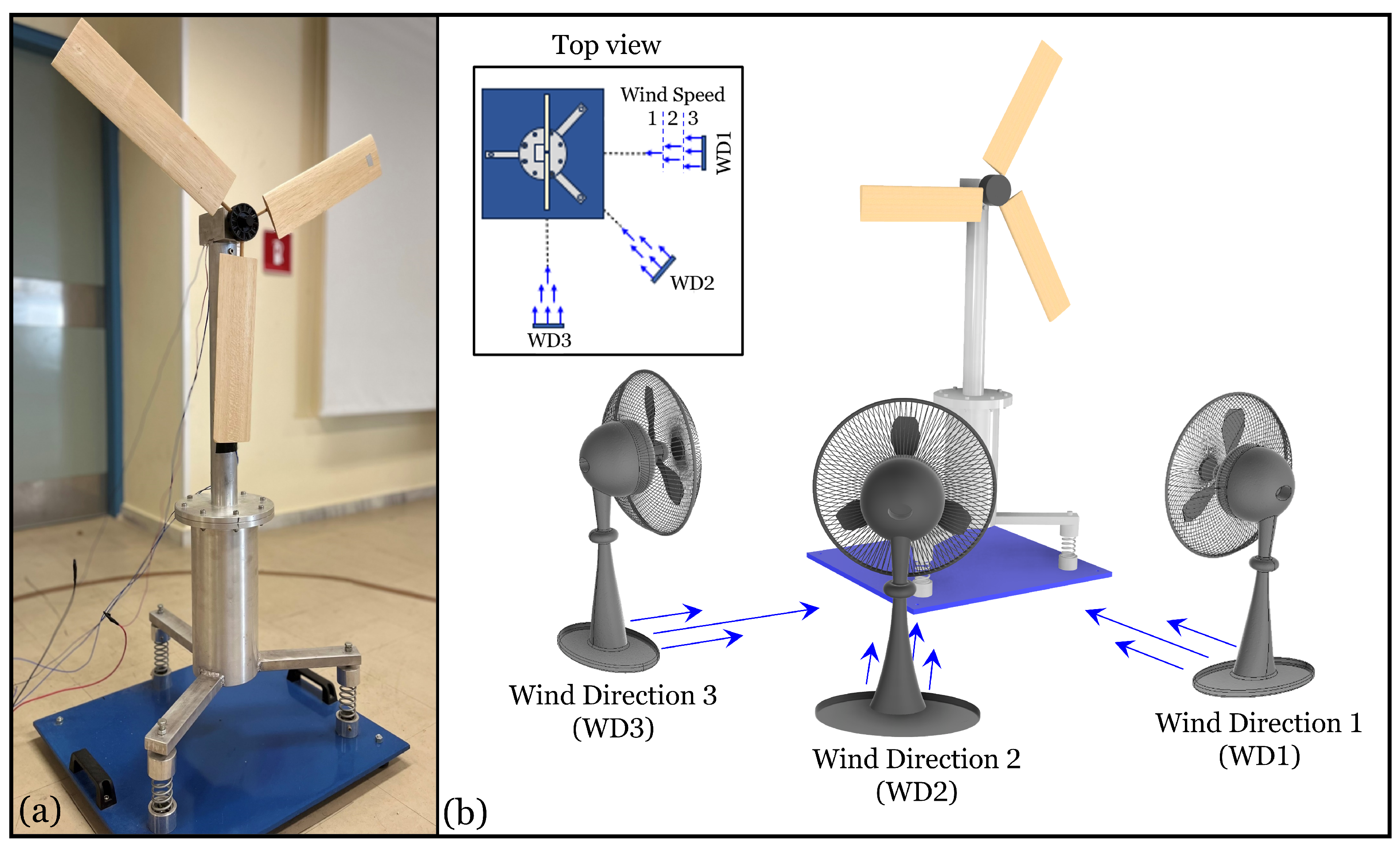
The lab-scale FWT model is shown in Figure 1(a). This has been conceptualized and designed at the University of Patras and constructed by the company “Alphamach.gr”. It comprises several integral components: the central tower, the rotor, the blades, a tension leg platform (commonly referred to as the floater), a base plate, and three springs. The tower accommodates the rotor, which is affixed to the blades, and is secured at its lower section to the platform via bolted connections. The base plate and three springs simulate the FWT’s motion, with the constraints from its mounting to the sea bottom through typical mooring lines. The FWT model is normally rotating under nine distinct operating conditions, derived from three different wind speeds (WS1, WS2, WS3) and three wind directions (WD1, WD2, WD3). These operational conditions are achieved by adjusting both the rotational velocity and the direction of a fan, relative to the FWT model, as depicted in Figure 1(b).

3.2. The Early-Stage Damage Scenarios

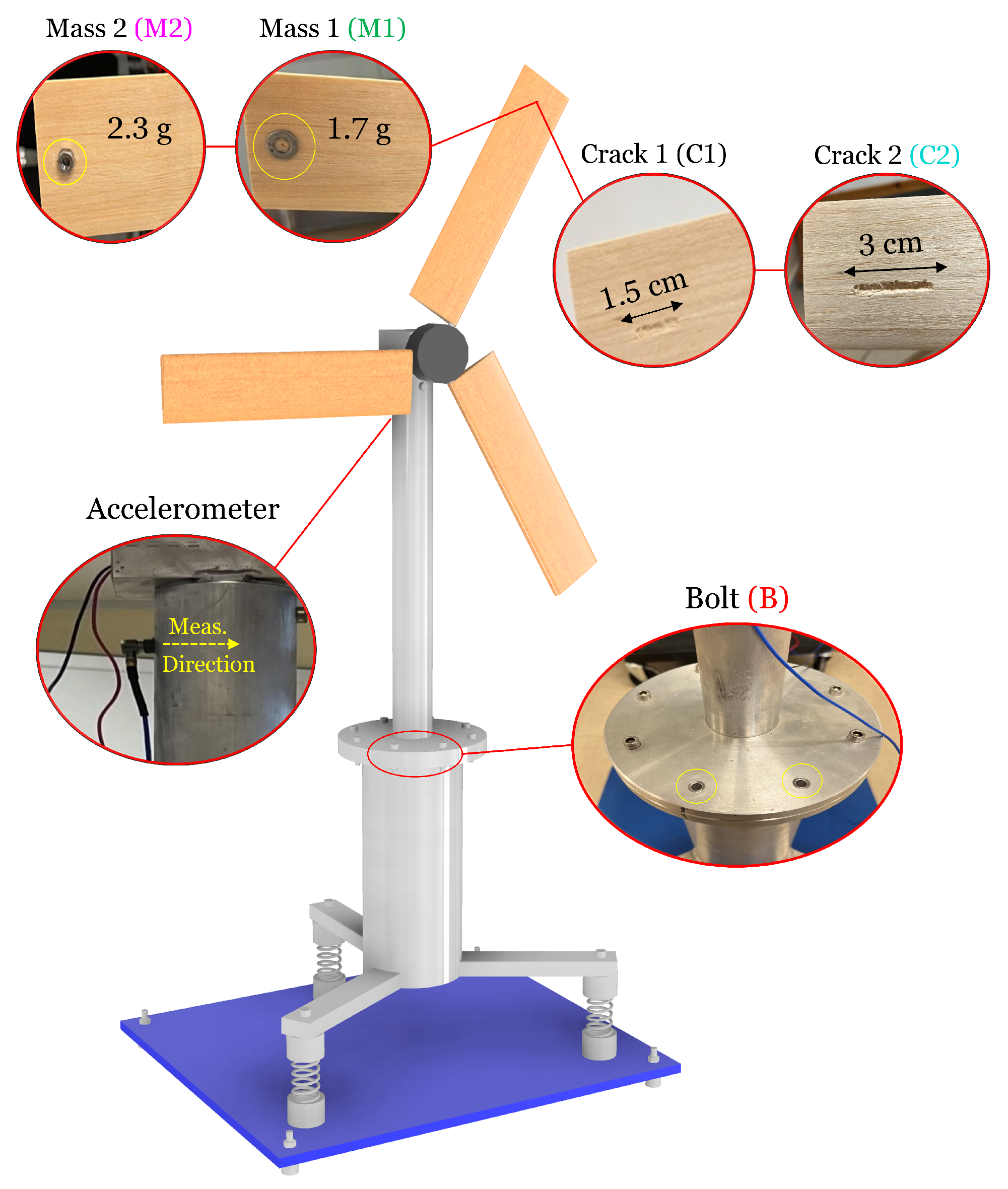
Five different damage scenarios are investigated in this study derived from three different types of early-stage damage. These include one scenario of connection degradation between the tower and floater implemented by removing two of the eight mounting bolts, two scenarios of blade crack, and two scenarios of added mass simulating potential ice accumulation. The last four scenarios have been separately implemented to a single blade with the two blade crack scenarios ( C 1 and C 2 ) to be implemented last due to their irreversibility. All damage scenarios along with their abbreviations are depicted in Figure 2 and described in more detail below:
  • Connection degradation between the tower and floater designated as ‘B
  • Added Mass 1 (m = 1.7 g), designated as ‘ M 1
  • Added Mass 2 (m = 2.3 g), designated as ‘ M 2
  • Blade Crack 1 (L = 1.5 cm, 4% of the total blade length), designated as ‘ C 1
  • Blade Crack 2 (L = 3 cm, 8% of the total blade length), designated as ‘ C 2 ’.

3.3. The Vibration Signals

All vibration signals are obtained using a single uniaxial lightweight accelerometer mounted on the upper part of the tower as shown in Figure 2 with a sampling frequency of f s = 1024 Hz (see details in Table 1). The data acquisition procedure has been initially performed for the healthy FWT model under the minimum wind speed (WS1) and direction WD1. Ten vibration signals, each consisting of 30 720 samples (or 30 seconds long), are collected. Then the wind speed is increased to WS2, and another set of 10 signals is collected. This procedure is repeated for the highest wind speed, WS3, as well. The same measurements are performed for wind directions WD2 and WD3, resulting in a total of 90 vibration signals for the healthy FWT. The same procedure is carried out for each early-stage damage scenario. Thus, 90 vibration signals are collected per FWT health state, leading thus to a total of 540 vibration signals (Table 1) for training and assessing the ML SHM methods.
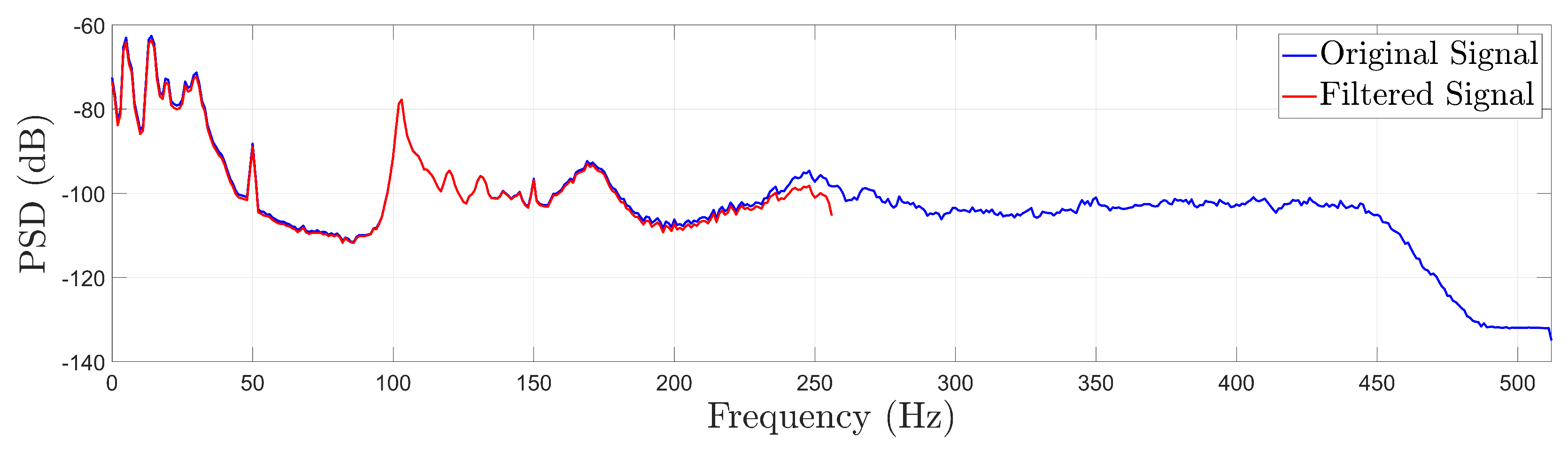
Following data acquisition, a 4th-order low-pass Chebyshev Type I filter with a cut-off frequency of 256 Hz and a ripple of 0.5 dB is applied to all vibration signals (Matlab function:  filtfilt . m ). This signal pre-processing has been decided based on the fact that the frequency content of the signals above 256 Hz is not information-rich as shown in the Welch-based PSD estimate [35] (p. 186) presented in Figure 3; Welch method parameters: Hamming window of 512 samples length, 90 % overlap, frequency resolution δ f = 1 Hz. Then, all signals are resampled to the new sample frequency of f s = 512 Hz as shown in Figure 3.

3.3.1. Effects of the Varying Wind Condition and Early-Stage Damages on the Vibration Signals

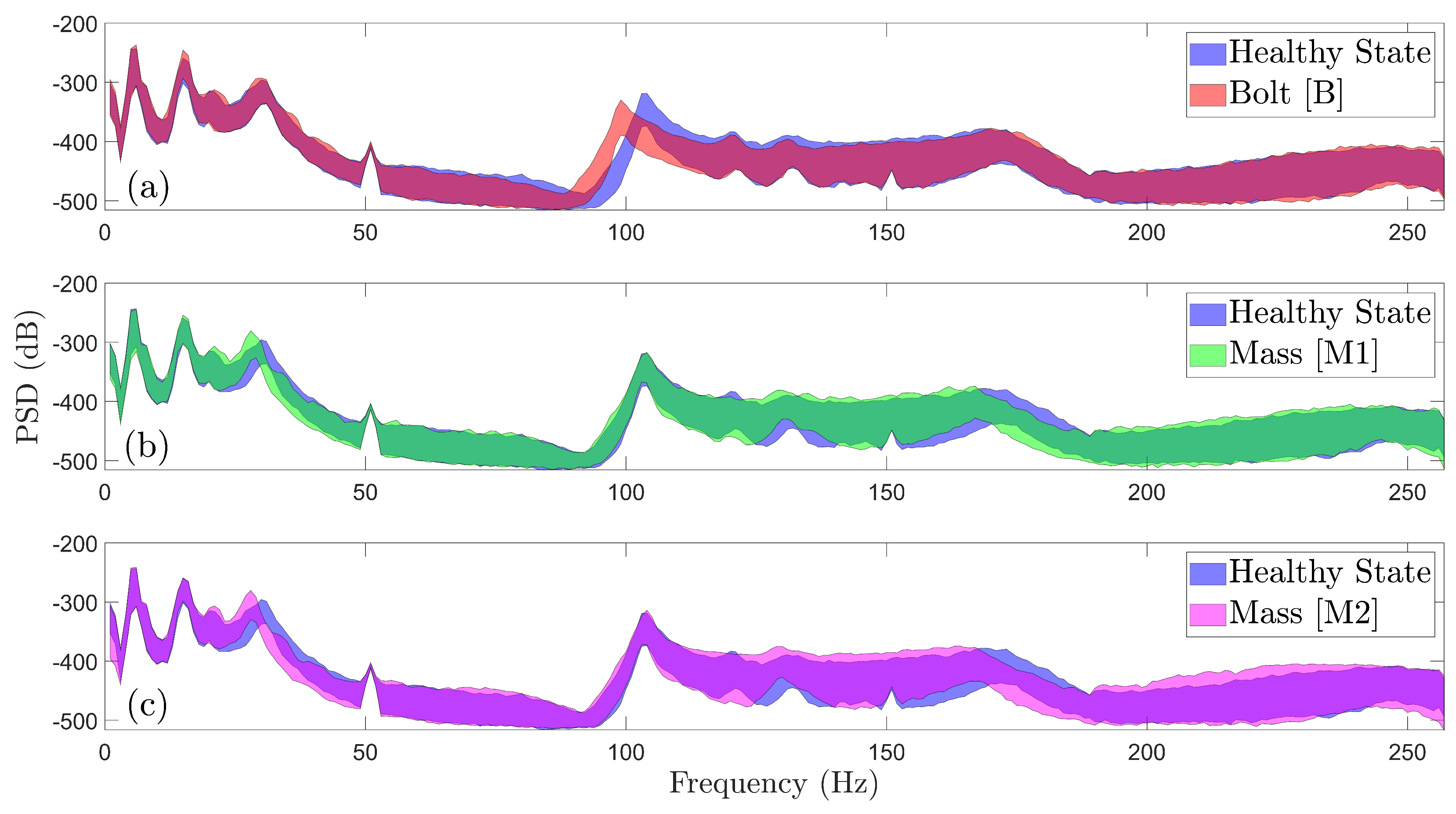
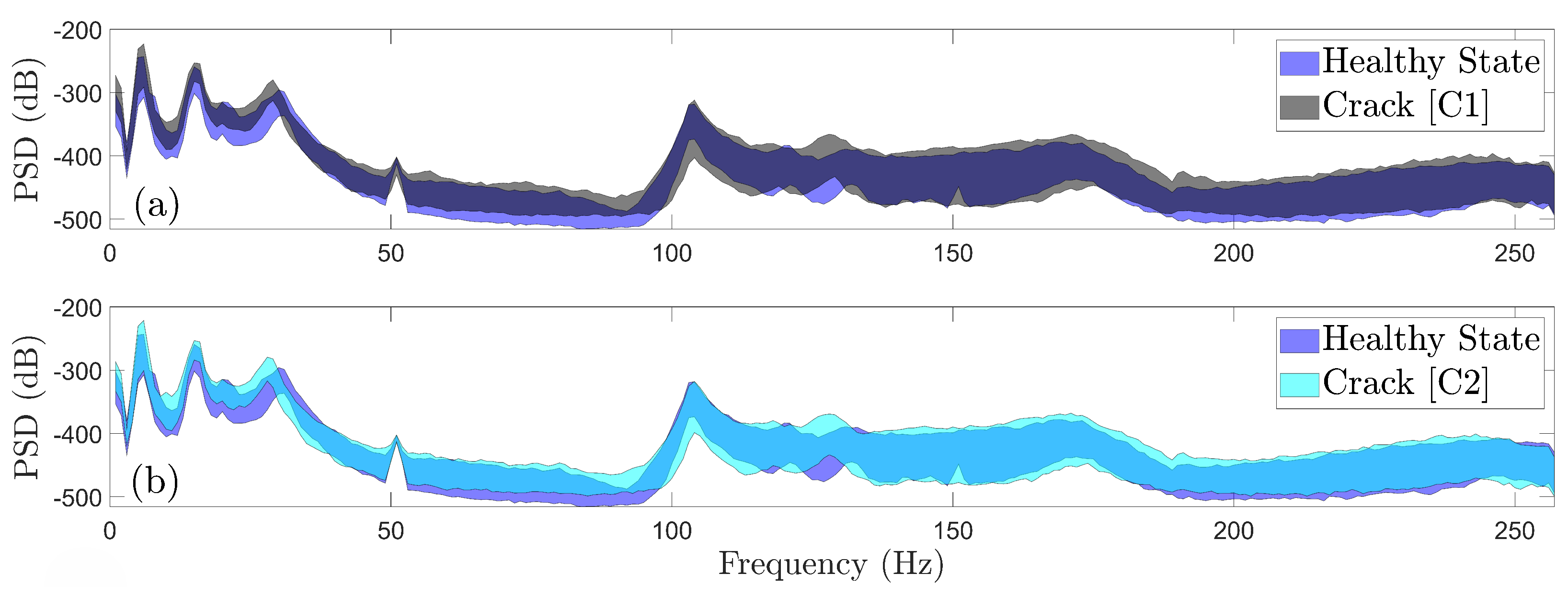
In this subsection the effects of the considered wind conditions, including both variations in speed and wind direction, as well as those due to the various early-stage damage scenarios on the vibration signals are explored. In particular, these effects are examined in the frequency domain by constructing spectrum zones (envelopes) using Welch-based PSD estimates obtained using a Hamming window of 512 samples length and overlap of 90 % leading thus to a frequency resolution of δ f = 1 Hz. These envelopes are derived from the 90 vibration signals per health state, including all combinations of wind speeds and directions (see Table 1), and for better clarity are depicted in Figure 4 and Figure 5.
In these figures, the healthy state is depicted in blue, while red, green, magenta, black, and teal correspond to the B, M 1 , M 2 , C 1 , and C 2 damage scenarios, respectively. A substantial overlap between the PSD envelopes of the healthy and damaged states is observed throughout most of the frequency range. This overlap arises from changes in the FWT dynamics due to varying wind conditions, which significantly affect the vibration signals and dominate the spectral characteristics, rendering thus accurate damage detection highly challenging.
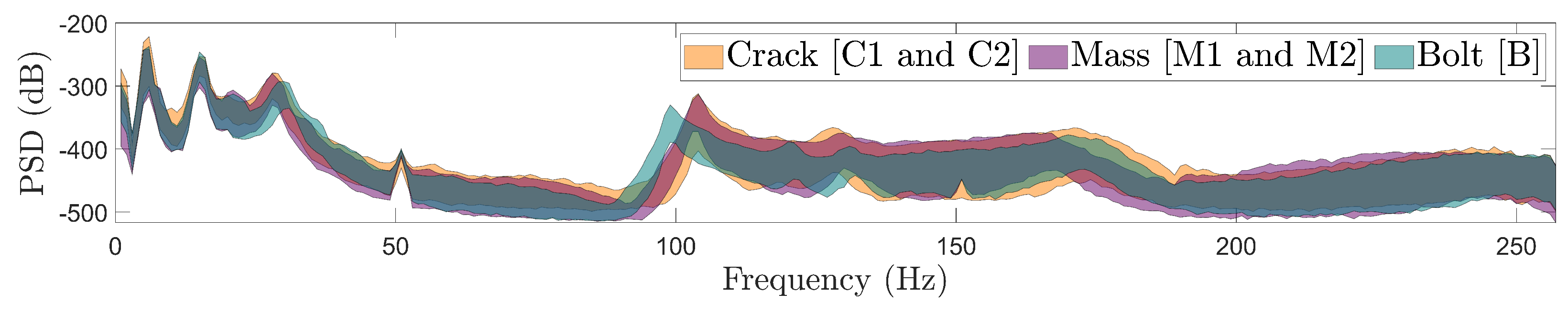
Additionally, the complexity of the damage type identification problem is demonstrated through the PSD envelopes depicted in Figure 6. These envelopes are derived from the 90 vibration signals corresponding to damage scenario B and the 180 vibration signals from the mass addition (M1 & M2), and cracks (C1 & C2) scenarios, including all considered wind speeds and directions. Evidently, there is a pronounced overlap between the PSD envelopes of the various damage scenarios throughout most of the frequency range indicating a challenging damage type identification problem.
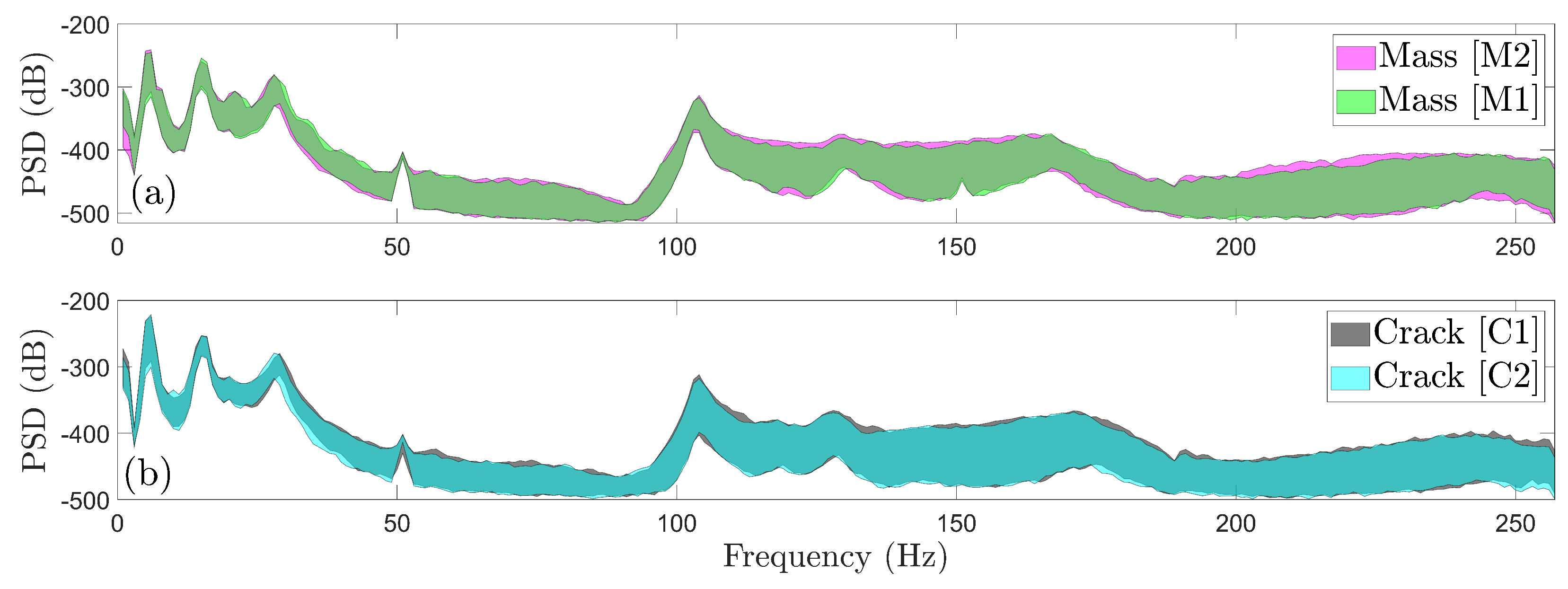
Finally, Figure 7 illustrates the PSD envelopes derived from the 90 vibration signals corresponding to the same damage type but different damage severity. The PSD envelopes for different severity levels are nearly indistinguishable for both (a) Mass and (b) Crack damage types. This similarity further highlights the significant difficulty in accurately characterizing damage severity under varying wind conditions.

4. The Machine Learning Methods for Robust Damage Diagnosis

Each ML method employed for robust damage diagnosis belongs to the data-driven class and operate in two phases per stage of diagnosis (see Section 2). The first phase, typically called the Baseline Phase, includes the training of the method using vibration signals from known EOCs and health states of the structure, while the second, the Inspection Phase is performed continuously in real time or periodically depending on the needs during the FWT operation. Furthermore, the performance of each ML method is assessed at each diagnosis stage using two different damage-sensitive feature vectors representing the structural dynamics within the entire considered frequency bandwidth. One feature vector includes Welch-based PSD estimates, and the other the parameters of AutoRegressive (AR) models obtained through standard identification procedures as described in the next subsection. In this context, damage detection (Diagnosis Stage 1) is pursued unsupervised using the U-MM-AR and U-MM-PSD methods, while damage type identification (Diagnosis Stage 2) and Severity Characterization (Diagnosis Stage 3) are conducted supervised via the S-MM-AR, S-MM-PSD, k-NN-AR, k-NN-PSD, SVM-AR, and SVM-PSD methods; ’U’ and ’S’ designate unsupervised and supervised methods, respectively.

4.1. Stage 1: Multiple Model (MM) Based Robust Damage Detection

Baseline (Training) phase: In this phase, the MM representation [28] of the healthy FWT dynamics, M o , is constructed via multiple individual models, obtained either parametrically (for U-MM-AR) or non-parametrically (for U-MM-PSD) using the available vibration signals (also see Stage 1 in Section 2). Each model is referred to as M o , i , with subscript “o” designating healthy structural state and i = 1 , , n determines the dimensionality of M o . The estimation of each model is achieved using a single vibration signal from the healthy FWT under a specific wind condition in the considered range (also see Section 2).
Inspection (Detection) phase: In this phase, damage detection is performed under normal operating conditions. A fresh vibration signal is obtained with the FWT being under unknown health state. Based on it, a new model, say M u , is estimated, and damage detection is based on determining whether or not the new model M u belongs to the MM representation M o . In the positive case the FWT is declared as “healthy”, else as “damaged”.
The decision-making mechanism is based on a similarity distance metric D between the new model M u and M o . This is currently defined as the minimum distance between M u and all elements of M o , that is:
D : = min i d ( M o , i , M u ) , for   i = 1 , , n
with d ( M o , i , M u ) designating a statistical distance between the two individual models M o , i and M u . For the U-MM-PSD method, the Euclidean distance is employed:
d ( M o , i , M u ) = S ^ o , i S ^ u T S ^ o , i S ^ u
with S ^ o , i and S ^ u designating estimates of the Welch-based PSD magnitude corresponding to M o , i and M u models, respectively (a hat over a symbol designates estimate). On the other hand, for the U-MM-AR method the Mahalanobis distance is employed:
d ( M o , i , M u ) = θ ^ o , i θ ^ u T P ^ o , i 1 θ ^ o , i θ ^ u
with θ ^ o , i and θ ^ u designating the estimated AR parameter vectors associated with M o , i and M u models, respectively, while P ^ o , i designates the estimated covariance matrix of θ ^ o , i as obtained through the the Cramèr-Rao bound [35] (p. 218). Damage detection is then declared if and only if D is greater than a user specified threshold L l i m , that is:
D L l i m Healthy   FWT Else Damaged   FWT
The PSD estimates are obtained using the Welch method (Matlab function:  pwelch . m ), while each AR model is obtained based on a typical Least Squares estimator [35] (pp. 81-83)) (Matlab function: arx . m ). AR model order selection is based on the Bayesian Information Criterion (BIC) [35] (pp. 505-507)), while its validation is achieved through typical model residual whiteness examination [35] (pp. 512-513).

4.2. Stage 2: The ML Methods for Robust Damage Type Identification

4.2.1. MM Based Damage Identification

Baseline (Training) phase: In this phase a single MM representation of the FWT dynamics under each of the m considered damage types is constructed. Consequently, m MM representations designated as M j ( j = 1 , 2 , , m ) are obtained, with each M j corresponding to a specific damage type. Each M j is constructed via multiple individual models, obtained either parametrically (for S-MM-AR) or non-parametrically (for S-MM-PSD), using the available vibration signals (also see Stage 2 in Section 2). Each model is referred to as M j , i where i = 1 , , n determines the dimensionality of M j . The estimation of each model M j , i is achieved using a single vibration signal obtained from the FWT operating under the j t h damage type and a specific wind condition in the considered range.
Inspection (Identification) phase: This phase involves damage type identification under normal operation of the FWT. Once the new vibration signal is determined (Stage 1) to originate from a damaged health state of the FWT, the model M u estimated during Stage 1, is also utilized in this phase. Damage type identification is then performed by determining to which of the previous (training) phase representations M j , the model M u belongs. This is achieved, as in damage detection, using a similarity distance metric D t y p e to evaluate the proximity of M u to each M j . Specifically, D t y p e is defined as the minimum distance between M u and all individual elements within each M j , that is:
D t y p e : = min i d ( M j , i , M u ) , for   j = 1 , , m and i = 1 , , n
with d ( M j , i , M u ) designating a statistical distance between the two individual models, which is the Euclidean distance for the S-MM-PSD method and the Mahalanobis for the S-MM-AR method, similarly to damage detection (also see Section 4.1).

4.2.2. k-NN Based Damage Identification

Baseline (Training) phase: In this phase a single k-NN class for the representation of the FWT dynamics for each of the m considered damage types is developed. Thus, m classes are determined along with their class labels and are designated as T j , with j = 1 , 2 , , m . Each class comprises a set of individual feature vectors, obtained either parametrically (for k-NN-AR) or non-parametrically (for k-NN-PSD). These individual feature vectors are labeled as T j , i where i = 1 , , n with n determining the T j dimensionality. Each T j , i is estimated using a single vibration signal obtained from the FWT operating under the j t h damage type and a specific wind condition within the considered range (also see Stage 2 in Section 2).
Inspection (Identification) phase: The feature vector (PSD or AR parameter vector) denoted as T u as obtained from model M u is employed for damage type identification. This is achieved by classifying T u into one of the T j k-NN classes from the training phase. To this end, the K nearest neighbors of T u are selected based on a distance metric between T u and each T j , i ( j = 1 , 2 , , m , i = 1 , 2 , , n ). Finally, the class (damage type) of each of the K neighbors is tallied, and the class with the highest participation (i.e., the most “votes”) is selected as the class to which T u belongs.
It is noted that for both k-NN versions the tuning procedure of the hyper-parameters including the number of nearest neighbors, the distance metric and the distance weight, has been conducted based on a Bayesian Optimization [38] (pp. 2951–2959).

4.2.3. SVM Based Damage Identification

SVM classification is primarily a binary classification technique that must be adapted to address multi-class problems. Identifying the type of detected damage using SVM belongs to the context of multi-class classification, therefore the common one-vs-all technique is employed [34].
Baseline (Training) phase: In this phase, m classifiers, one for each damage type, are developed. For each classifier, n signals derived across the considered range of wind conditions, along with a set of corresponding parametric (for SVM-AR) or non parametric (for SVM-PSD) feature vectors { α } = { α 1 , , α m · n } , are utilized.
The SVM algorithm [37] (pp. 131-146) aims to construct an optimal separating hyperplane (or other hypersurface) that effectively separates two classes, which is expressed by the following function:
D ( α ) = w T φ ( α ) + b
where the weight vector w (perpendicular to the hyperplane) and the coefficient b are used to define the position and orientation of the separating hyperplane, while T denotes the transpose operation. The choice of any φ ( α ) α transforms the hyperplane into a hypersurface in the original coordinate system determined from set α . The goal of the training phase is the determination of the decision function D ( α ) (Equation 6) that describes the optimal separating hyperplane by ensuring that the classification error in the baseline set is minimized, while still maximizing the distance between the hyperplane and the closest to the hyperplane baseline feature vectors of each class in { α } .
In order to quantify the classification error in the baseline set, a non-negative slack variable ξ i ( i = 1 , , m · n ) for each α i is introduced. Indeed, each ξ i represents the distance between the hyperplane and the feature vector α i when lying on the wrong side of the margin. A feature vector α i is misclassified if ξ i 1 .
Assuming that D ( α i ) 1 for α i coming from the class A, and D ( α i ) 1 for α i coming from the class B, the distance between the hyperplane and the nearest to the hyperplane element in { α } from each class is defined as:
d ( α , w , b ) = 1 w 2
with · 2 designating the l 2 norm, the geometrical margin between the two structural states is given by the quantity 2 w 2 . It is noted that the concept of margin is fundamental to the SVM framework, as it is a measure of its generalization capability.
D ( α ) may be determined as the solution of the following convex quadratic programming problem:
min w , b , ξ 1 2 w 2 + C i = 1 m · n ξ i Y i w T φ ( α i ) + b 1 ξ i , ξ i 0 , i = 1 , , m · n
The first term in the criterion ensures margin maximization between two classes, and the second provides an upper bound for the classification error in the baseline set. C is the error penalty that controls the balance between training error and margin maximization, Y i = 1 if α i is obtained from the first class A, and Y i = 1 if it is obtained from class B [37]. In order to simplify this optimization problem and eliminate the constraints, the method of Lagrange multipliers [37] (pp. 131-146) is used. Thus, the optimization problem of Equation 8 is transformed into the following dual quadratic form:
max r i = 1 m · n r i 1 2 i , j = 1 m · n r i r j Y i Y j φ T ( α i ) · φ ( α j ) s u b j e c t t o : i = 1 m · n r i Y i = 0 , 0 r i C , i = 1 , , m · n
where the coefficients r i are the Lagrange multipliers and the constant b is calculated as referred to in [37] (pp. 134–135). If there is a kernel function such that K ( α i , α j ) = φ T ( α i ) · φ ( α j ) , the explicit calculation of φ ( α ) turns out unnecessary [30]. The most popular kernel functions are the linear K ( α 0 , i , α 0 , j ) = α 0 , i T · α 0 , j , the polynomial K ( α 0 , i , α 0 , j ) = ( γ α 0 , i T · α 0 , j + 1 ) d , and the Gaussian K ( α 0 , i , α 0 , j ) = exp γ α 0 , i α 0 , j 2 . The tuning of the hyper-parameters γ and d is based on Bayesian Optimization.
Thus, by solving the dual optimization problem (Equation 9), one obtains the Lagrange multipliers r i ’s ( i = 1 , , m · n ). The decision function associated with the optimal hyperplane turns out to be:
D ( α ) = i = 1 m · n r i Y i K ( α i , α ) + b
Training is performed for m binary classifiers, where each classifier derives a decision boundary D ( α ) based on the procedure outlined above thus, m hyperplanes D ( α ) are constructed. In each classifier, class A represents a specific damage type, while class B includes all the remaining types. This approach enables the differentiation between the various types of the detected damage. For both SVM-AR and SVM-PSD the tuning procedure of the hyper-parameters, including the kernel function, kernel scale and box constrain, is conducted based on a Bayesian Optimization algorithm [38] (pp. 2951–2959).
Inspection (Identification) phase: The feature vector α u corresponding to model M u is herein utilized for damage type identification. The D ( α ) values are calculated for each classifier based on Equation 10, and the (unknown) feature vector α u is assigned to class A of the classifier with the highest positive D ( α ) .

4.3. Stage 3: The ML Methods for Robust Damage Severity Characterization

4.3.1. MM Based Damage Severity Characterization

Baseline (Training) phase: In this phase a single MM representation of the FWT dynamics for each of the l considered damage severity levels under varying wind conditions is constructed for each of the m damage types. This leads to l × m MM representations, designated as M j z ( j = 1 , , m and z = 1 , , l ), with each M j z corresponding to a damage severity level z of damage type j. As previously, the feature vectors of multiple individual parametric (S-MM-AR) or non-parametric (S-MM-PSD) models compose each M j z representation. The individual models are labeled as M j , i z where i = 1 , , n indicate the number of signals used for model identification (also see Stage 3 in Section 2) and n defines the M j z dimensionality. Each model M j , i z is estimated using a single vibration signal obtained from the FWT operating in the j t h damaged state with a z t h damage severity level under a specific wind condition within the considered range.
Inspection (Severity Characterization) phase: The model M u is utilized and severity characterization is performed by determining to which of the training phase representations, M j z , belongs. It is noted that j, corresponding to the damage type, is available from the diagnosis Stage 2. Thus, damage severity characterization is achieved using a distance metric, D m a g , which evaluates the proximity of M u to each M j z . Specifically, D s e v is defined as the minimum distance between M u and all individual elements within each M j z , that is:
D s e v : = min i d ( M j , i z , M u ) for   z = 1 , , l and i = 1 , , n
with d ( M j , i z , M u ) designating the employed statistical distance between the two individual models. In particular, the Euclidean distaance is selected for the S-MM-PSD method and the Mahalanobis, for the S-MM-AR method (also see Section 4.1).

4.3.2. k-NN Based Damage Severity Characterization

Baseline (Training) phase: In this phase, a single k-NN class for the representation of the FWT dynamics for each of the l considered damage severity levels under varying wind conditions is constructed for each of the m damage types. Thus, m × l classes are defined along with their class labels, designated as T j z , with j = 1 , 2 , , m and z = 1 , , l . Each class comprises a set of individual feature vectors, either parametric (for k-NN-AR) or non-parametric (for k-NN-PSD). The individual feature vectors are labeled as T j , i z with i = 1 , , n and n defining the T j dimensionality as above for the MM method. Each T j , i z is estimated using a single vibration signal obtained from the FWT operating in the j t h damaged state with a z t h damage severity level under a specific wind condition within the considered range. Bayesian Optimization [38] (pp. 2951–2959) is utilized for the method’s hyperparameter tuning.
Inspection (Severity Characterization) phase: The model M u , is utilized and the corresponding feature vector, denoted as T u , is employed for damage severity characterization. This is achieved by classifying the feature vector T u into one of the T j z k-NN classes from the training phase. To this end, the K nearest neighbors of T u are selected based on a statistical distance between T u and each T j , i z ( i = 1 , 2 , , n , z = 1 , , l , j: identified from diagnosis Stage 2). Finally, the class (damage severity) of each of the K neighbors is tallied, and the class with the highest participation (i.e., the most "votes") is selected as the class to which T u belongs.

4.3.3. SVM Based Damage Severity Characterization

Baseline (Training) phase: In this phase the construction of m · l individual classifiers for each of the l considered damage severity levels under varying wind conditions is constructed for each of the m damage types. The goal here again is the determination of the decision function D ( α ) of Equation 6 describing the optimal separating hyperplane. Following a similar procedure as described in Section 4.2.3, the decision function associated with the optimal hyperplane within the damage type which has already identified (Stage 2), finally turns out to be:
D j ( α ) = i = 1 l · n r i Y i K ( α i , α ) + b for   j = 1 , , m
Thus, m · l binary classifiers corresponding to m · l decision boundary/optimal hyperplanes D j ( α ) for j = 1 , , m are developed, with each consisting from a set of individual parametric (SVM-AR) or non-parametric (SVM-PSD) feature vectors.
In this case of damage severity characterization, for each classifier of a specific damage type m, class A represents an individual severity level, while class B includes all the remaining levels. This technique allows for clear differentiation between the different severity levels of the same damage type. The hyperparameter tuning of kernel function, kernel scale and box constrain is performed using Bayesian Optimization [38] (pp. 2951-2959).
Inspection (Severity Characterization) phase: The feature vector α u of model M u , corresponding to a specific damage type in the FWT as determined during the diagnosis Stages 1 and 2, is utilized and the D j ( α ) values (j is known from Stage 2) are calculated for each classifier based on Equation 12. The unknown signal is categorized into class A of the classifier with the maximum D j ( α ) .

5. Experimental Results

5.1. Performance Assessment Procedure

The performance assessment of the methods across all three stages (Stage 1: Damage Detection, Stage 2: Damage Type Identification, and Stage 3: Damage Severity Characterization) is performed using an iterative "rotation" approach [32] (p. 33). This strategy reduces potential bias introduced by specific vibration signals used in training, ensuring statistically robust assessment and fair comparison of the methods. For Stage 1, a random subset of vibration signals from the FWT in healthy state is selected in each rotation to train the damage detection methods, while the remaining signals are reserved for the inspection phase. This procedure is repeated until all available signals have been included in the training phase at least once. A similar procedure is applied for Stage 2 and 3, with the difference that an equal number of vibration signals for the baseline and inspection phase are always randomly selected from each damage type in Stage 2 and each damage severity level in Stage 3.
20 rotations are performed in this study for the methods’ performance assessment and comparison, resulting in 900 inspection test cases for the healthy state and 1800 test cases for each of the considered damage scenarios (B, M 1 , M 2 , C 1 , and C 2 ). These results in a total of 9900 inspection test cases for the damage detection problem (see Table 2). For damage type identification, 900 inspection test cases are used for Scenario B, and 1800 test cases for each scenario of the M and C damage types, yielding a total of 4500 inspection test cases (see Table 3). Lastly, for damage severity characterization, 900 inspection test cases are used for damage severity levels associated with M ( M 1 , M 2 ) and C ( C 1 , C 2 ) damage types (see Table 4 and Table 5).

5.2. Damage Detection Results

Baseline (Training) phase: In this phase, n = 45 vibration signals are used per rotation (see Table 2) to construct the MM representation M o of the healthy FWT dynamics under the considered wind conditions. For the U-MM-AR method, the MM representation M o consists of n = 45 AutoRegressive models of order n a = 80 , denoted as AR ( 80 ) . On the other hand, M o for the U-MM-PSD method consists of n = 45 Welch-based PSD estimates with all estimation details for both methods presented in Table 6.
Inspection (Detection) phase: Each vibration signal from the 9900 test cases of the inspection phase (see Table 2) is treated as originating from an unknown health state. For each vibration signal, a new model M u is estimated. This is an AR ( 80 ) for the U-MM-AR method, while a Welch-based PSD estimate of the signal using the same estimation details with the baseline phase for the U-MM-PSD method.
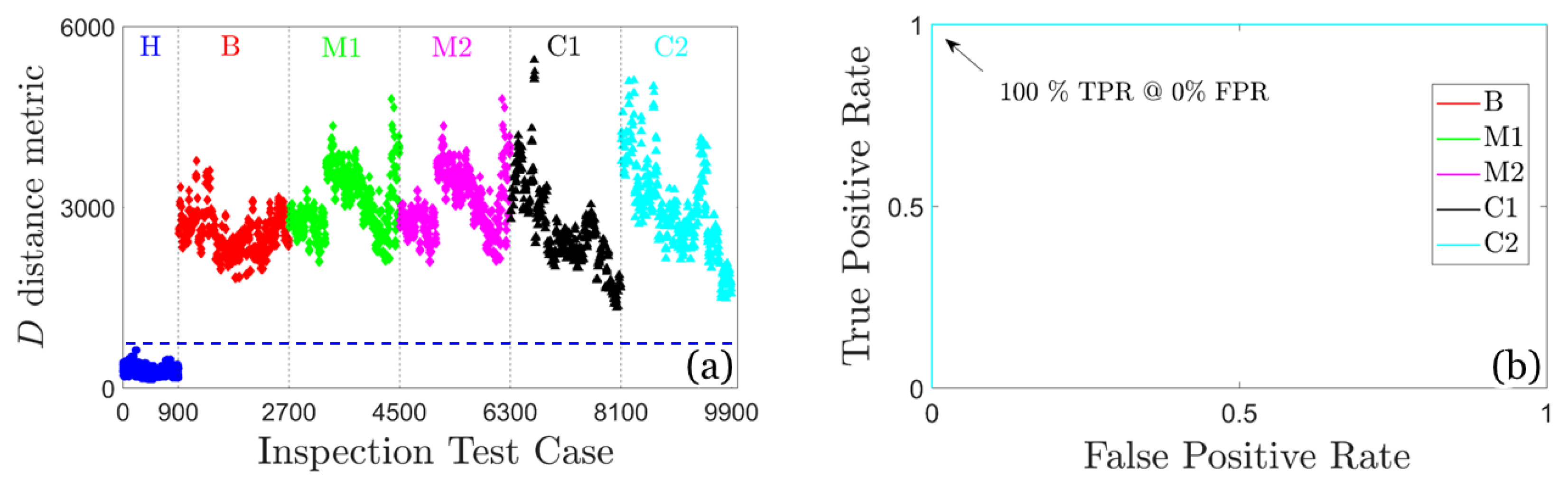
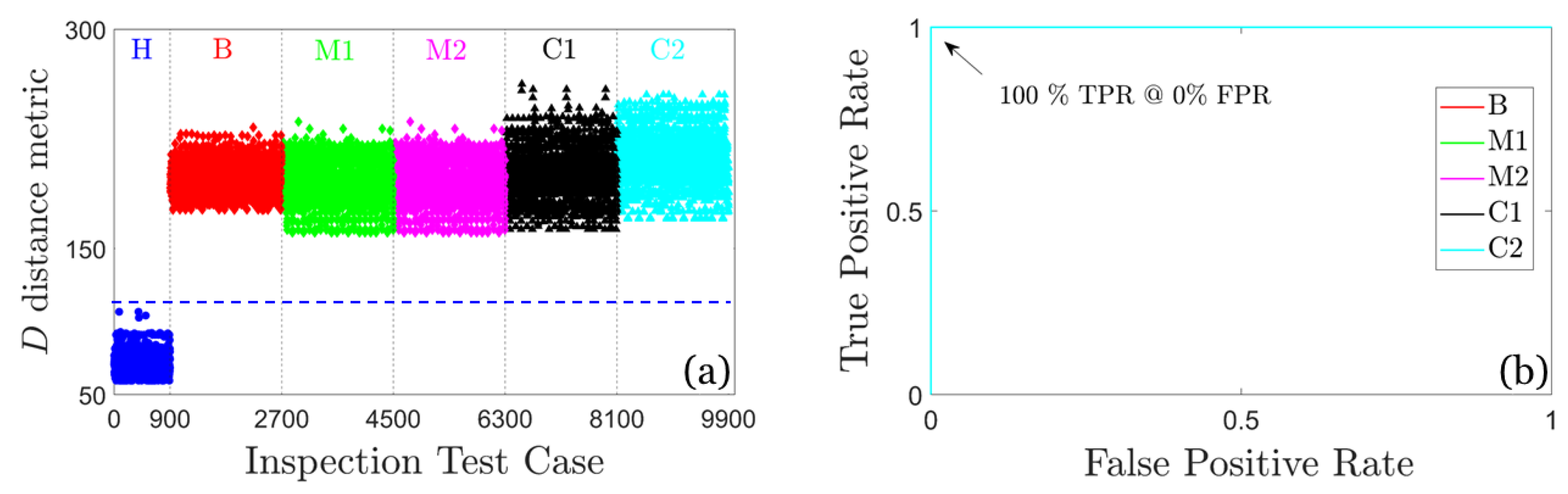
The detection results for the U-MM-AR method are illustrated in Figure 8. Evidently, the values of the distance metric D corresponding to the FWT’s healthy state are completely distinguishable from those of early-stage damages, demonstrating the method’s flawless damage detection performance. This is further confirmed by the ROC curves, which indicate perfect detection rate ( 100 % TPR) with no false alarms ( 0 % , FPR) for all considered damage scenarios.
Similarly, Figure 9 illustrates the values of the distance metric D and the ROC curves for the U-MM-PSD method. It is again evident that the detection performance is perfect ( 100 % TPR, 0 % FPR) for all considered damage scenarios.

5.3. Damage Type Identification Results

Baseline (Training) phase: In this phase, n = 45 vibration signals from the Bolt (B) damage type and n = 90 signals from each of the remaining damage types are used per rotation (see Table 3) to construct the MM representations M j ( j = 1 , 2 , 3 ). Each M j captures the FWT dynamics for a specific damage type under the considered wind conditions, as described in Section 4.2.1. For the S-MM-AR method, each M j representation consists of 225 AR ( 80 ) models, while for the S-MM-PSD method it consists of 225 Welch-based PSD estimates. All details on the estimation procedures are provided in Table 7.
Using the same set of vibration signals, a single k-NN class T j ( j = 1 , 2 , 3 ) is created to represent the FWT dynamics for each damage type over the considered wind conditions, as described in Section 4.2.2. As for the MM-based methods, for the k-NN-AR method, each T j includes 225 AR ( 80 ) parameter vectors, while for the k-NN-PSD method, it includes 225 Welch-based PSD estimates.
Finally, the same set of vibration signals is also used to train m = 3 binary SVM classifiers, one for each damage type, based on the procedure described in Section 4.2.3. Again, the training of the SVM-AR method is performed utilizing 225 AR ( 80 ) parameter vectors, while 225 Welch-based PSD estimates are used for the SVM-PSD method. For the SVM and k-NN based methods, the tuning procedure of the hyper-parameters has been conducted based on the Bayesian Optimization [38] (pp. 2951-2959) and the final hyper-parameter values are provided in Table 7.
Inspection (Identification) Phase: Each vibration signal from the 4500 test cases in the inspection phase (see Table 3), which has been previously (Stage 1) identified to originate from a damaged health state, is in this stage used for damage type identification. Thus, each model M u , estimated (see Table 7) during Stage 1, is now used for damage type identification through the methods outlined in Section 4.2.1, Section 4.2.2, and Section 4.2.3.
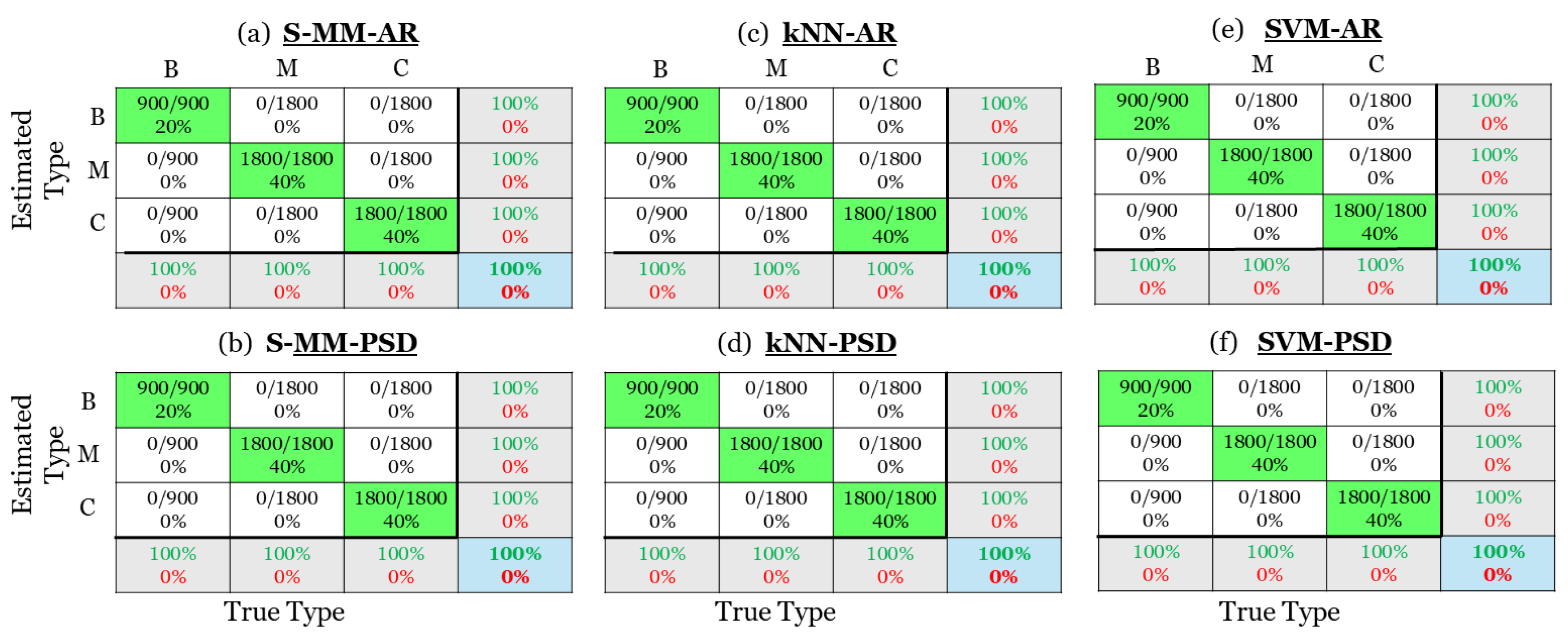
The damage type identification results are presented through confusion matrices in Figure 10. Each column of a confusion matrix in the upper left 3 × 3 sub-matrix corresponds to the actual type of early-stage damage, with each row representing the predicted type. The i,j-th cell indicates the number of times the actual i-th damage type was predicted as the j-th damage type, presented as a ratio with respect to the total number of actual inspection test cases. Correct identification of the true damage type appear along the diagonal, while incorrect in the off-diagonal elements. The rightmost column indicates the percentages of correctly (in green) and incorrectly (in red) identified test cases with respect to the total inspection test cases for each type. Conversely, the last row showcases the percentages of correctly (in green) and incorrectly (in red) identified test cases relative to the total test cases. Lastly, the lowest and rightmost cell specifies the overall correct identification rate (in green) and false identification rate (in red) across all three types. As it is evident, both versions of all investigated methods demonstrate excellent performance in damage type identification, achieving an overall correct identification rate of 100 % .

5.4. Damage Severity Characterization Results

Baseline (Training) phase: In this phase, n = 45 vibration signals from each damage severity level of the Added Mass and the Blade Crack scenarios are used per rotation (see details in Table 4 and Table 5) to construct the MM representations M j z ( j = 1 , 2 and z = 1 , 2 ). Each M j z captures the FWT dynamics for a specific damage type and severity level for the considered wind conditions, as described in Section 4.3.1. For the S-MM-AR method, the M j z consists of 180 AR ( 80 ) models, while 90 Welch-based PSD estimates are employed for the S-MM-PSD method. All estimation details are provided in Table 8.
Using the same set of vibration signals, a single k-NN class T j z ( j = 1 , 2 and z = 1 , 2 ) is created for the representation of the FWT dynamics for each considered damage severity and damage type, as described in Section 4.3.2. As previously, each T j z includes 180 AR ( 80 ) parameter vectors for the k-NN-AR method and 180 Welch-based PSD estimates for the k-NN-PSD method.
Finally, the same set of vibration signals is used to train z = 2 binary SVM classifiers for each damage type, one for each damage severity level, based on the procedure described in Section 4.3.3. Thus, for the training of the SVM-AR method, 180 AR ( 80 ) parameter vectors are utilized, while for the SVM-PSD method, 180 Welch-based PSD estimates. The tuning procedure of the hyper-parameters of SVM and k-NN based methods has been conducted based on Bayesian Optimization [38] (pp. 2951–2959) and the final hyper-parameter values are provided in Table 8.
Inspection (Severity Characterization) phase: Each vibration signal from the 1800 test cases in the inspection phase (see Table 4 and Table 5), which has been previously identified to originate from a specific type of damage, is in this diagnosis stage used for damage severity characterization. Thus, each model M u is employed for damage severity characterization using the methods outlined in Section 4.3.1, Section 4.3.2, and Section 4.3.3. Similarly to Section 5.3, in the first version of each method, M u corresponds to an AR ( 80 ) model, whereas in the second version to a Welch-based PSD estimate. All details of each method are summarized in Table 8.
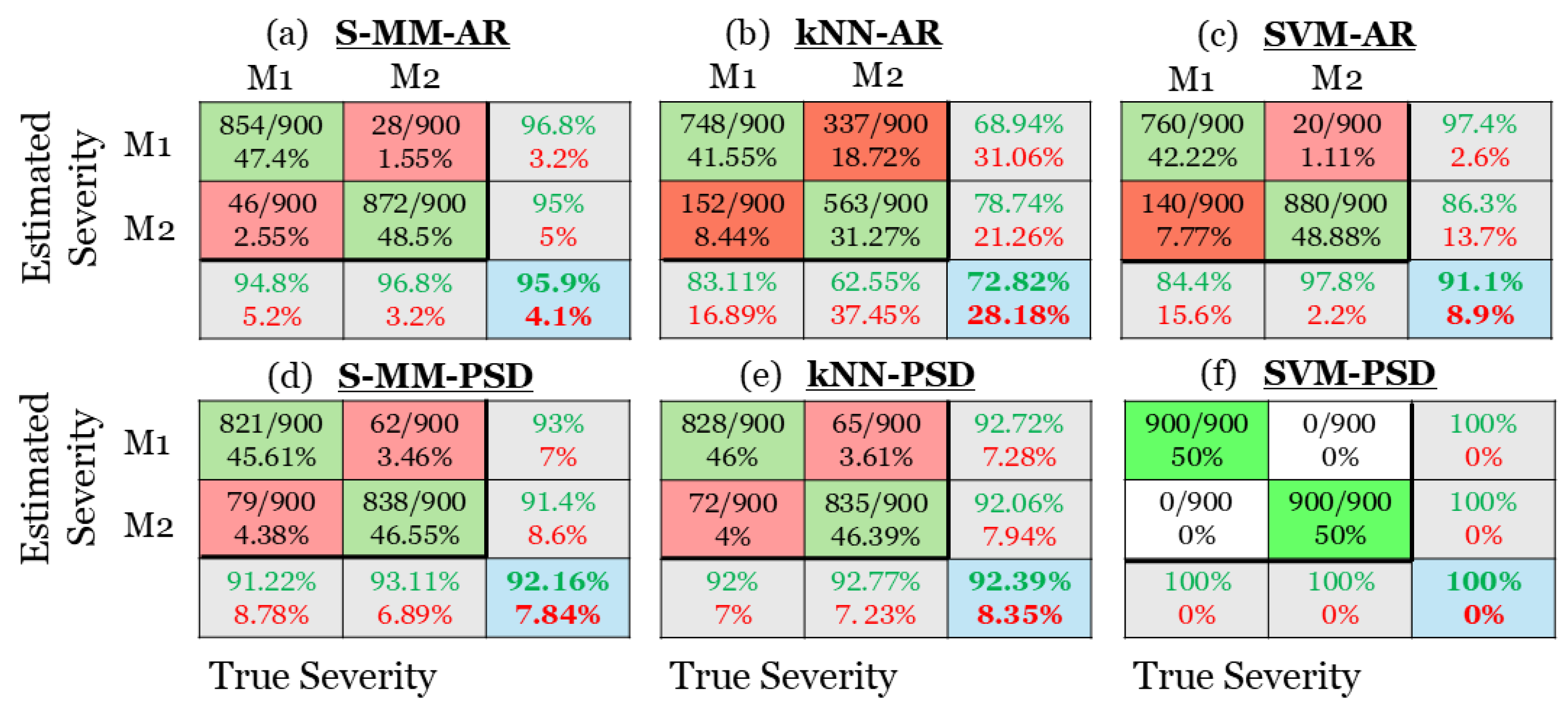
The damage severity characterization results are presented using confusion matrices, similar to those in Section 5.3 with the difference that each column of a confusion matrix in the upper left 2 × 2 sub-matrix corresponds to the actual severity of the investigated damage, with each row representing the predicted one. Correspondingly the lowest and rightmost cell specifies the overall correct characterization rate and false characterization rate across the two levels of severity. Specifically, Figure 11 illustrates the confusion matrices corresponding to the results of all investigated methods for the Added Mass ( M 1 and M 2 ) severity characterization problem. Both versions of the MM-based method demonstrate adequate performance, achieving correct severity characterization rates of 95.9 % and 92.16 % , respectively. From the k-NN-based methods the non-parametric k-NN-PSD has superior performance over its parametric counterpart, achieving correct characterization rate of 92.39 % , while the k-NN-AR method achieves a poor rate of 72.82 % . Finally, the SVM-PSD method achieves perfect damage severity characterization performance with a 100 % correct estimation rate, while its parametric counterpart, the SVM-AR method, achieves a rate of 91.1 % .
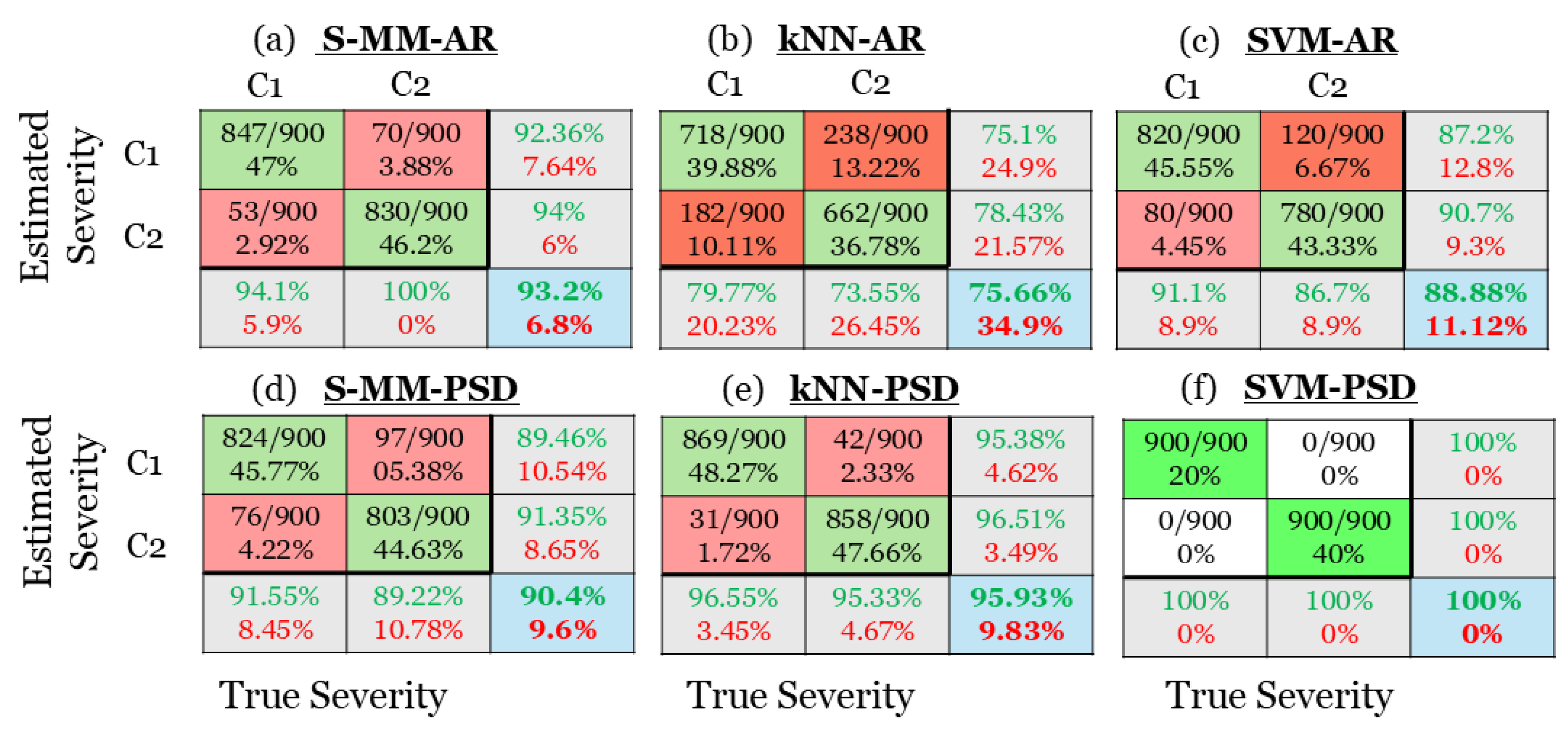
Moreover, Figure 12 presents the confusion matrices for all investigated methods in the Blade Crack ( C 1 and C 2 ) severity characterization problem. Both versions of the MM-based method demonstrate adequate performance, achieving severity characterization rates of 93.2 % and 90.4 % based on the S-MM-AR and the S-MM-PSD methods, respectively. On the other hand, the k-NN-AR method has a poor performance, achieving 75.66 % accuracy in characterizing the blade crack severity, whereas the k-NN-PSD method achieves a very good rate of 95.93 % . Finally, the SVM-PSD method again demonstrates perfect performance with 100 % accuracy in characterizing the blade crack severity, while its SVM-AR counterpart exhibits inferior performance with an accuracy rate of 88.88 % .
For a direct comparison over all methods in, the overall results of damaged severity characterization for the added mass ( M 1 and M 2 ) and blade crack ( C 1 and C 2 ) damage scenarios are presented as bar graphs in Figure 13. The best severity characterization performance for both damage types is achieved by the SVM-PSD method, while the lowest by the k-NN-AR method.

6. Discussion

Based on the above results, it is evident that the investigated vibration-based ML methods for robust SHM may lead to a highly effective SHM system in a FWT operating under a number of uncertainty sources. The methods demonstrate perfect performance in both damage detection and damage type identification of early-stage, while even in the delicate stage of damage severity characterization the SVM-PSD method achieves 100 % correct detection with zero false alarms. Regarding the methods complexity and thus their practical value for real time use it is noted that the MM-based methods which are used for damaged detection operate in a completely unsupervised manner without the need for measurements from the damage structure, while it requires a limited number of vibration signals from a single sensor on the healthy FWT lab-scale model for its training. More specifically, only the 8.33 % of the total 10800 signals from the healthy FWT has been used in the training of the baseline phase for damage detection with the remaining signals employed exclusively in the inspection phase.
It is noted that for the stages of damage type identification and severity characterization, the same number of signals has been utilized for the training of all methods, ensuring consistency in the methods’ assessment and comparison. The signals have been utilized equally in the baseline phase ( 50 % ) and inspection phase ( 50 % ) examining the methods’ performance leading to flawless identification of all damage types based on either of the investigated methods. This may be attributed to the damage-sensitive feature vectors representing the structural dynamics within the entire measurements’ frequency bandwidth. The results from damage severity characterization are perfect based on the SVM-PSD method followed by the k-NN-PSD and the S-MM-AR with the remaining methods achieving correct characterization rates of around 90 % and higher except from the k-NN-AR which is inadequate.
Furthermore, it should be stressed that both k-NN and SVM-based methods are considerably more complex and computationally demanding than the MM-based methods due to their dependency on extensive hyperparameter tuning. Since the same features are employed across the three investigated methods, it is important to note that certain hyperparameters are common to all methods regarding each versions. Specifically, the methods’ version utilizing PSD estimates requires the determination of the overlap, window length, and window type, while the other employing AR parameter vectors requires only the order of the AR models to be determined. The MM-based methods are inherently simpler and more computationally efficient, as they do not require any other extra hyperparameters to be determined, thus their setup is straightforward and facilitates faster implementation. On the other, Bayesian optimization has been utilized to fine-tune three extra hyperparameters in the baseline phase of SVM-based and k-NN-based methods. Particularly, the kernel function, kernel scale and box constraint level have been determined for the SVM-based methods, while the number of nearest neighbors, the distance metric, and the distance weight have been assessed for the k-NN-based methods. This optimization process necessitates a thorough exploration of the hyperparameter space, involving multiple iterations of model performance evaluation, which significantly increases computational cost and time requirements.

7. Conclusions

The experimental investigation and comparative assessment of advanced ML vibration-based SHM methods for robust diagnosis of early-stage damages in Floating Wind Turbines (FWTs) under varying Environmental and Operating Conditions (EOCs) have been presented. Two versions of three advanced ML methods have been employed in a proper framework for robust diagnosis: a Multiple Model (MM) method, a k-Nearest Neighbors (k-NN) method, and a Support Vector Machines (SVM) method. Each version incorporates two damage-sensitive feature vectors that represent the structural dynamics within the entire frequency bandwidth of measurements, one that includes Welch-based PSD estimates and another with AutoRegressive (AR) model parameters.
The performance of the methods has been rigorously evaluated through hundreds of experiments, demonstrating their effectiveness in the detection, type identification, and severity characterization of very early-stage damages, whose effects on the vibration signals are almost completely masked by those induced by the varying wind conditions. The MM-based method, which is characterized by the fewer hyperparameters and the simplest implementation achieved flawless damage detection and type identification, while achieving correct damage severity characterization for over 90 % of the considered cases using either of its two versions. The k-NN-based method also achieved flawless damage type identification, but only its k-NN-PSD version may reach acceptable (> 92 % ) damage severity characterization. Finally, the SVM-based methods demonstrated the best performance, as it achieved perfect damage type identification based on either of its two versions, as well as flawless ( 100 % ) severity characterization through its SVM-PSD version with the SVM-AR to be close to an average of 90 % .

Conflicts of Interest

The authors declare no conflicts of interest.

Abbreviations

The following abbreviations are used in this manuscript:
AR AutoRegressive
BIC Bayesian Information Criterion
EOCs Environmental and Operating Conditions
FPR False Positive Rate
FWT Floating Wind Turbine
fs Sampling frequency
k-NN k Nearest Neighbors
ML Machine Learning
MM Multiple Model
OLS Ordinary Least Squares
PCA Principal Components Analysis
PSD Power Spectral Density
ROC Receiver Operating Characteristic
RSS Residual Sum of Squares
SHM Structural Health Monitoring
STS Statistical Time Series
SPP Samples Per Parameter
SVM Support Vector Machines
TPR True Positive Rate
WD Wind Direction
WS Wind Speed

References

  1. Xiaojing, S.; Diangui, H. The current state of offshore wind energy technology development. Energy 2012, 41, 298–315. [Google Scholar]
  2. Martinez-Luengo, M.; Kolios, A.; Wang, L. Structural health monitoring of offshore wind turbines: A review through the statistical pattern recognition paradigm. Renewable and Sustainable Energy Reviews 2016, 64, 91–105. [Google Scholar] [CrossRef]
  3. Ren, Z.; Verma, A.S.; Li, Y.; Teuwen, J.; Jiang, Z. Offshore wind turbine operations and maintenance: A state-of-the-art review. Renewable and Sustainable Energy Reviews 2021, 144. [Google Scholar] [CrossRef]
  4. Faulkner, P.; Cutter, P.; Owens, A. Structural Health Monitoring Systems in Difficult Environments—Offshore Wind Turbines. In Proceedings of the 6th European Workshop on Structural Health Monitoring, Dresden, Germany; 2012. [Google Scholar]
  5. Jounior, F.M.; Moura, E.P.; Rocha, P.C.; Andrade, C.F. Unbalance evaluation of a scaled wind turbine under different rotational regimes via detrended fluctuation analysis of vibration signals combined with pattern recognition techniques. Energy 2019, 171, 556–565. [Google Scholar] [CrossRef]
  6. Joshuva, A.; Sugumaran, V. A data-driven approach for condition monitoring of wind turbine blade using vibration signals through best-first tree algorithm and functional trees algorithm: A comparative study. ISA Transactions 2017, 67, 160–172. [Google Scholar] [CrossRef]
  7. Sahoo, S.; Kushwah, K.; Sunaniya, A.K. Health Monitoring of Wind Turbine Blades through Vibration Signal Using Advanced Signal Processing Techniques. Proceedings of 2020 Advanced Communication Technologies and Signal Processing (ACTS), Silchar, India; 2020. [Google Scholar]
  8. Bull, T.; Ulriksen, M.; Tcherniak, D. The effect of environmental and operational variabilities on damage detection in wind turbine blades. In Proceedings of the 9th European Workshop on Structural Health Monitoring, Manchester, England; 2018. [Google Scholar]
  9. Tcherniak, D.; Mølgaard, L. Vibration-based SHM system: Application to Wind Turbine Blades. Journal of Physics: Conference Series 2015, 628, 012072. [Google Scholar] [CrossRef]
  10. Tcherniak, D.; Mølgaard, L. Active vibration-based structural health monitoring system for wind turbine blade: Demonstration on an operating Vestas V27 wind turbine. Structural Health Monitoring 2017, 16, 536–550. [Google Scholar] [CrossRef]
  11. Gonzales, A.; Fassois, S. A supervised vibration-based statistical methodology for damage detection under varying environmental conditions and its laboratory assessment with a scale wind turbine blade. Journal of Sound and Vibration 2016, 366, 484–500. [Google Scholar] [CrossRef]
  12. Panagiotopoulos, A.; Therniak, D.; Fassois, S. Damage detection on the blade of an operating wind turbine via a single vibration sensor and statistical time series methods: Exploring the performance limits of robust methods. Structural Health Monitoring 2022, 22, 405–414. [Google Scholar] [CrossRef]
  13. Avendaño-Valencia, D.; Fassois, S. Damage/fault diagnosis in an operating wind turbine under uncertainty via a vibration response Gaussian mixture random coefficient model-based framework. Mechanical Systems and Signal Processing 2017, 91, 326–353. [Google Scholar] [CrossRef]
  14. Xiang, L.; Wang, P.; Yang, X.; Hu, A.; Su, H. ; Fault detection of wind turbine based on SCADA data analysis using CNN and LSTM with attention mechanism. Measurment 2021, 175. [Google Scholar] [CrossRef]
  15. Chen, J.; Jian Li, J.; Chen, W.; Wang, Y.; Jiang, T. Anomaly detection for wind turbines based on the reconstruction of condition parameters using stacked denoising autoencoders. Renewable Energy 2020, 147, 1469–1480. [Google Scholar] [CrossRef]
  16. Chen, H.; Liu, H.; Chu, X.; Liu, Q.; Xue, D. Anomaly detection and critical SCADA parameters identification for wind turbines based on LSTM-AE neural network. Renewable Energy 2021, 172, 829–840. [Google Scholar] [CrossRef]
  17. Sakaris, C.; Yang, Y.; Bashir, M.; Michailides, C.; Wang, J.; Sakellariou, J.; Li, C. Structural health monitoring of tendons in a multibody floating offshore wind turbine under varying environmental and operating conditions. Renewable Energy 2021, 179, 1897–1914. [Google Scholar] [CrossRef]
  18. Sakaris, C.; Bashir, M.; Yang, Y.; Michailides, C.; Wang, J.; Sakellariou, J. Diagnosis of damaged tendons on a 10 MW multibody floating offshore wind turbine platform via a response-only functional model-based method. Engineering Structures 2021, 242, 112384. [Google Scholar] [CrossRef]
  19. Jamalkia, A.; Ettefagh, M.M.; Mojtahedi, A. Damage Detection of TLP and Spar Floating Wind Turbine Using Dynamic Response of the Structure. Ocean Eng. 2016, 125, 191–202. [Google Scholar] [CrossRef]
  20. Dehkharghani, P.H.; Ettefagh, M.M.; Hassannejad, R. Mooring Damage Identification of Floating Wind Turbine Using a Non-Probabilistic Approach Under Different Environmental Conditions. J. Mar. Sci. Appl. 2021, 20, 156–169. [Google Scholar] [CrossRef]
  21. Konstantinou, X.; Kritikakos, K.; Lee, C.F.; Sakaris, C.S.; Sakellariou, J.S.; Schlanbush, R.; Ong, M.C. Vibration-based Structural Health Monitoring of the mooring lines in a floating offshore wind turbine under varying environmental conditions: NN vs STS based methods. In Proceedings of the International Conference on Noise and Vibration Engineering, Leuven, Belgium, 2024. [Google Scholar]
  22. Liu, Y.; Ferrari, R.; Wu, P.; Jiang, X.; Li, S.; van Wingerden, J.-W. Fault Diagnosis of the 10MW Floating Offshore Wind Turbine Benchmark: A Mixed Model and Signal-Based Approach. Renewable Energy 2021, 164, 391-–406. [Google Scholar] [CrossRef]
  23. Gorostidi, N.; Nava, V.; Aristondo, A.; Pardo, D. Predictive Maintenance of Floating Offshore Wind Turbine Mooring Lines Using Deep Neural Networks. Journal of Physics: Conference Series, WindEurope Annual Event Bilbao, Spain 5-7 April 2022, 2257.
  24. Chun Bao, L.; Choung, J. Fatigue damage analysis for a floating offshore wind turbine mooring line using the artificial neural network approach. Ships and Offshore Structures 2016, 12, 288–295. [Google Scholar]
  25. Anastasiadis, N.; Sakaris, C.; Schlanbusch, R.; Sakellariou, J. Vibration-Based SHM in the Synthetic Mooring Lines of the Semisubmersible OO-Star Wind Floater under Varying Environmental and Operational Conditions. Sensors 2024, 24. [Google Scholar] [CrossRef] [PubMed]
  26. Kraemer, P.; Friedmann, H.; Ebert, C.; Mahowald, J.; Wolfel, B. Experimental validation of stochastic subspace algorithms for structural health monitoring of offshore wind turbine towers and foundations. 8th European Workshop On Structural Health Monitoring (EWSHM 2016) Spain, Bilbao, 2016.
  27. Vidal, Y.; Aquino, G.; Pozo, F.; Gutiérrez-Arias, J. E. M. Structural Health Monitoring for Jacket-Type Offshore Wind Turbines: Experimental Proof of Concept. Sensors 2020, 20. [Google Scholar] [CrossRef]
  28. Vamvoudakis-Stefanou, K.; Sakellariou, J.; Fassois, S. Vibration-based damage detection for a population of nominally identical structures: Unsupervised Multiple Model (MM) statistical time series type methods. Mechanical Systems and Signal Processing 2018, 111, 149–171. [Google Scholar] [CrossRef]
  29. Cover, T.; Hart, P. Nearest neighbor pattern classification. IEEE Transactions on Information Theory 1967, 13, 21–27. [Google Scholar] [CrossRef]
  30. Rahimi, A.; Recht, B. Random features for large-scale kernel machines. Advances in Neural Information Processing Systems. Proceedings of the 20th International Conference on Neural Information Processing Systems, 03 December 2007.
  31. Duda, R.; Hart, P.; Stork, D. Pattern Classification, New York: Wiley Interscience, 2001, 34–35.
  32. Bishop, C.M. Pattern Recognition and Machine Learning; Springer Science + Business Media: New York, USA, 2006. [Google Scholar]
  33. Korolis, J.S., Bourdalos, D.M. and Sakellariou, J.S.: Damage Diagnosis in a Floating Wind Turbine Lab-Scale Model Under Varying Wind Conditions Using Vibration-Based Machine Learning Methods. In Proceedings of the 10th International Operational Modal Analysis Conference (IOMAC), Springer Nature Switzerland, 381-393, 2024.
  34. Scholkopf, B.; Sung, K.K.; Burges, C.J.; Girosi, F.; Niyogi, P.; Poggio, T.; Vapnik, V. Comparing support vector machines with Gaussian kernels to radial basis function classifiers. IEEE Trans. Signal Process 1997, 45, 2758–2765. [Google Scholar] [CrossRef]
  35. Ljung, L. System Identification: Theory for the User, 2nd ed.; Prentice–Hall: New Jersey, USA, 1999. [Google Scholar]
  36. Yin, L.; Lv, L.; Wang, D.; Qu, Y.; Chen, H.; Deng, W. Spectral Clustering Approach with K-Nearest Neighbor and Weighted Mahalanobis Distance for Data Mining. Electronics 2023, 12, 3284. [Google Scholar] [CrossRef]
  37. Vapnik, V. The Nature of Statistical Learning Theory; Springer: New York, 2000. [Google Scholar]
  38. Snoek, J.; Larochelle, H.; Adams, R.P. Practical bayesian optimization of machine learning algorithms. In Proceedings of the 25th Internation Conference on Neural Information Processing Systems, New York, 2012; pp. 2951–2959. [Google Scholar]
Figure 1. (a) Photo of the lab-scale FWT model and, (b) the FWT under the considered wind directions (WD1, WD2, WD3) and speeds (WS1, WS2, WS3).
Preprints 144141 g001
Figure 2. The lab-scale FWT model, the accelerometer position and the considered damage scenarios.
Preprints 144141 g002
Figure 3. Indicative Welch-based PSD estimate using a vibration signal from the FWT in a healthy state before and after signal filtering and resampling at a frequency of f s = 512 Hz.
Preprints 144141 g003
Figure 4. Welch-based PSD envelope estimates under all considered wind speeds and directions of the healthy and damaged FWT (90 signals per health state): (a) Healthy vs Scenario B, (b) Healthy vs Scenario M1 and (c) Healthy vs Scenario M2.
Preprints 144141 g004
Figure 5. Welch-based PSD envelope estimates under all considered wind speeds and directions of the healthy and damaged FWT (90 signals per health state): (a) Healthy vs Scenario C1, (b) Healthy vs Scenario C2.
Preprints 144141 g005
Figure 6. Effects of different damage types on the dynamics through Welch-based PSD envelope estimates for damage Scenario B (90 signals), for Scenarios C1 & C2 (180 signals), and for Scenarios M1 & M2 (180 signals).
Preprints 144141 g006
Figure 7. Effects of different damage severity levels for the same damage type through Welch-based PSD envelope estimates (90 signals per damage severity): (a) Scenario M1 vs Scenario M2, and (b) Scenario C1 vs Scenario C2.
Preprints 144141 g007
Figure 8. Damage detection results based on the U-MM-AR method: (a) Plot of the distance metric D and (b) corresponding ROC curves; 900 inspection test cases for the healthy FWT and 1800 per damage scenario, 9900 in total. The blue dashed line indicates the user selected threshold.
Preprints 144141 g008
Figure 9. Damage detection results based on the U-MM-PSD method: (a) Plot of the distance metric D and (b) corresponding ROC curves; 900 inspection test cases for the healthy FWT and 1800 per damage scenario, 9900 in total. The blue dashed line indicates the user selected threshold.
Preprints 144141 g009
Figure 10. Damage Type identification results via confusion matrices: (a) The S-MM-AR method, (b) the S-MM-PSD method, (c) the k-NN-AR method, (d) the k-NN-PSD method, (e) the SVM-AR method and (f) the SVM-PSD method. Correct identification is indicated by green color and misidentification by red (4500 inspection test cases in total).
Preprints 144141 g010
Figure 11. Damage severity characterization results via confusion matrices for Added Mass damage scenario: (a) The S-MM-AR based method, (b) the k-NN-AR based method, (c) the SVM-AR based method, (d) the S-MM-PSD based method, (e) the k-NN-PSD based method, and (f) the SVM-PSD based method. Correct characterization is indicated by green color and mis-charachterization by red (1800 inspection test cases in total).
Preprints 144141 g011
Figure 12. Damage severity characterization results via confusion matrices for Blade Crack damage scenario: (a) The S-MM-AR based method, (b) the k-NN-AR based method, (c) the SVM-AR based method, (d) the S-MM-PSD based method, (e) the k-NN-PSD based method, and (f) the SVM-PSD based method. Correct characterization is indicated by green color and mis-characterization by red (1800 inspection test cases in total).
Preprints 144141 g012
Figure 13. Summary of severity correct characterization percentages for damage scenarios with added mass ( M 1 , M 2 ) and blade crack ( C 1 , C 2 ), based on all considered methods.
Preprints 144141 g013
Table 1. Experimental details on the varying wind conditions, the FWT health states and the vibration signals.
FWT Health State Wind Speed (WS) Wind Direction (WD) No. of Exp. per WS / WD Total No. of Exp.
Healthy (H) {1, 2, 3} {1, 2, 3} 10 / 10 90
Bolt (B) -//- -//- -//- -//-
Mass 1 (M1) -//- -//- -//- -//-
Mass 2 (M2) -//- -//- -//- -//-
Crack 1 (C1) -//- -//- -//- -//-
Crack 2 (C2) -//- -//- -//- -//-
Original signals:
Sampling rate: f s = 1024 Hz; Length: N=30720 samples; Frequency bandwidth: [ 0 512 ] Hz
Pre-processed signals:
Sampling rate: f s = 512 Hz; Length: N=15360 samples; Frequency bandwidth: [ 0 256 ] Hz
Pre-processing: Low-pass Chebyshev Type I filter & resampling
Table 2. Damage detection – details on the performance assessment.
Baseline (Training) phase
No. of Rotations Healthy State Bolt (B) Mass 1 (M1) Mass 2 (M2) Crack 1 (C1) Crack 2 (C2)
1 45 a
20 900
Inspection (Detection) phase
1 45 a 90 90 90 90 90
20 900 1800 1800 1800 1800 1800
a 5 signals per wind condition. Different signals per phase.
No. of training signals per rotation: 45; Total No. of inspection signals: 9900.
Table 3. Damage Type Identification - details on the performance assessment.
Baseline (Training) phase
No. of Rotations Bolt (B) Mass (M1, M2) Crack (C1, C2)
1 45 a 90 b 90 b
20 900 1800 1800
Inspection (Identification) phase
1 45 a 90 b 90 b
20 900 1800 1800
a 5 signals per wind condition. Different signals per phase.
b 45 signals per damage Type Scenario (5 signals per wind condition).
No. of training signals per rotation: 225; Total No. of inspection signals: 4500.
Table 4. Damage Severity Characterization of Added Mass damage scenarios - details on the performance assessment.
Baseline (Training) phase
No. of Rotations Mass 1 (M1) Mass 2 (M2)
1 45 a 45 a
20 900 900
Inspection (Severity Characterization) phase
1 45 45
20 900 900
a 5 signals per wind condition. Different signals per phase.
No. of training signals per rotation: 90; Total No. of inspection signals: 1800.
Table 5. Damage Severity Characterization of Blade Crack damage scenarios - details on the performance assessment.
Baseline (Training) phase
No. of Rotations Crack 1 (C1) Crack 2 (C2)
1 45 a 45 a
20 900 900
Inspection (Severity Characterization) phase
1 45 45
20 900 900
a 5 signals per wind condition. Different signals per phase.
No. of training signals per rotation: 90; Total No. of inspection signals: 1800.
Table 6. Damage Detection - details on the methods training and inspection phases.
Method Feature Feature vector dimensionality Distance type
U-MM-AR AR parameter vector 80 Mahalanobis
U-MM-PSD PSD estimates 256 Euclidean
Baseline (Training) phase
AR model estimation via OLS [35] (p. 204), Matlab function:  ar . m
Selected model: AR(80); BIC: -17.11; Samples Per Parameter (SPP): 192;
Condition Number: 1.92 × 10 5
Inspection (Detection) phase
U-MM-AR (U-MM-PSD): Detection based on the minimum Mahalanobis (Euclidean) distance
User defined threshold: 600 (90)
Table 7. Damage Type Identification - details on the methods baseline and inspection phases.
Method Feature Feature vector dimensionality Distance type
S-MM-AR AR parameter vector 80 Mahalanobis
k-NN-AR -//- -//- Cosine
SVM-AR -//- -//- -
S-MM-PSD PSD estimates 256 Euclidean
k-NN-PSD -//- -//- Cosine
SVM-PSD -//- -//- -
Baseline (Training) phase
AR model estimation via OLS [35] (p. 204), Matlab function:  ar . m
Selected model: AR(80); BIC: -17.11; Samples Per Parameter (SPP): 192;
Condition Number: 1.92 × 10 5 , k-NN space: Matlab function:  fitck NN . m
Inspection (Identification) phase
k-NN-AR: Search Method: Exhaustive; No. of Nearest Neighbors: K = 2 ; BreakTies: Nearest;
Weight: Inverse
k-NN-PSD: Search Method: Exhaustive; No. of Nearest Neighbors: K = 3 ; BreakTies: Nearest;
Weight: Equal (no weighting)
SVM-AR: Kernel Function: Quadratic; Kernel scale: 1; Box Constrain level: 1.852;
Multi-class coding: One vs All
SVM-PSD: Kernel Function: Gaussian; Kernel scale: 0.008; Box Constrain level: 22;
Multi-class coding: One vs All
Bayesian Optimization details:
Objective function: minimum classification error; Acquisition function: expected-improvement (EI)
Objective function evaluations: 30; Number of initial evaluation points: 4, Exploration ratio: 0.5
Table 8. Damage Severity Characterization - details on the methods Baseline and Inspection phases.
Method Feature Feature vector dimensionality Distance type
S-MM-AR AR parameter vector 80 Mahalanobis
k-NN-AR -//- -//- Minkowski(Euclidean) 1
SVM-AR -//- -//- -
S-MM-PSD PSD estimates 256 Euclidean
k-NN-PSD -//- -//- Euclidean(Corelation) 1
SVM-PSD -//- -//- -
Baseline (Training) phase
AR model estimation via OLS [35] (p. 204), Matlab function:  ar . m
Selected model: AR(80); BIC: -17.11; Samples Per Parameter (SPP): 192;
Condition Number: 1.92 × 10 5 , k-NN space: Matlab function:  fitcknn . m
Inspection (Severity Characterization) phase
1k-NN-AR: Search Method: Exhaustive(Exhaustive); No. of Nearest Neighbors: k = 30 ( 2 ) ;
BreakTies: Nearest(Nearest); Weight: Squared Inverse(Inverse)
1k-NN-PSD: Search Method: Exhaustive(Exhaustive); No. of Nearest Neighbors: K = 1 ( 1 ) ;
BreakTies: Nearest(Nearest); Weight: Squared Inverse(Inverse)
1SVM-AR: Kernel Function: Linear(Cubic); Kernel scale: 1(1);
Box Constrain level: 247(0.715); Multi-class coding: One vs All(One vs All)
1SVM-PSD: Kernel Function: Linear(Gaussian); Kernel scale: 1(951);
Box Constrain level: 0.001(883); Multi-class coding: One vs All(One vs All)
Bayesian Optimization details:
Objective function: minimum classification error; Acquisition function: expected-improvement (EI)
Objective function evaluations: 30; Number of initial evaluation points: 4, Exploration ratio: 0.5
1The values within the (parentheses) correspond to the Blade Crack scenario; The rest values
correspond to the Added Mass scenario
Disclaimer/Publisher’s Note: The statements, opinions and data contained in all publications are solely those of the individual author(s) and contributor(s) and not of MDPI and/or the editor(s). MDPI and/or the editor(s) disclaim responsibility for any injury to people or property resulting from any ideas, methods, instructions or products referred to in the content.
Copyright: This open access article is published under a Creative Commons CC BY 4.0 license, which permit the free download, distribution, and reuse, provided that the author and preprint are cited in any reuse.
Prerpints.org logo

Preprints.org is a free preprint server supported by MDPI in Basel, Switzerland.

Subscribe

Disclaimer

Terms of Use

Privacy Policy

Privacy Settings

© 2025 MDPI (Basel, Switzerland) unless otherwise stated