

Submitted:
23 December 2024
Posted:
24 December 2024
You are already at the latest version
Abstract
Background: Adherence to treatment in diabetes is an important factor in achieving good diabetes control and preventing mortality. Pender’s health promotion model (HPM) offers a theoretical framework for exploring the multiple factors affecting health behaviors, such as treatment adherence. This is why this writing survey was created.Method: Use PubMed, ProQuest, Science Direct, and Scopus to find reviews of previous research. The search criteria that were utilized to locate papers were diabetic, diabetes mellitus, health promotion model, increasing, and adherence. Search parameters for English-language, full-text, open-access publications released between 2019 and 2024.Results: The importance of this study is that factors affecting treatment adherence in diabetes mellitus (DM) patients are identified in different dimensions. So, we can design an effective relevant intervention through needs assessment and using the most appropriate methods to improve adherence to treatment in DM patients based on HPM.Conclusion: Pender’s HPM, have been effective in improving commitment to a plan of action. Moreover, managers, planners and healthcare policymakers and other relevant authorities are advised to consider the implementation of detailed training programs based on Pender’s HPM to improve treatment adherence and other relevant factors and increase patients’ contribution to health promotion.
Keywords:
Health Promotion Model
; Adherence
; Diabetes Mellitus
Introduction
Diabetes mellitus (DM), one of the most prevalent chronic illnesses worldwide, poses a significant threat to healthcare and public health systems (Mukhtar, Galalain and Yunusa, 2020). Effective management of diabetes requires blood glucose control and lifestyle adjustments, including medical nutrition therapy, regular physical activity, and psychosocial care. Adherence refers to the patient's commitment to following the recommendations of doctors or healthcare providers, including consistent medication use and maintaining a healthy lifestyle (Noble, 2020).
According to data from the International Diabetes Federation, 10.5% of adults aged 20 to 79 worldwide have diabetes, with approximately half of them unaware of their condition. In the Middle East and North Africa (MENA) region, which includes Iran, the prevalence of diabetes is estimated to potentially reach 19.3%. Data from Indonesia’s Diabetes Mellitus Early Detection Survey, as reported by ASIK, indicates a prevalence rate of 14.05% (13,470,556 cases out of 95,900,441 targets). East Java ranks 12th out of 35 Indonesian provinces, with a prevalence rate of 14.80%. In Surabaya, the number of diabetes cases increased from 102,599 in 2017 to 115,460 in 2018 (Indonesia, 2023).
To achieve effective diabetes control and reduce mortality, adherence to treatment is crucial. Diabetes requires self-management, which includes self-care practices, a balanced diet, exercise, weight control, and self-monitoring of blood glucose, in addition to medication therapy. As a result, patient empowerment and education are vital. Health behavior theories and models can assist researchers in creating intervention programs, as treatment adherence is a complex behavior (Educators, 2020). With an emphasis on how experiences shape behavior, Pender's Health Promotion Model (HPM) aims to explain positive behaviors. By using this model, health professionals can apply a psychosocial process to influence individuals to adopt health-promoting habits. HPM also provides a theoretical framework for investigating the various elements influencing health behaviors, such as treatment adherence (Shahabi et al., 2022).
This approach explains healthy behavior by emphasizing how experiences shape conduct. Health practitioners can use the Health Promotion Model (HPM) to identify processes that motivate individuals to engage in actions that promote health, such as adhering to treatment plans. The model consists of three components: behavioral outcomes (where health-promoting behavior is the desired outcome and endpoint of the model), behavior-specific cognitions and affect (including factors like perceived benefits, barriers, and self-efficacy), and individual characteristics and experiences (such as personal factors and past behaviors). Perceived benefits of behavior, perceived barriers, self-efficacy, activity-related effect, and situational and interpersonal factors are all examples of behavior-specific cognitions and affect. In contrast to immediate conflicting demands and preferences, these factors may encourage individuals to commit to health-promoting practices (Shahabi, Hosseini, Aghamolaei, Behzad, et al., 2024). This is the reason why this survey was created.
Design and Method
Sources of Information and Search Methodology
The literature search focused on original research publications published between January 2019 and December 2024. The secondary data used in this study was sourced from 25 reliable journal articles published in various countries. These papers were retrieved from four journal databases: PubMed, ProQuest, and SCOPUS. Using "MeSH terms," the specific terms identified were "diabetic" OR "diabetes mellitus" AND "adherence" AND "health promotion model."
Examine the Requirements for Eligibility and Selection
The papers were selected, and their appropriateness was evaluated using the PICOS methodology. The following criteria were used to select the articles: For adherence to the outcome (O), the study should demonstrate how the intervention worked. The population (P) should consist of patients with diabetes mellitus (DM) who have received the health promotion model (HPM) (I).
Any type of research design, such as descriptive, cross-sectional, observational, quasi-experimental, RCT, and mixed methods, could be used in the studies. All research should be conducted in English. Research articles that were not in English, were published as reviews (e.g., literature review, narrative review, scoping review, systematic review), did not discuss the health promotion model, or included populations of patients with chronic diseases other than diabetes mellitus were excluded based on the exclusion criteria. Then, using pre-selected keywords, we reviewed the selected articles.
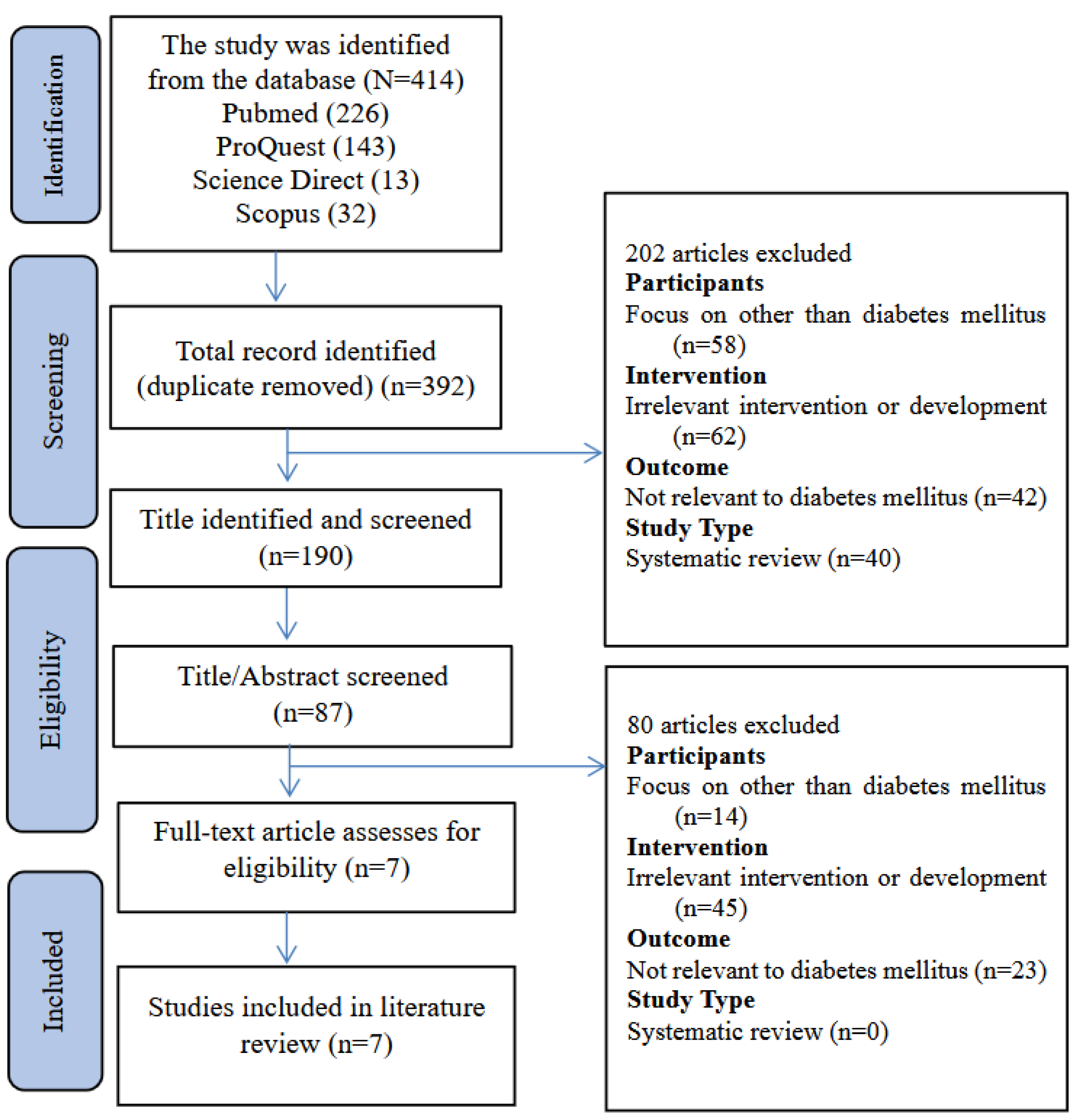
We found that the following databases contained articles that matched the preset keywords: 32 from Scopus, 143 from ProQuest, 13 from ScienceDirect, and 226 from PubMed. After reviewing the inclusion criteria and the 414 articles generated by the keyword search, six research papers were identified. Figure 1 shows the article selection process using the PRISMA flowchart.

Table 1.
Articles on Strategies for Increasing Self Efficacy in Individuals with Diabetes Mellitus.
| No | Title and author | Method (DSVIA) | Result |
| 1. | Application of Pender's health promotion model for type 2 diabetes treatment adherence: protocol for a mixed methods study in southern Iran. (Shahabi et al., 2022) | D: mixed method. S: 166 DM Type 2 patients V: adherence to diet, exercise, and medication as determined by the Health Promotion Model's components I: HPM-based questionnaire to assess patients with Type 2 DM's adherence to diet, exercise, and therapy A: The effectiveness of the intervention will be assessed using covariance analysis, independent t-test, paired t-test, and descriptive statistical data analysis. |
Several important conclusions regarding medication adherence in patients with type 2 diabetes mellitus, following the use of the Health Promotion Model (HPM)-based intervention, are expected to be included in the study's findings. |
| 2. | Evaluation of the effect of training given according to Pender's Health Promotion Model on psychological insulin resistance. (Bağrıaçık and Bayraktar, 2022) | D: quasi-experimental S: Sample of 68 patients with type II diabetes, 34 intervention groups and 34 control groups V: attitudes towards insulin treatment and metabolic control I: The Insulin Treatment Assessment Scale and a patient questionnaire that asks about demographics and medical conditions.A: Test T, ANOVA |
The findings demonstrated that patients' attitudes toward insulin treatment and several metabolic control measures were positively influenced by the education provided in line with the Pender Health Promotion Model. These variables include improvements in metabolic control, group homogeneity, and attitudes toward insulin treatment. |
| 3. | A health promotion model-based intervention to enhance treatment adherence in patients with type 2 diabetes. (Shahabi, Javdan, et al., 2024) | D: quasi-experimental design S: 95 samples total for the intervention and control groups. Eighty members of the control group and ninety-one members of the intervention group finished the questionnaire at the conclusion of the trial. V: Variables of educational intervention with HPM, Medication Adherence, Glucose Control level, Body Mass Index (BMI) I: Questionnaire on the construct of HPM Pender, as well as treatment compliance experience; Haemoglobin A1C (HbA1C); Body Mass Index (BMI). A: Independent t-test, paired t-test and regression analysis |
The findings demonstrated that HbA1C levels improved, and treatment compliance increased. |
| 4 | Psychometrics properties of type 2 diabetes treatment adherence questionnaire (DTAQ): a study based on Pender's health promotion model. (Shahabi, Hosseini, Aghamolaei, Ghanbarnejad, et al., 2024) | D: Mix method S: 20 patients were interviewed for the qualitative phase. 395 respondents in total were needed for confirmatory factor analysis during the quantitative phase. Purposive sampling as a method of sampling. V: Factors Affecting Medication Adherence and Medication Adherence I: diabetes treatment adherence questionnaire (DTAQ) consisting of 79 items measured using a five-point Likert scale A: To verify the reliability of the questionnaire, quantitative data were examined using AMOS and SPSS to compute Cronbach's alpha coefficient and conduct confirmatory factor analysis (CFA). |
The study's findings demonstrated that patients' levels of medication adherence varied. The findings also revealed a positive correlation between adherence and patients' level of trust in their ability to take their medications as prescribed. |
| 5 | Assessing of Effect of Educational Intervention based on Pender Health Promotion Model on the Medication Adherence of the Elderly with Type 2 Diabetes. (Khorashadizadeh et al., 2024) | D: experimental study S: 80 elderly people with diabetes in health and care centers. V: demographic variables such as age, marital status, education, and source of income. Other variables such as adherence to medication and lifestyle. I: Morisky's medication adherence questionnaire consisting of 8 questions. The Health-Promoting Lifestyle Profile II (HPLP II) was used to assess the healthy lifestyle aspects of participants. A: Independent t-test and paired t-test, linear regression analysis. |
The findings demonstrated that, compared to the control group, the intervention group's medication adherence ratings and healthy lifestyle had significantly improved. Furthermore, the intervention group's hemoglobin A1c levels significantly decreased, while the control group's levels remained the same. |
| 6 | Investigating the effect of educational intervention based on the Pender's health promotion model on lifestyle and self-efficacy of the patients with diabetic foot ulcer: A clinical trial. (Vakilian et al., 2021) | D: clinical trial design. S: 74 patients were selected through convenience sampling and divided into two groups. V: Independent Interventions: Educational Interventions. Dependent variables: Lifestyle score, Self-efficacy score. I: Health-Promoting Lifestyle Profile II (HPLP II) and Diabetes Foot Care Self-Efficacy Scale (DFCSES). A: independent t-test, paired t-test and ANCOVA |
Following the intervention, the intervention group's lifestyle ratings showed significant improvements in all areas assessed, including stress management, physical activity, diet, and interpersonal relationships (P < 0.001). After the session, the intervention group's self-efficacy scores also increased significantly (P < 0.001). However, there was no discernible difference in the control group's self-efficacy scores before and after the intervention. A comparison between the two groups revealed that the intervention group had considerably higher lifestyle and self-efficacy scores than the control group 50 days after the intervention (P < 0.001). |
| 7 | The Effect of Educational Intervention Based on Pender's Health Promotion Model for Distress Management in Patients with Type 2 Diabetes. (Rezaeemanesh et al., 2020) | D: quasy experiment with control group. S: 100 diabetic patients were divided into two groups (intervention and control). V: Independent Perspective: Educational interventions based on the Pender Health Promotion Model. Dependent variable: Diabetes distress rate I: Diabetes Distress Score (DDS17) and the structure of the Pender Health Promotion Model (perceived benefits, perceived barriers, perceived self-efficacy, interpersonal influences, situational influences, immediate competing demands, and commitment). A: descriptive statistics, analytical statistical tests (independent t-test, chi-square, ANOVA repeated measurements, and ANCOVA). |
The findings demonstrated that, following the intervention, the intervention group's distress scores significantly decreased (p < 0.001), while the control group's scores remained unchanged. After the intervention, all the Pender Health Promotion Model's components showed improvements, with statistically significant differences observed between the intervention and control groups (p < 0.005), as well as between the pre- and post-intervention status of the components. An essential aspect of disease management is the patient's commitment and self-efficacy in controlling their diabetes, which were enhanced by the intervention. |
Results and Discussion
In addition to paradigms and philosophical assumptions, research procedures are based on specific approaches. Researchers' worldviews, which consist of their philosophical assumptions and ideas about the nature of reality and how to interpret it, influence their methods.
The consideration of specific models and theories that characterize, explain, or predict health behavior is referred to as "Health Promotion Model Theory," and it broadens the scope of strategies available to nurses in their role as educators. The Health Promotion Model Theory, developed by Pender (1987) and presented in Alligood and Tomey (2006), describes the elements and processes that determine health-promoting behaviors in nursing.
From a philosophical perspective, the various study methodologies used in research can be seen as evidence that researchers' worldviews and methods are shaped by their philosophical assumptions and ideas about the nature of the universe and how it can be understood. In the context of a given research paradigm, methodology refers to the approach or plan of action that guides the selection and application of specific methods. The term "methodology" refers to the plans, strategies, and tactics employed in a well-organized research effort to find answers (Alele and Malau-Aduli, 2023).
- 1.
- Ontological study of health promotion model to increasing adherence of diabetes mellitus
The goal of the ontological research on the Health Promotion Model (HPM) is to gain a thorough understanding of the ideas, principles, and phenomena surrounding health behavior, particularly in relation to improving compliance in individuals with diabetes mellitus (DM) (Shahabi, Javdan, et al., 2024). Nola J. Pender's HPM places a strong emphasis on how personal characteristics, past experiences, and environmental influences shape health behavior. The ontology in this study aims to explore the reality and essence of how DM patients perceive and integrate health promotion initiatives into their daily lives, including motivation, risk assessment, and the obstacles they encounter (Turner and Reed, 2023).
The ontological approach in HPM research allows for an understanding of the subjective experiences of individuals with diabetes mellitus in relation to factors that affect compliance, such as perceptions of the benefits of treatment, social support, and self-confidence in managing the condition. Programs for community-based education, counseling, or mentoring are examples of more personalized and effective interventions that can be developed using HPM to increase compliance. It is anticipated that the findings of this ontological investigation will significantly contribute to the development of more patient-centered and comprehensive health promotion strategies (Khorashadizadeh et al., 2024).
Health professionals can encourage individuals with DM to maintain a healthy lifestyle, improve medication adherence, and help patients better understand the importance of behavioral changes by integrating the findings of ontological research into clinical practice. In the long run, this approach will not only assist individuals but also help communities manage diabetic complications and improve the quality of life (Vakilian et al., 2021).
- 2.
- Epistemological study of health promotion model to increasing adherence of diabetes mellitus
The focus of epistemological research on the Health Promotion Model (HPM) is to understand elements such as perceived benefits, barriers, and internal motivations that can be applied in practice to facilitate behavior change. This includes examining empirical data on the influence of social support, community-based interventions, and the effectiveness of health education in the context of diabetes mellitus. The study also examines the effectiveness of HPM concepts, such as self-efficacy, in enhancing patients' commitment to long-term care and healthy lifestyles. By adopting an epistemological approach, HPM can be used to develop more evidence-based health promotion strategies (Vakilian et al., 2021).
This study helps healthcare professionals understand how insights derived from this model can be applied to improve the effectiveness of intervention programs, including interdisciplinary collaboration, patient education, and the use of digital technologies for health monitoring. Health promotion strategies grounded in a solid epistemological foundation can be more targeted and relevant in improving DM patients' adherence, thereby enhancing their overall quality of life (Shahabi et al., 2022).
- 3.
- Axiological study of health promotion model to increasing adherence of diabetes mellitus
To improve compliance in patients with diabetes mellitus (DM), axiological studies of the Health Promotion Model (HPM) highlight the significance of the values and benefits of health treatments. This approach evaluates how interventions based on the HPM can encourage patients to adopt healthy habits, recognize the importance of managing their illness, and overcome barriers to self-care. Therefore, the value component of health interventions is essential for promoting positive behavioural changes in individuals with diabetes mellitus (Rezaeemanesh et al., 2020).
According to the study's findings, dietary compliance in type 2 DM patients was significantly influenced by health promotion using a peer model. The study showed that dietary compliance improved when patients received health education through a peer-to-peer approach, where they could exchange experiences and offer support (Siopis, Colagiuri and Allman-Farinelli, 2021). This demonstrates that the importance of patient empowerment and social support in health interventions can enhance compliance with DM management. These results reflect the effectiveness of health interventions that emphasize patient empowerment, social support, and education—all of which are outlined in the HPM—in improving adherence to diabetes mellitus care (Rouholamini et al., 2020). Therefore, DM patients can greatly benefit from the axiological approach when designing health promotion programs.
Conclusion
Treatment adherence in chronic diseases like diabetes can be greatly influenced by educational programs, particularly those based on Pender's HPM. By employing its practical elements, this model affects behavior on both an individual and interpersonal level. Therefore, it is recommended to create and implement such programs to improve the lives of these patients. Additionally, it is advised that managers, planners, healthcare policymakers, and other relevant authorities consider implementing comprehensive training programs based on Pender's HPM to enhance treatment adherence, address other relevant aspects, and increase patients' involvement in health promotion.
Acknowledgments
Our gratitude to Universitas Airlangga and everyone who took part in this literature review. Funding organizations from the governmental, private, or nonprofit sectors did not provide a specific grant for this literature review.
Conflicts of Interest
The authors have no conflict of interest.
References
- Alele: F. and Malau-Aduli, B. (2023) An introduction to research methods for undergraduate health profession students. James Cook University Townsville, Qld.
- Alligood, M.R. and Tomey, A.M. (2006) ‘Nursing theory’, Utilization&Application. Third edition, America: Mosby Company, pp. 393–399.
- Bağrıaçık, E. and Bayraktar, N. Evaluation of the effect of training given according to Pender’s Health Promotion Model on psychological insulin resistance. Human Nutrition & Metabolism, 2022, 29, 200153. [Google Scholar]
- Educators, A.A. An effective model of diabetes care and education: revising the AADE7 Self-Care Behaviors®. The Diabetes Educator, 2020, 46, 139–160. [Google Scholar]
- Indonesia, K.K.R. (2023) DITJEN P2P (Direktorat Jendral Pencegahan dan Pengendalian Penyakit) Laporan Kinerja Semester 1 Tahun 2023.
- Khorashadizadeh, F.; et al. (2024) ‘Assessing of Effect of Educational Intervention based on Pender Health Promotion Model on the Medication Adherence of the Elderly with Type 2 Diabetes’, Iranian Journal of Ageing, p. 0.
- Mukhtar, Y. , Galalain, A. and Yunusa, Ujej. (2020) ‘A modern overview on diabetes mellitus: a chronic endocrine disorder’, European Journal of Biology, 5(2), pp. 1–14.
- Noble, L.M. (2020) ‘Doctor-patient communication and adherence to treatment’, in Adherance to Treatment in Medical Conditions. CRC Press, pp. 51–82.
- Pender, N.J. (1987) ‘Health promotion in nursing practice.’, Appleton & Lange, East Norwalk, Znd ed., pp. 9–11.
- Rezaeemanesh, M.; et al. The effect of educational intervention based on Pender’s health promotion model for distress management in patients with type 2 diabetes. Pakistan Journal of Medical and Health Sciences 2020, 14, 8. [Google Scholar]
- Rouholamini, S.; et al. The effects of a training program based on the health promotion model on physical activity in women with type 2 diabetes: a randomized controlled clinical trial. Iranian journal of nursing and midwifery research 2020, 25, 224–231. [Google Scholar]
- Shahabi, N.; et al. Application of Pender’s health promotion model for type 2 diabetes treatment adherence: protocol for a mixed methods study in southern Iran. Trials 2022, 23, 1056. [Google Scholar] [CrossRef]
- Shahabi, N., Javdan. A health promotion model-based intervention to enhance treatment adherence in patients with type 2 diabetes. BMC Public Health, 2024, 24, 1943. [Google Scholar] [CrossRef]
- Shahabi, N., Hosseini. Determinants of Adherence to Treatment in Type 2 Diabetic Patients: A Directed Qualitative Content Analysis Based on Pender’s Health Promotion Model. Qualitative Health Research, 2024, 34, 114–125. [Google Scholar] [CrossRef]
- Shahabi, N., Hosseini. Psychometrics properties of type 2 diabetes treatment adherence questionnaire (DTAQ): a study based on Pender’s health promotion model. BMC Endocrine Disorders, 2024, 24, 157. [Google Scholar] [CrossRef] [PubMed]
- Siopis, G., Colagiuri. People with type 2 diabetes report dietitians, social support, and health literacy facilitate their dietary change. Journal of Nutrition Education and Behavior, 2021, 53, 43–53. [Google Scholar] [CrossRef] [PubMed]
- Turner, A.R. and Reed, S.M. (2023) ‘Theory analysis: The health promotion model and motivation in physical activity’, Research and Theory for Nursing Practice [Preprint]. Springer.
- Vakilian, P.; et al. ‘Investigating the effect of educational intervention based on the Pender’s health promotion model on lifestyle and self-efficacy of the patients with diabetic foot ulcer: A clinical trial’, Journal of education and health promotion, 2021, 10, 466.
Figure 1.
Preferred Reporting Items for Systematic Review.
Disclaimer/Publisher’s Note: The statements, opinions and data contained in all publications are solely those of the individual author(s) and contributor(s) and not of MDPI and/or the editor(s). MDPI and/or the editor(s) disclaim responsibility for any injury to people or property resulting from any ideas, methods, instructions or products referred to in the content. |
© 2024 by the authors. Licensee MDPI, Basel, Switzerland. This article is an open access article distributed under the terms and conditions of the Creative Commons Attribution (CC BY) license (http://creativecommons.org/licenses/by/4.0/).
Copyright: This open access article is published under a Creative Commons CC BY 4.0 license, which permit the free download, distribution, and reuse, provided that the author and preprint are cited in any reuse.


