
Submitted:
20 December 2024
Posted:
24 December 2024
You are already at the latest version
Abstract
On October 16th 1843 the prominent Irish mathematician Sir William Rowan Hamilton, in an inspired act of vandalism, carved his famous i2=j2=k2=ijk=−1 on the Brougham Bridge in Dublin, thus starting a major clash of ideas with the potential to change the course of history. Quaternions, as he called his invention, were quite useful in describing Newtonian mechanics, and as it turned out later - also quantum and relativistic phenomena, which were yet to be discovered in the next century. However, the scientific community did not embrace this new approach with enthusiasm: there was a battle to be fought and Hamilton failed to make a compelling case probably because he was standing alone at the time. Although Quaternions were soon to find useful applications in geometry and physics (with the works of Clifford, Cayley, Maxwell, Einstein, Pauli, and Dirac), the battle seemed lost a few decades after Hamilton’s death. But a century later computer algorithms turned the tides, and nowadays we witness a revived interest in the subject, prompted by technology.
Keywords:
1. Introduction
2. Projective Space, Euler-Rodrigues’ Parameters and the Cayley Transform
3. Fedorov’s Parametrization of the Lorentz Group
4. Grassmann and Clifford vs. ’The Matrix’
5. Maxwell, Dirac and Weyl: Geometric Calculus in Modern Physics
6. Hestenes and the Geometric Algebra Renaissance
7. Discussion
Funding
Acknowledgments
Conflicts of Interest
Abbreviations
| PGA | Projective Geometric Algebra |
| CGA | Conformal Geometric Algebra |
References
- Dray, T. and Manogue, C. The Geometry of the Octonions, World Scientific, Singapore 2015.
- Maxwell, J.C. A Treatise on Electricity and Magnetism, vol. 1, Macmillan and Co., London 1873.
- Hamilton, W.R. Lectures on Quaternions, Hodges and Smith, Dublin 1853.
- Gibbs, J.W. and Wilson, E.B. Vector Analysis, Charles Scribner’s Sons, New York 1901.
- Heaviside, O. Electromagnetic Theory, "The Electrician" Printing and Publishing Company ltd, London 1893.
- Tait, P.G. An Elementary Treatise on Quaternions, Cambridge University Press, London 1890.
- Altmann, S. Hamilton, Rodrigues, and the quaternion scandal, Mathematics Magazine 1989, 62, 291–308.
- Pujol, J. Hamilton, Rodrigues, Gauss, Quaternions, and Rotations: A Historical Reassessment. Communications in Mathematical Analysis 2012, 13, 1–14.
- Rodrigues, O. Des lois géométriques qui regissent les déplacéments d’un systéme solide dans l’espace, et de la variation des coordonnées provenant de ces déplacéments considérés indépendamment des causes qui peuvent les produire, J. Math. Pures Appl. 1840, 5, 380–440.
- Piña, E. Rotations with Rodrigues’ Vector, Eur. J. Phys. 2011, 32. 1171–1178. [CrossRef]
- Bauchau, O.; Trainelli, L. and Bottaso, C. The Vectorial Parameterization of Rotation, Nonlinear Dynamics2003, 32, 71–92. [CrossRef]
- Fedorov, F. The Lorentz Group (in Russian), Science, Moscow 1979.
- Mladenova, C. Approach to Description of a Rigid Body Motion, C. R. Acad. Sci. Bulg. 1985, 38, 1657–1660.
- Brezov, D.; Mladenova, C.; Mladenov, I. A Decoupled Solution to the Generalized Euler Decomposition Problem in R3 and R2,1. J. Geom. Symmetry Phys. 2014, 33, 47–78. [Google Scholar] [CrossRef]
- Wittenburg, J. Kinematics: Theory and Applications, Springer-Verlag Berlin Heidelberg 2016.
- Farias, J.G.; De Pieri, E.; Martins, D. A Review on the Applications of Dual Quaternions. Machines 2024, 12, 402. [Google Scholar] [CrossRef]
- Valverde, A.; Tsiotras, P. Spacecraft Robot Kinematics Using Dual Quaternions. Robotics 2018, 7, 64. [Google Scholar] [CrossRef]
- Kuvshinov, V. and Tho, N. Local Vector Parameters of Groups, The Cartan Form and Applications to Gauge and Chiral Field Theory. Physics of Elementary Particles and the Nucleus 1994, 25, 603–648.
- Brezov, D.; Mladenova, C.; Mladenov, I. Wigner Rotation and Thomas Precession: Geometric Phases and Related Physical Theories. J. Korean Phys. Soc. 2015, 66. [Google Scholar] [CrossRef]
- Brezov, D. On Complex Kinematics and Relativity. Adv. Appl. Clifford Algebras 2022, 32. [Google Scholar] [CrossRef]
- Brezov, D. Higher-Dimensional Representations of SL2 and its Real Forms via Plücker Embedding. Adv. Appl. Clifford Algebras 2017, 27, 2375–2392. [Google Scholar] [CrossRef]
- Clifford, W. Applications of Grassmannn’s extensive algebra. American Journal of Mathematics 1878, 1, 350–358. [Google Scholar] [CrossRef]
- Grassmannn, H. Die lineale Ausdehnungslehre, ein neuer Zweig der Mathematik (von 1844). Verlag von Otto Wigand, Leipzig 1878.
- Lounesto, P. Clifford Algebras and Spinors, Cambridge University Press 2009.
- Delanghe, R. Clifford Analysis: History and Perspective. Comput. Methods Funct. Theory 2001, 1, 107–153. [Google Scholar] [CrossRef]
- De Leo, S.; Rotelli, P.P. Quaternionic Analyticity. Applied Mathematics Letters 2003, 16, 1077–1081. [Google Scholar] [CrossRef]
- Jefferies, B. The Monogenic Functional Calculus. In: Alpay, D. (eds) Operator Theory. Springer, Basel 2015.
- Hestenes, D. and Garret Sobczyk, G. Clifford Algebra to Geometric Calculus: A Unified Language for Mathematics and Physics; Editor 1, F., Editor 2, A., Eds.; D. Reidel Publishing Company, Dordrecht, Holland 1984.
- Ivey, T.; Landsberg, J. Cartan for Begginers: Differential Geometry via Moving Frames and Exterior Differential Systems. American Mathematical Society, Providence 2003.
- Vargas, J.G. Differential Geometry for Physicists and Mathematicians, World Scientific 2014.
- Vargas, J.G. The Foundations of Quantum Mechanics and the Evolution of the Cartan-Kähler Calculus. Found Phys 2008, 38, 610–647. [Google Scholar] [CrossRef]
- Shirokov, D. Covariantly Constant Solutions of the Yang–Mills Equations. Adv. Appl. Clifford Algebras 2018, 28, 53. [Google Scholar] [CrossRef]
- Shirokov, D. On Solutions of the Yang-Mills Equations in the Algebra of h-Forms. Journal of Physics: Conference Series 2021, 2099. [Google Scholar] [CrossRef]
- Danielewski, M.; Sapa, L. Foundations of the Quaternion Quantum Mechanics. Entropy 2020, 22, 1424. [Google Scholar] [CrossRef]
- Adler, S. Quaternionic Quantum Mechanics and Quantum Fields, Oxford University Press Inc., New York 1995.
- Castro, C. A Clifford algebra-based grand unification program of gravity and the Standard Model: a review study. Canadian Journal of Physics 2014, 92, 1501–1527. [Google Scholar] [CrossRef]
- Lasenby, A.N. Geometric Algebra as a Unifying Language for Physics and Engineering and Its Use in the Study of Gravity. Adv. Appl. Clifford Algebras 2017, 27, 733–759. [Google Scholar] [CrossRef]
- Valverde, A.; Tsiotras, P. Dual Quaternion Framework for Modeling of Spacecraft-Mounted Multibody Robotic Systems. Front. Robot. AI 2018, 5, 128. [Google Scholar] [CrossRef] [PubMed]
- Hitzer, E. Introduction to Clifford’s Geometric Algebra, SICE Journal of Control, Measurement, and System Integration 2011, 4:1, 001–011.
- Dorst, L.; De Keninck, S. A Guided Tour to the Plane-Based Geometric Algebra PGA (2022) https://bivector.net/PGA4CS.html.
- Hrdina, J.; Návrat, A.; Vas̆ik, P.; Dorst L. Projective Geometric Algebra as a Subalgebra of Conformal Geometric algebra, Adv. Appl. Clifford Algebras 2021, 31(18).
- Bayro-Corrochano, E. Geometric Computing: For Wavelet Transforms, Robot Vision, Learning, Control and Action. Springer-Verlag, London 2010.
| 1 | the conjugation here is the same as in (Hermitian in the matrix representation), i.e., . |
| 2 | note that the Einstein rule for summation of velocities is already in (10) without the necessity of invoking any additional artificial constructions, such as gyrogroups for example. |
| 3 | here we assume , but in general or any other field with characteristic not equal to 2 works just as well. |
| 4 | Einstein summation over repeated indices is assumed here and below for convenience and . |
| 5 |
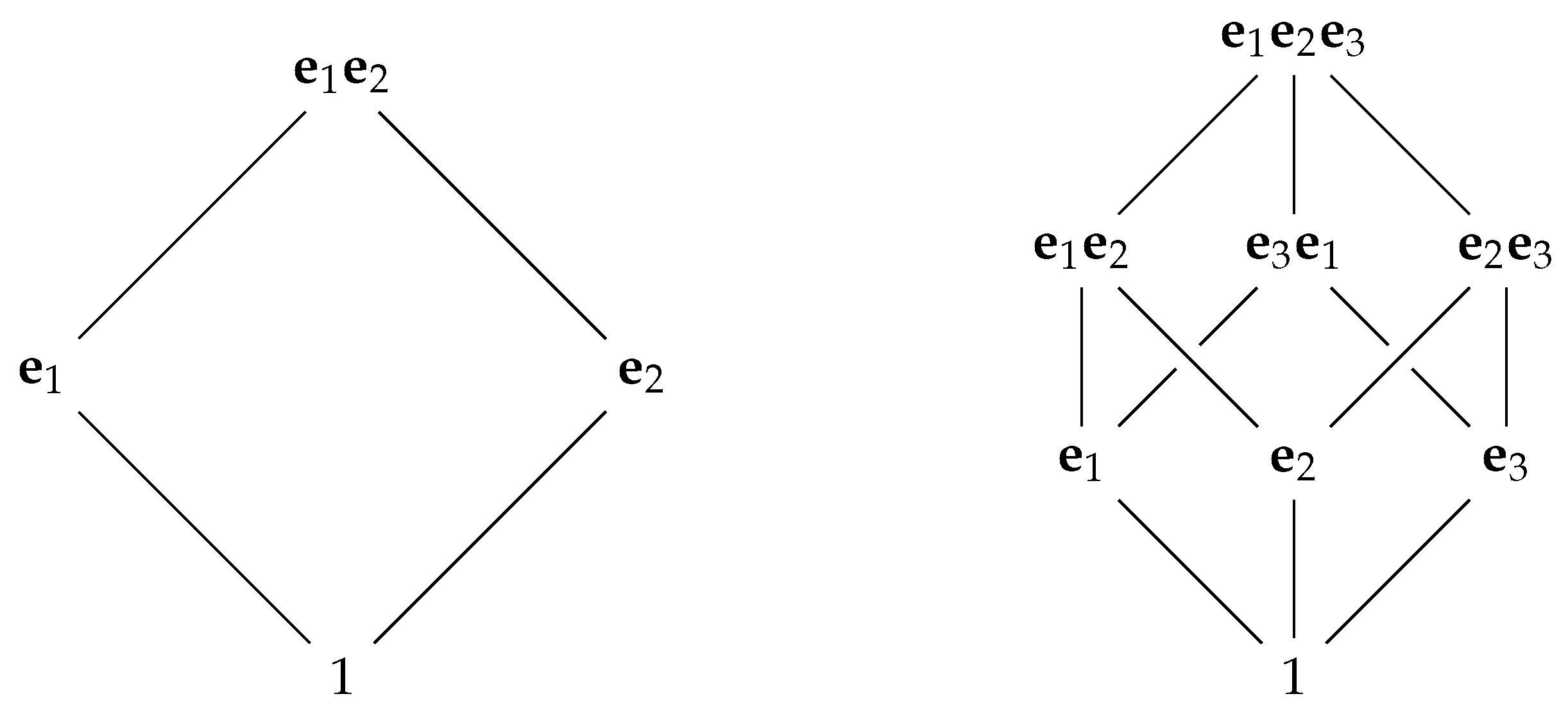

| 0 | 1 | 2 | 3 | 4 | 5 | 6 | 7 | |
|---|---|---|---|---|---|---|---|---|
| 0 | ||||||||
| 1 | ||||||||
| 2 | ||||||||
| 3 | ||||||||
| 4 | ||||||||
| 5 | ||||||||
| 6 | ||||||||
| 7 |
Disclaimer/Publisher’s Note: The statements, opinions and data contained in all publications are solely those of the individual author(s) and contributor(s) and not of MDPI and/or the editor(s). MDPI and/or the editor(s) disclaim responsibility for any injury to people or property resulting from any ideas, methods, instructions or products referred to in the content. |
© 2024 by the authors. Licensee MDPI, Basel, Switzerland. This article is an open access article distributed under the terms and conditions of the Creative Commons Attribution (CC BY) license (http://creativecommons.org/licenses/by/4.0/).


