1. Introduction
Given the World Bank (2016) study, many researchers have been interested in Nigeria's Urbanisation because of the increased population growth. The United Nations Population Fund also predicted less than a year ago that urbanisation would rise in the next twenty years, especially in developing countries (United Nations, 2007a). However, rapid urbanisation is propelling most nations' economies, particularly the developed ones.
As globalisation links towns across the globe, it presents opportunities for better access to goods, services, and jobs for the impoverished in developing nations and beyond. Being hubs for civilisations and cultures, with their unquestionable potential, they have provided job opportunities, housing, security and access to social amenities. Okpoko and Oluwatayo (2014) say these would make inhabitants live in a safe, healthy, sustainable, and more convenient environment. Urbanisation in developing countries differs from the above expectations, and many urban dwellers and their governments need clarification.
Urbanisation opportunities are in short supply due to the unavailability of resources, infrastructure, services, and proper planning. The African urbanisation process has consequently been called "pseudo-urbanisation". For example, it is generally known that cities and urban centres are different; there needs to be a defined meaning of what exactly makes a city (Dirmann, 2020). A metropolitan area is a contentious issue that makes it challenging to determine the level of urbanisation in developing countries. For example, many developing countries must regularly conduct censuses, making it difficult to obtain up-to-date or reliable data on population distribution (Giok, 2008). Urbanisation trends, therefore, lead to Urban renewal and growth and link to sustainable urban development as a solution to Urban trends (Johnson, 2020).
This paper aims to assess urbanisation, urban renewal, and sustainable urban development in Nigeria in view of the governmental policies that affect urbanisation trends, urban renewal and sustainable urban development. The primary data used for this paper were from archival materials—publications from agencies such as the World Bank and the United Nations. The objectives of this paper are as follows:
i) To evaluate the Nigerian cities experiencing urban trends. ii) To examine the causes of urbanisation in developing cities. iii) To investigate the policies that foster urbanisation, urban renewal and sustainable urban development in Nigeria.
The significance of this research is that it reviews the causes and effects of urbanisation trends, urban renewal, sustainable urban development, and the interaction between Nigeria's economic and social development.
This paper reviews current literature on urbanisation, urban renewal, and sustainable urban development in Nigeria from published journals in Scopus, ScienceDirect, Research Gate, World Bank and the United Nations.
2. Global Urbanisation Trends
Urbanisation is becoming the world's most influential human social change, especially in developing countries. However, what are the global effects of urbanisation? What forces are driving the urbanisation trends?
Urbanisation is a sign of modernisation. It is also known as a process in which a population continues to flow into urban areas, the non-agricultural industries (manufacturing and service industries) concentrate and develop, and the structure of human society gradually transforms. Urbanisation drives economic development, changes the urban form, and influences production and manufacturing technologies, citizen lifestyles, societal values, and beliefs. However, urbanisation can negatively impact social equity, public health, and the natural environment (Gu, 2019). Leveraging the positive effects of urbanisation while mitigating the adverse effects is necessary for sustaining urban progress and improving human settlements. Otherwise, the "urban disease" and regional inequalities caused by urbanisation will become increasingly severe, especially in rapidly urbanising countries. Urbanisation has transformed the natural geography in the following ways: The alteration of topography and geomorphology has flattened the landscapes of built-up areas—human beings (Gu, 2019).
Urbanisation is a complex process that involves various factors and driving forces. Urbanisation has gradually become one of the most common attributes of economic growth globally. As urbanisation and economic development are related, the economic development of a country shows the enhancement of its population's economic development and the standard of living. Urbanisation depends on shifting overpopulation from rural to urban areas with the gradual growth of some industrialised urban centres. People from villages tend to move towards urban areas in search of job opportunities, as manufacturing industries and industrial activities offer job opportunities to those migrating from rural areas to cities. As urbanisation processes continue to dominate regional and national development, migration and immigration trends are transforming the sociocultural composition of urban regions and introducing a growing spectrum of cultural diversity (Auwalu, 2021).
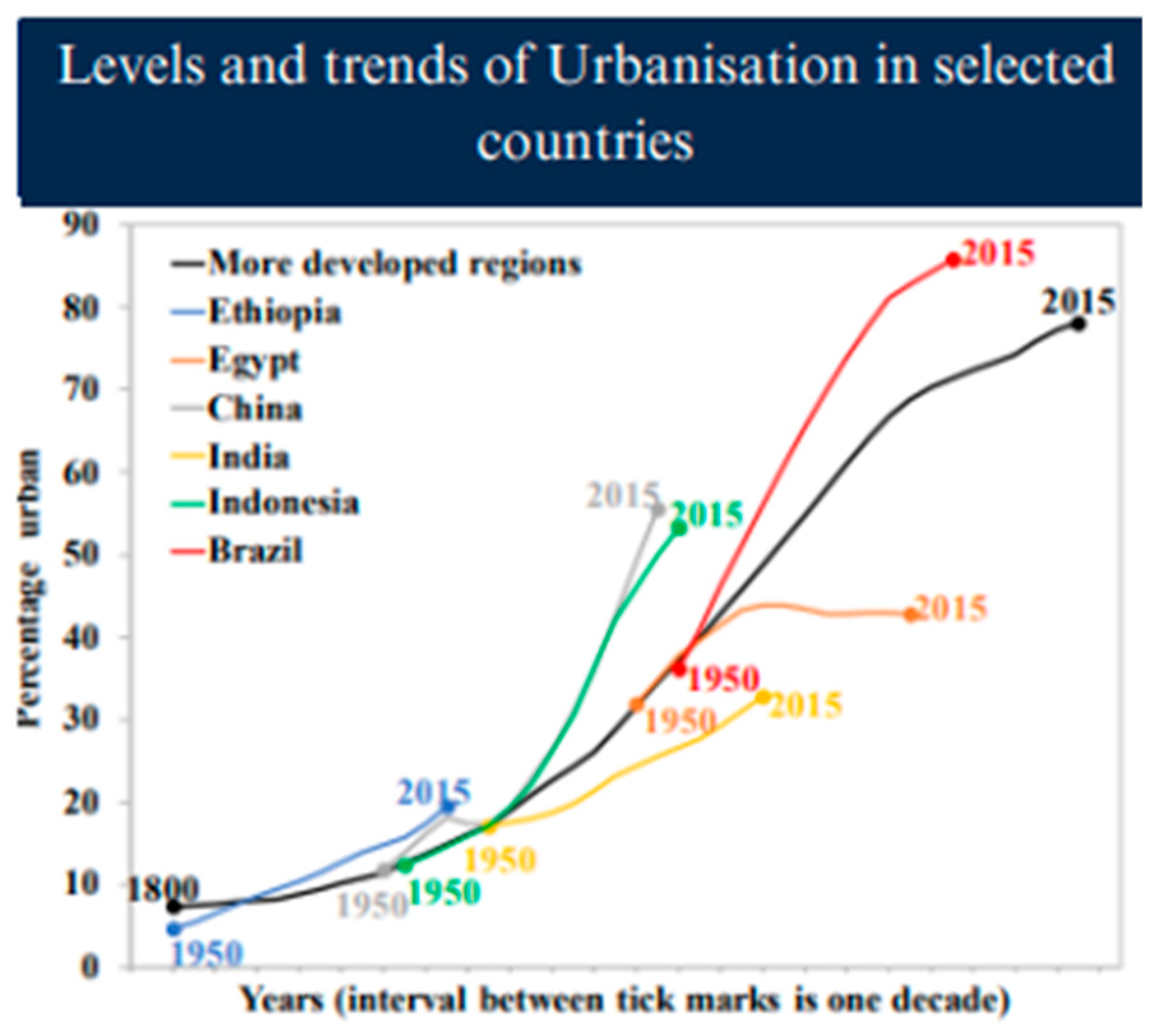
Figure 1 below shows the number of years, the levels and trends in population growth in certain countries.
2.1. Causes Of Urbanisation Trends
When a large population migrates to developed regions (towns and cities), it leads to the concept of urbanisation. The causes of urbanisation are as follows:
i) Industrialisation: an increased trend that shifted from ancient agricultural practices to non-agricultural jobs, creating a modernised society. An increasing number of people have moved from rural to urban areas for better job opportunities connected with industrialisation. People can work with various industrial sectors to increase economic growth (Gu, 2019).
ii) Commercialisation: Different types of merchandise contribute to urbanisation. The continuous distribution of goods, services, and commercial transactions has developed many institutions and companies, resulting in the rapid growth of cities. It is a general perception in people's minds that commercialisation and trading in towns and cities usually provide better opportunities. iii) Rural-urban transformation: Due to the discovery of mineral resources and the exploitation of specific agricultural practices, various areas have become more prosperous and buoyant, and as a result, cities have begun to emerge. It is well-known that increased productivity generates economic growth and higher value-added employment opportunities. This trend has contributed to developing lands for use in the socio-economic development of institutions, transportation, and residential buildings (Gu, 2019). iv) Rural-urban Migration: Rural-to-urban migration refers to shifting people from rural to urban areas to seek better opportunities (The Borgen Project, 2021). This transformation, known as "urban transition," brings countries' economies from rural-driven to urban-driven (Fan, 2022).
2.2. Effects of Urbanisation Trends on Developed and Developing Countries
According to Science China Earth Sciences, urbanisation processes can be observed in different countries, as stated below:
i) Economic growth and development: Urbanisation creates economic growth and development. As countries grow economically, people migrate from rural areas to urban centres for better job opportunities and higher living standards. ii) Demographic change: Changes in population demographics, such as ageing populations or declining birth rates, can also drive urbanisation. For example, as the population ages, more people may move to cities to be closer to healthcare facilities. iii) Social transformation: Social changes and the rise of the middle class, or changing gender roles, can also drive urbanisation. For example, as more women enter the workforce, they may move to cities for better job opportunities. iv) Reshaped and stretched urban spaces: Urbanisation can also result in changes in the physical landscape of cities. For example, new neighbourhoods and suburbs were formed as cities grew and expanded.
v) Shrinking cities: Finally, Urbanisation can also result from the decline of certain cities or regions. For example, as industries decline or natural disasters occur, people may move away from specific areas (Gu, 2019).
2.3. Historical Stages of Urbanisation Trends
Urbanisation relates to the increased movement of people from rural areas, which results in the formation of cities from a small number of people. The following highlights the historical stages of urbanisation trends:
i) Preindustrial Cities: People have roamed for sustenance for most of history. Small permanent settlements emerged during the Neolithic Period (around 10,000 BCE). Cities with populations exceeding 100,000 existed in classical antiquity. By the mid-1960s, about one-quarter of the population resided in urban centres. Early towns were close-knit due to limited transportation and water supply ranges. Archaeological evidence suggests high population density in 2000 BCE cities (Construction Market, 2023). ii) Industrial Cities: The revolution of industrial cities started in the 18th - 19th centuries due to rapid urbanisation. Factories, railways, and technological advancements attracted people to cities. Urban centres grew significantly, and new infrastructure emerged. Population density increased, and cities faced challenges like sanitation and housing. iii) Metropolitan Megalopolitan Cities: Urbanisation intensified globally during the Post-World War II. Megacities (with millions of inhabitants) and significant cities expanded. Regional to mid-sized cities (500k to 5 million inhabitants) also grew (World Economic Forum, 2019). Asia and Africa became influential economic hubs. India, China, and Nigeria are projected to drive significant urban growth by 2050. The Challenges include infrastructure development and services for growing populations (Construction Market, 2023).
Urbanisation continues to shape our world, impacting economies, societies, and the environment. As cities evolve, addressing infrastructure needs will be necessary.
2.4. Urbanisation Trends in Nigeria
Nigeria's population growth, falling death rate, and consistently high fertility are the leading causes of Urbanisation (World Bank, 2017). In Nigeria, the urbanisation process has been characterised by fast growth, with cities fostering increased productivity and efficiency. However, urbanisation has drawbacks, like poor environmental conditions, expensive urban transportation, and restricted access to essential services.
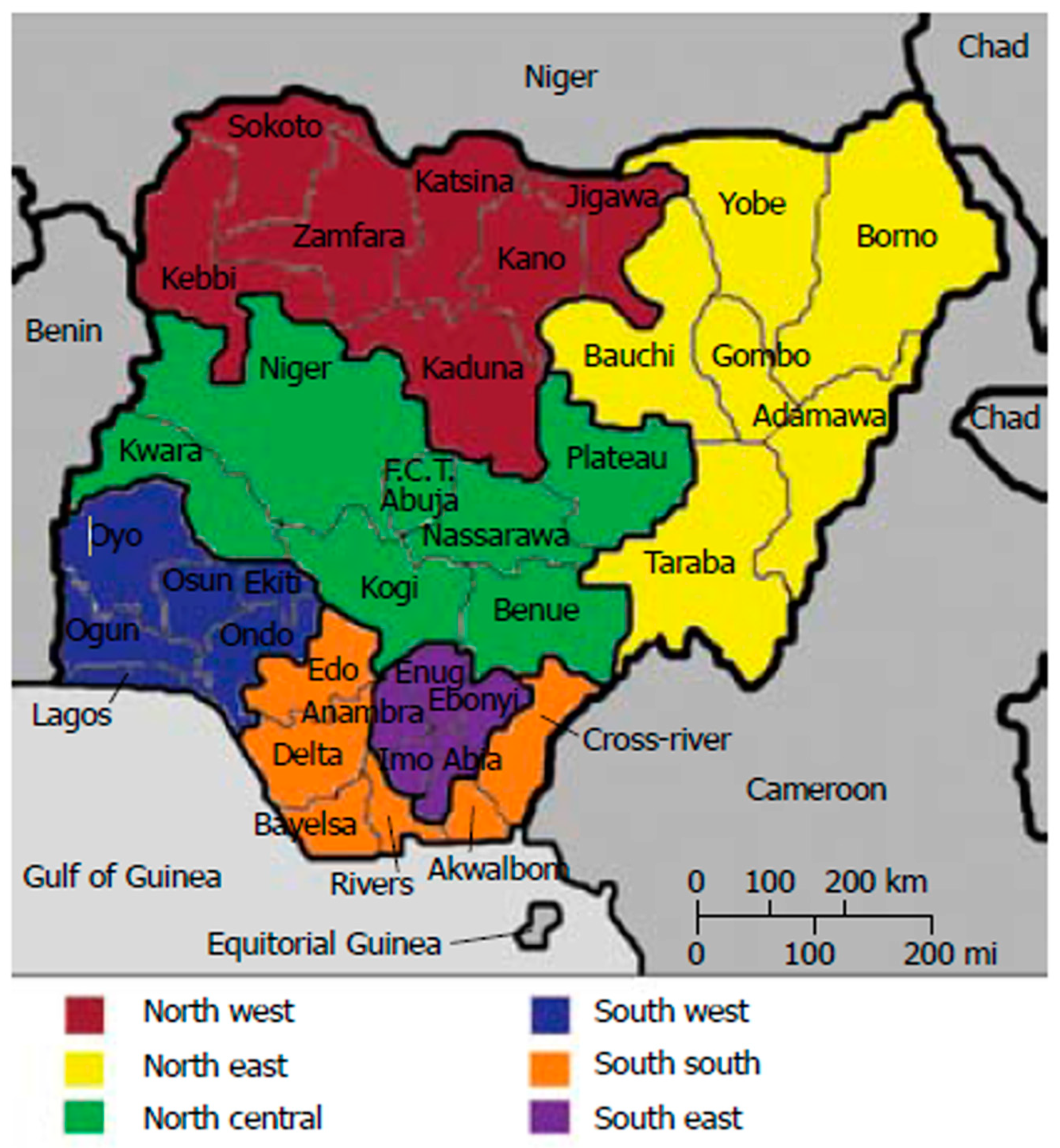
The increase in the urban population in Nigeria results from the expansion of existing built-up areas and the emergence of new and identifiably 'urban' settlements (Avis, 2019; BLOCH et al., 2015). At the national scale, urban expansion has been focused on four urban fields which are:
i) a northern conurbation centred on Kano, with an east-west axis roughly extending from Funtua to Hadejia and a north-south axis stretching from Katsina to Zaria;
ii) a newly formed central conurbation extending from Jos in the northeast to Abuja in the southwest;
iii) A conurbation in the southwest that stretches from Akure in the east to Lagos in the south and Ilorin in the north;
iv) a region that spans Benin City, Port Harcourt, Calabar, and Enugu in a roughly square area to the southeast.
While urban growth results from rural-urban migration, the importance of urban natural increase and reclassification due to rural densification (Bloch, 2015) has been widely underrecognised. In contrast, rural-urban migration has likely been more generally overstated in Nigeria and sub-Saharan Africa (SSA) (Fox, 2015).
There has been a massive increase in rural and urban settlements (on several accounts of more than 10,000 and more than 20,000 inhabitants). These 'emerging' towns and cities have lower population densities than the established urban settlements, with accumulated infrastructure contributing to urban expansion with the ongoing enlargement of existing urban boundaries. While rural-urban migration is not the main contributor to overall urban population growth in Nigeria (Bloch, 2015), it nevertheless plays a vital role in urbanisation (defined narrowly as the urban proportion of the total population (Fox, 2015).
Overview of the Nigerian Urban System from a Historical Perspective
The urban system had grown since the early mediaeval period (about the 7th century). It was especially noticeable in the country's north before the incursion of European powers in the second half of the 19th and early 20th centuries (Mabogunje, 1965). This system started around trans-Saharan trade. The Hausa States and the Kanem Empire centred on Borno were part of a trade network stretching northwards across the Sudan region to North Africa and European ports. Urban settlements also developed in the southwestern Yoruba part of the country around the same time (Bloch, 2015). These towns were initially a result of Yoruba colonisation rather than as a consequence of long-distance trade but soon became trading centres themselves (Mabogunje, 1965). The colonial period transformed the urban system by changing the distribution pattern of towns in the country (Fourchard, 2003). New towns emerged as administrative headquarters (such as Kaduna and Nsukka), while others became industrial centres (Jos and Enugu). Before British rule, urbanisation was focused in the north and southwest, and the southeast had a predominantly rural character (Abumere, 1994). The colonial powers encouraged the Urbanisation of southeastern Nigeria by creating four significant cities for processing and exporting raw materials: Port Harcourt, Aba, Enugu, and Owerri (Bloch, 2015).
The 1917 Township Ordinance was established in three categories: first, second, and third class, which remains ambiguous due to the population size and the traditional size of the towns, which do not emerge as determining factors.
Lagos was the only city that was signified as a first-class town, with 18 classified as second-class towns and 50 as third-class towns, primarily located in the south (ibid). The classification resulted in an uneven distribution of amenities and infrastructure. Cities in the south, especially the coastal cities, ports, and railway lines, were privileged at the expense of northern cities, leading the latter to decline. This process resulted in uneven urban development between the country's north and south urban areas. These changes in the post-independence urban landscape were connected to the transformations in the administrative sector.
Furthermore, three regions, the Northern, Western, and Eastern regions, with capitals at Kaduna, Ibadan, and Enugu, respectively, and Lagos as the federal capital, were created. In addition, a fourth Midwestern region (with Benin City as the capital) was added in 1963, which resulted in an increase in the number of states to 12 in 1967 and 19 in 1976—currently, 36 states and the Abuja Federal Capital Territory (FCT) (Bloch, 2015).
3. Urban Renewal and Growth in Nigeria
Urban renewal is known to often lead to the displacement of inhabitants whose homes and livelihoods are deteriorated to make way for new developments.
While urban regeneration, rehabilitation, and redevelopment share similarities with the concept of urban renewal, they differ significantly in scale, with urban renewal primarily involving large-scale work with physical change as its primary goal (Zheng, 2014). Slums, poverty, and urbanisation are closely related and present significant obstacles to developed and developing countries. However, developing countries like Nigeria are not exempt from these issues, which are more severe there (Bakare G., 2014). Urbanisation has been a major demographic trend in Nigeria, most especially in the major cities across the country in the last half of the century, because of the relative increase in both social and economic development that is presently resulting in the uncontrolled population growth of Nigerian significant cities, some of which are manifesting in the unnecessary pressures on available infrastructure, environmental degradation, traffic congestion, housing shortages, and high levels of crime. Urban poverty poses a significant issue because there is social exclusion, unemployment, homelessness, a lack of paid income, vulnerability to environmental risks, and poor health in major cities in Nigeria.
In contrast, the result of these challenges and manifestations is the growth of slums, squatter settlements, shacks, and dirty rundown housing that are already becoming permanent structures in major cities in Nigeria. Urban renewal is transforming the urban environment by controlling it extensively and comprehensively to improve the lives of those who live in cities now and in the future (Dimuna, 2010; Osuide, 2004). Zienlenbach and Levin (2000) defined urban renewal as the physical reconstruction of deteriorated areas, enhancing public infrastructure, removing undesirable people or private organisations, and generating new jobs. Urban renewal primarily uplifts a decaying urban area to restore its economic vitality, which is vital to sustainable development and improves the overall safety of people living in such urban areas (Norris, 2007). Gbadegesin and Aluko (2010) conclude that urban renewal overhauls the congestion in urban centres, helps to stimulate economic growth, creates environmentally friendly opportunities for private investments, and improves and expands developmental opportunities for sustainable development (Planning and Land Bureau, 2001). Therefore, Zheng (2014) posits that urban renewal is a comprehensive strategy for promoting land values, enhancing environmental quality, addressing the issue of urban decay, and achieving the different socio-economic goals for sustainable development (Auwalu, 2021).
3.1. Urban Renewal Strategies
Given the study done by Urban Renewal Strategy (URS), 2011, urban renewal replans and restructures affected urban areas; designs efficient and environmentally friendly transportation networks; provides public and recreational facilities; provides timely building and road maintenance and rehabilitation; provides purposefully built housing for various groups of people, including groups with special needs and people with disabilities; and preserves historical and culturally significant building structures and sites. Urban renewal enhances metropolitan areas' physical, environmental, and socio-economic aspects through various techniques, including redevelopment, rehabilitation, revitalisation, and heritage preservation (Gulli & Zazzi, 2011). These strategies are crucial in addressing this growth's ecological, social, and economic issues. These four effective urban renewal strategies are stated below:
Redevelopment
The government employs this strategy within specific project areas to improve the urban centre's physical, social, economic, and environmental vibrancy independently or in collaboration with private developers (Auwalu, 2021). Redevelopment typically entails clearing land to construct new projects, reusing it, and demolishing or removing existing infrastructure, buildings, and other structures. It positively affects urban centre growth by encouraging restoration and improvement, prioritising sustainable development in these areas (Auwalu, 2021).
Rehabilitation
Rehabilitation refers to conservation or preservation and is a means to maintain, mend, and rebuild urban areas' built and natural environments. It is generally suitable for urban areas where infrastructure, buildings, or other structures are structurally sound but have deteriorated over time due to neglect. The study done by Duzcu (2006) also explains that urban rehabilitation eliminates any physical obstacles contributing to urban decline and enhances existing structures and infrastructure while maintaining the urban fabric's original character (Auwalu, 2021).
Revitalisation
It is a thorough urban renewal plan that blends the most effective redevelopment and rehabilitation techniques. Roberts and Sykes (2000) explain urban revitalisation as a novel approach emphasising an integrated and combined approach to solving urban problems. It entails rebuilding buildings, structures, and infrastructure beyond the scope of realistic rehabilitation. By protecting the urban environment and encouraging enhancing urban centres' physical, environmental, and socio-economic conditions, revitalisation strategies are adaptable methods that help resolve urban issues (Auwalu, 2021).
Preserving Cultural Heritage
This urban renewal strategy includes keeping the historical character of urban centres along with the local identity of the community and preserving and restoring buildings, structures, historical sites, and cultural and architectural heritage. Most metropolitan areas consider historic structures and local landmarks to be valuable assets. Therefore, by protecting historically significant buildings and enhancing historical, cultural, or architectural interest locations, heritage preservation as an urban renewal strategy dramatically improves the distinctiveness of urban centres for sustainable development (Auwalu, 2021).
3.2. Urban Growth and Control in Nigeria
Urban growth and control in Nigeria are complex due to the rapidly changing population and growth rate. Nigeria is known to have development in urban areas, which is a result of the rural-urban migration. Some key areas of focus include the urban centres' economic, infrastructural, and social conditions, the urban sprawl resulting from inefficient growth and development, transportation, and waste management (Jise, 2020).
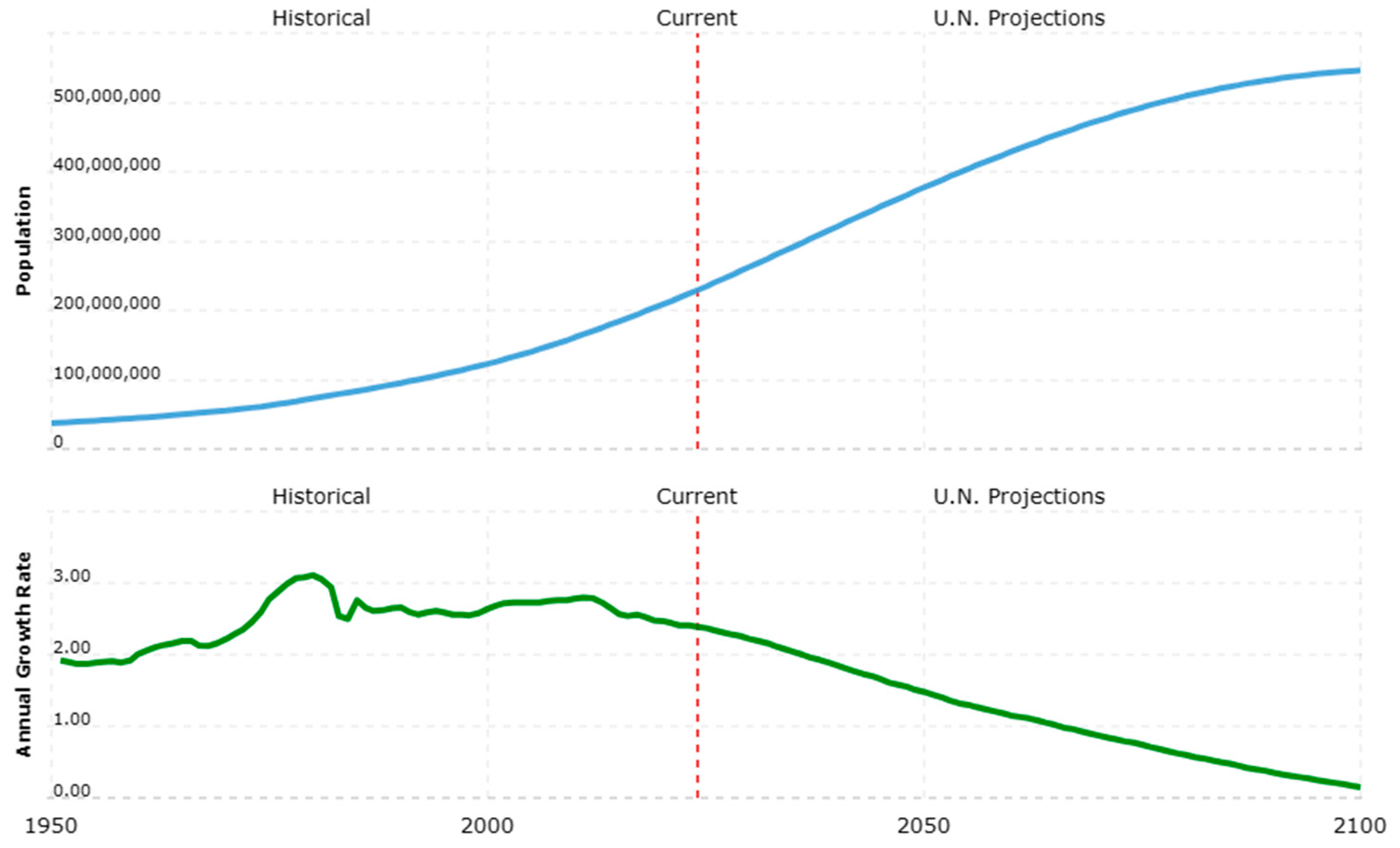
However, it is essential to note that each city has unique challenges. For instance, Kano, the largest city in Northern Nigeria, has experienced tremendous urban growth since the late 10th century, mainly attributed to the influx of people due to socio-economic trading activities (United Nations, 2022). In
Figure 2 below, the current population of Nigeria in 2024 will be
229,152,217, a
2.39% increase from 2023 (United Nations, 2022).
Urban growth and control in Nigeria is a multifaceted issue that requires comprehensive and sustainable solutions.
Figure 3.
Chart of Nigeria's population from 1950 to 2024. United Nations projections are also included through the year 2100. Data Source: United Nations - World Population Prospects (United Nations, 2022).
Figure 3.
Chart of Nigeria's population from 1950 to 2024. United Nations projections are also included through the year 2100. Data Source: United Nations - World Population Prospects (United Nations, 2022).
3.4. Sustainable Urban Development in Nigeria
According to the United Nations (2020), sustainable urban development is a crucial goal for Nigeria, aiming to design communities and cities that are inclusive, safe, resilient, and environmentally sustainable, as outlined in the Sustainable Development Goals (SDGs) set by the United Nations. In order to achieve this, Nigeria has created some relevant institutional frameworks, such as the Nigeria Integrated Sustainable Development Goals (SDG) Model (Ekhator, 2021). These frameworks guide the implementation of the SDGs in Nigeria, focusing on improving living conditions, reducing environmental impact, and promoting inclusive and sustainable urban development. Sustainable urban development in Nigeria is a topic of great importance, and the country has been trying to integrate the Sustainable Development Goals (SDGs) into its national development planning (Dirmann, 2021). The focus of these efforts has been on critical issues such as health and well-being (SDG-3), education (SDG-4), gender equality (SDG-5), enabling an environment of peace and security (SDG-16), and partnerships (SDG-17) (Dirmann, 2021).
For urban sustainability, Sustainable Development Goal 11 aims to make cities and human settlements inclusive, safe, resilient, and sustainable (Oromiya, 2015). The targets under this goal include:
i) To ensure access to adequate, secure, affordable housing and essential services.
ii) To provide access to safe, affordable, accessible, and sustainable transport systems.
iii) To enhance inclusive and sustainable urbanisation.
iv) To reduce the adverse environmental impact of cities and provide universal access to safe, inclusive, and accessible green and public spaces.
Despite the challenges, Nigeria is committed to mainstreaming the SDGs into its medium and long-term development plans. As the country develops a successor development plan to the Economic Recovery & Growth Plan (ERGP), it aims to ensure the active participation of state and non-state actors in the review and reporting processes (The Presidency, 2020). However, achieving sustainable urban development in Nigeria requires addressing several major environmental problems. Nigerian cities are currently witnessing a high rate of environmental deterioration, and they are rated among metropolitan areas with the lowest livability index in the world. Therefore, sustainable urban development in Nigeria is about implementing the SDGs and addressing these environmental challenges.
3.5. Policies that foster Sustainable Urban Development in Nigeria
Urbanisation is a critical aspect of national progress, and well-designed policies play a pivotal role in shaping cities for the better. Here are some key policies and initiatives:
- A)
National Urban Development Policy (NUDP): The NUDP aims to coordinate efforts by all stakeholders to achieve predetermined goals and objectives in Nigeria's urban development sector. It replaces the 2012 edition and emphasises holistic planning, management, and service provision approaches. Key Objectives: i) Efficient Urban Development: Implementing improved urban planning and essential infrastructure services. ii) Accountability: Ensuring tiers of government are accountable for plan preparation and implementation. iii) Private Sector Participation: Encouraging private sector involvement in urban development. iv) Sustainable Goals: Aligning with the Sustainable Development Goals (SDGs) and the New Urban Agenda (NUA) (Uwaegbulam, 2019).
- B)
Urban Planning Laws and Regulations: Nigeria's urban and regional planning laws ensure that development control measures are implemented. These laws establish design, construction, and building use standards, ensuring alignment with overall development plans and public safety.
- C)
Efforts to Implement SDGs: Nigeria actively works toward achieving the SDGs, addressing poverty, inclusive economies, health, education, gender equality, peace, and partnerships. The UN provides technical support to ensure that planning and budgeting align with SDG frameworks (United Nations, 2024).
- D)
Strengthening Institutional Arrangements: The revised policy focuses on restructuring and strengthening institutions for urban development. It aims to make Nigerian cities inclusive, resilient, safe and sustainable, in line with SDG Goal 11. The policy recognises urbanisation's potential for socio-economic and environmental development. It emphasises well-managed urban settlements, economic growth, and improved living standards for all Nigerians (Uwaegbulam, 2019).
Nigeria actively shapes its urban landscape through policy reforms, sustainable planning, and collaboration with international partners. The goal is to create vibrant, resilient cities that enhance the well-being of citizens and promote equitable development.
4. Conclusion and Recommendations
From the findings in the literature, there is clarity in the understanding that most urban centres in Nigeria continue to face a severe challenge due to the increase in urbanisation that has resulted in environmental challenges in urban areas. While urbanisation and urban renewal present significant challenges, they can also offer opportunities for sustainable urban development. By aligning urbanisation and urban renewal strategies with the Sustainable Development Goals (SDGs), Nigeria can work towards creating cities that are inclusive, safe, resilient, and sustainable.
Furthermore, to achieve the goals of recommending practicable solutions to drive sustainable urban development, collaborative efforts need to be made by all stakeholders, including the public and private sectors. Sustainable urban development in Nigeria is a multidimensional issue that requires a multifaceted approach, including policy changes, infrastructure development, environmental protection, and community involvement, which directly involves both the public and private sectors, especially civil society. The process is long-term, but with collaborative efforts, it is achievable.
References
-
Akinlua, James & Meakin, Richard & Umar, Aminu & Freemantle, Nick. (2015). Current Prevalence Pattern of Hypertension in Nigeria: A Systematic Review. PLOS ONE. 10. e0140021. [CrossRef]
-
Auwalu, F. (2021). Urban Renewal as a Tool for the Sustainable Development of Kaduna Urban Area. ResearchGate. Retrieved April 5, 2024, from https://www.researchgate.net/publication/349759203_Urban_Renewal_as_a_Tool_for_the_Sustainable_Development_of_Kaduna_Urban_Area.
-
Avis, W. R. (2019). Urban Expansion in Nigeria. https://core.ac.uk/download/266222793.pdf.
-
Bloch, R., Monroy, J., Fox, S., & Ojo, A. (2015). Urbanisation and Urban Expansion in Nigeria. https://core.ac.uk/download/pdf/96701289.pdf.
-
The Borgen Project. (2021). Rural-Urban Migration and the Developing World. The Borgen Project. https://borgenproject.org/rural-urban-migration/.
-
Construction Market. (2023). Construction Market 2023. Business Research. https://www.thebusinessresearchcompany.com/report/Discount?id=5206&type=discount.
-
Desonie, D. (2024). Geosphere: The Land and its Uses (Our Fragile Planet). https://epdf.tips/geosphere-the-land-and-its-uses-our-fragile-planet.html.
-
Dirmann, J. (2020). Developing National Urban Policies Ways Forward to Green and Smart Cities. Springer. Retrieved April 6, 2024, from https://link.springer.com/book/10.1007/978-981-15-3738-7. [CrossRef]
-
Ekhator, E., Miller, S., & Etinosa, I. (2021). Implementing the Sustainable Development Goals in Nigeria: Barriers, Prospects and Strategies. [CrossRef]
-
Fan, C. (2022). Rural-Urban Migration - Urban Studies. Oxford Bibliographies. Retrieved April 6, 2024, from https://www.oxfordbibliographies.com/display/document/obo-9780190922481/obo-9780190922481-0057.xml.
-
Fox, S. (2015). Urbanisation and Urban Expansion in Nigeria. https://www.researchgate.net/publication/281677412_Urbanisation_and_Urban_Expansion_in_Nigeria.
-
Gu, C. (2019). Urbanization: positive and negative effects. https://linkinghub.elsevier.com/retrieve/pii/S2095927319300751.
-
Jise, D. (2020). An Assessment of Urban Development and Control Mechanisms_in Selected Nigerian Cities. https://www.academia.edu/93576724/An_Assessment_of_Urban_Development_and_Control_Mechanisms_in_Selected_Nigerian_Cities.
-
Johnson, A. (2020). Developing National Urban Policies Ways Forward to Green and Smart Cities. Springer. Retrieved April 5, 2024, from https://link.springer.com/book/10.1007/978-981-15-3738-7. [CrossRef]
-
Olalekan, B. G. (2014). Urbanization, Urban Poverty, Slum and Sustainable Urban Development in Nigerian Cities: Challenges and Opportunities. Developing Country Studies. https://www.iiste.org/Journals/index.php/DCS/article/download/15980/16153.
-
Oromiya. (2015). The Addis Ababa Master Plan Violates the UN Sustainable Development Goals. libration for oromiya. http://librationfororomiya.blogspot.com/2016/01/.
-
The Presidency. (2020). Nigeria National Development Planning A Second Voluntary National Review. Sustainable Development. Retrieved April 6, 2024, from https://www.wits.ac.za/media/wits-university/about-wits/documents/Nigeria%202020%20VNR_June%202020.pdf.
-
United Nations. (2022). World Population Prospects 2022. Population Division. https://population.un.org/wpp/.
-
United Nations. (2024). Sustainable Development Goals. United Nations in Nigeria. https://nigeria.un.org/en/sdgs.
-
Uwaegbulam, C. (2019). New urban development policy underway. The Guardian Nigeria. https://guardian.ng/property/urban-development/new-urban-development-policy-underway/.
-
World Bank. (2017). https://elibrary.worldbank.org/doi/10.1596/978-1-4648-0792-3_ch1.
-
World Economic Forum. (2019). The dramatic global rise of urbanization | World Economic Forum. The World Economic Forum. https://www.weforum.org/agenda/2019/09/mapped-the-dramatic-global-rise-of-urbanization-1950-2020/.
|
Disclaimer/Publisher’s Note: The statements, opinions and data contained in all publications are solely those of the individual author(s) and contributor(s) and not of MDPI and/or the editor(s). MDPI and/or the editor(s) disclaim responsibility for any injury to people or property resulting from any ideas, methods, instructions or products referred to in the content. |
© 2024 by the authors. Licensee MDPI, Basel, Switzerland. This article is an open access article distributed under the terms and conditions of the Creative Commons Attribution (CC BY) license (http://creativecommons.org/licenses/by/4.0/).