

Submitted:
22 December 2024
Posted:
23 December 2024
You are already at the latest version
Abstract
The Next Generation Science Standards (NGSS) highlight the importance of students engaging in scientific discourse and argumentation as a core part of students’ learning development. A key Science and Engineering Practice outlined in the NGSS is "Engaging in Argument from Evidence," which inspires students to compare and evaluate claims, critically analyze the reasoning and evidence supporting different situations, and construct well-reasoned arguments to support or refute scientific explanations. Thus, the primery objective of this paper is to identify patterns in scientific argumentation research, including the keywords, objectives, research methods, and instruments used in studies published in the ESERA conference proceedings from 2011 to 2021. A mix of quantitative and qualitative content analysis methodology was employed to examine the trends in argumentation and discourse studies published by ESERA. The results indicated that the proportion of articles focused on argumentation and scientific discourse ranged between 3.8% and 6.6%, with the highest publication rate occurring in 2017 at 6.6%. In terms of keywords, no clear consistent pattern was observed in their occurrence across the argumentation and discourse articles; however, keywords related to classroom and discourse, argumentation, context and content, thinking skills, and learning processes were the most common. These articles primarily focused on addressing several objectives; however, the articles addressing investigating discourse analysis and argumentation, and exploring student learning and understanding comprised more than 60% of the contentt. In terms of research methodologies, qualitative approaches were the most commonly used, comprising more than three-quarters of the studies. The leading data collection tools included document and transcript analyses and case studies. The findings can provide evidence-based indicators of the growing importance of research in discourse and argumentation, which is increasingly recognized as crucial due to its strong connection with the emergence of new standards such as the Next-Generation Science Standards (NGSS). The NGSS standards emphasize the significance of scientific and engineering practices, particularly those involving the construction of evidence-based arguments.
Keywords:
1. Introduction
1.1. The purpose of the Research
- What are the percentages of articles related to argumentation and discourse published in ESERA proceedings from 2011 to 2021?
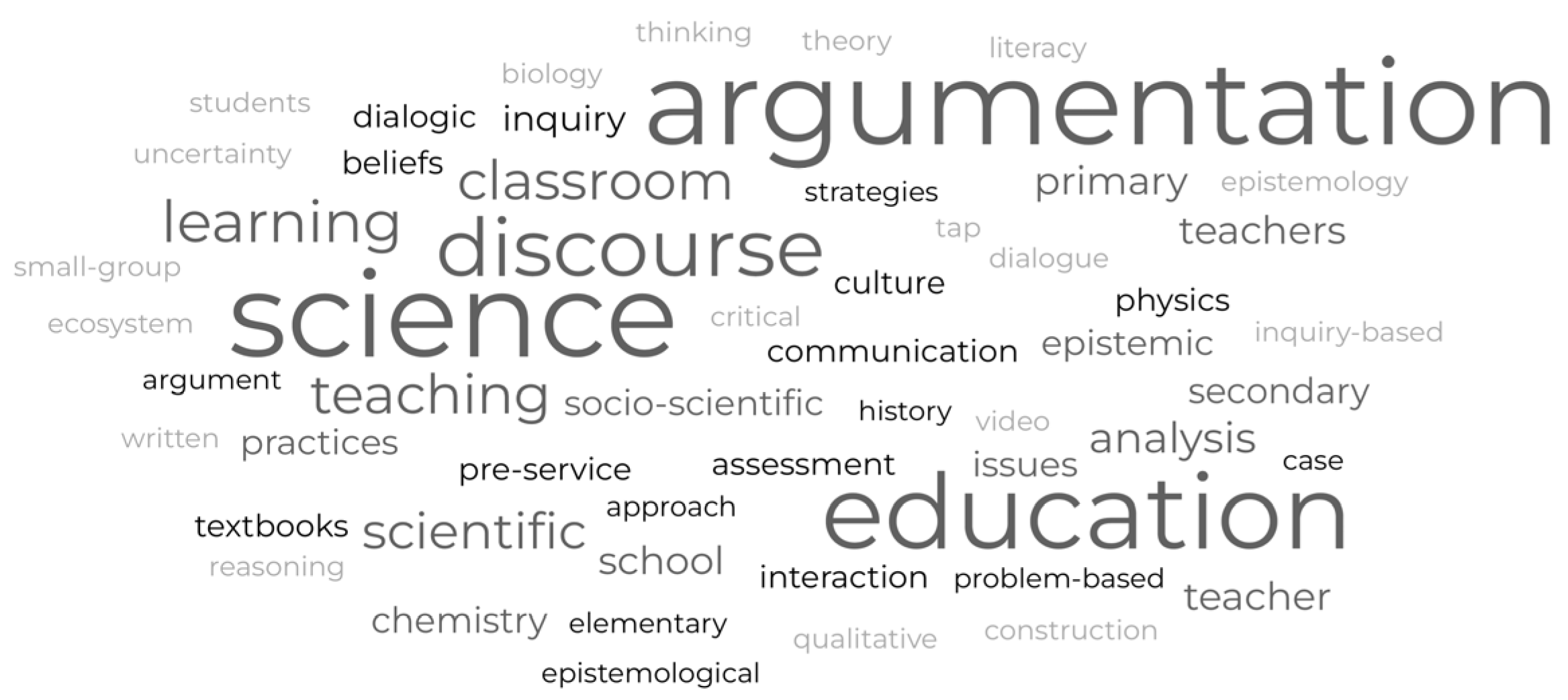
- What are the trend-related keywords published in ESERA proceedings from 2011 to 2021?
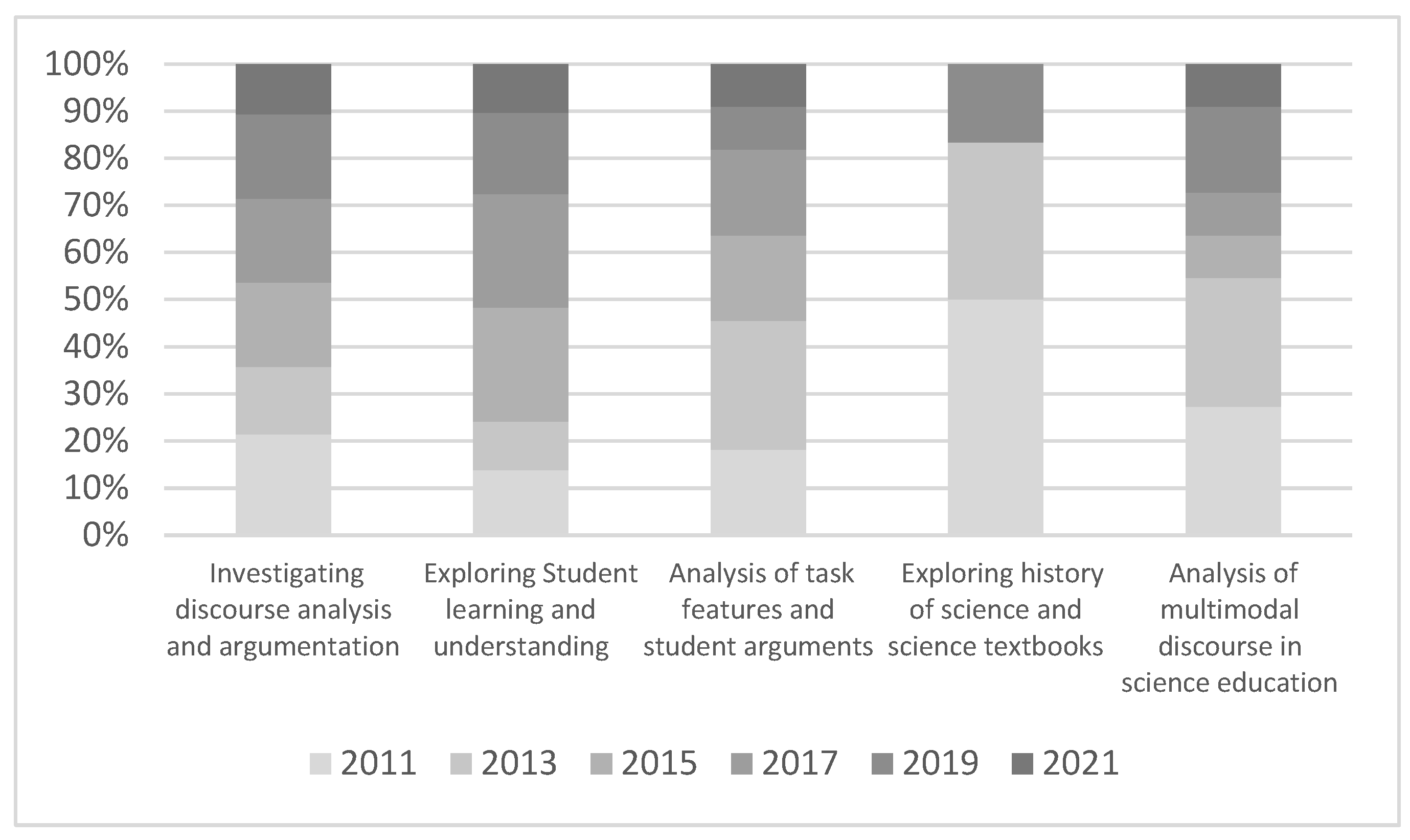
- What are the goals and focus of the research on argumentation in science education published in ESERA proceedings from 2011 to 2021?
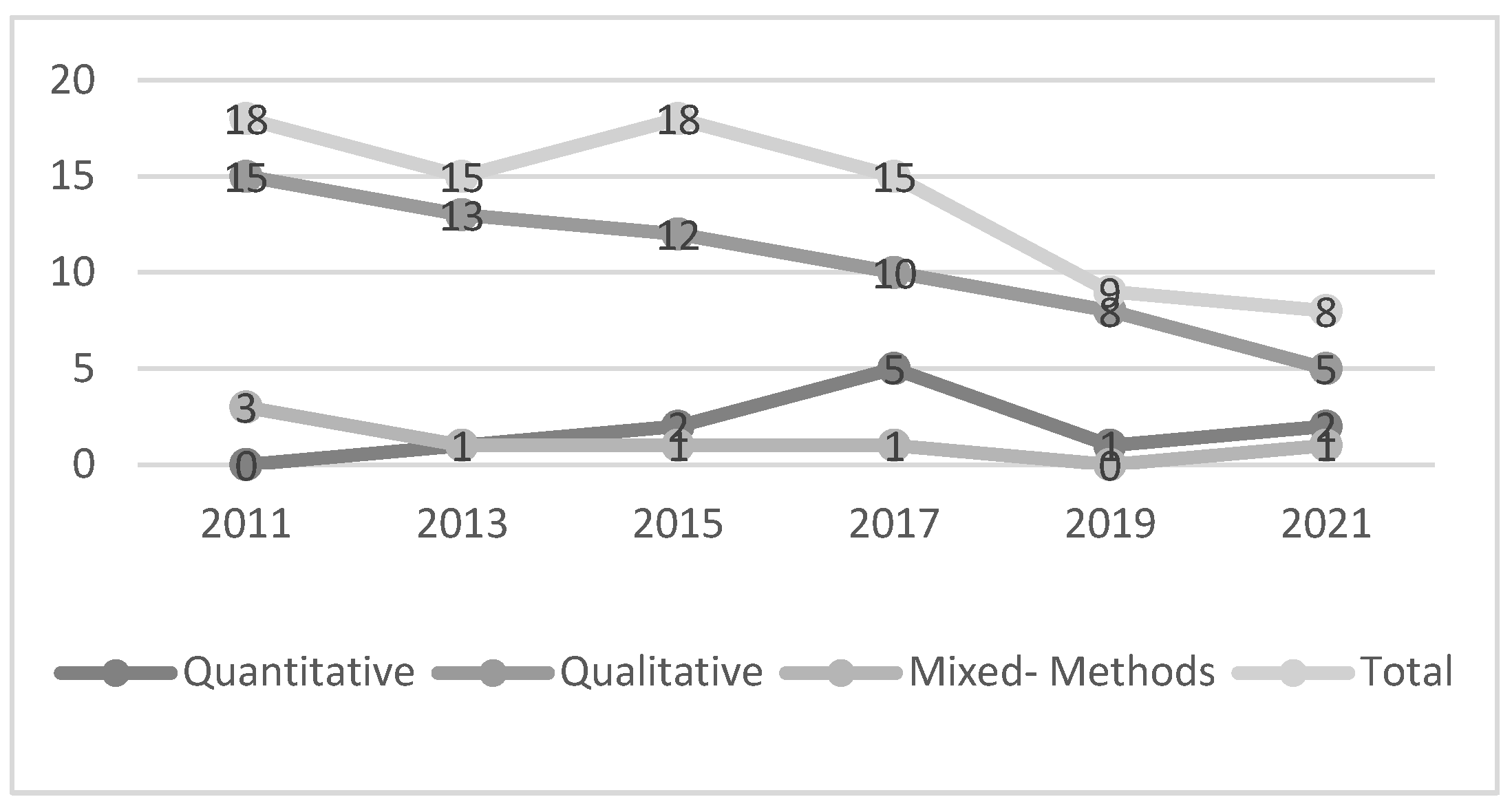
- What are the most common methodologies used in argumentation research in science education published in ESERA proceedings from 2011 to 2021?
- What are the most common instruments used in argumentation research in science education published in ESERA proceedings from 2011 to 2021?
2. Method
2.1. Procedures
2.2. Sample
2.3. Instrument
- Searching and screening: Developing criteria for including or excluding studies in the review, searching through electronic databases to find studies that meet the established criteria, and then evaluating the identified studies to determine if they meet the inclusion criteria.
- In-depth review and data-extraction: Summarizing and evaluating the contents of studies according to pre-determined categories.
- Synthesis: Providing an overview of the quality and relevance of the studies included in the in-depth review and compiling and weighing the collective findings from the studies.
2.4. Validity and Reliability
3. Research Findings
3.1. The Percentages of Articles Related to Argumentation and Discourse Presented in ESERA Proceedings from 2011 to 2021

| Year | 2011 | 2013 | 2015 | 2017 | 2019 | 2021 | Total |
| No. of all strands in each proceeding | 14 | 16 | 19 | 18 | 18 | 17 | 102 |
| No. of all articles | 303 | 322 | 326 | 243 | 238 | 162 | 1594 |
| No. of articles in the argumentation and discourse strand | 18 | 15 | 15 | 16 | 9 | 8 | 81 |
| % of argumentation and discourse articles | 5.9 | 4.7 | 4.6 | 6.6 | 3.8 | 5.00 | 5.1 |
3.2. Trend-Related Keywords and Sub-Keywords
3.3. Identifying the Goals of Focuses of the Published Research
3.4. Research Methodologies
3.5. Research Instruments
| Instruments | 2011 | 2013 | 2015 | 2017 | 2019 | 2021 | Total | |
| Surveys and questionnaires | 2 | 0 | 2 | 6 | 1 | 2 | 13 | 13.27% |
| Tests | 1 | 2 | 0 | 1 | 0 | 1 | 5 | 5.10% |
| In-depth interviews and focus groups | 1 | 2 | 2 | 3 | 1 | 1 | 10 | 10.20% |
| Observation | 5 | 0 | 2 | 1 | 4 | 0 | 12 | 12.24% |
| Case study | 1 | 3 | 3 | 5 | 2 | 3 | 17 | 17.35% |
| Document and transcript analysis | 10 | 9 | 14 | 4 | 1 | 3 | 41 | 41.84% |
| Total | 20 | 16 | 23 | 20 | 9 | 10 | 98 | 100.00 |
4. Discussion
5. Conclusions and Implications
- This research is a review study that did not include human subjects and, therefore, did not require ethical approval from the ethical community at the University
- Informed consent was obtained from all individual participants included in the study.
References
- Adúriz-Bravo, A., & Revel Chion, A. (2017). Language, Discourse, Argumentation, and Science Education. In K. S. Taber & B. Akpan (Eds.), Science Education (pp. 157–166). Sense Publishers. [CrossRef]
- Aldahmash, A. H., & Alfarraj, Y. F. (2022). Exploring the Integration of Engineering Design Practices in Tenth-Grade Chemistry Activities. Frontiers in psychology, 13, 774022. [CrossRef]
- Aldahmash, A. H., Alshamrani, S. M., Alshaya, F. S., & Alsarrani, N. A. (2019). Research Trends in In-Service Science Teacher Professional Development from 2012 to 2016. International Journal of Instruction, 12(2), 163-178.
- Alfarraj, Y. F., & Althubyani, A. R. (2023). Evaluation of various aspects of the 11th grade engineering curriculum: A mixed-methods study. International Journal of Engineering Education, 39(6), 1400-1416.
- Alfarraj, Y. F., Aldahmash, A. H., & Omar, S. H. (2023). Teachers’ perspectives on teaching science through an argumentation-driven inquiry model: A mixed-methods study. Heliyon, 9(9). [CrossRef]
- Andrée, M. & Viiri, J. (2018). ESERA Proceedings introduction strand 7 "Discourse and Argumentation in Science Education". https://core.ac.uk/reader/228382720.
- Asterhan, C. S., & Schwarz, B. B. (2007). The effects of monological and dialogical argumentation on concept learning in evolutionary theory. Journal of Educational Psychology, 99, 626–639.
- Asterhan, C. S., & Schwarz, B. B. (2009). Argumentation and explanation in conceptual change: Indications from protocol analyses of peer-to-peer dialogue. Cognitive Science, 33(3), 374–400. [CrossRef]
- Baker, D., Bueno-Watts, N., Lewis, E.B., Ozdemir, G., Perkins, G., Uysal, S., Wong, S., & Yasar- Purzer, S. (2008). Discourse in Inquiry Science Classrooms (DiISC): Reference Manual (Tech. Rep. No. 001). Tempe, AZ: Arizona State University, The Communication in Science Inquiry Project (CISIP). https://shorturl.at/pLZkT.
- Bennett, J., Lubben, F., Hogarth, S., & Campbell, B. (2004). A systematic review of the use of small-group discussions in science teaching with students aged 11–18, and their effects on students’ understanding in science or attitude to science. Research evidence in education library. London: EPPICentre, Social Science Research Unit, Institute of Education. [CrossRef]
- Berland, L., & Lee, V. R. (2012). In pursuit of consensus: Disagreement and legitimization during small-group argumentation. International Journal of Science Education, 34(12), 1857–1882. [CrossRef]
- Berland, L., & Reiser, B. (2009). Making sense of argumentation and explanation. Science Education, 93(1), 26–55. [CrossRef]
- Bowman, S. A., Gortmaker, S. L., Ebbeling, C. B., Pereira, M. A., & Ludwig, D. S. (2004). Effects of fast-food consumption on energy intake and diet quality among children in a national household survey. Pediatrics, 113(1), 112-118. [CrossRef]
- Bricker, L.A., & Bell, P. (2008). Conceptualizations of argumentation from science studies and the learning sciences and their implications for the practices of science education. Science Education, 92, 473–498. [CrossRef]
- Chang, S. N., & Chiu, M. H. (2008). Lakatos’ scientific research programmes as a framework for analysing informal argumentation about socio-scientific issues. International Journal of Science Education, 30(13), 1753–1773. [CrossRef]
- Chen, Y. C., Hand, B., & Park, S. (2016). Examining elementary students’ development of oral and written argumentation practices through argument-based inquiry. Science & Education, 25, 277-320. [CrossRef]
- Creswell, J. W. (2014). Research Design: Qualitative, Quantitative and Mixed Methods Approaches (4th ed.). Thousand Oaks, CA: SAGE Publications.
- De Lima, T. M., Jiménez-Aleixandre, M. P., & Mortimer, E. F. (2010). Articulation of conceptual knowledge and argumentation practices by high school students in evolution problems. Science and Education, 19, 573–598. [CrossRef]
- Driver, R., Newton, P., & Osborne, J. (2000). Establishing the norms of scientific argumentation in classrooms. Science Education, 84(3), 287–312. [CrossRef]
- Erduran, S. (2008). Methodological foundations in the study of argumentation in the science classroom. In S. Erduran, & M. P. Jiménez-Aleixandre (Eds.), In Argumentation science education: Perspectives from classroom-based research (pp. 47–69). Dordrecht, Netherland: Springer. https://link.springer.com/content/pdf/10.1007/978-1-4020-6670-2.pdf#page=59.
- Erduran, S., Ozdem, Y., & Park, J. Y. (2015). Research trends on argumentation in science education: A journal content analysis from 1998–2014. International Journal of STEM Education, 2(5), 1-12.
- Erduran, S., Simon, S., & Osborne, J. (2004). TAPping into argumentation: Developments in the application of Toulmin's argument pattern for studying science discourse. Science education, 88(6), 915-933. [CrossRef]
- ESERA. (n.d.). General information - ESERA. https://www.esera.org/conference/.
- Ferrini-Mundy, J. (2000). Principles and standards for school mathematics: A guide for mathematicians. Notices of the American Mathematical Society, 47(8).
- Foong, C., & Daniel, E. (2010). Assessing students’ arguments made in socio-scientific contexts: The considerations of structural complexity and the depth of content knowledge. Procedia-Social and Behavioral Sciences Journal, 9, 1120–1127. [CrossRef]
- Foong, C., & Daniel, E. (2013). Students’ argumentation skills across two socio-scientific issues in a Confucian classroom: Is transfer possible? International Journal of Science Education, 35(14), 2331–2355. [CrossRef]
- Ford, M. (2008). Disciplinary authority and accountability in scientific practice and learning. Science Education, 92(3), 404–423. [CrossRef]
- Ford, M. J. (2012). A dialogic account of sense-making in scientific argumentation and reasoning. Cognition and Instruction, 30(3), 207-245. https://doi.org/10.1080/07370008.2012.689383. [CrossRef]
- Ghebru, S., & Ogunniyi, M. (2017). Pre-service science teachers’ understanding of argumentation. African Journal of Research in Mathematics, Science and Technology Education, 21, 1–12. [CrossRef]
- Golanics, J. D., & Nussbaum, E. M. (2008). Enhancing collaborative online argumentation through question elaboration and goal instructions. Journal of Computer Assisted Learning, 24, 167–180. [CrossRef]
- Gonzalo, M.A. Bermudez1, María E. Ottogalli & Lía P. García (2019). Socioscientific Argumentation: Toulmin’s Argument Pattern for Teaching and Learning of Biodiversity and Its Conservation. 13th ESERA Conference – 2019. https://www.esera.org/esera-2019/.
- Hasnunidah, N., Susilo, H., Irawati, M., & Suwono, H. (2020). The contribution of argumentation and critical thinking skills on students’ concept understanding in different learning models. Journal of University Teaching & Learning Practice, 17(1). [CrossRef]
- Henderson, B., McNeill, K. L., González-Howard, M., Close, K., & Evans, M. (2018). Key challenges and future directions for educational research on scientific argumentation. Journal of Research in Science Teaching, 55(1), 5–18. [CrossRef]
- Iordanou, K. & Kuhn, D., Matos, F., Shi, Y. & Hemberger, L. (2019). Learning by arguing. Learning and Instruction. [CrossRef]
- Jayarajah, K., Saat, R.M. & Rauf, R.A.A. (2014). A review of science, technology, engineering & mathematics (STEM) education research from 1999–2013: A Malaysian perspective. Eurasia Journal of Mathematics, Science & Technology Education, 10(3), 155-163. [CrossRef]
- Jimenez-Aleixandre, M. P. & Erduran, S. (2007). Argumentation in science education: An overview. In S. Erduran and MP Jiménez-Aleixandre (Ed.) In Argumentation in science education: Perspectives from classroom-based research (pp. 3-27). Springer.
- Jiménez-Aleixandre, M. P., & Erduran, S. (2007). Argumentation in science education: An overview. Argumentation in science education: Perspectives from classroom-based research, 3-27.
- Jonassen, D., & Kim, B. (2010). Arguing to learn and learning to argue: Design justifications and guidelines. Educational Technology Research and Development, 58, 439–457. [CrossRef]
- Kalypso, I. & Costas., C. (2013). Promoting students’ evidence-based argumentation skills. A comparison of a dialogic argumentation vs a non-dialogic intervention. Proceedings of Esera Conference, Cyprus.
- Kaya, E. (2013). Argumentation practices in classroom: Pre-service teachers’ conceptual understanding of chemical equilibrium. International Journal of Science Education, 35(7), 1139–1158. [CrossRef]
- Kaya, E., Erduran, S., & Cetin, P. S. (2012). Discourse, argumentation, and science lessons: Match or mismatch between students’ perceptions and understanding? Mevlana International Journal of Education, 2(3), 1–32.
- Khan, B., Khan, O. Y., Zehra, S., Azhar, A., & Fatima, S. (2020). Association between obesity and risk of knee osteoarthritis. Pak J Pharm Sci, 33(1), 295-298.
- Klein, P. D. (2006). The challenges of scientific literacy: From the viewpoint of second-generation cognitive science. International Journal of Science Education, 28, 143–178.
- Landis, J. R., & Koch, G. G. (1977). An application of hierarchical kappa-type statistics in the assessment of majority agreement among multiple observers. Biometrics, 363-374.
- Lauscher, A., Glavas, G., & Eckert, K. (2018). Arguminsci: A tool for analyzing argumentation and rhetorical aspects in scientific writing. In Proceedings of the 5th Workshop on Argument Mining, ArgMining@ EMNLP 2018, Brussels, Belgium, November 1, 2018 (pp. 22-28). Association for Computational Linguistics. [CrossRef]
- Li, Y., Wang, K., Xiao, Y. et al. (2020). Research and trends in STEM education: a systematic review of journal publications. IJ STEM Ed 7, 11. [CrossRef]
- Lin, S. S., & Mintzes, J. J. (2010). Learning argumentation skills through instruction in socioscientific issues: The effect of ability level. International Journal of Science and Mathematics Education, 8, 993-1017.
- Lin, T.C., Lin, T.J. & Tsai, C.C. (2014). Research trends in science education from 2008 to 2012: A systematic content analysis of publications in selected journals, International Journal of Science Education, 36(8), 1346-1372. [CrossRef]
- Lu, J., & Zhang, Z. (2013). Scaffolding argumentation in intact class: Integrating technology and pedagogy. Computer and Education, 69, 189–198. [CrossRef]
- McNeill, K. L., & Krajcik, J. (2007). Middle school students’ use of appropriate and inappropriate evidence in writing scientific explanations. Thinking with Data, 233–265.
- McNeill, K. L., Lizotte, D. J., Krajcik, J., & Marx, R. W. (2006). Supporting students’ construction of scientific explanations by fading scaffolds in instructional materials. The Journal of the Learning Sciences, 15, 153–191. [CrossRef]
- Minogue, J., Madden, L., Bedward, J., Wiebe, E., & Carter, M. (2010). The cross-case analyses of elementary students’ engagement in the strands of science proficiency. Journal of Science Teacher Education, 21, 559-587. [CrossRef]
- Mullis, I. V., Martin, M. O., & von Davier, M. (2021). TIMSS 2023 Assessment Frameworks. International Association for the Evaluation of Educational Achievement. https://files.eric.ed.gov/fulltext/ED618559.pdf.
- National Research Council, NRC. (2012). A framework for K-12 science education: Practices crosscutting concepts, and core ideas. Washington, DC: The National Academies Press.
- Nersessian, N. J. (2004). Interpreting scientific and engineering practices: Integrating the cognitive, social, and cultural dimensions. In Scientific and technological thinking(pp. 17-56). Psychology Press.
- Nersessian, N. J. (2009). How do engineering scientists think? Model-based simulation in biomedical engineering research laboratories. Topics in Cognitive Science, 1(4), 730–757. [CrossRef]
- NGSS Lead States. (2013). Next generation science standards: For states, by states. Washington, DC: The National Academies Press.
- NGSS Lead States. (2014). Where did the water go? Watershed study—Middle school sample classroom task. https://shorturl.at/aZ7yN.
- Norris, S., Philips, L., & Osborne, J. (2007). Scientific inquiry: the place of interpretation and argumentation. In J. Luft, R. Bell & J. Gess-Newsome (Eds.), Science as Inquiry in the Secondary Setting.
- Nussbaum, E. M., & Sinatra, G. M. (2003). Argument and conceptual engagement. Contemporary Educational Psychology, 28, 384–395. [CrossRef]
- OECD. (2023). PISA 2025 science framework draft. https://pisa-framework.oecd.org/science-2025/assets/docs/PISA_2025_Science_Framework.pdf.
- Osborne, J. (2010). Arguing to learn in science: The role of collaborative, critical discourse. Science, 328, 463–466. [CrossRef]
- Osborne, J. F., Borko, H., Fishman, E., Gomez Zaccarelli, F., Berson, E., Busch, K. C., Reigh, E., & Tseng, A. (2019). Impacts of a Practice-Based Professional Development Program on Elementary Teachers’ Facilitation of and Student Engagement with Scientific Argumentation. American Educational Research Journal, 56(4), 1067-1112. [CrossRef]
- Osborne, J., Christodoulou, A., Howell-Richardson, C., & Richardson, K. (2013). Learning to argue: A study of four schools and their attempt to develop the use of argumentation as a common instructional practice and its impact on students. Journal of Research in Science Teaching, 50(3), 315–347. [CrossRef]
- Osborne, J.; MacPherson, A.; Patterson, A., & Szu, E. (2012). Chapter 1: Introduction. In M. S. Khine (Ed.), Perspectives on scientific argumentation: Theory, practice and design. London/New York: Springer Dordrecht Heidelberg. https://link.springer.com/book/10.1007/978-94-007-2470-9.
- Özdem, Y.; Ertepinar, H.; Cakiroglu, J.; & Erduran, S. (2013). The nature of pre-service science teachers’ argumentation in inquiry-oriented laboratory context. International Journal of Science Education, 35(15), 2559–2586. [CrossRef]
- Passmore, C., & Svoboda, J. (2012). Exploring opportunities for argumentation in modelling classrooms. International Journal of Science Education, 34(10), 1535–1554. [CrossRef]
- Perdana, R., Jumadi, J., & Rosana, D. (2019). Relationship between Analytical Thinking Skill and Scientific Argumentation Using PBL with Interactive CK 12 Simulation. International Journal on Social and Education Sciences, 1(1), 16-23.
- Ramage, J. D., Bean, J. C., & Johnson, J. (2016). In Writing arguments: a rhetoric with readings. Pearson.
- Rapanta, C., Garcia-Mila, M., Remesal, A., & Gonçalves, C. (2021). The challenge of inclusive dialogic teaching in public secondary school. Comunicar, 29(66). [CrossRef]
- Rapanta, Chrysi. (2019). Argumentation Strategies in the Classroom. Wilmington. Vernon press.
- Romano, L. G., Condat, M. E., Occelli, M., Masullo, M., & Valeiras, N. (2017). Some Conceptions About Argumentation of In-Service Science Teachers in Córdoba (Argentina). Discourse and Argumentation in Science Education, 945.
- Sadler, T. D. (2006). Promoting discourse and argumentation in science teacher education. Journal of Science Teacher Education, 17(4), 323-346. [CrossRef]
- Sampson, V., & Clark, D. (2009). The impact of collaboration on the outcomes of scientific argumentation. Science Education, 93(3), 448–484. [CrossRef]
- Sampson, V., Enderle, P., & Grooms, J. (2013). Argumentation in science education: Helping students understand the nature of scientific argumentation so they can meet the new science standards. The Science Teacher, 80(5), 30. [CrossRef]
- Sampson, V., Grooms, J., & Walker, J. P. (2011). Argument-driven inquiry as a way to help students learn how to participate in scientific argumentation and craft written arguments: An exploratory study. Science Education, 95(2), 217–257. [CrossRef]
- Simon, S., Erduran, S., & Osborne, J. (2006). Learning to teach argumentation: Research and development in the science classroom. International journal of science education, 28(2-3), 235-260. [CrossRef]
- Tagnin, L., Ní Ríordáin, M., & Fleming, M. (2017). Accessing Science Through Classroom Talk When Adopting a CLIL Approach. Proceedings of Esera Conference, Ireland.
- Topcu, M., Sadler, T., & Yilmaz-Tuzun, O. (2010). Pre-service science teachers’ informal reasoning about socio-scientific issues: The influence of issue context. International Journal of Science Education, 32(18), 2475–2495. [CrossRef]
- Toulmin, S. E. (2003). The uses of argument: Updated edition. In The Uses of Argument: Updated Edition. [CrossRef]
- Van Dijk, T. (1993). The principles of Critical Discourse Analysis. Discourse and Society, 4(2). 249–283.
- Van Eemeren, F. H., & Grootendorst, R. (2004). A systematic theory of argumentation: The pragma-dialectical approach. Cambridge: Cambridge University Press. [CrossRef]
- Van Eemeren, F. H., van Eemeren, F. H., Jackson, S., & Jacobs, S. (2015). Argumentation. Reasonableness and effectiveness in argumentative discourse: Fifty contributions to the development of Pragma-dialectics, 3-25. [CrossRef]
- Venville, G. J., & Dawson, V. (2012). The impact of a classroom intervention on grade 10 students’ argumentation skills, informal reasoning, and conceptual understanding of science. Journal of Research in Science Teaching, 47(8), 952–977. [CrossRef]
- Xie, Q., & So, W. W. M. (2012). Understanding and practice of argumentation: A pilot study with Mainland Chinese pre-service teachers in secondary science classrooms. Asia-Pacific Forum on Science Learning and Teaching, 13(2), 3–20.
- Zembal-Saul, C. (2009). Learning to teach elementary school science as argument. Science Education, 93(4), 687–719. [CrossRef]
- Zohar, A. (2007). Science teacher education and professional development in argumentation. In Argumentation in science education: Perspectives from classroom-based research (pp. 245-268). Dordrecht: Springer Netherlands. [CrossRef]
| Domain | 2011 | 2013 | 2015 | 2017 | 2019 | 2021 | Total | % |
| Classroom Interactions and Discourse | 15 | 9 | 4 | 4 | 5 | 4 | 41 | 15.36 |
| Context and Content | 26 | 17 | 16 | 13 | 8 | 7 | 87 | 32.58 |
| Argumentation | 10 | 7 | 9 | 10 | 2 | 2 | 40 | 14.98 |
| Thinking Skills and Learning Processes | 8 | 7 | 20 | 12 | 8 | 6 | 61 | 22.85 |
| Specific Subject Areas | 7 | 4 | 2 | 1 | 3 | 2 | 19 | 7.12 |
| Evaluation and Assessment | 3 | 1 | 0 | 1 | 0 | 1 | 6 | 2.25 |
| Systemic and Cultural Aspects | 3 | 2 | 5 | 3 | 0 | 0 | 13 | 4.87 |
| Total | 74 | 47 | 56 | 44 | 26 | 22 | 267 | 100 |
| Domain | 2011 | 2013 | 2015 | 2017 | 2019 | 2021 | Total | |||||||
| # | % | # | % | # | % | # | % | # | % | # | % | # | % | |
| 1. Investigating discourse analysis and argumentation | 6 | 35 | 4 | 26.7 | 5 | 33.33 | 5 | 31.2 | 3 | 33.3 | 3 | 37.5 | 26 | 32.1 |
| 2. Exploring Student learning and understanding | 4 | 24 | 3 | 20 | 7 | 46.67 | 5 | 31.2 | 3 | 33.3 | 3 | 37.50 | 25 | 30.8 |
| 3. Analysis of task features and student arguments | 2 | 12 | 3 | 20. | 2 | 13.33 | 1 | 6.2 | 2 | 22.2 | 1 | 12.50 | 11 | 13.6 |
| 4. Exploring history of science and science textbooks | 3 | 18 | 2 | 13. | 0 | 0.00 | 1 | 6.2 | 0 | 0.00 | 0 | 0.00 | 6 | 7.4 |
| 5. Analysis of multimodal discourse in science education | 3 | 18 | 3 | 20 | 1 | 6.67 | 2 | 12.5 | 0 | 0.00 | 1 | 12.50 | 10 | 12.4 |
| Total | 18 | 100% | 15 | 100% | 15 | 100% | 16 | 100% | 9 | 100% | 8 | 100% | 81 | 100% |
| Methodology | 2011 | 2013 | 2015 | 2017 | 2019 | 2021 | Total | |||||||
| No. | % | No. | % | No. | % | No. | % | No. | % | No. | % | No. | % | |
| Quantitative | 0 | 0 | 1 | 6.67 | 2 | 13.33 | 5 | 31.25 | 1 | 11.11 | 2 | 25 | 11 | 13.58 |
| Qualitative | 15 | 83.33 | 13 | 86.67 | 12 | 80 | 10 | 62.5 | 8 | 88.89 | 5 | 62.5 | 63 | 77.78 |
| Mixed- Methods | 3 | 16.67 | 1 | 6.67 | 1 | 6.67 | 1 | 6.25 | 0 | 0 | 1 | 12.5 | 7 | 8.6 |
| Total | 18 | 100 | 15 | 100 | 15 | 100 | 16 | 100 | 9 | 100 | 8 | 100 | 81 | 100 |
Disclaimer/Publisher’s Note: The statements, opinions and data contained in all publications are solely those of the individual author(s) and contributor(s) and not of MDPI and/or the editor(s). MDPI and/or the editor(s) disclaim responsibility for any injury to people or property resulting from any ideas, methods, instructions or products referred to in the content. |
© 2024 by the authors. Licensee MDPI, Basel, Switzerland. This article is an open access article distributed under the terms and conditions of the Creative Commons Attribution (CC BY) license (http://creativecommons.org/licenses/by/4.0/).


