
Submitted:
19 December 2024
Posted:
20 December 2024
You are already at the latest version
Abstract
Collision avoidance and path planning are critical topics in autonomous vehicle development. This paper presents the progressive development of an optimization-based controller for autonomous vehicles using the Control Lyapunov Function - Control Barrier Function - Quadratic Programming (CLF – CBF - QP) approach. This framework enables the vehicle to navigate to its destination while avoiding obstacles. A unicycle model is utilized to incorporate vehicle dynamics. A series of simulations were conducted, starting with basic model-in-the-loop (MIL) non-real-time simulations, followed by real-time simulations. Multiple scenarios with different controller configurations and obstacle setups were tested, demonstrating the effectiveness of the proposed controllers in avoiding collisions. Real-time simulations in Simulink were used to demonstrate that the proposed controller could compute control actions for each state within a very short timestep, highlighting its computational efficiency. This efficiency underscores the potential for deploying the controller in real-world vehicle autonomous driving systems. Furthermore, we explored the feasibility of a hierarchical control framework comprising a Deep Reinforcement Learning (DRL) specifically Deep Q-Network (DQN) based high-level controller and a CLF-CBF-QP-based low-level controller. Simulation results show that the vehicle can effectively respond to obstacles and generate a successful trajectory towards its goal.
Keywords:
1. Introduction
2. Methodology
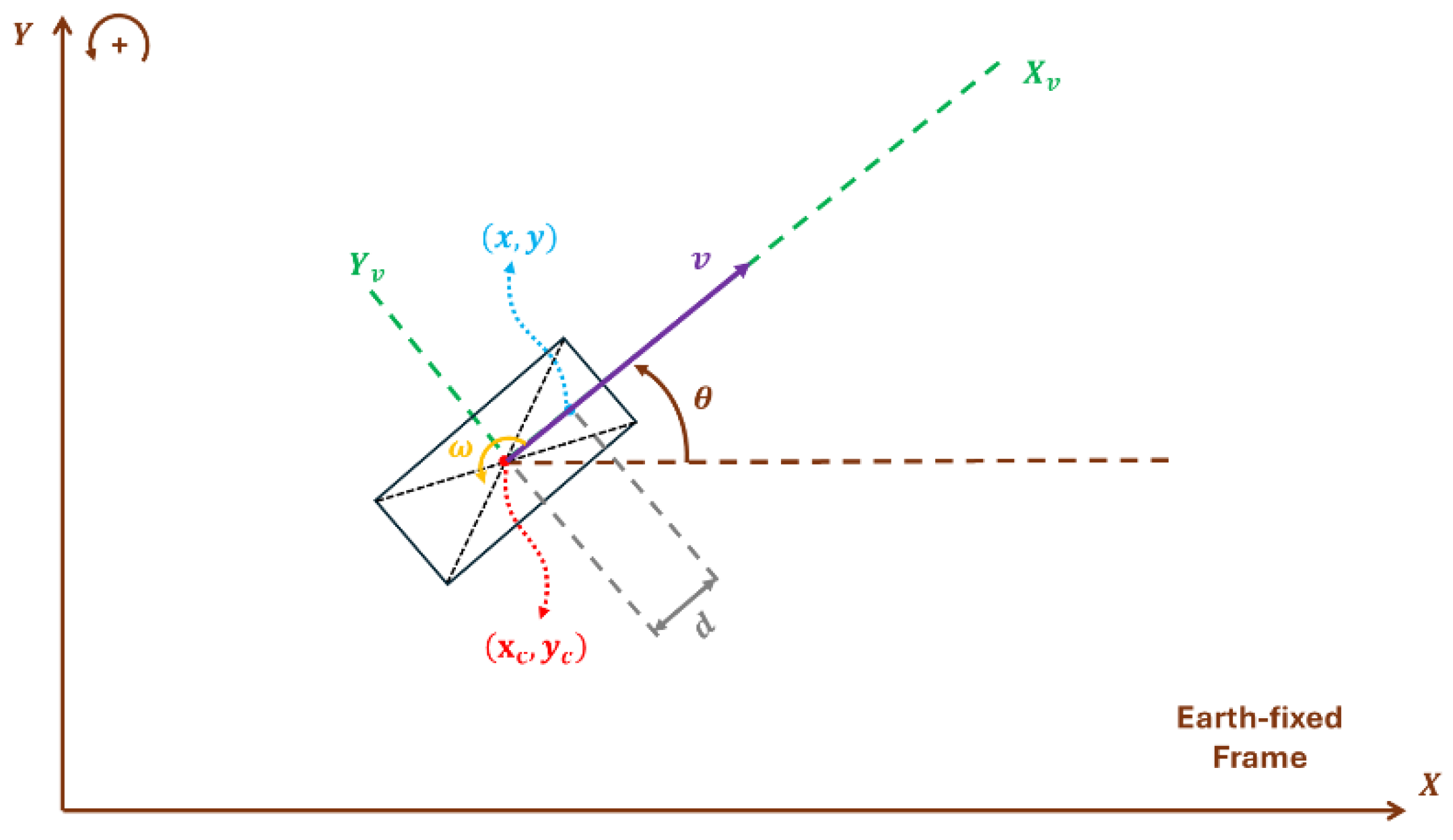
2.1. Unicycle Vehicle Dynamics
2.2. Control Lyapunov Functions and Control Barrier Functions
2.2.1. Control Lyapunov Function Principle and Design
- (1)
- Positive definiteness:where is the equilibrium point.
- (2)
- Sublevel set boundedness: For a given constant , the sublevel set, is bounded. This ensures that defines a meaningful region of attraction (ROA) around .
- (3)
- Stability: There exists a control input such that the derivative of along the trajectory of the system satisfies:
2.2.2. Control Barrier Functions Principle and Design
2.2.3. CLF-CBF-QP Formulation
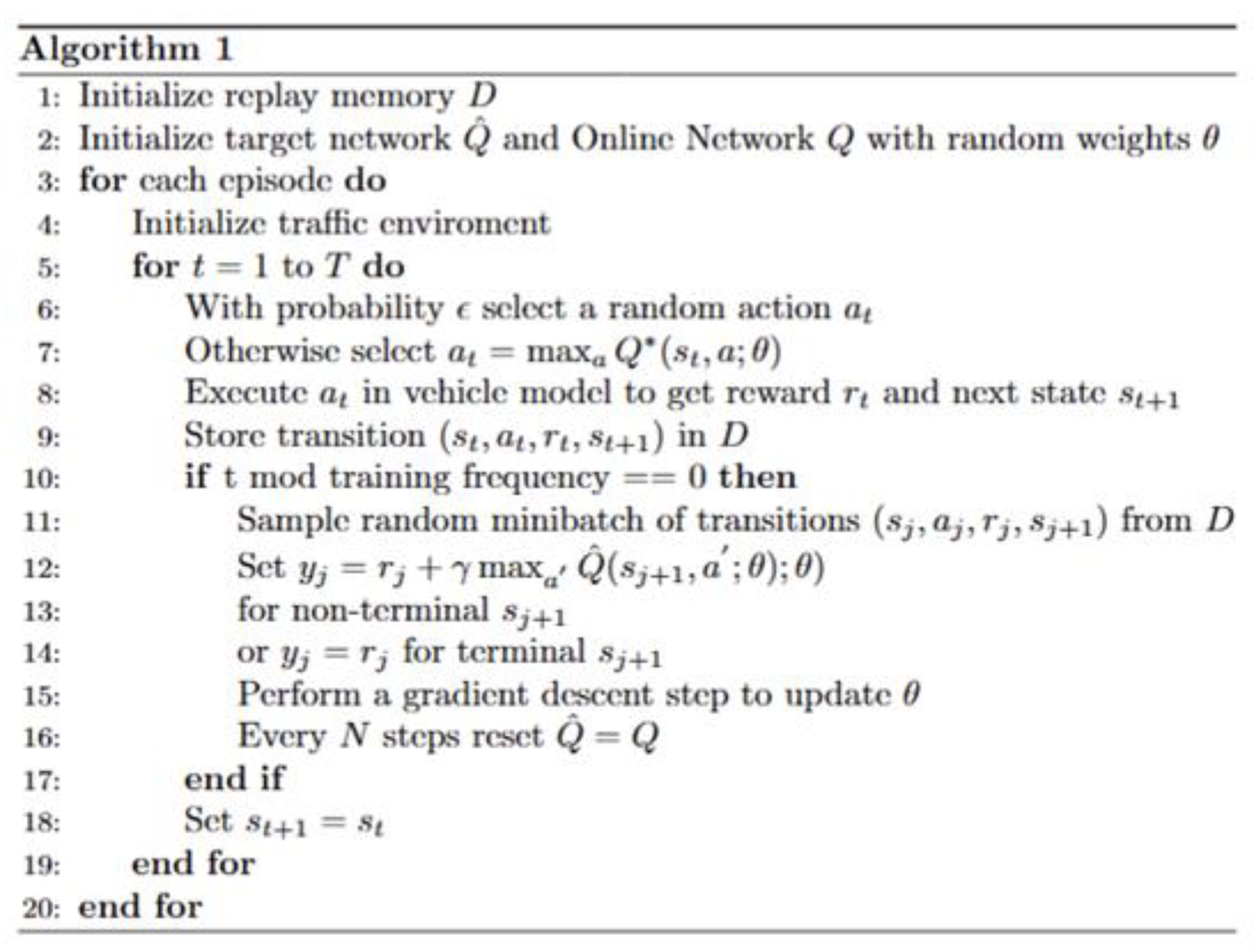
2.3. Deep-Reinforcement-Learning
3. Results
3.1. CLF-CBF Based Optimization Controller
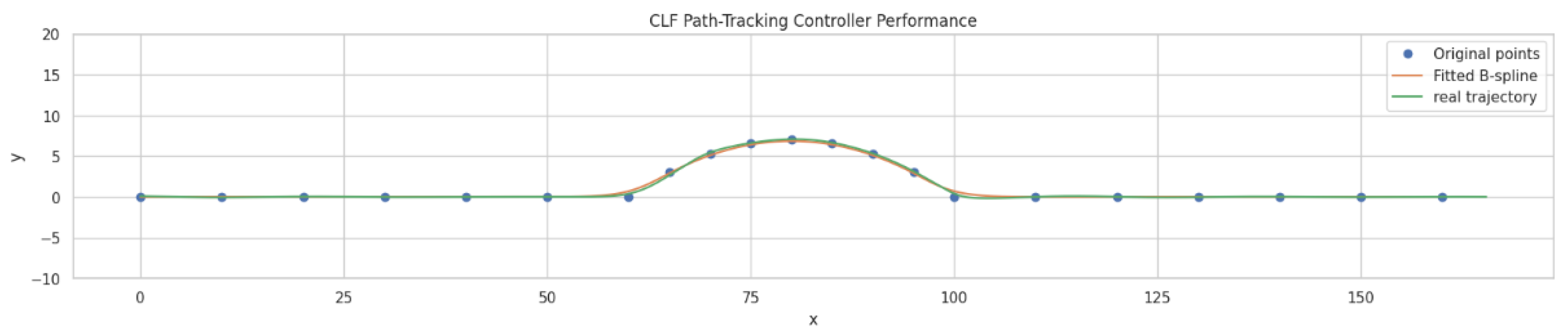
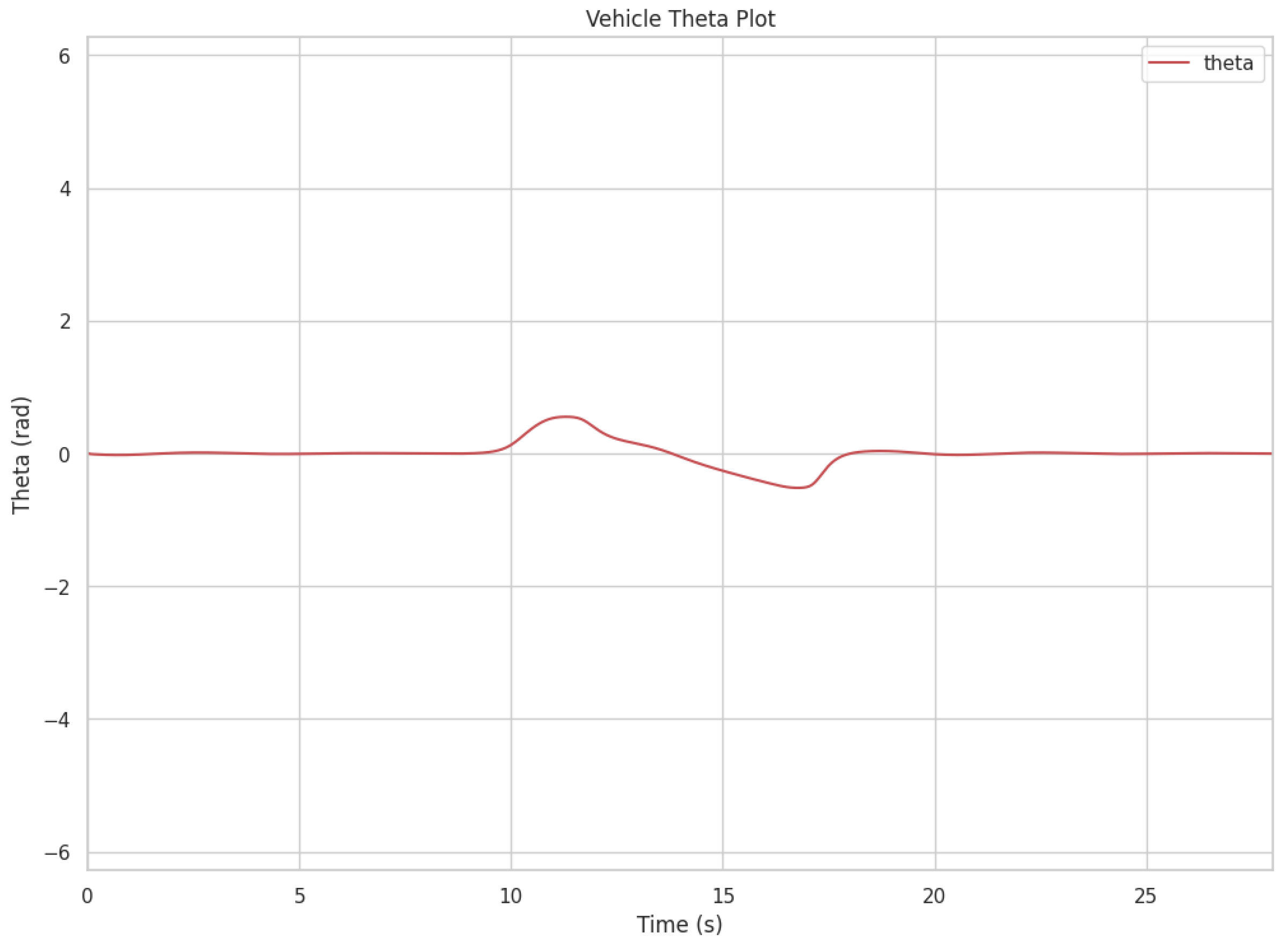
3.1.1. CLF Based Path Tracking Controller
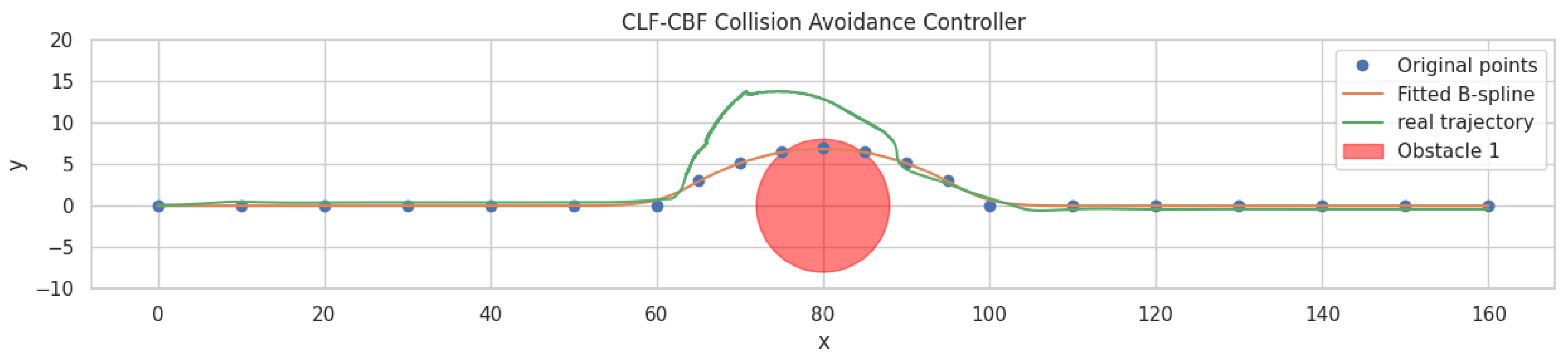
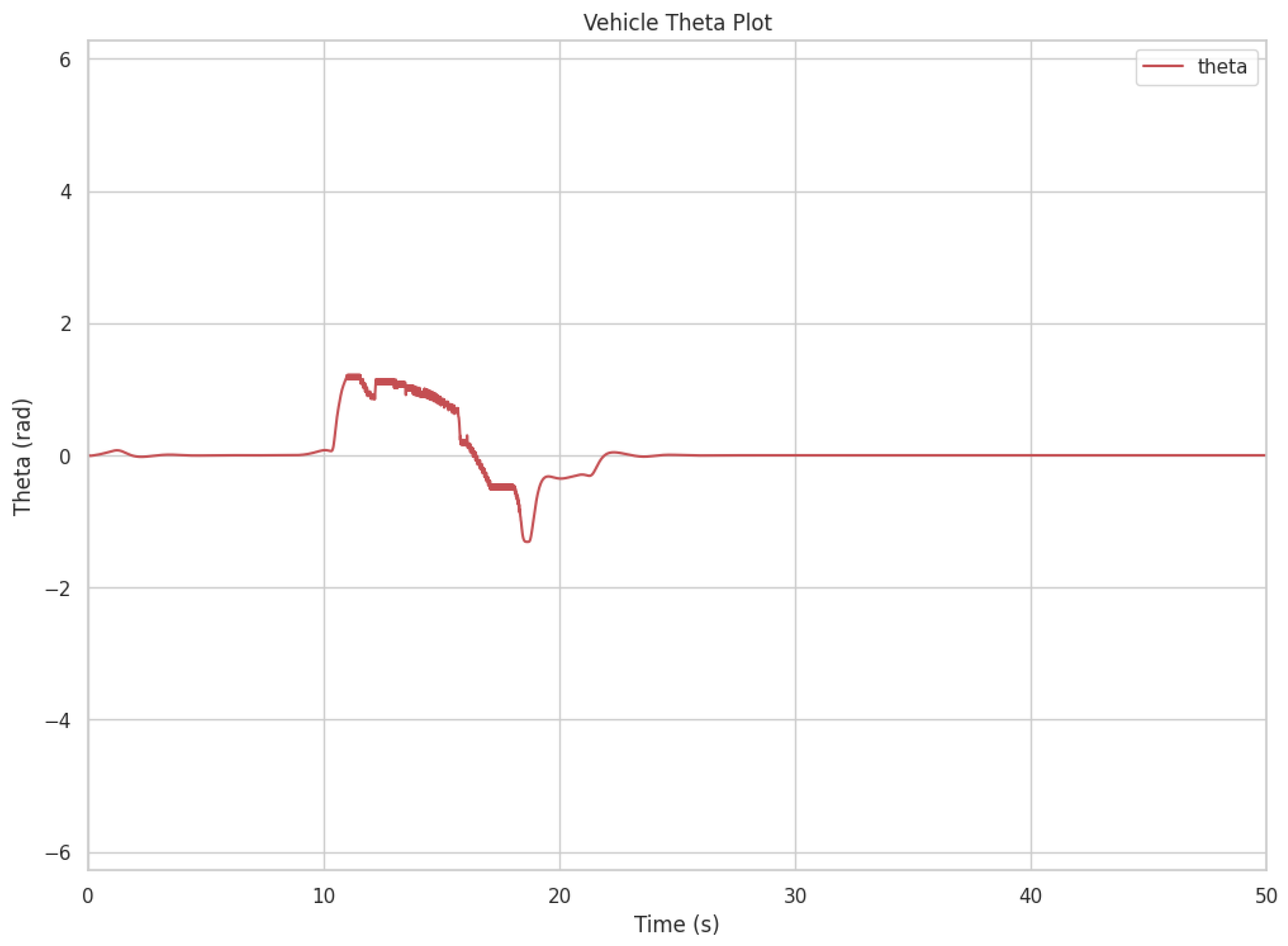
3.1.2. CLF-CBF Based Autonomous Driving Controller for Static Obstacle
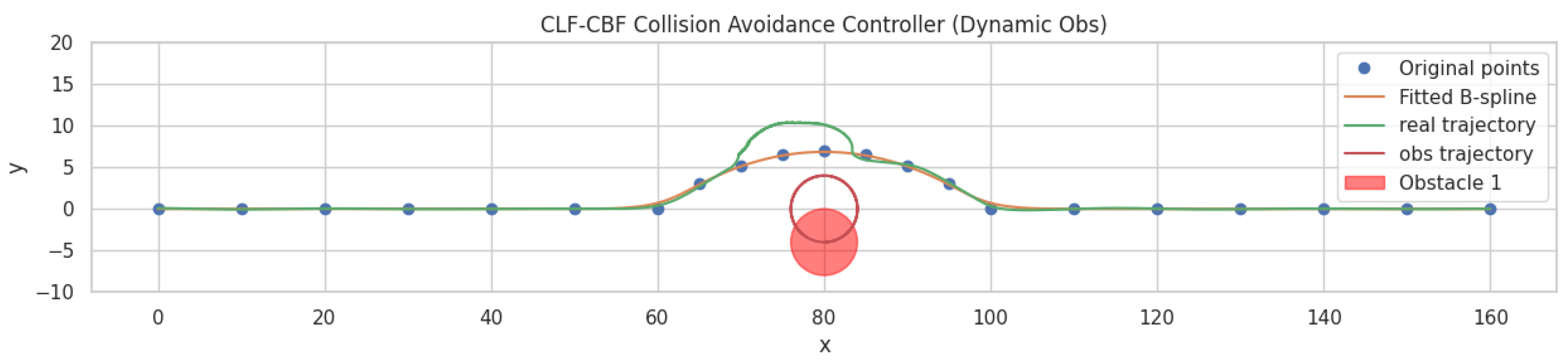
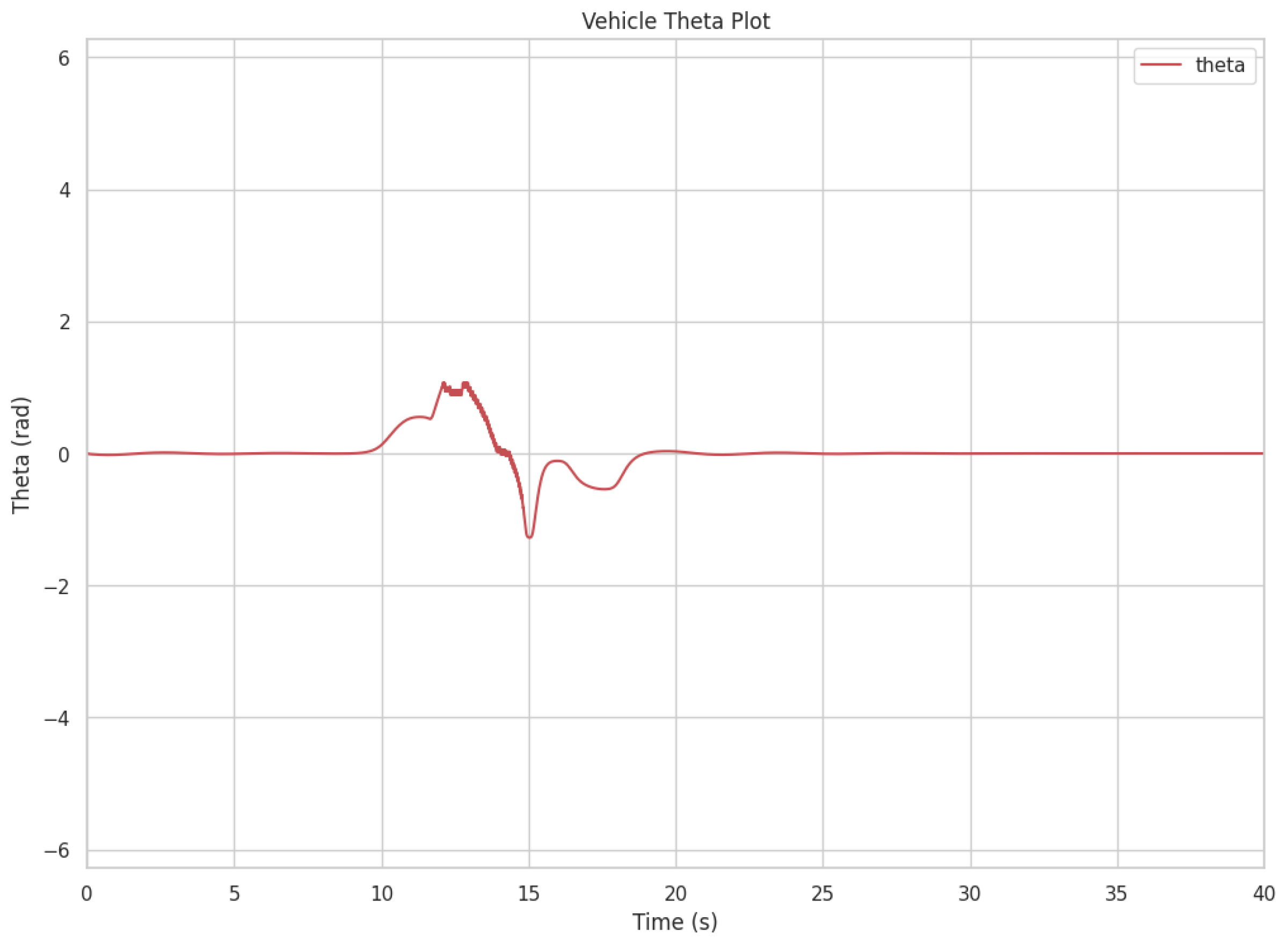
3.1.3. CLF-CBF Based Autonomous Driving Controller for Dynamic Obstacle
3.2. Hybrid DRL and CLF-CBF Based Controller
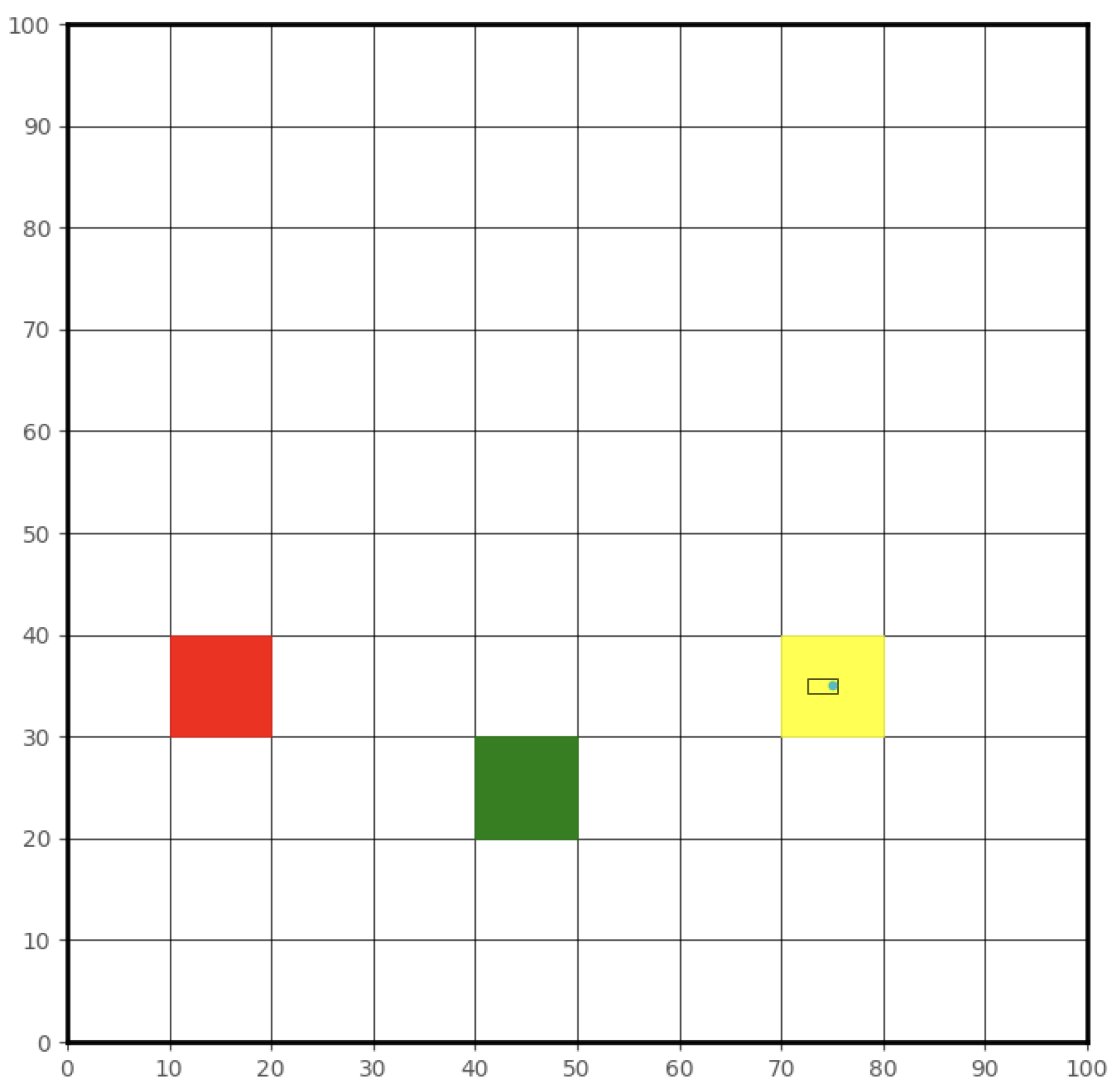
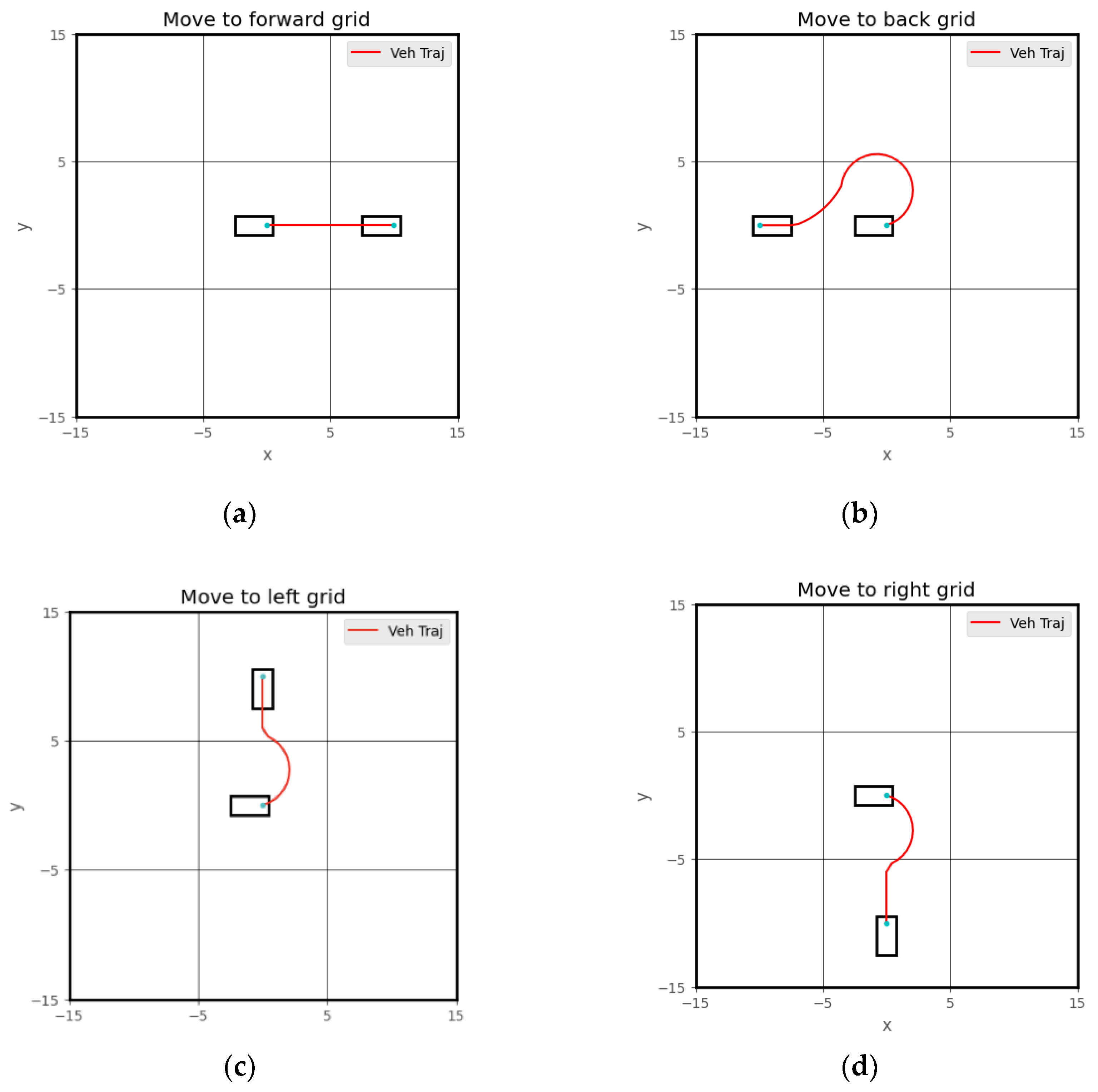
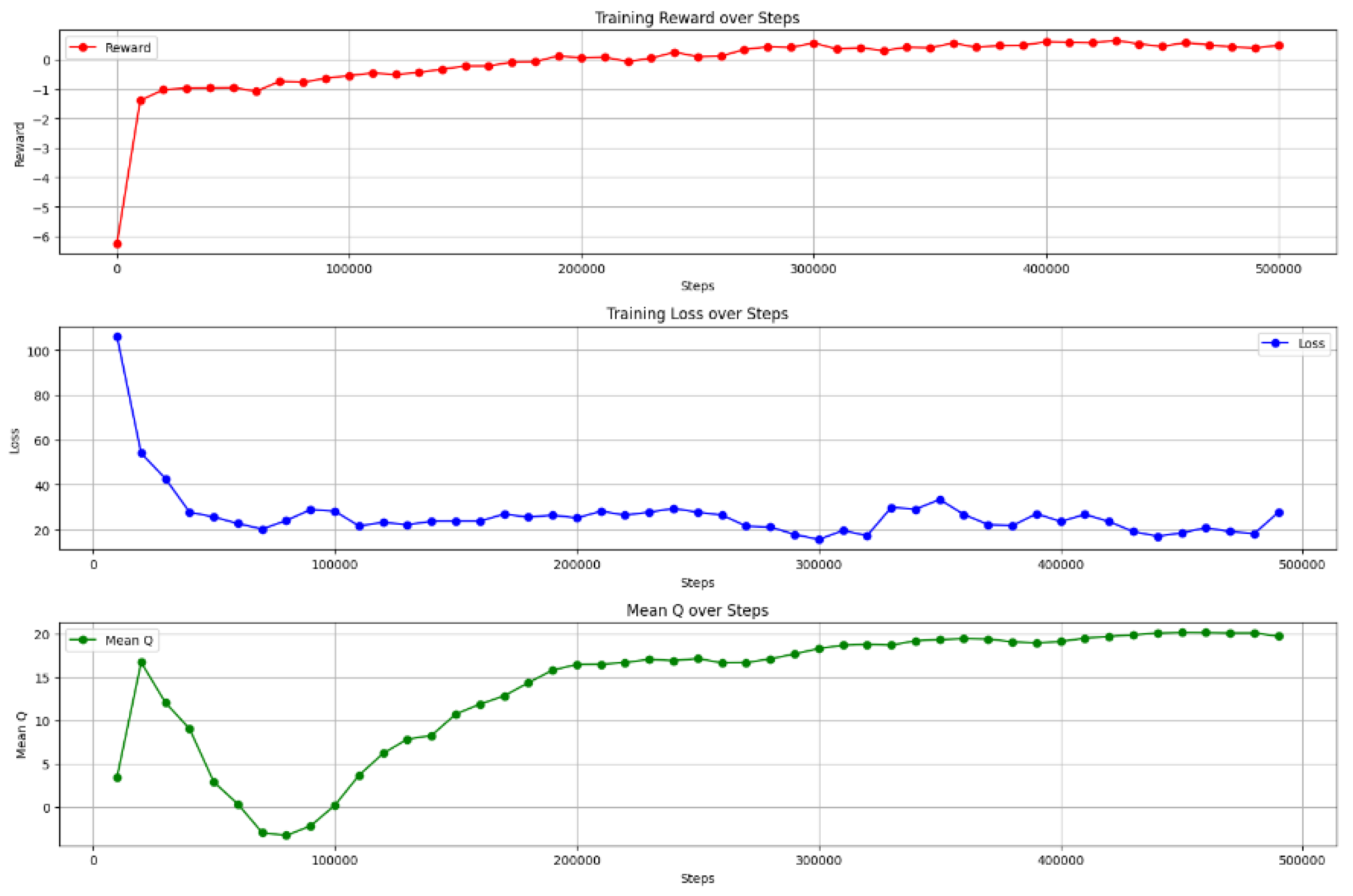
3.2.1. DRL High-Level Decision-Making Agent
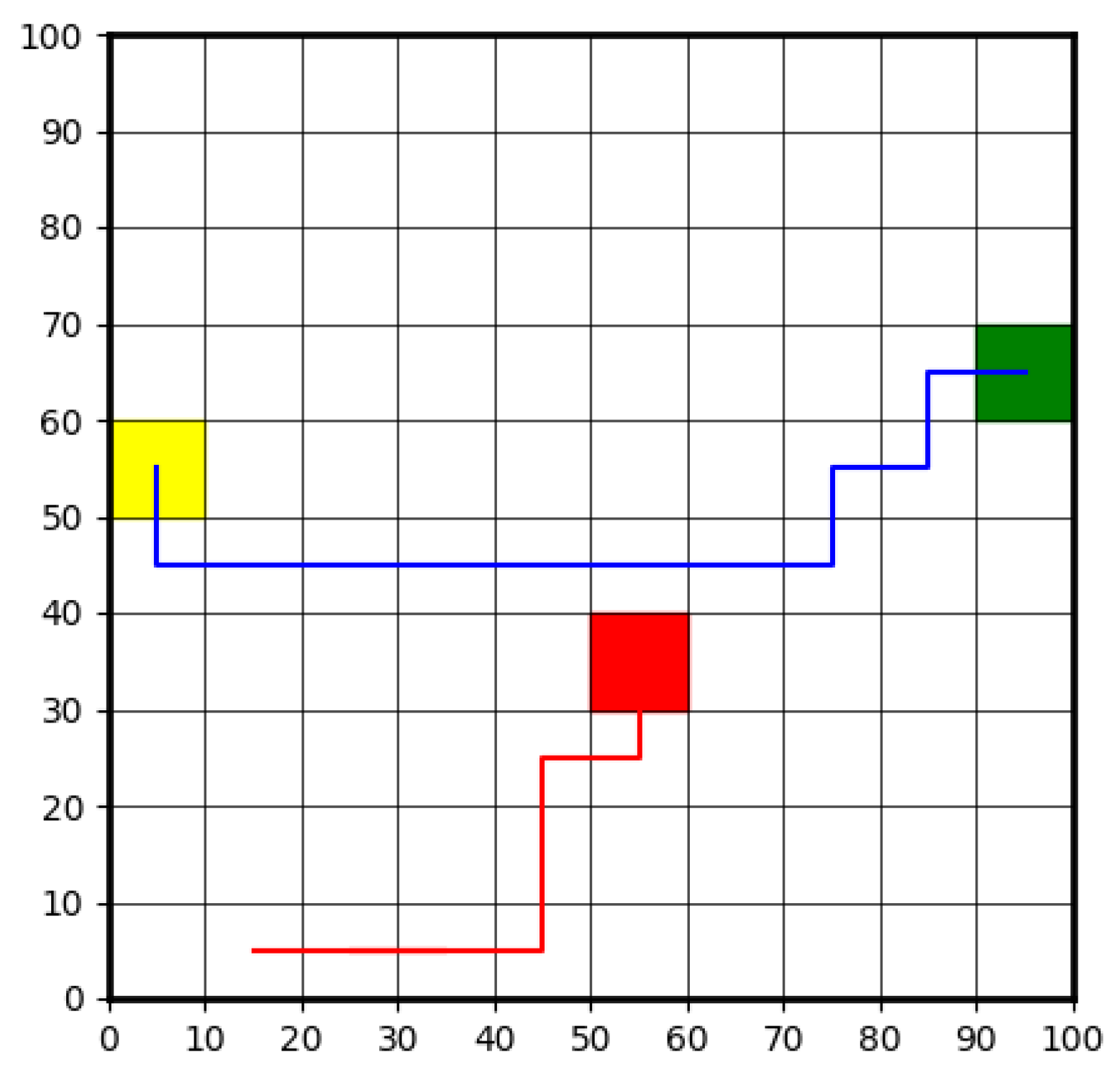
3.2.2. Hybrid DRL and CLF-CBF Controller
4. Conclusions and Future Work
Author Contributions
Funding
Data Availability Statement
Acknowledgments
Demo Video Link
References
- B. Wen et al, “Localization and Perception for Control and Decision Making of a Low Speed Autonomous Shuttle in a Campus Pilot Deployment,” Apr. 2018. [CrossRef]
- S. Y. Gelbal, B. A. Guvenc, and L. Guvenc, “SmartShuttle: a unified, scalable and replicable approach to connected and automated driving in a smart city,” in Proceedings of the 2nd International Workshop on Science of Smart City Operations and Platforms Engineering, in SCOPE ’17. New York, NY, USA: Association for Computing Machinery, 2017, pp. 57–62. [CrossRef]
- L. Guvenc, B. A. Guvenc and M. T. Emirler, "Connected and Autonomous Vehicles," in Internet of Things and Data Analytics Handbook, John Wiley & Sons, 2017, pp. 581-595.
- L. Guvenc et al, Autonomous Road Vehicle Path Planning and Tracking Control., Hoboken, NJ: John Wiley & Sons, 2022.
- E. Lowe and L. Guvenc, "Autonomous Vehicle Emergency Obstacle Avoidance Maneuver Framework at Highway Speed," Electronics, 12(23), 4765., vol. 12, no. 23, p. 4765, 2023.
- M. T. Emirler, H. Wang, and B. Guvenc, “Socially Acceptable Collision Avoidance System for Vulnerable Road Users,” IFAC-Pap., vol. 49, pp. 436–441, Dec. 2016. [CrossRef]
- A. D. Ames, J. W. Grizzle, and P. Tabuada, “Control barrier function based quadratic programs with application to adaptive cruise control,” in 53rd IEEE Conference on Decision and Control, Dec. 2014, pp. 6271–6278. [CrossRef]
- A. D. Ames, X. Xu, J. W. Grizzle, and P. Tabuada, “Control Barrier Function Based Quadratic Programs for Safety Critical Systems,” IEEE Trans. Autom. Control, vol. 62, no. 8, pp. 3861–3876, Aug. 2017. [CrossRef]
- A. D. Ames, S. Coogan, M. Egerstedt, G. Notomista, K. Sreenath, and P. Tabuada, “Control Barrier Functions: Theory and Applications,” in 2019 18th European Control Conference (ECC), Jun. 2019, pp. 3420–3431. [CrossRef]
- S. He, J. Zeng, B. Zhang, and K. Sreenath, “Rule-Based Safety-Critical Control Design using Control Barrier Functions with Application to Autonomous Lane Change,” Mar. 23, 2021, arXiv: arXiv:2103.12382. [CrossRef]
- L. Wang, A. D. Ames, and M. Egerstedt, “Safety Barrier Certificates for Collisions-Free Multirobot Systems,” IEEE Trans. Robot., vol. 33, no. 3, pp. 661–674, Jun. 2017. [CrossRef]
- M. Liu, I. Kolmanovsky, H. E. Tseng, S. Huang, D. Filev, and A. Girard, “Potential Game-Based Decision-Making for Autonomous Driving,” Nov. 09, 2023, arXiv: arXiv:2201.06157. [CrossRef]
- M. F. Reis, G. A. Andrade, and A. P. Aguiar, “Safe Autonomous Multi-vehicle Navigation Using Path Following Control and Spline-Based Barrier Functions,” in Robot 2023: Sixth Iberian Robotics Conference, L. Marques, C. Santos, J. L. Lima, D. Tardioli, and M. Ferre, Eds., Cham: Springer Nature Switzerland, 2024, pp. 297–309. [CrossRef]
- M. Desai and A. Ghaffari, “CLF-CBF Based Quadratic Programs for Safe Motion Control of Nonholonomic Mobile Robots in Presence of Moving Obstacles,” in 2022 IEEE/ASME International Conference on Advanced Intelligent Mechatronics (AIM), Jul. 2022, pp. 16–21. [CrossRef]
- K. Long, Y. Yi, J. Cortes, and N. Atanasov, “Distributionally Robust Lyapunov Function Search Under Uncertainty,” Jul. 11, 2024, arXiv: arXiv:2212.01554. [CrossRef]
- Y.-C. Chang, N. Roohi, and S. Gao, “Neural Lyapunov Control,” Sep. 22, 2022, arXiv: arXiv:2005.00611. [CrossRef]
- W. B. Knox, A. Allievi, H. Banzhaf, F. Schmitt, and P. Stone, “Reward (Mis)design for autonomous driving,” Artif. Intell., vol. 316, p. 103829, Mar. 2023. [CrossRef]
- B. R. Kiran et al., “Deep Reinforcement Learning for Autonomous Driving: A Survey,” IEEE Trans. Intell. Transp. Syst., vol. 23, no. 6, pp. 4909–4926, Jun. 2022. [CrossRef]
- F. Ye, S. Zhang, P. Wang, and C.-Y. Chan, “A Survey of Deep Reinforcement Learning Algorithms for Motion Planning and Control of Autonomous Vehicles,” in 2021 IEEE Intelligent Vehicles Symposium (IV), Jul. 2021, pp. 1073–1080. [CrossRef]
- Z. Zhu and H. Zhao, “A Survey of Deep RL and IL for Autonomous Driving Policy Learning,” IEEE Trans. Intell. Transp. Syst., vol. 23, no. 9, pp. 14043–14065, Sep. 2022. [CrossRef]
- H. Wang, A. Tota, B. Aksun-Guvenc, and L. Guvenc, “Real time implementation of socially acceptable collision avoidance of a low speed autonomous shuttle using the elastic band method,” Mechatronics, vol. 50, pp. 341–355, Apr. 2018. [CrossRef]
- S. Lu, R. Xu, Z. Li, B. Wang, and Z. Zhao, “Lunar Rover Collaborated Path Planning with Artificial Potential Field-Based Heuristic on Deep Reinforcement Learning,” Aerospace, vol. 11, no. 4, Art. no. 4, Apr. 2024. [CrossRef]
- M. Morsali, E. Frisk, and J. Åslund, “Spatio-Temporal Planning in Multi-Vehicle Scenarios for Autonomous Vehicle Using Support Vector Machines,” IEEE Trans. Intell. Veh., vol. 6, no. 4, pp. 611–621, Dec. 2021. [CrossRef]
- S. Zhu, “Path Planning and Robust Control of Autonomous Vehicles,” Ph.D., The Ohio State University, United States -- Ohio, 2020. Accessed: Oct. 24, 2023. [Online]. Available: https://www.proquest.com/docview/2612075055/abstract/73982D6BAE3D419APQ/1.
- G. Chen et al., “Emergency Obstacle Avoidance Trajectory Planning Method of Intelligent Vehicles Based on Improved Hybrid A*,” SAE Int. J. Veh. Dyn. Stab. NVH, vol. 8, no. 1, pp. 10-08-01–0001, Nov. 2023. [CrossRef]
- A. Kendall et al., “Learning to Drive in a Day,” Sep. 11, 2018, arXiv: arXiv:1807.00412. [CrossRef]
- E. Yurtsever, L. Capito, K. Redmill, and U. Ozguner, “Integrating Deep Reinforcement Learning with Model-based Path Planners for Automated Driving,” May 19, 2020, arXiv: arXiv:2002.00434. Accessed: Nov. 05, 2024. [Online]. Available: http://arxiv.org/abs/2002.00434.
- L. Dinh, P. T. A. Quang, and J. Leguay, “Towards Safe Load Balancing based on Control Barrier Functions and Deep Reinforcement Learning,” Jan. 10, 2024, arXiv: arXiv:2401.05525. [CrossRef]
- S. H. Ashwin and R. Naveen Raj, “Deep reinforcement learning for autonomous vehicles: lane keep and overtaking scenarios with collision avoidance,” Int. J. Inf. Technol., vol. 15, no. 7, pp. 3541–3553, Oct. 2023. [CrossRef]
- A. J. M. Muzahid, S. F. Kamarulzaman, Md. A. Rahman, and A. H. Alenezi, “Deep Reinforcement Learning-Based Driving Strategy for Avoidance of Chain Collisions and Its Safety Efficiency Analysis in Autonomous Vehicles,” IEEE Access, vol. 10, pp. 43303–43319, 2022. [CrossRef]
- R. Emuna, A. Borowsky, and A. Biess, “Deep Reinforcement Learning for Human-Like Driving Policies in Collision Avoidance Tasks of Self-Driving Cars,” Jun. 19, 2020, arXiv: arXiv:2006.04218. [CrossRef]
- H. Chen et al, “Deep-Reinforcement-Learning-Based Collision Avoidance of Autonomous Driving System for Vulnerable Road User Safety,” Electronics, vol. 13, no. 10, Art. no. 10, Jan. 2024. [CrossRef]
- X. Cao et al, “Vehicle-in-Virtual-Environment (VVE) Method for Autonomous Driving System Development, Evaluation and Demonstration,” Sensors, vol. 23, no. 11, Art. no. 11, Jan. 2023. [CrossRef]
- O. Kavas-Torris et al, “V2X Communication between Connected and Automated Vehicles (CAVs) and Unmanned Aerial Vehicles (UAVs),” Sensors, vol. 22, no. 22, Art. no. 22, Jan. 2022. [CrossRef]
Disclaimer/Publisher’s Note: The statements, opinions and data contained in all publications are solely those of the individual author(s) and contributor(s) and not of MDPI and/or the editor(s). MDPI and/or the editor(s) disclaim responsibility for any injury to people or property resulting from any ideas, methods, instructions or products referred to in the content. |
© 2024 by the authors. Licensee MDPI, Basel, Switzerland. This article is an open access article distributed under the terms and conditions of the Creative Commons Attribution (CC BY) license (http://creativecommons.org/licenses/by/4.0/).


