

Submitted:
18 December 2024
Posted:
19 December 2024
You are already at the latest version
Abstract
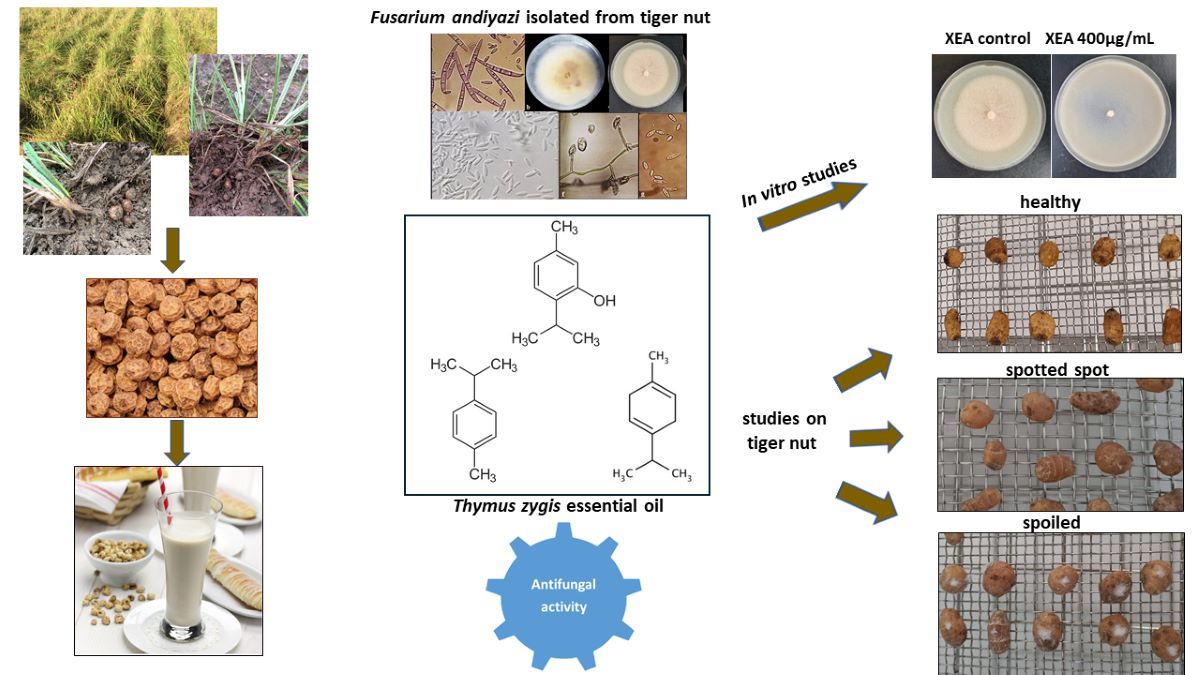
Cyperus esculentus L. var sativus is cultivated in Spain only in the L´Horta Nord in the Valencia region. In this country, tubers are consumed fresh to make a popular beverage in the Valencia region called “horchata de chufa” (chufa milk). This drink is considered beneficial for human health for its high nutritional value and medicinal importance in several treatments. This work evaluates the antifungal potential of the Thymus zygis essential oil against fungi found in tiger nut warehouses to preserve tubers under the best conditions. The analyzed commercial thyme es-sential oil belongs to the thymol/p-cymene/γ-terpinene chemotype. Thymol was found in larger quantities (51.34%), followed by the identified biogenetic precursors p-cymene (35.16%) and γ-terpinene (3.53%). Carvacrol also appeared, but in small quantities (3.53%). During "in vitro" tests, the T. zygis EO showed strong inhibition (98.85% to 91.81% MGI) against fungi Alternaria al-ternata, Fusarium andiyaci, Fusarium incarnatum and Fusarium oxysporum at 300 µg/mL. It totally inhibited their growth (100% MGI) at 400 µg/mL, and did so strongly (75.94%, 72.16% and 70.78%) with fungi Podospora australis, Penicillium commune and Cladosporium subuliforme, respectively. Under “in vivo” conditions, formulated as a protective biofilm, and by forcing the environmental con-ditions of temperature and humidity to the maximum for fungus F. andiyazi growth on tiger nut tubers, the created film acted as a strong protector against fungal attack.
Keywords:
Cyperus esculentus
; chufa
; tiger nute
; Thymus zygis
; essential oil
; preservation
; antifungal effect
1. Introduction
Cyperus esculentus L. belongs to the genus Cyperus (Monocots, Poales, Cyperaceae) with 949 accepted species according to Plants of the World Online [1]. The Latin name Cyperus derives from the Greek kýpeiros, which refers to a kind of rush, while esculentus means “edible” in relation to its underground tubers [2]. This species has been known to be edible for more than 3000 years, with tubers found in Tutankhamen’s tomb [3].
Researchers have reached no agreement about the origin of this plant species. According to Follak et al. [4], it could lie in the Mediterranean and Southwest Asia.
C. esculentus has great plasticity and is widespread in tropical, subtropical and temperate regions worldwide [4,5,6]. It also possesses vast variability, about which several authors have focused on studying the infraspecific taxonomy of C. esculentus. This was started by Boeckeler [7] for the American forms and cultivated varieties (var. sativus Boeckeler). Clarke [8] and Britton [9] have described new varieties from North America and India, which is interesting. Before reviewing taxa, in 1936 Kükenthal [10] proposed further C. esculentus varieties, and recently others have been registered to show the species’ wide variability [11]. Nevertheless, most contemporary authors do not make a distinction in infraspecific taxa.
C. esculentus, known as chufa, juncia avellanada, tiger nut, yellow sedge, earth almond, among others, includes wild and selected varieties for cultivation [12]. Varieties that grow wild in some regions are considered one of the worst weeds of agricultural and horticultural crops in the world because of their invasive growth due to their root system, which is difficult to control. Interestingly, C. esculentus var. sativus includes the species selected by humans for cultivation, which have larger and sweeter tubers than wild varieties [13].
C. esculentus is a perennial herb that produces rhizomes, stolons and terminal geophyte tubers, although cultivated varieties often display annual behavior. Tuber size can lie between 15 mm and up 25 mm in diameter in wild and cultivated varieties, respectively. When young, they are externally whitish-reddish, but while are ovoid, elliptic or subglobose and brownish-grayish showing transversal striates at maturity. The inner tuber part is initially white, but turns to a cream color with advancing maturity. A large difference between tubers from wild and cultivated varieties can be highlighting because the cultivated ones are sweeter and more tasteful [2,4].
There are pieces of evidences that ancient Egyptians planted and used this Cyperus for culinary and medicinal purposes. Nowadays, the use of this Cyperus as food and medicinal purposes is widely known because it is rich in fat, protein, sugar, and other nutrients like volatile oil, organic acids, alkaloids, phenols, terpenoids, anthraquinone, steroids, etc., with diverse properties for human health [5]. Its tuber composition has been recently analyzed to show high calorie content with a high percentage of starch (more than peanut and soybean), high contents of lipids (more than soybean), carbohydrates (more than peanut and sugar), dietary fiber, proteins, alkaloids, vitamins, minerals, among others [5]. Likewise, others authors, have recorded the presence of different substances, such as flavonoids, terpenoids and tannin, along with other biological and pharmaceutical uses [14].
Although C. esculentus is distributed worldwide in tropical, subtropical and temperate regions, the sativus variety is cultivated in some regions of Africa, where it is consumed fresh and dried as a snack. In America (Chile, Brazil and the United States), its crop is used as animal feed. In Asia (China and India) and Europe, its uses differ. In Spain, the crop is cultivated only in the L`Horta Nord of the Valencia region [4]. Annually this region produces around 5.3 million kilograms of dry chufa, of which 90% has had Protected Designation of Origin since 1995 as “Chufa de Valencia/Xufa de València” by the Conselleria d’Agricultura, Medi Ambient, Canvi Climàtic I Desenvolupament Rural [15]. In Spain, tubers are consumed fresh to make a popular beverage in the Valencia region called “horchata de chufa” (chufa milk). Interestingly, this drink is considered beneficial for human health because of its high nutritional value and its medicinal importance in several treatments [16]. Nowadays, different products are made based on chufas, such as chocolates, beer, liquor and gin, and even in the cosmetic industry [4,17].
Since 2013, two cultivars, namely “Bonrepos” and “Alboraia”, respectively with spherical and elongated tubers, have been registered by the Spanish Ministry of Agriculture [17]. In this region, there is a temperate climate with sandy silt soils conditions that are essentially for its growth.
There is evidence that different genera of fungi, such as Ascochyta, Cercospora, Cintractia, Claviceps, Dactylaria, Fusarium, Puccinia and Sclerotinia, are associated with C. esculentus plant growing as weeds, and most have been found outside Europe [4]. For example; Sclerotinia minor has been cited to cause symptoms in yellow sedge plants growing in peanut fields in the United States [18]; rust Puccinia canaliculate [19] is registered in different countries [20]; Cercospora caricis is reported to cause foliar disease in North Carolina (USA) [21], among others. Interestingly, some have been evaluated as a potential biological control of this worst weed.
However, very little attention has been paid to the phytosanitary problems of the crop of C. esculentus var. sativus. “Tuber rot” caused by Dematophora necatrix Hartig (teleomorph: Rosellinia necatrix Prill.), which was registered in 1997 in the Valencia Province of Spain [22,23].
In 2022, a virus that caused reduced plant growth, chlorosis and mosaic in leaves and root atrophy that drastically reduced tuber size was identified as Xufa yellow dwarf virus (XYDV) [24] Marsal et al. [25] have reported a disease that causes external black spots on tubers, known as “black chufa” or “black spot”. The etiology of this pathology is still unknown, but it affects only tuber skin and causes yield losses.
It is interesting to know that once the crop cycle finishes, plants are uprooted, and tubers are collected, washed and selected to remove defective tubers. Once cleaned, chufas are left inside “drying attics or cambras” to reduce humidity from 50% to 11%. This is because high moisture content can cause tuber rancidity and fungal growth, which consequently reduce its quality and lower commercial value. Therefore, the drying process period is considered extremely important after harvest. During this period, which usually lasts about 3 months, tubers must be turned every day to ensure uniform drying [15]. It is during this period that chufa tubers develop their natural sweetness, which can be affected by different phytosanitary problems.
It is widely known that fruit and vegetable fungal infection may occur on field crops and along the entire food chain, including harvesting, transport, packing management, postharvest storage and marketing. This contamination by fungi along the food chain impacts fruit and vegetables, and can cause 35-55% reductions in yield and market quality [26,27]. Spoilage fungi invade foods and cause quality reduction, which render products unesthetic or unusable, and sometimes unsafe. Some fungi also produce toxins as secondary metabolites, which are dangerous to human health [28,29].
The tiger nut crop has been paid little attention in terms of production and genetic improvement and, therefore, yields are low and susceptible to diseases and pests. No reports have been found about fungi isolated from tiger nuts during storage, which can cause yield losses, including deterioration of quality and a shorter shelf life, and may also produce mycotoxin that is capable of harming human health.
In this work, we focused on studying the fungal tuber borne and the fungi present in drying chambers. Once fungi were isolated, we focused on evaluating an ecofriendly alternative against these fungi to preserve shelf life and chufa tuber quality during the postharvest.
Essential oils (EOs) are known for their applications in foods, in the pharmaceutical industry and for their wide use as antimicrobials, mainly due to their bioactive compounds. Several authors have recorded the potential effect of EOs to protect and preserve foods against pathogenic and spoilage microorganisms [30,31].
The genus Thymus has a wide chemical polymorphism with several chemotypes. Interestingly, a significant amount of research has demonstrated antibacterial and antifungal activity [32].
Thus, the objectives of the present work were to: i) isolate and identify the fungal population from chufa tubers and airborne fungal cultivable species from drying chambers; ii) evaluate the antifungal potential of the Thymus zygis EO against isolated fungi in an in vitro assay; iii) assess the effectiveness of the T. zygis EO applied as a natural biofilm for tiger nut preservation purposes.
2. Results
2.1. Chemical Composition of the Thymus zygis EO
In the commercial thyme herein analyzed (Table 1), chemotype thymol/p-cymene/γ-terpinene was found in the largest quantities of thymol (51.34%), followed by the identified biogenetic precursors p-cymene (35.16%) and γ-terpinene (3.53%). The other identified compounds included oxygenated monoterpenes carvacrol (3.53%), linalool (2.21%) and borneol (1.12%), with percentages above 1%. Only two sesquiterpene hydrocarbons were detected: β-caryophyllene (0.13%) and α-humulene (0.02%).
2.2. In vitro Studies. Determining the Antifungal Potential of the Thymus zygis EO. MGI (%) (Mycelial Growth Inhibition)
The results obtained in this assay showed that the Thymus zygis EO reduced the fungal growth of all the evaluated phytopathogens (Table 2 and Table 3, Figure 1). EO inhibition was affected by the doses used in all the tested fungi. The MGI increased the higher doses became. Fusarium andiyazi and Fusarium incarnatum were the most sensitive fungi at the 200 µg/mL dose.
The T. zygis EO showed strong inhibition (98.85% to 91.81% MGI) against Alternaria alternata, F. andiyaci, F. incarnatum and Fusarium oxysporum at 300 µg/mL. It totally inhibited the growth of these fungi (100% MGI) at 400 µg/mL, and strongly inhibited it with 75.94%, 72.16% and 70.78%, respectively for fungi Podospora australis, Penicillium commune and Cladosporium subuliforme.
Fungi P. australis, P. commune and C. subuliforme showed minor, albeit not negligible inhibition, with MGI values of 41- 52% at doses 200- 300 µg/mL, except for Cladosporium whose inhibition was very low at 200 µg/mL.
The inhibitory effect of the Thymus zygis EO on the growth of seven fungal species at 200, 300 and 400 µg/mL was evaluated by Tukey's HSD plots. The results showed a significant MGI for all the species tested at three doses compared to the control (p<0.05) (Figure 2). This inhibition was greater at the 400 µg/mL dose, as the graphs depict.
Figure 2 shows the marked effectiveness of all the tested doses of T. zygis oil on the tested fungi. Significant differences were found in the mean growth of all fungi under all the tested conditions when the EO was used at the different doses compared to the mean growth of the controls. One exception was Alternaria alternata, in which case the 300 and 400 µg/mL doses were equally effective.
Finally, the results showed that, when comparing the inhibitory effect of the three EO doses tested, at the 400 µg/mL concentration, the Thymus zygis extract completely inhibited (100%) the growth of Alternaria alternata, Fusarium andiyazi, Fusarium incarnatum and Fusarium oxysporum.
Therefore, the Thymus zygis EO at 800 µg/mL was selected to study its effect on harvested and stored tiger nut conservation to prolong their commercial shelf life.
3.2. In Vivo Study of the Antifungal Effect of the Thymus zygis EO Against Fusarium andiyazi on Tiger nuts. EO on Tiger Nut Storage
In this study (Table 4, Figure 3), the protective effect of the film with the EO was observed because it maintained tuber turgor, prevented tuber weight loss, allowed Fusarium andiyazi infection to not advance and functioned as a second epidermis.
Two days after the experiment began, all the tubers were healthy in both the control and treatments. After 10 days at 90% RH, all the tubers were damaged in the control. In control 2 (covered with film without the EO), 68% of tubers were healthy, which indicates a certain protective effect of film. Those covered with film containing the Thymus zygis EO (EO-film) were completely healthy (96%), or only the inoculation point was evident (4%) with no damaged tubers. At 15 post-experiment days, 60% of the tubers in control 2 were damaged, 40% had a stained inoculation point and none were healthy. Of those covered with the film containing the T. zygis EO (EO-film), 80% were healthy or had a patent inoculation point.
At 30 days, of all the tubers in both control 1 and control 2, 100% were damaged. Of those treated with the film containing the EO, 52% were healthy or had a somewhat patent inoculation point. From this we can conclude that the film containing the EO offers a good protective effect, and the film without the EO has a certain protective effect.
3. Discussion
This study is the first to report about the mycobiota of the tiger nut tubers collected from the field and stored. We found that the Fusarium genus predominated with different species, of which some produced mycotoxins. We also found the cosmopolitan fungus Alternaria alternata, some Penicillium, a typical storage fungal genus, and some Mucoral. No species of the Aspergillus genus was detected, nor fungus A. flavus.
The genus Thymus is highly polymorphic and its species exhibit distinct chemical profiles. A previous study conducted on Thymus serpyllum and two T. piperella chemotypes observed that the analyzed T. serpyllum species was rich in thymol and carvacrol, in a very balanced proportion (21.5% and 18.7%, respectively). The two T. piperella chemotypes exhibited different chemical profiles. T. piperella chemotype 1 was rich in carvacrol (51%), while T. piperella chemotype 2 was rich in thymol (35.7%). The study of the antifungal activity of these EOs at the 300 µg/mL dose against the phytopathogenic and postharvest fungi Alternaria alternata, Bipolaris spicifera, Curvularia hawaiiensis, Fusarium oxysporum, Penicillium italicum and Botryotinia fuckeliana revealed that the species containing the mixture of both monoterpenes had a higher antifungal potential. In other words, both compounds play a synergistic role by enhancing their antifungal effect [31]. The same synergism results were obtained in the study of different botanical compounds when tested independently and when their mixtures were tested against fungi Botryotinia fuckeliana and Rhizoctonia solani. The mixture of the botanical active ingredients had a synergistic effect and gave better results [34].
In our study, the major components of the commercial T. zygis oil were thymol (51.34%), followed by the identified biogenetic precursors p-cymene (35.16%) and γ-terpinene (3.53%), and a smaller amount of carvacrol. This means that they correspond to chemotype thymol/p-cymene/γ-terpinene. The synergism shown by the components of the Thymus zygis EO makes it especially effective against the tested fungi, with growth inhibition over 70% in them all, and total growth inhibition in four of the studied seven fungi in the in vitro test. Furthermore, under the in vivo conditions, formulated as a protective biofilm and forcing the environmental temperature and humidity conditions to the maximum for fungus F. andiyazi to grow on tiger nut tubers, after 15 days 80% of tubers were ready for consumption. These conditions do not occur in warehouses because they have drying nozzles and temperature and humidity controls. The tiger nuts harvested in summer are stored for horchata production, and those of autumn in Valencia are hot and humid, with cold snap and cold drop episodes. Hence the importance of keeping tubers under the best conditions to be able to produce quality drink D.O. horchata of Valencia.
Various studies have shown the very high potential of the EO in the control of phytopathogenic and postharvest fungi, the importance of their formulation in biofilm formation, and its protective role in fruit, vegetables, seeds and cereals (tomatoes, persimmons, rice, etc.) by extending the shelf life of treated products [26,30,31]. In addition, Sapper et al. [35,36] published works in 2018 and 2019 that studied the physico-mechanical properties and the antifungal activity of a created biofilm containing the Thymus zygis EO with excellent results. This, shows the very high potential of this EO against pathogenic and spoilage microorganisms.
4. Materials and Methods
4.1. Fungal Species
The fungal species employed in this study were: Alternaria alternata (Fr.) Keissler (LBEA 2300), Fusarium andiyazi Marasas, Rheeder, Lampr., K. A. Zeller & J. F. Leslie (LBEA 2303), Fusarium incarnatum (Desm.) Sacc. (LBEA 2304), Fusarium oxysporum Schltdl. (LBEA 2305), Podospora australis (Speg.) Niessl (LBEA 2302), Penicillium commune (LBEA 2307) and Cladosporium subuliforme Bensch, Crous & U. Braun (LBEA 2310). They were all isolated from Alboraya (Valencia) tiger nut tubers in the Laboratorio Botánica of the Departament of Ecosistemas Agroforestales (LBEA), Escuela Técnica Superior de Ingeniería Agronómica y del Medio Natural (ETSIANM), Universitat Politècnica de València (Spain). All the isolated fungi were maintained on PDA (Potato Dextrose Agar) and on XEA (Chufa Extract Agar) at 5 °C until they were used.
4.2. Fungal Strain Identification
These fungi were identified by morphological and molecular methods. The morphological analysis consisted of the inoculation, incubation and validation of culture characteristics, as well as microscopic observation, growing data or colony morphology. The molecular identification of fungal species was carried out by the Laboratorio de Técnicas Instrumentales of the Universidad de León, Spain. Two different regions of ribosomal DNA genes were analyzed: the nuclear ribosomal internal transcribed spacer ‘ITS region’ including 5.8S rDNA as a standard barcode for fungi [37]; the D1/D2 hypervariable domains of large-subunit 28S rDNA (LSU). The analysis of sequences was performed by BLAST similarity for ITS region and the D1/D2 domains of the LSU gene against the public database RefSeq: NCBI Reference Sequence DataBase (http://www.ncbi.nlm.nih.gov/refseq/).
4.3. Essential Oil (EO)
The commercial Thymus zygis EO (batch 105, date January 2026), prepared from leaves, stems and flowers, was purchased at Plantis, Artesanía Agricola S.A. (Ctra. a Vilafranca, C-15 B, Km 5,2, 08810 Sant Pere de Ribes Barcelona, Spain). EOs were stored at 4 °C until the chemical analysis and antifungal studies were done.
4.4. Gas Chromatography/Mass Spectrometry Analysis of EOs
The analysis of EOs was carried out by gas chromatography coupled to flame ionization detection (GC-FID) and mass spectrometry (GC-MS), as described in Giménez-Santamarina et al. [38]. Each sample was run in triplicate.
4.5. In Vitro Antifungal Activity of the T. zygis EO
An in vitro assay was performed to evaluate the antifungal activity of the T. zygis EO against all the studied fungi. The EO was dissolved, mixed and homogenized by shaking in flasks in sterilized XEA medium (500 mL chufa extract XE (60 g chufa, 1000 ml water), 16 g agar, 500 mL water). Tween 20 (0.1%) was added at 45-50 °C to obtain final concentrations of 200, 300 and 400 μg/mL. Then while the medium was still liquid, it was distributed on Petri dishes in a laminar flow chamber. Discs of each fungus (8 mm diameter) were taken from the edge of the 7-day colonies that developed on XEA and placed in the center of Petri dishes. Controls were performed by placing discs of each fungus on XEA medium, but without the T. zygis EO.
Five replicates were performed for each fungus and T. zygis EO concentration. The experiment was replicated 3 times. Petri plates were incubated in the dark at 25 °C for 7 days. Measurements of the fungal colonies diameter were taken in two perpendicular directions and Mycelial Growth Inhibition (MGI) was calculated with the formula used by Albuquerque et al. [39]:
where DC is the average of the colonies on the control dishes, and DO is the average of the colonies´ diameter of each fungus and concentration.
MGI = [(DC – DO) / DC] x 100
The effect of the T. zygis EO against seven fungal species oil was evaluated by an analysis of variance (ANOVA) for a completely randomized design using the Python Scipy Stats module (scipy.stats). Means were compared by the HSD Tukey test (P ≤ 0.05) available in the same Python package.
2.6. Fungitoxicity of the T. zygis EO in an In Vivo Assay
After obtaining the results of in vitro assay, an in vivo experiment was performed to evaluate the effect of the T. zygis EO against F. andiyaci (FA), which showed 100% MGI.
2.6.1. Fungal Suspensions (FI) and Fungal Biofilm Preparation (FIFi)
To coat fruit with fungi, a solution containing AA and FA propagules was prepared. To do this,10 mL of a suspension of 1 x 10⁶ conidia/mL were added to 90 mL of water/Tween 20 (0.1%) (FI). To prepare FIFi, 0.25% agar was added to the FI spore suspension. Finally, suspensions were homogenized by shaking at 170 rpm for 10 min.
2.6.2. T. zygis EO Biofilm (EOFi)
The T. zygis EO concentration used to evaluate in vivo was 800 µg/mL. The T. zygis EO solution for coating was prepared in flasks containing water/Tween 20 (0.1%)/0.25% agar, which were homogenized by shaking at 170 rpm for 10 min.
2.6.3. Biofilm Application of the T. zygis EO on (tiger nut) Tubers
A sample of chufa (tiger nut) tubers, origin Alboraya (Valencia, Spain), were surface-sterilized with 1% sodium hypochlorite solution for 2 min and then washed twice with sterile distilled water for 4 min. Sterilized tubers were wounded (1 mm depth) on the surface with a sterile needle. Fifty tubers were immersed in the biofilm containing the T. zygis EO (EOFi) for 4 min before being placed on racks and dried for 24 h at room temperature. Afterward, tubers were immersed in FIFi for 4 min and placed on racks and dried at room temperature for 24 h.
Two controls were performed during the trial, which consisted: control 1 with 50 sterilized and wounded tubers, which were only treated with the fungal inoculum (FI) of each fungus; control 2 with 50 sterilized and wounded tubers, which were immersed in the biofilm without the EO (water/Tween 20 (0.1%)/0.25% agar) for 4 min; after 24 h, they were immersed in the fungal biofilm (FIFi) of each fungus for 4 min.
The tubers treated with the T. zygis EO-biofilm, and controls 1 and 2, were placed on racks inside a controlled environment chamber at 90% RH and 28 °C. Tuber progress was monitored daily and the evaluation consisted in determining incidence or severity at 10, 15 and 30 days.
5. Conclusions
The Thymus zygis EO has a very high antifungal potential against the tested fungi: Alternaria alternata, Fusarium andiyaci, Fusarium incarnatum, Fusarium oxysporum, Podospora australis, Penicillium commune and Cladosporium subuliforme. These fungi constitute the dominant mycobiota of the analyzed tiger nut tubers after harvesting and storage. The T. zygis EO formulated as a biofilm is highly effective and easily biodegradable. Active compounds are volatile and the agar-agar base matrix is used in food as a gelling agent. Therefore, it does not pose no danger for human health, animal health or the environment.
Author Contributions
The work herein presented was carried out with the collaboration of all the authors. Conceptualization, M.P.S. and J.R.; methodology, M.P.S., C. S., S. G-S and J.R.; investigation, J.R., C. S., S. L., and M.P.S.; original draft preparation, S. G-S., C.S., J.R., S. L and M.P.S.; writing, S. G-S., C. S., S.L., J.R. and M.P.S.; review and editing, M.P.S., and J.R.; supervision, M.P.S. All authors have read and agreed to the published version of the manuscript.
Funding
This research was funded by the Spanish Ministry of Economy and Competitiveness, Programme-oriented Societal Challenges 2016–2019, grant number AGL2016-76699-R-AR.
Institutional Review Board Statement
Not applicable.
Informed Consent Statement
Not applicable.
Data Availability Statement
The raw data supporting the conclusions of this article Will be made available by authors, without undue reservation.
Conflicts of Interest
The authors declare no conflict of interest.
Sample Availability
Samples of the compounds are available from the authors.
References
- Plants of the World Online. Royal Botanic Gardens, Kew and Missouri Botanical Garden. Available online: https://powo.science.kew.org/taxon/urn:lsid:ipni.org:names:330001-2 (accessed on 10 December 2024).
- Castroviejo, S. Cyperus L. In Flora Ibérica. Plantas vasculares de la Península Ibérica e Islas Baleares. Castroviejo, S., Luceño, M., Galán, A., Jiménez Mejías, P., Cabezas, F.; Medina, L., Eds.; Real Jardín Botánico - CSIC, Madrid, 2007; Volume XVIII, pp. 8–27.
- Serrallach, J. Die wurzelknolle von Cyperus esculentus L. Ph. D. Tesis, University Frankfur am Main, 1927.
- Follak, S.; Belz, R.; Bohren, C.; De Castro, O.; Del Guacchio, E.; Pascual-Seva, N.; Schwarz, M.; Verloove, F.; Essl, F. Biological flora of Central Europe: Cyperus esculentus L. Perspect. Pl. Ecol. Evol. Syst. 2016, 23, 33-51. http://doi.org/10.1016/j.ppees.2016.09.003.
- Zhang, S.; Li, P.; Wei, Z.; Cheng, Y.; Liu, J.; Yang, Y.; Wang, Y.; Mu, Z. Cyperus (Cyperus esculentus L.): A Review of Its Compositions, Medical Efficacy, Antibacterial Activity and Allelopathic Potentials. Plants 2022, 11, 1127. [CrossRef]
- Zuloaga, F.O.; Morrone, O.; Belgrano, M.J. Catálogo de las Plantas Vasculares del Cono Sur (Argentina, Sur de Brasil, Chile, Paraguay y Uruguay); (Eds.), Marticorena, C.; Marchesi, E. (Assoc. Eds); Missouri Botanical Garden Press, St. Louis, 2008; 3486 pp. ISBN 978-1-930723-70-2.
- Boeckeler, J. Die Cyperaceen des königlichen Herbariums zu Berlin. Linnaea 1870, 36, 287−291.
- Clarke, C.B. On the Indian species of Cyperus. J. Linn. Soc., Bot. 1884, 21, 178−181. [CrossRef]
- Britton, N.L. The sedges of Jamaica (Cyperaceae). Bull. Dept. Agric. Jamaica 1907, 5, Suppl. 1, 1−19.
- Kükenthal, G. Cyperaceae – Scirpoideae – Cypereae. In Das Pflanzenreich. Regni vegetabilis conspectus. Engler, A., Diels, L., Eds., Verlag Wilhelm Engelmann, Leipzig, 1936; Volume 4 (20), 101.
- Tayyar, R.I., Nguyen, J.H.T., Holt, J.S. Genetic and morphological analysis of two novel nutsedge biotypes from California. Weed Science 2003, 51, 731-739. [CrossRef]
- Yang, Z. Characteristics and Research Progress of Cyperus esculentus L. North. Hortic. 2017, 17, 192–201.
- Tucker, G.C.; Simpson, D.A. Cyperus Linnaeus. In Flora of China; Wu, Z.Y., Raven, P.H., Hong, D.Y., Eds.; Science Press, Beijing, and Missouri Botanical Garden Press, St. Louis, 2010; Volume 23, pp. 219−241.
- Guo, T.; Wan, C.; Huang, F.; Wei, C.; Hu, Z. Research Progress on main nutritional components and physiological functions of tiger nut (Cyperus esculentus L.). Chin. J. Oil Crop Sci. 2021, 43, 1174–1180.
- Consejo Regulador Denominación de Origen Chufa de Valencia. Available online: https://chufadevalencia.org/la-chufa/ (accessed on 10 December 2024).
- Montaño Mata, N.J.; Jiménez García, J. Sintomatología y control de la necrosis foliar de la chufa (Cyperus esculentus L.). Revista Científica UDO Agrícola 2012, 3, 627-638.
- Pascual-Seva, N.; San Bautista, A.; López-Galarza, S.; Maroto, J.V.; Pascual, B. ‘Alboraia’ and ‘Bonrepos’: The First Registered Chufa (Cyperus esculentus L. var. sativus Boeck.) Cultivars. HortScience 2013, 48 (3), 386–389. [CrossRef]
- Hollowell, J.E.; Shew, B.B. Yellow nutsedge (Cyperus esculentus L.) as a host of Sclerotinia minor. Plant Dis. 2001, 85 (5), 562-562. [CrossRef]
- Arthur, J.C. Manual of rust in the United State and Canada. Purdue Rest. Foundation, Lafayette, Indiana, 1934; 189 pp.
- Morales-Payan, J.P.; Charudattan, R.; Stall, W.M. Fungi for biological control of weedy Cyperaceae, with emphasis on purple and yellow nutsedges (Cyperus rotundus and C. esculentus). Outlooks Pest Manag. 2005, 14 (4), 148-155. [CrossRef]
- Blaney, C.L.; Van Dyke, C.G. Cercospora caricis from Cyperus esculentus (yellow nutsedge): morphology and cercosporin production. Mycologia 1988, 80, 418–421. [CrossRef]
- García-Jiménez, J.; Busto, J.; Armengol, J.; Martínez Ferrer, G.; Sales, R.; García Morató, M. La podredumbre negra o “alquitranat”: un grave problema de la chufa en Valencia. Agrícola Vergel 1997, 183, 144-148.
- García-Jiménez, J.; Busto, J.; Vicent, A.; Sales, R.; Armengol, J. A tuber rot of Cyperus esculentus caused by Rosellinia necatrix. Plant Dis. 1998, 82, 1281. [CrossRef]
- Galipienso Torregrosa, L.; Rubio, L.; Guinot Moreno, F.J.J.; Sanz López, C. Identificación de un virus como el causante de una nueva enfermedad que afecta al cultivo de chufa en Valencia. Phytoma 2022, 344, 50-53. [CrossRef]
- Marsal, J.I.; Cerda, J. J.; Penella, C.; Calatayud, A. Mejora de la sanidad y calidad de la chufa en valencia: Situación actual. Agrícola Vergel: Fruticultura, Horticultura, Floricultura 2017, 402, 205-210. http://hdl.handle.net/20.500.11939/5877.
- Verdeguer, M.; Roselló, J.; Castell, V.; Llorens, J.A.; Santamarina, M.P. Cherry tomato and persimmon kaki conservation with a natural and biodegradable film. Curr. Res. Food Sci. 2020, 2, 33–40. [CrossRef]
- Allagui, M.B.; Moumni, M.; Romanazzi, G. Antifungal activity of thirty essential oils to control pathogenic fungi of postharvest decay. Antibiotics 2024, 13, 28. [CrossRef]
- Ji, F.; He, D.; Olaniran, A.O.; Mokoena, M.P.; Xu, J.; Shi, J. Occurrence, toxicity, production and detection of Fusarium mycotoxin: a review. Food Prod. Process. Nutr. 2019, 1, 6. [CrossRef]
- Ekwomadu, T.I.; Akinola, S.A.; Mwanza, M. Fusarium mycotoxins, their metabolites (free, emerging, and masked), food safety concerns, and health impacts. Int. J. Environ. Res. Public Health 2021, 18 (22), 11741. [CrossRef]
- Soliman, K.M.; Badeaa, R.I. Effect of oil extracted from some medicinal plants on different mycotoxigenic fungi. Food Chem. Toxicol. 2002, 40, 1669–1675. [CrossRef]
- Roselló J.; Llorens-Molina J.A.; Larran S.; Sempere-Ferre F.; Santamarina M.P. Biofilm containing the Thymus serpyllum essential oil for rice and cherry tomato conservation. Front. Plant Sci. 2024, 15, 1362569. [CrossRef]
- Ruiz-Navajas, Y.; Viuda-Martos, M.; Sendra, E., Perez-Alvarez, J.A.; Fernández-López, J. In vitro antioxidant and antifungal properties of essential oils obtained from aromatic herbs endemic to the southeast of Spain. J. Food Prot. 2013, 76, 1218–1225. [CrossRef]
- Adams, R.P. Identification of essential components by Gas Chromatography/Mass Spectrometry, 4 th ed.; Allured Publishing Corporation, Carol Stream: Illinois, 2007, 804 pp.
- Sempere-Ferre, F.; Asamar, J.; Castell, V.; Roselló J.; Santamarina, M.P. Evaluating the antifungal potential of botanical compounds to control Botryotinia fuckeliana and Rhizoctonia solani. Molecules 2021, 26, (9), 2472. [CrossRef]
- Sapper, M.; Wilcaso, P.; Santamarina M.P.; Roselló, J.; Chiralt, A. Antifungal and functional properties of starch-gellan films containing thyme (Thymus zygis) essential oil. Food Control 2018, 92, 505-515. [CrossRef]
- Sapper, M.; Palou, L.; Pérez-Gago, M.B.; Chiralt, A. Antifungal starch–gellan edible coatings with Thyme essential oil for the postharvest preservation of apple and persimmon. Coatings 2019, 9, 333. [CrossRef]
- Schoch, C.L.; Seifert, K.A.; Huhndorf, S.; Robert, V.; Spouge, J.L.; Levesque, C.A.; Chen, W.; Fungal barcoding consortium; Fungal Barcoding Consortium Author List. Nuclear ribosomal internal transcribed spacer (ITS) region as a universal DNA barcode marker for fungi. Proc. Natl. Acad. Sci. USA 2012, 109, (16), 6241-6246. [CrossRef]
- Giménez-Santamarina, S.; Llorens-Molina, J.C.; Sempere-Ferre, F.; Santamarina, C.; Roselló, J.; Santamarina, M.P. Chemical composition of essential oils of three Mentha species and their antifungal activity against selected phytopathogenic and post-harvest fungi. All Life 2022, 15, 64-73. [CrossRef]
- Albuquerque, C.C. de; Camara, T.R.; Mariano, R. de L.R.; Willadino, L.; Marcelino Junior, C.; Ulisses, C. Antimicrobial action of the essential oil of Lippia gracilis Schauer. Braz. Arch. Biol. Technol. 2006, 49, 527–535. [CrossRef]
Figure 1.
Mycelial growth of 7th day of Alternaria alternata, Fusarium andiyazi, Fusarium incarnatum, Fusarium oxysporum, Podospora australis, Penicillium commune and Cladosporium subuliforme on Control (XEA) at diferente concentrations (200, 300 and 400 μg/mL) of Thymus zygis essential oil.
Figure 1.
Mycelial growth of 7th day of Alternaria alternata, Fusarium andiyazi, Fusarium incarnatum, Fusarium oxysporum, Podospora australis, Penicillium commune and Cladosporium subuliforme on Control (XEA) at diferente concentrations (200, 300 and 400 μg/mL) of Thymus zygis essential oil.
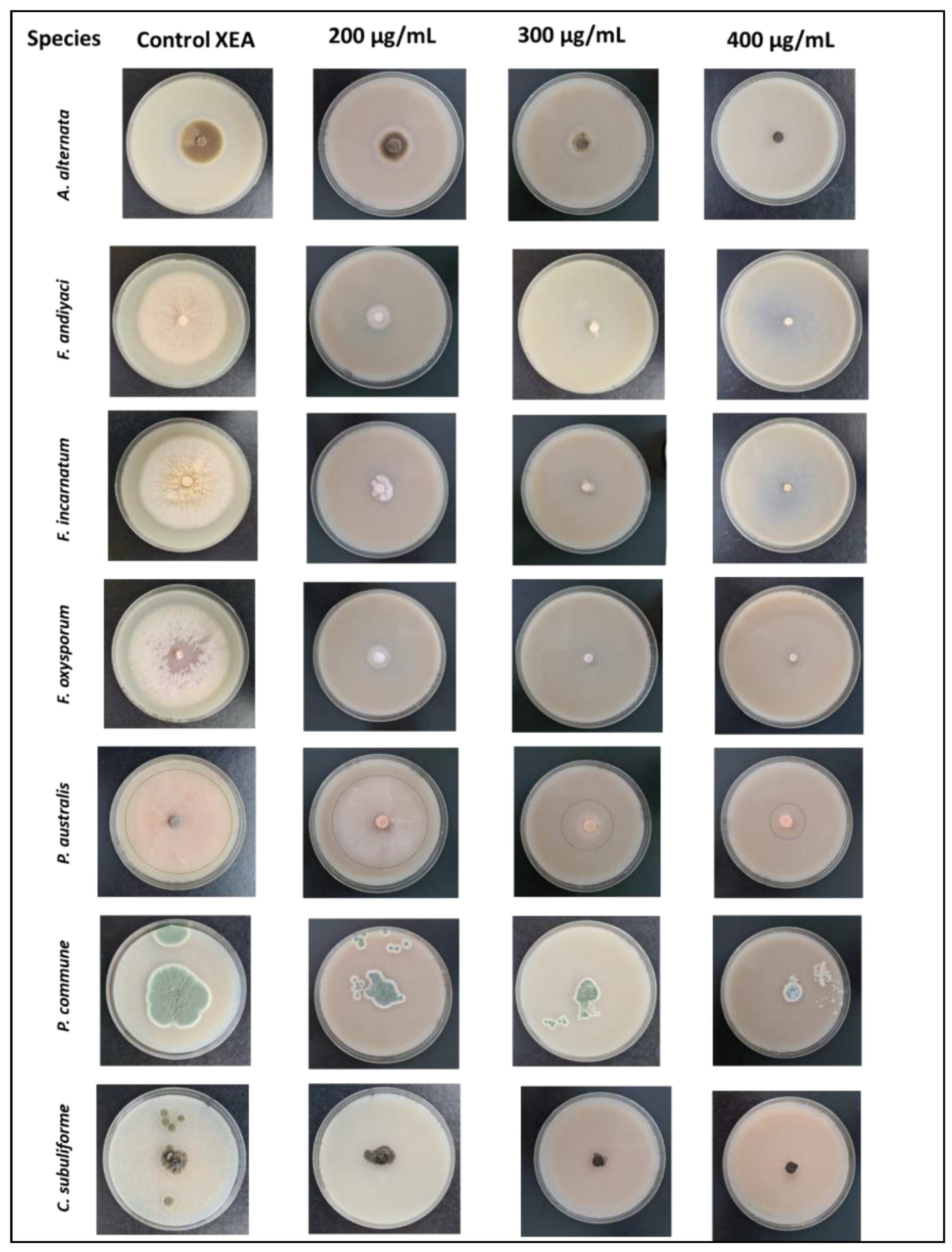
Figure 2.
Interaction plot, mean growth, species, at 200, 300 and 400 μg/mL concentrations of Thymus zygis essential oil against Alternaria alternata (AA), Fusarium andiyazi (FA), Fusarium incarnatum (FI), Fusarium oxysporum (FO), Podospora australis (PoA), Penicillium commune (PC) and Cladosporium subuliforme (CS). n (30) observations per treatment were used in the statistical analysis.
Figure 2.
Interaction plot, mean growth, species, at 200, 300 and 400 μg/mL concentrations of Thymus zygis essential oil against Alternaria alternata (AA), Fusarium andiyazi (FA), Fusarium incarnatum (FI), Fusarium oxysporum (FO), Podospora australis (PoA), Penicillium commune (PC) and Cladosporium subuliforme (CS). n (30) observations per treatment were used in the statistical analysis.
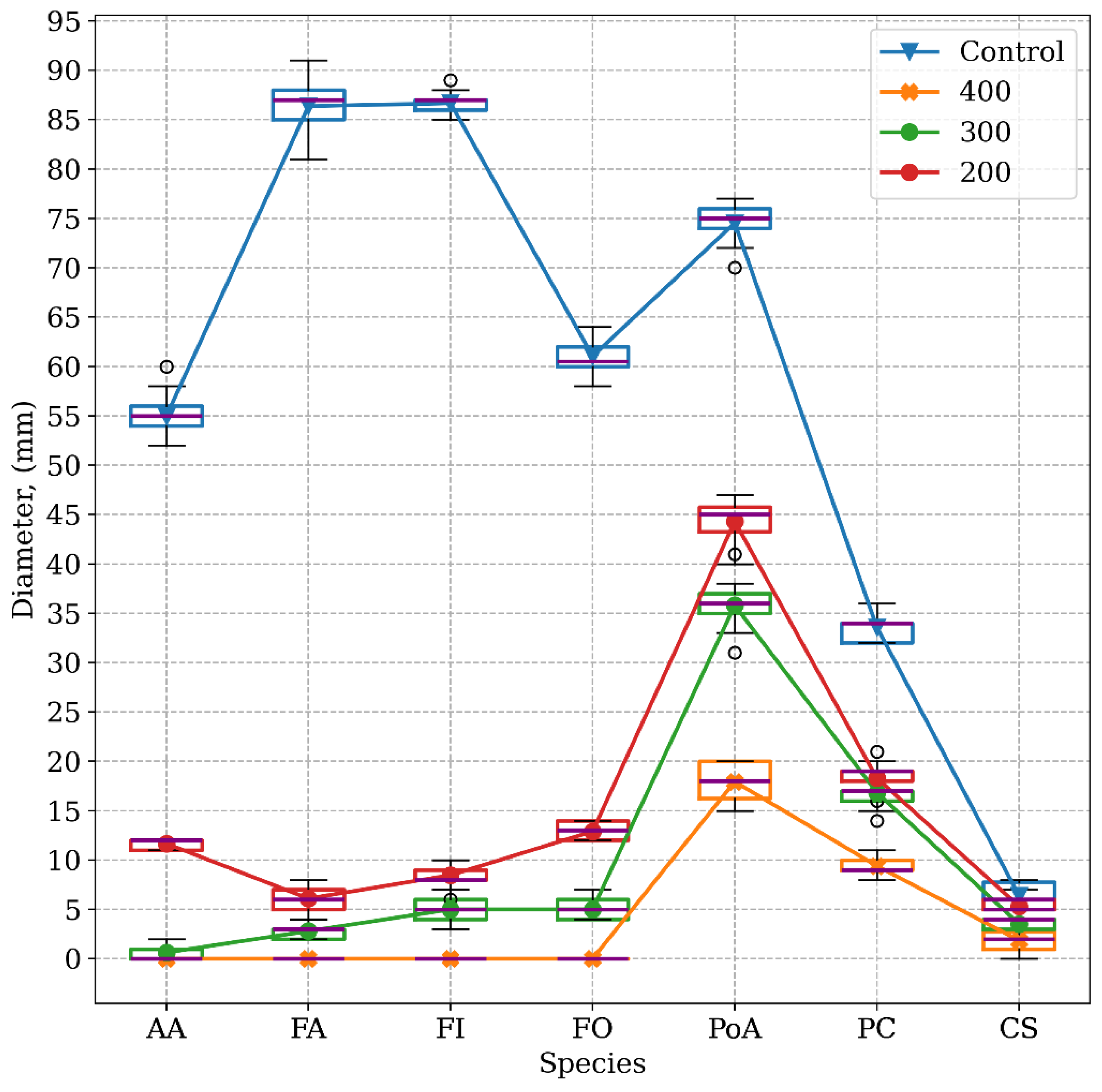
Figure 3.
Effect of Thymus zygis essential oil at 800 µg/mL on Fusarium andiyazi inoculated in tuber tiger nut after 10, 15 and 30 days. Control 1, fruits without film and without EO. Control 2, fruits with film and without EO. EO-Film, fruits with film and essential oil.
Figure 3.
Effect of Thymus zygis essential oil at 800 µg/mL on Fusarium andiyazi inoculated in tuber tiger nut after 10, 15 and 30 days. Control 1, fruits without film and without EO. Control 2, fruits with film and without EO. EO-Film, fruits with film and essential oil.
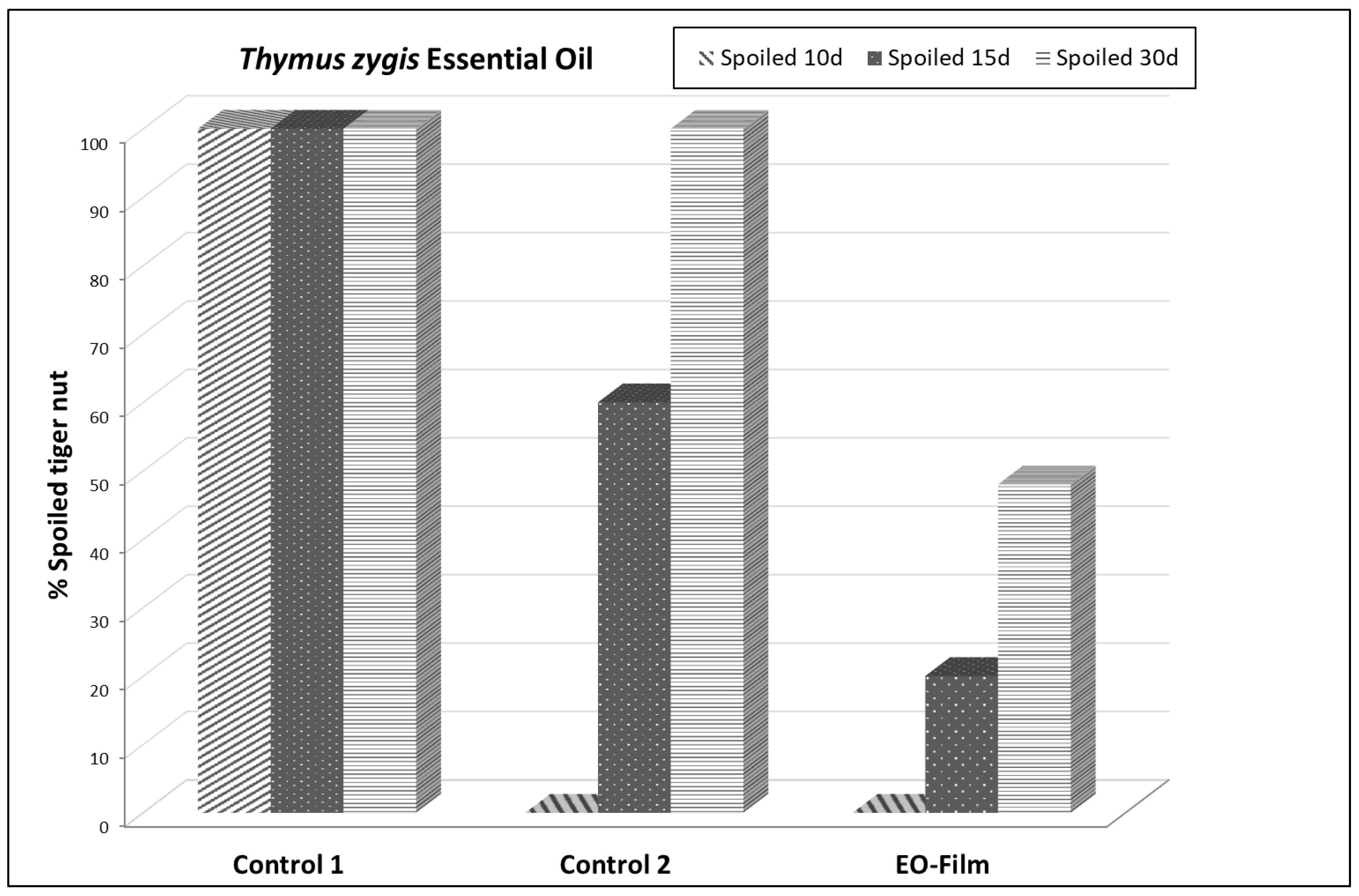

Table 1.
Identified compounds in commercial Thymus zygis essential oil.
| RT | LRI lit. | Peak Area (%) Mean ±SD |
Identification Method | |
|---|---|---|---|---|
| Monoterpene hydrocarbons | 39.74±0.19 | |||
| α-thujene | 930 | 930 | 0.01±0.00 | MS, LRI |
| α-pinene | 937 | 939 | 0.38±0.01 | MS, LRI |
| Camphene | 951 | 954 | 0.02±0.00 | MS, LRI |
| trans-pinane | 971 | 975 | 0.01±0.00 | MS, LRI |
| 3-p-menthene | 985 | 987 | 0.12±0.00 | MS, LRI |
| Myrcene | 992 | 990 | 0.46±0.00 | MS, LRI |
| α-terpinene | 1018 | 1017 | 0.02±0.00 | MS, LRI |
| p-cymene | 1024 | 1024 | 35.16±0.16 | MS, LRI |
| γ−terpinene | 1061 | 1059 | 3.53±0.02 | MS, LRI |
| Terpinolene | 1088 | 1088 | 0.01±0.00 | MS, LRI |
| p-cymenene | 1089 | 1091 | 0.02±0.00 | MS, LRI |
| Oxygenated monoterpenes | 59.73±0.34 | |||
| 1,8-cineole | 1033 | 1031 | 0.79±0.01 | MS, LRI |
| cis-linalool oxide | 1074 | 1072 | 0.02±0.00 | MS, LRI |
| trans-linalool oxide | 1086 | 1086 | 0.01±0.00 | MS, LRI |
| 6,7-epoxymyrcene | 1094 | 1092 | 0.01±0.01 | MS, LRI |
| Linalool | 1101 | 1096 | 2.21±0.03 | MS, LRI |
| α-fenchol | 1112 | 1116 | 0.01±0.00 | MS, LRI |
| Isoborneol | 1156 | 1160 | 0.25±0.03 | MS, LRI |
| Borneol | 1166 | 1169 | 1.12±0.01 | MS, LRI |
| terpinen-4-ol | 1177 | 1177 | 0.02±0.00 | MS, LRI |
| Isocitral | 1179 | 1180 | 0.05±0.01 | MS, LRI |
| Isomenthol | 1180 | 1182 | 0.01±0.01 | MS, LRI |
| α-terpineol | 1189 | 1188 | 0.18±0.02 | MS, LRI |
| γ-terpineol | 1201 | 1199 | 0.16±0.00 | MS, LRI |
| carvacrol methyl ether | 1245 | 1244 | 0.02±0.00 | MS, LRI |
| Thymol | 1295 | 1290 | 51.34±0.21 | MS, LRI |
| Carvacrol | 1305 | 1299 | 3.53±0.01 | MS, LRI |
| Sesquiterpene hydrocarbons | 0.15±0.00 | |||
| β-caryophyllene | 1417 | 1419 | 0.13±0.00 | MS, LRI |
| α-humulene | 1451 | 1454 | 0.02±0.00 | MS, LRI |
| Oxygenated sesquiterpenes | 0.33±0.00 | |||
| caryophyllene oxide | 1578 | 1583 | 0.31±0.00 | MS, LRI |
| humulene epoxide II | 1603 | 1608 | 0.02±0.00 | MS, LRI |
| Total identified | 99.95±0.53 | |||
Compounds listed in order of elution in the column. RT: retention time according to CG/MS analysis. LRI lit.: Linear retention indices from Adams [33]. MS: Comparing with spectra from NIST 2.0. LRI: Linear retention indices based on C8-C25 alkanes. Peak area values are means ± standard deviation of three samples.
Table 2.
Mean growth (mm) for each fungus grown on XEA (control) and XEA-Thymus zygis essential oil at different concentrations. XEA (Tiger nut extract agar), AA (Alternaria alternata), FA (Fusarium andiyazi), FI (Fusarium incarnatum), FO (Fusarium oxysporum), PoA (Podospora australis), PC (Penicillium commune), CS (Cladosporium subuliforme).
Table 2.
Mean growth (mm) for each fungus grown on XEA (control) and XEA-Thymus zygis essential oil at different concentrations. XEA (Tiger nut extract agar), AA (Alternaria alternata), FA (Fusarium andiyazi), FI (Fusarium incarnatum), FO (Fusarium oxysporum), PoA (Podospora australis), PC (Penicillium commune), CS (Cladosporium subuliforme).
| Concentration (µg/mL) | AA | FA | FI | FO | PoA | PC | CS |
|---|---|---|---|---|---|---|---|
| Control (XEA) | 54.97 | 86.50 | 86.67 | 61.03 | 74.53 | 33.60 | 6.40 |
| 200 | 11.67 | 6.10 | 8.47 | 12.90 | 44.30 | 18.30 | 5.33 |
| 300 | 0.63 | 2.80 | 5.00 | 5.00 | 35.80 | 16.83 | 3.53 |
| 400 | 0 | 0 | 0 | 0 | 17.93 | 9.40 | 1.87 |
Table 3.
Mycelial Growth Inhibition (MGI) percentage for each fungus grown on XEA-Thymus zygis essential oil at different doses. AA (Alternaria alternata), FA (Fusarium andiyazi), FI (Fusarium incarnatum), FO (Fusarium oxysporum), PoA (Podospora australis), PC (Penicillium commune), CS (Cladosporium subuliforme).
Table 3.
Mycelial Growth Inhibition (MGI) percentage for each fungus grown on XEA-Thymus zygis essential oil at different doses. AA (Alternaria alternata), FA (Fusarium andiyazi), FI (Fusarium incarnatum), FO (Fusarium oxysporum), PoA (Podospora australis), PC (Penicillium commune), CS (Cladosporium subuliforme).
| Concentration (µg/mL) | AA | FA | FI | FO | PoA | PC | CS |
|---|---|---|---|---|---|---|---|
| 200 | 78.77 | 92.95 | 90.23 | 78.86 | 40.56 | 45.54 | 16.72 |
| 300 | 98.85 | 96.76 | 94.23 | 91.81 | 51.97 | 49.91 | 44.84 |
| 300 | 100 | 100 | 100 | 100 | 75,94 | 72,02 | 70.78 |
Table 4.
Efficacy of the treatment with Thymus zygis essential oil biofilm at 800 µg/mL against fungal development of Fusarium andiyazi on tiger nut.
Table 4.
Efficacy of the treatment with Thymus zygis essential oil biofilm at 800 µg/mL against fungal development of Fusarium andiyazi on tiger nut.
| Efficacy on tiger nut (%) | |||||||||
| 10 days | 15 days | 30 days | |||||||
| Treatment | healthy | spotted spot | spoiled | healthy | spotted spot | spoiled | |||
| Control 1 | 0c* | 0c | 100a | - | - | - | - | - | - |
| Control 2 | 68b | 32a | 0b | 0b | 40a | 60a | - | 0b | 100a |
| EO-Film | 96a | 4b | 0b | 64a | 20b | 20b | 40a | 12a | 48b |
Control 1, fruits without film and without EO. Control 2, fruits with film and without EO. EO-Film, fruits with film and essential oil. -: No Reading. *Different letters in the same column indicate a significant difference at 95% level probability by Tukey’s HSD.
Disclaimer/Publisher’s Note: The statements, opinions and data contained in all publications are solely those of the individual author(s) and contributor(s) and not of MDPI and/or the editor(s). MDPI and/or the editor(s) disclaim responsibility for any injury to people or property resulting from any ideas, methods, instructions or products referred to in the content. |
© 2024 by the authors. Licensee MDPI, Basel, Switzerland. This article is an open access article distributed under the terms and conditions of the Creative Commons Attribution (CC BY) license (http://creativecommons.org/licenses/by/4.0/).
Copyright: This open access article is published under a Creative Commons CC BY 4.0 license, which permit the free download, distribution, and reuse, provided that the author and preprint are cited in any reuse.


