1. Introduction
Technology has penetrated teaching practices thus the need to establish new competencies that focus on the use of technology and instruction. It has been useful in practice because of shift of emphasis and hence a paradigm shift has occurred in the Technological Pedagogical Content Knowledge (TPACK) that evolved from Shulman 1986 of Pedagogical Content Knowledge (PCK). TPACK adapts the use of technology in a learning process due to its applicability in today’s classes (Mishra & Koehler, 2006). As the development of digital technologies and online classes occurs, intensified after COVID-19, teachers are urged to solve multifaceted learning contexts that involve both traditional and digital teaching instruments and environments.
Despite this though, there are factors that make forming these new types of skills hard for many teachers: There are exciting new pedagogies emerging in the context of these changes, but creating the necessary techno-pedagogical skills is quite a challenge for many teachers. Examples of variables that affect the techno-pedagogical competence of educators include resource availability, socio-demographic characteristics of the learners and the type of teacher training programmes. A number of recent publications have indicated that teachers who have well developed TPACK skills are try effective in the management of classroom learning processes with specific reference to student’s engagement and achievement (Beaudin & Hadden, 2006). On the other hand, ‘techno stress’, a term that can be new to many, has risen to be the biggest hindrance to integration of technology in learning focusing to trainers in particular who are often ill-equipped for the task (Özgür, 2020).
Considering all these challenges the purpose of this study is to explore the current level of techno-pedagogical competence among the teachers of primary, secondary and higher secondary schools in urban and rural settings. In other words, the purpose of the study is to gain further understanding of the factors that can enhance teacher performance and thus improve the impact that teachers have on their students through discovering the correlation between the technicians and pedagogy skills applied in the schools, school support, and teacher performance. It also analyses the effect of technostress on teacher performance and examines ways to deal with this problem.
2. Objectives
- a)
To investigate the level of techno-pedagogical competence among teachers in primary, secondary, and higher secondary schools across various socio-demographic contexts.
- b)
To assess the relationship between techno-pedagogical competence and teacher effectiveness in terms of student academic performance and engagement.
- c)
To explore the role of school support in fostering techno-pedagogical competencies and reducing technostress among teachers.
- d)
To examine the influence of teacher training programs on the development of TPACK skills among pre-service and in-service teachers.
- e)
To identify the challenges and barriers teachers face in integrating technology into their teaching practice and propose solutions to address these issues.
3. Research Hypotheses
- a)
Teachers in urban areas have significantly higher levels of techno-pedagogical competence compared to teachers in rural areas.
- b)
There is a positive correlation between high levels of TPACK competence and teacher effectiveness, as measured by student academic performance and engagement.
- c)
Teachers who receive strong school support exhibit lower levels of technostress and higher TPACK competencies.
- d)
Teacher training programs that incorporate technology integration lead to higher TPACK scores among pre-service teachers.
- e)
Techno stress negatively impacts a teacher’s ability to integrate technology effectively into their pedagogy.
4. Method and Materials
This research utilises quantitative and qualitative data to underpin the investigation of the nexus between techno-pedagogical competency and teacher achievement irrespective of context. This study is conducted on 500 teachers from both the urban and rural areas of primary, secondary and higher secondary school teachers of Andaman and Nicobar Island. The participants are pre and in-service teachers identified by socio-demographic variables of gender, years of teaching experience and discipline.
They use the process of stratified sampling to choose participants possibly with variation in the level of education and geographical area. The target population is teachers who undertake qualitative interviews based on purposive sampling; all participants differ in their techno-pedagogical proficiency.
TPACK questionnaire is used because it adopts an established and standardized survey of teachers’ self-reported techno pedagogical competency. Other scales measure school support, techno-stress, and teacher outcome in terms of students’ academic performance and learning interest. Semi structured interviews form part of the technique used for a purposeful sample of teachers to identify their perceptions, use and barriers of introducing technology in the classroom.
Descriptive statistics, independent sample t-tests, analysis of variance (ANOVA) and regression analysis are employed to analyse quantitative data with a view of establishing the correlation between TPACK, teacher effectiveness, and techno stress. The collected qualitative data is analyzed thematically to capture patterns of difficulties and facilitators of technology adoption.
5. Analysis and Interpretation
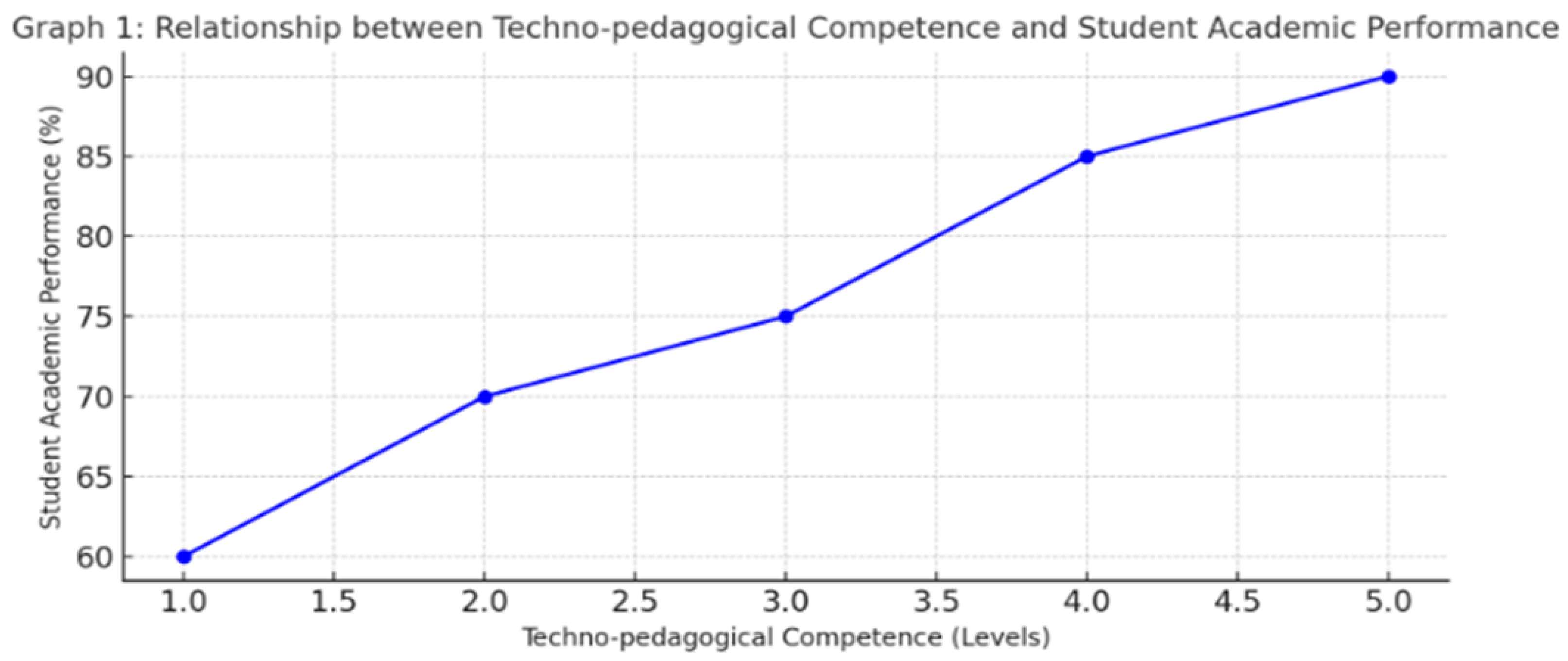
The present work synthesises several conclusions and recommendations concerning the correlation between techno-pedagogical competence and teacher performance. Teachers at these centres are more competent in TPACK technical ability compared to the rural ones because of far better access to technologies and professionalism. Analysis of the results obtained reveals a very strong and positive relationship between Techno-pedagogy competencies, on one side, and performance, evidently on the credit scores of students, given subject areas, which heavily employ technology, such as sciences and mathematics.
On the other hand, teachers in rural areas while receiving less techno-pedagogical proficiency, genuinely possess high levels of PCK. Such a conclusion indicates that despite minimal availability and utilization of technological resources in teaching practices, the concepts within a given subject matter allow teachers to work effectively with what is available to them. But, schools fail to support and provide training for these technologies, the integration of technology in these areas become difficult.
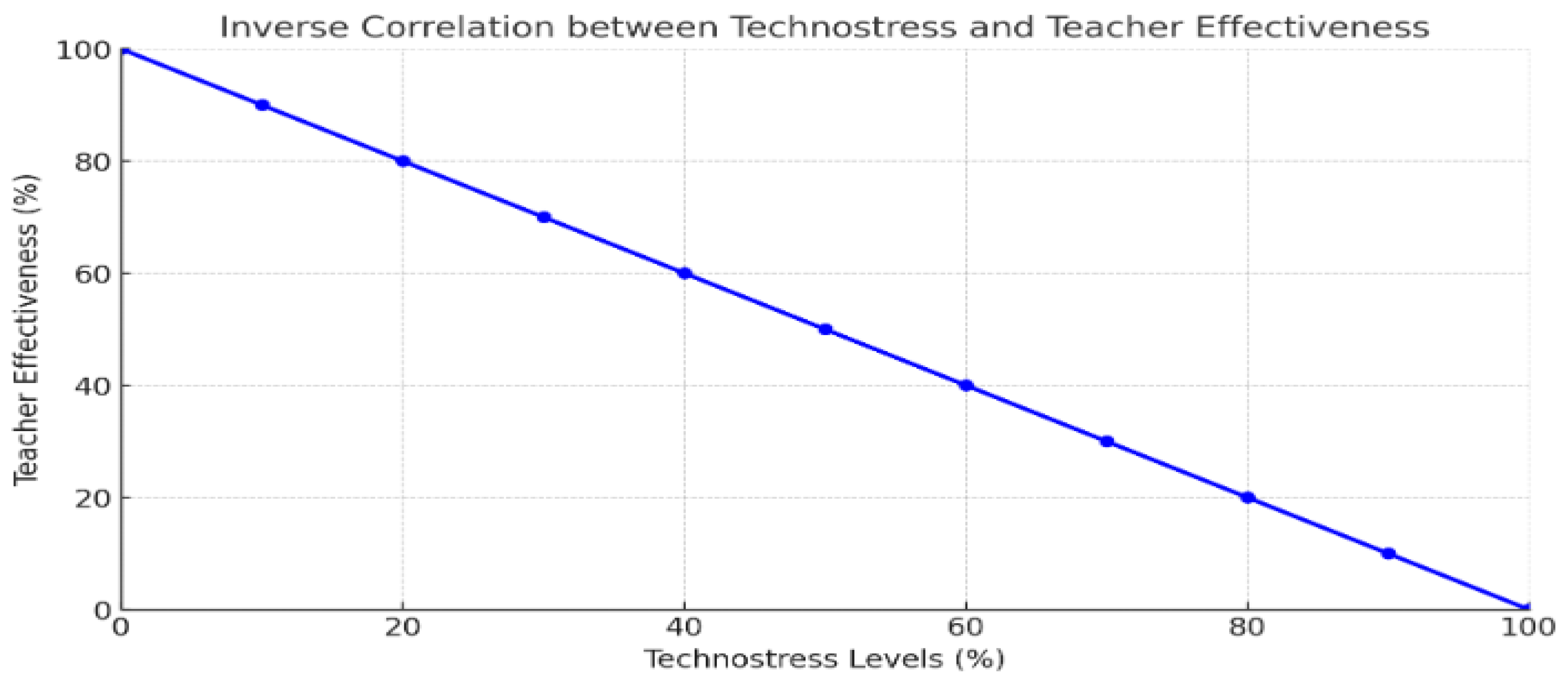
Similarly, the analysis of the data also shows that techno stress has significant negative effects on the performance of the teachers; measured TPACK competence decreases as stress level increase. Techno-stressed teachers had problems in learning new technologies, and they thereby struggled to teach students properly. Teachers who get adequate institutional help, infrastructural support and on-going staff development regarding technology they report low techno stress and high effective output scores.
Figure 1.
illustrates the relationship between techno-pedagogical competence and student academic performance.
Figure 1.
illustrates the relationship between techno-pedagogical competence and student academic performance.
Figure 2.
shows the inverse correlation between techno stress and teacher effectiveness.
Figure 2.
shows the inverse correlation between techno stress and teacher effectiveness.
6. Major Findings
a) Techno-pedagogical competence shows a strong positive relationship with teacher outcomes as well as students’ performance.
b) Teachers teach in urban areas have higher assessment TPACK competency levels because of enhanced access to technology as well as well enhanced professional development.
c) Rural teacher’s content knowledge particular to their teaching subjects is well developed but they grapple with issues relating to use of technology caused by inadequate resources.
d) Techno stress was a major influence towards the usage of technology hence with higher levels of stress; the performance of the teachers is low.
e) Insufficient school support, and particularly physical structures available for technological. Integration and teachers training are essential in mitigating instances of techno stress as well as improving on teacher’s techno pedagogical competency.
7. Recommendations
Teacher Education Programs: TPACK framework needs to be integrated into the training curricula of teacher training universities to be used by pre service teachers more directly on the field of workplace via exposing them to technology integration through hands on experience.
Professional Development: The in-service teachers should be continuing to make techno pedagogical skills a continuous run in order to design continuous professional development programs for them. What should be put emphasis on is practical ways to use digital tools in the classroom.
School Support: Digital infrastructure in schools should be thought of as an investment and teachers, similarly, should come equipped with adequate support for access and use of technology. Since school administrations should also improve strategies to cut down the use of fake likes, mental health support, and regular training sessions for teachers to reduce techno stress should be implemented.
Policy Recommendations: Paradoxically, on the one hand, educational policy makers should support equal access to technological resources between urban and rural schools, and on the other hand, be prepared to provide rural teachers with the needed instruments to use technology as a teaching tool.
8. Conclusions
The findings stress the need for teachers to have techno pedagogical competence to keep pace with the requirements of 21st century classrooms. If technology is used well, it helps teachers integrate technology well into teaching practices, which increases student engagement, disrupts complacency of students and boosts students’ academic performance. Nevertheless, the research demonstrates the great disparity in techno pedagogical skills amongst urban and rural areas mainly because of a lack of resources and training.
Results imply a necessity for comprehensive teacher education which integrates technology into the curriculum. Also in service teachers must be supported through on-going professional development opportunities to be able to keep themselves proficient in using digital tools. Further the study identifies techno stress as a significant challenge to integrating technology especially when teachers lack support. Future research should explore the use of strategies to mitigate techno stress and to increase to access to digital resources in underserved areas.
Ethics Approval and Consent to Participate
This study was conducted within the ethical guidelines for research involving human participants. Informed consent was obtained from all participants prior to the data collection, with a focus on explaining the purpose of the study to the participants, their rights as participants, and how the confidentiality of their responses would be maintained.
Consent for Publication
Consent to publish was obtained from all participants who were part of the study. Participants were assured that there would be no sharing or publication of personal identifiable information.
Competing Interests
The authors declare no competing interests in connection with this study. Neither financial, professional, nor personal interests would influence the research or its result.
Authors Contributions
{Prodee Kumar Mondal}: Conceptualized the study, designed the methodology, and wrote the manuscript. Data collection, Statistical analysis and helped in writing the results. Aided the qualitative data analysis and thematic interpretation, and contributed to recommendations. In-charge of supervision of the study and reviewed the manuscript for intellectual content. The authors have read and approved the final manuscript.
Funding
This research was not funded by any organisation.
Acknowledgements
The authors wish to express their gratitude to the teachers and administrators of schools in the Andaman and Nicobar Islands for their direct participation and cooperation during the course of this study. The authors are also grateful to the research assistants for data collection and analysis.
References
- Tosuntaş, Ş. B., Cubukcu, Z., & Beauchamp, G. (2021). Teacher performance in terms of technopedagogical content knowledge competencies. Kastamonu Eğitim Dergisi, 29(1), 63–83. [CrossRef]
- Gure, G. S. I. N. G. H. (2016). Techno-Pedagogy Practices in Teacher Education. International Journal of Enhanced Research in Educational Development (IJERED), Vol. 4(Issue 6,). https://www.academia.edu/44260189/Techno_Pedagogy_Practices_in_Teacher_Education.
- Nayar, A., Norul, S., & Assoc, A. (2020). Technology Pedagogical Content Knowledge(TPCK) and Techno Pedagogy Integration Skill ( TPIS) among Pre-Service Science teachers- case study of a University based ICT based Teacher Education curriculum. Journal of Education and Practice. [CrossRef]
- M, L. K., & Saleem, T. M. (2017). Infusion of Techno Pedagogy in Elementary Teacher Education Curriculum: Perspectives and challenges. IOSR Journal of Humanities and Social Science, 22(01), 06–10. [CrossRef]
- Asad, M. M., Aftab, K., Sherwani, F., Churi, P., Moreno-Guerrero, A., & Pourshahian, B. (2021). Techno-Pedagogical Skills for 21st century Digital Classrooms: An extensive literature review. Education Research International, 2021, 1–12. [CrossRef]
- Akay, C., & Incik, E. Y. (2017). A Comprehensive analysis on Technopedagogical Education Competency and Technology Perception of Pre-service teachers: relation, levels and views. Contemporary Educational Technology, 8(3). [CrossRef]
- Grenon, V., & Samson, G. (2019). Developing the techno-pedagogical skills of online university instructors. International Journal of E-learning & Distance Education, 34(2). http://files.eric.ed.gov/fulltext/EJ1238223.pdf.
- . Öztürk, G., Karamete, A., & Çeti̇N, G. (2020). The Relationship between Pre-service Teachers’ Cognitive Flexibility Levels and Techno-pedagogical Education Competencies. International Journal of Contemporary Educational Research, 7(1), 40–53. [CrossRef]
- Şentürk, Ş. (2019). Investigation of pre-service teachers’ techno-pedagogical skills and lifelong learning tendencies. Participatory Educational Research, 6(2), 78–92. [CrossRef]
- PPalanisamy, K. D. A. (2020). Techno Pedagogical Skills for Teaching-Learning Process in Smart Class. Journal of Talent Development and Excellence, 12(1), 4984–4994. http://iratde.com/index.php/jtde/article/view/1512.
- Soto, M. a. P., Salvat, B. G., & Herrera, P. A. (2024). Technopedagogical and disciplinary knowledge of primary school teachers in different socio-demographic contexts. Campus Virtuales, 13(1), 69. [CrossRef]
- Özdemir, M. (2016). An examination of the Techno-pedagogical Education Competencies (TPACK) of pre-service elementary school and preschool teachers. Journal of Education and Training Studies, 4(10). [CrossRef]
- Beaudin, L., & Hadden, C. (2006). Technology and Pedagogy: Building Techno-Pedagogical skills in preservice teachers. Innovate, 2(2), 5. https://www.learntechlib.org/p/104237/article_104237.pdf.
- Özgür, H. (2020). Relationships between teachers’ technostress, technological pedagogical content knowledge (TPACK), school support and demographic variables: A structural equation modeling. Computers in Human Behavior, 112, 106468. [CrossRef]
- Guru, N., & Beura, M. K. (2019). Techno-pedagogical competency of higher secondary school teachers in relation to students’ academic achievement in science. International Journal of Applied Research, 5(12), 362–370. https://www.allresearchjournal.com/archives/2019/vol5issue12/PartF/5-10-60-608.pdf.
- Mishra, P., & Koehler, M. J. (2006). Technological Pedagogical Content Knowledge: a framework for teacher knowledge. Teachers College Record the Voice of Scholarship in Education, 108(6), 1017–1054. [CrossRef]
- Yorulmaz, A., Can, S., & Çokçalişkan, H. (2017). The Relationship between the Pre-service Classroom Teachers’ Techno Pedagogical Instructional Competencies and Epistemological Beliefs. Journal of Education and Training Studies, 5(9), 27. [CrossRef]
- Beri, N., & Sharma, L. (2019). A Study on Technological Pedagogical and Content Knowledge among Teacher-Educators in Punjab Region. International Journal of Engineering and Advanced Technology, 8(5c), 1306–1312. [CrossRef]
- Whyte, S. (2014). Bridging the gaps: Using social media to develop techno-pedagogical competences in pre-service language teacher education. Recherche Et Pratiques PéDagogiques En Langues De SpéCialité, Vol. XXXIII N° 2, 143–169. [CrossRef]
- . Fekete, I. (2022). Profiling Hungarian K12 teachers based on their techno-pedagogical skills: State of affairs and development possibilities amid COVID-19. Journal of Adult Learning Knowledge and Innovation, 5(2), 111–124. [CrossRef]
|
Disclaimer/Publisher’s Note: The statements, opinions and data contained in all publications are solely those of the individual author(s) and contributor(s) and not of MDPI and/or the editor(s). MDPI and/or the editor(s) disclaim responsibility for any injury to people or property resulting from any ideas, methods, instructions or products referred to in the content. |
© 2024 by the authors. Licensee MDPI, Basel, Switzerland. This article is an open access article distributed under the terms and conditions of the Creative Commons Attribution (CC BY) license (http://creativecommons.org/licenses/by/4.0/).