

Submitted:
18 December 2024
Posted:
19 December 2024
You are already at the latest version
Abstract
Sorghum is a key global crop with substantial economic importance. Implementing green pest management for sorghum is crucial for promoting ecological balance and reducing reliance on chemical pesticides. This study assesses the impact of green pest management on arthropod biodiversity and sorghum yield and quality. Over two years, using Malaise trapping and DNA metabarcoding, we found that green pest management significantly enhanced arthropod diversity and shifted species composition, notably increasing Hymenoptera abundance. Although sorghum yield metrics were higher in the green group compared to chemical control group, these differences were not statistically significant. However, the green group exhibited improved quality with lower crude fat and higher levels of crude protein, starch, and amylopectin. These findings underscore the benefits of green pest management in fostering biodiversity and enhancing sorghum quality.
Keywords:
1. Introduction
2. Materials and Methods
2.1. Basic Information of Sampling Places
2.2. Green and Non-Green Pest Control
2.2.1. Green Pest Control Methods
2.2.2. Non-Green Pest Control Methods
2.3. Collection of Arthropods
2.3.1. Sampling
2.3.2. DNA Extraction, PCR Amplification, High-Throughput Sequencing
2.3.3. Metagenomic Data Processing
2.3.4. BOLD System MOTUs Division
2.3.5. Downstream Analysis of Metagenomic Data
2.4. Sorghum Yield and Quality Calculations
2.4.1. Sample Collection
2.4.2. Data Analysis
3. Results
3.1. Arthropods Dominate Across Different Years
3.2. Increased Arthropod Diversity and Hymenoptera Dominance in Green Groups
3.3. Green Groups Show Higher Sorghum Yield and Improved Grain Quality Trends
4. Conclusion and Discussion
4.1. Arthropod Diversity Dynamics
4.2. Impact of Green Pest Management on Arthropod Communities
4.3. Effects of Green Pest Management on Sorghum Quality
Supplementary Materials
Author Contributions
Data Availability Statament
Acknowledgments
Conflicts of Interest
References
- Alyokhin, A.; Nault, B.; Brown, B. Soil conservation practices for insect pest management in highly disturbed agroecosystems – a review. Èntomol. Exp. et Appl. 2019, 168, 7–27. [Google Scholar] [CrossRef]
- Baker, B.P.; Green, T.A.; Loker, A.J. Biological control and integrated pest management in organic and conventional systems. 140, 1040; 95. [Google Scholar] [CrossRef]
- Bik, H.M. Just keep it simple? Benchmarking the accuracy of taxonomy assignment software in metabarcoding studies. Mol. Ecol. Resour. 2021, 21, 2187–2189. [Google Scholar] [CrossRef]
- Bolger, A.M.; Lohse, M.; Usadel, B. Trimmomatic: A flexible trimmer for Illumina sequence data. Bioinformatics 2014, 30, 2114–2120. [Google Scholar] [CrossRef] [PubMed]
- Cortez-Madrigal, H.; Gutiérrez-Cárdenas, O.G. Enhancing biological control: conservation of alternative hosts of natural enemies. Egypt. J. Biol. Pest Control. 2023, 33, 1–13. [Google Scholar] [CrossRef]
- Dabija, A.; Ciocan, M.E.; Chetrariu, A.; Codină, G.G. Maize and Sorghum as Raw Materials for Brewing, a Review. Appl. Sci. 2021, 11, 3139. [Google Scholar] [CrossRef]
- de Sena, B.G. , and Smith, A.D. (2019). Falco: high-speed FastQC emulation for quality control of sequencing data. F1000Research 8, 1-22.
- Eitzinger, B. , Abrego, N., Gravel, D., Huotari, T., Vesterinen, E.J., and Roslin, T. (2019). Assessing changes in arthropod predator–prey interactions through DNA-based gut content analysis—variable environment, stable diet. Molecular Ecology 28, 266-280.
- Elbrecht, V.; Taberlet, P.; Dejean, T.; Valentini, A.; Usseglio-Polatera, P.; Beisel, J.-N.; Coissac, E.; Boyer, F.; Leese, F. Testing the potential of a ribosomal 16S marker for DNA metabarcoding of insects. PeerJ 2016, 4, e1966–e1966. [Google Scholar] [CrossRef]
- Fei, M.; Gols, R.; Harvey, J.A. The Biology and Ecology of Parasitoid Wasps of Predatory Arthropods. Annu. Rev. Èntomol. 2023, 68, 109–128. [Google Scholar] [CrossRef] [PubMed]
- Flomer, O. (1994). DNA primers for amplification of mitochondrial cytochrome c oxidase subunit I from diverse metazoan invertebrates. Mol Mar Biol Biotech 3, 294-299.
- Ganapathy, K.N. , Rao, B.D., Rakshit, S., Gnanesh, B.N., and Patil, J.V. (2015). Sorghum for health and business. Sustainable agriculture reviews: Cereals, 173-196.
- Guo, C. , Cui, W. ( 2011). Sorghum insect problems and Managementf. Journal of integrative plant biology 53, 178–192.
- Harris-Shultz, K.; Knoll, J.; Punnuri, S.; Niland, E.; Ni, X. Evaluation of strains of Beauveria bassiana and Isaria fumosorosea to control sugarcane aphids on grain sorghum. Agrosystems, Geosci. Environ. 2020, 3. [Google Scholar] [CrossRef]
- Hebert, P.D. , Cywinska, A., Ball, S.L., and DeWaard, J.R. (2003). Biological identifications through DNA barcodes. Proceedings of the Royal Society of London Series B: Biological Sciences 270, 313-321.
- Hendrichs, J. , Vreysen, M., Enkerlin, W., and Cayol, J. (2021). Strategic options in using sterile insects for area-wide integrated pest management. In Sterile insect technique (CRC press), pp. 841-884.
- Ji, S.; Gong, J.; Cui, K.; Zhang, Y.; Mostafa, K. Performance Test and Parameter Optimization of Trichogramma Delivery System. Micromachines 2022, 13, 1996. [Google Scholar] [CrossRef] [PubMed]
- Liu, Y.-X. , Chen, L., Ma, T., Li, X., Zheng, M., Zhou, X., Chen, L., Qian, X., Xi, J., Lu, H., et al. (2023). EasyAmplicon: An easy-to-use, open-source, reproducible, and community-based pipeline for amplicon data analysis in microbiome research. iMeta 2, e83.
- Magoč, T.; Salzberg, S.L. FLASH: fast length adjustment of short reads to improve genome assemblies. Bioinformatics 2011, 27, 2957–2963. [Google Scholar] [CrossRef] [PubMed]
- Magurran, A.E. Measuring biological diversity. 31, 1174. [Google Scholar] [CrossRef]
- McMurdie, P.J.; Holmes, S. phyloseq: An R package for reproducible interactive analysis and graphics of microbiome census data. PLoS ONE 2013, 8, e61217. [Google Scholar] [CrossRef]
- Mundia, C.W.; Secchi, S.; Akamani, K.; Wang, G. A Regional Comparison of Factors Affecting Global Sorghum Production: The Case of North America, Asia and Africa’s Sahel. Sustainability 2019, 11, 2135. [Google Scholar] [CrossRef]
- N’woueni, D.K.; Gaoue, O.G. Plant Diversity Increased Arthropod Diversity and Crop Yield in Traditional Agroforestry Systems but Has No Effect on Herbivory. Sustainability 2022, 14, 2942. [Google Scholar] [CrossRef]
- Neuwirth, E. , and Neuwirth, M.E. (2014). Package ‘RColorBrewer’. ColorBrewer palettes 991.
- Poudel, S.; Poudel, B.; Acharya, B.; Poudel, P. PESTICIDE USE AND ITS IMPACTS ON HUMAN HEALTH AND ENVIRONMENT. Environ. Ecosyst. Sci. 2020, 4, 47–51. [Google Scholar] [CrossRef]
- “Critical peak pricing-San Diego Gas & Electric,” https://www. sdge.com/businesses/savings-center/energy-management-programs/ demand-response/critical-peak-pricing, accessed: 2022-03-04.
- Rognes, T.; Flouri, T.; Nichols, B.; Quince, C.; Mahé, F. VSEARCH: A versatile open source tool for metagenomics. PeerJ 2016, 2016, e2584. [Google Scholar] [CrossRef]
- Shannon, C.E. (2001). A mathematical theory of communication. ACM SIGMOBILE mobile computing and communications review 5, 3-55.
- Skvarla, M.J. , Larson, J. P. ( 2021). A review of terrestrial and canopy Malaise traps. Annals of the Entomological Society of America 114, 27–47.
- Stenberg, J.A. A Conceptual Framework for Integrated Pest Management. 22. [CrossRef]
- Suchan, T.; Talavera, G.; Sáez, L.; Ronikier, M.; Vila, R. Pollen metabarcoding as a tool for tracking long-distance insect migrations. Mol. Ecol. Resour. 2018, 19, 149–162. [Google Scholar] [CrossRef]
- Tamhane, V.A.; Sant, S.S.; Jadhav, A.R.; War, A.R.; Sharma, H.C.; Jaleel, A.; Kashikar, A.S. Label-free quantitative proteomics of Sorghum bicolor reveals the proteins strengthening plant defense against insect pest Chilo partellus. Proteome Sci. 2021, 19, 1–25. [Google Scholar] [CrossRef] [PubMed]
- Wickham, H. (2011). ggplot2. Wiley interdisciplinary reviews: computational statistics 3, 180-185.
- Xia, H.; Zhang, Z.; Luo, C.; Wei, K.; Li, X.; Mu, X.; Duan, M.; Zhu, C.; Jin, L.; He, X.; et al. MultiPrime: A reliable and efficient tool for targeted next-generation sequencing. iMeta 2023, 2, e143. [Google Scholar] [CrossRef]
- Xing-Lin, H.; De-Liang, W.; Wu-Jiu, Z.; Shi-Ru, J. The production of the Chinese baijiu from sorghum and other cereals. J. Inst. Brew. 2017, 123, 600–604. [Google Scholar] [CrossRef]
- Zhou, W.; Arcot, Y.; Medina, R.F.; Bernal, J.; Cisneros-Zevallos, L.; Akbulut, M.E.S. Integrated Pest Management: An Update on the Sustainability Approach to Crop Protection. ACS Omega 2024, 9, 41130–41147. [Google Scholar] [CrossRef] [PubMed]
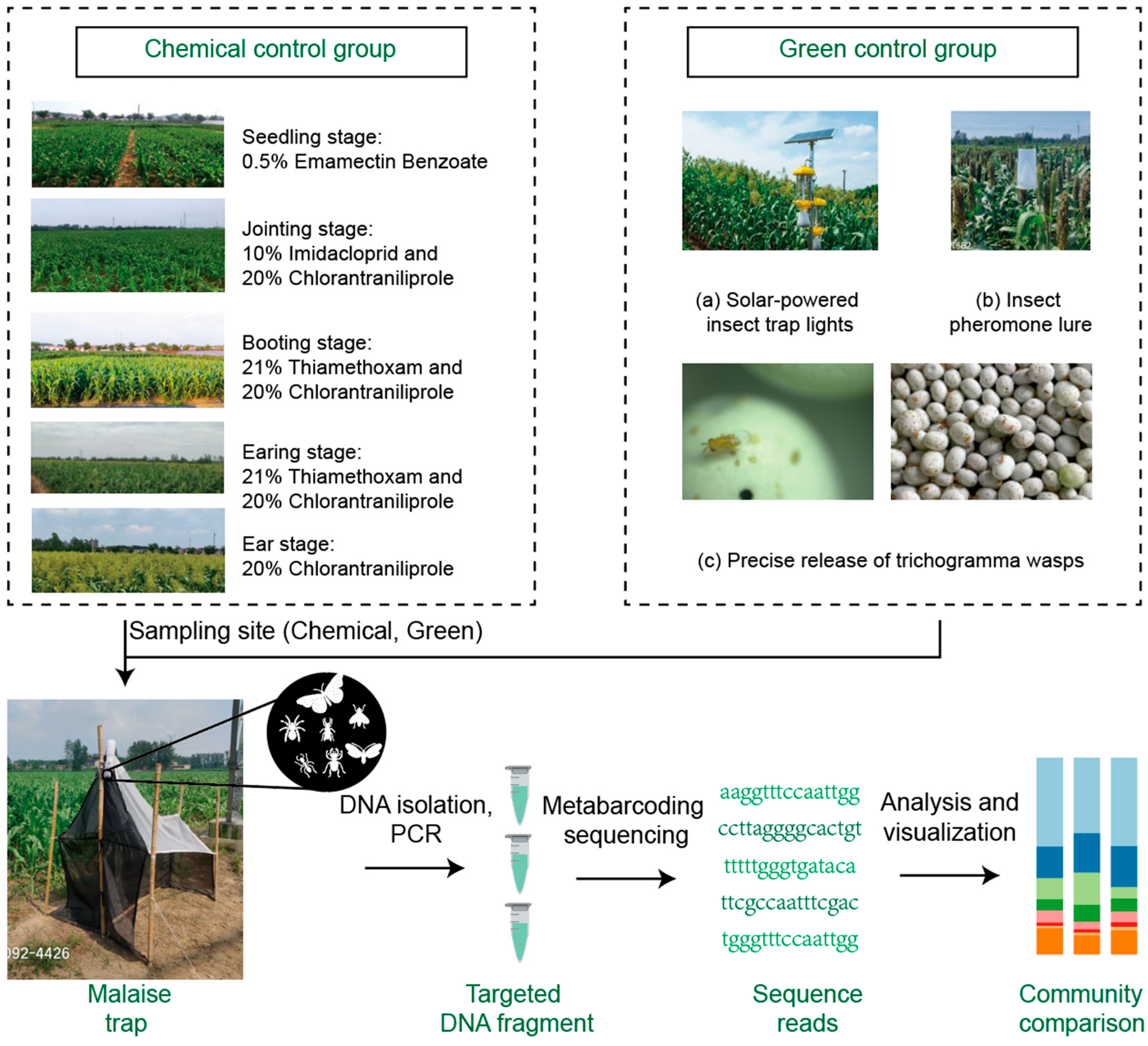

| Frequency | Time | Pesticide | Dosage of pesticide |
|---|---|---|---|
| First time | Seedling stage | 0.5% Emamectin Benzoate | 450 mL/ha |
| Second time | Jointing stage | 10% Imidacloprid, 20% Chlorantraniliprole |
225 g/h, 120 mL/ha |
| Third time | Booting stage | 21% Thiamethoxam, 20% Chlorantraniliprole |
120 mL/ha each |
| Fourth time | Earing stage | 21% Thiamethoxam, 20% Chlorantraniliprole |
120 mL/ha, 150 mL/ha |
| Fifth time | Ear stage | 20% Chlorantraniliprole | 150 mL/ha |
Disclaimer/Publisher’s Note: The statements, opinions and data contained in all publications are solely those of the individual author(s) and contributor(s) and not of MDPI and/or the editor(s). MDPI and/or the editor(s) disclaim responsibility for any injury to people or property resulting from any ideas, methods, instructions or products referred to in the content. |
© 2024 by the authors. Licensee MDPI, Basel, Switzerland. This article is an open access article distributed under the terms and conditions of the Creative Commons Attribution (CC BY) license (http://creativecommons.org/licenses/by/4.0/).