

Submitted:
17 December 2024
Posted:
18 December 2024
You are already at the latest version
Abstract
This paper explores the macroeconomic trajectories of the United States and China using the Solow growth model, focusing on capital accumulation, labour force dynamics, and technological progress. The analysis highlights the distinct challenges and opportunities arising from population characteristics, including ageing populations and demographic transitions, and evaluates state dynamics and institutional frameworks influencing economic strategies. The findings reveal that while the United States benefits from technological innovation and a balanced demographic structure, it faces rising dependency ratios. Conversely, China confronts significant demographic and structural headwinds but leverages state-driven initiatives and rapid urbanisation. Policy recommendations address demographic adjustments, productivity enhancement, and structural reforms to sustain long-term growth.
Keywords:
1. Introduction
1.1 The Solow Growth Model as a Framework
1.2. The American Economy: Strength in Innovation but Facing Demographic Headwinds
1.3. The Chinese Economy: Transitioning Amidst Demographic and Structural Challenges
1.4. Comparative Analysis of Population Dynamics
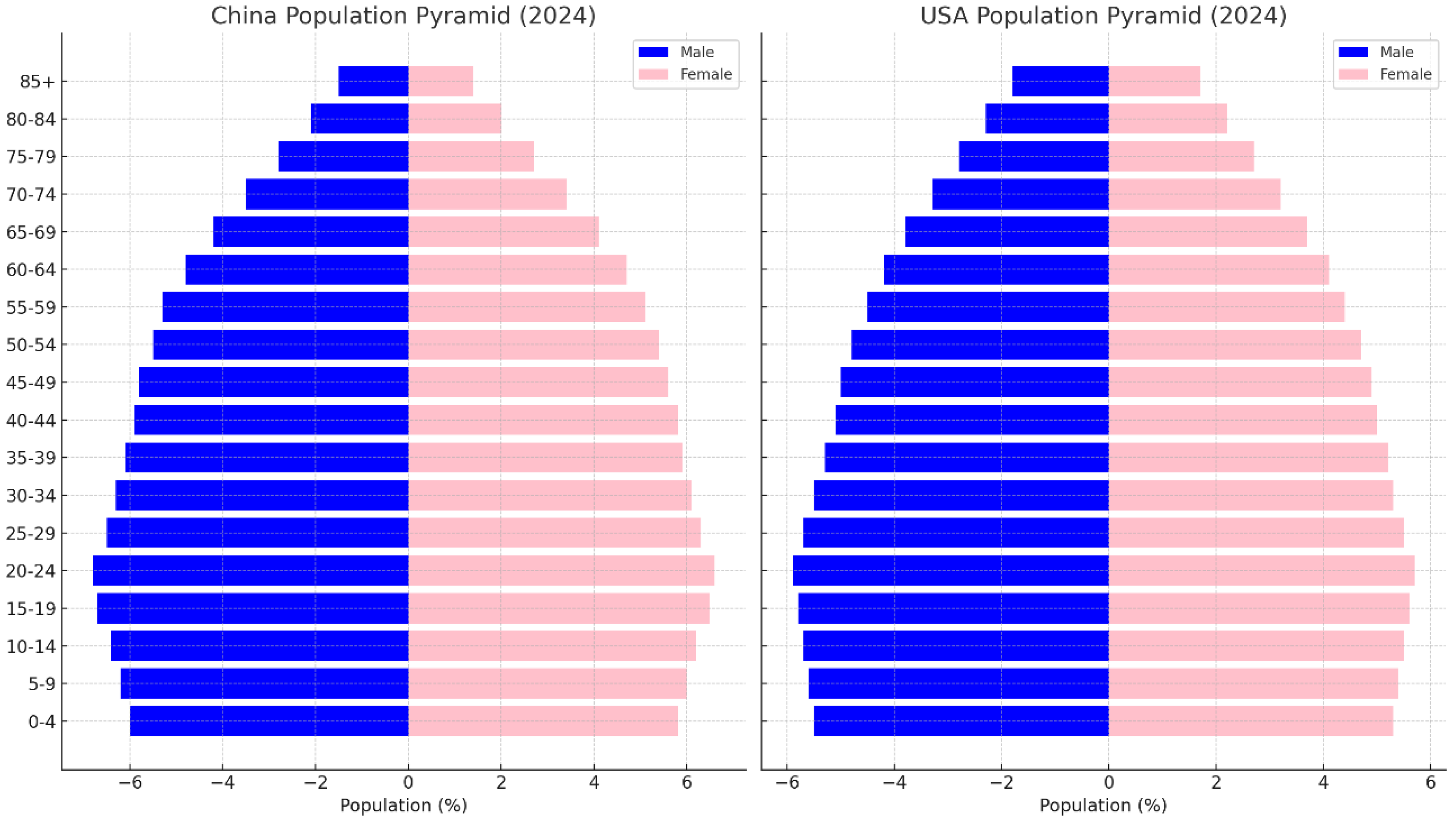
1.5. State Governance and Economic Strategies
1.6. Summary
2. Methodology
2.1. The Solow Growth Model Framework
- : Total factor productivity (TFP) or technological progress.
- : Capital stock at time .
- : Labour input (determined by population dynamics).
- : Elasticity of output with respect to capital, capturing the share of income accruing to capital.
- Labour and Technology Dynamics: Labour grows at a constant rate , and technology improves at a constant rate , such that:
- Capital Accumulation: The change in capital stock ) is determined by savings , depreciation , and population growth :
2.2. Steady-State Analysis
- Savings Rate: Higher savings leads to higherand.
- Population Growth: Higherreducesand, indicating the impact of demographic dynamics.
- Technological Growth (): Drives long-term growth in output per worker beyond the steady state.
2.3. Comparative Analysis Framework
- Demographics: Labour input is refined to include age-dependent participation rates, reflecting ageing populations and immigration effects.where is the population at age and is the labour participation rate for that age.
- State Dynamics: For China, the model includes a state-driven investment multiplier that amplifies savings:
- Technological Catch-Up: Technological progress is modelled differently:
- For the United States: , assuming endogenous innovation.
- For China: incorporates a catch-up factor relative to the technological frontier:
2.4. Growth Accounting Decomposition
- The United States: Higher contributions from, reflecting innovation.
- China: Greater reliance on, indicative of capital-led growth.
2.5. Policy Simulation Framework
2.6. Summary
3. Results
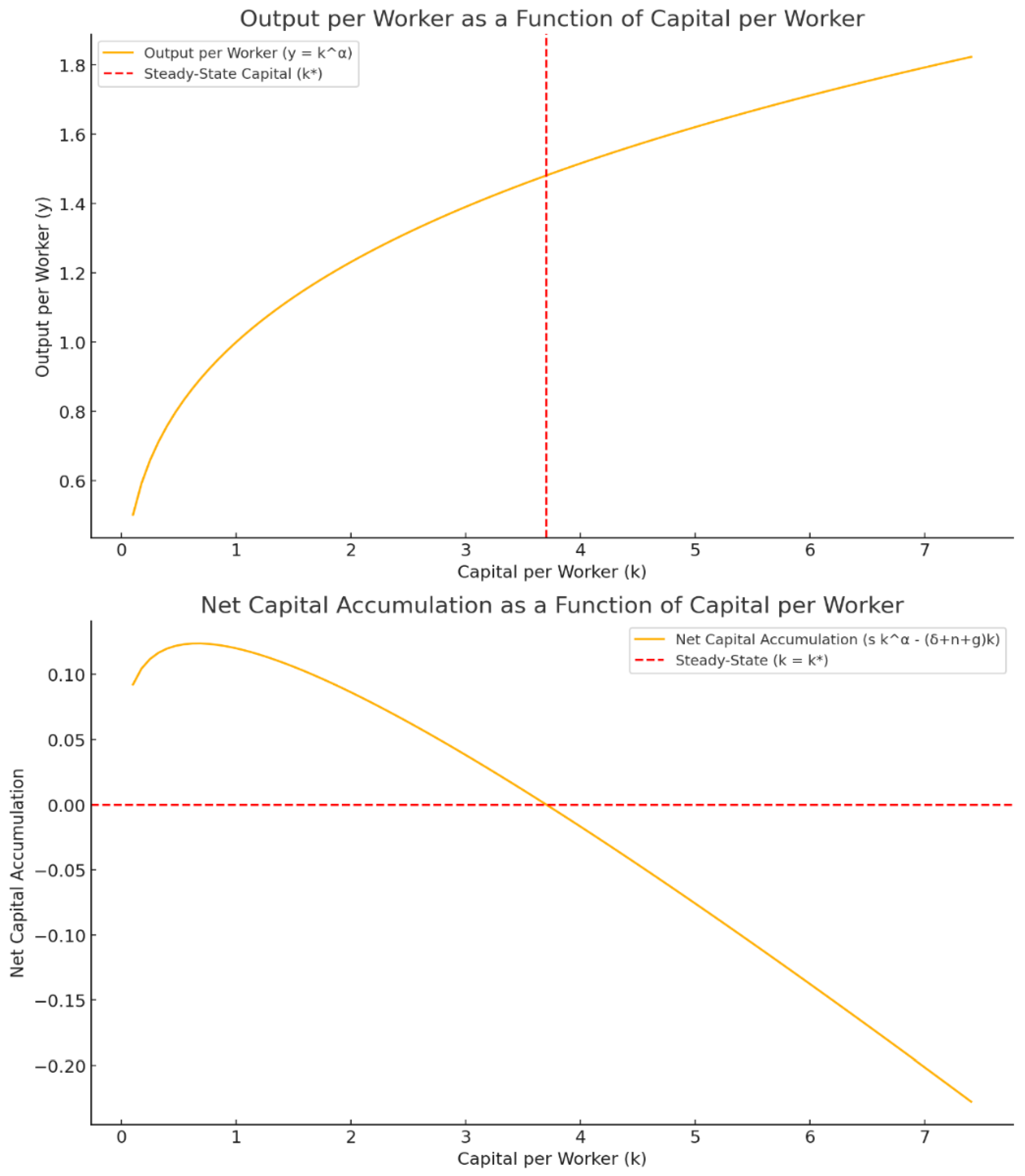
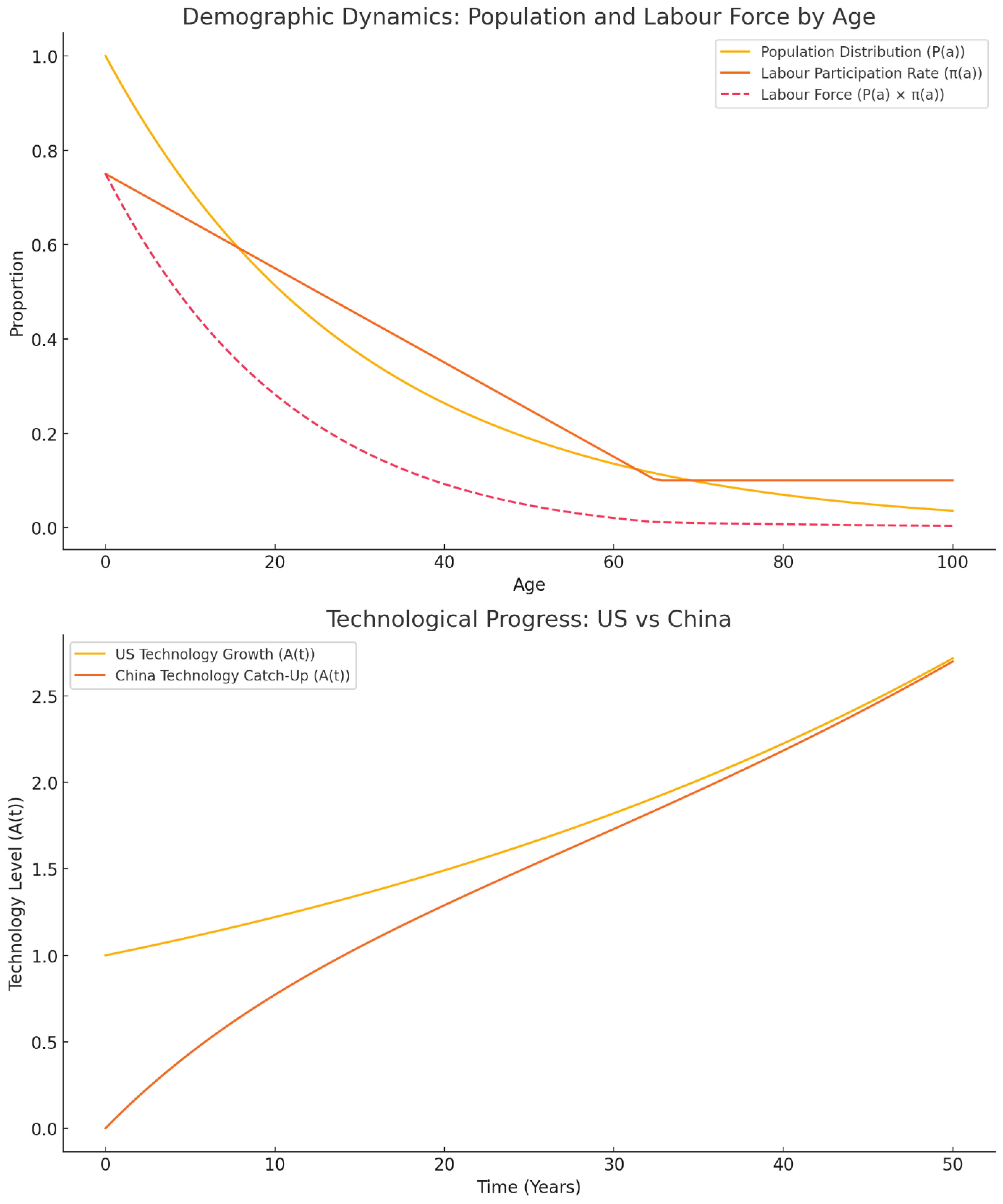
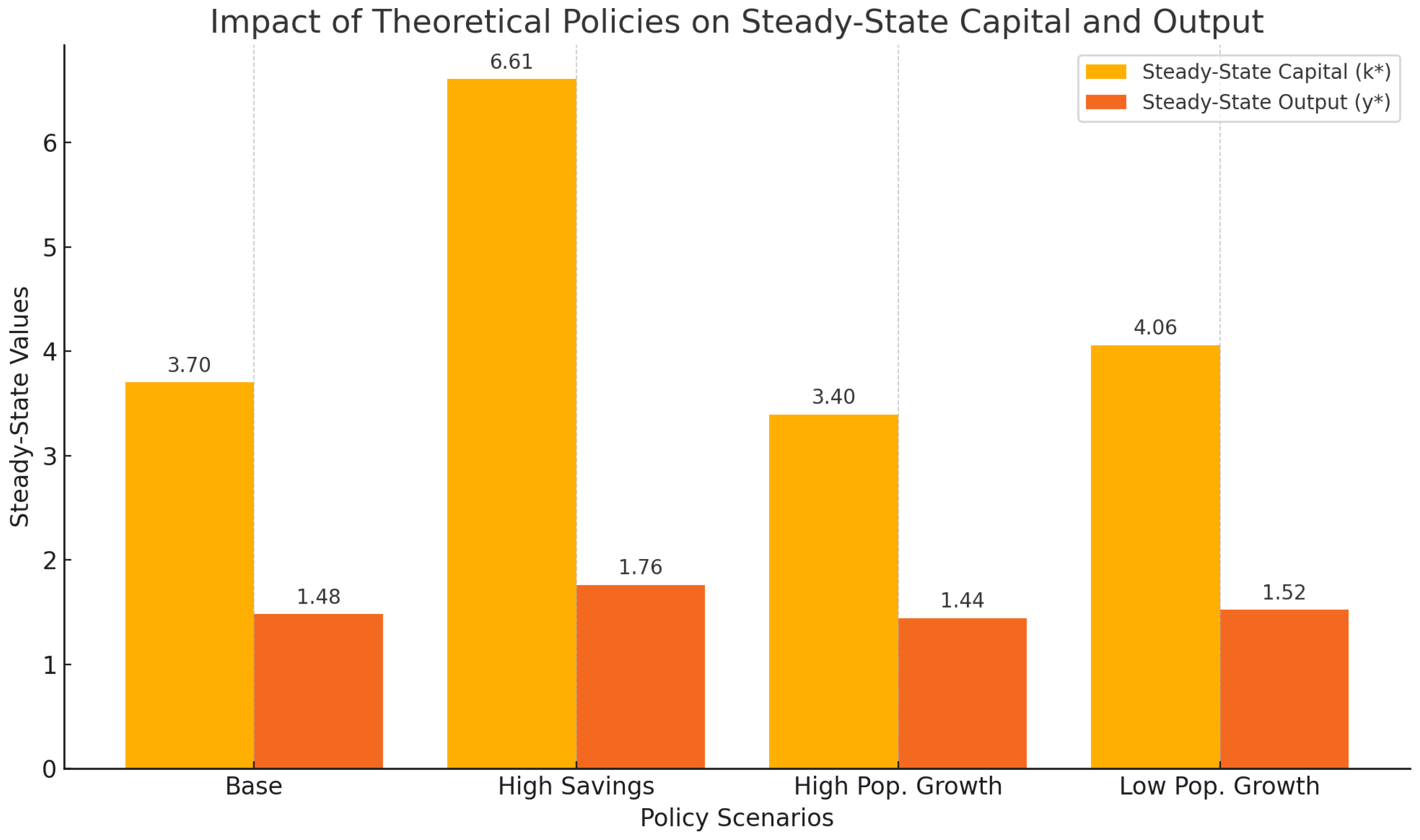
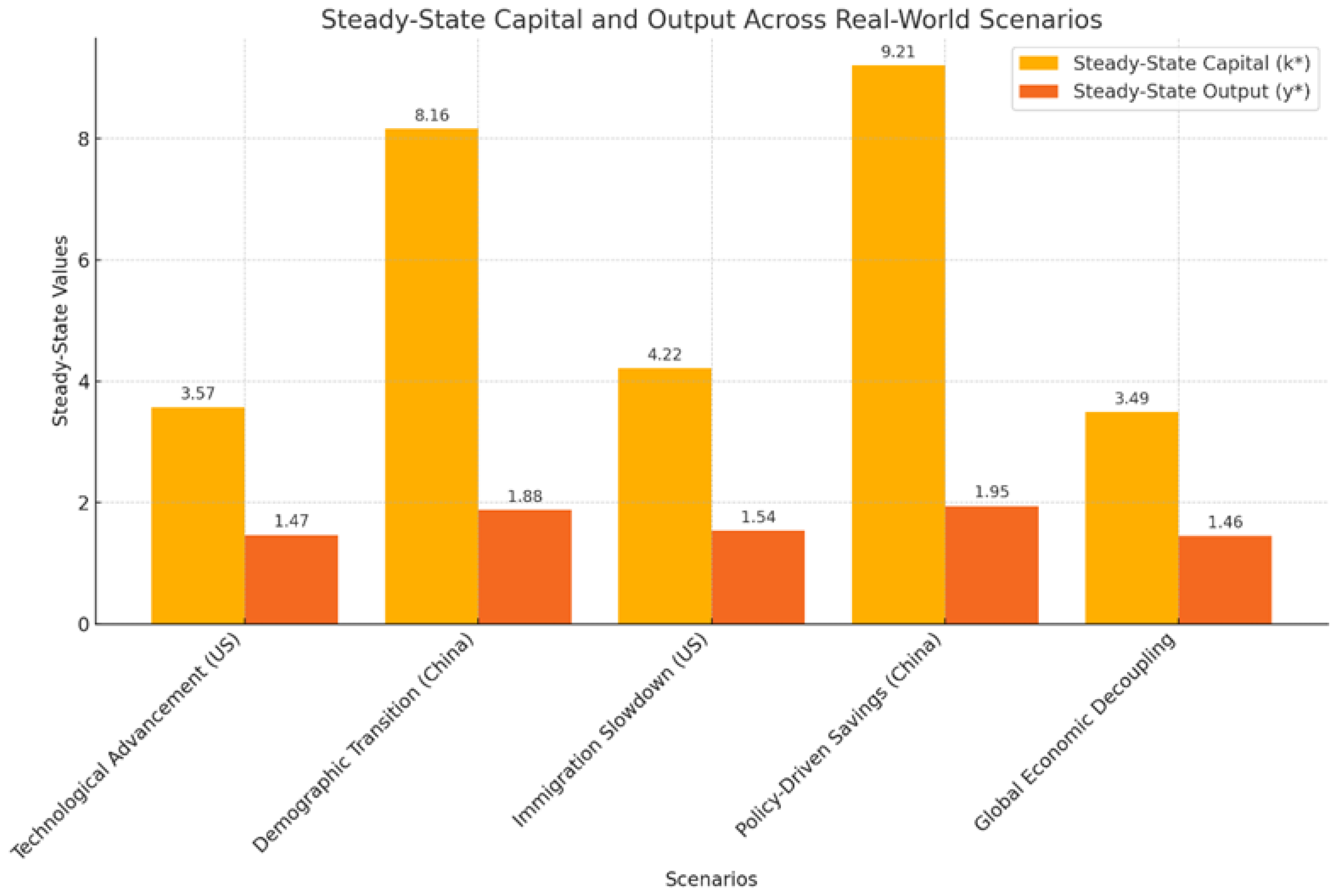
3.1. Detailed Graphs Explanation
- Technological Advancement (US): Steady-state output is significantly higher due to rapid technological progress, illustrating the power of sustained innovation to boost productivity and offset slower labour force growth.
- Demographic Transition (China): Despite high savings, China's shrinking population limits its steady-state output. This underscores the importance of a balanced demographic structure for economic sustainability
- Immigration Slowdown (US): Reduced population growth from restricted immigration results in lower steady-state output and capital levels. This scenario demonstrates how demographic policies directly affect long-term growth.
- Policy-Driven Savings (China): Higher savings, driven by policy incentives, lead to increased capital accumulation and output, showcasing the potential of targeted economic interventions to enhance growth.
- Global Economic Decoupling: Trade restrictions and reduced technological diffusion negatively impact both economies, lowering steady-state output and capital. This scenario warns of the economic costs associated with reduced global integration.
3.2. Technological and Demographic Scenarios: Economic Growth Analysis
3.3. Conclusion of All Graphs
4. Discussion
4.1. The United States: Balancing Innovation with Demographic Pressures
4.2. China: Navigating Structural Transitions and Demographic Decline
4.3. The Impact of Global Economic Decoupling
4.4. Policy Implications and Broader Reflections
4.5. Soft Skills and Systemic Strengths of the United States and China
4.5.1. China: Systemic Efficiency and Strategic Execution
4.5.2. The United States: Diversity and Creativity as Catalysts for Innovation
4.6. Comparative Analysis: Efficiency versus Creativity
4.7. The Role of Ascending Artificial Intelligence in Economic Growth
4.7.1. United States: Innovation and Research Leadership
4.7.2. China: Infrastructure and Strategic Integration
4.7.3. Comparative Dynamics: Scaling versus Innovation
4.7.4. Global Implications
4.8. Limitations of the Solow Growth Model in Real-World Analysis
4.8.1. Simplistic Assumptions about Technology
4.8.2. Homogeneity of Capital and Labour
4.8.3. Absence of Institutional and Policy Factors
4.8.4. Ignoring Global Interdependencies
4.8.5. Static Treatment of Savings and Population Growth
4.8.6. Neglect of Environmental Constraints
4.8.7. Transition Dynamics Are Simplified
4.9. Summary
5. Conclusion
Conflicts of Interest
References
- Autor, D., Dorn, D., & Hanson, G. (2016). The China Syndrome: Local Labor Market Effects of Import Competition in the United States. American Economic Review, 103(6), 2121-2168. [CrossRef]
- Congressional Budget Office. (2023). The Budget and Economic Outlook: 2023 to 2033. Washington, D.C.: U.S. Government Publishing Office.
- Fu, X., & Gong, Y. (2021). Indigenous and Foreign Innovation Efforts and the Determinants of Technological Catch-Up in Emerging Economies: Evidence from China. Research Policy, 50(7), 104265.
- Mankiw, N. G., Romer, D., & Weil, D. N. (1992). A Contribution to the Empirics of Economic Growth. The Quarterly Journal of Economics, 107(2), 407-437. [CrossRef]
- National Bureau of Statistics of China. (2023). Statistical Yearbook of China 2023. Beijing: NBS.
- National Foundation for American Policy. (2022). Immigrants and Billion-Dollar Startups: A Review of Contributions. Arlington, VA: NFAP.
- National Science Foundation. (2023). Science and Engineering Indicators 2023. Arlington, VA: NSF.
- National Science Foundation. (2023). Science and Engineering Indicators. Retrieved from https://www.nsf.gov/statistics/seind/.
- Solow, R. M. (1956). A Contribution to the Theory of Economic Growth. The Quarterly Journal of Economics, 70(1), 65-94. [CrossRef]
- U.S. Census Bureau. (2023). Demographic Trends and Population Projections. Washington, D.C.: Department of Commerce.
- UN Population Division. (2023). World Population Prospects 2023. New York: United Nations.
- World Bank. (2023). China Economic Update: Shifting Demographics and Growth. Washington, D.C.: The World Bank.
Disclaimer/Publisher’s Note: The statements, opinions and data contained in all publications are solely those of the individual author(s) and contributor(s) and not of MDPI and/or the editor(s). MDPI and/or the editor(s) disclaim responsibility for any injury to people or property resulting from any ideas, methods, instructions or products referred to in the content. |
© 2024 by the authors. Licensee MDPI, Basel, Switzerland. This article is an open access article distributed under the terms and conditions of the Creative Commons Attribution (CC BY) license (http://creativecommons.org/licenses/by/4.0/).


