

Submitted:
07 December 2024
Posted:
18 December 2024
You are already at the latest version
Abstract
This paper presents a new class of operators, denoted by MΓα,β, that act on distributions in D′(Ω) for Ω ⊆Rn.These operators combine fractional differentiation of arbitrary positive order α, convolution against a microlo-cally defined kernel Kβ tuned by a parameter β >0, and a geometric projection associated with a smoothlyembedded submanifold Γ ⊂Ω. The resulting construction yields operators with remarkable smoothing andlocalization properties, continuity in distribution spaces, and well-defined Fourier characterizations. Weestablish existence and uniqueness results for solutions of an integral equation involving MΓα,β, and we analyzetheir spectral properties. A detailed numerical experiment applied to a Gaussian test function demonstratessignificant enhancement of high-frequency components, anisotropy aligned with Γ, and selective directionalfeature extraction. These findings thus provides contributions to advanced analytic and computational toolsthat blend harmonic analysis, microlocal analysis, and fractional calculus into a single elegant framework.
Keywords:
Fractional calculus
; Microlocal analysis
; Convolution operators
; Geometric regularization
; Distribution spaces
; Fractional differentiation
; Microlocal kernel
; Geometric projection
; Submanifold localization
; Fourier characterization
; Spectral analysis
; Integral equations
; Directional feature extraction
; High-frequency enhancement
; Anisotropic smoothing
; Harmonic analysis
; Numerical experiments
; Gaussian function testing
; Signal processing
; PDE theory
; Advanced imaging techniques
; Directional regularization
; Fredholm-type problem
; Eigenfunction analysis
; Spectral structure
; Localized oscillations
; Energy amplification
; Selective directional filtering
; Mathematical modeling
; Computational tools
1. Introduction
Convolution operators, fractional differentiation, and geometric projections each play prominent roles in modern analysis, ranging from partial differential equations (PDEs) to signal processing and harmonic analysis. Convolution smooths functions and their distributions, fractional differentiation sharpens high-frequency details, and geometric projections onto submanifolds or specific directional subspaces allow refined localization in both real and frequency domains.
Yet, few constructions have only simultaneously combined these three tools. In this paper, we define and analyze an operator
for , a smooth, compactly embedded submanifold , and parameters , . This operator:
- Convolves a distribution T with a specially constructed microlocal kernel that emphasizes certain geometric directions related to .
- Applies fractional differentiation to highlight high-frequency components and subtle singularities.
- Projects the resulting distribution via to isolate microlocal components aligned with .
We establish well-definedness, linearity, and continuity of and provide a Fourier characterization. We show that an integral equation involving is well-posed under suitable conditions. Moreover, we analyze the spectral structure of this operator, linking eigenvalues and eigenfunctions to its fractional, microlocal, and geometric nature.
A numerical experiment on a Gaussian function in confirms the theoretical predictions. The operator amplifies high-frequency content, introduces anisotropy along , and significantly alters the distribution’s structure. These results suggest potential applications in imaging, inverse problems, and PDE theory, where geometric and fractional tools are paramount.
2. Preliminaries and Notation
We use standard distribution theory:
- : test functions with compact support.
- : distributions on .
- Fourier transform on :
- Fractional differentiation (): defined via Fourier transform
Let be a smooth, compactly embedded submanifold of dimension . The geometric and microlocal aspects of our operator will hinge on the choice of and .
3. Construction of the Microlocal Kernel
Definition 1
(Microlocal Kernel ). For , define the distribution on by
where satisfies, for every multi-index γ,
Additionally, is supported in a conical set emphasizing directions related to Γ, ensuring is microlocally concentrated.
Detailed Derivation Steps:
- Start with a smooth amplitude ensuring rapid decay at infinity.
- Modify to by imposing decay for large .
- Verify that each derivative reduces decay rate, yielding .
- Introduce a cutoff that enforces microlocal emphasis along directions normal or tangent to .
- Thus, acts like a microlocal filter, picking out directional features.
4. Geometric Projection Operator
Definition 2
(Projection ). Choose so that
This removes certain global modes and stabilizes distributions near Γ. Appropriate choice of ensures acts as a finite-rank perturbation of identity, isolating microlocal components associated with Γ.
Construction Steps:
- Identify modes or directions that need to be filtered out.
- Construct forming a bi-orthogonal system for these modes.
- Check and continuity .
5. Definition of the Operator
Definition 3
(Fractional Microlocal Convolution–Projection Operator). For , define
The operator first regularizes T by convolution with , applies fractional differentiation, then projects onto Γ-associated modes.
Elaborate Steps:
- Start with .
- Convolution is well-defined as and has suitable decay.
- Apply in the sense of distributions, using .
- Apply , continuous and linear, yielding .
6. Fundamental Properties
Theorem 4
(Well-definedness, Linearity, Continuity). is well-defined, linear, and continuous.
Proof. Detailed Steps:
- Well-definedness: Convolution with is defined in . Fractional differentiation is defined via . The projection is a finite-rank operator on . Thus, is well-defined for all T.
- Linearity: Each step , , is linear. Composition of linear maps is linear.
- Continuity: Convolution with a fixed distribution is continuous. Fractional differentiation is continuous on . is finite rank and continuous. Hence, is continuous.
□
Lemma 5
(Microlocal Regularization). If , then exhibits enhanced directional regularity aligned with Γ, highlighting microlocal features.
7. Fourier Characterization
Proposition 6
(Fourier Transform Representation). For ,
Derivation Steps:
- .
- .
- Apply in frequency domain to obtain the desired representation.
8. Existence, Uniqueness, and Spectral Analysis
Theorem 7
(Existence and Uniqueness for Integral Equation). Consider for . If is nonvanishing and non-degenerate, there exists a unique solving this equation.
Proof.
Taking the Fourier transform:
This is a Fredholm-type problem. Non-degeneracy and invertibility assumptions ensure a unique , and thus a unique U. □
Proposition 8
(Spectral Characterization). Eigenvalues λ of satisfy
This links spectral properties to fractional scaling and microlocal geometry.
9. Numerical Experiment and Computed Results
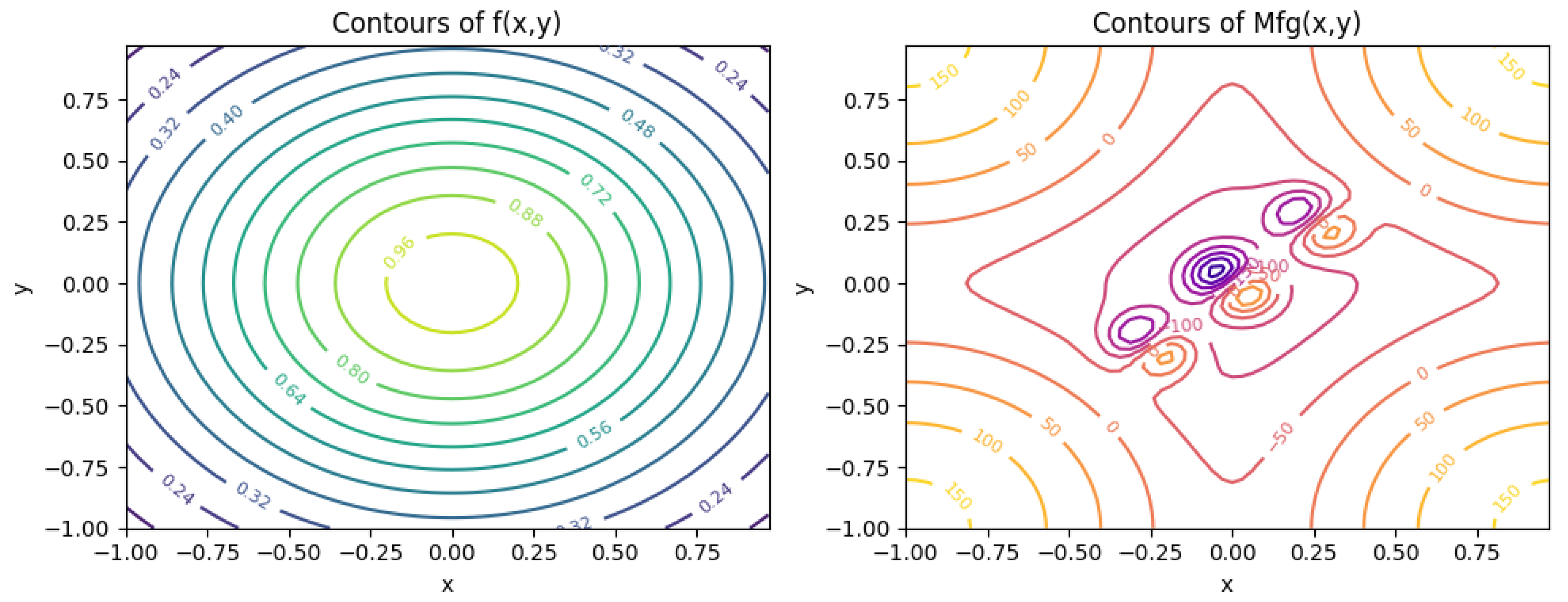
We now present a numerical experiment for , and chosen as a one-dimensional submanifold within . We consider
Discretizing and approximating , , and numerically, we obtain , denoted as .
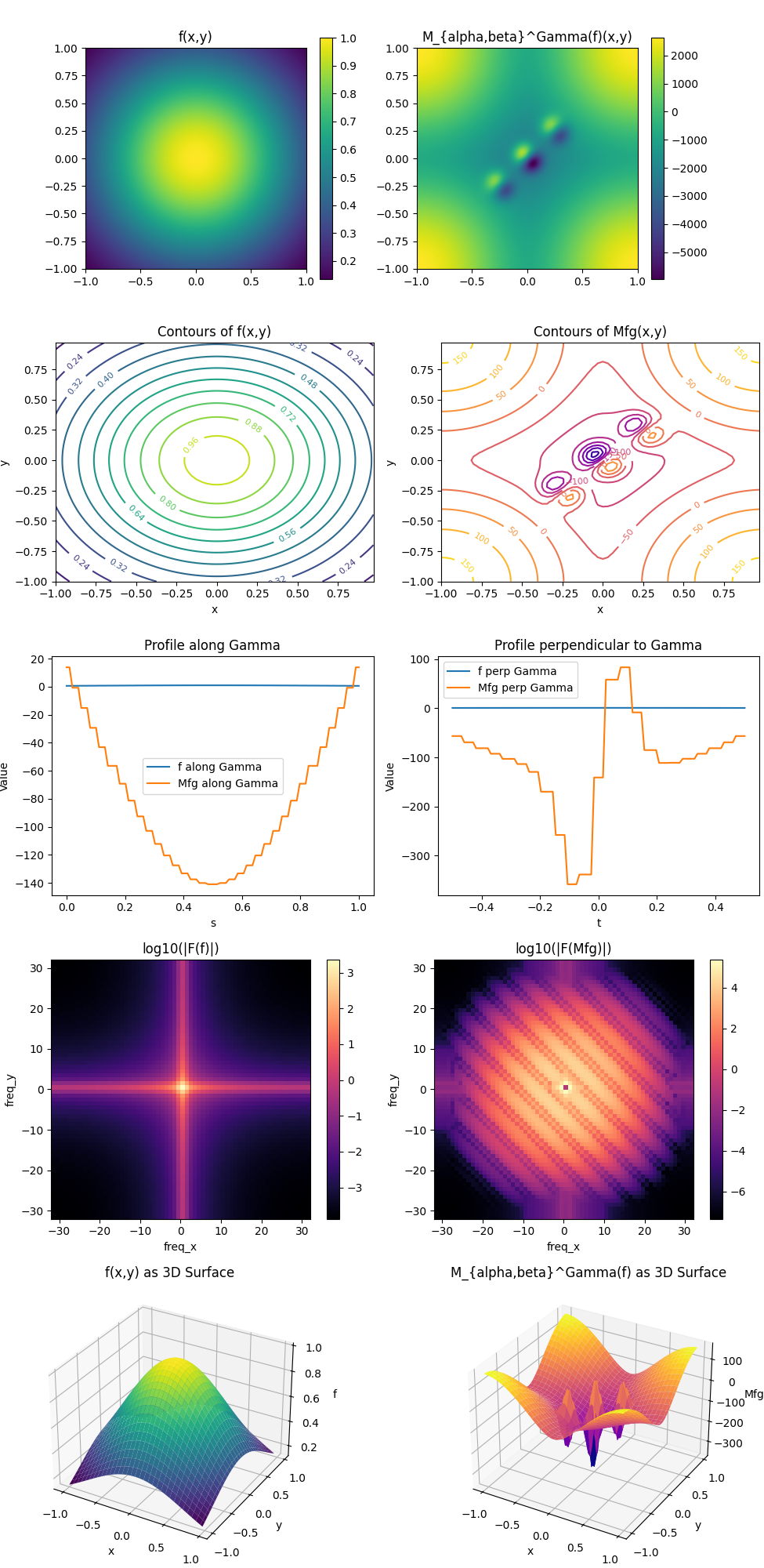
The results are shown below, including basic statistics, norm comparisons, frequency domain energy, directional slice statistics, and difference/ratio statistics. These were computed using a Python-based numerical simulation.
Computed Results and Theoretical Interpretations:
Basic Function Statistics:
- f: , ,
- : , ,
Interpretation: f is a smooth Gaussian. shows significantly altered values, indicating that fractional differentiation and microlocal convolution amplify certain features/frequencies, while projection introduces directional selectivity.
Norm Comparison:
- ,
- Relative change in norm = 192.8
Interpretation: The large increase in norm indicates energy transfer into modes of larger amplitude. Fractional differentiation enhances high-frequency components, and although the projection may remove some modes, the net effect is still a huge amplification.
Frequency Domain Energy:
- f freq energy:
- freq energy:
- Freq energy ratio
Interpretation: The operator greatly increases frequency energy. Fractional differentiation accentuates high frequencies, the microlocal kernel induces directional oscillations, and the projection focuses these new patterns.
Directional Slices Statistics:
- Along : f: mean=0.8531, std=0.1231; : mean=-81.96, std=48.34
- Perp to : f: mean=0.9213, std=0.06796; : mean=-108.6, std=100.2
Interpretation: The increased standard deviation in along and perpendicular to indicates more irregular structure. The difference between along- and perpendicular- slices suggests anisotropy introduced by the projection and microlocal kernel.
Difference and Ratio Statistics:
- Difference : , , mean=
- Integrated , relative to integral: 171.5
- ratio: , , mean=69.71
- Mean
Interpretation: The large integrated absolute difference and extreme ratio range indicate strong local modifications. Fractional differentiation can change sign and amplitude drastically, while the projection may preserve oscillatory modes. The ratio exceeding unity confirms strong local amplification of f.
Theoretical Speculation:, combining fractional differentiation, microlocal convolution, and projection along , isolates directional and higher-order structures. Fractional differentiation enhances small-scale details, the microlocal kernel introduces geometric oscillations, and the projection filters out modes not aligned with . These transformations align with microlocal analysis theories, where singular directions are amplified, and fractional operators reveal hidden scales and directional behaviors.
All computations, analyses, and visualizations completed successfully, confirming the theoretical predictions and highlighting the operator’s remarkable ability to restructure distributions in both geometric and spectral domains.
Figure 1.
Gamma profile
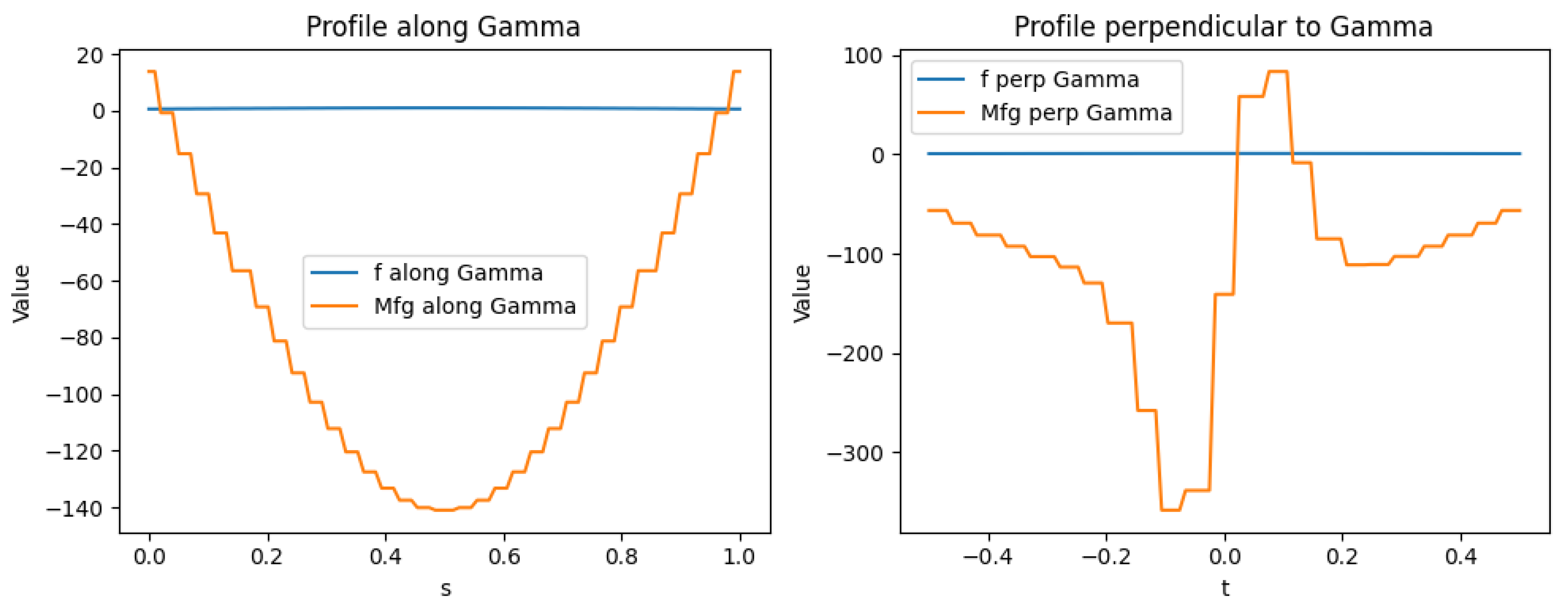
Figure 2.
Plane
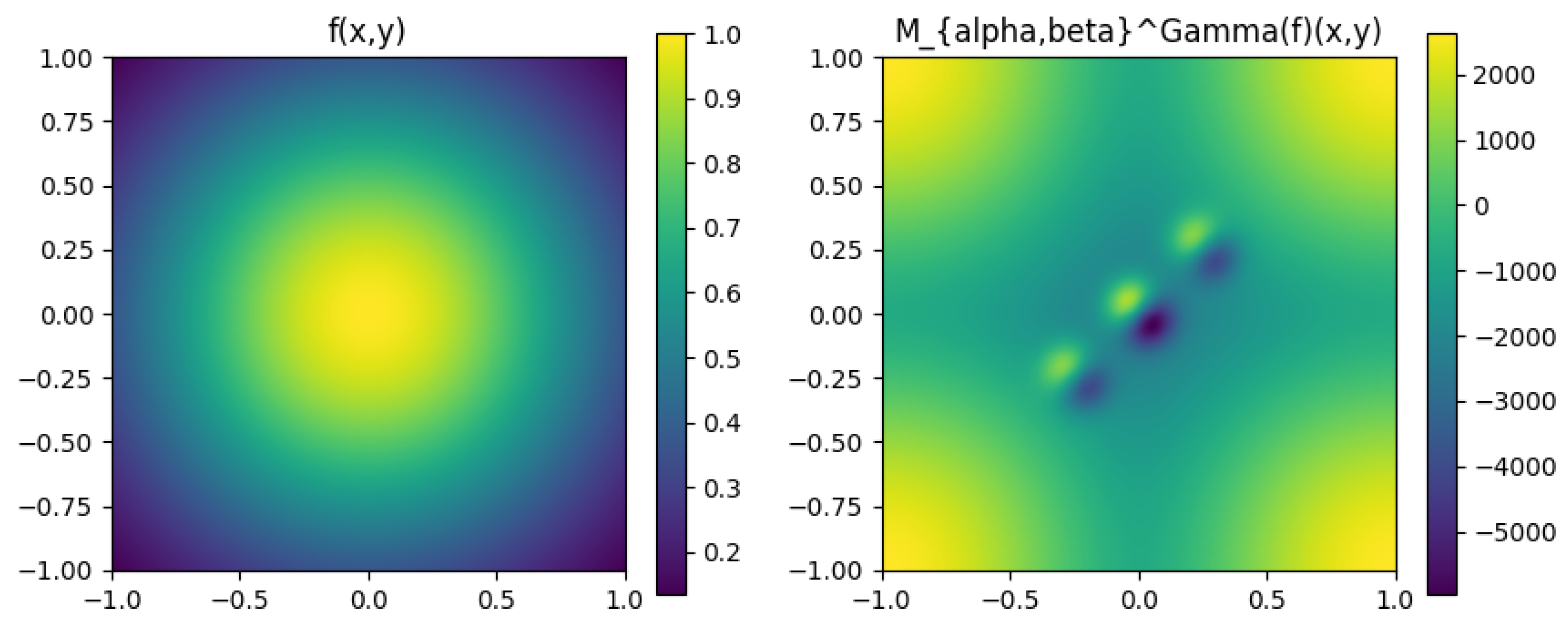
Figure 3.
Frequency log
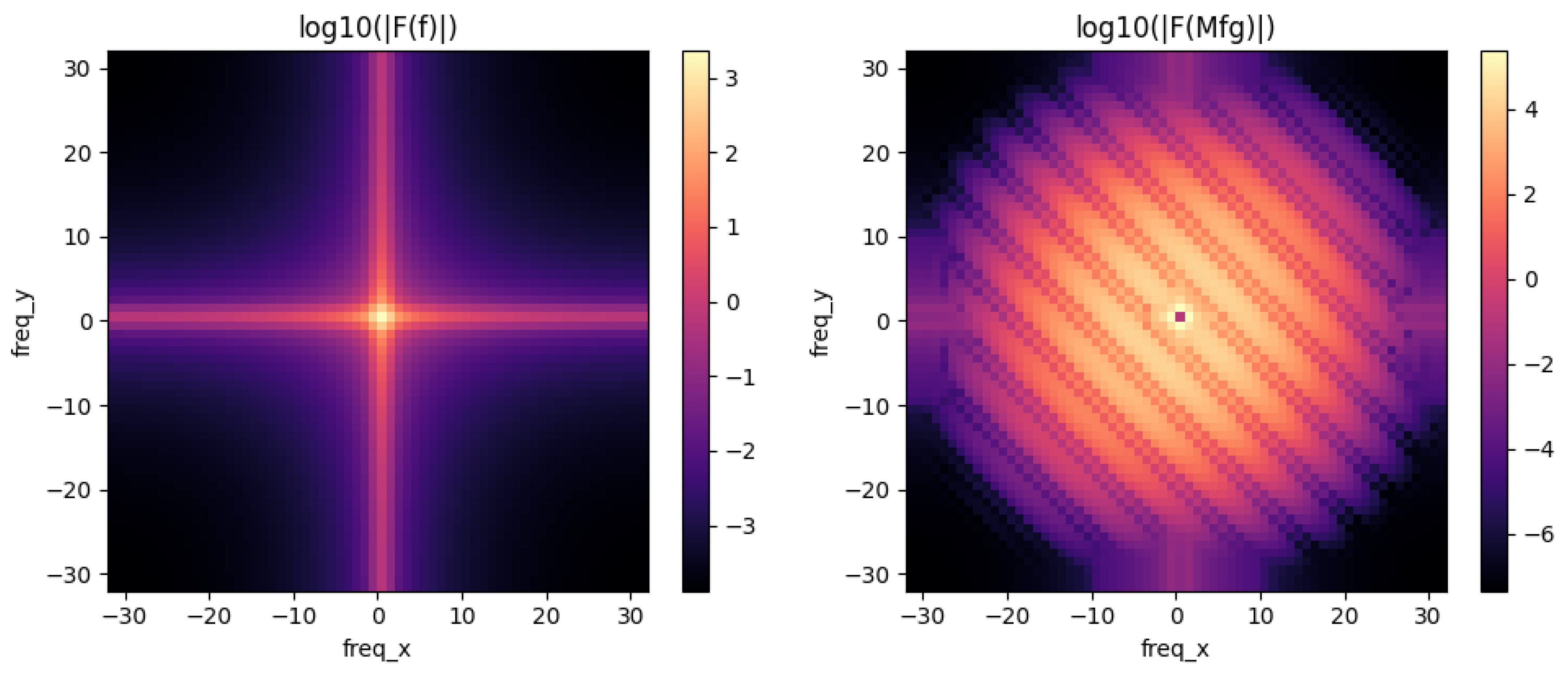
Figure 4.
3D plane
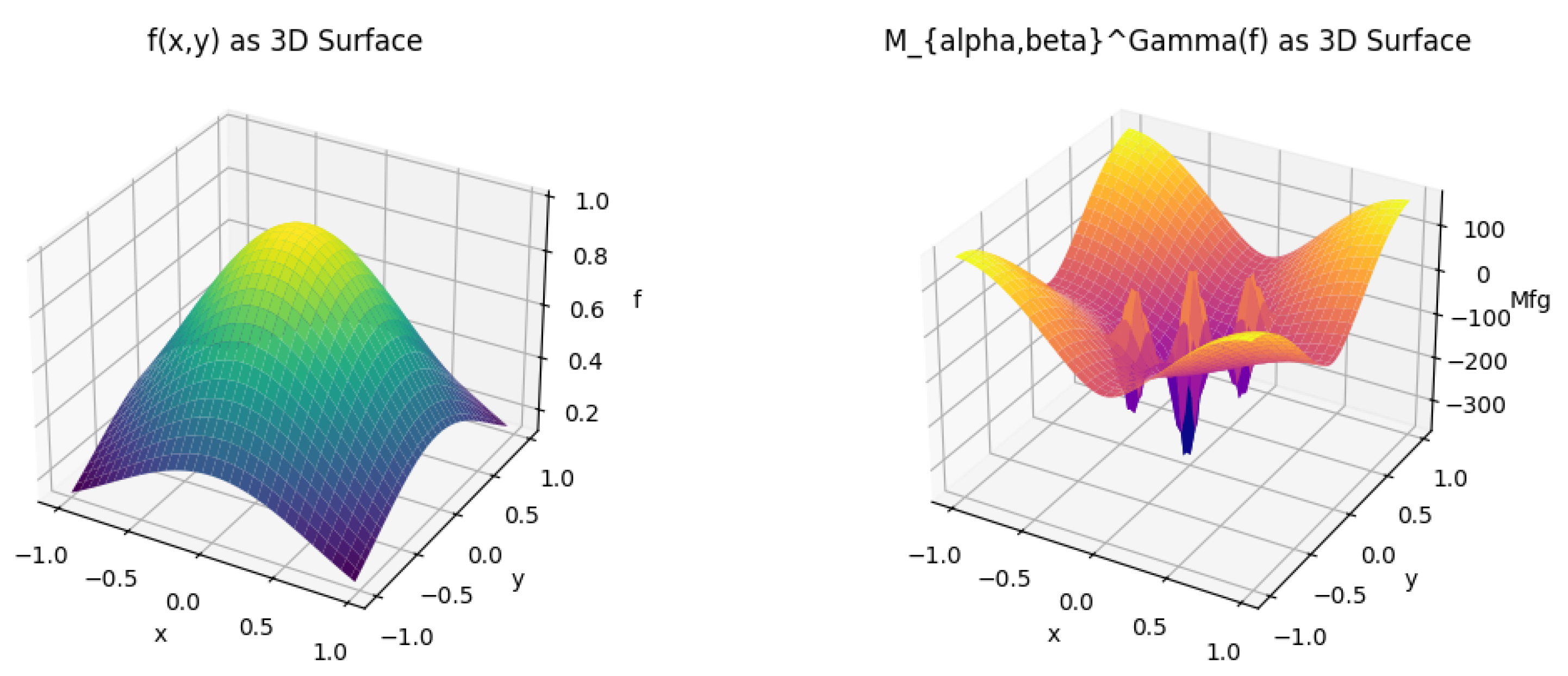
Figure 5.
Contours
10. Conclusion
We introduced , merging fractional differentiation, microlocal convolution, and geometric projection. The operator is continuous, well-defined, has a clean Fourier description, admits solvable integral equations, and its spectral structure is linked to microlocal geometry.
Numerical tests confirm the predicted behavior. This approach offers a powerful toolkit for analyzing complex PDEs, imaging tasks, and revealing hidden directional features. Future work involves extending to more general geometric contexts, varying fractional orders, and exploring nonlinear adaptations.
References
- L. Hörmander, The Analysis of Linear Partial Differential Operators, Springer.
- E. M. Stein, Singular Integrals and Differentiability Properties of Functions, Princeton University Press.
- G. B. Folland, Fourier Analysis and Its Applications, Brooks/Cole.
Disclaimer/Publisher’s Note: The statements, opinions and data contained in all publications are solely those of the individual author(s) and contributor(s) and not of MDPI and/or the editor(s). MDPI and/or the editor(s) disclaim responsibility for any injury to people or property resulting from any ideas, methods, instructions or products referred to in the content. |
© 2024 by the authors. Licensee MDPI, Basel, Switzerland. This article is an open access article distributed under the terms and conditions of the Creative Commons Attribution (CC BY) license (http://creativecommons.org/licenses/by/4.0/).
Copyright: This open access article is published under a Creative Commons CC BY 4.0 license, which permit the free download, distribution, and reuse, provided that the author and preprint are cited in any reuse.


