1. Introduction
Papua New Guinea is characterized by a diverse variety of Quaternary volcanic associations. Localized geothermal activity is associated with many of the subduction-related active andesitic volcanoes of northern New Guinea and in south-eastern Papua [
1]. Silicic magmatism occurs only in the Admiralty islands, the Talasea Peninsula of New Britain and in southeastern Papua [
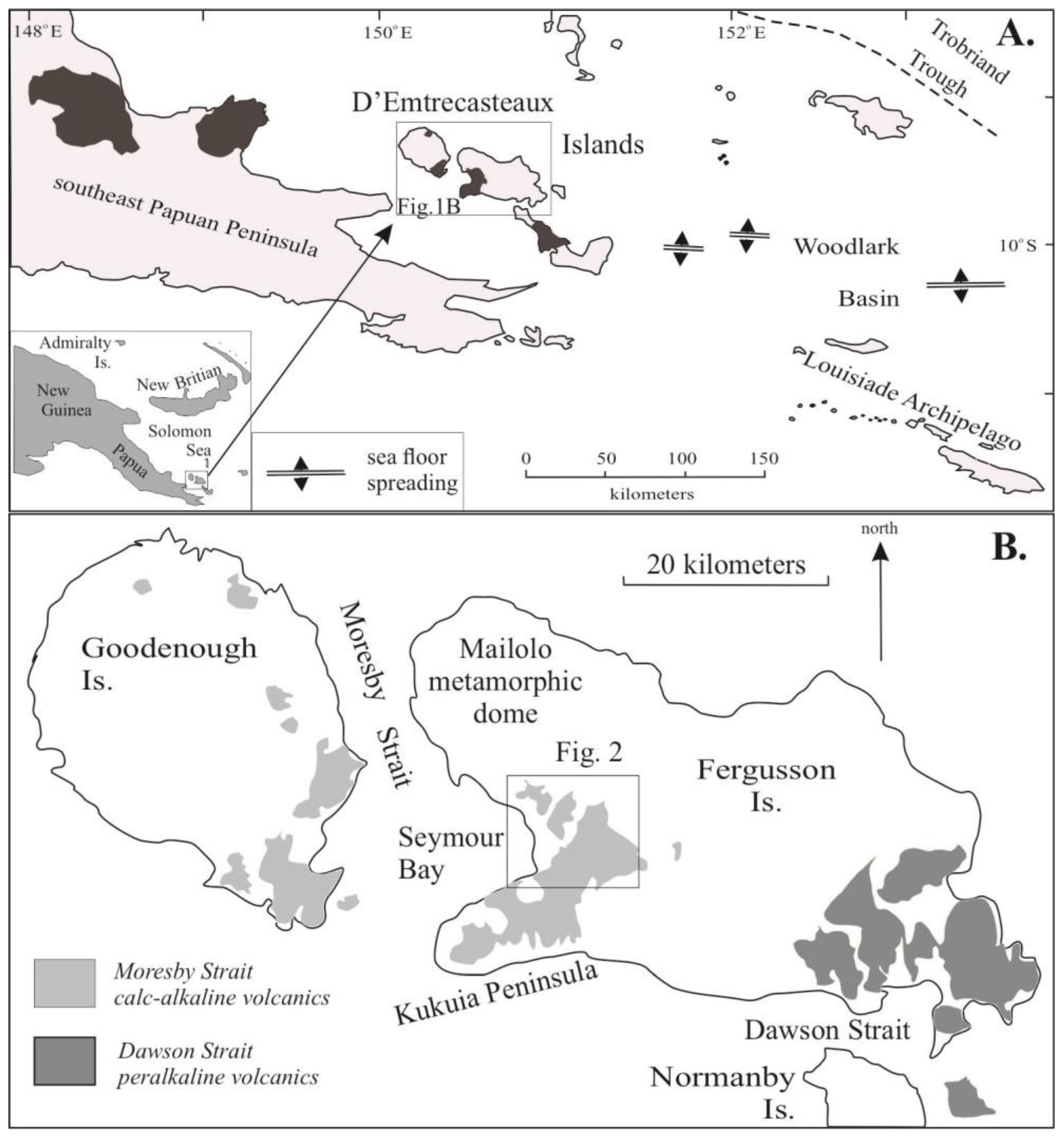
2] Geothermal activity associated with this silicic volcanism occurs on the Talasea Peninsula and in the Moresby Strait and Dawson Strait areas of the D’Entrecasteaux Islands of southeastern Papua (
Figure 1).
Silicic volcanism in the D’Entrecasteaux Islands has been described by Smith and Johnson [
2]. In the east, in the Dawson Strait area, small peralkaline rhyolite volcanoes are linked to the extensional tectonics of sea-floor spreading in the Woodlark basin [
3]. Further west on the eastern side of Moresby Strait the more extensive Iamalele geothermal field is associated with calc-alkaline magmatism of the Papuan Arc [
4]. In this paper we describe the geology, hydrothermal alteration and geochemistry of the Iamalele geothermal system which is the only extensive geothermal field linked to the volcanic activity of the Papuan Arc. Significantly, the continuing activity of the field and its location within a potential caldera structure is an indication of the potential for major explosive volcanism in the future.
The Papuan Arc is a system of predominantly andesitic calc-alkaline volcanoes extending westward from the Louisiade Archipelago into the southeastern Papuan mainland. It is linked to the southward subduction of the Solomon Sea plate from the Trobriand Trough [
4]. Systematic age relationships indicate a westward migration of subduction-related volcanism as sea floor spreading of the Woodlark spreading center impinged on the Papuan continental block. The silicic magmatism of western Fergusson Island is unique in the Papuan Arc in terms of the range of rock compositions and is probably linked to the rapid uplift of the metamorphic core complexes that are a feature of the D’Entrecasteaux Islands [
5].
2. Iamalele Geothermal Field
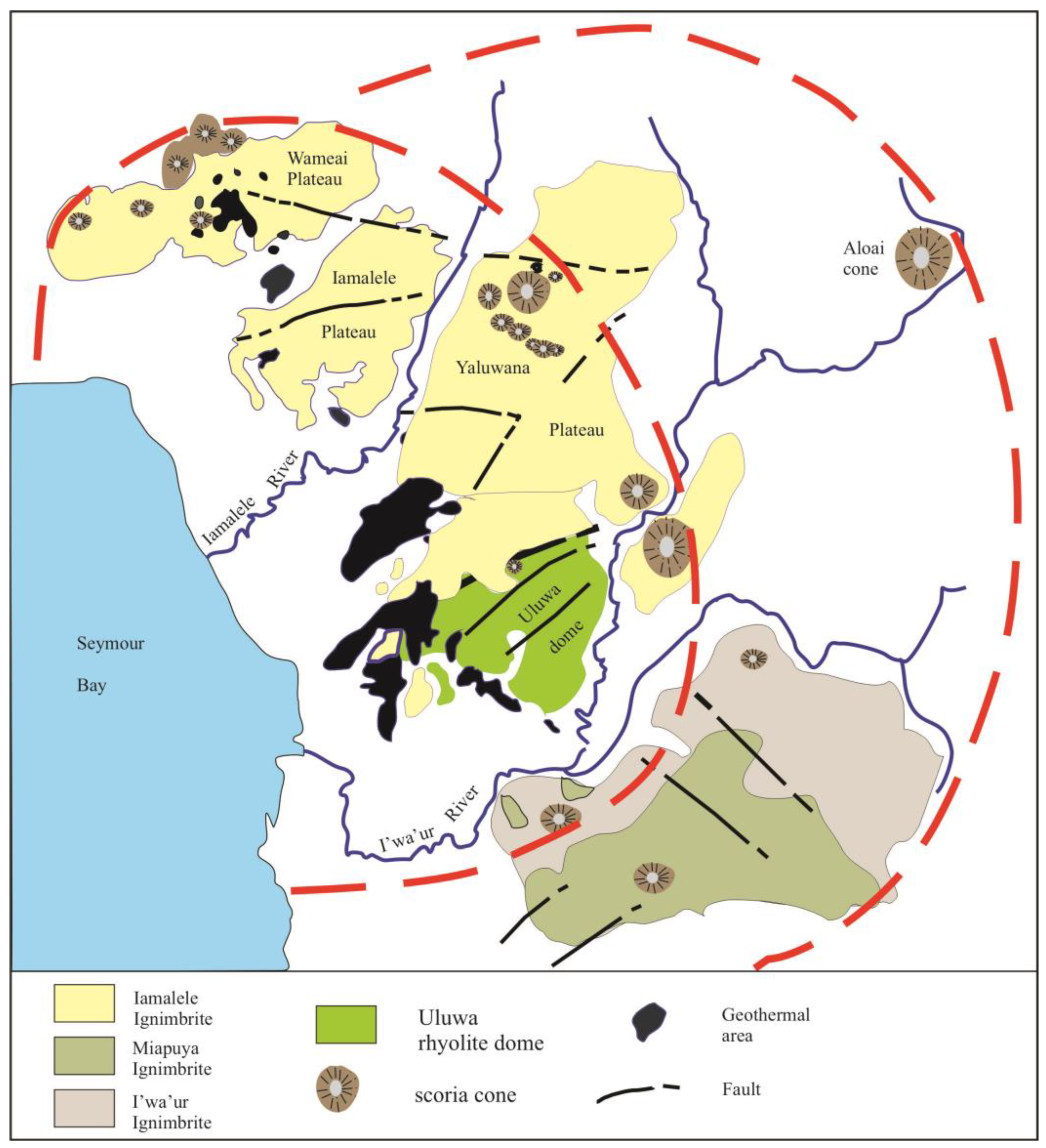
The coastal lowlands of western Fergusson Island are bounded by a Cretaceous age metamorphic core complex (Mailolo metamorphic dome) to the north and east. The southern boundary is defined by a thick sequence of Pliocene to Holocene andesitic volcanic rocks forming the Kukuia Peninsula. The Iamalele geothermal field occurs within a roughly elliptical topographic basin bordered by rugged mountainous terrain to the north, mountains of moderate relief to the east and south, and Seymour Bay to the west. The floor of the basin was initially a planar feature but it has been disrupted by block faulting. These faults have been a focus for the eruption of lava domes and small cones of pyroclastic deposits and lava flows. The physiography of the area together with the presence of abundant eruptive centers localized by high-angle normal faults is the result of caldera collapse and post-caldera eruptive activity.
Volcanic rocks exposed in the Iamalele area range in age from Late Pleistocene to Holocene and are a temporal continuation of the rocks forming the Kukuia Peninsula. The rocks are of mafic to intermediate compositions (basaltic andesite to low-silica dacite) evolving to mainly and silicic rocks with time.
Most of the volcanic rocks exposed in the Iamalele Field are ignimbrite flows and air-fall tuffs of dacite to rhyolite composition. These pyroclastic units are intercalated with and intruded by minor andesitic to rhyolitic lavas and are locally overlain by cones composed of andesite scoria and lava domes composed of flow-banded rhyolite and rhyolitic obsidian flows. Approximately 60% of the Iamalele lowlands are covered by boulder terrace and other fluvial deposits.
3. Volcanic Stratigraphy
Davies and Ives [
6] recognized two stratigraphic sequences in the Iamalele area which they referred to as the Fagalulu Volcanics (older) and the Iamalele Volcanics. The oldest unit of the Fagalulu Volcanics is only known from drill core (see below). It is a lithic-rich flow banded ash-flow tuff containing a high percentage of glass shards and poorly sorted polymictic fragments supported within an ash matrix. Lithic fragments are mainly rounded clasts of coarse-grained biotite dacite and fine-grained rhyolite a few millimeters to 6 centimeters in size.
Surface exposures of the Fagalulu Volcanics consist mainly of andesitic lava together with high-silica dacitic and rhyolitic ignimbrite and air-fall tuff. These outcrop on the southern side of the I’wa’ur River and abut the older volcanics of the Kukuia Peninsula. Two ignimbrite units are recognized. The older I’wa’ur Ignimbrite (informal name) is an unconsolidated to poorly welded pumiceous tuff of biotite rhyolite to dacite composition. The sequence includes grey to pink glassy and pumiceous ignimbrite units and poorly consolidated sandy fall deposits. Overlying these is the Miapuya Ignimbrite (informal name) consisting of at least four discrete flow units together with fall deposits. These are generally unconsolidated to poorly welded but contain thin beds of volcanic glass and vitrophyre. The dominant lithologies are pumiceous biotite rhyolite and dacite tuff and tuff breccia.
The Iamalele Volcanics are dominated by a high-silica dacitic and rhyolitic ignimbrite together with air-fall tuff intercalated with andesitic lava and pyroclastics. The Iamalele ignimbrite (informal name) is the youngest and subaerially the most widespread ignimbrite in the area. It is a fine grained pumiceous rhyolitic ash-flow tuff which caps the Yaluwana and Iamalele plateaux (
Figure 2) and many of the low-lying hills to the east. In outcrop it varies from a basal partly devitrified glass through a middle moderately welded tuff to an upper pumiceous tuff. It is flat lying with a composite thickness of at least 50 m. The Iamalele ignimbrite contains a few oligoclase phenocrysts or, more commonly microphenocrysts in an ash matrix. Iron titanium oxides, minor amphibole and rare orthopyroxene also occur but the most notable feature of the unit is the abundance of thin to thick books of igneous black biotite.
Lava units of mainly andesitic composition account for less than 10% of the exposed rocks in the Iamalele area. Massive to scoriaceous high-Mg andesite forms the Aloai cone several lava flows on the Wameai plateau. Both the Aloai and Wameai andesites are typically hypocrystalline and sparsely porphyritic. Phenocrysts of olivine, diopside and labradorite comprise less that 15% of the rocks and are dispersed in a trachytoid groundmass of labradorite to andesine plagioclase, clinopyroxene, olivine and interstitial brown glass.
The Ulawa dome consists of effusive rhyolite and obsidian together with pyroclastic tuff deposits with compositions comparable to those of the ignimbrite units in the area.
Recent alluvium occurs throughout the Iamalele area and consists of extensive boulder terrace deposits and minor talus deposits. The boulder terraces are of fluvial and possibly shallow marine origin and are composed primarily of unaltered Mesozoic metamorphic lithologies. Remnants of these terraces suggests that the entire region was at some stage a low lying plain which post-dated the ignimbrite eruptions.
Progressive changes in the morphology of the active and ancestral channels of the major rivers (Iamalele and I’wa’ur Rivers) that drain the Iamalele lowlands indicate a southward migration that is consistent with Recent tilting of the area toward the southeast.
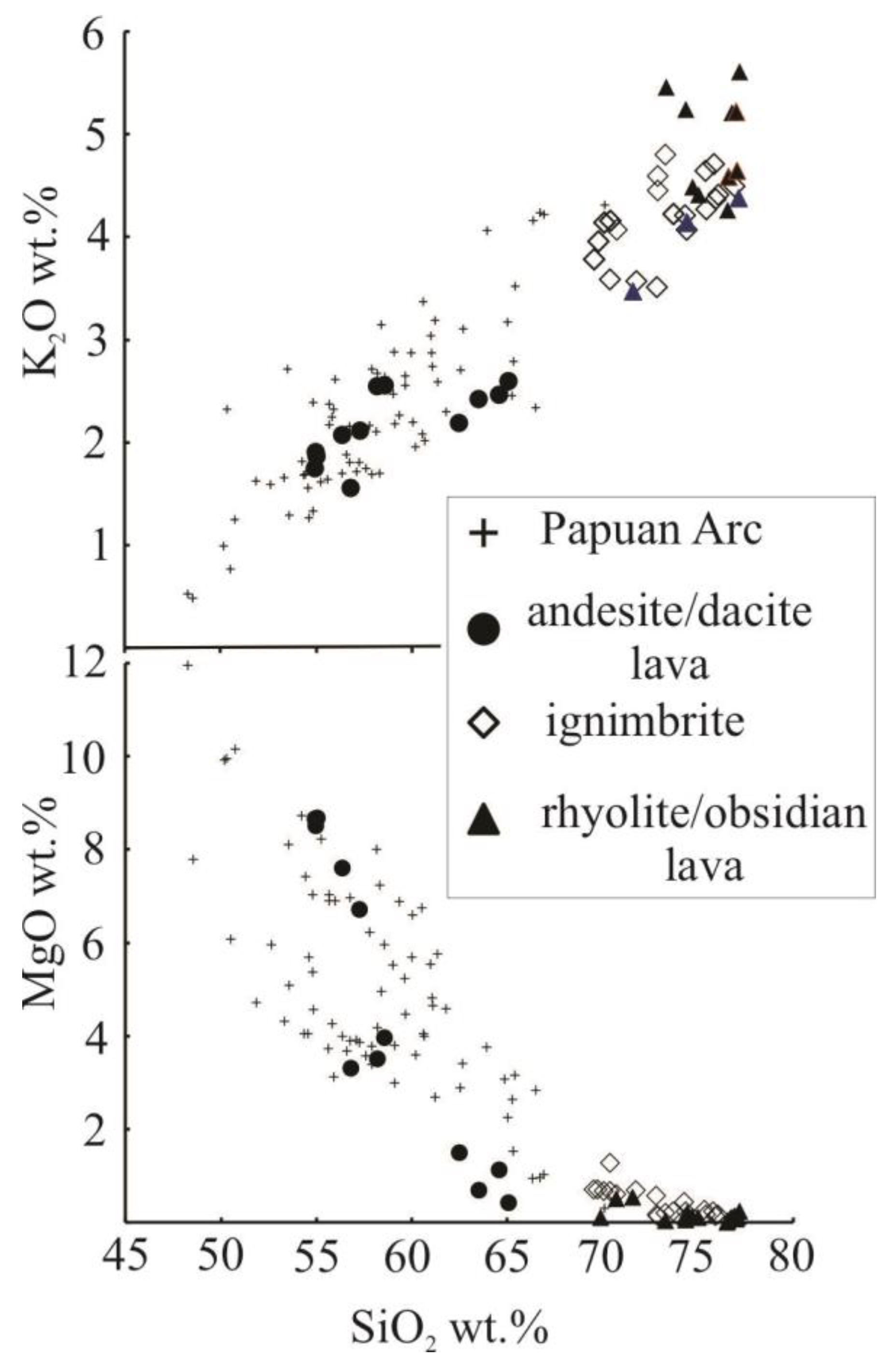
Lavas and pyroclastic deposits range in composition from basaltic andesite to low-silica dacite (supplementary data
Table S1); they occur as discrete units intercalated with and overlying high-silica dacitic to rhyolitic ignimbrite and air-fall tuff throughout the Iamalele area. These compositions lie within the range of published compositions from the Papuan Arc [
4] and extend to high silica compositions; they constitute a high-K arc-type association. A feature of the intermediate rocks of the Iamalele area is the occurrence of high-Mg andesites together with compositions more typical of convergent margin plate tectonic settings. The compositional variations displayed by samples from the Iamalele area indicate complex petrogenetic processes rather than simple fractionation line of a single parental magma. Rocks with silicic compositions are not present in other parts of the Papuan Arc.
4. Surface Geothermal Features
Geothermal activity is widespread in the Iamalele area; active thermal features are exposed over ~30km2 of the coastal lowlands. Surface features include boiling springs, mud pools, sinter terraces and areas of intense hydrothermal rock alteration. Areas of thermal activity are typically located in shallow depressions formed by the dissolution of rock by acidic near-surface solutions. Within these areas, rocks are strongly altered (>90%) to a mixture of kaolinite, cristobalite, alunite and native sulphur any one of which may be the dominant phase. Halos of kaolinite + cristobalite alteration extend outward from most active thermal areas for a distance of from 10 to more than 3000 m. Samples collected from mud pools indicate that the mud consists predominantly of kaolinite but typically also contains cristobalite and alunite. Sinter terraces are relatively rare and only occur in and around areas of hot spring activity.
Surface discharge from the Iamalele area is dominated by hot (~45
o to 101
oC) acidic solutions most of which are dominated by sulphate. In contrast other thermal areas on Fergusson Island are discharging near-neutral pH chloride waters. Alkali geothermometers [
7,
8,
9] indicate source temperatures for the underlying Iamalele reservoir of up to 647
oC (
Table 1). However, temperatures calculated for the system are highly variable and, in some cases, unrealistically high. The Iamalele springs formed by vapour condensation with H
2S oxidation within the vadose zone forming the sulphate-rich compositions of low Ph and /or incorporation of sea water into the hydrothermal fluid (e.g. 10).
5. Hydrothermal Alteration
The subsurface nature of the Iamalele thermal field has been investigated by means of a drill holle that reached a depth of ~200 meters. At depths less than 15 m kaolinite and hydrous silica (lussatite + cristobalite) are the dominant minerals occurring together with trace to minor amounts of gibbsite, brucite, jarosite, goethite and hematite. Below this depth the major hypogene mineral assemblages are the result of either potassic metasomatism or a subsequent hydrolytic event.
The drill core intersected two breccias cemented by alunite + cristobalite around which kaolinite-cristobalite +alunite occurs as an inner halo and smectite+vermiculite forms an outer and possibly earlier halo. Potassic alteration occurs outside the limits of intense intermediate argillic alteration. Silica and sulphate minerals and the metals Hg, As, and Sb are well zoned with respect to depth and type of alteration.
The assemblage quartz – adularia – illite/sericite – anhydrite – pyrite occurs as pervasive rock alteration and as vein fillings. Adularia was first identified at a depth of ~78 m comprising >20% of the potassic alteration assemblage; together with quartz adularia may locally comprise more than 50% of the core. Hydrothermal biotite is present in the core between 130 and 150 m where it replaces rare primary amphibole (hornblende) and forms overgrowths on magmatic biotite. The occurrence of secondary biotite overgrowths on magmatic biotite confirms that biotite at least locally is a stable phase within the zone of potassic alteration. The occurrence of secondary biotite at depths of 150 meters is unexpected since hydrothermal biotite normally does not form at temperature less than ~300
oC [
11].
Below 75 m anhydrite is present as a vug filling or in fracture fillings where it is intergrown with quartz, adularia and albite. In general the anhydrite is stoichiometric calcium sulphate. Illite commonly replaces plagioclase but is in equilibrium with adularia and possibly pericline. This is suggested by the apparent coexistence these minerals in vugs and open fractures where illite coats adularia without evidence of replacement.
Hydraulic fracturing occurs in the core at intervals between 165 and 195 m depth. The associated breccias consist of angular fragments composed of a mixture of adularia (~50%), quartz (~35%), and illite-smectite (~15%) supported in a matrix consisting of quartz (>50%), pyrite (~10%), adularia (~10%) and illite-vermiculite (>25%). Crackle breccias consisting of angular fragments of altered rock surrounded by quartz veins and open space filling 1-7 mm thick occur on the margins of the larger breccias. The breccias most likely formed during a fracturing event which accompanied alteration and were then replaced by smectite and vermiculite.
Below the shallow kaolinite-cristobalite + alunite alterationzone a zone clay minerals are present rom ~75-110 m with smectite (K- and Na beidellite + montmorillonite) and mixed layer illite-smectite + K-vermiculite coexist with quatrz in fractures and replace feldspars and illite/smectite. Barite is a minor component and may reflect Ba lost from feldspar as it is altered to clay. Smectite first appears at 75 m and is a major (>20%) constituent of the core between 80 and 115 m. Smectite replaces primary and secondary feldspar and the groundmass and is particularly well developed along fault planes. The clay fraction at 100 m is a (K,Na) beidellite mixed with a small (<5%) portion of K-vermiculite. K-vermiculite occurs as an alteration product of smectite below 110 m. The volume ratio of mixed layer vermiculate-smectite varies from ~50 to ~100% vermiculite with vermiculite being a major mineral phase in the hydrothermal breccias below 170 m. Mixed layer illite-vermiculite coexisting with quartz occurs in the last ~30 meters of the core. There is an inverse correlation between the abundance of vermiculite and pyrite indicating that these two minerals may not coexist.
Alunite, kaolinite, lussatite and cristobalite are the major components of advanced argillic alteration. Initially, kaolinite alunite and lussatite-cristobalite replace illite-sericite and primary and secondary feldspar but as the intensity of alteration increases the entire rock including quartz may be replaced. Hydrothermal breccias containing a high percentage of alunite are characteristic of advanced argillic alteration and within these breccias some of the alunite and lussatite in the matrix appears to have precipitated directly from the fluid. Intergrown alunite and lussatite occur as very fine-grained bedded sediment locally filling voids in the alunite breccias. Alunite, which first appears in the core at ~10 m, remains a volumetrically significant phase to a depth of ~70 meters. The abundance of alunite shows an inverse relationship to that of kaolinite and cristobalite. Below a depth of ~52 meters alunite changes colour from a light tannish brown to dark greyish black. Kaolinite is a major component of the core between -15 and ~45 m and between ~60 and ~110 m depth. Minor barite is a component of advanced argillic alteration occurring as a late fracture filling intergrown with kaolinite lussatite and pyrite and, below 80 m, quartz. Barite is not present in the main alunite zone possibly because barium is strongly partitioned into alunite.
Hydrothermal breccias genetically related to advanced argillic alteration occur at depths between 32 and 62 meters. The breccias are composed of clasts of cristobalite lussatite and alunite supported in a lussatite-alunite matrix. Near the base, the breccia becomes clast supported and cristobalite is the dominant alteration mineral comprising >50% of the rock. Open spaces within the breccias are typically coated or filled with a fine horizontally banded mixture of lussatite (40%) kaolinite (40%) and alunite (20%). Alunite makes up >40% of the breccia and locally constitutes 100% of the core.
6. Seymour Caldera
The silicic volcanism of the Iamalele area occurs within the dominantly andesitic Papuan Arc and is unique in the occurrence of the silicic compositions of erupted magmas. Two arcuate features occur at the boundaries of the Iamalele lowlands and in part define the spatial distribution of volcanic eruptive centers (
Figure 2). The trace of the outermost of these structures coincides with the contact between the high-grade metamorphic terrain and the Iamalele Volcanics. A smaller arcuate structure is inferred from the distribution of cumulo domes, hypabyssal intrusions and eruptive centers within the Iamalele lowlands. These two arcuate structures are centered near the mouth of the Iamalele River and have radii of approximately 5 and 4 km respectively. They are interpreted as the structures along which basement subsidence occurred during the eruption cycle that produced the Iamalele ignimbrite and ash fall deposits and along which post-caldera volcanism was localized. These structural features suggest the presence of a nascent caldera structure.
The more than 250 m thickness of sub-horizontal ignimbrite deposits in the Iamalele lowlands indicates the existence of a major depression into which the eruptive material could accumulate. Volume calculations based on the present surface exposures of the Iamalele ignimbrite deposits indicate an eruption volume of a least 1 km3. The spatial distribution and inferred eruption volumes that are observed in the Iamalele geothermal system imply the existence of a major caldera system. Considering the spatial distribution of the volcanic rocks in western Fergusson Island the only viable source for their pyroclastic members lies beneath the Iamalele are and adjacent Seymour Bay.
The existence of a nascent caldera in the Moresby Strait area together with the continuing geothermal activity of the Iamalele geothermal field is an indication of the potential for volcanic hazard in the event of further rhyolitic eruptions. This observation is important in terms of future planning for the mitigation of volcanic hazards in southeastern Papua.
7. Comment
The Iamalele area of the D’Entrecasteaux Islands in southeastern Papua hosts the only significant geothermal activity associated with the Late Cenozoic Papuan Arc. The geothermal activity is associated with silicic magmatism expressed as ignimbrites and lava flows which were erupted from a caldera structure.
The Iamalele geothermal field is one of a relatively few geothermal systems in Papua New Guinea associated with silicic magmatism. The occurrence of numerous surface geochemical anomalies and the degree of metallization of the drill core clearly indicate that the reservoir fluid at Iamalele transported gold mercury arsenic and antimony and this supports an association with potential mineral deposits.
In this paper we suggest the possibility of a nascent caldera structure, the Seymour Bay Caldera. Its existence presages a significant potential eruption hazard. Although there is no record of volcanic eruptions in the western D’Entrecasteaux Islands the presence of a caldera and with continuing vigorous geothermal activity represents a significant potential for hazardous explosive volcanism in the future.
Supplementary Materials
The following supporting information can be downloaded at the website of this paper posted on Preprints.org.
Author Contributions
Conceptualization, I.E.M Smith and P.A Mitchell.; data curation, I.E.M Smith and P.A Mitchell; writing—original draft preparation, I.E.M Smith; writing—review and editing, I.E.M Smith and P.A Mitchell. Both authors have read and agreed to the published version of the manuscript.
Funding
This research received no external funding.
Conflicts of Interest
The authors declare no conflicts of interest.
References
- Grindley, G.W; Nairn, I.A. Geothermal investigations in Papua New Guinea. New Zealand Geological Survey Unpublished Report M9, Department of Scientific and Industrial Research, New Zealand 1974, 30 pp.
- Smith, I.E.M.; Johnson, W.R. Contrasting Rhyolite Suites in the Late Cenozoic of Papua New Guinea. Journal of Geophysical Research 1981, 86, 10257-10272. [CrossRef]
- Baldwin, S.L; Paul, G.F; Webb, L.E. Tectonics of the New Guinea Region. Annual Review of Earth and Planetary Sciences, 2012, 40, 495-520. [CrossRef]
- Smith, I.E.M. High-magnesium andesites: the example of the Papuan Volcanic Arc. In Gomaz-Tuena A, Straub SM, Zellmer GF. (eds) Orogenic Andesites and Crustal Growth, Geological Society London Special Publications, 2014, 385, pp. 117-135.
- Hill, E.J; Baldwin, S.L; Lister, G.S. Unroofing of active metamorphic core complexes in the D’Entrecasteaux Islands, Papua New Guinea, Geology, 1992, 20, 907-910.
- Davies, H.L.; Ives, D.J. The geology of Fergusson and Goodenough Islands Papua New Guinea. Bureau of Mineral Resources Australia Report, 1965, 82.
- Fournier, R.O; Truesdell, A.H. An empirical Na-K-Ca geothermometer for natural waters. Geochimica et Cosmochimica Acta 1973, 37, 1255-1275. [CrossRef]
- Fournier, R.G. Application of water geochemistry to geothermal exploration and reservoir engineering. In Ryback L and Muffler LJP, (eds) Geothermal systems: principles and case histories: New York, John Wiley and sons 1981, 109-143.
- Truesdell, A.H. Chemical geothermometers for geothermal exploration. In Henley, R.W; Truesdell, A.H; Barton, P.B; Whitney, J.A. Fluid-mineral equilibria in hydrothermal systems: Economic Geology. Reviewers in Economic Geology. 1984, 1, 31-43. [CrossRef]
- Giggenbach, W.F; Gonfiatini, R; Jangi, B.L; Truesdell, A.H. Isotopic and chemical composition of Parbati Valley geothermal discharges NW Himalaya India. Geothermics 1983, 12, 199-222. [CrossRef]
- Bird, D.K; Norton, D.L. Theoretical prediction of phase relations among aqueous solutions and minerals: Salton Sea geothermal system. Geochimica et Cosmochimica Acta 1981,45, 1479-1493. [CrossRef]
|
Disclaimer/Publisher’s Note: The statements, opinions and data contained in all publications are solely those of the individual author(s) and contributor(s) and not of MDPI and/or the editor(s). MDPI and/or the editor(s) disclaim responsibility for any injury to people or property resulting from any ideas, methods, instructions or products referred to in the content. |
© 2024 by the authors. Licensee MDPI, Basel, Switzerland. This article is an open access article distributed under the terms and conditions of the Creative Commons Attribution (CC BY) license (http://creativecommons.org/licenses/by/4.0/).