Preprint
Article

This version is not peer-reviewed.

Diagnosing Heart Diseases With One-Dimensional Evolutionary Neural Networks Based On Heart Sounds

Submitted:

15 December 2024

Posted:

16 December 2024

You are already at the latest version

Abstract

This study aims to investigate the effectiveness of deep learning methods in classifying heart sounds (phonocardiograms - PCG). Early diagnosis of heart diseases is critical for improving patients' quality of life and reducing mortality rates. The project uses a comprehensive heart sounds database provided by PhysioNet/CinC Challenge 2016.The data is collected from various sources, enhancing the model's generalizability. During the feature extraction process, MFCC, Chroma, and Mel-Spectrogram features were extracted from the sound signals. A high-pass filter was applied for noise reduction.In the modeling phase, a 1D Convolutional Neural Network (CNN) was used. The model was evaluated using accuracy, classification report, and ROC-AUC scores. The results show that the proposed CNN model provides high accuracy in classifying heart sounds as normal or abnormal. This study represents a significant step towards developing an automatic system for early diagnosis of heart diseases.
Keywords: 
;  ;  ;  ;  ;  ;  ;  

Introduction

The integration of deep learning and artificial intelligence (AI) into medical diagnostics has transformed the healthcare landscape, enabling accurate and efficient disease detection. Cardiovascular diseases, a leading cause of global mortality, demand early diagnosis to improve patient outcomes and reduce healthcare costs. Traditional diagnostic techniques, including imaging and invasive procedures, require significant expertise and are often inaccessible in resource-limited settings. This research explores the potential of 1D Convolutional Neural Networks (CNNs) to address these challenges by automating heart sound classification with high accuracy and cost efficiency.. Various cardiovascular problems, such as coronary artery disease, heart valve diseases, heart failure, and arrhythmias, are diagnosed using traditional medical imaging methods. However, the cost and expertise of these methods limit widespread access.
Deep learning models, such as Convolutional Neural Networks (CNNs), have demonstrated high performance across a range of domains, including morphological classification of galaxies using SpinalNet, image-to-image transformations for AI-driven image generation, advanced air quality prediction, and predicting hospital re-admissions in diabetes patients through machine and deep learning approaches [1,2,3,4]. These applications highlight the versatility and effectiveness of deep learning techniques in handling complex datasets and automating decision-making processes.
In the context of medical diagnostics, there are many studies in the literature where CNNs have been successful in classifying abnormal and normal heart sound signals. These studies usually use sound attributes such as MFCC or spectrograms processed in the time-frequency domain. 1D Convolutional Neural Networks (CNN) can automate the diagnostic process of heart diseases by extracting attributes from heart sounds, significantly improving accessibility in this area.
This study focuses on the diagnosis and management of heart diseases and aims to investigate the potential of CNN models while highlighting advances in this field.

Findings

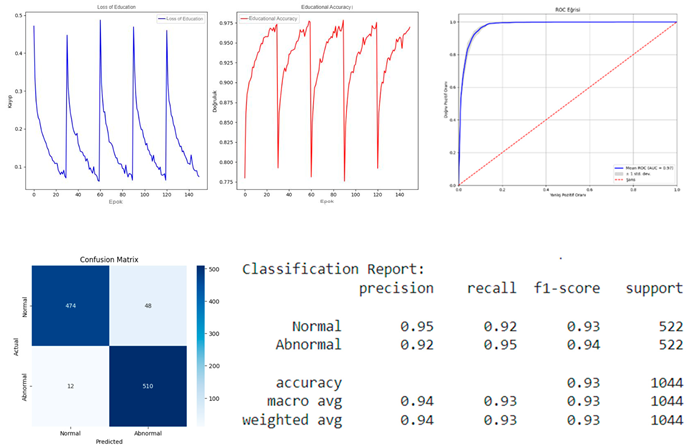
In this study, the deep learning model developed to classify normal and abnormal heart sounds was evaluated by a cross-validation method. The performance of the model was evaluated on the basis of loss function, accuracy, sensitivity, originality, F1 score and ROC AUC values in each training and test cycle. The findings show that the model is able to successfully detect abnormal heart sounds and accurately classify normal heart sounds. These results indicate that deep learning techniques may be an effective method for automatic classification of heart sounds.
Preprints 142994 i001

Material and Methods

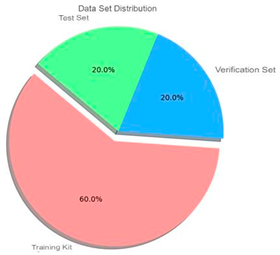
This project aims to develop a classification model to classify normal and abnormal heart sounds using 1D Convolutional Neural Networks (CNN) on the PhysioNet dataset. During the data loading and preparation process, audio files were loaded in WAV format using the librosa library, and noise reduction and high-pass filtering were applied. From each audio recording, MFCC, Chroma, and Mel-Spectrogram features were extracted, normalized, and combined into a single feature vector. Feature vectors were converted to NumPy arrays and normalized using StandardScaler.
Class imbalance in the dataset was addressed using SMOTE (Synthetic Minority Over-sampling Technique). The CNN model consists of 1D Convolutional, MaxPooling, Dense, and Dropout layers. To prevent overfitting during the training process, a 50% Dropout rate was applied. The model was trained on the training data for 30 epochs, during which the model weights were optimized to minimize the loss function.
After training, the model's performance was evaluated on the test data. The results were assessed using the loss function, accuracy, sensitivity, specificity, F1 score, and ROC AUC values.
Preprints 142994 i002

Results

This research was conducted to develop a deep learning model for classifying normal and abnormal heart sounds. During the research process, feature extraction was performed from audio data using a 1D CNN architecture, and classification was carried out based on the obtained features. The results show that the developed model successfully classifies normal and abnormal heart sounds. The model achieved an accuracy rate of 93.50%, and the area under the ROC curve (AUC) was calculated as 0.9773, indicating a high classification performance.
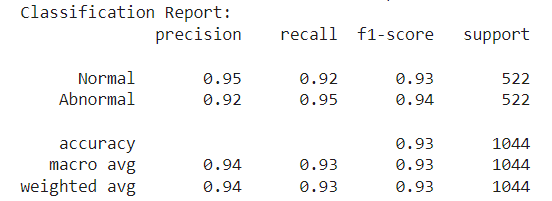
In the classification report, precision and sensitivity values of 98% and 88%, respectively, were obtained for the normal class, while precision and sensitivity values of 89% and 98% were achieved for the abnormal class. These results demonstrate that the model is highly successful in detecting abnormal heart sounds. The obtained results are consistent with previous studies in the literature, further enhancing the reliability of the model's success.

References

  1. D. Shaiakhmetov, R. R. Mekuria, R. Isaev, and F. Unsal, “Morphological classification of galaxies using SpinalNet,” in Proc. 2021 16th Int. Conf. Electron. Comput. Computation (ICECCO), Nov. 2021, pp. 1–5.
  2. A. Toktosunova, A. Ergeshov, G. Esenalieva, A. Ermakov, and R. Isaev, “Developing an artificial intelligence tool for image generation using a unique dataset with image-to-image functionality,” in Proc. Int. Conf. Comput. Syst. Technol. 2024, Jun. 2024, pp. 132–136.
  3. Z. Sadriddin, R. R. Mekuria, and M. S. Gaso, “Machine learning models for advanced air quality prediction,” in Proc. Int. Conf. Comput. Syst. Technol. 2024, Jun. 2024, pp. 51–56.
  4. M. S. Gaso, R. R. Mekuria, A. Khan, M. I. Gulbarga, I.Tologonov, and Z. Sadriddin, “Utilizing machine and deep learning techniques for predicting re-admission cases in diabetes patients,” in Proc. Int. Conf. Comput. Syst. Technol. 2024, Jun. 2024, pp. 76–81.
  5. C. Potes, S. Parvaneh, A. Rahman, and B. Conroy, “Ensemble of feature-based and deep learning-based classifiers for detection of abnormal heart sounds,” in Proc. 2016 IEEE Int. Conf. Acoust. Speech Signal Process. (ICASSP), 2016, pp. 645–649.
  6. A. Y. Hannun et al., “Cardiologist-level arrhythmia detection and classification in ambulatory electrocardiograms using a deep neural network,” Nature Med., vol. 25, no. 1, pp. 65–69, 2019. [CrossRef]
  7. T. Ergin, “Convolutional neural network (ConvNet) yada CNN nedir? Nasıl çalışır?,” Medium. Accessed: Dec. 10, 2024. [Online]. Available: https://medium.com/@tuncerergin/convolutional-neural-network-convnet-yada-cnn-nedir-nasil-calisir-97a0f5d34cad.
  8. M. Güven, Kalp rahatsızlıklarının yapay zekâ algoritmaları ve akıllı telefonlar/tabletlere kullanılarak tespit edilmesi. Ankara, Turkey: Gazi University, 2021.
  9. PhysioNet Challenge 2016 Dataset. Accessed: Dec. 10, 2024. [Online]. Available: https://physionet.org/content/challenge-2016/1.0.
  10. A. Kumar, S. Jaswal, and V. Srivastava, “Automated cardiac auscultation for heart murmur detection using deep learning,” IEEE J. Biomed. Health Inform., vol. 25, no. 12, pp. 4321–4330, 2021.
Disclaimer/Publisher’s Note: The statements, opinions and data contained in all publications are solely those of the individual author(s) and contributor(s) and not of MDPI and/or the editor(s). MDPI and/or the editor(s) disclaim responsibility for any injury to people or property resulting from any ideas, methods, instructions or products referred to in the content.
Copyright: This open access article is published under a Creative Commons CC BY 4.0 license, which permit the free download, distribution, and reuse, provided that the author and preprint are cited in any reuse.
Prerpints.org logo

Preprints.org is a free preprint server supported by MDPI in Basel, Switzerland.

Subscribe

Disclaimer

Terms of Use

Privacy Policy

Privacy Settings

© 2025 MDPI (Basel, Switzerland) unless otherwise stated