

Submitted:
13 December 2024
Posted:
16 December 2024
You are already at the latest version
Abstract
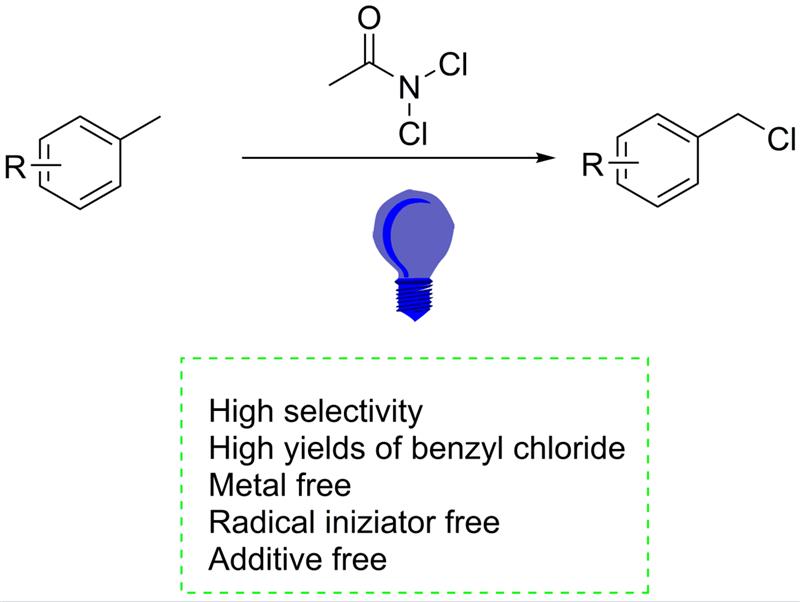
Chlorination is a widely used strategy at industrial level. Chlorinated products represent indispensable building blocks in synthetic chemistry. For this reason, finding new and alternative methodologies of these compounds continues to be a challenge. Here we report the synthesis of benzyl chlorides and α-chloro alkyl arenes mediated by visible light. This methodology is a valid alternative to the syntheses previously reported in the literature. It is a metal-free process, without the use of additives and radical initiators.
Keywords:
benzyl chloride
; visible light
; toluene
1. Introduction
Organochlorine compounds are among the most abundant compounds in nature and can be found in a wide range of classes of biomolecules, such as alkaloids, terpenoids and steroids [1]. Furthermore, organochlorines represent versatile building blocks in chemical synthesis and are key components in multitude of functional materials and pharmaceutical active ingredients [2,3,4,5,6,7].
For this reason, an important goal in chemical synthesis is the development of new efficient synthetic strategies that allow site-selective chlorination in a specific C-H bond of an organic compound [5,6,8,9].
C–H bonds halogenation is of great relevance as it is an essential process for the preparation of precursors for synthetic chemistry, e.g., industrial synthesis of amphetamine-class drugs, artificial resins, dyes and photographic developer [7].
The major industrial production of benzyl chloride consists of the homolysis of elemental chlorine, activated by thermal or UV irradiation, where one hydrogen atom of toluene is substituted by one chlorine atom [10]. Chlorination proceeds with the formation of benzyl chloride along with undesirable poly-chlorination products such as benzal chloride, benzotrichloride and chlorotoluene derived from the chlorination of the aromatic ring. Another methodology widely used at industrial level is the reaction of benzene with paraformaldehyde, gaseous hydrochloric acid and anhydrous zinc chloride which leads to the chloromethylation of benzene [7,11,12]. These synthetic procedures are widely used but have significant disadvantages related to the use of dangerous and difficult to handle reagents, difficult reaction conditions, low conversions and yields of benzyl chloride due to a low selectivity of the process. Furthermore, not only is chlorine a very hazardous and corrosive chemical, but the theoretical limit for maximum chlorine usage is only 50% since half of the dichlorine forms HCl as a side-product.
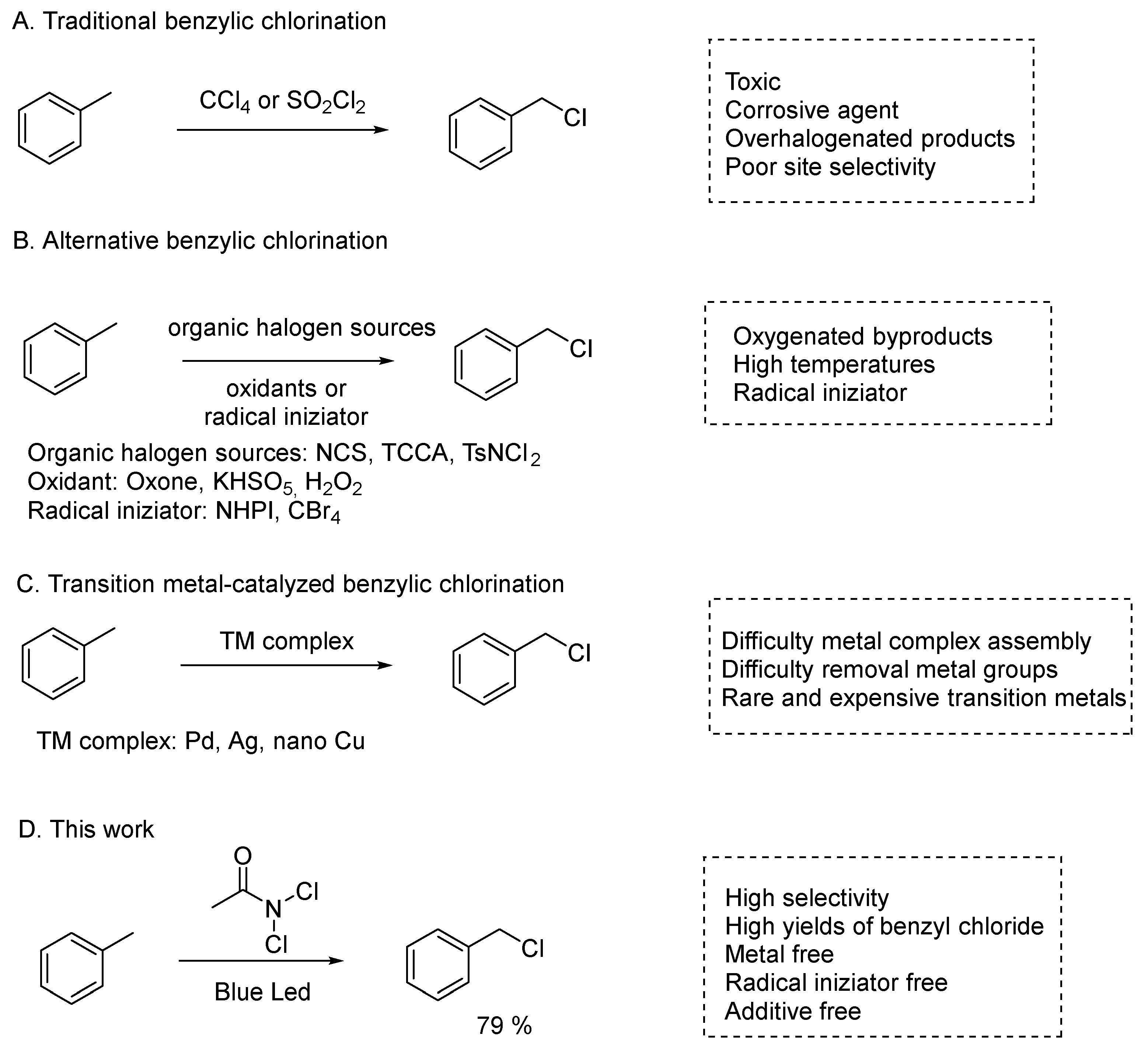
Other traditional synthetic strategies involve benzylic chlorination using explosive, toxic, or corrosive chlorinating reagents such as CCl4 or SO2Cl2 (Scheme 1, pathway A) [13,14,15]. However reagent concentrations and reaction conditions must be carefully controlled to minimize the formation of over halogenated products and isomers [13].
Scheme 1.
Strategies for the synthesis of benzyl chloride.
For these reasons, academic and industrial researchers continue to study approaches that enable the α-chlorination of toluene and alkyl arenes to do high conversions and yields of benzyl chloride, using mild and easy to handle reagents.
A more controlled synthesis of halogenated chemicals under relatively mild reaction conditions is provided by using organic halogen sources (e.g., N-chlorosuccinimide (NCS), trichloroisocyanuric acid (TCCA), and dichloramine-T (TsNCl2)) (Scheme 1, pathway B) [16,17,18,19,20,21,22]. Thirumamagal et al. have reported the reaction of xylene with N-chlorosuccinimide (NCS) as a reagent and montmorillonite clay K-10 as a solid support in 1,2-dichloroethane [19]. The reaction was heated for 18 h at 80 °C [19]. In 2010 Bucos et al. have reported a microwave assisted chlorination of alkyl aromatic hydrocarbons with N-chlorosuccinimide (NCS) in the presence of ionic species as additives [20]. The reaction has been studied only on p-xylene, but it was not possible to obtain 1-(chloromethyl)-4-methylbenzene as the exclusive product.
Other methods for benzyl chlorination involve the combination of chloride anion and stoichiometric amounts of oxidants, such as peroxides, Oxone, KHSO5 and H2O2, under acidic or basic reaction conditions, which can avoid the use of toxic chlorinating reagents and afford low concentrations of chlorine radical [23,24,25,26]. Unfortunately, these reactions often require high temperatures to release chlorine radicals (Cl•) to attack C–H bonds. Furthermore, it is often necessary to work with unfavorable stoichiometric ratios, and they often provide oxygenated byproducts (Scheme 1, pathway B). Li et al. have reported the chlorination reaction of toluenes using N-chlorosuccinimide (NCS), N-hydroxyphthalimide (NHPI) as a catalyst and 2,3-dicyano-5,6-dichloro-benzoquinone (DDQ) as an external radical initiator by heating at 80 °C [22]. Under these reaction conditions an excess of toluene respect to N-chlorosuccinimide was necessary.
A current trend in organic chemistry is the development of new methodologies induced by visible light [27]. In this way it is possible to develop sustainable and efficient synthetic methodologies. In fact, photosynthesis is the transformation of light into chemical energy and can be efficiently employed to promote chemical reactions. Photochemistry has long been a well-known part of traditional synthetic organic chemistry, but it has mainly been based on the direct excitation of organic compounds by UV light, which has significantly limited its scope. The use of visible light represents a very important goal for the organic chemist. In fact, visible light activates substrates without leaving by-products in the reaction mixture, with a significant simplification of the processing and for this reason it can be considered a clean reagent. Furthermore, the use of visible light, instead of thermal energy, to carry out chemical processes leads to significant energy savings.
In this context, alternative strategies for site-selective chlorination at a specific C–H bond in an organic compound include transition metal-catalyzed C–H bond chlorination (Scheme 1, pathway C) [28,29]. Although transition metal-catalyzed direct C–H bond formation at C–Cl is an alternative and versatile strategy, it is more time-consuming due to the difficulties related to the complex synthesis and removal of metal groups [30]. In particular, most of the reported transition metal-catalyzed C–H bond halogenation reactions have been achieved using rare and expensive transition metals such as Palladium and Silver [31,32,33,34,35]. Stahl and co-workers reported a copper-catalyzed benzyl chlorination with N-fluorobenzenesulfonimide as an oxidant [36]. This procedure shows benzyl site selectivity but requires a complex reaction system and an expensive ligand. Combe et al. proposed a chlorination of toluene using trichloroisocyanuric acid as a chlorine source, N-hydroxyphthalimide (NHPI) as a radical initiator, catalytic amounts of CBr4 and Cu(OAc)2 as catalyst, obtaining benzyl chloride yield of 58% [17]. Whiting and co-workers reported α-H selective chlorination of alkylarenes using nano Ag/AgCl in aqueous NaCl/HCl under sunlight or visible light irradiation obtaining benzyl chloride in 38 % yield [35]. Subsequently, the same group performed a selective photochlorination study using a nano-Cu@CuCl catalyst and various inorganic salts, under acidic conditions obtaining benzyl chloride in yields ranging from 46 to 80 % [37]. These methodologies, although interesting, do not allow to obtain benzyl chloride with high yields and furthermore it is necessary to prepare the catalyst with long procedures sometimes even with difficult reaction conditions.
It is well known that C–H chlorination reactions have been widely employed to create valuable building blocks in organic chemistry. Nevertheless, it is fundamental to develop new and sustainable selective chlorination reactions of C–H bond under visible-light irradiation.
Encouraged by our previous research results [21], we examined the use of inexpensive N,N-dichloroacetamide to induce the chlorination of alkylaromatic hydrocarbons via a photochemistry process. N,N-dichloroacetamide is a cheap and stable alternative to commercially available chlorinating reagents (Scheme 1, pathway D), the synthesis of N,N-dichloramide is simple, and once prepared it is easy to store, handle and use. [38,39]. Furthermore, our work is metal free without the use of additives and radical initiators. Also, the use of visible light allows for a sustainable and accessible alternative to traditional approaches and the introduction of new methods of reactivity in organic synthesis.
2. Results
2.1. Optimization of Reaction Conditions
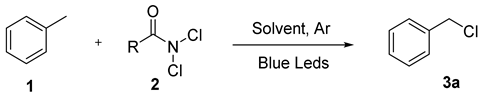
We initially examined the chlorination of alkylaromatic hydrocarbons using toluene with N,N-dichloroacetamide (2) under different conditions (Table 1).
We began our investigation, as a model substrate, by using 2 mmol of toluene (1), with 1 mmol of N,N-dichloroacetamide (2), in 1 mL of dichloromethane as solvent and irradiated by blue LED (λ max= 455 nm) for 8 h. Benzyl chloride (3a) was obtained in 64% yield relative to the amount of chlorine source. Increasing the amount of N,N-dichloroacetamide (2) to 1.2 mmol also increased the yield of benzyl chloride (3a) to 70% (Table 1, entry 2). An even better result was obtained by working with 1.3 mmol of N,N-dichloroacetamide (2), in this menner it was possible to obtain benzyl chloride (3a) with a yield of 79% (Table 1, entry 3). Further increasing the amount of N,N-dichloroacetamide (2) to 2 mmol instead, led to a slight decrease in the yield of the desired product (3a) to 70%, indicating that it was not necessary to work with such a high stoichiometric ratio. (Table 1, entry 4). After having optimized the stoichiometric ratio between the reagents, the reaction was studied by varying the irradiation times. By irradiating the reaction mixture for 30 min, benzyl chloride (3a) was obtained in 36% yield (Table 1, entry 5). By increasing the irradiation time to 1 h, benzyl chloride (3a) could be obtained in 44% yield (Table 1, entry 6). Similar results were obtained by increasing the irradiation time to 2h and 3h where benzyl chloride was obtained in 47% and 57% yields respectively (Table 1, entries 7, 8). Encouraged by these results, the reaction was tested for 5 h obtaining the corresponding chlorinated compound (3a) in 65% yield. A further attempt by irradiating the reaction for up to 12 h did not lead to significant variations in yield (Table 1, entry 10). To improve the yield, some solvents were tested but we were unable to obtain the desired product. In detail, cyclopentyl methyl ether (Table 1, entry 11), acetonitrile (Table 1, entry 12), 2-methyltetrahydrofuran (Table 1, entry 14), tetrahydrofuran (Table 1, entry 15) and 1,2-dichloroethane (Table 1, entry 16) were employed but no product was obtained. Using ethyl acetate as solvent it was possible to obtain only trace amounts of benzyl chloride (3a) (Table 1, entry 13). Notably, the reaction did not proceed at all in the absence of light irradiation (Table 1, entry 17). The reaction was performed under green LEDs irradiation (Table 1, entry 18) and no product was obtained. This finding confirms a blue LED light-activation process.
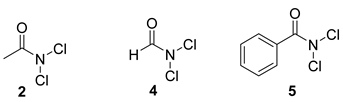
Finally the reaction was tested by changing the chlorine source. Using N,N-dichloroformamide (4) and N,N-dichlorobenzamide (5) benzyl chloride was obtained with 47 % and 60 % yield respectively.
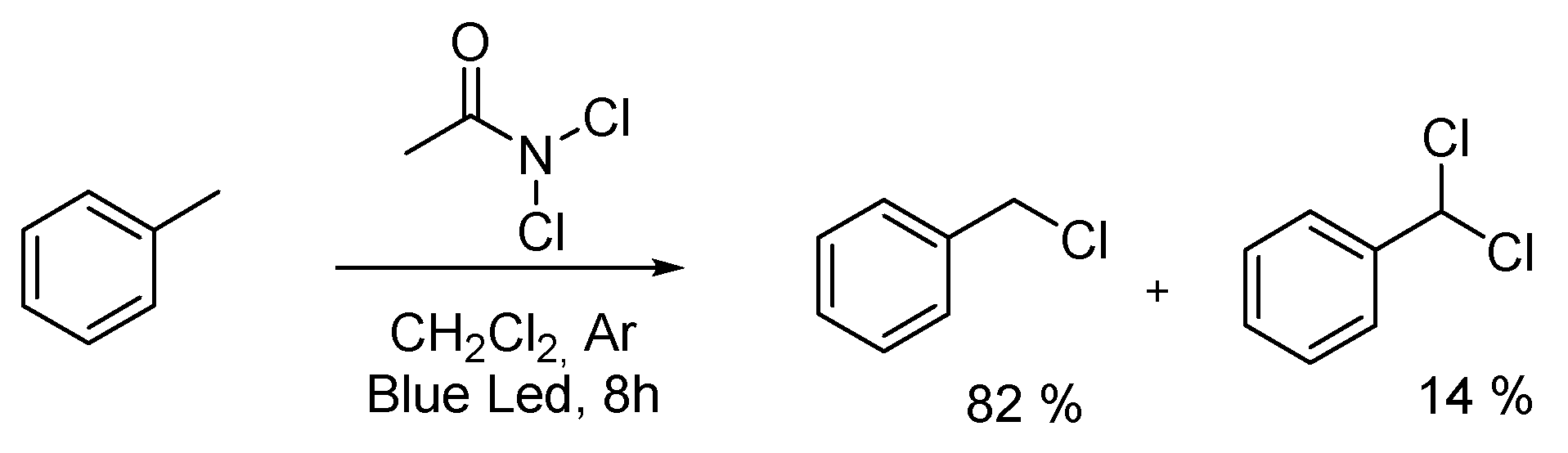
We also studied the conversion of toluene, evaluating the possible by-products that can be formed (Scheme 2). The method that was chosen to evaluate the conversion is 1H NMR. With our procedure it is possible to obtain a conversion of 96% of toluene. To our knowledge it is one of the highest reported in literature. Furthermore it was possible to observe the conversion in benzyl chloride of 82%, and in benzal chloride only 14%. No chlorination by-products of the benzene ring were observed.
Scheme 2.
Evaluation of conversion of toluene in benzyl chloride and benzal chloride.
2.2. Scale up of Our Methodology
We then evaluated the scale up of our methodology. The reaction of 2.0 g of toluene with 1.8 g of N,N-dichloroacetamide in 10 mL of dichloromethane under blue LED irradiation for 8 h was tested. In this condition, benzyl chloride was obtained in 74% yield. Both the yield and purity remained similar to the small-scale reaction. This result is an important advantage of the approach because one of the main disadvantages of many light-induced reactions is the need for the use of chromophores which are such light absorbers, and this leads to scalability issues.
2.3. Scope of the Reaction
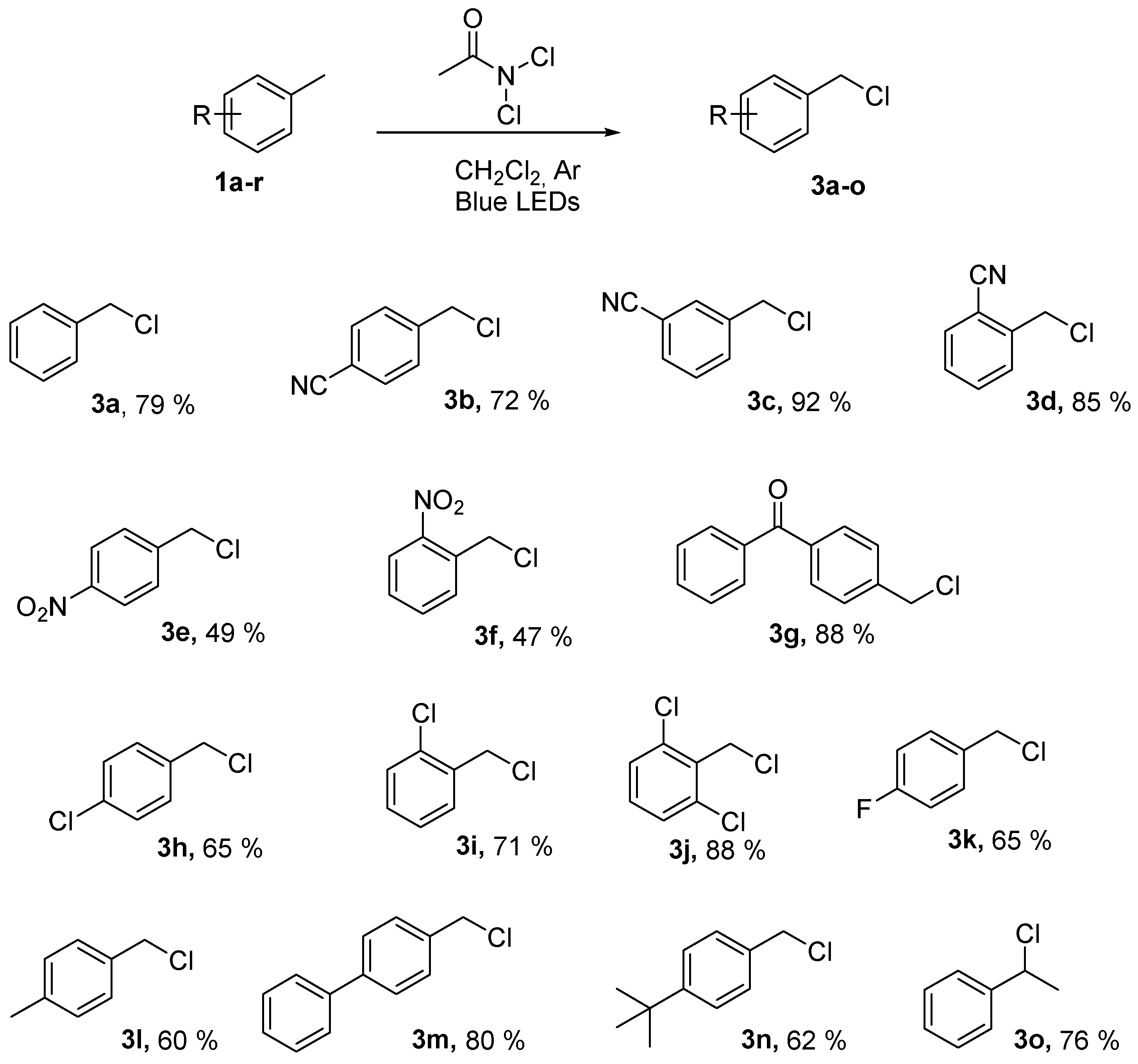
With the optimized reaction conditions in hand the scope of the reaction was explored to variously substituted toluenes, affording a wide range of α-H chlorinated alkylarenes (Scheme 3). In general the corresponding α-H chlorinated alkylarenes were obtained in satisfying yields (Scheme 3, 3a-o). Different functional groups on aromatic ring both electron donating and electron withdrawing were tested. Neither the electronic properties nor the steric effects of substituents on the ring of alkylarenes were found to have effect on the reaction yields. Strong electron withdrawing substituents were tested and showed very good results (Scheme 3, 3b, 3c, 3d, 3e, 3f). CN group in ortho, meta and para positions were tested giving the corresponding α-H chlorinated alkylarene in very good yields (Scheme 3, 3b, 3c, 3d). NO2 in para and ortho positions also showed good results(Scheme 3, 3e, 3f). Moderate electron withdrawing substituent, in para such as phenyl(p-tolyl)methanone was employed affording the corresponding (4-(chloromethyl)phenyl)(-phenyl)methanone (Scheme 3, 3g) in 88% yield. Toluenes with halide substituents, as chlorine in ortho, meta, para positions and fluorine in para position were tested to obtain the resultants α-H chlorinated alkylarene (Scheme 3, 3h, 3i, 3j, 3k) in good yields. Substrates with moderate electron-donating substituents as 4-methyl-1-1′-biphenyl and 1-(tert-butyl)-4-methylbenzene (Scheme 3, 3m, 3n) were tested with satisfactory results. Para-xylene afforded the corresponding 1-(chloromethyl)-4-methylbenzene 3l in 60% yield by regioselectively chlorinating only at one position. The chlorination of ethylbenzene given the corresponding (1-chloroethyl)benzene 3o as exclusively product in 76 % yield.
Scheme 3.
Substrate scope for the α-H chlorination of toluenes. Reaction conditions: toluenes (2.0 mmol), N,N-dichloroacetamide (2) (1.3 mmol), in DCM (1 mL), irradiated with Blue LEDs for 8 h under Ar. Yields are of isolated products.
Scheme 3.
Substrate scope for the α-H chlorination of toluenes. Reaction conditions: toluenes (2.0 mmol), N,N-dichloroacetamide (2) (1.3 mmol), in DCM (1 mL), irradiated with Blue LEDs for 8 h under Ar. Yields are of isolated products.
2.4. Proposed Mechanism
Based on previous studies [21,40,41] a description of two possible mechanisms are reported in Scheme 4. In both pathways a radical mechanism is supposed [41,42,43]. In the first possible pathway (Scheme 4, pathway 1) the process initiates from visible-light-assisted homolytic cleavage of N-Cl bond in N,N-dichloroacetamide to form N-chloroacetamide radical A and chlorine radical B [44,45,46]. Then the N-centred radical A abstracts a hydrogen atom at the benzylic position of toluene to form the benzylic radical C. Finally, the intermediary benzylic radical B and chlorine radical B react together to form benzyl chloride D. This key step is repeated two times until the formation of acetamide E.
Scheme 4.
Plausible mechanisms for the α-chlorination of toluene.
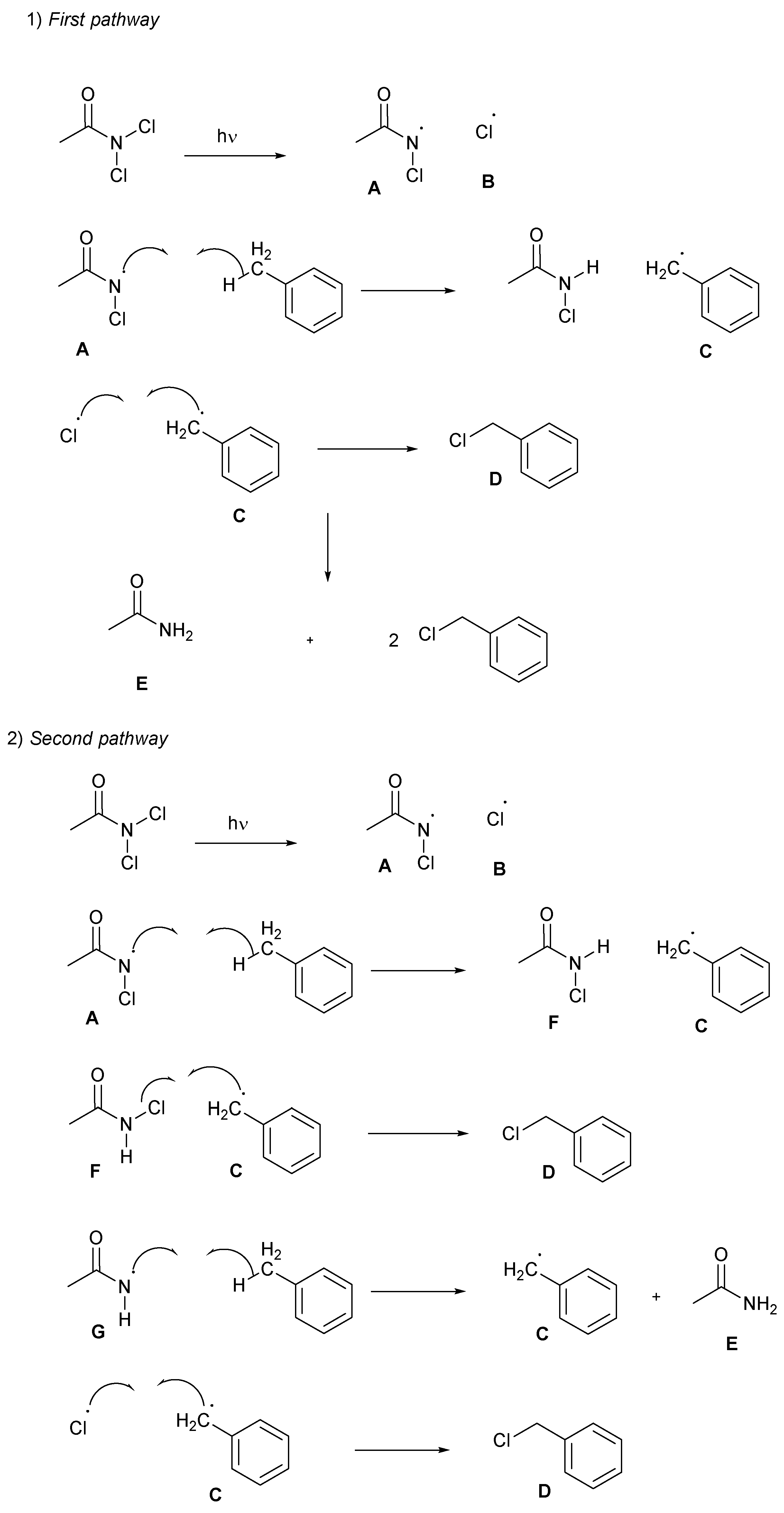
In the second possible pathway, (Scheme 4, pathway 2) the reaction starts with a homolytic cleavage of the N–Cl bond of N,N-dichloroacetamide to generate radical chlorine atom B and nitrogen-centered radical A [44,45,46]. Then the process propagates via abstraction of toluene’ hydrogen by A to generate intermediate benzyl radical C and N-chloroacetamide F. Then acyl radical C react with N-chloroacetamide F to generate benzyl chloride D and nitrogen-centered radical F. Subsequently, nitrogen-centered radical F react with toluene to give benzyl radical C and acetamide E. Finally benzyl radical C is quenched by the radical chlorine atom B to generate benzyl chloride D.
3. Materials and Methods
3.1. General Information
All solvents and reagents were employed as bought by commercial suppliers. All the reactions were carried out in an Argon atmosphere using standard methods. All solvents were dried by common techniques and distilled in an Argon atmosphere. Short-column chromatography was performed with 4 cm column diameter charged with 18 g of silica gel (pore size 60 Å, 32-63 nm particle size) and reactions were monitored by thin-layer chromatography (TLC) analysis was carried out with Merck Kieselgel 60 F254 plates and visualized using UV light at 254 nm. Irradiation with blue light was performed with OSRAM Oslon SSL 80 LDCQ7P-1U3U (blue, λ max = 455 nm, I max = 1000 mA, 1.12 W). 1H NMR and 13C NMR spectra were recorded by a Bruker Avance III 400 spectrometer (400 MHz or 100 MHz, respectively) using CDCl3 solutions and TMS as an internal standard. Chemical shifts are reported in parts per million (ppm, d) relative to the internal tetramethylsilane standard (TMS, d 0.00). The peak patterns are denoted as follows: s, singlet; d, doublet; t, triplet; m, multiplet; q, quartet; dd, doublet of doublets; br, broad. The coupling constants, J, are indicated in Hertz (Hz). Melting points were recorded in open capillary tubes and were uncorrected.
3.2. General Procedure to N,N-dichloroamides 2, 4, 5:[38]
In a round bottom flask of 10 mL were added 1 mmol N,N-dichloroamide and 2 mmol (0.21 g) of tert-Butyl hypochlorite[39] in 2 mL of diethyl ether at room temperature. The resulting suspension was stirred for 2 h. The reaction was monitored by TLC. After 2 h, the crude mixture was purified by short column chromatography (diameter= 4 cm with 18 g of silica gel, Hexane/AcOEt).
3.3. General Procedure to Compounds 3a-3o:
In a round bottom flask of 10 mL were added 2 mmol of alkylarenes and 1.3 mmol (0.166 g) of N,N-dichloroacetamide in 1 mL of dichloromethane under dry Argon atmosphere at room temperature. The resulting suspension was irradiated under blue LED, under stirring, for 8 h. The reaction was monitored by TLC. After 8 h, the crude mixture was purified by short column chromatography (diameter= 4 cm with 18 g of silica gel, Hexane/AcOEt).
4. Conclusions
In conclusion, a visible light-mediated synthesis of α-H chloroalkylaromatic hydrocarbons has been reported. The conditions are mild and the stoichiometric ratio of reagents is ideal. The methodology has shown to have good versatility and applicability and various functional groups are well tolerated, providing an alternative approach to the visible light-mediated synthesis of α-H chloroalkylaromatic hydrocarbons. The use of visible light allows for a sustainable and accessible alternative to traditional approaches. Also, the methodology is metal-free, without the use of additives and radical initiators. It also provided the products in good yields.
Supplementary Materials
The following supporting information can be downloaded at the website of this paper posted on Preprints.org, Figure S1: title; Table S1: title; Video S1: title.
Author Contributions
Conceptualization, writing—original draft preparation, writing—review and editing, S.G.; validation, formal analysis, investigation, data curation, L.L., A.P., M.C., L.P. and L.D.L.; supervision, review and editing, A.P. and L.D.L.; funding acquisition, L.D.L., S.G. L.P. M.C. All authors have read and agreed to the published version of the manuscript.
Funding
“This research was funded by National Recovery and Resilience Plan (NRRP), Mission 4, Component 2, Investment 1.1, Call for tender No. 1409 published on 14.9.2022 by the Italian Ministry of University and Research (MUR), funded by the European Union – NextGenerationEU- Project Title: The Second Life of Posidonia Oceanica: Sustainability-guided Isolation and Valorization of its Main Constituents – CUP J53D23014680001- Grant Assignment Decree No. 1064 adopted on 18.07.2023 by the Italian Ministry of Ministry of University and Research (MUR)”
Institutional Review Board Statement
Not applicable
Informed Consent Statement
Not applicable.
Data Availability Statement
The data presented in this study are available in the Supplementary Materials.
Acknowledgments
We acknowledge the Dipartimento di Scienze Chimiche, Fisiche, Matematiche e Naturali, and the Università degli Studi di Sassari for the facilities.
Conflicts of Interest
The authors declare no conflict of interest.
References
- Gribble, G. W. , Natural Organohalogens: A New Frontier for Medicinal Agents? Journal of Chemical Education 2004, 81(10), 1441. [Google Scholar] [CrossRef]
- Lin, R.; Amrute, A. P.; Pérez-Ramírez, J. , Halogen-Mediated Conversion of Hydrocarbons to Commodities. Chemical Reviews 2017, 117(5), 4182–4247. [Google Scholar] [CrossRef] [PubMed]
- Terao, J.; Kambe, N. , Cross-Coupling Reaction of Alkyl Halides with Grignard Reagents Catalyzed by Ni, Pd, or Cu Complexes with π-Carbon Ligand(s). Accounts of Chemical Research 2008, 41(11), 1545–1554. [Google Scholar] [CrossRef]
- Auffinger, P.; Hays, F. A.; Westhof, E.; Ho, P. S. , Halogen bonds in biological molecules. Proceedings of the National Academy of Sciences 2004, 101(48), 16789–16794. [Google Scholar] [CrossRef]
- Petrone, D. A.; Ye, J.; Lautens, M. , Modern Transition-Metal-Catalyzed Carbon–Halogen Bond Formation. Chemical Reviews 2016, 116(14), 8003–8104. [Google Scholar] [CrossRef] [PubMed]
- Podgoršek, A.; Zupan, M.; Iskra, J. , Oxidative Halogenation with “Green” Oxidants: Oxygen and Hydrogen Peroxide. Angewandte Chemie International Edition 2009, 48(45), 8424–8450. [Google Scholar] [CrossRef]
- Rossberg, M.; Lendle, W.; Pfleiderer, G.; Tögel, A.; Dreher, E.-L.; Langer, E.; Rassaerts, H.; Kleinschmidt, P.; Strack, H.; Cook, R.; Beck, U.; Lipper, K.-A.; Torkelson, T. R.; Löser, E.; Beutel, K. K.; Mann, T. , Chlorinated Hydrocarbons. In Ullmann’s Encyclopedia of Industrial Chemistry.
- Zhang, L.; Hu, X. , Room temperature C(sp2)–H oxidative chlorination via photoredox catalysis. Chemical Science 2017, 8(10), 7009–7013. [Google Scholar] [CrossRef]
- Ozawa, J.; Kanai, M. , Silver-Catalyzed C(sp3)–H Chlorination. Organic Letters 2017, 19(6), 1430–1433. [Google Scholar] [CrossRef] [PubMed]
- Furniss, B. S. H., A. J.; Smith, P. W. G.; Tatchell, A. R, Vogel’s Textbook of Practical Organic Chemistry. 5th ed. ed.; Harlow: Longman: 1989; p 864.
- Whitmore, F. C.; Ginsburg, A.; Rueggeberg, W.; Tharp, I.; Nottorf, H.; Cannon, M.; Carnahan, F.; Cryder, D.; Fleming, G.; Goldberg, G.; Haggard, H.; Herr, C.; Hoover, T.; Lovell, H.; Mraz, R.; Noll, C.; Oakwood, T.; Patterson, H.; Van Strien, R.; Walter, R.; Zook, H.; Wagner, R.; Weisgerber, C.; Wilkins, J. , Production of Benzyl Chloride by Chloromethylation of Benzene. Laboratory and Pilot Plant Studies. Industrial & Engineering Chemistry.
- Lei A., S. W., Liu C., Liu W., Zhang H. He C., Oxidative Cross-Coupling Reactions. Wiley-VCH: 2016.
- Delaude, L.; Laszlo, P. , Versatility of zeolites as catalysts for ring or side-chain aromatic chlorinations by sulfuryl chloride. The Journal of Organic Chemistry 1990, 55(18), 5260–5269. [Google Scholar] [CrossRef]
- Tanemura, K.; Suzuki, T.; Nishida, Y.; Horaguchi, T. , Chlorination of aliphatic hydrocarbons, aromatic compounds, and olefins in subcritical carbon tetrachloride. Tetrahedron Letters 2008, 49(45), 6419–6422. [Google Scholar] [CrossRef]
- Kharasch, M. S.; Brown, H. C. , Chlorinations with Sulfuryl Chloride. I. The Peroxide-Catalyzed Chlorination of Hydrocarbons. Journal of the American Chemical Society, 2142. [Google Scholar]
- Xiang, M.; Zhou, C.; Yang, X.-L.; Chen, B.; Tung, C.-H.; Wu, L.-Z. , Visible Light-Catalyzed Benzylic C–H Bond Chlorination by a Combination of Organic Dye (Acr+-Mes) and N-Chlorosuccinimide. The Journal of Organic Chemistry 2020, 85(14), 9080–9087. [Google Scholar] [CrossRef] [PubMed]
- Combe, S. H.; Hosseini, A.; Parra, A.; Schreiner, P. R. , Mild Aliphatic and Benzylic Hydrocarbon C–H Bond Chlorination Using Trichloroisocyanuric Acid. The Journal of Organic Chemistry 2017, 82(5), 2407–2413. [Google Scholar] [CrossRef]
- Jin, J.; Zhao, Y.; Kyne, S. H.; Farshadfar, K.; Ariafard, A.; Chan, P. W. H. , Copper(I)-catalysed site-selective C(sp3)–H bond chlorination of ketones, (E)-enones and alkylbenzenes by dichloramine-T. Nature Communications 2021, 12(1), 4065. [Google Scholar] [CrossRef]
- Thirumamagal, B. T. S.; Narayanasamy, S.; Venkatesan, R. , Regiospecific Chlorination of Xylenes Using K-10 Montmorrillonite Clay. Synthetic Communications 2008, 38(16), 2820–2825. [Google Scholar] [CrossRef]
- Bucos, M.; Villalonga-Barber, C.; Micha-Screttas, M.; Steele, B. R.; Screttas, C. G.; Heropoulos, G. A. , Microwave assisted solid additive effects in simple dry chlorination reactions with n-chlorosuccinimide. Tetrahedron 2010, 66(11), 2061–2065. [Google Scholar] [CrossRef]
- Gaspa, S.; Valentoni, A.; Mulas, G.; Porcheddu, A.; De Luca, L. , Metal-Free Preparation of α-H-Chlorinated Alkylaromatic Hydrocarbons by Sunlight. ChemistrySelect 2018, 3(27), 7991–7995. [Google Scholar] [CrossRef]
- Li, Z.-H.; Fiser, B.; Jiang, B.-L.; Li, J.-W.; Xu, B.-H.; Zhang, S.-J. , N-Hydroxyphthalimide/benzoquinone-catalyzed chlorination of hydrocarbon C–H bond using N-chlorosuccinimide. Organic & Biomolecular Chemistry, 3403. [Google Scholar]
- Çimen, Y.; Akyüz, S.; Türk, H. , Facile, efficient, and environmentally friendly α- and aromatic regioselective chlorination of toluene using KHSO5 and KCl under catalyst-free conditions. New Journal of Chemistry 2015, 39(5), 3894–3899. [Google Scholar] [CrossRef]
- Liu, S.; Zhang, Q.; Tian, X.; Fan, S.; Huang, J.; Whiting, A. , Highly selective halogenation of unactivated C(sp3)–H with NaX under co-catalysis of visible light and Ag@AgX. Green Chemistry 2018, 20(20), 4729–4737. [Google Scholar] [CrossRef]
- Lu W., Z. M., Li M., Visible-Light-Driven Oxidative Mono- and Dibromination of Benzylic sp3 C–H Bonds with Potassium Bromide/Oxone at Room Temperature Synthesis 2018, 50, 4933–4939. 50.
- Zhao, M.; Lu, W. , Visible Light-Induced Oxidative Chlorination of Alkyl sp3 C–H Bonds with NaCl/Oxone at Room Temperature. Organic Letters 2017, 19(17), 4560–4563. [Google Scholar] [CrossRef]
- Stephenson C. R. J., Y. T. P., MacMillan D. W. C., Visible light photo-catalysis in organic chemistry,. Wiley-VCH Verlag, Weinheim: 2017.
- Das, R.; Kapur, M. , Transition-Metal-Catalyzed Site-Selective C−H Halogenation Reactions. Asian Journal of Organic Chemistry 2018, 7(8), 1524–1541. [Google Scholar] [CrossRef]
- Abderrazak, Y.; Bhattacharyya, A.; Reiser, O. , Visible-Light-Induced Homolysis of Earth-Abundant Metal-Substrate Complexes: A Complementary Activation Strategy in Photoredox Catalysis. Angewandte Chemie International Edition 2021, 60(39), 21100–21115. [Google Scholar] [CrossRef]
- Paik, A.; Paul, S.; Bhowmik, S.; Das, R.; Naveen, T.; Rana, S. , Recent Advances in First-Row Transition-Metal-Mediated C−H Halogenation of (Hetero)arenes and Alkanes. Asian Journal of Organic Chemistry 2022, 11(5), e202200060. [Google Scholar] [CrossRef]
- Lyons, T. W.; Sanford, M. S. , Palladium-Catalyzed Ligand-Directed C−H Functionalization Reactions. Chemical Reviews 2010, 110(2), 1147–1169. [Google Scholar] [CrossRef]
- Racowski, J. M.; Ball, N. D.; Sanford, M. S. , C–H Bond Activation at Palladium(IV) Centers. Journal of the American Chemical Society 2011, 133(45), 18022–18025. [Google Scholar] [CrossRef] [PubMed]
- Chen, C.; Tong, X. , Synthesis of organic halides via palladium(0) catalysis. Organic Chemistry Frontiers 2014, 1(4), 439–446. [Google Scholar] [CrossRef]
- Huang, J.; Liu, Y.; Tian, X.; Ni, S.-F.; Li, S.; Zhang, Z.-H.; Li, D.; Liu, S. , Visible light-induced FeCl3-catalyzed chlorination of C–H bonds with MgCl2. Green Chemistry 2024, 26(11), 6559–6569. [Google Scholar] [CrossRef]
- Liu, S.; Zhang, Q.; Li, H.; Yang, Y.; Tian, X.; Whiting, A. , A Visible-Light-Induced α-H Chlorination of Alkylarenes with Inorganic Chloride under NanoAg@AgCl. Chemistry – A European Journal, 9671. [Google Scholar]
- Lopez, M. A.; Buss, J. A.; Stahl, S. S. , Cu-Catalyzed Site-Selective Benzylic Chlorination Enabling Net C–H Coupling with Oxidatively Sensitive Nucleophiles. Organic Letters 2022, 24(2), 597–601. [Google Scholar] [CrossRef]
- Zhang, Q.; Liu, S.; Tian, X.; Liu, Y.; Fan, S.; Huang, B.; Whiting, A. , Cu@CuCl-visible light co-catalysed chlorination of C(sp3)–H bonds with MCln solution and photocatalytic serial reactor-based synthesis of benzyl chloride. Green Chemistry 2022, 24(1), 384–393. [Google Scholar] [CrossRef]
- Zimmer, H.; Audrieth, L. F. , Tertiary Butyl Hypochlorite as as N-Chlorinating Agent. Journal of the American Chemical Society 1954, 76(14), 3856–3857. [Google Scholar] [CrossRef]
- Gómez, J. E.; Guo, W.; Gaspa, S.; Kleij, A. W. , Copper-Catalyzed Synthesis of γ-Amino Acids Featuring Quaternary Stereocenters. Angewandte Chemie International Edition 2017, 56(47), 15035–15038. [Google Scholar] [CrossRef]
- Dellisanti, A.; Chessa, E.; Porcheddu, A.; Carraro, M.; Pisano, L.; De Luca, L.; Gaspa, S. , Visible Light-Promoted Oxidative Cross-Coupling of Alcohols to Esters. Molecules 2024, 29(3), 570. [Google Scholar] [CrossRef]
- Gaspa, S.; Raposo, I.; Pereira, L.; Mulas, G.; Ricci, P. C.; Porcheddu, A.; De Luca, L. , Visible light-induced transformation of aldehydes to esters, carboxylic anhydrides and amides. New Journal of Chemistry 2019, 43(27), 10711–10715. [Google Scholar] [CrossRef]
- Podgoršek, A.; Stavber, S.; Zupan, M.; Iskra, J. , Visible light induced ‘on water’ benzylic bromination with N-bromosuccinimide. Tetrahedron Letters 2006, 47(7), 1097–1099. [Google Scholar] [CrossRef]
- Venkatachalapathy, C.; Pitchumani, K. , Selectivity in bromination of alkylbenzenes in the presence of montmorillonite clay. Tetrahedron 1997, 53(7), 2581–2584. [Google Scholar] [CrossRef]
- Zhang, H.; Muñiz, K. , Selective Piperidine Synthesis Exploiting Iodine-Catalyzed Csp3–H Amination under Visible Light. ACS Catalysis 2017, 7(6), 4122–4125. [Google Scholar] [CrossRef]
- Saikia, I.; Borah, A. J.; Phukan, P. , Use of Bromine and Bromo-Organic Compounds in Organic Synthesis. Chemical Reviews 2016, 116(12), 6837–7042. [Google Scholar] [CrossRef]
- Vaillard, S. E.; Schulte, B.; Studer, A. , Radical-Based Arylation Methods. In Modern Arylation Methods, 2009; pp 475-511.

Table 1.
Screening of reaction conditions.
 | |||||
| Entry1 | Toluene (mmol) | Cl-source (mmol) | Solvent | Time (h) | Yield2 (%) |
| 1 | 2 | (2) 1 | DCM | 8 | 64 % |
| 2 | 2 | (2) 1.2 | DCM | 8 | 70 % |
| 3 | 2 | (2) 1.3 | DCM | 8 | 79 % |
| 4 | 2 | (2) 2 | DCM | 8 | 70 % |
| 5 | 2 | (2) 1.3 | DCM | 0.5 | 36 % |
| 6 | 2 | (2) 1.3 | DCM | 1 | 44 % |
| 7 | 2 | (2) 1.3 | DCM | 2 | 47 % |
| 8 | 2 | (2) 1.3 | DCM | 3 | 57 % |
| 9 | 2 | (2) 1.3 | DCM | 5 | 65 % |
| 10 | 2 | (2) 1.3 | DCM | 12 | 66 % |
| 11 | 2 | (2) 1.3 | CPME | 8 | - |
| 12 | 2 | (2) 1.3 | CH3CN | 8 | - |
| 13 | 2 | (2) 1.3 | AcOEt | 8 | trace |
| 14 | 2 | (2) 1.3 | 2-MeTHF | 8 | - |
| 15 | 2 | (2) 1.3 | THF | 8 | - |
| 16 | 2 | (2) 1.3 | DCE | 8 | - |
| 17 3 | 2 | (2) 1.3 | DCM | 8 | - |
| 18 4 | 2 | (2) 1.3 | DCM | 8 | - |
| 19 | 2 | (4) 1.3 | DCM | 8 | 47 % |
| 20 | 2 | (5) 1.3 | DCM | 8 | 60 % |
 | |||||
1 Reaction conditions: toluene (2.0 mmol), Cl-source (1.3 mmol), in Solvent (1 mL), irradiated with Blue LEDs for 8 h under Ar. 2 Yields are of isolated products. 3 Reaction performed without light. 4 The reaction mixture was irradiated for 8 h with green LED (535 nm).
Disclaimer/Publisher’s Note: The statements, opinions and data contained in all publications are solely those of the individual author(s) and contributor(s) and not of MDPI and/or the editor(s). MDPI and/or the editor(s) disclaim responsibility for any injury to people or property resulting from any ideas, methods, instructions or products referred to in the content. |
© 2024 by the authors. Licensee MDPI, Basel, Switzerland. This article is an open access article distributed under the terms and conditions of the Creative Commons Attribution (CC BY) license (http://creativecommons.org/licenses/by/4.0/).
Copyright: This open access article is published under a Creative Commons CC BY 4.0 license, which permit the free download, distribution, and reuse, provided that the author and preprint are cited in any reuse.