

Submitted:
12 December 2024
Posted:
13 December 2024
You are already at the latest version
Abstract
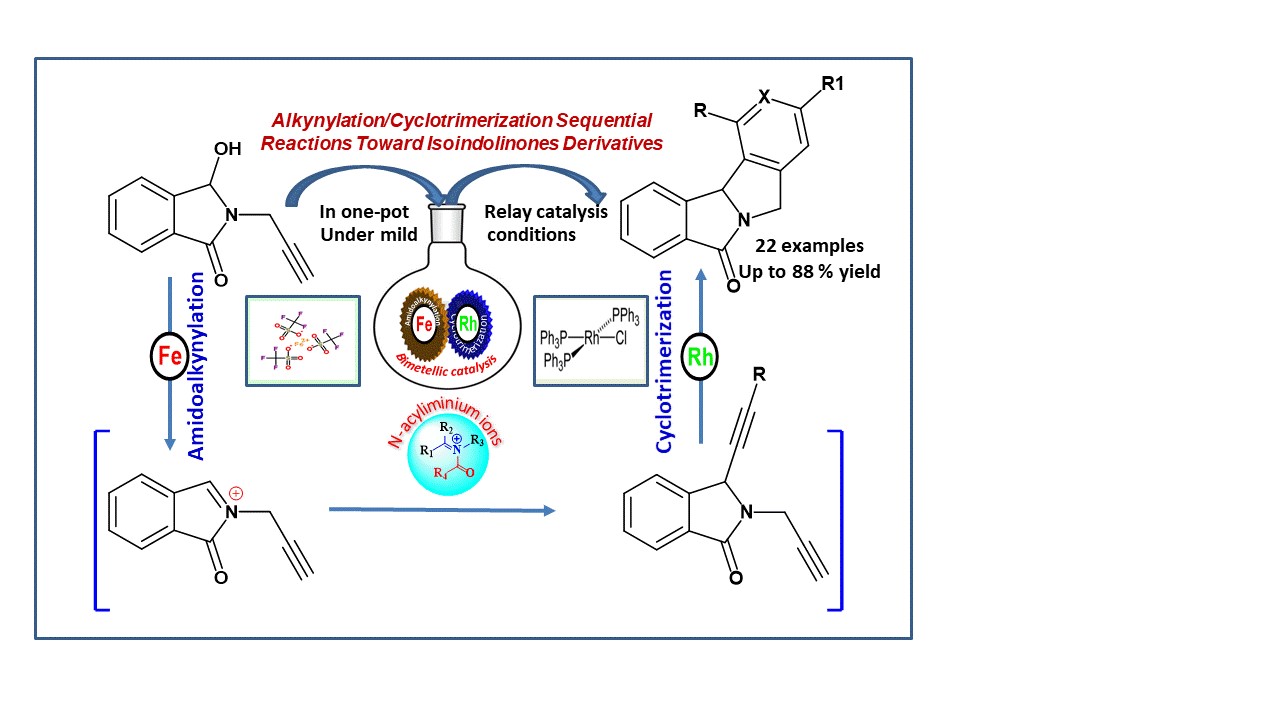
A novel sequential one-pot bimetallic catalytic system combining Fe(III)-catalyzed alkynylation and a Rh(I)-catalyzed [2+2+2] reaction was successfully developed. The σ-Lewis acid properties of iron (III) and the π-Lewis acid properties of rhodium (I) catalysts were unified in an unprece-dented intermolecular alkynylation/cyclotrimerization one-pot process. Using this unique Fe/Rh bimetallic relay catalytic system, a variety of benzo and pyrridinoisoindolinones derivatives were obtained under mild conditions from easily available N-(propargyl) hydroxy aminals, as the simplest N-acyliminium ion precursors, and several alkynes.
Keywords:
Isoindolinones
; alkynylation
; cyclotrimerization
; iron
; rhodium
; sequential tandem reactions
1. Introduction
The development of novel methodologies that enable rapid, practical, and economical construction of privileged small molecules in pharmaceutical sciences is highly desirable. In this context, sequential one-pot bimetallic catalysis is undoubtedly one of the most powerful strategies offering an efficient diversity-oriented, ecofriendly synthesis of these privileged scaffolds [1,2,3,4,5,6,7,8,9,10,11,12,13,14,15].
Isoindolinone frameworks, which are referred as phthalimidines or benzo fused γ-lactams, are common structural motifs in many synthetic and natural products that exhibit interesting biological activities. Many of these frameworks showed anxiolytic [16], MDM2-p53 inhibitory [17,18], antimicrobial [19,20,21,22], antiviral [23,24,25,26], PARP-1-inhibitory [27], histone deacetylase inhibitory [28,29], antihyperglycemic [30,31,32,33], antioxidant [34], anti-inflammatory [35], antifungal [36], antiparkinsonian [37], selective NaV1.7 blocking [38,39] antipsychotic [40,41,42], antihypertensive [43], anticancer [44,45,46], anesthetic [47], vasodilatory [48], and survival motor neuron protein production regulating activities (Figure 1) [49].
Owing to the wide spectrum of isoindolinone core biological activities, substantial efforts have been devoted to preparing this heterocyclic skeleton [50,51,52,53,54,55,56,57]. Among them are the functionalization of phthalimides or phthalimidines, transition-metal catalyzed C-C bond-forming reactions involving for example, C-H activation [58,59,60,61,62,63,64,65,66,67,68,69], cycloaddition [70,71], cross-coupling [72,73,74,75,76,77,78,79,80,81], carbonylation [82,83,84] strategies. Despite the development of a plethora of methods, the preparation of isoindolines [85,86,87,88,89,90,91,92,93,94] and pyrollopyrridine [95,96,97] fused isondolinones were not yet reported.
Recently, our group developed an unprecedented (ligand-free) iron (III) tandem intermolecular amidoalkynylation/intramolecular hydration sequence of several isoindolic cyclic N,O-acetals (acetoxylactams) allowing expedient access to new functionalized isoindolinone ketone motifs. Unprotected hydroxy N,O-acetals (hydroxylactams), a more atom-economic source of electrophile in comparison with the parent acetoxylactams, was used in these transformations (Scheme 1, eq. 1) [98].
Moreover, the transition-metal-catalyzed [2+2+2] cyclotrimerization reactions of alkynes constitute powerful methods for the synthesis of substituted six-membered aromatics in a one-step highly atom economic process [99,100,101,102,103,104,105,106,107,108,109]. Since Reppe’s pioneering cyclotrimerization of alkynes in 1948, a myriad of efficient catalytic species (e.g., Rh [110,111,112,113,114,115,116,117,118,119,120,121], Ru [122,123,124,125,126,127,128], Ir [129,130,131,132], Co [133,134,135,136,137], Ni [138,139,140,141,142,143], Mo [144,145], Nb [146], Au [147], Pd [148], Fe [149,150,151,152,153,154,155,156]) and coupling partners (e.g., olefins, nitriles, isocyanates, cyanamides, aldehydes, ketones, carbon dioxide, imines, and carbodiimides), were employed for this purpose.
Inspired by our results on iron (III) N,O-cyclic acetals alkynylation, the advances and elegance of transition-metal-catalyzed [2+2+2] cyclotrimerization reactions, and the biological and synthetic importance of isondolinone scaffolds, we became interested in developing a one-step synthetic route to prepare novel isoindolines and pyrollopyrridines fused isoindolinones through bimetallic Fe(III) alkynylation/Rh(I) [2+2+2] cycloaddition relay catalysis (Scheme 1, eq. 2).
2. Results
2.1. Cyclotrimerization of Dialkyne (Optimization Study)
Based on our previous work on iron-catalyzed alkynylation and before exploring the one-pot procedure, we decided to test the feasibility of the cyclotrimerization reaction. We performed a catalyst screening for the [2+2+2] cycloaddition reaction. Based on recent successes in constructing highly substituted benzenes and pyridines via an iron cyclotrimerization reaction, we first applied a similar approach to diynes 2a,b, and phenylacetylene 3a as a model substrate. Unfortunately, all efforts to obtain the isoindolinones 4 using Fe(OTf)3, FeI2, or Fe(OAc)2 as precatalysts along with various ligands in the presence of Zn metal as reducer were unsuccessful, and diynes 2a,b were invariably partially regenerated (Table 1, entries 1-3). To overcome these limitations, we decided to move from a monometallic iron-based catalyst to a bimetallic sequence, using a hard Lewis acid (FeIII) catalyst for alkynylation and Rh or Ru catalyst for the [2+2+2] cycloaddition step (Table 1, entries 4-11).
The results showed that 2b and RhCl(PPh3)3 were the best substrate and the most effective catalyst for this reaction, respectively (Table 1, entries 4-8). Further assessment of the solvent effect indicated that PhMe was the best solvent for this cyclotrimerization reaction, providing a higher yield than other commonly used solvents (entry 5 vs. 7-8). Grubbs catalysts resulted in inferior results. The use of Grubbs first generation (Grubbs-I) catalyst (Table 1, entry 10) under the Wilkinson conditions (3a (10 equiv.), PhMe reflux, argon) gave 4 in only 10% yield along with several side-products. Under Grubbs second generation (Grubbs-II) catalyst (Table 2, entry 11), the same profile of the reaction was observed (4: 15%; several side-products) even after a prolonged reaction time (24 h). These findings highlighted the advantage of using Rhodium (I) in the cyclotrimerization reaction.
Encouraged by these results, we moved forward to optimizing the reaction conditions (Table 2). Different temperatures, the addition rate of alkyne 3a, and reaction time were examined. It was found that the slow addition of alkyne 3a to the reaction media for 2 h followed by reflux in PhMe for 1 h afforded the expected isoindolinones 4a/4a’ (4a:4a’ = 60:40 in the highest yield (76%, entry 6).
The use of Grubbs instead of Wilkinson catalyst under the above-optimized conditions did not improve the yield; isoindolinones 4 were obtained in 20% and 30% isolated yields, respectively, with Grubbs first generation (Grubbs-I) and Grubbs second generation (Grubbs-II) (Table 2, entries 12 and 14). Switching the solvent from PhMe to other solvents such as THF or DCE resulted in inferior results. For example, RhCl(PPh3)3 in DCE produced 4a/4a’ in 52% yield (Table 2, entry 10).
With the establishment of the optimized conditions, the substrate scope was examined (Scheme 2). The [2+2+2] cyclotrimerization proved to be quite general; a broad range of terminal aromatic alkynes served as suitable substrates for this reaction, leading to the desired isoindolinones in moderate to excellent yields (Scheme 2, entries 1−8). The reactions of alkynes bearing an electron-donating group such as m- or p-methyl on aryl rings resulted in high yields of isoindolinones 4b/4b’ (69% yield, 4b:4b’ = 54:46) and 4c/4c’ (68% yield, 4c:4c’ = 60:40) (Scheme 2, entries 2 and 3). Substrates with an electron-withdrawing substituent on the aryl ring, such as p-NO2 and p-Br, proved to be also suitable, furnishing 4d/4d’and 4e/4e’ in 58% (4d:4d’ = 61:39) and 75% (4e:4e’ = 58:42) yields (Scheme 2, entries 4 and 5).
Interestingly, with the ortho-substituted alkynes 3f and 3g, the reaction proceeded with complete regioselectivity. Isoindolinones 4f and 4g were obtained in 59% and 83% isolated yields, respectively (Scheme 2, entries 6 and 7). Heteroaryl-substituted alkyne (e.g., 2-thienyl-substituted) was transformed to 4h/4h’ (4h:4h’ = 54:46) successfully in 71% yield (Scheme 2, entry 8). The reaction was also applicable to internal aromatic alkynes, as exemplified by the synthesis of 4i/4i’ isoindolinones derivatives in 43% (4i:4i’ = 63:37) isolated yield (Scheme 2, entry 9).
Encouraged by the results with aromatic alkynes, we examined the [2+2+2] cyclotrimerization reaction with aliphatic alkynes. A wide range of aliphatic alkynes were used for our cycloaddition. The results are summarized in Scheme 3.
The reaction with benzylacetylene 3j provided isoindolinones 4j/4j’ in 51% (4j:4j’ = 60:40) yield (Scheme 3, entry 1). Similarly, diyne 2b reacted with tert-butylacetylene 3k to produce 4k/4k’ (4k:4k’ = 73:27) in 40% yield (Scheme 3, entry 2). Activated aliphatic alkynes were also good substrates for the reaction; diyne 2b reacted smoothly with methyl propiolate 3l to provide 4l/4l’ (4l:4l’ = 55:45) in 54% yield (Scheme 3, entry 3). The reaction with dimethyl acetylenedicarboxylate (DMAD) 3m gave regioselectively isoindolinone 4m in 45% yield (Scheme 3, entry 5). An isoindole moiety was also introduced at the side chain of the benzene ring. When diyne 2b was reacted with N-propargyl phthalimide 3n, isoindolinones 4n/4n’ were obtained in an excellent yield of 88% (4n:4n’ = 60:40) (Scheme 3, entry 5).
Having established the conditions for the two distinct catalytic (Fe(III)-catalyzed alkynylation and Rh(I)-catalyzed cycloaddition) reactions, we tried combining both catalytic systems into a one-pot bimetallic tandem alkynylation/[2+2+2] cycloaddition sequences to save time, labor, and resources and to avoid yield losses associated with the purification of dialkynes 2.
When the one-pot/sequential procedure was carried out in DCE (hydroxylactam 1a (1 equiv.), propyne-TMS (1 equiv.), Fe(OTf)3 10 mol%, 4 h at reflux (TLC)) followed by a portion-wise addition of a solution of alkyne 3b (10 equiv.) and 10 mol% of RhCl(PPh3)3 in DCE (2 mL) for 2 h, isoindolinones 4a/4a’ were isolated after 1 h of reflux (TLC) in a 20% yield. Although the desired products were isolated in moderate yield after purification, this result validates our initial design plan. The choice of solvent was found to be critical. Switching from DCE to a mixture of solvents DCE/PhMe (2:1) gave the desired isoindolinones in a 27% yield. Increasing the ratio of PhMe to 50% (DCE:PhMe (1:1)) delivered 4a/4a’ in a 36% isolated yield (entry 11).
The replacement of DCE (removed under vacuum) after completion of the alkynylation step by PhMe, in the same above conditions (Fe(OTf)3 10 mol%, DCE (2 mL), 4 h under reflux (TLC), solvent removed in vacuo, a portion-wise addition of alkyne 2b solution (10 equiv.) and 10 mol% of RhCl(PPh3)3 in 2 mL of PhMe (for 2 h), under reflux 1 h) produced isoindolinones 4a/4a’ in a 60% yield (Scheme 4, entry 1).
Having established the optimal reaction conditions, we inspected the scope of the one-pot bimetallic sequence. As depicted in scheme 4, electron-neutral (3a, 3o, 3p), electron-rich (3q), and electron-withdrawing (3d) substituents on the phenyl ring of alkyne 3, such as p-methoxy or p-nitro, were well accommodated in this relay catalysis, delivering the isoindolinones 4 in moderate to high yields (51–70% yields, Scheme 4, entries 1-5). The ortho-bromo and ortho-methoxy-substituted alkynes 3f and 3g were also favorable for this one-pot bimetallic transformation, generating the corresponding products 4f and 4g in 51 and 73% yields, respectively and in total regioselectivity (Scheme 4, entries 6 and 7). Similarly, the reaction of 2b, with DMAD 3m afforded regioselectively the cyclotrimerization product 4m in a moderate yield of 35% (Scheme 4, entry 10).
Isoindolic substrates alkynes 3n and 3t, and their non-aromatic analog succinimide 3u were suitable substrates in producing isoindolinones 4n/4n’, 4t/4t’ and 4u/4u’ in good yields of 70%, 82%, and 72%, respectively (Scheme 4, entries 11-13). It is worth mentioning that all the regiochemical profiles obtained throughout this exemplification study are in good agreement with the preliminary experiments obtained during the cyclotrimerization reactions (Scheme 2 and Scheme 3), demonstrating the formation of mixtures of ortho and meta isoindolinones in varying ratios.
3. Mechanistic Study
The use of Fe(OTf)3 and the 1-TMS-propyne in the alkynylation reactions may generate TMSOTf and TMSOH (Scheme 5), highlighting the possibility that the in situ generated TMSOTf and TMSOH may catalyze or co-catalyze the [2+2+2] reaction [157,158,159]. The following control experiments were performed. When 10 mol% of TMSOH was used as the catalyst under the described conditions for 2b, no cyclotrimerization product was observed even after a prolonged reaction time (24 h). Only dialkyne 2b was partially regenerated along with several side-products resulting from the hydration of alkyne functions, thus ruling out the possibility of TMSOH catalysis.
The reaction of 2b with 3a catalyzed by 10 mol% of TMSOTf afforded 4a/4a’ in trace amounts (< 10%). However, the addition of 10 mol% of RhCl(PPh3)3 to the reaction mixture led to the formation of 4a/4a’ in 67% yield. These results suggested that the cyclotrimerization reaction proceeded through rhodium-catalysis. These observations were confirmed by experiments performed with TMSOTf + RhCl(PPh3)3. The treatment of 2b with 3d or 3g under a mixture of 10 mol% of (TMSOTf + RhCl(PPh3)3) provided isoindolinones 4d/4d’ and 4g in 55% and 81% isolated yields, respectively, and in shorter reaction times (4 h for 4d/4d’ and 2 h for 4g). Considering the cyclotrimerization reactions, the yields were not diminished (55% vs 58% (Scheme 2, entry 4) for 4d/4d’ and 81% vs 83% (Scheme 2, entry 7) for 4g), combined with the fact that the higher rates were observed (4 h vs 6 h for 4d/4d’ and 2 h versus 3 h for 4g), we believe that the reaction proceeded through rhodium-catalysis, although RhCl(PPh3)3/TMSOTf co-catalysis should not be excluded.
Encouraged by the efficiency and robustness of the current protocol in the construction of novel isoindolinone products and inspired by the fact that pyridines are privileged structures widely available in natural products, pharmaceuticals, and agrochemicals [160,161,162,163,164], we also evaluated the one-pot alkynylation/cyclotrimerization reaction in the construction of novel pyridines-fused isoindolinones [165,166,167,168,169,170,171,172,173,174,175,176,177,178,179,180,181,182,183,184]. A nitrile derivative 5a was subjected to our protocol under the standard reaction conditions (Scheme 6). The pyridine derivative 6a was obtained as a single regiosomer and isolated in an acceptable yield of 40%.
4. Conclusions
We took advantage of the different reactivities of iron and rhodium, and their compatibility to develop an efficient sequential one-pot bimetallic iron-rhodium alkynylation/cyclotrimerization sequential reactions to synthesize novel fused benzene and pyridine isoindolinone derivatives from trivial starting materials. The σ-Lewis acid properties of iron (III) were implemented to promote the alkynylation step, and then, in a one-pot procedure, rhodium (I) was used to ensure the [2+2+2] cycloaddition reaction. This method can be applied for the synthesis of chemical scaffolds with potential applications in the chemical and pharmaceutical industries.
5. Experimental Section
General Information. Unless otherwise specified, the starting reagents and deuterated solvent were purchased from commercial sources and used without further purification (Sigma-Aldrich, Fisher scientific, TCI). All solvents were dried and freshly distilled before use, taking precautions to exclude moisture by refluxing over CaH2. All reactions were performed under an argon-inert atmosphere. Thin layer chromatography (TLC) was performed on precoated sheets of silica gel 60 with fluorescent indicator UV254 (Merck). Detection was accomplished by exposure to a UV lamp and by heating after exposure to an ethanolic solution of p-anisaldehyde. Chromatographic separations were achieved on silica gel columns (Kieselgel 60, 40−63 μm, Merck) using a cyclohexane/ethyl acetate eluent system. Flash chromatography purifications were performed on Interchim Puriflash (Puriflash columns 50 μ) using a cyclohexane/ethyl acetate eluent system. In all cases, distilled solvents were used as eluents for column chromatography. NMR spectra were recorded on a Bruker AvanceTM 300 spectrometer. 1H NMR spectra were recorded at 300 MHz and data are reported as chemical shift (δ) in ppm, multiplicity (s = singlet, d = doublet, t = triplet, b = broad, m = multiplet), coupling constants J in Hz and integration. 13C NMR spectra were recorded at 75 MHz using broadband proton decoupling and the data were reported as chemical shift (δ) in ppm. High-resolution mass spectra (HRMS) were measured on Agilent 6530 Q-Tof MS system. The Q-TOF MS instrument was operated under the following conditions: Ion source ESI+ Agilent Jet Stream or APCI in positive ionization mode. FTIR spectra were recorded with a PerkinElmer Frontier.
Representative Procedure for the Rhodium(I)-Catalyzed Cyclotrimerization of Dialkynes: To a solution of alkynes 3a-w (2.3 mmol, 10 eq) and RhCl(PPh3)3 (0.023 mmol, 0.1 eq) in toluene (4 mL) we slowly add the substrate 2b (0.23 mmol, 1 equiv.), for 2 h, under argon. The reaction mixture was heated under reflux and monitored by TLC. After the total conversion of the starting material, the solvent was removed under reduced pressure. The crude product was then purified by flash chromatography on a silica gel column using a mixture of cyclohexane/AcOEt as the eluent or DCM/AcOEt to give the desired compounds 4.
Synthesis and characterization of compounds 4a/4a‘.
These products were obtained as a mixture of separable two regioisomers in 76% global yield, with a ratio of 4a:4a’: 60:40.
11-Methyl-9-phenyl-7,11b-dihydro-5H-isoindolo[1,2-a]isoindol-5-one (4a).
Major regioisomer-4a: This product was isolated as a white solid, Rf (cyclohexane/AcOEt: 9/1) = 0.24; m.p. = 174-176 °C; IR (νmax cm-1): 1687;1H NMR (300 MHz, CDCl3): δH 7.99-7.89 (m, 1H, Haro), 7.89 (d, J = 7.5 Hz, 1H, Haro), 7.63 (td, J = 7.6, 1.3 Hz, 1H, Haro), 7.56-7.49 (m, 3H, Haro), 7.46-7.34 (m, 3H, Haro), 7.33 (s, 1H, Haro), 7.30 (s, 1H, Haro), 6.14 (s, 1H, CH), 5.29 (d, J = 15.0 Hz, 1H, CH2), 4.52 (d, J = 15.0 Hz, 1H, CH2), 2.73 (s, 3H, CH3) ppm. 13C NMR (75 MHz, CDCl3): δC 174.1 (C=O), 145.2 (Cqaro), 142.7 (Cqaro), 142.1 (Cqaro), 140.6 (Cqaro), 135.9 (Cqaro), 133.8 (Cqaro), 133.7 (Cqaro), 132.2 (CHaro), 129.0 (2 x CHaro), 128.8 (CHaro), 128.8 (CHaro), 127.7 (CHaro), 127.3 (2 x CHaro), 125.2 (CHaro), 124.8 (CHaro), 119.7 (CHaro), 69.5 (CH), 49.5 (CH2), 21.8 (CH3) ppm. HRMS (+ESI) calculated for C22H17NO [M+H]+: 312.1383, found 312.1404.
11-Methyl-10-phenyl-7,11b-dihydro-5H-isoindolo[1,2-a]isoindol-5-one (4a’).
Minor regioisomer-4a’: This product was isolated as a white solid, Rf (cyclohexane/AcOEt: 9/1) = 0.23; m.p. = 173-175 °C; IR (νmax cm-1): 1687; 1H NMR (300 MHz, CDCl3): δH 7.97-7.93 (m, 1H, Haro), 7.90 (d, J = 7.3 Hz, 1H, Haro), 7.61 (td, J = 7.5, 1.3 Hz, 1H, Haro), 7.51 (t, J = 7.4 Hz, 1H, Haro), 7.42-7.35 (m, 3H, Haro), 7.28 (d, J = 1.8 Hz, 2H, Haro), 7.19 (d, J = 4.3 Hz, 2H, Haro), 6.17 (s, 1H), 5.29 (d, J = 15.0 Hz, 1H, CH2), 4.51 (d, J = 14.9 Hz, 1H, CH2), 2.57 (s, 3H, CH3) ppm. 13C NMR (75 MHz, CDCl3): δC 174.1 (C=O), 145.5 (Cqaro), 142.3 (Cqaro), 141.3 (Cqaro), 140.9 (Cqaro), 138.0 (Cqaro), 133.8 (Cqaro), 132.2 (CHaro), 131.3 (Cqaro), 130.5 (CHaro), 129.5 (2 x CHaro), 128.8 (CHaro), 128.3 (2 x CHaro), 127.2 (CHaro), 125.4 (CHaro), 124.7 (CHaro), 120.8 (CHaro), 70.0 (CH), 49.5 (CH2), 20.2 (CH3) ppm. HRMS (+ESI) calculated for C22H17NO [M+H]+: 312.1383, found 312.1404.
Synthesis and characterization of compounds 4b/4b‘.
This product was obtained as a mixture of inseparable two regioisomers and was isolated as a yellow oil in 69% global yield, with a ratio of 4b/4b’: 54/46, Rf (cyclohexane/AcOEt: 7/3) = 0.22; IR (νmax cm-1): 1705.
11-Methyl-9-(m-tolyl)-7,11b-dihydro-5H-isoindolo[1,2-a]isoindol-5-one (4b).
Major regioisomer-4b: The NMR characteristics of this product were extracted from the spectrum of the mixture; 1H NMR (300 MHz, CDCl3): δH 7.93 (d, J = 5.5 Hz, 1H, Haro), 7.88 (d, J = 3.8 Hz, 1H, Haro), 7.54-7.47 (m, 2H, Haro), 7.37-7.27 (m, 6H, Haro), 6.16 (s, 1H, CH), 5.29 (d, J = 14.9 Hz, 1H, CH2), 4.51 (d, J = 14.9 Hz, 1H, CH2), 2.58 (s, 3H, CH3), 2.40 (s, 3H, CH3) ppm. 13C NMR (75 MHz, CDCl3): δC 174.0 (C=O), 145.4 (Cqaro), 142.3 (Cqaro), 141.1 (Cqaro), 140.4 (Cqaro), 137.8 (Cqaro), 135.6 (Cqaro), 133.5 (Cqaro), 132.0 (CHaro), 131.2 (Cqaro), 130.3 (CHaro), 128.7 (CHaro), 128.6 (CHaro), 128.1 (CHaro), 127.8 (CHaro), 126.5 (CHaro), 125.1 (CHaro), 124.3 (CHaro), 120.6 (CHaro), 69.9 (CH), 49.3 (CH2), 21.6 (CH3), 21.5 (CH3) ppm. HRMS (+ESI) calculated for C23H19NO [M+H]+: 326.1539, found 326.1560.
11-Methyl-10-(m-tolyl)-7,11b-dihydro-5H-isoindolo[1,2-a]isoindol-5-one (4b’).
Minor regioisomer-4b’: The NMR characteristics of this product were extracted from the spectrum of the mixture; 1H NMR (300 MHz, CDCl3): δH 7.96 (d, J = 5.3 Hz, 1H, Haro), 7.91 (d, J = 3.7 Hz, 1H, Haro), 7.66-7.58 (m, 2H, Haro), 7.22-7.14 (m, 4H, Haro), 7.10-7.05 (m, 2H, Haro), 6.13 (s, 1H, CH), 5.29 (d, J = 14.9 Hz, 1H, CH2), 4.51 (d, J = 14.9 Hz, 1H, CH2), 2.72 (s, 3H, CH3), 2.42 (s, 3H, CH3) ppm. 13C NMR (75 MHz, CDCl3): δC 74.0 (C=O), 145.1 (Cqaro), 142.5 (Cqaro), 142.1 (Cqaro), 140.6 (Cqaro), 138.4 (Cqaro), 137.8 (Cqaro), 133.6 (Cqaro), 133.6 (Cqaro), 132.0 (CHaro), 130.1 (CHaro), 128.7 (2 x CHaro), 128.3 (CHaro), 127.9 (CHaro), 125.3 (CHaro), 124.6 (CHaro), 124.6 (CHaro), 119.6 (CHaro) 69.4 (CH), 49.3 (CH2), 21.7 (CH3), 20.1 (CH3) ppm. HRMS (+ESI) calculated for C23H19NO [M+H]+: 326.1539, found 326.1560.
Synthesis and characterization of compounds 4c/4c‘.
These products were obtained as a mixture of inseparable two regioisomers and were isolated as a yellow oil in 68% global yield, with a ratio of 4c/4c’: 60/40, Rf (cyclohexane/AcOEt: 8/2) = 0.23; IR (νmax cm-1): 1697.
11-Methyl-9-(p-tolyl)-7,11b-dihydro-5H-isoindolo[1,2-a]isoindol-5-one (4c).
Major regioisomer-4c: The NMR characteristics of this product were extracted from the spectrum of the mixture; 1H NMR (300 MHz, CDCl3): δH 7.98-7.86 (m, 2H, Haro), 7.62 (t, J = 7.5 Hz, 1H, Haro), 7.53-7.42 (m, 2H, Haro), 7.32 (s, 1H, Haro), 7.29 (s, 1H, Haro), 7.26-7.13 (m, 3H, Haro), 6.13 (s, 1H, CH), 5.28 (d, J = 14.9 Hz, 1H, CH2), 4.51 (d, J = 15.0 Hz, 1H, CH2), 2.72 (s, 3H, CH3), 2.39 (s, 3H, CH3) ppm. 13C NMR (75 MHz, CDCl3): δC 174.1(C=O), 145.2 (Cqaro), 142.6 (Cqaro), 142.0 (Cqaro), 137.7 (Cqaro), 137.5 (Cqaro), 135.6 (Cqaro), 133.7 (Cqaro), 133.7 (Cqaro), 132.1 (CHaro), 129.7 (2 x CHaro), 128.8 (CHaro), 128.5 (CHaro), 127.1 (2 x CHaro), 125.2 (CHaro), 124.7 (CHaro), 119.5 (CHaro), 69.5 (CH), 49.5 (CH2), 21.8 (CH3), 21.2 (CH3) ppm. HRMS (+ESI) calculated for C23H19NO [M+H]+: 326.1539, found 326.1565.
11-Methyl-10-(p-tolyl)-7,11b-dihydro-5H-isoindolo[1,2-a]isoindol-5-one (4c’).
Minor regioisomer-4c’e: The NMR characteristics of this product were extracted from the spectrum of the mixture; 1H NMR (300 MHz, CDCl3): δH 7.95 (d, J = 7.7 Hz, 1H, Haro), 7.90 (d, J = 7.5 Hz, 1H, Haro), 7.61 (t, J = 7.5 Hz, 1H, Haro), 7.50 (t, J = 7.5 Hz, 1H, Haro), 7.25-7.14 (m, 6H, Haro), 6.16 (s, 1H, CH), 5.28 (d, J = 14.5 Hz, 1H, CH2), 4.51 (d, J = 15.0 Hz, 1H, CH2), 2.58 (s, 3H, CH3), 2.41 (s, 3H, CH3) ppm. 13C NMR (75 MHz, CDCl3): δC 174.1 (C=O), 145.6 (Cqaro), 142.2 (Cqaro), 140.7 (Cqaro), 138.3 (Cqaro), 138.0 (Cqaro), 136.9 (Cqaro), 133.8 (Cqaro), 132.2 (CHaro), 131.3 (Cqaro), 130.5 (CHaro), 129.4 (2 x CHaro), 129.0 (2 x CHaro), 128.8 (CHaro), 125.4 (CHaro), 124.7 (CHaro), 120.7 (CHaro), 70.0 (CH), 49.5 (CH2), 21.3 (CH3), 20.2 (CH3) ppm. HRMS (+ESI) calculated for C23H19NO [M+H]+: 326.1539, found 326.1565.
Synthesis and characterization of compounds 4d/4d‘.
These products were obtained as a mixture of inseparable two regioisomers and were isolated as a yellow oil in 58% global yield, with a ratio of 4d/4d’: 61/39, Rf (cyclohexane/AcOEt: 7/3) = 0.34; IR (νmax cm-1): 1690, 1511, 1339.
11-Methyl-9-(4-nitrophenyl)-7,11b-dihydro-5H-isoindolo[1,2-a]isoindol-5-one (4d).
Major regioisomer-4d: The NMR characteristics of this product were extracted from the spectrum of the mixture; 1H NMR (300 MHz, CDCl3): δH 8.30-8.24 (m, 2H, Haro), 7.96-7.86 (m, 2H, Haro), 7.71-7.60 (m, 2H, Haro), 7.54-7.43 (m, 2H, Haro), 7.36 (s, 1H, Haro), 7.33 (s, 1H, Haro), 6.17 (s, 1H, CH), 5.30 (d, J = 15.2, 2.6 Hz, 1H, CH2), 4.51 (d, J = 15.3, 2.1 Hz, 1H, CH2), 2.57 (s, 3H, CH3) ppm. 13C NMR (75 MHz, CDCl3): δC 174.1 (C=O), 148.2 (Cqaro), 147.1 (Cqaro), 145.1 (Cqaro), 142.2 (Cqaro), 139.9 (Cqaro), 138.5 (Cqaro), 133.6 (Cqaro), 132.3 (CHaro), 131.1 (Cqaro), 130.4 (CHaro), 130.1 (CHaro), 128.9 (CHaro), 128.0 (CHaro), 125.3 (CHaro), 124.8 (CHaro), 124.2 (CHaro), 123.6 (CHaro), 121.2 (CHaro), 69.8 (CH), 49.4 (CH2), 20.1 (CH3) ppm. HRMS (+ESI) calculated for C22H16N2O3 [M+H]+: 357.1234, found 357.1254.
11-Methyl-10-(4-nitrophenyl)-7,11b-dihydro-5H-isoindolo[1,2-a]isoindol-5-one (4d’).
Minor regioisomer-4d’: The NMR characteristics of this product were extracted from the spectrum of the mixture; 1H NMR (300 MHz, CDCl3): δH 8.30-8.24 (m, 2H, CHaro), 7.96-7.86 (m, 2H, CHaro), 7.71-7.60 (m, 2H, CHaro), 7.54-7.43 (m, 2H, CHaro), 7.24-7.16 (m, 2H, CHaro), 6.14 (s, 1H, CH), 5.30 (d, J = 15.2, 2.6 Hz, 1H, CH2), 4.51 (d, J = 15.3, 2.1 Hz, 1H, CH2), 2.75 (s, 1H, CH3) ppm. 13C NMR (75 MHz, CDCl3): δC 174.0 (C=O), 147.3 (Cqaro), 147.0 (Cqaro), 144.8 (Cqaro), 143.2 (Cqaro), 139.5 (Cqaro), 137.7 (Cqaro), 134.4 (Cqaro), 133.5 (Cqaro), 132.3 (CHaro), 130.4 (2 x CHaro), 128.9 (2 x CHaro), 125.2 (CHaro), 124.8 (CHaro), 123.6 (2 x CHaro), 119.9 (CHaro), 69.4 (CH), 49.3 (CH2), 21.8 (CH3) ppm. HRMS (+ESI) calculated for C22H16N2O3 [M+H]+: 357.1234, found 357.1254.
Synthesis and characterization of compounds 4e/4e‘.
This product was obtained as a mixture of inseparable two regioisomers and was isolated as a yellow oil, in 75% global yield, with a ratio of 4e/4e’: 58/42, Rf (cyclohexane/AcOEt: 7/3) = 0.26; IR (νmax cm-1): 1688.
9-(4-Bromophenyl)-11-methyl-7,11b-dihydro-5H-isoindolo[1,2-a]isoindol-5-one (4e):
Major regioisomer-4e: The NMR characteristics of this product were extracted from the spectrum of the mixture; 1H NMR (300 MHz, CDCl3): δH 8.04 (d, J = 7.9 Hz, 1H, Haro), 8.00 (d, J = 7.7 Hz, 1H, Haro), 7.71 (t, J = 7.6 and1.4 Hz, 1H, Haro), 7.66-7.58 (m, 3H, Haro), 7.36 (s, 2H, Haro), 7.23 (d, J = 1.9 Hz, 2H, Haro), 6.26 (s, 1H, CH), 5.38 (d, J = 15.1 Hz, 1H, CH2), 4.60 (d, J = 15.1 and 1.6 Hz, 1H, CH2), 2.65 (s, 3H, CH3) ppm. 13C NMR (75 MHz, CDCl3): δC 174.1 (C=O), 145.4 (Cqaro), 141.3 (2 x Cqaro), 141.0 (Cqaro), 140.2 (Cqaro), 138.2 (Cqaro), 133.7 (Cqaro), 132.2 (CHaro), 131.5 (2 x CHaro), 131.2 (2 x CHaro), 130.3 (CHaro), 128.9 (CHaro), 125.3 (CHaro), 124.8 (CHaro), 121.5 (Cqaro), 120.9 (CHaro), 69.9 (CH), 49.4 (CH2), 20.1 (CH3) ppm. HRMS (+ESI) calculated for C22H16BrNO [M+H]+: 390.0488, found 390.0508.
10-(4-Methoxyphenyl)-11-methyl-7,11b-dihydro-5H-isoindolo[1,2-a]isoindol-5-one (4e’).
Minor regioisomer-4e’: The NMR characteristics of this product were extracted from the spectrum of the mixture; 1H NMR (300 MHz, CDCl3): δH 8.06-7.96 (m, 2H, Haro), 7.75-7.68 (m, 1H, Haro), 7.67 -7.57 (m, 2H, Haro), 7.50 (d, J = 8.5 Hz, 2H, Haro), 7.40-7.32 (m, 3H, Haro), 6.22 (s, 1H, CH), 5.38 (d, J = 15.1 Hz, 1H, CH2), 4.60 (d, J = 15.1 Hz, 1H, CH2), 2.82 (s, 3H, CH3) ppm. 13C NMR (75 MHz, CDCl3): δC 174.1 (C=O), 145.1 (Cqaro), 142.9 (Cqaro), 140.8 (Cqaro), 139.5 (Cqaro), 136.3 (Cqaro), 134.1 (Cqaro), 133.6 (Cqaro), 132.2 (CHaro), 132.1 (2 x CHaro), 128.9 (2 x CHaro), 128.5 (CHaro), 125.2 (CHaro), 124.8 (CHaro), 122.0 (Cqaro), 120.9 (CHaro), 119.5 (CHaro), 69.5 (CH), 49.4 (CH2), 21.8 (CH3) ppm. HRMS (+ESI) calculated for C22H16BrNO [M+H]+: 390.0488, found 390.0508.
Synthesis and characterization of compound 4f.
10-(2-Bromophenyl)-11-methyl-7,11b-dihydro-5H-isoindolo[1,2-a]isoindol-5-one (4f).
This product was obtained as a single regioisomer in 59% yield.
This compound was isolated as a yellow oil, Rf (cyclohexane/AcOEt: 7/3) = 0.24; IR (νmax cm-1): 1696; 1H NMR (300 MHz, CDCl3): δH 7.95 (d, J = 7.7 Hz, 1H, Haro), 7.90 (d, J = 8.4 Hz, 1H, Haro), 7.68-7.60 (m, 2H, Haro), 7.51 (t, J = 7.4 Hz, 1H, Haro), 7.34 (td, J = 7.5, 1.3 Hz, 1H, Haro), 7.23 (dd, J = 3.8, 1.9 Hz, 1H, Haro), 7.21-7.15 (m, 2H, Haro), 7.12 (s, 1H, Haro), 6.15 (s, 1H, CH), 5.28 (d, J = 15.0 Hz, 1H, CH2), 4.52 (d, J = 15.0 Hz, 1H, CH2), 2.72 (s, 3H, CH3) ppm. 13C NMR (75 MHz, CDCl3): δC 174.1 (C=O), 145.1 (Cqaro), 141.9 (Cqaro), 141.9 (Cqaro), 141.7 (Cqaro), 136.2 (Cqaro), 133.7 (Cqaro), 133.3 (CHaro), 133.2 (Cqaro), 132.2 (CHaro), 131.3 (CHaro), 130.8 (CHaro), 129.1 (CHaro), 128.8 (CHaro), 127.6 (CHaro), 125.2 (CHaro), 124.8 (CHaro), 122.6 (Cqaro), 122.0 (CHaro), 69.6 (CH), 49.4 (CH2), 21.8 (CH3) ppm. HRMS (+ESI) calculated for C22H16BrNO [M+H]+: 390.0488, found 390.0482.
Synthesis and characterization of compound 4g.
10-(2-Methoxyphenyl)-11-methyl-7,11b-dihydro-5H-isoindolo[1,2-a]isoindol-5-one (4g).
This product was obtained as a single regioisomer in 83% yield.
This compound was isolated as a yellow oil, Rf (cyclohexane/AcOEt: 7/3) = 0.23; IR (νmax cm-1): 1696;1H NMR (300 MHz, CDCl3): δH 7.93 (d, J = 7.8 Hz, 1H, Haro), 7.88 (d, J = 7.5 Hz, 1H, Haro), 7.62 (t, J = 7.5 Hz, 1H, Haro), 7.49 (t, J = 7.4 Hz, 1H, Haro), 7.38-7.28 (m, 2H, Haro), 7.24-7.15 (m, 2H, Haro), 7.08-6.91 (m, 2H, Haro), 6.13 (s, 1H, CH), 5.27 (d, J = 14.9 Hz, 1H, CH2), 4.51 (d, J = 14.8 Hz, 1H, CH2), 3.80 (s, 3H, O-CH3), 2.70 (s, 3H, CH3) ppm. 13C NMR (75 MHz, CDCl3): δC 174.1 (C=O), 156.5 (Cqaro), 145.3 (Cqaro), 141.8 (Cqaro), 139.2 (Cqaro), 135.5 (Cqaro), 133.7 (Cqaro), 133.1 (Cqaro), 132.1 (CHaro), 130.9 (CHaro), 130.9 (CHaro), 130.0 (Cqaro), 129.0 (CHaro), 128.7 (CHaro), 125.2 (CHaro), 124.7 (CHaro), 122.2 (CHaro), 121.0 (CHaro), 111.2 (CHaro), 69.6 (CH), 55.7 (O-CH3), 49.5 (CH2), 21.8 (CH3) ppm. HRMS (+ESI) calculated for C23H19NO2 [M+H]+: 342.1489, found 342.1513.
Synthesis and characterization of compounds 4h/4h‘.
This product was obtained as a mixture of separable two regioisomers in 71% global yield, with a ratio of 4h/4h’: 57/43.
11-Methyl-9-(thiophen-2-yl)-7,11b-dihydro-5H-isoindolo[1,2-a]isoindol-5-one (4h).
Major regioisomer-4h: This compound was isolated as a yellow oil, Rf (cyclohexane/AcOEt: 8/2) = 0.25; IR (νmax cm-1): 1687;1H NMR (300 MHz, CDCl3): δH 7.91 (d, J = 8.9 Hz, 1H, Haro), 7.88 (d, J = 7.2 Hz, 1H, Haro), 7.62 (t, J = 7.4 Hz, 1H, Haro), 7.49 (t, J = 7.4 Hz, 1H, Haro), 7.35 (s, 1H, Haro), 7.32 (s, 1H, Haro), 7.29-7.27 (m, 2H, Haro), 7.08-7.06 (m, 1H, Haro), 6.10 (s, 1H, CH), 5.26 (d, J = 15.0 Hz, 1H, CH2), 4.48 (d, J = 14.9 Hz, 1H, CH2), 2.69 (s, 3H, CH3) ppm. 13C NMR (75 MHz, CDCl3): δC 174.0 (C=O), 145.1 (Cqaro), 143.6 (Cqaro), 142.8 (Cqaro), 136.1 (Cqaro), 135.0 (Cqaro), 134.0 (Cqaro), 133.6 (Cqaro), 132.2 (CHaro), 128.8 (CHaro), 128.2 (CHaro), 127.5 (CHaro), 125.3 (CHaro), 125.2 (CHaro), 124.8 (CHaro), 123.6 (CHaro), 118.4 (CHaro), 69.5 (CH), 49.4 (CH2), 21.7 (CH3) ppm. HRMS (+ESI) calculated for C20H15NOS [M+H]+: 318.0947, found 318.0977.
11-Methyl-10-(thiophen-2-yl)-7,11b-dihydro-5H-isoindolo[1,2-a]isoindol-5-one (4h’).
Minor regioisomer-4h’: This compound was isolated as a yellow oil, Rf (cyclohexane/AcOEt: 8/2) = 0.21; IR (νmax cm-1): 1687;1H NMR (300 MHz, CDCl3): δH 7.96 (d, J = 8.7 Hz, 1H, Haro), 7.90 (d, J = 7.2 Hz, 1H, Haro), 7.62 (td, J = 7.5, 1.3 Hz, 1H, Haro), 7.51 (t, J = 7.4 Hz, 1H, Haro), 7.37-7.31 (m, 2H, Haro), 7.14 (d, J = 7.8 Hz, 1H, Haro), 7.09 (dd, J = 5.1, 3.5 Hz, 1H, Haro), 6.99 (dd, J = 3.5, 1.2 Hz, 1H, Haro), 6.16 (s, 1H, CH), 5.27 (d, J = 15.2 Hz, 1H, CH2), 4.50 (d, J = 15.1 Hz, 1H, CH2), 2.71 (s, 3H, CH3) ppm. 13C NMR (75 MHz, CDCl3): δC 174.2 (C=O), 145.5 (Cqaro), 142.3 (Cqaro), 141.5 (Cqaro), 138.4 (Cqaro), 134.5 (Cqaro), 133.7 (Cqaro), 132.3 (Cqaro), 132.3 (CHaro), 131.3 (CHaro), 128.9 (CHaro), 127.3 (CHaro), 127.1 (CHaro), 125.7 (CHaro), 125.3 (CHaro), 124.7 (CHaro), 120.8 (CHaro), 69.9 (CH), 49.5 (CH2), 20.4 (CH3) ppm. HRMS (+ESI) calculated for C20H15NOS [M+H]+: 318.0947, found 318.0977.
Synthesis and characterization of compounds 4i/4i‘.
This product was obtained as a mixture of separable two regioisomers in 43% global yield, with a ratio of 4i/4i’: 63/37.
10-Acetyl-11-methyl-9-phenyl-7,11b-dihydro-5H-isoindolo[1,2-a]isoindol-5-one (4i).
Major regioisomer-4i: This product was isolated as a white solid, Rf (cyclohexane/AcOEt: 7/3) = 0.19; m.p. = 198-200 °C; IR (νmax cm-1): 1691;1H NMR (300 MHz, CDCl3): δH 7.97-7.86 (m, 2H, Haro), 7.68-7.56 (m, 1H, Haro), 7.52 (t, J = 7.5 Hz, 1H, Haro), 7.48-7.36 (m, 3H, Haro), 7.31 (s, 1H, Haro), 7.25-7.18 (m, 1H, Haro), 7.17-7.08 (m, 1H, Haro), 6.17 (s, 1H, CH), 5.31 (d, J = 15.2 Hz, 1H, CH2), 4.51 (d, J = 15.1 Hz, 1H, CH2), 2.48 (s, 3H, CH3), 1.79 (s, 3H, CH3) ppm. 13C NMR (75 MHz, CDCl3): δC 204.5 (C=O), 174.1 (C=O), 145.1 (Cqaro), 142.7 (Cqaro), 141.0 (Cqaro), 140.3 (Cqaro), 139.6 (Cqaro), 138.9 (Cqaro), 133.6 (Cqaro), 132.5 (Cqaro), 132.4 (CHaro), 130.1 (CHaro), 129.9 (CHaro), 129.0 (CHaro), 129.0 (CHaro), 128.5 (CHaro), 128.2 (CHaro), 125.2 (CHaro), 124.9 (CHaro), 119.9 (CHaro), 69.8 (CH), 49.4 (CH2), 30.4 (CH3), 20.1 (CH3) ppm. HRMS (+ESI) calculated for C24H19NO2 [M+H]+: 354.1489, found 354.1515.
9-Acetyl-11-methyl-10-phenyl-7,11b-dihydro-5H-isoindolo[1,2-a]isoindol-5-one (4i’).
Minor regioisomer-4i’: This product was isolated as a white solid, Rf (cyclohexane/AcOEt: 7/3) = 0.23; m.p. = 197-199 °C; IR (νmax cm-1): 1691; 1H NMR (300 MHz, CDCl3): δH 7.94 (d, J = 7.9 Hz, 1H, Haro), 7.89 (d, J = 7.7 Hz, 1H, Haro), 7.63 (t, 1H, Haro), 7.52 (t, J = 7.4 Hz, 1H, Haro), 7.43-7.34 (m, 3H, Haro), 7.30 (m, J = 2.8 Hz, 2H, , Haro), 7.15 (s, 1H, Haro), 6.17 (s, 1H, CH), 5.30 (d, J = 15.3 Hz, 1H, CH2), 4.51 (d, J = 15.2 Hz, 1H, CH2), 2.63 (s, 3H, CH3), 1.92 (s, 3H, CH3) ppm.13C NMR (75 MHz, CDCl3): δC 207.5 (C=O), 174.2 (C=O), 145.1 (Cqaro), 142.5 (Cqaro), 141.7 (Cqaro), 139.8 (Cqaro), 139.5 (Cqaro), 137.2 (Cqaro), 133.5 (Cqaro), 132.4 (CHaro), 129.6 (Cqaro), 129.0 (CHaro), 129.0 (2 x CHaro), 128.9 (2 x CHaro), 128.2 (CHaro), 125.3 (CHaro), 124.8 (CHaro), 122.5 (CHaro), 69.6 (CH), 49.5 (CH2), 32.5 (CH3), 19.0 (CH3) ppm. HRMS (+ESI) calculated for C24H19NO2 [M+H]+: 354.1489, found 354.1515.
Synthesis and characterization of compounds 4j/4j‘.
These products were obtained as a mixture of inseparable two regioisomers and were isolated as a yellow oil in 51% global yield, with a ratio of 4j/4j’: 60/40, Rf (cyclohexane/AcOEt: 8/2) = 0.22; IR (νmax cm-1): 1691.
9-Benzyl-11-methyl-7,11b-dihydro-5H-isoindolo[1,2-a]isoindol-5-one (4j).
Major regioisomer-4j: The NMR characteristics of this product were extracted from the spectrum of the mixture; 1H NMR (300 MHz, CDCl3): δH 7.94-7.84 (m, 2H, Haro), 7.64-7.54 (m, 1H, Haro), 7.47 (t, J = 7.5 Hz, 1H, Haro), 7.32-7.26 (m, 2H, Haro), 7.23-7.15 (m, 3H, Haro), 6.95 (s, 1H, Haro), 6.92 (s, 1H, Haro), 6.05 (s, 1H, CH), 5.32-5.12 (m, 1H, CH2), 4.44 (t, J = 14.8 Hz, 1H, CH2), 3.93 (s, 2H, CH2), 2.62 (s, 3H, CH3) ppm. 13C NMR (75 MHz, CDCl3): δC 174.0 (C=O), 145.3 (Cqaro), 142.3 (Cqaro), 140.8 (Cqaro), 138.7 (Cqaro), 134.6 (Cqaro), 133.6 (Cqaro), 133.4 (Cqaro), 132.0 (CHaro), 130.3 (CHaro), 128.9 (3 x CHaro), 128.6 (CHaro), 128.6 (CHaro), 126.3 (CHaro), 125.1 (CHaro), 124.6 (CHaro), 121.4 (CHaro), 69.4 (CH), 49.3 (CH2), 41.6 (CH2), 21.6 (CH3) ppm. HRMS (+ESI) calculated for C23H19NO [M+H]+: 326.1539, found 326.1562.
Synthesis and characterization of compounds 4k/4k‘.
These products were obtained as a mixture of inseparable two regioisomers and were isolated as a yellow oil in 40% global yield, with a ratio of 4k /4k’: 73/27, Rf (cyclohexane/AcOEt: 7/3) = 0.42; IR (νmax cm-1): 1688.
9-(tert-Butyl)-11-methyl-7,11b-dihydro-5H-isoindolo[1,2-a]isoindol-5-one (4k).
Major regioisomer-4k: The NMR characteristics of this product were extracted from the spectrum of the mixture; 1H NMR (300 MHz, CDCl3): δH 7.93-7.83 (m, 2H, CHaro), 7.60 (t, J = 7.5 Hz, 1H, CHaro), 7.51-7.43 (m, 1H, CHaro), 7.14 (s, 1H, CHaro), 7.10 (s, 1H, CHaro), 6.06 (s, 1H, CH), 5.22 (d, J = 14.9 Hz, 1H, CH2), 4.44 (dd, J = 14.8, 7.8 Hz, 1H, CH2), 2.66 (s, 3H, CH3), 1.30 (s, 9H, 3 x CH3) ppm. 13C NMR (75 MHz, CDCl3): δC 174.1 (C=O), 152.2 (Cqaro), 145.4 (Cqaro), 142.0 (Cqaro), 134.0 (Cqaro), 133.7 (Cqaro), 132.9 (Cqaro), 132.0 (CHaro), 128.6 (CHaro), 126.8 (CHaro), 125.1 (CHaro), 124.6 (CHaro), 117.9 (CHaro), 69.5 (CH), 49.6 (CH2), 34.7 (Cq), 31.5 (3 x CH3), 21.9 (CH3) ppm. HRMS (+ESI) calculated for C20H21NO [M+H]+: 292.1696, found 292.1714.
10-(tert-Butyl)-11-methyl-7,11b-dihydro-5H-isoindolo[1,2-a]isoindol-5-one (4k’).
Minor regioisomer-4k’: The NMR characteristics of this product were extracted from the spectrum of the mixture; 1H NMR (300 MHz, CDCl3): δH 7.98 (d, J = 7.9 Hz, 1H, Haro), 7.93-7.83 (m, 1H, Haro), 7.60 (t, J = 7.5 Hz, 1H, Haro), 7.51-7.43 (m, 1H, Haro), 7.36 (d, J = 8.1 Hz, 1H, Haro), 7.05 (d, J = 8.1 Hz, 1H, Haro), 6.16 (s, 1H, CH), 5.22 (d, J = 14.9 Hz, 1H, CH2), 4.44 (dd, J = 14.8, 7.8 Hz, 1H, CH2), 2.87 (s, 3H, CH3), 1.42 (s, 9H, 3 x CH3) ppm. 13C NMR (75 MHz, CDCl3): δC 174.0 (C=O), 147.7 (Cqaro), 145.7 (Cqaro), 139.5 (Cqaro), 139.3 (Cqaro), 133.9 (Cqaro), 132.7 (Cqaro), 132.0 (CHaro), 128.7 (CHaro), 126.8 (CHaro), 125.7 (CHaro), 124.6 (CHaro), 120.5 (CHaro), 70.4 (CH), 49.2 (CH2), 36.0 (Cq), 31.4 (3 x CH3), 22.3 (CH3) ppm. HRMS (+ESI) calculated for C20H21NO [M+H]+: 292.1696, found 292.1714.
Synthesis and characterization of compounds 4l/4l‘.
These products were obtained as a mixture of separable two regioisomers in 54% global yield, with a ratio of 4l/4l’: 55/45.
Methyl 1-methyl-7-oxo-7, 11b-dihydro-5H-isoindolo [1,2-a]isoindole-3-carboxylate (4l).
Major regioisomer-4l: This compound was isolated as a yellow oil, Rf (cyclohexane/AcOEt: 8/2) = 0.14; IR (νmax cm-1): 1703 (2 x C=O);1H NMR (300 MHz, CDCl3): δH 7.92 (d, J = 7.9 Hz, 1H, Haro), 7.88 (d, J = 7.7 Hz, 1H, Haro), 7.78 (s, 2H, Haro), 7.63 (td, J = 7.6, 1.3 Hz, 1H, Haro), 7.54-7.47 (m, 1H, Haro), 6.11 (s, 1H, CH), 5.26 (d, J = 15.2 Hz, 1H, CH2), 4.47 (d, J = 15.2 Hz, 1H, CH2), 3.90 (s, 3H , CH3), 2.71 (s, 3H, CH3) ppm. 13C NMR (75 MHz, CDCl3): δC 173.9 (C=O), 166.7 (C=O), 144.4 (Cqaro), 142.4 (Cqaro), 141.7 (Cqaro), 133.8 (Cqaro), 133.6 (Cqaro), 132.3 (CHaro), 131.1 (CHaro), 130.7 (Cqaro), 129.0 (CHaro), 125.3 (CHaro), 124.8 (CHaro), 122.2 (CHaro), 69.6 (CH), 52.4 (O-CH3), 49.2 (CH2), 21.6 (CH3) ppm. HRMS (+ESI) calculated for C18H15NO3 [M+H]+: 294.1125, found 294.1147.
Methyl 1-methyl-7-oxo-7,11b-dihydro-5H-isoindolo[1,2-a]isoindole-2-carboxylate (4l’).
Minor regioisomer-4l’: This compound was isolated as a yellow oil, Rf (cyclohexane/AcOEt: 8/2) = 0.12; IR (νmax cm-1): 1703 (2 x C=O). 1H NMR (300 MHz, CDCl3): δH 7.98 (d, J = 7.8 Hz, 1H, Haro), 7.87 (d, J = 7.6 Hz, 1H, Haro), 7.83 (d, J = 7.9 Hz, 1H, Haro), 7.62 (t, J = 7.5 Hz, 1H, Haro), 7.50 (t, J = 7.4 Hz, 1H, Haro), 7.16 (d, J = 7.9 Hz, 1H, Haro), 6.17 (s, 1H, CH), 5.27 (d, J = 15.6 Hz, 1H , CH2), 4.48 (d, J = 15.6 Hz, 1H, CH2), 3.89 (s, 3H, CH3), 2.90 (s, 3H, CH3) ppm. 13C NMR (75 MHz, CDCl3): δC 174.3 (C=O), 168.0 (C=O), 145.4 (Cqaro), 145.4 (Cqaro), 139.1 (Cqaro), 135.9 (Cqaro), 133.4 (Cqaro), 132.5 (CHaro), 131.2 (CHaro), 130.2 (Cqaro), 129.0 (CHaro), 125.3 (CHaro), 124.7 (CHaro), 120.7 (CHaro), 69.7 (CH), 52.2 (O-CH3), 49.7 (CH2), 20.6 (CH3) ppm. HRMS (+ESI) calculated for C18H15NO3 [M+H]+: 294.1125, found 294.1147.
Synthesis and characterization of compound 4m.
Dimethyl 1-methyl-7-oxo-7,11b-dihydro-5H-isoindolo[1,2-a]isoindole-2,3-dicarboxylate (4m).
This product was obtained as a single regioisomer in a 45% yield.
This product was isolated as a white solid in 45% yield, Rf (cyclohexane/AcOEt: 7/3) = 0.38; m.p. = 196-198 °C; IR (νmax cm-1): 1736, 1719, 1692;1H NMR (300 MHz, CDCl3): δH 7.95-7.84 (m, 2H, Haro), 7.77 (s, 1H, Haro), 7.62 (t, J = 7.6, 1.4 Hz, 1H, Haro), 7.51 (t, J = 7.4 Hz, 1H, Haro), 6.13 (s, 1H, CH), 5.28 (d, J = 15.4 Hz, 1H, CH2), 4.47 (d, J = 15.3 Hz, 1H , CH2), 3.94 (s, 3H, CH3), 3.88 (s, 3H, CH3), 2.64 (s, 3H, CH3) ppm.13C NMR (75 MHz, CDCl3): δC 174.0 (C=O), 169.5 (C=O), 165.8 (C=O), 144.2 (Cqaro), 142.8 (Cqaro), 142.4 (Cqaro), 135.9 (Cqaro), 133.4 (Cqaro), 132.5 (CHaro), 131.5 (Cqaro), 129.2 (CHaro), 128.5 (Cqaro), 125.3 (CHaro), 124.9 (CHaro), 122.7 (CHaro), 69.6 (CH), 52.9 (CH3), 52.8 (CH3), 49.3 (CH2), 18.7 (CH3) ppm. HRMS (+ESI) calculated for C24H19NO2 [M+H]+: 352.1179, found 352.1203.
Synthesis and characterization of compounds 4n/4n‘.
These products were obtained as a mixture of separable two regioisomers in 88% global yield, with a ratio of 4n/4n’: 60/40.
2-((1-Methyl-7-oxo-7,11b-dihydro-5H-isoindolo[1,2-a]isoindol-3-yl)methyl)isoindoline-1,3-dione (4n).
Major regioisomer-4n: This product was isolated as a white solid, Rf (DCM/AcOEt: 9/1) = 0.24; m.p. = 174-176 °C; IR (νmax cm-1): 1687;1H NMR (300 MHz, CDCl3): δH 7.89-7.80 (m, 4H, Haro), 7.73-7.68 (m, 2H, Haro), 7.58 (t, J = 7.5 Hz, 1H, Haro), 7.46 (t, J = 7.4 Hz, 1H, Haro), 7.18 (s, 1H, Haro), 7.14 (s, 1H, Haro), 6.03 (s, 1H, CH), 5.18 (d, J = 15.1 Hz, 1H, CH2), 4.79 (s, 2H, CH2), 4.41 (d, J = 15.1 Hz, 1H, CH2), 2.63 (s, 3H, CH3) ppm. 13C NMR (75 MHz, CDCl3): δC 174.0 (C=O), 168.1 (2 x C=O), 145.0 (Cqaro), 142.6 (Cqaro), 137.1 (Cqaro), 136.5 (Cqaro), 134.2 (2 x CHaro), 133.9 (Cqaro), 133.6 (Cqaro), 132.2 (2 x Cqaro), 132.1 (CHaro), 130.0 (CHaro), 128.8 (CHaro), 125.1 (CHaro), 124.7 (CHaro), 123.5 (2 x CHaro), 121.2 (CHaro), 69.4 (CH), 49.3 (CH2), 41.3 (CH2), 21.6 (CH3) ppm. HRMS (+ESI) calculated for C25H18N2O3 [M+H]+: 395.1390, found 395.1395.
2-((1-Methyl-7-oxo-7,11b-dihydro-5H-isoindolo[1,2-a]isoindol-2-yl)methyl)isoindoline-1,3-dione (4n’).
Minor regioisomer-4n’: This product was isolated as a white solid, Rf (DCM/AcOEt: 9/1) = 0.19; m.p. = 208-210 °C; IR (νmax cm-1): 1687;1H NMR (300 MHz, CDCl3): δH 7.95 (d, J = 7.8 Hz, 1H, Haro), 7.88-7.79 (m, 3H, Haro), 7.74-7.69 (m, 2H, Haro), 7.59 (t, J = 7.4 Hz, 1H, Haro), 7.47 (t, J = 7.5 Hz, 1H, Haro), 7.32 (d, J = 7.8 Hz, 1H, Haro), 7.07 (d, J = 7.8 Hz, 1H, Haro), 6.13 (s, 1H, CH), 5.19 (d, J = 15.1 Hz, 1H, CH2), 4.98-4.75 (m, 2H, CH2), 4.41 (d, J = 15.0 Hz, 1H, CH2), 2.82 (s, 3H, CH3) ppm. 13C NMR (75 MHz, CDCl3): δC 174.1 (C=O), 168.2 (2 x C=O), 145.5 (Cqaro), 141.3 (Cqaro), 138.1 (Cqaro), 134.2 (2 x CHaro), 134.2 (Cqaro), 134.1 (Cqaro), 133.6 (Cqaro), 132.2 (CHaro), 132.2 (Cqaro), 132.1 (CHaro), 129.9 (Cqaro), 128.8 (CHaro), 125.2 (CHaro), 124.7 (CHaro), 123.5 (2 x CHaro), 121.0 (CHaro), 69.8 (CH), 49.5 (CH2), 39.3 (CH2), 18.5 (CH3) ppm. HRMS (+ESI) calculated for C25H18N2O3 [M+H]+: 395.1390, found 395.1395.
Representative Procedure for the Iron(III)/Rhodium(I)-Catalyzed One-Pot Alkynylation/Cyclotrimerization of N,O-Acetals: Commercially available Fe(OTf)3 (Aldrich, 5 mol%) was added to a solution of hydroxylactam 1 (0.5 mmol) and propyne-TMS 2 (1.1 equiv.) in 1,2-dichloroethane (2 mL) under argon. The mixture was placed in a pre-heated oil bath at reflux and magnetically stirred. The progress of the reaction was monitored by TLC. The solvent was evaporated under reduced pressure. The intermediate 2b was solubilized without purification in 2 mL of toluene and was added dropwise over 2 h to a solution of 3a-t alkynes (10 equiv.) and RhCl(PPh3)3 (10 mol%) in toluene (4 mL). The reaction mixture was heated under reflux. After the total conversion of the starting material as monitored by TLC, the solvent was removed under reduced pressure. The crude products were purified by flash chromatography (silica gel column, cyclohexane/AcOEt, or DCM/AcOEt as eluents).
Synthesis and characterization of compounds 4a/4a‘.
These products were obtained as a mixture of separable two regioisomers in 60% global yield, with a ratio of 4a/4a’: 60/40.
Data analyses were identical in all respects with cyclotrimerization step data.
Synthesis and characterization of compounds 4e/4e‘.
These products were obtained as a mixture of separable two regioisomers in 51% global yield, with a ratio of 4e/4e’: 60/40.
Data analyses were identical in all respects with cyclotrimerization step data.
Synthesis and characterization of compounds 4f.
This product was obtained as a single regioisomer in 51% global yield.
Data analyses were identical in all respects with cyclotrimerization step data.
Synthesis and characterization of compounds 4g.
This product was obtained as a single regioisomer in 73% global yield.
Data analyses were identical in all respects with cyclotrimerization step data.
Synthesis and characterization of compounds 4m.
This product was obtained as a single regioisomer in 35% global yield.
Data analyses were identical in all respects with cyclotrimerization step data.
Synthesis and characterization of compounds 4n/4n‘.
These products were obtained as a mixture of separable two regioisomers in 70% global yield, with a ratio of 4n/4n’: 60/40.
Data analyses were identical in all respects with cyclotrimerization step data.
Synthesis and characterization of compounds 4o/4o‘.
These products were obtained as a mixture of separable two regioisomers in 59% global yield, with a ratio of 4o/4o’: 58/42.
11-Methyl-9-(thiophen-3-yl)-7,11b-dihydro-5H-isoindolo[1,2-a]isoindol-5-one (4o).
Major regioisomer-4o: This compound was isolated as a white solid, Rf (cyclohexane/AcOEt: 8/2) = 0.21; m.p. = 193-195 °C; IR (νmax cm-1): 1683; 1H NMR (300 MHz, CDCl3): δH 7.95-7.85 (m, 2H, Haro), 7.68-7.57 (m, 1H, Haro), 7.55-7.44 (m, 1H, Haro), 7.41 (s, 1H, Haro), 7.39-7.32 (m, 3H, Haro), 7.31 (s, 1H, Haro), 6.11 (s, 1H, CH), 5.27 (d, J = 15.7 Hz, 1H, CH2), 4.49 (d, J = 15.0 Hz, 1H, CH2), 2.70 (s, 3H, CH3) ppm. 13C NMR (75 MHz, CDCl3): δC 174.0 (C=O), 145.2 (Cqaro), 142.7 (Cqaro), 141.7 (Cqaro), 136.5 (Cqaro), 135.7 (Cqaro), 133.9 (Cqaro), 133.7 (Cqaro), 132.2 (CHaro), 128.8 (CHaro), 128.0 (CHaro), 126.5 (CHaro), 126.4 (CHaro), 125.2 (CHaro), 124.7 (CHaro), 120.8 (CHaro), 119.0 (CHaro), 69.5 (CH), 49.4 (CH2), 21.8 (CH3) ppm. HRMS (+ESI) calculated for C20H15NOS [M+H]+: 318.0947, found 318.0947.
11-Methyl-10-(thiophen-3-yl)-7,11b-dihydro-5H-isoindolo[1,2-a]isoindol-5-one (4o’).
Minor regioisomer-4o’: This compound was isolated as a white solid, Rf (cyclohexane/AcOEt: 8/2) = 0.18; m.p. = 191-193 °C; IR (νmax cm-1): 1696; 1H NMR (300 MHz, CDCl3): δH 7.96 (d, J = 7.7 Hz, 1H, Haro), 7.90 (d, J = 7.6 Hz, 1H, Haro), 7.62 (t, J = 7.1 Hz, 1H, Haro), 7.50 (t, J = 7.4 Hz, 1H, Haro), 7.42-7.33 (m, 1H, Haro), 7.27-7.25 (m, 1H, Haro), 7.20-7.10 (m, 2H, Haro), 7.12 -7.04 (m, 1H, Haro), 6.16 (s, 1H, CH), 5.27 (d, J = 15.2 Hz, 1H, CH2), 4.50 (d, J = 15.0 Hz, 1H, CH2), 2.63 (s, 2H, CH3) ppm. 13C NMR (75 MHz, CDCl3): δC 174.1 (C=O), 145.5 (Cqaro), 141.5 (Cqaro), 140.9 (Cqaro), 138.1 (Cqaro), 136.9 (Cqaro), 133.7 (Cqaro), 132.2 (CHaro), 131.7 (Cqaro), 130.4 (CHaro), 129.1 (CHaro), 128.8 (CHaro), 125.4 (CHaro), 125.3 (CHaro), 124.7 (CHaro), 123.2 (CHaro), 120.8 (CHaro), 69.9 (CH), 49.5 (CH2), 20.2 (CH3) ppm. HRMS (+ESI) calculated for C20H15NOS [M+H]+: 318.0947, found 318.0947.
Synthesis and characterization of compounds 4p/4p‘.
These products were obtained as a mixture of inseparable two regioisomers and were isolated as a yellow oil in 70% global yield, with a ratio of 4p/4p’: 51/49, Rf (cyclohexane/AcOEt: 7/3) = 0.35; IR (νmax cm-1): 1695.
11-Methyl-9-(naphthalen-2-yl)-7,11b-dihydro-5H-isoindolo[1,2-a]isoindol-5-one (4p).
The NMR characteristics of this product were extracted from the spectrum of the mixture; 1H NMR (300 MHz, CDCl3): δH 8.01-7.84 (m, 10H, Haro) (4p or 4p’), 7.72 (dd, J = 9.1, 1.8 Hz, 2H, Haro) (4p or 4p’), 7.68-7.60 (m, 3H, Haro) (4p or 4p’), 7.54-7.46 (m, 7H, Haro) (4p or 4p’), 7.44-7.39 (m, 2H, Haro) (4p or 4p’), 7.30 (d, J = 7.8 Hz, 1H, Haro) (4p or 4p’), 7.21 (d, J = 7.8 Hz, 1H, Haro) (44p or 4p’), 6.16 (s, 1H, CH), 5.32 (dd, J = 15.1, 3.5 Hz, 1H, CH2), 4.54 (d, J = 15.0 Hz, 1H, CH2), 2.76 (s, 3H, CH3) ppm. 13C NMR (75 MHz, CDCl3): δC 174.1 (C=O), 145.5 (Cqaro) (4p or 4p’), 145.2 (Cqaro) (4p or 4p’), 142.8 (Cqaro) (4p or 4p’), 142.2 (Cqaro) (4p or 4p’), 142.0 (Cqaro) (4p or 4p’), 141.0 (Cqaro) (4p or 4p’), 138.9 (Cqaro) (4p or 4p’), 138.1 (Cqaro) (4p or 4p’), 137.9 (Cqaro) (4p or 4p’), 136.0 (Cqaro) (4p or 4p’), 133.9 (Cqaro) (4p or 4p’), 133.8 (Cqaro) (4p or 4p’), 133.7 (Cqaro) (4p or 4p’), 133.7 (Cqaro) (4p or 4p’), 133.4 (Cqaro) (4p or 4p’), 132.9 (Cqaro) (4p or 4p’), 132.5 (Cqaro) (4p or 4p’), 132.2 (CHaro) (4p or 4p’), 132.2 (CHaro) (4p or 4p’), 131.5 (Cqaro) (4p or 4p’), 130.7 (CHaro) (4p or 4p’), 129.0 (CHaro) (4p or 4p’), 128.8 (2 x CHaro) (4p or 4p’), 128.7 (CHaro) (4p or 4p’), 128.3 (CHaro) (4p or 4p’), 128.2 (CHaro) (4p or 4p’), 128.1 (CHaro) (4p or 4p’), 127.9 (3 x CHaro) (4p or 4p’), 127.8 (CHaro) (4p or 4p’), 126.6 (CHaro) (4p or 4p’), 126.5 (CHaro) (4p or 4p’), 126.2 (CHaro) (4p or 4p’), 126.2 (CHaro) (4p or 4p’), 126.0 (CHaro) (4p or 4p’), 125.6 (CHaro) (4p or 4p’), 125.4 (CHaro) (4p or 4p’), 125.2 (CHaro) (4p or 4p’), 124.8 (2 x CHaro) (4p or 4p’), 120.8 (CHaro) (4p or 4p’), 120.0 (CHaro) (4p or 4p’), 69.5 (CH), 49.5 (CH2), 21.8 (CH3) ppm. HRMS (+ESI) calculated for C26H19NO [M+H]+: 362.1539, found 362.1562.
Synthesis and characterization of compounds 4q/4q‘.
This product was obtained as a mixture of separable two regioisomers in 68% global yield, with a ratio of 4q/4q’: 53/47.
9-(4-Methoxyphenyl)-11-methyl-7,11b-dihydro-5H-isoindolo[1,2-a]isoindol-5-one (4q).
Major regioisomer-4q: This product was isolated as a white solid, Rf (cyclohexane/AcOEt: 7/3) = 0.24; m.p. = 181-183 °C; IR (νmax cm-1): 1691; 1H NMR (300 MHz, CDCl3): δH 7.93 (d, J = 7.8 Hz, 1H, Haro), 7.88 (d, J = 7.5 Hz, 1H, Haro), 7.62 (t, J = 7.2 Hz, 1H, Haro), 7.53-7.44 (m, 3H, Haro), 7.27 (d, J = 6.7 Hz, 2H, Haro), 6.96 (d, J = 8.7 Hz, 2H, Haro), 6.11 (s, 1H, CH), 5.27 (d, J = 15.0 Hz, 1H, CH2), 4.50 (d, J = 14.9 Hz, 1H, CH2), 3.84 (s, 3H, O-CH3), 2.71 (s, 3H, CH3) ppm. 13C NMR (75 MHz, CDCl3): δc 174.1 (C=O), 159.5 (Cqaro), 145.3 (Cqaro), 142.7 (Cqaro), 141.6 (Cqaro), 135.2 (Cqaro), 133.7 (Cqaro), 133.6 (Cqaro), 133.1 (Cqaro), 132.1 (CHaro), 128.8 (CHaro), 128.3 (3 x CHaro), 125.2 (CHaro), 124.7 (CHaro), 119.2 (CHaro), 114.4 (2 x CHaro), 69.5 (CH), 55.5 (O-CH3), 49.5 (CH2), 21.8 (CH3) ppm. HRMS (+ESI) calculated for C23H19NO2 [M+H]+: 342.1489, found 342.1510.
10-(4-Methoxyphenyl)-11-methyl-7,11b-dihydro-5H-isoindolo[1,2-a]isoindol-5-one (4q’).
Minor regioisomer-4q’: This product was isolated as a white solid, Rf (cyclohexane/AcOEt: 7/3) = 0.37; m.p. = 180-182 °C IR (νmax cm-1): 1691;1H NMR (300 MHz, CDCl3): δH 7.95 (d, J = 7.8 Hz, 1H, Haro), 7.90 (d, J = 7.5 Hz, 1H, Haro), 7.61 (t, J = 7.6, 1.3 Hz, 1H, Haro), 7.52 (t, J = 7.5 Hz, 1H, Haro), 7.24-7.13 (m, J = 8.6, 6.3 Hz, 4H, Haro), 7.01-6.90 (d, 2H, Haro), 6.16 (s, 1H, CH), 5.28 (d, J = 15.0 Hz, 1H, CH2 ), 4.51 (d, J = 15.0 Hz, 1H, CH2), 3.86 (s, 3H, O-CH3), 2.58 (s, 3H, CH3). 13C NMR (75 MHz, CDCl3): δC 174.1 (C=O), 158.9 (Cqaro), 145.6 (Cqaro), 141.9 (Cqaro), 140.6 (Cqaro), 138.0 (Cqaro), 133.8 (Cqaro), 133.6 (Cqaro), 132.2 (CHaro), 131.4 (Cqaro), 130.6 (2 x CHaro), 130.5 (CHaro), 128.8 (CHaro), 125.3 (CHaro), 124.7 (CHaro), 120.7 (CHaro), 113.7 (2 x CHaro), 70.0 (CH), 55.5 (O-CH3), 49.5 (CH2), 20.3 (CH3). HRMS (+ESI) calculated for C23H19NO2 [M+H]+: 342.1489, found 342.1510.
Synthesis and characterization of compounds 4r/4r‘.
These products were obtained as a mixture of separable two regioisomers in 69% global yield, with a ratio of 4r/4r’: 70/30.
10-(Hydroxymethyl)-11-methyl-9-phenyl-7,11b-dihydro-5H-isoindolo[1,2-a]isoindol-5-one (4r).
Major regioisomer-4r: This compound was isolated as a yellow oil, Rf (cyclohexane/AcOEt: 5/5) = 0.11; IR (νmax cm-1): 3383, 1678;1H NMR (300 MHz, CDCl3): δH 7.89 (d, J = 7.6 Hz, 2H, Haro), 7.62-7.55 (m, 1H, Haro), 7.53-7.37 (m, 4H, Haro), 7.35 (s, 1H, Haro), 7.19 (d, J = 7.4 Hz, 1H, Haro), 7.05 (dd, J = 5.7, 3.3 Hz, 1H, Haro), 6.16 (s, 1H, CH), 5.30 (d, J = 15.0 Hz, 1H, CH2), 4.51 (d, J = 15.0 Hz, 1H, CH2), 4.33 (s, J = 2.2 Hz, 2H, CH2), 2.34 (s, 3H, CH3) ppm. 13C NMR (75 MHz, CDCl3): δC 174.2 (C=O), 145.5 (Cqaro), 141.1 (Cqaro), 140.6 (Cqaro), 139.8 (Cqaro), 139.1 (Cqaro), 136.7 (Cqaro), 133.7 (Cqaro), 132.2 (CHaro), 132.1 (Cqaro), 129.5 (CHaro), 129.2 (CHaro), 128.9 (CHaro), 128.8 (CHaro), 128.8 (CHaro), 127.6 (CHaro), 125.3 (CHaro), 124.7 (CHaro), 119.9 (CHaro), 69.9 (CH), 63.5 (CH2OH), 49.6 (CH2), 19.9 (CH3) ppm. HRMS (+ESI) calculated for C23H19NO2 [M+H]+: 342.1489, found 342.1513.
9-(Hydroxymethyl)-11-methyl-10-phenyl-7,11b-dihydro-5H-isoindolo[1,2-a]isoindol-5-one (4r’).
Minor regioisomer-4r’: This compound was isolated as a yellow oil, Rf (cyclohexane/AcOEt: 5/5) = 0.13; IR (νmax cm-1): 3383, 1678; 1H NMR (300 MHz, CDCl3): δH 7.98 (d, J = 7.8 Hz, 1H, Haro), 7.86 (d, J = 7.5 Hz, 1H, Haro), 7.61 (t, J = 7.6, 1.3 Hz, 1H, Haro), 7.48 (t, J = 7.5 Hz, 1H, Haro), 7.45-7.27 (m, 5H, Haro), 7.04 (s, 1H, Haro), 6.15 (s, 1H, CH), 5.22 (d, J = 15.1 Hz, 1H, CH2), 4.59 (s, 2H, CH2), 4.44 (d, J = 15.1 Hz, 1H, CH2), 2.85 (s, 3H, CH3) ppm. 13C NMR (75 MHz, CDCl3): δC 174.2 (C=O), 145.5 (Cqaro), 143.9 (Cqaro), 141.2 (Cqaro), 141.1 (Cqaro), 137.3 (Cqaro), 135.7 (Cqaro), 134.3 (Cqaro), 133.6 (Cqaro), 132.3 (CHaro), 129.3 (2 x CHaro), 128.8 (CHaro), 128.3 (2 x CHaro), 127.5 (CHaro), 125.3 (CHaro), 124.7 (CHaro), 122.7 (CHaro), 69.8 (CH), 59.8 (CH2OH), 49.5 (CH2), 18.6 (CH3) ppm. HRMS (+ESI) calculated for C23H19NO2 [M+H]+: 342.1489, found 342.1513.
Synthesis and characterization of compounds 4s/4s‘.
These products were obtained as a mixture of inseparable two regioisomers and were isolated as a yellow oil in 55% global yield, with a ratio of 4s/4s’: 63/37, Rf (cyclohexane/AcOEt: 7/3) = 0.28; IR (νmax cm-1): 1694.
11-Methyl-9-propyl-7,11b-dihydro-5H-isoindolo[1,2-a]isoindol-5-one (4s).
Major regioisomer-4s: The NMR characteristics of this product were extracted from the spectrum of the mixture; 1H NMR (300 MHz, CDCl3): δH 7.98-7.84 (m, 2H, Haro), 7.60 (t, J = 7.5 Hz, 1H, Haro), 7.47 (t, J = 7.4 Hz, 1H, Haro), 6.93 (s, 1H, Haro), 6.88 (s, 1H, Haro), 6.05 (s, 1H, CH), 5.20 (d, J = 14.6 Hz, 1H, CH2), 4.43 (d, J = 14.8 Hz, 1H, CH2), 2.63 (s, 3H, CH3), 2.58-2.49 (m, 2H, CH2), 1.64-1.52 (m, 2H, CH2), 0.99 -0.88 (m, 3H, CH3) ppm. 13C NMR (75 MHz, CDCl3): δC 174.1 (C=O), 145.4 (Cqaro), 143.5 (Cqaro), 142.0 (Cqaro), 134.1 (Cqaro), 133.7 (Cqaro), 133.1 (Cqaro), 132.0 (CHaro), 129.9 (CHaro), 128.6 (CHaro), 125.1 (CHaro), 124.6 (CHaro), 120.9 (CHaro), 69.5 (CH), 49.4 (CH2), 37.7 (CH2), 24.8 (CH2), 21.6 (CH3), 13.9 (CH3) ppm. HRMS (+ESI) calculated for C19H19NO [M+H]+: 278.1539, found 278.1556.
11-Methyl-10-propyl-7,11b-dihydro-5H-isoindolo[1,2-a]isoindol-5-one (4s’).
Minor regioisomer-4s’: The NMR characteristics of this product were extracted from the spectrum of the mixture; 1H NMR (300 MHz, CDCl3): δH 7.98-7.84 (m, 2H, CHaro), 7.60 (t, J = 7.5 Hz, 1H, CHaro), 7.47 (t, J = 7.4 Hz, 1H, CHaro), 7.09 (d, J = 7.7 Hz, 1H, CHaro), 7.03 (d, J = 7.8 Hz, 1H, CHaro), 6.13 (s, 1H, CH), 5.20 (d, J = 14.6 Hz, 1H, CH2), 4.43 (d, J = 14.8 Hz, 1H, CH2), 2.63 (s, 3H), 2.58-2.49 (m, 2H, CH2), 1.64-1.52 (m, 2H, CH2), 0.99-0.88 (m, 3H, CH3) ppm. 13C NMR (75 MHz, CDCl3): δC 174.1 (C=O), 145.8 (Cqaro), 140.7 (Cqaro), 139.2 (Cqaro), 137.6 (Cqaro), 133.8 (Cqaro), 132.1 (CHaro), 131.6 (Cqaro), 129.7 (CHaro), 128.6 (CHaro), 125.1 (CHaro), 125.2 (CHaro), 120.6 (CHaro), 69.9 (CH), 49.4 (CH2), 35.5 (CH2), 23.9 (CH2), 18.2 (CH3), 14.2 (CH3) ppm. HRMS (+ESI) calculated for C19H19NO [M+H]+: 278.1539, found 278.1556.
Synthesis and characterization of compounds 4t/4t‘.
These products were obtained as a mixture of separable two regioisomers in 82% global yield, with a ratio of 4t/4t’: 52/48.
2-(2-(1-Methyl-7-oxo-7,11b-dihydro-5H-isoindolo[1,2-a]isoindol-3-yl)ethyl)isoindoline-1,3-dione (4t)
Major regioisomer-4t: This product was isolated as a white solid, Rf (DCM/AcOEt: 9/1) = 0.22; m.p. = 179-181 °C; IR (νmax cm-1): 1690; 1H NMR (300 MHz, CDCl3): δH 7.91-7.80 (m, 4H, Haro), 7.74-7.68 (m, 2H, Haro), 7.60 (t, J = 7.4 Hz, 1H, Haro), 7.48 (t, J = 7.4 Hz, 1H, Haro), 7.02 (s, 1H, Haro), 6.99 (s, 1H, Haro), 6.05 (s, 1H, CH), 5.17 (d, J = 15.0 Hz, 1H, CH2), 4.41 (d, J = 14.9 Hz, 1H, CH2), 3.913.79 (m, 2H, CH2), 2.98-2.87 (m, 2H, CH2), 2.62 (s, 3H, CH3) ppm. 13C NMR (75 MHz, CDCl3): δC 174.0 (C=O), 168.3 (2 x C=O), 145.3 (Cqaro), 142.4 (Cqaro), 138.8 (Cqaro), 135.3 (Cqaro), 134.1 (2 x CHaro), 133.7 (Cqaro), 133.7 (Cqaro), 132.2 (2 x Cqaro), 132.1 (CHaro), 130.3 (CHaro), 128.7 (CHaro), 125.2 (CHaro), 124.7 (CHaro), 123.4 (2 x CHaro), 121.4 (CHaro), 69.5 (CH), 49.3 (CH2), 39.3 (CH2), 34.3 (CH2), 21.6 (CH3) ppm. HRMS (+ESI) calculated for C26H20N2O3 [M+H]+: 409.1547, found 409.1548.
2-(2-(1-Methyl-7-oxo-7,11b-dihydro-5H-isoindolo[1,2-a]isoindol-2-yl)ethyl)isoindoline-1,3-dione (4t’).
Minor regioisomer-4t’: This product was isolated as a white solid, Rf (DCM/AcOEt: 9/1) = 0.15; m.p. = 178-180 °C; IR (νmax cm-1): 1690;1H NMR (300 MHz, CDCl3): δH 7.96 (d, J = 7.8 Hz, 1H, Haro), 7.88-7.79 (m, 3H, Haro), 7.75-7.66 (m, 2H, Haro), 7.60 (t, J = 7.7 Hz, 1H, Haro), 7.48 (t, J = 7.4 Hz, 1H, Haro), 7.17 (d, J = 7.7 Hz, 1H, Haro), 7.04 (d, J = 7.7 Hz, 1H, Haro), 6.13 (s, 1H, CH), 5.20 (d, J = 14.9 Hz, 1H, CH2), 4.42 (d, J = 14.9 Hz, 1H, CH2), 3.81 (t, J = 8.2 Hz, 2H, CH2), 3.00 (t, J = 8.3 Hz, 2H, CH2), 2.77 (s, 3H, CH3) ppm. 13C NMR (75 MHz, CDCl3): δC 174.1 (C=O), 168.3 (2 x C=O), 145.6 (Cqaro), 140.4 (Cqaro), 138.1 (Cqaro), 136.0 (Cqaro), 134.1 (2 x CHaro), 133.7 (Cqaro), 132.4 (Cqaro), 132.2 (2 x Cqaro), 132.2 (CHaro), 130.3 (CHaro), 128.7 (CHaro), 125.3 (CHaro), 124.6 (CHaro), 123.4 (2 x CHaro), 121.0 (CHaro), 69.9 (CH), 49.4 (CH2), 38.3 (CH2), 32.3 (CH2), 18.2 (CH3) ppm. HRMS (+ESI) calculated for C26H20N2O3 [M+H]+: 409.1547, found 409.1548.
Synthesis and characterization of compounds 4u/4u‘.
These products were obtained as a mixture of separable two regioisomers in 72% global yield, with a ratio of 4u/4u’: 67/33.
1-((1-Methyl-7-oxo-7,11b-dihydro-5H-isoindolo[1,2-a]isoindol-3-yl)methyl)pyrrolidine 2,5-dione (4u).
Major regioisomer-4u: This product was isolated as a white solid, Rf (DCM/AcOEt: 9/1) = 0.22; m.p. = 208-210 °C; IR (νmax cm-1): 1705; 1H NMR (300 MHz, CDCl3): δH 7.86 (t, J = 8.4 Hz, 2H, Haro), 7.59 (t, J = 7.5 Hz, 1H, Haro), 7.47 (t, J = 7.4 Hz, 1H, Haro), 7.14 (s, 1H, Haro), 7.10 (s, 1H, Haro), 6.04 (s, 1H, CH), 5.19 (d, J = 15.1 Hz, 1H, CH2), 4.60 (d, J = 2.3 Hz, 2H, CH2), 4.41 (d, J = 15.1 Hz, 1H, CH2), 2.69 (s, 4H, 2 x CH2), 2.63 (s, 3H, CH3) ppm. 13C NMR (75 MHz, CDCl3): δC 176.9 (2 x C=O), 170.0 (C=O), 145.0 (Cqaro), 142.6 (Cqaro), 136.7 (Cqaro), 136.4 (Cqaro), 133.9 (Cqaro), 133.6 (Cqaro), 132.1 (CHaro), 130.3 (CHaro), 128.8 (CHaro), 125.2 (CHaro), 124.7 (CHaro), 121.5 (CHaro), 69.4 (CH), 49.3 (CH2), 42.1 (CH2), 28.3 (2 x CH2), 21.6 (CH3) ppm. HRMS (+ESI) calculated for C21H18N2O3 [M+H]+: 347.1390, found 347.1410.
1-((1-Methyl-7-oxo-7,11b-dihydro-5H-isoindolo[1,2-a]isoindol-2-yl)methyl)pyrrolidine-2,5-dione (4u’).
Minor regioisomer-4u’: This product was isolated as a white solid, Rf (DCM/AcOEt: 9/1) = 0.17; m.p. = 197-199 °C; IR (νmax cm-1): 1705; 1H NMR (300 MHz, CDCl3): δH 7.95 (d, J = 7.8 Hz, 1H, Haro), 7.86 (d, J = 7.5 Hz, 1H, Haro), 7.60 (t, J = 7.5 Hz, 1H, Haro), 7.48 (t, J = 7.4 Hz, 1H, Haro), 7.27 (d, J = 8.6 Hz, 1H, Haro), 7.07 (d, J = 7.9 Hz, 1H, Haro), 6.13 (s, 1H, CH), 5.20 (d, J = 15.0 Hz, 1H, CH2), 4.71 (d, J = 16.2 Hz, 2H, CH2), 4.42 (d, J = 14.6 Hz, 1H, CH2), 2.80-2.74 (m, 4H, 2 x CH2), 2.72 (s, 3H, CH3) ppm. 13C NMR (75 MHz, CDCl3): δC 177.1 (2 x C=O), 174.2 (C=O), 145.6 (Cqaro), 141.5 (Cqaro), 138.1 (Cqaro), 133.6 (Cqaro), 133.5 (Cqaro), 132.5 (Cqaro), 132.3 (CHaro), 130.1 (CHaro), 128.8 (CHaro), 125.3 (CHaro), 124.7 (CHaro), 121.0 (CHaro), 69.8 (CH), 49.5 (CH2), 39.9 (CH2), 28.3 (2 x CH2), 18.6 (CH3) ppm. HRMS (+ESI) calculated for C21H18N2O3 [M+H]+: 347.1390, found 347.1410.
Synthesis and characterization of compound 6a.
3-(Dimethylamino)-1-methyl-5,11b-dihydro-7H-pyrido[3’,4’:3,4]pyrrolo[2,1-a]isoindol-7-one (6a).
This product was isolated as a yellow oil in 40% yield, Rf (cyclohexane/AcOEt: 7/3) = 0.5; IR (νmax cm-1): 1695;1H NMR (300 MHz, CDCl3): δH 7.92-7.80 (m, 2H, Haro), 7.61 (td, J = 7.5 and 1.4 Hz, 1H, Haro), 7.48 (t, J = 7.4 Hz, 1H, Haro), 6.23 (s, 1H, Haro), 5.96 (s, 1H, CH), 5.12 (d, J = 15.6 Hz, 1H, CH2), 4.34 (d, J = 15.5 Hz, 1H, CH2), 3.05 (s, 6H, 2 x CH3), 2.68 (s, 3H, CH3) ppm. 13C NMR (75 MHz, CDCl3): δC 174.2 (C=O), 159.1 (Cqaro), 152.8 (Cqaro), 151.2 (Cqaro), 145.9 (Cqaro), 133.3 (Cqaro), 132.3 (CHaro), 128.7 (CHaro), 124.7 (CHaro), 124.6 (CHaro), 120.1 (Cqaro), 97.3 (CHaro), 67.8 (CH), 49.3 (CH2), 38.3 (2 x CH3), 24.7 (CH3) ppm. HRMS (+ESI) calculated for C17H17N3O [M+H]+: 280,1450, found 280.1448.
Supplementary Materials
The following supporting information can be downloaded at the website of this paper posted on Preprints.org. Figure S1. 1H NMR spectrum of compound 4a; Figure S2. 13C NMR spectrum of compound 4a; Figure S3. 1H NMR spectrum of compound 4a’; Figure S4. 13C NMR spectrum of compound 4a’; Figure S5. 1H NMR spectrum of compounds 4b + 4b’; Figure S6. 13C NMR spectrum of compounds 4b + 4b’; Figure S7. 1H NMR spectrum of compounds 4c + 4c’; Figure S8. 13C NMR spectrum of compounds 4c + 4c’; Figure S9. 1H NMR spectrum of compound 4c’; Figure S10. 13C NMR spectrum of compound 4c’; Figure S11. 1H NMR spectrum of compounds 4d + 4d’; Figure S12. 13C NMR spectrum of compounds 4d + 4d’; Figure S13. 1H NMR spectrum of compounds 4e + 4e’; Figure S14. 13C NMR spectrum of compounds 4e + 4e’; Figure S15. 1H NMR spectrum of compound 4e; Figure S16. 13C NMR spectrum of compound 4e; Figure S17. 1H NMR spectrum of compound 4f; Figure S18. 13C NMR spectrum of compound 4f; Figure S19. 1H NMR spectrum of compound 4g; Figure S20. 13C NMR spectrum of compound 4g; Figure S21. 1H NMR spectrum of compound 4h; Figure S22. 13C NMR spectrum of compound 4h; Figure S23. 1H NMR spectrum of compound 4h’; Figure S24. 13C NMR spectrum of compound 4h’; Figure S25. 1H NMR spectrum of compound 4i; Figure S26. 13C NMR spectrum of compound 4i; Figure S27. 1H NMR spectrum of compound 4i’; Figure S28. 13C NMR spectrum of compound 4i’; Figure S29. 1H NMR spectrum of compounds 4j + 4j’; Figure S30. 13C NMR spectrum of compounds 4j + 4j’; Figure S31. 1H NMR spectrum of compounds 4k + 4k’; Figure S32. 13C NMR spectrum of compounds 4k + 4k’; Figure S33. 1H NMR spectrum of compound 4l; Figure S34. 13C NMR spectrum of compound 4l; Figure S35. 1H NMR spectrum of compo und 4l’; Figure S36. 13C NMR spectrum of compound 4l’; Figure S37. 1H NMR spectrum of compound 4m; Figure S38. 13C NMR spectrum of compound 4m; Figure S39. 1H NMR spectrum of compound 4n; Figure S40. 13C NMR spectrum of compound 4n; Figure S41. 1H NMR spectrum of compound 4n’; Figure S42. 13C NMR spectrum of compound 4n’; Figure S43. 1H NMR spectrum of compound 4o; Figure S44. 13C NMR spectrum of compound 4o; Figure S45. 1H NMR spectrum of compound 4o’; Figure S46. 13C NMR spectrum of compound 4o’; Figure S47. 1H NMR spectrum of compounds 4p + 4p’; Figure S48. 13C NMR spectrum of compounds 4p + 4p’; Figure S49. 1H NMR spectrum of compound 4q; Figure S50. 13C NMR spectrum of compound 4q; Figure S51. 1H NMR spectrum of compound 4q’; Figure S52. 13C NMR spectrum of compound 4q’; Figure S53. 1H NMR spectrum of compound 4r; Figure S54. 13C NMR spectrum of compound 4r; Figure S55. 1H NMR spectrum of compound 4r’; Figure S56. 13C NMR spectrum of compound 4r’; Figure S57. 1H NMR spectrum of compounds 4s + 4s’; Figure S58. 13C NMR spectrum of compounds 4s + 4s’; Figure S59. 1H NMR spectrum of compound 4t; Figure S60. 13C NMR spectrum of compound 4t; Figure S61. 1H NMR spectrum of compound 4t’; Figure S62. 13C NMR spectrum of compound 4t’; Figure S63. 1H NMR spectrum of compound 4u; Figure S64. 13C NMR spectrum of compound 4u; Figure S65. 1H NMR spectrum of compound 4u’; Figure S66. 13C NMR spectrum of compound 4u’; Figure S67. 1H NMR spectrum for product 6a; Figure S68. 13C NMR spectrum for product 6a.
Author Contributions
Conceptualization, Methodology, and Data curation, S.M.A and E.F.E.; Writing—Original draft preparation, S.M.A., B.O.E., and E.F.E.; Supervision, A.H., A.M.L. and A.D.; Writing- Reviewing and Editing, M.O. and M.E.S. The manuscript was a collaborative effort by all authors. The final version of the manuscript received approval from all the authors.
Funding
We are grateful for financial support from Institut Français d’Égypte (IFE); Campus France; Ministry of Education of Mauritania and Le Havre Normandie University, France.
Institutional Review Board Statement
Not applicable.
Informed Consent Statement
Not applicable.
Data Availability Statement
The data presented in this work are available in this article.
Acknowledgments
We are grateful to financial support from Institut Français d’Égypte (IFE); Campus France; National Research Centre (NRC) and Science and Technology Development Fund (STDF), Egypt; Ministry of Education of Mauritania and Le Havre Normandie University, France.
Conflicts of Interest
The authors declare no conflicts of interest.
References
- For examples of reviews on bimettalic catalysis, see: Malakar, C. C.; Dell’Amico, L.; Zhang, W. Eur. J. Org. Chem. 2023, 26, e202201114.
- Reis, A. R.; Viduedo, N.; Raydan, D.; Marques, M. M. B. Catalysts 2023, 13, 1268.
- Patil, N. T.; Shinde, V. S.; Gajula, B. Org. Biomol. Chem. 2012, 10, 211–224.
- Zhou, J. Chem. Asian J. 2010, 5, 422–434.
- For examples of bimettalic catalysis, see: Fu+, C.; He+, L.; Chang, X.; Cheng, X.; Wang, Z-F.; Zhang, Z.; Larionov, V. A.; Dong, X-Q.; Wang; C-J. Angew. Chem. Int. Ed. 2024, 63, e202315325.
- Wang, Y.; Zhu, L.; Chen, W.; Zhou, Z.; Zhang, Z.; Hadjichristidis, N. Macromolecules 2022, 55, 643-651.
- Lee, Y. L.; Lee, K. R.; Xuan, Z.; Lee, S-g. Bull. Korean Chem. Soc. 2021, 42, 537–541.
- Tani, T.; Sohma, Y.; Tsuchimoto, T. Adv. Synth. Catal. 2020, 362, 4098–4108.
- Ji, W-W.; Lin, E.; Li, Q.; Wang, H. Chem. Commun. 2017, 53, 5665–5668.
- Wang, B.; Chen, Y.; Zhou, L.; Wang, J.; Xu, Z. Org. Biomol. Chem. 2016, 14, 826–829.
- Ye, J.; Limouni, A.; Zaichuk, S.; Lautens; M. Angew. Chem. Int. Ed. 2015, 54, 3116–3120.
- Wang, X.; Dong, S.; Yao, Z.; Feng, L.; Daka, P.; Wang, H.; Xu, Z. Org. Lett. 2014, 16, 22−25.
- Wang, X.; Yao, Z.; Dong, S.; Wei, F.; Wang, H.; Xu, Z. Org. Lett. 2013, 15, 2234−2237.
- Debleds, O.; Dal Zotto, C.; Vrancken, E.; Campagne, J-M.; Retailleau, P. Adv. Synth. Catal. 2009, 351, 1991–1998.
- Liu, Y.; Song, Z.; Yan, B. Org. Lett. 2007, 9, 409−412.
- Takahashi, I.; Kawakami, T.; Hirano, E.; Yokota, H.; Kitajima, H. Synlett 1996, 353–355.
- Hardcastle, I. R.; Liu, J.; Valeur, E.; Watson, A.; Ahmed, S. U.; Blackburn, T. J.; Bennaceur, K.; Clegg, W.; Drummond, C.; Endicott, J. A.; Golding, B. T.; Griffin, R. J.; Gruber, J.; Haggerty, K.; Harrington, R. W.; Hutton, C.; Kemp, S.; Lu, X.; McDonnell, J. M.; Newell, D. R.; Noble, M. E. M.; Payne, S. L.; Revill, C. H.; Riedinger, C.; Xu, Q.; Lunec, J. J. Med. Chem. 2011, 54, 1233–1243.
- Hardcastle, I. R.; Ahmed, S. U.; Atkins, H.; Calvert, A. H.; Curtin, N. J.; Farnie, G.; Golding, B. T.; Griffin, R. J.; Guyenne, S.; Hutton, C.; Källblad, P.; Kemp, S. J.; Kitching, M. S.; Newell, D. R.; Norbedo, S.; Northen, J. S.; Reid, R. J.; Saravanan, K.; Willems, H. M. G.; Lunec, J. Bioorg. Med. Chem. Lett. 2005, 15, 1515–1520.
- Breytenbach, J. C.; van Dyk, S.; van der Heever, I.; Allin, S. M.; Hodkinson, C. C.; Northfield, C. J.; Page, M. I. Bioorg. Med. Chem. Lett. 2000, 10, 1629–1631.
- Neumann, H.; Strebink, D.; Lalk, M.; Klaus, S.; Hebner, S.; Spannenberg, A.; Lindequist, U.; Beller, M. Org. Biomol. Chem. 2006, 4, 1365–1375.
- Mikolasch, A.; Hessel, S.; Salazar, M. G.; Neumann, H.; Manda, K.; Gçrdes, D.; Schmidt, E.; Thurow, K.; Hammer, E.; Lindequist, U.; Beller, M.; Schauer, F. Chem. Pharm. Bull. 2008, 56, 781–786.
- F. Csende, A. Porkoláb, Pharma Chem. 2018, 10, 43–50.
- Govindachari, T. R.; Ravindranath, K. R.; Viswanathan, N. J. Chem. Soc. Perkin Trans. 1 1974, 1, 1215–1217.
- Mertens, A.; Zilch, J. H.; Konig, B.; Schafer, W.; Poll, T.; Kampe, W.; Seidel, S.; Leser, U.; Leinert, H. J. Med. Chem. 1993, 36, 2526–2535.
- Pendrak, I.; Barney, S.; Wittrock, R.; Lambert, D. M.; Kingsbury, W. D. J. Org. Chem. 1994, 59, 2623–2625.
- De Clercq, E. J. Med. Chem. 1995, 38, 2491–2517.
- Papeo, G.; Orsini, P.; Avanzi, N. R.; Borghi, D.; Casale, E.; Ciomei, M.; Cirla, A.; Desperati, V.; Donati, D.; Felder, E. R.; Galvani, A.; Guanci, M.; Isacchi, A.; Posteri, H.; Rainoldi, S.; Riccardi-Sirtori, F.; Scolaro, A.; Montagnoli, A. ACS Med. Chem. Lett. 2019, 10, 534–538.
- Lee, S.; Shinji, C.; Ogura, K.; Shimizu, M.; Maeda, S.; Sato, M.; Yoshida, M.; Hashimoto, Y.; Miyachi, H. Bioorg. Med. Chem. Lett. 2007, 17, 4895–4900.
- Shinji, C.; Nakamura, T.; Maeda, S.; Yoshida, M.; Hashimoto, Y.; Miyachi, H. Bioorganic & medicinal chemistry letters 2005, 15, 4427–4431.
- Pascale, R.; Carocci, A.; Catalano, A.; Lentini, G.; Spagnoletta, A.; Maddalena Cavalluzzi, M.; De Santis, F.; De Palma, A.; Scalera, V.; Franchini, C. Bioorg. Med. Chem. 2010, 18, 5903–5914.
- Pl Mahapatra, S.; Ghode, P.; Jain, D.K.; Chaturvedi, S. C.; Maiti, B. C.; Maity, T. K.; J. Pharm. Sci. Res. 2010, 2, 567–578.
- Kim, Y-J.; Yang, H-J.; Park, K-H.; Koh, D-S.; Lim, Y-H. J. Appl. Biol. Chem. 2002, 45, 141–146.
- Hashimoto, Y. Book Chapter, Curr. Med. Chem. 1998, 5, 163–178.
- Lee, I.-K.; Kim, S.-E.; Yeom, J.-H.; Ki, D. W.; Lee, M.-S.; Song, J.-G.; Kim, Y.-S.; Seok, S.-J.; Yun, B.-S. J. Antibiot. 2012, 65, 95–97.
- Buttinoni, A.; Ferrari, M.; Colombo, M.; Ceserani, R. J. Pharm. Pharmacol. 1983, 35, 603–604.
- Tejesvi, M. V.; Pirttil-, A. M.; Endophytes of Forest Trees: Biology and Applications. Forestry Sciences (Eds.: Pirttil-, A. M.; Frank, A. C.), Springer, Berlin, 2011, 80, p. 302.
- Chen, Z.-L.; Zhu, D.-Y.; The Alkaloids: Chemistry and Pharmacology (Ed.:A. Brossi), Academic Press, New York, 1987, 31, pp. 29–62.
- Trivedi, S.; Dekermendjian, K.; Julien, R.; Huang, J.; Lund, P.-E.; Krupp, J.; Kronqvist, R.; Larsson, O.; Bostwick, R. Drug Deliv. Technol. 2008, 6, 167–179.
- Macsari, I.; Besidski, Y.; Csjernyik, G.; Nilsson, L. I.; Sandberg, L.; Yngve, U.; ahlin, K.; Bueters, T.; Eriksson, A. B.; Lund, P.-E.; Venyike, E.; Oerther, S.; Blakeman, K. H.; Luo, L.; Arvidsson, P. J. Med. Chem. 2012, 55, 6866–6880.
- Linden, M.; Hadler, D.; Hofmann, S. Hum. Psychopharmacol. 1997, 12, 445–452.
- Zhuang, Z.-P.: Kung, M.-P.; Mu, M.; Kung, H. F. J. Med. Chem. 1998, 41, 157–166.
- Norman, M. H.; Minick, D. J.; Rigdon, G. C. J. Med. Chem. 1996, 39, 149–157.
- Ferland, J.-M.; Demerson, C. A.; Humber, L. G. Can. J. Chem. 1985, 63, 361–365.
- Taylor, E. C.; Zhou, P.; Jenning, L. D.; Mao, Z.; Hu, B.; Jun, J.-G. Tetrahedron Lett. 1997, 38, 521–524.
- Armoiry, X.; Aulagner, G.; Facon, T.; J. Clin. Pharm. Ther. 2008, 33, 219–226.
- Kim, K. H.; Noh, H. J.; Choi, S. U.; Lee, K. R. J. Antibiot. 2012, 65, 575–577.
- Laboratori Baldacci S. p. A., Japanese Patent 5,946,268, 1984; Chem. Abstr. 1984, 101, 54922.
- Achinami, N. Ashizawa, F. Kobayasui, Japanese Patent 03,133,955, 1991; Chem. Abstr. 1991, 115, 255977j.
- Lunn, M. R.; Root, D. E.; Martino, A. M.; Flaherty, S. P.; Kelley, B. P.; Coovert, D. D.; Burghes, A. H.; thi Man, N.; Morris, G. E.; Zhou, J Androphy, E. J.; Sumner, C. J.; Stockwell, B. R. Chem. Biol. 2004, 11, 1489–1493.
- For recent reviews related to isoindolinone synthesis, see: a) Di Mola, A.; Palombi, L.; Massa, A. Targ. Heterocycl. Chem. 2014, 18, 113–140.
- Meazza, M.; Companyj, X., Rios, R. Chem. Asian J. 2018, 7, 1934–1956.
- Chanda, T.; Zhao, J. C.-G. Adv. Synth. Catal. 2018, 360, 2–79.
- Varvounis, G.; Gerontitis, I. E.; Gkalpinos, V. Chem. Heterocycl. Compd. 2018, 54, 249–268.
- Liu, Z.; Zhang, Y. Green Techniques for Organic Synthesis and Medicinal Chemistry, 2nd ed. (Eds.: W. Zhang, B. W. Cue), Wiley-VCH, Weinheim, 2018, Chapter 7.
- Gao, W.; Chen, M.-W.; Ding, Q.; Peng, Y. Chem. Asian J. 2019, 14, 1306–1322.
- Gabriele, B.; Mancuso, R.; Veltri, L.; Ziccarelli, I.; Ca’, N. D. Eur. J. Org. Chem. 2019, 5073–5092.
- Youn, S. W. Synthesis 2020, 52, 807–818.
- For examples of C-H bond functionalization/activation see; for a seminal example of Palladium catalyzed C-H functionalization see: Youn, S. W.; Ko, T. Y.; Kim, Y. H.; Kim, Y. A. Org Lett. 2018, 20, 7869–7874.
- Jing, K.; Wang, X.-N.; Wang, G.-W. J. Org. Chem. 2019, 84, 161–172.
- For a seminal example of Rhodium catalyzed C-H functionalization see: Patureau, F. W.; Besset, T.; Glorius, F. Angew. Chem. Int. Ed. 2011, 50, 1064–1067; Angew. Chem. 2011, 123, 1096–1099.
- Ramesh, B.; Tamizmani, M.; Jeganmohan, M. J. Org. Chem. 2019, 84, 4058–4071.
- Liu, H.; Song, S.; Wang, C.-Q.; Feng, C.; Loh, T.-P. ChemSusChem 2017, 10, 58–61.
- Wang, C.-Q.; Ye, L.; Feng, C.; Loh, T.-P.; J. Am. Chem. Soc. 2017, 139, 1762–1765.
- Ye, B.; Cramer, N. Angew. Chem. Int. Ed. 2014, 53, 7896–7899; Angew. Chem. 2014, 126, 8030–8033.
- For a seminal example of Ruthenium catalyzed C-H functionalization see: Hashimoto, Y.; Ueyeama, T.; Fukutani, T.; Hirano, K.; Satoh, T.; Miura, M. Chem. Lett. 2011, 40, 1165–1166.
- Wu, X.; Wang, B.; Zhou, S.; Zhou, Y.; Liu, H. ACS Catal. 2017, 7, 2494–2499.
- For a seminal example of Nickel catalyzed C-H functionalization see: Chen, S.-Q.; Jiao, J.-Y.; Zhang, X.-G.; Zhang, X.-H. Tetrahedron 2019, 75, 246–252.
- For a seminal example of Copper catalyzed C-H functionalization see: Wang, H.-L.; Shang, M.; Sun, S.-Z.; Zhou, Z.-L.; Laforteza, B. N.; Yu, J.-Q. Org. Lett. 2015, 17, 1228–1231.
- For a seminal example of Cobalt catalyzed C-H functionalization see: Kalsi, D.; Barsu, N.; Sundararaju, B. Chem. Eur. J. 2018, 24, 2360–2364.
- For a seminal example of Cycloaddition and Cyclotrimerization Reactions see: Foster, R. W.; Tame, C. J.; Hailes, H. C.; Sheppard, T. D. Adv. Synth. Catal. 2013, 355, 2353–2360.
- Méndez-Gálvez, C.; Bçhme, M.; Leino, R.; Savela, R. Eur. J. Org. Chem. 2020, 1708–1719.
- For a seminal example of Cross coupling Reactions see: Lalji, R. S. K.; Kumar, P.; Gupta, M.; Parmar, V. S.; Singh, B. K. Adv. Synth. Catal. 2020, 362, 552–560.
- S. B. Nallapati, R. Adepu, M. A. Ashfaq, B. Y. Sreenivas, K. Mukkanti, M. Pal, RSC Adv. 2015, 5, 88686–88691.
- Lee, B.-J.; Hong, G.-P.; Kim, G. Tetrahedron Lett. 2016, 57, 5348–5350.
- Zhao, L.; Li, Z.; Chang, L.; Xu, J.; Yao, H.; Wu, X. Org. Lett. 2012, 14, 2066 –2069.
- Shen, C.; Liu, R.-R.; Fan, R.-J.; Li, Y.-L.; Xu, T.-F.; Gao, J.-R.; Jia, Y.-X. J. Am. Chem. Soc. 2015, 137, 4936–4939.
- Li, X.; Zhou, B.; Yang, R.-Z.; Yang, F.-M.; Liang, R.-X.; Liu, R.-R.; Jia, Y.-X. J. Am. Chem. Soc. 2018, 140, 13945–13951.
- Yang, P.; You, S.-L. Org. Lett. 2018, 20, 7684–7688.
- Qin, X.; Lee, M. W. Y.; Zhou, J. S. Angew. Chem. Int. Ed. 2017, 56, 12723–12726; Angew. Chem. 2017, 129, 12897–12900.
- Saini, H. K.; Nandwana, N. K.; Dhiman, S.; Rangan, K.; Kumar, A. Eur. J. Org. Chem. 2017, 7277–7282.
- Saini, H. K.; Dhiman, S.; Nandwana, N. K.; Krishnan, R.; Kumar, A. Org. Biomol. Chem. 2019, 17, 4281–4290.
- For a seminal example of Carbonylation Reactions see: Guo, S.; Wang, F.; Sun, L.; Zhang, X.; Fan, X. Adv. Synth. Catal. 2018, 360, 2537–3545.
- Guo, S.; Zhai, J.; Wang, F.; Fan, X. Org. Biomol. Chem. 2017, 15, 3674 –3680.
- Guo, S.; Wang, F.; Liu, Y.; Fan, X. Tetrahedron 2019, 75, 3355–3360.
- Dutta, S.; Eyolfson, S.; Zhu, Y.; Gao, Y.; Wang, X. Org. Biomol. Chem. 2024, 22, 4057–4061.
- Rishton, G. M.; Look, G. C.; Ni, Z. J.; Zhang, J.; Wang, Y.; Huang, Y.; Wu, X.; Izzo, N. J.; LaBarbera, K. M.; Limegrover, C. S.; Rehak, C.; Yurko, R.; Catalano, S. M. ACS Med. Chem. Lett, 2021, 12, 1389–1395.
- Weintraub, R. A.; He, W.; Wang, X. Tetrahedron Lett, 2020, 61, 152128.
- Huang, M. J.; Luo, F. X.; Mo, H. B.; Ren, Y. G.; Wang, X. G.; Ou, X. M.; Lei, M. X.; Liu, A. P. J. Agric. Food Chem, 2009, 57, 9585–9592.
- Barker, T. J.; Duncun, K. K.; Otrubova, K.; Boger, D. L. ACS Med. Chem. Lett, 2013, 4, 985–988.
- Van Goethem, S.; Van der Veken, P.; Dubois, V.; Soroka, A.; Lambeir, A.-M.; Chen, X.; Haemers, A.; Scharpe, S.; De Meester, I.; Agustyns, K. Bioorg. Med. Chem. Lett, 2008, 18, 4159–4162.
- Kukkola, P. J.; Bilci, N. A.; Ikler, T.; Savage, P.; Shetty, S. S.; DelGrande, D.; Jeng, A. Y. Bioorg. Med. Chem. Lett, 2001, 11, 1737–1740.
- Szafran, C. E. A.; Lai, Y.; Sakkab, A. T.; Walker, L. C. PCT Int. Appl WO 0076969A1, 2000.
- Soto, Y.; Nishimata, T.; Kori, M. J. Org. Chem, 1994, 59, 6133–6135.
- Bare, T. M.; Draper, C. W.; McLaren, C. D.; Pullan, L. M.; Patel, J.; Patel, P. B. Bioorg. Med. Chem. Lett, 1993, 3, 55–60.
- Wójcicka, A.; Redzicka, A. Pharmaceuticals 2021, 14, 354.
- Szkatuła, D.; Krzyżak, E.; Mogilski, S.; Sapa, J.; Filipek, B.; Świaątek, P.; Molecules 2020, 25, 5883.
- Dragovich, P. S.; Bair, K. W.; Baumeister, T.; Ho, Y-C.; Liederer, B. M.; Liu, X.; Liu, Y.; O’Brien, T.; Oeh, J.; Sampath, D.; Skelton, N.; Wang, L.; Wang, W.; Wu, H.; Xiao, Y.; Yuen, P-w.; Zak, M.; Zhang, L.; Zheng, X. Bioorg. Med. Chem. Lett. 2013, 23, 4875–4885.
- Abdallahi, S. M.; Ewies, E. F.; El-Shazly, M.; Ould Elemine, B.; Hadou, A.; Moncol, J.; Lawson, A. M.; Daïch, A.; Othman, M. Chem. Eur. J. 2021, 27, 15440–15449.
- For selected reviews on [2+2 +2] Cyclotrimerization, see: Vollhardt, K. P. C.; Acc. Chem. Res. 1977, 10, 1-8.
- Schore, N. E. Chem. Rev. 1988, 88, 1081–1119.
- Lautens, M.; Klute, W.; Tam, W. Chem. Rev. 1996, 96, 49–92.
- Saito, S., Yamamoto, Y. Chem. Rev. 2000, 100, 2901–2915.
- Yamamoto, Y. Curr. Org. Chem. 2005, 9, 503–519.
- Kotha, S.; Brahmachary, E.; Lahiri, K. Eur. J. Org. Chem. 2005, 22, 4741–4767.
- Chopade, P. R.; Louie, J. Adv. Synth. Catal. 2006, 348, 2307–2327.
- Gandon, V.; Aubert, C.; Malacria, M. Chem. Commun. 2006, 149, 2209–2217.
- Agenet, N.; Buisine, O.; Slowinski, F.; Gandon, V.; Aubert, C.; Malacria, M. Org. React. 2007, 68, 1–302.
- Saito, S.; Yamamoto, Y. Chem. Rev. 2000, 100, 2901–2916.
- Gandon, V.; Aubert, C.; Malacria, M. Curr. Org. Chem. 2005, 9, 1699–1712.
- For examples of Rhodium-Catalyzed [2+2+2] reactions, see: Müller, E. Synthesis 1974, 11, 761–774.
- Grigg, R.; Scott, R.; Stevenson, P.; Tetrahedron Letters 1982, 23, 2691–2692.
- McDonald, F. E.; Zhu, H. Y.; Holmquist, C. R. J. Am. Chem. Soc. 1995, 117, 6605–-6606.
- Tanaka, K. Takeishi, K. Noguchi, K. J. Am. Chem. Soc. 2006, 128, 4586–4587.
- Nishida, G.; Noguchi, K.; Hirano, M.; Tanaka, K. Angew. Chem. Int. Ed. 2008, 47, 3410–3413.
- Iannazzo, L.; Kotera, N.; Malacria, M.; Aubert, C.; Gandon, V. J. Organomet. Chem. 2011, 696, 3906–3908.
- Shintani, R.; Takagi, C.; Ito, T.; Naito, M.; Nozaki, K. Angew. Chem. Int. Ed. 2015, 54, 1616–1620.
- Shintani, R.; Takano, R.; Nozaki, K. Chem. Sci. 2016, 7, 1205–1211.
- Murayama, K.; Shibata, Y.; Sugiyama, H.; Uekusa, H.; Tanaka, K. J. Org. Chem. 2017, 82, 1136–1144.
- Shintani, R.; Misawa, N.; Takano, R.; Nozaki, K. Chem. Eur. J. 2017, 23, 2660–2665.
- Rycek, L.; Mateus, M.; Beytlerová, N.; Kotora, M. Org. Lett. 2021, 23, 4511–4515.
- Tavakoli, A.; Dudley, G. B. J. Org. Chem. 2024, 89, 6847–6852.
- For examples of Ruthenium Carbene Mediated [2+2 +2] Cyclotrimerization, see: Witulski, B.; Stengel, T.; Fernández-Hernández, J. M. Chem. Commun. 2000, 1965–1966.
- Yamamoto, Y.; Ogawa, R.; Itoh, K. Chem. Commun. 2000, 549–550.
- Yamamoto, Y.; Arakawa, T.; Ogawa, R.; Itoh, K. J. Am. Chem. Soc. 2003, 125, 12143–12160.
- Yamamoto, Y.; Kinpara, K.; Saigoku, T.; Nishiyama, H.; Itoh, K. Org. Biomol. Chem. 2004, 2, 1287–1294.
- Ura, Y.; Sato, Y.; Tsujita, H.; Kondo, T.; Imachi, M.; Mitsudo, T. J. Mol. Catal. Chem. 2005, 239, 166–171.
- Jacquet, J.; Auvinet, A.-L.; Mandadapu, A. K.; Haddad, M.; Ratovelomanana-Vidal, V.; Michelet, V. Adv. Synth. Catal. 2015, 357, 1387–1392.
- Ye, F.; Haddad, M.; Michelet, V.; Ratovelomanana-Vidal, V. Org. Lett. 2016, 18, 5612–5615.
- For examples of Iridium-Catalyzed [2+2+2] Cycloaddition, see: Takeuchi, R.; Tanaka, S.; Nakaya, Y. Tetrahedron Lett. 2001, 42, 2991–2994.
- Takeuchi, R.; Nakaya, Y. Org. Lett. 2003, 5, 3659–3662.
- Kezuka, S.; Tanaka, S.; Ohe, T.; Nakaya, Y.; Takeuchi, R. J. Org. Chem. 2006, 71, 543–552.
- Hashimoto, T.; Okabe, A.; Mizuno, T.; Izawa, M.; Takeuchi, R. Tetrahedron 2014, 70, 8681–8689.
- For examples of Cobalt-mediated cyclotrimerization, see: Witulski, B.; Zimmermann, A.; Gowans, N. D. Chem. Commun. 2002, 2984–2985.
- Saino, N.; Amemiya, F.; Tanabe, E.; Kase, K.; Okamoto, S. Org. Lett. 2006, 8, 1439–1442.
- Goswami, A.; Ito, T.; Okamoto, S. Adv. Synth. Catal. 2007, 349, 2368–2374.
- Hilt, G.; Hengst, C.; Hess, W. Eur. J. Org. Chem. 2008, 2293–2297.
- Geny, A.; Agenet, N.; Iannazzo, L.; Malacria, M.; Aubert, C.; Gandon, V. Angew. Chem. Int. Ed. 2009, 48, 1810–1813.
- For examples of Nickel-Catalyzed [2+2+2] Cycloaddition, see: Reppe, W.; Schweckendiek, W. J. Justus Liebigs Ann. Chem. 1948, 560, 104–116.
- Jeevanandam, A.; Korivi, R. P.; Huang, I.; Cheng, C.-H. Org. Lett. 2002, 4, 807-810.
- Turek, P.; Kotora, M.; Hocek, M., Císařová, I. Tetrahedron lett. 2003, 44, 785–788.
- Turek, P.; Kotora, M.; Tišlerová, I.; Hocek, M.; Votruba, I.; Císařová, I. J. Org. Chem. 2004, 69, 9224–9233.
- Turek, P.; Novak, P.; Pohl, R.; Hocek, M.; Kotora, M. J. Org. Chem. 2006, 71, 8978–8981.
- Tamizmani, M.; Sivasankar, C. J. Organometal. Chem. 2017, 845, 82–89.
- For examples of Molybdenum-Catalyzed [2+2+2] Cycloaddition, see: Kotha, S.; Sreevani, G. Synthesis 2018, 50, 4883–4888.
- Kotha, S.; Sreevani, G. Eur. J. Org. Chem. 2018, 2018, 5935–5941.
- For examples of Niobium-Catalyzed [2+2+2] cycloaddition, see: YWatanabe, K.; Satoh, Y.; Kamei, M.; Furukawa, H.; Fuji, M.; Obora, Y. Org. Lett. 2017, 19, 5398–5401.
- For examples of Gold-Catalyzed [2+2+2] cycloaddition, see: Jónsson, H. F.; Evjen, S.; Fiksdahl, A. Org. Lett. 2017, 19, 2202–2205.
- For examples of Paladium-Catalyzed [2+2+2] cycloaddition, see: Zhao, W-C.; Wang, X.; Feng, J.; Tian, P.; He, Z-T. Tetrahedron 2021, 79, 131862.
- For examples of Iron-catalysed [2+2+2] cycloaddition, see: Saino, N.; Kogure, D.; Okamoto, S.; Org. Lett. 2005, 7, 3065–3067.
- Saino, N.; Kogure, D.; Kase, K.; Okamoto, S. J. Organomet. Chem. 2006, 691, 3129–3136.
- Liu, Y.; Yan, X.; Yang, N.; Xi, C. Catal. Commun. 2011, 12, 489–492.
- Okamoto, S.; Sugiyama, Y.-K. Synlett 2013, 24, 1044–1060.
- Nakajima, K.; Liang, W.; Nishibayashi, Y. Org. Lett. 2016, 18, 5006–5009.
- Bhatt, D.; Chowdhury, H.; Goswami, A. Org. Lett. 2017, 19, 3350–3353.
- Provis-Evans, C. B.; Lau, S.; Krewald, V.; Webster, R. L. ACS Catal. 2020, 10, 10157–10168.
- Doll, J. S.; Eichelmann, R.; Hertwig, L. E.; Bender, T.; Kohler, V. J.; Bill, E.; Wadepohl, H.; Roşca, D.-A. ACS Catal. 2021, 11, 5593–5600.
- Zhang, J.; Guo, M.; Chen, Y.; Zhang, S.; Wang, X-N.; Chang, J. Org. Lett. 2019, 21, 1331−1336.
- Wen, H.; Cao, W.; Liu, Y.; Wang, L.; Chen, P.; Tang, Y. J. Org. Chem. 2018, 83, 13308−13324.
- You, X.; Xie, X.; Wang, G.; Xiong, M.; Sun, R.; Chen, H.; Liu, Y.Chem. Eur. J. 2016, 22, 16765–16769.
- Islam, Md. B.; Islam, Md. I.; Nath, N.; Emran, T. B.; Rahman, Md. R.; Sharma, R.; Martin, M. M. Biomed Res. Int. 2023, 2023, 9967591.
- Guan, A.-Y.; Liu, C.-L.; Sun, X.-F.; Xie, Y.; Wang, M.-A. Bioorg. Med. Chem. 2016, 24, 342−353.
- Roughley, S. D.; Jordan, A. M. J. Med. Chem. 2011, 54, 3451−3479.
- Fischer, D. F.; Sarpong, R. J. Am. Chem. Soc. 2010, 132, 5926−5927.
- Yuan, C.; Chang, C.-T.; Axelrod, A.; Siegel. D. J. Am. Chem. Soc. 2010, 132, 5924−5925.
- For examples of pyridines preparation through Cobalt-mediated cyclotrimerization, see: Garcia, P.; Evanno, Y.; George, P.; Sevrin, M.; Ricci, G.; Malacria, M.; Aubert, C.; Gandon, V. Chem. Eur. J. 2012, 18, 4337−4344.
- Sugiyama, Y.; Amo, M.; Ibe, K.; Okamoto, S. Adv. Synth. Catal. 2023, 365, 3897−3901.
- For examples of pyridines preparation through Iron-Catalysed [2+2+2] cycloaddition, see: Ipouck, M.; Merel, D. S.; Gaillard, S.; Whitby, R. J.; Witulski, B.; Renaud, J. L. Chem. Commun. 2014, 50, 593−595.
- Spahn, N. A.; Nguyen, M. H.; Renner, J.; Lane, T. K.; Louie, J. J. Org. Chem. 2017, 82, 234−242.
- Wang, C.; Li, X.; Wu, F.; Wan, B. Angew. Chem., Int. Ed. 2011, 50, 7162−7166.
- For examples of pyridines preparation through Gold-catalyzed [2+2+2] cycloaddition pyridines: Chen, Y. L.; Sharma, P.; Liu, R. S. Chem. Commun. 2016, 52, 3187−3190.
- For examples of pyridines preparation through Copper-Catalyzed [2+2+2] cycloaddition see: Sheng, J.; Wang, Y.; Su, X.; He, R.; Chen, C. Angew. Chem., Int. Ed. 2017, 56, 4824−4828.
- For examples of pyridines preparation through Nickel-Catalyzed [2+2+2] Cycloaddition see: Kumar, P.; Prescher, S.; Louie, J. Angew. Chem., Int. Ed. 2011, 50, 10694−10698.
- McCormick, M. M.; Duong, H. A.; Zuo, G.; Louie, J. J. Am. Chem. Soc. 2005, 127, 5030−5031.
- Stolley, R. M.; Duong, H. A.; Thomas, D. R.; Louie, J. J. Am. Chem. Soc. 2012, 134, 15154−15162.
- For examples of pyridines preparation through Ruthenium Carbene Mediated [2+2 +2] Cyclotrimerization, see: Medina, S.; Domínguez, G.; Pérez-Castells, J. Org. Lett. 2012, 14, 4982−4985.
- Trost, B. M.; Gutierrez, A. C. Org. Lett. 2007, 9, 1473−1476.
- Yamamoto, Y.; Kinpara, K.; Ogawa, R.; Nishiyama, H.; Itoh, K. Chem. Eur. J. 2006, 12, 5618−5631.
- Zou, Y.; Liu, Q.; Deiters, A. Org. Lett. 2011, 13, 4352−4355.
- For examples of pyridines preparation through Rhodium-Catalyzed [2+2+2] reactions, see: Komine, Y.; Tanaka, K. Org. Lett. 2010, 12, 1312−1315.
- Oberg, K. M.; Lee, E. E. Rovis, T. Tetrahedron 2009, 65, 5056−5061.
- Tanaka, K.; Hara, H.; Nishida, G.; Hirano, M. Org. Lett. 2007, 9, 1907−1910.
- Tanaka, K.; Suzuki, N.; Nishida, G. Eur. J. Org. Chem. 2006, 2006, 3917−3922.
- Tanaka, K.; Takahashi, Y.; Suda, T.; Hirano, M. Synlett 2008, 2008, 1724−1728.
- Wada, A.; Noguchi, K.; Hirano, M.; Tanaka, K. Org. Lett. 2007, 9, 1295−1298.
Figure 1.
Examples of biologically active isoindolinone derivatives.
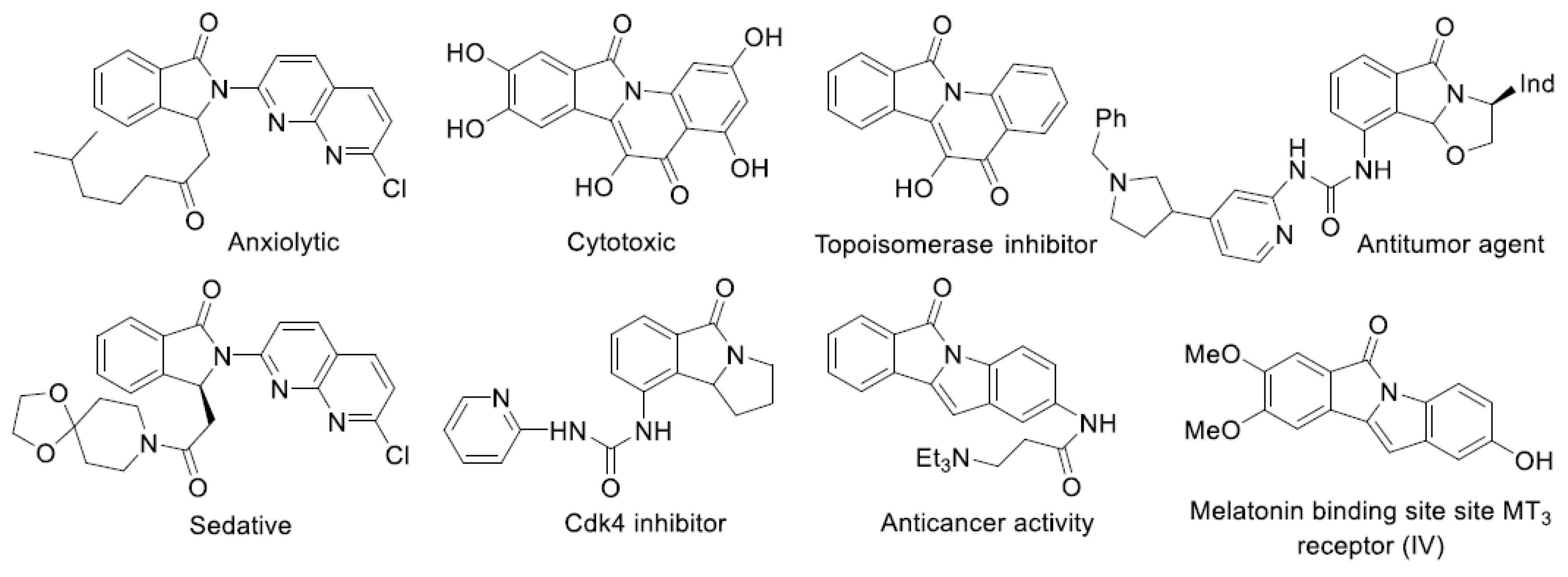
Scheme 1.
Current state-of-the-art C-alkynylation of N-acyliminium reactions (eq. 1) and this work (eq. 2).
Scheme 1.
Current state-of-the-art C-alkynylation of N-acyliminium reactions (eq. 1) and this work (eq. 2).
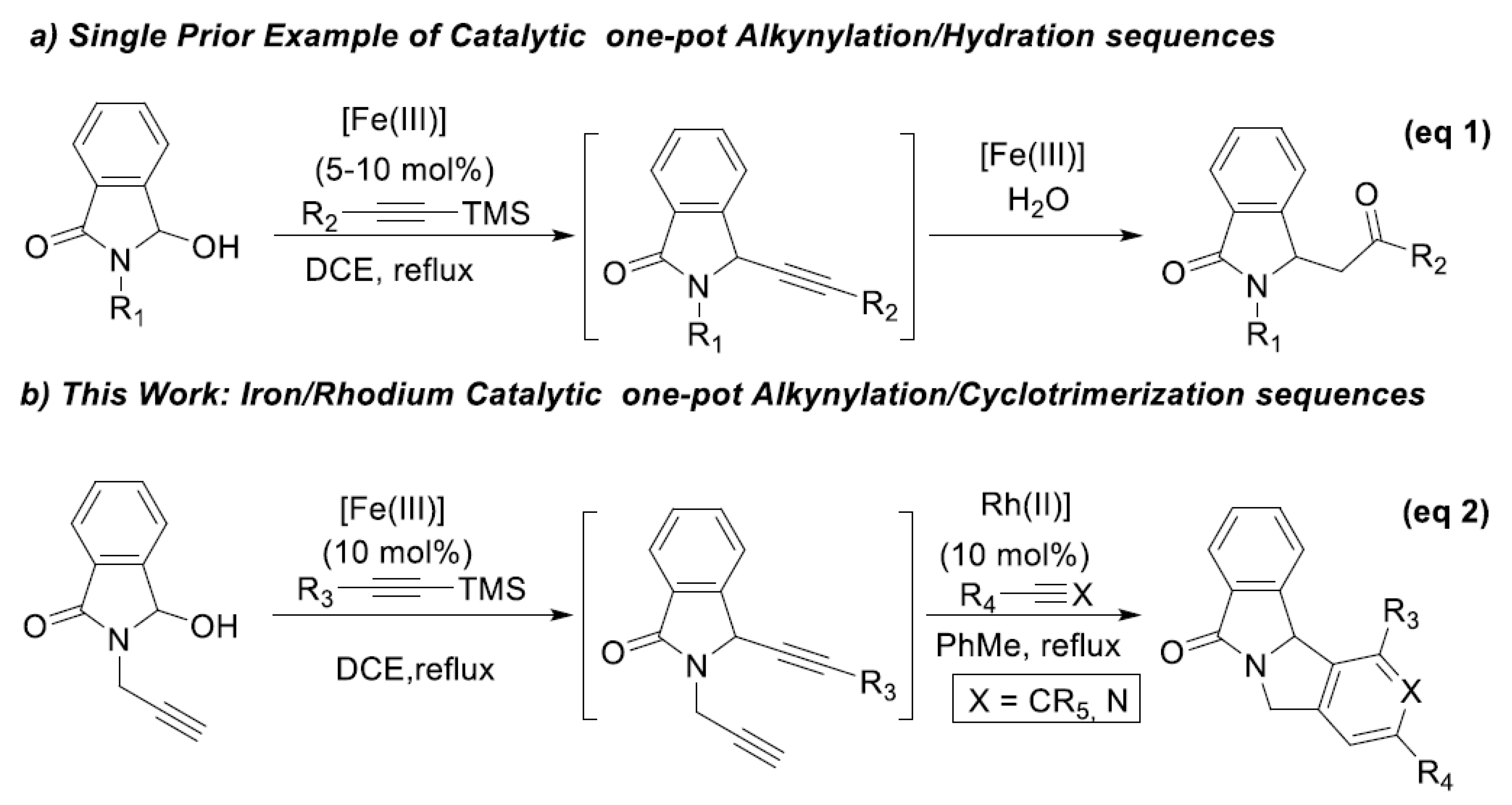
Scheme 2.
Reaction scope of aromatic alkynes. [a,b]
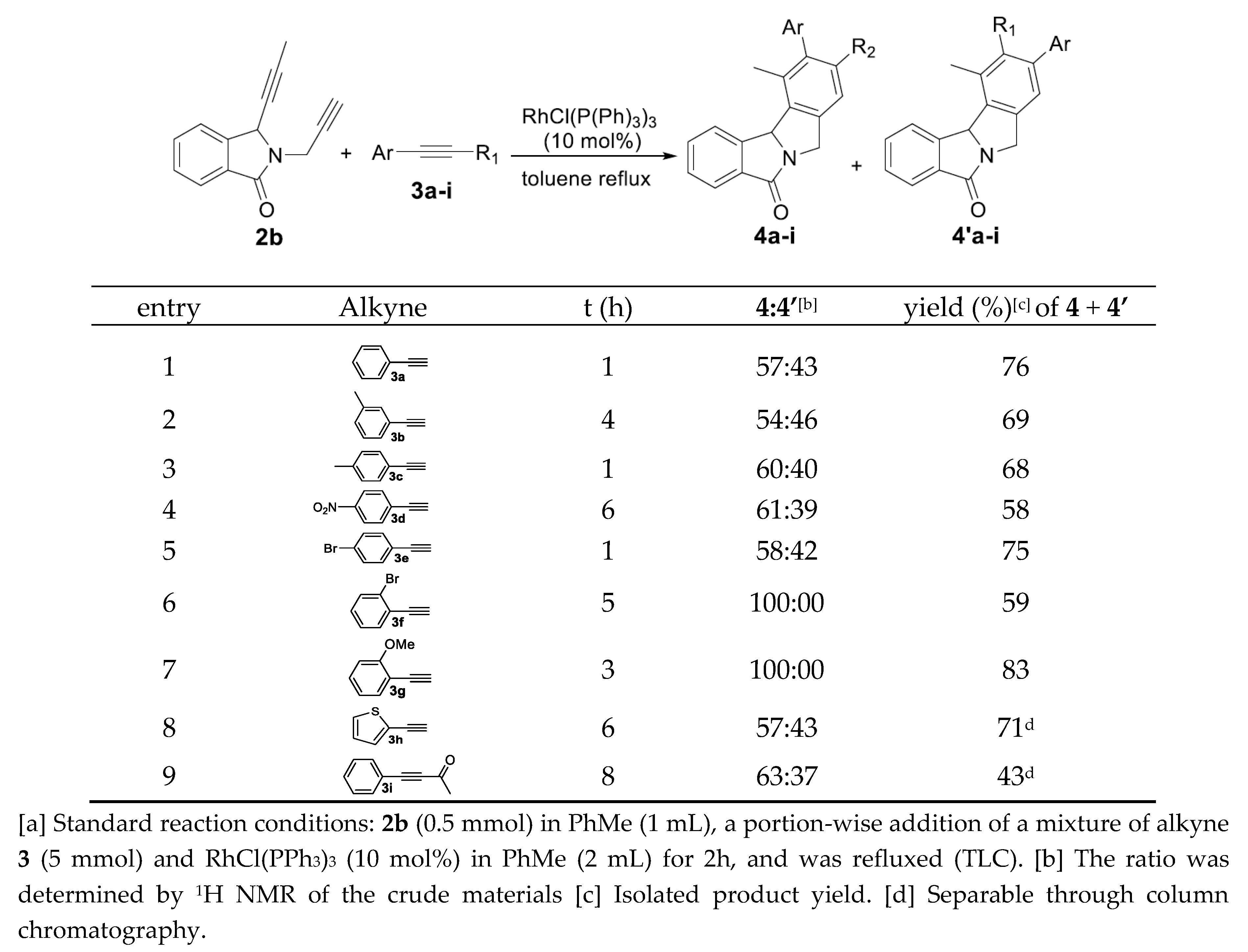
Scheme 3.
Reaction scope of non-aromatic alkynes.
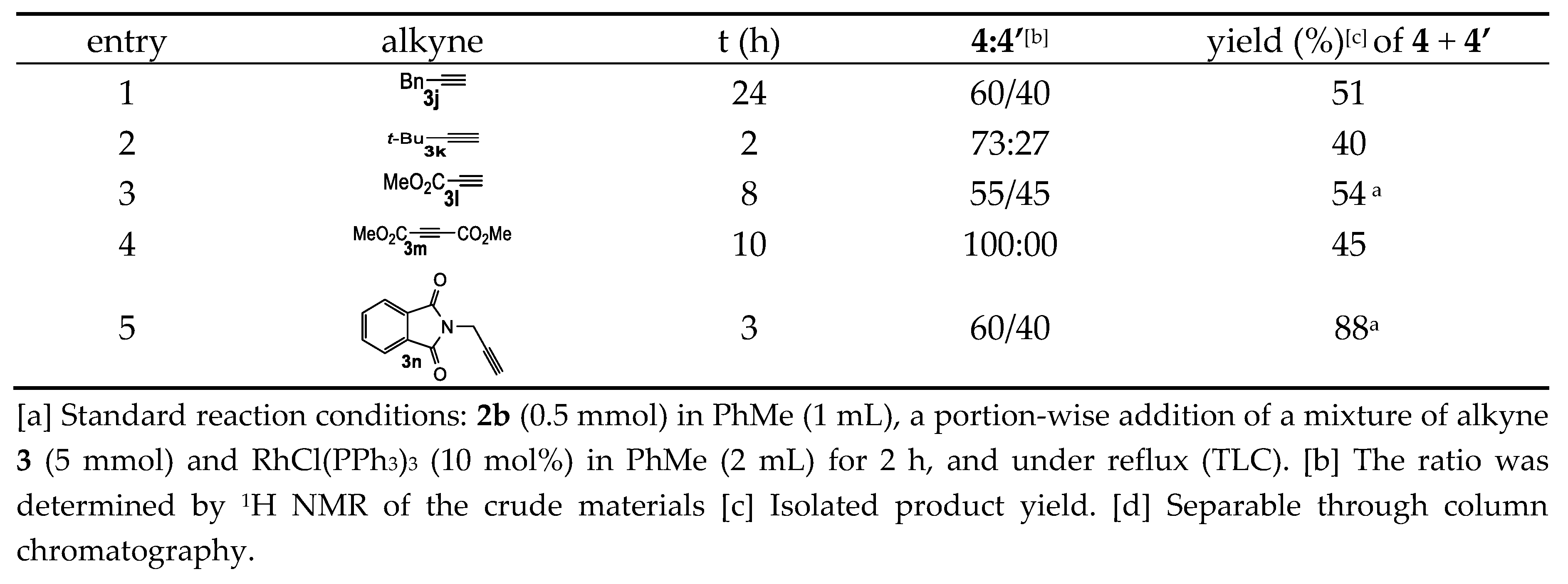
Scheme 4.
The scope of one-pot [Fe]/[Rh]-catalyzed alkynylation/cyclotrimerization reaction. [a]
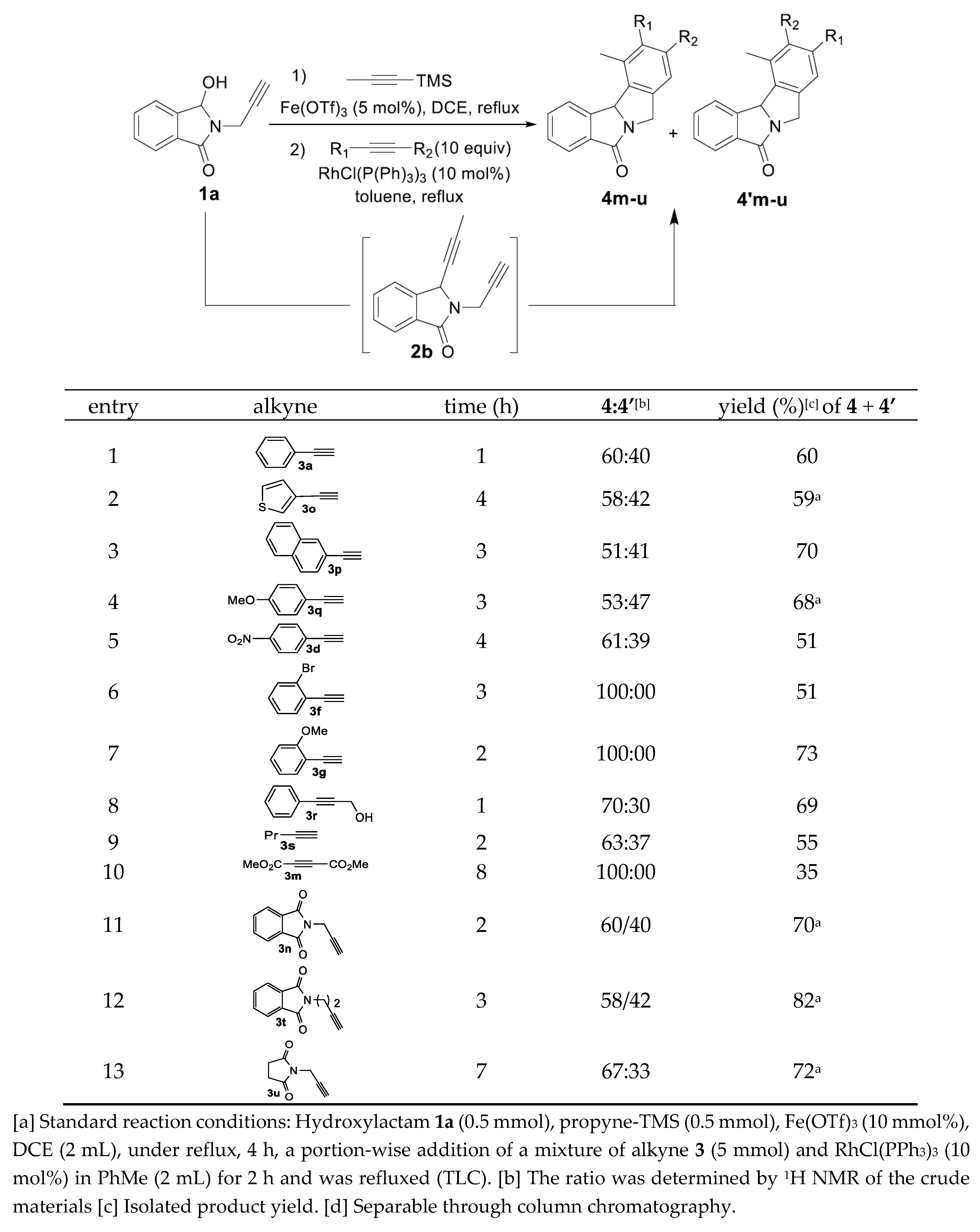
Scheme 5.
Mechanistic study to reveal the identity of the catalytic species.
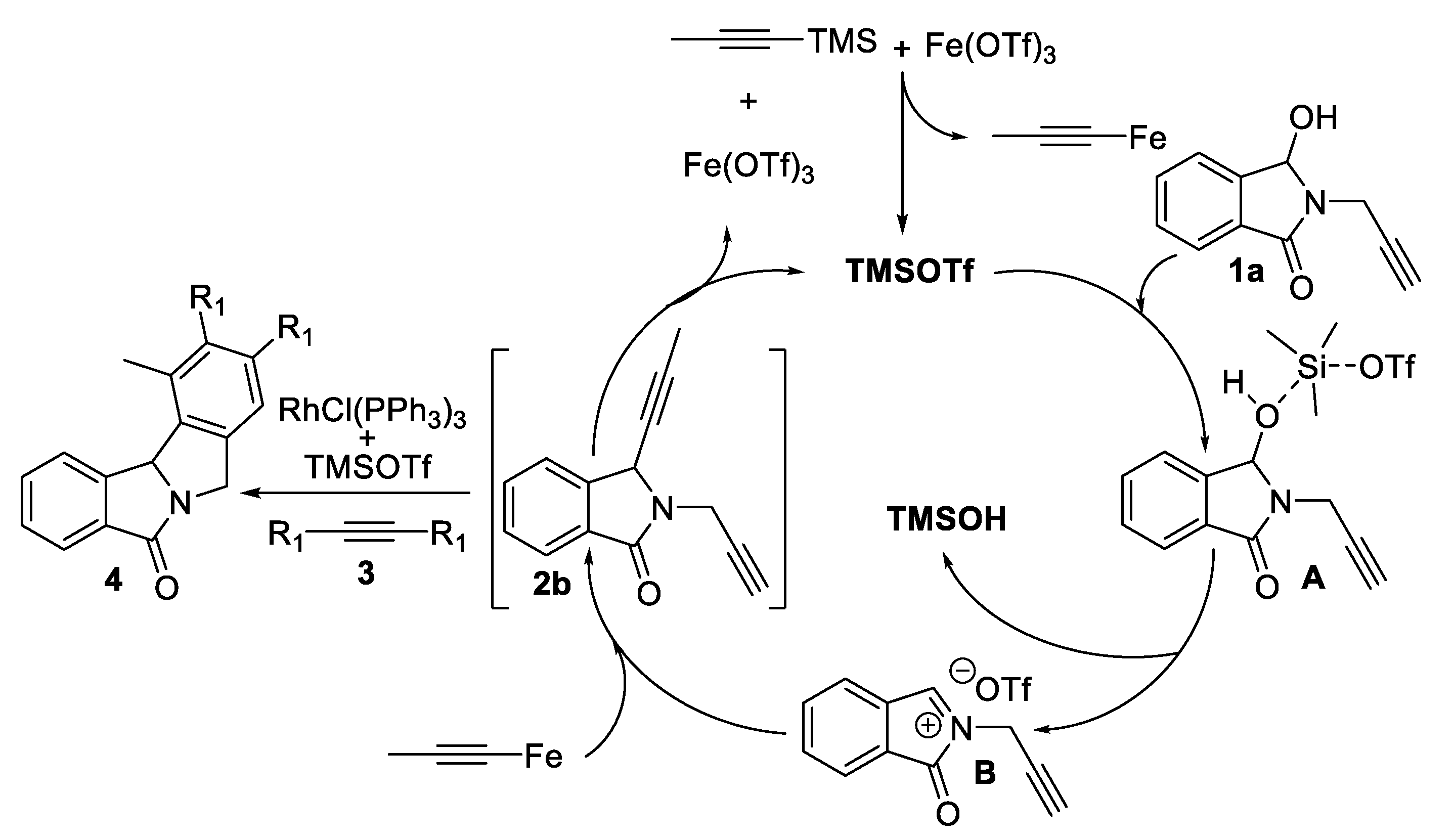
Scheme 6.
Cyclotrimerization of nitriles, preparation of pyridines 6.[a,b]
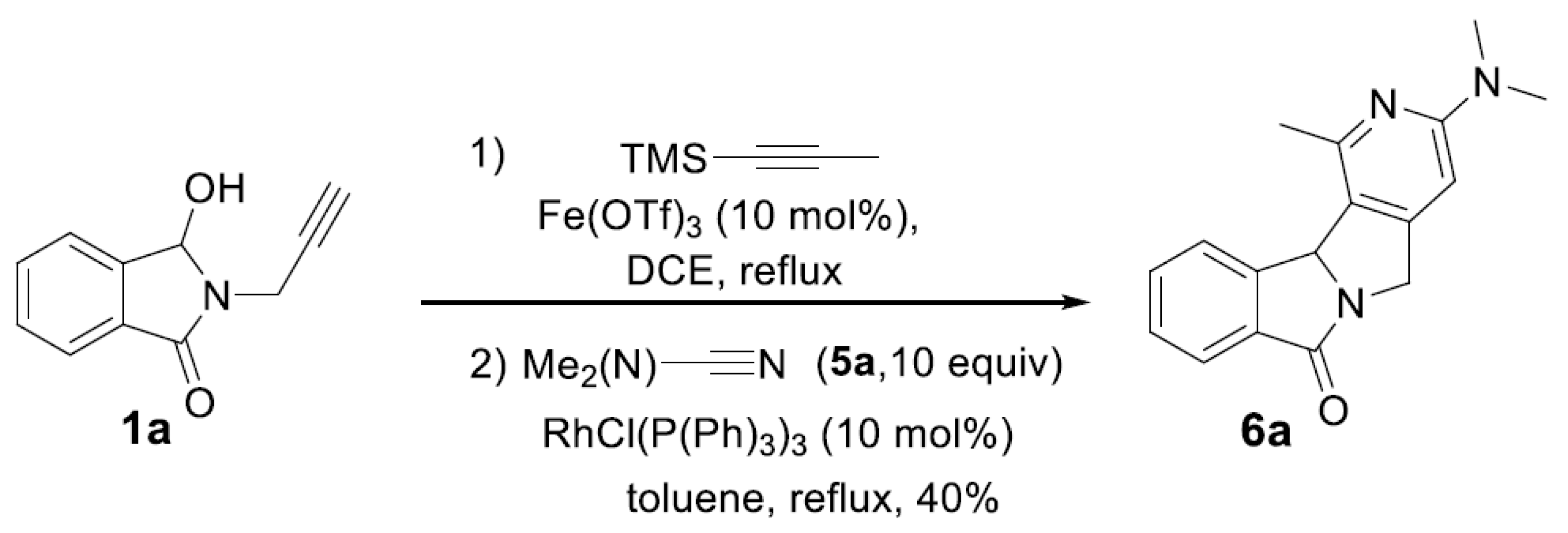

Table 1.
Identification of the best cyclotrimerization catalyst. [a]
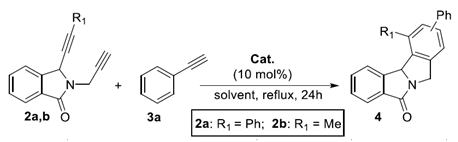
| entry | R1 | catalyst | solvent | product | yieldb |
| 1 | Ph/Me | Fe(OTf)3 | -[c,d] | - | ND |
| 2 | Ph/Me | Fe(OAc)2/L/Zn | -[c,d] | - | ND |
| 3 | Ph/Me | FeI2/dppp/Zn | -[c,d] | - | ND |
| 4 | Ph | RhCl(PPh3)3 | PhMe | -[d] | ND |
| 5 | Me | RhCl(PPh3)3 | PhMe | 4 | 35 |
| 6 | Me | RhCl(PPh3)3 | PhMe | 4 | 15 |
| 7 | Me | RhCl(PPh3)3 | THF | 4 | 17 |
| 8 | Me | RhCl(PPh3)3 | DCE | 4 | 25 |
| 9 | Ph | Grubbs-I/II | -[c,d] | -[d] | ND |
| 10 | Me | Grubbs-I | PhMe | 4 | 10 |
| 11 | Me | Grubbs-II | PhMe | 4 | 15 |
[a] Standard reaction conditions: All reactions were carried out using 2 (0.5 mmol), 3a (5 mmol), 10 mol% catalyst, and 2 mL of solvent under N2. [b] Isolated yield. [c] The reaction was tested in DCM, DCE, PhMe, or THF. [d] The reaction was tested at room temperature and under reflux. ND = not determined.
Table 2.
Optimization of cyclotrimerization of di-alkyne 2b[a].
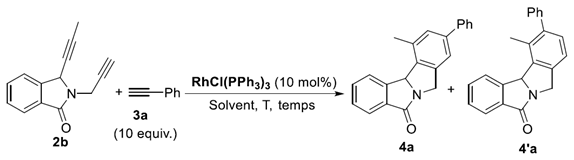
| entry | catalyst | add of 3a (h) | t (h) | T (°C) | yield (%) [b] | 4a:4a’[c] |
| 1 | RhCl(PPh3)3 | 0.5 | 48 | rt | 29 | 55:45 |
| 2 | RhCl(PPh3)3 | 0.5 | 0.3 | reflux | 47 | 60:40 |
| 3 | RhCl(PPh3)3 | 1 | 0.5 | reflux | 55 | 58:42 |
| 4 | RhCl(PPh3)3 | 2 | 2 | reflux | 68 | 60:40 |
| 5 | RhCl(PPh3)3 | 3 | 2 | reflux | 60 | 57:43 |
| 6 | RhCl(PPh3)3 | 2 | 1 | reflux | 76 | 60:40 |
| 7 | RhCl(PPh3)3 | 2 | 1 | 80 | 64 | 57:43 |
| 8[d] | RhCl(PPh3)3 | 2 | 1 | reflux | 43 | 60:40 |
| 9[e] | RhCl(PPh3)3 | 2 | 1 | reflux | 60 | 56:44 |
| 10[f] | RhCl(PPh3)3 | 2 | 1 | reflux | 52 | 57:43 |
| 11[g] | RhCl(PPh3)3 | 2 | 1 | reflux | 45 | 57:43 |
| 12 | Grubbs-I | 2 | 1 | reflux | 20 | 60:40 |
| 13[g] | Grubbs-I | 2 | 1 | reflux | 15 | 58:42 |
| 14 | Grubbs-II | 2 | 1 | reflux | 30 | 60:40 |
| 15[g] | Grubbs-II | 2 | 1 | reflux | 12 | 60:40 |
[a] Standard reaction conditions: All reactions were carried out using 2b (0.5 mmol), 3a (5 mmol, 10 equiv.), 10 mol% catalyst, and 2 mL of solvent under N2. [b] Isolated yield. [c] Ratio was determined by 1H NMR of the crude materials. [d] Reaction was done using 5 equiv. of alkyne 3a [e] Reaction was done using 5 mmol% of the catalyst. [f] The reaction was tested in DCE. [g] The reaction was tested in THF.
Disclaimer/Publisher’s Note: The statements, opinions and data contained in all publications are solely those of the individual author(s) and contributor(s) and not of MDPI and/or the editor(s). MDPI and/or the editor(s) disclaim responsibility for any injury to people or property resulting from any ideas, methods, instructions or products referred to in the content. |
© 2024 by the authors. Licensee MDPI, Basel, Switzerland. This article is an open access article distributed under the terms and conditions of the Creative Commons Attribution (CC BY) license (http://creativecommons.org/licenses/by/4.0/).
Copyright: This open access article is published under a Creative Commons CC BY 4.0 license, which permit the free download, distribution, and reuse, provided that the author and preprint are cited in any reuse.


