Preprint
Review

This version is not peer-reviewed.

Biomimicry for Mining: Investigating the Applications of Swarm Robotics and Other Nature-Inspired Designs for Mining

A peer-reviewed article of this preprint also exists.

Submitted:

12 December 2024

Posted:

12 December 2024

You are already at the latest version

Abstract

This review critically examines the integration of biomimicry, nature-inspired algorithms (NIAs), and swarm robotics to enhance sustainability, automation, and efficiency in mining operations. The paper begins by defining the foundational concepts of biomimicry, highlighting how nature-inspired designs have influenced engineering, architecture, and other fields. It then explores NIAs, discussing how biological processes such as foraging, evolution, and swarming have been modelled to solve complex optimization problems. Swarm robotics, largely inspired by the collective behaviour of social insects and other natural systems, is also analysed for its potential to revolutionize autonomous exploration, material transport, and excavation in dynamic mining environments. The synergy between biomimicry, NIAs, and swarm robotics is assessed for its applicability in addressing key challenges in the mining sector, including safety, resource management, and environmental sustainability. Systematic review of current technologies and future potential applications is presented, offering strategic insights into how these innovations can drive the transition towards fully automated and sustainable mining practices.

Keywords: 
;  ;  ;  ;  ;  

1. Introduction

Nature has long served as a source of inspiration for solving complex human challenges, with designs and behaviours evolved over millions of years providing blueprints for innovation. Biomimicry, popularized by Janine Benyus in her seminal work Biomimicry: Innovation Inspired by Nature (1997), involves studying nature to solve human challenges by emulating designs that have evolved over millions of years [1,2]. This approach has been applied in various fields, such as engineering, medicine, and architecture, to name a few, to create sustainable products and processes. For instance, aerodynamic designs in vehicles and aircraft have been influenced by the streamlined shapes of fish and birds [3]. Similarly, drones designed like birds and adhesives inspired by the microscopic foot structures of geckos have improved robotics manufacturing, and medical devices [4] as well as have other applications. Buildings are being designed with natural cooling mechanisms inspired by termite mounds, and ant colony behaviour is being used to optimize logistics systems [5,6].
The mining industry plays a critical role in the global economy by supplying essential raw materials for sectors such as manufacturing, power generation, and construction [7]. However, it faces significant challenges, including the inefficiency of labour-intensive technologies, inherent safety risks, and environmental concerns like pollution and deforestation [8,9]. With mining operations increasingly moving to remote and difficult-to-access locations, operational costs and complexities are rising [10,11]. Although technologies such as Rio Tinto's autonomous haulage system (AHS) have improved productivity, most mining activities still rely on remote-controlled operations rather than full automation [12]. Other innovations, like drones, the Internet of Things (IoT), and artificial intelligence (AI), have been applied to improve mining tasks, but achieving long-term sustainability and full automation remains challenging [13,14]. Swarm robotics, which mimics the cooperative behaviour of social insects, offers decentralized and scalable solutions to tasks such as exploration, transportation, and excavation in complex mining environments [15,16]. These systems excel in dynamic settings due to their self-organizing and adaptive capabilities. Nature-inspired algorithms (NIAs) that imitate biological processes for solving complex optimization and control problems [17,18], can complement swarm robotics, supporting more efficient and sustainable mining operations [15]. Swarm robotics, that involves numerous simple robots working together, is inspired by the collective intelligence of social insects like ants and bees. Brambilla et al. [17] classified swarm robots based on their capabilities in spatial organization, navigation, and decision-making, showing their suitability for changing and unpredictable environments. These robots are already being used in agriculture for tasks like weeding and harvesting, and in military for mine clearance, surveillance, and rescue operations [19,20]. This review provides a comprehensive analysis of the current developments in swarm robotics and nature-inspired algorithms for applications in mining, evaluating their potential to address key challenges in safety, efficiency, and sustainability. It also identifies gaps in existing research and offers recommendations for advancing these technologies to achieve sustainable and automated mining practices.

2. Biomimicry

2.1. Conceptual Foundations of Biomimicry

Studying nature to find creative answers to solve problems faced by humanity in various disciplines, including engineering is known as biomimicry [1,2]. In order to thrive organisms have evolved efficient and sustainable solutions over millions of years and biomimicry’s approach is developing solutions based on this knowledge. Utilizing biomimicry in disciplines like engineering, medicine and architecture has produced novel and ecologically sustainable designs, goods and procedures [3].

2.2. Applications of Biomimicry in Engineering and Design

In contemporary engineering, the application of biomimetic methods is growing in popularity. Engineers and designers have utilized nature’s structures and principles to make significant advancements in both technology and social sciences. These nature’s designs have served as inspiration for many of the technologies we use daily.
According to the studies by Young et al. [21], some synthetic adhesives have been modelled after gecko setae, i.e. microscopic hair-like structures on gecko’s toes that interact with surfaces via Van der Waal’s forces. These adhesives enable humans to climb vertical surfaces, including those of glass, by optimizing contact area and increasing adhesion. Another outstanding example of nature-inspired solution is Japan’s redesign of the Shinkansen bullet train to mitigate sonic booms created by high-speed tunnel exits [21]. The front of the train was modelled after kingfisher’s beak, which design allows to reduce splashing when the bird dives into water. This bio-inspired design resulted in 10% increase in speed and 15% reduction in energy consumption due to decreased aerodynamic drag and pressure waves. Similarly, the tubercles or bumps on the edges of humpback whale fins were found to reduce drag and increase lift by altering water flow patterns. Engineers applied this design solution to wind turbine blades by adding serrated edges, leading to improved aerodynamic efficiency, quieter operation, and increased energy production. NASA utilized shark skin’s dermal denticles, which reduce drag by regulating water flow, in the design of ribbed membranes for swimsuits, submarines, and ship hulls [22]. Velcro, invented by George de Mestral, was inspired by the small hooks on burrs that latch onto hair or fabric to create a strong bond [21]. The light-concentrating nanostructures found on rose butterfly wings, which efficiently capture light from multiple angles, inspired the development of solar cells that are twice as efficient as the conventional models. These nature inspired technologies are demonstrated in Figure 1 [21].
In industries like engineering and architecture, biomimicry has proven to be a potent source of inspiration for the creation of efficient and sustainable technologies. Computational models have been inspired by the underlying biological processes even though these applications frequently concentrate on reproducing the structural and physical characteristics of nature. These models also known as nature-inspired algorithms (NIAs) aim to mimic the approaches and patterns of problem-solving found in nature’s systems. The following sections examine how these biological processes are used to develop optimization algorithms that stimulate creativity in sophisticated systems such as mining operations.

3. Nature-Inspired Algorithms (NIAs)

3.1. Theoretical Foundations of Nature-Inspired Algorithms

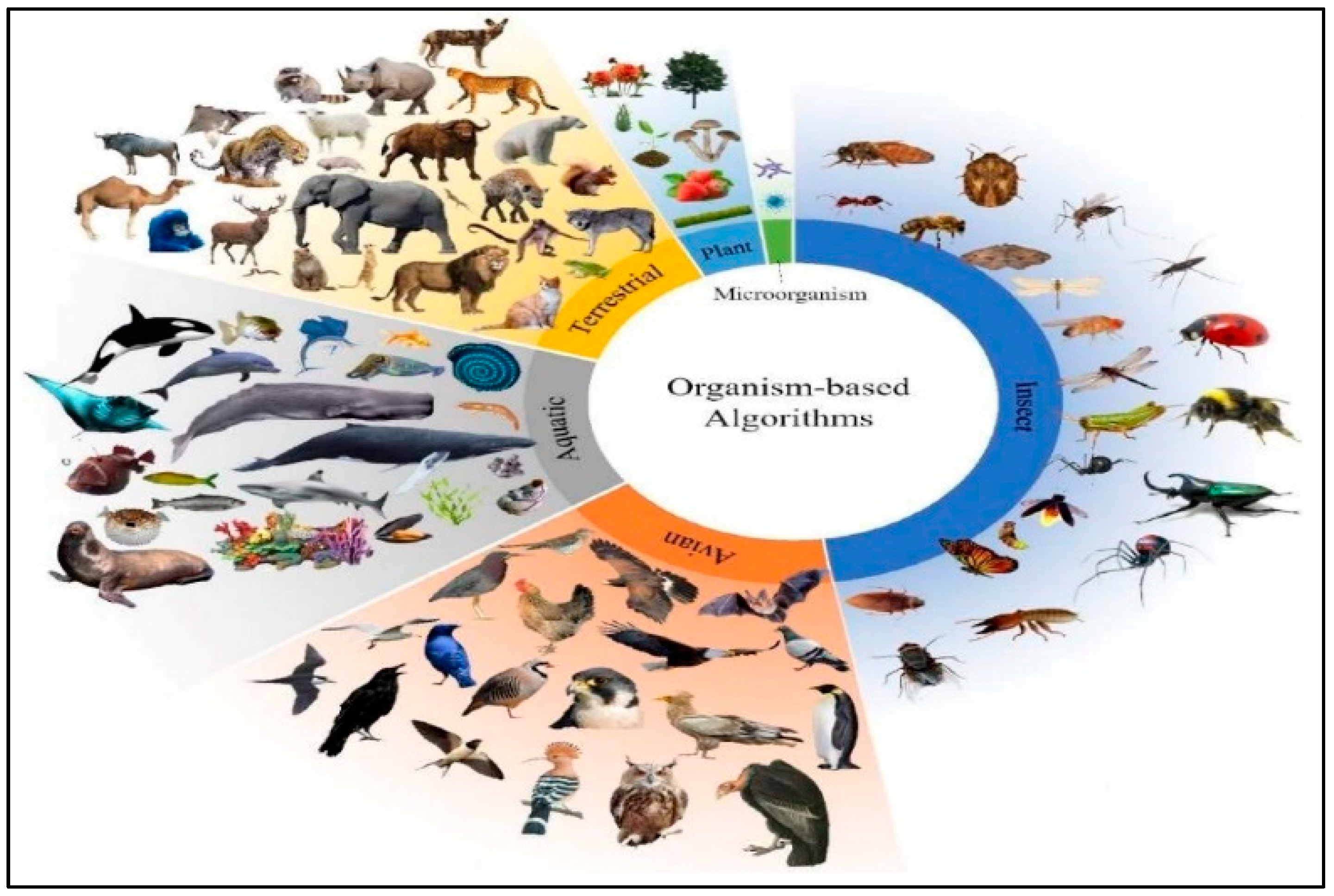
Nature-inspired algorithms (NIAs) are computational techniques that draw inspiration from wide range of nature’s systems and are modelled after various biological processes and behaviours to solve complex optimization problems [23]. While some NIAs, like particle swarm optimization and ant colony optimization, are modelled after swarm intelligence that involves the collective behaviour of social animals, others are inspired by single-agent systems. For example, plume-tracking algorithms modelled after the anataxis behaviour of insects have been successfully implemented on mobile robots to navigate and locate the source of a plume under varying environmental conditions, demonstrating the versatility of NIAs in single-agent systems [224]. All these approaches leverage nature’s principles to create intelligent behaviour for artificial systems, allowing them to navigate dynamic environments. Figure 2 illustrates the broad range of biological model inspirations that underpin NIAs, from microorganisms to large mammals [24].

3.2. NIA Classification

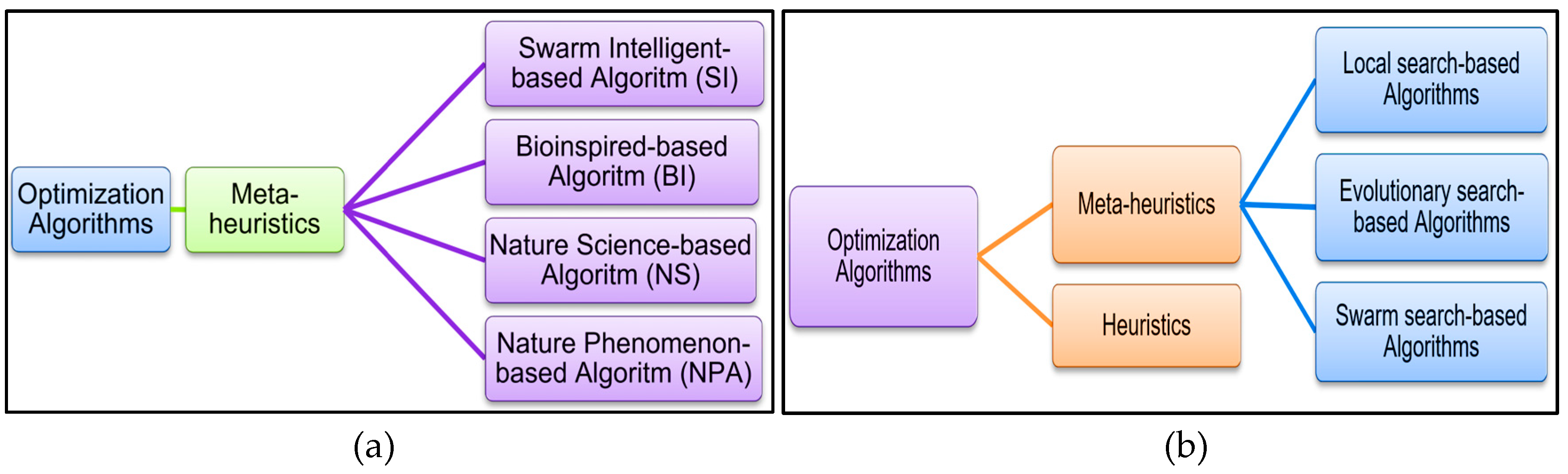
Bio-inspired algorithms can be categorized based on their natural sources (such as phenomena, animals, science, etc.) into four main groups: swarm intelligence (SI), biomimetic algorithms (BI), natural science algorithms (NS), and algorithms based on natural phenomena (NP) [25]. Swarm intelligence imitates social behaviours of animals like wolves, birds, and fish. Not all biomimetic algorithms rely on swarm intelligence [26], though SI serves as the foundation of BI. For instance, the genetic algorithm is a BI-not-SI algorithm, as it depends on operators like crossover and mutation, not group behaviour [27]. NS algorithms replicate chemical and physical phenomena, such as gravity, ion mobility, and charge [26,28]. A subset of nature-inspired algorithms (NIAs) remains unclassified within these categories. The relationship between NIAs, BI, and SI can be represented as NIAs ⊂ BI ⊂ SI [25]. While NIAs is inspired by nature, certain BI algorithms do not align with nature inspired methods [29]. NP algorithms simulate natural phenomena with social and emotional components. There is no universal method for classifying NIAs, however some are classified by biomimetic principles or problem-solving strategies. Figure 3 shows classifications based on nature and problem-solving [30].
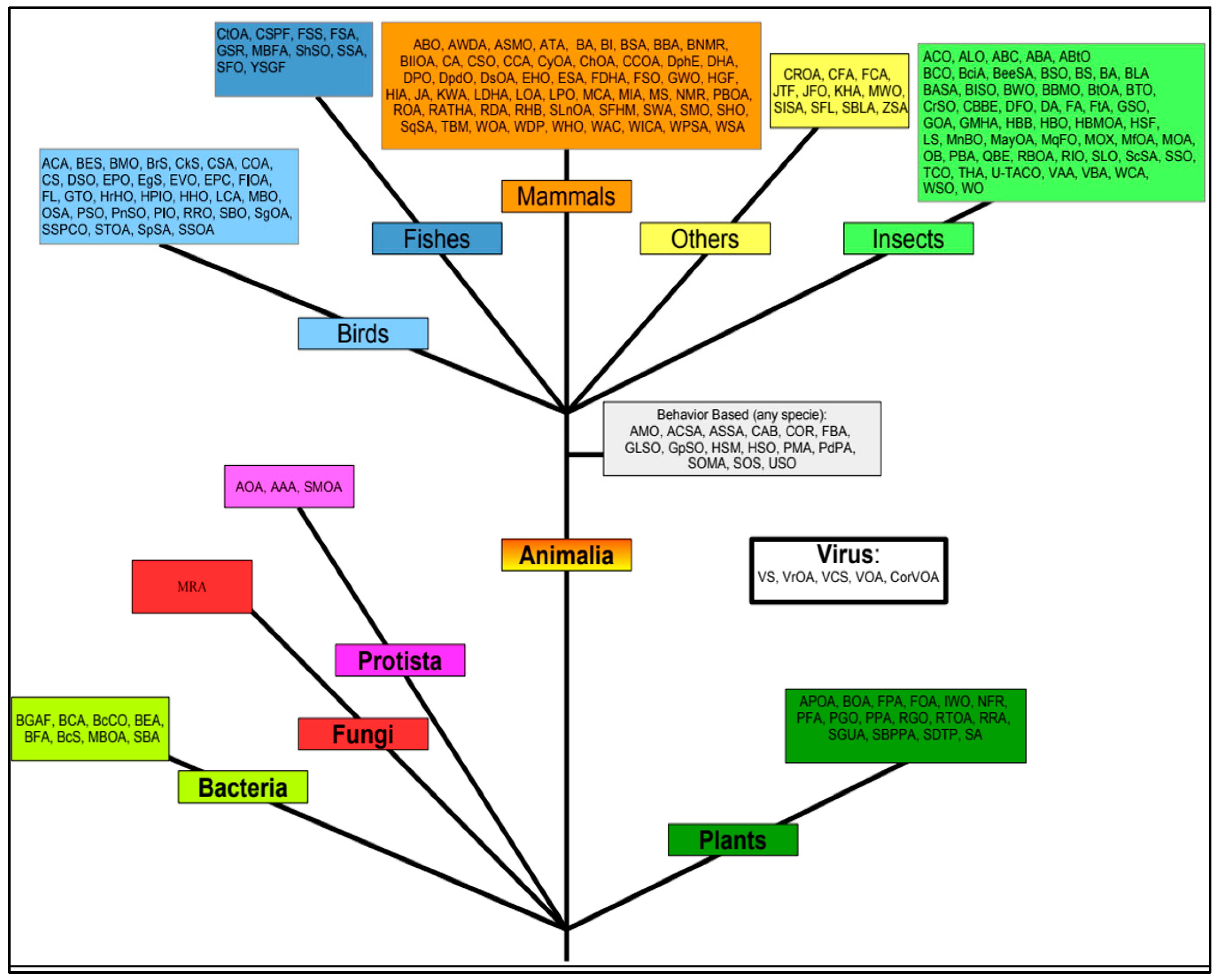
Optimization algorithms that focus on engineering applications and difficulties faced by designers and engineers are classified as problem-solving algorithms. These problem-solving algorithms include population-based algorithms, evolution-based algorithms, and local search-based algorithms [30]. The first variant of the local search-based algorithm iterates through development until the termination condition is met and uses a single-pass solution, for example, hill climbing [31], tabu search [32], B-hill climbing [30], and simulated annealing [33]. The second variant, evolution-based algorithms are based on evolution and use a population strategy to repeatedly combine solutions to achieve the best fitness function. Such algorithms are usually used to collect randomly generated solutions and find the best solution. Examples of such algorithms are genetic algorithms [34], harmony search [35], cuckoo optimization algorithm [36], firefly algorithm [37], ant colony optimization [38], etc. The third variant are population-based algorithms that use population-based techniques. In these algorithms the current solution is usually generated in each iteration using historical data from previous generations. Examples of such algorithms are spotted hyena optimization algorithms [39], bat algorithms [40], krill swarm algorithms [41], symbiotic search algorithms [42], artificial bee colony algorithms [43], moth flame optimization algorithms [44], bacterial foraging algorithms [45], biogeography-based optimization [46], grey wolf optimization (GWO) algorithms [47], ant lion optimization [48], and particle swarm optimization algorithms [49]. Swarm search-based algorithms, which belong to the third category, utilize swarm-based techniques to generate new solutions by iteratively leveraging data from previous generations. Numerous algorithms have been developed based on various models from nature, as the summary of these algorithms, based on the 2020 classification by Torres-Treviño presented in Figure 4 [50], shows.

3.3. Swarm-Based Bioinspired Algorithms

This section focuses on nature-inspired algorithm especially swarm-based algorithms, with particular emphasis on their application in swarm robotics. As swarm robotics closely aligns with swarm-based models, other algorithm categories, such as local search-based and evolution-based algorithms, will not be considered. This is because swarm-based algorithms are easier to adapt into hybrid models, which can address the challenges encountered in swarm robot development. Additionally, they are more relevant to the field of swarm robotics, as they integrate large-scale social animal behaviours effectively. In this section, the pseudocode of nine key swarm-based bio-inspired algorithms will be explored: Ant Colony Optimization (ACO), Particle Swarm Optimization (PSO), Artificial Bee Colony Algorithm (ABC), Firefly Algorithm (FA), Bat Algorithm (BA), Krill Herding Algorithm (KH), Salp Swarm Algorithm (SSA), Grasshopper Optimization Algorithm (GOA), and Grey Wolf Optimization Algorithm (GWO).

3.3.1. Ant Colony Optimization (ACO) Algorithm

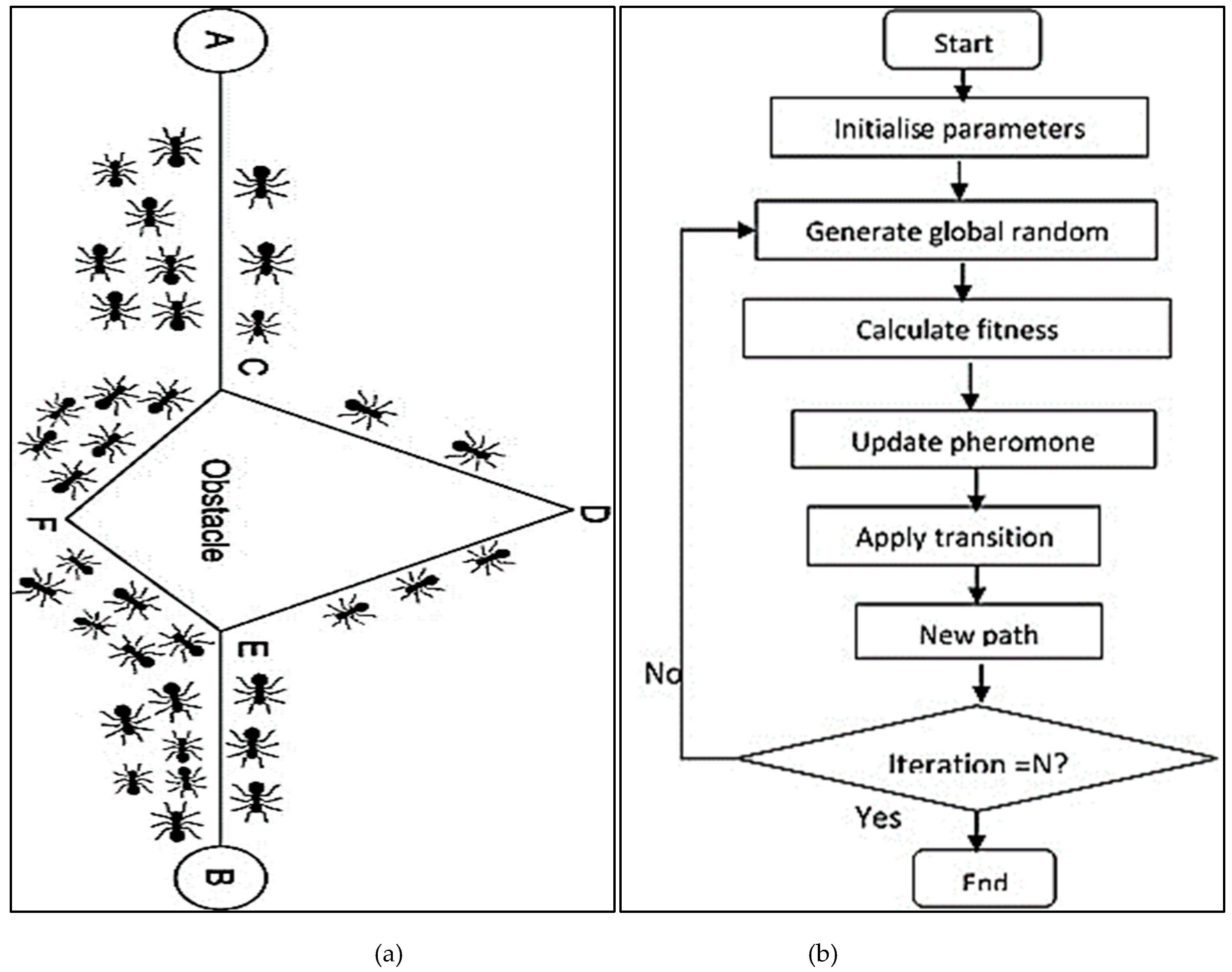
The Ant Colony Optimization (ACO) algorithm, introduced by Marco Dorigo in 1992, is a swarm-based metaheuristic that mimics the foraging behaviour of ants (Formicidae) [51,52]. Ants use pheromones to mark the shortest path to food sources, and the ACO algorithm simulates this by utilizing positive feedback from pheromone trails. Initially, ants explore randomly, and once a food source is found they deposit pheromones guiding others to follow. The algorithm begins by initializing parameters and the ant population [51,53]. Each ant then constructs a solution based on a state transition rule, repeating the process until an optimal solution is found. Offline pheromone updates are used to calculate fitness values and improve the solution. As ants update their pheromone trails, stronger paths are reinforced while weaker one’s fade. Tan et al. have presented theoretical details and equations for this algorithm in their work [51,52,53,54,55]. The ACO behaviour flow chart is illustrated in Figure 5 [56,57].

3.3.2. Particle Swarm Optimization (PSO) Algorithm

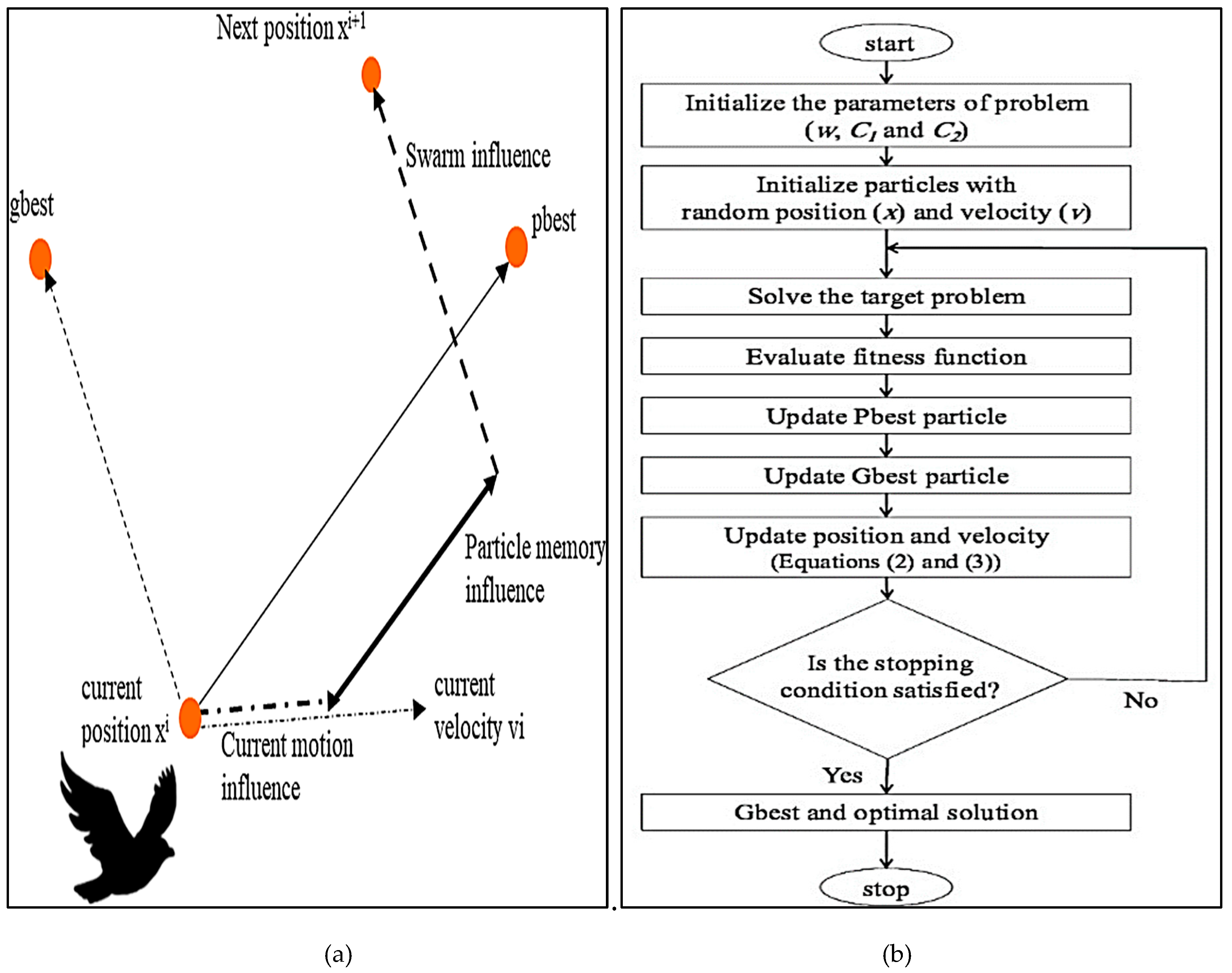
Particle Swarm Optimization (PSO), introduced by Eberhart and Kennedy in 1995, is a swarm-based metaheuristic algorithm that simulates the behaviour of a flock of birds or school of fish moving together to forage for food and avoid predators [49]. The PSO algorithm begins by initializing parameters and the particle swarm [58,59]. Each particle's fitness value is calculated, and the particle with the highest fitness is assigned as the global best. The position and velocity of each particle are updated accordingly, with this process repeating until the termination condition is met. The position and velocity updates are the core operational procedures of PSO, representing the movement of the swarm [58]. Tan et al. have presented the theoretical equations for this algorithm in their work [49,54,58,59]. The PSO behaviour flow chart is illustrated in Figure 6 [58,59].

3.3.3. Artificial Bee Colony (ABC) Algorithm

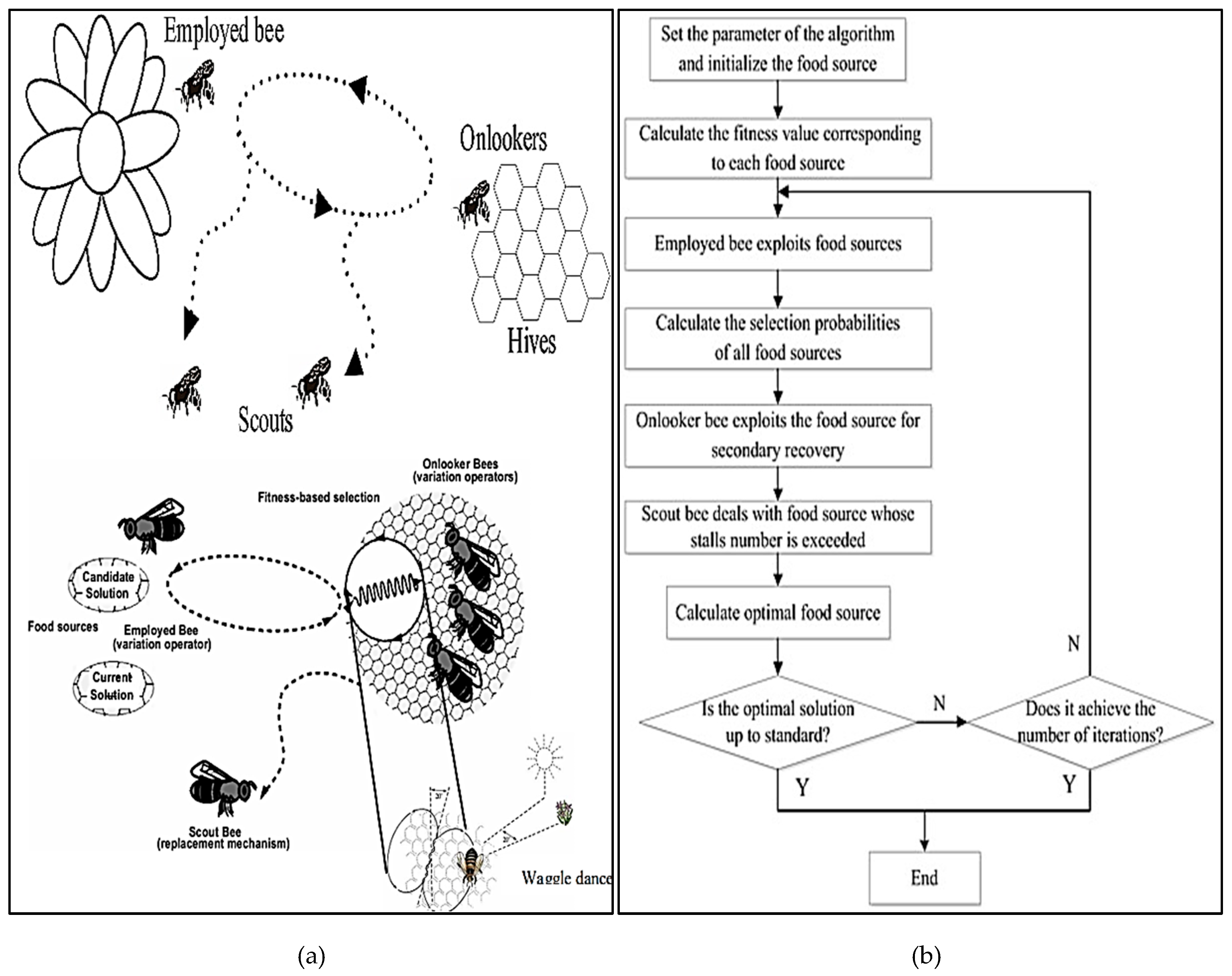
The Artificial Bee Colony (ABC) algorithm, proposed by Dervis Karaboga in 2005, is a metaheuristic inspired by the foraging behaviour of honeybees (Apis cerana) [60]. The ABC algorithm consists of three stages: scouting, recruiting, and harvesting. Scout bees begin by randomly searching for food sources, followed by employed bees gathering nectar and informing onlooker bees of promising sites. The onlooker bees then choose optimal sites, recruiting employed bees to collect nectar from the most abundant sources. The process continues as scout bees find new sources [61]. The algorithm starts by initializing parameters and the bee population [60,62]. Fitness values are calculated for each bee, and ineffective bees are reassigned through a greedy selection technique. The process repeats until termination conditions are met, with a new solution tailored for onlooker bees based on probability and prior solutions. The algorithm's foundation lies in the probability of high-quality food sources and new source locations, which guide the bees' foraging movements [60]. The best food source is the one with the highest nectar content. Tan et al. have presented theoretical equations behind this algorithm in their work [54,61,62,63,64,65]. The ABC behaviour flow chart is illustrated in Figure 7 [63,64,65].

3.3.4. Firefly Algorithm (FA)

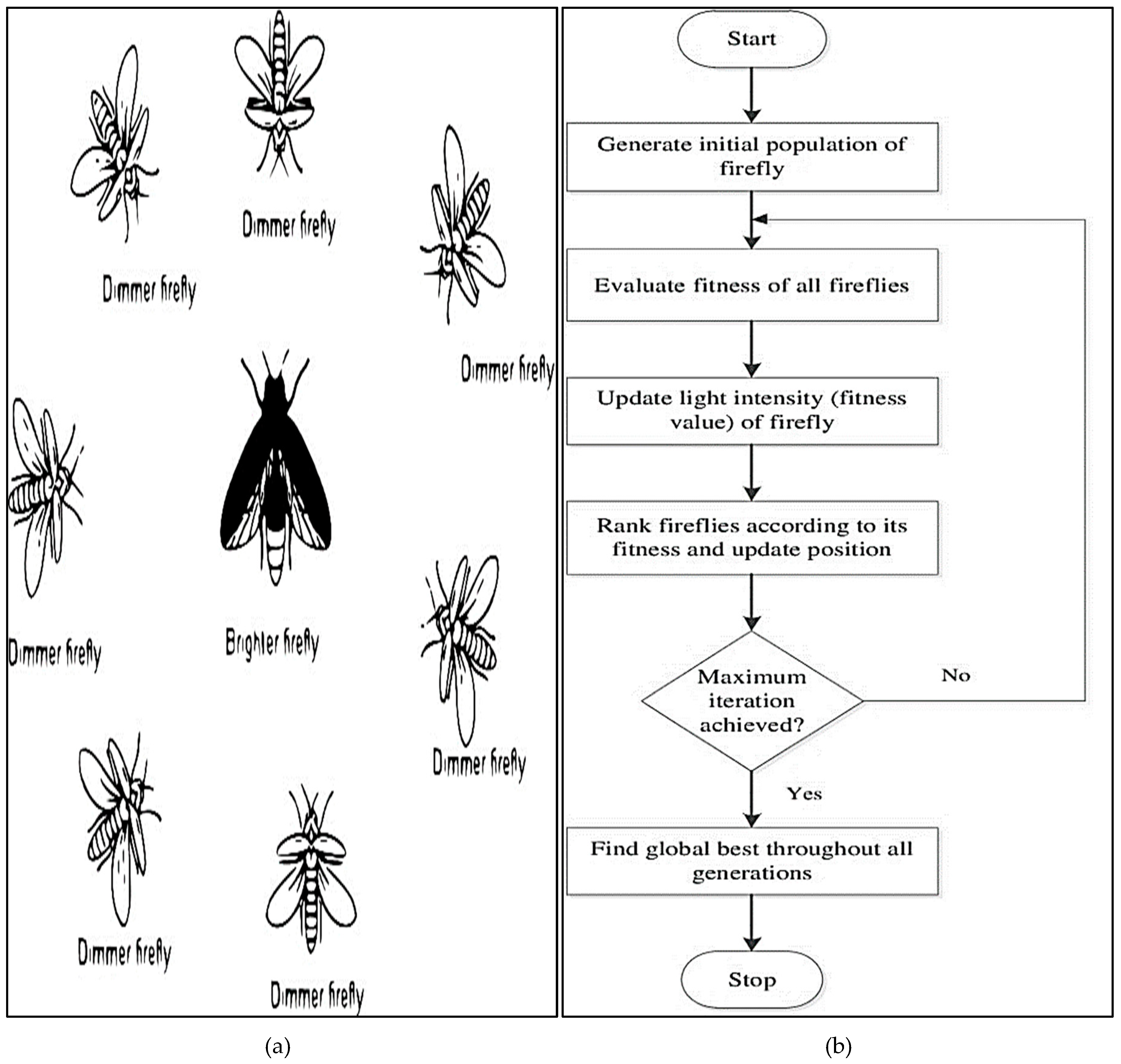
The Firefly Algorithm (FA), introduced by Xin-She Yang in 2007, is a population-based metaheuristic inspired by the flashing behaviour of fireflies (Lampyridae) during courtship [37]. The algorithm is driven by the attraction of fireflies to brighter flashes, with the brightness decreasing as the distance between fireflies increases. If no brighter firefly is nearby, a random move occurs. The brightness is determined by the objective function being optimized. The FA starts by initializing parameters and the firefly population. It then evaluates each firefly’s fitness according to their light intensity and updates their position and intensity if certain conditions are met. This process repeats until termination conditions are satisfied. The algorithm's core components include light intensity, attraction, and movement step size [37,66]. The goal function of the firefly’s movement is linked to its light output. Tan et al. and Yang have presented comprehensive theoretical details behind this algorithm in their work [54,66]. The FA behaviour flow chart is illustrated in Figure 8 [67,68].

3.3.5. Bat Algorithm (BA)

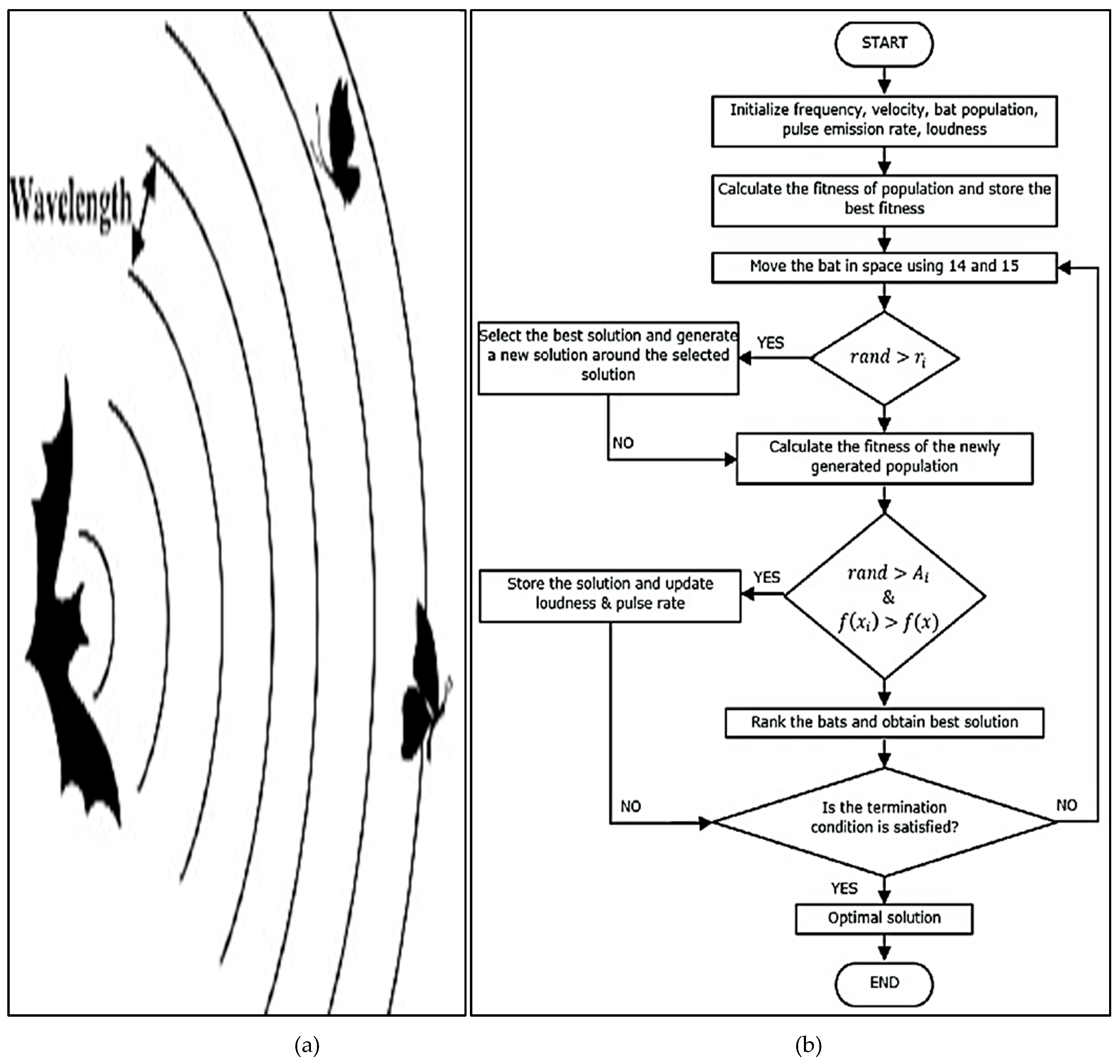
The Bat Algorithm (BA), introduced by Yang [40] and further described by Iglesias et al. [69], is a swarm-based metaheuristic inspired by the echolocation behaviour of small bats (Microchiroptera) during hunting. Bats use sonar pulses to measure the distance to prey and other bats, adjusting their position, speed, and pulse rate as they approach their target. The BA begins by initializing the parameters and bat population. The position, speed, and frequency of each bat are calculated to generate new solutions, followed by verifying pulse rates to select the best solution. A local solution is then built around the best choice, and the loudness and pulse rate are confirmed and updated. This process repeats until the termination conditions are satisfied. Key operational steps include updating velocity, position, and ranking [40]. The bat’s pulse emission and volume serve as the movement's goal functions. Tan et al. and Yang have presented comprehensive theoretical details of this algorithm in their work [40,54,69,70,71]. The BA behaviour flow chart is illustrated in Figure 9 [70,71].

3.3.6. Krill Herding (KH) Algorithm

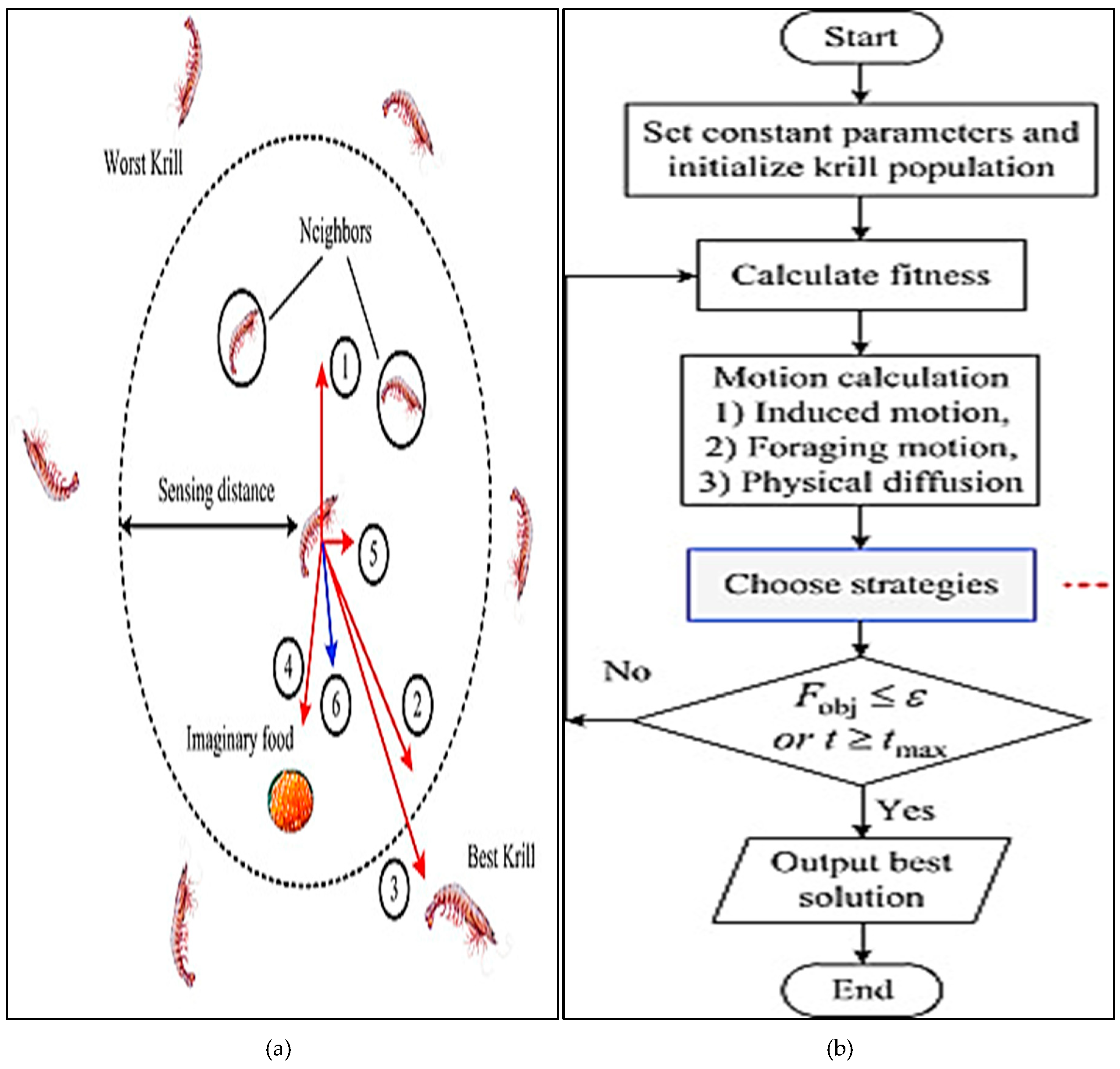
The Krill Herding (KH) algorithm, proposed by Gandomi and Alavi [72], is a swarm-based algorithm that simulates the behaviour of krill (Euphausiacea) in a swarm. When under threat, krill moves towards healthier individuals to maintain formation. The KH algorithm relies on three factors: induced movement, foraging movement, and physical dispersion [41,72]. Each krill assesses the health of its neighbours and moves toward healthier krill while searching for food in a multidimensional space. The krill also disperse in all directions at maximum speed. These three motion vectors are combined to determine each krill’s new optimal position [73]. The KH algorithm begins by initializing parameters and the krill population, then evaluates each krill’s fitness based on its position. The process repeats until the best krill is found and replaces the worst [41,73,74]. Key operational mechanisms include induced movement, foraging, and physical diffusion. The goal is to keep each krill near its food source and away from densely populated areas. Gandomi and Alavi and Tan et al. have presented comprehensive discussions on this algorithm in their work [54,72,73,74,75]. The KH algorithm behaviour flow chart is illustrated in Figure 10 [74,75].

3.3.7. Grey Wolf Optimization (GWO) Algorithm

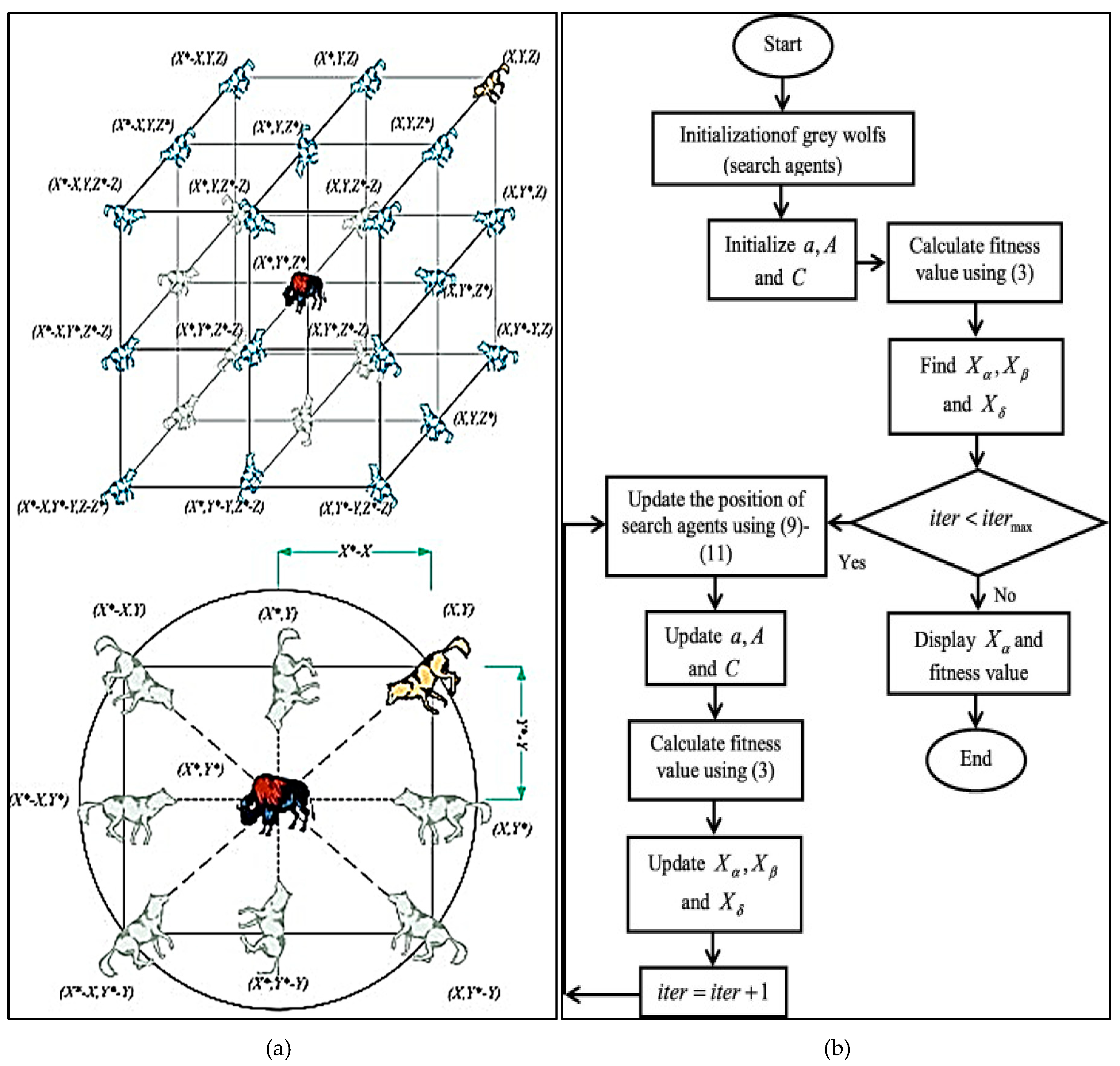
The Grey Wolf Optimization (GWO) algorithm, introduced by Mirjalili et al. [47], is a population-based metaheuristic inspired by the social structure and hunting strategies of grey wolves (Canis lupus). The algorithm models the social hierarchy with alpha, beta, delta, and omega wolves, where alphas lead, betas and deltas provide support, and omegas act as scapegoats. During hunting, wolves collaborate to stalk, surround, and capture prey [76,77]. The GWO algorithm starts by initializing parameters and the wolf population, followed by evaluating each wolf's fitness. The alpha, beta, and delta wolves iteratively guide the search by updating the position of the prey, with the value of "a" decreasing from 2 to 0 to balance exploration and exploitation [47]. This process repeats until termination conditions are met. The key operational steps are based on the wolves' social hierarchy and their hunting strategy, with the top three wolves (alpha, beta, delta) leading the search for the optimal solution. Tan et al. and Mirjalili et al. have presented the theoretical equations for this algorithm in their work [47,54]. The GWO algorithm behaviour flow chart is illustrated in Figure 11 [47,77].

3.3.8. Salp Swarm Algorithm (SSA)

The Salp swarm algorithm (SSA), proposed by Mirjalili et al. [27], is a swarm-based metaheuristic inspired by the behaviour of salps (Thalia) when foraging and navigating in water. The SSA classifies salps into leaders and followers. The leader salp directs the group towards the food source, with followers adjusting their positions based on the leader [27,30]. If any salp moves beyond the search area, it is repositioned within the boundary. The algorithm begins by initializing parameters and the salp population, followed by evaluating the fitness of each salp. The leader and follower positions are iteratively updated until the termination conditions are met. The core operational steps include updating positions based on fitness and boundaries. The algorithm continues until the optimal food positions are identified, allowing the leader to move to the best location. Mirjalili et al. and Tan et al. have presented the theoretical equations behind this algorithm [27,30,54]. The SSA behaviour flow chart is illustrated in Figure 12 [27,78].

3.3.9. Grasshopper Optimization Algorithm (GOA)

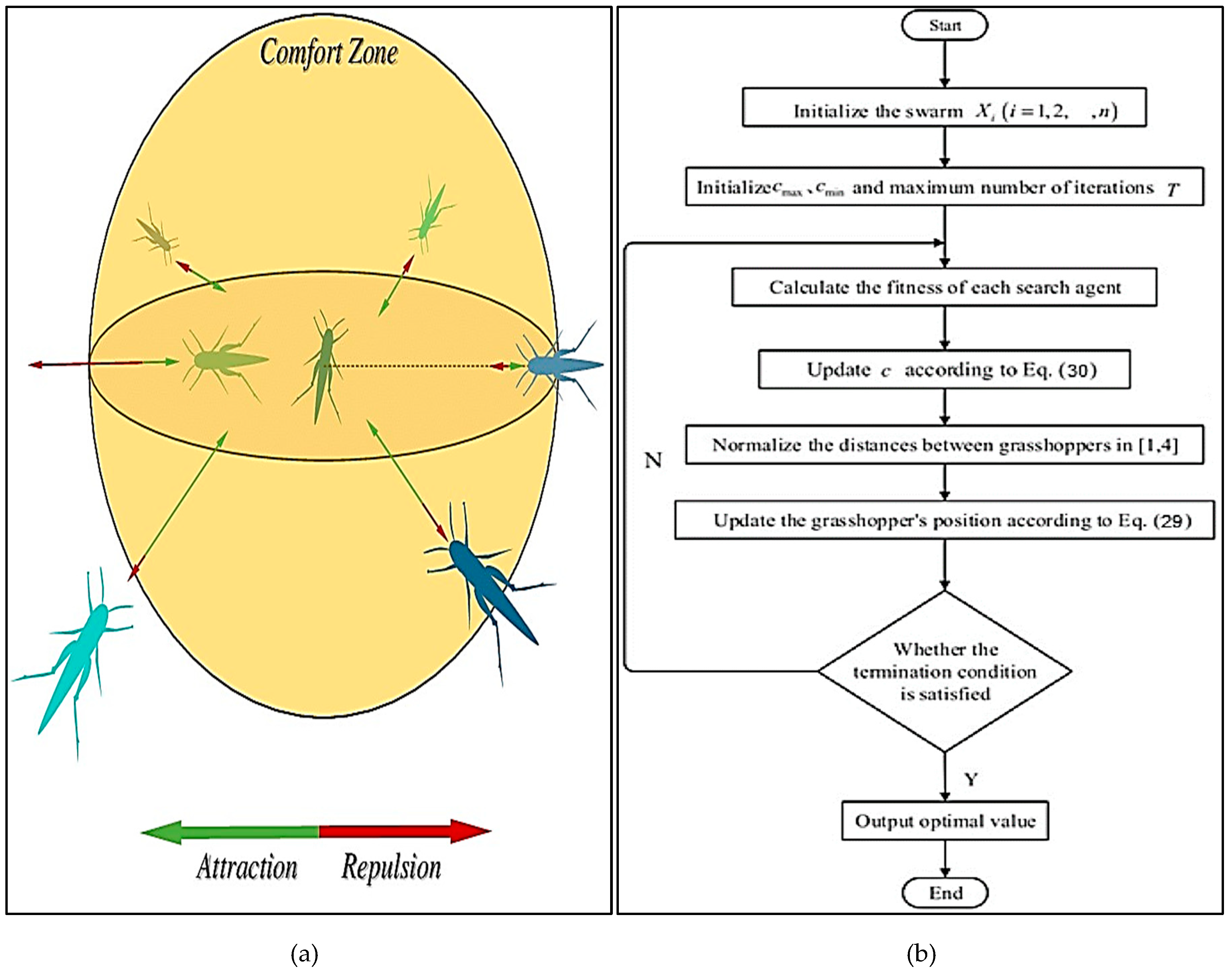
The Grasshopper Optimization Algorithm (GOA), introduced by Saremi in 2017, is a swarm-based metaheuristic inspired by the swarming and foraging behavior of grasshoppers [79]. The GOA simulates their life cycle, including the nymph and adult stages, with nymphs moving slowly and adults covering long distances while foraging [80]. The Grasshopper movement is influenced by three main factors: social interactions, gravity, and wind advection [80,81]. Social interactions are governed by repulsion, attraction, or a comfort zone with no force. The GOA begins by initializing the grasshopper population and parameters, followed by evaluating the fitness of each grasshopper. Positions are updated based on distance, and if a grasshopper crosses a boundary, it is repositioned. The process continues until the best solution is reached. The wind direction significantly affects grasshopper flight, especially during the nymph stage, and positions are adjusted accordingly. Saremi and Tan et al. have presented the theoretical details behind this algorithm [54,79,80]. The GOA behaviour flow chart is illustrated in Figure 13 [81,82].

4. Swarm Robotics: Concepts and Applications

Swarm robotics is defined as the study of large groups of simple robots that cooperate to complete complex tasks [83]. Four key principles form the foundation of swarm robotic systems [84,85,86]. First, swarm robots are typically homogeneous, meaning that their interactions and task performing are either identical or highly similar. Second, effective coordination is crucial for smooth cooperation, as it depends on how well each robot interacts with its surroundings and other robots. Third, these robots are designed to be simple, with limited individual capabilities compared to the complexity of the tasks they perform, highlighting the importance of group behavior over individual sophistication. Forth, local interaction ensures that each robot interacts only with its immediate environment, promoting distributed coordination and scalability as the swarm size increases. These four principles help facilitate the emergence of collective behavior, guiding the robots' interactions with one another and their environment.
While the initial focus of swarm robotics research was on homogeneous systems, recent studies have expanded to include both homogeneous and heterogeneous types of robot swarms [87,88]. In heterogeneous swarms, robots may have distinct functions or capabilities within the group [87,89]. A notable example of heterogeneous swarm robotics is the "Swarmanoid" experiment [90], which involved three distinct types of robots: handbots, designed for gripping objects and climbing vertical surfaces; footbots, used for transporting objects and self-assembly; and eyebots, responsible for observing and gathering information in areas inaccessible to handbots and footbots. This experiment demonstrated that heterogeneous swarm systems can integrate multiple tasks and fully accomplish objectives that homogeneous systems may not be able to achieve. The evolution of swarm robotics towards heterogeneous systems illustrates the increasing complexity and adaptability of these technologies, further enhancing their potential for carrying out real-world mining operations such as exploring, mapping, extracting, and transporting [16].

4.1. Swarm Robotics Application in Various Industries

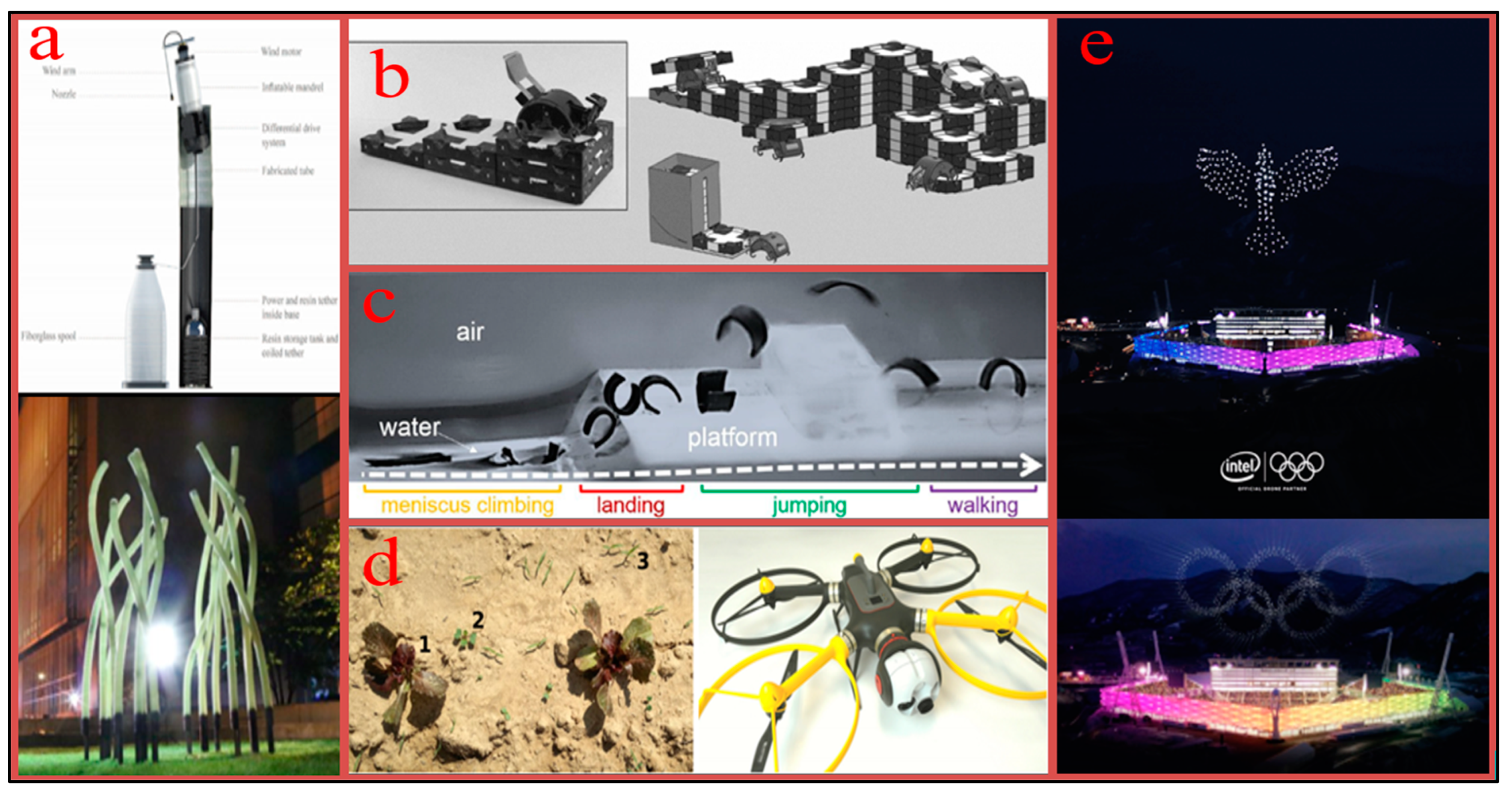
Swarm robotics is still in an emerging stage as a field of study and has not yet gained much traction in the mining industry. This section summarizes the current applications of swarm robotics both in research platforms and commercial projects. Figure 14 illustrates several uses for swarm robotics [91,92,93,94,95].
This section focuses on robotic platform-based swarm robotic applications, with an emphasis on practical implementations. Fiberbots are employed in the construction industry to construct prefabricated buildings. To enable accurate and effective construction, these robots use particle swarm optimization (PSO), a method motivated by the collective behaviour of particle swarms [91]. Furthermore, KALI robots draw inspiration from termite colonies that are employed to construct structures on their own, exhibiting sophisticated automation and decentralized control [92]. Drug delivery within the human body is accomplished by millirobots in the medicine and pharmaceutical industry. These robots can precisely and minimally invasively navigate the complex environment of the human body because of their design solutions inspired from the soft-bodied movements of jellyfish and caterpillars [93]. Swarm robotics for Agricultural Applications (SAGA) employs robots for performing tasks like weeding and field mapping [94]. According to Trianni et al. [94], these robots take advantage of the bee foraging model which offers decentralized control and scalability for increased efficiency and coverage. During the 2018 Winter Olympics in South Korea, the swarm of 1218 Intel drones produced intricate aerial flight patterns setting a Guinness World Record [95]. This amazing show demonstrated the ability of drone swarms to carry out coordinated tasks with extreme accuracy and synchronization. By imitating natural behaviours and systems, swarming robots have the potential to transform a wide range of industries. These examples demonstrate the inventive and varied applications of swarm robots.
Moreover, currently there are numerous other applications of swam robots particularly in research platforms and commercial initiatives that present as real-world application examples above the technology readiness level (TRL) of four [18]. Swarm robotics for research platforms and industrial projects have been systematically reviewed and categorized by Schranz et al [18]. The following section provides a comprehensive discussion on the taxonomy of swarm robot behaviour and formation control, which are key to effective swarm robotics operations.

4.2. Swarm Robotics Behaviour Classification

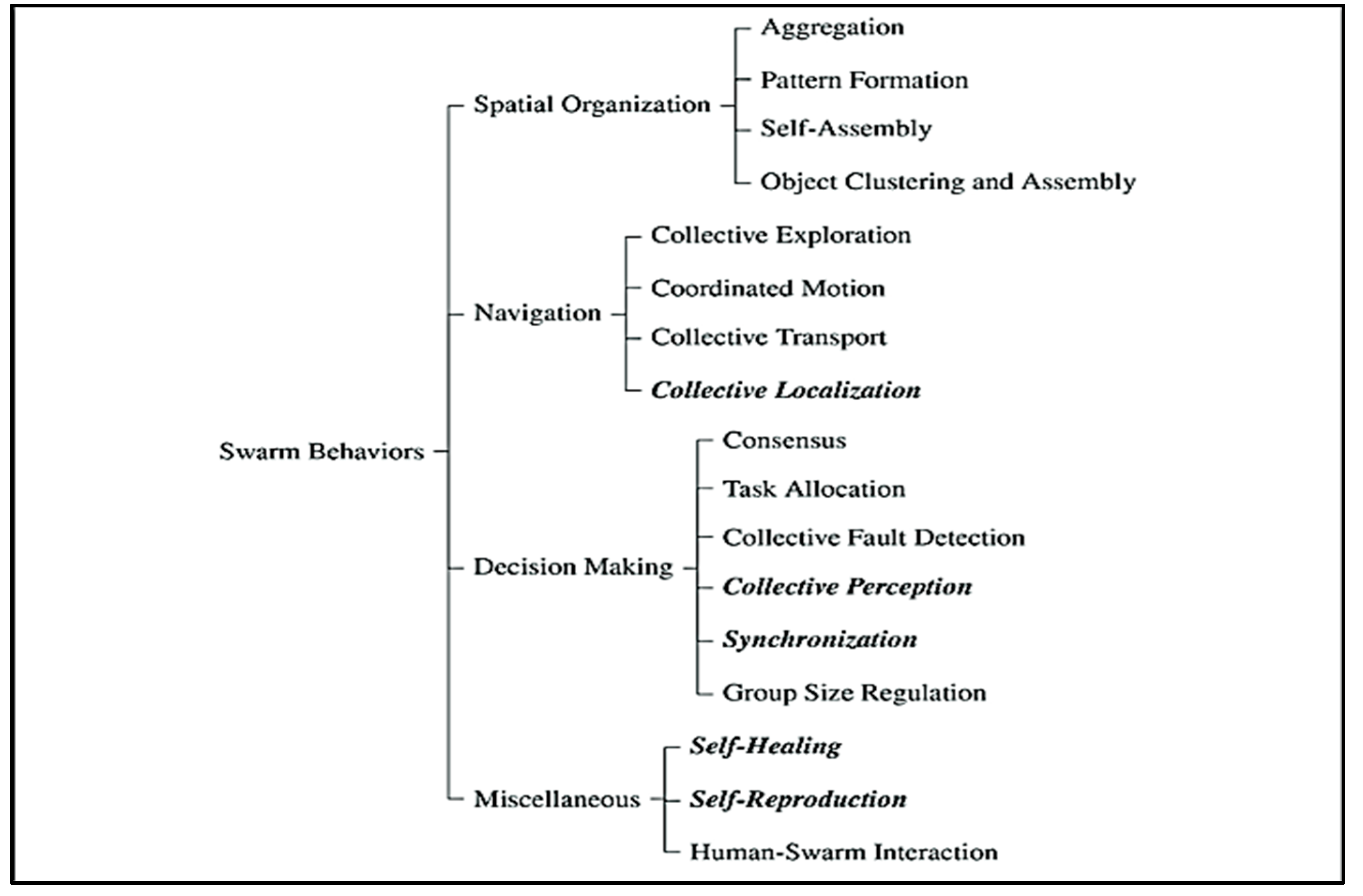
Spatial organization, navigation, decision-making and other aspects like self-healing, crowd interaction, etc. grouped under the title miscellaneous are four main categories into which swarm robotic behaviour can be classified [17,18]. Several studies have examined the behaviour and classification of swarm robotics, and these classifications are essential for preserving the swarm’s cohesiveness and guaranteeing efficient operation [17,18,54,87,88,96,97,98,99,100,101,102,103]. These studies could contribute significantly to the improvement of mining operations by allowing to boost productivity, safety, and sustainability. The swarm robotic behaviour classification is shown in Figure 17 [17,18].

4.2.1. Spatial Organization

The field of research on swarm robotics spatial organization studies the placement and configuration of robotic agents in space. This idea, which emphasizes the value of organized coordination among swarm agents, is consistent with the research of Brambilla et al. [17] and Schranz et al. [18] which focus on swarm organization. The main goal is ensuring that the swarm maintains spatial coherence while performing tasks effectively. This aspect of swarm robotics is very important, because it will have a direct impact on how well the swarm can move to investigate and engage with its surroundings. A cohesive and operationally effective swarm can adapt to a variety of tasks and environmental challenges with ease when its spatial organization is well-structured.
Swarm robots’ distribution at a mining site can be optimized through spatial organization, which is essential for activities like excavation and exploration [104]. Robots can autonomously cover vast areas during exploration to guarantee thorough coverage and identify the most optimal positioning for excavation to improve the efficiency of material transport [16].

4.2.2. Navigation

One of the most important aspects of swarm robotics is navigation in the context of swarm behaviour. It allows for the precise coordination and movement of many robots in a variety of tasks including localization, exploration and transportation [17,18]. The behaviour of different social animals in the natural world serves as the model for this aspect of swarm robotics. Because they lack global positioning system (GPS), these animals mainly depend on collective group dynamics to navigate and control their movements within large groups. Inspired by the behaviour of collective animals, swarm robotics provides a solution for decentralized coordination and decision-making, which is critical to the effective functioning of robotic swarms in complex and dynamic environments. With this kind of approach robotic swarms can carry out tasks with a level of adaptability and efficiency that often resembles observations in natural ecosystems.
Swarm robots can navigate through unstructured terrain through navigation, which was inspired by decentralized animal behaviours. This is especially useful in underground mining, where GPS signals are not available [105]. They can autonomously modify their routes to avoid obstacles or adapt to changing terrain, by reacting to local environmental cues and interacting with nearby robots ensuring efficient completion of tasks like transportation and drilling [106].

4.2.3. Decision Making

Decision Making is an important feature of swarm behaviour, that allows swarm robot groups to make decisions on their own without requiring human intervention or explicit instructions [17,18]. This ability can be applied to a variety of tasks such as task allocation, synchronization, collective sensing, collective failure detection, consensus-building and group size regulation. Since many social organisms in the natural world lack controlled leaders to coordinate group activities, group members must make independent decisions and work together as a unit. Natural swarms can decentralize and automate the assignment of roles, sense the health of individuals or nearby agents, gather information among themselves and plan group actions.
This is especially helpful in mining in dynamic settings with quick changes in conditions like rockfalls or equipment failures [16]. By redistributing tasks or rerouting transportation swarm robots can autonomously adjust operations minimizing the need for human intervention in hazardous areas and enhancing system resilience overall [17,18] or eliminating human intervention completely.

4.2.4. Miscellaneous

A large group of robots that can perform different autonomous tasks such as self-replication, self-healing and crowd interaction are referred to as exhibiting miscellaneous swarm behaviour [17,18]. These behaviours are intended to increase the robot swarm’s flexibility, resilience and capacity for condition adaptation. They are modelled after the social animal world.

4.3. Swarm Robotics Formation Control

Swarm robot formation control is a term that describes the control or formation over the large group of swarm robots, how it is adapting behaviour to maintain swarm organization and collaboration [17,18]. This approach is a mechanism on preserving a predefined formation shape of a swarm robotic system, guaranteeing uniform relative separations between individual robots while the mission is being carried out. In recent decades much interest and a lot of studies have been conducted on swarm robotic formation control [54,107,108,109,110,111,112]. Swarm robotic formation control can be classified into two large groups, which are centralised control and decentralised control.

4.3.1. Centralized Control vs Decentralised Control

Local information processing and dispersed command structure characterize the decentralized control, whereas global information processing and central command structure define the centralized control [109,110]. Team members can communicate and share information when there is decentralized control. Centralized control on the other hand, gathers information from every team member and uses clear directives to guide the group [54,108,113,114,115]. Yet because of the rising computational and communication requirements, centralized control loses effectiveness as the number of robots increases. This limits its practical applications by resulting in lower resilience, higher costs and higher fault susceptibility.
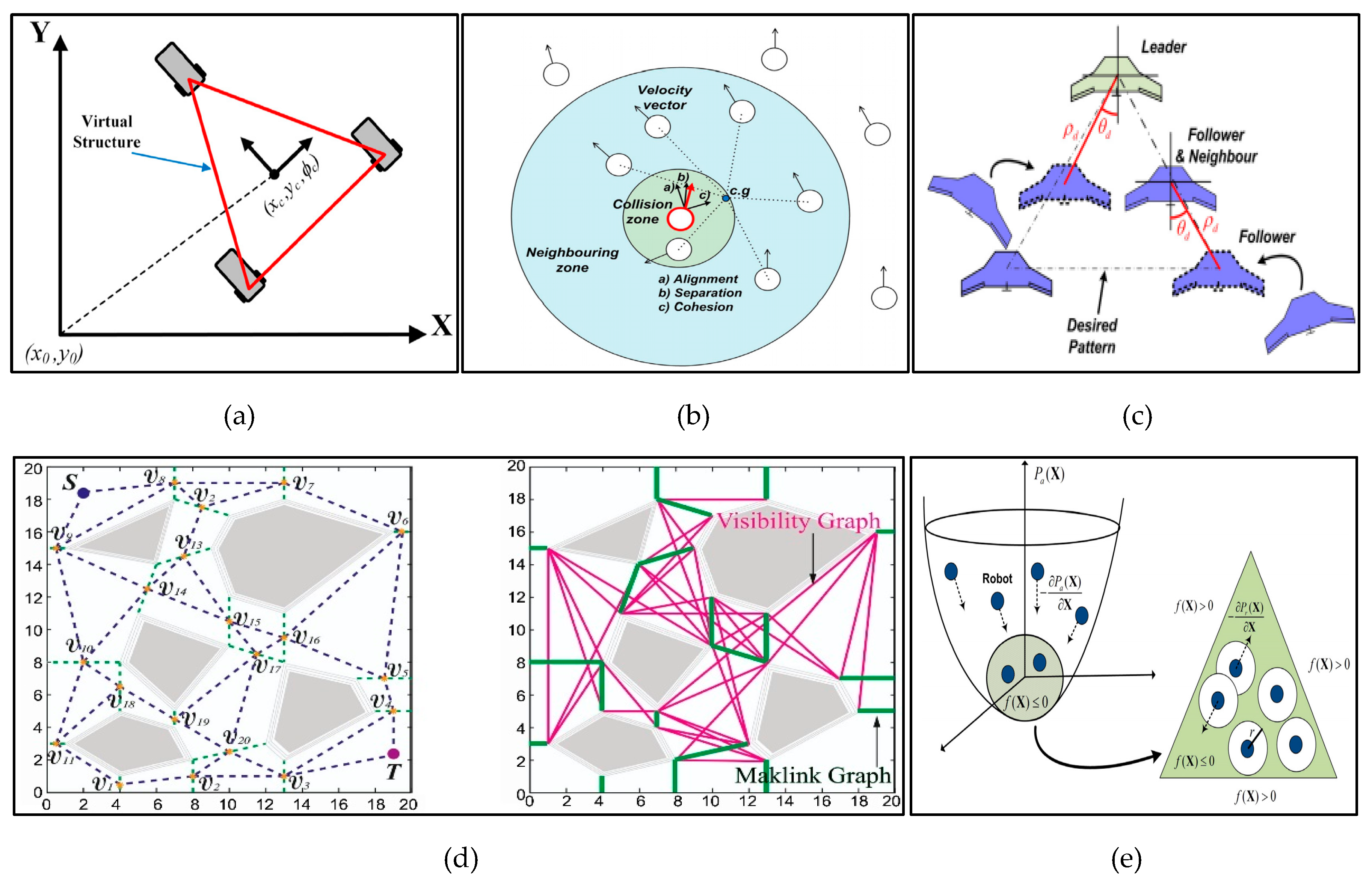
As demonstrated in Figure 18, there are a few tactics for both centralised and decentralised formation control which are further broken down into the virtual structure method [116], behaviour-based method [117], leader-follower method [118], graph-based method [119,120] and artificial potential method [121].

4.3.2. Virtual Structure Approach

Lewis and Tan [116] introduced the virtual structure technique, which is a centralized formation control that tracks trajectories, by giving each member of the formation a virtual structure and treating the formation as a unit. This virtual structure method is novel in that it can maintain rigid geometric links between formations and groups during manoeuvres, while anticipating the coordinated behaviour of the entire formation beforehand. This approach does, however, have several drawbacks including a high formation reconfiguration rate, a significant computational and communication load, and a low level of resilience to fleetwide single point failures.

4.3.3. Behaviour-Based Approach

The decentralized formation control methodology outlined by Balch and Arkin [117] is behaviour-based and inspired by naturally occurring interacting behaviours like flocking, swarming, and schooling. These actions make use of data from agents in the vicinity to expedite further interactions. Swarm robotic systems are capable of using a behaviour-based approach to navigate in an unknown environment, where decisions are made by behavioural coordinators. This behaviour-based approach is exceptional, due to being decentralized and requiring less computation and communication. But this approach has drawbacks as well. For example, it cannot assess or manage the formation convergence robustness and stability of swarm robots [122].

4.3.4. Leader-Follower Approach

The centralized formation control method known as the leader-follower technique was developed by Desai et al [118]. In this technique a robot within a formation is designated as the leader, and all followers take over the position of local control from the leader. Next, rules and regulations associated with leaders maintain the system in place. The leader-follower technique is distinctive in that the entire formation depends on the leader, who is straightforward and visible, and the course of the entire formation can be followed. This strategy’s main problem is that it transmits information to the follower about the leader’s position, trajectory, velocity and direction without requiring inter-agent communication [109]. This strategy’s main flaw is that there isn’t any direct feedback from the followers to the leader which means that, if the leader fails the formation could fall apart as a whole.

4.3.5. Graph-Based Approach

The graph-based method presented by Desai et al. [119,120], explains the mathematical representation of the robot network structure through a decentralized formation control that can be represented like a graph. All the robots in the queue are called vertices, and the information flow between them is represented by the edges connecting them. The graph-based approach maintains appropriate behaviour, by preserving information flow between the agents even in the presence of different communication topologies. The main limitation in this approach is that the agents can only obtain information from their neighbours.

4.3.6. Artificial Potential Approach

The artificial potential technique first introduced by Khatib [121], is a decentralized formation control that uses artificial potentials to enforce inter-agent spacing between neighbouring agents and establish interaction control forces [54,109]. This methodology is distinct in that it provides real-time applications, lowers processing demands and makes agent collision prevention simpler. The main drawbacks, however, are instability brought on by communication delays and local minima challenges in determining underlying functions.

5. Applications of NIAs, Biomimicry and Swarm Robotics in Mining

Swarm robotics, biomimicry, and nature-inspired algorithms (NIAs) have a great potential to revolutionize mining operations through increased automation, sustainability and efficiency. These cutting-edge technologies might offer solutions to various complex engineering problems that the mining sector is facing. This section examines how these technologies might improve mining industry’s various features, including mining operations, safety and sustainability.

5.1. NIAs in Mining

The many challenges that the mining industry is facing include high operating costs, safety hazards, and environmental issues in areas such as exploration, mine planning, transportation, extraction, and mine closure [54]. Nature-inspired algorithms (NIAs) are inspired by behaviours observed in nature and might offer new ways to optimize safety, promote sustainability, and increase operational efficiency. This section explores how NIAs may contribute to these key areas.

5.1.1. Exploration and resource Management

The accuracy and effectiveness of resource management and exploration have been shown to be enhanced by NIAs. According to Nhleko, A.S. and Musingwini, C. (2019) the subterranean stope identification could be improved by using particle swarm optimization (PSO), which has been shown to increase resource extraction efficiency and safety [123]. Jafrasteh and Fathianpour [124] used fuzzy artificial bee colony (FABC) algorithms for 3D ore characterization to lower the kriging variance and increase the accuracy of mineral estimation. A more precise and economical exploration was made possible by applying the Grasshopper Optimization Algorithm (GOA) which improved the effectiveness of the mineral zone identification [125]. A study conducted by Muhammadzadeh et al. [126] found that applying the Bat Algorithm (BA) and Support Vector Machines (SVM) increased the accuracy of mapping copper-gold mineralization by 10% yielding and achieved a 94.3% accuracy rate and a 6.6% reduction in square error value.

5.1.2. Mine Planning and Logistical Optimization

Mining operations were able to achieve improved route planning through implementation of Ant Colony Optimization (ACO) which is based on how ants forage. Korzeń and Kruszyna [127] report that the Wrocław underground railway project is one instance where ACO has been successfully implemented. At the Sungun Copper Mine in Iran, ACO also incorporated geological uncertainty into production planning, boosting the net present value (NPV) by as much as 21.1% [128,129]. ACO’s efficacy in maximizing mining schedules was demonstrated in a study by Shishvan and Sattarvand [130], where the Ant Colony System (ACS) had increased the NPV by 2.58%, when utilized to optimize long-term production planning for a Copper-Gold deposit. In comparison to CPLEX optimizer, Khan and Niemann-Delius [131] achieved faster results with NPVs, between $1.26 and $1.34 billion by using PSO to optimize the production scheduling of an open-pit mine. Particle Swarm Optimization (PSO) has been demonstrated to enhance block scheduling and profit optimization in open pit mining, yielding gains ranging from 2.32% to 52.24% over the conventional methods [132]. In situations where grade uncertainty exists, BA demonstrated to manage long-term mine planning schedules [133]. In open-pit mining, Grey Wolf Optimization (GWO) and the augmented Lagrangian relaxation (ALR) methods further enhanced long-term production scheduling, increasing the NPV by 13.39% [134]. The Sungun Copper Mine implemented Firefly Algorithm (FA) for logistical management, which reduced idle time and improved equipment scheduling, leading to 20% increase in productivity [135]. Shenbao open pit mine implemented PSO for lowering truck counts and shortening the wait times [136].

5.1.3. Mine Safety and Risk Management

Enhancements in safety is another highlight of NIAs. In order to improve safety during blasting operations at the Coc Sau coal mine, the Salp Swarm Algorithm (SSA) has been used in conjunction with Extreme Learning Machines (ELM) to predict ground vibrations with an accuracy of 90.5% [137]. According to Yan and Feng [138], Ant Colony Optimization (ACO) has been utilized in Max-Min Ant System (MMAS) to design dependable escape routes for large domestic coal mines, thereby improving tunnel safety in case of danger. Li et al. [139] reported that Grey Wolf Optimization (GWO) and Support Vector Machines (SVM) combined were able to achieve 97.22% fault detection accuracy in subterranean belt conveyor systems lowering the risk of accidents and decreasing the downtime.

5.1.4. Mine Environmental Sustainability

NIAs might play a key role in supporting environmentally friendly mining techniques. An extremely accurate analysis of variables like salinity, vegetation indices and soil respiration (R2 = 0.959) has been achieved through the integration of PSO and Support Vector Regression (SVR) in UAV-based environmental monitoring [140]. In the context of mapping copper-gold mineralization, the Bat Algorithm (BA) increased the accuracy by 10% and was used to reduce environmental disturbances during exploration and mine closure [126].

5.1.5. Overview of NIAs in Mining Applications

An extensive analysis of the use of Nature-Inspired Algorithms (NIAs) in the mining sector is given in this section. These algorithms are based on natural behaviours and might provide answers to problems faced in mining including risk management, safety, environmental sustainability, mine planning, exploration, resource management and logistics. Table 1 provides a brief overview of the roles and contributions of these algorithms and illustrates how they might maximize efficiency, safety and sustainability in mining.
The Krill Herding Algorithm has not been used in the mining industry despite its effectiveness in a variety of optimization tasks such as for electric and power system problem, wireless and network system problem, and neural network training [41]. Therefore, it is not included in this analysis of mining algorithms inspired by nature. This leaves us with eight essential algorithms that have been effectively applied in various mining applications proving their usefulness in domains like environmental sustainability, safety, mine planning, exploration and logistics.

5.2. Biomimicry in Mining

The technique known as biomimicry which takes cues from the way nature has evolved solutions, shows great promise for the mining industry. For instance, the design of infrastructure and mining equipment might incorporate the efficiency and sustainability found in nature. Furthermore, by imitating these effective natural processes biomimicry might provide inspiration for increasing mining efficiency, lowering drilling energy consumption, enhancing mining exploration and mapping, and minimizing the environmental impact.

5.2.1. Mining Excavation and Drilling

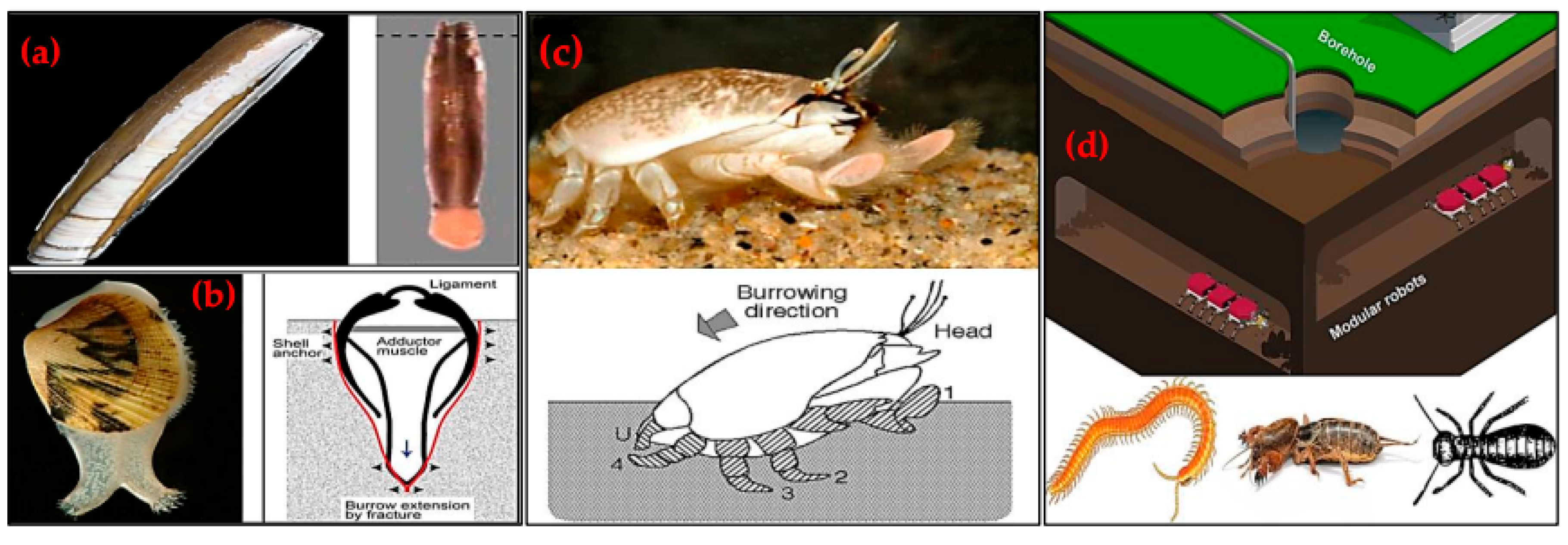
In hard rock mining, core logging and mineral extraction, drilling is an essential part of the mining process. Biomimicry might provide novel approaches to improve drilling efficiency in various mining conditions. The RoboClam [141,142,143,144,145,146,147,148] and the Actuated Bivalve Robot [148,149] are two prominent examples of bioinspired robots. The burrowing mechanism of the Atlantic razor clam, which quickly contracts its valves to fluidize the surrounding soil, served as the model for the RoboClam. By doing this, the clam can burrow with less energy consumption, because the drag is greatly reduced. Compared to conventional methods, RoboClam achieves a remarkable 90% energy reduction when burrowing in wet soils by contracting its valves in a manner replicating Atlantic razor clam’s mechanism [145,146,147]. Similarly, by combining a rocking motion with water expulsion to fluidize the surrounding sediment, the Actuated Bivalve Robot imitates the behaviour of bivalves such as clams. The robot can reduce the force required for burrowing by a factor of 1/7, by expelling water through its shell which makes it a promising tool for tasks like mining anchoring and sediment excavation [148,149].
The ROBOMINERS project develops autonomous robotic miners for subterranean exploration by drawing inspiration from multiple organisms. These robots’ designs are inspired by the segmented bodies of centipedes, the mole cricket’s digging prowess for effective excavation, and the termite’s ability to navigate precisely underground without the use of GPS [150,151,152]. With an emphasis on environmental impact reduction and safety enhancement, these robots are perfect for mining deep underground high-grade deposits, rehabilitating mines and reopening abandoned sites [150,151,152]. Inspired by the strength and recovery movements of the mole crab (Emerita talpoida), the CRABOT is a burrowing robot that uses a similar burrowing technique [148,153]. The robot can replicate the burrowing activity of a mole crab by using appendages resembling uropods, which leads to a 50% increase in burrowing capacity. This design has potential uses in underground leak detection, cable installation and excavation reduction in mining operations [153]. Figure 19 shows the bio-inspired robots’ mechanisms for drilling and burrowing in mining applications [148,150,153,167,168].

5.2.2. Mining Exploration and Mapping

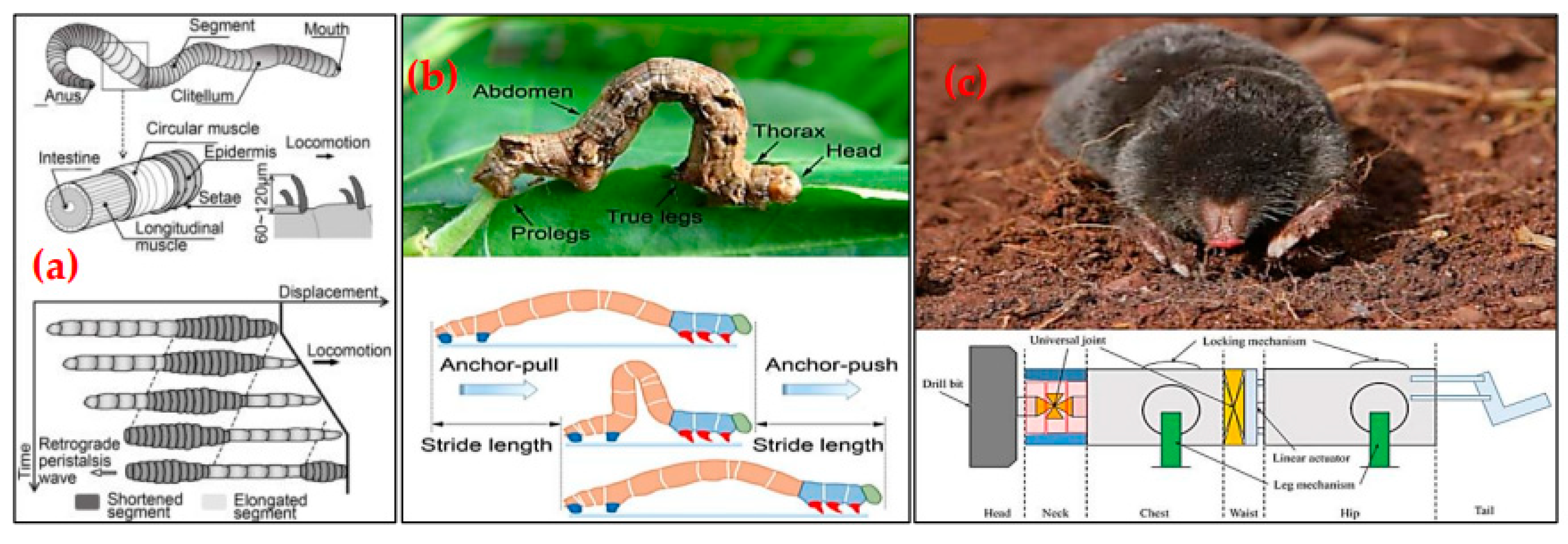
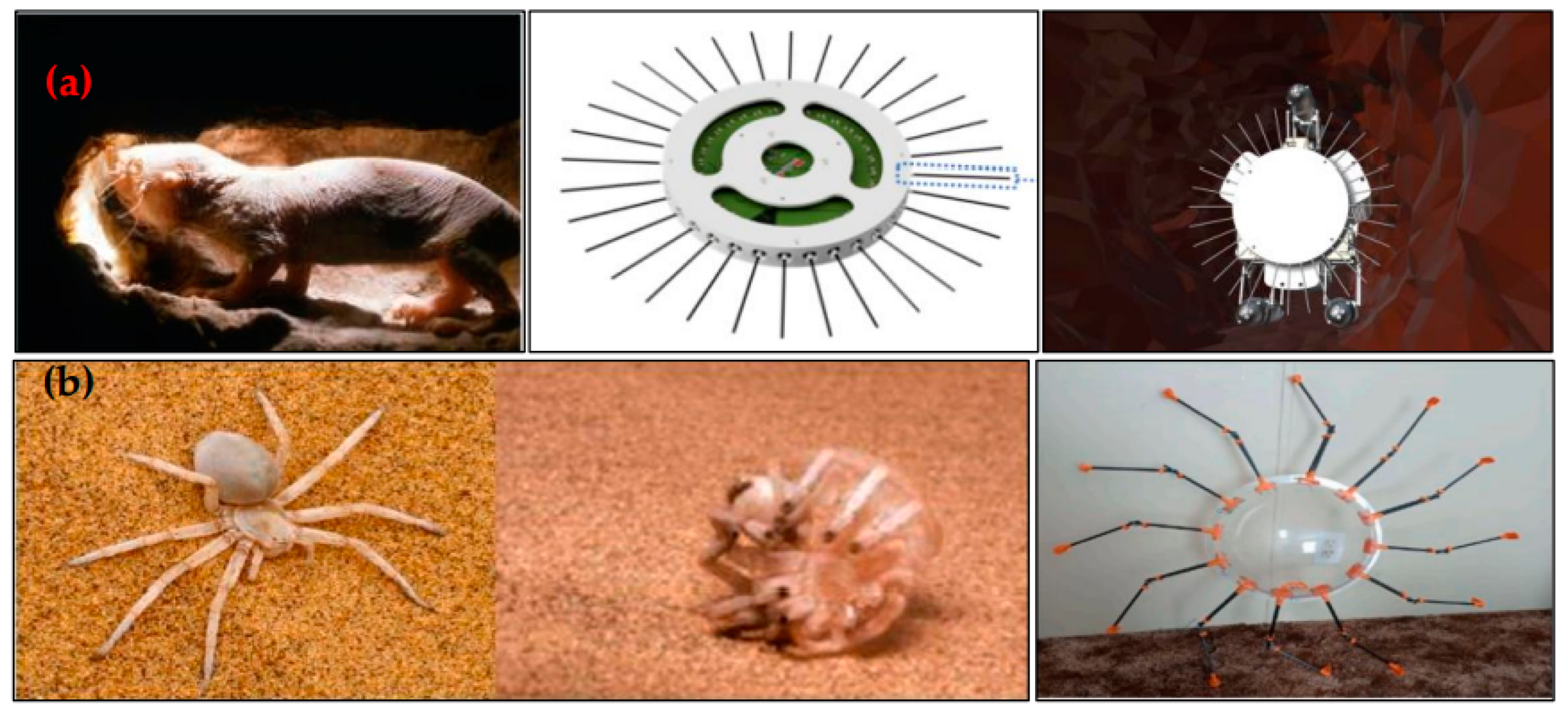
Several robots inspired by moles were developed for shallow drilling mimicking their natural digging behaviour. Using its incisors to push dirt out of the hole, the first drilling robot was designed to resemble an African mole-rat [148,154]. Tested on autoclaved lightweight concrete (ALC) with a compressive strength of 4 Mpa, this robot showed a rate of penetration (ROP) of 0.52 meters per hour, demonstrating its effectiveness in difficult environments [154]. Another robot inspired by the mole, i.e. the Rescue Mole, to perform rescue missions moves through confined underground areas using the palms of its two arms, imitating the mole’s burrowing and crawling abilities [148,155]. The robust humerus and scapula of moles served as inspiration for the Mole-Bot. Enhancing drilling efficiency and debris removal during mining operations, Mol-Bot’s extendable drill bit and forelimb mechanism imitate the forelimbs of a mole [156,157,158]. In addition to terrestrial drilling, Yuan et al. [159,160,161] also explored the application of the mole-inspired drilling technology in the lunar regolith.
Worms are a source of inspiration for biomimetic underground exploration techniques. Earthworms move forward by contracting and releasing body segments, a movement that served as inspiration for the Stratloong robot [148,162]. The anchoring components and drill bit from Stratloong, mimic this mechanism and efficiently penetrate through the seabed soil by stretching and anchoring like an earthworm [162,169]. In tests conducted outdoors Stratloong showed 89% efficiency and moved 2230 mm forward with over 90% motion efficiency in the lab [159,160,161]. This means that it might drill underground tunnels and pipes with greater precision, without needing to excavate in an open way [159,160,161]. Another study on the alternating contraction and extension behaviour of inchworms served as an inspiration for robots such as BADGER [162,163,164] and NASA’s inchworm robots [165,166]. Inchworms tighten their bodies to bring the back of their body into alignment, by anchoring their back segments and pushing their front forward [148,162,163,164,165,166,170]. By using segments that are retractable, extendable and clampable, the BADGER robot simulates this process and can dig and navigate in underground environments [162,163,164]. Tests using straight-line drilling showed that BADGER could follow both straight and curved paths with controlled movement at 0.05 mm/s. Figure 20 shows the bioinspired robots’ mechanisms for exploration and mapping in mining applications [148,154,169,170].
Another study examined a biomimetic tactile navigation system for robotic miners, which was inspired by the whisker sensing abilities of rodents and naked mole rats [171]. The robot developed a three-dimensional map of uneven subterranean terrain, by utilizing Hall effect sensors and a circular array of thirty-two whiskers. An additional discovery is a biomimetic whisker sensor (BMWS) [172]. It uses triboelectric nanogenerators to mimic the structure of mouse whiskers on Earth and in space, enabling it to identify objects and contours with an accuracy of up to 97. 3% in difficult scenarios. A hybrid navigation algorithm and the RM3 robot’s whisker sensors [173] were used in another ROBOMINERS project technique, that increased navigation speed in difficult mining conditions by 26% to 43%. When considered collectively these developments demonstrate how whisker-based sensing might help with navigation and SLAM tasks, where conventional vision systems fall short especially in mining applications.
The Golden Wheel Spider which moves effectively over desert terrain is recognized for its wind-assisted rolling, serving as inspiration for the rolling robots [174]. Prototypes of these robots which are intended for planetary exploration have been tested for energy-efficient mobility on flat Martian terrain. In order to overcome obstacles and save energy, these robots employ pendulum-driven locomotion and wind assistance. Despite being space-focused, the designs might prove useful for mining exploration in challenging conditions like desert. Figure 21 shows the bio-inspired robots’ mechanisms for sensing and navigation in mining applications [171,174].
As can be seen in [148,175], there are numerous bio-inspired robots that have been researched for planetary exploration, mining and other projects and missions. Utilizing inspiration from nature’s models, biomimicry might enhance productivity, sustainability and lessens environmental impact in mining. While the ROBOMINERS project develops robots based on centipedes, mole crickets and termites for deep mining, and excavation, bio-inspired robots like the RoboClam and Actuated Bivalve Robot replicate clam burrowing to significantly reduce energy and force in drilling. Robots that resemble moles improve the efficiency of shallow drilling, while earthworm-like machines like BADGER and Stratloong provide precise subterranean exploration. Furthermore, biomimicry’s potential in demanding mining environments is demonstrated by rolling robots inspired by the Golden Wheel Spider and whisker-based tactile navigation systems based on rodent models that enhance mapping in complicated terrains. Every robot might offer innovative ways to improve productivity, accuracy, and sustainability in mining environments. Table 2 summarise the different bio-inspired robots for mining applications [141,142,143,144,145,146,147,148,149,150,151,152,153,154,155,156,157,158,162,163,164,165,166,171,172,173,174].

5.3. Swarm Robotics in Mining

5.3.1. Mining Operational

Swarm robotics has found extensive applications in fields such as agriculture (Swarm Robotics for Agricultural Applications (SAGA) project [176]), medicine (millirobots [177]), construction (Fiberbots [178] and KALI [179]), and transportation [19,20], but for mining applications it is still in its developing stage. One of the best examples of its mining potential is the Pilbara iron ore mine in Western Australia, which enables operators to remotely control machinery and vehicles from a central hub in Perth [180]. Swarm-based solutions might enhance operational efficiency and safety, as is illustrated in the case fo a smart mine in studies by Ellem, B. [181] and Tinto, R. [182]. It is equipped with innovative technologies such as the Autonomous Haulage System (AHS) and the Autonomous Drilling System (ADS) [183]. At its Jimblebar iron ore mine, BHP mining company deployed more than 50 AHS and achieved 25% increase in production, 40% reduction in drilling costs and 80% reduction in accidents [184]. Rio Tinto deployed 130 AHS in Pilbara iron ore mines and reported 11% improvement in operational performance [185]. The deployment of these autonomous systems at Pilbara has already yielded noteworthy results. Fortescue Metals Group deployed 183 AHS to Chichester and Solomon mine, achieving 50% reduction in production costs [186]. Sweden's Boliden uses 11 Komatsu FrontRunner AHS in the automated underground mining of the Aitik copper mine, and the project will be fully operational in 2024 [187]. Chile's Los Bronces mine also aimed to deploy 62 new 930E super dump trucks by 2024 [187].
Emesent drones participating in the DARPA Subterranean (SubT) Challenge [188] are equipped with hovermaps and are being used to map and explore the subsurface in actual underground mining environments [188,189,190,191,192,193,194], such as Olympic Dam Mine (Australia) [192], Kiruna Mine (Sweden) [193] and Las Cuevas Cave (Belize) [194]. These drones can fly through vertical shafts and cramped areas to detect hazards and provide 3D real-time maps. They are usually used in formations of two to five [188]. Drones ensure safe and effective exploration and environmental monitoring by extending communication networks deep into the mines’ areas that are not accessible to surface robots [188,190]. Similar to this, the Exyn A3R drone uses cutting-edge technologies like LiDAR and SLAM to map underground spaces and collect real-time data [195,196,197]. It is also being used in the Prometheus project [196] and actual underground gold mines like Ascot Resources in Canada [195] and Chelopech mine in Bulgaria [197].
In both surface and underground mining operations, Sandvik’s AutoMine system has created a teleremote autonomous system that allows complete control over the fleet of TH663 trucks and LH514E electric loaders [198,199,200]. The EL Teniente Mine in Chile by Codelco in 2004, the Pyhasalmi Mine in Finland by Inmet Mining in 2005, the Finsch Mine in South Africa by De Beers in 2005, and the Williams Mine in Canada in 2007, are among the mines that have used Sandvik’s AutoMine systems [198]. In 2018, Sandvik’s AutoMine system was deployed in the Resolutes Syama gold mine in Mali, which was managed from a control room in Australia [199]. By cutting FIFO costs, labour costs at the mine and allowing skilled workers to remain on site, this system allows for the automatic extraction of 800 tons of minerals, improving productivity, safety and cost-effectiveness [199].

5.3.2. Mining Research and Development

In recent years, swarm robotics has gained a lot of attention in research and development for both on- and off-earth mining. One of the projects supported by the EU’s Horizon 2020 program is UNEXMIN (Underwater Explorer for Flooded Mines), which creates an autonomous swarm robotic system for mapping and exploring underground mines that have flooded [201,202,203,204]. With the help of numerous UX-1 robots, the project seeks to reopen 30000 abandoned mines in Europe, that contain valuable minerals [202]. The objective is to gather environmental, geological and geophysical data for sustainable non-invasive exploration [201,202,203,204]. In 2018, three UX-1 robot prototypes (UX-1a, UX-1b, and UX-1c) equipped with structured light sensors (SLS) [201], were tested at Kaatiala mine in Finland (quartz and feldspar mine) and Idrija mine in Slovenia (mercury mine), and in 2019 at Urgeiriça mine in Portugal (uranium mine), Ecton mine in the UK (copper mine), and Molnár János cave in Budapest, Hungary [202,204], demonstrating the potential of UX-1 for environmental monitoring and mineral exploration in flooded underground mines. Another mining robot swarm project named NEXGEN SIMS is being worked on by Epiroc [205]. It makes use of autonomous robot groups for mining transportation, drilling and inspection. By operating in both open-pit and underground mines, these robots lessen the need for human intervention in dangerous mining situations. The project has the potential to be fully operational and has undergone testing at Boliden mine in Sweden [205].
Swarmies are small autonomous robots made up of three to six units that are designed to explore, collect and transport resources to complete ISRU tasks for upcoming Mars missions [206,207,208]. They are part of the NASA’s projects (National Aeronautics and Space Administration), for extraterrestrial space exploration. With the help of these swarm robots, minerals like water ice which can be converted into fuel for upcoming space missions, oxygen and water can be extracted and utilized for human habitation on the Moon. NASA developed the Regolith Advanced Surface System Operations Robot (RASSOR) to mine icy regolith on the Moon and Mars [209,210,211]. NASA plans to deploy several RASSOR units in a coordinated system for continuous regolith mining even though, RASSOR is not regarded as a swarm robot [210]. In this scenario the robots could function as a swarm, with each one functioning independently and improving the overall efficiency of regolith mining [211,212]. Table 3 summarise the application of swarm robotics in mining sector [180,181,182,183,184,185,186,187,188,189,190,191,192,193,194,195,196,197,198,199,200,201,202,203,204,205,206,207,208,209,210,211,212].

6. Future Directions and Research Gaps

6.1. Emerging Research Areas

The goal of this new field of research is to improve mining automation, efficiency, safety and sustainability, by combining swarm robotics, bio-inspired design and nature-inspired algorithms based on nature’s systems and their behaviours. Future research endeavours might focus on heterogenous swarms, in which every agent has a distinct role or task within the swarm and has to accomplish a major objective, such as in the study focusing on the integration of natural behaviours in swarm robotic mining under different mining conditions [16], and in another study focusing on developing hybrid heterogeneous swarm robotic systems inspired by natural behaviours for lunar water ice extraction [212]. A system known as an “autonomous swarm robotic system” comprises a swarm of robots that cooperate by using algorithms or behavior inspired by nature and is designed with a bioinspired robot for mining. Swarm robotics for instance, includes drilling, exploration, mapping, extraction, and transportation capabilities. Each individual robot with a specific role can be incorporated in a team. When mining in hostile environments, such as in an underground confined space, in space or deep sea, where human presence and access are restricted, this heterogeneous swarm system might offer a superior solution.
Additionally, incorporation of machine learning (ML) and artificial intelligence (AI) is critical for the development of swarm robotics systems as these technologies can lead to improved robotic behavior such as achieving global consensus through enhanced decision-making [17,18]. This will allow the swarm robots to autonomously decide on specific emergency tasks as well as eliminate potential threats. Furthermore, emerging swarm robotics with highly sophisticated AI that can sense and learn from their surroundings are frequently observed in the field of biomimicry by social animals, like ants and bee in BEE Clust experiments [213,214] and shortest route experiments [215,216,217,218]. Moreover, biomimicry such as self-healing in the miscellaneous category [17,18] is imperative for the field of swarm robotics, particularly when operating in harsh and dynamic environments. Swarm robots can enhance their operational efficiency and reliability by repairing or implementing fault tolerance protocols through the use of this self-healing system autonomously.

6.2. Technological Barriers and Challenges

Swarm robots have been used in various industries, but expanding their use to industry-scale mining operations still presents a challenge. When it comes to real-time decision-making, one of the biggest challenges in deploying swarm robots in dynamic mining environments (like underground mining, remote mining and extraterrestrial mining) is signal transmission [219,220,221]. The power consumption of swarm robots presents another challenge. Swarm robots are contingent upon battery capacity and battery technology is constrained [222,223]. The study by Carrillo et al demonstrated how social insects can divide work among themselves to maximize energy [223]. They created robots that could share power by charging, increasing their operational time and automating tasks. An alternative strategy might involve utilizing solar energy and piezoelectric energy derived from vibrations experienced during excavation or movement during mining activities. Furthermore, the engineering difficulties involved in transferring biomimetic concepts from lab prototypes to intricate mechanical industrial devices in the real world continue to be challenging. Small-scale prototypes work well in testing, but in practice many factors need to be considered including material composition, machine control algorithms and environmental factors like humidity and temperature.

6.3. Opportunities for Cross-Disciplinary Research

The goal of this well-motivated and fascinating research is to develop advanced automated mining systems by bringing together various engineering disciplines, including computer science, mining, planetary mining, swarm robotics, biomimicry, bio-inspired algorithms based on nature’s systems and behaviours. Biologists, computer scientists, mechanical engineers, chemical engineers, mining engineers and environmental scientists will be among the experts involved from related disciplines. For instance, material scientists and chemical engineers could use biological systems to gain insights into better materials, that are tighter, lighter, more energy-efficient and more durable. Biologists could study the behaviours of social animals in nature, such as how these tiny creatures create a life mechanism for survival. Computer scientists and mechanical engineers could adapt it into robotic systems, to test the behavior of swarm robots. Furthermore, through these tests mining engineers and environmental scientists could discover more sophisticated smart mining solutions, to achieve highly sustainable operations, increasing operational efficiency and reducing environmental impact for more complex mining problems.

7. Conclusion

This comprehensive review aimed to demonstrate the potential of incorporating biomimicry, nature-inspired algorithms (NIA), and swarm robotics into mining operations. More scalable, decentralized and dependable mining operations would be made possible, by this inspiration. Applications of NIAs in resource management, mine exploration, scheduling, monitoring and safety, might benefit all these aspects of mining industry. Like biomimicry, it has gained a lot of attention, and might be developed to enhance mining performance, particularly when it comes to drilling in a variety of ground conditions for terrestrial and extraterrestrial mining and in dangerous environments like flooded mines and underground mines. Several research and development projects on the applications of biomimicry, NIAs and swarm robotics in the mining sector have been carried out to increase automation, efficiency and sustainability in mining. Swarm robotics integration into the mining industry faces challenges, including scalability concerns for large-scale operations, communication problems, energy consumption problems and reliability problems when converting the prototypes onto large-scale mining applications. Machine learning (ML), artificial intelligence (AI) and interdisciplinary teams integrating scientists and experts from various related fields are crucial in pushing the boundaries of automated sustainable smart mining to the next level. To summarize, fully automated and sustainable mining operations that make use and benefit from the potential of biomimicry, swarm robotics and nature-inspired algorithms will be critical to creating smart mines.

Funding

This research received no external funding.

Conflicts of Interest

The authors declare no conflicts of interest.

References

  1. Benyus, J. (1997). Biomimicry: Innovation Inspired by Nature. Harper Perennial.
  2. Omar, M., Akash, B., & Sheraz, U. (2015). Applications of biomimicry in engineering design. Journal of Bionic Engineering, 12(1), 24-35.
  3. Akash, G.M., 2020. Application of biomimetics in design of vehicles–A review. Int Res J Eng Technol, 7(3), pp.2753-2759.
  4. Cheraghi, A.R., Shahzad, S., & Graffi, K. (2022). Past, present, and future of swarm robotics. arXiv preprint arXiv:2101.00671.
  5. Shibeshi, T.S. (2009). Urban planning inspired by ant colony organization. International Journal of Urban Sciences, 13(2), 157-172.
  6. Hutchins, E. (2012). Biomimicry in architecture: Cooling systems inspired by termite mounds. Architectural Science Review, 55(1), 45-56.
  7. Bertayeva, K., Panaedova, G., Natocheeva, N. and Belyanchikova, T., 2019. Industry 4.0 in the mining industry: Global trends and innovative development. In E3S Web of conferences (Vol. 135, p. 04026). EDP Sciences.
  8. Jenkins, H. , 2004. Corporate social responsibility and the mining industry: conflicts and constructs. Corporate social responsibility and environmental management, 11(1), pp.23-34.
  9. Rogers, W.P., Kahraman, M.M., Drews, F.A., Powell, K., Haight, J.M., Wang, Y., Baxla, K. and Sobalkar, M., 2019. Automation in the mining industry: Review of technology, systems, human factors, and political risk. Mining, metallurgy & exploration, 36, pp.607-631.
  10. Carvalho, F.P. , 2017. Mining industry and sustainable development: time for change. Food and Energy security, 6(2), pp.61-77.
  11. Kalisz, S., Kibort, K., Mioduska, J., Lieder, M. and Małachowska, A., 2022. Waste management in the mining industry of metals ores, coal, oil and natural gas-A review. Journal of environmental management, 304, p.114239.
  12. McNab, K. and Garcia-Vasquez, M., 2011. Autonomous and remote operation technologies in Australian mining. Brisbane City, Australia: Centre for Social Responsibility in Mining (CSRM)-Sustainable Minerals Institute, University of Queensland.
  13. Singh, G., Singh, S.K., Chaurasia, R.C. and Jain, A.K., 2024. THE PRESENT AND FUTURE PROSPECT OF ARTIFICIAL INTELLIGENCE IN THE MINING INDUSTRY. Machine Learning, 53(4).
  14. Onifade, M., Zvarivadza, T., Adebisi, J.A., Said, K.O., Dayo-Olupona, O., Lawal, A.I. and Khandelwal, M., 2024. Advancing toward sustainability: The emergence of green mining technologies and practices. Green and Smart Mining Engineering, 1(2), pp.157-174.
  15. Tan, J., Melkoumian, N., Akmeliawati, R., & Harvey, D., 2021. Design and application of swarm robotics system using ABCO method for off-Earth mining. Fifth International Future Mining Conference 2021. AusIMM.
  16. Tan, J., Melkoumian, N., Harvey, D. and Akmeliawati, R., 2024. Evaluating Swarm Robotics for Diverse Mining Environments: Insights into Model Performance and Application.
  17. Brambilla, M., Ferrante, E., Birattari, M. and Dorigo, M., 2013. Swarm robotics: a review from the swarm engineering perspective. Swarm Intelligence, 7, pp.1-41.
  18. Schranz, M., Umlauft, M., Sende, M. and Elmenreich, W., 2020. Swarm robotic behaviors and current applications. Frontiers in Robotics and AI, 7, p.36.
  19. Trianni, V., IJsselmuiden, J. and Haken, R., 2016. The Saga Concept: Swarm Robotics for Agricultural Applications. Technical Report. 2016. Available online: http://laral. istc. cnr. it/saga/wp-content/uploads/2016/09/sagadars2016. pdf (accessed on 23 August 2018).
  20. Sawant, R., Singh, C., Shaikh, A., Aggarwal, A., Shahane, P. and Harikrishnan, R., 2022, January. Mine Detection using a Swarm of Robots. In 2022 International Conference on Advances in Computing, Communication and Applied Informatics (ACCAI) (pp. 1-9). IEEE.
  21. Young, C., Papadopoulos, L., Wendorf, M. and Williams, M., 2021. Biomimicry: 9 Ways Engineers Have Been `Inspired` by Nature. [online] Interestingengineering.com. 21 September. Available online: https://interestingengineering.com/biomimicry-9-ways-engineers-have-been-inspired-by-nature (accessed on 21 September 2020).
  22. Wen, L., Weaver, J.C. and Lauder, G.V., 2014. Biomimetic shark skin: design, fabrication and hydrodynamic function. Journal of experimental Biology, 217(10), pp.1656-1666.
  23. Ab Wahab, M.N., Nefti-Meziani, S. and Atyabi, A., 2015. A comprehensive review of swarm optimization algorithms. PloS one, 10(5), p.e0122827.
  24. Darvishpoor, S., Darvishpour, A., Escarcega, M. and Hassanalian, M., 2023. Nature-inspired algorithms from oceans to space: a comprehensive review of heuristic and meta-heuristic optimization algorithms and their potential applications in drones. Drones, 7(7), p.427.
  25. Houssein, E.H., Younan, M. and Hassanien, A.E., 2019. Nature-inspired algorithms: A comprehensive review. Hybrid Computational Intelligence, pp.1-25.
  26. Fister Jr, I., Yang, X.S., Fister, I., Brest, J. and Fister, D., 2013. A brief review of nature-inspired algorithms for optimization. arXiv:1307.4186.
  27. Mirjalili, S., Gandomi, A.H., Mirjalili, S.Z., Saremi, S., Faris, H. and Mirjalili, S.M., 2017. Salp Swarm Algorithm: A bio-inspired optimizer for engineering design problems. Advances in Engineering Software, 114, pp.163-191.
  28. Dhiman, G. and Kumar, V., 2017. Spotted hyena optimizer: a novel bio-inspired based metaheuristic technique for engineering applications. Advances in Engineering Software, 114, pp.48-70.
  29. Zang, H., Zhang, S. and Hapeshi, K., 2010. A review of nature-inspired algorithms. Journal of Bionic Engineering, 7(4), pp. S232-S237.
  30. Abualigah, L., Shehab, M., Alshinwan, M. and Alabool, H., 2020. Salp swarm algorithm: a comprehensive survey. Neural Computing and Applications, 32(15), pp.11195-11215.
  31. Abualigah, L.M., Sawaie, A.M., Khader, A.T., Rashaideh, H., Al-Betar, M.A. and Shehab, M., 2017. β-hill climbing technique for the text document clustering. New Trends in Information Technology (NTIT)–2017, 60.
  32. Glover, F., 1989. Tabu search—part I. ORSA Journal on computing, 1(3), pp.190-206.
  33. Kirkpatrick, S., 1984. Optimization by simulated annealing: Quantitative studies. Journal of statistical physics, 34(5), pp.975-986.
  34. Abualigah, L.M.Q. and Hanandeh, E.S., 2015. Applying genetic algorithms to information retrieval using vector space model. International Journal of Computer Science, Engineering and Applications (IJCSEA) Vol, 5.
  35. Geem, Z.W., Kim, J.H. and Loganathan, G.V., 2001. A new heuristic optimization algorithm: harmony search. simulation, 76(2), pp.60-68.
  36. Rajabioun, R., 2011. Cuckoo optimization algorithm. Applied soft computing, 11(8), pp.5508-5518.
  37. Yang, X.S., 2010. Firefly algorithm, stochastic test functions and design optimisation. International journal of bio-inspired computation, 2(2), pp.78-84.
  38. Dorigo, M. and Di Caro, G., 1999, July. Ant colony optimization: a new meta-heuristic. In Proceedings of the 1999 congress on evolutionary computation-CEC99 (Cat. No. 99TH8406) (Vol. 2, pp. 1470-1477). IEEE.
  39. Dhiman, G. and Kumar, V., 2017. Spotted hyena optimizer: a novel bio-inspired based metaheuristic technique for engineering applications. Advances in Engineering Software, 114, pp.48-70.
  40. Yang, X.S., 2010. A new metaheuristic bat-inspired algorithm. In Nature inspired cooperative strategies for optimization (NICSO 2010) (pp. 65-74). Springer, Berlin, Heidelberg.
  41. Bolaji, A.L.A., Al-Betar, M.A., Awadallah, M.A., Khader, A.T. and Abualigah, L.M., 2016. A comprehensive review: Krill Herd algorithm (KH) and its applications. Applied Soft Computing, 49, pp.437-446.
  42. Yang, X.S. and Deb, S., 2009, December. Cuckoo search via Lévy flights. In 2009 World congress on nature & biologically inspired computing (NaBIC) (pp. 210-214). Ieee.
  43. Karaboga, D., 2005. An idea based on honeybee swarm for numerical optimization (Vol. 200, pp. 1-10). Technical report-tr06, Erciyes university, engineering faculty, computer engineering department.
  44. Mirjalili, S., 2015. Moth-flame optimization algorithm: A novel nature-inspired heuristic paradigm. Knowledge-based systems, 89, pp.228-249.
  45. Niu, B. and Wang, H., 2012. Bacterial colony optimization, ‖ Discrete Dyn. Nat. Soc, 2012.
  46. Simon, D., 2008. Biogeography-based optimization. IEEE transactions on evolutionary computation, 12(6), pp.702-713.
  47. Mirjalili, S., Mirjalili, S.M. and Lewis, A., 2014. Grey Wolf Optimizer Adv Eng Softw 69: 46–61.
  48. Mirjalili, S., 2015. The ant lion optimizer. Advances in engineering software, 83, pp.80-98.
  49. Eberhart, R. and Kennedy, J., 1995, October. A new optimizer using particle swarm theory. In MHS'95. Proceedings of the sixth international symposium on micro machine and human science (pp. 39-43). Ieee.
  50. Torres-Treviño, L. , 2021. A 2020 taxonomy of algorithms inspired on living beings’ behavior. arXiv:2106.04775.
  51. Dorigo, M. and Di Caro, G., 1999, July. Ant colony optimization: a new meta-heuristic. In Proceedings of the 1999 congress on evolutionary computation-CEC99 (Cat. No. 99TH8406) (Vol. 2, pp. 1470-1477). IEEE.
  52. Colorni, A., Dorigo, M. and Maniezzo, V., 1992, September. An Investigation of some Properties of an" Ant Algorithm". In Ppsn (Vol. 92, No. 1992).
  53. Kumar, V. and Yadav, S.M., 2022. A state-of-the-Art review of heuristic and metaheuristic optimization techniques for the management of water resources. Water Supply, 22(4), pp.3702-3728.
  54. Tan, J., Melkoumian, N., Harvey, D. and Akmeliawati, R., 2024. Classifying Nature-Inspired Swarm Algorithms for Sustainable Autonomous Mining.
  55. Jackson, D.E. and Ratnieks, F.L., 2006. Communication in ants. Current biology, 16(15), pp.R570-R574.
  56. Phan, H.D., Ellis, K., Barca, J.C. and Dorin, A., 2020. A survey of dynamic parameter setting methods for nature-inspired swarm intelligence algorithms. Neural computing and applications, 32(2), pp.567-588.
  57. Okonta, C.I., Kemp, A.H., Edopkia, R.O., Monyei, G.C. and Okelue, E.D., 2016, August. A heuristic based ant colony optimization algorithm for energy efficient smart homes. In Proc. 5th Int. Conf. Exhib. Clean Energy (pp. 1-12).
  58. Van Quan, T., Giang, N.H. and Tan, N.N., 2023. A DATA-DRIVEN APPROACH FOR INVESTIGATING SHEAR STRENGTH OF SLENDER STEEL FIBER REINFORCED CONCRETE BEAMS. Journal of Science and Technology in Civil Engineering (JSTCE)-HUCE, 17(2), pp.133-144.
  59. Yousefi, M., Omid, M., Rafiee, S. and Ghaderi, S.F., 2013. Strategic planning for minimizing CO2 emissions using LP model based on forecasted energy demand by PSO Algorithm and ANN. International Journal of Energy and Environment (Print), 4.
  60. Khader, A.T., Al-betar, M.A. and Mohammed, A.A., 2013. Artificial bee colony algorithm, its variants and applications: a survey.
  61. Karaboga, D., 2010. Artificial bee colony algorithm. scholarpedia, 5(3), p.6915.
  62. Chalotra, S., Sehra, S.K. and Sehra, S.S., 2016, February. A systematic review of applications of bee colony optimization. In 2016 International conference on innovation and challenges in cyber security (ICICCS-INBUSH) (pp. 257-260). IEEE.
  63. Chao, K.H. and Li, J.Y., 2022. Global maximum power point tracking of photovoltaic module arrays based on improved artificial bee colony algorithm. Electronics, 11(10), p.1572.
  64. Sharma, T.K., Pant, M. and Singh, V.P., 2012. Improved local search in artificial bee colony using golden section search. arXiv:1210.6128.
  65. Yang, J. and Peng, Z., 2018. Improved ABC algorithm optimizing the bridge sensor placement. Sensors, 18(7), p.2240.
  66. Tighzert, L., Fonlupt, C. and Mendil, B., 2018. A set of new compact firefly algorithms. Swarm and evolutionary computation, 40, pp.92-115.
  67. Sharma, S., Jain, P. and Saxena, A., 2020. Adaptive inertia-weighted firefly algorithm. In Intelligent Computing Techniques for Smart Energy Systems: Proceedings of ICTSES 2018 (pp. 495-503). Springer Singapore.
  68. Nordin, N., Sulaiman, S.I. and Omar, A.M. (2018) ‘Hybrid artificial neural network with meta-heuristics for grid-connected photovoltaic system output prediction’, Indonesian Journal of Electrical Engineering and Computer Science, 11(1), p. 121. [CrossRef]
  69. Iglesias, A., Gálvez, A. and Suárez, P., 2020. Swarm robotics–a case study: bat robotics. In Nature-Inspired Computation and Swarm Intelligence (pp. 273-302). Academic Press.
  70. Topal, A.O. and Altun, O., 2016. A novel meta-heuristic algorithm: dynamic virtual bats algorithm. Information Sciences, 354, pp.222-235.
  71. Templos-Santos, J.L., Aguilar-Mejia, O., Peralta-Sanchez, E. and Sosa-Cortez, R., 2019. Parameter tuning of PI control for speed regulation of a PMSM using bio-inspired algorithms. Algorithms, 12(3), p.54.
  72. Gandomi, A.H. and Alavi, A.H., 2012. Krill herd: a new bio-inspired optimization algorithm. Communications in nonlinear science and numerical simulation, 17(12), pp.4831-4845.
  73. Wang, G.G., Gandomi, A.H., Alavi, A.H. and Gong, D., 2019. A comprehensive review of krill herd algorithm: variants, hybrids and applications. Artificial Intelligence Review, 51, pp.119-148.
  74. Ren, Y.T., Qi, H., Huang, X., Wang, W., Ruan, L.M. and Tan, H.P., 2016. Application of improved krill herd algorithms to inverse radiation problems. International Journal of Thermal Sciences, 103, pp.24-34.
  75. Regad, M., Helaimi, M.H., Taleb, R., Othman, A.M. and Gabbar, H.A., 2020. Frequency control of microgrid with renewable generation using PID controller based krill herd. Indonesian Journal of Electrical Engineering and Informatics (IJEEI), 8(1), pp.21-32.
  76. Faris, H., Aljarah, I., Al-Betar, M.A. and Mirjalili, S., 2018. Grey wolf optimizer: a review of recent variants and applications. Neural computing and applications, 30, pp.413-435.
  77. Guha, D., Roy, P.K. and Banerjee, S., 2016. Load frequency control of large scale power system using quasi-oppositional grey wolf optimization algorithm. Engineering Science and Technology, an International Journal, 19(4), pp.1693-1713.
  78. Zhang, J., Wang, Z. and Luo, X., 2018. Parameter estimation for soil water retention curve using the salp swarm algorithm. Water, 10(6), p.815.
  79. Saremi, S., Mirjalili, S. and Lewis, A., 2017. Grasshopper optimisation algorithm: theory and application. Advances in engineering software, 105, pp.30-47.
  80. Meraihi, Y., Gabis, A.B., Mirjalili, S. and Ramdane-Cherif, A., 2021. Grasshopper optimization algorithm: theory, variants, and applications. IEEE Access, 9, pp.50001-50024.
  81. Abualigah, L. and Diabat, A., 2020. A comprehensive survey of the Grasshopper optimization algorithm: results, variants, and applications. Neural Computing and Applications, 32(19), pp.15533-15556.
  82. Nabavi, S., Gholampour, S. and Haji, M.S., 2022. Damage detection in frame elements using Grasshopper Optimization Algorithm (GOA) and time-domain responses of the structure. Evolving Systems, 13(2), pp.307-318.
  83. Tan, Y. and Zheng, Z.Y., 2013. Research advance in swarm robotics. Defence Technology, 9(1), pp.18-39.
  84. Fong, T., Nourbakhsh, I. and Dautenhahn, K., 2003. A survey of socially interactive robots. Robotics and autonomous systems, 42(3-4), pp.143-166.
  85. Blum, C. and Merkle, D. eds., 2008. Swarm intelligence: introduction and applications. Springer Science & Business Media.
  86. Szabó, L., Káptalan, E. and Szász, C., 2011. Applications of Collective Behavior Concepts in Flexible Manufacturing Systems. Journal of Computer Science and Control Systems, 4(1), p.187.
  87. Majid, M.H.A., Arshad, M.R. and Mokhtar, R.M., 2022. Swarm robotics behaviors and tasks: a technical review. Control engineering in robotics and industrial automation: Malaysian society for automatic control engineers (MACE) technical series 2018, pp.99-167.
  88. Mariappan, M., Arshad, M.R., Akmeliawati, R. and Chong, C.S., 2022. Control Engineering in Robotics and Industrial Automation.
  89. Novischi, D.M. and Florea, A.M., 2013, October. Toward a real-time heterogeneous mobile robotic swarm: Robot platform and agent architecture. In 2013 17th International Conference on System Theory, Control and Computing (ICSTCC) (pp. 772-776). IEEE.
  90. Dorigo, M., Floreano, D., Gambardella, L.M., Mondada, F., Nolfi, S., Baaboura, T., Birattari, M., Bonani, M., Brambilla, M., Brutschy, A. and Burnier, D., 2013. Swarmanoid: a novel concept for the study of heterogeneous robotic swarms. IEEE Robotics & Automation Magazine, 20(4), pp.60-71.
  91. Kayser, M., Cai, L., Bader, C., Falcone, S., Inglessis, N., Darweesh, B., Costa, J. and Oxman, N., 2018, September. Fiberbots: design and digital fabrication of tubular structures using robot swarms. In Robotic Fabrication in Architecture, Art and Design (pp. 285-296). Springer, Cham.
  92. Petersen, K.H., Nagpal, R. and Werfel, J.K., 2011. Termes: An autonomous robotic system for three-dimensional collective construction. Robotics: science and systems VII.
  93. Phys.org. 2018. Nature-inspired soft millirobot makes its way through enclosed spaces. Available online: https://phys.org/news/2018-01-nature-inspired-soft-millirobot-enclosed-spaces.html (accessed on 1 June 2020).
  94. Trianni, V., IJsselmuiden, J. and Haken, R., 2016. The Saga Concept: Swarm Robotics for Agricultural Applications. Technical Report. 2016. Available online: http://laral. istc. cnr. it/saga/wp-content/uploads/2016/09/sagadars2016. pdf (accessed on 23 August 2018).
  95. Kshetri, N. and Rojas-Torres, D., 2018. The 2018 winter olympics: A showcase of technological advancement. IT Prof., 20(2), pp.19-25.
  96. Navarro, I. and Matía, F., 2013. An introduction to swarm robotics. International Scholarly Research Notices, 2013(1), p.608164.
  97. BRAMBILLA, D., 2014. Environment classification: an empirical study of the response of a robot swarm to three different decision-making rules.
  98. Trianni, V. and Campo, A., 2015. Fundamental collective behaviors in swarm robotics. Springer handbook of computational intelligence, pp.1377-1394.
  99. Bayındır, L., 2016. A review of swarm robotics tasks. Neurocomputing, 172, pp.292-321.
  100. Mendonça, M., Chrun, I.R., Neves Jr, F. and Arruda, L.V., 2017. A cooperative architecture for swarm robotic based on dynamic fuzzy cognitive maps. Engineering Applications of Artificial Intelligence, 59, pp.122-132.
  101. Connor, J., Champion, B. and Joordens, M.A., 2020. Current algorithms, communication methods and designs for underwater swarm robotics: A review. IEEE Sensors Journal, 21(1), pp.153-169.
  102. Duflo, G., Danoy, G., Talbi, E.G. and Bouvry, P., 2022. Learning to Optimise a Swarm of UAVs. Applied Sciences, 12(19), p.9587.
  103. Duan, H., Huo, M. and Fan, Y., 2023. From animal collective behaviors to swarm robotic cooperation. National Science Review, 10(5), p.nwad040.
  104. Ibrahim, R., Alkilabi, M., Khayeat, A.R.H. and Tuci, E., 2024. Review of Collective Decision Making in Swarm Robotics. Journal of Al-Qadisiyah for Computer Science and Mathematics, 16(1), pp.72-80.
  105. Mansouri, S.S., Kanellakis, C., Kominiak, D. and Nikolakopoulos, G., 2020. Deploying MAVs for autonomous navigation in dark underground mine environments. Robotics and Autonomous Systems, 126, p.103472.
  106. Lerman, K., Martinoli, A. and Galstyan, A., 2005. A review of probabilistic macroscopic models for swarm robotic systems. In Swarm Robotics: SAB 2004 International Workshop, Santa Monica, CA, USA, July 17, 2004, Revised Selected Papers 1 (pp. 143-152). Springer Berlin Heidelberg.
  107. De La Cruz, C. and Carelli, R., 2006, November. Dynamic modeling and centralized formation control of mobile robots. In IECON 2006-32nd annual conference on IEEE industrial electronics (pp. 3880-3885). IEEE.
  108. Mehrjerdi, H., Saad, M. and Ghommam, J., 2010. Hierarchical fuzzy cooperative control and path following for a team of mobile robots. IEEE/ASME Transactions on Mechatronics, 16(5), pp.907-917.
  109. Kamel, M.A., Yu, X. and Zhang, Y., 2020. Formation control and coordination of multiple unmanned ground vehicles in normal and faulty situations: A review. Annual reviews in control, 49, pp.128-144.
  110. Dorigo, M., Theraulaz, G. and Trianni, V., 2021. Swarm robotics: Past, present, and future [point of view]. Proceedings of the IEEE, 109(7), pp.1152-1165.
  111. Kambayashi, Y., Yajima, H., Shyoji, T., Oikawa, R. and Takimoto, M., 2019. Formation control of swarm robots using mobile agents. Vietnam Journal of Computer Science, 6(02), pp.193-222.
  112. Stolfi, D.H. and Danoy, G., 2024. Evolutionary swarm formation: From simulations to real world robots. Engineering Applications of Artificial Intelligence, 128, p.107501.
  113. Lu, S., Samaan, N., Diao, R., Elizondo, M., Jin, C., Mayhorn, E., Zhang, Y. and Kirkham, H., 2011, January. Centralized and decentralized control for demand response. In ISGT 2011 (pp. 1-8). Ieee.
  114. Jamshidpey, A., Wahby, M., Heinrich, M.K., Allwright, M., Zhu, W. and Dorigo, M., 2024. Centralization vs. decentralization in multi-robot coverage: Ground robots under uav supervision. arXiv:2408.06553.
  115. Garattoni, L., Birattari, M. and Webster, J.G., 2016. Swarm robotics. Wiley encyclopedia of electrical and electronics engineering, 10.
  116. Lewis, M.A. and Tan, K.H., 1997. High precision formation control of mobile robots using virtual structures. Autonomous robots, 4(4), pp.387-403.
  117. Balch, T. and Arkin, R.C., 1998. Behavior-based formation control for multirobot teams. IEEE transactions on robotics and automation, 14(6), pp.926-939.
  118. Desai Jaydev, P. and Ostrowski James, P., 2001. Kumar Vijay. Modeling and control of formations of nonholonomic mobile robots, Robotics and Automation, IEEE Transactions on, 17(6), pp.905-908.
  119. Lei, T., Sellers, T., Luo, C., Carruth, D.W. and Bi, Z., 2023. Graph-based robot optimal path planning with bio-inspired algorithms. Biomimetic Intelligence and Robotics, 3(3), p.100119.
  120. Desai, J.P., Ostrowski, J. and Kumar, V., 1998, May. Controlling formations of multiple mobile robots. In Proceedings. 1998 IEEE International Conference on Robotics and Automation (Cat. No. 98CH36146) (Vol. 4, pp. 2864-2869). IEEE.
  121. Khatib, O., 1986. Real-time obstacle avoidance for manipulators and mobile robots. In Autonomous robot vehicles (pp. 396-404). Springer, New York, NY.
  122. Lawton, J.R., Beard, R.W. and Young, B.J., 2003. A decentralized approach to formation maneuvers. IEEE transactions on robotics and automation, 19(6), pp.933-941.
  123. Nhleko, A.S. and Musingwini, C., 2019. Analysis of the particle swarm optimization (PSO) algorithm for application in stope layout optimisation for underground mines. In Proceedings of the Mine Planner’s Colloquium.
  124. Jafrasteh, B. and Fathianpour, N., 2017. Optimal location of additional exploratory drillholes using afuzzy-artificial bee colony algorithm. Arabian Journal of Geosciences, 10, pp.1-16.
  125. Saremi, S., Mirjalili, S. and Lewis, A., 2017. Grasshopper optimisation algorithm: theory and application. Advances in engineering software, 105, pp.30-47.
  126. Mohammadzadeh, M., Mahboubiaghdam, M., Nasseri, A. and Jahangiri, M., 2023. A New Frontier in Mineral Exploration: Hybrid Machine Learning and Bat Metaheuristic Algorithm for Cu-Au Mineral Prospecting in Sonajil area, E-Azerbaijan.
  127. Korzeń, M. and Kruszyna, M., 2023. Modified Ant Colony Optimization as a Means for Evaluating the Variants of the City Railway Underground Section. International Journal of Environmental Research and Public Health, 20(6), p.4960.
  128. Sattarvand, J., 2012. Long-term open-pit planning by ant colony optimization (Doctoral dissertation, Aachen, Techn. Hochsch., Diss., 2009).
  129. Gilani, S.O. and Sattarvand, J., 2016. Integrating geological uncertainty in long-term open pit mine production planning by ant colony optimization. Computers & Geosciences, 87, pp.31-40.
  130. Shishvan, M.S. and Sattarvand, J., 2015. Long term production planning of open pit mines by ant colony optimization. European Journal of Operational Research, 240(3), pp.825-836.
  131. Khan, A. and Niemann-Delius, C., 2014, September. Application of particle swarm optimization to the open pit mine scheduling problem. In Proceedings of the 12th International Symposium Continuous Surface Mining-Aachen 2014 (pp. 195-212). Cham: Springer International Publishing.
  132. Ferland, J., Amaya, J. and Djuimo, M.S., 2007. Particle swarm procedure for the capacitated open pit mining problem. Autonomous Robot and Agents. Studies in Computational Intelligence, Book Series, Springer Verlag.
  133. Khan, A., 2018. Long-term production scheduling of open pit mines using particle swarm and bat algorithms under grade uncertainty. Journal of the Southern African Institute of Mining and Metallurgy, 118(4), pp.361-368.
  134. Tolouei, K. and Moosavi, E., 2020. Production scheduling problem and solver improvement via integration of the grey wolf optimizer into the augmented Lagrangian relaxation method. SN Applied Sciences, 2(12), p.1963.
  135. Ghaziania, H.H., Monjezi, M., Mousavi, A., Dehghani, H. and Bakhtavar, E., 2021. Design of loading and transportation fleet in open-pit mines using simulation approach and metaheuristic algorithms. Journal of Mining and Environment, 12(4), pp.1177-1188.
  136. Bao, H. and Zhang, R., 2020. Study on Optimization of Coal Truck Flow in Open-Pit Mine. Advances in Civil Engineering, 2020(1), p.8848140.
  137. Nguyen, H., Bui, X.N. and Topal, E., 2023. Reliability and availability artificial intelligence models for predicting blast-induced ground vibration intensity in open-pit mines to ensure the safety of the surroundings. Reliability Engineering & System Safety, 231, p.109032.
  138. Yan, G. and Feng, D., 2013. Escape-Route Planning of Underground Coal Mine Based on Improved Ant Algorithm. Mathematical Problems in Engineering, 2013(1), p.687969.
  139. Li, X., Li, Y., Zhang, Y., Liu, F. and Fang, Y., 2020. Fault diagnosis of belt conveyor based on support vector machine and grey wolf optimization. Mathematical Problems in Engineering, 2020(1), p.1367078.
  140. Liu, Y., Lin, J. and Yue, H., 2023. Soil respiration estimation in desertified mining areas based on UAV remote sensing and machine learning. Earth Science Informatics, 16(4), pp.3433-3448.
  141. Trueman, E.R., 1967. The dynamics of burrowing in Ensis (Bivalvia). Proceedings of the Royal Society of London. Series B. Biological Sciences, 166(1005), pp.459-476.
  142. Winter, A.G., Hosoi, A.E., Slocum, A.H. and Deits, R.L., 2009, January. The design and testing of RoboClam: A machine used to investigate and optimize razor clam-inspired burrowing mechanisms for engineering applications. In International Design Engineering Technical Conferences and Computers and Information in Engineering Conference (Vol. 49040, pp. 721-726).
  143. Winter, A.G. and Hosoi, A.E., 2011. Identification and evaluation of the Atlantic razor clam (Ensis directus) for biologically inspired subsea burrowing systems.
  144. Winter, A.G., Deits, R.L. and Dorsch, D.S., 2013, August. Critical timescales for burrowing in undersea substrates via localized fluidization, demonstrated by RoboClam: a robot inspired by Atlantic razor clams. In International Design Engineering Technical Conferences and Computers and Information in Engineering Conference (Vol. 55935, p. V06AT07A007). American Society of Mechanical Engineers.
  145. Winter, A.G., Deits, R.L.H., Dorsch, D.S., Slocum, A.H. and Hosoi, A.E., 2014. Razor clam to RoboClam: burrowing drag reduction mechanisms and their robotic adaptation. Bioinspiration & biomimetics, 9(3), p.036009.
  146. Isava, M., 2015. An investigation of the critical timescales needed for digging in wet and dry soil using a biomimetic burrowing robot (Doctoral dissertation, Massachusetts Institute of Technology).
  147. Isava, M., 2016. Razor clam-inspired burrowing in dry soil. International Journal of Non-Linear Mechanics, 81, pp.30-39.
  148. Wei, H., Zhang, Y., Zhang, T., Guan, Y., Xu, K., Ding, X. and Pang, Y., 2021. Review on bioinspired planetary regolith-burrowing robots. Space Science Reviews, 217, pp.1-39.
  149. Koller-hodac et al., “Actuated Bivalve Robot Study of the Burrowing Locomotion in Sediment,” in IEEE International Conference on Robotics and Automation, 2010, pp. 1209–1214.
  150. Lopes, L., Bodo, B., Rossi, C., Henley, S., Žibret, G., Kot-Niewiadomska, A. and Correia, V., 2020. ROBOMINERS–Developing a bio-inspired modular robot-miner for difficult to access mineral deposits. Advances in Geosciences, 54, pp.99-108.
  151. Gomez, V., Hernando, M., Aguado, E., Sanz, R. and Rossi, C., 2023. Robominer: Development of a highly configurable and modular scaled-down prototype of a mining robot. Machines, 11(8), p.809.
  152. Berner, M. and Sifferlinger, N.A., 2024. H2020-ROBOMINERS Prototype Field Test. BHM Berg-und Hüttenmännische Monatshefte, 169(4), pp.197-198.
  153. Russell, R.A., 2011. CRABOT: A biomimetic burrowing robot designed for underground chemical source location. Advanced Robotics, 25(1-2), pp.119-134.
  154. Kim, J., Jang, H.W., Shin, J.U., Hong, J.W. and Myung, H., 2018. Development of a mole-like drilling robot system for shallow drilling. IEEE Access, 6, pp.76454-76463.
  155. Kobayashi, T., Tshukagoshi, H., Honda, S. and Kitagawa, A., 2011. Burrowing rescue robot referring to a mole’s shoveling motion. In Proceedings of the 8th JFPS international symposium on fluid power (pp. 644-649).
  156. Lee, J., Lim, H., Song, S. and Myung, H., 2019, November. Concept design for mole-like excavate robot and its localization method. In 2019 7th International Conference on Robot Intelligence Technology and Applications (RiTA) (pp. 56-60). IEEE.
  157. Lee, J., Tirtawardhana, C. and Myung, H., 2020, October. Development and analysis of digging and soil removing mechanisms for mole-bot: Bio-inspired mole-like drilling robot. In 2020 IEEE/RSJ International Conference on Intelligent Robots and Systems (IROS) (pp. 7792-7799). IEEE.
  158. Chen, Z., Liang, Z., Zheng, K., Zheng, H., Zhu, H., Guan, Y., Xu, K. and Zhang, T., 2024, August. Mechanism Design of a Mole-inspired Robot Burrowing with Forelimb for Planetary Exploration. In 2024 IEEE International Conference on Mechatronics and Automation (ICMA) (pp. 982-987). IEEE.
  159. Yuan, Z., Mu, R., Yang, J., Wang, K. and Zhao, H., 2022, June. Modeling of Autonomous Burrowing Mole-type Robot Drilling into Lunar Regolith. In 2022 International Conference on Service Robotics (ICoSR) (pp. 113-117). IEEE.
  160. Yuan, Z., Mu, R., Zhao, H. and Wang, K., 2023. Predictive model of a mole-type burrowing robot for lunar subsurface exploration. Aerospace, 10(2), p.190.
  161. Yuan, Z. and Zhao, H., 2023, June. Towards Ultra-Deep Exploration in the Moon: Modeling and Implementation of a Mole-Type Burrowing System. In ARMA US Rock Mechanics/Geomechanics Symposium (pp. ARMA-2023). ARMA.
  162. Zhang, P., Chen, J., Xia, H., Li, Z., Lin, X. and Zhou, P., 2024. Development and Motion Mechanism of a Novel Underwater Exploration Robot for Stratum Drilling. IEEE Journal of Oceanic Engineering.
  163. Simi, A., Pasculli, D. and Manacorda, G., 2019, September. Badger project: GPR system design on board on a underground drilling robot. In 10th International Workshop on Advanced Ground Penetrating Radar (Vol. 2019, No. 1, pp. 1-9). European Association of Geoscientists & Engineers.
  164. Vartholomeos, P., Marantos, P., Karras, G., Menendez, E., Rodriguez, M., Martinez, S. and Balaguer, C., 2021. Modeling, gait sequence design, and control architecture of BADGER underground robot. IEEE Robotics and Automation Letters, 6(2), pp.1160-1167.
  165. Zhang, W., Jiang, S., Tang, D., Chen, H. and Liang, J., 2017. Drilling load model of an inchworm boring robot for lunar subsurface exploration. International Journal of Aerospace Engineering, 2017(1), p.1282791.
  166. Zhang, W., Li, L., Jiang, S., Ji, J. and Deng, Z., 2019. Inchworm drilling system for planetary subsurface exploration. IEEE/ASME Transactions on Mechatronics, 25(2), pp.837-847.
  167. Dorgan, K.M., 2015. The biomechanics of burrowing and boring. Journal of Experimental Biology, 218(2), pp.176-183.
  168. Winter, A.G., Deits, R.L., Dorsch, D.S., Hosoi, A.E. and Slocum, A.H., 2010, October. Teaching roboclam to dig: The design, testing, and genetic algorithm optimization of a biomimetic robot. In 2010 IEEE/RSJ International Conference on Intelligent Robots and Systems (pp. 4231-4235). IEEE.
  169. Isaka, K., Tsumura, K., Watanabe, T., Toyama, W., Sugesawa, M., Yamada, Y., Yoshida, H. and Nakamura, T., 2019. Development of underwater drilling robot based on earthworm locomotion. Ieee Access, 7, pp.103127-103141.
  170. Wang, W., Lee, J.Y., Rodrigue, H., Song, S.H., Chu, W.S. and Ahn, S.H., 2014. Locomotion of inchworm-inspired robot made of smart soft composite (SSC). Bioinspiration & biomimetics, 9(4), p.046006.
  171. Gomez, V., Remmas, W., Hernando, M., Ristolainen, A. and Rossi, C., 2024. Bioinspired Whisker sensor for 3D mapping of underground mining environments. Biomimetics, 9(2), p.83.
  172. Hou, X., Xin, L., Fu, Y., Na, Z., Gao, G., Liu, Y., Xu, Q., Zhao, P., Yan, G., Su, Y. and Cao, K., 2023. A self-powered biomimetic mouse whisker sensor (BMWS) aiming at terrestrial and space objects perception. Nano Energy, 118, p.109034.
  173. Kossas, T., Remmas, W., Gkliva, R., Ristolainen, A. and Kruusmaa, M., 2024, May. Whisker-based tactile navigation algorithm for underground robots. In 2024 IEEE International Conference on Robotics and Automation (ICRA) (pp. 13164-13170). IEEE.
  174. Western, A., Haghshenas-Jaryani, M. and Hassanalian, M., 2023. Golden wheel spider-inspired rolling robots for planetary exploration. Acta Astronautica, 204, pp.34-48.
  175. Yazıcı, A.M., 2021. Bio-inspired Robotics For Space Research. Havacılık ve Uzay Çalışmaları Dergisi, 1(2), pp.64-77.
  176. Trianni, V., IJsselmuiden, J. and Haken, R., 2016. The saga concept: swarm robotics for agricultural applications. Technical Report. 2016. Available online: http://laral. istc. cnr. it/saga/wp-content/uploads/2016/09/sagadars2016. pdf (accessed on 23 August 2018).
  177. Phys.org. 2018. Nature-inspired soft millirobot makes its way through enclosed spaces. Available online: https://phys.org/news/2018-01-nature-inspired-soft-millirobot-enclosed-spaces.html (accessed on 1 June 2021).
  178. Kayser, M., Cai, L., Bader, C., Falcone, S., Inglessis, N., Darweesh, B., Costa, J. and Oxman, N., 2018, September. Fiberbots: design and digital fabrication of tubular structures using robot swarms. In Robotic Fabrication in Architecture, Art and Design (pp. 285-296). Springer, Cham.
  179. Petersen, K.H., Nagpal, R. and Werfel, J.K., 2011. Termes: An autonomous robotic system for three-dimensional collective construction. Robotics: science and systems VII.
  180. Bearne, G., 2014. Innovation in mining: Rio Tinto's Mine of the Future (TM) programme. Aluminium International Today, 26(3), p.15.
  181. Ellem, B., 2015. Resource peripheries and neoliberalism: The Pilbara and the remaking of industrial relations in Australia. Australian Geographer, 46(3), pp.323-337.
  182. Tinto, R., 2015. Rio Tinto. MarketLine Company Profile, pp.1-36.
  183. Government of Western Australia., 2019. Western Australia Iron Ore Profile 2019.
  184. BHP., 2019. Automation data is making work safer, smarter and faster.
  185. Salisbury, C., 2018. Iron Ore–Delivering value from flexibility and optionality. London, UK: Rio Tinto.
  186. Jang, H. and Topal, E., 2020. Transformation of the Australian mining industry and future prospects. Mining Technology, 129(3), pp.120-134.
  187. Leonida, C., 2022. Introducing Autonomy 2.0. Engineering and Mining Journal, 223(12), pp.26-30.
  188. Kottege, N., Williams, J., Tidd, B., Talbot, F., Steindl, R., Cox, M., Frousheger, D., Hines, T., Pitt, A., Tam, B. and Wood, B., 2023. Heterogeneous robot teams with unified perception and autonomy: How Team CSIRO Data61 tied for the top score at the DARPA Subterranean Challenge. arXiv:2302.13230.
  189. Vallejos, C.A.C., 2019. Structural recognition and rock mass characterisation in underground mines: A UAV And LiDAR Mapping Based Approach (Doctoral dissertation, MSc thesis, Universidad De Concepción, Concepción).
  190. Jones, E., Sofonia, J., Canales, C., Hrabar, S. and Kendoul, F., 2019, June. Advances and applications for automated drones in underground mining operations. In Deep mining 2019: Proceedings of the ninth international conference on deep and high stress mining (pp. 323-334). The Southern African Institute of Mining and Metallurgy.
  191. Baylis, C.N.C., Kewe, D.R., Jones, E.W. and Wesseloo, J., 2020, November. Mobile drone LiDAR structural data collection and analysis. In Proceedings of the Second International Conference on Underground Mining Technology, Australian Centre for Geomechanics, Perth (pp. 325-334).
  192. Woolmer, D., Jones, E., Taylor, J., Baylis, C. and Kewe, D., 2020, December. Use of Drone based Lidar technology at Olympic Dam Mine and initial Technical Applications. In MassMin 2020: Proceedings of the Eighth International Conference & Exhibition on Mass Mining (pp. 565-582). University of Chile.
  193. Gustafsson, C., 2023. Evaluation of SLAM based mobile laser scanning and terrestrial laser scanning in the Kiruna mine: A comparison between the Emesent Hovermap HF1 mobile laser scanner and the Faro Laser Scanner Focus3D X 330 terrestrial laser scanner.
  194. Lozano Bravo, H., Lo, E., Moyes, H., Rissolo, D., Montgomery, S. and Kuester, F., 2023. a Methodology for Cave Floor Basemap Synthesis from Point Cloud Data: a Case Study of Slam-Based LIDAR at Las Cuevas, Belize. ISPRS Annals of the Photogrammetry, Remote Sensing and Spatial Information Sciences, pp.179-186.
  195. Carter, R.A., 2019. Over, Under, Sideways, Down. Engineering and Mining Journal, 220(12), pp.66-71.
  196. Brown, L., Clarke, R., Akbari, A., Bhandari, U., Bernardini, S., Chhabra, P., Marjanovic, O., Richardson, T. and Watson, S., 2020. The design of prometheus: A reconfigurable uav for subterranean mine inspection. robotics, 9(4), p.95.
  197. Extance, A., 2019. Optical sensor drones fly into danger: Powered predominantly by lidar, plus spectroscopy and visual-wavelength imaging, Andy Extance discovers unmanned aerial vehicles can safely survey hazardous environments. Electro Optics, (292), pp.18-23.
  198. Mueller, R.P. and Van Susante, P.J., 2012. A review of extra-terrestrial mining robot concepts. Earth and Space 2012: Engineering, Science, Construction, and Operations in Challenging Environments, pp.295-314.
  199. du Venage, G., 2018. Thousands gather at Electra. Engineering and Mining Journal, 219(10), pp.70-73.
  200. Nguyen, H.A. and Ha, Q.P., 2023. Robotic autonomous systems for earthmoving equipment operating in volatile conditions and teaming capacity: a survey. Robotica, 41(2), pp.486-510.
  201. Lopes, L., Zajzon, N., Bodo, B., Henley, S., Žibret, G. and Dizdarevic, T., 2017. UNEXMIN: Developing an autonomous underwater explorer for flooded mines. Energy Procedia, 125, pp.41-49.
  202. Lopes, L., Zajzon, N., Henley, S., Vörös, C., Martins, A. and Almeida, J.M., 2017. UNEXMIN: a new concept to sustainably obtain geological information from flooded mines. European Geologist, 44, pp.54-57.
  203. Martins, A., Almeida, J., Almeida, C., Dias, A., Dias, N., Aaltonen, J., Heininen, A., Koskinen, K.T., Rossi, C., Dominguez, S. and Vörös, C., 2018, October. UX 1 system design-A robotic system for underwater mining exploration. In 2018 IEEE/RSJ International Conference on Intelligent Robots and Systems (IROS) (pp. 1494-1500). IEEE.
  204. Almeida, J.M., Martins, A., Viegas, D., Ferreira, A., Matias, B., Sytnyk, D., Soares, E. and Pereira, R., 2023. Underwater Robotics: Sustainable Prospecting and Exploitation of Raw Materials. INESC TEC Science&Society, 1(6).
  205. Clausen, E. and Sörensen, A., 2022. Required and desired: breakthroughs for future-proofing mineral and metal extraction. Mineral Economics, 35(3), pp.521-537.
  206. Alvarenga, C.D., Castellon, J.S.G., Hermosillo, J.M.G., Mann, N., Meraz, M., Nho, J., Salcedo, J. and Carpin, S., NASA Swarmathon 2017.
  207. Ackerman, S.M., Fricke, G.M., Hecker, J.P., Hamed, K.M., Fowler, S.R., Griego, A.D., Jones, J.C., Nichol, J.J., Leucht, K.W. and Moses, M.E., 2018. The swarmathon: An autonomous swarm robotics competition. arXiv:1805.08320.
  208. Nguyen, L.A., Harman, T.L. and Fairchild, C., 2019, September. Swarmathon: a swarm robotics experiment for future space exploration. In 2019 IEEE International Symposium on Measurement and Control in Robotics (ISMCR) (pp. B1-3). IEEE.
  209. Mueller, R.P., Cox, R.E., Ebert, T., Smith, J.D., Schuler, J.M. and Nick, A.J., 2013, March. Regolith advanced surface systems operations robot (RASSOR). In 2013 IEEE Aerospace Conference (pp. 1-12). IEEE.
  210. Mueller, R.P., Smith, J.D., Schuler, J.M., Nick, A.J., Gelino, N.J., Leucht, K.W., Townsend, I.I. and Dokos, A.G., 2016, April. Design of an excavation robot: regolith advanced surface systems operations robot (RASSOR) 2.0. In 15th Biennial ASCE Conference on Engineering, Science, Construction, and Operations in Challenging Environments (pp. 163-174). Reston, VA: American Society of Civil Engineers.
  211. NASA. (n.d.). Regolith Advanced Surface Systems Operations Robot (RASSOR) Excavator (KSC-TOPS-7). NASA Technology Transfer Program. Available from https://technology.nasa.gov/patent/KSC-TOPS-7.
  212. Tan, J., Melkoumian, N., Harvey, D. and Akmeliawati, R., 2024. LUNARMINERS: Lunar Mining for Water-Ice Etraction by Implementing Nature-Inspired Behavior in Robotic Swarms.
  213. Schmickl, T. and Hamann, H., 2011. BEECLUST: A swarm algorithm derived from honeybees. Bio-inspired computing and communication networks, pp.95-137.
  214. Wahby, M., Weinhold, A. and Hamann, H., 2016. Revisiting BEECLUST: Aggregation of swarm robots with adaptiveness to different light settings. EAI Endorsed Transactions on Collaborative Computing, 2(9), pp.272-279.
  215. Jayadeva, Shah, S., Bhaya, A., Kothari, R. and Chandra, S., 2013. Ants find the shortest path: a mathematical proof. Swarm Intelligence, 7, pp.43-62.
  216. Głąbowski, M., Musznicki, B., Nowak, P. and Zwierzykowski, P., 2014. An algorithm for finding shortest path tree using ant colony optimization metaheuristic. In Image Processing and Communications Challenges 5 (pp. 317-326). Springer International Publishing.
  217. Ok, S.H., Seo, W.J., Ahn, J.H., Kang, S. and Moon, B., 2009. An ant colony optimization approach for the preference-based shortest path search. In Communication and Networking: International Conference, FGCN/ACN 2009, Held as Part of the Future Generation Information Technology Conference, FGIT 2009, Jeju Island, Korea, December 10-12, 2009. Proceedings (pp. 539-546). Springer Berlin Heidelberg.
  218. Vittori, K., Talbot, G., Gautrais, J., Fourcassié, V., Araújo, A.F. and Theraulaz, G., 2006. Path efficiency of ant foraging trails in an artificial network. Journal of Theoretical Biology, 239(4), pp.507-515.
  219. Bandyopadhyay, L.K., Chaulya, S.K. and Mishra, P.K., 2010. Wireless communication in underground mines. RFID-Based Sens. Netw, 22.
  220. Yarkan, S., Guzelgoz, S., Arslan, H. and Murphy, R.R., 2009. Underground mine communications: A survey. IEEE Communications Surveys & Tutorials, 11(3), pp.125-142.
  221. Forooshani, A.E., Bashir, S., Michelson, D.G. and Noghanian, S., 2013. A survey of wireless communications and propagation modeling in underground mines. IEEE Communications surveys & tutorials, 15(4), pp.1524-1545.
  222. Cao, L., Cai, Y. and Yue, Y., 2019. Swarm intelligence-based performance optimization for mobile wireless sensor networks: survey, challenges, and future directions. IEEE Access, 7, pp.161524-161553.
  223. Carrillo, M., Gallardo, I., Del Ser, J., Osaba, E., Sanchez-Cubillo, J., Bilbao, M.N., Gálvez, A. and Iglesias, A., 2018. A bio-inspired approach for collaborative exploration with mobile battery recharging in swarm robotics. In Bioinspired Optimization Methods and Their Applications: 8th International Conference, BIOMA 2018, Paris, France, May 16-18, 2018, Proceedings 8 (pp. 75-87). Springer International Publishing.
  224. Harvey, D.J., 2007. An investigation into insect chemical plume tracking using a mobile robot (Doctoral dissertation).
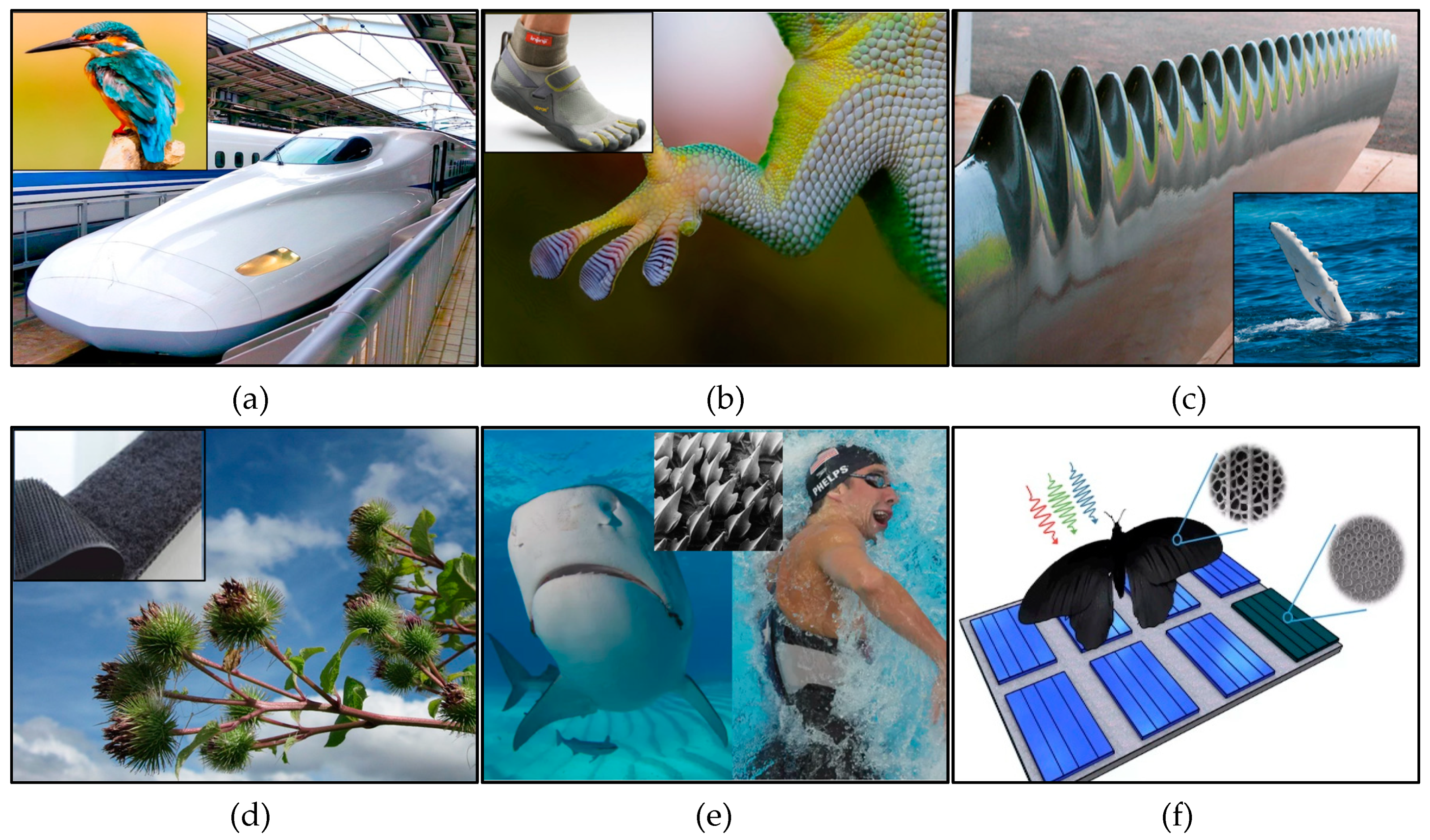
Figure 1. Bio-inspired designs [21]: (a) Shinkansen train nose, inspired by the kingfisher's beak to reduce drag; (b) Gecko-inspired adhesive technology for climbing; (c)Wind turbine blades with serrated edges, mimicking humpback whale fins; (d) Velcro inspired by burrs hook; (e) Shark skin-inspired ribbed surface for drag reduction; (f) Solar cells inspired by rose butterfly wings to enhance light capture.
Preprints 142660 g001
Figure 2. Classification of organism-based algorithms inspired by terrestrial, aquatic, aerial, insect, plant, and microorganism species [24].
Preprints 142660 g002
Figure 3. Nature-inspired algorithm classification [30]: (a) Classification based on natural sources, including swarm intelligence (SI), bio-inspired (BI), nature science (NS), and nature phenomenon-based algorithms (NPA); (b) Classification based on problem-solving approaches, including local search-based, evolutionary search-based, and swarm search-based algorithms.
Preprints 142660 g003
Figure 4. Taxonomy of nature-inspired algorithms 2020 classification by Torres-Treviño [50].
Preprints 142660 g004
Figure 5. (a) Ant Colony Optimization (ACO) behaviour navigating around obstacles [56]. (b) Flowchart of the ACO process, from initialization to finding the optimal path [57].
Preprints 142660 g005
Figure 6. (a) Particle Swarm Optimization (PSO) particle movement influenced by pbest, gbest, and velocity [58]. (b) Flowchart of the PSO process, from initialization to optimal solution [59].
Preprints 142660 g006
Figure 7. (a) Artificial Bee Colony (ABC) algorithm showing the roles of scout, employed, and onlooker bees in foraging [63,64]. (b) Flowchart of the ABC process, from food source initialization to finding the optimal solution through bee interactions [65].
Preprints 142660 g007
Figure 8. (a) Firefly Algorithm (FA) illustrating how dimmer fireflies are attracted to brighter ones [67]. (b) Flowchart of the FA process, from population initialization to finding the global best solution based on light intensity and fitness [68].
Preprints 142660 g008
Figure 9. (a) Bat Algorithm (BA) illustrating how bats use echolocation to locate prey [70]. (b) Flowchart of the BA process, from initializing parameters and population to finding the optimal solution through pulse rate and loudness updates [71].
Preprints 142660 g009
Figure 10. (a) Krill Herding (KH) algorithm showing krill movement influenced by sensing distance, neighbours, and food sources [74]. (b) Flowchart of the KHA process, from initializing the population to finding the optimal solution through motion calculations and fitness evaluations [75].
Preprints 142660 g010
Figure 11. (a) Grey Wolf Optimization (GWO) algorithm illustrating the hierarchical positions of wolves in search space [47]. (b) Flowchart of the GWO process, from initializing search agents to finding the optimal solution based on the social hierarchy of alpha, beta, and delta wolves [77].
Preprints 142660 g011
Figure 12. (a) Salp Swarm Algorithm (SSA) illustrating the movement of leader and follower salps in a chain formation [27]. (b) Flowchart of the SSA process, from updating leader and follower positions to identifying the optimal food source and reaching the termination condition [78].
Preprints 142660 g012
Figure 13. (a) Grasshopper Optimization Algorithm (GOA) illustrating grasshopper movement influenced by attraction, repulsion, and comfort zones [81]. (b) Flowchart of the GOA process, from initializing the swarm and calculating fitness to finding the optimal solution based on updated positions [82].
Preprints 142660 g013
Figure 14. Examples of swarm robotics applications: (a) Fiberbots for construction [91], (b) KALI robots inspired by termite colonies [92], (c) Millirobots for medical applications [93], (d) SAGA robots for agriculture [94], and (e) Intel drones performing synchronized flight at the 2018 Winter Olympics [95].
Preprints 142660 g014
Figure 17. Classification of swarm robotic behaviour as proposed by Brambilla et al. [17] and extended by Schranz et al. [18].
Preprints 142660 g015
Figure 18. (a) Virtual Structure Approach [116]; (b) Behaviour-based Approach [117]; (c) Leader-follower Approach [118]; (d) Graph-based Approach [119,120]; (e) Artificial Potential Approach [121].
Preprints 142660 g016
Figure 19. Examples of bio-inspired ideas for drilling and burrowing in mining applications. (a) RoboClam inspired by the Atlantic razor clam, fluidizing soil to reduce drag [148,167]. (b) Actuated Bivalve Robot mimicking bivalve burrowing with water expulsion [148,168]. (c) CRABOT, modelled after the mole crab, increasing burrowing capacity through power strokes [148,153]. (d) ROBOMINERS project using centipede, mole cricket, and termite-inspired modular robots for underground mining operations [150].
Preprints 142660 g017
Figure 20. Bio-inspired mechanisms for underground exploration and mining. (a) Earthworm inspired peristaltic locomotion, with retrograde wave and segment elongation for soil penetration [148,169]. (b) Inchworm-inspired locomotion, using anchor-pull and anchor-push mechanisms to traverse underground environments [148,170]. (c) Mole-inspired digging mechanism, featuring a drill bit and forelimb structure to enhance excavation and soil removal [148,154].
Preprints 142660 g018
Figure 21. Biomimetic tactile navigation and rolling robots for exploration. (a) Whisker-inspired navigation system modelled after the sensory abilities of rodents and naked mole rats, utilizing Hall effect sensors and whisker arrays to map subterranean terrain [171]. (b) Golden Wheel Spider-inspired rolling robots, employing wind-assisted and pendulum-driven locomotion for energy-efficient movement across desert and planetary terrain [174].
Preprints 142660 g019
Table 1. Overview of Nature-Inspired Algorithms (NIAs) in mining applications, highlighting their impacts and associated references.
Algorithms Mining Applications Mining Optimization Ref.
PSO Exploration Improves stope identification, enhances block scheduling, reduces truck counts, shortens wait times, increases productivity (up to 52.24% profit gains), enhances mapping accuracy (97.22%), fault detection, and environmental variable analysis (R2 = 0.959) [123,126,132,136,139,140]
Mine Planning
Logistics Optimization
Safety and Risk Management
Environmental Monitoring
ABC Exploration Lowers kriging variance, increases accuracy of mineral estimation [124]
Resource Management
GOA Exploration Improves effectiveness of mineral zone identification [125]
Resource Management
BA Exploration Increases mineralization mapping accuracy (94.3%), reduces exploration disturbances, enhances fault detection accuracy (97.22%) [126,139]
Environmental Sustainability
Safety and Risk Management
ACO Mine Planning
Safety and Risk Management
Enhances route planning, integrates geological uncertainty, improves escape routes, increases NPV by up to 21.1%, improves long-term production planning, increasing NPV by 2.58% [127,128,129,130,138]
GWO Mine Planning
Safety and Risk Management
Increases long-term scheduling NPV by 13.39%, enhances fault detection accuracy (97.22%) [134,139]
FA Logistics Optimization
Reduces idle time, improves equipment scheduling (20% productivity gain) [135]
SSA Safety and Risk Management Improves blasting safety, predicts ground vibrations with 90.5% accuracy [137]
Table 2. Overview of Bio-Inspired Robots and Their Mining Applications.
Bio-Inspiration Robots Bio-inspired Mechanism Mining Applications Ref.
Atlantic Razor Clam RoboClam Contracts its valves to fluidize soil and reduce drag.
  • Surface mining
  • Mine drilling
[141,142,143,144,145,146,147,148]
Bivalve Actuated Bivalve Robot Uses a rocking motion and water expulsion to fluidize sediment.
  • Surface mining
  • Mine drilling
[148,149]
Mole Crickets, Termites, Centipedes Robot-miner Dig, navigate and excavate autonomously without GPS.
  • Underground mining
  • Mine exploration
  • Mine excavation
  • Mine closure
[150,151,152]
Mole crab CRABOT Mimics burrowing motion with power and recovery strokes; uses a uropod-like appendage to improve excavation efficiency by 50%.
  • Underwater mining
  • Mine Excavation
[148,153]
Mole Mole-like Drilling Robot Uses incisors to brace and push soil out of holes.
  • Mine excavation (shallow deposits)
[148,154]
Burrowing Rescue Robot Shovelling motion with two arms and palms to push aside soil and steer itself.
  • Surface mining
  • Mine exploration
[148,155]
Mole-Bot Expandable drill bit mimicking the teeth and forelimbs of a mole for digging habit.
  • Surface mining
  • Mine excavation (soft, shallow deposits)
[156,157,158]
Earthworm Stratloong Peristaltic motion mimicking anchoring and extending motions to penetrate soil.
  • Seabed strata exploration
  • Underwater mining
[148,162]
Inchworm BADGER Sequential extension and contraction mimicking anchoring and forward pushing.
  • Underground tunnelling
  • Mine excavation
[162,163,164]
NASA Inchworm Robot [165,166]
Naked Mole Rat Robotic Miner with Whisker Sensors Mimics the tactile whisker sensing of naked mole rats.
  • Underground mining
  • Obstacles detection
[171]
Mouse Biomimetic Whisker Sensor (BMWS) Mimics mouse whiskers for object and contour detection.
  • Underground mining
  • Obstacles detection
  • Terrain mapping
[172]
Rodents RM3 Robot Mimics the whisker sensing of rodents.
  • Underground mining
  • Navigating in harsh environment.
[173]
Golden Wheel Spider Spider Rolling Robot (SRR) Wind-assisted rolling motion to traverse rough surfaces efficiently.
  • Surface Mining
  • Mine exploration (rough terrains).
[174]
Table 3. Overview of Swarm Robotics and Their Mining Applications.
Robot / System Project / Company Mining Application Mining Applications Status Ref.
Autonomous Haulage System (AHS) Rio Tinto Autonomous haulage trucks for transporting ore teleoperated.
  • Surface mining
  • Mine transportation
Operational [180,181,182,183,184,185,186,187]
Hovermap Emesent Autonomous drone for 3D mapping in underground mines.
  • Underground mining
  • Mine exploration
Operational [188,189,190,191,192,193,194]
Exyn A3R Exyn Technologies Autonomous drone for 3D mapping in underground mines.
  • Underground mining
  • Mine exploration
Operational [195,196,197]
AutoMine system Sandvik Autonomous trucks and loaders teleremote.
  • Surface mining
  • Underground mining
  • Mine transportation
Operational [198,199,200]
UX-1 UNEXMIN project Autonomous robot for exploring and mapping flooded underground mines.
  • Underground mining
  • Mine exploration
Research & development [201,202]
NEXGEN SIMS Autonomous Robots Epiroc project Autonomous electric robots for mine transportation, drilling and inspection
  • Surface mining
  • Underground mining
  • Mine transportation
  • Mine excavation
  • Mine inspection
Research & development [205]
Swarmies NASA’s Swarmathon Competition Autonomous robots for resource collection simulating Mars missions for ISRU.
  • Space exploration
  • Resource collection
Research & development [206,207,208]
RASSOR* (*updated name: IPEx) NASA Autonomous robot for regolith excavation and processing on the Moon and Mars
  • Lunar mining
  • Martian mining
  • Regolith collection
  • Resource extraction
Research & development [209,210,211,212]
Disclaimer/Publisher’s Note: The statements, opinions and data contained in all publications are solely those of the individual author(s) and contributor(s) and not of MDPI and/or the editor(s). MDPI and/or the editor(s) disclaim responsibility for any injury to people or property resulting from any ideas, methods, instructions or products referred to in the content.
Copyright: This open access article is published under a Creative Commons CC BY 4.0 license, which permit the free download, distribution, and reuse, provided that the author and preprint are cited in any reuse.
Prerpints.org logo

Preprints.org is a free preprint server supported by MDPI in Basel, Switzerland.

Subscribe

Disclaimer

Terms of Use

Privacy Policy

Privacy Settings

© 2025 MDPI (Basel, Switzerland) unless otherwise stated