Introduction
Jeffrey Pfeffer, in his book “The Human Equation: Building Profits by Putting People First”, the author argues that many managers continue to overlook the extent to which the more effective management of people can improve firm economic performance. Firms that seek to produce enhanced economic performance through the management of their human capital have adopted several common personnel practices. These include the provision of employment security, the selective hiring of new personnel, decentralized decision-making, high compensation contingent on organizational performance, extensive training, minimal status distinctions and barriers, and the extensive sharing of financial and performance information throughout the firm (Pfeffer, 1998) The objective of this essay is to examine the best practices in organizational management systems, such as motivation in the management process. Within the framework of best practices management, knowledge management encompasses both “knowledge” and “information.” and assists businesses in assessing and enhancing management abilities and communication. The research examined important elements that can influence management practices, such as team meetings and communication, team goal setting, and time management abilities within an organization. Both quantitative and qualitative data methods were employed in the data collection and analysis process, which included survey data. Perceived efficacy of leadership in businesses was revealed by employee motivation in organizational management practices and satisfaction levels.
Literature Review
Bloom 2012 analyzed the management practices across over 10K organizations in twenty countries over a decade, to explore management practices across different countries ex: U.S., Japan, and Germany. To examine the influencing factors that affect management practices. Also, the results of Bloom’s study discovered that U.S., Japanese, and German firms lead in management practices, while firms in developing countries lagged. Better management is linked to strong competition, skilled workers, flexible labor markets, and ownership type, with multinationals and private equity outperforming government and family-led firms.
It is commonly known that the caliber of human resources has a significant impact on the organization’s performance and reputation. Beginning with the notion that employees were merely a means to accomplish the stated objectives, human resources now have a central position in businesses; we discover that they constitute the organization itself. It is possible to inspire people to perform better on the job and feel more satisfied. Employee performance and satisfaction can either reach a high level or, on the other hand, a very low level, depending on the motivation behind any given action (COSTIN A., 2022). Knowledge management involves “knowledge” and “information.” Both concepts lie at the heart of human resource development. This research project aimed to help organizations evaluate and improve management skills and communication, within the concept of pest practices.
Governance practices and their effect on the performance of community organizations (cooperatives) in Ethiopia’s Halaba district were evaluated by R. Dayanandan in 2000. A proportionate random sampling procedure was used to select 125 sample members from eight primary cooperatives to meet the objectives. A semi-structured questionnaire was used to gather primary data. SPSS (version 20) was used to analyze the gathered data, and basic statistics like mean, percentages, and the chi-square test were employed to arrive at the conclusions. Furthermore, a binary logistic regression model was used to identify the variables influencing cooperative performance and governance practices. According to the research findings, insufficient corporate involvement, poor responsiveness, ignorance of management, a lack of democracy, corruption, poor sense of ownership, double responsibility and lack of members’ awareness were found to be the reasons for weak performance.
According to Gupta 2000 Knowledge management (KM) requires a major shift in organizational culture and a commitment at all levels of a firm to make it work. Through a supportive organizational climate, ideally, through effective KM, an organization can bring its entire organizational learning and knowledge to bear on any problem, anywhere in the world, at any time (Gupta, B., et al., 2000).
However, no studies have been found that explore all different factors affecting management practices such as communications, employee satisfaction, team meetings, goal setting for the teams, and time management skills within an organization. Employee motivation in organizational management practices, as well as the levels of satisfaction, offered insights into the perceived effectiveness of leadership in organizations.
Methodology
The methodology used in the research mixed methods means data collected and analyzed with both quantitative methods to measure and qualitative methods to explore data for analysis of data collected via survey.
Research Analysis and Findings
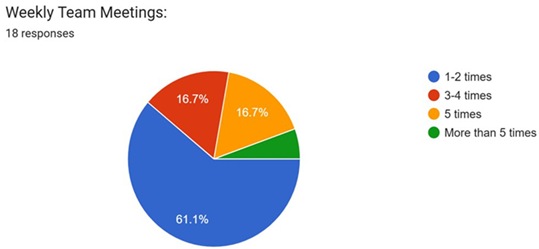
The chart shows that eighteen participants completed the self-created questionnaire about weekly team meetings, which helped in identifying organizational management practices. Most respondents (61.1%) attend team meetings once or twice a week, suggesting that they would rather attend fewer meetings possibly because too many meetings interfere with workflow. A comparatively smaller percentage of the respondents claimed to attend higher meeting frequencies, 16.7% attended 5 meetings per week while 5.6% attended meetings more than 5 times a week, this might imply the type of work demands frequent meetings to update, but also could be an indication of inefficiency if every other meeting becomes disruptive.
This data helps to demonstrate how meeting frequency is a crucial part of management and impacts communication, team, dynamics, and operation. These results present implications to equate the meeting frequency to decision only, while there is potential for meeting practices to be questionable about other aspects of organizational performance including productivity and satisfaction levels of employees, as well as to suggest the necessity for more theoretical and empirical studies regarding the meeting frequency and the way they affect the organizational performance and to establish how the organization can manage its meeting practices to take advantage of the total enhancement of communication and cooperation between its members.
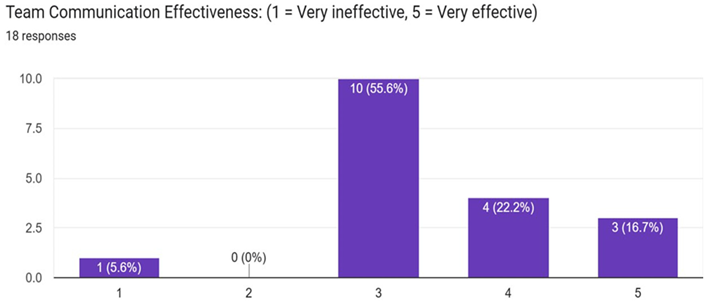
Nineteen questionnaires that captured both junior and senior team members’ data on the effectiveness of their team communications were received and analyzed to gather how management practices affect communication within an organization. In the evaluation of the communication effectiveness, ten out of the respondents gave three out of five points which indicated that while communication in the respective teams is serviceable it may not be as clear, or efficient as it can be. A further 22.2% assessed the communication effectiveness at 4, signaling moderate or fairly effective verbal and written communication practices. Moreover, 16.7% indicated five which means effective communication within the team is highly effective. A few/one employees (5.6%) selected communication at the worst level of one thus indicating significant difficulties in improving organizational communication. Predictably, nobody selected the next worst level of two. The fact most teams are at mid-level in terms of communication effectiveness implies that while working in groups, teams can achieve better organizational performance without compromising on the quality of communication as was seen in the high-performing groups. This data highlights the importance of understanding the connection between management practices and communication effectiveness in organizations more specifically, the strategies which facilitate better clarity and collaboration, as well as enable better decision-making. Knowing how best to manage factors that hinder communication can significantly help an organization gain better team performance and, consequently, organizational results.
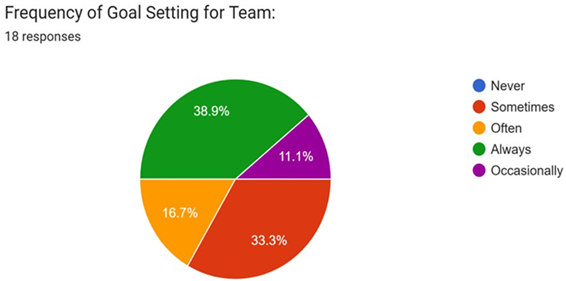
The frequencies of the goal setting for the teams are shown in the Figure based on the survey data collected from eighteen respondents which illustrate the variations in one of the most important management activities practiced in organizations. Just over one-third of the respondents stated that goal setting is always done. The highest results were obtained in the questions which had options regarding frequently and systematically carried out practices, which show that a clear definition of goals is important in creating a constructive and effective team. However, 33.3% responded that goal setting occurs only sometimes, which can mean more of a lack of consistent adherence to it and may lessen the teams’ concentration and performance. A slightly lesser proportion, 16.7%, answered that goal setting is practiced frequently, though not regularly. Moreover, 11.1% said that this takes place occasionally meaning that there is scarce use of the practice, and none mentioned that goal setting never occurs. The results presented here imply that while some organizations substantively include setting goals among managerial practices, others show fluctuating levels of goal setting may be due to differences in strategic concentration or organizational strictness. This data calls for the examination of consistent goal-setting practices for the enhancement of productivity, engagement and organizational success of the teams. Future studies elucidating the enablers and constraints that affect the practice of daily and weekly goal setting could offer useful recommendations for applying systematic management techniques that make teams more effective and productive.
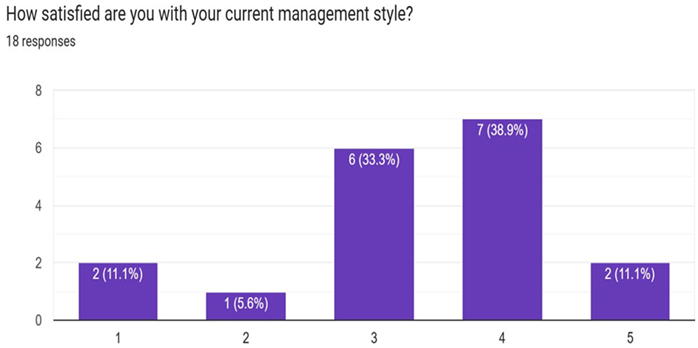
Analysis of the survey results focused on opinions concerning present management approaches, with eighteen responses regarding the levels of satisfaction in the provided data, which offered insights into the perceived effectiveness of leadership in organizations. As for the respondents’ satisfaction options, the largest number of respondents (38,9%) chose the rating four, which can be considered as an above-average positive outlook regarding the management style with potential for development. Likewise, 33.3% described their satisfaction as three, which is inconclusive or represents the variable acceptability of present management practices. More limited still was the level of very high satisfaction, of which 11.1% rated their management style average 5 and highlighted teams that are within highly efficient and well-perceived boss sub-samples. Conversely, 16.7% responded with 1 or 2, indicating dissatisfaction, potentially over communication or lack of understanding of team requirements. These results reveal various forms of management approaches, which show that, despite the existence of best practices, there are definite deficiencies in some companies. This data highlights the value of learning more about various factors that increase management satisfaction and encourage the adoption of effective communication practices, decision-making that includes team members, and leadership flexibility about organizational culture and climate, all of which would improve morale and create a better-performing team.
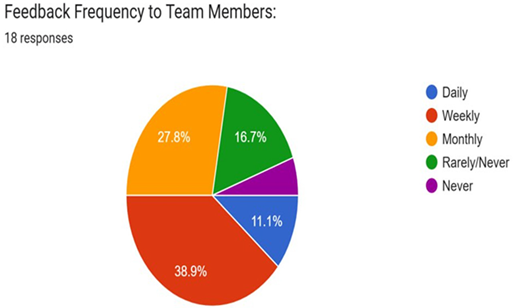
The provided graph unveils the number of feedback shared among employees within organizational structures, which is a measure of management techniques. The largest portion of respondents (38.9%) mentioned frequency as ‘weekly’ The small difference of ‘monthly’ indicates that while performance may be viewed as a continuous process, reflection is given periodically. Of the respondents, 11.1% claimed to get feedback daily, traditionally linked to high-performance and/or agile companies; another 16.7% of the respondents stated that they rarely or never received feedback from their manager. From this distribution, it can be deduced that while numerous organizations have put in place formalized feedback processes, there is still a significant proportion that is not organized in terms of systematic feedback practice, which causes detrimental effects on the growth of the employees and overall organizational compatibility. Considering these findings, it may be suggested that further enhancement of feedback mechanisms is required for increased usage and focus on enhancing engagement, openness as well as participative improvement of the work environment.
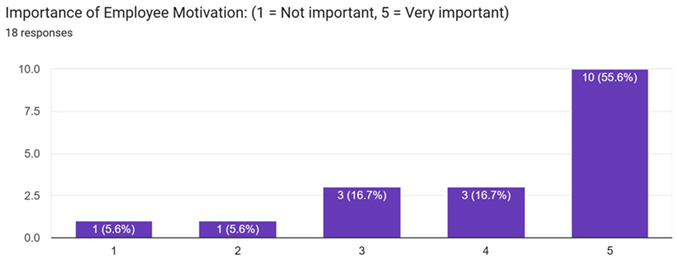
The importance of employee motivation in organizational management practices was evidenced by eighteen participants. The largest portion (55.6%) described motivation as “very important” (score 5), thus, achieving general agreement on its importance for enhancing productivity and organizational outcomes. Furthermore, 16.7% labelled it as ‘important’ (score 4), in total, indicating that 72.3% of respondents consider motivation as one of the critical areas of management concern. While 16.7% gave a middle score of 3, 11.2% considered motivation to be as insignificant (scores one & 2). These findings further enhance the understanding that motivation is a key driver of employee behavior about engagement, satisfaction and performance. Nonetheless, the small number of organizations with lower levels of attrition may give the method limited credibility through underestimation stemming from variations in management approaches or organizational cultures of the companies adopting it. This data further supports the need for future research into the ways that motivation can be incorporated back into meaningful management techniques to harmonize organizational objectives with human spirits.
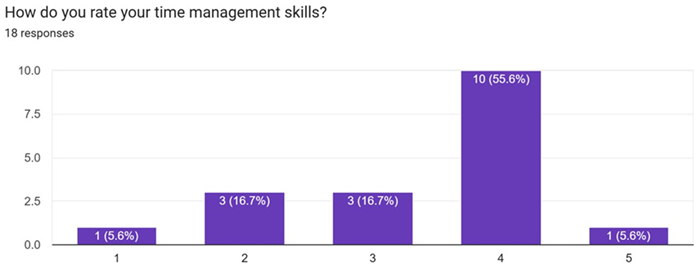
This data proves the self-estimated time management skills of eighteen respondents with a score of 1 to 5, where 1 is the lowest and five is the highest level. Most of the participants (10) assigned themselves to level 4, which implies that they have adequate self-assertion regarding their time management competency, only a few/one of the participants (1) assigned themselves to level 5. Sixteen-point seven percent (3 out of 18) of respondents provided each of the moderate ratings of 2 and 3 which shows that there is still a lot of potential for growth among a large part of the participants. Specifically, 5.6% (1) said that they felt low self-efficacy, having given themselves an efficacy rating of one. Such results support the need to investigate further ways of improving time management behaviors to increase personal and organizational productivity among individuals who rated themselves as moderate and low in terms of self-assessment.
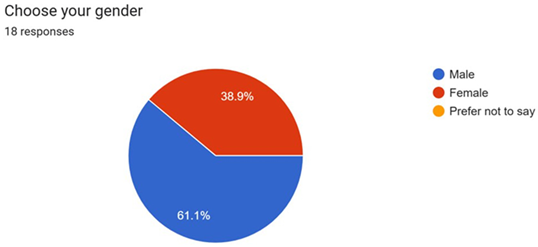
The provided pie chart shows the breakdown of the eighteen people who responded to the management practices. From the gender perspective, the largest share of the respondents, 61.1%, described themselves as male and 38.9% chose the female option. Of the responses, none of the respondents chose the ‘Do not wish to state’ category. Such data indicates a sex bias in the sample given that the number of male participants is higher than the females in the sample. It is, therefore, important for anyone given to a similar survey, to consider this form of sampling bias when interpreting the results and or when making conclusions about the practices of management within the organizations in question. Future research should extend the understanding of the effect of this gender bias on the study conclusions and the overall external validity of the observed outcomes.
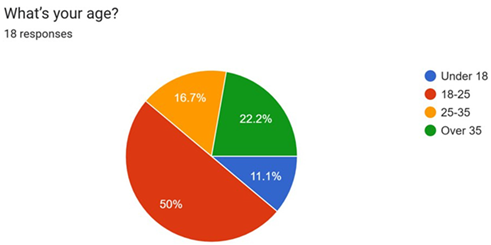
This pie chart shows the age profiles of eighteen respondents to management practices. The largest age group in the study will be the 18 to 25-year age bracket, with 50 per cent of the sample. The next biggest category is the 25-35 age category with 22.2%, while the 25-35 age bracket retains 16.7% and the under-eighteen age group with 11.1%. This age distribution indicates a higher density of young people in the responses indicating a limitation to the generalization of the results to include other age groups in organizations. The identified audience is dominated by people aged 18, 25 or younger; thus, the survey results might reflect only youthful bias. This bias should be declared and debated in the limitations part of the research proposal, owing to the relationship between age and management practices and perceived risk.
Conclusion
In conclusion, there are several factors affecting management practice communication and team meetings and goal setting for the teams, time management skills within an organization. Employee motivation in organizational management practices, as well as the levels of employee satisfaction, offered insights into the perceived effectiveness of leadership in organizations. The meeting frequency and the way they affect the organizational performance and establish how the organization can manage its meeting practices to take advantage of the total enhancement of communication and cooperation between its members. Understanding the connection of the management practices with the communication effectiveness in organizations more specifically, the strategies which facilitate better clarity and collaboration, as well as enable better decision making. The importance of employee motivation in organizational management practices, self-estimated time management skills, and goal setting could offer useful recommendations for applying systematic management techniques that make teams more effective and productive. Effective communication practices, decision-making that includes team members, and leadership flexibility concerning organizational culture and climate, all would improve morale and create a better-performing team. Enhancement of feedback mechanisms is required for increased usage and focus on enhancing engagement, openness as well as participative improvement of the work environment.
References
- Bloom, N., Gianakos, C., Sadun, R., & Van Reenen, J. (2012). Management practices across firms and countries. Academy of Management Perspectives, 26(1), 12-33. [CrossRef]
- COSTIN ALEXANDRU PANAIT, 2022): Study of Employee Motivation in Organizations, University of Craiova cod: 200585 13, A.I. Cuza Street, Craiova, Dolj, Romania. http://www.globeco.ro/wp-content/uploads/vol/GEO_Vol_8_No_1.pdf#page=114.
- Dayanandan, R. Good governance practice for better performance of community organisations and realities. Journal of Power, Politics & Governance 2013, 1, 10–26. [Google Scholar]
- Gupta, B., Iyer, L.S. and Aronson, J.E. (two thousand), “Knowledge management: practices and challenges”, Industrial Management & Data Systems, Vol. 100 No. 1, pp. 17-21. [CrossRef]
- Jeffrey Pfeffer (1998) Seven Practices of Successful Organizations, Volume 40, Issue2. [CrossRef]
- Pfeffer, J. (1998). The human equation: Building profits by putting people first. Harvard Business School.
|
Disclaimer/Publisher’s Note: The statements, opinions and data contained in all publications are solely those of the individual author(s) and contributor(s) and not of MDPI and/or the editor(s). MDPI and/or the editor(s) disclaim responsibility for any injury to people or property resulting from any ideas, methods, instructions or products referred to in the content. |
© 2024 by the authors. Licensee MDPI, Basel, Switzerland. This article is an open access article distributed under the terms and conditions of the Creative Commons Attribution (CC BY) license (http://creativecommons.org/licenses/by/4.0/).