
Submitted:
12 December 2024
Posted:
12 December 2024
You are already at the latest version
Abstract
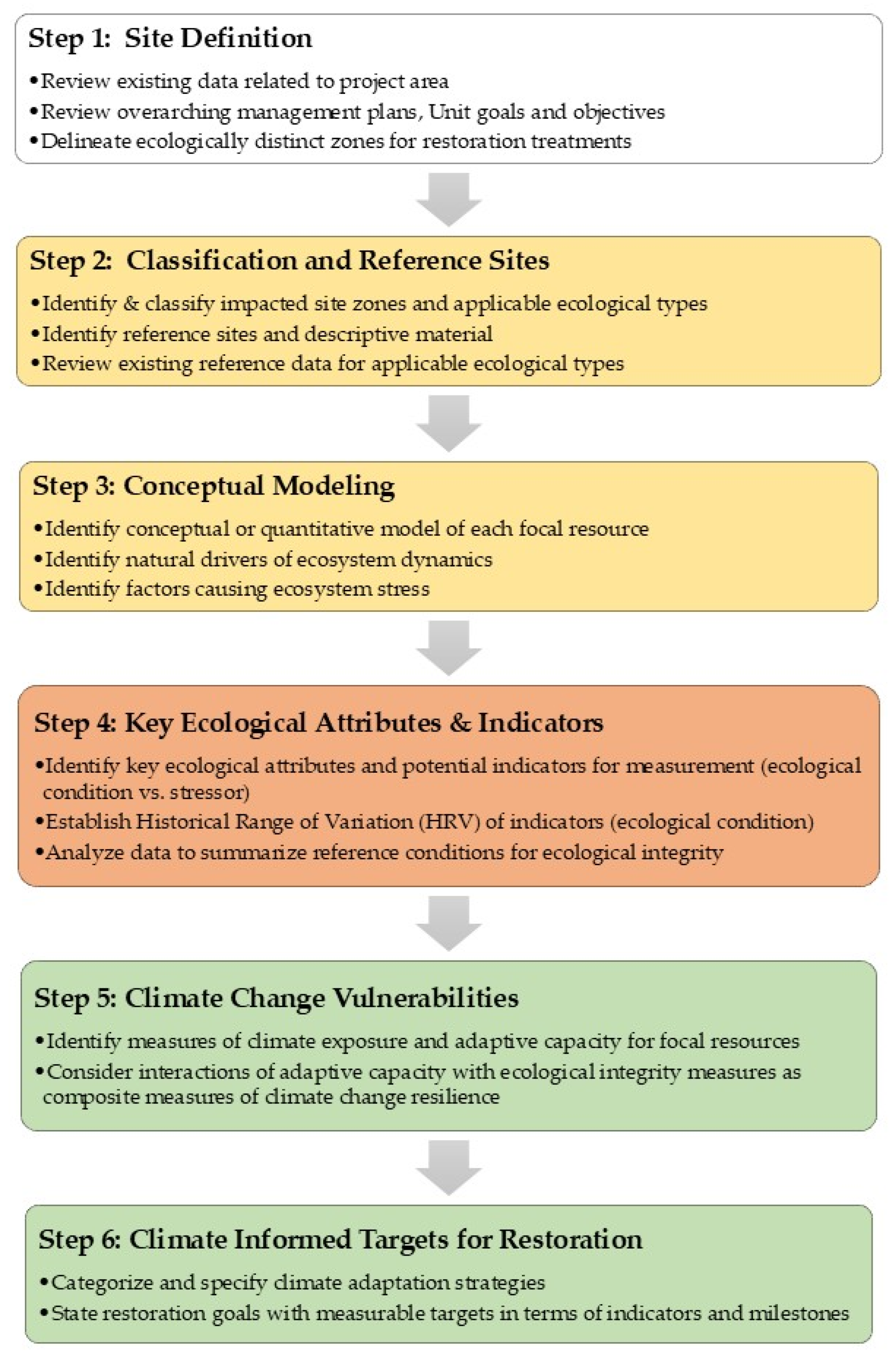
Restoration practitioners specify targets for what the ecosystem will look like to reach recovery goals. Targets may be influenced by the level of degradation, surrounding landscape conditions, societal choice, and a changing and uncertain climate regime. The Society for Ecological Restoration’s International Principles and Standards for the Practice of Ecological Restoration recommends that targets be informed by reference models of site conditions that include biotic composition, environmental setting, and dynamic processes—had anthropogenic degradation not occurred—while accounting for anticipated change. Models optimally reflect a variety of information sources and are based where possible on multiple reference sites of similar native ecological conditions. Using a project site from Colorado National Monument, we illustrate a stepwise process for compiling and synthesizing map, text, and tabular information from reference materials and sites. Reference materials include multiple ecosystem classifications and site inventories to describe composition, structure, and dynamics of the target ecosystems. An ecological integrity framework aids in identifying key ecological attributes and indicators for site measurement. Climate change vulnerability assessment specifies risks to anticipate, while adaptation frameworks point to appropriate strategies. By systematically utilizing existing frameworks and available data, practitioners can streamline the establishment of reference models for ecological restoration.
Keywords:
1. Introduction
2. Materials and Methods
2.1. Colorado National Monument—Case Study
2.2. Analytical Frameworks and Data Sources
2.3. Ecosystem Classifications
2.4. Reference Data Describing the Types to be Restored
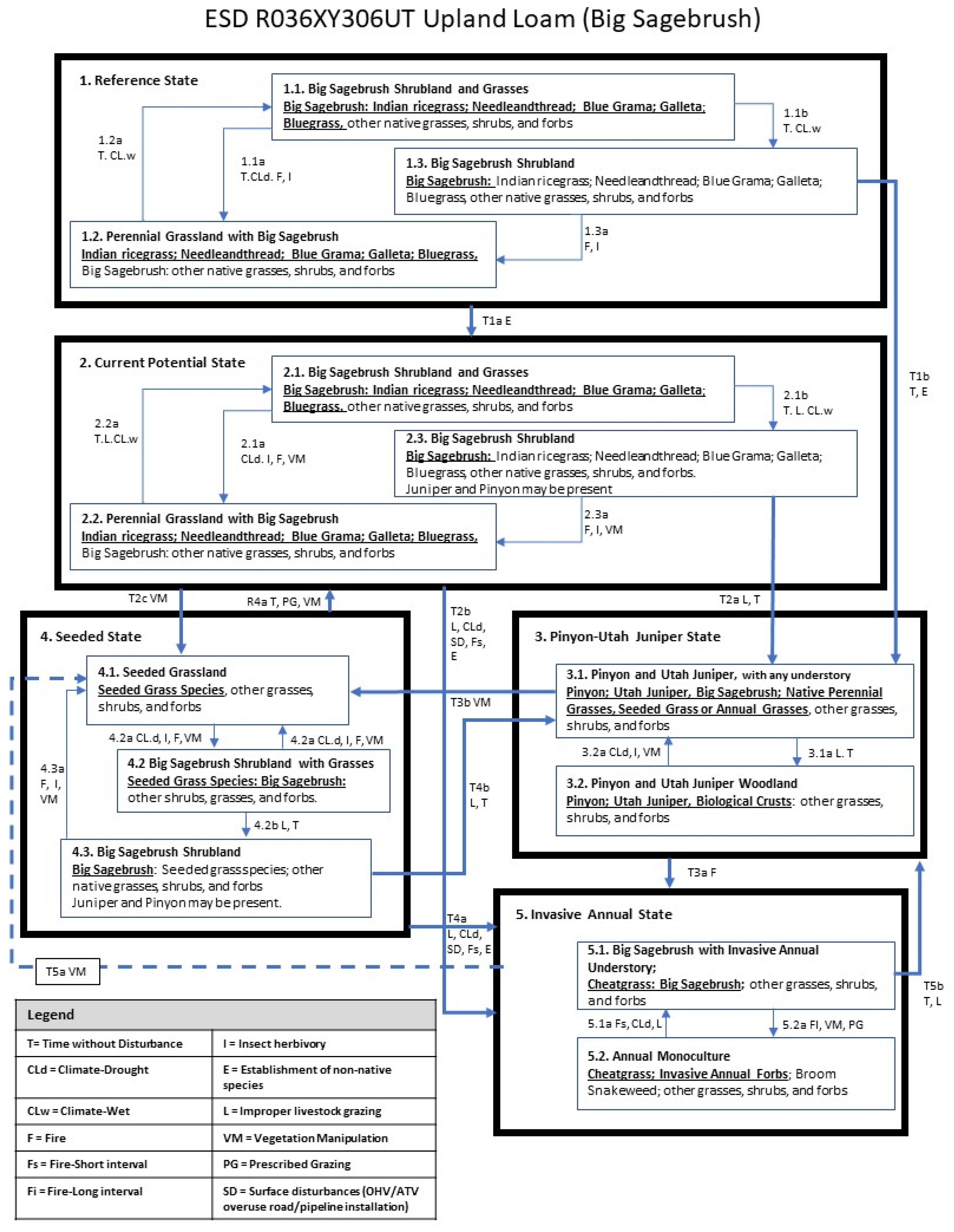
2.5. Modeling Landscape and Ecosystem Dynamics
2.6. Identify Indicators for Restoring Ecological Integrity
- 1)
- Key Ecological Attributes (KEAs) driving natural states and transitions,
- 2)
- measurable indicators of those attributes,
- 3)
- the expected/historic range of variation for each indicator; and,
- 4)
- practical thresholds for indicator measurements suggesting restoration milestones
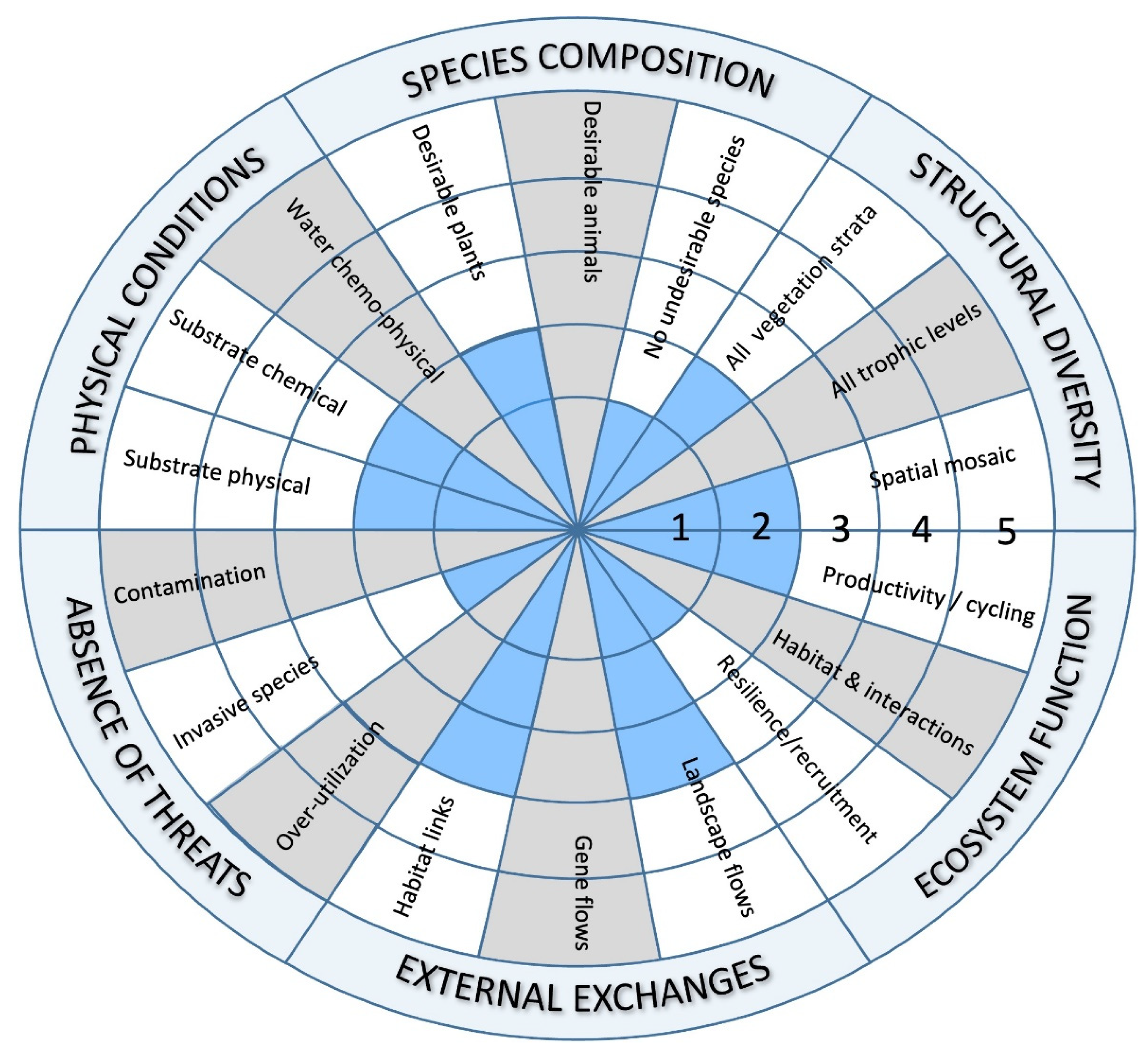
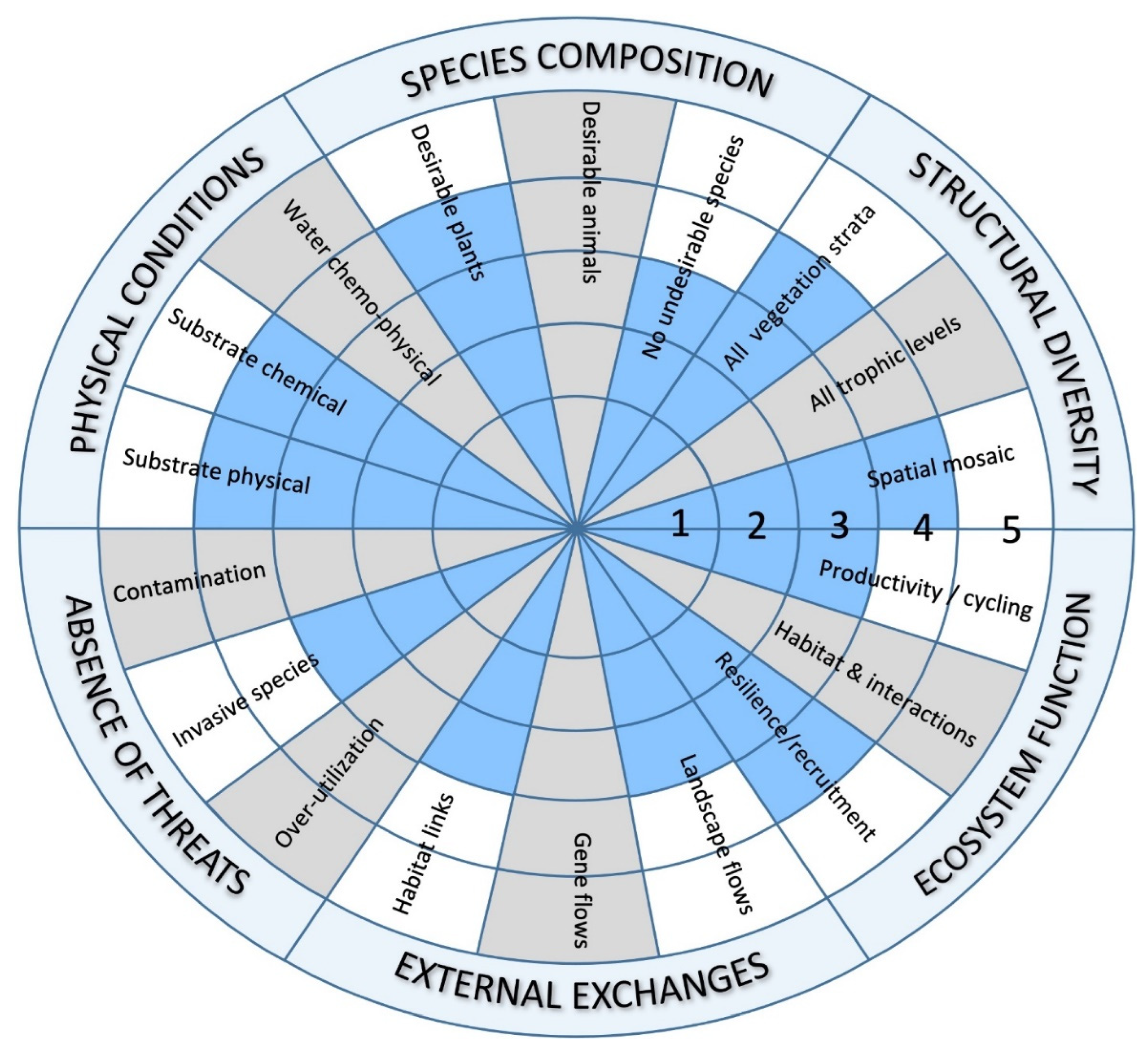
2.7. SER Five-star System and Ecological Recovery Wheel
2.8. Vulnerability and Adaptation to Climate Change
3. Results
3.1. Classification and Reference Sites
3.2. Reference Site Data Describing the Types to be Restored
3.3. State and Transition Models
3.4. Key Ecological Attributes and Indicators of Ecological Integrity
- Landscape-scale Processes Requiring Connectivity
- Community Composition Contribution to Characteristic Ecological Processes
- Vegetation Structural Response to Disturbance
- Wildfire Regime
- Chemical & Physical Processes
3.4.1. Expected/Historical Ranges of Variation for Indicators
3.4.2. Indicators Thresholds
3.4.3. Scorecard of Indicators and Ratings
3.5. Preliminary Reference Target by Ecosystem Attribute and Sub-Attribute
3.6. Accounting for Climate Change
4. Discussion
4.1. Ecological Restoration Is Challenging in Nearly All Circumstances
4.2. Synthesizing Information Across Analytical Frameworks
4.3. Coping with Climate-Induced Stress in Restoration Targeting
5. Conclusions
5.1. Implications for Practice
- Multiple sources of information should be sought to describe reference conditions and clarify restoration goals, including appropriate reference sites, which may be limited or challenging to identify for a given restoration project due to pervasive environmental degradation.
- Several existing analytical frameworks and associated data sets can be combined with data from reference sites to establish practical reference models. Expert judgement is required to integrate these multiple sources of information.
- Climate change vulnerability of targeted ecosystems can be documented, and appropriate adaptation strategies and restoration targets suggested to implement within set timeframes.
- These data are synthesized to express key ecological attributes, measurable indicators, expected ranges of variation, and assessment categories of resources that are compatible with the SER Five-star System for ecosystem recovery.
Supplementary Materials
Author Contributions
Funding
Data Availability Statement
Acknowledgments
Conflicts of Interest
Appendix A
References
- Gann G.D., McDonald T., Walder B., Aronson J., Nelson C.R., Jonson J., Hallett J.G., Eisenberg C.., Guariguata M.R., Liu J., Hua F., Echeverría C., Gonzales E., Shaw N., Decleer K., Dixon K.W. International principles and standards for the practice of ecological restoration. Second edition: 2019, Society for Ecological Restoration, Washington, D.C. 20005 U.S.A. [CrossRef]
- Benck K.M., Allen K., Nadeau A., Davis A., Gardner S., Randerson M., Robertson A. Colorado National Monument: Natural resources condition assessment. Natural Resource Report. 2016, NPS/COLM/NRR—2016/1356. National Park Service. Fort Collins, Colorado.
- Murphy M. Colorado National Monument West Entrance Site History and Ongoing Early Season Invasive Control Project: Restoration and monitoring efforts to repair damage from human activity Molly Murphy, 2014-2020 Gilbert Moreno, 2014-2015 Amy Birtwistle. 2015, Internal NPS report.
- National Park Service (NPS). Management Policies. 2006, Washington, DC: U.S. Department of the Interior, National Park Service.
- Faber-Langendoen D., Keeler-Wolf T., Meidinger D., Tart D., Hoagland B., Josse C., Navarro G., Ponomarenko S., Saucier J.P., Weakley A., Comer P., EcoVeg: a new approach to vegetation description and classification. 2014, Ecological Monographs, 84(4), pp.533-561. [CrossRef]
- Caudle D., DiBenedetto J., Karl M., Sanchez H., Talbot C. Interagency ecological site handbook for rangelands. 2013, US Department of the Interior, Bureau of Land Management.
- Comer P., Faber-Langendoen D., Evans R., Gawler S., Josse C., Kittel G., Menard S., Pyne M., Reid M., Schulz K., Snow K. Ecological systems of the United States: a working classification of US terrestrial systems. 2003, NatureServe, Arlington, VA. Aug 12;75.
- Higgins J.V., Bryer M.T., Khoury M.L., Fitzhugh T.W. A freshwater classification approach for biodiversity conservation planning. 2005, Conservation Biology. 19(2):432-45. [CrossRef]
- Von Loh J et al. Vegetation Classification and Mapping Project Report, Colorado National Monument. Natural Resource Technical Report. NPS/NCPN/NRTR—2007/061. 2007, Natural Resource Program Center. Fort Collins, Colorado.
- Unnasch R.S., Braun D.P., Comer P.J., Eckert G.E. The ecological integrity assessment framework: A framework for assessing the ecological integrity of biological and ecological resources of the national park system (Version 1.1). 2018, Natural Resource Report. NPS/NRSS/BRD/NRR—2018/1602. National Park Service. Fort Collins, Colorado.
- Parrish J.D., Braun D.P., Unnasch R.S. Are we conserving what we say we are? Measuring ecological integrity within protected areas. BioScience 53(9):851-60. [CrossRef]
- Standards Reference Group (SERA). 2018, National Standards for the Practice of Ecological Restoration in Australia, Edition 2.1. Society for Ecological Restoration Australasia. In consultation with key partners. 46 pp.
- Young, R.E., Gann, G.D., Walder, B., Liu, J., Cui, W., Newton, V., Nelson, C.R., Tashe, N., Jasper, D., Silveira, F.A. and Carrick, P.J., 2022, International principles and standards for the ecological restoration and recovery of mine sites. Restoration Ecology, 30, p.e13771. [CrossRef]
- Qin D., Chen Z., Averyt K.B., Miller H.L., Solomon S., Manning M., Marquis M., Tignor M. 2007, IPCC: Summary for policymakers.
- Comer, P.J. Seddon E., Climate Change Adaptation Zones in Pinyon-Juniper Woodlands of Western North America. 2023, Forests 14(8), 1533. [CrossRef]
- Schmitz O.J., Lawler J.J., Beier P., Groves C., Knight G., Boyce D.A., Bulluck J., Johnston K.M., Klein M.L., Muller K., Pierce D.J. Conserving biodiversity: practical guidance about climate change adaptation approaches in support of land-use planning. 2015, Natural Areas Journal 35(1):190-203. [CrossRef]
- Keith D.A., Rodríguez J.P., Brooks T.M., Burgman M.A., Barrow E.G., Bland L., Comer P.J., Franklin J., Link J., McCarthy M.A., Miller R.M. The IUCN red list of ecosystems: Motivations, challenges, and applications. Conservation Letters. 2015, May;8(3):214-26. [CrossRef]
- Schuurman, G.W., Cole, D.N., Cravens, A.E., Covington, S., Crausbay, S.D., Hawkins Hoffman, C., Lawrence, D.J., Magness, D.R., Morton, J.M., Nelson, E.A., O’Malley, R., Navigating Ecological Transformation: Resist–Accept–Direct as a Path to a New Resource Management Paradigm, 2022, BioScience, Volume 72, Issue 1, Pages 16–29. [CrossRef]
- Peterson St-Laurent G., Oakes L.E., Cross M., Hagerman S. R–R–T (resistance–resilience–transformation) typology reveals differential conservation approaches across ecosystems and time. 2021, Communications Biology 4(1):1-9. [CrossRef]
- Mitchell, A.T., Cavelier, J. Barriers to Lowland Tropical Forest Restoration in the Sierra Nevada de Santa Marta, Colombia. 1994, Restoration Ecology 2(4): 219-229. [CrossRef]
- Comer P.J., Hak J.C., Reid M.S., Auer S.L., Schulz K.A., Hamilton H.H., Smyth R.L., Kling M.M. Habitat climate change vulnerability index applied to major vegetation types of the western interior United States. Land. 2019, Jul 6;8(7):108. [CrossRef]

| Ecosystem Attribute | Sub-Attribute(s) | Indicator |
|---|---|---|
| Absence of threats | Invasive Species |
|
| Physical Conditions | Substrate physical / chemical |
|
| Species Composition | Desirable plants No undesirable species |
|
| Structural Diversity | All vegetation strata Spatial mosaic |
|
| Ecosystem Function | Resilience / Recruitment |
|
| External Exchanges | Landscape and Gene Flows, Habitat Links |
|
| ATTRIBUTE CATEGORY | STAR LEVEL (1-5) |
SER RANKING GUIDANCE | EVIDENCE FOR RECOVERY LEVEL |
|---|---|---|---|
| ABSENCE OF THREATS | |||
| Invasive species | 1 | Some direct degradation drivers (e.g., erosion, substrate instability, active contamination) absent and land tenure status secured, but others remain high in number and degree. | Invasive species abundant (>10% absolute cover). Indicative of seedbank, offsite inputs. |
| PHYSICAL CONDITIONS | |||
| Substrate physical / chemical | 2 | Landforms, and physical and chemical properties of substrates and hydrology, remain at low similarity levels relative to reference model but capable of supporting some biota of reference model. |
|
| SPECIES COMPOSITION | |||
| Desirable Plants | 2 | Some colonizing native species present (e.g., >25% of species in the reference model). Very high abundance of nonnative invasive or undesirable species. |
|
| No undesirable species | 1 | Invasive species abundant (>10% absolute cover). | |
| STRUCTURAL DIVERSITY | |||
| All vegetation strata | 2 | Several strata of the reference present and some similarity of spatial patterning and trophic complexity, relative to reference model. | Biological soil crust is present in protected areas and with a minor component elsewhere 30-60% of area within expected 0-5 trees per hectare Average VCC Score = < 0.3—Severe Departure |
| Spatial Mosaic | 2 | ||
| ECOSYSTEM FUNCTION | |||
| Productivity / Cycling | 2 | Low numbers and levels of physical and biological processes and functions, relative to the reference model (incl. plant growth, decomposition, soil processes) are present. | Biological soil crust is present in protected areas and with a minor component elsewhere |
| Resilience / Recruitment | 1 | Processes and functions (e.g., water and nutrient cycling, habitat provision, appropriate disturbance regimes and resilience) are at a foundational stage only, comparted to the reference model. | Average VCC Score = < 0.3 (Severe Departure) |
| EXTERNAL EXCHANGES | |||
| Landscape Flows / Habitat Links | 3 | Positive exchanges and flows with surrounding environment (e.g., species, genes, water, fire) in place for only very low numbers of species and processes. | Landscape Condition Model Score < 0.5. Note: the landscape condition model creates a spatial surface with lowest scores closest to most intensive land uses. For the Monument site it mainly indicated proximity to nearby urban development. Within the Monument, conditions are better, consistent with better connectivity. Average VCC Score = < 0.3 (Severe Departure) |
| Ecosystem Attributes | Sub-Attributes | Indicator (stressor indicator in italics) | Measurements |
|---|---|---|---|
| Absence of threats | Invasive Species | Percent Cover of Invasive Annual Grass Species | Invasive species prevalent (3–10% absolute cover). |
| Physical Conditions | Substrate physical / chemical | Soil permeability and Aggregate Stability Percent Bare Ground |
Proportional area 61-80% within expected range |
| Species Composition | Desirable plants /No undesirable species (community composition contribution to characteristic ecological processes) |
Percent Cover of Native vs. Non-Native Plant Species | Cover of native plants 80%-90% |
| Structural Diversity | All vegetation strata / Spatial Mosaic Vegetation Structural Response to Disturbance |
Invading Tree Density | 61-90% of area within expected 0-5 trees per hectare |
| Ecosystem Function | Productivity/cycling | Observed vs. Expected Cover Biological Soil Crust | Biological soil crust is present in protected areas and with a minor component elsewhere |
| Resiliency / Recruitment (Wildfire Regime) | Vegetation Departure Index |
Average VCC Score = 0.61-0.9 Low to Moderate Departure |
|
| External Exchanges | Landscape Flows / Habitat Links (Landscape-scale processes requiring connectivity) | Modeled Landscape Condition (sensu Hak and Comer 2017) | Landscape Condition Model Score 0.80–0.5 |
Disclaimer/Publisher’s Note: The statements, opinions and data contained in all publications are solely those of the individual author(s) and contributor(s) and not of MDPI and/or the editor(s). MDPI and/or the editor(s) disclaim responsibility for any injury to people or property resulting from any ideas, methods, instructions or products referred to in the content. |
© 2024 by the authors. Licensee MDPI, Basel, Switzerland. This article is an open access article distributed under the terms and conditions of the Creative Commons Attribution (CC BY) license (http://creativecommons.org/licenses/by/4.0/).