Preprint
Article

This version is not peer-reviewed.

Twenty-Three Year Mortality in Parkinson’s Disease: A Population-Based Prospective Study (NEDICES)

A peer-reviewed article of this preprint also exists.

Submitted:

10 December 2024

Posted:

12 December 2024

You are already at the latest version

Abstract

Parkinson's disease (PD) is a prevalent neurodegenerative disorder in older adults, yet its long-term mortality impact remains inadequately defined. This study builds on prior findings from the Neurological Disorders in Central Spain (NEDICES) cohort, extending mortality analysis to a 23-year follow-up within a Spanish population-based sample. This prospective cohort study included 5,278 individuals aged 65 years and older. Conducted in two waves (baseline and follow-up), it identified 81 prevalent PD cases at baseline (1994-95) and 30 incident (premotor) cases at follow-up (1994-95). Mortality was tracked for up to 23 years, with Cox proportional hazard models used to estimate mortality hazard ratios (HRs), adjusted for demographic and clinical variables. Among 111 PD cases, 109 (98.2%) died during follow-up, compared to 4,440 (86.8%) of 5,114 without PD. PD was associated with a significantly increased mortality risk (adjusted HR=1.62; 95% confidence interval [CI]=1.31–2.01). Individuals with both PD and dementia had an even higher risk (HR=2.19; 95% CI=1.24–3.89). Younger-onset PD (<65 years) showed heightened mortality risk (HR=2.11; 95% CI=1.22–3.64). Cardiovascular or cerebrovascular diseases were the leading causes of death in both PD and non-PD participants. PD was significantly more often listed as the primary cause of death in PD individuals compared to the reference group (14.7% vs. 0.4%, p<0.001). PD significantly increases mortality risk over 23 years, particularly among those with early onset and dementia. These findings support a multidisciplinary PD care approach that addresses both motor and non-motor symptoms to improve long-term outcomes.

Keywords: 
;  ;  ;  ;  

1. Introduction

Parkinson's disease (PD) is a major neurodegenerative disorder with complex and progressively disabling symptoms.1 While primarily affecting motor function, PD also involves various non-motor symptoms, including cognitive impairment, dysphagia, and autonomic dysfunction, which contribute to increased mortality, often through complications like infections and respiratory issues.2–4 Mortality in PD is influenced by factors such as age at diagnosis, disease severity, and comorbid conditions, with advanced age, male sex, and dementia being key predictors of higher mortality risk.5–7 These associations highlight the need for comprehensive management to improve survival.
The variability in studies on PD mortality arises from differences in study design, methodology, and population characteristics. Clinical cohorts often fail to capture undiagnosed or less severe cases, potentially skewing results and underestimating the full impact of the disease lies on hospital-based series or diagnostic registries, often at institutional or national levels, rather than genuinely population-based samples.8,9
Population-based studies are crucial to provide a more accurate understanding of PD's impact on mortality, as they encompass a broader range of disease severities, including milder and undiagnosed cases. Table 1 highlights key findings from population-based studies, reflecting the diverse approaches and results in this field.7,10–23 Consistently, meta-analyses have demonstrated an elevated mortality rate among PD patients compared to the general population. However, reported standardized mortality ratios vary significantly across studies, driven by methodological heterogeneity and differing population structures.2,3
The Neurological Disorders in Central Spain (NEDICES) cohort provides a unique opportunity to examine PD mortality within a large, prospective, population-based cohort with neurologist-confirmed diagnoses.24–26 The initial 13-year follow-up in NEDICES showed a significantly elevated mortality risk in PD, with an adjusted hazard ratio of 1.75 compared to controls, and identified dementia as a significant risk factor.7 However, given PD’s gradual progression, further longitudinal analysis is needed to capture mortality determinants, particularly in relation to aging entirely.
This study extends the NEDICES follow-up to 23 years to explore long-term mortality trends in PD and examine how demographic, clinical, and environmental factors affect survival. These findings will enhance our understanding of PD progression and mortality, providing insights to inform clinical practice and public health strategies for managing PD in aging populations.

2. Methods

2.1. Ethical Aspects

Study participants provided written informed consent after receiving a comprehensive explanation of the research procedures. This study adhered to the principles of the 1975 Helsinki Declaration and received approval from the ethics committees of the University Hospitals "12 de Octubre" and "La Princesa" in Madrid, ensuring full compliance with ethical standards for human research.

2.2. Study Areas

The NEDICES study was conducted in three distinct regions in central Spain: two urban neighborhoods (Lista in Madrid, a middle- to upper-class area, and Las Margaritas in Getafe, a working-class area) and a rural region (Arévalo county in Ávila). These areas were selected for their varied socioeconomic profiles, suitable population sizes for studying neurological disease prevalence, availability of computerized medical records, and the support of the University Hospital "12 de Octubre," in Madrid (Spain), which provided consistent access to neurologists.

2.3. Study Design

The baseline assessment, conducted between 1994 and 1995, included 5,278 individuals aged 65 and older and targeted a variety of neurological conditions such as dementia, essential tremor, PD and other parkinsonian syndromes, and cerebrovascular diseases.7,27–34
The NEDICES study employed a two-phase, door-to-door design to ensure exhaustive case capture within the target population.24–26
Screening Phase: During the initial (1994–1995) and follow-up (1997–1998) assessments, participants were interviewed with a questionnaire designed to gather information on demographic factors, medication use, medical history, smoking (ever vs. never), and drinker (ever/at least once per week vs. never).24–26 Participants and family members completed the initial screening, while a shortened version was mailed to those who could not be reached in person. Family physicians provided additional information when participants were unavailable, and a specific questionnaire recorded death information if applicable.
Specific parkinsonism screening questions were incorporated in both the baseline (1994–1995) and follow-up (1997–1998) assessments,31,32 including the history of PD diagnosis, presence of tremor, and slow walking, adapted from the Italian Longitudinal Study on Aging.35 To evaluate the effectiveness of these screening questions, a sample of 183 individuals who had initially screened negative for parkinsonism was selected through simple random sampling during the first assessment. Each participant underwent a thorough examination, confirming that none exhibited signs of parkinsonism.36
Diagnostic Phase: Individuals who screened positive for neurological symptoms, including those with affirmative responses to parkinsonism-related questions, progressed to Phase 2 for a detailed neurological evaluation. For suspected parkinsonism cases, a single affirmative response warranted referral. The diagnosis of parkinsonism was established if at least two of the four cardinal signs (resting tremor, rigidity, bradykinesia, and postural reflex impairment) were present or if a single cardinal sign was observed in participants receiving antiparkinsonian medication.
Neurologists performed comprehensive assessments focusing on bradykinesia, tremor, rigidity, gait abnormalities, and postural instability, utilizing the Unified Parkinson's Disease Rating Scale (UPDRS).37 Cases were categorized as drug-induced, vascular, or idiopathic parkinsonism (i.e., PD). Parkinsonism associated with additional features or arising from other causes—such as nervous system infections, major head trauma, brain tumors, dementia, or other neurological disorders impacting the basal ganglia—was identified through routine clinical diagnosis, including Parkinson-plus syndromes. A panel of four senior neurologists reviewed all diagnoses to resolve any discrepancies. Dementia status was assessed based on the criteria outlined in the Diagnostic and Statistical Manual of Mental Disorders, Fourth Edition (DSM-IV).38 The stages of PD were classified according to the Hoehn and Yahr scale.39
Mortality data were tracked until December 31, 2017, with death dates and causes obtained through Spain's National Population Register. Death certificates issued by attending physicians were categorized using ICD-10 codes. For cases initially coded in ICD-9, neurologists and a statistician recoded them to ICD-10 to ensure consistency. The principal underlying cause of death was determined as the condition initiating the sequence leading to death. Causes were classified into six main categories: PD, dementia, cerebrovascular or cardiovascular diseases, respiratory disease, cancer, and other causes (infections, trauma, genitourinary or gastrointestinal disorders).

2.4. Statistical Analyses

Data analyses were conducted using SPSS version 29.0 and Python 3.12.2, with pandas 2.2.2 and lifelines 0.29.0. All p-values were two-tailed, with significance set at p < 0.05. Chi-square or Fisher's exact tests were used for categorical variables, and the Mann–Whitney test was applied to non-normally distributed continuous variables.
A comorbidity score was calculated based on conditions like atrial fibrillation, cancer, chronic obstructive pulmonary disease, depression, dementia, diabetes, heart failure, myocardial infarction, psychiatric disorders, renal disease, and stroke, producing a cumulative score from 0 (no conditions) to 28 (all conditions present).40
Cox proportional hazard models were used to calculate hazard ratios (HRs) for mortality, with 95% confidence intervals. Time to event was defined as years from the initial assessment to either December 31, 2017, for survivors or the date of death for deceased participants. Cox models were developed incrementally, starting with an unadjusted model, followed by models adjusting for variables significantly associated with both PD and mortality (strict criterion) or either PD or mortality (less strict criterion), and finally, a fully adjusted model. Kaplan–Meier survival curves compared PD cases to controls, with the log-rank test assessing differences between groups.

3. Results

Starting in January 1994, letters explaining the survey and inviting participation were sent to 6,395 individuals. Of these, 5,914 were deemed eligible for screening, and 5,278 of the 5,914 eligible individuals (89.2%) were evaluated. Among the 636 individuals who were not evaluated, 292 (45.9%) declined participation, 292 (45.9%) could not be located due to a change of address, and 52 (8.2%) had passed away (Figure 1, see supplemental material).
In the current study, we included premotor PD patients—those first diagnosed with PD at follow-up (1997–1998)—within the PD patient group. This approach aligns with emerging research suggesting that non-motor symptoms may constitute an early or variant stage of the motor disorder.41,42 Previous studies support a progression from non-motor to motor symptoms, indicating a continuum in the disease's manifestation.43,44 Therefore, the inclusion of premotor cases is justified, as it reflects the evolving understanding of the progression and spectrum of PD.43,44
The baseline cohort consisted of 5,278 participants, of whom 81 had PD, 30 had premotor PD—participants identified with PD during the follow-up period but not at baseline—and 5,167 did not (control group) (Figure 1, see supplemental material). However, 53 individuals in the cohort, all of whom were in the control group, were excluded due to the lack of reliable mortality data. Consequently, the study cohort consisted of 111 individuals with PD and 5,114 in the reference group (total = 5,225) (Figure 1, see supplemental material).
Among the 81 prevalent PD patients, three (3.7%) had lived with the disease for 20 or more years, 19 (23.4%) for 10–19 years, and 59 (72.8%) for 1–9 years. The age of onset for these 81 patients ranged from 41 to 84 years, with a median of 70 years. Initial Hoehn & Yahr staging was distributed as follows: stage I (9 individuals, 11.1%), stage II (40 individuals, 49.4%), stage III (12 individuals, 14.8%), stage IV (16 individuals, 19.8%), and stage V (4 individuals, 4.9%). Of the 81 patients, 61 (75.3%) were examined by NEDICES neurologists, while diagnoses for the remaining 20 cases were based on medical report reviews. Lastly, 42 patients (51.8%) received levodopa treatment.
The median follow-up period for the cohort was 12.2 years (range: 0.03 - 23.9 years); during this time, 4,549 (87.1%) of the 5,225 participants died. Among the 111 PD cases, 109 individuals (98.2%) died during follow-up, while 4,440 (86.8%) of the 5,114 without PD disease died during the same period (Figure 1, see supplemental material).
There were significant differences in age and medical comorbidities between individuals with PD and those without. Additionally, the proportion of men and individuals with dementia was higher in the PD group. (Table 2). Furthermore, participants who died were older, more likely to be male, had lower education levels, higher rates of past smoking, a higher prevalence of arterial hypertension, and a more significant comorbidity burden compared to those who survived (Table 3).
In an unadjusted Cox model, individuals with PD had a significantly higher mortality risk (HR = 1.91, 95% CI = 1.58–2.32, p < 0.001) compared to those without PD (reference group). After adjusting for age, sex, and comorbidity index—factors associated with both PD and mortality—the elevated risk remained significant (HR = 1.56, 95% CI = 1.29–1.89, p < 0.001, Model 1 in Table 3A). This increased risk persisted in a Cox model adjusted for factors associated with either PD or mortality (age, sex, study area, education, smoking status, arterial hypertension, and comorbidity index; Model 2, p < 0.001) and in a model adjusting for all variables (Model 3, p < 0.001) (Table 4A).
In additional Cox models, we observed an increased mortality risk among individuals with both PD and dementia, as well as those with PD without dementia, compared to the reference group (see Table 4B). The adjusted HRs were consistently higher for PD patients with dementia across all models, highlighting dementia as a significant factor contributing to mortality risk in PD. Specifically, the HR for PD patients with dementia was more than double compared to those with PD without dementia, further underscoring the elevated risk associated with the combined presence of PD and cognitive impairment.
Table 4C presents mortality HRs in PD patients stratified by age at disease onset, indicating that individuals with earlier-onset PD (diagnosed before age 65) exhibited a higher mortality risk compared to those with later-onset PD.
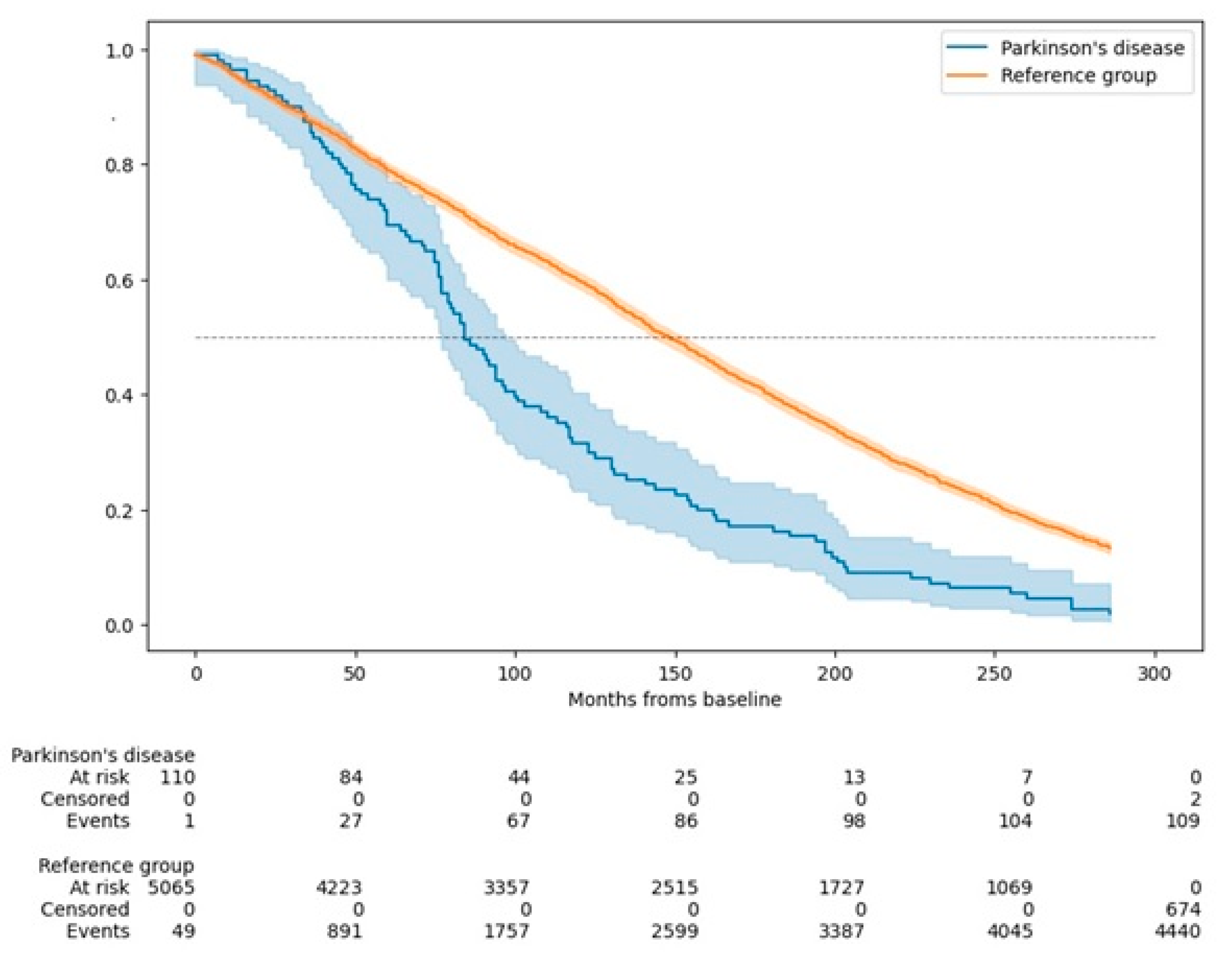
The analysis depicted in Figure 2 shows a marked difference in survival between individuals with Parkinson’s disease (PD) and those in the reference group. The survival curve for the PD group declines at a much faster rate, illustrating a lower survival probability in individuals with PD (log-rank test [Mantel-Cox]: χ² = 46.247, p < 0.001). By the study's conclusion, nearly all participants with PD had passed away, whereas a considerable portion of the reference group remained alive.
The estimated mean survival time for individuals without PD was 12.7 years (95% CI: 12.5–12.9 years), with a median survival time of 12.4 years (95% CI: 12.0–12.7 years). In contrast, individuals with PD had a substantially lower estimated mean survival time of 8.8 years (95% CI: 7.7–9.9 years) and a median survival time of 7.1 years (95% CI: 6.1–8.0 years).
Notably, PD itself was a significantly more common cause of death in the PD group, with 14.7% of deaths attributed to it, compared to only 0.4% in those without PD (p < 0.001). No significant differences were found for other causes of death, including dementia, cerebrovascular or cardiovascular diseases, respiratory diseases, cancer, and other causes.

4. Discussion

To our knowledge, this is the first prospective, population-based study with over two decades of follow-up in which PD patients were evaluated by neurologists, ensuring diagnostic accuracy and providing robust insights into long-term mortality outcomes. Our findings demonstrate a significantly increased 23-year mortality risk among older adults with PD in Spain, with individuals with PD experiencing markedly higher mortality than those without the disease, even after adjusting for various confounders.
In the initial model, adjusting for age, sex, and comorbidity index yielded an HR of 1.56 (95% CI = 1.29–1.89), which remained significantly elevated at 62% (HR = 1.62, 95% CI = 1.31–2.01) in the fully adjusted model. These findings are consistent with prior studies linking PD to elevated mortality,2,3 though our extended 23-year follow-up offers a uniquely comprehensive view of long-term mortality trajectories. This duration allows insights into PD progression and mortality beyond the typical follow-up of most studies. The prospective, population-based design of the NEDICES study, along with neurologist-confirmed diagnoses, minimizes selection bias and enhances the accuracy and generalizability of our results, setting this study apart as a valuable contribution to understanding PD mortality.
The consistency of our results with those from the earlier 13-year NEDICES mortality analysis reinforces the validity of our findings.7 At 13 years, the adjusted HR for mortality in individuals with PD was 1.75 (95% CI = 1.32–2.31),7 closely aligning with our current 23-year outcome. This stability over time suggests that the elevated mortality risk associated with PD remains steady, even with prolonged follow-up.
Interestingly, our adjusted 23-year HR is slightly lower than those reported in other population-based studies (Table 1). For instance, Xu et al’s.2 meta-analysis observed a higher all-cause mortality risk for PD patients (relative risk = 2.22; 95% CI = 1.78–2.77). Several factors could explain this discrepancy. Our door-to-door, population-based design likely captured milder PD cases that are typically excluded from clinical record-based studies, typically excluded from clinical record-based studies, potentially lowering our HR estimate. Xu et al.2 noted that cohort studies generally report somewhat higher relative risks (2.39) than case-control studies (2.00).
Additionally, the inclusion of premotor cases in our study could contribute to a slightly lower mortality risky when compared to studies that include only patients with manifest motor symptoms. Premotor cases likely represent earlier or milder stages of PD,43,44 where mortality risks might not yet be as pronounced. However, the inclusion of premotor/incident PD cases in this study not only broadens our understanding of PD's progression but also highlights a continuum of disease impact extending from non-motor to motor phases.
On the other hand, our extended follow-up may have diluted the observed mortality impact, as studies with follow-up periods longer than ten years often show lower relative risks.2 Advances in PD treatment and management over the study period may also have contributed to reducing excess mortality, though further research is needed to confirm this hypothesis. Finally, population-specific factors may influence PD survival; unique characteristics of the Spanish population could partly explain the lower HR observed in our study compared to studies from other regions.
Dementia within the context of PD emerged as a particularly significant factor, with individuals experiencing both conditions showing the highest mortality risk (adjusted HR = 2.19, 95% CI = 1.24–3.89). This finding is consistent with previous studies that have identified dementia as a critical predictor of mortality in PD,18,45 including the earlier 13-year NEDICES analysis,7 which also reported a notably high HR in this subgroup. The association between dementia and increased mortality risk in PD may be attributed to several mechanisms, including an elevated risk of falls and associated complications,46 poorer treatment adherence,47 and possibly an indication of a more aggressive or advanced form of PD.48,49 Our findings underscore the importance of close monitoring and comprehensive management of cognitive impairment in PD patients, particularly given the strong association between dementia and mortality risk.
Our study identifies a compelling trend observed in other research:23 individuals with younger-onset PD (diagnosed before age 65) exhibited a heightened mortality risk (adjusted HR = 2.11, 95% CI = 1.22–3.64) compared to those with later-onset PD. Younger-onset PD may lead to prolonged exposure to PD-related complications, potentially increasing overall mortality risk. This finding contrasts with other studies that have associated early-onset PD with more favorable long-term outcomes.5,50,51 However, much of the prior research on younger-onset PD is based on data from patients in specialist clinic settings, which may limit the generalizability of these results to the broader population.50 Further research is, however, needed to explore the distinct characteristics and risk factors associated with early-onset PD.
Regarding causes of death, it is notable that PD itself was listed as the primary cause in only 14.7% of PD cases. Cardiovascular and cerebrovascular diseases were the most commonly reported cause of death in both PD and non-PD individuals, a finding consistent with both the 13-year NEDICES analysis and other hospital-based studies.7,52 The low proportion of deaths directly attributed to PD could reflect the underreporting of the condition on death certificates, a recognized limitation in PD mortality studies that may lead to an underestimation of PD’s true impact on mortality.21,53 Additionally, differentiating between direct PD complications and other comorbidities can be challenging, particularly in older individuals. PD may also increase susceptibility to other conditions,54,55 indirectly influencing mortality. The high prevalence of cardiovascular-related deaths emphasizes the importance of a comprehensive approach to PD management that not only addresses motor symptoms but also focuses on preventing and treating cardiovascular comorbidities. Studies have highlighted the relevance of cardiovascular health in PD,56 suggesting that interventions aimed at reducing cardiovascular risk may have a substantial impact on survival.
Our study has several important strengths. The population-based design reduces selection bias that can affect hospital-based studies, and the extended 23-year follow-up period provides a unique long-term perspective on PD mortality trajectories. The broad range of covariates included allows for robust adjustment for potential confounders, and the use of a validated comorbidity index strengthens the validity of our findings compared to studies that rely on less specific indices. Additionally, continuity with the earlier 13-year NEDICES analysis enables direct comparisons and facilitates the evaluation of trends over time. However, certain limitations should be acknowledged. Relying on initial assessments for diagnoses meant we could not capture all incident PD cases during the 23-year follow-up, possibly leading to an underestimation of PD-related mortality risk. Additionally, the lack of access to detailed treatment information over the study period may have influenced mortality outcomes.
In closing, the findings from our study have significant implications for clinical practice and future research. Effective PD management requires a holistic approach that addresses motor symptoms, cognitive impairment, and comorbidities, especially cardiovascular health. Early identification of mortality risk factors, such as signs of dementia or rapid motor decline, may help clinicians recognize patients with the highest mortality risk, allowing for more personalized treatment planning. Furthermore, our findings support the development of more accurate prognostic models for PD patients, which could guide decision-making and resource allocation in clinical settings. Future studies should investigate the mechanisms underlying the increased mortality risk in early-onset PD, evaluate the impact of different treatment strategies on long-term survival, and explore the interactions between PD and cardiovascular disease. Incorporating biomarkers and genetic data could further enhance our understanding of disease progression variability and its impact on mortality.57–59
From a public health perspective, our results underscore the need for adequate healthcare planning to accommodate the anticipated increase in PD prevalence associated with an aging population. As the prevalence and incidence of PD continue to rise, a multidisciplinary approach to PD care that includes prevention and management of cognitive and cardiovascular complications will be essential for improving survival and quality of life in this growing patient population.

Funding Sources and Conflict of Interest

No specific funding was received for this work. The authors declare that there are no conflicts of interest relevant to this work.

Affirmation that all authors have read and complied with the Journal’s Ethical Publication Guidelines

We confirm that we have read the Journal’s position on issues involved in ethical publication and affirm that this work is consistent with those guidelines.

Ethical aspects

Study participants provided written informed consent following a comprehensive explanation of the research procedures. This study, aligned with the 1975 Helsinki Declaration principles, received approval from the ethical standards committees at the University Hospitals "12 de Octubre" and "La Princesa" in Madrid, ensuring adherence to ethical guidelines in human experimentation.

Authors Roles:

C. Benito-Rodríguez (carlaabeenito@gmail.com) collaborated on 1) the conception organization of the study and 2) the writing of the first draft of the manuscript.
F. Bermejo-Pareja (felixbermejo006@gmail.com) collaborated on 1) the conception, organization, and execution of the research project and 2) the review and critique of the manuscript.
A. Berbel (aberbel@yahoo.com) collaborated on 1) the conception organization of the study and 2) the review and critique of the manuscript.
J. Lapeña-Motilva (joselapemo@gmail.com) collaborated on 1) the conception organization of the study, 2) the statistical analysis design, and 3) the review and critique of the manuscript.
J. Benito-León (jbenitol67@gmail.com) collaborated on 1) the conception, organization, and execution of the research project, 2) the statistical analysis design, and 3) the writing of the first draft of the manuscript.

Acknowledgments

This article is derived from Carla M. Benito-Rodríguez's Medical Degree Thesis at Alfonso X El Sabio University. J. Benito-León is supported by the National Institutes of Health, Bethesda, MD, USA (NINDS #R01 NS39422), the European Commission (grant ICT-2011- 287739, NeuroTREMOR), the Spanish Health Research Agency (grant FIS PI12/01602 and grant FIS PI16/00451) and The Recovery, Transformation and Resilience Plan at the Ministry of Science and Innovation (grant TED2021-130174B-C33, NETremor). The Spanish Health Research Agency and the Spanish Office of Science and Technology supported NEDICES. Information about collaborators and detailed funding of the NEDICES study can be found on the following webpage (https://www.ciberned.es/en/research-programmes/projects/nedices).

References

  1. Bloem BR, Okun MS, Klein C. Parkinson’s disease. The Lancet 2021, 397, 2284–303. [Google Scholar] [CrossRef]
  2. Xu J, Gong DD, Man CF, Fan Y. Parkinson’s disease and risk of mortality: meta-analysis and systematic review. Acta Neurol Scand 2014, 129, 71–9. [Google Scholar] [CrossRef] [PubMed]
  3. Macleod AD, Taylor KSM, Counsell CE. Mortality in Parkinson’s disease: A systematic review and meta-analysis. Movement Disorders 2014, 29, 1615–22. [Google Scholar] [CrossRef]
  4. Aquino YC, Cabral LM, Miranda NC, et al. Respiratory disorders of Parkinson’s disease. J Neurophysiol 2022, 127, 1–15. [Google Scholar] [CrossRef] [PubMed]
  5. De Pablo-Fernández E, Lees AJ, Holton JL, Warner TT. Prognosis and Neuropathologic Correlation of Clinical Subtypes of Parkinson Disease. JAMA Neurol 2019, 76, 470–9. [Google Scholar] [CrossRef]
  6. Dommershuijsen LJ, Darweesh SKL, Ben-Shlomo Y, Kluger BM, Bloem BR. The elephant in the room: critical reflections on mortality rates among individuals with Parkinson’s disease. NPJ Parkinsons Dis 2023, 9, 145. [Google Scholar] [CrossRef] [PubMed]
  7. Posada IJ, Benito-León J, Louis ED, et al. Mortality from Parkinson’s disease: A population-based prospective study (NEDICES). Movement Disorders 2011, 26, 2522–9. [Google Scholar] [CrossRef] [PubMed]
  8. Benito-León J, Porta-Etessam J, Bermejo F. [Epidemiology of Parkinson disease]. Neurologia 1998, 13 (Suppl 1), 2–9. [Google Scholar]
  9. Benito-Leon, J. [Epidemiology of Parkinson’s disease in Spain and its contextualisation in the world]. Rev Neurol 2018, 66, 125–34. [Google Scholar]
  10. Ebmeier KP, Calder SA, Crawford JR, Stewart L, Besson JA, Mutch WJ. Parkinson’s disease in Aberdeen: survival after 3.5 years. Acta Neurol Scand 1990, 81, 294–9. [Google Scholar]
  11. Ben-Shlomo Y, Marmot MG. Survival and cause of death in a cohort of patients with parkinsonism: possible clues to aetiology? Journal of Neurology, Neurosurgery & Psychiatry 1995, 58, 293–9. [Google Scholar]
  12. Morens DM, Davis JW, Grandinetti A, Ross GW, Popper JS, White LR. Epidemiologic observations on Parkinson’s disease: Incidence and mortality in a prospective study of middle-aged men. Neurology 1996, 46, 1044–50. [Google Scholar] [CrossRef]
  13. Louis ED, Marder K, Cote L, Tang M, Mayeux R. Mortality From Parkinson Disease. Archives of Neurology 1997, 54, 260–4. [Google Scholar] [CrossRef]
  14. Berger K, Breteler MM, Helmer C, et al. Prognosis with Parkinson’s disease in europe: A collaborative study of population-based cohorts. Neurologic Diseases in the Elderly Research Group. Neurology 2000, 54 (Suppl 5), Suppl–5. [Google Scholar]
  15. Donnan PT, Steinke DT, Stubbings C, Davey PG, MacDonald TM. Selegiline and mortality in subjects with Parkinson’s disease: a longitudinal community study. Neurology 2000, 55, 1785–9. [Google Scholar] [CrossRef]
  16. Morgante L, Salemi G, Meneghini F, et al. Parkinson disease survival: a population-based study. Arch Neurol 2000, 57, 507–12. [Google Scholar] [CrossRef] [PubMed]
  17. Fall P-A, Saleh A, Fredrickson M, Olsson J-E, Granérus A-K. Survival time, mortality, and cause of death in elderly patients with Parkinson’s disease: a 9-year follow-up. Mov Disord 2003, 18, 1312–6. [Google Scholar] [CrossRef] [PubMed]
  18. De Lau LML, Schipper CMA, Hofman A, Koudstaal PJ, Breteler MMB. Prognosis of Parkinson Disease: Risk of Dementia and Mortality: The Rotterdam Study. Arch Neurol 2005, 62, 1265. [Google Scholar] [CrossRef] [PubMed]
  19. Forsaa EB, Larsen JP, Wentzel-Larsen T, Alves G. What predicts mortality in Parkinson disease?: A prospective population-based long-term study. Neurology 2010, 75, 1270–6. [Google Scholar] [CrossRef] [PubMed]
  20. Savica R, Grossardt BR, Bower JH, et al. Survival and Causes of Death Among People With Clinically Diagnosed Synucleinopathies With Parkinsonism: A Population-Based Study. JAMA Neurol 2017, 74, 839–46. [Google Scholar] [CrossRef]
  21. Hobson P, Meara J. Mortality and quality of death certification in a cohort of patients with Parkinson’s disease and matched controls in North Wales, UK at 18 years: a community-based cohort study. BMJ Open 2018, 8, e018969. [Google Scholar] [CrossRef]
  22. Keener AM, Paul KC, Folle A, Bronstein JM, Ritz B. Cognitive Impairment and Mortality in a Population-Based Parkinson’s Disease Cohort. J Parkinsons Dis 2018, 8, 353–62. [Google Scholar] [CrossRef] [PubMed]
  23. Hoogland J, Post B, De Bie RMA. Overall and Disease Related Mortality in Parkinson’s Disease – a Longitudinal Cohort Study. JPD 2019, 9, 767–74. [Google Scholar] [CrossRef]
  24. Morales JM, Bermejo FP, Benito-León J, et al. Methods and demographic findings of the baseline survey of the NEDICES cohort: a door-to-door survey of neurological disorders in three communities from Central Spain. Public Health 2004, 118, 426–33. [Google Scholar] [CrossRef] [PubMed]
  25. Bermejo-Pareja F, Benito-León J, Vega-Q S, et al. [The NEDICES cohort of the elderly. Methodology and main neurological findings]. Rev Neurol 2008, 46, 416–23. [Google Scholar]
  26. Vega S, Benito-León J, Bermejo-Pareja F, et al. Several factors influenced attrition in a population-based elderly cohort: Neurological disorders in Central Spain Study. Journal of Clinical Epidemiology 2010, 63, 215–22. [Google Scholar] [CrossRef]
  27. Bermejo-Pareja F, Benito-León J, Vega S, et al. Consistency of clinical diagnosis of dementia in NEDICES: A population-based longitudinal study in Spain. J Geriatr Psychiatry Neurol 2009, 22, 246–55. [Google Scholar] [CrossRef] [PubMed]
  28. Bermejo-Pareja F, Benito-León J, Vega S, Medrano MJ, Román GC. Neurological Disorders in Central Spain (NEDICES) Study Group. Incidence and subtypes of dementia in three elderly populations of central Spain. J Neurol Sci 2008, 264, 63–72. [Google Scholar] [CrossRef]
  29. Benito-León J, Bermejo-Pareja F, Morales J, Vega S, Molina J. Prevalence of essential tremor in three elderly populations of central Spain. Movement Disorders 2003, 18, 389–94. [Google Scholar] [CrossRef] [PubMed]
  30. Benito-León J, Bermejo-Pareja F, Louis ED. Incidence of essential tremor in three elderly populations of central Spain. Neurology 2005, 64, 1721–5. [Google Scholar] [CrossRef]
  31. Benito-León J, Bermejo-Pareja F, Rodríguez J, et al. Prevalence of PD and other types of parkinsonism in three elderly populations of central Spain. Movement Disorders 2003, 18, 267–74. [Google Scholar] [CrossRef]
  32. Benito-León J, Bermejo-Pareja F, Morales-González JM, et al. Incidence of Parkinson disease and parkinsonism in three elderly populations of central Spain. Neurology 2004, 62, 734–41. [Google Scholar] [CrossRef] [PubMed]
  33. Díaz-Guzmán J, Bermejo-Pareja F, Benito-León J, Vega S, Gabriel R, Medrano MJ. Prevalence of Stroke and Transient Ischemic Attack in Three Elderly Populations of Central Spain. Neuroepidemiology 2008, 30, 247–53. [Google Scholar] [CrossRef] [PubMed]
  34. Martínez-Salio A, Benito-León J, Díaz-Guzmán J, Bermejo-Pareja F. Cerebrovascular disease incidence in central Spain (NEDICES): A population-based prospective study. Journal of the Neurological Sciences 2010, 298, 85–90. [Google Scholar] [CrossRef] [PubMed]
  35. the ILSA Group, Maggi S, Zucchetto M, et al. The Italian Longitudinal Study on Aging (ILSA): Design and methods. Aging Clin Exp Res 1994, 6, 464–73. [Google Scholar] [CrossRef]
  36. Bermejo F, Gabriel R, Vega S, Morales JM, Rocca WA, Anderson DW. Problems and Issues with Door-To-Door, Two-Phase Surveys: An Illustration from Central Spain. Neuroepidemiology 2001, 20, 225–31. [Google Scholar] [CrossRef] [PubMed]
  37. Fahn, S. Members of the UPDRS Development Committee. Unified Parkinson’s Disease Rating Scale [Internet]. 1987. Available from: https://api.semanticscholar.org/CorpusID:203500896.
  38. American Psychiatric Association. APAssociation Task Force on DSM-IV,. Diagnostic and statistical manual of mental disorders : DSM-IV. Washington, DC: American Psychiatric Association; 1994.
  39. Hoehn MM, Yahr MD. Parkinsonism: onset, progression, and mortality. 1967. Neurology 2001, 57 (Suppl 3), S11–26.
  40. Carey IM, Shah SM, Harris T, DeWilde S, Cook DG. A new simple primary care morbidity score predicted mortality and better explains between practice variations than the Charlson index. J Clin Epidemiol 2013, 6, 436–44. [Google Scholar]
  41. Fereshtehnejad S-M, Yao C, Pelletier A, Montplaisir JY, Gagnon J-F, Postuma RB. Evolution of prodromal Parkinson’s disease and dementia with Lewy bodies: a prospective study. Brain 2019, 142, 2051–67. [Google Scholar] [CrossRef] [PubMed]
  42. Diederich NJ, Sauvageot N, Pieri V, Hipp G, Vaillant M. The Clinical Non-Motor Connectome in Early Parkinson’s Disease. J Parkinsons Dis 2020, 10, 1797–806. [Google Scholar] [CrossRef] [PubMed]
  43. Siderowf A, Stern MB. Premotor Parkinson’s disease: clinical features, detection, and prospects for treatment. Ann Neurol 2008, 64 (Suppl 2), S139–147.
  44. Siderowf A, Lang AE. Premotor Parkinson’s disease: concepts and definitions. Mov Disord 2012, 27, 608–16. [Google Scholar] [CrossRef] [PubMed]
  45. Levy G, Tang M-X, Louis ED, et al. The association of incident dementia with mortality in PD. Neurology 2002, 59, 1708–13. [Google Scholar] [CrossRef] [PubMed]
  46. Fasano A, Canning CG, Hausdorff JM, Lord S, Rochester L. Falls in Parkinson’s disease: A complex and evolving picture. Movement Disorders 2017, 32, 1524–36. [Google Scholar] [CrossRef]
  47. Daley DJ, Myint PK, Gray RJ, Deane KHO. Systematic review on factors associated with medication non-adherence in Parkinson’s disease. Parkinsonism & Related Disorders 2012, 18, 1053–61. [Google Scholar]
  48. Cereda E, Cilia R, Klersy C, et al. Dementia in Parkinson’s disease: Is male gender a risk factor? Parkinsonism & Related Disorders 2016, 26, 67–72.
  49. Hoogland J, Boel JA, De Bie RMA, et al. Risk of Parkinson’s disease dementia related to level I MDS PD-MCI. Movement Disorders 2019, 34, 430–5. [Google Scholar] [CrossRef] [PubMed]
  50. Wickremaratchi MM, Ben-Shlomo Y, Morris HR. The effect of onset age on the clinical features of Parkinson’s disease. Euro J of Neurology 2009, 16, 450–6. [Google Scholar] [CrossRef] [PubMed]
  51. Pagano G, Ferrara N, Brooks DJ, Pavese N. Age at onset and Parkinson disease phenotype. Neurology 2016, 86, 1400–7. [Google Scholar] [CrossRef]
  52. Pinter B, Diem-Zangerl A, Wenning GK, et al. Mortality in Parkinson’s disease: A 38-year follow-up study. Movement Disorders 2015, 30, 266–9. [Google Scholar] [CrossRef]
  53. Benito-León J, Louis ED, Villarejo-Galende A, Romero JP, Bermejo-Pareja F. Under-reporting of Parkinson’s disease on death certificates: A population-based study (NEDICES). Journal of the Neurological Sciences 2014, 347, 188–92. [Google Scholar] [CrossRef]
  54. Coomber R, Alshameeri Z, Masia AF, Mela F, Parker MJ. Hip fractures and Parkinson’s disease: A case series. Injury 2017, 48, 2730–5. [Google Scholar] [CrossRef] [PubMed]
  55. Burchill E, Watson CJ, Fanshawe JB, et al. The impact of psychiatric comorbidity on Parkinson’s disease outcomes: a systematic review and meta-analysis. Lancet Reg Health Eur 2024, 39, 100870. [Google Scholar] [CrossRef] [PubMed]
  56. Hong CT, Hu HH, Chan L, Bai C-H. Prevalent cerebrovascular and cardiovascular disease in people with Parkinson&rsquo;s disease: a meta-analysis. CLEP 2018, 10, 1147–54. [Google Scholar]
  57. Caspell-Garcia C, Simuni T, Tosun-Turgut D, et al. Multiple modality biomarker prediction of cognitive impairment in prospectively followed de novo Parkinson disease. PLoS One 2017, 12, e0175674. [Google Scholar]
  58. Fereshtehnejad S-M, Zeighami Y, Dagher A, Postuma RB. Clinical criteria for subtyping Parkinson’s disease: biomarkers and longitudinal progression. Brain 2017, 140, 1959–76. [Google Scholar] [CrossRef] [PubMed]
  59. Espay AJ, Kalia LV, Gan-Or Z, et al. Disease modification and biomarker development in Parkinson disease: Revision or reconstruction? Neurology 2020, 94, 481–94. [Google Scholar] [CrossRef] [PubMed]
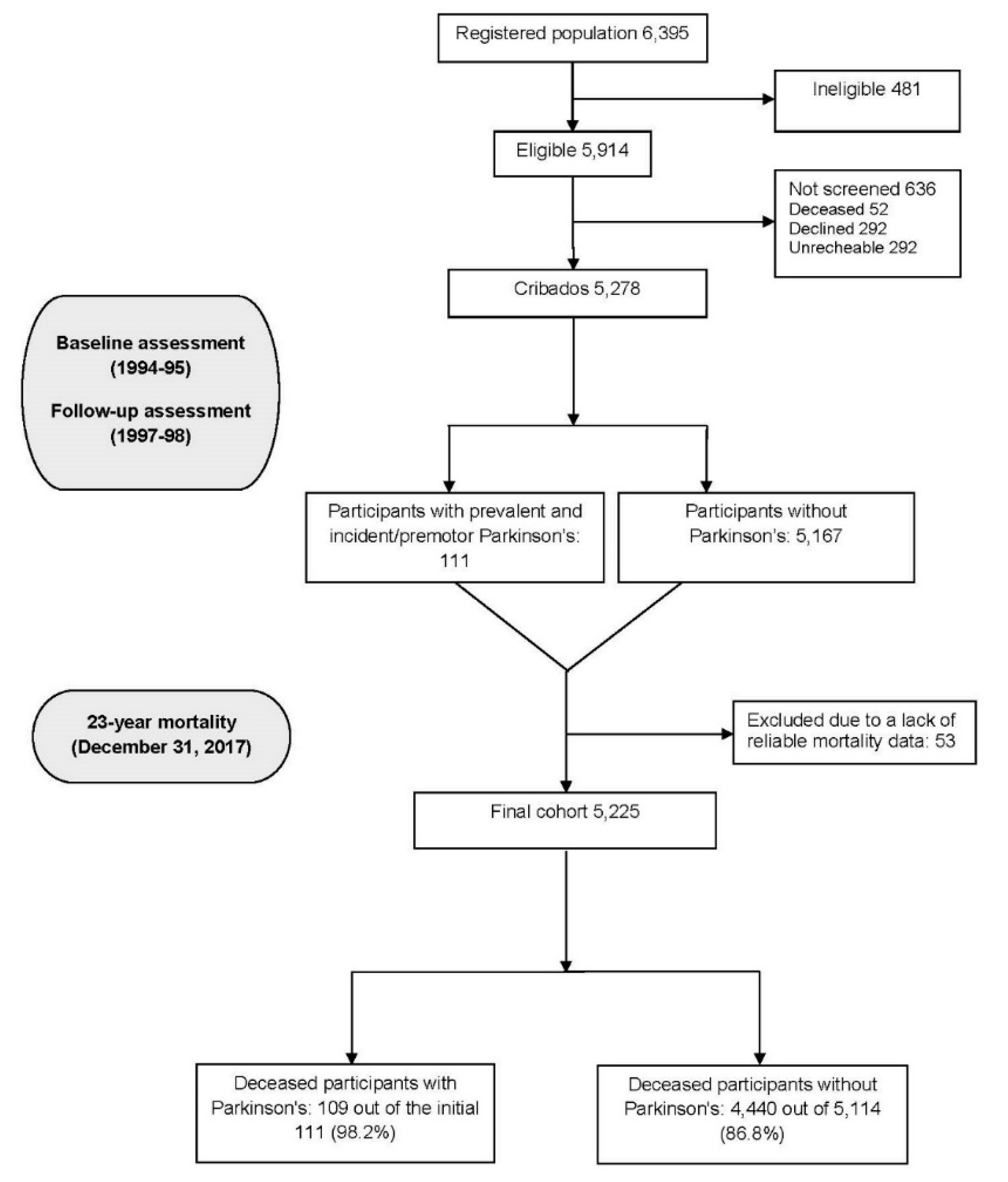
Figure 1. Flow chart of the study.
Preprints 142503 g001
Figure 2. Kaplan-Meier curve showing the overall survival of the NEDICES cohort.
Preprints 142503 g002
Table 1. Summary of Mortality Risk in Parkinson's Disease: Key Findings from a Selection of Major Population-Based.
Year Study Cohort Characteristics Key Findings
1990 Ebmeier et al.10 267 patients and 233 matched controls in Scotland were followed for 3.5 years The ratio of mortality risks for patients and controls was 2.35. Factors predicting death included cognitive impairment, older age, late disease onset, long-term smoking, low blood pressure, and Parkinson's-related mobility issues
1995 Ben-Shlomo & Marmot11 220 Parkinson’s disease patients and 421 matched controls in the UK were followed for 20 years Parkinson's disease was associated with increased mortality (adjusted hazard ratio = 2.6); cerebrovascular and ischemic heart disease deaths were higher in Parkinson's disease.
1996 Morens et al.12 8,006 middle-aged men from the Honolulu Heart Study were followed for 29 years Mortality increased 2-3 times in Parkinson's disease; survival was reduced by 8 years compared to controls.
1997 Louis et al.13 288 patients, Manhattan, USA The risk of mortality, when compared with nondemented elderly subjects, was highest among those with both PD and dementia (rate ratio, 4.9). Dementia and extrapyramidal symptoms strongly influenced risk.
2000 Berger et al.14 Pooled analysis of five European population-based cohorts (16,143 participants) The relative risk of death in Parkinson's disease = 2.3; increased institutionalization and mortality risks, especially in men.
2000 Donnan et al.15 97 Parkinson's disease patients in Scotland Mortality in Parkinson's disease doubled (Rate Ratio = 1.76); higher mortality with levodopa monotherapy (Rate Ratio = 2.45).
2000 Morgante et al.16 59 patients and 118 matched controls in Sicily, Italy, were followed for 8 years. Parkinson's disease mortality was significantly higher, with a relative risk of 2.3; pneumonia was the most common cause of death.
2003 Fall et al.17 170 Parkinson’s disease patients and 510 matched controls in Sweden were followed for 9 years The mortality rate ratio was 1.6 when comparing PD patients with controls. There was a significant increase in deaths from pneumonia
2005 de Lau et al.18 (Rotterdam Study) 6,969 participants, 99 prevalent, 67 incident Parkinson's disease cases Increased mortality risk (Hazard ratio = 1.83). Within PD cases, mortality risk was influenced by disease duration and by occurrence of dementia
2010 Forsaa et al.19 230 Parkinson's disease patients, followed from 1993 to 2009, Norway Median survival was 15.8 years; mortality predictors included higher age at motor onset, older age, male sex, more severe motor impairment, psychotic symptoms, and dementia.
2011 Posada et al.7 (NEDICES Study) 5,262 elderly participants, 81 Parkinson's disease cases, Spain, 13-year follow-up Parkinson's disease mortality was higher (adjusted hazard ratio = 1.75); dementia further increased the risk (adjusted hazard ratio = 2.60).
2017 Savica et al.20 461 patients with synucleinopathies, Minnesota, USA Parkinson's disease was associated with moderately increased mortality (Hazard Ratio = 1.75); multiple system atrophy with parkinsonism showed the highest mortality (Hazard Ratio = 10.51).
2018 Hobson & Meara21 166 Parkinson's disease patients and 102 controls, followed for 18 years at Wales Compared with the general UK population, individuals with Parkinson's disease had a higher risk of mortality, with a standardized mortality ratio of 1.82. The most common causes of death were pneumonia and cardiac-related conditions.
2018 Keener et al.22 360 Parkinson's disease patients, new-onset cohort, California, mean follow-up of 5.8-years Cognitive impairment, older age at diagnosis, and motor subtype (postural instability and gait difficulty associated with higher risk; HR = 0.58 for tremor-dominant subtype) were significant predictors of mortality.
2019 Hoogland et al.23 133 newly diagnosed Parkinson's disease patients in the Netherlands followed for at least 13 years. Increased mortality associated with mild cognitive impairment, higher levodopa dose, and earlier onset.
Table 2. Baseline Demographic and Clinical Characteristics (1994-1995) of Individuals with and without Parkinson’s Disease – Reference Group – (N=5,225).
Parkinson’s disease (N = 111) Without Parkinson’s (N = 5,114) p value
Age in years 76.5 ± 5.7 (76.0) 74.3 ± 7.0 (73.0) <0.001
Sex (female) 49 (44.1%) 2,949 (57.7%) 0.004
Study area 0.359
- Arévalo 47 (42.3%) 1,874 (36.6%)
- Las Margaritas 31 (27.9%) 1,725 (33.7%)
- Lista 33 (29.6%) 1,515 (29.6%)
Education in years of study completed * 5.7 ± 7.1 (6.0) 6.0 ± 5.3 (6.0) 0.270
Smoking habit* 0.118
- Smoker 5 (5.4%) 489 (12.2%)
- Ex-smoker 29 (31.5%) 1,068 (26.7%)
- Never smoked 58 (63.0%) 2,436 (61.0%)
Alcohol consumption* 0.233
- Regular drinker 23 (25.0%) 1,334 (33.4%)
- Ex-drinker 21 (22.8%) 830 (20.8%)
- Never drank 48 (52.2%) 1,825 (45.8%)
Arterial hypertension* 62 (56.4%) 2,483 (51.0%) 0.267
Comorbidity Index 1.6 ± 1.8 (1.0) 1.1 ± 1.5 (0.0) 0.005
Dementia 14 (12.6%) 291 (5.7%) 0.002
Mean ± standard deviation (median) values are provided for age, years of education, and comorbidity index. Mann-Whitney test (continuous data comparison) and chi-square test (proportions) were used. * N < 5,225 due to missing data in some participants.
Table 3. Baseline Demographic and Clinical Characteristics (1994-1995) of the Cohort, Stratified by Mortality (N=5,225).
Alive (N = 676) Deceased (N = 4,549) p value
Age in years 68.9 ± 3.9 (68.0) 75.1 ± 7.0 (74.0) <0.001
Sex (female) 460 (68.0%) 2,538 (55.8%) <0.001
Study area 0.006
- Arévalo 211 (31.2%) 1,710 (37.6%)
- Las Margaritas 249 (36.8%) 1,507 (33.1%)
- Lista 216 (32.0%) 1,332 (29.3%)
Education in years of study completed * 6.8 ± 5.7 (7.0) 5.9 ± 5.3 (6.0) <0.001
Smoking habit* 0.002
- Smoker 62 (10.8%) 432 (12.3%)
- Ex-smoker 125 (21.7%) 972 (27.7%)
- Never smoked 388 (67.5%) 2,106 (60.0%)
Alcohol consumption* 0.050
- Regular drinker 208 (36.3%) 1,149 (32.8%)
- Ex-drinker 99 (17.3%) 752 (21.4%)
- Never drank 266 (46.4%) 1,607 (45.8%)
Arterial hypertension* 254 (38.4%) 2,291 (53.1%) <0.001
Comorbidity Index 0.6 ± 1.0 (0.0) 1.2 ± 1.6 (1.0) <0.001
Mean ± standard deviation (median) values are provided for age, years of education, and comorbidity index. Mann-Whitney test (continuous data comparison) and chi-square test (proportions) were used. * N < 5,225 due to missing data in some participants.
Table 4. Mortality Hazard Ratios in Parkinson's Disease Patients Compared to Non-PD Participants and Stratifications by Dementia Status and Disease Duration.
A. Mortality hazard ratios in Parkinson's disease patients versus those without Parkinson's disease
Unadjusted Model 1 Model 2 Model 3
Hazard ratio 95% CI p value Hazard ratio 95% CI p value Hazard ratio 95% CI Valor p Hazard ratio 95% CI p value
Parkinson's disease patients (N=111) 1.91 1.58-2.32 <0.001 1.56 1.29-1.89 <0.001 1.64 1.33-2.04 <0.001 1.62 1.31-2.01 <0.001
Participants without Parkinson's disease (N = 5,114) (reference group) 1.0 _ 1.0 1.0 _ 1.0 1.0 _ 1.0 1.0 _ 1.0
B. Mortality hazard ratios in Parkinson's disease patients, stratified by the presence or absence of dementia
Unadjusted Model 1 Model 2 Model 3
Hazard ratio 95% CI p value Hazard ratio 95% CI p value Hazard ratio 95% CI p value Hazard ratio 95% CI p value
Parkinson's disease patients with dementia (N = 14) 4.27 2.52-7.23 <0.001 2.13 1.26-3.62 0.005 2.19 1.24-3.88 0.007 2.19 1.24-3.89 0.007
Parkinson's disease patients without dementia (N = 97) 1.77 1.44-2.17 <0.001 1.50 1.23-1.84 <0.001 1.58 1.26-1.99 <0.001 1.56 1.24-1.96 <0.001
Participants without either condition (N = 5,114) (reference group) 1.0 _ 1.0 1.0 _ 1.0 1.0 _ 1.0 1.0 _ 1.0
C. Mortality hazard ratios in Parkinson's disease patients, stratified by disease onset
Unadjusted Model 1 Model 2 Model 3
Hazard ratio 95% CI p value Hazard ratio 95% CI p value Hazard ratio 95% CI p value Hazard ratio 95% CI p value
Parkinson's disease onset at age 65 or later (N = 92) 1.87 1.52-2.30 <0.001 1.46 1.19-1.80 <0.001 1.58 1.25-1.99 <0.001 1.56 1.24-1.97 <0.001
Parkinson's disease onset before age 65 (N = 19) 2.16 1.38-3.40 <0.001 2.32 1.48-3.66 <0.001 2.15 1.25-3.71 0.006 2.11 1.22-3.64 0.007
Participants without Parkinson's disease (N = 5,114) (reference group) 1.0 _ 1.0 1.0 _ 1.0 1.0 _ 1.0 1.0 _ 1.0
Model 1 (baseline variables significantly associated with both Parkinson's disease and mortality): adjusted for age, sex, and comorbidity index (atrial fibrillation, non-metastatic cancer, metastatic cancer, chronic obstructive pulmonary disease, depression, dementia, diabetes, treated epilepsy, heart failure, myocardial infarction, psychiatric disorders, kidney disease, and stroke). Model 2 (baseline variables significantly associated with either Parkinson's disease or mortality): adjusted for age, sex, study area, education, smoking status, arterial hypertension, and comorbidity index. Model 3 (all variables): adjusted for age, sex, study area, education, smoking and alcohol status, arterial hypertension, and comorbidity index.
Disclaimer/Publisher’s Note: The statements, opinions and data contained in all publications are solely those of the individual author(s) and contributor(s) and not of MDPI and/or the editor(s). MDPI and/or the editor(s) disclaim responsibility for any injury to people or property resulting from any ideas, methods, instructions or products referred to in the content.
Copyright: This open access article is published under a Creative Commons CC BY 4.0 license, which permit the free download, distribution, and reuse, provided that the author and preprint are cited in any reuse.
Prerpints.org logo

Preprints.org is a free preprint server supported by MDPI in Basel, Switzerland.

Subscribe

Disclaimer

Terms of Use

Privacy Policy

Privacy Settings

© 2025 MDPI (Basel, Switzerland) unless otherwise stated