

Submitted:
11 December 2024
Posted:
12 December 2024
You are already at the latest version
Abstract
Several guidelines provided by European organizations and the World Health Organization, and frameworks in the scientific literature suggest focusing on the built environment for promoting public health as it acts as a promoter of healthy lifestyles. They also highlight the importance of creating healthy conditions for active ageing through spatial and urban furniture solutions that improve overall accessibility, walkability, and independence, by providing supporting products, such as urban furniture for resting and access to quality food and water, as well as equipment for physical activities, including socializing and creating multigenerational connections.
The paper presents the results at the micro scale, relating to urban furniture design, of an action-research, that investigated two representative neighborhoods as case studies of Florence in which the topics of inclusion, proximity and healthy lifestyles were tested, and design strategies and orienting scenarios for a healthy neighborhood were developed.
Semi-structured interviews, co-design workshops, and living labs with citizens, stakeholders and experts provided several needs, problems, opportunities, and potential aspects about the healthy perspective of the neighborhoods.
The results highlight the potential and important role of urban furniture design in promoting a healthy built environment, underlining the strategic role of tangible products as healthy touchpoints to promote healthy lifestyles.
Keywords:
healthy neighborhood
; urban furniture design and innovation
; built environment innovation
; product design
; design thinking
; co-design methods
; active aging
1. Introduction
1.1. Healthy Neighbourhoods Hub (HNH) Research Project
The paper presents and discusses part of the results of the research project “Healthy Neighbourhoods Hubs” (HNH) [1,2,3,4,5,6,7], funded by Fondazione CR Firenze and the Department of Architecture of the University of Florence - DIDA Unifi. The project involves an interdisciplinary team that includes disciplines related to product, service, and communication design, architectural technology, urban planning, and landscape architecture.
It is based on the assumption that citizens' health is closely related to the built environment in which communities live and work. It is consolidated in the scientific literature that the built environment - which means indoor and outdoor spaces, including street furniture, wayfinding, information, and communication systems designed for such spaces - influences public health as it acts as a promoter of healthy lifestyles: doing physical activity, having a healthy diet, being involved in positive social interactions, etc. These lifestyles help prevent chronic diseases - such as cardiovascular diseases, diabetes, and some types of cancer - and physical and cognitive aging. Actions aimed at supporting human fragility and combating loneliness also benefit from designing a healthy and inclusive built environment.
Therefore, the synergy between public health, urban planning, architecture, and product and service design plays a significant role in increasing and promoting health, including the dimensions of mental health, social inclusion, and healthy aging, in addition to chronic conditions.
The built environment influences lifestyles because people find themselves living in different spaces every day, from their homes to their workplaces, moving around the open spaces of the city, characterized by squares, streets, parks, porticos, halls of public buildings, with their furnishings [8].
Therefore, public space, in addition to being a common good and a service for citizens, also has great potential for promoting people's health, improving the quality of their daily lives, and nudging them to be autonomous, active, and healthy as long as possible.
Requalifying and healthily designing public space is an investment for the future of society, whose impacts will be readable in terms of social and health indicators.
The overarching objective of the research is to define strategies and design scenarios for healthy, inclusive, and based on 1500 mt. model cities by undertaking an action-research approach on two testing neighbourhoods in Florence. The project had lots of partners composed of public and private entities, such as the Metropolitan City of Florence, Municipality of Florence, Health Society of Florence, Local Health Unit of Tuscany, and Metalco Street Furniture Group. The government part of the consortium is the recipient of the research project. Indeed, the research team aims to define cross-scalar strategic support tools to improve the quality of the urban environment and promote active and healthy aging, through experimentation in two neighborhoods of Florence, identifying and analyzing the opportunities, potential, and sources of value creation offered by public space.
As mentioned, the interdisciplinary research team is cross-scalar and comprises four disciplinary sectors aiming at co-defining a strategic output from the micro-level of the design discipline to the meso-level of the architectural technology sector, and the macro-level of the urban planning, and landscape architecture discipline.
Macchi et al. [9] introduce the HNH conceptual framework and operational model. The HNH is a multidisciplinary and multi-scalar conceptual framework that synthesizes and systematizes the key characteristics of healthy and inclusive neighbourhoods into seven distinct themes (Figure 1) [9]: (i) the neighbourhood for all; (ii) the neighbourhood of the interactions; (iii) the active neighbourhood; (iv) the neighbourhood of the senses; (v) the green neighbourhood; (vi) the smart neighbourhood; and (vii) the neighbourhood of the 1500 m. The seven themes incorporate spatial and environmental elements that foster health and well-being goals at the neighbourhood level.
Each theme (or “neighbourhoods”) describes specific characteristics, sub-characteristics, and variables that allow the measurement of the neighbourhood-built environment from multiple perspectives (including the micro-scale of the urban furniture) and by involving multiple actors, including experts, citizens, policy-makers, and third-sector entities [9,10].
Busciantella-Ricci et al. [10] explain how to adopt it as a design action-research tool in desk and in-the-field activities and how it fosters user studies, social participation, and citizen and collective engagement research activities.
This paper discusses adopting the HNH conceptual framework to examine the role of urban furniture, and explore the urban furniture design, in neighbourhood regeneration and to drive participative and co-design research activities with stakeholders and citizens.
The specific research objectives at the micro-level of the design scale are: (i) to define a scalable and replicable methodological co-design process for designing healthy and inclusive micro-level interventions; (ii) to cluster and identify “Urban Furniture Product” domains, and sub-domains, and strategic requirements capable of achieving the research challenges; and (iii) to outline design guidelines for the categories of “Urban Furniture Product” identified, aimed at supporting and orienting the public administration in urban redevelopment towards a healthy, inclusive and proximity-based city, but also designers and companies in conceiving and manufacturing innovative and ‘healthy’ urban furniture products.
The related research questions are (i) which methodological approaches could address health and inclusive issues in the urban context; (ii) how the HNH conceptual framework could enable the methodological co-design process; and (iii) which co-design research tools and methods could be implemented in the action-research process.
The paper is organized as follows: (i) the following sub-section critically reviews the current literature on urban health, co-design, and participation; (ii) the second section describes the operative model and methodological approach adopted, it highlights the hierarchical structure of research phases, and which design research methods and tools is to be undertaken; (iii) the third section shows the results clustering the “Urban Furniture Product” in domains and sub-domains, defining the strategic requirements to consider in its development to achieve the research challenges and identifying the “Urban Furniture Product” categories to implement in the urban context; and (iv) the last section discusses the capability of the results to support the public administrations in urban renovation projects strategically.
In conclusion, the adoption of the HNH conceptual framework highlighted the role of “Urban Furniture Product” as a strategic neighbourhoods touchpoint capable of promoting and orienting people towards healthy and inclusive lifestyles, supported the participative co-design of the micro-level urban product scenarios, and the definition of “Urban Furniture Product” categories as a strategic tool for public administration to regenerate the urban space.
1.2. Design Thinking Correlating Healthy Lifestyle, Inclusion, and Proximity
The interdisciplinary research team identifies “proximity", “healthy lifestyles”, and “inclusion” as core topics for achieving neighbourhood health challenges [9]. In the early research project’s stages, the research team critically and interdisciplinarily reviews the literature from the design perspective, identifying which methodological approaches, research methods, and toolkits strategically address urban health.
The proximity concept aims at rethinking the cities supporting the daily displacements, encouraging community building, and fostering social interactions through services and places [11,12]. Manzini [13] highlights the link between proximity and health, introducing the caring capability due to the vicinity of people, organizations, places, products, and services. The case study “Superblocks” in Barcelona (see [14]) is an example of relational welfare’s efficiency in fostering territorialized care [15]. Conceiving the neighbourhoods as cities’ ecosystems enabled by services and products, the research team focuses on the product-service systems design disciplines to define “Urban Furniture Product” scenarios capable of supporting healthier, active, and more sustainable lifestyles. Notably, the research team identifies the “design for social innovation” (see [16]) as a design research methodological approach to support social change toward healthy and sustainable ways of living and experiencing the cities.
Moreover, this methodological approach is a broad-spectrum enabler of other concepts strictly related to proximity, including walkability (see [17]), cyclability, or intermodality. The correlation with these three sub-topics lets the researchers identify the design for behaviour change methodological approach as design research supporting tool for defining proximal and healthy product-service systems interventions [18]. The main feature of this design research approach is to impact people's healthy behavioural intentions. This aspect highlights the coherence with the HNH research project's specific objectives which seek to understand how urban furniture products orient people towards healthy lifestyles, and active mobility, or rather a nutritious diet, physical activity, and positive social relationships (see [19]).
The “healthy lifestyles” concept is strictly related to the “Active and healthy ageing” challenge [20] and the design capability to support the creation of active societies, environments, people, and systems [21]. Notably, the research project aims to identify the behavioural and spatial factors fostering lifestyle change, and healthier and active daily displacements. The research team, therefore, framed behavioural and age-friendly approaches and strategies to apply to create active change through urban furniture product-service systems, i.e. “Fogg Behaviour Model” [22], the “COM-B Model” [23], “Design for Behaviour Change” [24,25]. The physical environment, as a determinant of active ageing [26] and Age-Friendly Cities [27], is also a key concept for the development of an inclusive and healthy neighbourhood. According to this perspective, the Active Design Guidelines [28,29] propose to create a synergy between active, sustainable, and universal design, while Sport England [30] refers to the Inclusive Design approach (ID) to suggest a strategy for developing neighbourhoods and open spaces accessible to all users and able to support physical activity across all ages [30]. Moreover, ‘inclusion’ is described as a diffused strategy to be adopted for the elderly needs by designing accessible environments through the adoption of the Universal Design (UD) approach [31,32].
The “inclusion” concept, in the urban health approach, is addressed according to several points of view. Indeed, the built environment in the urban health approach mainly suggests the adoption of the Design for All (DfA) and Universal Design (UD) approaches as strategies for breaking physical barriers by guaranteeing access to health vulnerabilities [33,34,35]. UD has also been proposed as a reference for assessing the propensity of urban plans to promote urban health strategies [36,37]. In parallel, alternative approaches also emerged such as the “streets for life” [38] that envisions easy and enjoyable streets in the neighbourhoods; and the “restorative cities” perspective that includes the concept of “inclusive city” [39], and the “Inclusive Healthy Places” framework [40] that describes inclusion as (i) an outcome, a process, and a tool that can eliminate health inequities at the urban level.
It is not new that DfA, UD, and ID are considered and discussed as the main approaches for addressing inclusion at the multiple levels of a city, including the neighbourhood and the furniture that holds or describes those spaces. From a micro-level perspective, traditional design approaches related to inclusion - ID [41], DfA [42,43], and UD [44] - are the most significant for addressing the urban furniture at the level of the product design. However, they support the design of urban products (i.e. urban furniture), with some specific and available resources to be used by designers. Specifically, the UD approach is often considered for the seven design principles [45] and the revised eight goals [46]. They are useful resources for also applying design philosophy such as the DfA which describes an approach related to socio-political and socio-cultural drivers, and the enhancement of diversity as a value [see (43,47)]. The recent standard EN 17161:20191 [48] also, describes how DfA can assume a strategic value, if applied collaboratively, in organizations that need a transformation toward a generally more positive attitude towards diversity and inclusion, including the selling of new and inclusive products and services. Finally, the ID results are one of the most structured approaches in terms of tools, methodologies, and strategies available for designers such as the Inclusive Design Toolkit, or the exclusions calculators (see [49,50]). Also, the ID is recognised for the five design principles [51] that emphasize how to develop inclusive products for an inclusive environment.
2. Methodological Approach
The project adopted the action research approach by investigating two representative case studies of Florence - two neighborhoods where the “Casa della Salute” [Health House] is present - in which the topics of inclusion, proximity, and healthy lifestyles were tested until strategies and design scenarios for a healthy neighborhood were developed. The results are scalable to other neighborhoods and contexts at local, national, and European levels.
The research strategy adopted is “research through design” (see [52]) and is aimed at generating knowledge to conduct interdisciplinary design research and guide higher education and practice in the development of strategies and design-oriented product-service system scenarios fostering healthy, inclusive, and livable neighbourhoods.
The research process is hierarchically structured into two macro-phases or rather is framed in the Double-Diamond design thinking model (see [53,54]). The first one aimed at (i) clustering the “Urban Furniture Product” for a healthy neighborhood into functional domains and subdomains; (ii) defining strategic requirements to be considered for developing “Urban Furniture Product” capable of meeting the research challenges, and (iii) identifying the categories of “Urban Furniture Product” to be implemented in the city to support public administrations in urban regeneration projects. Within the first Diamond, the research team strategically evaluated the data gathered through desk research activities, and the adoption of related methods, and tools. As Busciantella-Ricci et al. [10] discussed, the research team used the HNH framework as a design research support tool for categorizing urban furniture products, enabling us to set the foreground for the following participatory and co-design activities.
The second phase is about co-designing the data results, which emerged from the first phase, with researchers, project experts, citizens, stakeholders, and practitioners. Within the second diamond, the research team structured the co-designed research tasks and aimed at (i) exploring and discussing with researchers and project experts the preliminary results on domains and sub-domains; and (ii) designing product-service systems scenarios in a collaborative and participative context for and with practitioners, citizens, and stakeholders.
Notably, the two research stages have diverging and converging microphases, subdividing the research design process into 4 micro stages, aligned with the overarching objectives, encompassing research macro-tasks, research micro-tasks, and adopting related tools and methods.
2.1. First Phase: Clustering “Urban Furniture Product” Domains, Sub-Domains, and Strategic Requirements
2.1.1. Adopting the HNH Conceptual Framework as a Design Research Tool
In the initial diverging phase, the research team “broadened its horizons” on the challenges achieved by adopting the HNH conceptual framework [9] as design research supporting tool. The researchers the researchers analyzed abductively the general and specific characteristics, and variables with the three orders of design (see [55,56]), related to information, product, and product-service systems design disciplines. They extracted micro-level design opportunities, insights, and disruptive and promising interventions to gather main “Micro-level design trending topics” capable of delivering real outputs.
Moreover, the researchers internally co-designed information sheets supporting the desk categorization of the trending topics. The template in Figure 2 is specifically conceptualized to identify emerging concepts and assigns every theme: (i) an inspiring title, to provide a creative and imaginary vision of the content; (ii) the reference neighbourhood theme, to directly link the content to the HNH conceptual framework; (iii) the corresponding general and specific characteristic of the seven themes; (iv) a representative of the emerged strategies or solutions; (v) a descriptive sample of the concept; (vi) keywords; and (vii) some space for notes.
After the identification of the main trending topics, the research team qualitatively iterated the synthesizing phase to reject the less promising proposals, through the adoption of the following indicators: (i) the innovative potential, regarding the research challenges and HNH conceptual framework; (ii) the feasibility and developing potential; (iii) coherence with the seven themes of the HNH project; and (iv) the research team development goals.
Lastly, in the final converging phase of the first Diamond, the research team collaboratively and qualitatively clustered the trending topics in “macro-topics”, or rather domains. The researchers adopted an affinity diagram (see [57]) to meaningfully categorize based on topic similarities, to fully consider and capture every insight, concern, and effective requirement.
2.1.2. Adopting Artificial Intelligence Design Tools
The emerging results were assigned to be explored through the application of online Artificial Intelligence design tools, capable of investigating the potential of the ideas selected. In this synthesizing and converging phase, the research team identified the consistent AI software, i.e. Midjourney [see (58)], DALL-E 2 [see (59)], and Microsoft Bing [see (60)], to iterate the previous phase in a free-thinking context with 2 young designers and redesign the strategic brief to follow in the second “co-design” macro-phase.
Therefore, the researchers hierarchically structured the tasks the practitioners had to undertake to generate evocative images representing the macro-topics: (i) understanding the research challenges and topics; (ii) collaboratively developing concepts samples; (iii) defining the concept design; (iv) co-developing of one or more scripts for each domain, to graphically describe possible solutions; (v) submitting scripts to artificial intelligence systems to produce images; (vi) iterating and redefining scripts; and (vii) further submission of scripts.
2.2. Second Phase: Co-Design Research Process
2.2.1. Templates Design for Co-Design Activities
The iteration, addressed in the previous paragraph, set the basis for designing tools and templates for the facilitation of further co-design workshops. The aim was to define two templates for every domain and related sub-domains to collaboratively analyze and design the desk activities results with practitioners, citizens, and stakeholders. Therefore, the first template (in Figure 3) consists of (i) a heading and conceptual references, for general understanding; (ii) a research question to investigate the theme’s purpose, what needs or which requirements are being addressed to develop the scenario; (iii) a definition of where the scenario takes place; (iv) the description of possible categories or user groups; (v) leveraged elements to develop the scenario; (vi) the references concerning HNH conceptual framework’s themes; and (vii) a small conceptual map concerning transversal elements to assume disruptive thinking in the development of the scenario.
Going on, the second template (in Figure 4) foresees every domain is (i) graphically represented through a conceptual map, describing possible scenarios; (ii) briefly described, concerning why, where, and who might be involved in the scenario; and (iii) inspiring and disruptive elements, enhancing the scenario proposed.
2.2.2. Internal Co-Design Workshop
In the first micro-phase of the second Diamond, the research team hierarchically structured an internal diverging phase with 2 young designers and 2 researchers from the Innovation in Design and Engineering Laboratory - IDEE Lab. The co-design workshop aimed at identifying a process enabling every domain and the development of corresponding scenarios, visions, and feasible outputs to implement and deliver.
The research team, indeed, organized a 5-day internal workshop, as follows: (i) brainstorming and collaboratively accomplishing the first template, Figure 3, identifying motivations, needs, places, and people, and which leverage support the implementation of every single domain; (ii) ideating the promising scenarios and concept by adopting the second template, in Figure 4; (iii) assessments of the scenarios selected for every domain; (iv) assessment of the connection elements between the scenario proposal and the HNH conceptual framework; and (v) the evaluation of transversal elements for disruptive thinking, capable of stimulating the level of creativity in further developments of the scenario.
2.2.3. Co-Design Workshop for and with Stakeholders
The co-design workshop for and with stakeholders is the final diverging stage before the internal implementation phase letting the research team define and design scenarios for novel healthy lifestyles and ways of living in the urban environment. The co-design workshop aimed to (i) design in a participatory and collaborative manner tangible concepts and visualization, starting from idea generation of the scenarios proposed; (ii) identify design scenarios of urban furniture products and related accessories, and product-service systems, consistent with HNH research; and (iii) frame strategies for the micro level of the HNH research project.
The research team organized a 4-day co-design workshop, from 10/05 to 24/05, with the co-design team, the HNH research team and with the participation of professionals and/or guests from the project consortium. The specific timetable includes the following dates and times.
The first day was an opening day with students, young designers, urban planners, and architects. The IDEE Lab research team showed data and HNH case studies context to the young practitioners to create the best conditions for the following co-design phases. Moreover, the first-day schedule included the intervention of a design researcher, whose research concerns “physical activity”, “active design”, and “active and healthy ageing”.
The second day was scheduled for an open workshop in contact with communities and citizens, in the case studies’ neighbourhoods context. The research team organized the phase as follows: (i) divide the group into roles, letting the young practitioners take on different roles within the group, or rather one member had to be dedicated to interacting with the people intercepted, others had to be in charge of taking notes, photos and write material on the Miro board; (ii) invite the present to participate, where the young designers had to briefly introduce the workshop and invite people to participate; (iii) adopt the Lego Serious Play (see (61)] with the active and participative person, where the students had to briefly introduce the main activities to be done, activate the process asking people which scenario they imagine, co-create vision with Lego Bricks in 10 minutes, define a descriptive story-telling of the proposed vision, and synthesized the developed results in Miro Table; and lastly (iv) adopt AI online tools to produce snapshot images, where the designers had to define and enter a script - i.e. SUBSTANTIVE (animal) + ADJECTIVE (funny) + VERB (wearing sunglasses) + STYLE (digital art), discuss the emerging results thorugh modifying with hand drawing or reinserting another script.
After the Living Lab day, the third day foresaw the idea generation and development of the co-designed output with citizens and an assessment phase of the proposals with the Metalco group.
Lastly, the fourth day was scheduled for (i) the second part of the idea development; and (ii) the online presentation of the results to citizens, public administration, stakeholders, third sectors, and the Metalco group.
3. Results: Micro-Level Urban Furniture Product Domains, Sub-Domains and Categories
As discussed in the previous section, the research team clustered 34 effective “Micro-level design trending topics”, 3 “Micro-level domains”, consistent “Micro-level requirements”, corresponding 4 “Micro-level subdomains”, and 13 “Micro-Level Urban Furniture products categories”.
The “Micro-level design trending topics” are: (i) adaptable urban furniture; (ii) cross-cultural urban furniture; (iii) multi-sensorial wayfinding; (iv) safe pedestrian crossing; (v) green immersion; (vi) circular economy urban furniture; (vii) site-specific urban furniture; (viii) neighbourhood branding; (ix) relational and proximal urban furniture; (x) social wayfinding; (xi) sharing through urban furniture; (xii) active urban furniture; (xiii) urban furniture supporting active lifestyles; (xiv) physically activator urban furniture; (xv) playful urban furniture; (xvi) spontaneous interaction activator; (xvii) supporting soundscaping; (xviii) take away design; (xix) urban furniture product that raises awareness on food waste; (xx) feed-breasting urban furniture; (xxi) DIY garden; (xxii) smart urban furniture; (xxiii) interactive urban furniture; (xxiv) energetically active urban furniture; (xxv) guerriglia healthy lifestyles; (xxvi) urban furniture for functional mixité; (xxvii) urban furniture for pedestrians; (xxviii) supporting walkability; (xxix) urban furniture for parking microvehicles; (xxx) supporting soft and e-mobility through urban furniture; (xxxi) intermodal matching; (xxxii) active bus stop; (xxxiii) sharing-mobility urban furniture; and (xxxiv) supporting sharing mobility.
The three functional domains promoting the development of a healthy neighborhood are: (i) Relating; (ii) Communicating; and (iii) Moving.
The domains have been assigned sub-domains to which a total of 13 categories of urban furniture products belong. For each domain and sub-domain, a project sheet describes the general and specific objectives, as well as the strategic product requirements. Similarly, the product category sheets explain how to approach the development of design scenarios for innovative and suitable street furniture concerning specific contexts, stakeholders, and users. The product sheets provide appropriate indications - where, for whom, how, and why - for the application of strategic requirements in the design and choice of products that address the single category and introduce and explore some possible design scenarios that make the identified innovations and requirements visible and tangible [5].
The following table summarizes the categorization of urban furniture products into domains, their subdivision into subdomains, and the related product categories.
3.1. Domain: Relating
3.1.1. Sub-Domain “Human-Human Relationship”
The sub-domain refers to the following themes of the HNH conceptual framework: Neighborhood for all, Neighborhood of interactions, Active neighborhood.
The general objective of this sub-domain is to support and facilitate the relationships between people, that means, to promote what concerns social interaction. The urban furniture products, which concern the micro-scale of the project, belonging to the design discipline, which falls into this sub-domain, must have the requirements to characterize the healthy neighborhood in this direction, such as the transformability, adaptability, and flexibility necessary to satisfy the different needs of use in the reference urban area.
In the process of defining strategic factors and building design-oriented scenarios, the necessary determinants and strategic product requirements to diversify and improve urban furniture products promoting the theme in question have emerged.
The list of the strategic product requirements referred to in this sub-domain is available in Appendix A. The following three product categories belong to this subdomain.
- SP1: Dialogue and socialization
The objective of the category of urban furniture products for dialogue and socialization is to stimulate social relationships, between people, between parents and children, families and caregivers of both children and the elderly, and between adults and adolescents, to support daily activities.
WHY - The challenge of the scenario is to respond to the various needs of those who live in the neighborhood, such as talking and expressing their thoughts, through social activities of cultural and multigenerational exchange, and mutual aid activities, but also managing the needs of families regarding children or grandchildren.
WHERE - The scenario proposes the design of accessible, flexible, aggregative, recreational, close-knit urban furniture and wayfinding products, spread within green areas, public gardens, or areas with games and activities for children, to stimulate positive social relationships and healthy lifestyles, to create an information network between existing virtuosities and host recreational attractions.
WHO - The scenario aims to create a dialogue between baby boomers, in search of social relationships that give shape to their future; X and Y generations, looking for functional relationships concerning the relationships they establish; alpha generation, which benefits from the activities offered by associations and requires new models of interaction.
HOW - The levers to focus on concern the generation of informal, multicultural, and intergenerational communities through laboratory spaces, the activation of networks of recognition of realities in the territory, and the activation of measures for the digital transformation of the neighborhood. In particular, the activities that support the objective of the scenario are multigenerational comparison, the shared use of new technologies, and taking care of children, sons, or grandchildren (Figure 5).
- SP2: Sharing and conviviality
The objective of the category of urban furniture products for sharing and conviviality is to stimulate social relationships, between people, between parents and children, between families and caregivers of both children and the elderly, and between adults and adolescents, to support daily activities.
WHY - The challenge of the scenario is to respond to the various needs of those who live in the neighborhood, such as: carrying out social activities of multicultural exchange and spending convivial moments, through recreational and inclusive, spontaneous and/or associative activities.
WHERE - The scenario proposes the design of accessible, aggregative, recreational-playful, close street furniture and/or wayfinding products, with excellent aesthetic-material qualities, spread within green areas, public gardens, or areas with games and activities for children, to stimulate positive social relationships and healthy lifestyles, create an information network between existing virtuosities, host recreational-playful attractions and promote virtuous behaviors in using public space.
WHO - The scenario aims to create a dialogue between X and Y generations, looking for functional relationships concerning the relationships they establish; alpha generation, which benefits from the activities offered by associations and requires new models of interaction.
HOW - The levers to focus on concern the generation of informal, multicultural, and intergenerational communities through laboratory spaces, the activation of networks of recognition of realities in the territory, the activation of measures for the digital transformation of the neighborhood, and the use of the banks for spontaneous recreational activities. In particular, the activities that support the dialogue between the identified actors are the shared use of new technologies and access to services and activities based on cultural and functional exchanges (Figure 6).
- SP3: Widespread contact and exchange
The goal of the category of urban furniture products for widespread meeting and exchange is to stimulate positive social relationships between the different users of an urban area, supporting them in their daily activities.
WHY - The challenge of the scenario is to respond to the needs of those who live in the neighborhood, such as: talking and expressing their problems through social activities of cultural and multigenerational exchange and creating spontaneous relationships based on shared passions or needs.
WHERE - The scenario proposes the design of accessible, aggregative, recreational, close-by street furniture and wayfinding products, spread along pedestrian paths far from busy areas and/or in waiting and parking areas, to stimulate positive social relationships and healthy lifestyles, create a physical and information network between existing virtuosities and host recreational attractions.
WHO - The scenario aims to create a dialogue between boomers, looking for social relationships that give shape to their future; X and Y generations, looking for functional relationships concerning the relationships they establish; alpha generation, which benefits from the activities offered by associations and requires new models of interaction.
HOW - The levers to focus on concern the generation of informal, multicultural, and intergenerational communities, the activation of networks of recognition of realities in the territory, the activation of digital transformation measures, and the use of embankments. In particular, the activities that support dialogue between the identified actors are multigenerational comparison, shared use of new technologies, and access to creative activities such as dance, street games, and local art forms (Figure 7).
3.1.2. Sub-Domain “Human-Nature Relationship”
The sub-domain refers to the following themes of the NHN Framework: Neighborhood for all, Neighborhood of interactions, Neighborhood of the senses, Active neighborhood, and Green neighborhood.
Its objective is to support human-nature relationships, that means, to promote everything that concerns the relationships that people can establish with nature. The urban furniture products, which concern the micro-scale of the project, belonging to the design discipline, which fall into this sub-domain, must have the requirements to characterize the healthy neighborhood in this direction, such as transformability, adaptability, and flexibility that encourage the possibility of contact with nature or reproduce “green areas” in areas that do not benefit from them.
In the process of defining strategic factors and building design-oriented scenarios, the necessary determinants and strategic product requirements to diversify and improve urban furniture products promoting the theme in question have emerged.
The list of the strategic product requirements referred to in this sub-domain is available in Appendix B.
The following four product categories belong to this subdomain.
- SP4: Sensory stimulation and biodiversity
The goal of the category of urban furniture products for sensory stimulation and biodiversity is to promote relationships and harmony with nature, to abandon stressful lifestyles, and to support a better quality of life for all.
WHY - The challenge of the scenario is to respond to the needs of those who live in the neighborhood, such as: enjoying naturalness, creating a holistic relationship with natural elements, and relaxing from work stress and the chaotic conditions of daily routine.
WHERE - The scenario proposes the design of street furniture products, with excellent aesthetic/material qualities, present in a widespread manner within the neighborhood or in semi-organized themed paths, to stimulate the senses to natural light and open air and to enjoy the naturalness of greenery outside of dedicated green spaces and in areas subject to urban chaos.
WHO - The scenario aims to create a dialogue between people subject to daily stress, dictated by work and urban life, who are looking for tranquility and natural stimuli.
HOW - The levers concern the increase of green spaces and the diffusion of greenery in areas without them, as well as the use of embankments for recreational and spontaneous activities. In particular, the activities that support the relationship with nature are: screening unpleasant visual, auditory, and olfactory stimuli through the presence of widespread greenery and promoting the presence of landscape biodiversity to stimulate the senses with dedicated accessories; such as bird boxes, bee hotels, biodiversity kits applied to road signs (Figure 8).
- SP5: Active and shared urban greenery
The objective of the category of furniture products for active and shared urban greenery is to stimulate relationships and harmony with nature, to abandon stressful lifestyles, and to support a better quality of life.
WHY - The challenge of the scenario is to respond to the needs of those who live in the neighborhood, such as: enjoying naturalness, creating a holistic relationship with nature, and cultivating passions and interests regarding natural elements and healthy food.
WHERE - The scenario proposes the design of street furniture products, with excellent aesthetic/material qualities, spread throughout the neighborhood, or in spaces designed for sharing, stimulating the senses, enjoying the naturalness of greenery outside of dedicated green spaces, encouraging sustainable lifestyles and supporting the circular economy and creating a physical and cognitive network of spaces, entities and virtuous products.
WHO - The scenario aims to encourage a dialogue between people subject to daily stress, dictated by work and urban life, who are looking for tranquility and natural stimuli, and also between hobbyists and creatives looking for stimuli coming from nature and specific natural elements.
HOW - The levers to focus on concern the spread of greenery in areas without it, access to healthy and controlled food, the use of embankments for recreational and spontaneous activities, and access to an attractive and aesthetically pleasing context. In particular, the activities that support the relationship with nature are the creation of an interactive context, where spaces can be shared for gardening and horticulture, and the ability to screen unpleasant visual, auditory, and olfactory stimuli through the presence of widespread greenery (Figure 9).
- SP6: Sensory stimulation and soundscaping
The objective of the category of street furniture products for sensory stimulation and soundscaping is to stimulate relationships and harmony with nature, to abandon stressful lifestyles, and to support a better quality of life.
WHY - The challenge of the scenario is to respond to the needs of those who live in the neighborhood, such as: enjoying naturalness, creating a holistic relationship with natural elements, and relaxing from work stress and chaotic conditions of daily life.
WHERE - The scenario proposes the design of street furniture products, with excellent aesthetic/material qualities, present in a widespread manner within the neighborhood or in semi-organized themed paths, to stimulate the senses with natural light and open air, screen unpleasant auditory, olfactory, and visual stimuli, enjoy "quiet areas" and the naturalness of greenery even outside dedicated spaces or in areas subject to urban chaos.
WHO - The scenario aims to create a dialogue between people subject to daily stress, dictated by work and urban life, who are looking for tranquility and natural stimuli.
HOW - The levers to focus on concern the increase of green spaces and the spread of greenery in areas without them, as well as the use of embankments for recreational and spontaneous activities. In particular, the activities that support the relationship with nature are the presence of pleasant sound effects, which reduce the perception of noise pollution, through soundscaping and the stimulation of the senses through the integration of water or wind games, and the choice of materials with relaxing sounds (Figure 10).
- SP7: Techlash
The goal of the category of street furniture products for techlash is to stimulate relationships and harmony with nature, abandon stressful lifestyles, and support a better quality of life.
WHY - The challenge of the scenario is to respond to the needs of those who live in the neighborhood, such as: enjoying naturalness, creating a holistic relationship with natural elements, performing meditative disciplines, and relaxing from work stress, from chaotic conditions of the daily routine.
WHERE - The scenario proposes the design of green street furniture products, with excellent aesthetic/material qualities, present in a widespread manner within the neighborhood, on pedestrian paths far from busy areas or in waiting and rest areas, to stimulate the senses to natural light and open air and enjoy the naturalness of greenery even outside dedicated green spaces or in areas subject to urban chaos.
WHO - The scenario aims to offer people subject to daily stress, dictated by work and urban life, who are looking for tranquility and natural stimuli, to find opportunities for detachment, albeit temporary, from digital technology and related behaviors.
HOW - The levers to focus on concern the increase in green spaces and the spread of greenery in areas without them, the use of embankments for recreational, spontaneous activities, and the activation of digital transformation measures in the neighborhood. In particular, the activities that support the relationship with nature are access to spaces and urban furnishings that favor techlash and the presence of elements for body care, meditation, for carrying out holistic disciplines that stimulate the senses with dedicated accessories that recall the natural environment, improving the user experience (Figure 11).
3.2. Domain: Communicating
3.2.1. Sub-Domain “Connected and Collaborative Communication”
The sub-domain refers to the following themes of the NHN conceptual framework: Neighborhood for all, Neighborhood of interactions, Active neighborhood, Smart neighborhood.
Its objective is to support topics that deal with interactive, information and communication systems that simplify the user experience in the urban area, as well as monitor its transition in favor of optimization and better use of services.
In the process of defining strategic factors and of building design oriented scenarios, the necessary determinants and strategic product’s requirements to diversify and improve the urban furniture products promoting the theme in question have emerged. The list of the strategic product requirements referred to this sub-domain are available in Appendix C.
The following two product categories belong to this subdomain.
- SP8: Wayfinding and health
The objective of the category of urban furniture products for wayfinding and health is to inform and raise awareness among people about the importance of psycho-physical well-being to encourage the adoption of healthy lifestyles.
WHY - The challenge of this category of products is to respond to the needs of those who live in the neighborhood, such as: enjoying and connecting the network of opportunities present in the neighborhood and developing a sense of belonging to give recognition to places and orient oneself in space.
WHERE - The scenario proposes the design of recognizable street furniture and wayfinding products, with excellent aesthetic and material qualities, attractive, spread within pedestrian paths and in the proximity of the House of the Health (HoH), to promote virtuous behaviors, carry out physical activity, stimulate positive social relationships and healthy lifestyles, inform about the existing sports infrastructures, improve the experience of use and accessibility of the interface and entrance of the HoH and create a physical and information network between the existing virtuosities.
WHO - The scenario aims to create a dialogue between X and Y generations, in search of functional relationships with respect to the relationships they establish, and “fitness addicted” people in search of data that demonstrates the improvement of performance.
HOW - The levers to focus on concern the increase of the attractiveness of the neighborhood, the fight against the abandonment of sport and the activation of digital transformation measures of the neighborhood. In particular, the activities that encourage the use of connected and collaborative information tools are specific feedback on one's physical condition (on the calories burned or to be burned, on the possible training options or healthy lifestyle to undertake, on biological data, on air quality, etc.) and neighborhood branding, to facilitate reaching places of interest, through specific and thematic directions or routes (Figure 12).
- SP9: Smart Wayfinding
The objective of the category of urban furniture products for intelligent wayfinding is to inform and raise awareness among people about psycho-physical well-being to encourage the adoption of healthy lifestyles.
WHY - The challenge of this category of products is to respond to the needs of those who live in the neighborhood, such as: using and connecting the network of opportunities present in the neighborhood and optimizing mobility, or making mobility functional.
WHERE - The scenario proposes the design of urban wayfinding products that are informative, accessible, with excellent aesthetic and material qualities, attractive, spread along pedestrian paths, intermodal spaces and near public transport stops, to promote virtuous behaviors, carry out physical activity, stimulate positive social relationships and healthy lifestyles, promote the walkability of places and create a physical and information network between existing virtuosities.
WHO - The scenario aims to create a dialogue between the Z generation interested in technology and sustainability issues and workers and commuters interested in optimizing travel times based on work-related stress.
HOW - The levers to focus on concern the support of active mobility, the promotion of new styles of active mobility and the activation of digital transformation measures of the neighborhood. In particular, the activities that encourage the use of connected and collaborative information tools are specific feedback on the route to be taken (on calories, on existing usable routes, on stress indicators, etc.) and nudge solutions that improve the quality of time spent during travel through citizen engagement (Figure 13).
3.3. Domain: Moving
3.3.1. Sub-Domain “Active Mobility and Physical Activity”
The sub-domain refers to the following themes of the NHN Framework: Neighborhood for all, Neighborhood of interactions, Active neighborhood, Smart neighborhood, Neighborhood 1500 mt.
Its objective is to support topics that deal with the possibility of improving opportunities and spaces dedicated to physical activity, but also to active breaks and what has been defined as active rest.
In the process of defining strategic factors and of building design oriented scenarios, the necessary determinants and strategic product’s requirements to diversify and improve the urban furniture products promoting the theme in question have emerged. The list of the strategic product requirements referred to this sub-domain are available in Appendix D.
The following four product categories belong to this subdomain.
- SP10: Active breaks and waits
The objective of the category of urban furniture products for breaks and active waiting is to encourage people to carry out light physical activity in an informal manner, during travel and other moments of everyday life.
WHY - The challenge of this category of products is to respond to the needs of those who live in the neighborhood, such as: relaxing from daily work stress and creating the conditions to abandon sedentary lifestyles.
WHERE - The scenario proposes the design of street furniture products, wayfinding, informative and accessible to all, with excellent aesthetic and material qualities, attractive, spread within waiting and rest areas and spaces close to workplaces, to carry out spontaneous physical activity, host recreational attractions, stimulate positive social relationships and healthy lifestyles, promote active mobility and create a physical and information network between existing virtuosities opposed to a sedentary lifestyle.
WHO - The scenario aims to create a dialogue between the alpha, Z, and Y generations looking for new stimuli for physical exercise, and the X generation interested in maintaining physical fitness and looking for simple exercises.
HOW - The levers to focus on concern the creation of active spaces for interaction, the increase of the attractiveness of the neighborhood, the generation of informal communities and positive social relationships, and the use of the embankments for recreational, spontaneous activities. In particular, the solutions that support a positive relationship with physical activity are solutions of urban furniture products based on nudge design, which, in this case, elude physical effort with fun and entertainment and active breaks and waiting that optimize the time available to carry out light physical activity (Figure 14).
- SP11: Physical activity and fitness
The objective of the category of urban furniture products for physical activity and fitness is to stimulate people to carry out informal physical activity, optimizing it in daily travel.
WHY - The challenge of this category of products is to respond to the needs of those who live in the neighbourhood, such as systematizing physical activity in their daily lives and creating lasting, functional social networks that motivate them to maintain a healthy and correct physical shape.
WHERE - The scenario proposes the design of accessible, flexible, attractive, aesthetic, and material quality street furniture products, spread throughout the neighbourhood and in spaces with urban barriers - such as stairways, to carry out physical activity, host recreational attractions, stimulate positive social relationships and healthy lifestyles, encourage active mobility, support intergenerational activities and create a physical network between existing virtuosities opposed to a sedentary lifestyle.
WHO - The scenario aims to create a dialogue between the alpha, Z, and Y generations looking for new stimuli for physical exercise, the X generation looking for simple exercises, and boomers looking for specific activities, social relationships, and mutual aid to stay fit.
HOW - The levers to focus on concern the creation of active spaces for interaction, the attractiveness of the neighborhood, the generation of informal communities and positive social relationships, and the use of embankments for recreational activities. In particular, the activities that support a positive relationship with physical activity are widespread fitness trials and gratifying social stimuli useful for the creation of social relationships that motivate people to make constant physical efforts (Figure 15).
- SP12: Physical activity and attractiveness
The objective of the category of urban furniture products for physical activity and attractiveness is to stimulate people to carry out informal physical activity, optimizing it in daily travel.
WHY - The challenge is to respond to the needs of those who live in the neighbourhood, such as: relaxing from daily work stress and carrying out physical activity spontaneously.
WHERE - The scenario proposes the design of street furniture products, wayfinding, informative, accessible, and flexible, with excellent aesthetic and material qualities, attractive, spread within the neighbourhood and in spaces with urban barriers - such as stairways, ramps, or complex paths, to carry out spontaneous physical activity, host recreational attractions, stimulate positive social relationships and healthy lifestyles, promote active mobility, support intergenerational activities and create a physical and information network between existing virtuosities opposed to sedentary lifestyle.
WHO - The scenario aims to create a dialogue between the alpha, Z, and Y generations looking for new stimuli for physical exercise, the X generation looking for simple exercises, and boomers looking for specific activities, social relationships, and mutual aid to stay fit.
HOW - The levers to focus on concern increasing the attractiveness of the neighborhood, the generation of informal communities, and positive social relationships. In particular, urban furniture products that support a positive relationship with physical activity through attractive recreational elements, such as play, and creative activities such as dancing, street games, and active local art forms (Figure 16).
- SP13: Supporting active mobility
The objective of the category of urban furniture products for the support of active mobility is to stimulate people to carry out informal physical activity, optimizing it in daily travel.
WHY - The challenge is to respond to the needs of those who live in the neighborhood, such as: systematizing physical activity in their daily lives and adopting healthy mobility behaviors.
WHERE - The scenario proposes the design of street furniture products, wayfinding, informative, accessible, flexible, with excellent aesthetic and material qualities, attractive, spread within the neighborhood, in spaces close to places of work and study, and in spaces with urban barriers - such as stairways, ramps or complex paths, to carry out spontaneous physical activity, host recreational attractions, stimulate positive social relationships and healthy lifestyles, promote active mobility, support intergenerational activities and create a physical and information network between existing virtuosities opposed to a sedentary lifestyle.
WHO - The scenario aims to create a dialogue between the alpha, Z, and Y generations looking for new stimuli for physical exercise and the X generation and boomers interested in keeping fit and looking for simple exercises.
HOW - The levers to focus on concern the promotion of sports activities, support for active mobility and micro-mobility, and the activation of digital transformation measures for the neighborhood. In particular, the products that support a positive relationship between physical activity and micro-mobility are access to safe and functional parking systems for micro-mobility vehicles, such as bicycles, scooters, and others, and accessory elements to support active mobility, such as charging stations for vehicles, repair, and maintenance points, but also seats, drinking fountains and shelters for weather changes (Figure 17).
4. Discussion and Conclusions
4.1. The “Urban Furniture Product Categories” as a Strategic Tool for Public Administration
In this paper we have presented some of the results of the HNH research project, those obtained at the microscale of product design, that concern the definition of design strategies, project sheets, and design orienting scenarios related to urban furniture, stating that those have a decisive role in building healthy and inclusive neighborhoods.
The built environment - which includes open and closed spaces, as well as urban furniture, and wayfinding, information and communication product systems that better define the function of such spaces - affects public health as it acts as a promoter of healthy lifestyles. Doing physical activity outdoors, walking, being involved in positive social interactions, choosing an active and sustainable mobility mode, etc. depends greatly on the characteristics of the spaces and on the urban furniture that have been installed.
The choice and design of urban furniture must therefore be aimed at improving the conditions of public space, to promote health and active aging of the population.
The definition of the design strategies and design-orienting scenarios that the research team has arrived at is based on the results of the project obtained in other previous phases, primarily on the HNH conceptual framework.
The initial results of the research have already been published in other articles [9,10] that we invite you to read to have a more complete vision of the research process and methodology.
The HNH project was applied in two neighborhoods of Florence, Italy, as a testing ground, but the results obtained, those relating to the micro-scale of product design, are scalable to other urban contexts both at the national and European levels.
The categorization into functional domains and sub-domains, as well as the product design sheets, have been worked out to directly support the design phases and, indirectly, also the decision-making phases.
A group of actors with a decision-making role can use the product design sheets presented in this article to become aware of the opportunities and concrete problems related to public space in a healthy neighborhood perspective and therefore direct strategic choices at a larger scale and in the phases preceding the design.
From a design point of view, the sheets provide indications on which individual solutions and measures to adopt at a detailed scale, and which requirements are necessary during the development of the project to create a healthy urban built environment that encourages citizens to adopt a healthy and active lifestyle.
The results aim to become a tool for orientation in urban redevelopment processes: i) policy makers of public administrations; ii) professionals such as architects, landscape planners, and planners in charge of public procurement; iii) street furniture manufacturing companies of street furniture and designers; iv) third sector entities.
The results also address the scientific community of the disciplinary sectors involved, offering an innovative methodological approach to complex interdisciplinary issues, on the themes of built environment to promote health at urban and neighborhood levels.
4.2. Further Research Directions: Towards Design Orienting Neighbourhood-Scale Scenarios
The developed design process is based on “scenario building methodologies” to define strategic factors and build design-oriented scenarios at the micro-scale, or rather urban furniture products. At the end of the desk and action research activities, we compared the design research process adopted with the Design-orienting Scenarios. In these advanced stages, the research team had the possibility to assess the main differences between the two research processes. Notably, the researchers highlighted that DOS is focused on redesigning product-service systems within the company context. On the other side, the HNH design research process focused on designing innovative and disruptive scenarios, or rather urban furniture products, fostering healthy lifestyles in the neighbourhood context.
Therefore, the research team is evaluating a novel “design orienting neighbourhood-scale scenarios”, matching the DOS process with different overarching objectives and reference context to enhance the development of products, product-service systems, and services alike with urban health, healthy cities, and active and healthy ageing concepts. The aim is implementing the actual desk phase of the HNH design research process through empathizing and adopting direct environmental observations, interdisciplinary environmental surveys, semi-structured interviews, focus groups with the stakeholders, as well as HNH conceptual framework as a Design Research Tool, co-design workshops with design experts and researchers, living labs with citizens; and qualitative coding of the emerged domain.
Author Contributions
Conceptualization, A.R.; Methodology, A.R., S.V. and D. B.-R.; Formal analysis, A.R., S.V.; Investigation, A.R., S.V. and D.B.-R.; Data curation, S.V.; Writing—original draft, A.R., and S.V.; Writing—review & editing, A.R. and S.V.; Visualization S.V.; Supervision, A.R.; Project administration, A.R.; Funding acquisition, A.R. All authors have read and agreed to the published version of the manuscript.
Funding
This research was funded by Fondazione CR Firenze and the Department of Architecture of the University of Florence through the tender “Ricercatori a Firenze” 2022-2023. The funding has been provided for developing the project “Quartieri sani e inclusivi per le comunità della città metropolitana di Firenze. Strategie e scenari progettuali per una città prossima e in salute, e per l’invecchiamento attivo della popolazione [Healthy and inclusive neighbourhoods for the communities of the metropolitan city of Florence. Strategies and design scenarios for a healthy and proximity city, and for the active aging of the population]”.
Institutional Review Board Statement
The study was conducted in accordance with the Declaration of Helsinki.
Informed Consent Statement
Informed consent was obtained from all subjects involved in the study.
Data Availability Statement
The data presented in this study are available in the article itself.
Acknowledgments
The authors would like to acknowledge the QSH research team and the IDEE Lab team; the partners of the research - Metropolitan City of Florence, Municipality of Florence, Health Society of Florence, Local Health Unit of Tuscany, and Metalco Street Furniture Group - and the third sector entities (see acknowledgements in Setola and Rinaldi 2024 [3–6]) for supporting us in collected data, and in focus groups; citizens of San Frediano and Le Piagge neighborhoods of Florence for their support in participatory design and co-design events; young designers, PhD, Bachelor and Master Degree students in Design of the University of Florence, for their enthusiastic participation and support in co-design workshops.
Conflicts of Interest
The authors declare no conflicts of interest.
Appendix A
| Sub-domain “Human-Human Relationship”: strategic product’s requirements |
| Consistency with the principles of Universal Design |
| Consistency with the coordinated image of the urban context, capable of coherently communicating the identity and recognizability elements of the points of interest |
| Result of collaborative and organized co-design activities with the neighbourhood community |
| Attractive aesthetics and sustainable, durable materials integrated with contextual features and pleasing to both touch and sight, featuring thoughtful colour choices and preferably sinuous shapes: ● to encourage frequent use of the site, positive behavior, and improved safety conditions |
| Requirements for accessibility, flexibility, transformability, modularity, safety, nighttime visibility, and ease of use, incorporating nudge design and playful (gamification) solutions: ● to support creative, artistic, or cultural events, including temporary ones; ● to facilitate the arrangement of furniture in the space and promote socialization and dialogue among people; ● to support multi-generational, multi-cultural interaction, various local activities, and informal meetings among groups of citizens; ● to support pedestrian safety even during night hours; ● to support neighbourhood community co-creation and co-production activities; ● to support rest and refreshment, featuring drinking fountains, seating, public restrooms, and more, and to provide shelter in adverse weather conditions; ● to stimulate and engage people in using fitness equipment and participating in playful, recreational movement activities during moments of waiting, stopping, or breaks |
| Inclusion of multi-language, multicultural, multi-sensory, multi-user and multi-function elements in urban furniture systems for wayfinding: ● to make waiting at pedestrian crossings more pleasant; ● to emphasize multicultural contexts as well as enhance physical, cultural, and social diversity; ● to support the presence of systems that inform and guide citizens to places and activities for relationships and socialization, points of interest, spaces, active practices, and healthy neighbourhood activities. |
Appendix B.
| Sub-domain “human-nature relationship”: strategic product’s requirements |
| Consistency with the principles of Universal Design |
| Consistency with the coordinated image of the urban context, capable of coherently communicating the identity and recognizability elements of the points of interest |
| Result of collaborative and organized co-design activities with the neighbourhood community |
| Requirements to encourage outdoor activities, such as physical activities, and socializing |
Attractive aesthetics and sustainable, durable materials integrated with contextual features and pleasing to both touch and sight, featuring thoughtful colour choices and preferably sinuous shapes:
|
Requirements for accessibility, flexibility, transformability, modularity, safety, nighttime visibility, and ease of use, incorporating nudge design and playful (gamification) solutions:
|
Inclusion of multi-language, multicultural, multi-sensory, multi-user and multi-function elements in urban furniture systems for wayfinding:
|
Appendix C
| Sub-domain “connected and collaborative communication”: strategic product’s requirements |
| Consistency with the principles of Universal Design |
| Consistency with the coordinated image of the urban context, capable of coherently communicating the identity and recognizability elements of the points of interest |
| Result of collaborative and organized co-design activities with the neighbourhood community |
| Presence of smart, connected, interactive, and attractive information systems to disseminate and receive information for more efficient people services |
| Presence of renewable energy-powered information systems, including those with direct user interaction stimulation, such as self-charging stations for electronic devices |
Attractive aesthetics and sustainable, durable materials integrated with contextual features and pleasing to both touch and sight, featuring thoughtful colour choices and preferably sinuous shapes:
|
Requirements for accessibility, flexibility, transformability, modularity, safety, nighttime visibility, and ease of use, incorporating nudge design and playful and playful (gamification) solutions:
|
Inclusion of multi-language, multicultural, multi-sensory, multi-user and multi-function elements in urban furniture systems for wayfinding:
|
Appendix D
| Sub-domain “active mobility and physical activity”: strategic product’s requirements |
| Consistency with the principles of Universal Design |
| Consistency with the coordinated image of the urban context, capable of coherently communicating the identity and recognizability elements of the points of interest |
| Result of collaborative and organized co-design activities with the neighbourhood community |
| Presence of smart, connected, interactive, and attractive information systems to disseminate and receive information for more efficient people services |
| Presence of renewable energy-powered information systems, also/ including those with direct user interaction stimulation, such as self-charging stations for electronic devices |
Attractive aesthetics and sustainable, durable materials integrated with contextual features and pleasing to both touch and sight, featuring thoughtful colour choices and preferably sinuous shapes:
|
Requirements for accessibility, flexibility, transformability, modularity, safety, nighttime visibility, and ease of use, incorporating/including through push-to-use (nudge) and playful (gamification) solutions:
|
Inclusion of multi-language, multicultural, multi-sensory, multi-user and multi-function elements in urban furniture systems for wayfinding:
|
References
- Setola, N.; Rinaldi, A.; Macchi, A.; Busciantella Ricci, D. Healthy and inclusive neighbourhoods in Florence: A new research approach for public urban spaces. In International Conference “Species of Spaces: Fostering Psycho-Physical Well-Being by Design”, SITdA—Environmental Accessibility Cluster; Department of Architecture, University of Florence: Florence, Italy, 2023; pp. 224–231. [Google Scholar]
- Lingua, V.; Setola, N.; Rinaldi, A.; Morelli, E. Quartieri Sani Hub: Healthy and Inclusive Neighborhoods for the Communities of the Metropolitan City of Florence. In SBEUT-Sustainable Built Environment and Urban Transition Conference. 2023. Available online: https://open.lnu.se/index.php/sbut/article/view/3832/3511 (accessed on 25 October 2024).
- Setola, N. Rinaldi, A. (eds). Progettare un quartiere sano. Quaderno 1. Sette temi per un quartiere sano. Didapress, Firenze, 2024.
- Setola, N. Rinaldi, A. (eds). Progettare un quartiere sano. Quaderno 2. Strategie di progetto per un quartiere sano. Didapress, Firenze, 2024.
- Setola, N. Rinaldi, A. (eds). Progettare un quartiere sano. Quaderno 3. Schede progettuali per un quartiere sano. Didapress, Firenze, 2024.
- Setola, N. Rinaldi, A. (eds). Progettare un quartiere sano. Quaderno 4. Progetti pilota per Firenze città sana. Didapress, Firenze, 2024.
- Quartieri sani HUB. Available online: https://sites.google.com/unifi.it/quartierisanihub (accessed on 23 October 2024).
- Rinaldi, A. , Setola, N. Descrizione generale. Ambiente e stili di vita sani. In Progettare un quartiere sano. Quaderno 3. Schede progettuali per un quartiere sano. Setola, N. Rinaldi, A. (eds). Didapress, Firenze, 2024, 13-16. 13-16.
- Macchi, A.; Busciantella-Ricci, D.; Caruso, E.; Setola, N. Healthy Neighbourhoods Hub (HNH) Framework: A Practical Guide for Fostering Healthy and Inclusive Living in Florence’s Urban Environment. Sustainability 2024, 16, 4423. [Google Scholar] [CrossRef]
- Busciantella-Ricci, D.; Macchi, A.; Viviani, S.; Rinaldi, A. Healthy and Inclusive Neighbourhoods: A Design Research Toolkit for the Promotion of Healthy Behaviours. Sustainability 2024, 16, 3059. [Google Scholar] [CrossRef]
- Lanza, G.; Pucci, P.; Carboni, L. Measuring accessibility by proximity for an inclusive city. Cities 2023, 143, 104581. [Google Scholar] [CrossRef]
- Fassi, D., Borin A. Territorial Networks, Services, and Public Engagement. In Designing Proximity. Reflections on Future Cities; Galluzzo, L., Zurlo, F., Eds.; Springer Series in Design and Innovation: Switzerland, Cham, 2024; Volume 45, pp. 99–115. [Google Scholar]
- Manzini, E. Livable Proximity: Ideas for the City That Cares; EGEA Spa: Evanston, IL, USA, 2022. [Google Scholar]
- Rueda, S. Superblocks for the Design of New Cities and Renovation of Existing Ones: Barcelona’s Case. In Integrating Human Health into Urban and Transport Planning; Nieuwenhuijsen, M., Khries, H., Eds.; Springer: Switzerland, Cham, 2018; pp. 135–153. [Google Scholar]
- Benini, J. , Manzini, E., Parameswaran, L. Care Up-Close and Digital: A Designers’ Outlook on the Pandemic in Barcelona. Design and Culture, 2021; 13:1, 91–102. [Google Scholar]
- Manzini, E. Design, When Everybody Designs: An Introduction to Design for Social Innovation; MIT Press: Cambridge, MA, USA, 2015. [Google Scholar]
- Middleton, J. The Walkable City. Dimensions of Walking and Overlapping Walks of Life; Routledge: London, 2021. [Google Scholar]
- Clune, S. , Lockton, D. Design for behavioural change and sustainability. In Design for Behaviour Change. Theories and practices of designing for change, 1st ed.; Niedderer, K., Clune, S., Ludden, G.; Routledge: New York, 2018: pp 166-183.
- Sallis, J.F.; Floyd, M.F.; Rodríguez, D.A.; Saelens, B.E. Role of built environments in physical activity, obesity, and cardiovascular disease. Circulation 2012, 125, 729–737. [Google Scholar] [CrossRef] [PubMed]
- World Health Organization. Decade of healthy ageing: baseline report, World Health Organization: Geneva, Switzerland, 2020.
- World Health Organization. Global action plan on physical activity 2018-2030: more active people for a healthier world, World Health Organization: Geneva, Switzerland, 2019.
- Fogg, B. J. Tiny habits: The small changes that change everything; Eamon Dolan/Houghton Mifflin Harcourt, 2019.
- Michie, S. , van Stralen, M.M. & West, R. The behaviour change wheel: A new method for characterising and designing behaviour change interventions. Implementation Sci 2011, 6, 42. [Google Scholar]
- Niedderer, K., Clune, S., & Ludden, G. Design for Behaviour Change: Theories and practices of designing for change. Routledge, 2017.
- Niedderer, K. , Ludden, G., Clune, S. J., Lockton, D., Mackrill, J., Morris, A., Cain, R., Gardiner, E., Evans, M., Gutteridge, R., and Hekkert, P. P. Design for behaviour change as a driver for sustainable innovation: Challenges and opportunities for implementation in the private and public sectors. International Journal of Design, 2016, 10, 67–85. [Google Scholar]
- World Health Organization. Active ageing: A policy framework, World Health Organization: Geneva, Switzerland, 2002; https://iris.who.int/handle/10665/67215.
- World Health Organization. Global age-friendly cities: a guide, World Health Organization: Geneva, Switzerland, 2007; https://iris.who.int/handle/10665/43755.
- Lee, K.K. Developing and implementing the active design guidelines in New York City. Health Place 2012, 18, 5–7. [Google Scholar] [CrossRef]
- The City of New York. The Active Design Guidelines: Promoting Physical Activity through Design; The City of New York: New York, NY, USA, 2010. [Google Scholar]
- Sport England. Active Design: Planning for Health and Wellbeing through Sport and Physical Activity; Sport England: Loughborough, UK, 2015. [Google Scholar]
- World Health Organization. Age-Friendly Environments in Europe: Indicators, Monitoring and Assessments; World Health Organization—Regional Office for Europe: København, Denmark, 2016; Available online: https://www.who.int/publications/i/item/9789289052122 (accessed on 23 January 2024).
- Gamme, A. , and Rafoss, A.B. (2020) Handbook for Age-Friendly Communities. The Norwegian Association of Local and Regional Authorities (KS), 2020.
- Mosca, E. I. , Herssens, J. , Rebecchi, A., Froyen, H., and Capolongo, S. (2018) Designfor All manual: From users’ needs to inclusive design strategies. In Proceedings of the 20th Congress of the International Ergonomics Association. [Google Scholar]
- Capolongo, S.; Buffoli, M.; Mosca, E.I.; Galeone, D.; D’Elia, R.; Rebecchi, A. Public health aspects’ assessment tool for urban projects, according to the urban health approach. In Regeneration of the Built Environment from a Circular Economy Perspective; Della Torre, S., Cattaneo, S., Lenzi, C., Zanelli, A., Eds.; Springer: Cham, Switzerland, 2020; pp. 325–335. [Google Scholar]
- Forsyth, A.; Salomon, E.; Smead, L. Creating Healthy Neighborhoods: Evidence-Based Planning and Design Strategies; Routledge: Abingdon, UK, 2017. [Google Scholar]
- Buffoli, M.; Rebecchi, A.; Dell’Ovo, M.; Oppio, A.; Capolongo, S. Transforming the Built Environment through Healthy-Design Strategies. In New Metropolitan Perspectives; Bevilacqua, C., Calabrò, F., Della Spina, L., Eds.; Springer: Cham, Switzerland, 2020; pp. 187–196. [Google Scholar]
- Ministero della Salute. Documento di Indirizzo per la Pianificazione Urbana in Un’ottica di Salute Pubblica [Guidance Document for Urban Planning from a Public Health Perspective]. Direzione Generale della Prevenzione Sanitaria. 2021. Available online: https://www.salute.gov.it/imgs/C_17_pubblicazioni_3125_allegato.pdf (accessed on 09 December 2024).
- Burton, E.; Mitchell, L. Inclusive Urban Design: Streets for Life; Routledge: Abingdon, UK, 2006. [Google Scholar]
- Roe, J.; McCay, L. Restorative Cities: Urban Design for Mental Health and Wellbeing; Bloomsbury Publishing: London, UK, 2021. [Google Scholar]
- Gardner, J.; Marpillero-Colomina, A.; Begault, L. Inclusive Healthy Places: A Guide to Inclusion & Health in Public Space: Learning Globally to Transform Locally; Gehl Institute: New York, NY, USA, 2018. [Google Scholar]
- Clarkson, P.J.; Coleman, R. History of inclusive design in the UK. Appl. Ergon. 2015, 46, 235–247. [Google Scholar] [CrossRef] [PubMed]
- European Institute for Design and Disability. The EIDD Stockholm Declaration.European Institute for Design and Disability (EIDD). Available at: https://dfaeurope.eu/what-is-dfa/dfa-documents/the-eidd-stockholm-declaration-2004/. (accessed on 09 December 2024).
- Bendixen, K.; Benktzon, M. Design for All in Scandinavia–A strong concept. Appl. Ergon. 2015, 46, 248–257. [Google Scholar] [CrossRef] [PubMed]
- Ostroff, E. Universal design: An evolving paradigm. In Universal Design Handbook, 2nd ed.; Preiser, W.F.E., Smith, K.H., Eds.; McGraw-Hill: New York, NY, USA, 2011; pp. 34–42. [Google Scholar]
- Story, M. F. (2011) Principles of universal design. In Universal Design Handbook, 2nd ed.; W. F. E. Preiser, K. H. Smith; McGraw-Hill, pp. 4.3-4.12.
- Steinfeld, E., and Maisel, J. Universal design: Creating inclusive environments. John Wiley & Sons, 2012.
- Bandini Buti, L. Ask the Right Question: A Rational Approach to Design for All in Italy. Springer Nature, 2018.
- European Committee for Standardization. EN 17161:2019: Design for All -Accessibility following a Design for All approach in products, goods and services -Extending the range of users. Available at: https://standards.cencenelec.eu/dyn/www/f?p=205:110:0::::FSP_PROJECT:62323&cs=1AACF18C6E52E9DAB72F4C2A03A2115BF (accessed 09 December 2024).
- Clarkson, J., Coleman, R., Hosking, I. and Waller, S. Inclusive DesignToolkit. Cambridge: Engineering Design Centre, University Of Cambridge, 2007.
- Waller, S. , Bradley, M., Hosking, I., and Clarkson, P. J. Making the case forinclusive design. Applied ergonomics 2015, 46, 297–303. [Google Scholar] [CrossRef] [PubMed]
- Commission for Architecture and the Built Environment. The principles ofinclusive design: (They include you). CABE. Available at: https://www.designcouncil.org.uk/fileadmin/uploads/dc/Documents/the-principles-of-inclusive-design.pdf (accessed on 09 December 2024).
- Godin, D.; Zahedi, M. Aspects of Research through Design: A Literature Review. In Proceedings of the Design’s Big Debates—DRS International Conference 2014, Umea, Sweden, 16–19 June 2014. [Google Scholar]
- Design Council. The Double Diamond. Available online: https://www.designcouncil.org.uk/our-resources/the-doublediamond/ (accessed on 09 December 2024).
- Viviani, S.; Gulino, M.-S.; Rinaldi, A.; Vangi, D. An Interdisciplinary Double-Diamond Design Thinking Model for Urban Transport Product Innovation: A Design Framework for Innovation Combining Mixed Methods for Developing the Electric Microvehicle “Leonardo Project”. Energies 2024, 17, 5918. [Google Scholar] [CrossRef]
- Buchanan, R. Design research and the new learning. Design Issues 2001, 17(4), 3–23. [Google Scholar]
- Sanders, E. B. , & Stappers, P. J. Co-creation and the new landscapes of design. Design Issues 2008, 4(1), 5–18. [Google Scholar] [CrossRef]
- Hanington, B.; Martin, B. Universal Methods of Design Expanded, and Revised; Rockport Publishers, 2019; pp. 12-13.
- Midjourney. Available online: https://www.midjourney.com/home (accessed on 09 December 2024).
- OpenAI. DALL-E 2. Available online: https://openai.com/index/dall-e-2/ (accessed on 09 December 2024).
- Microsoft Bing. Image Creator. Available online: https://www.bing.com/images/create?FORM=GENILP&darkschemeovr=1 (accessed on 09 December 2024).
- Primus, D.J.; Sonnenburg, S. Flow Experience in Design Thinking and Practical Synergies with Lego Serious Play. Creat. Res. J. 2018, 30, 104–112. [Google Scholar] [CrossRef]
Figure 1.
- The HNH conceptual framework.
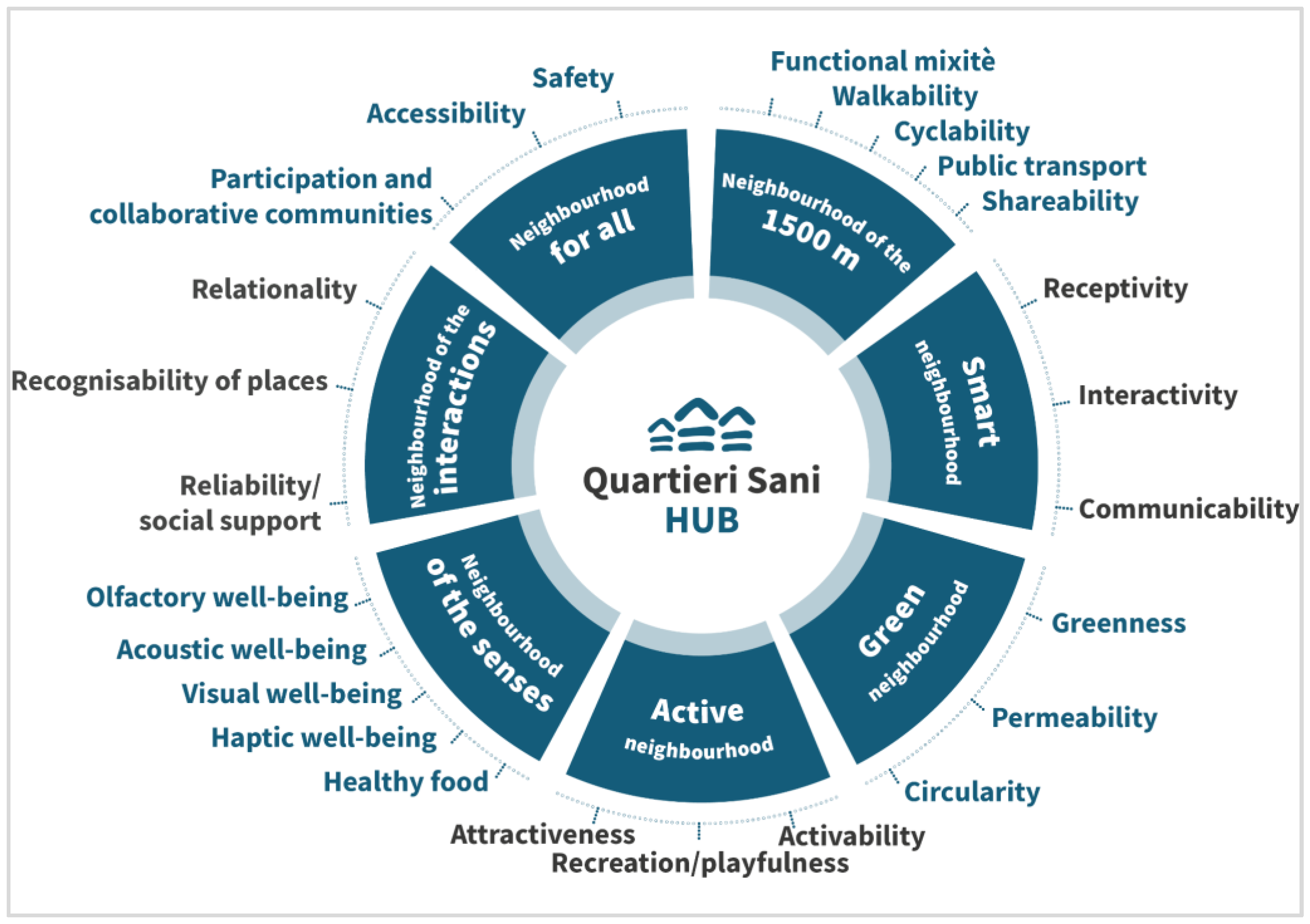
Figure 2.
- Example of a “Micro-level design trending topic” information sheet.
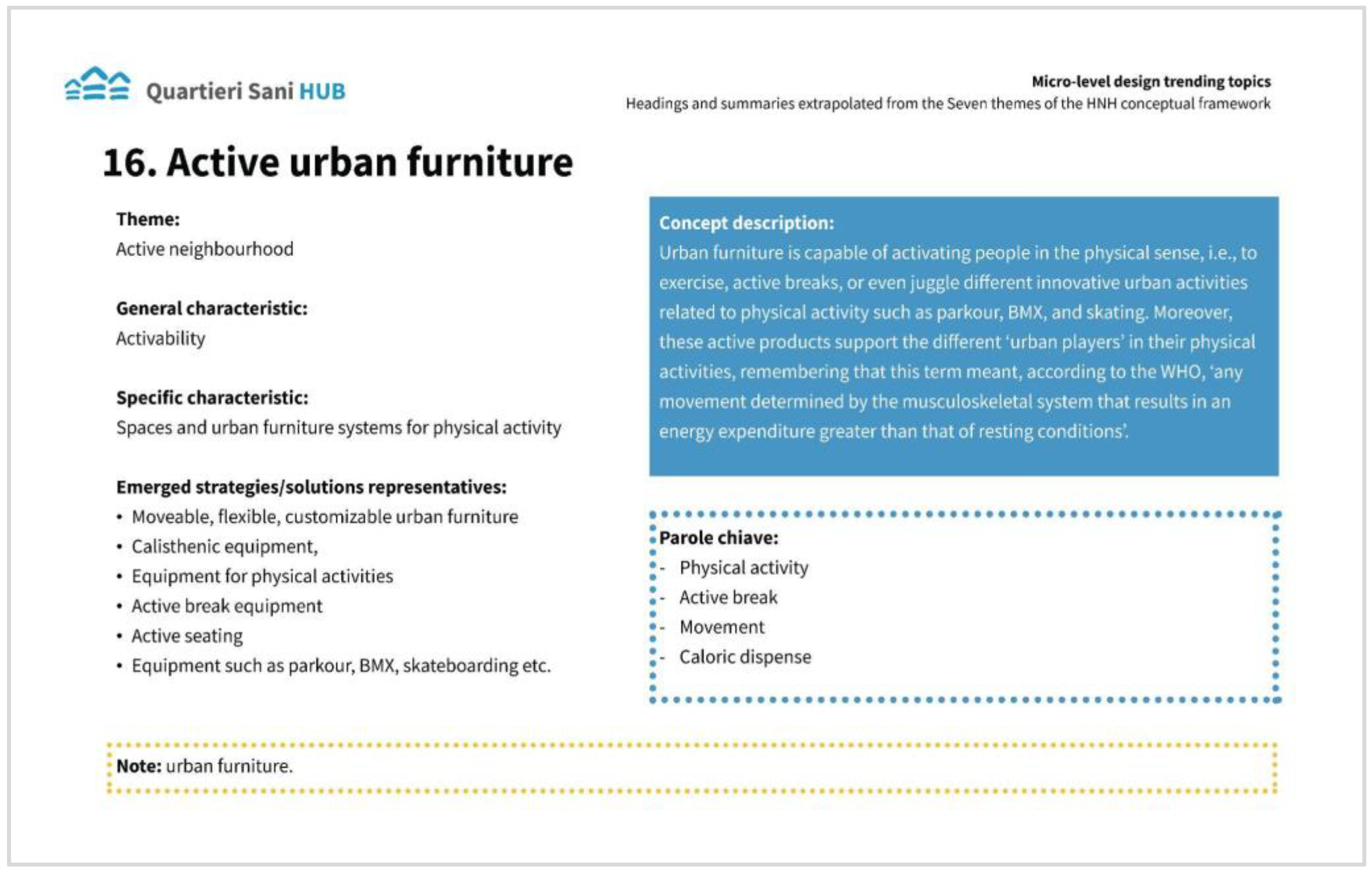
Figure 3.
- Example of the first template for further co-design activities.
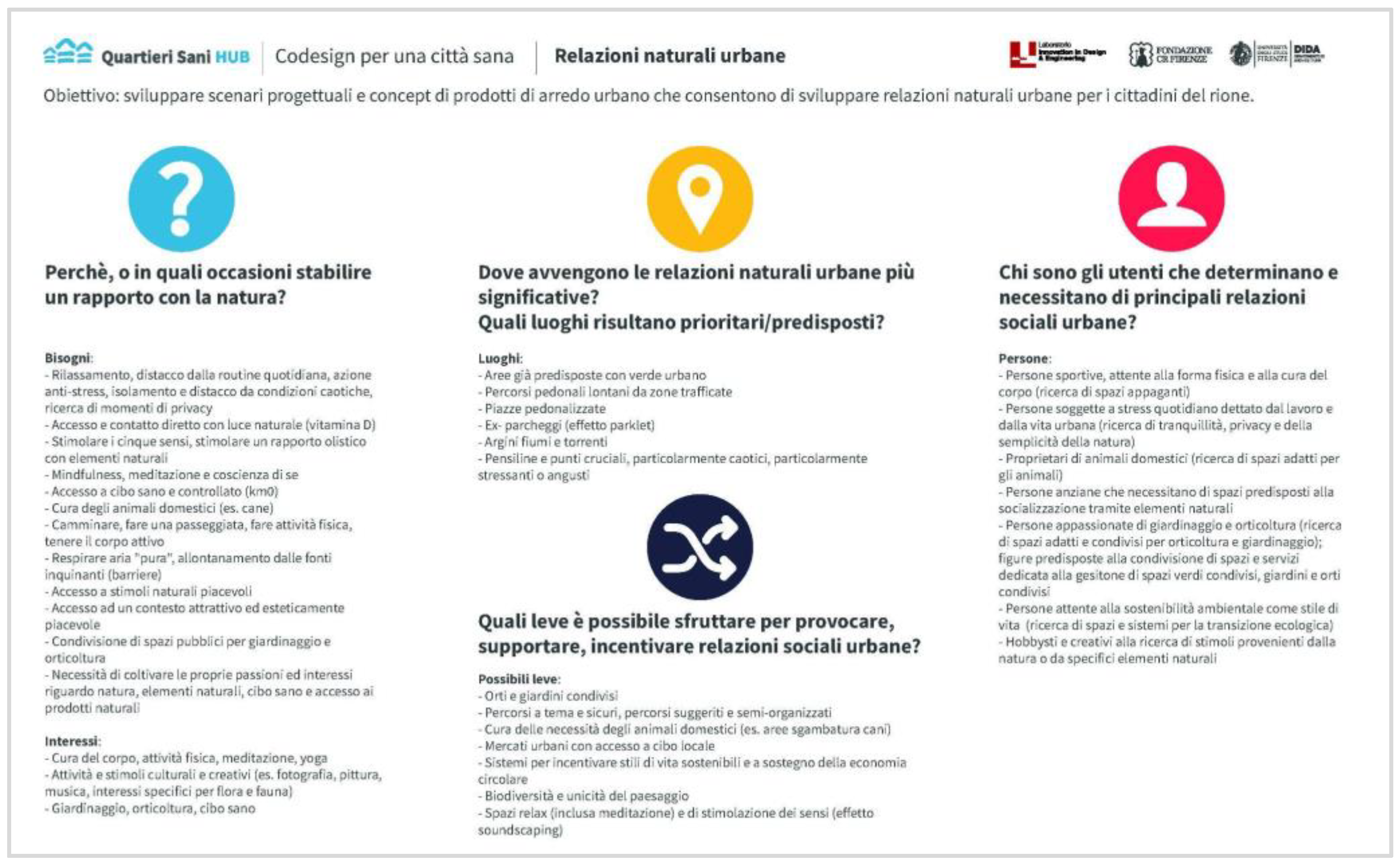
Figure 4.
- Example of the second template for further co-design activities.
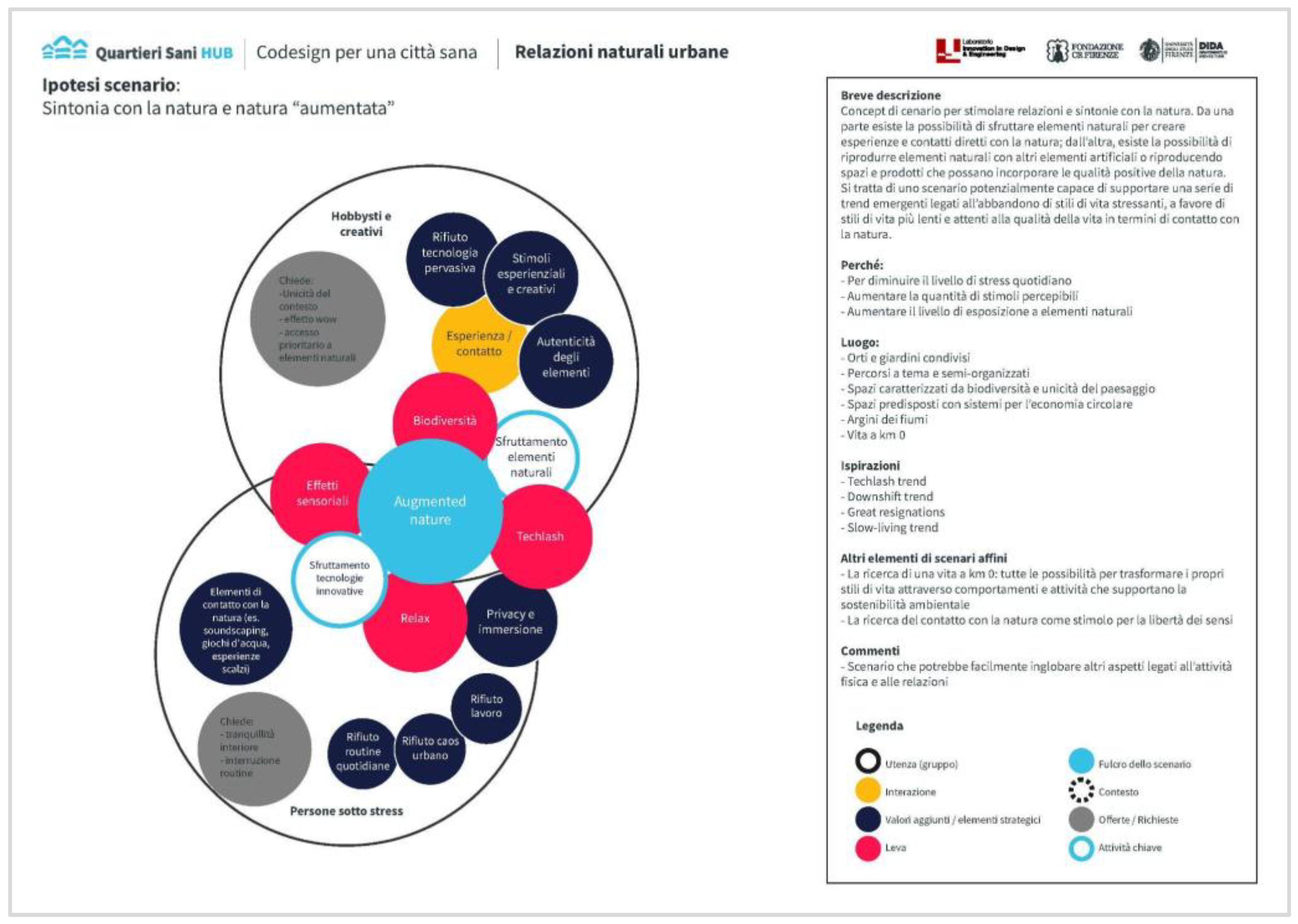
Figure 5.
- Tetramino (a). Modular furniture system for rest, whose flexibility, adaptability and modularity facilitates socialization, multigenerational comparison and cultural exchange. Design by Beatrice Bandiera and Alice Carfagno – IDEE Lab. Care Cup (b). Urban furniture to promote breastfeeding and the care of newborns and parents. Design by Jonathan Lagrimino – IDEE Lab. Ninfa (c). Outdoor smart-working station to support parents-child, adult-child interaction. Design by Giulia Maria Sturma and Gessica Vita – IDEE Lab.
Figure 5.
- Tetramino (a). Modular furniture system for rest, whose flexibility, adaptability and modularity facilitates socialization, multigenerational comparison and cultural exchange. Design by Beatrice Bandiera and Alice Carfagno – IDEE Lab. Care Cup (b). Urban furniture to promote breastfeeding and the care of newborns and parents. Design by Jonathan Lagrimino – IDEE Lab. Ninfa (c). Outdoor smart-working station to support parents-child, adult-child interaction. Design by Giulia Maria Sturma and Gessica Vita – IDEE Lab.
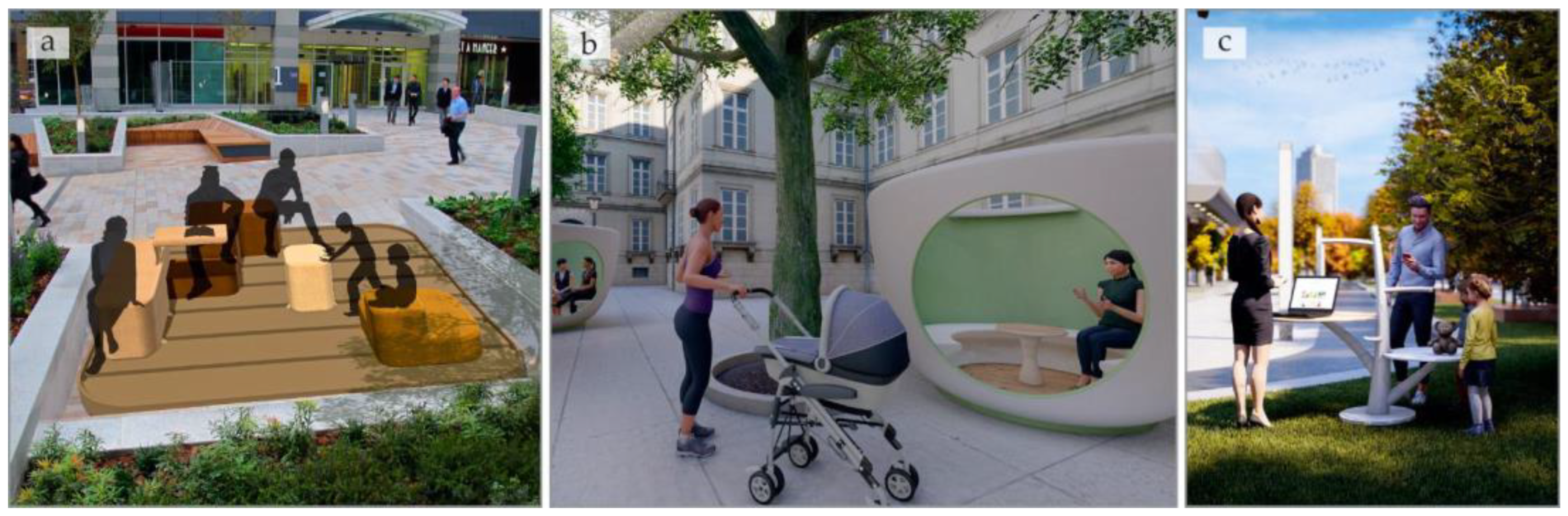
Figure 6.
- M-EATING (a-b): interactive urban furniture system to facilitate conviviality and intercultural dialogue, through creative culinary activity. IDEE Lab, EU-funded project, subcontractor of Designscapes. Pocket Stop (c): waiting point at the bus stop that supports the performance of spontaneous social and cultural activities, through the collection, reading and exchange of books. Design by Michela Castelli – IDEE Lab.
Figure 6.
- M-EATING (a-b): interactive urban furniture system to facilitate conviviality and intercultural dialogue, through creative culinary activity. IDEE Lab, EU-funded project, subcontractor of Designscapes. Pocket Stop (c): waiting point at the bus stop that supports the performance of spontaneous social and cultural activities, through the collection, reading and exchange of books. Design by Michela Castelli – IDEE Lab.
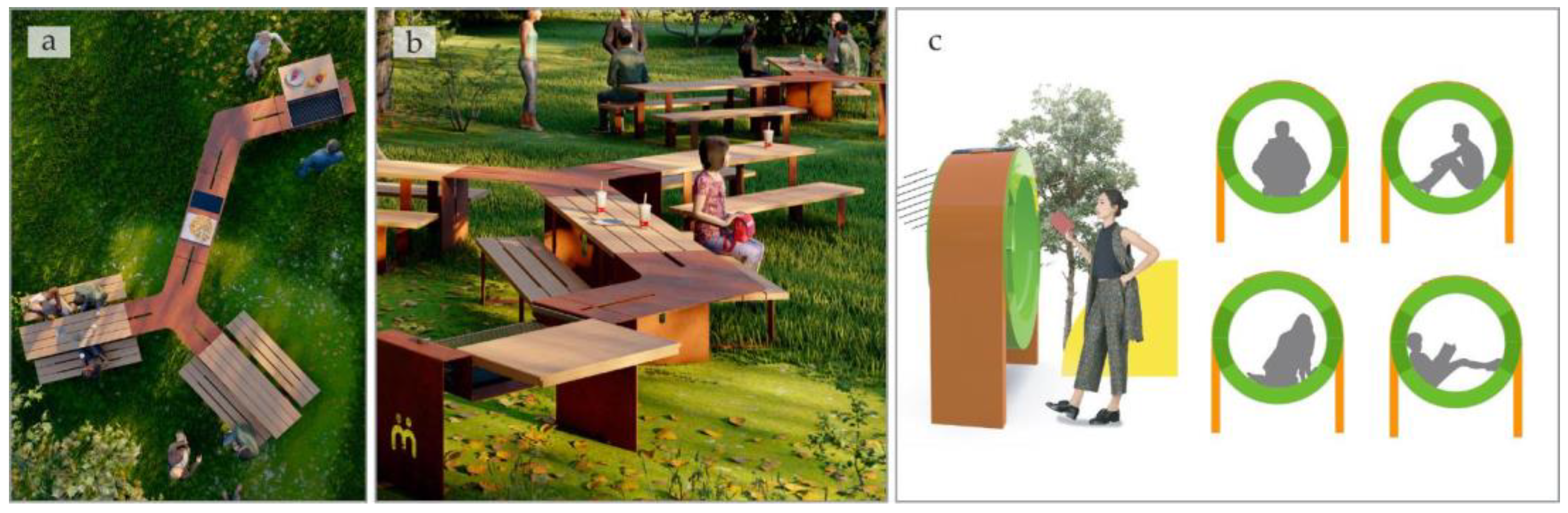
Figure 7.
- Ovalis (a): playful seating to encourage meeting, as well as new models of interaction and light physical activity. Design by Agatino Bulla – IDEE Lab. CUV (b): interactive furniture system to support spontaneous social relationships spread through gamification, music and dance. Design by Remei Barber, Maria Bustero, Marcela Soyas - IDEE Lab.
Figure 7.
- Ovalis (a): playful seating to encourage meeting, as well as new models of interaction and light physical activity. Design by Agatino Bulla – IDEE Lab. CUV (b): interactive furniture system to support spontaneous social relationships spread through gamification, music and dance. Design by Remei Barber, Maria Bustero, Marcela Soyas - IDEE Lab.
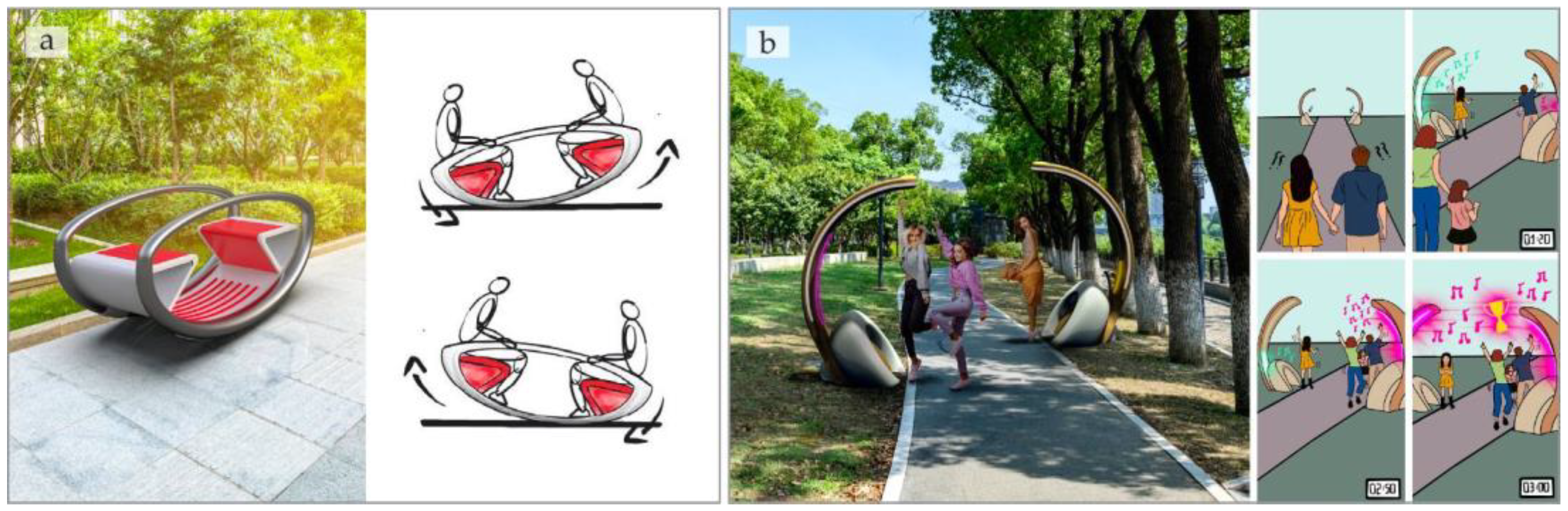
Figure 8.
- Pepito (a-b): furniture system design for increasing biodiversity and stimulating the senses through the integration of natural plant essences into the furnishings. Design by Lorenzo Tormentoni and Alessio Romano - IDEE Lab. Plantt (c): living furniture system. Design by Chiara Saccone, with the supervision of Marco Marseglia. GreeW (d): furniture system that enhances and gives new life to the elements already present within the built environment through the vertical installation of plants. Design by Sara Viviani – IDEE Lab.
Figure 8.
- Pepito (a-b): furniture system design for increasing biodiversity and stimulating the senses through the integration of natural plant essences into the furnishings. Design by Lorenzo Tormentoni and Alessio Romano - IDEE Lab. Plantt (c): living furniture system. Design by Chiara Saccone, with the supervision of Marco Marseglia. GreeW (d): furniture system that enhances and gives new life to the elements already present within the built environment through the vertical installation of plants. Design by Sara Viviani – IDEE Lab.
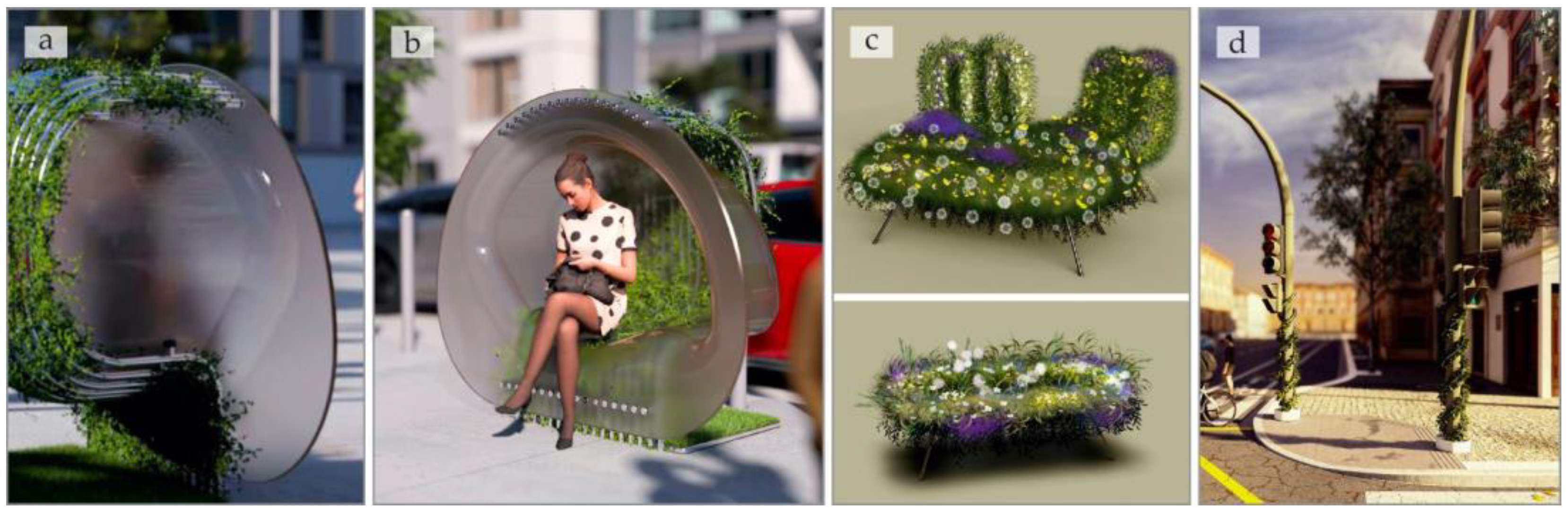
Figure 9.
- Application of artificial intelligence (a) to visualize the ideas that emerged in the workshop “Co-design for a healthy city” between citizens and researchers of IDEE Lab. Oh piantala (b): interactive furniture systems to share the enjoyment of nature, gardening, and horticulture, outside of dedicated green spaces, such as parks and urban gardens. Design by Giulio Dalla Porta – IDEE Lab. Aura (c): attractive traffic deterrent, designed to improve air quality and reduce pollution levels, thanks to its function as a phyto-purifier, but also to educate people to sustainable lifestyles, allowing users to reduce stress through greenery care. Design by Francesca Paola Fornari – IDEE Lab.
Figure 9.
- Application of artificial intelligence (a) to visualize the ideas that emerged in the workshop “Co-design for a healthy city” between citizens and researchers of IDEE Lab. Oh piantala (b): interactive furniture systems to share the enjoyment of nature, gardening, and horticulture, outside of dedicated green spaces, such as parks and urban gardens. Design by Giulio Dalla Porta – IDEE Lab. Aura (c): attractive traffic deterrent, designed to improve air quality and reduce pollution levels, thanks to its function as a phyto-purifier, but also to educate people to sustainable lifestyles, allowing users to reduce stress through greenery care. Design by Francesca Paola Fornari – IDEE Lab.
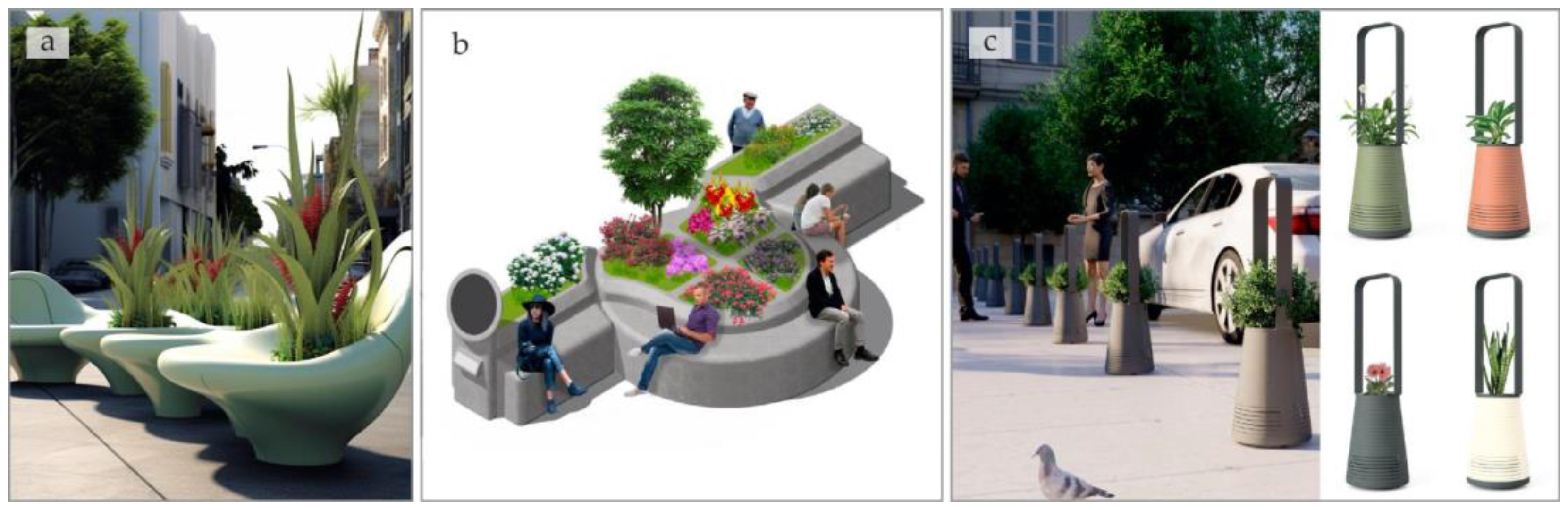
Figure 10.
- (a) Modular, adaptable, and widespread urban furniture system that screens out negative and unpleasant auditory stimuli and relaxes through the sound of water and the flexibility of the seat. Design by Sara Viviani – IDEE Lab. Pocket Stop (b): waiting point at the bus stop that supports pleasant auditory stimuli through the sound that the air creates by blowing into the pipes that make up the seat. Design by Michela Castelli – IDEE Lab.
Figure 10.
- (a) Modular, adaptable, and widespread urban furniture system that screens out negative and unpleasant auditory stimuli and relaxes through the sound of water and the flexibility of the seat. Design by Sara Viviani – IDEE Lab. Pocket Stop (b): waiting point at the bus stop that supports pleasant auditory stimuli through the sound that the air creates by blowing into the pipes that make up the seat. Design by Michela Castelli – IDEE Lab.
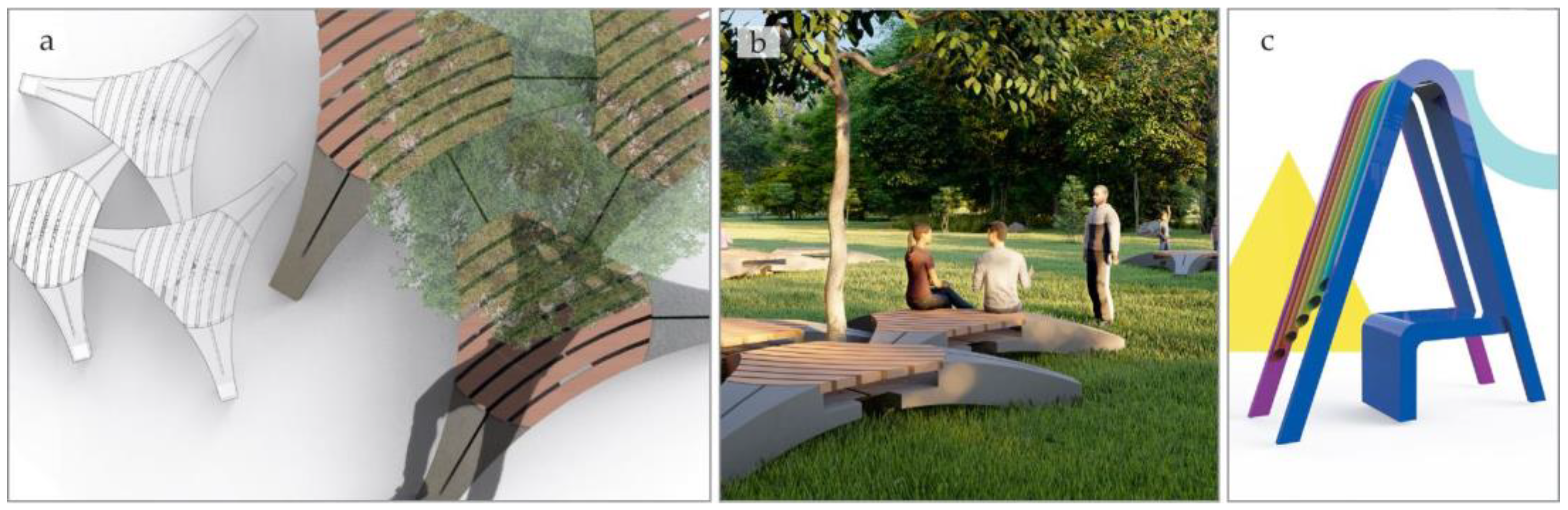
Figure 11.
- Station of Being (a): smart and eco-friendly bus stop of the future that encourages people to use local public transport, transforming the bus waiting area into a welcoming, safe place, with natural materials, almost an urban forest, where you can relax and unload from tensions and technological stimuli. Design by Rombout Frieling Lab and Umeå University, Sweden. Squatted (b-c): sinuous and welcoming ischial seat for the bus stop, to transform waiting into moments of techlash, relaxation from work stress, with the possibility of doing light physical squat activity. Design by Lissia Di Noia and Lucia Noemi Cammarata – IDEE Lab. Go (d): attractive seating system, of high material and aesthetic quality, that refers to the natural and healthy environment. The seats promote outdoor refreshment and meditation for the user in their daily commute. Design by Giulia Antonelli and Camilla Benincasa – IDEE Lab.
Figure 11.
- Station of Being (a): smart and eco-friendly bus stop of the future that encourages people to use local public transport, transforming the bus waiting area into a welcoming, safe place, with natural materials, almost an urban forest, where you can relax and unload from tensions and technological stimuli. Design by Rombout Frieling Lab and Umeå University, Sweden. Squatted (b-c): sinuous and welcoming ischial seat for the bus stop, to transform waiting into moments of techlash, relaxation from work stress, with the possibility of doing light physical squat activity. Design by Lissia Di Noia and Lucia Noemi Cammarata – IDEE Lab. Go (d): attractive seating system, of high material and aesthetic quality, that refers to the natural and healthy environment. The seats promote outdoor refreshment and meditation for the user in their daily commute. Design by Giulia Antonelli and Camilla Benincasa – IDEE Lab.
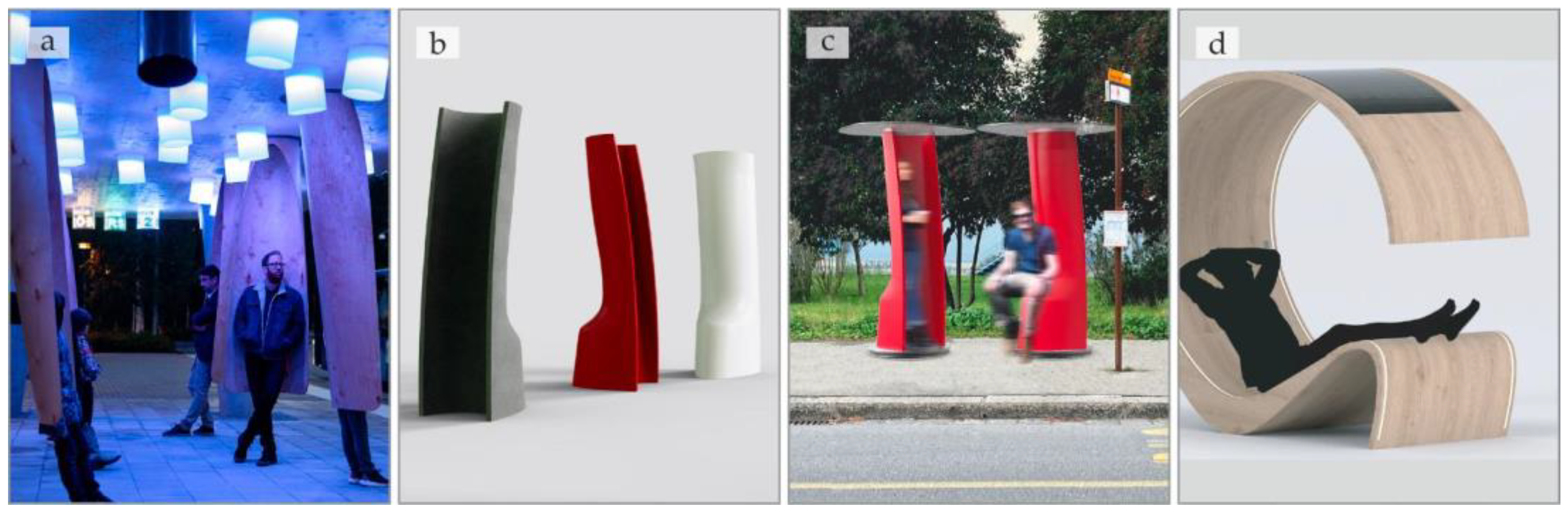
Figure 12.
- Health Map (a): recognizable, attractive and widespread wayfinding system within the urban context of reference to raise awareness on issues that promote healthy lifestyles. Design by Research Team Quartieri Sani Hub. Wayfinding system for Health Map (b). Design by Sara Viviani - IDEE Lab. Neighborhood branding and accessible, inclusive, communicative and intelligent support tools to enjoy healthy places, activities and services within the neighborhood, improving the experience of use (c). Design by Research Team Quartieri Sani Hub. Wait-Fit (d-e): informative, connected, collaborative and attractive rest and waiting point that encourages users to perform light physical activity while waiting, through play and feedback on calories burned during the activity. Design by Leonardo Milotti and Mattia Parisi - IDEE Lab.
Figure 12.
- Health Map (a): recognizable, attractive and widespread wayfinding system within the urban context of reference to raise awareness on issues that promote healthy lifestyles. Design by Research Team Quartieri Sani Hub. Wayfinding system for Health Map (b). Design by Sara Viviani - IDEE Lab. Neighborhood branding and accessible, inclusive, communicative and intelligent support tools to enjoy healthy places, activities and services within the neighborhood, improving the experience of use (c). Design by Research Team Quartieri Sani Hub. Wait-Fit (d-e): informative, connected, collaborative and attractive rest and waiting point that encourages users to perform light physical activity while waiting, through play and feedback on calories burned during the activity. Design by Leonardo Milotti and Mattia Parisi - IDEE Lab.
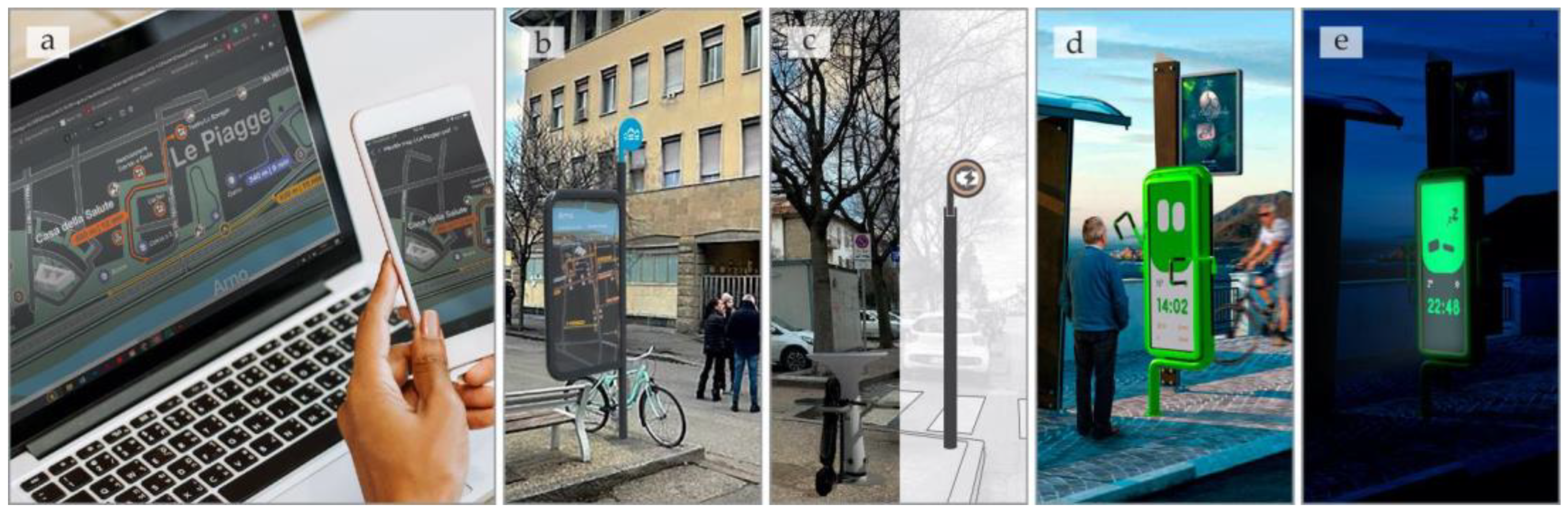
Figure 13.
- Stadia (a-b): urban furniture for smart running trails, informative and attractive, that stimulates active mobility behaviors. walkability and cycling, through specific feedback on emissions and calories burned. Design by Maria Sole Traversa - IDEE Lab. Panoramic totem (c): a smart, connected, collaborative and attractive furnishing system that connects the services and activities present within the neighborhood to improve their usability, through interactive engagement solutions and emerging technologies. Design by Marta Masili - IDEE Lab.
Figure 13.
- Stadia (a-b): urban furniture for smart running trails, informative and attractive, that stimulates active mobility behaviors. walkability and cycling, through specific feedback on emissions and calories burned. Design by Maria Sole Traversa - IDEE Lab. Panoramic totem (c): a smart, connected, collaborative and attractive furnishing system that connects the services and activities present within the neighborhood to improve their usability, through interactive engagement solutions and emerging technologies. Design by Marta Masili - IDEE Lab.
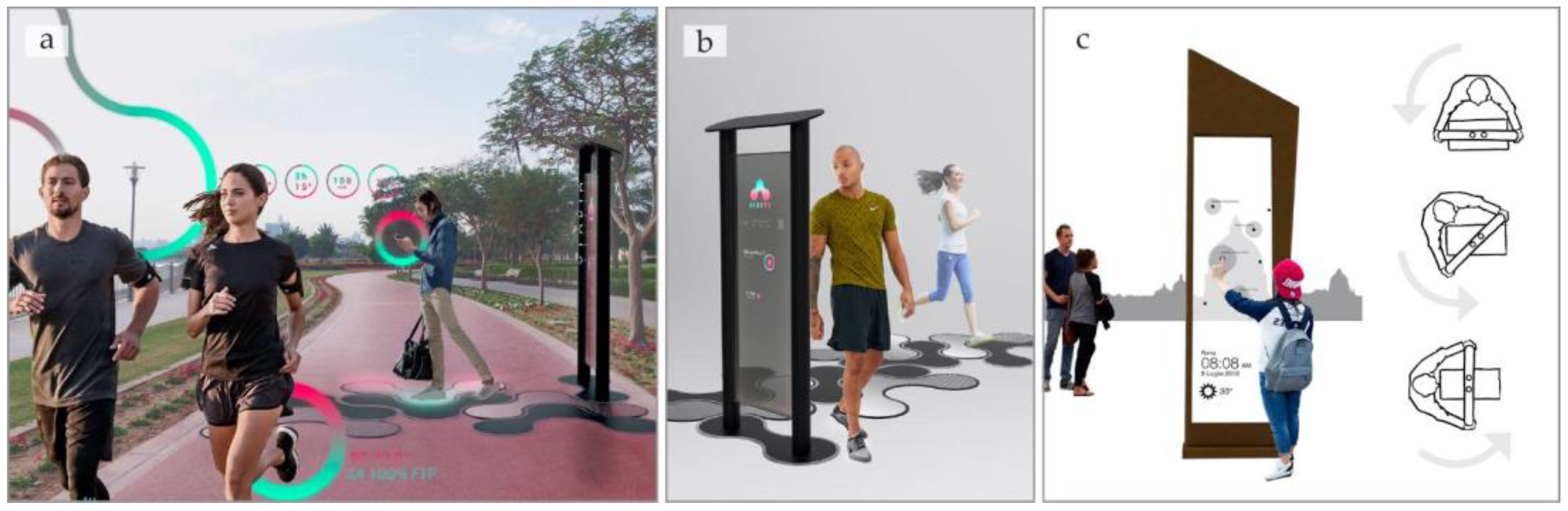
Figure 14.
-My Active Bench (a): active seat that inspires positive physical attitudes, helps to assume a correct posture, and stimulates active muscle tone for daily waiting moments. Metalco Group. Pocket stop (b): waiting point at the bus stop that promotes light physical activity and fun through the playfulness of the swing, ensuring movement and dynamism. Design by Michela Castelli - IDEE Lab.
Figure 14.
-My Active Bench (a): active seat that inspires positive physical attitudes, helps to assume a correct posture, and stimulates active muscle tone for daily waiting moments. Metalco Group. Pocket stop (b): waiting point at the bus stop that promotes light physical activity and fun through the playfulness of the swing, ensuring movement and dynamism. Design by Michela Castelli - IDEE Lab.
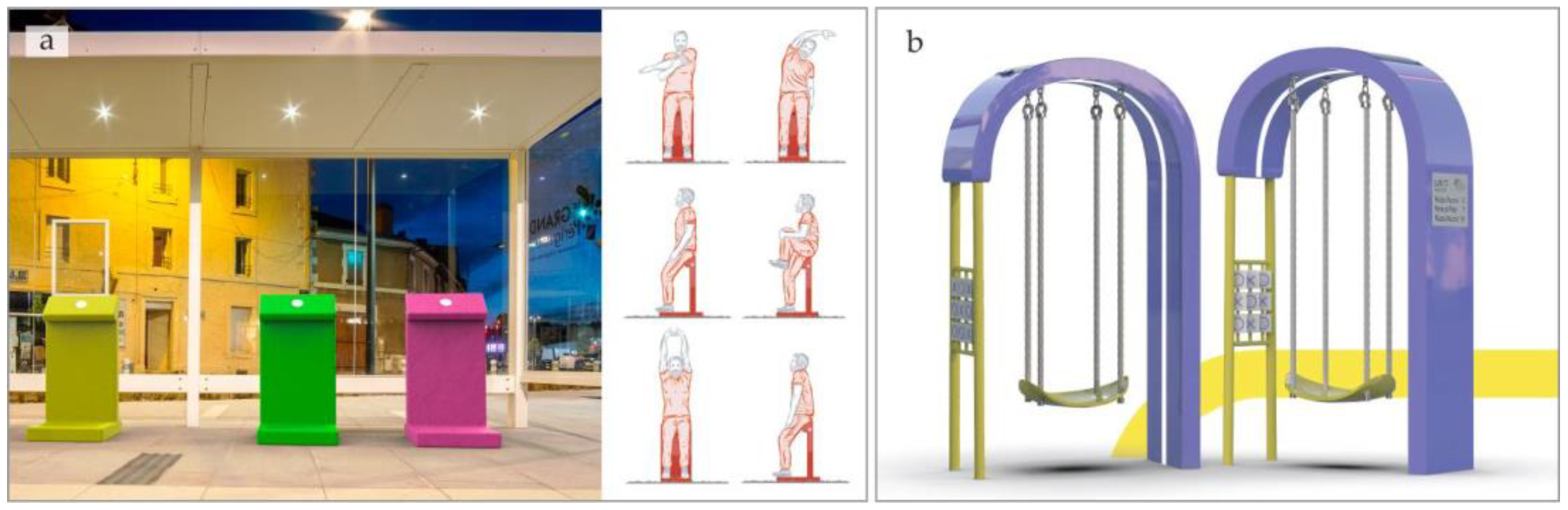
Figure 15.
- Modular, flexible and attractive outdoor urban furniture system (a-c) to promote light physical exercise, through circuits for the legs, buttocks, abdomen and upper body, spread throughout the urban context. Design by Alice Beconcini, Giovanni Lastrucci, Iacopo Vaglio - IDEE Lab. Tone-up (b): multipurpose seat for physical strengthening and stretching. Design by Laura Melcarne - IDEE Lab.
Figure 15.
- Modular, flexible and attractive outdoor urban furniture system (a-c) to promote light physical exercise, through circuits for the legs, buttocks, abdomen and upper body, spread throughout the urban context. Design by Alice Beconcini, Giovanni Lastrucci, Iacopo Vaglio - IDEE Lab. Tone-up (b): multipurpose seat for physical strengthening and stretching. Design by Laura Melcarne - IDEE Lab.
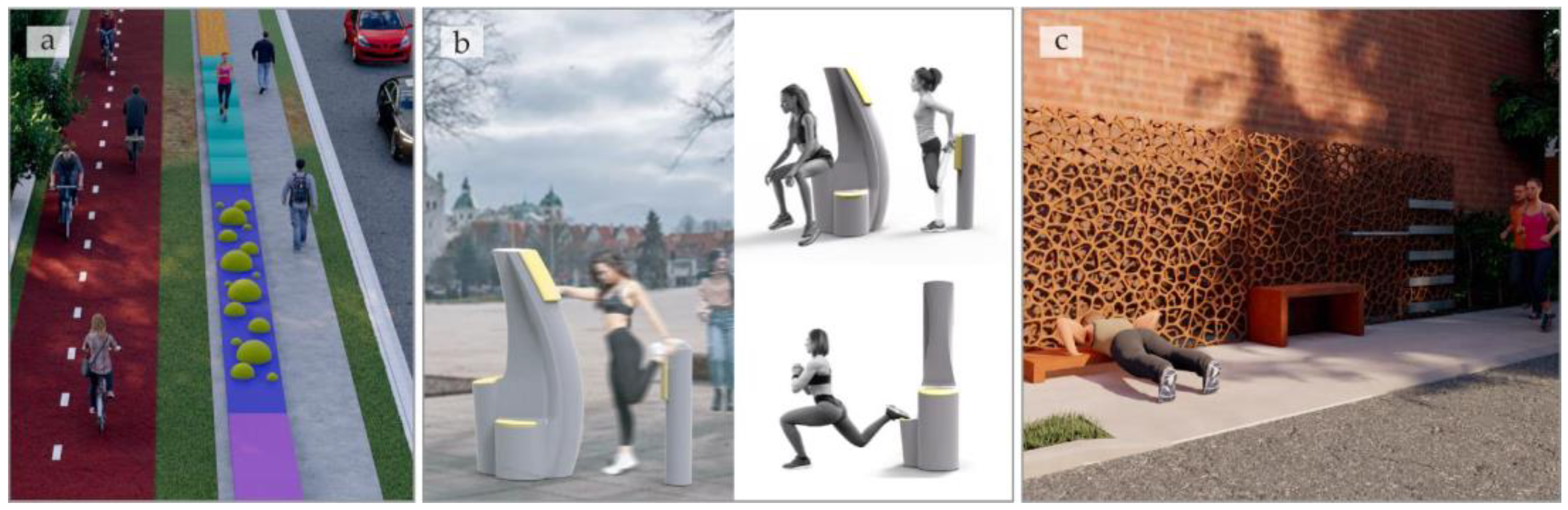
Figure 16.
- Pocket stop (a): recreational waiting point at the bus stop that raises awareness about waste collection by supporting virtuous behaviors and activating physical movement. Design by Michela Castelli - IDEE Lab. System of street furniture(b-c-d) that enhances and gives new functionality to elements already present in a widespread manner in the urban context, through the insertion of rotating poles, for high jump; safety barriers and deterrents for playing soccer and basketball in groups to raise awareness on the issue of waste. Design by Alice Beconcini, Giovanni Lastrucci, Iacopo Vaglio - IDEE Lab.
Figure 16.
- Pocket stop (a): recreational waiting point at the bus stop that raises awareness about waste collection by supporting virtuous behaviors and activating physical movement. Design by Michela Castelli - IDEE Lab. System of street furniture(b-c-d) that enhances and gives new functionality to elements already present in a widespread manner in the urban context, through the insertion of rotating poles, for high jump; safety barriers and deterrents for playing soccer and basketball in groups to raise awareness on the issue of waste. Design by Alice Beconcini, Giovanni Lastrucci, Iacopo Vaglio - IDEE Lab.
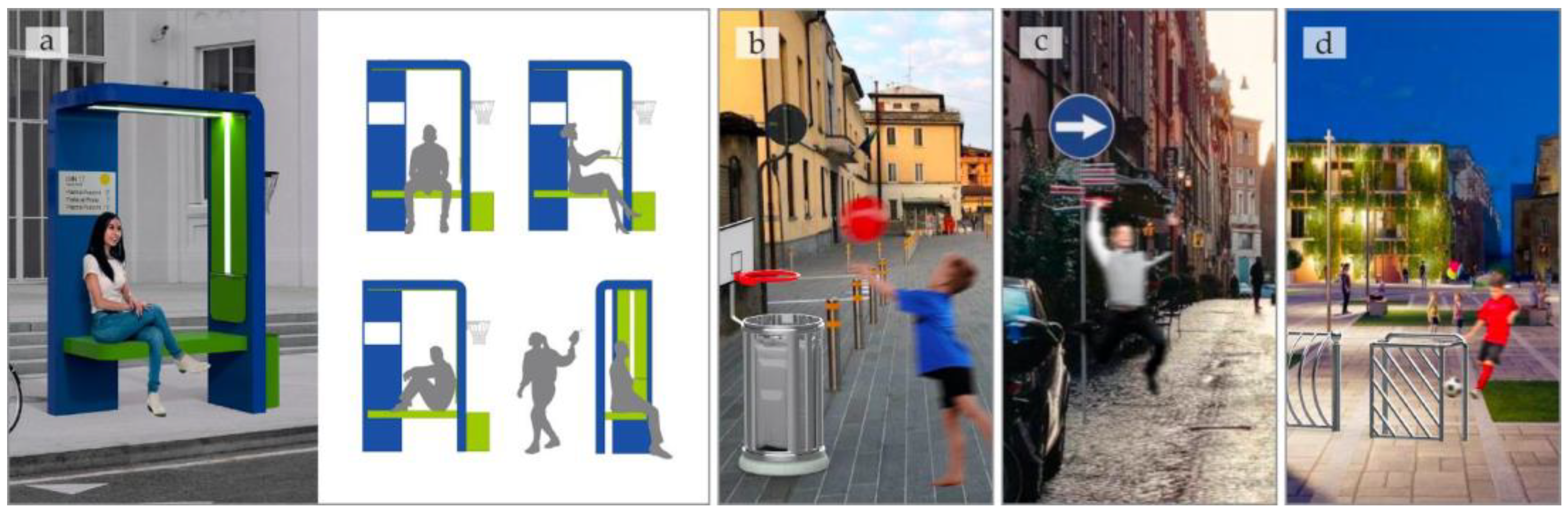
Figure 17.
- Sunenergy (a-b): urban furniture for parking and charging private electric scooters. Design by Giulia Maria Sturma - IDEE Lab. Service bike (c-d): docking station for e-scooters with integrated helmet storage. Design by Luca Cimaroli - IDEE Lab.
Figure 17.
- Sunenergy (a-b): urban furniture for parking and charging private electric scooters. Design by Giulia Maria Sturma - IDEE Lab. Service bike (c-d): docking station for e-scooters with integrated helmet storage. Design by Luca Cimaroli - IDEE Lab.
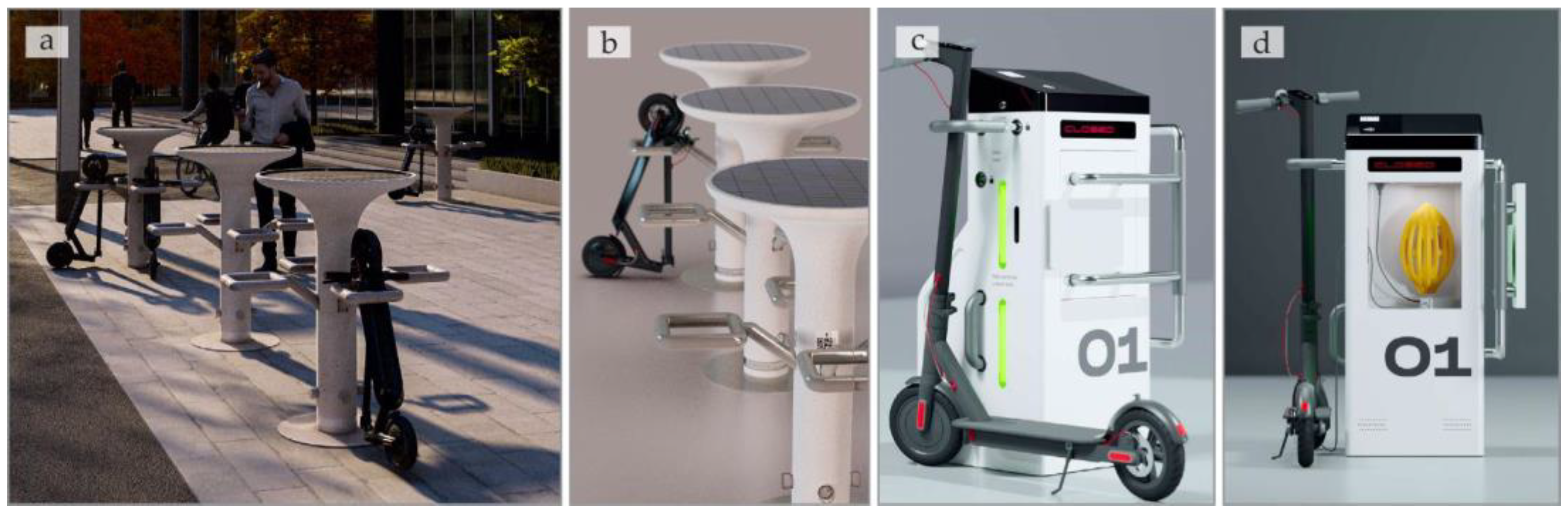

Table 1.
- Categorization of urban furniture products into domains, subdomains, and product categories.
Table 1.
- Categorization of urban furniture products into domains, subdomains, and product categories.
| Domains | Sub-Domains | Urban Furniture Product Categories |
|---|---|---|
| Relating | Human-Human Relationship | SP1 | Dialogue and socialization |
| SP2 | Sharing and conviviality | ||
| SP3 | Widespread contact and exchange | ||
| Human-Nature Relationship | SP4 | Sensory stimulation and biodiversity | |
| SP5 | Active and shared urban greenery | ||
| SP6 | Sensory stimulation and soundscaping | ||
| SP7 | Techlash | ||
| Communicating | Connected and Collaborative Communication | SP8 | Wayfinding and health |
| SP9 | Smart Wayfinding | ||
| Moving | Active Mobility and Physical Activity | SP10 | Active breaks and waits |
| SP11 | Physical activity and fitness | ||
| SP12 | Physical activity and attractiveness | ||
| SP13 | Supporting active mobility |
Disclaimer/Publisher’s Note: The statements, opinions and data contained in all publications are solely those of the individual author(s) and contributor(s) and not of MDPI and/or the editor(s). MDPI and/or the editor(s) disclaim responsibility for any injury to people or property resulting from any ideas, methods, instructions or products referred to in the content. |
© 2024 by the authors. Licensee MDPI, Basel, Switzerland. This article is an open access article distributed under the terms and conditions of the Creative Commons Attribution (CC BY) license (http://creativecommons.org/licenses/by/4.0/).
Copyright: This open access article is published under a Creative Commons CC BY 4.0 license, which permit the free download, distribution, and reuse, provided that the author and preprint are cited in any reuse.


