
Submitted:
09 December 2024
Posted:
10 December 2024
You are already at the latest version
Abstract
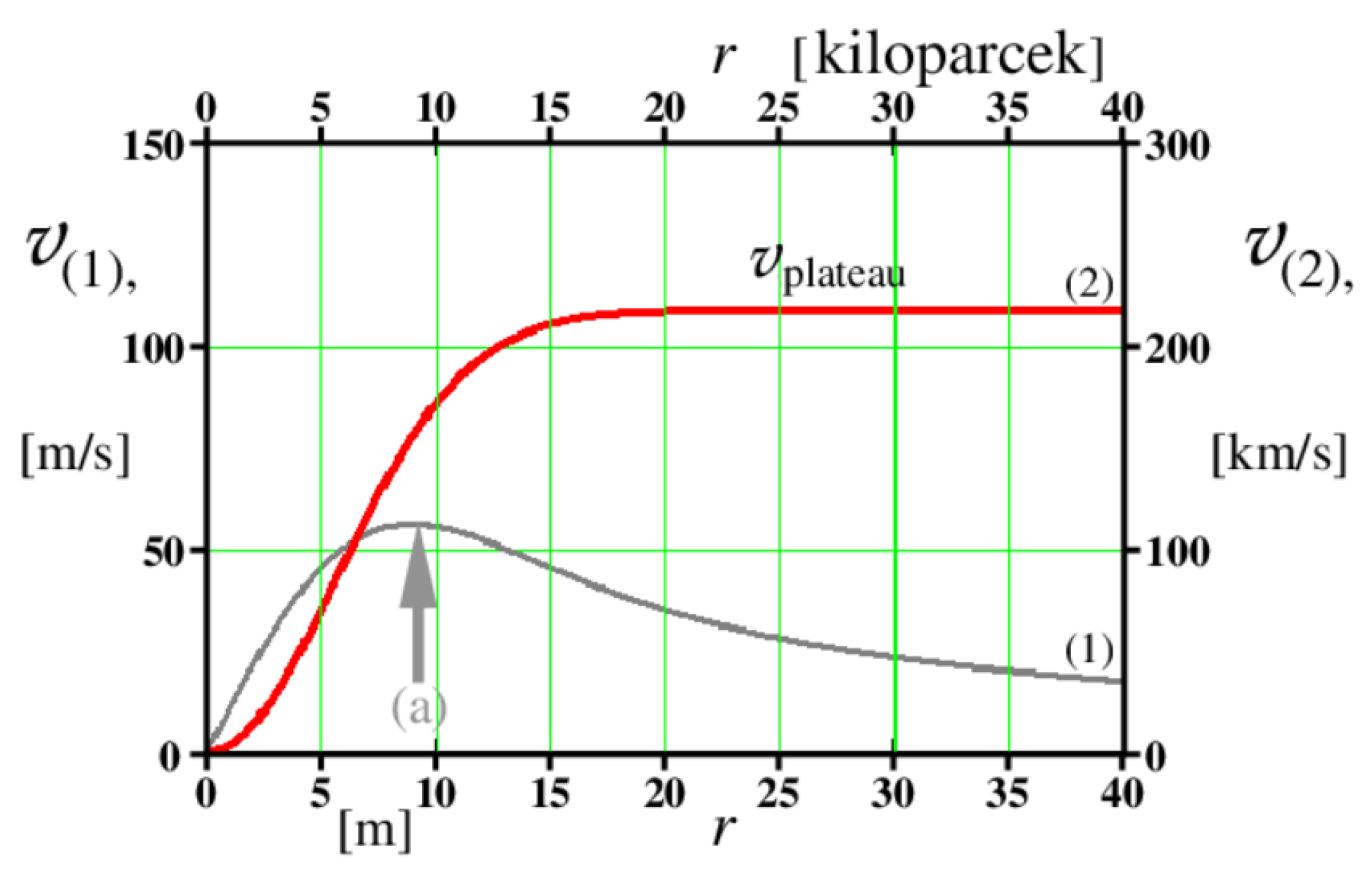
Lorentz gauge, cutting arbitrary scalar fields out from the energy-momentum density tensor, opens a door to the invisible world of dark energy and dark matter. This path leads to the coupled Dirac equations on the mass shell, solutions of which are those of the Majorana fermions. From the other side, the Lambda + cold dark matter paradigm is a main step leading to getting the Majorana fermion mass. Three key parameters are involved in the formula for computing the mass. They are the critical density distribution of dark matter, the Planck constant, and the temperature of the cosmic microwave radiation. The mass calculated to be equal to about 0.04 eV is in good agreement with the masses measured for neutrino. The formula represents itself as the five-degree root from the above key parameters. It opens the existence of three Majorana fermion generations. These generations form wave modes that lead to the appearance of the Bose-Einstein condensate in this dark matter. For that reason, the baryon matter does not experience resistance when it is rotating in this dark superfluid medium. Orbital speeds of rotating about the galaxy core of its arms show the flat profile.
Keywords:
| Contents | ||
| 1 | Introduction: LambdaCDM Paradigm | 1 |
| 2 | The Lorentz Gauge Is a Door to the Invisible World of Dark Energy and Dark Matter | 4 |
| 2.1 Relict Majorana Fermion Is a Neutrino......................................................................................................................................... | 6 | |
| 2.2 Majorana Fermion Generations.................................................................................................................................................. | 8 | |
| 3 | Decreasing and Flat Profiles of the Orbital Speed | 10 |
| 3.1 The Lamb-Oseen Decreasing Profile of the Orbital Speed........................................................................................................................ | 12 | |
| 3.2 Flat Profile of the Orbital Speed............................................................................................................................................. | 12 | |
| 4 | Materials and Methods | 13 |
| 5 | Results | 13 |
| 6 | Discussion | 13 |
| References | 16 | |
1. Introduction: LambdaCDM Paradigm
2. The Lorentz Gauge Is a Door to the Invisible World of Dark Energy and Dark Matter
2.1. Relict Majorana Fermion Is a Neutrino
2.2. Majorana Fermion Generations
3. Decreasing and Flat Profiles of the Orbital Speed
3.1. The Lamb-Oseen Decreasing Profile of the Orbital Speed
3.2. Flat Profile of the Orbital Speed
4. Materials and Methods
5. Results
- An exact formula of the cold neutrino mass is obtained based on the Lambda CDM paradigm. The formula contains three key parameters - the critical density distribution of dark matter, the Planck constant, and the CMB temperature. The mass calculated is about 0.039 eV.
- This formula, representing itself as the five-degree root from the above key parameters, discloses three generations of the cold neutrinos.
- The could dark matter represents by itself a dark superfluid substance.
- The galaxy arms rotating in this substance do not face its resistance. An exact formula of the rotated orbit flat profile of galaxy arms is extracted.
6. Discussion
Funding
Institutional Review Board Statement
Informed Consent Statement
Data Availability Statement
Acknowledgments
Conflicts of Interest
Abbreviations
| CDM | Cold Dark Matter |
| CMB | Cosmic Microwave Background |
| JWST | James Webb Space Telescope |
| MACHOs | Massive (Astrophysical) Compact Halo Objects |
| WIMPs | Weakly Interacting Massive Particles |
References
- Griest, K. WIMPs and MACHOs. Encyclopedia of astronomy and astrophysics, 2002; 6. [Google Scholar]
- Das, S.; Bhaduri, R.K. Dark matter and dark energy from Bose-Einstein condensate. Class. Quant. Grav. 2015, 32, 105003–6. [Google Scholar] [CrossRef]
- Tamburini, F.; Licata, I. Can the periodic spectral modulations observed in 236 Sloan Sky Survey stars be due to dark matter effects? Physica Scripta 2017, 92, 095001. [Google Scholar] [CrossRef]
- Mostepanenko, V.M. Some remarks on axion dark matter, dark energy and energy of the quantum vacuum. Int J. Mod. Phys. A 2020, 35, 2040036. [Google Scholar] [CrossRef]
- Mielczarek, J.; Stachowiak, T.; Szydlowski, M. Vortex in axion condensate as a dark matter halo. Int. J. Mod. Phys. D 2010, 19, 1843–1855. [Google Scholar] [CrossRef]
- Freese, K. Status of dark matter in the universe. Int. J. Mod, Phys. D 2017, 26, 1730012. [Google Scholar] [CrossRef]
- Fixsen, D.J. The Temperature of the Cosmic Microwave Background. Astrophys. J. 2009, 707, 916–920. [Google Scholar] [CrossRef]
- Planck Collaboration. Planck 2013 results. I. Overview of products and scientific results. Astronomy & Astrophysics 2014, 517, 1–48. [Google Scholar] [CrossRef]
- Planck collaboration. Planck 2015 results. XIII. Cosmological parameters. Astronomy & Astrophysics 2016, 594, 1–63. [Google Scholar] [CrossRef]
- Planck Collaboration. Planck 2018 results VI. Cosmological parameters. Astronomy & Astrophysics 2020, 641, 67. [Google Scholar] [CrossRef]
- Bars, I.; Terning, J. Extra Dimensions in Space and Time; Springer: New York, Dordrecht, Heidelberg, London, 2010. [Google Scholar] [CrossRef]
- Immerman, N. The Universe. WebSite 2001. [Google Scholar]
- Davies, P. The goldilocks enigma; A mariner book, Houghton Mifflin Co.: Boston, N. Y, 2006. [Google Scholar]
- Vlahovic, B. A New Cosmological Model for the Visible Universe and its Implications. arXiv, 2011; 1005.4387. [Google Scholar] [CrossRef]
- Freedman, W.L.; Madore, B.F.; Gibson, B.K.; Ferrarese, L.; Kelson, D.D.; Sakai, S.; Mould, J.R.; Kennicutt, Jr., R. C.; Ford, H.C.; Graham, J.A.; et al. Final Results from the Hubble Space Telescope Key Project to Measure the Hubble Constant. Astrophys. J. 2001, 553, 47–72. [Google Scholar] [CrossRef]
- Carroll, S.M. Dark Energy and the Preposterous Universe. arXiv 2001. [Google Scholar] [CrossRef]
- Nishiyama, M.; Morita, M.; Morikawa, M. Bose Einstein Condensation as Dark Energy and Dark Matter. arXiv, 2004; astro-ph/0403571. [Google Scholar] [CrossRef]
- Ryden, B. Introduction to Cosmology; The Ohio State University, 2006.
- Riess, A.G.; et al. A 2. 4The Astrophysical Journal 2016, 826, 31. [Google Scholar] [CrossRef]
- Sbitnev, V.I.; Fedi, M. Superfluid Quantum Space and Evolution of the Universe. In Trends in Modern Cosmology; A. J. Capistrano de, Souza., Ed.; InTech: Rijeka, 2017. [Google Scholar] [CrossRef]
- Sbitnev, V.I. Quaternion Algebra on 4D Superfluid Quantum Space-Time:Can Dark Matter Be a Manifestation of the Superfluid Ether? Universe 2021, 7, 1–40. [Google Scholar] [CrossRef]
- Sbitnev, V.I. Relativistic Fermion and Boson Fields: Bose-Einstein Condensate as a Time Crystal. Symmetry 2023, 15, 275. [Google Scholar] [CrossRef]
- Majorana, E. A symmetric theory of electrons and positrons. Il Nuovo Cimento 1937, 14, 171–184. [Google Scholar] [CrossRef]
- Sbitnev, V.I. Quaternion Algebra on 4D Superfluid Quantum Space-Time. Dirac"s Ghost Fermion Fields. Found. Phys. 2022, 52, 1–21. [Google Scholar] [CrossRef]
- Mandl, F. Statistical Physics; John Wiley & Sons: Chichester, 2008. [Google Scholar]
- KamLAND-Zen Collaboration. Search for the Majorana Nature of Neutrinos in the Inverted Mass Ordering Region with KamLAND-Zen. Phys. Rev. Lett. 2023, 130, 051801. [Google Scholar] [CrossRef] [PubMed]
- GERDA Collaboration. Improved Limit on Neutrinoless Double-β Decay of 76Ge from GERDA Phase II. Phys. Rev. Lett. 2018, 120, 132503. [Google Scholar] [CrossRef] [PubMed]
- Majorana Collaboration. Search for Neutrinoless Double-β Decay in 76Ge with the Majorana Demonstrator. Phys. Rev. Lett. 2018, 120, 132502. [Google Scholar] [CrossRef] [PubMed]
- KamLAND-Zen Collaboration. Search for Majorana Neutrinos Near the Inverted Mass Hierarchy Region with KamLAND-Zen. Phys. Rev. Lett. 2016, 117, 082503. [Google Scholar] [CrossRef] [PubMed]
- The EXO-200 Collaboration. The EXO-200 detector, part I: detector design and construction. JINST 2012, 7, P05010. [Google Scholar] [CrossRef]
- The EXO-200 Collaboration. Search for Majorana neutrinos with the first two years of EXO-200 data. Nature 2014, 510, 229–234. [Google Scholar] [CrossRef] [PubMed]
- CUORE Collaboration. CUORE-0 detector: design, construction and operation. JINST 2016, 11, P07009. [Google Scholar] [CrossRef]
- CUORE Collaboration. First Results from CUORE: A Search for Lepton Number Violation via 0νββ Decay of 130Te. Phys. Rev. Lett. 2018, 120, 132501. [Google Scholar] [CrossRef]
- Bondi, H. Negative Mass in General Relativity. Rev. Mod. Phys. 1957, 29, 423–428. [Google Scholar] [CrossRef]
- Bonnor, W.B. Negative mass in general relativity. Gen. Relat. Gravit. 1989, 21, 1143–1157. [Google Scholar] [CrossRef]
- Forward, R.L. Negative matter propulsion. J. Propulsion 1990, 6, 28–37. [Google Scholar] [CrossRef]
- Landis, G.A. Comment on ’Negative matter propulsion’. J. Propulsion 1991, 7, 304. [Google Scholar] [CrossRef]
- Cselyuszka, N.; Seĉujski, M.; Crnojević-Bengin, V. Novel negative mass density resonant metamaterial unit cell. Physics Letters A 2015, 379, 33–36. [Google Scholar] [CrossRef]
- Khamehchi, M.A.; Hossain, K.; Mossman, M.E.; Zhang, Y.; Busch, T.; McNeil Forbes, M.; Engels, P. Negative-Mass Hydrodynamics in a Spin-Orbit-Coupled Bose-Einstein Condensate. Phys. Rev. Lett. 2017, 118, 155301. [Google Scholar] [CrossRef] [PubMed]
- Farnes, J.S. A Unifying Theory of Dark Energy and Dark Matter: Negative Masses and Matter Creation within a Modified LambdaCDM Framework. Astronomy and Astrophysics 2018, 620, 20. [Google Scholar] [CrossRef]
- Lounasmaa, O.V.; Thuneberg, E. Vortices in rotating superfluid 3He. PNAS 1999, 96, 7760–7767. [Google Scholar] [CrossRef] [PubMed]
- Sbitnev, V.I. Hydrodynamics of the physical vacuum: dark matter is an illusion. Mod. Phys. Lett. A 2015, 30, 1550184. [Google Scholar] [CrossRef]
- Sbitnev, V.I. Hydrodynamics of the physical vacuum: I. Scalar quantum sector. Found. Phys. 2016, 46, 606–619. [Google Scholar] [CrossRef]
- Sbitnev, V.I. Hydrodynamics of superfluid quantum space: particle of spin-1/2 in a magnetic field. Quantum Stud.: Math. Found. 2017, 5, 297–314. [Google Scholar] [CrossRef]
- Volovik, G.E. The Universe in a Helium Droplet; Oxford University Press: Oxford, 2003. [Google Scholar]
- Hajdukovic, D.S. Is dark matter an illusion created by the gravitational polarization of the quantum vacuum? Astrophys. Space Sci. 2011, 334, 215–218. [Google Scholar] [CrossRef]
- Rubin, V.C. Galaxy dynamics and the mass density of the universe. PNAS 1993, 90, 4814–4821. [Google Scholar] [CrossRef]
- Gupta, R.P. Testing CCC+TL Cosmology with Observed Baryon Acoustic Oscillation Features. The Astrophysical Journal 2024, 964, 55. [Google Scholar] [CrossRef]
- Gupta, R.P. On Dark Matter and Dark Energy in CCC+TL Cosmology. Universe 2024, 10, 266. [Google Scholar] [CrossRef]
- JWST collaboration. Webb First Image Observations. STScI and JWST. url: https://www.stsci.edu/jwst/science-execution/approved-programs/webb-first-image-observations.

| Experiment | Isotope | Half-decay, [year] | mass, [eV] |
|---|---|---|---|
| Gerda [27] | Ge | ||
| Majorana [28] | Ge | ||
| KamLAND-Zen [29] | Xe | ||
| EXO [30,31] | Xe | ||
| CUORE [32,33] | Te | ||
| KamLAND-Zen [26] | Xe |
| Integer k | The exponent | Re | im |
|---|---|---|---|
| 0 | 1 | 0 | |
| 1 | |||
| 2 | |||
| 3 | |||
| 4 |
| Integer l | The cosine | Re |
|---|---|---|
| 0 | 1 | |
| 1 | ||
| 2 |
Disclaimer/Publisher’s Note: The statements, opinions and data contained in all publications are solely those of the individual author(s) and contributor(s) and not of MDPI and/or the editor(s). MDPI and/or the editor(s) disclaim responsibility for any injury to people or property resulting from any ideas, methods, instructions or products referred to in the content. |
© 2024 by the author. Licensee MDPI, Basel, Switzerland. This article is an open access article distributed under the terms and conditions of the Creative Commons Attribution (CC BY) license (https://creativecommons.org/licenses/by/4.0/).