

Submitted:
09 December 2024
Posted:
10 December 2024
You are already at the latest version
Abstract
Coordination compounds, characterized by the coordination of metal ions with ligands, represent a pivotal area of research in chemistry due to their diverse structures and versatile applications. This review delves into the synthesis, characterization, biological evaluation, and practical ap-plications of these compounds. A variety of synthetic methodologies (traditional solution-based techniques) are discussed to highlight advancements in the field. Investigations into the structural, electronic, and spectral properties of coordination compounds are emphasized to provide insights into their functional attributes. The biological evaluation section focuses on their roles in anti-microbial, anticancer, and enzyme-inhibitory activities, underscoring their potential in therapeutic development. Аttention is paid to nanoparticles, which are increasingly used for the treatment of oncological diseases. The metal complexes have been shown to have antibacterial, antifungal, antiviral, antioxidant and antiproliferative properties. Additionally, the review ex-plores their applications across domains such as catalysis illustrating their multifaceted utility. By synthesizing recent findings and trends, this article aims to bridge the gap between fundamental chemistry and applied sciences, paving the way for innovative uses of coordination compounds in both biological and industrial contexts.
Keywords:
coordination compounds
; biological properties
; characterization
1. Introduction
Coordination compounds, formed by the interaction of metal ions with surrounding ligands, have long been a cornerstone of inorganic chemistry. Their structural diversity, arising from variations in metal centers, oxidation states, and ligand types, endows these compounds with unique physicochemical properties. These features not only provide a deeper understanding of chemical bonding and reactivity but also enable a wide range of applications spanning biological, industrial, and environmental fields. The synthesis of coordination compounds has evolved significantly, leveraging both conventional and modern techniques to optimize their yield, stability, and functionality (see Scheme 1–3). Characterization methods, such as spectroscopic, crystallographic, and electrochemical analyses, play a critical role in unraveling their structural intricacies and guiding their application.
To date numerous metal complexes of different organic ligands were synthesized by using Scheme 1 [1,2,3,4,5,6,7,8,9,10,11,12] or Scheme 2 [23,24,25,26,27]. The Figure 1 presents the classification of ligands and metal complexes.
One of the most intriguing aspects of coordination compounds is their biological relevance. Many of these compounds exhibit promising activities, including antimicrobial, anticancer, and enzyme-inhibitory properties, positioning them as candidates for therapeutic development. Furthermore, their roles in catalysis, molecular sensing, and environmental remediation underscore their significance in addressing global challenges.
This review provides a comprehensive exploration of the synthesis, investigation, biological evaluation, and applications of coordination compounds. By integrating insights from recent studies and emerging trends, it aims to illuminate the potential of these compounds to advance science and technology.
Key Characteristics of Transition Metals and Their Complexes:
1. Charge Variation: Transition metals can exist as positively charged species in aqueous solutions, with charges adaptable based on their coordination environment. This enables binding to negatively charged biomolecules, which is critical in therapeutic applications [28].
2. Structural Diversity: Transition metal complexes can adopt a wide range of coordination geometries and bond configurations. This flexibility allows for unique shapes and molecular interactions, surpassing conventional carbon-based compounds [28,29,30,31].
3. Metal-Ligand Interactions: These interactions form unique complexes with distinct thermodynamic and kinetic properties, enhancing ligand exchange reactions and biological compatibility [28].
4. Lewis Acid Properties: The high electron affinity of transition metals facilitates the polarization and hydrolysis of coordinated groups, contributing to their catalytic activities [28,29].
5.Partially Filled Shells: The electronic configurations of transition metals impact their magnetic and electronic properties, which are crucial for biochemical functions [29].
6. Redox Activity: Transition metals readily undergo redox reactions, a vital feature in biochemical redox catalysis and drug design [29].
2. Methods for characterization of coordination compounds
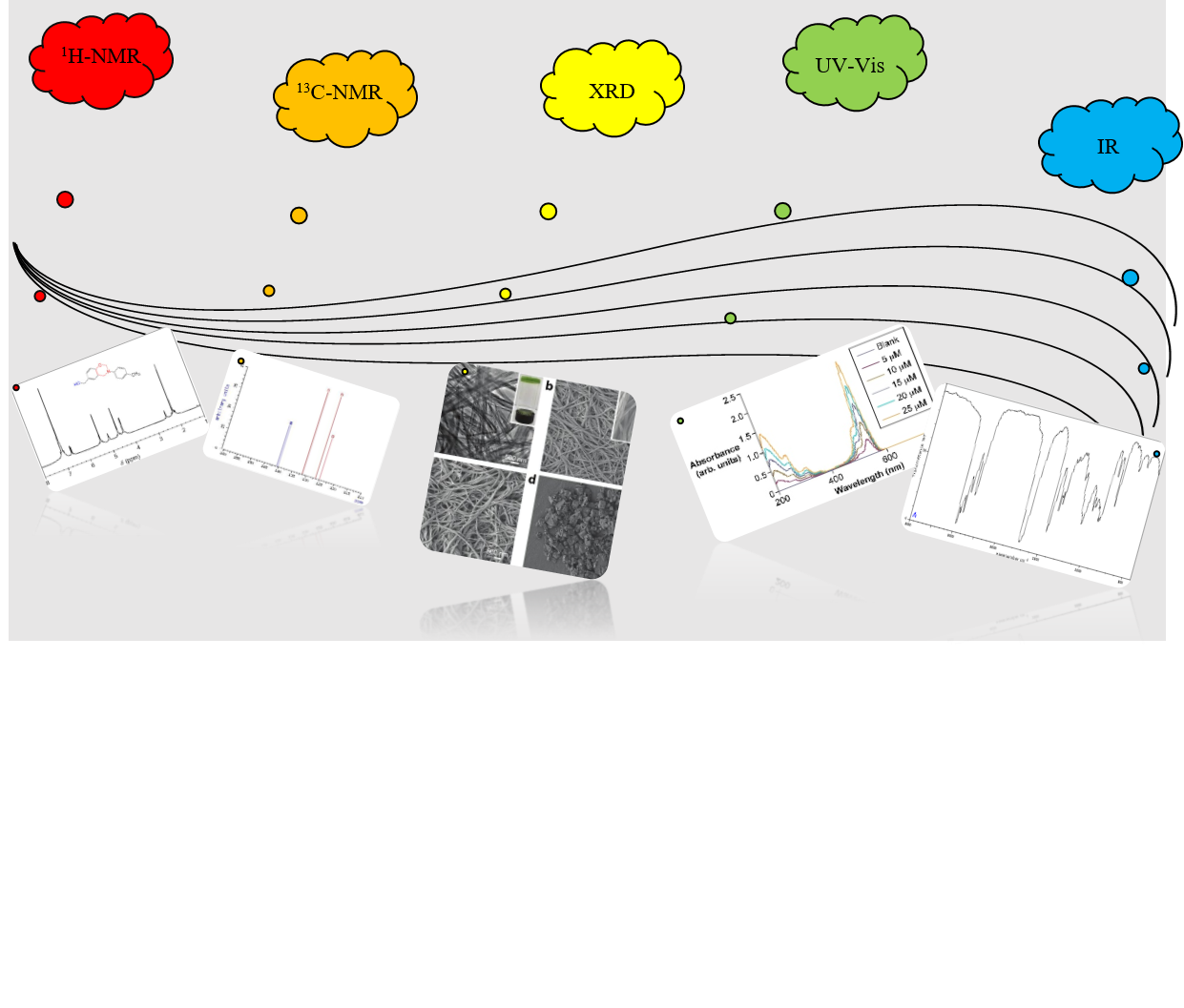
Characterization of coordination compounds involves determining their chemical composition, structural properties, and electronic behavior to understand their reactivity, functionality, and applications. Several analytical and spectroscopic methods are employed to explore these aspects. Techniques such as X-ray crystallography [32,33,34,35,36,37,38,39,40,41,42,43] are central to determining the three-dimensional arrangement of atoms, providing precise geometrical details about the coordination sphere. UV-Vis spectroscopy [44,45,46,47,48,49,50,51,52,53,54,55,56,57,58,59,60,61,62,63,64,65,66,67,68,69,70,71,72,73,74] is used to study the electronic transitions within the metal-ligand complexes, offering insights into the ligand field and electronic structure. Infrared (IR) spectroscopy identifies functional groups and bond vibrations, highlighting the types of ligands present and their binding modes [75,76,77,78,79,80,81,82,83,84,85]. Additionally, NMR spectroscopy (solid state or in solution) [86,87,88,89,90,91,92,93,94,95,96,97,98,99,100,101] can probe the chemical environment of nuclei within the ligands, especially in diamagnetic complexes. Other techniques like elemental analysis, mass spectrometry, and thermogravimetric analysis (TGA) provide quantitative data on the composition, stability, and thermal properties. Cyclic voltammetry and related electrochemical methods help in understanding redox behavior, while magnetic susceptibility measurements reveal information about unpaired electrons and the magnetic properties of the metal center. These techniques together provide a comprehensive understanding of coordination compounds, supporting their design and application in areas such as catalysis, medicine, and materials science. Several spectroscopic methods for investigation of coordination compounds are given in Scheme 4.
To date numerous metal complexes of spirohydantoins [1,2,3,4,5], thiouracils [6,7,8] and other derivatives [10,11,12,88,89,93] were synthesized and their composition and structure with various metals like copper, nickel, zinc, [1,2,12,102], as well as palladium, platinum and gold was studied [6,7,8,9]. Summary data on the structure of the complexes and the donor atoms involved in the coordination are given in Table 1.
X-ray analysis for C3 and C4 have been used to established the structure of metal complexes with Zn(II) ) [102]. Molecular structures of two complexes are presented in Figure 5.
3. Some Aspects of the Biological Significance of Coordination Compounds
Recently, Soroceanu et al. presented biomedical application of coordination compounds with Schiff-base ligands [110]. Raducka et al. provides insight into the structural and biological evaluation of zinc-based coordination compounds with benzimidazole derivatives [102]. Ndagi et al. evaluated the anticancer therapy with coordination compounds [111]. Possible biological application of coordination compounds are given in Figure 10 and Figure 11.
Schiff-base metal complexes have garnered significant attention in the fields of biological and inorganic chemistry due to their promising biological activities, particularly in the development of therapeutic agents for various bacterial infections. Schiff bases, which are derived from the condensation of primary amines with carbonyl compounds, often serve as effective ligands for transition metals. These metal complexes mimic biologically relevant species, making them valuable models for studying enzyme mechanisms and other biological processes. Many Schiff-base metal complexes demonstrate antimicrobial properties, showing efficacy against a wide range of bacterial strains, including both Gram-positive and Gram-negative bacteria [102,110,112]. The ability of these complexes to interact with biological molecules, such as enzymes and DNA, enhances their therapeutic potential, particularly for the treatment of bacterial diseases. For instance, Schiff-base complexes of metals like copper, iron, and zinc have been extensively studied for their antibacterial, antifungal, and anticancer activities [102,110,112]. The biological relevance of Schiff-base metal complexes also extends to their use as models for metalloenzymes, which are critical in various biochemical processes. These complexes can be designed to simulate the active sites of enzymes, allowing researchers to investigate the mechanisms behind their biological activity and to develop more targeted therapeutic agents. In summary, Schiff-base metal complexes represent a promising avenue for the design of new antibiotics and other therapeutic agents due to their biological activity and ability to mimic biologically significant species.
3.1. Anticancer Properties
Therapeutic Potential in Cancer Treatment:
Transition metal-based compounds, such as platinum-based drugs (e.g., cisplatin), have demonstrated notable success in cancer therapy due to their ability to:
- -
- Exhibit redox activity.
- -
- Form complexes targeting specific biomolecules.
- -
- Disrupt cellular mechanisms of proliferation.
Emerging research continues to focus on synthesizing new metal-based compounds with enhanced selectivity, reduced toxicity, and improved efficacy. These include compounds that modulate cellular mechanisms via novel pathways, offering hope for more effective cancer treatments (see Figure 12, Figure 13 and Figure 14).
Table 1 summarizes the in vitro cytotoxic effects of various metal-based compounds over a 6-year period, with a focus on their proposed mechanisms of action and targets.
Several metal-based compounds have been synthesized with promising anticancer properties. Some of these are already used in clinical practice for diagnosis and treatment, while others are still undergoing clinical trials. Recently, synthesized metal-based compounds are the result of targeted drug design aimed at achieving specific goals that the original compound could not. These new compounds display a different spectrum of cytotoxicity. The summary of metal-based compounds undergoing clinical trials in human [111] are given in Table 3 and evolution of organometallic complexes in cancer therapy was presented in Figure 15.
The cytotoxic efefct of the newly developed compounds, assessed as potential anticancer agents, was evaluated against adenocarcinoma (A549), neuroblastoma (SK-N-AS), glioblastoma (T98G) and lung cell cultures, along with normal human skin fibroblasts (CCD-1059Sk) [102]. The prediction results for the free ligand L3 and L4 are given in Table 4 and cytotoxic effect of metal complexes are presented in Table 5.
Recently, Nandaniya et al. presented a mini review with biological application of Schiff base metal complexes [132]. The text explores both the challenges and advancements related to the safety and efficacy of metal complexes in cancer therapy and the innovative role of nanotechnology in addressing these issues. Here's a summary of the main points:
Safety Issues with Metal Complexes
1. Toxicity Challenges: Despite their effectiveness, metal-based cancer drugs like cisplatin are associated with severe side effects, including nephrotoxicity, neurotoxicity, and ototoxicity [133]. These challenges have spurred the development of derivatives such as carboplatin, which, while promising, still face regulatory hurdles due to adverse effects.
2. Examples of Failed Derivatives: Several platinum-based drugs (e.g., JM-11, ormaplatin, zeniplatin, and spiroplatin) failed to gain market approval due to severe or unpredictable toxicities [129].
3. Gold and Copper Complexes: Gold(III) complexes, while studied for anticancer applications, can cause toxicity, particularly affecting skin and mucous membranes [134]. Elevated copper levels have been linked to cancer progression, further underscoring safety concerns [135].
4. Strategies to Mitigate Toxicity: Structural modifications of metal complexes aim to improve their selectivity for cancer cells and reduce adverse effects on healthy tissues.
Nanoparticles in Cancer Therapy
1. Advantages of Nanotechnology: Nanoparticles (NPs) offer targeted drug delivery, improving therapeutic index and reducing off-target effects [136]. They enhance bioavailability, solubility, and stability while facilitating sustained release and selective targeting of cancer cells.
2.Metal-Based Nanoparticles: Metal-based NPs (e.g., nickel, gold, silver, iron oxide, gadolinium) provide significant advantages in drug delivery and diagnosis due to their large surface area, which can carry higher drug loads.
3. Tumor-Specific Targeting: NPs can be functionalized with peptides, proteins, nucleic acids, or small molecules to target tumor-specific receptors or biomarkers, ensuring precise delivery [137]. This reduces toxicity in non-cancerous tissues.
4. Imaging and Therapeutic Applications: NP-based platforms are used for advanced optical imaging and therapeutic delivery. Their multifunctional nature enables combined diagnostic and therapeutic applications, paving the way for synergistic effects when combined with multidrug regimens.
While metal complexes remain a cornerstone of cancer treatment, their clinical use is often limited by toxicity and side effects. Innovations in nanotechnology provide a promising pathway to enhance the safety, efficacy, and specificity of metal-based cancer therapies, offering a brighter future for targeted and less toxic treatments.
3.2. Antimicrobial Activity (Antibacterial and Antifungal)
In recent years, particularly from 2015 onwards, Schiff-base metal complexes have garnered significant interest due to their noteworthy biological properties. Numerous studies have been published highlighting their applications in biological sciences [138,139]. Schiff-bases have demonstrated potential as antibacterial agents, with their metal complexes exhibiting superior antibacterial activity compared to the free ligands themselves [140,141,142,143,144,145]. Recent literature underscores the promising antimicrobial potential of Schiff-base metal complexes and highlights progress in the study of other intriguing topoisomerase inhibitors [146]. For instance, the Cu(II)-picolinic acid complex has been shown to act as a significant inhibitor in gel electrophoresis experiments [147]. Additionally, thiosemicarbazone derivatives of copper(II) have exhibited strong antibacterial activity, effectively targeting pathogens such as S. aureus, S. typhimurium, and K. pneumoniae after just six hours of incubation [148]. Literature reviews show that Schiff bases with antibacterial properties can be synthesized from coordination compounds with different ligands such as indole [149,150], pyridine [151,152,153], isatin [154,155], hydrazide [156,157], benzimidazole [158,159], thiazolidiones [160,161], thiazole [162], thiosemi-carbazone [163,164], lysine/curcumin [165,166], and siloxane [167]. Further examination of the literature reveals a significant rise in systemic fungal infections, which can be life-threatening [168]. Numerous studies highlight that Candida species (both albicans and non-albicans) and Aspergillus species (Asp.) are responsible for causing the most severe fungal infections [169,170,171,172,173]. Consequently, the development of new antifungal agents with reduced resistance and increased effectiveness has become a priority [174,175]. Extensive and meticulous research has been conducted, with several Schiff ligands identified as highly effective antifungal agents [176,177]. Researchers have also pointed out that specific groups, such as methoxy, halogen, and naphthyl, enhance the fungicidal activity of these ligands [178,179]. While still widespread, recent literature strongly emphasizes the promising potential of metal complex-based antifungal drug development [180,181]. In another study, Schiff base ligands and their mononuclear chelate complexes, incorporating metals like Cr(III), Fe(III), Mn(II), Cu(II), Zn(II), Ni(II), and Cd(II), were synthesized from the 4-((1-5-acetyl-2,4-dihydroxyphenyl)ethylidene) amino)-1,5-dimethyl-2-phenyl-1H-pyrazol-3(2H)-one ligand, a tridentate ligand. These complexes were used for in vitro tests to assess their antimicrobial activity against both Gram-negative and Gram-positive bacteria, as well as fungal organisms. In this research, the MOE 2008 software was used for drug screening by molecular docking at protein sites of the novel coronavirus, and the study included molecular docking validation through MD simulations [182]. The antimicrobial potential of zinc complexes, their unbound ligands, and standard drugs was examined against six strains of Gram-positive bacteria, five Gram-negative bacterial strains, and three yeast strains [102]. The minimum inhibitory concentrations (MICs) of the tested derivatives were determined against a panel of reference microorganisms from the American Type Culture Collection (ATCC). The panel included Gram-negative bacteria such as Escherichia coli (ATCC 25922), Salmonella Typhimurium (ATCC 14028), Klebsiella pneumoniae (ATCC 13883), Pseudomonas aeruginosa (ATCC 9027), and Proteus mirabilis (ATCC 12453). Gram-positive bacteria tested included Staphylococcus aureus (ATCC 25923), Staphylococcus epidermidis (ATCC 12228), Micrococcus luteus (ATCC 10240), Enterococcus faecalis (ATCC 29212), Bacillus subtilis (ATCC 6633), and Bacillus cereus (ATCC 10876). The antifungal activity was assessed against Candida albicans (ATCC 10231), Candida parapsilosis (ATCC 22019), and Candida glabrata (ATCC 90030). The antibacterial and antifungal efficacy was quantified using the minimum inhibitory concentration (MIC), expressed in milligrams per liter. The activity of zinc complexes was compared to the antimicrobial profiles of their corresponding ligands. Vancomycin (Van), ciprofloxacin (Cip), and nystatin (Nys) were employed as reference standards. The evaluated compounds demonstrated no activity against Gram-negative bacteria and yeasts. However, against Gram-positive bacteria, moderate activity was observed, with a slight enhancement in bioactivity for the zinc complexes [102].
3.2. Antioxidant Activity
There has been considerable interest in discovering compounds with antioxidant properties (see Figure 16). While natural antioxidants are typically the most costly, researchers have turned to synthetic antioxidants as a more cost-effective and efficient alternative. As a result, various metal complexes have been studied for their ability to act as effective scavengers of reactive oxygen species (ROS), functioning as antioxidants [183].
In a study by Devi and colleagues [184], 16 novel Ni(II), Cu(II), Co(II), and Zn(II) metal complexes were synthesized starting from four Schiff-base ligands. These ligands were created through a condensation reaction involving 4-(benzyloxy)-2-hydroxybenzaldehyde and various aminophenol derivatives. The antioxidant properties of these metal(II) complexes were evaluated in vitro, and the results revealed that the complexes exhibited notable potential (see Figure 17). Particularly, the Cu(II) complexes displayed excellent antioxidant activity, significantly decolorizing the purple DPPH solution, with an IC50 value ranging from 2.98 to 3.89 µM, which was more effective compared to the free ligands.
A range of Schiff-base compounds, derived from diamine, sulfanilamide, hydroxyquinoline, thiocarbohydrazide, and benzohydrazide, with substituted ketone or aldehyde groups, as well as their Co(II), Zn(II), Cu(II), Fe(II), Ni(II), Pd(II), Cd(II), and Ru(II) metal complexes, have been examined for their antioxidant potential. Compounds with methyl and nitro groups exhibited stronger antioxidant activity compared to those with 4-hydroxy groups, leading to an enhancement in antioxidant performance [185,186].
A study conducted by Inan et al. demonstrated the antioxidant activity of these complexes using the L-ascorbic acid-standard method (DPPH) [187]. The complexes showed greater activity than the ligands themselves, likely due to the coordination of the metal ion with the organic ligand. Specifically, [Cu(II)-(furfural-MAP)2Cl2] and [Ni(II)-(furfural-MAP)2Cl2] showed significant antimicrobial activity, while [Zn(II)-(furfural-MAP)2Cl2] displayed moderate activity. The variance in antioxidant activity among the complexes was attributed to differences in their coordination sphere and redox properties [187]. Kizilkaya et al. explored the antioxidant capabilities of Schiff-bases synthesized using ABTS radical scavenging and DPPH free radical scavenging methods [188]. The synthesized compounds demonstrated good antioxidant activity, suggesting their potential as synthetic antioxidant agents.
3.4. Enzyme-Inhibitory Activities
Che et al. presented the metal complexes in medicine with a focus on enzyme inhibition [189]. Metal complexes containing labile ligands have long been recognized for their ability to undergo ligand-substitution reactions with biomolecular targets (see Figure 18).
These metal ions interact with nitrogen, sulfur, or selenium atoms in histidine, cysteine, or selenocysteine residues found in proteins, often resulting in therapeutic effects. Some notable examples include:
Gold: Auranofin, a gold(I) phosphine complex (illustrated in Figure 19), is an established drug for managing rheumatoid arthritis. Recent findings indicate that gold from auranofin can transfer to the selenoprotein thioredoxin glutathione reductase, producing therapeutic effects against parasitic diseases. Additionally, auranofin demonstrated tumor cell growth inhibition in vitro [190]; however, its high reactivity with protein thiols limits its antitumor efficacy in vivo [191]. New research highlights a gold(I) phosphine complex with a naphthalimide ligand as a potent thioredoxin reductase inhibitor with significant antiproliferative and anti-angiogenic activities [192]. Furthermore, studies on a gold(III) dithiocarbamate complex (depicted in Figure 19) identified the proteasome as its main target [193], showing promise in therapeutic applications.
Platinum: Selenoenzyme thioredoxin reductase has been identified as a target effectively inhibited by (2,2′:6′,2′′-terpyridine)platinum(II) complexes (shown in Figure 19) with IC50 values at the nanomolar level [194]. Recently, research by Lo et al. employed X-ray crystallography and mass spectrometry to demonstrate that aromatic thiolato platinum(II)-terpyridine complexes inhibit human thioredoxin reductase 1 by blocking its C-terminal active-site selenocysteine [195]. Furthermore, a series of platinum(II)-terpyridine complexes exhibited inhibitory activity against topoisomerase II (top2). The mechanisms of top2 inhibition are diverse, involving DNA intercalation, enzyme binding, and modification of enzyme thiol groups. As such, these platinum(II)-terpyridine complexes are thought to inhibit topoisomerase II by ligand exchange reactions with the thiol groups of enzymes [195]. Additionally, a series of platinum(II) complexes with two or three labile ligands (PtCl2(smp), Figure 19) demonstrated inhibitory effects on matrix metalloproteinase-3 (MMP-3) [196].
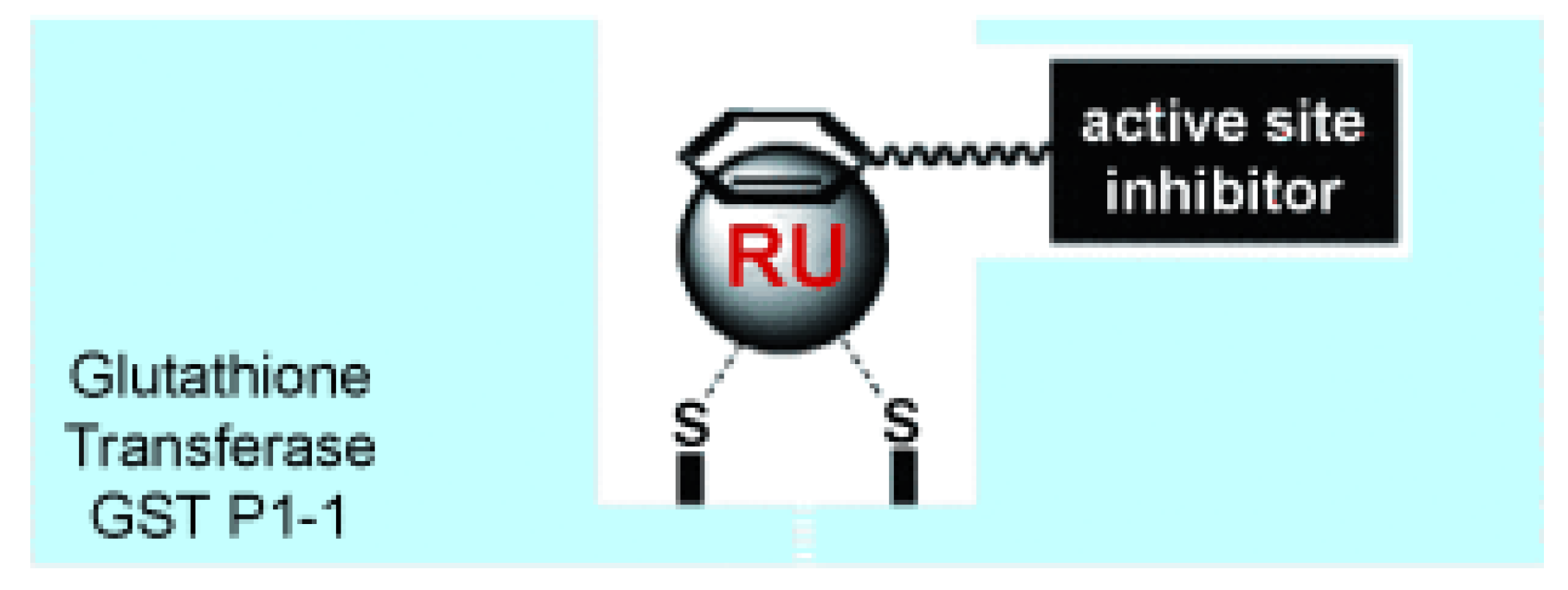
Ruthenium: A novel class of glutathione transferase inhibitors (denoted as Ru–EA, shown in Figure 1) was synthesized by coupling ethacrynic acid (EA), a potent glutathione transferase inhibitor, with a ruthenium complex [197]. Analysis using mass spectrometry and X-ray crystallography revealed that the Ru–EA complex initially loses two chloride ligands, followed by cleavage to release a ruthenium-containing fragment (Figure 19). Overall, metal complexes with labile ligands predominantly target proteins featuring selenocysteine or cysteine in their active sites, such as thioredoxin glutathione reductase, thioredoxin reductase, and glutathione transferase.
Figure 20.
Ruthenium-based enzyme inhibitors [189].
Figure 20.
Ruthenium-based enzyme inhibitors [189].
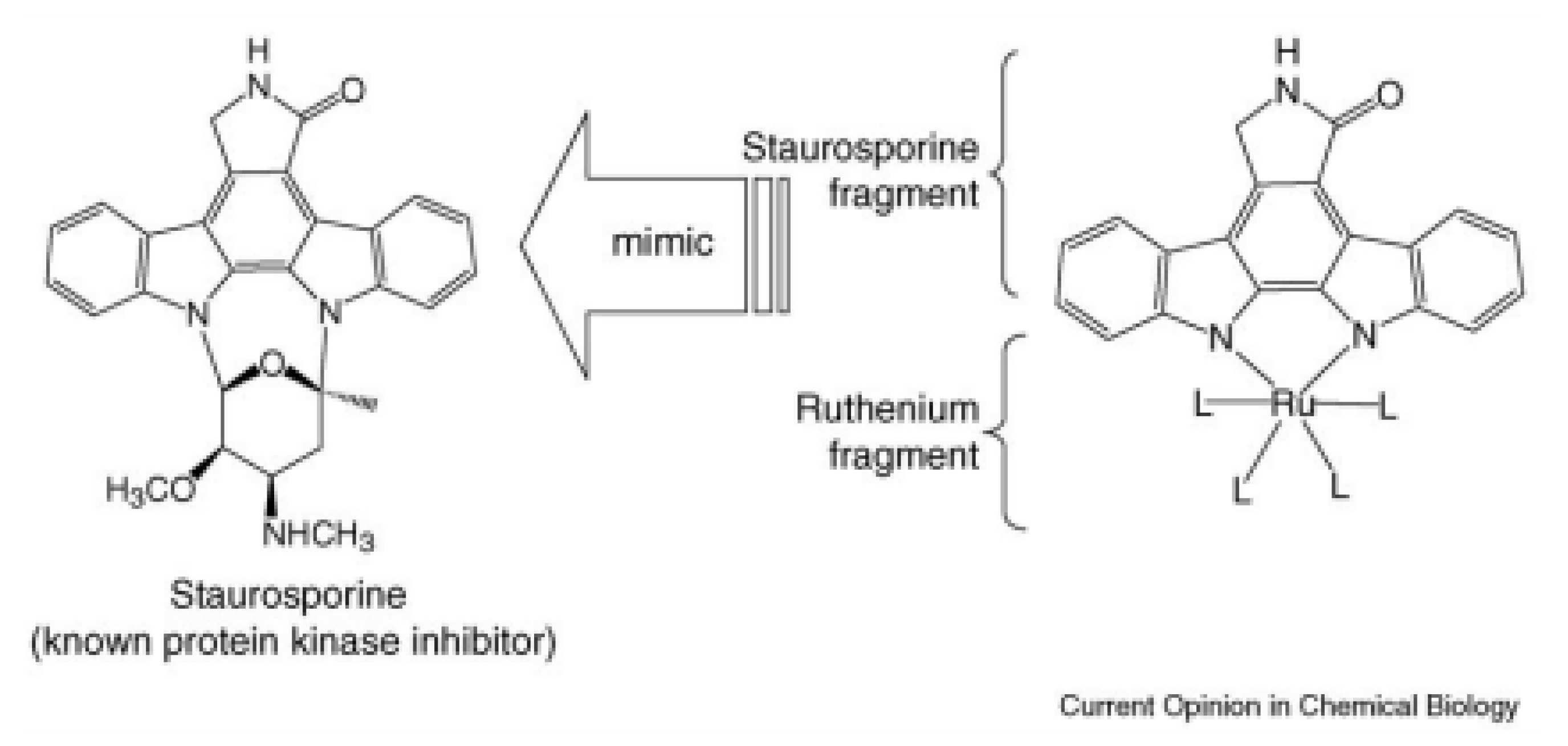
Figure 21.
Ruthenium complex as glutathione transferase inhibitor [197].
Figure 21.
Ruthenium complex as glutathione transferase inhibitor [197].
A notable limitation of the metal complexes mentioned earlier is their lack of selectivity. These complexes often interact with human serum albumin or other proteins that have potential metal-binding sites, such as histidine, cysteine, or selenocysteine. Such interactions make it challenging to deliver metal complexes to specific biomolecular targets. For instance, while auranofin is known to inhibit thioredoxin glutathione reductase and suppress tumor cell growth in vitro [190], its strong reactivity with protein thiols significantly reduces its antitumor efficacy in vivo [191]. To address this, Berners-Price and Filipovska developed a series of gold(I) complexes engineered to preferentially target proteins containing selenocysteine while avoiding cysteine, achieved by optimizing ligand exchange reactions at the gold(I) center [198].
Figure 22.
Gold(I) complex inhibit the activity of thioredoxin reductase (TrxR) but not the closely related and Se-free enzyme glutathione reductase [198].
Figure 22.
Gold(I) complex inhibit the activity of thioredoxin reductase (TrxR) but not the closely related and Se-free enzyme glutathione reductase [198].
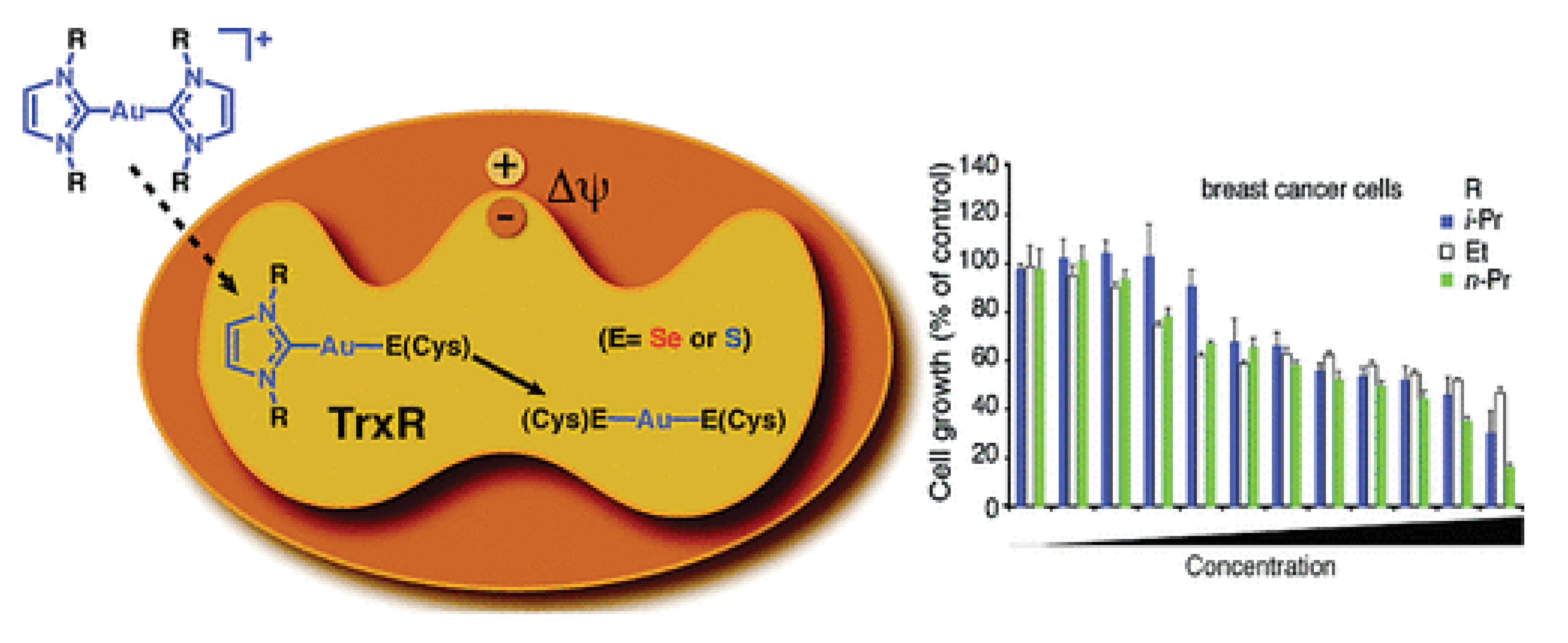
Figure 23.
A 3D structure of the TrxR reductase homodimer (PDB entry 2J3N), with two chains in green and purple. Note: The active site residues CYS 59.B, CYS 64.B, HIS 472.A and GLU 477.A represent the possible binding site for the gold(III) compou Abbreviations: TrxR, thioredoxin reductase; PDB, Protein Data Bank; CYS, cysteine; HIS, histidine; GLU, glutamate [104].
Figure 23.
A 3D structure of the TrxR reductase homodimer (PDB entry 2J3N), with two chains in green and purple. Note: The active site residues CYS 59.B, CYS 64.B, HIS 472.A and GLU 477.A represent the possible binding site for the gold(III) compou Abbreviations: TrxR, thioredoxin reductase; PDB, Protein Data Bank; CYS, cysteine; HIS, histidine; GLU, glutamate [104].
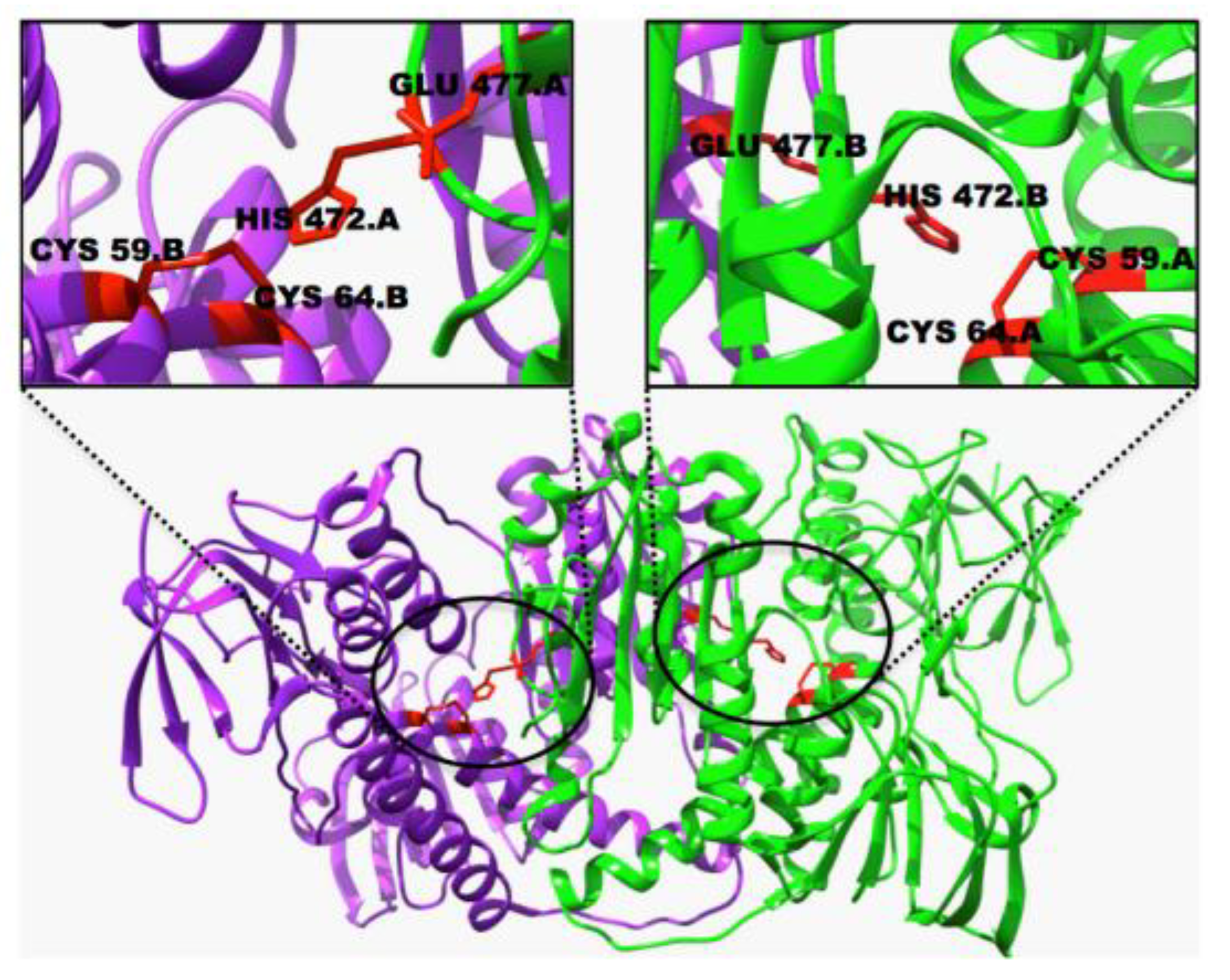
Additionally, the role of labile ligands or leaving groups in metal complexes has been rigorously investigated [199]. Efforts are ongoing to enhance the stability of metal complexes under physiological conditions to discover unique anticancer properties in substitution-inert complexes.
4. Schiff-Base Complexes as Catalysts
Schiff-base complexes with transition metals have become highly sought-after co-catalysts due to their accessibility and the versatility of metal centers that can be integrated into the N2O2 coordination sphere [200,201]. Their structure allows for a wide range of substituents, enabling chemical flexibility and covalent stability, which is crucial when such catalysts are used on supports [202,203]. Numerous studies have demonstrated that Schiff-base metal complexes possess excellent catalytic activity, which can enhance product selectivity and yield in various processes [204,205,206]. The synthesis methods and thermogravimetric stability of these complexes play a key role in their performance as metal catalysts.
Figure 23.
Application of metal complexes as catalysts [206].
Figure 23.
Application of metal complexes as catalysts [206].
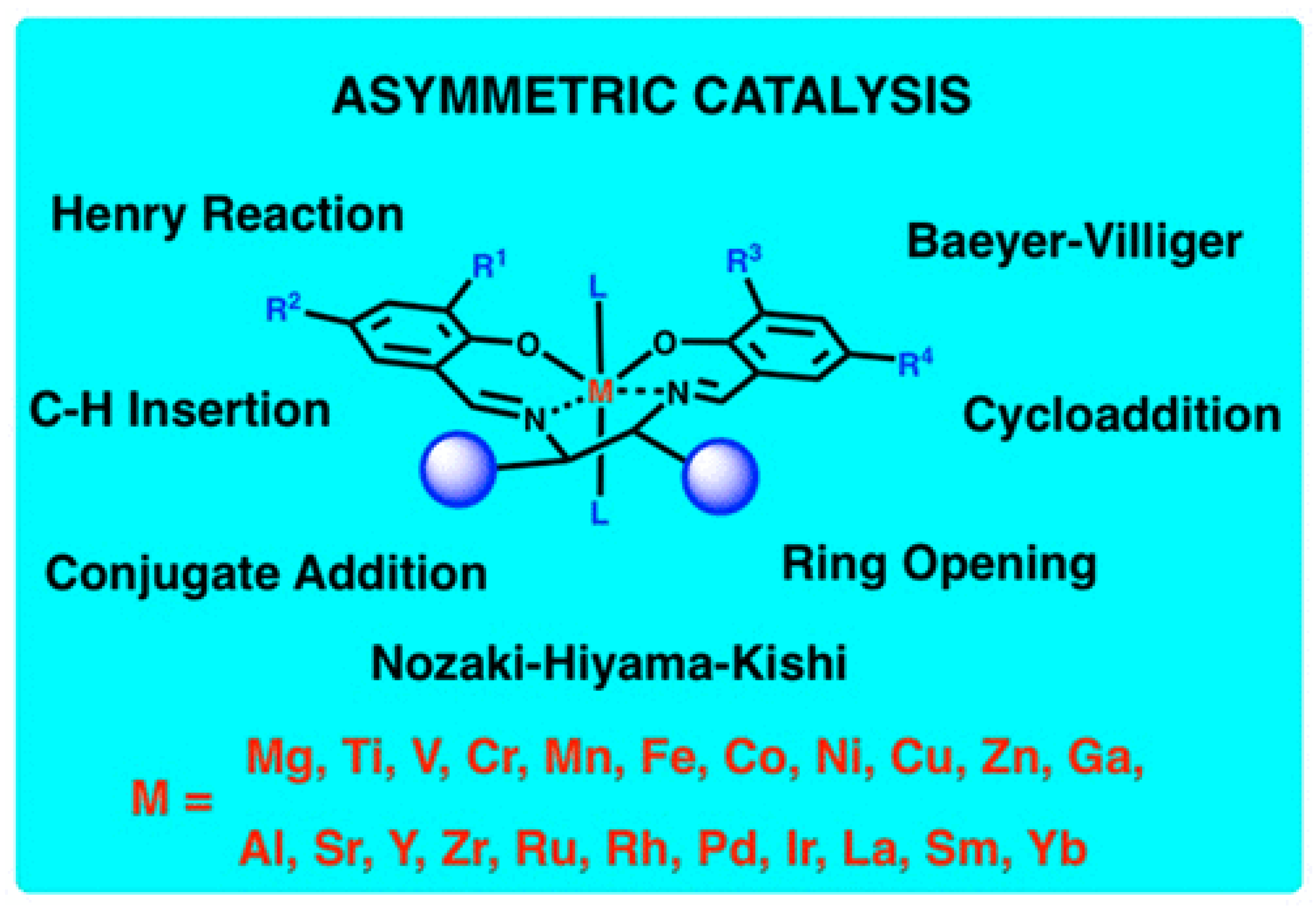
These complexes, formed from transition metal ions, are effective in both homogeneous and heterogeneous catalytic processes. Their catalytic activity depends on factors like the type of metal ion, ligands, and coordination sites. Schiff-bases are particularly useful because they can coordinate a variety of metals at different oxidation states, enhancing the metal ions' catalytic performance across various reactions [207]. For example, the catalytic activity of Congo red (CR) in photodecomposition under natural light was assessed using a Co-complex of CX and EBPy, showing a discoloration efficiency of nearly 82% after 80 minutes of exposure to sunlight [208].
Figure 24.
Different coordination compounds used in catalysis [207].
Figure 24.
Different coordination compounds used in catalysis [207].
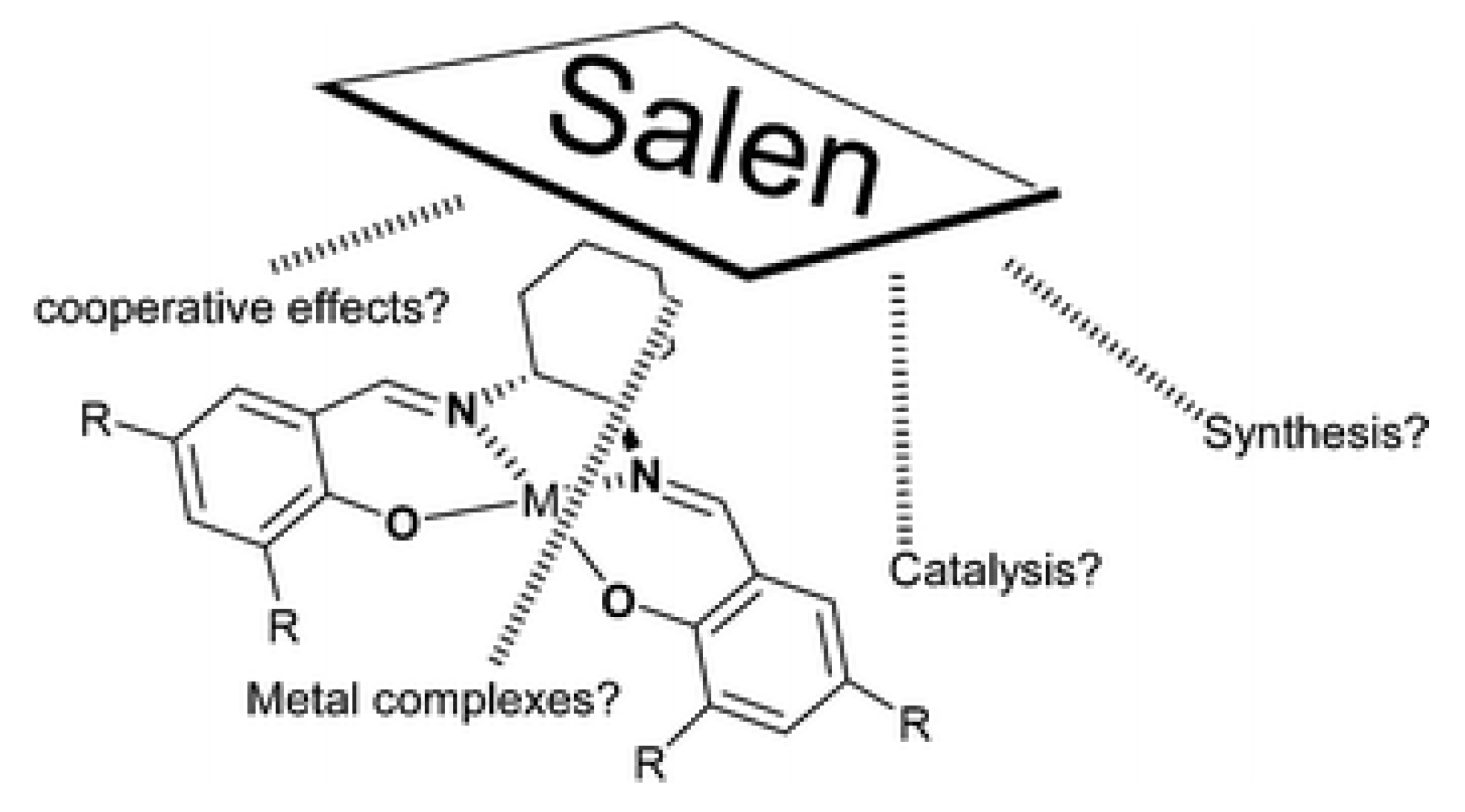
Schiff-base complexes with metals like V, Mn, Fe, Co, Ni, Cu, and Zn have also been studied as catalysts for alkene peroxidation reactions, such as those involving limonene, cyclohexene, and styrene [209]. These polymer-supported complexes have shown promising catalytic properties when compared to unsupported catalysts, offering unique advantages in material science and catalysis.
The average particle size of the prepared nanofilms, derived from the organic ligand and its chromium(III) complex, were 94 nm and 98 nm, respectively [210]. Optical properties revealed that the direct energy gaps of the nanoparticles (L and M) were 2.6 eV and 3.2 eV, respectively. These results can be attributed to the quantum size effect. X-ray diffraction (XRD) data confirmed the polycrystalline nanostructures of (L and M), with no other phases detected. The efficiency of the fabricated inorganic silicon solar cell (M/Si) was found to be higher than that of the organic solar cell (L/Si).
5. Conclusions
Coordination compounds have demonstrated unparalleled versatility due to their structural diversity and range of applications. The synthesis of these compounds has progressed significantly, incorporating both conventional techniques and innovative approaches to achieve desired properties. Their structural and spectroscopic investigations reveal insights into their reactivity and stability, underpinning their functional potential.
Biologically, coordination compounds stand out for their significant roles as antimicrobial agents, anticancer drugs, and enzyme inhibitors. These properties underscore their potential in therapeutic development and biomedical applications. Beyond biology, their applications in catalysis and advanced material science illustrate their broad utility across various fields.
By bridging fundamental inorganic chemistry with applied sciences, coordination compounds hold promise for addressing some of the most pressing global challenges. The continued exploration of novel synthetic methods, coupled with detailed biological and structural evaluations, will pave the way for innovative solutions in healthcare and technology.
Author Contributions
Conceptualization, P.M. and K.T; writing—original draft preparation, P.M. and K.T; writing—review and editing, P.M. and K.T; project administration, S.T.; funding acquisition, P.M.
Acknowledgments
We acknowledge the financial support from the Fund for Scientific Research of the Plovdiv University, project СП 23-ХФ-006.
Conflicts of Interest
The authors declare no conflict of interest.
References
- Ahmedova, A.; Marinova, P.; Paradowska, K.; Stoyanov, N.; Wawer, I.; Mitewa, M. Spectroscopic aspects of the coordination modes of 2,4-dithiohydantoins: Experimental and theoretical study on copper and nickel complexes of cyclohexanespiro-5-(2,4-dithiohydantoin), Inorg. Chim. Acta 2010, 363, 3919-3925. [CrossRef]
- Ahmedova, A.; Marinova, P.; Paradowska, K.; Marinov, M.; Wawer, I.; Mitewa, M. Structure of 2,4-dithiohydantoin complexes with copper and nickel – Solid-state NMR as verification method, Polyhedron 2010, 29, 1639-1645. [CrossRef]
- Ahmedova, A.; Pavlović, G.; Marinov, M.; Marinova, P.; Momekov, G.; Paradowska, K.; Yordanova, S.; Stoyanov, S.; Vassilev, N.; Stoyanov N. Synthesis and anticancer activity of Pt(II) complexes of spiro-5-substituted 2,4-dithiohydantoins”, Inorg. Chim. Acta 2021, 528, Article number 120605. [CrossRef]
- Ahmedova, A.; Marinova, P.; Paradowska, K.; Marinov, M.; Mitewa, M. Synthesis and characterization of Copper(II) and Ni(II) complexes of (9’-fluorene)-spiro-5-dithiohidantoin, J.Mol.Str. 2008, 892, 13-19. [CrossRef]
- Ahmedova, A.; Paradowska, K.; Wawer I. 1H, 13C MAS NMR and DFT GIAO study of quercetin and its complex with Al(III) in solid state, J. Inorg. Biochem. 2012, 110, 27-35. [CrossRef]
- Marinova, P.; Hristov,M.; Tsoneva, S.; Burdzhiev,N.; Blazheva, D.; Slavchev, A.; Varbanova, E.; Penchev, P. Synthesis, Characterization, and Antibacterial Studies of New Cu(II) and Pd(II) Complexes with 6-Methyl-2-Thiouracil and 6-Propyl-2-Thiouracil. Appl. Sci. 2023, 13, 13150-13168. [CrossRef]
- Marinova, P.; Stoitsov, D.; Burdzhiev, N.; Tsoneva, S.; Blazheva, D.; Slavchev, A.; Varbanova, E.; Penchev, P. Investigation of the Complexation Activity of 2,4-Dithiouracil with Au(III) and Cu(II) and Biological Activity of the Newly Formed Complexes. Appl. Sci. 2024, 14, 6601. [CrossRef]
- Marinova, P.; Burdzhiev, N.; Blazheva, D.; Slavchev, A. Synthesis and Antibacterial Studies of a New Au(III) Complex with 6-Methyl-2-Thioxo-2,3-Dihydropyrimidin-4(1H)-One. Molbank 2024, 2024, M1827. [CrossRef]
- Ahmedova, A.; Marinova, P.; Paradowska, K.; Tyuliev, G.; Marinov, M.; Stoyanov, N. Spectroscopic study on the solid state structure of Pt(II) complexes of cycloalkanespiro-5-(2,4-dithiohydantoins), Bulg. Chem. Communic., 2024, Vol. 56, Special Issue C, 89-95. [CrossRef]
- Altowyan, M.S.; Soliman, S.M.; Al-Wahaib, D.; Barakat, A.; Ali, A.E.; Elbadawy, H.A. Synthesis of a New Dinuclear Ag(I) Complex with Asymmetric Azine Type Ligand: X-ray Structure and Biological Studies. Inorganics 2022, 10, 209. [CrossRef]
- Zimina, A.M.; Somov, N.V.; Malysheva, Y.B.; Knyazeva, N.A.; Piskunov, A.V.; Grishin, I.D. 12-Vertex clo-so-3,1,2- Ruthenadicarba-dodecaboranes with Chelate POP-Ligands: Synthesis, X-ray Study and Electrochemical Properties. Inorganics 2022, 10, 206. [CrossRef]
- Al-Shboul, T.M.A.; El-khateeb, M.; Obeidat, Z.H.; Ababneh, T.S.; Al-Tarawneh, S.S.; Al Zoubi, M.S.; Alshaer,W.; Abu Seni, A.; Qasem, T.; Moriyama, H.; et al. Synthesis, Characterization, Computational and Biological Activity of Some Schiff Bases and Their Fe, Cu and Zn Complexes. Inorganics 2022, 10, 112. [CrossRef]
- P. Marinova, M. Marinov, M. Kazakova, Y. Feodorova, D. Blazheva, A. Slavchev, H. Sbirkova-Dimitrova, V. Sarafian, N. Stoyanov, Crystal Structure of 5'-oxospiro-(fluorene-9, 4'-imidazolidine)-2'-thione and biological activities of its derivatives. Russ J Gen Chem 2021, 91(5), 939-946. [CrossRef]
- P. Marinova, M. Marinov, M. Kazakova, Y. Feodorova, D. Blazheva, A. Slavchev, D. Georgiev, I. Nikolova, H. Sbirkova-Dimitrova, V. Sarafian, N. Stoyanov, Copper(II) complex of bis(1',3'-hydroxymethyl)-spiro-(fluorine-9,4'-Imidazolidine)-2',5'-dione, cytotoxicity and antibacterial activity of its derivative and crystal structure of free ligand, Russ J Inorg. Chem. 2021, 66(13), 1925-1935. ISSN 0036-0236.
- Anife Ahmedova, Gordana Pavlović, Marin Marinov, Petya Marinova, Georgi Momekov, Katarzyna Paradowska, Stanislava Yordanova, Stanimir Stoyanov, Nikolay Vassilev, Neyko Stoyanov. Synthesis and anticancer activity of Pt(II) complexes of spiro-5-substituted 2,4-dithiohydantoins. Inorganica Chimica Acta, 2021, 528, Article number 120605. [CrossRef]
- Petja Marinova, Marin Marinov, Danail Georgiev, Maria Becheva, Plamen Penchev, Neyko Stoyanov. Synthesis and antimicrobial study of new Pt(IV) and Ru(III) complexes of fluorenylspirohydantoins. Rev. Roum. Chim. 2019, 64(7), 595-601;. [CrossRef]
- P. Marinova, M. Marinov, M. Kazakova, Y. Feodorova, P. Penchev, V. Sarafian, N. Stoyanov, Synthesis and in vitro activity of platinum (II) complexes of two fluorenylspirohydantoins against a human tumor cell line, Biotechnology & Biotechnological Equipment, 2014, 28 (2), 316-321. [CrossRef]
- P. Marinova, M. Marinov, N. Stoyanov. New metal complexes of cyclopentanespiro-5-hydantoine. Trakia Journal of Sciences, “30 years higher medical education, Stara Zagora” 2012, Vol. 10, Supplement 1, 84-87.
- P. E. Marinova, M. N. Marinov, M. H. Kazakova, Y. N. Feodorova, V. S. Sarafian, N. M. Stoyanov. Synthesis and bioactivity of new platinum and ruthenium complexes of 4-bromo-spiro-(fluorene-9,4'-imidazolidine)-2',5'-dithione. Bulgarian Chemical Communications, 2015, 47, Special issue A, 75 -79.
- Anife Ahmedova, Petja Marinova, Marin Marinov, Neyko Stoyanov. An integrated experimental and quantum chemical study on the complexation properties of (9’-fluorene)-spiro-5-hydantoin and its thio-analogues. J Mol. Str. 2016, 1108, 602-610. [CrossRef]
- Petja Marinova, Slava Tsoneva, Maria Frenkeva, Denica Blazheva, Aleksandar Slavchev and Plamen Penchev. New Cu(II), Pd(II) and Au(III) complexes with 2-thiouracil: Synthesis, Characteration and Antibacterial Studies. Russ J Gen Chem, 2022, 92(8), 1578–1584. [CrossRef]
- Petja Marinova, Stoyanka Nikolova, Slava Tsoneva. Synthesis of N-(1-(2-acetyl-4,5-dimethoxyphenyl)propan-2-yl)benzamide and its copper(II) complex. Russ J Gen Chem 2023, 93(1), 161-165.
- A. Ahmedova, V. Atanasov, P. Marinova, N. Stoyanov, M. Mitewa, Synthesis, characterization and spectroscopic properties of some 2-substituted 1,3-indandiones and their metal complexes. Central European Journal of Chemistry, 2009, 7(3), 429-438. [CrossRef]
- A. Ahmedova, P. Marinova, S. Ciattini, N. Stoyanov, M. Springborg, M. Mitewa, A combined experimental and theoretical approach for structural study on a new cinnamoyl derivative of 2-acetyl-1,3-indandione and its metal(II) complexes, Strucural Chemisry, 2009, 20, 101–111.
- A. Ahmedova, P. Marinova, G. Pavlović, M. Guncheva, N. Stoyanov, M. Mitewa. Structure and properties of a series of 2-cinnamoyl-1,3-indandiones and their metal complexes. Journal of the Iranian Chemical Society, 2012, 9 (3), 297-306. [CrossRef]
- Iliana Nikolova, Marin Marinov, Petja Marinova, Atanas Dimitrov, Neyko Stoyanov. Cu(II) complexes of 4- and 5- nitro-substituted heteroaryl cinnamoyl derivatives and determining their anticoagulant activity. Ukrainian Food Journal 2016, 5(2), 326-349. doi. 10.24263/2304-974x-2016-5-2-12.
- P. E. Marinova, I. D. Nikolova, M. N. Marinov, S. H. Tsoneva, A. N. Dimitrov, N. M. Stoyanov. Ni(II) complexes of 4- and 5- nitro-substituted heteroaryl cinnamoyl derivatives. Bulgarian chemical communication 2017, 49, Special issue, 183-187.
- Frezza, M.; Hindo, S.; Chen, D.; Davenport, A.; Schmitt, S.; Tomco, D.; Dou Q. P. Novel metals and metal complexes as platforms for cancer therapy. Curr Pharm Des. 2010, 16(16), 1813–1825. [CrossRef]
- Haas, K.L.; Franz, K.J. Application of metal coordination chemistry to explore and manipulate cell biology. Chem Rev. 2010, 109(10), 4921–4960. [CrossRef]
- Yan, Y.K.; Melchart, M.; Habtemariam, A.; Sadler, P. J. Organometallic chemistry, biology and medicine: ruthenium arene anticancer complexes. Chem Commun. 2005,14(38), 4764–4776. [CrossRef]
- Salga, M.S.; Ali, H.M.; Abdulla, M.A.; Abdelwahab, S.I. Acute oral toxicity evaluations of some zinc(II) complexes derived from 1-(2- Salicylaldiminoethyl)piperazine schiff bases in rats. Int J Mol Sci. 2012, 13(2), 1393–1404. [CrossRef]
- Sekine, Y.; Nihei, M.; Kumai, R.; Nakao, H.; Murakami, Y.; Oshio, H. Investigation of the light-induced electron-transfer-coupled spin transition in a cyanide-bridged [Co₂Fe₂] complex by X-ray diffraction and absorption measurements. Inorganic Chemistry Frontiers, 2014, 1(4), 540-543. [CrossRef]
- Matteppanavar, S.; Rayaprol, S.; Singh, K.; Raghavendra Reddy, V.; Angadi, B. Structural, magnetic, and dielectric properties of perovskite-type complex oxides La₃FeMnO₇ studied using X-ray diffraction. J. Mater. Sci., 2015, 50(13), 4980-4993. [CrossRef]
- Mustafin, E.S.; Mataev, M.M.; Kasenov, R.Z.; Pudov, A.M.; Kaykenov, D.A. Synthesis and X-ray diffraction studies of a new pyrochlore oxide (Tl₂Pb)(MgW)O₇. Inorganic Materials, 2014, 50(5), 672-675. [CrossRef]
- Cheong, S.; Mostovoy, M. Multiferroics: a magnetic twist for ferroelectricity. Nature Materials, 2007, 6(1), 13-20. [CrossRef]
- Valencia, S.; Konstantinovic, Z.; Schmitz, D.; Gaupp, A. X-ray magnetic circular dichroism study of cobalt-doped ZnO. Physical Review B, 2011, 84, 024413. [CrossRef]
- Harder, R.; Robinson, I.K. Three-dimensional mapping of strain in nanomaterials using X-ray diffraction microscopy. New Journal of Physics, 2010, 12, 035019. [CrossRef]
- Newton, M.C.; Leake, S.J.; Harder, R.; Robinson, I.K. Three-dimensional imaging of strain in ZnO nanorods using coherent X-ray diffraction. Nature Materials 2010, 9, 120-125. [CrossRef]
- Cha, W.; Ulvestad, A.; Kim, J.W. Coherent diffraction imaging of crystal strains and phase transitions in complex oxide nanocrystals. Nature Communic. 2018, 9, 3422. [CrossRef]
- Diao, J.; Ulvestad, A. In situ study of ferroelastic domain wall dynamics in BaTiO₃ nanoparticles by X-ray diffraction microscopy. Physical Review Materials, 2020, 4, 053601. [CrossRef]
- Kim, J.; Robinson, I.K. Real-time observation of defect dynamics during oxidation in Pt nanoparticles using coherent X-ray diffraction imaging. Nano Letters 2015, 15(7), 5044-5051. [CrossRef]
- Pfeifer, M.A.; Williams, G.J.; Vartanyants, I.A.; Harder, R.; Robinson, I.K. Three-dimensional mapping of a deformation field inside a nanocrystal using coherent X-ray diffraction. Nature 2006, 442, 63-66. [CrossRef]
- Song, C.; Nam, D. Quantitative imaging of single, unstained viruses with coherent X-rays. Physical Review Letters, 2014, 101, 158101. [CrossRef]
- Prativa Shrestha, UV-Vis Spectroscopy: Principle, Parts, Uses, Limitations, 2023.
- Khalisanni Khalid, Ruzaina Ishak, Zaira Zaman Chowdhury, Chapter 15 - UV–Vis spectroscopy in non-destructive testing, Non-Destructive Material Characterization Methods, 2024, Pages 391-416. [CrossRef]
- Harris DC. Quantitative Chemical Analysis. 7th ed, 3rd printing. W. H. Freeman; 2007.
- Diffey BL. Sources and measurement of ultraviolet radiation. Methods. 2002;28(1):4-13. [CrossRef]
- Namioka T. Diffraction Gratings. In: Vacuum Ultraviolet Spectroscopy. Vol 1. Experimental Methods in Physical Sciences. Elsevier; 2000:347-377. [CrossRef]
- Mortimer Abramowitz and Michael W. Davidson. Photomultiplier Tubes. Molecular Expressions. Accessed April 25, 2021. https://micro.magnet.fsu.edu/primer/digitalimaging/concepts/photomultipliers.html.
- Picollo M, Aceto M, Vitorino T. UV-Vis spectroscopy. Phys Sci Rev. 2019;4(4). [CrossRef]
- What is a Photodiode? Working, Characteristics, Applications. Published online October 30, 2018. Accessed April 29, 2021. https://www.electronicshub.org/photodiode-working-characteristics-applications/.
- Amelio G. Charge-Coupled Devices. Scientific American. 1974;230(2):22-31. http://www.jstor.org/stable/24950003.
- Hackteria. DIY NanoDrop. Accessed June 15, 2021. https://hackteria.org/wiki/File:NanoDropConceptSpectrometer2.png.
- Sharpe MR. Stray light in UV-VIS spectrophotometers. Anal Chem. 1984;56(2):339A-356A. [CrossRef]
- Liu P-F, Avramova LV, Park C. Revisiting absorbance at 230 nm as a protein unfolding probe. Anal Biochem. 2009;389(2):165-170. [CrossRef]
- Kalb V., Bernlohr R. A New Spectrophotometric Assay for Protein in Cell Extracts. Anal Biochem. 1977;82:362-371. [CrossRef]
- Bosch Ojeda C, Sanchez Rojas F. Recent applications in derivative ultraviolet/visible absorption spectrophotometry: 2009–2011. Microchem J. 2013;106:1-16. [CrossRef]
- Domingo C, Saurina J. An overview of the analytical characterization of nanostructured drug delivery systems: Towards green and sustainable pharmaceuticals: A review. Anal Chim Acta. 2012;744:8-22. [CrossRef]
- Gaikwad J, Sharma S, Hatware KV. Review on Characteristics and Analytical Methods of Tazarotene: An Update. Crit Rev Anal Chem. 2020;50(1):90-96. [CrossRef]
- Gendrin C, Roggo Y, Collet C. Pharmaceutical applications of vibrational chemical imaging and chemometrics: A review. J Pharm Biomed Anal. 2008;48(3):533-553. [CrossRef]
- Lourenço ND, Lopes JA, Almeida CF, Sarraguça MC, Pinheiro HM. Bioreactor monitoring with spectroscopy and chemometrics: a review. Anal Bioanal Chem. 2012;404(4):1211-1237. [CrossRef]
- Sánchez Rojas F, Bosch Ojeda C. Recent development in derivative ultraviolet/visible absorption spectrophotometry: 2004–2008. Anal Chim Acta. 2009;635(1):22-44. [CrossRef]
- Stevenson K, McVey AF, Clark IBN, Swain PS, Pilizota T. General calibration of microbial growth in microplate readers. Sci Rep. 2016;6(1):38828. [CrossRef]
- Tadesse Wondimkun Z. The Determination of Caffeine Level of Wolaita Zone, Ethiopia Coffee Using UV-visible Spectrophotometer. Am J Appl Chem. 2016;4(2):59. [CrossRef]
- Yu J, Wang H, Zhan J, Huang W. Review of recent UV–Vis and infrared spectroscopy researches on wine detection and discrimination. Appl Spectrosc Rev. 2018;53(1):65-86. [CrossRef]
- Leong Y, Ker P, Jamaludin M, et al. UV-Vis Spectroscopy: A New Approach for Assessing the Color Index of Transformer Insulating Oil. Sensors. 2018;18(7):2175. [CrossRef]
- Brown JQ, Vishwanath K, Palmer GM, Ramanujam N. Advances in quantitative UV–visible spectroscopy for clinical and pre-clinical application in cancer. Curr Opin Biotechnol. 2009;20(1):119-131. [CrossRef]
- Pinheiro HM, Touraud E, Thomas O. Aromatic amines from azo dye reduction: status review with emphasis on direct UV spectrophotometric detection in textile industry wastewaters. Dyes Pigm. 2004;61(2):121-139. [CrossRef]
- Kristo E, Hazizaj A, Corredig M. Structural Changes Imposed on Whey Proteins by UV Irradiation in a Continuous UV Light Reactor. J Agric Food Chem. 2012;60(24):6204-6209. [CrossRef]
- Lange R, Balny C. UV-visible derivative spectroscopy under high pressure. Biochim Biophys Acta BBA - Protein Struct Mol Enzymol. 2002;1595(1-2):80-93. [CrossRef]
- Tom J, Jakubec PJ, Andreas HA. Mechanisms of Enhanced Hemoglobin Electroactivity on Carbon Electrodes upon Exposure to a Water-Miscible Primary Alcohol. Anal Chem. 2018;90(9):5764-5772. [CrossRef]
- Patel MUM, Demir-Cakan R, Morcrette M, Tarascon J-M, Gaberscek M, Dominko R. Li-S Battery Analyzed by UV/Vis in Operando Mode. ChemSusChem. 2013;6(7):1177-1181. [CrossRef]
- Begum R, Farooqi ZH, Naseem K, et al. Applications of UV/Vis Spectroscopy in Characterization and Catalytic Activity of Noble Metal Nanoparticles Fabricated in Responsive Polymer Microgels: A Review. Crit Rev Anal Chem. 2018;48(6):503-516. [CrossRef]
- Behzadi S, Ghasemi F, Ghalkhani M, et al. Determination of nanoparticles using UV-Vis spectra. Nanoscale. 2015;7(12):5134-5139. [CrossRef]
- Kazuo Nakamoto, Infrared and Raman Spectra of Inorganic and Coordination Compounds Part A: Theory and Applications in Inorganic Chemistry, Sixth Edition, John Wiley & Sons, Inc., Hoboken, New Jersey, 2009.
- Kazuo Nakamoto, Infrared and Raman Spectra of Inorganic and Coordination Compounds Part B: Applications in Coordination, Organometallic, and Bioinorganic Chemistry, Sixth Edition, John Wiley & Sons, Inc., Hoboken, New Jersey, 2009.
- Infrared Spectroscopy: Perspectives and Applications, Marwa El-Azazy, Khalid Al-Saad, Ahmed S. El-Shafie, Books on Demand, 2023, ISBN 1803562811, 9781803562810;
- James M. Thompson, Infrared Spectroscopy, 1st Edition, 2018, New York, . [CrossRef]
- Barbara H. Stuart, Infrared Spectroscopy: Fundamentals and Applications, 2004, John Wiley & Sons ISBN:9780470854273. [CrossRef]
- Marwa El-Azazy, Ahmed S. El-Shafie and Khalid Al-Saad. Infrared Spectroscopy - Principles, Advances, and Applications, 2019, IntechOpen. [CrossRef]
- Robert T. Conley, Infrared spectroscopy, Allyn and Bacon, Boston, 1972.
- Brian C. Smith, Fundamentals of Fourier Transform Infrared Spectroscopy, 2nd Edition, 2011, Boca Raton. [CrossRef]
- Iglesias-Reguant, A., Reis, H., Medveď, M., Luis, J. M., & Zaleśny, R. A New Computational Tool for Interpreting the Infrared Spectra of Molecular Complexes. Phys. Chem. Chem. Phys. 2023, 25, 11658-11664. [CrossRef]
- Golea, C. M.; Codină, G. G.; Oroian, M. Prediction of Wheat Flours Composition Using Fourier Transform Infrared Spectrometry (FT-IR). Food Control 2023, 143, 109318. [CrossRef]
- Yaman, H.; Aykas, D. P.; Rodriguez-Saona, L. E. Monitoring Turkish White Cheese Ripening by Portable FT-IR Spectroscopy. Front. Nutr. 2023, 10, 1107491. [CrossRef]
- Yeongseo An, Sergey L. Sedinkin and Vincenzo Venditti. Solution NMR methods for structural and thermodynamic investigation of nanoparticle adsorption equilibria. Nanoscale Adv., 2022, 4, 2583-2607. [CrossRef]
- M. Mohan, A. B. A. Andersen, J. Mareš, N. D. Jensen, U. G. Nielsen, J. Vaara. Unravelling the effect of paramagnetic Ni²⁺ on the ¹³C NMR shift tensor for carbonate in Mg₂₋ₓNiₓ Al layered double hydroxides by quantum-chemical computations. Phys. Chem. Chem. Phys, 2023. [CrossRef]
- R. Uzal-Varela, F. Lucio-Martínez, A. Nucera, M. Botta, D. Esteban-Gómez, L. Valencia, A. Rodríguez-Rodríguez, C. Platas-Iglesias. A systematic investigation of the NMR relaxation properties of Fe(III)-EDTA derivatives and their potential as MRI contrast agents. Inorganic Chemistry Frontiers, 2023. [CrossRef]
- Ö. Üngör, S. Sanchez, T. M. Ozvat, J. M. Zadrozny. Asymmetry-enhanced 59Co NMR thermometry in Co(III) complexes. Inorganic Chemistry Frontiers, 2023. [CrossRef]
- Y. Zhang, H. T. Fei, G. T. Liu, W. Wang, Y. J. Sun, C. J. Wu. Exploring paramagnetic NMR and EPR for studying the bonding in actinide complexes. Dalton Transactions, 2023. [CrossRef]
- E. Göthner, K. Lehmann, D. Grote, A. L. Spek, J. P. Hill, M. Ikeda. NMR studies on manganese(II) complexes for enhanced relaxivity in MRI applications. Inorg. Chem., 2023. [CrossRef]
- H. K. Shin, S. J. Lee, T. J. Kim, K. G. Lee, D. H. Kang, J. T. Son. Analyzing 31P NMR shifts in molybdenum phosphide nanoclusters. J. Mol.Str., 2023. [CrossRef]
- D. Adams, C. J. Hines, M. L. Rodriguez. Utilizing high-field NMR for detection of low-spin iron(III) centers in bioinorganic complexes. J. Inorg. Biochem., 2023. [CrossRef]
- T. Bai, A. Y. Lee, J. Chen, Z. Ma. Coordination dynamics in copper(I) complexes: A study through variable-temperature NMR. Inorg. Chem. Commun., 2023. [CrossRef]
- G. L. Brett, R. D. Armstrong, S. P. Thomas, C. J. McQueen. Exploring transition metal complex environments via 1H and 31P NMR spectroscopy. Chemistry - A European Journal, 2023. [CrossRef]
- Middleton, D.A., Griffin, J., Esmann, M., Fedosova, N.U. Solid-state NMR chemical shift analysis for determining the conformation of ATP bound to Na,K-ATPase in its native membrane. RSC Advances, 2023. [CrossRef]
- Smith, M.E., et al. Recent progress in solid-state NMR of spin-½ low-γ nuclei applied to inorganic materials. Phys. Chem. Chem. Phys. 2023. [CrossRef]
- Zhang, L., et al. Advanced Solid-State NMR Studies of Transition Metal Complexes. J. Americ. Chem.l Soc., 2022. [CrossRef]
- Kumar, A.; Sahoo, S. K. Structural insights into metallocomplexes via SSNMR and DFT. Inorganic Chemistry Frontiers, 2021. [CrossRef]
- Pyykkö, P., et al. Analyzing the crystal lattice effects in inorganic complexes by MAS SSNMR. Dalton Transactions, 2020. [CrossRef]
- Yamada, K.; Saito, T. Exploring ligand field environments in metal complexes by SSNMR. Magnetic Resonance in Chemistry, 2019. [CrossRef]
- Raducka, A.; Swi˛atkowski, M.; ´ Korona-Głowniak, I.; Kapro ´n, B.; Plech, T.; Szczesio, M.; Gobis, K.; Szynkowska-Jó ´zwik, M.I.; Czylkowska, A. Zinc Coordination Compounds with Benzimidazole Derivatives: Synthesis, Structure, Antimicrobial Activity and Potential Anticancer Application. Int. J. Mol. Sci. 2022, 23, 6595. [CrossRef]
- Jing-Jing Zhang, Julienne K. Muenzner, Mohamed A. Abu el Maaty, Bianka Karge, Rainer Schobert, Stefan Wölfl and Ingo Ott. A Multi-target caffeine derived rhodium(I) N-heterocyclic carbene complex: evaluation of the mechanism of action. Dalton Trans. 2016, 45(33), 13161. [CrossRef]
- Bidyut Kumar Rana, Abhishek Nandy, Valerio Bertolasi, Christopher W. Bielawski, Krishna Das Saha, Joydev Dinda Novel gold(I) − and gold(III) − N-heterocyclic carbene complexes: synthesis and evaluation of their anticancer properties. Organometallics 2014, 33(10), 2544–2548. [CrossRef]
- Maura Pellei, Valentina Gandin, Marika Marinelli, Cristina Marzano, Muhammed Yousufuddin, H V Rasika Dias, Carlo Santini. Synthesis and biological activity of ester- and amide-functionalized imidazolium salts and related water-soluble coinage metal N-heterocyclic carbene complexes. Inorg Chem. 2012, 51(18), 9873–9882. [CrossRef]
- Maroto-Díaz, M.; Elie, B.T.; Gómez-Sal, P.; et al. Synthesis and anticancer activity of carbosilane metallodendrimers based on arene ruthenium (II) complexes. Dalton Trans. 2016, 45(16), 7049–7066. [CrossRef]
- El-Tabl A.S.; El-Waheed M.M.A.; Wahba, M.A.; El-Halim N. A.; El-Fadl A. Synthesis, characterization, and anticancer activity of new metal complexes derived from 2-Hydroxy-3-(hydroxyimino)-4-oxopentan-2-ylidene benzohydrazide. Bioinorg Chem Appl. 2015, 1, 2–14. [CrossRef]
- H. Chen, J. A. Parkinson, S. Parsons, R. A. Coxall, R. O. Gould and P. J. Sadler, J. Am. Chem. Soc., 2002, 124, 3064.
- R. Ferna´ndez, M. Melchart, A. Habtemariam, S. Parsons and P. J. Sadler, Chem. Eur. J., 2004, 10, 5173. http://pubs.rsc.org |. [CrossRef]
- Soroceanu, A.; Bargan, A. Advanced and Biomedical Applications of Schiff-Base Ligands and Their Metal Complexes: A Review. Crystals 2022, 12, 1436. [CrossRef]
- Ndagi, U.; Mhlongo, N.; Soliman, M. E. Metal complexes in cancer therapy - an update from drug design perspective. Drug Des Devel Ther. 2017, 11, 599-616. [CrossRef]
- Juliana Jorge, Kristiane Fanti Del Pino Santos, Fernanda Timóteo, Rafael Rodrigo Piva Vasconcelos, Osmar Ignacio Ayala Cáceres, Isis Juliane Arantes Granja, David Monteiro de Souza, Tiago Elias Allievi Frizon, Giancarlo Di Vaccari Botteselle, Antonio Luiz Braga, Sumbal Saba, Haroon ur Rashid and Jamal Rafique, Recent Advances on the Antimicrobial Activities of Schiff Bases and their Metal Complexes: An Updated Overview, Current Medicinal Chemistry 2024, 31(17), 2330 – 2344. [CrossRef]
- Benoît Bertrand, Loic Stefan, Marc Pirrotta, David Monchaud, Ewen Bodio, Philippe Richard, Pierre Le Gendre, Elena Warmerdam, Marina H de Jager, Geny M M Groothuis, Michel Picquet, Angela Casini. Caffeine-based gold(I) N – heterocyclic carbenes as possible anticancer agents: synthesis and biological properties. Inorg Chem. 2014, 53(4), 2296–2303. [CrossRef]
- Hackenberg, F; Mueller-Bunz, H; Smith, R; Streciwilk, W; Zhu, X; Tacke, M . Novel ruthenium(II) and gold(I) NHC complexes: synthesis, characterization, and evaluation of their anticancer properties. Organometallics 2013, 32(19), 5551–5560. [CrossRef]
- Dragutan, I.; Dragutan, V.; Demonceau, A. Editorial of special issue ruthenium complex: the expanding chemistry of the ruthenium complexes. Molecules 2015, 20(9), 17244–17274. [CrossRef]
- Mélanie Chtchigrovsky, Laure Eloy, Hélène Jullien, Lina Saker, Evelyne Ségal-Bendirdjian, Joel Poupon, Sophie Bombard, Thierry Cresteil,Pascal Retailleau, Angela Marinetti. Antitumor trans-N-heterocyclic carbene-amine-Pt(II) complexes: synthesis of dinuclear species and exploratory investigations of DNA binding and cytotoxicity mechanisms. J Med Chem. 2013, 56(5), 2074–2086. [CrossRef]
- El-Tabl A.S.; El-Waheed M.M.A.; Wahba, M.A.; El-Halim N. A.; El-Fadl A. Synthesis, characterization, and anticancer activity of new metal complexes derived from 2-Hydroxy-3-(hydroxyimino)-4-oxopentan-2-ylidene benzohydrazide. Bioinorg Chem Appl. 2015, 1, 2–14. [CrossRef]
- Pfeiffer, H. Synthesis and Biological Activity of Molybdenum Carbonyl Complexes and Their Peptide Conjugates [dissertation]. Julius Maximilians-Universität Würzburg. 2012, 6–137. https://opus.bibliothek.uni-wuerzburg.de/opus4-wuerzburg/frontdoor/deliver/index/docId/5907/file/hendrikpfeifferdiss.pdf.
- Carter, R.; Westhorpe, A.; Romero, M.J.; Habtemariam, A.; Gallevo, C. R.; Bark, Y.; Menezes, N.; Sadler, P. J.; Sharma R. A. Radiosensitisation of human colorectal cancer cells by ruthenium (II) arene anticancer complexes. Sci Rep. 2016, 6, 20569. [CrossRef]
- Raosaheb, G.; Sinha, S.; Chhabra, M.; Paira, P. Bioorganic & medicinal chemistry letters synthesis of novel anticancer ruthenium – arene pyridinylmethylene scaffolds via three-component reaction. Bioorg Med Chem Lett. 2016, 26, 2695–2700. [CrossRef]
- Wang, Z.; Qian, H.; Yiu, S.; Sun, J.; Zhu, G. Multi-targeted organometallic ruthenium (II) – arene anticancer complexes bearing inhibitors of poly (ADP-ribose) polymerase-1: a strategy to improve cytotoxicity. J Inorg Biochem. 2014, 31, 47–55. [CrossRef]
- Marta Martínez-Alonso, Natalia Busto, Félix A Jalón, Blanca R Manzano, José M Leal, Ana M Rodríguez, Begoña García, Gustavo Espino. Derivation of structure−activity relationships from the anticancer properties of ruthenium(II) arene complexes with 2-aryldiazole ligands. Inorg Chem. 2014, 53(20), 11274–11288. [CrossRef]
- Muhammad Hanif, Alexey A. Nazarov, Christian G. Hartinger, Wolfgang Kandioller, Michael A. Jakupec, Vladimir B. Arion, Paul J. Dyson and Bernhard K. Keppler. Osmium (II)– versus ruthenium (II)– arene carbohydrate-based anticancer compounds: similarities and differences. Dalton Trans. 2010;39(31):7345–7352. [CrossRef]
- Maroto, B. T. Elie, M. P. Gómez-Sal, J. Pérez, R. Gomez Ramirez, M. Contel and J. de la Mata, Ruthenium (II) complexes containing aroylhydrazone ligands. J Organomet Chem. 2016, 807, 45–51. [CrossRef]
- Millett, A. J.; Habtemariam, A.; Romero-Canelo, I.; Clarkson, G. J.; Sadler, P. J. Contrasting anticancer activity of half-sandwich iridium(III) complexes bearing functionally diverse 2-phenylpyridine ligands. Organometallics 2015, 34(11), 2683–2694. [CrossRef]
- Virtudes Moreno, Mercè Font-Bardia, Teresa Calvet, Julia Lorenzoc, Francesc X. Avilésc, M. Helena Garcia, Tânia S. Morais, Andreia Valente, M. Paula Robalo. DNA interaction and cytotoxicity studies of new ruthenium(II) cyclopentadienyl derivative complexes containing heteroaromatic ligands. J Organomet Chem. 2014, 105(2), 241–249. [CrossRef]
- Pedro R. Florindo, Diane M. Pereira, Pedro M. Borralho. Cecília M. P. Rodrigues, M. F. M. Piedade, Ana C. Fernandes. Cyclopentadienyl-ruthenium (II) and iron (II) organometallic compounds with carbohydrate derivative ligands as good colorectal anticancer agents. J Med Chem. 2015, 58(10), 4339–4347. [CrossRef]
- Qamar, B.; Liu, Z.; Hands-Portman, I. Organometallic iridium(III) anticancer complexes with new mechanisms of action: NCI-60 screening, mitochondrial targeting, and apoptosis. Chem Biol. 2013, 8(6), 1335–1345. [CrossRef]
- Wheate, N.J.; Walker, S.; Craig, G.E.; Oun, R. The status of platinum anticancer drugs in the clinic and in clinical trials. Dalton Trans. 2012, 39(35), 8113–8127. [CrossRef]
- Antonarakis, E.S.; Emadi, A. Ruthenium-based chemotherapeutics: are they ready for prime time? Cancer Chemother Pharmacol. 2010, 66(1), 1–9. [CrossRef]
- Szymański, P.; Fraczek, T.; Markowicz, M.; Mikiciuk-Olasik, E. Development of copper based drugs, radiopharmaceuticals and medical materials. Biometals. 2012, 25(6), 1089–1112. [CrossRef]
- Bansuri K Nandaniya, Siva Prasad Das, Divyesh R Chhuchhar, Mayur G Pithiya, Mayur D Khatariya, Darsan Jani and Kiran B Dangar. Schiff base metal complexes: Advances in synthesis, characterization, and exploration of their biological potential. International Journal of Chemical Studies 2024; 12(5): 131-134. P-ISSN: 2349–8528 E-ISSN: 2321–4902.
- Farrell, N. Transition metal complexes as drugs and chemotherapeutic agents. Met Complexes Drugs Chemother Agents. 1989, 11, 809–840.
- Uversky, V.N.; Kretsinger, R. H.; Permyakov, E. A. Encyclopedia of Metalloproteins. Vol. 1. New York: Springer; 2013, 1–89.
- Iakovidis, I.; Delimaris, I.; Piperakis, S. M. Copper and its complexes in medicine: a biochemical approach. Mol Biol Int. 2011, 2011, 594529. [CrossRef]
- Díaz, M.R.; Vivas-Mejia, P.E. Nanoparticles as drug delivery systems in cancer medicine: emphasis on RNAi-containing nanoliposomes. Pharmaceuticals (Basel) 2013, 6(11), 1361–1380. [CrossRef]
- Ventola, C. L. The nanomedicine revolution: part 2: current and future clinical applications. P T. 2012, 37(10), 582–591. PMCID: PMC3474440 PMID: 23115468.
- Kargar, H.; Fallah-Mehrjardi, M.; Behjatmanesh-Ardakani, R.; Rudbari, H.A.; Ardakani, A.A.; Sedighi-Khavidak, S.; Munawarf, K.S.; Ashfaq, M.; Tahir, M.N. Synthesis, spectral characterization, crystal structures, biological activities, theoretical calculations and substitution effect of salicylidene ligand on the nature of mono and dinuclear Zn(II) Schiff base complexes. Polyhedron 2022, 213, 115636. [CrossRef]
- Nath, B.D.; Islam, M.; Karim, R.; Rahman, S.; Shaikh, A.A.; Georghiou, P.E.; Menelaou, M. Recent Progress in Metal-Incorporated Acyclic Schiff-Base Derivatives: Biological Aspects. Chemistry Select 2022, 7, e20210429. [CrossRef]
- Abid, K.K.; Al-Bayati, R.H.; Faeq, A.A. Transition metal complexes of new N-amino quinolone derivative; synthesis, characterization, thermal study and antimicrobial properties. J. Am. Chem. Soc. 2016, 6, 29–35.
- Abu-Dief, M.; Nassr, L.A.E. Tailoring, physicochemical characterization, antibacterial and DNA binding mode studies of Cu(II) Schiff bases amino acid bioactive agents incorporating 5-bromo- 2-hydroxybenzaldehyde. J. Iran. Chem. Soc. 2015, 12, 943–955. https://link.springer.com/article/10.1007/s13738-014-0557-9.
- Abdel-Rahman, L.H.; Abu-Dief, A.M.; Hashem, N.A.; Seleem, A.A. Recent advances in synthesis, characterization and biological activity of nano sized Schiff base amino acid M(II) complexes. Int. J. Nanomater. Chem. 2015, 1, 79–95. [CrossRef]
- Yousif, E.; Majeed, A.; Al-Sammarrae, K.; Salih, N.; Salimon, J.; Abdullah, B. Metal complexes of Schiff base: Preparation, characterization and antibacterial activity. Arab. J. Chem. 2017, 10, 1639–1644. [CrossRef]
- Horozic, E.; Suljagic, J.; Suljkanovic, M. Synthesis, characterization, antioxidant and antimicrobial activity of Copper (II) complex with Schiff base derived from 2,2-dihydroxyindane-1, 3-dione and Tryptophan. Am. J. Org. Chem. 2019, 9, 9–13. [CrossRef]
- Abu-Yamin, A.A.; Abduh, M.S.; Saghir, S.A.M.; Al-Gabri, N. Synthesis, Characterization and Biological Activities of New Schiff Base Compound and Its Lanthanide Complexes. Pharmaceuticals 2022, 15, 454. [CrossRef]
- Liang, J.; Sun, D.; Yang, Y.; Li, M.; Li, H.; Chen, L. Discovery of metal-based complexes as promising antimicrobial agents. Eur. J. Med. Chem. 2021, 224, 113696. [CrossRef]
- Parveen, S.; Arjmand, F.; Zhang, Q.; Ahmad, M.; Khan, A.; Toupet, L. Molecular docking, DFT and antimicrobial studies of Cu(II) complex as topoisomerase I inhibitor. J. Biomol. Struct. Dyn. 2020, 39, 2092–2105. [CrossRef]
- Lobana, T.S.; Kaushal, M.; Bala, R.; Nim, L.; Paul, K.; Arora, D.S.; Bhatia, A.; Arora, S.; Jasinski, J.P. Di-2-pyridylketone-N(1)- substituted thiosemicarbazone derivatives of copper(II): Biosafe antimicrobial potential and high anticancer activity against immortalized L6 rat skeletal muscle cells. J. Inorg. Biochem. 2020, 212, 111205. [CrossRef]
- Halawa, A.H.; El-Gilil, S.M.A.; Bedair, A.H.; Shaaban, M.; Frese, M.; Sewald, N.; Eliwa, E.M.; El-Agrody, A.M. Synthesis, biological activity and molecular modeling study of new Schiff bases incorporated with indole moiety. Z. Naturforsch. 2017, 72, 467–475. [CrossRef]
- Sharma, P.; Singh, V.K.; Kumar, G. Synthesis, Antimicrobial Evaluation of Substituted Indole and Nitrobenzenamine based Cr(III), Mn(III) and Fe(III) Metal Complexes. Drug Res. 2021, 71, 455–461. [CrossRef]
- Al Zamil, N.O. Synthesis, DFT calculation, DNA-binding, antimicrobial, cytotoxic and molecular docking studies on new complexes VO(II), Fe(III), Co(II), Ni(II) and Cu(II) of pyridine Schiff base ligand. Mater. Res. Express 2020, 7, 065401. [CrossRef]
- Nayak, S.G.; Poojary, B. Synthesis of novel Schiff bases containing arylpyrimidines as promising antibacterial agents. Heliyon 2019, 5, e02318. [CrossRef]
- Benabid, W.; Ouari, K.; Bendia, S.; Bourzami, R.; Ali, M.A. Crystal structure, spectroscopic studies, DFT calculations, cyclic voltammetry and biological activity of a copper (II) Schiff base complex. J. Mol. Struct. 2020, 1203, 127313. [CrossRef]
- Tehrani, K.H.M.E.; Hashemi, M.; Hassan, M.; Kobarfard, F.; Mohebbi, S. Synthesis and antibacterial activity of Schiff bases of 5-substituted isatins. Chin. Chem. Lett. 2016, 27, 221–225. [CrossRef]
- El-Faham, A.; Hozzein, W.N.; Wadaan, M.A.M.; Khattab, S.N.; Ghabbour, H.A.; Fun, H.-K.; Siddiqui, M.R. Microwave Synthesis, Characterization, and Antimicrobial Activity of Some Novel Isatin Derivatives. J. Chem. 2015, 2015, 716987. [CrossRef]
- Dikio, C.W.; Okoli, B.J.; Mtunzi, F.M. Synthesis of new anti-bacterial agents: Hydrazide Schiff bases of vanadium acetylacetonate complexes. Cogent Chem. 2017, 3, 1336864. [CrossRef]
- Al-Hiyari, B.A.; Shakya, A.K.; Naik, R.R.; Bardaweel, S. Microwave-Assisted Synthesis of Schiff Bases of Isoniazid and Evaluation of Their Anti-Proliferative and Antibacterial Activities. Molbank 2021, 2021, M1189. [CrossRef]
- Fonkui, T.Y.; Ikhile, M.I.; Njobeh, P.B.; Ndinteh, D.T. Benzimidazole Schif base derivatives: Synthesis, characterization and antimicrobial activity. BMC Chem. 2019, 13, 127. [CrossRef]
- Alterhoni, E.; Tavman, A.; Hacioglu, M.; Sahin, O.; Tan, A.S.B. Synthesis, structural characterization and antimicrobial activity of Schiff bases and benzimidazole derivatives and their complexes with CoCl2 , PdCl2 , CuCl2 and ZnCl2 . J. Mol. Struct. 2021, 1229, 129498. [CrossRef]
- Kais, R.; Adnan, S. Synthesis, Identification and Studying Biological Activity of Some Heterocyclic Derivatives from 3, 5- Dinitrosalicylic Acid. IOP Conf. Ser. J. Phys. Conf. Ser. 2019, 1234, 01209.. [CrossRef]
- Govindarao, K.; Srinivasan, N.; Suresh, R. Synthesis, Characterization and Antimicrobial Evaluation of Novel Schiff Bases of Aryl Amines Based 2-Azetidinones and 4-Thiazolidinones. Res. J. Pharm. Technol. 2020, 13, 168–172. [CrossRef]
- Mohanty, P.; Behera, S.; Behura, R.; Shubhadarshinee, L.; Mohapatra, P.; Barick, A.K.; Jali, B.R. Antibacterial Activity of Thiazole and its Derivatives: A Review. Biointerface Res. Appl. Chem. 2022, 12, 2171–2195. [CrossRef]
- Zhu, J.; Teng, G.; Li, D.; Hou, R.; Xia, Y. Synthesis and antibacterial activity of novel Schiff bases of thiosemicarbazone derivatives with adamantane moiety. Med. Chem. Res. 2021, 30, 1534–1540. [CrossRef]
- Yakan, H. Preparation, structure elucidation, and antioxidant activity of new bis(thiosemicarbazone) derivatives. Turk. J. Chem. 2020, 44, 1085–1099. [CrossRef]
- Vimala Joice, M.; Metilda, P. Synthesis, characterization and biological applications of curcumin-lysine based Schiff base and its metal complexes. J. Coord. Chem. 2021, 74, 2395–2406. [CrossRef]
- Omidi, S.; Kakanejadifard, A. A review on biological activities of Schiff base, hydrazone, and oxime derivatives of curcumin. RSC Adv. 2020, 10, 30186–30202. [CrossRef]
- Plumb, J.A. Cell sensitivity assays: Clonogenic assay. Methods Mol. Med. 2004, 88, 159–164. https://link.springer.com/protocol/10.1385/1-59259-687-8:17.
- Sundriyal, S.; Sharma, R.K.; Jain, R. Current advances in antifungal targets and drug development. Curr. Med. CChem. 2006, 13, 1321–1335. [CrossRef]
- Enoch, D.A.; Yang, H.; Aliyu, S.H.; Micallef, C. Human Fungal Pathogen Identification; Springer: New York, NY, USA, 2017; Volume 1508.
- Allen, D.; Wilson, D.; Drew, R.; Perfect, J. Azole Antifungals: 35 Years of Invasive Fungal Infection Management. Expert Rev. Anti-Infect. Ther. 2015, 13, 787–798. [CrossRef]
- Ejidike, I. Cu(II) Complexes of 4-[(1E)-N-{2-[(Z)-Benzylidene-amino]ethyl}ethanimidoyl]benzene-1,3-diol Schiff base: Synthesis, spectroscopic, in-vitro antioxidant, antifungal and antibacterial studies. Molecules 2018, 23, 1581. [CrossRef]
- Li, Z.; Liu, N.; Tu, J.; Ji, C.; Han, G.; Sheng, C. Discovery of Simplified Sampangine Derivatives with Potent Antifungal Activities against Cryptococcal Meningitis. ACS Infect. Dis. 2019, 5, 1376–1384. [CrossRef]
- Shafiei, M.; Toreyhi, H.; Firoozpour, L.; Akbarzadeh, T.; Amini, M.; Hosseinzadeh, E.; Hashemzadeh, M.; Peyton, L.; Lotfali, E.; Foroumad, A. Design, Synthesis, and In Vitro and In Vivo Evaluation of Novel Fluconazole-Based Compounds with Promising Antifungal Activities. ACS Omega 2021, 6, 24981–25001. [CrossRef]
- Su, H.; Han, L.; Huang, X. Potential Targets for the Development of New Antifungal Drugs. J. Antibiot. 2018, 71, 978–991. [CrossRef] 104. Montoya, M.C.; Didone, L.; Heier, R.F.; Meyers, M.J.; Krysan, D.J. Antifungal Phenothiazines: Optimization, Characterization of Mechanism, and Modulation of Neuroreceptor Activity. ACS Infect. Dis. 2018, 4, 499–507. [CrossRef]
- Montoya, M.C.; Didone, L.; Heier, R.F.; Meyers, M.J.; Krysan, D.J. Antifungal Phenothiazines: Optimization, Characterization of Mechanism, and Modulation of Neuroreceptor Activity. ACS Infect. Dis. 2018, 4, 499–507. [CrossRef]
- Malik, M.A.; Lone, S.A.; Gull, P.; Dar, O.A.; Wani, M.Y.; Ahmad, A.; Hashmi, A.A. Efficacy of Novel Schiff base Derivatives as Antifungal Compounds in Combination with Approved Drugs Against Candida Albicans. Med. Chem. 2019, 15, 648–658. [CrossRef]
- Wei, L.; Tan, W.; Zhang, J.; Mi, Y.; Dong, F.; Li, Q.; Guo, Z. Synthesis, Characterization, and Antifungal Activity of Schiff Bases of Inulin Bearing Pyridine ring. Polymers 2019, 11, 371. [CrossRef]
- Qin, Q.P.; Wang, Z.F.; Huang, X.L.; Tan, M.X.; Shi, B.B.; Liang, H. High in Vitro and in Vivo Tumor-Selective Novel Ruthenium(II) Complexes with 3-(20 -Benzimidazolyl)-7-fluoro-coumarin. ACS Med. Chem. Lett. 2019, 10, 936–940. [CrossRef]
- Pahontu, E.; Julea, F.; Rosu, T.; Purcarea, V.; Chumakov, Y.; Petrenco, P.; Gulea, A. Antibacterial, antifungal and in vitro antileukaemia activity of metal complexes with thiosemicarbazones. J. Cell. Mol. Med. 2015, 19, 865–878. [CrossRef]
- Boros, E.; Dyson, P.J.; Gasser, G. Classification of Metal-based Drugs According to Their Mechanisms of Action. Chem 2020, 6, 41–60. [CrossRef]
- Morrison, C.N.; Prosser, K.E.; Stokes, R.W.; Cordes, A.; Metzler-Nolte, N.; Cohen, S.M. Expanding medicinal chemistry into 3D space: Metallofragments as 3D scaffolds for fragment-based drug discovery. Chem. Sci. 2020, 11, 1216–1225. [CrossRef]
- Frei, A.; King, A.P.; Lowe, G.J.; Cain, A.K.; Short, F.L.; Dinh, H.; Elliott, A.G.; Zuegg, J.; Wilson, J.J.; Blaskovich, M.A.T. Nontoxic Cobalt(III) Schiff Base Complexes with Broad-Spectrum Antifungal Activity. Chem. Eur. J. 2021, 27, 2021–2029. [CrossRef]
- Lin, Y.; Betts, H.; Keller, S.; Cariou, K.; Gasser, G. Recent developments of metal-based compounds against fungal pathogens. Chem. Soc. Rev. 2021, 50, 10346–10402. [CrossRef]
- Gehad, G.; Mohamed, M.M.; Omar, M.; Yasmin, M. Metal complexes of Tridentate Schiff base: Synthesis, Characterization, Biological Activity and Molecular Docking Studies with COVID-19 Protein Receptor. J. Inorg. Gen Chem. Z. Anorg. Allg. Chem. 2021, 647, 2201–2218. [CrossRef]
- Abu-Dief, A.M.; Mohamed, I.M.A. A review on versatile applications of transition metal complexes incorporating Schiff bases. Beni Suef. Univ. J. Basic Appl. Sci. 2015, 4, 119–133. [CrossRef]
- Devi, J.; Kumar, S.; Kumar, B.; Asija, S.; Kumar, A. Synthesis, structural analysis, in vitro antioxidant, antimicrobial activity and molecular docking studies of transition metal complexes derived from Schiff base ligands of 4-(benzyloxy)-2- hydroxybenzaldehyde. Res. Chem. Intermed. 2022, 48, 1541–1576. [CrossRef]
- Uddin, M.N.; Ahmed, S.S.; Alam, S.M.R. REVIEW: Biomedical applications of Schiff base metal complexes. J. Coord. Chem. 2020, 73, 3109–3149. [CrossRef]
- Borase, J.N.; Mahale, R.G.; Rajput, S.S.; Shirsath, D.S. Design, synthesis and biological evaluation of heterocyclic methyl substituted pyridine Schiff base transition metal complexes. SN Appl. Sci. 2021, 3, 197. [CrossRef]
- Inan, A.; Ikiz, M.; Tayhan, S.E.; Bilgin, S.; Genç, N.; Sayın, K.; Ceyhan, G.; Kose, M.; Dag, A.; Ispir, E. Antiproliferative, antioxidant, computational and electrochemical studies of new azo-containing Schiff base ruthenium (II) complexes. New J. Chem. 2018, 42, 2952–2963. [CrossRef]
- Kizilkaya, H.; Dag, B.; Aral, T.; Genc, N.; Erenler, R. Synthesis, characterization, and antioxidant activity of heterocyclic Schiff bases. J. Chin. Chem. Soc. 2020, 67, 1696–1701.
- Chi-Ming Che and Fung-Ming Siu. Metal complexes in medicine with a focus on enzyme inhibition. Current Opinion in Chemical Biology 2010, 14, 255–261. [CrossRef]
- Angelucci, F.; Sayed, A.A.; Williams, D.L.; Boumis, G.; Brunori, M.; Dimastrogiovanni, D.; Miele, A.E.; Pauly, F.; Bellelli, A. Inhibition of Schistosoma mansoni thioredoxin glutathione reductase by auranofin: structural and kinetic aspects. J Biol Chem 2009, 284:28977-28985. [CrossRef]
- Mirabelli, C.K.; Johnson, R.K.; Sung, C.M.; Faucette, L.; Muirhead, K.; Crooke, S.T. Evaluation of the in vivo antitumor activity and in vitro cytotoxic properties of auranofin, a coordinated gold compound, in murine tumor models. Cancer Res 1985, 45, 32-39.
- Ott, I.; Qian, X.; Xu, Y.; Vlecken, D.H.; Marques, I.J.; Kubutat, D.; Will, J.; Sheldrick, W.S.; Jesse, P.; Prokop, A. et al.: A gold(I) phosphine complex containing a naphthalimide ligand functions as a TrxR inhibiting antiproliferative agent and angiogenesis inhibitor. J Med Chem 2009, 52, 763-770. [CrossRef]
- Milacic, V.; Chen, D.; Ronconi ,L.; Landis-Piwowar, K.R.; Fregona, D.; Dou, Q. P. A novel anticancer gold(III) dithiocarbamate compound inhibits the activity of a purified 20S proteasome and 26S proteasome in human breast cancer cell cultures and xenografts. Cancer Res 2006, 66, 10478-10486. [CrossRef]
- Becker, K.; Herold-Mende, C.; Park, J.J.; Lowe, G.; Schirmer, R.H. Human thioredoxin reductase is efficiently inhibited by (2,2’:6’,2’’-terpyridine)platinum(II) complexes. Possible implications for a novel antitumor strategy. J Med Chem 2001, 44, 2784-2792. [CrossRef]
- Lo, Y.C.; Ko, T.P.; Su, W.C.; Su, T.L.; Wang, A.H.J. Terpyridine-platinum(II) complexes are effective inhibitors of mammalian topoisomerases and human thioredoxin reductase 1. J Inorg Biochem 2009, 103, 1082-1092. [CrossRef]
- Arnesano, F.; Boccarelli, A.; Cornacchia, D.; Nushi, F.; Sasanelli, R.; Coluccia, M.; Natile, G. Mechanistic insight into the inhibition of matrix metalloproteinases by platinum substrates. J Med Chem 2009, 52(23), 7847-7855. [CrossRef]
- Ang, W.H.; Parker, L.J.; De Luca, A.; Juillerat-Jeanneret, L.; Morton, C.J.; Lo Bello, M.; Parker, M.W.; Dyson, P.J. Rational design of an organometallic glutathione transferase inhibitor. Angew Chem Int Ed Engl 2009, 48, 3854-3857. [CrossRef]
- Hickey, J.L.; Ruhayel, R.A.; Barnard, P.J.; Baker, M.V.; Berners-Price, S.J.; Filipovska, A. Mitochondria-targeted chemotherapeutics: the rational design of gold(I) N-heterocyclic carbene complexes that are selectively toxic to cancer cells and target protein selenols in preference to thiols. J Am Chem Soc 2008, 130, 12570-12571. [CrossRef]
- Montana, A.M.; Batalla, C. The rational design of anticancer platinum complexes: the importance of the structure–activity relationship. Curr Med Chem 2009, 16:2235-2260. [CrossRef]
- Zoubi, W.A.; Ko, Y.G. Schiff base complexes and their versatile applications as catalysts in oxidation of organic compounds: Part I. Appl. Organomet. Chem. 2016, 31, e3574. [CrossRef]
- Balas, M.; KBidi, L.; Launay, F.; Villanneau, R. Chromium-Salophen as a Soluble or Silica-Supported Co-Catalyst for the Fixation of CO2 Onto Styrene Oxide at Low Temperatures. Front. Chem. 2021, 9, 765108. [CrossRef]
- North, M.; Quek, S.C.Z.; Pridmore, N.E.; Whitwood, A.C.; Wu, X. Aluminum(salen) Complexes as catalysts for the Kinetic Resolution of Terminal Epoxides via CO2 Coupling. ACS Catal. 2015, 5, 3398–3402. [CrossRef]
- Castro-Osma, J.A.; Lamb, K.J.; North, M. Cr(salophen) Complex Catalyzed Cyclic Carbonate Synthesis at Ambient Temperature and Pressure. ACS Catal. 2016, 6, 5012–5025. [CrossRef]
- Tuna, M.; Tu ˘gba U ˘gur, T. Investigation of The Effects of Diaminopyridine and o-Vanillin Derivative Schiff Base Complexes of Mn(II), Mn(III), Co(II) and Zn(II) Metals on The Oxidative Bleaching Performance of H2O2. SAUJS 2021, 25, 984–994. OI:10.16984/saufenbilder.948657.
- Bulduruna, K.; Özdemir, M. Ruthenium(II) complexes with pyridine-based Schiff base ligands: Synthesis, structural characterization and catalytic hydrogenation of ketones. J. Mol. Struct. 2020, 1202, 127266. [CrossRef]
- Shaw, S.; White, J.D. Asymmetric Catalysis Using Chiral Salen–Metal Complexes: Recent Advances. Chem. Rev. 2019, 119, 9381–9426. [CrossRef]
- Cozzi, P.G. Metal-salen Schiff base complexes in catalysis: Practical aspects. Chem. Soc. Rev. 2004, 33, 410–421. [CrossRef]
- Racles, C.; Zaltariov, M.F.; Iacob, M.; Silion, M.; Avadanei, M.; Bargan, A. Siloxane-based metal–organic frameworks with re markable catalytic activity in mild environmental photodegradation of azo dyes. Appl. Catal. B Environ. 2017, 205, 78–92. [CrossRef]
- Maharana, T.; Nath, N.; Pradhan, H.C.; Mantri, S.; Routaray, A.; Sutar, A.K. Polymer-supported first-row transition metal schiff base complexes: Efficient catalysts for epoxidation of alkenes. React. Funct. Polym. 2022, 171, 105142. [CrossRef]
- Salman, A. T.; Ismail, A. H.; Rheima, A. M.; Abd, A. N.; Habubi N. F.; Abbas Z. S. Nano-Synthesis, characterization and spectroscopic Studies of chromium (III) complex derived from new quinoline-2-one for solar cell fabrication. The International Conference of Chemistry 2020 Journal of Physics: Conference Series 1853 (2021) 012021 IOP Publishing. [CrossRef]
Scheme 1.
Synthesis of metal complexes without heating.
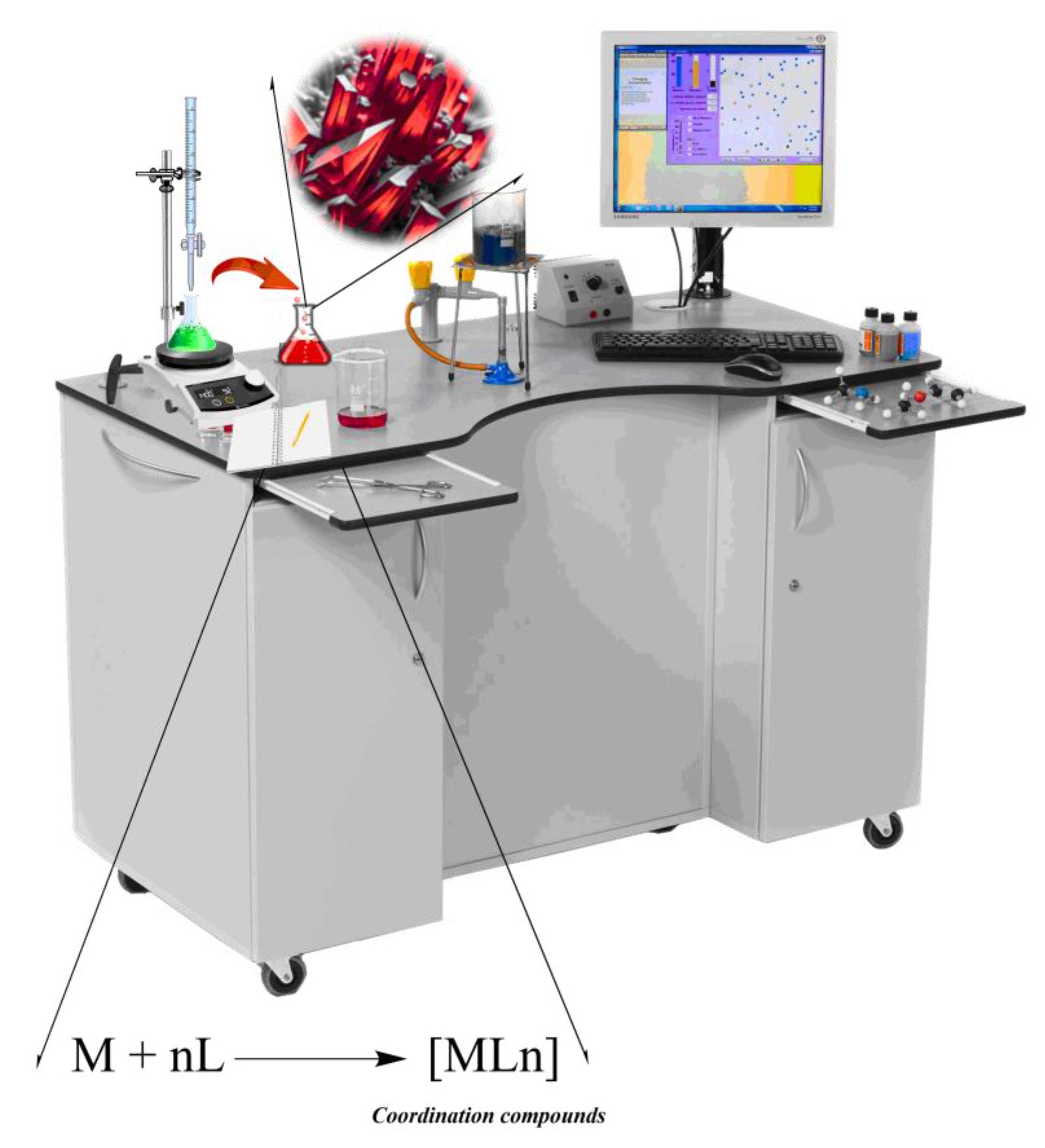
Scheme 2.
Possible synthesis of complexes upon heating.
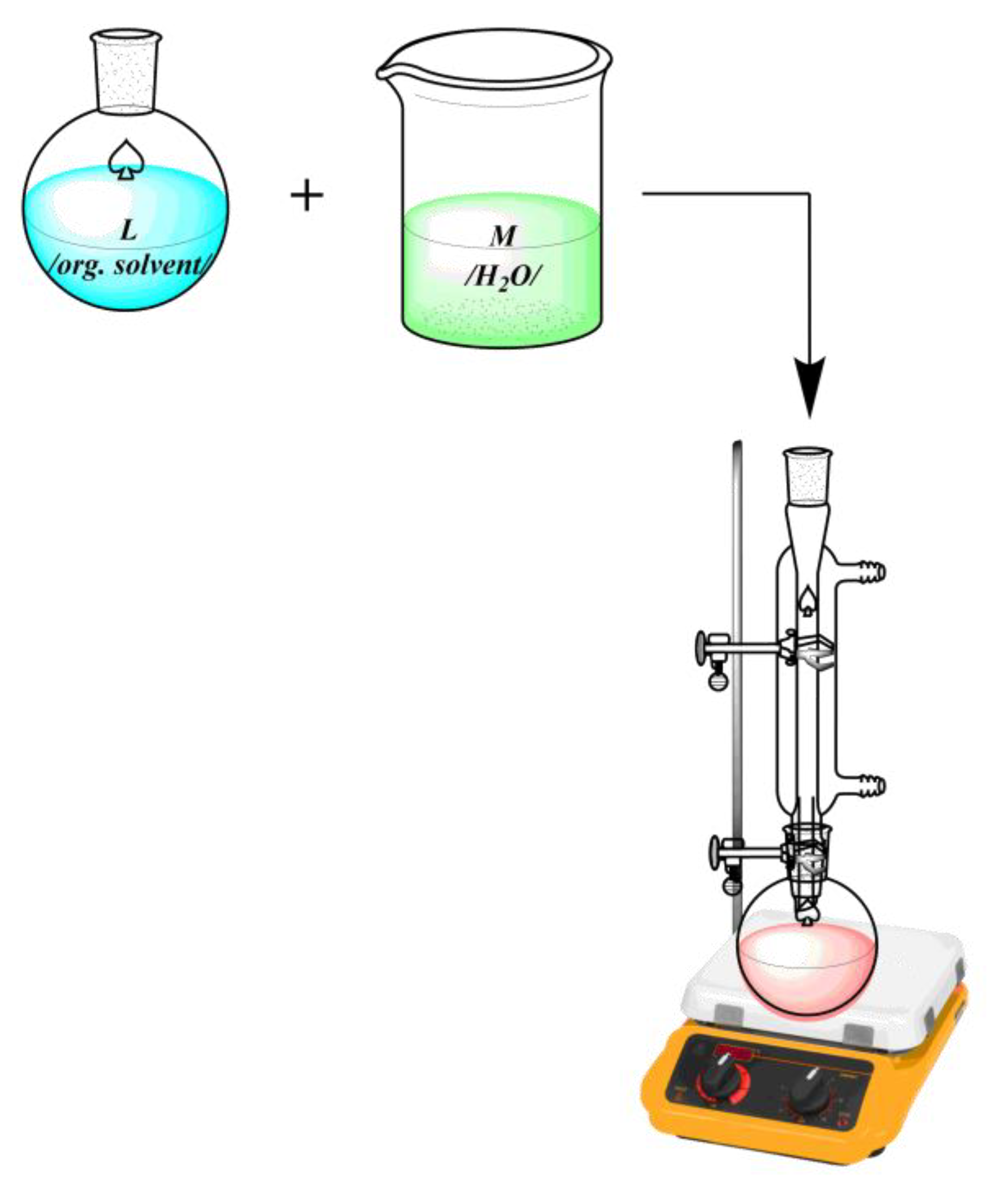
Scheme 3.
Synthesis of solid metal(II), (III), (IV) or other oxidation state coordination compounds.
Scheme 3.
Synthesis of solid metal(II), (III), (IV) or other oxidation state coordination compounds.
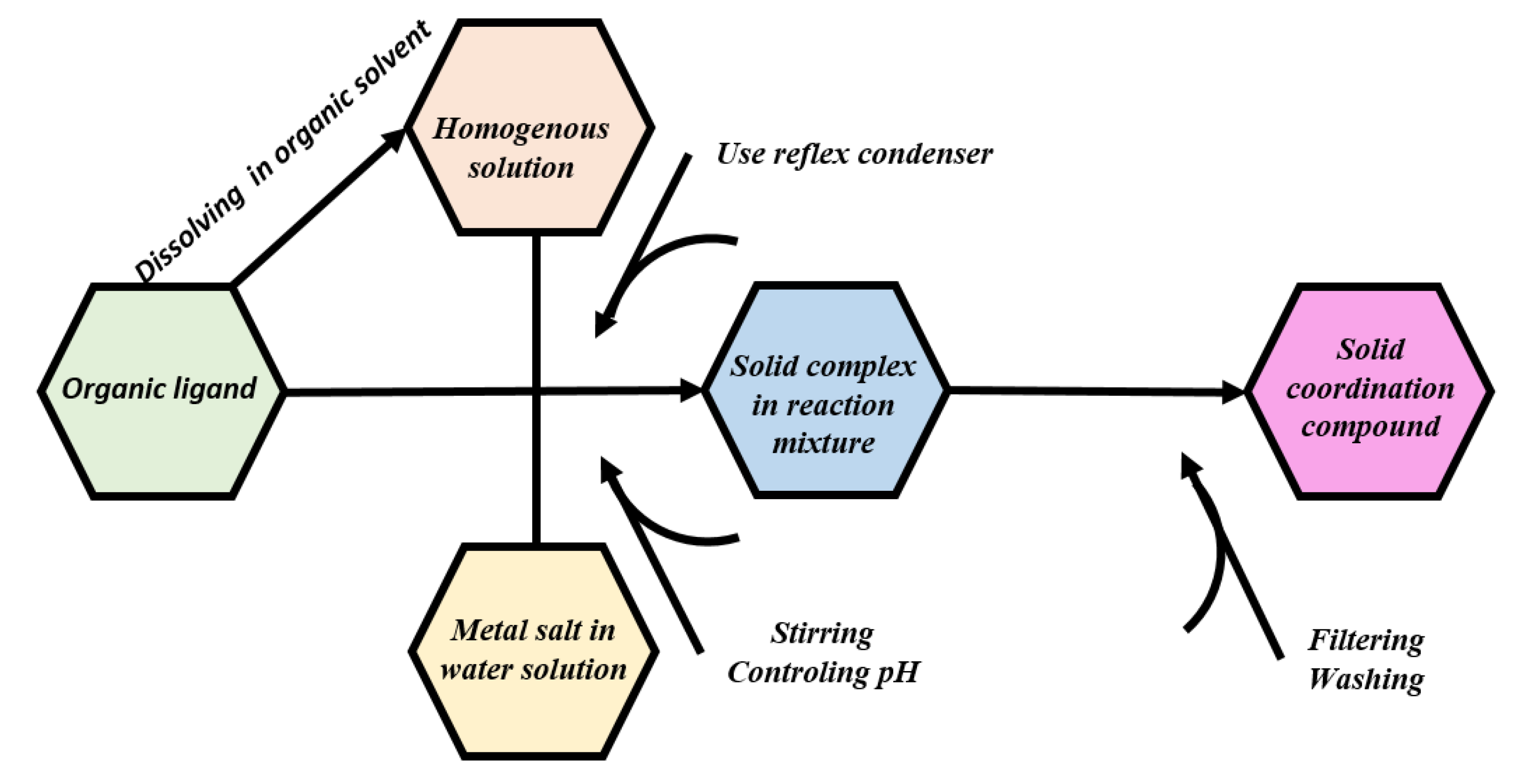
Figure 1.
Flow diagram presenting the classification of ligands and metal complexes (L=Schiff base).
Figure 1.
Flow diagram presenting the classification of ligands and metal complexes (L=Schiff base).
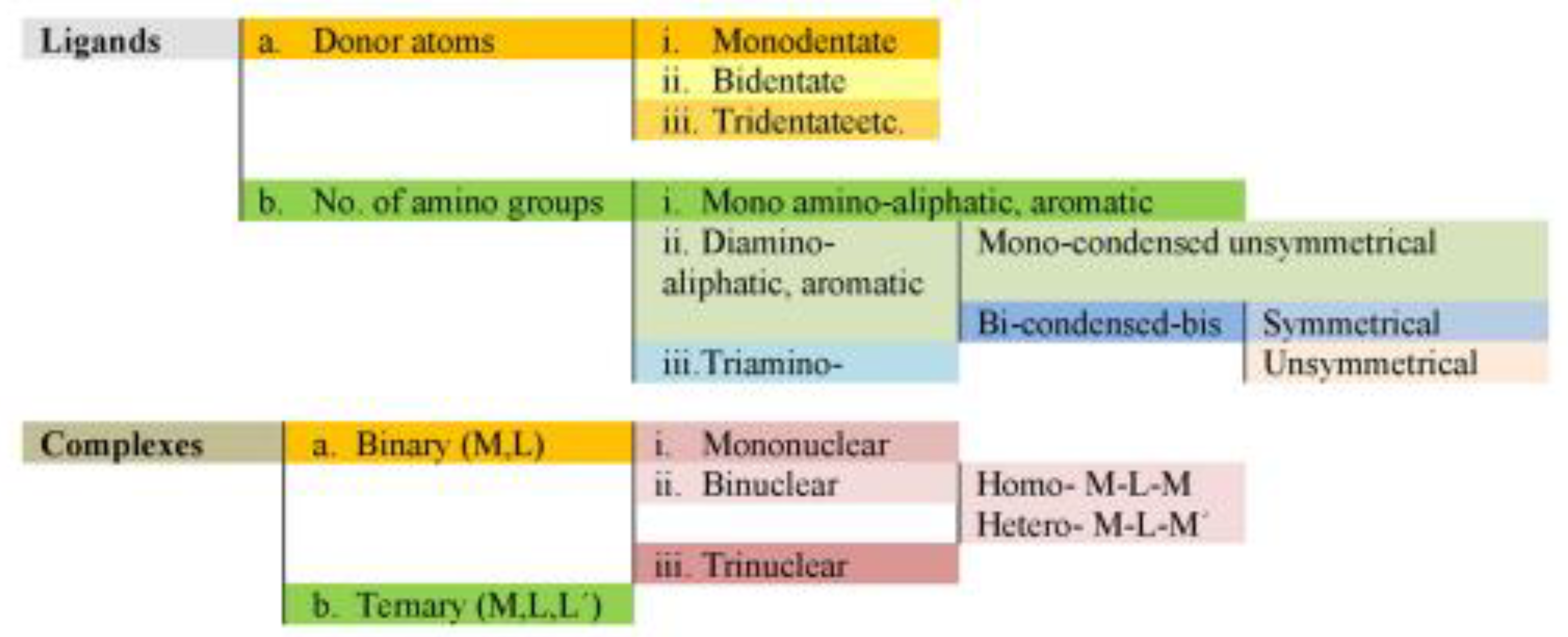
Scheme 4.
Investigation of coordination compounds.
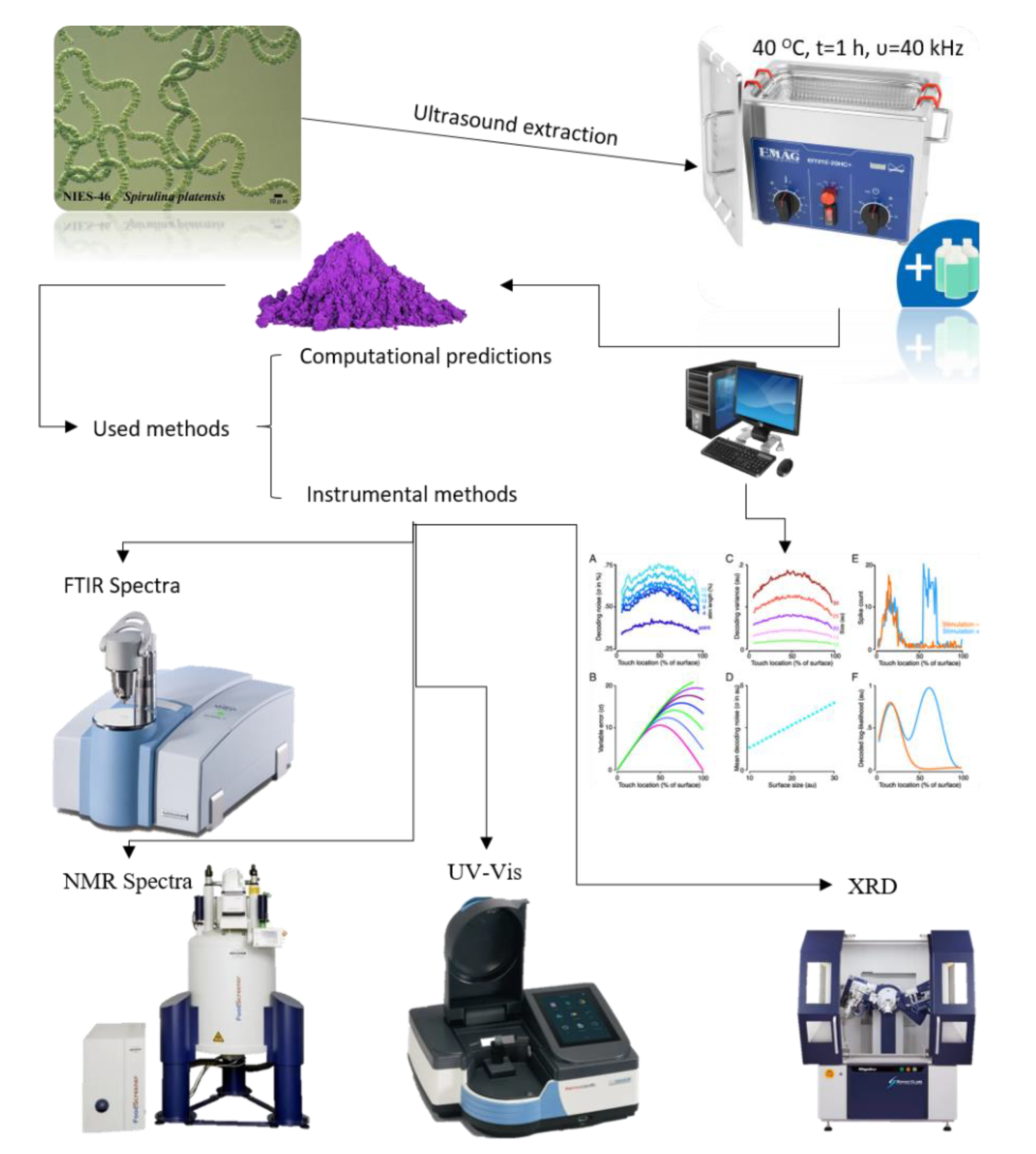
Figure 2.
The structure of Rh and Ru complexes [103].
Figure 2.
The structure of Rh and Ru complexes [103].
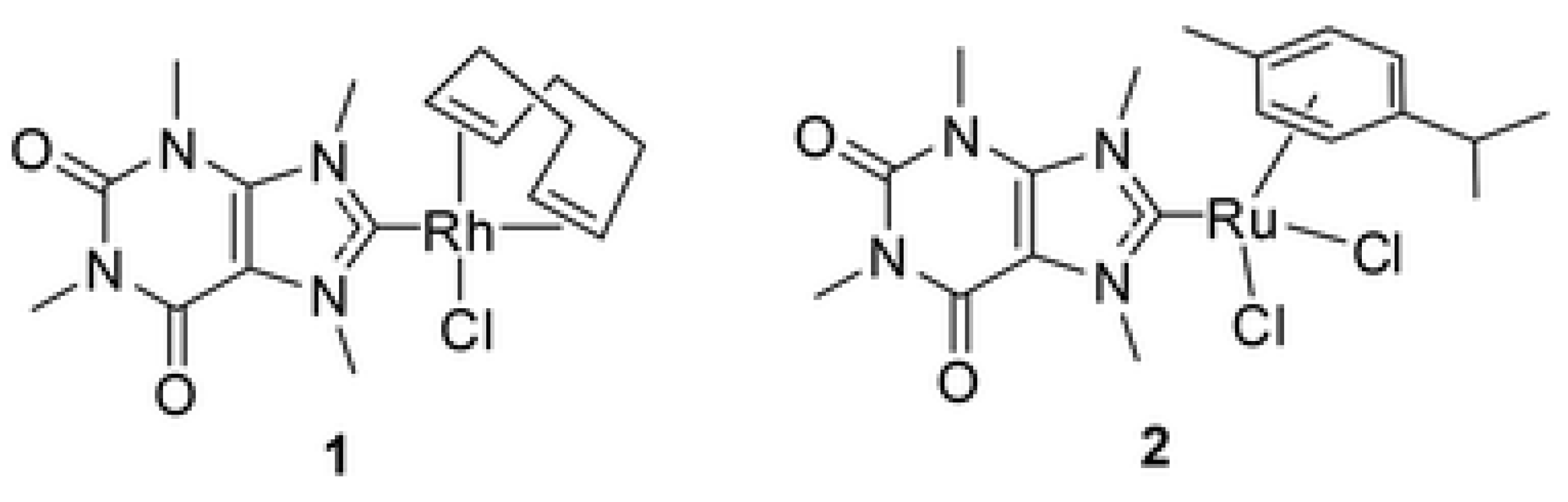
Figure 3.
Ru(II) complex as anticancer agents [106].
Figure 3.
Ru(II) complex as anticancer agents [106].
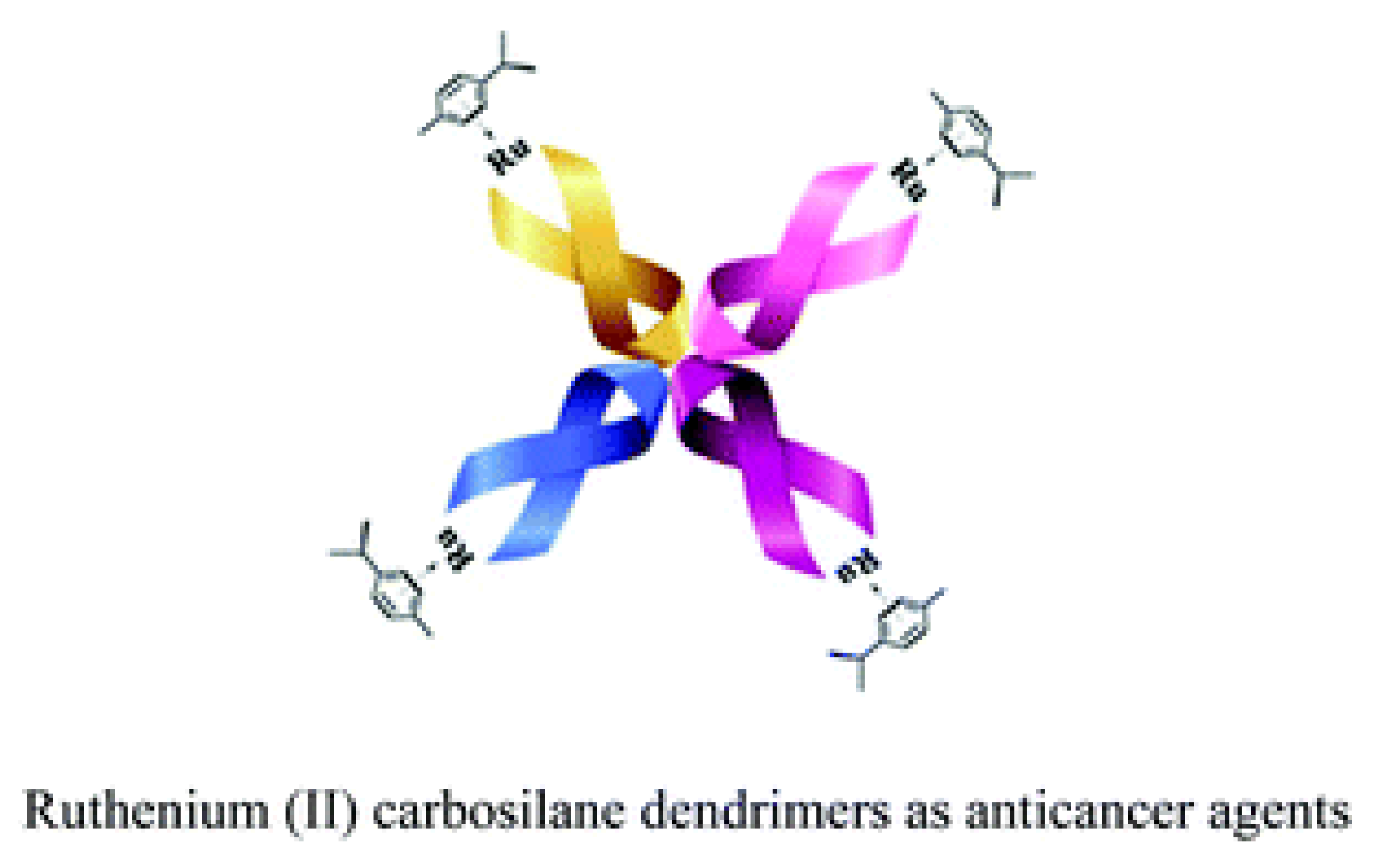
Figure 4.
Proposed structures of the ligand [H2L] and its metal complexes [107].
Figure 4.
Proposed structures of the ligand [H2L] and its metal complexes [107].
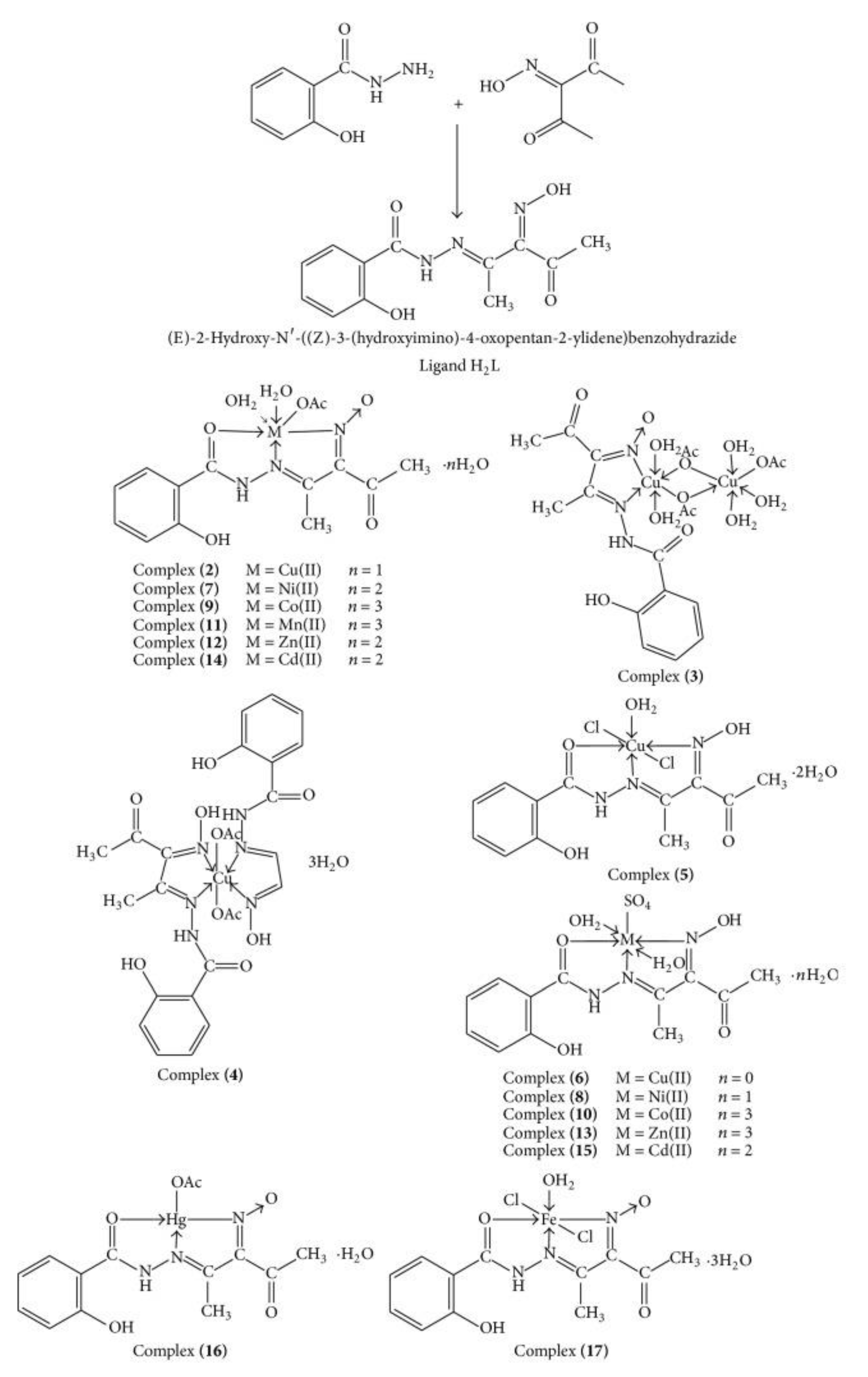
Figure 5.
(a,b) Molecular structures of C3 and C4 with displacement ellipsoids of nonhydrogen atoms plotted with 50% probability (a). A comparison of the coordination entity structures (b) [102].
Figure 5.
(a,b) Molecular structures of C3 and C4 with displacement ellipsoids of nonhydrogen atoms plotted with 50% probability (a). A comparison of the coordination entity structures (b) [102].
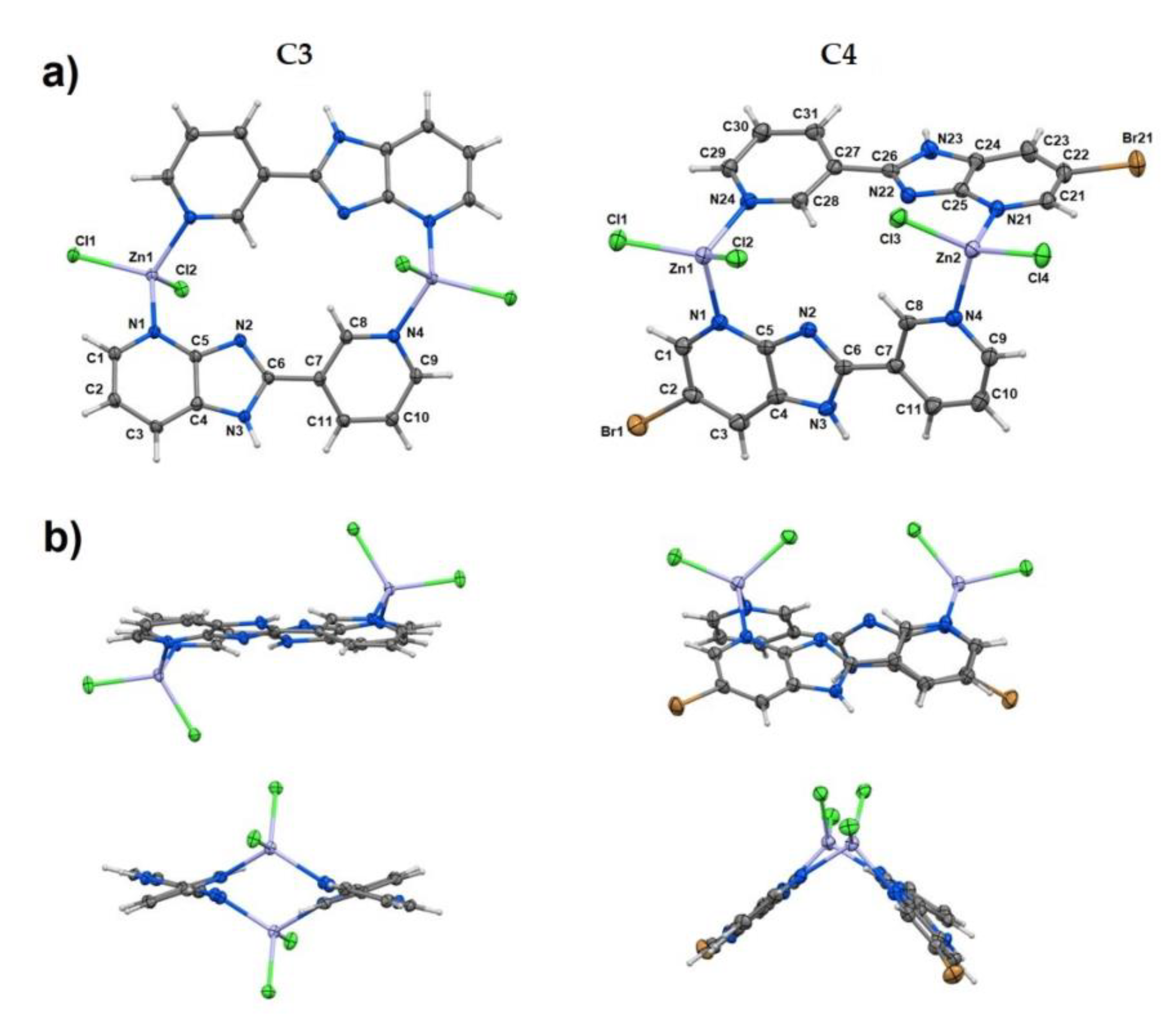
Figure 6.
Crystal structures of [(η6 -DHA)Ru(en)(9EtG)]2+ (left) and [(η6 -THA)Ru(en)(9EtG)]2+ (right), showing the arene–purine p-stacking and hydrogen bonding between en NH and G C6O [108].
Figure 6.
Crystal structures of [(η6 -DHA)Ru(en)(9EtG)]2+ (left) and [(η6 -THA)Ru(en)(9EtG)]2+ (right), showing the arene–purine p-stacking and hydrogen bonding between en NH and G C6O [108].
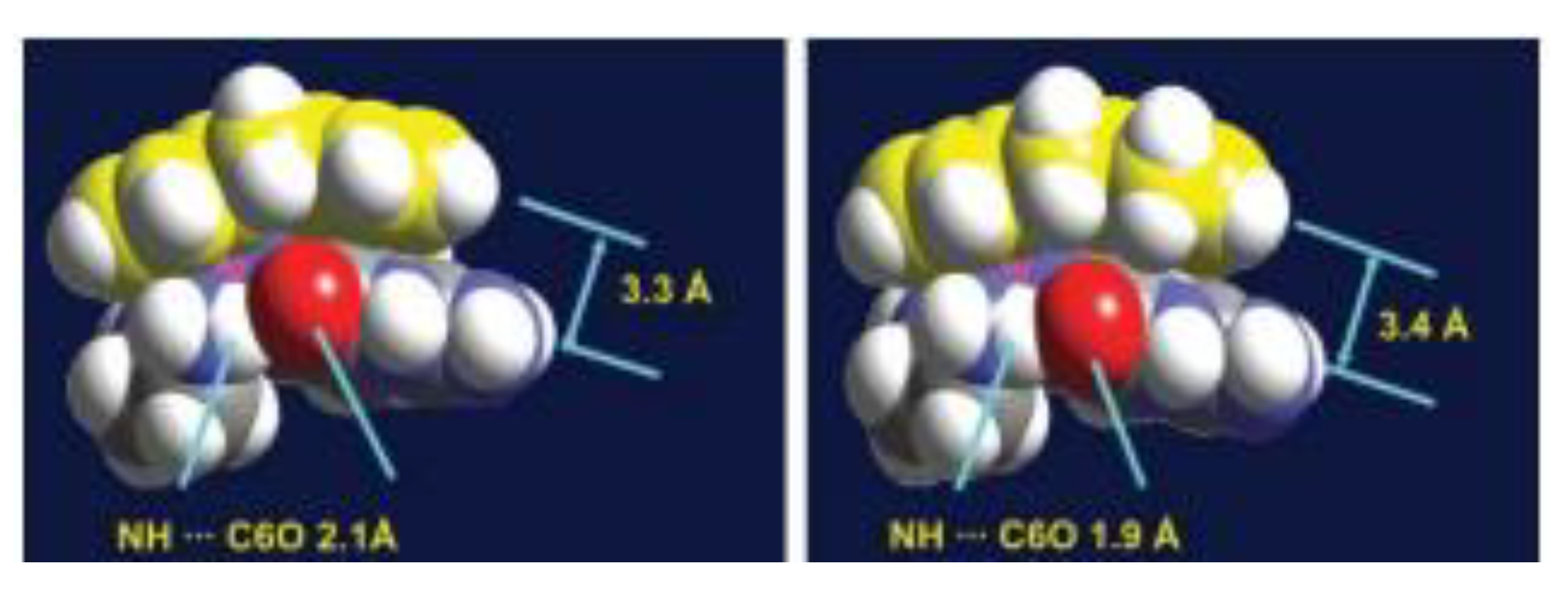
Figure 7.
Molecular model of [(η6 -Cym)Ru(acac)(9EtA)]+ . The hydrogen bond between acac O and A N6H is represented by a dashed line. [109].
Figure 7.
Molecular model of [(η6 -Cym)Ru(acac)(9EtA)]+ . The hydrogen bond between acac O and A N6H is represented by a dashed line. [109].
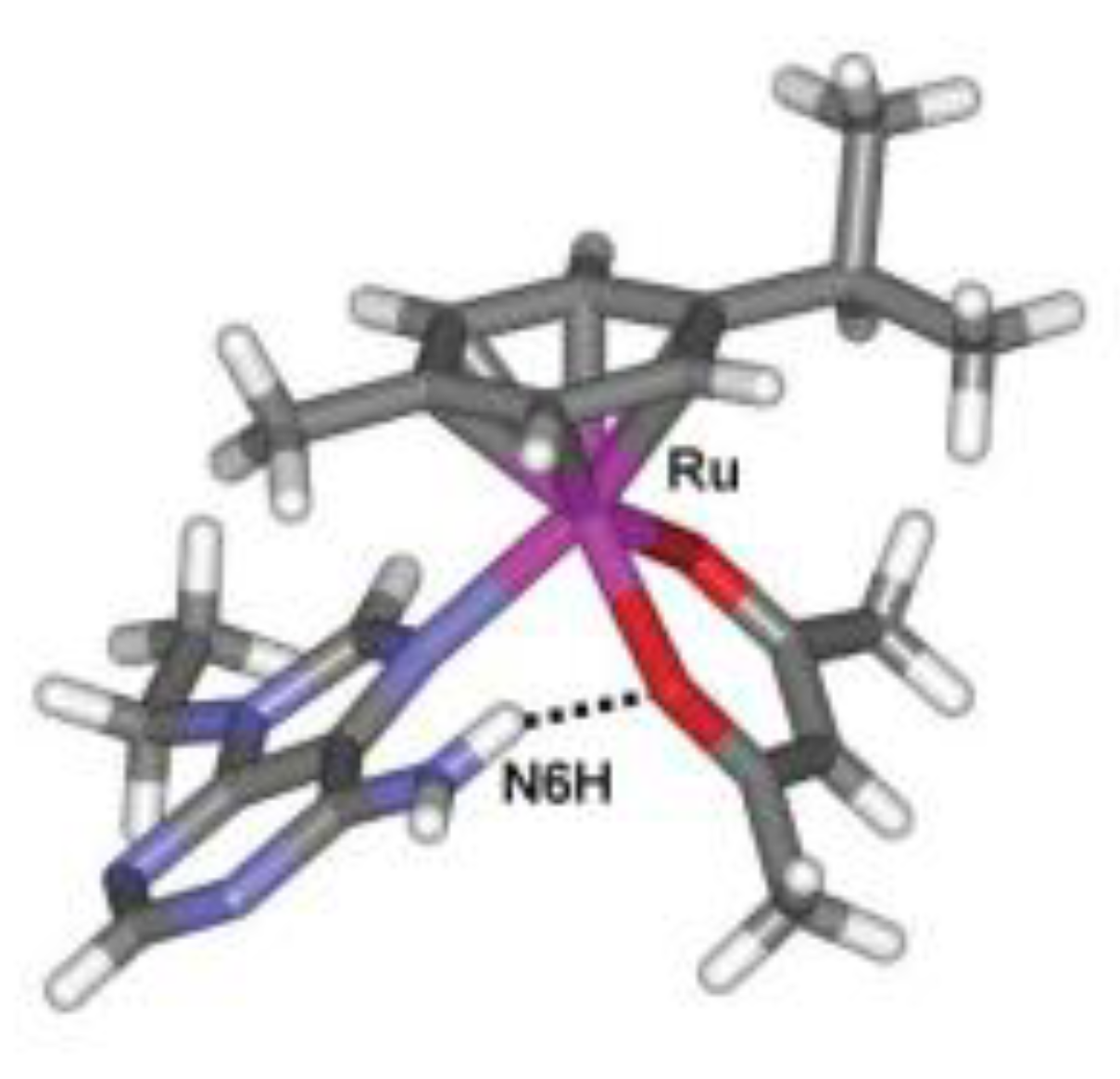
Figure 8.
ORTEP view of 2 (30% probability). The PF6 counter anion and the H atoms have been omitted for the sake of clarity. Key bond lengths (angstroms) and angles (degrees): Au(1)−C(1) = 2.008(5), Au(1)−C(14) = 2.018(5), N(1)−C(1) = 1.373(8), N(2)−C(1) = 1.359(7), C(14)−N(4) = 1.354(7), C(14)−N(5) = 1.351(7), C(1)− Au(1)−C(14) = 176.7(2), N(1)−C(1)−N(2) = 104.1(5), and N(4)− C(14)−C(5) = 103.5(5). Note that two asymmetric units were present [104].
Figure 8.
ORTEP view of 2 (30% probability). The PF6 counter anion and the H atoms have been omitted for the sake of clarity. Key bond lengths (angstroms) and angles (degrees): Au(1)−C(1) = 2.008(5), Au(1)−C(14) = 2.018(5), N(1)−C(1) = 1.373(8), N(2)−C(1) = 1.359(7), C(14)−N(4) = 1.354(7), C(14)−N(5) = 1.351(7), C(1)− Au(1)−C(14) = 176.7(2), N(1)−C(1)−N(2) = 104.1(5), and N(4)− C(14)−C(5) = 103.5(5). Note that two asymmetric units were present [104].
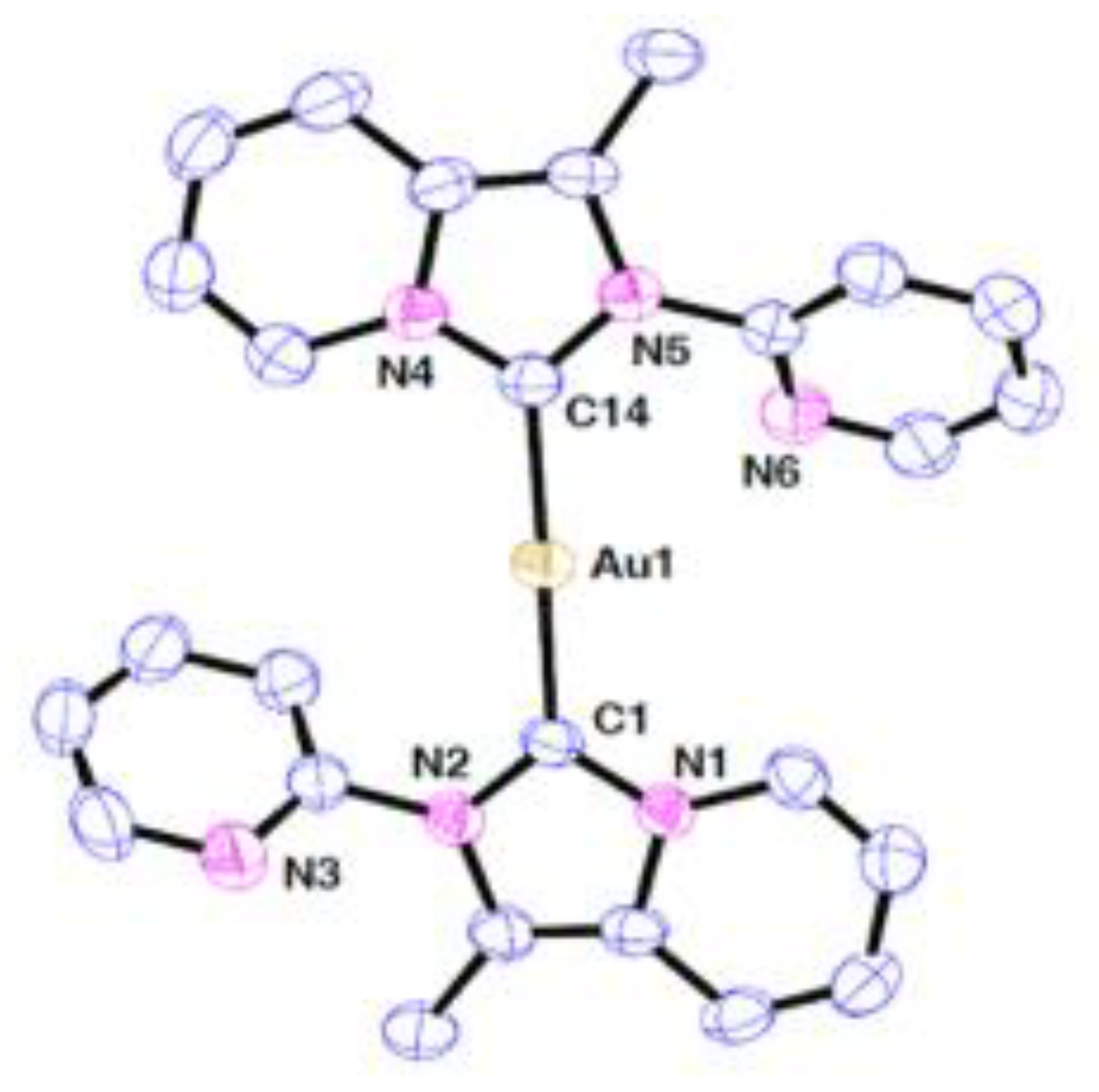
Figure 9.
ORTEP view of 3 (30% probability). The H, PF6, and H2O species have been omitted for the sake of clarity. Pertinent bond lengths (angstroms) and angles (degrees): Au(1)−C(1) = 1.996(6), Au(1)−C(14) = 2.014(5), Au(1)−Cl(1) = 2.2984(16), Au(1)−Cl(2) = 2.3150(16), N(1)−C(1) = 1.360(7), N(2)−C(1) = 1.363(8), C(14)−N(4) = 1.338(7), C(14)−N(5) = 1.347(7), N(1)−C(1)− N(2) = 105.3(5), N(4)−C(14)−C(5) = 106.2(4), C(1)−Au(1)− C(14) = 89.9(2), C(1)−Au(1)−Cl(1) = 88.08(17), C(14)−Au(1)− Cl(1) = 177.89(15), C(1)−Au(1)−Cl(2) = 177.91(17), C(14)− Au(1)−Cl(2) = 90.22(16), and Cl(1)−Au(1)−Cl(2) = 91.86(7). [104].
Figure 9.
ORTEP view of 3 (30% probability). The H, PF6, and H2O species have been omitted for the sake of clarity. Pertinent bond lengths (angstroms) and angles (degrees): Au(1)−C(1) = 1.996(6), Au(1)−C(14) = 2.014(5), Au(1)−Cl(1) = 2.2984(16), Au(1)−Cl(2) = 2.3150(16), N(1)−C(1) = 1.360(7), N(2)−C(1) = 1.363(8), C(14)−N(4) = 1.338(7), C(14)−N(5) = 1.347(7), N(1)−C(1)− N(2) = 105.3(5), N(4)−C(14)−C(5) = 106.2(4), C(1)−Au(1)− C(14) = 89.9(2), C(1)−Au(1)−Cl(1) = 88.08(17), C(14)−Au(1)− Cl(1) = 177.89(15), C(1)−Au(1)−Cl(2) = 177.91(17), C(14)− Au(1)−Cl(2) = 90.22(16), and Cl(1)−Au(1)−Cl(2) = 91.86(7). [104].
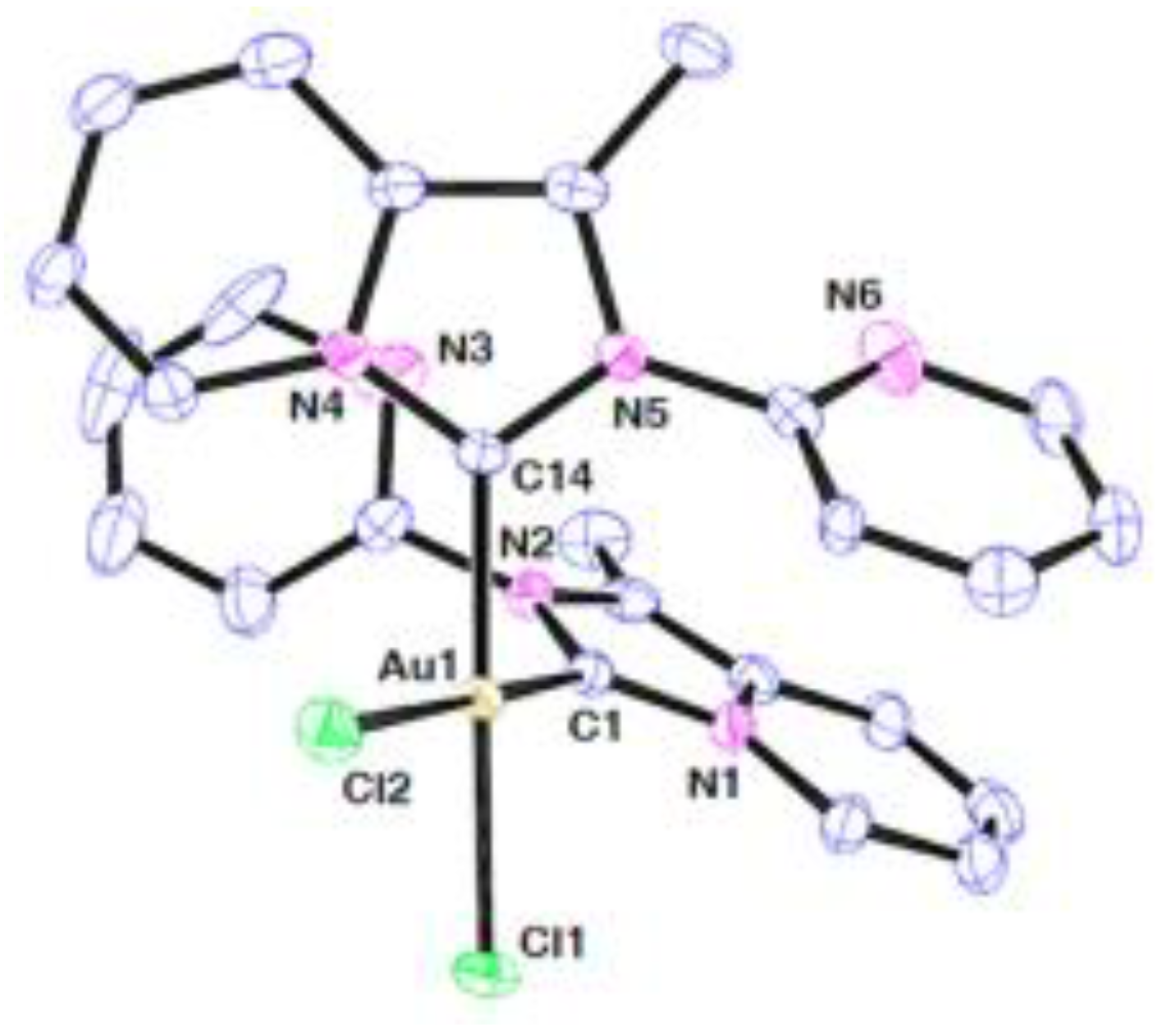
Figure 10.
Biological application of coordination compounds.
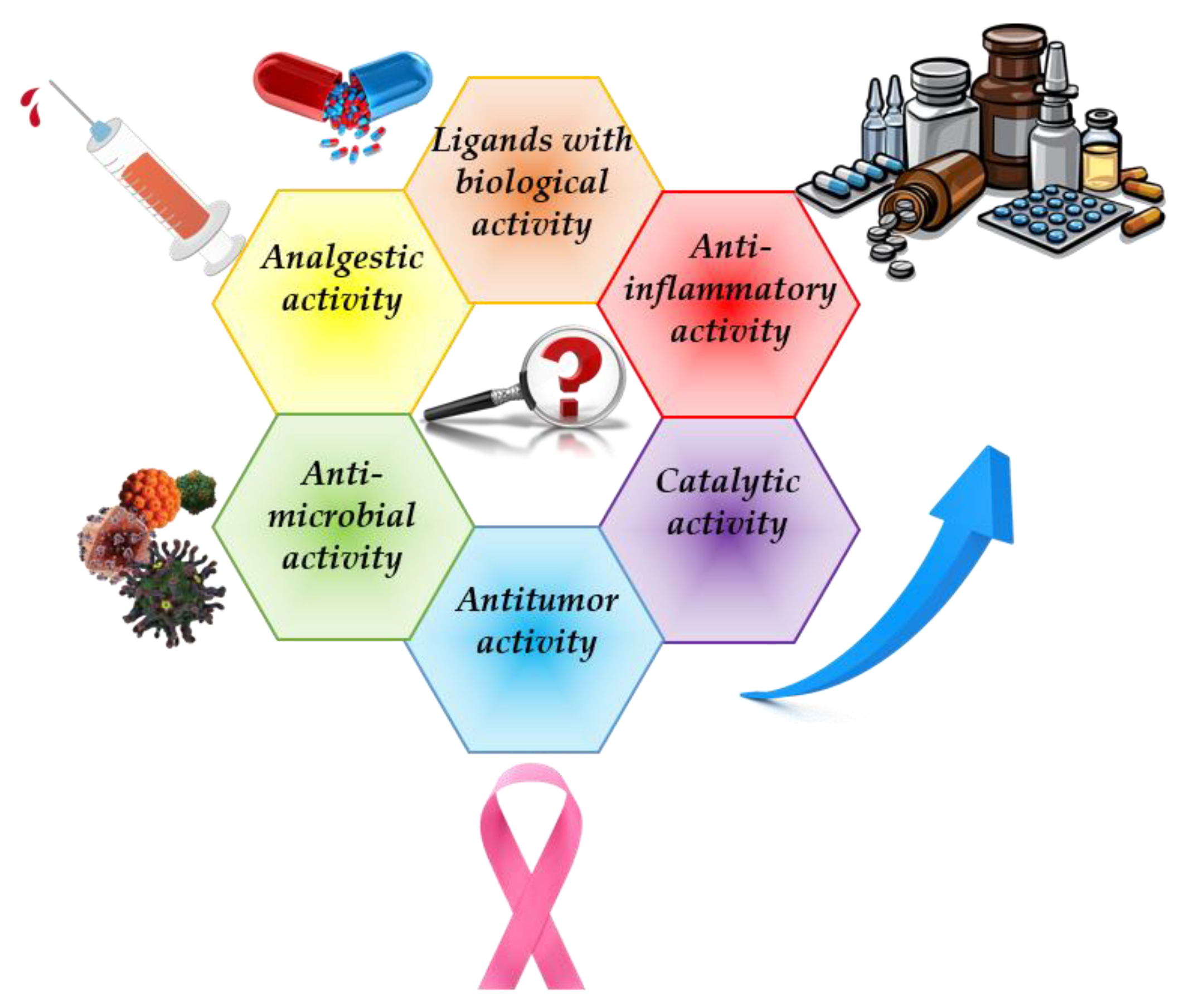
Figure 11.
Relationship between chemistry and biology.
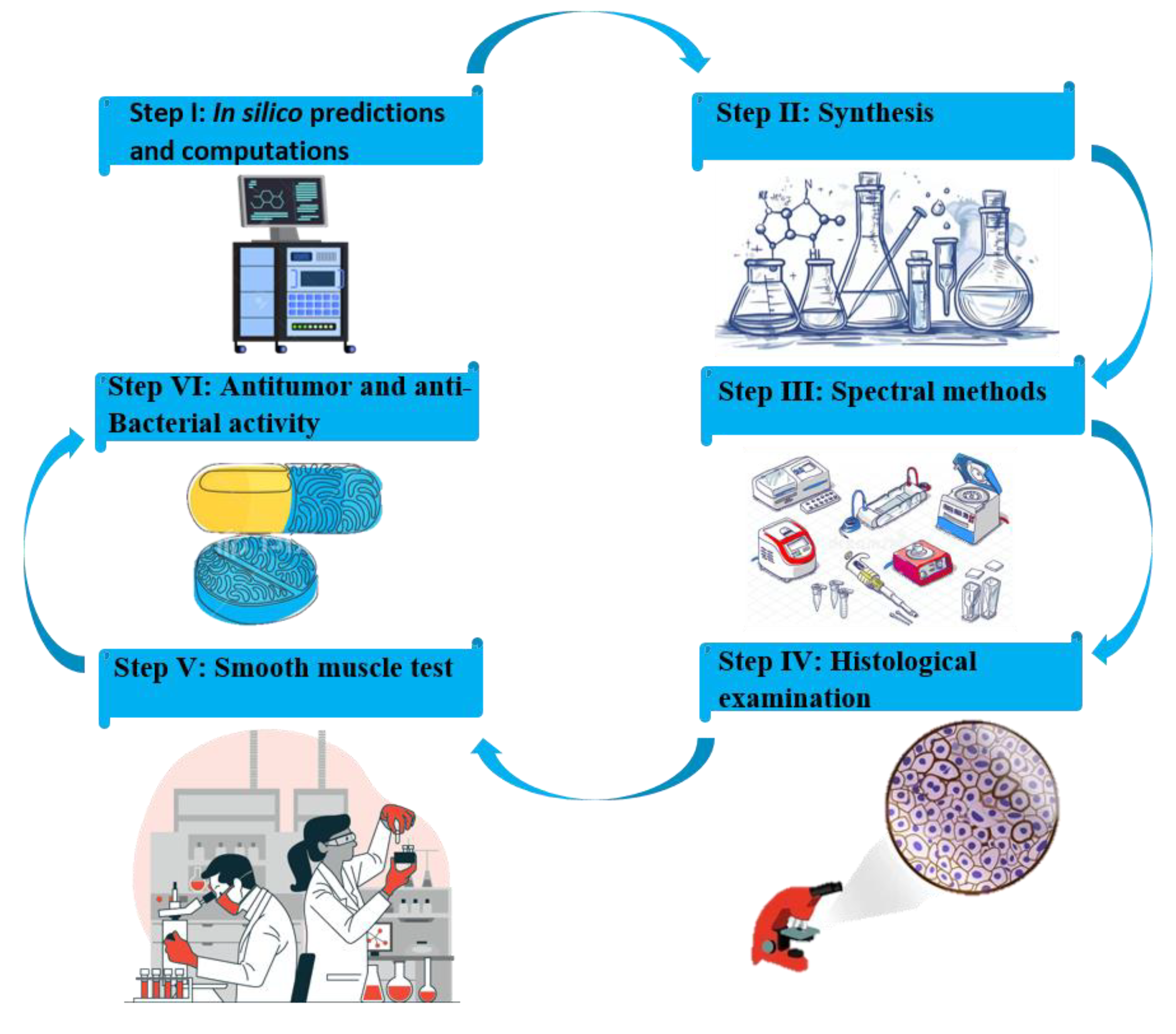
Figure 12.
Biological application of Au(I) complex [104].
Figure 12.
Biological application of Au(I) complex [104].
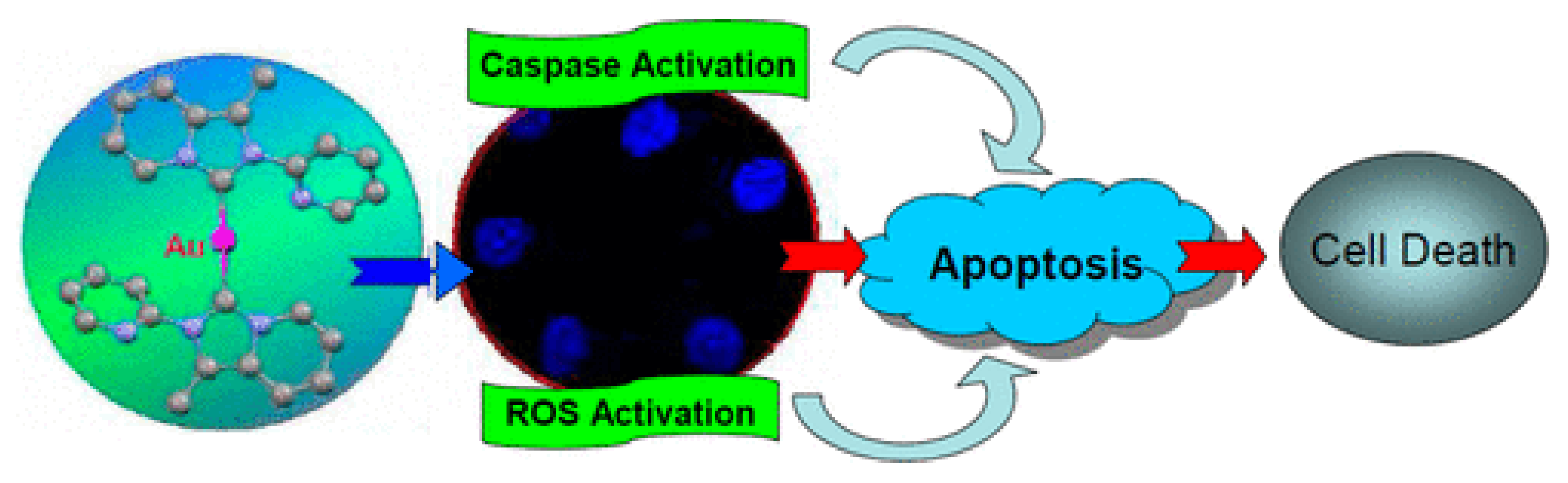
Figure 13.
Possible mechanism of action of metal complex [113].
Figure 13.
Possible mechanism of action of metal complex [113].
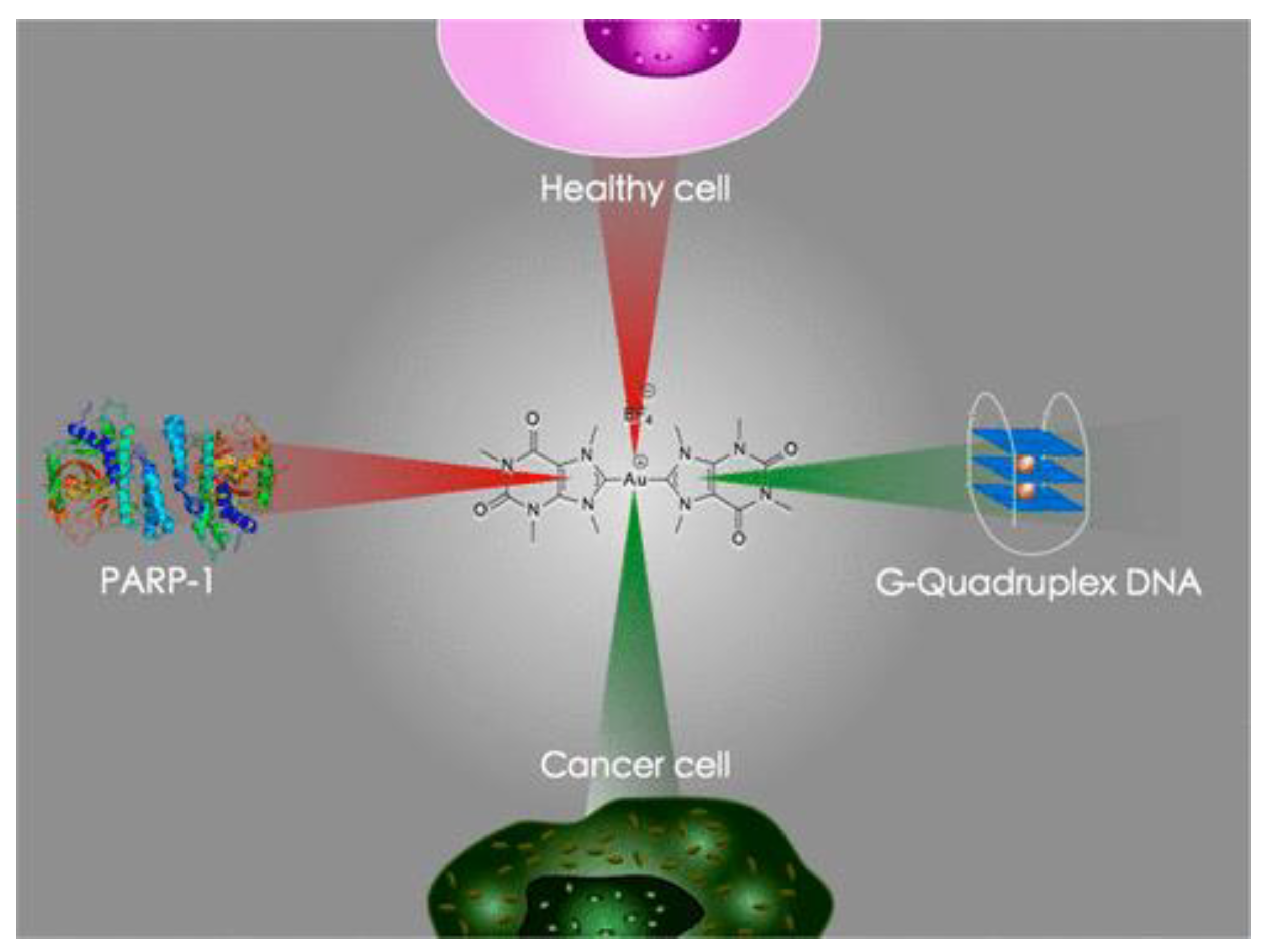
Figure 14.
Proposed mechanism of the cytotoxic action of Rh(I) complex [103].
Figure 14.
Proposed mechanism of the cytotoxic action of Rh(I) complex [103].
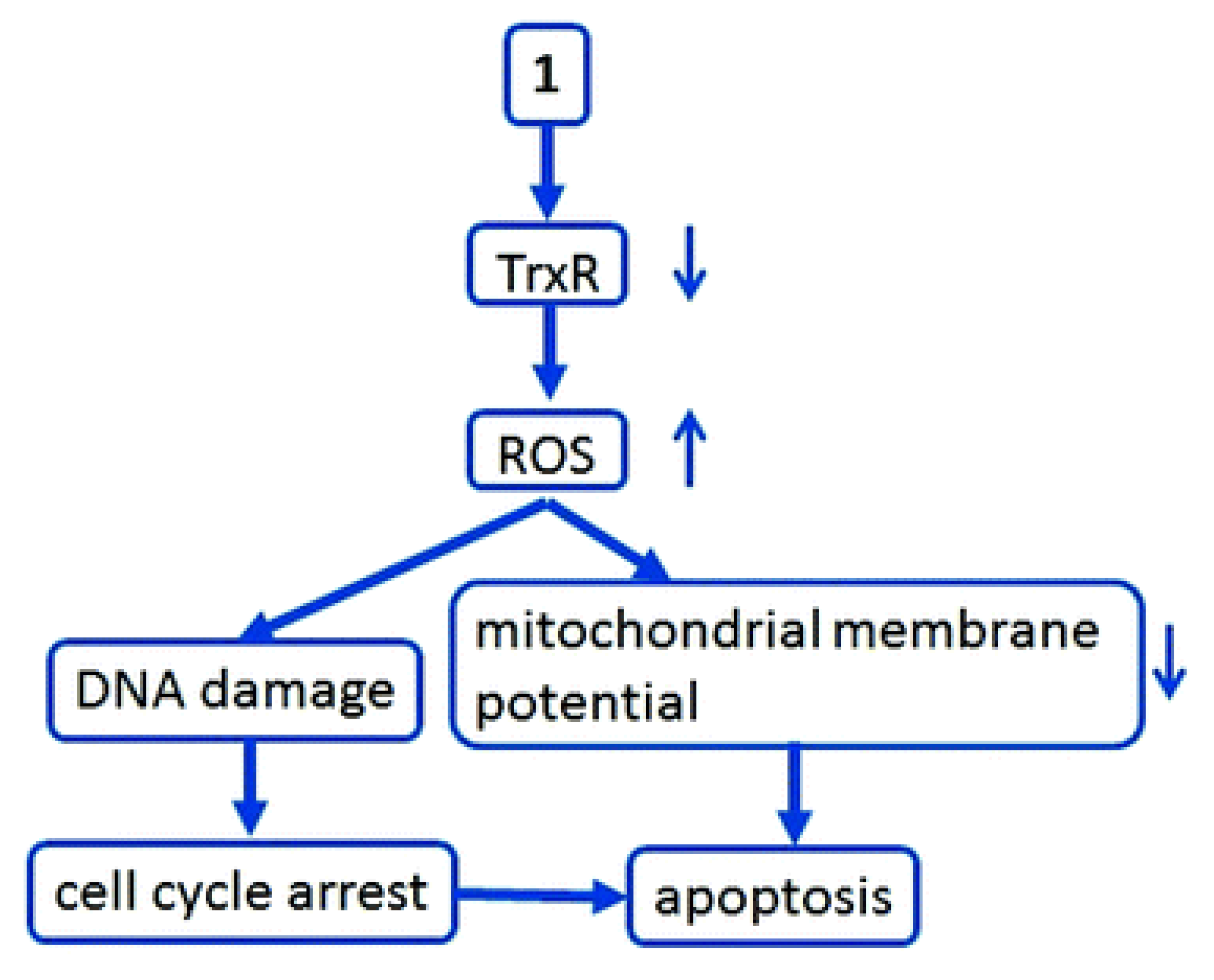
Figure 15.
Evolution of organometallic complexes in cancer therapy Abbreviation: FDA, US Food and Drug Administration [111].
Figure 15.
Evolution of organometallic complexes in cancer therapy Abbreviation: FDA, US Food and Drug Administration [111].
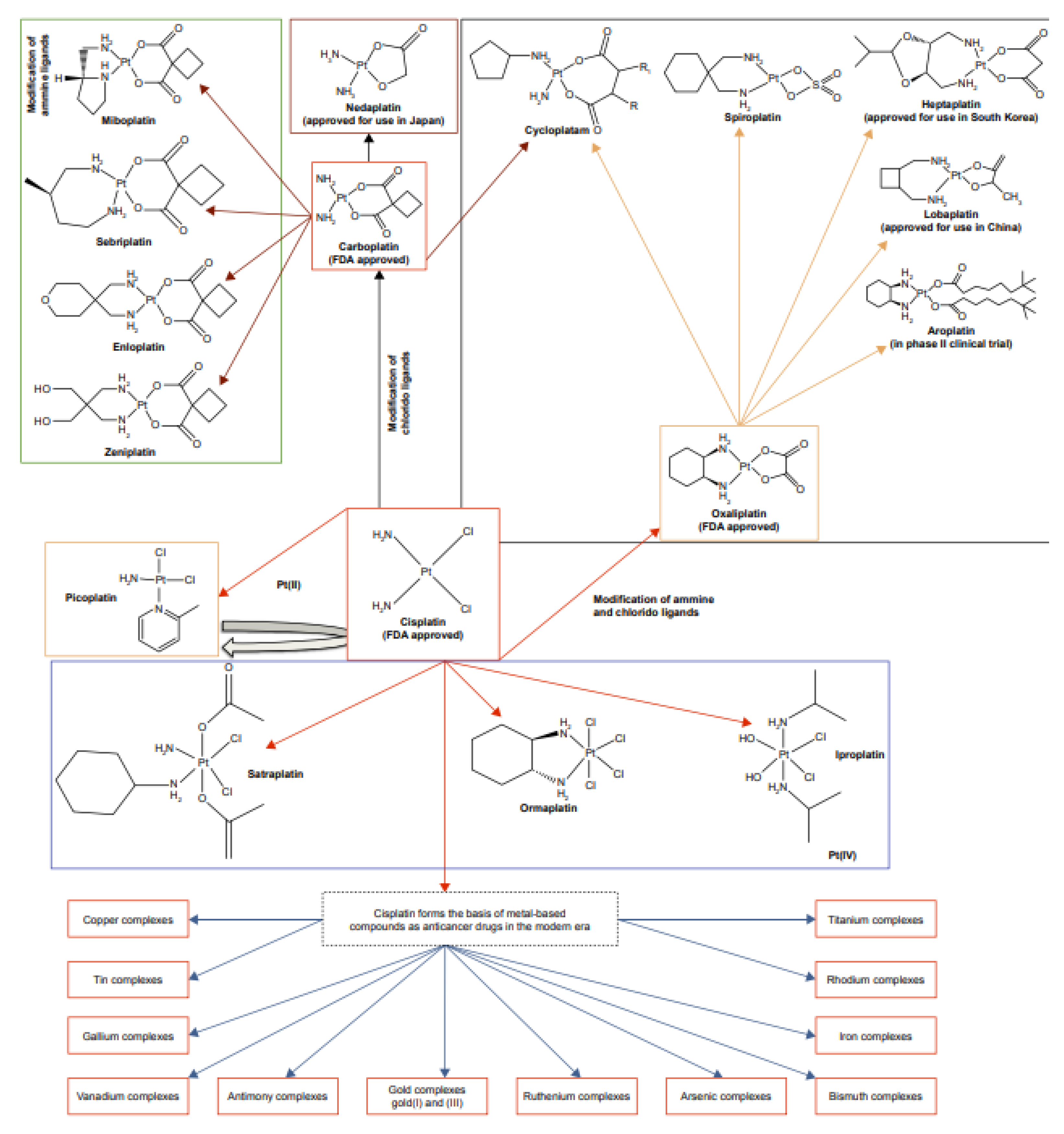
Figure 16.
Summary of the Mechanism of Action of Metal-Based Drugs [178].
Figure 16.
Summary of the Mechanism of Action of Metal-Based Drugs [178].
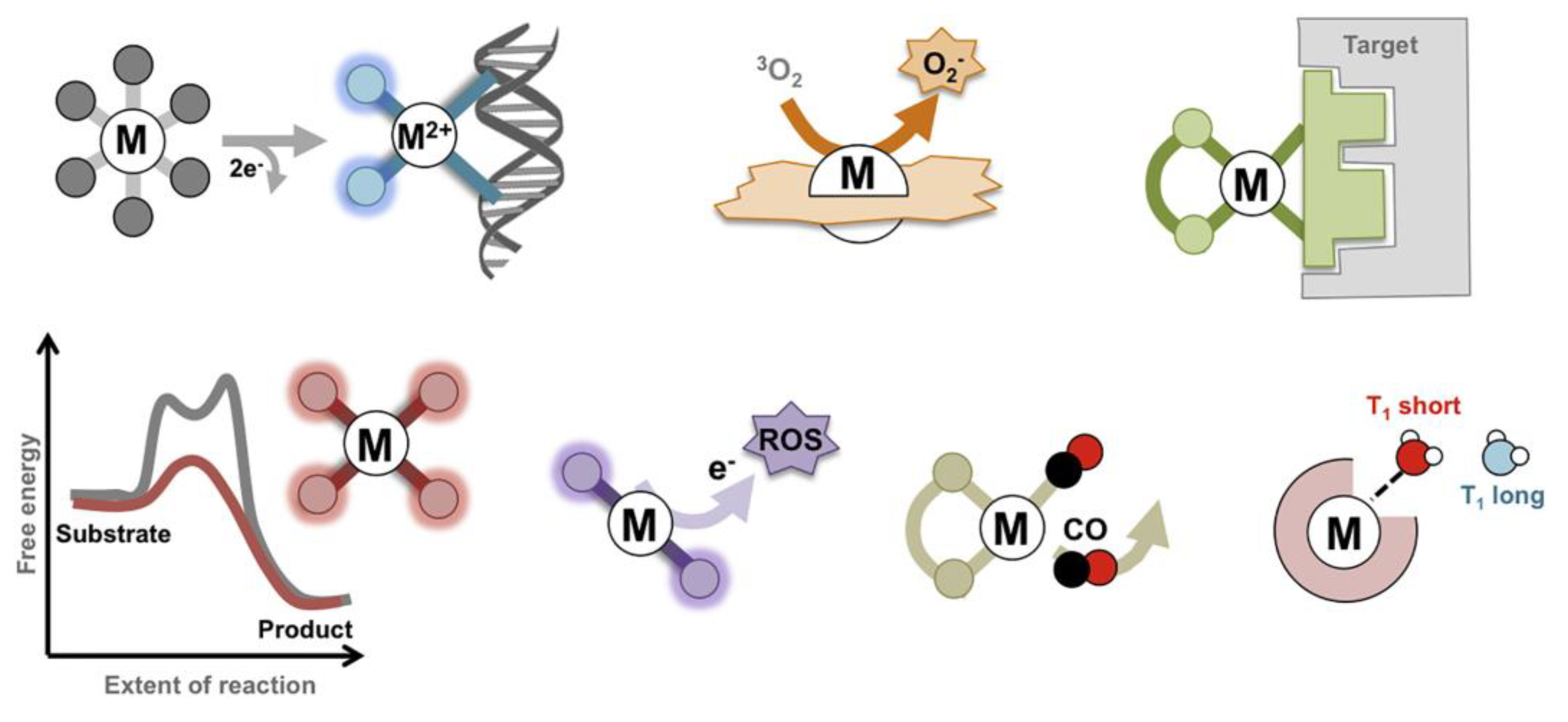
Figure 17.
Possible mechanism of action of metal complex [184].
Figure 17.
Possible mechanism of action of metal complex [184].
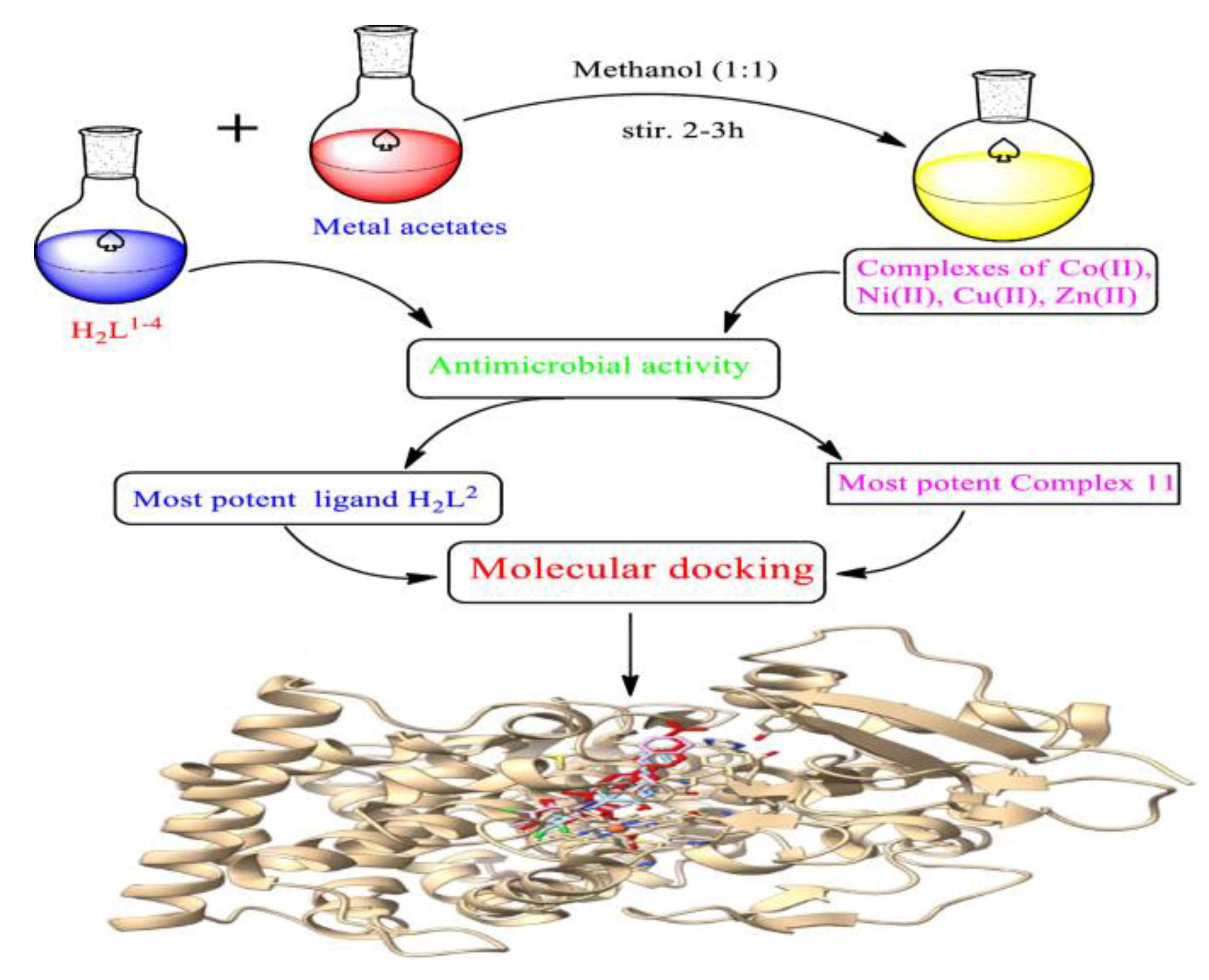
Figure 18.
Fragment-based drug discovery (FBDD) is a powerful strategy for the identification of new bioactive molecules [179].
Figure 18.
Fragment-based drug discovery (FBDD) is a powerful strategy for the identification of new bioactive molecules [179].
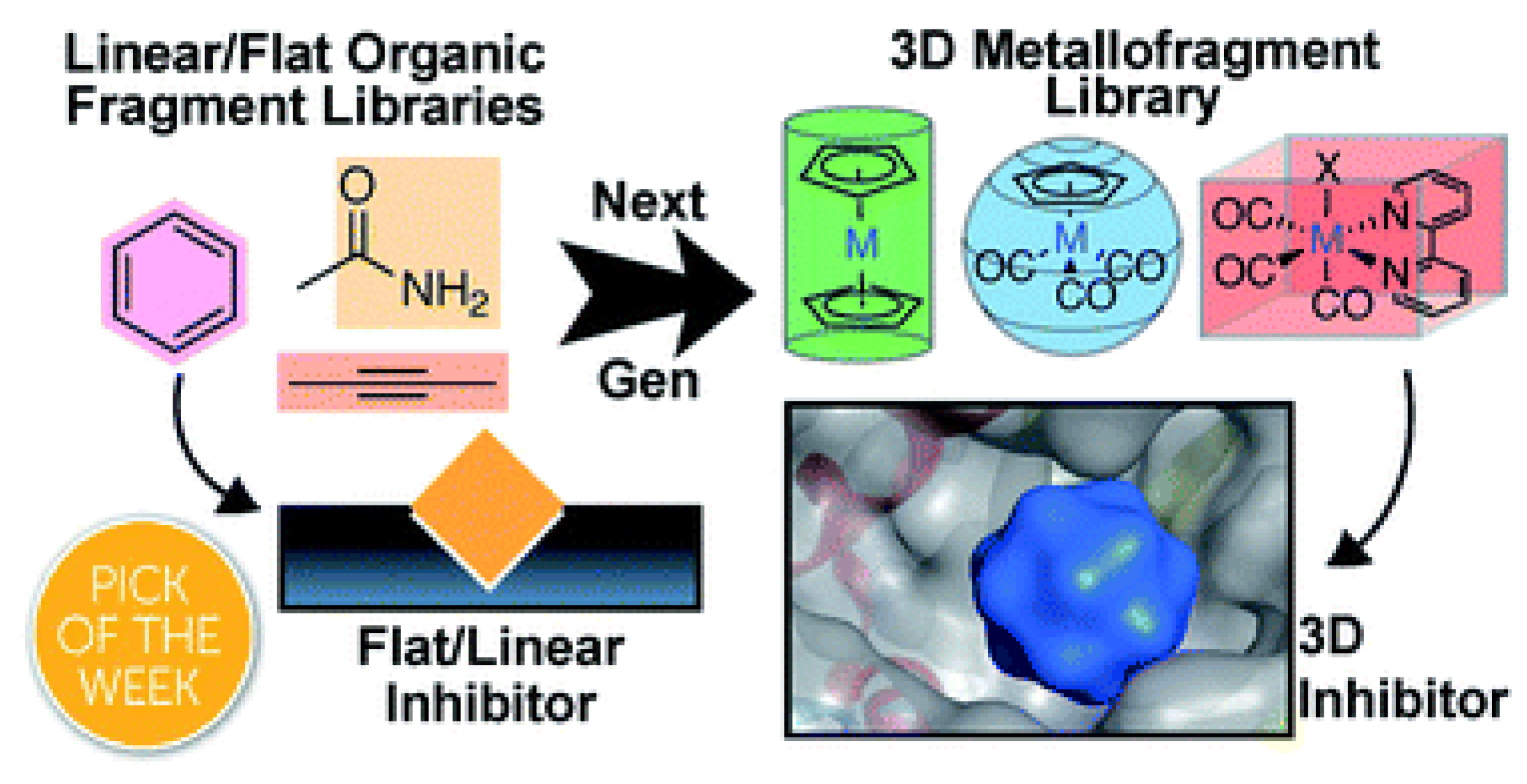
Figure 19.
Examples of metal-based drugs with enzyme inhibitory effects [189].
Figure 19.
Examples of metal-based drugs with enzyme inhibitory effects [189].
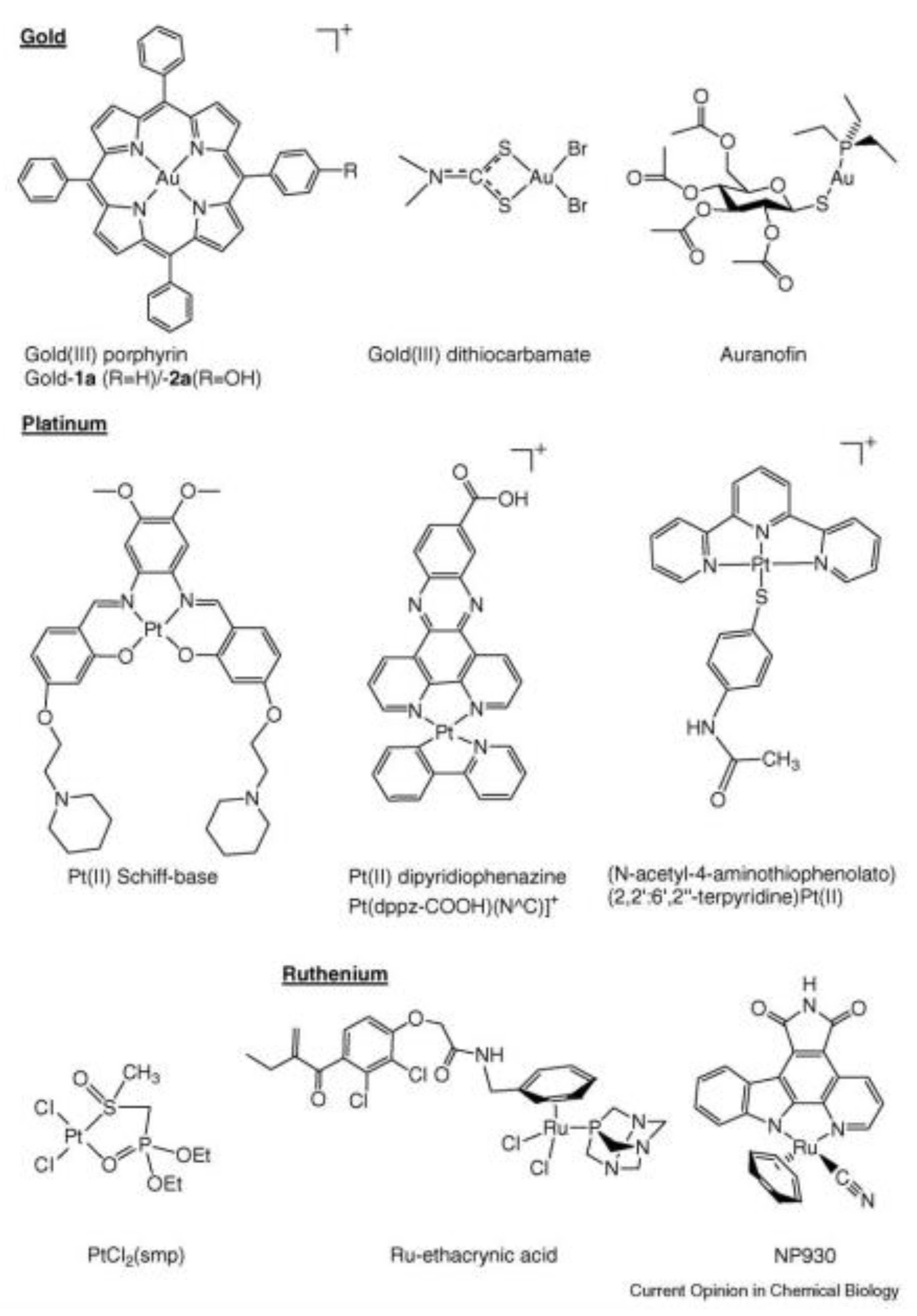

Table 1.
Summary data on the structure of the complexes and the donor atoms involved in the coordination.
Table 1.
Summary data on the structure of the complexes and the donor atoms involved in the coordination.
| technique | donor atom | metal | structure | references |
| 13C CPMAS NMR, IR and FAB-MS and theoretical DFT studies | N3^S4-bridging coordination | Cu(I) and Ni(II) | dimeric structures | [1] |
| 13C CPMAS NMR and theoretical DFT studies | N3^S2-bridging coordination for L1 with Cu(I); monodentate coordination (N3- and S2- ) of two non-equivalent ligand molecules for L2 with Cu(I); N3^S4- bridging way for Ni(II) |
Cu(I) and Ni(II) | dimeric structure for Cu(I) with L1; square planar for Ni(II) with L1 and L2 |
[2] |
| IR and 13C CPMAS NMR and theoretical DFT studies | N and S | Pt(II) | square planar | [3] |
|
13C-NMR-CP-MAS, EPR, IR and quantum-chemical (DFT/B3LYP-6-31G (d,p)) methods |
N for Cu(II) and N3 and S2 for Ni(II) | Cu(II) and Ni(II) | distorted tetrahedral for Cu(II) and square planar for Ni(II) | [4] |
| 13C CPMAS NMR and theoretical DFT studies, X-ray | O, Cl | Al(III) | six-membered chelate rings | [5] |
| melting point analysis, MP-AES for Cu and Pd, UV-Vis, IR, ATR, 1H NMR, 13C NMR and Raman, Solid-state NMR spectroscopy | O,S for L1 and S for L2 with Cu(II); N, S, O with Pd(II) |
Cu(II) and Pd(II) | tetrahedral for Cu(II) with L1 and octahedral for L2; chelate for Pd(II) with L1 and L2 |
[6] |
| MP-AES for Cu and Au, ICP-OES for S, ATR, solution and solid-state NMR, and Raman spectroscopy | N,S for Au(III) and O,S for Cu(II) | Au(III) and Cu(II) | chelate structure |
[7] |
| UV-Vis, IR, ATR, 1H NMR, HSQC, and Raman, solid-state NMR spectroscopy | O, S | Au(III) | tetrahedral |
[8] |
| IR, FAB-MS, XPS, solid-state NMR spectroscopy and theoretical DFT studies | N, S | Pt(II) | dimer, chelate structure | [9] |
| X-ray | O, N | Ag(I) | dinuclear complex, chelate structure | [10] |
| X-ray, ESR, MALDI mass-spectrometry, NMR spectroscopy | P, O, P | Ru(II) and Ru(III) | chelate structure | [11] |
| X-ray and 1H-, 13C-NMR, IR and UV-Vis spectroscopy and elemental analysis and theoretical DFT studies | O, N | Cu(II), Fe(II) and Zn(II) | chelate structure | [12] |
| elemental analysis, FAAS, FT-IR, MS, TG methods and X-ray for C3 and C4 | N, Cl | Zn(II) | tetrahedral geometry, dinuclear coordination compounds | [102] |
| Elemental analysis, NMR and ESI-MS | C, Cl | Rh(I) and Ru(II) | Tetrahedral or square planar | [103] |
| X-ray and 1H-, 13C-NMR, IR and UV-Vis spectroscopy and elemental analysis | C, Cl | Au(III) | square planar | [104] |
| NMR and mass spectroscopy, X-ray | C, Cl | Au(I) and Ag(I) | Liner | [105] |
Table 2.
An update on the anticancer activities of metal-based complexes (2010–2016) [111].
Table 2.
An update on the anticancer activities of metal-based complexes (2010–2016) [111].
|
Metal complexes |
Molecular formula | Proposed mechanism of action | Target enzymes/cell lines/ therapeutic indications | IC50 range (μM) | Reference |
| Carbene–metal complexes and related ligands | |||||
| Novel gold(I) and gold(III) NHC complexes | C52H44Au2N12P2F12 | Induction of apoptosis Inhibition of TrxR Induction of ROS |
TrxR A549, HCT116, HepG2, MCF7 Chemotherapy of solid tumors |
C52H44Au2N12P2F12 5.2±1.5 (A549) 3.6±4.1 HCT-116) 3.7±2.3 (HepG2) 4.7±0.8 (MCF7) |
[104] |
| C26H24AuCl2OF6N6P | C26H24AuCl2OF6N6P 5.2±3.0 (A549) 5.9±3.6 (HCT-116) 5.1±3.8 (HepG2) 6.2±1.4 (MCF7) |
[104] | |||
| Caffeine-based gold(I) NHCs | [Au(Caffeine-2-yielding)2][BF4 ] | Inhibition of protein PARP-I | DNA A2780, A2780R, SKO3, A549 HK-293T |
0.54–28.4 (A2780) 17.1–49 (A2780/R) 0.75–62.7 (SKO3) 5.9–90.0 (A549) 0.20–84 (HK-293T) | [113] |
| Ester- and amidefunctionalized imidazole of NHC complexes | {[ImA]AgCl} {[ImA]AuCl} {[ImB]2AgCl} {[ImB]AuCl} HmACl = [1,3-bis (2-ethoxy-2-oxoethyl)-1Himidazol-3-ium chloride] HmBCl={1,3-bis[2(diethylamino)-2-oxoethyl]-1H-imidazol-3-ium chloride} |
Inhibition of tyrosine by gold(I) NHC ligands, thereby targeting TrxR CuNHC cell cycle arrest progression in G phase Anticancer activity of Ag1 NHC is based on highly lipophilic aromaticsubstituted carbenes |
TrxR A375, A549, HCT-15 and MCF7 Human colon adenocarcinoma Leukemia and breast cancer |
{[ImA]AgCl} 24.65 (A375) 22.14 (A549) 20.32 (HCT-15) 21.14 (MCF7) {[ImA]AuCl} 44.64 (A375) 42.37 (A549) 41.33 (HCT-15) 38.53 (MCF7) {[ImB]2AgCl} 24.46 (A375) 16.23 (A549) 14.11 (HCT-15) 15.31 (MCF7) |
[105] |
| Novel Ru(II) NHCs83 | η6-p-cymene)2Ru2(Cl2)2]NHC | Mimic iron Interact with plasmidic DNA |
DNA as target Caki-1 and MCF7 Chemotherapy of solid tumor |
13–500 (Caki-1) 2.4–500 (MCF7) | [114,115] |
| Caffeine-derived rhodium(I) NHC complexes | [Rh(I)Cl(COD)(NHC)] complexes | Inhibition of TrxR Increase in ROS formation DNA damage Cell cycle arrest Decrease in mitochondria membrane potentia |
TrXR MCF7, HepG2 MDA-MB-231, HCT-116, LNCaP, Panc-I and JoPaca-I Chemotherapy of solid tumor85 |
84 (HepG2) 20 (HCF-7) 23 (MDA-MB-231) 35 (JoPaca-I) 49 (Panc-I) 80 (LNCaP) 9.0 (HCT-116 |
[103] |
| NHC–amine Pt(II) complexes | NHC (PtX2)–amine complexes | Nuclear DNA platination | Target DNA KB3-1, SK-O3, OCAR-8, M-4-11, A2780 and A2780/ DPP Chemotherapy of solid and non-solid tumors |
2.5 (KB3-1) 4.33 (SK-O3) 1.84 (OCAR-8) 0.60 (M-4-11) 4.00 (A2780) 8.5 (A2780/DPP) |
[116] |
| 2-Hydroxy-3-[(hydroxyimino)-4- oxopentan-2-ylidene] benzohydrazide derivatives | [(HL)Cu(OAc)(H2O)2]⋅H2OC14H21N3O9Cu | Bind to DNA | Target DNA HepG2 Chemotherapy of solid tumors |
2.24–6.49 (HepG2) | [117] |
| Molybdenum(II) allyl dicarbonate complexes | [Mo(allyl)(CO)2 (N-N)(py)]PF6 | DNA fragmentation Induction of apoptosis |
Target DNA NALM-6, MCF7 and HT-29 Chemotherapy of solid and non-solid tumors |
1.8–13 (NALM-6) 2.1–32 (MCF7) 1.8–32 (HT-29) | [118] |
| Metal-arene complexes and other ligands | |||||
| Ru(II)–arene complex | [(η6-arene)Ru(II)(en)Cl]+ | DNA damage Cell cycle arrest Induction of apoptosis |
Target DNA AH54 and AH63 Chemotherapy of colorectal cancer |
C15H18ClF6N2PRu 16.6 (AH54) C16H2OClF6N2PRu 10.9 (AH63) |
[119] |
| Novel ruthenium– arene pyridinyl methylene complexes | [(η6-p-cymene)RuCl(pyridinylmethylene)] | DNA binding | Target DNA MCF7 and HeLa Chemotherapy of solid tumor |
07.76–25.42 (MCF7) 07.10–29.22 (HeLa) | [120] |
| Multi-targeted organometallic Ru(II)–arene | [(η6-p-cymene)RuCl2]2-PARP and PARP-I inhibitors | DNA binding PARP-I inhibition Transcription inhibition |
Target DNA A549, A2780, HCT-116, HCC1937 and MRC-5 Chemotherapy of solid tumors |
85.1–500 (A549) 38.8–500 (A2780) 46.0–500 (HCT-116) 93.3–500 HCC1937) 143–500 (MRC-5) | [121] |
| Ru(II)–arene complexes with 2-aryldiazole ligands | [(η6-arene)RuX(k2 -N,N-L)]Y | DNA binding Inhibition of CDK1 |
Target DNA A2780, A2780cis, MCF7 and MRC-5 Chemotherapy of solid tumors |
11–300 (A2780) 11–34 (A2780cis) 26–300 (MCF7) 25–224 (MRC-5) | [122] |
| Osmiun(II)–arene carbohydrate base anticancer compound | Osmium(II)-bis [dichloride(η6-p-cymene)] | DNA binding | Target DNA CH1, S480 and A549 |
50–746 (CHI) 215–640 (S480) 640 (A549) |
[123] |
| Ru(II)–arene complexes with carbosilane metallodendrimers | Gn-[NH2Ru(η6-p-cymene)Cl2]m | Interaction with DNA Interaction with HSA94 Inhibition of cathepsin B |
Target DNA HeLa, MCF7, HT-29 MDAMB-231 and HK-239T Chemotherapy of solid and non-solid tumors |
6.3–89 (HeLa) 2.5–56.0 (MCF7) 3.3–41.7 (HT-29) 4–74 (MDA-MB-231) 5.0–51.9 (HK-239T) | [106] |
| Ru(II) complexes with aroylhydrazone ligand | [Ru(η6-C6H6)Cl(L)] | Induction of apoptosis Fragmentation of DNA |
Target DNA MCF7, HeLa, NH-3T3 Chemotherapy of solid tumor |
10.9–15.8 (MCF7)95 34.3–48.7 (HeLa) 152.6–192 (NH-3T3) | [124] |
| Cyclopentadienyl complexes and other ligands | |||||
| Iridium(III) complexes with 2-phenylpyridine ligand | [(η5-Cp*)r(2-(R′-phenyl)-Rpyridine)Cl] | Interaction with DNA nucleobases Catalysis of NADH oxidation |
Target DNA A2780, HCT-116, MCF7 and A549 Chemotherapy of solid tumor |
1.18–60 (A2780) 3.7–57.3 (HCT-116) 4.8–28.6 (MCF7) 2.1–56.67 (A549) | [125] |
| New iron(II) cyclopentadienyl derivative complexes | [Fe(η5-C5H5)(dppe)L][X] | Interaction with DNA Induction of apoptosis |
Target DNA HL-60 Chemotherapy of non-solid tumors |
0.67–5.89 (HL-60) | [126] |
| Ru(II) cyclopentadienyl complexes with carbohydrate ligand | [Ru(η5-C5H5)(PP)(L)][X] | Induction of apoptosis Activation of caspase-3 and -7 activity |
HCT116CC, HeLa Chemotherapy of solid tumors |
0.45 (HCT116CC) 3.58 (HeLa) | [127] |
| Ru(II) cyclopentadienyl complexes with phosphane co-ligand | [Ru(η5-C5H5)(PP)(L)][X] | Induction of apoptosis | HeLa Chemotherapy of solid tumo |
2.63 (HeLa) | [128] |
| Organoiridium cyclopentadienyl complexes | [(η5-Cpx)r(L^L′)Z] | Intercalation of DNA Coordination with DNA guanine |
HeLa Chemotherapy of solid tumor |
0.23 (HeLa) | [129] |
| Abbreviations: IC50, half maximal inhibitory concentration; NHC, N-heterocyclic carbene; TrxR, thioredoxin reductase; ROS, reactive oxygen species; PARP-1, Poly(ADP-ribose) polymerase-1; CDK1, cyclin-dependent kinase 1; HSA, human serum albumin; ADP, adenosine diphosphate. | |||||
Table 3.
Summary of metal-based compounds undergoing clinical trials in human [111].
Table 3.
Summary of metal-based compounds undergoing clinical trials in human [111].
| Drug name | Developers | Phase of clinical trial | Indications | Reference |
| Picoplatin (JM473) | Pionard | Phase I | Treatment of colorectal cancer in combination with 5-FU and leucovorin | [129] |
| Lipoplatin™ (Nanoplatin™, Oncoplatin) | Regulon | Phase II and phase III clinical in different cancer cells | Treatment of locally advanced gastric cancer/ squamous cell carcinoma of head and nec | [129] |
| ProLindac™ (AP5046) | Access Pharm | Phase I, II ad III trials | Advanced ovarian cancer68 and head and neck cancers | [129] |
| Satraplatin (JM216) | Spectrum Pharm and Agennix AG | Phase I, II ad III trials | Treatment of colorectal cancer in combination with 5-FU and leucovorin, treatment of prostate cancer in combination with docetaxel and treatment of a patient with progressive or relapse NSCLC68 | [129] |
| NAMIA-A | – | Phase I | Metastatic tumor (lung, colorecta, melanoma, ovaria and pancreatic) | [130] |
| KP1019 | – | Phase II | Advanced colorecta cancer | [130] |
|
64Cu-ATSM |
– |
Phase II |
PET/CT monitoring therapeutic progress in patient with cervica1 |
[131] |
Abbreviations: FU, fluorouracil; NSCLC, non-small-cell lung cancer; 64Cu-ATSM, 64Cu-diacetyl-bis(N4 -methylthiosemicarbazone); PET, positron emission tomography; CT, computed tomography.
Table 4.
Cancer cell line prediction results for the ligand—Pa (probability “to be active”), Pi (probability “to be inactive”) [102].
Table 4.
Cancer cell line prediction results for the ligand—Pa (probability “to be active”), Pi (probability “to be inactive”) [102].
| Ligand | Pa | Pi | Cell-Line Name | Tissue | Tumor Type |
| L3 | 0.587 | 0.029 | Oligodendroglioma | Brain | Glioma |
| L3 | 0.538 | 0.010 | Colon adenocarcinoma | Colon | Adenocarcinoma |
| L3 | 0.490 | 0.022 | Non-small-cell lung carcinoma | Lung | Carcinoma |
| L3 | 0.475 | 0.009 | Pancreatic carcinoma | Pancreas | Carcinoma |
| L3 | 0.439 | 0.043 | Pancreatic carcinoma | Pancreas | Carcinoma |
| L4 | 0.559 | 0.006 | Pancreatic carcinoma | Pancreas | Carcinoma |
| L4 | 0.554 | 0.009 | Colon adenocarcinoma | Colon | Adenocarcinoma |
| L4 | 0.415 | 0.038 | Cervical adenocarcinoma | Cervix | Adenocarcinoma |
| L4 | 0.426 | 0.099 | Oligodendroglioma | Brain | Glioma |
Table 5.
Cytotoxic effect of the metal complexes against glioblastoma (T98G), neuroblastoma (SK-N-AS), lung adenocarcinoma (A549) cell lines and human normal fibroblasts (CCD-1059Sk) determined by MTT assay after 24 h incubation. IC50 ± SD (µg/mL) [102].
Table 5.
Cytotoxic effect of the metal complexes against glioblastoma (T98G), neuroblastoma (SK-N-AS), lung adenocarcinoma (A549) cell lines and human normal fibroblasts (CCD-1059Sk) determined by MTT assay after 24 h incubation. IC50 ± SD (µg/mL) [102].
| Complex | T98G | SK-N-AS | A549 | CCD-1059-Sk |
| L1 | 41.25 ± 2.30 | >100 | >100 | >100 |
| C1 |
32.22 ± 0.92 | 35.59 ± 1.03 | 33.51 ± 1.29 | 18.42 ± 0.37 |
| L2 |
34.98 ± 1.44 | 81.35 ± 3.31 | 43.08 ± 2.17 | >100 |
| C2 |
24.29 ± 0.11 | 33.72 ± 0.39 | 34.44 ± 0.75 | 27.27 ± 1.05 |
| L3 | >100 | >100 | >100 | >100 |
| C3 |
46.54 ± 1.86 | 41.60 ± 1.93 | 41.34 ± 2.17 | 30.84 ± 1.11 |
| L4 | >100 | >100 | >100 | >100 |
| C4 |
30.05 ± 1.81 | 36.17 ± 0.44 | 35.01 ± 0.86 | 33.62 ±0.85 |
| Etoposide |
>100 | 67.83 ± 2.03 | >100 | >100 |
Disclaimer/Publisher’s Note: The statements, opinions and data contained in all publications are solely those of the individual author(s) and contributor(s) and not of MDPI and/or the editor(s). MDPI and/or the editor(s) disclaim responsibility for any injury to people or property resulting from any ideas, methods, instructions or products referred to in the content. |
© 2024 by the authors. Licensee MDPI, Basel, Switzerland. This article is an open access article distributed under the terms and conditions of the Creative Commons Attribution (CC BY) license (http://creativecommons.org/licenses/by/4.0/).
Copyright: This open access article is published under a Creative Commons CC BY 4.0 license, which permit the free download, distribution, and reuse, provided that the author and preprint are cited in any reuse.


