

Submitted:
07 December 2024
Posted:
09 December 2024
You are already at the latest version
Abstract
Safe and effective execution of excavation operations and other high-risk construction tasks requires operators to perform multiple concurrent tasks, including maintaining continuous awareness of coworkers and other hazards in their surroundings. Given the heavy demand on workers’ visual and auditory resources in these contexts, vibrotactile feedback systems offer a potential solution for enhancing awareness without overburdening vision or audition. Aim: This study evaluated the impact of vibrotactile feedback regarding proximity to hazards on multitasking performance and cognitive workload in a simulated excavation task environment. Method: Twenty-four participants performed a joystick-controlled navigation task and a concurrent mental spatial rotation task. Proximity to hazards in the navigation task was conveyed via different encodings of vibrotactile feedback: No Vibration, Intensity Modulation, Pulse Duration, and Pulse Spacing. Performance metrics, including obstacle collisions, target hits, contact time, and accuracy were assessed alongside perceived workload. Results: Intensity-modulated feedback significantly reduced obstacle collisions and contact time compared to No Vibration, and additionally supported the lowest levels of experienced workload. No significant effects were observed for feedback conditions on spatial rotation accuracy, suggesting that vibrotactile feedback can effectively guide navigation and excavation control tasks while supporting general spatial awareness. Conclusions: This study demonstrates the potential for vibrotactile feedback to enhance navigation performance and hazard awareness, providing actionable insights for the development of multimodal safety systems in construction and other high-demand operational environments.
Keywords:
Vibrotactile display
; construction
; hazard awareness
; multitasking performance
1. Introduction
Construction sites, characterized by significant hazards, recorded 25,705 fatalities due to occupational injuries from 1992 to 2015, average around 1,071 deaths each year [1]. Occupational injuries remain a critical issue in construction industries, highlighting the continued need for improved safety practices [2]. Utility excavation is especially dangerous due to regular interactions with underground obstacles, including pipelines and power lines [3]. The United States has more than 20 million miles of underground utilities, and in 2018, there were around 439,000 cases of utility strikes, incurring economic expenses close to $1.5 billion [4].
On construction sites, safety is generally improved by passive measures including signage, control systems, and flaggers. Nevertheless, these approaches fail to deliver fast, real-time notifications to workers of any near potential hazards, especially when the hazards are visually obscured by the environment [5]. In acknowledgment of these constraints, there has been a transition towards active safety systems capable of responding to dynamic threats, including hazard detection technologies [6,7,8,9,10,11,12,13,14]. These systems employ algorithms to evaluate and regulate spatial interactions among items, facilitating the identification and mitigation of possible hazards inside a location. Hazard detection is especially crucial in excavator operations, where spatial awareness is vital for safety and efficiency. For example, Shen et al. (2016) addressed the design of hazardous proximity zones around excavation equipment, stressing the importance of effective hazard sensing in accident prevention [6]. Teizer et al. (2015) demonstrated the application of proximity sensing for automatic hazard detection, which could aid in real-time recognition of collision paths for excavators, significantly lowering accident risks [7]. Shi et al. (2021) examined equipment control signals to better understand an excavator’s proximity to its surroundings, highlighting the importance of spatial awareness for safe operations [8].
Hazard information can be conveyed to operators through various sensory channels, including visual, auditory, and tactile displays. Vibrotactile displays, in particular, have shown great potential for hazard sensing in construction environments, where maintaining situational awareness is essential. Research supports the use of vibrotactile displays over visual or auditory displays in proximity coding. Studies show that vibrotactile displays do not increase visual workload and are particularly advantageous in complex environments where visual and auditory resources are heavily utilized. Salzer and Oron-Gilad (2012) found that directional task performance improved with the use of tactile cues, which did not increase cognitive load relative to visual or combined visual-tactile alerts [15]. Lind et al. (2020) noted that vibrotactile feedback could reduce physical strain by offloading information to the tactile channel [16]. Hudin and Hayward (2020) emphasized that tactile sensation is particularly beneficial in noisy environments, where auditory channels are often overloaded by communication and machinery sounds [17]. Noise on construction sites has been shown to degrade cognitive performance and increase error rates [18,19]. Thus, vibrotactile feedback displays have the potential to enable workers to remain aware of physical hazards even in loud or visually obscured environments [20]. This potential may be understood through Wickens' Multiple Resources Theory, which explains that human information processing resources, such as visual, auditory, and tactile channels, function independently to a certain extent [21,22]. Using the tactile sensory channel or the sense of touch for feedback may enable operators to process additional information without increasing cognitive demands on visual and auditory resources, which are often heavily utilized in construction or excavation tasks. In construction-like setting, vibrotactile displays can also play a substantial role in reducing accidents by improving situational awareness. Yang and Roofigari-Esfahan (2023) explored the use of vibrotactile displays to improve safety, highlighting their ability to provide intuitive feedback while reducing accident risks [20]. Lim and Yang (2023) exhibited that vibrotactile feedback can also promote ergonomic practices, enabling operators to maintain postures that reduce the risk of musculoskeletal disorders [23]. Similarly, Márquez-Sánchez et al. (2021) emphasized the role of vibrotactile cues in improving situational awareness and safety in environments where visual and auditory resources are inadequate or overwhelmed [24].
The design of vibrotactile feedback systems has been shaped by extensive research on human sensory thresholds and tactile encoding methods. Research has also highlighted the role of temporal properties and waveform characteristics in optimizing feedback systems. Temporal features, such as interpulse interval, have been carefully tested and refined to ensure that urgency is perceptible without inducing discomfort [25]. Waveform characteristics, such as roughness and smoothness, play a significant role in the perception of tactile cues, while ramp-up and ramp-down configurations may not provide the clarity and reliability needed for effective feedback [26].
Studies by Jones and Sarter (2008) and related works have shown that optimal sensitivity for vibrotactile feedback occurs within the frequency range of 150 to 300 Hz, with fingertips exhibiting the lowest amplitude thresholds [27,28,29,30,31]. This sensitivity underpins the use of frequencies and amplitudes that ensure feedback signals are both perceptible and comfortable. Key dimensions such as vibration intensity, pulse duration, and pulse spacing have demonstrated effectiveness in conveying quantitative information, particularly by indicating the urgency or severity of nearby hazards. Intensity modulation provides an intuitive means of signaling urgency or severity, which can relate to hazard proximity, with stronger vibrations aligning with increased hazard levels [27]. Adjusting pulse duration encodes information by utilizing temporal summation, allowing longer vibrations to enhance perception without overwhelming the user [32]. Pulse spacing, defined by the interval between successive vibrations, adds another layer of temporal encoding. Shorter intervals effectively communicate urgency or closer proximity by leveraging rhythmic adjustments to create a sense of immediacy [25]. Such dimensions appear promising for multitasking environments like construction, where non-visual feedback has the potential to reduce reliance on overburdened sensory channels while supporting situational awareness. By leveraging these properties, vibrotactile displays can provide intuitive, non-intrusive feedback that enhances safety and efficiency in high-demand settings.
In light of the need for effective safety systems in high-risk environments, this study investigates the potential of vibrotactile feedback to improve operators' spatial awareness when visual and auditory channels are in high demand for the task set. Building on Wickens' Multiple Resources Theory, this research evaluates the effectiveness of vibrotactile displays integrated into a joystick controller for a simulated excavator task, used convey hazard sensing information. The primary research questions are:
How do different vibration patterns, conveying hazard sensing information, impact performance on a joystick-controlled navigation task?
How is the accuracy of the spatial rotation task influenced by vibratory feedback conditions?
How does vibratory feedback affect the overall experienced workload when performing concurrent navigation and spatial rotation tasks?
This study addressed these questions by evaluating operator performance on a simulated excavator navigation task with concurrent vibrotactile feedback and a concurrent spatial processing task. The vibrotactile feedback, integrated into the joystick, varied in encoding pattern (Intensity Modulation, Pulse Duration, and Pulse Spacing) to provide proximity cues without relying on visual or auditory resources. Without such feedback, it would be expected that the divided attention required for multitasking would make it less likely for operators to notice collisions or prolonged contact with hazards. Nonvisual feedback, on the other hand, offers real-time awareness of proximity and contact with hazards, enabling operators to allocate visual attention more fully to secondary tasks. This study hypothesized that vibrotactile feedback would reduce obstacle hits, minimize time in contact with hazards, and improve spatial awareness, as measured by the accuracy of the spatial rotation task, thereby alleviating cognitive workload in multitasking contexts. These findings are expected to contribute to the development of vibrotactile safety systems that enhance spatial awareness and operational efficiency in high-risk construction environments.
2. Materials and Methods
2.1. Participants
Twenty-four students from Texas A&M University, aged between 19 and 27 years, participated in this study. They were recruited through university channels, including departmental announcements and recruitment emails, to provide a diverse sample of undergraduate and graduate students.
Eligible participants were required to have normal or corrected-to-normal vision and
no known physical or neurological impairments that might interfere with the perception of vibrotactile stimuli or joystick operation. All participants provided informed consent in accordance with Texas A&M University’s Institutional Review Board (IRB) requirements, which approved the study under ethical guidelines for confidentiality and voluntary participation.
2.2. Experimental Setup
The experimental setup is shown in Figure 1. The setup consisted of a modified joystick and a touchscreen interface, allowing participants to perform a navigation task and a spatial rotation task concurrently. The apparatus and feedback conditions were designed to evaluate the effectiveness of vibrotactile feedback on task performance in a multitasking scenario.
The navigation task and spatial rotation task were selected to represent the navigation and situational awareness demands found in real-world excavator operations [3]. In the navigation task, inspired by Fitts’ Law, participants used a joystick to guide a cursor accurately through a virtual environment, targeting specific points while avoiding obstacles [33,34]. This setup reflected the precision and motor control required in excavation work. Simultaneously, the spatial rotation task engaged participants in visual-spatial judgments akin to monitoring surroundings for potential hazards, such as nearby workers or equipment. Together, these tasks allowed for an examination of how vibrotactile feedback supports multitasking under conditions that approximate the visual-motor coordination and environmental awareness required in operational settings.
2.2.1. Virtual Environment and Navigation Task
Participants used the joystick to complete a navigation task within a virtual environment displayed on a computer monitor, as shown in Figure 2 (a). This task required moving a cursor across the screen to contact target locations while avoiding obstacles, which mimicked the operational challenges faced by excavation workers. The "targets" represented excavation sites that operators must frequently visit in a small, confined area, such as digging locations or zones that require frequent interaction with machinery. These targets required precise navigation to ensure safe and efficient operations, similar to the way operators in excavation tasks need to navigate within tight, complex environments.
The "obstacles" in the task represented hazards that operators need to avoid, such as underground pipelines, power lines, or other potential hazards in real-world excavation sites. Just as excavation operators must steer clear of these hazards to ensure safety, participants in this task had to avoid virtual obstacles while maintaining high accuracy and speed. The task followed a Fitts' Law paradigm, with an emphasis on accuracy and speed in reaching targets without collision. In conditions where vibrotactile feedback was applied, the intensity, duration, or spacing of vibration adjusted in response to the cursor's proximity to obstacles, providing haptic cues to assist in navigation.
2.2.2. Spatial Rotation Task
The spatial rotation task, shown in Figure 2 (b), was included as a secondary task to assess participants’ spatial processing abilities under multitasking conditions. This task required participants to identify the correct mirrored version of a presented three-dimensional shape from a set of four options displayed on a touchscreen. The task was inspired by the mental rotation paradigm commonly used in spatial cognition research, which examines the ability to mentally transform and recognize objects in different orientations [35]. The shapes and selection process simulate the spatial awareness required in high-demand environments, helping to evaluate participants’ visual-spatial processing while managing the navigation task. Participants selected their responses by tapping the touchscreen, and their accuracy on this task contributed to the overall assessment of multitasking performance.
2.3. Apparatus
2.3.1. Joystick
The navigation task required participants to use a Logitech Extreme 3D Pro joystick modified with four 10 mm, 3V flat coin vibration motors attached to the handle (shown in Figure 3). These motors were controlled by an Arduino Mega microcontroller to deliver different feedback patterns based on the experimental condition. The joystick was spring centered to provide resistance, supporting controlled navigation through a virtual task environment. Feedback was localized to the participant’s hand, with motors programmed to vary vibration in intensity, duration, or spacing, providing proximity cues in real time.
2.4. Vibrotactile Feedback Conditions
The design of the vibrotactile feedback conditions for this study was based on a systematic process of pilot testing and refinement. The initial stage involved generating a range of waveform types and configurations to explore different sensations and determine which patterns would be most effective in a multitasking environment.
2.4.1. Vibrotactile Feedback Design and Selection Process
The vibrotactile feedback conditions in this study were developed through a systematic process of selection, refinement, and pilot testing. The initial design included 14 waveform patterns, each crafted to produce distinct tactile sensations. These patterns ranged from simple pulses, such as strong click and sharp buzz, to more complex gradual intensity patterns like ramp up and ramp down, tested for both smooth and sharp transitions. Each waveform was evaluated for its potential to provide clear and comfortable feedback cues in continuous navigation tasks, ensuring that each pattern could deliver relevant proximity information in an intuitive manner [26].
Pilot testing was conducted to narrow down the waveform selection and identify patterns most suited for multitasking environments. Using pairwise comparisons, participants evaluated waveforms based on clarity and distinctiveness, with less effective patterns eliminated through successive rounds. Refinements included testing variations in intensity, pulse duration, and spacing. Intensity was adjusted in incremental steps, while pulse durations and spacings were tested over intervals ranging from 250 milliseconds to 2000 milliseconds. Adjustments were informed by prior research indicating that exponential changes in tactile parameters, such as intensity and duration, are often more noticeable and effective than linear changes [25]. A psychophysical method of limits was employed, where participants indicated noticeable changes as parameters were modified, confirming the reliability and clarity of the selected feedback patterns.
Following this iterative process, three distinct feedback conditions were chosen: Intensity Modulation, Pulse Duration, and Pulse Spacing, alongside a baseline No Vibration condition. In the Intensity Modulation condition, vibration intensity increased as proximity or distance to obstacles decreased, providing alerts for nearby hazards [36]. Pulse Duration involved longer vibration pulses as the cursor neared obstacles, leveraging temporal summation to heighten urgency while maintaining participant comfort [32,37]. Pulse Spacing reduced the interval between successive pulses as proximity decreased, creating a rapid and rhythmic sensation to convey increasing hazard severity [25,38].
2.5. Dependent Measures
Several dependent measures were collected to assess participants’ performance and cognitive workload across the different vibrotactile feedback conditions. These measures were chosen to capture both objective performance metrics in the navigation and spatial rotation tasks, as well as subjective evaluations of cognitive workload and feedback comfort.
2.5.1. Navigation Task Performance
Performance in the navigation task was assessed through three primary metrics: target hits, obstacle collisions, and time spent in contact with obstacles. Target hits reflected successful movements to designated points within the virtual environment, indicating navigational accuracy. Obstacle collisions measured the number of times the cursor contacted obstacles, capturing participants’ ability to avoid hazards. Time spent in contact with obstacles provided an additional metric of navigational precision, quantified as the duration from the moment the cursor first made contact with an obstacle until it separated and moved away from that obstacle. This metric emphasizes the time participants remained in contact with hazards, highlighting their ability to promptly and effectively respond to potential threats in the environment.
2.5.2. Spatial Rotation Task Performance
Accuracy in the spatial rotation task was recorded to evaluate participants’ spatial processing abilities while multitasking. Participants’ selections on the touchscreen were used to calculate the percentage of correct responses, with higher accuracy indicating better spatial awareness and task performance under each feedback condition. This task was self-paced, allowing participants to immediately start a new trial upon completing the previous one. On average, participants completed approximately 12-15 trials per condition, indicating continuous engagement with spatial awareness demands throughout the experiment.
2.5.3. Cognitive Workload (NASA-TLX)
After each trial, participants completed the NASA Task Load Index (NASA-TLX) to gauge their perceived cognitive workload [39]. This subjective measure included six subscales—mental demand, physical demand, temporal demand, performance, effort, and frustration—which participants rated on a scale from low to high. The NASA-TLX scores provided insights into the mental and physical demands associated with each feedback condition, allowing for comparisons in perceived workload.
2.5.4. Post-Task Questionnaire
At the end of each feedback condition, participants provided qualitative feedback on the comfort and effectiveness of the vibrotactile feedback patterns. Open-ended questions allowed participants to express any discomfort experienced, any strategy followed for completing both tasks and suggestions for improvement. This feedback was used to gain additional insights into participants’ subjective experiences and preferences for each vibration pattern.
2.6. Procedure
Each participant followed a structured procedure designed to ensure task familiarity and consistent data collection. The entire experiment, including training and data collection, took approximately one hour per participant.
In the training phase, participants were first briefed on the study’s objectives and introduced to the experimental apparatus, including the modified joystick and touchscreen interface. To minimize learning effects, participants initially practiced each task separately. They began with the navigation task, using the joystick to control a cursor within a virtual environment, aiming to reach targets while avoiding obstacles. This practice helped them adjust to the joystick’s control requirements. They then practiced the spatial rotation task on a touchscreen, where they identified the correct mirrored version of a presented 3D shape. This step familiarized participants with the touchscreen interface and the nature of the spatial judgments required. Following these individual training sessions, participants engaged in a five-minute multitasking session, performing both tasks concurrently to simulate the experiment’s conditions. Participants were not specifically trained on the vibration conditions, as the condition order was randomized for each participant during the experimental trials. Additionally, there were no criteria for passing the training phase, and participants were not required to demonstrate accurate interpretation of the signals during the navigation task prior to advancing to the experimental trials.
After training, participants proceeded to the main experiment, which involved multiple trials under each of the four vibrotactile feedback conditions: No Vibration (baseline), Intensity Modulation, Pulse Duration, and Pulse Spacing. Conditions were presented in a balanced order to prevent order effects. In each trial, participants performed the navigation and spatial rotation tasks concurrently under one feedback condition. Following each trial, participants completed the NASA Task Load Index (NASA-TLX) to assess cognitive workload, along with providing qualitative feedback on the vibration pattern’s comfort and effectiveness.
To mitigate fatigue, participants were given a short break after two sets of trials. This pause was intended to maintain consistent performance levels throughout the session. Additionally, the starting feedback condition was randomized for each participant to counterbalance potential order biases. Upon completion of the experiment, participants were debriefed and compensated for their time according to university guidelines.
2.7. Data Analysis
Data analysis was performed in R. Repeated measures ANOVA was used to examine differences in navigation task performance (target hits, obstacle collisions, and time in contact), spatial rotation task accuracy, and NASA-TLX workload scores across the four feedback conditions. Statistical significance was set at 0.05.
3. Results
The impact of four distinct vibration conditions on navigation task performance was quantitatively assessed, as shown in Figure 4 and Figure 5, representing mean values for target hits, obstacle hits, and time in contact with obstacles. A one-way ANOVA revealed no significant differences in target hits across the conditions, F(3, 69) = 0.237, p = 0.871, indicating that target hits remained consistent irrespective of the vibration condition.
In contrast, the number of obstacle hits was significantly affected by the vibration conditions, as shown in Figure 5 (a). The one-way ANOVA showed a significant effect, F(2.11, 48.52) = 5.502, p = 0.006, η2= 0.037. Notably, the ‘No Vibration’ condition resulted in a higher number of obstacle hits compared to other conditions, with fewer hits in the ‘Intensity’ condition (M = 6.42) versus ‘No Vibration’ (M = 11.79, p-adjusted = 0.015). No other significant differences among the means were observed.
The time participants remained in contact with obstacles also varied significantly with vibration conditions, as depicted in Figure 5 (b). A one-way ANOVA found significant differences, F(1.51, 34.83) = 5.82, p = 0.011, η2 = 0.011.
Post-hoc analysis showed that the 'Intensity' condition significantly reduced contact time (M = 2782.7 ms) compared to 'No Vibration' condition (M = 7054.9 ms, p-adjusted = 0.034), with no other significant variations noted.
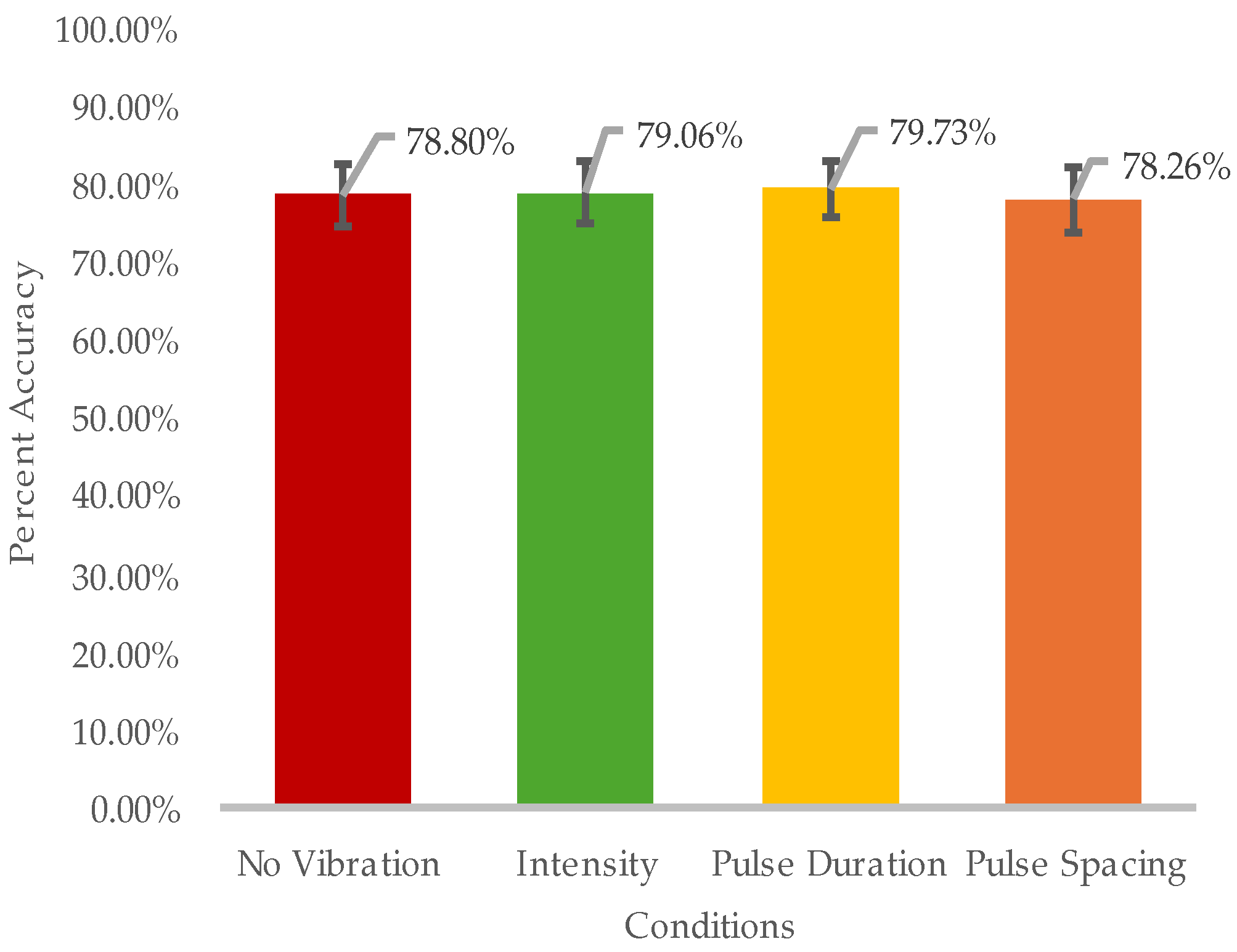
In assessing the performance of the spatial rotation task, accuracy of the attempts was measured, as depicted in Figure 6. The one-way ANOVA conducted for mean attempts showed no significant differences across the various vibration conditions, F(3, 69) = 0.105, p = 0.957. Therefore, Despite the varying vibration conditions, accuracy of the spatial rotation task remained consistent across all conditions. This lack of significant variation suggests that the vibration conditions did not impact the participants' ability to perform the spatial rotation task.
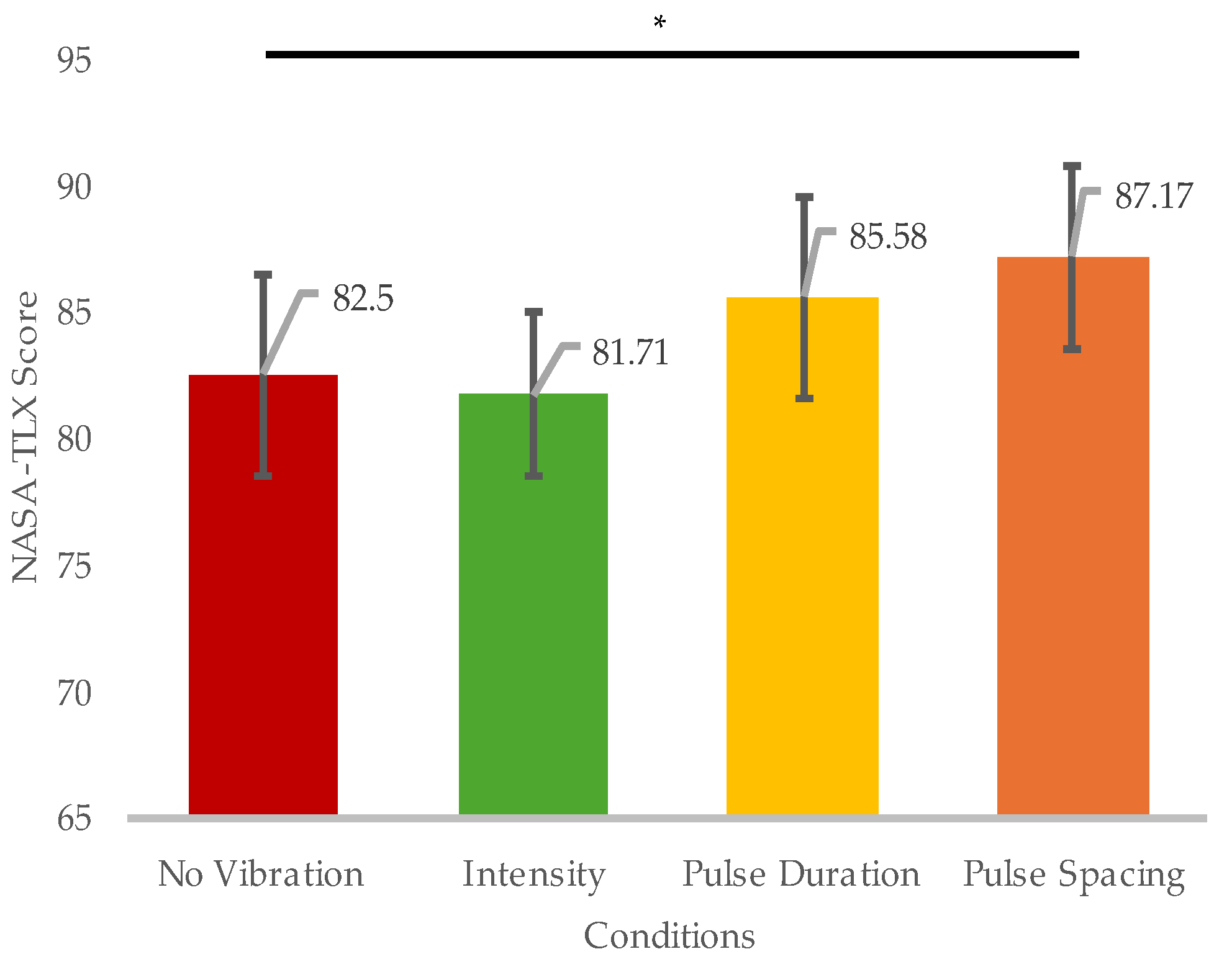
Lastly, perceived workload, gauged through NASA-TLX scores and depicted in Figure 7, was significantly influenced by vibration conditions, F(3, 69) = 3.175, p = 0.029, η2 = 0.018. Despite this finding, post-hoc analyses did not discern any particular vibration condition as significantly different from others in terms of perceived workload among participants.
The post-experiment questionnaire included two key inquiries. The first asked participants to identify from the NASA-TLX which dimensions they felt were most impactful to their overall workload. The second was an open-ended question, which invited participants to describe any strategies they developed to help complete the dual tasks more effectively. The majority of participants identified Mental Demand as the most influential factor contributing to their overall workload experience. In response to the open-ended question, participants reported strategies for managing the concurrent demands of the navigation and spatial rotation tasks, providing insight into the observed statistical results. Many participants focused on the spatial rotation task during moments when the navigation task required minimal attention, such as, while moving the cursor between targets. This approach may explain why spatial rotation accuracy remained consistent across vibration conditions, as participants allocated more cognitive resources to this task during less demanding navigation phases. Additionally, some participants indicated that they moved the cursor more slowly in the navigation task to maintain accuracy and reduce obstacle hits, particularly under vibrotactile feedback conditions. These strategies highlight how participants adapted their behavior to balance task demands, potentially mitigating the full impact of vibrotactile feedback on performance metrics.
4. Discussion
The current study aimed to investigate the effectiveness of vibrotactile feedback in supporting multitasking performance and workload management in a simulated excavation environment. Excavation operations require operators to maintain high levels of spatial awareness while managing multiple concurrent tasks, often under conditions where visual and auditory resources are heavily taxed. In 2021 alone, the U.S. Bureau of Labor Statistics reported 5,190 occupational fatalities, with excavation being among the riskiest tasks due to the need to monitor both above ground activities and underground hazards [1,4]. Given the physical and cognitive demands of such environments, vibrotactile feedback systems offer a promising solution for delivering critical proximity cues non-visually, potentially enhancing safety and efficiency. Our findings provide insight into how different patterns of vibrotactile feedback (No Vibration, Intensity Modulation, Pulse Duration, and Pulse Spacing) influence multitasking performance, including navigating to targets while maintaining spatial awareness to avoid hazards, managing additional tasks that challenge vision and spatial reasoning, and mitigating cognitive workload. These specific feedback conditions were selected based on their theoretical support in human sensory research (e.g., Jones and Sarter, 2008; Choi and Kuchenbecker, 2012) and iterative refinement through pilot testing to ensure clear, perceptible cues without causing discomfort [27,40].
Figure 7.
NASA-TLX Scores across vibration conditions.
In the navigation task, while no significant differences were observed in target hits (Figure 4) between the vibrotactile feedback conditions, notable improvements were found in reduced obstacle collisions, and reduced time in contact with the obstacles (Figure 5). The ‘Intensity’ condition, in particular, resulted in fewer obstacle hits and reduced time in contact with obstacles compared to the ‘No Vibration’ condition. However, no other significant advantages were observed for the Pulse Duration or Pulse Spacing conditions, indicating that intensity-modulated feedback was uniquely effective in this context. This suggests that intensity-modulated feedback may serve as an effective cue for guiding spatial navigation around hazards, enhancing operators’ ability to avoid obstacles without relying on visual information. Such findings are consistent with prior research on tactile feedback, which highlights its potential to reduce visual demands in operational settings by providing critical spatial information through non-visual channels [15,25,40,41,42,43]. Intensity modulation, specifically, was noted for its capacity to deliver clear and intuitive cues, with stronger vibrations effectively signaling greater proximity to obstacles. Jones and Sarter (2008) emphasized that amplitude changes are readily perceived by the fingertips, which may make intensity-based feedback more salient in real-time applications [27]. This aligns with the broader understanding that amplitude modulation is often associated with conveying urgency or critical information [25]. Therefore, the findings indicate a strong potential of intensity-modulated vibrotactile feedback to enhance navigational performance and hazard avoidance, particularly in high-risk construction environments where precise spatial awareness is critical.
It can be observed from Figure 6 that the spatial rotation task showed no significant impact from vibrotactile feedback on task accuracy or number of attempts across conditions. This stability suggests that while vibrotactile feedback can support spatial navigation tasks, it may have limited influence on tasks primarily requiring cognitive processing. Wickens’ Multiple Resources Theory suggest that engaging underutilized and relatively available sensory channels, such as tactile feedback, can help alleviate sensory load on more heavily burdened channels, particularly visual and auditory channels [21,22]. In this case, participants’ adaptive strategies in managing the dual-task setup may have influenced the outcome. Many participants reported in post-task questionnaires that they prioritized the spatial rotation task between targets in the navigation task, where obstacle presence was minimal. This task-switching strategy likely contributed to maintaining stable spatial rotation accuracy across vibrotactile feedback conditions, as participants allocated more cognitive resources to the rotation task at times when fewer demands were placed on navigation.
The results from the NASA-TLX workload assessment revealed that perceived workload did vary significantly across feedback conditions, though no one feedback type consistently reduced workload in all dimensions (Figure 7). The mixed impact on workload may reflect the duality of tactile feedback’s role: while it can offload some cognitive demands by guiding obstacle avoidance non-visually, managing dual tasks in a two dimensional environment still required substantial mental effort, particularly given the absence of depth cues available in real-world or VR settings. This finding is consistent with Wickens’ theory that performance benefits arise from distributing task demands across multiple sensory channels, though the limitations of a 2D environment likely moderated this benefit.
4.1. Limitations and Future Work
Several limitations of this study should be noted, particularly in the context of sensory integration and the realism of the experimental setup. While the study investigated vibrotactile feedback in a controlled 2D environment, the absence of stereoscopic depth cues may have limited the effectiveness of spatial awareness enhancements. Previous research, such as Triantafyllidis et al. (2020), demonstrates that depth perception significantly improves spatial orientation and navigation accuracy, suggesting that the benefits of vibrotactile feedback might be further amplified in 3D or VR-based setups where such cues are present [44]. This aligns with findings from Berger et al. (2018), who identified the "uncanny valley of haptics," where incongruences between haptic and visual inputs diminish subjective realism [45]. In this study, the absence of dynamic, real-world elements such as continuous movement and repositioning further constrained the ecological validity of the results, mirroring Berger et al.’s observation that sensory congruence and contextual realism are critical for achieving effective haptic feedback [45]. Future work should explore dynamic 3D environments that incorporate stereoscopic depth and movement to better replicate real-world conditions and ensure seamless integration of visual and haptic stimuli for enhanced navigation and situational awareness.
Future research should acknowledge that this study focused exclusively on vibrotactile feedback, and other sensory feedback modalities were not explored. It remains possible that alternative approaches, such as electro-tactile stimulation, ambient visual displays, or multimodal combinations of visual, auditory, and tactile cues, may offer similar or greater effectiveness. These modalities could provide distinct advantages in operational contexts, depending on their ability to integrate seamlessly with task demands and minimize sensory overload. Investigating such alternatives would help identify optimal feedback systems for enhancing safety and efficiency in construction and similar high-demand settings.
5. Conclusions
This study evaluated the effects of vibrotactile feedback on multitasking performance, spatial awareness, and cognitive workload in a simulated excavation environment. Findings suggest that, compared to no feedback, vibratory cues better support navigation performance by reducing obstacle collisions and contact time. Among the feedback conditions, intensity-modulated vibrotactile feedback demonstrated the most significant improvements, highlighting its potential to enhance safety in visually demanding tasks. However, the effects of vibrotactile feedback were less pronounced on secondary cognitive tasks, such as spatial rotation, suggesting that the impact of tactile feedback may vary with task type and demands on visual-spatial processing.
These findings can inform the design of multimodal feedback systems in construction settings where operators face high cognitive and sensory loads. By utilizing non-visual feedback, such systems could reduce dependence on overtaxed visual and auditory resources, supporting operators’ spatial awareness and hazard management without adding to cognitive overload. Designers of safety-critical systems may consider incorporating intensity-based tactile feedback to improve proximity awareness, particularly in environments where visual demands are high.
This research study provides valuable insights into the potential of vibrotactile feedback to enhance navigation performance and support hazard awareness in multitasking environments, particularly in construction settings where visual and auditory resources are heavily taxed. The outcome of the study showcases the effectiveness of intensity-modulated feedback in reducing obstacle collisions and contact duration, stressing the potential role of tactile feedback in improving safety and efficiency in operational tasks. Consequently, these findings contribute to the broader understanding of multimodal feedback design and its application in safety-critical tasks, offering a foundation for advancing human-centered system design in high-risk industries.
Author Contributions
Conceptualization: S.M.A.H., A.Y. and T.K.F.; methodology: S.M.A.H., A.Y.; formal analysis: S.M.A.H; writing—original draft preparation: S.M.A.H.; writing—review and editing: S.M.A.H. and T.K.F. All authors have read and agreed to the published version of the manuscript.
Funding
This research was funded by the National Science Foundation, Award Number 2026574, “FW-HTF-RM: The Future of Teleoperation in Construction Workplaces.” PI: Y. Ham. Additionally, S.M.A.H. was funded in part by the Department of Environmental and Occupational Health, Texas A&M Health Science Center, and the Wm Michael Barnes ’64 Department of Industrial and Systems Engineering, Texas A&M University.
Institutional Review Board Statement
This study was approved by the Texas A&M University Institutional Review Board (IRB number: IRB2023-0676D).
Informed Consent Statement
Informed consent was obtained from all subjects involved in the study.
Data Availability Statement
The data presented in this study are available on request from the corresponding author due to the confidentiality and Protection of Personal Information Act.
Acknowledgments
The authors would like to acknowledge and thank Balaji Reddy Varadareddygari and Daniel Beltran for their efforts in developing the experimental environment and materials.
Conflicts of Interest
The authors declare no conflicts of interest.
References
- Dong, X.; Wang, X.; Katz, R. The Sixth Edition of The Construction Chart Book—The U.S. Construction Industry and Its Workers, 6th ed.; CPWR-The Center for Construction Research and Training: Silver Spring, MD, USA, 2018; Vol. 40. [Google Scholar]
- U.S. Bureau of Labor Statistics Injuries, Illnesses, and Fatalities 2021.
- Hossain, S.M.A.; Peres, S.C.; Martin, R.; Lee, J.S.; Du, A.; Bergman, M.; Ham, Y.; Ferris, T. Current Practices, Conflicts, and Future Teleoperation in Construction Workplaces: A Survey Study. Proc. Hum. Factors Ergon. Soc. Annu. Meet. 2023, 67, 1038–1042. [Google Scholar] [CrossRef]
- Common Ground Alliance Damage Information Reporting Tool, Analysis and Recommendations; Common Ground Alliance: Alexandria, USA, 2019.
- Marks, E.D.; Teizer, J. Method for Testing Proximity Detection and Alert Technology for Safe Construction Equipment Operation. Constr. Manag. Econ. 2013, 31, 636–646. [Google Scholar] [CrossRef]
- Shen, X.; Marks, E.; Pradhananga, N.; Cheng, T. Hazardous Proximity Zone Design for Heavy Construction Excavation Equipment. J. Constr. Eng. Manag. 2016, 142, 05016001. [Google Scholar] [CrossRef]
- Teizer, J.; Golovina, O.; Wang, D.; Pradhananga, N. Automated Collection, Identification, Localization, and Analysis of Worker-Related Proximity Hazard Events in Heavy Construction Equipment Operation. ISARC Proc. 2015, 1–9. [Google Scholar]
- Shi, Z.; Heng Zou; Rank, M. ; Lihan Chen; Hirche, S.; Muller, H.J. Effects of Packet Loss and Latency on the Temporal Discrimination of Visual-Haptic Events. IEEE Trans. Haptics 2010, 3, 28–36. [Google Scholar] [CrossRef]
- Ferris, T.; Sarter, N. Evaluation of Multiparameter Vibrotactile Display Designs to Support Physiological Monitoring Performance in Anesthesiology. Proc. Hum. Factors Ergon. Soc. Annu. Meet. 2011, 55, 515–519. [Google Scholar] [CrossRef]
- Ferris, T.K.; Sarter, N. Continuously Informing Vibrotactile Displays in Support of Attention Management and Multitasking in Anesthesiology. Hum. Factors 2011, 53, 600–611. [Google Scholar] [CrossRef] [PubMed]
- Kim, J.; Ham, Y.; Park, H. Underground Metal Pipeline Localization Using Low-Cost Wireless Magnetic Sensors Mounted on an Excavator. IEEE Trans. Ind. Electron. 2022, 69, 10674–10683. [Google Scholar] [CrossRef]
- Lee, S.; Ham, Y. Measuring the Distance between Trees and Power Lines under Wind Loads to Assess the Heightened Potential Risk of Wildfire. Remote Sens. 2023, 15, 1485. [Google Scholar] [CrossRef]
- Chae, Y.; Gupta, S.; Ham, Y. Effects of Visual Prompts in Human-Machine Interface for Construction Teleoperation System. Int. Symp. Autom. Robot. Constr. ISARC Proc. 2024, 2024 Proceedings of the 41st ISARC, Lille, France, 73–80. [CrossRef]
- Chae, Y.; Gupta, S.; Ham, Y. Divergent Effects of Visual Interfaces on Teleoperation for Challenging Jobsite Environments. Autom. Constr. 2024, 167, 105683. [Google Scholar] [CrossRef]
- Salzer, Y.; Oron-Gilad, T. A Comparison of “on-Thigh” Vibrotactile, Combined Visual-Vibrotactile, and Visual-Only Alerting Systems for the Cockpit under Visually Demanding Conditions. Proc. Hum. Factors Ergon. Soc. Annu. Meet. 2012, 56, 1644–1648. [Google Scholar] [CrossRef]
- Lind, C.M.; Yang, L.; Abtahi, F.; Hanson, L.; Lindecrantz, K.; Lu, K.; Forsman, M.; Eklund, J. Reducing Postural Load in Order Picking through a Smart Workwear System Using Real-Time Vibrotactile Feedback. Appl. Ergon. 2020, 89, 103188. [Google Scholar] [CrossRef] [PubMed]
- Hudin, C.; Hayward, V. When Hearing Defers to Touch. ArXiv Prepr. ArXiv200413462 2020. [Google Scholar]
- Brown, K.W.; Ryan, R.M. The Benefits of Being Present: Mindfulness and Its Role in Psychological Well-Being. J. Pers. Soc. Psychol. 2003, 84, 822–848. [Google Scholar] [CrossRef]
- Seli, P.; Risko, E.F.; Smilek, D. On the Necessity of Distinguishing Between Unintentional and Intentional Mind Wandering. Psychol. Sci. 2016, 27, 685–691. [Google Scholar] [CrossRef] [PubMed]
- Yang, X.; Roofigari-Esfahan, N. Vibrotactile Alerting to Prevent Accidents in Highway Construction Work Zones: An Exploratory Study. Sensors 2023, 23, 5651. [Google Scholar] [CrossRef]
- Wickens, C.D. Multiple Resources and Performance Prediction. Theor. Issues Ergon. Sci. 2002, 3, 159–177. [Google Scholar] [CrossRef]
- Wickens, C.D. Multiple Resources and Mental Workload. Hum. Factors J. Hum. Factors Ergon. Soc. 2008, 50, 449–455. [Google Scholar] [CrossRef] [PubMed]
- Lim, S.; Yang, X. Real-Time Vibrotactile Feedback System for Reducing Trunk Flexion Exposure during Construction Tasks. Appl. Ergon. 2023, 110, 104019. [Google Scholar] [CrossRef] [PubMed]
- Márquez-Sánchez, S.; Campero-Jurado, I.; Robles-Camarillo, D.; Rodríguez, S.; Corchado-Rodríguez, J.M. BeSafe B2.0 Smart Multisensory Platform for Safety in Workplaces. Sensors 2021, 21. [Google Scholar] [CrossRef] [PubMed]
- van Erp, J.B.F.; Veen, H.A.H.C.V.; Jansen, C.; Dobbins, T. Waypoint Navigation with a Vibrotactile Waist Belt. ACM Trans. Appl. Percept. 2005, 2, 106–117. [Google Scholar] [CrossRef]
- Tan, H.; Lim, A.; Traylor, R. A Psychophysical Study of Sensory Saltation With an Open Response Paradigm. In Proceedings of the Dynamic Systems and Control: Volume 2; American Society of Mechanical Engineers: Orlando, Florida, USA, November 5, 2000; pp. 1109–1115. [Google Scholar]
- Jones, L.A.; Sarter, N.B. Tactile Displays: Guidance for Their Design and Application. Hum. Factors 2008, 50, 90–111. [Google Scholar] [CrossRef]
- Gescheider, G.A.; Bolanowski, S.J.; Chatterton, S.K. Temporal Gap Detection in Tactile Channels. Somatosens. Mot. Res. 2003, 20, 239–247. [Google Scholar] [CrossRef]
- Sherrick, C.E. A Scale for Rate of Tactual Vibration. J. Acoust. Soc. Am. 1985, 78, 78–83. [Google Scholar] [CrossRef] [PubMed]
- Ferris, T.K. Informative Vibrotactile Displays to Support Attention and Task Management in Anesthesiology . Available online: https://www.proquest.com/openview/905643751e99993e1722496c21568323/1?pq-origsite=gscholar&cbl=18750 (accessed on 29 November 2024).
- Ferris, T.K.; Sarter, N. When Content Matters: The Role of Processing Code in Tactile Display Design. IEEE Trans. Haptics 2010, 3, 199–210. [Google Scholar] [CrossRef]
- Craig, J.C.; Rollman, G.B. SOMESTHESIS. Annu. Rev. Psychol. 1999, 50, 305–331. [Google Scholar] [CrossRef] [PubMed]
- Fitts, P.M. Fitts’s Law. Wikipedia 2024.
- Fitts, P.M. The Information Capacity of the Human Motor System in Controlling the Amplitude of Movement. J. Exp. Psychol. 1954, 47, 381–391. [Google Scholar] [CrossRef] [PubMed]
- Ganis, G.; Kievit, R. A New Set of Three-Dimensional Shapes for Investigating Mental Rotation Processes: Validation Data and Stimulus Set. J. Open Psychol. Data 2015, 3. [Google Scholar] [CrossRef]
- Sullivan, D.H.; Chase, E.D.Z.; O’Malley, M.K. Comparing the Perceived Intensity of Vibrotactile Cues Scaled Based on Inherent Dynamic Range. IEEE Trans. Haptics 2024, 17, 45–51. [Google Scholar] [CrossRef] [PubMed]
- Elsaid, A.; Park, W.; Ha, S.; Song, Y.-A.; Eid, M. Effects of Duration and Envelope of Vibrotactile Alerts on Urgency, Annoyance, and Acceptance. In Proceedings of the Haptic Interaction; Wang, D., Song, A., Liu, Q., Kyung, K.-U., Konyo, M., Kajimoto, H., Chen, L., Ryu, J.-H., Eds.; Springer International Publishing: Cham, 2023; pp. 1–10. [Google Scholar]
- Villalonga, M.B.; Sussman, R.F.; Sekuler, R. Perceptual Timing Precision with Vibrotactile, Auditory, and Multisensory Stimuli. Atten. Percept. Psychophys. 2021, 83, 2267–2280. [Google Scholar] [CrossRef] [PubMed]
- Hart, S.G.; Staveland, L.E. Development of NASA-TLX (Task Load Index): Results of Empirical and Theoretical Research. In Advances in Psychology; Elsevier, 1988; Vol. 52, pp. 139–183 ISBN 978-0-444-70388-0.
- Choi, S.; Kuchenbecker, K.J. Vibrotactile Display: Perception, Technology, and Applications. Proc. IEEE 2013, 101, 2093–2104. [Google Scholar] [CrossRef]
- Elliott, L.; Jansen, C.; Redden, E.; Pettitt, R. Robotic Telepresence: Perception, Performance, and User Experience. 2012.
- Islam, M.S.; Lim, S. Vibrotactile Feedback in Virtual Motor Learning: A Systematic Review. Appl. Ergon. 2022, 101, 103694. [Google Scholar] [CrossRef]
- Brickler, D.; Babu, S.V.; Bertrand, J.; Bhargava, A. Towards Evaluating the Effects of Stereoscopic Viewing and Haptic Interaction on Perception-Action Coordination. 2018 IEEE Conf. Virtual Real. 3D User Interfaces VR 2018, 1–516. [Google Scholar] [CrossRef]
- Triantafyllidis, E.; Mcgreavy, C.; Gu, J.; Li, Z. Study of Multimodal Interfaces and the Improvements on Teleoperation. IEEE Access 2020, 8, 78213–78227. [Google Scholar] [CrossRef]
- Berger, C.C.; Gonzalez-Franco, M.; Ofek, E.; Hinckley, K. The Uncanny Valley of Haptics. Sci. Robot. 2018, 3, eaar7010. [Google Scholar] [CrossRef]
Figure 1.
Experimental Environment.
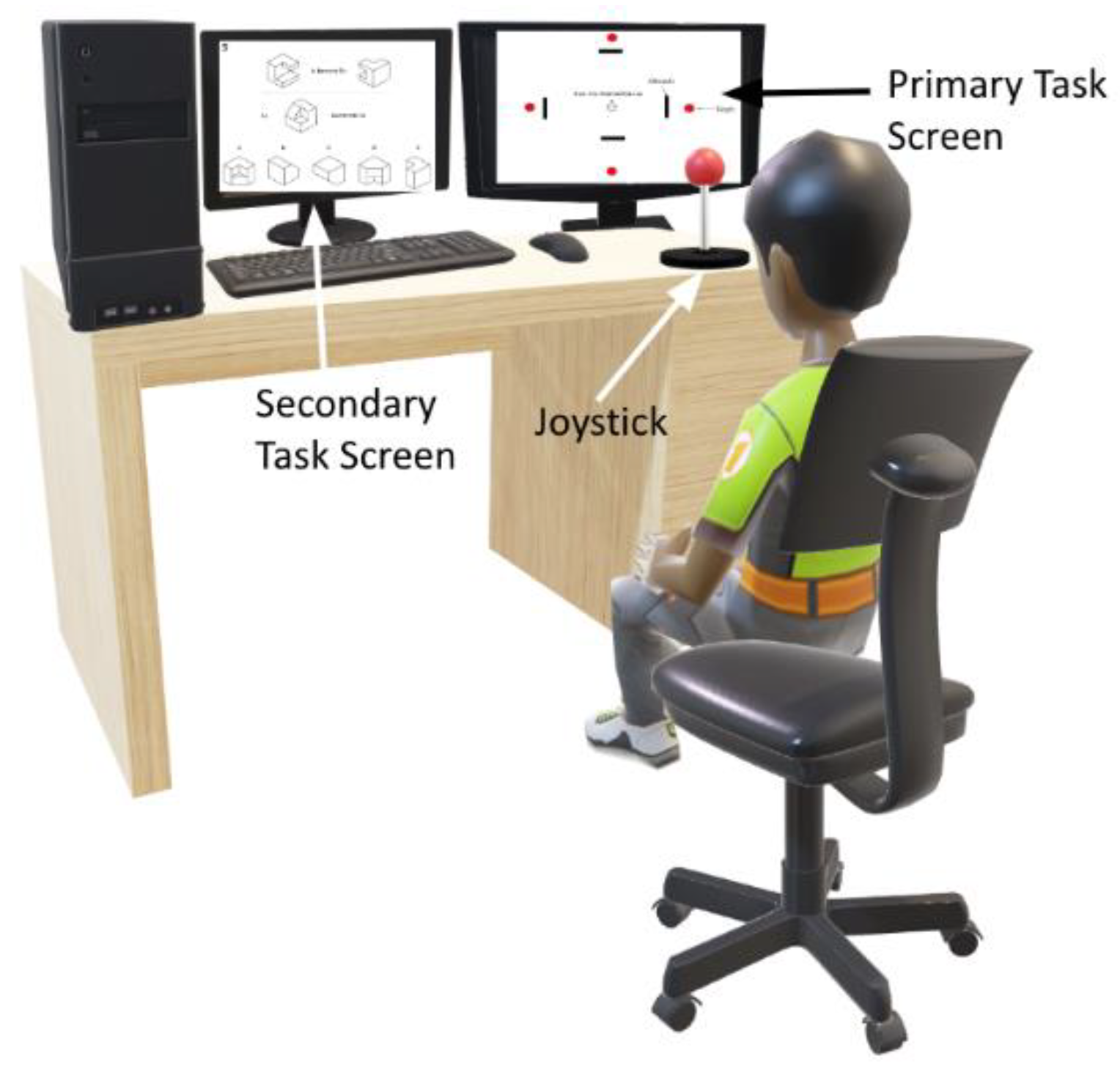
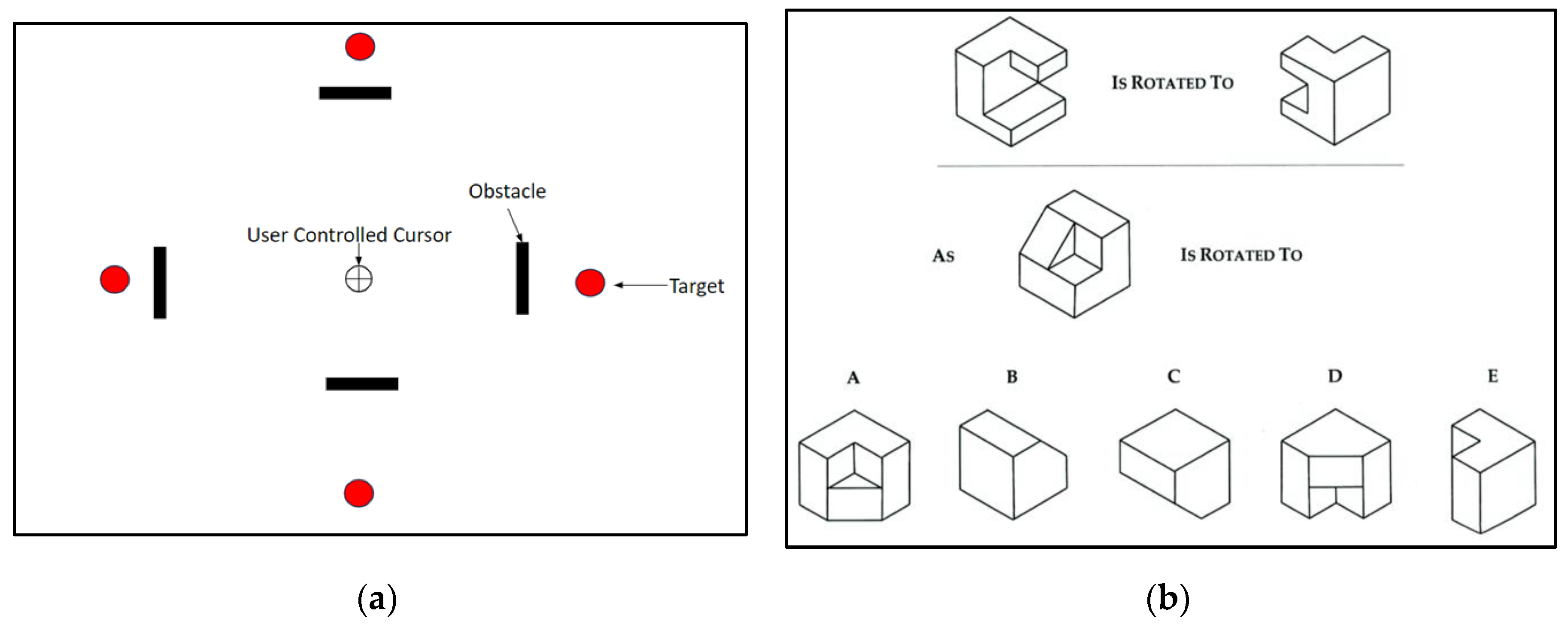
Figure 3.
Logitech Extreme 3D Pro Joystick with Tactors Attached to Provide Vibrational Feedback.
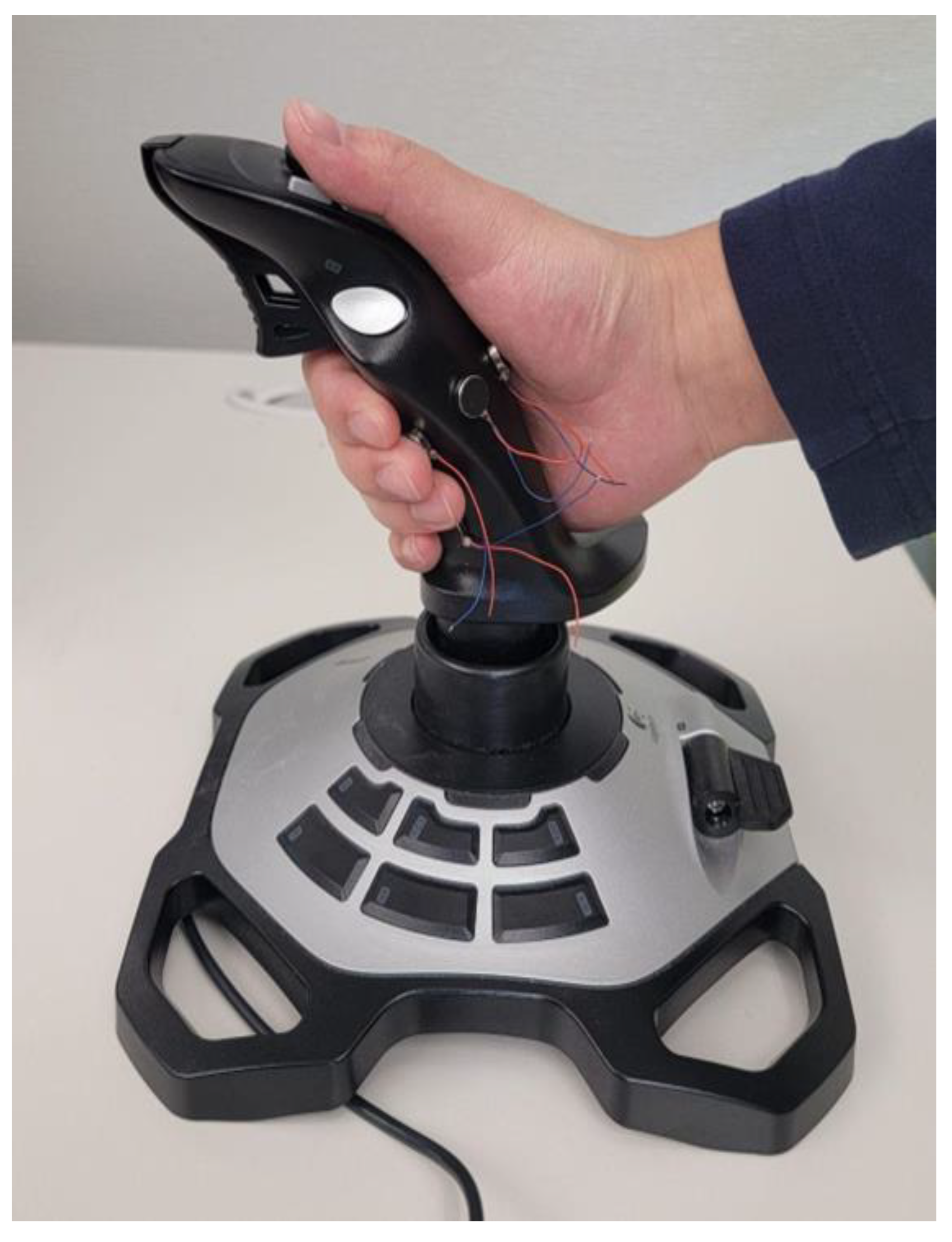
Figure 4.
Number of Target Hits across vibration conditions.

Figure 5.
(a) Number of Obstacle Hits across vibration conditions.; (b) Time in Contact with Obstacles across vibration conditions.
Figure 5.
(a) Number of Obstacle Hits across vibration conditions.; (b) Time in Contact with Obstacles across vibration conditions.
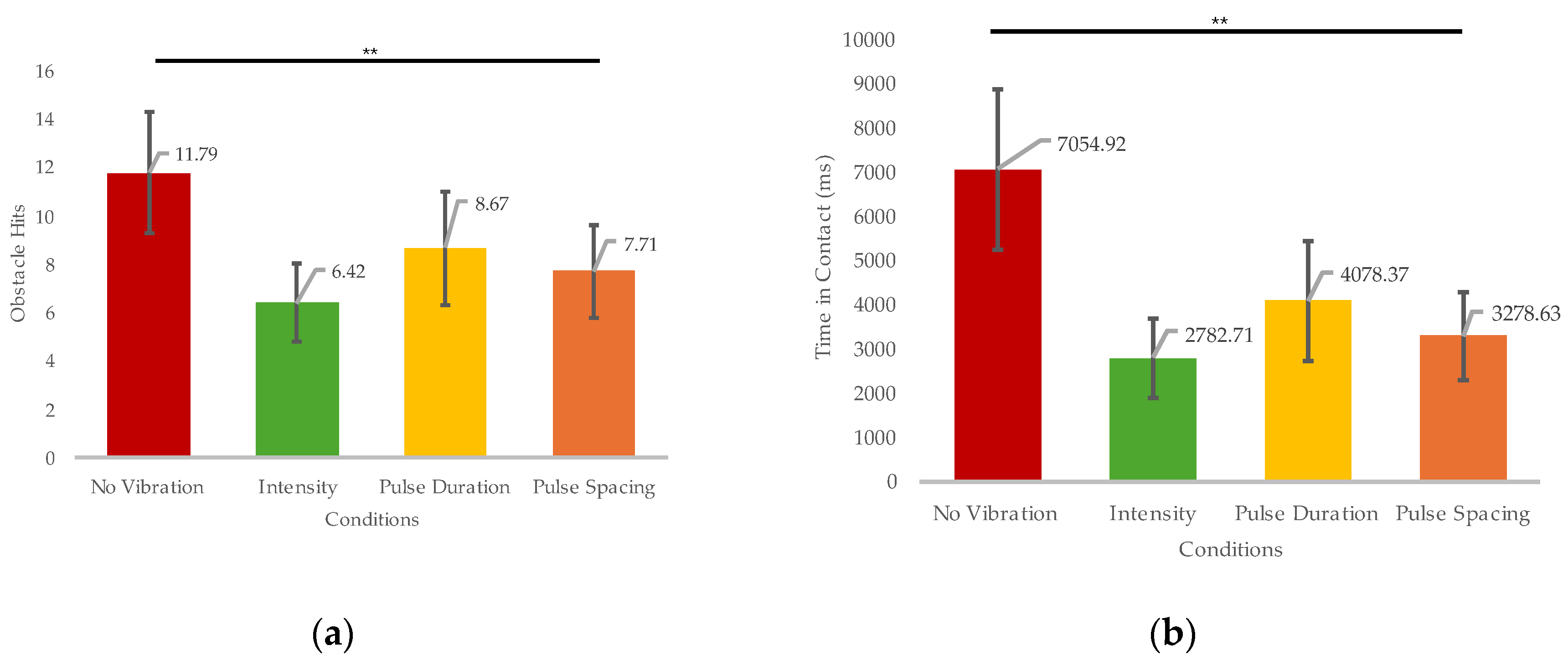
Figure 6.
Percent Accuracy for the spatial rotation task across vibration conditions.
Disclaimer/Publisher’s Note: The statements, opinions and data contained in all publications are solely those of the individual author(s) and contributor(s) and not of MDPI and/or the editor(s). MDPI and/or the editor(s) disclaim responsibility for any injury to people or property resulting from any ideas, methods, instructions or products referred to in the content. |
© 2024 by the authors. Licensee MDPI, Basel, Switzerland. This article is an open access article distributed under the terms and conditions of the Creative Commons Attribution (CC BY) license (http://creativecommons.org/licenses/by/4.0/).
Copyright: This open access article is published under a Creative Commons CC BY 4.0 license, which permit the free download, distribution, and reuse, provided that the author and preprint are cited in any reuse.


