

Submitted:
09 December 2024
Posted:
10 December 2024
You are already at the latest version
Abstract
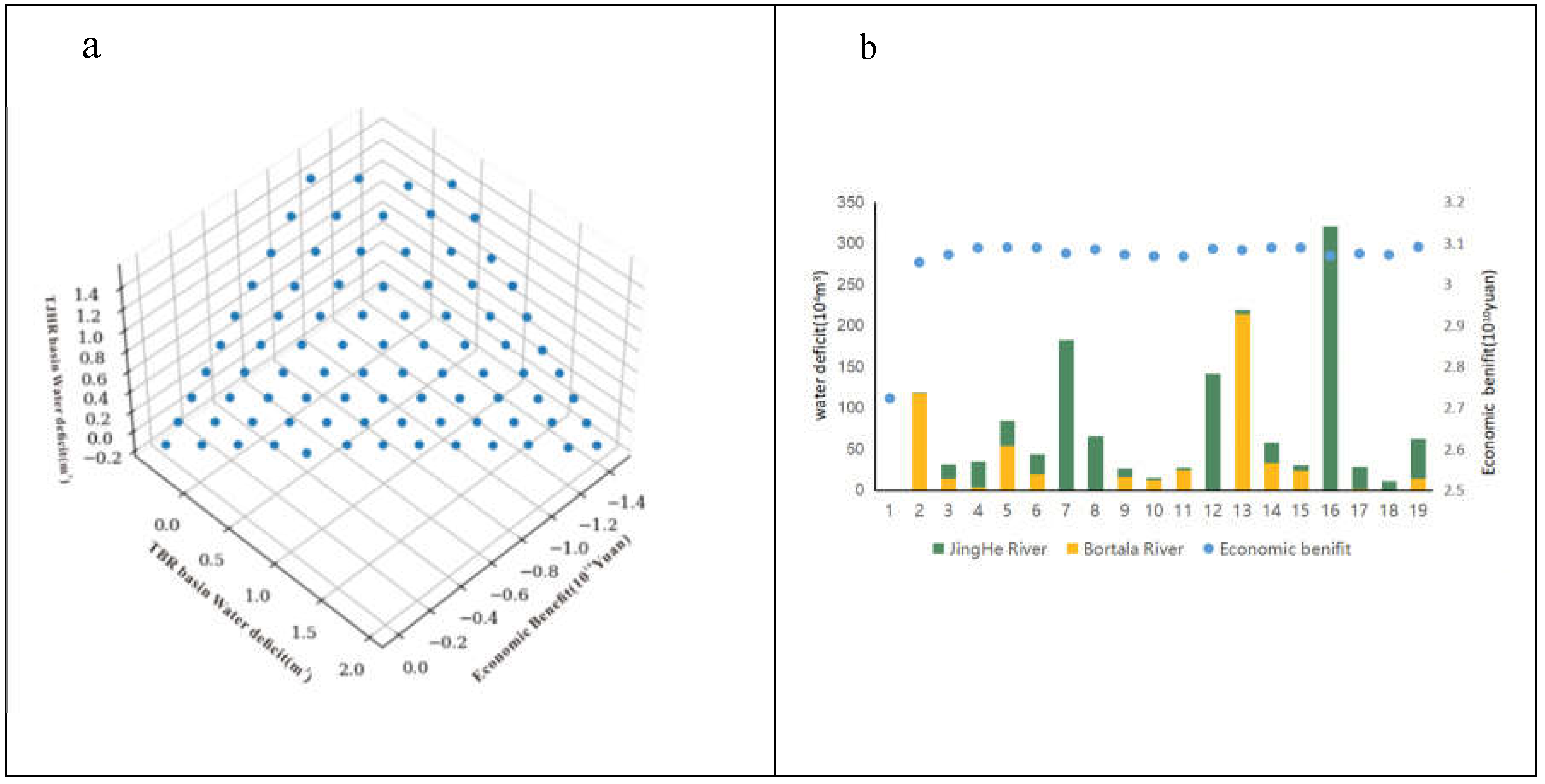
The current water use structure in Xinjiang is characterized by high water consumption and low output.Finding optimal water resources allocation for crops and ecological is necessary to increase the efficiency of water usage. This study takes Abby Lake Basin as an example to quantify the social, economic, and ecological values of surface water generation,the optimal allocation model of water resources with the maximum economic-ecological benefit, the minimum water shortage and Food security as a constraint as the objective function was constructed. The improved third generationnon-dominated sorting genetic algorithm ( NSGA-Ⅲ) was used to solve the model.The results show that the total economic-ecological benefit generated by surface water in the Abbey Lake Basin through optimization could reach 3.09 ×10¹⁰yuan in 2021,About 36.5% higher than the original benefit .Also, the volume of the water shortage is 301,800 m3, of which 78.2% of the water shortage in the Bortala River Basin, 21.2% of the water shortage in the Jing River Basin, and 197,447.89m3 river water allocated to the lake water.When social benefit minimization takes precedence,economic-ecological benefit values are 2.72×10¹⁰ yuan, the volume of the water shortage is 326.53m3, of which the Bortala River shortage is 326.40m3, Jing River is 0.1m3 and 1208,869.56m3 river water is allocated to the lake. In this condition, the economic-ecological benefit is smaller than the first condition, but still 20.3% higher than the actual production of economic value.This research results provide new ideas and approaches to water resources management in arid zones.
Keywords:
1. Introduction
2. Methods and Data
2.1. Methodological Framework
2.2. Optimization Model
2.2.2. Constraints
2.3. Study Area and Data Sources
2.3.1. Overview of the Study Area
2.3.2. Data Sources
3. Results and Analysis
4. Conclusions
Data Availability Statement
Acknowledgments
Conflicts of Interest
References
- WANG Hao, YOU Jinjun. Advancements and development course of research on water resources deployment[J].Journal of Hydraulic Engineering, 2008(10):1168-1175.(in Chinese)).
- ZHAO Yong, PEI Yuansheng, WANG Jianhua.The progress of water resources rational allocation[J].Advances in Science and Technology of Water Resources,2009,29(03):78-84.(in Chinese)).
- ZHENG Hexiang, SHI Haibin, CHAI Jianhua, et al.Optimal irrigation schedule model of.
- forage crop by RAGA-DP under deficit irrigation[J].
- Li Lin, Wu Xinmiao, Du Zhihong, Research on optimal allocation of water resources based on improved NSGA algorithm[J]. Hydropower Energy Sci..2015,33(4): 34-37.
- DU Bailin, ZHANG Jianfeng, GAO Zehai, et al. Optimal allocation of water resources based on simulated annealing particle swarm algorithm [J]. Journal of Irrigation and Drainage Machinery Engineering.2021,39(3):292-299..
- LI Xin,MA Xiaodong. An improved simulated annealingalgorithm for interactive multi-objective land resourcespatial allocation [J]. Ecological Complexity,2018,36:184-195 . [CrossRef]
- WANG Zhanping,TIAN Juncang,FENG Kepeng.Optimalallocation of regional water resources based on simulatedannealing particle swarm optimization algorithm [J]Energy Reports,2022,8:9119-9126 . [CrossRef]
- ZARGHAMI M, HAJYKAZEMIAN H. Urban water resources planning by using a modified particle swarm optimization algorithm[J]. Resources,Conservation and Recycling,2013,70:1-8. [CrossRef]
- WANG Wenjun, FANG Guohua, LI Yuan, et al. Optimal scheduling of water resources in plains slope water area based on improved multi-objective particle swarm algorithm[J]. Water Resources Conservation, 2022,38(2):91-96.
- Mahdi Zarghami, Hassan Hajykazemian. Urban water resources planning by using a modified particle swarm optimization algorithm[J].Resources,Conservation and Recycling,2013,70:1-8 . [CrossRef]
- WANG Yujuan,LUO Jian, XUE Qing, et al. Optimal Allocation of Water Resources Based on Chaotic Gaussian Perturbation Cuckoo Algorithm,2021,39(09):45-49. (in Chinese)).
- LU Xiao,WU Yun,YANG Kan,et al. Water resources allocation based on improved multi-objective cuckoo search[J].China Rural Water and Hydropower,2020(04):56-60. (in Chinese)).
- CHENG Q, DU B, ZHANG L P, et al. ANSGA-III: A Multiobjective Endmember Extraction Algorithm for Hyperspectral Images[J]. IEEE Journal Of Selected Topics in Applied Earth Observations and Remote Sensing,2019,12(2): 700-721 . [CrossRef]
- ZHU S D,ZHANG F,ZHANG Z Y,et al.Hydrogen and Oxygen lsotope Composition and Water QualityEvaluation for Different Water Bodies in the Ebinur Lake Watershed.NorthwesternChina[J].WATER,2019,11(10):2067 . [CrossRef]
- ZHANG Huan, QIU Yubao, ZHENG Zhaojun, et al. Comparative study on the feasibility of seasonal snow de-clouding methods on the Tibetan Plateau based on MODIS[J]. Glacial Permafrost,2016,38(3):714-724.
- Yan Yuna,Che Tao,Li Hongyi,et al.Improving the simulation accuracy of spring snowmelt runoff in mountainous areas using snowpack remote sensing area dataJ]. Glacial permafrost,2016,38(1):211-221.
- Li Xiaolan, Jiang Fengqing, Wang Shaoping, et al. Characteristics of spatial distribution of winter snow depth and density in the city-suburbs of Urumqi from 2011 to 2013[J1.Glacial Permafrost,2015,37(5):1168-1177.
- Gong Yanming. Response of plant diversity to water and salt stress in the Abby Lake Basin [D]. Xinjiang University, 2019.
- Liu Yan. Current situation of biodiversity and protection countermeasures in Aibi Lake Wetland Nature Reserve [J]. Green Science and Technology, 2017.(14): 191-192. [CrossRef]
- Deb K, Jain H. An evolutionary many-objective optimization algorithm using reference-point-based nondominated sorting approach, part i: solving problems.
- Su Xiangming,Liu Zhihui,Wei Tianfeng et al. Response of Abbey Lake area change and its runoff characteristics change [J]. Research on Soil and Water Conservation, 2016, 23 (03): 252-256. [CrossRef]
- Li Jiang, Zhang Zongliang, Yue Chunfang. Reflections on the Evolutionary Characteristics and Ecological Restoration Countermeasures of Aibi Lake [J]. Water Resources Planning and Design, 2023, (01): 75-81+100.
- GUO Shuangshuang, CHU Xinzheng, HU Yuan et al. Discussions on the reasonable water area of Lake Aibi[J]. Journal of Xinjiang Normal University (Natural Science Edition),2012,31(02):16-20. [CrossRef]

| Wheat | corn | cotton | beet | wolfberry | sunflower | |
| Bole city | 36.81 | 53.25 | 86.81 | 54.02 | 145.61 | 71.43 |
| Jinghe county | 20.65 | 28.18 | 66.70 | 30.47 | 145.92 | 22.51 |
| Wenquan county | 22.18 | 57.08 | 76.76 | 11.13 | 145.61 | 30.76 |
| First indicators | Secondary indicators | Tertiary indicators | calculation method |
| supply value | Food and raw material supply | reeds | market pricing method |
| Non-metallic minerals | market pricing method | ||
| others | market pricing method | ||
| regulation value | Water flow regulation | save | cost-replacement method |
| climate regulation | carbon sequestration | cost-replacement method | |
| release oxygen | cost-replacement method | ||
| cooling and humidifying | cost-replacement method | ||
| protect against natural disasters | sand and windbreak | cost-replacement method | |
| Species diversity | Species conservation | protection cost method | |
| host | |||
| Value of cultural services | sightseeing | Tourism and Leisure | Travel Expenses method |
| cultures | Science and education services | cost-replacement method | |
Disclaimer/Publisher’s Note: The statements, opinions and data contained in all publications are solely those of the individual author(s) and contributor(s) and not of MDPI and/or the editor(s). MDPI and/or the editor(s) disclaim responsibility for any injury to people or property resulting from any ideas, methods, instructions or products referred to in the content. |
© 2024 by the authors. Licensee MDPI, Basel, Switzerland. This article is an open access article distributed under the terms and conditions of the Creative Commons Attribution (CC BY) license (http://creativecommons.org/licenses/by/4.0/).