

Submitted:
05 December 2024
Posted:
06 December 2024
Read the latest preprint version here
Abstract
The city of Macapá in the Brazilian Amazon faces critical aquatic pollution challenges due to inadequate sanitation infrastructure, leading to heavy metal contamination in fish within its urban water bodies. This study evaluates concentrations of metals (Cu, Cd, Cr, Fe, Mn, Ni, Pb, Zn, Hg) in muscle tissues of fish from igarapés, floodplain lakes, and canals. Samples were collected from six sites to investigate the bioaccumulation of these metals and their potential human health risks. Using Atomic Absorption Spectrometry and Inductively Coupled Plasma Optical Emission Spectrometry for Hg, metal levels were analyzed in three carnivorous and seven omnivorous fish species. Cd concentrations in several species exceeded safety thresholds for human consumption, while the estimated daily intake (EDI) of Hg also surpassed reference doses. Risk assessment combining the risk quotient (RQ) for individual metals and the risk index (RI) for metal mixtures indicated considerable health risks associated with consuming fish from these contaminated waters. These findings reveal concerning exposure to contaminants, underscoring the need for environmental management and ongoing monitoring to protect public health in vulnerable urban areas.
Keywords:
heavy metals
; bioaccumulation
; human health risk assessment
; fish contamination
; Brazilian Amazon
; urban water pollution
1. Introduction
Macapá is the capital of the Brazilian state of Amapá, has an estimated population of 522,357 inhabitants, a territory of 6,563,849 km2 [1] and, in the Basic Sanitation Ranking of the 100 largest Brazilian cities, occupies last place [2]. The Macapá urban area is located on the left bank of the Amazon River mouth, inserted in the estuarine coastal zone, and is subject to constant anthropogenic pressure on the use and conservation of soil, water resources, and climate [3,4]. Its complex urban design is characterized by dry land and flooded areas that interact and are linked, making it in many cases difficult to distinguish where one type of territory begins and where the other ends [5]. Igarapés, ressaca areas, and channels constitute the extensive network that makes up the system of urban water bodies in Macapá [6]. The floodplain areas called ressaca areas are under the strong urbanization processes characterized by the presence of wooden houses supported by stilts (called Palafitas in Portuguese), built over the waters [3,5]. Approximately 30% of the Macapá urban population lives in ressaca areas, and these areas are under increased socio-environmental vulnerability and a population growth rate of 20% every four years. In general, solid, and liquid domestic wastes generated in stilt houses are released directly into the water below them without any type of treatment [5]. Igarapés are small branches of rivers that generally have preserved riparian forests. These water bodies are used for fishing, leisure, and transport of people and various products. Channels are the water bodies that cover most of Macapá’s urban area and flow directly into the Amazon River. All these aquatic environments are heavily impacted by human activities, the Amazon River inflows, and the Atlantic Ocean tide effect [3]. When considered together, these urban aquatic environments act as natural filters that receive, retain, and attenuate urban drainage [6].
Urban aquatic environments are among the ecosystems most affected by different human activities since cities generate large amounts of liquid and solid waste that flow into local water resources [7,8,9]. Particularly, urban Amazonian aquatic ecosystems are increasingly vulnerable to stress resulting from human activities [3,10], mainly because the sanitation infrastructure has not kept pace with population growth and the speed of urbanization [11]. Therefore, solid, and liquid waste from industrial and domestic origins are the main drivers of pollution into these aquatic environments. Notably, these effluents carry potentially toxic organic and inorganic chemicals, including metals, directly into waters [12,13].
Contamination of aquatic environments by toxic metals is one of the most serious environmental problems worldwide, both for the conservation of fish species and for human health owing to the potential for bioaccumulation and biomagnification [3,14,15]. Freshwater fish are the main source of protein for Amazonian communities, and the artisanal fishing industry provides the livelihood for around 40% of families in fishing communities [16]. Despite they are still little studied, Rivero et al. [17] demonstrated that fishing households living in urban Amazonian areas are highly dependent on fish consumption and use fishing as a subsistence strategy to deal with food insecurity. Approximately 80% of fishing households living in urban centers eat fish almost every day [17]. However, studies conducted in different hydrographic basins from the Amapá State have demonstrated the bioaccumulation of toxic metals in the muscle tissue of several fish species and that there are risks to human health resulting from their consumption [18,19,20,21]. Thus, the high consumption of fish contaminated by toxic metals from Amazonian rivers can represent serious risks to human health for local vulnerable populations [17,21].
The most vulnerable population in the urban area of Macapá fishes and consumes fish caught in urban water bodies daily. Considering that small-scale urban fishing is practically not studied, despite its enormous relevance for reducing poverty and developing policies to combat food insecurity [16]. Our objective was to determine the concentrations of metals Cu, Cd, Cr, Fe, Mn, Ni, Pb, Zn, and Hg in samples of muscle tissue from different fish species caught in three types of aquatic environments (igarapés, ressaca areas, and channels) located in Macapá urban area, and to evaluate both the individual and mixture of metals bioaccumulated risks for human health via fish consumption.
2. Materials and Methods
Sampling Sites
For fish collection, we selected 6 sampling sites located in the urban area of Macapá. All sampling sites belong to the Igarapé da Fortaleza sub-basin, which is part of the Amazon River Basin. Three sampling sites are located in channels, two in igarapes, and one in a ressaca area (Figure 1).
The sampling sites were selected based on strong human influence, particularly the release of untreated domestic sewage and solid waste, which negatively impacts the quality of all waters in the Amazon River. Indeed, the Amazon River has become the main recipient of industrial effluents, often inadequately treated, from the urban regions of Amapá State [22]. Sampling was carried out between March and June 2019 during the daytime.
Fish Sampling
All fish samples were collected using gill nets with mesh sizes ranging from 1.5 to 8.0 cm between adjacent nodes and cast nets. Biometric data, total weight (g) and standard length (mm), were obtained using an ichthyometer and a field scale, respectively. Taxonomic identification of fish samples was performed using specialized literature [23,24]. Muscle tissue samples for metal analysis were obtained between the dorsal fin and the end of the caudal peduncle. After collection, muscle tissue samples were frozen and transported to the laboratory. In the laboratory, they were kept at -20°C for a maximum period of 30 days. This project was approved by the Ethics Committee on Animal Use at UNIFAP (017/2019).
Preparation of Fish Muscle Samples and Determination of Metals
The preparation of fish muscle tissue samples was performed according to the protocol described by Viana et al. [25]. Briefly, muscle samples were dehydrated at 40 °C for 3 h and then macerated and sieved. Aliquots of 0.5 g were transferred to digestion tubes containing 10 mL of a sulfonitric mixture (HNO3/H2SO4 - 1:1 v/v) and 0.1% (w/v) V2O5 and kept at rest for 2 h. Blank samples were prepared according to Olmedo et al. [25]. Quantification of Cd, Pb, total Cr, Ni, Fe, Mn, Cu, and Zn concentrations was performed with an atomic absorption spectrometer (Shimadzu, model AA7000, Japan) [26]. All analytical standards used were purchased from Merck KGaA, Darmstadt, Germany. Each metal was quantified according to its calibration curve, and the following detection limits (µg g-1) were obtained: Cu = 0.06, Cd = 0.01, Cr = 0.01, Fe = 0.05, Mn = 0.03, Ni = 0.04, Pb = 0.06, and Zn = 0.08. To quantify Hg in muscle tissue samples, we used a hydride generator coupled to Inductively Coupled Plasma Optical Emission Spectrometry. The operating conditions of the instrument were as follows: power, 1000 W; 15 L min-1, argon gas flow; 1.5 L min-1, auxiliary gas flow; 10 s, replication time; 15 s, stabilization time; 10 s, cleaning time; and 253 to 652 nm, wavelength reading for Hg [27]. Hg detection limit was 0.10 µg g-1.
Risk Assessment for Human Health from Fish Consumption
We performed risk assessments for each metal individually and also for mixtures of metals present in fish muscle tissue samples. For individual risk assessment of each metal, we use the risk quotient (RQ) approach. The QRs were calculated by the ratios between the concentrations of each metal present in the fish muscle tissue samples and the maximum limits (MLs) established by the Brazilian legislation for human consumption [28,29]. RQ values < 1 indicate no risk to human health, while RQ values > 1 indicate risks of adverse effects [30,31]. For risk assessment of metal mixtures, we use the risk index (RI) approach. The RIs were obtained by summing the RQ values obtained for each metal. The higher the RI value, the greater the risk of damage to human health resulting from fish consumption [21].
Estimation of Daily Intake (EDI)
To refine risk assessment for human health, we included EDI calculated by the ratio between the concentration of each bioaccumulated metal in the muscle of fish samples and the average daily fish consumption by adult individuals as a function of average body weight. The IDE calculation allows a more realistic risk estimation since it is based on the concentrations of metals found in food and the best available data on food intake for a specific population [32]. EDI calculation was performed according to the protocol described by Viana et al. [21], as:
where EDI is µg kgbw-1 day-1, BC is the mean metal concentration bioaccumulated in fish muscle tissue (µg g-1), and Df is the daily fish consumption rate (416.39 g person-1 day-1) for the Brazilian Amazon population [33,34]. BW is the average human body weight (60 kg) [35]. The EDI values obtained were compared with reference doses (RfDs) established for each metal. We used the RfDs established by ANVISA [35] for all metals, except Pb. In this case, the RfD was established by FAO/WHO [36]. The RfD represents the maximum amount of exposure to each metal that humans can be exposed to without adverse health effects [20,37].
EDI = BC × Df∕BW
3. Results
Nine native fish species were collected from different urban aquatic environments. The non-native species Oreochromis niloticus (Linnaeus 1758) was collected from the sampling sites located in the ressaca area (sampling site 3). Three species of carnivorous fish (Acestrorhynchus altus (Menezes 1969), Pygocentrus nattereri (Kner 1858), and Serrasalmus spilopleura (Kner 1858) and 7 species of omnivorous fish (Astyanax lacustris (Lutken 1875), Acaronia nassa (Heckel 1840), Cichlasoma amazonarum (Kullander 1983), Krobia guianensis (Regan 1905), Leporinus friderici (Bloch 1794), Myloplus rubripinnis (Müller and Troschel 1844), and O. niloticus were collected (Table 1). The majority of fish samples were collected at the sampling site located in the ressaca area (57 specimens), followed by sampling sites located in canals (19 specimens) and in igarapés (17 specimens, all of the same species). The weight of the fish samples collected ranged from 6.00 to 512.57 g and the size from 4.5 to 23.28 cm (Table 1).
3.1. Metal Concentrations in Fish Muscle Tissue Samples
We observed relatively similar concentrations of the metals analyzed in both carnivorous and omnivorous fish species collected in the different types of urban aquatic environments of Macapá. Concentrations of Pb, Cr, Ni, Hg, Cu, and Zn were lower than the ML established by Brazilian legislation [27,28,37] and were thus considered safe for human consumption (Figure 3B–I). Brazilian legislation does not establish ML for Fe. However, Cd showed concentrations above the ML [28], making all fish species sampled unfit for human consumption, regardless of eating habits, size, weight, foraging behavior or type of urban aquatic environment (Figure 3A). Cd presented an average concentration of ~ 0.06 (µg g-1) (Figure 3A). The fish species that presented higher Cd concentrations in their muscle tissue were A. nassa (0.09 µg g-1), followed by A. altus (0.07 µg g-1), L. friderici (0.07 µg g-1) , S. spilopleura (0.07 µg g-1), P. nattereri (0.07 µg g-1), C. amazonarum (0.06 µg g-1), K. guianensis (0.06 µg g-1), A. lacustris (0.06 µg g-1), M. rubripinnis (0.06 µg g-1) and O. niloticus (0.05 µg g-1) (Figure 3A). The species with higher Pb concentrations in their muscle tissue were M. rubripinnis with ~ 0.28 (µg g-1), followed by O. niloticus with ~ 0.24 (µg g-1) (Figure 3B). A. nassa presented the smallest concentrations of Cr, Ni, Fe, Hg, Mn, Cu, and Zn in muscle tissue samples, while L. friderici had higher concentrations of Fe, Hg and Mn (Figure 3).
3.2. Nine Native Fish Species Were Collected from different urban aquatic environments.
The non-native species Oreochromis niloticus (Linnaeus 1758) was collected from the sampling sites located in the ressaca area (sampling site 3). Three species of carnivorous fish (Acestrorhynchus altus (Menezes 1969), Pygocentrus nattereri (Kner 1858), and Serrasalmus spilopleura (Kner 1858) and 7 species of omnivorous fish (Astyanax lacustris (Lutken 1875), Acaronia nassa (Heckel 1840), Cichlasoma amazonarum (Kullander 1983), Krobia guianensis (Regan 1905), Leporinus friderici (Bloch 1794), Myloplus rubripinnis (Müller and Troschel 1844), and O. niloticus were collected (Table 1). The majority of fish samples were collected at the sampling site located in the ressaca area (57 specimens), followed by sampling sites located in canals (19 specimens) and in igarapés (17 specimens
3.3. Human Health Risk Assessment from Fish Consumption
In all fish species sampled, Cd was the only metal that presented risks to human health (RQs > 1). The highest risk was observed for A. nassa samples collected at sampling site 4 (ressaca area). Pb, Cr, Ni, Hg, Cu, and Zn did not individually pose risks to human health associated with fish consumption (RQs < 1) for all species sampled from different aquatic environments (Figure 4).
All fish species collected had RI values > 1, indicating a potential risk to human health related to the consumption of these fish (Figure 5).
3.4. Estimation of Daily Intake (EDI)
The EDI values obtained for Cd, Pb, Cr, Ni, Fe, Mn, and Cu showed lower values than the established RfD [35,36]. However, Hg presented EDI values higher than the RfD established in Brazil [35] or all fish species evaluated, regardless of the sampled sites. This indicates that Hg poses risks to human health from the daily consumption of fish (Table 2).
4. Discussion
In general, carnivorous fish are considered to have higher concentrations of metals in their organs and tissues because they are at the top of food chains. However, several studies have observed greater metal bioaccumulation in omnivorous fish [14]. Viana et al. [21] observed that both the distribution and concentrations of Cr, Ni, Fe, Hg, MN, Cu, and Zn were similar in all fish species collected in the lower stretch of the Araguari River (Brazilian State of Amapá), regardless of eating habits. Naka et al. [38] pointed out that the increase in Cd in urban Amazonian aquatic environments is mainly related to the irregular disposal of household/urban waste and the burning of fossil fuels used by boats. According to Rico et al. [39], about 90% of wastewater from urban areas located in the Amazon region is discharged without adequate treatment, and it is directly released into the Amazon River or its small tributaries. This wastewater contains several types of toxic chemicals, including different metals [39]. Thus, the bioaccumulation of Cd in muscle tissue from the collected fish samples seems to be related mainly to wastewaters and solid wastes that directly impact urban waterbodies.
In Macapá, fish is commonly consumed as an essential and easily accessible source of protein since urban aquatic environments are located close to human habitations, or even below them, as in the case of the inhabited areas of ressacas. Cd levels can vary between species, within species and by location [40], but we did not observe any important variation in Cd concentrations in the collected fish samples (Figure 3). Diet is the main source of exposure to Cd for the non-smoking population [41], and daily ingestion of fish containing high levels of Cd can cause severe chronic human health problems, including anemia, insomnia, kidney and liver damage, cancers, and osteoporosis, among others [42,43].
However, even though individual concentrations of the analyzed metals do not pose risks to human health, it is important to emphasize that chronic exposure to metal mixtures can cause oxidative stress, cytotoxicity, immunotoxicity, hepatotoxicity, nephrotoxicity, neurotoxicity, and the development of different types of cancer [44,45]. Consequently, for risk assessment of metal mixtures contained in each fish species sampled, we calculated RIs. The RIs are based on the concentration addition (CA) model, commonly used for risk assessment of toxic metal mixtures. The CA model is based on dilution theory and assumes that each constituent of a mixture can be replaced by an effective concentration of another constituent, maintaining the final effect of the mixture [45].
Throughout the Amazon region, fish is the main source of protein and subsistence for riverine and indigenous communities [11,46], and also for vulnerable urban populations [17]. In this region, the average per capita consumption of fish is 135 kg/person/year, which is considered to be higher than the world average [20]. Thus, risk assessment of metal mixtures in fish muscle tissue is particularly important in the Macapá urban area because many families consume contaminated fish on a daily basis [17], putting them at serious risk. In addition, metals, such as Cd, Pb, Hg, and Cr, are also harmful to aquatic biota, even when present in aquatic environments in low concentrations, owing to their high toxicity and bioaccumulation potentials [25], which can compromise biodiversity and regional fisheries resources.
The RfD is the maximum amount considered safe for exposure by all sources. When a single source exceeds its value, it is possible to verify a serious situation because the population can be exposed to Hg by other sources, such as water, air, and foods other than fish. Hg is a very toxic element, even at low concentrations, and it can induce severe damage to human health, including neurological, mutagenic, carcinogenic, and hepatic effects, among others [21]. Families residing in areas of urban aquatic environments in Macapá consume these contaminated fish by the exigencies of their socioeconomic situation, which does not allow for greater diversification of protein sources. Therefore, contamination of freshwater fish by Hg in the Amazon region threatens food safety and has become a serious public health problem [16,47].
Contamination of water and fish by Hg in the Amazon region is associated with small-scale artisanal gold mining, often carried out illegally, as Hg is used to extract gold from rocks through the amalgamation process [47]. The different urban aquatic environments in Macapá are contaminated with Hg, likely originating from long distances, mainly from the tidal effect of the Amazon River or atmospheric deposition of particulates [18,48]. With the effect of the tide, contaminants are distributed to other water bodies, as in the case of all urban aquatic environments studied here. Viana et al. [21] found high EDI values for Hg in eleven Amazonian fish species from the Araguari River, ranging from 2.34 to 2.62 μg kg−1bw day− 1. Costa et al. [20] reported a high risk of Hg present in the muscle tissue of the Amazonian fish species Plagioscion squamosissimus from sampling done in the Araguari River middle and lower sections. Hacon et al. [18] observed high concentrations of Hg in several Amazonian fish species, highlighting the risks of consuming contaminated fish, especially for riverine and indigenous communities. Viana et al. [49] also found Hg contamination in different organs of an endemic fish species from the Amazon Basin, Colomesus asellus, sampled in the Pedrinhas Channel, which is located on the banks of the Amazon River in the Macapá urban area.
Contamination of water and fish by Hg in the Amazon region is associated with small-scale artisanal gold mining, often carried out illegally, as Hg is used to extract gold from rocks through the amalgamation process [48]. The different urban aquatic environments in Macapá are contaminated with Hg, likely originating from long distances, mainly from the tidal effect of the Amazon River or atmospheric deposition of particulates [18,48]. With the effect of the tide, contaminants are distributed to other water bodies, as in the case of all urban aquatic environments studied here. Viana et al. [21] found high EDI values for Hg in eleven Amazonian fish species from the Araguari River, ranging from 2.34 to 2.62 μg kg−1bw day− 1. Costa et al. [20] reported a high risk of Hg present in the muscle tissue of the Amazonian fish species Plagioscion squamosissimus from sampling done in the Araguari River middle and lower sections. Hacon et al. [18] observed high concentrations of Hg in several Amazonian fish species, highlighting the risks of consuming contaminated fish, especially for riverine and indigenous communities. Viana et al. [48] also found Hg contamination in different organs of an endemic fish species from the Amazon Basin, C. asellus, sampled in the Pedrinhas Channel, which is located on the banks of the Amazon River in the Macapá urban area.
5. Conclusions
All metals analyzed in muscle tissue samples from different fish species could be quantified, and the concentrations found for Cd are above the ML established by Brazilian legislation for human consumption of fish. Metal concentrations and their distribution profiles were similar among different fish species, regardless of their feeding behavior, and the type of aquatic environment where they were collected. The RIs obtained for all fish species sampled indicate that the mixture of metals Cd, Hg, Pb, Cr, Ni, Fe, Mn, and Cu present in muscle tissues presented risks related to their consumption. Furthermore, for Hg, EDI values higher than the RfD were found for all fish species. Together, our results indicate that all populations consuming fish caught in aquatic environments from the Macapá urban area are at risk and may develop serious chronic health problems resulting from long-term exposure to metals. Therefore, the urban aquatic environments of Macapá require pollution recovery projects to guarantee the maintenance and conservation of native species of Amazonian fish, as well as food security.
Author Contributions
Conceptualization: Lucilene Finoto Viana and Alexandro Cezar Florentino; Field work: Lucilene Finoto Viana and Debora Cristina Damasceno de Souza; methodology: Claudia Andrea Lima Cardoso; data analysis: Lucilene Finoto Viana; writing-original draft preparation: Debora Cristina Damasceno de Souza, Lucilene Finoto Viana, Fábio Kummrow and Alexandro Cezar Florentino; writing-review and editing: Lucilene Finoto Viana, Fábio Kummrow, Nathalya Alice de Lima, Bruno do Amaral Crispim, Izabelle Alexandra Rodrigues Lacerda, Alexeia Barufatti, Lúcio André Viana Dias, Claudia Andrea Lima Cardoso and Alexandro Cezar Florentino. All authors have read and agreed to the publication of the manuscript.
Funding
Fundação de Amparo à Pesquisa do Amapá-FAPEAP (Process 250.2303.123/2018), ICMBio (license 63366-1), the Conselho Nacional de Desenvolvimento Científico e Tecnológico (CNPq) (Process 311975/2018-6, CALC), the UNIFAP (EDITAL 01/2022 - DPG/PROPESPG) and CAPES/PDPG-Amazônia Legal (Process 88887.510191/2020-00).
Conflicts of Interest
The authors declare no conflicts of interest. The funders had no role in the design of the study; in the collection, analyses, or interpretation of data; in the writing of the manuscript; or in the decision to publish the results.
References
- IBGE: Instituto Brasileiro de Geografia e Estatística, Population Estimates, Macapá. https://www.ibge.gov.br/cidades-e-estados/ap/macapa.html, (accessed ). 15 February.
- Santos, CMB, Nery, C.H.S. Análise do atual sistema de esgotamento sanitário da cidade de Macapá em conjuntura com realização de estudo de caso do sistema de esgoto encontrado no bairro central, Rev. Mult. CEAP 2022, 4 1–9.
- Rodriguez-Levy, I.E.; Van Damme, P.A.; Carvajal-Vallejos, F.M.; Bervoets, L. Trace Element Accumulation in Different Edible Fish Species from the Bolivian Amazon and the Risk for Human Consumption. Heliyon 2022, 8, e11649. [Google Scholar] [CrossRef]
- Rodriguez-Levy, I.E.; Van Damme, P.A.; Carvajal-Vallejos, F.M.; Bervoets, L. Trace Element Accumulation in Different Edible Fish Species from the Bolivian Amazon and the Risk for Human Consumption. Heliyon 2022, 8, e11649. [Google Scholar] [CrossRef] [PubMed]
- Sousa, T.S.; Viegas, C.J.T.; Cunha, H.F.A.; Cunha, A.C.D. Drainage and Preliminary Risk of Flooding in an Urban Zone of Eastern Amazon. GEP 2023, 11, 1–16. [Google Scholar] [CrossRef]
- Costa, P.C.; Samora, P. Formas Urbanas Para Áreas de Conflito Socioambiental Em APP’s: Modelos Para Os Desafios Das Áreas de Ressaca de Macapá-AP. Rev Morfologia Urbana 2023, 11. [Google Scholar] [CrossRef]
- Takiyama, L.R. , Silva, U.R.L., Jimenez, E.A., Pereira, R.A. Zoneamento ecológico-econômico urbano das áreas úmidas de Macapá e Santana, Estado do Amapá. Amapá, OLAM - Ciência & Tecnologia 2013, 1, 1–30.
- Flores, C.A.R. , Cunha, A.C., Cunha, H.F.A. Modelagem de lixiviados e compostos gerados em sistema de bdrenagem de aterro controlado de Macapá/Brasil, Revista Ibero-americana de Ciências Ambientais 2022, 12, 568-583. [CrossRef]
- Bega, J.M.M.; Zanetoni Filho, J.A.; Albertin, L.L.; Oliveira, J.N.D. Temporal Changes in the Water Quality of Urban Tropical Streams: An Approach to Daily Variation in Seasonality. Integr Envir Assess & Manag 2022, 18, 1260–1271. [CrossRef]
- Albuquerque, F.E.A.; Herrero-Latorre, C.; Miranda, M.; Barrêto Júnior, R.A.; Oliveira, F.L.C.; Sucupira, M.C.A.; Ortolani, E.L.; Minervino, A.H.H.; López-Alonso, M. Fish Tissues for Biomonitoring Toxic and Essential Trace Elements in the Lower Amazon. Environmental Pollution 2021, 283, 117024. [Google Scholar] [CrossRef] [PubMed]
- Ferreira, M.D.S.; Fontes, M.P.F.; Pacheco, A.A.; Lima, H.N.; Santos, J.Z.L. Risk Assessment of Trace Elements Pollution of Manaus Urban Rivers. Science of The Total Environment 2020, 709, 134471. [Google Scholar] [CrossRef]
- Yuan, G.; Dai, S.; Yin, Z.; Lu, H.; Jia, R.; Xu, J.; Song, X.; Li, L.; Shu, Y.; Zhao, X. Toxicological Assessment of Combined Lead and Cadmium: Acute and Sub-Chronic Toxicity Study in Rats. Food and Chemical Toxicology 2014, 65, 260–268. [Google Scholar] [CrossRef] [PubMed]
- Viana, L.F.; Súarez, Y.R.; Cardoso, C.A.L.; Crispim, B.D.A.; Grisolia, A.B.; Lima-Junior, S.E. Mutagenic and Genotoxic Effects and Metal Contaminations in Fish of the Amambai River, Upper Paraná River, Brazil. Environ Sci Pollut Res 2017, 24, 27104–27112. [Google Scholar] [CrossRef]
- Ali, H.; Khan, E. Bioaccumulation of Non-Essential Hazardous Heavy Metals and Metalloids in Freshwater Fish. Risk to Human Health. Environ Chem Lett 2018, 16, 903–917. [Google Scholar] [CrossRef]
- Dagosta, F.C.P.; Pinna, M.D. The Fishes of the Amazon: Distribution and Biogeographical Patterns, with a Comprehensive List of Species. Bulletin of the American Museum of Natural History 2019, 1. [Google Scholar] [CrossRef]
- Albuquerque, F.E.A.; Minervino, A.H.H.; Miranda, M.; Herrero-Latorre, C.; Barrêto Júnior, R.A.; Oliveira, F.L.C.; Sucupira, M.C.A.; Ortolani, E.L.; López-Alonso, M. Toxic and Essential Trace Element Concentrations in Fish Species in the Lower Amazon, Brazil. Science of The Total Environment 2020, 732, 138983. [Google Scholar] [CrossRef]
- Rivero, S.L.M.; Almeida, O.T.D.; Torres, P.C.; De Moraes, A.; Chacón-Montalván, E.; Parry, L. Urban Amazonians Use Fishing as a Strategy for Coping with Food Insecurity. The Journal of Development Studies 2022, 58, 2544–2565. [Google Scholar] [CrossRef]
- Hacon, S.D.S.; Oliveira-da-Costa, M.; Gama, C.D.S.; Ferreira, R.; Basta, P.C.; Schramm, A.; Yokota, D. Mercury Exposure through Fish Consumption in Traditional Communities in the Brazilian Northern Amazon. IJERPH 2020, 17, 5269. [Google Scholar] [CrossRef]
- Viana, L.F.; Kummrow, F.; Cardoso, C.A.L.; De Lima, N.A.; Solórzano, J.C.J.; Crispim, B.D.A.; Barufatti, A.; Florentino, A.C. High Concentrations of Metals in the Waters from Araguari River Lower Section (Amazon Biome): Relationship with Land Use and Cover, Ecotoxicological Effects and Risks to Aquatic Biota. Chemosphere 2021, 285, 131451. [Google Scholar] [CrossRef] [PubMed]
- Costa, M.S.; Viana, L.F.; Lima Cardoso, C.A.; Gonar Silva Isacksson, E.D.; Silva, J.C.; Florentino, A.C. Landscape Composition and Inorganic Contaminants in Water and Muscle Tissue of Plagioscion Squamosissimus in the Araguari River (Amazon, Brazil). Environmental Research 2022, 208, 112691. [Google Scholar] [CrossRef]
- Viana, L.F.; Kummrow, F.; Cardoso, C.A.L.; De Lima, N.A.; Do Amaral Crispim, B.; Barufatti, A.; Florentino, A.C. Metal Bioaccumulation in Fish from the Araguari River (Amazon Biome) and Human Health Risks from Fish Consumption. Environ Sci Pollut Res 2023, 30, 4111–4122. [Google Scholar] [CrossRef] [PubMed]
- Dos Santos Rodrigues, C.C.; Santos, L.G.G.V.; Santos, E.; Damasceno, F.C.; Corrêa, J.A.M. Polycyclic Aromatic Hydrocarbons in Sediments of the Amazon River Estuary (Amapá, Northern Brazil): Distribution, Sources and Potential Ecological Risk. Marine Pollution Bulletin 2018, 135, 769–775. [Google Scholar] [CrossRef] [PubMed]
- Santos, G.M.; Juras, A.A.; Mérona, B.; Jégue, M. Peixes do baixo rio Tocantins. 20 anos depois da Usina Hidrelétrica Tucuruí. Eletronorte. Brasília, 2004.
- Sleen, P.V.; Albert, J.S. Field guide to the fishes of the Amazon, Orinoco, and Guianas. Princeton University Press, Publisher. New Jersey, 2018.
- Viana, L.F.; Cardoso, C.A.L.; Lima-Junior, S.E.; Súarez, Y.R.; Florentino, A.C. Bioaccumulation of Metal in Liver Tissue of Fish in Response to Water Toxicity of the Araguari-Amazon River, Brazil. Environ Monit Assess 2020, 192, 781. [Google Scholar] [CrossRef]
- Olmedo, P.; Pla, A.; Hernández, A.F.; Barbier, F.; Ayouni, L.; Gil, F. Determination of Toxic Elements (Mercury, Cadmium, Lead, Tin and Arsenic) in Fish and Shellfish Samples. Risk Assessment for the Consumers. Environment International 2013, 59, 63–72. [Google Scholar] [CrossRef] [PubMed]
- Morgano, M.A.; Gomes, P.C.; Mantovani, D.M.B.; Perrone, A.A.M.; Santos, T.F. Níveis de Mercúrio Total Em Peixes de Água Doce de Pisciculturas Paulistas. Ciênc. Tecnol. Aliment. 2005, 25, 250–253. [CrossRef]
- ANVISA: Agência Nacional de Vigilância Sanitária do Brasil, Portaria nº 685 de 27 de agosto de 1998, Brasília. https://www.univates.br/unianalises/media/imagens/Anexo_XI_61948_11.pdf (accessed ). 12 May.
- ANVISA: Agência Nacional de Vigilância Sanitária do Brasil, Legislação brasileira, resolução nº 42 de 29 de agosto de 2013, Brasília. https://bvsms.saude.gov.br/bvs/saudelegis/anvisa/2013/rdc0042_29_08_2013.html, (accessed ). 10 June.
- Ullah, A.K.M.A.; Maksud, M.A.; Khan, S.R.; Lutfa, L.N.; Quraishi, S.B. Development and Validation of a GF-AAS Method and Its Application for the Trace Level Determination of Pb, Cd, and Cr in Fish Feed Samples Commonly Used in the Hatcheries of Bangladesh. J Anal Sci Technol 2017, 8, 15. [Google Scholar] [CrossRef]
- USEPA, Risk based Concentration Table, United States Environmental Protection Agency, Philadelphia, PA; Washington DC. 2000.
- Duffus, J.H.; Duffus, J.H.; Nordberg, M.; Templeton, D.M. Glossary of Terms Used in Toxicology, 2nd Edition (IUPAC Recommendations 2007). Pure and Applied Chemistry 2007, 79, 1153–1344. [Google Scholar] [CrossRef]
- Isaac, V.J.; Almeida, M.C.; Giarrizzo, T.; Deus, C.P.; Vale, R.; Klein, G.; Begossi, A. Food Consumption as an Indicator of the Conservation of Natural Resources in Riverine Communities of the Brazilian Amazon. An. Acad. Bras. Ciênc. 2015, 87, 2229–2242. [Google Scholar] [CrossRef] [PubMed]
- Souza-Araujo, J.D.; Hussey, N.E.; Hauser-Davis, R.A.; Rosa, A.H.; Lima, M.D.O.; Giarrizzo, T. Human Risk Assessment of Toxic Elements (As, Cd, Hg, Pb) in Marine Fish from the Amazon. Chemosphere 2022, 301, 134575. [Google Scholar] [CrossRef]
- ANVISA: Agência Nacional de Vigilância Sanitária do Brasil, Nota Técnica nº 8/2019/SEI/GEARE/GGALI/DIRE2/ ANVISA. Processo nº 25351.918291/2019–53, Avaliação de Risco: Consumo de pescado proveniente de regiões afetadas pelo rompimento da Barragem do Fundão/MG. https://sanityconsultoria.com/wp-content/uploads/2019/06/nota-tecnica-anvisa-pescado-rio-doce-junho-2019.pdf, (accessed ). 15 June.
- FAO/WHO, Summary Report of the Seventy-third Meeting of JECFA. Joint FAO/ WHO Expert Committee on Food Additives, Geneva, 2010.
- Musarrat, M.; Ullah, A.K.M.A.; Moushumi, N.S.; Akon, S.; Nahar, Q.; Saliheen Sultana, S.S.; Quraishi, S.B. Assessment of Heavy Metal(Loid)s in Selected Small Indigenous Species of Industrial Area Origin Freshwater Fish and Potential Human Health Risk Implications in Bangladesh. LWT 2021, 150, 112041. [Google Scholar] [CrossRef]
- Naka, K.S.; De Cássia Dos Santos Mendes, L.; De Queiroz, T.K.L.; Costa, B.N.S.; De Jesus, I.M.; De Magalhães Câmara, V.; De Oliveira Lima, M. A Comparative Study of Cadmium Levels in Blood from Exposed Populations in an Industrial Area of the Amazon, Brazil. Science of The Total Environment 2020, 698, 134309. [Google Scholar] [CrossRef] [PubMed]
- Do Nascimento, T.S.R.; Do Nascimento Monte, C.; Corrêa, E.S.; Costa, I.; Batista, L.F. The Seasonality of Contaminants in an Urbanized Microbasin in the Brazilian Amazon. Water Air Soil Pollut 2022, 233, 412. [Google Scholar] [CrossRef]
- Zhang, H.; Reynolds, M. Cadmium Exposure in Living Organisms: A Short Review. Science of The Total Environment 2019, 678, 761–767. [Google Scholar] [CrossRef] [PubMed]
- Zhao, D.; Wang, P.; Zhao, F.-J. Dietary Cadmium Exposure, Risks to Human Health and Mitigation Strategies. Critical Reviews in Environmental Science and Technology 2023, 53, 939–963. [Google Scholar] [CrossRef]
- Klaassen, C.D.; Liu, J.; Diwan, B.A. Metallothionein Protection of Cadmium Toxicity. Toxicology and Applied Pharmacology 2009, 238, 215–220. [Google Scholar] [CrossRef]
- Witkowska, D.; Słowik, J.; Chilicka, K. Heavy Metals and Human Health: Possible Exposure Pathways and the Competition for Protein Binding Sites. Molecules 2021, 26, 6060. [Google Scholar] [CrossRef]
- Yuan, G.; Dai, S.; Yin, Z.; Lu, H.; Jia, R.; Xu, J.; Song, X.; Li, L.; Shu, Y.; Zhao, X. Toxicological Assessment of Combined Lead and Cadmium: Acute and Sub-Chronic Toxicity Study in Rats. Food and Chemical Toxicology 2014, 65, 260–268. [Google Scholar] [CrossRef]
- Anyanwu, B.; Ezejiofor, A.; Igweze, Z.; Orisakwe, O. Heavy Metal Mixture Exposure and Effects in Developing Nations: An Update. Toxics 2018, 6, 65. [Google Scholar] [CrossRef] [PubMed]
- Ferreira Da Silva, S.; De Oliveira Lima, M. Mercury in Fish Marketed in the Amazon Triple Frontier and Health Risk Assessment. Chemosphere 2020, 248, 125989. [Google Scholar] [CrossRef] [PubMed]
- Rodriguez-Levy, I.E.; Van Damme, P.A.; Carvajal-Vallejos, F.M.; Bervoets, L. Trace Element Accumulation in Different Edible Fish Species from the Bolivian Amazon and the Risk for Human Consumption. Heliyon 2022, 8, e11649. [Google Scholar] [CrossRef] [PubMed]
- Viana, L.F.; Súarez, Y.R.; Cardoso, C.A.L.; Crispim, B.D.A.; Grisolia, A.B.; Lima-Junior, S.E. Mutagenic and Genotoxic Effects and Metal Contaminations in Fish of the Amambai River, Upper Paraná River, Brazil. Environ Sci Pollut Res 2017, 24, 27104–27112. [Google Scholar] [CrossRef] [PubMed]
Figure 1.
The six sampling sites located in different urban aquatic environments in Macapá, State of Amapá, Brazil.
Figure 1.
The six sampling sites located in different urban aquatic environments in Macapá, State of Amapá, Brazil.
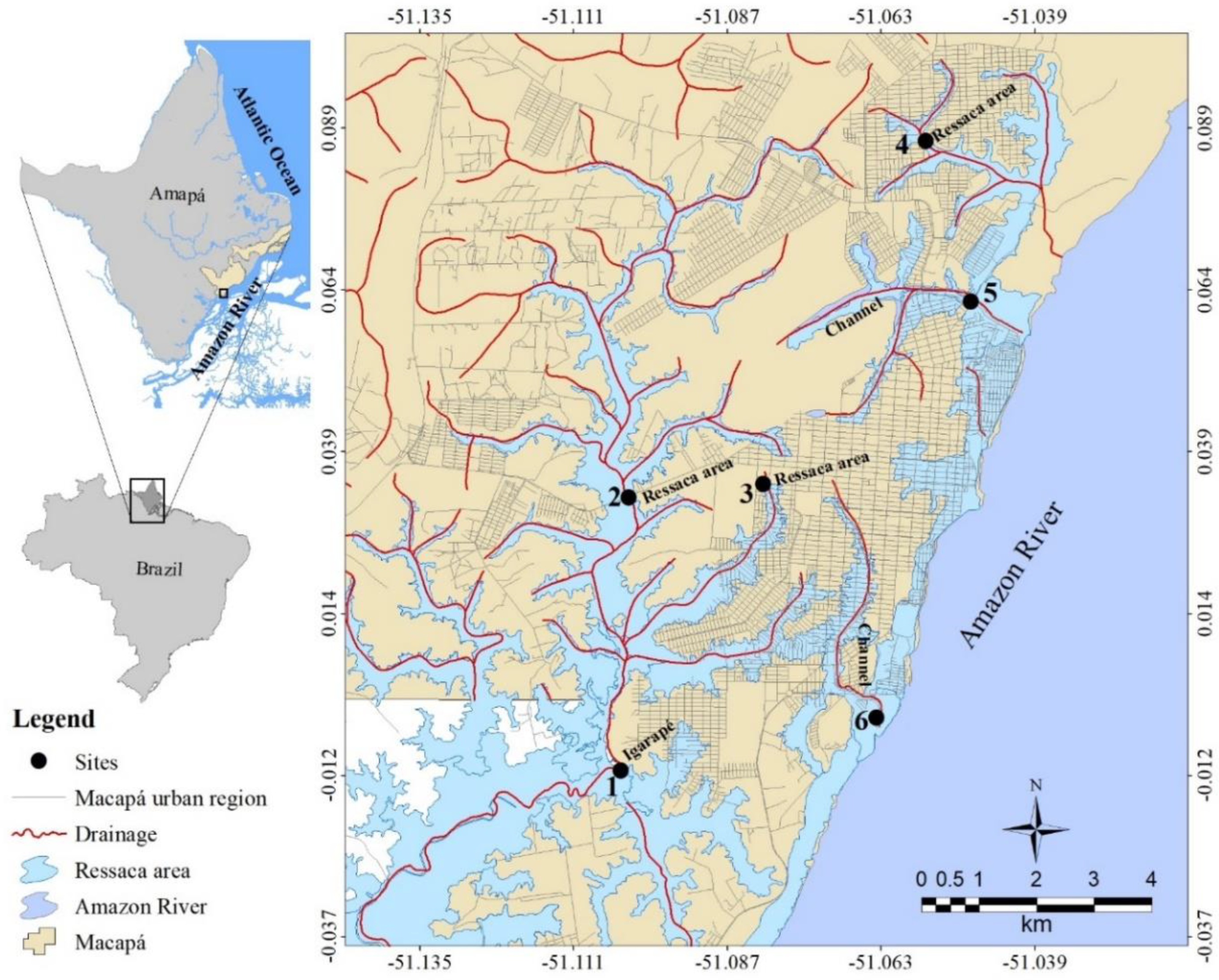
Figure 3.
Metal concentrations (µg g-1) present in fish muscle samples collected in different urban aquatic environments in Macapá. The red dotted line represents the maximum limit established for Cd by Brazilian legislation [28].
Figure 3.
Metal concentrations (µg g-1) present in fish muscle samples collected in different urban aquatic environments in Macapá. The red dotted line represents the maximum limit established for Cd by Brazilian legislation [28].
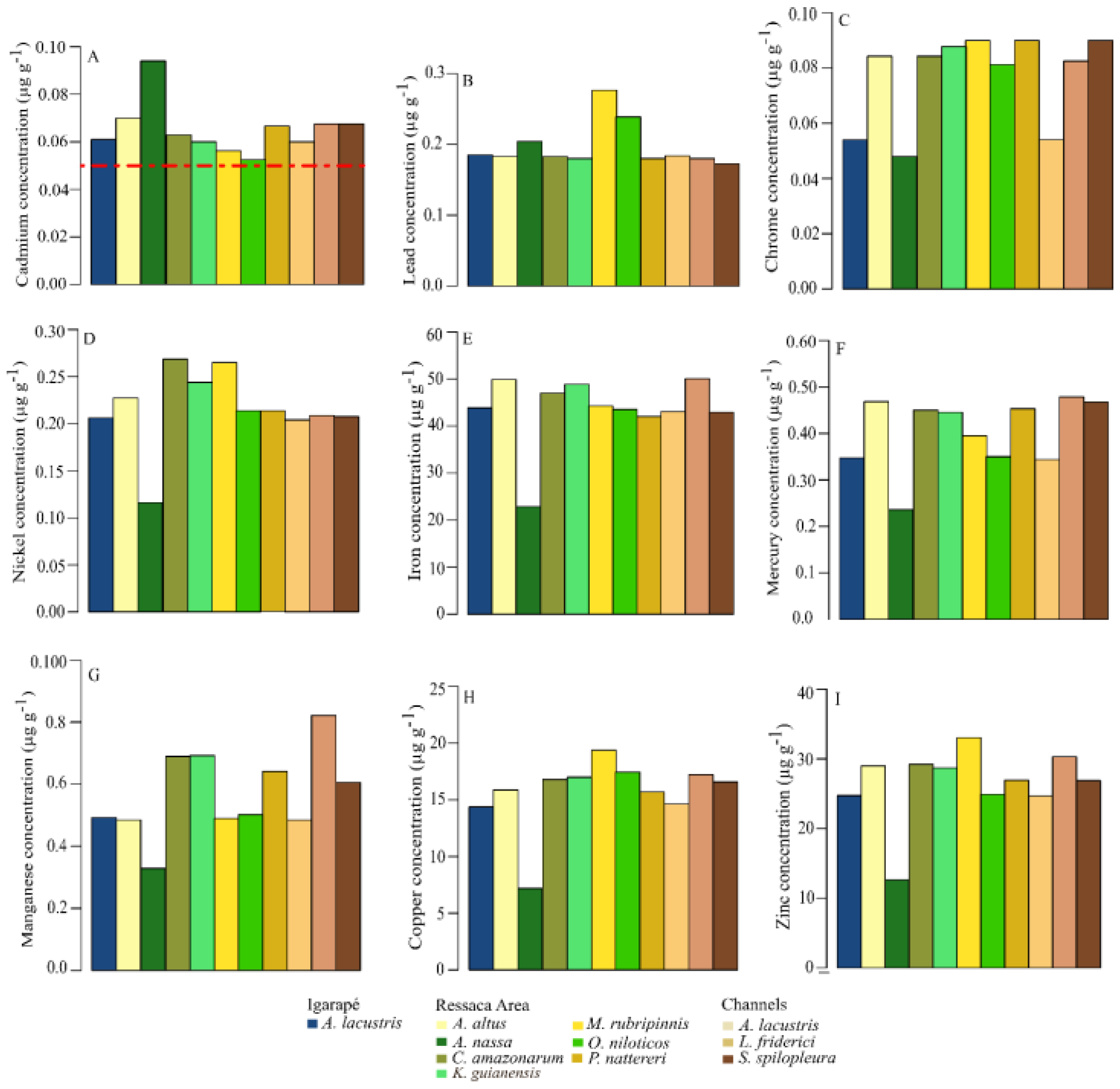
Figure 4.
Risk assessment for human health related to fish consumption sampled in different aquatic environments located within the Macapá urban area. RQs above the red dotted line represent risk to human health (RQs > 1).
Figure 4.
Risk assessment for human health related to fish consumption sampled in different aquatic environments located within the Macapá urban area. RQs above the red dotted line represent risk to human health (RQs > 1).
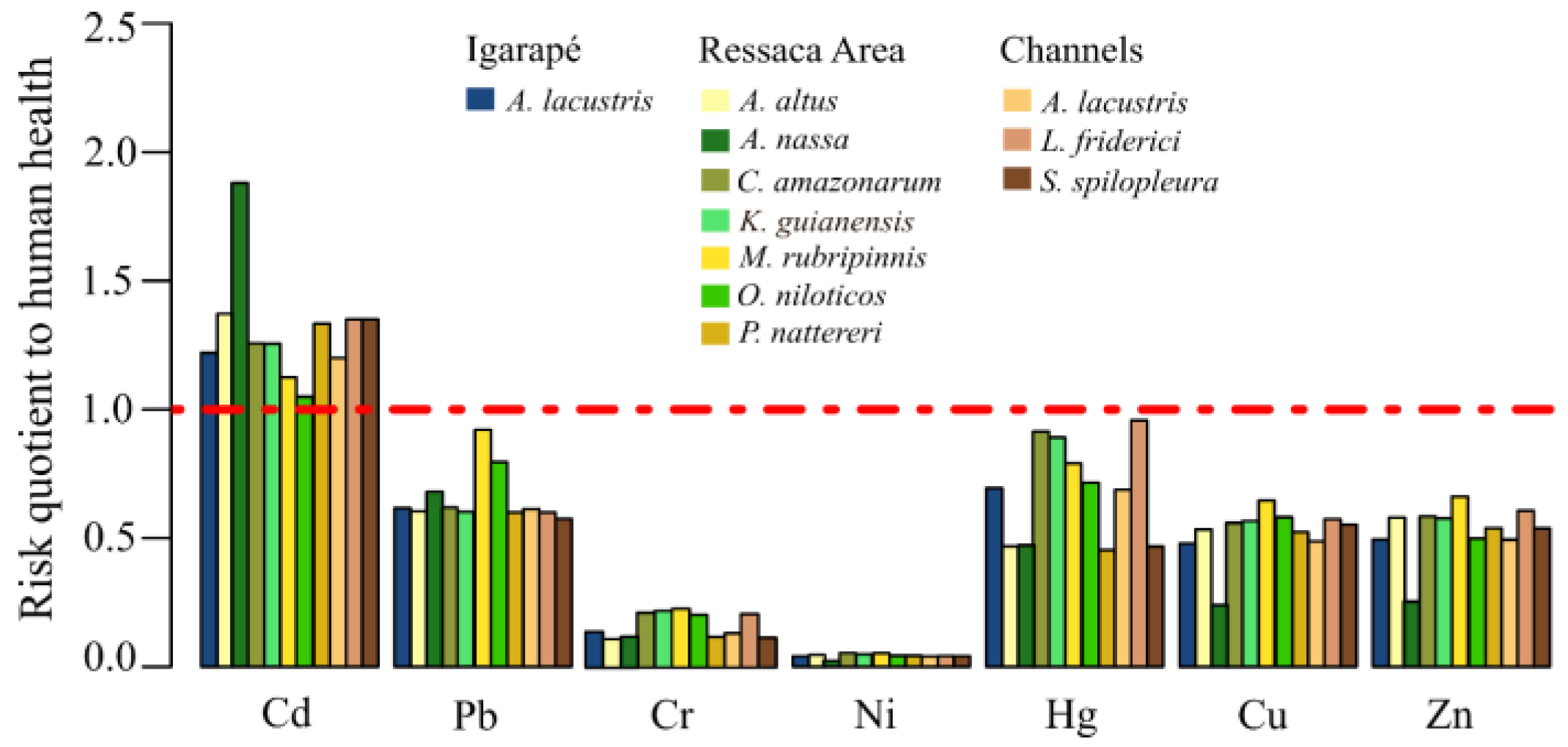
Figure 5.
Risk indexes (RIs) determined for the protection of human health in relation to the consumption of different fish species contaminated by mixtures of metals and collected in different aquatic environments from Macapá urban area. RIs above the red dotted line pose a risk to human health (IRs > 1).
Figure 5.
Risk indexes (RIs) determined for the protection of human health in relation to the consumption of different fish species contaminated by mixtures of metals and collected in different aquatic environments from Macapá urban area. RIs above the red dotted line pose a risk to human health (IRs > 1).
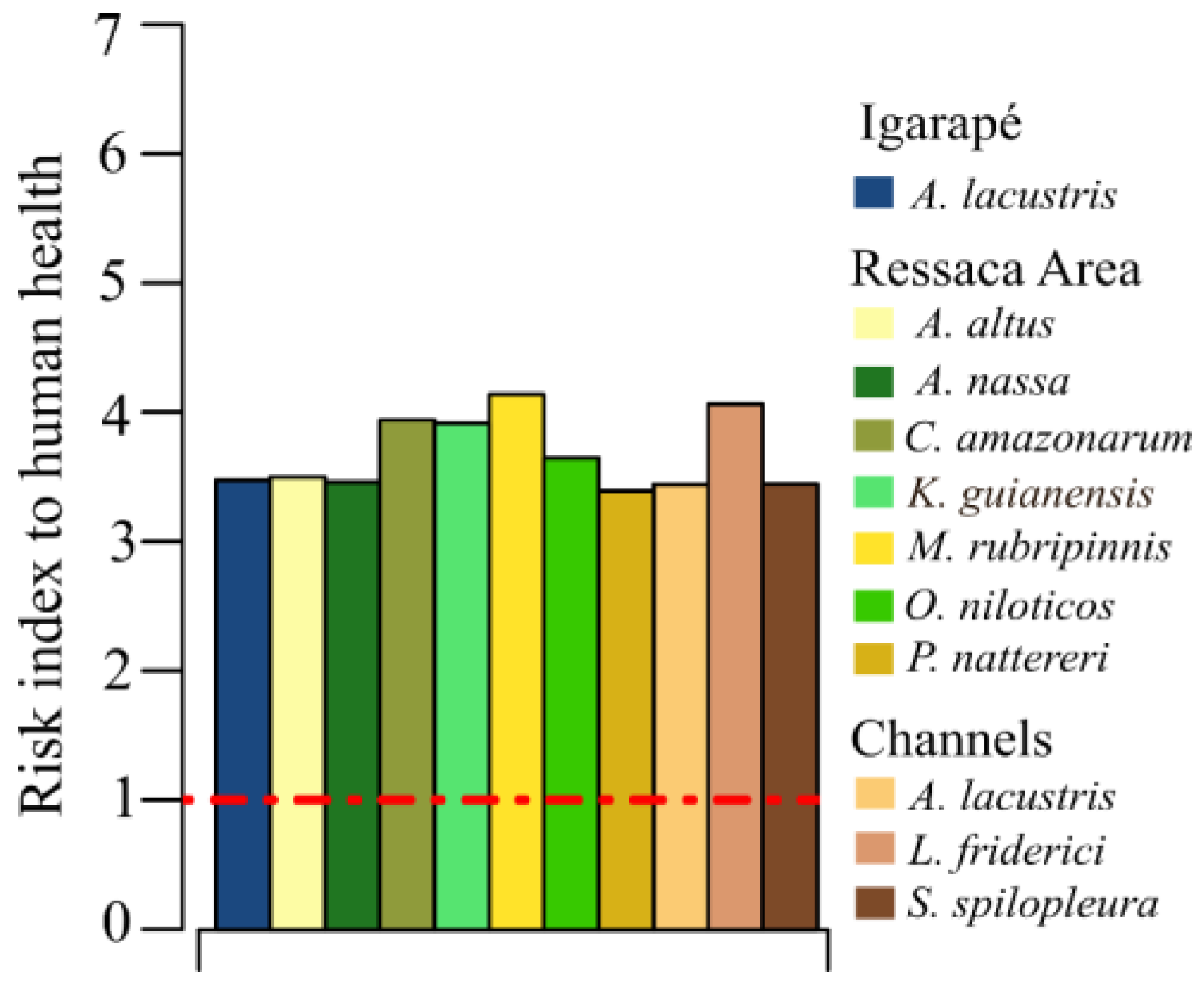

Table 1.
Sampled fish species, length (cm) and weight (g) (Mean ± SD), feeding habits, and habitats of different urban aquatic environments in Macapá, Amapá, Brazil.
Table 1.
Sampled fish species, length (cm) and weight (g) (Mean ± SD), feeding habits, and habitats of different urban aquatic environments in Macapá, Amapá, Brazil.
| Fish species | Igarapé | Ressaca areas | Channels | Standard length (cm) | Total weight (g) | Feeding habits | Habitats | |||
|---|---|---|---|---|---|---|---|---|---|---|
| Site 1 | Site 2 | Site 3 | Site 4 | Site 5 | Site 6 | |||||
| A. altus | 0 | 5 | 0 | 0 | 0 | 0 | 11.02±0.72 | 18.18±3.41 | Carnivore | Benthopelagic |
| P. nattereri | 0 | 5 | 0 | 0 | 0 | 0 | 8.84±1.66 | 37.56±20.76 | Carnivore | Pelagic |
| S. spilopleura | 0 | 0 | 0 | 0 | 0 | 4 | 7.25±0.31 | 12.80±2.20 | Carnivore | Benthopelagic |
| A. lacustris | 17 | 0 | 0 | 0 | 5 | 0 | 8.50±0.85 | 20.01±6.75 | Omnivore | Benthopelagic |
| A. nassa | 0 | 0 | 0 | 3 | 0 | 0 | 4.50±1.13 | 6.00±4.24 | Omnivore | Benthopelagic |
| C. amazonarum | 0 | 0 | 7 | 0 | 0 | 0 | 10.10±0.88 | 61.62±27.58 | Omnivore | Benthopelagic |
| K. guianensis | 0 | 0 | 20 | 0 | 0 | 0 | 11.16±0.99 | 63.80±40.54 | Omnivore | Benthopelagic |
| L. friderici | 0 | 0 | 0 | 0 | 0 | 9 | 9.02±2.67 | 23.87±14.82 | Omnivore | Benthopelagic |
| M. rubripinnis | 0 | 10 | 0 | 0 | 0 | 0 | 9.55±1.66 | 42.21±15.40 | Omnivore | Benthopelagic |
| O. niloticus | 0 | 0 | 7 | 0 | 0 | 0 | 23.28±2.46 | 512.57±166.44 | Omnivore | Benthopelagic |
| Total | 17 | 20 | 34 | 3 | 5 | 14 | ||||
Table 2.
Average daily intake (EDI) (μg kg-1bw day-1) of metals through consumption of fish muscle tissue from different species and feeding behavior collected in different urban aquatic environments in Macapá, Amapá, Brazil, and the oral reference dose (RfD) for each metal.
Table 2.
Average daily intake (EDI) (μg kg-1bw day-1) of metals through consumption of fish muscle tissue from different species and feeding behavior collected in different urban aquatic environments in Macapá, Amapá, Brazil, and the oral reference dose (RfD) for each metal.
| Fish species | Sites | Element daily intake (EDI) | ||||||||
|---|---|---|---|---|---|---|---|---|---|---|
| Cd | Pb | Cr | Ni | Fe | Hg | Mn | Cu | Zn | ||
| A. lacustris | Igarapé | 0.42 | 1.28 | 0.37 | 1.43 | 304.34 | 2.41 | 3.41 | 99.75 | 171.59 |
| A. altus | Ressaca areas | 0.47 | 1.26 | 0.58 | 1.58 | 346.72 | 3.25 | 3.36 | 111.07 | 201.17 |
| A. nassa | Ressaca areas | 0.65 | 1.41 | 0.33 | 0.80 | 158.80 | 1.64 | 2.28 | 49.86 | 87.75 |
| C. amazonarum | Ressaca areas | 0.44 | 1.29 | 0.58 | 1.87 | 329.23 | 3.17 | 4.78 | 116.48 | 202.67 |
| K. guianensis | Ressaca areas | 0.43 | 1.25 | 0.61 | 1.70 | 339.20 | 3.09 | 4.80 | 117.90 | 200.12 |
| M. rubripinnis | Ressaca areas | 0.39 | 1.92 | 9.22 | 1.84 | 307.36 | 2.74 | 3.37 | 134.44 | 229.37 |
| O. niloticus | Ressaca areas | 0.36 | 1.65 | 0.56 | 1.48 | 301.30 | 2.48 | 3.48 | 120.93 | 172.91 |
| P. nattereri | Ressaca areas | 0.46 | 1.25 | 0.62 | 1.48 | 291.54 | 3.15 | 4.44 | 108.93 | 186.86 |
| A. lacustris | Channels | 0.41 | 1.27 | 0.37 | 1.41 | 298.72 | 2.39 | 3.36 | 101.47 | 171.37 |
| L. friderici | Channels | 0.47 | 1.25 | 0.57 | 1.45 | 347.55 | 3.32 | 5.70 | 119.45 | 210.41 |
| S. spilopleura | Channels | 0.47 | 1.20 | 0.62 | 1.44 | 297.96 | 3.24 | 4.20 | 114.98 | 186.63 |
| RfD | 0.83a | 3.57b | 45.00a | 1000.00a | 3470.00 a | 0.57a | 2300.00a | 6935.00a | 23,500.00a | |
Disclaimer/Publisher’s Note: The statements, opinions and data contained in all publications are solely those of the individual author(s) and contributor(s) and not of MDPI and/or the editor(s). MDPI and/or the editor(s) disclaim responsibility for any injury to people or property resulting from any ideas, methods, instructions or products referred to in the content. |
© 2024 by the authors. Licensee MDPI, Basel, Switzerland. This article is an open access article distributed under the terms and conditions of the Creative Commons Attribution (CC BY) license (http://creativecommons.org/licenses/by/4.0/).
Copyright: This open access article is published under a Creative Commons CC BY 4.0 license, which permit the free download, distribution, and reuse, provided that the author and preprint are cited in any reuse.