

Submitted:
05 December 2024
Posted:
06 December 2024
You are already at the latest version
Abstract
The voles and lemmings (subfamily Arvicolinae) remain one of the most difficult groups for disentangling phylogenetic relationships due to recent and very fast explosive radiation. The rapid radiations are challenging for phylogenetic analysis producing bushes of various forms impossible to resolve with a straightforward approach using individual loci. Here using quaddRADseq technique and comprehensive sample and transcriptomes on a limited sample we test whether the data from the nuclear genome are consistent with the trees inferred earlier in topology and divergence dating and evaluate the relative influence of sample number versus number of molecular markers. The study demonstrates that most plausible and reliable dated phylogeny of Arvicolinae at the supraspecies level is given by nuclear data. At the same time, the divergence dating is highly dependent on the number and position of calibration points at the tree and sample number. The most vulnerable for phylogenetic inference is the position of nodes with insufficient taxa sample. The challenge of rapid radiation in phylogeny reconstruction is easier to overcome when the number of recent taxa is not less than the number of extinctions. The robust resolution may be achieved only by accounting both the number of molecular markers and the sample size.
Keywords:
1. Introduction
2. Materials and Methods
2.1. Sampling
2.2. DNA and RNA Isolation, Library Preparation, and Sequencing
2.3. Phylogenetic Tree Reconstruction Using Transcriptomic Dataset
2.4. Phylogenetic Tree Reconstruction Using ddRADseq Dataset
2.5. Molecular Dating
3. Results
3.1. Transcriptome Sequencing and Assembly
3.2. Phylogenetic Inference From Transcriptomic Dataset
3.4. Divergence Dating
4. Discussion
4.1. Features of Different Radiation Waves Within Arvicolinae
4.2. Phylogenetic Relations of Supraspecies Taxa Within Arvicolinae. Сcomparison of Results Inferred From Various Data Sets
4.3. Divergence Dating
5. Conclusions
Supplementary Materials
Author Contributions
Funding
Institutional Review Board Statement
Data Availability Statement
Acknowledgments
Conflicts of Interest
References
- Fejfar, O.; Heinrich, W.-D.; Kordos, L.; Maul, L. C. Microtoid Cricetids and the Early History of Arvicolids (Mammalia, Rodentia). Palaeontol Electron 2011, 14. [Google Scholar]
- Martin, R. A. Arvicolidae. In Evolution of Tertiary Mammals of North America; Janis, C. M., Gunnell, G. F., Uhen, M. D., Eds.; Cambridge University Press, 2007; Vol. 2, pp 480–497.
- Susko, E.; Roger, A. J. Long Branch Attraction Biases in Phylogenetics. Syst. Biol. 2021, 70, 838–843. [Google Scholar] [CrossRef] [PubMed]
- Abramson, N. I.; Lebedev, V. S.; Tesakov, A. S.; Bannikova, A. A. Supraspecies Relationships in the Subfamily Arvicolinae (Rodentia, Cricetidae): An Unexpected Result of Nuclear Gene Analysis. Mol. Biol. 2009, 43, 834–846. [Google Scholar] [CrossRef]
- Abramson, N. I.; Bodrov, S. Yu.; Bondareva, O. V.; Genelt-Yanovskiy, E. A.; Petrova, T. V. A Mitochondrial Genome Phylogeny of Voles and Lemmings (Rodentia: Arvicolinae): Evolutionary and Taxonomic Implications. PLOS ONE 2021, 16, e0248198. [Google Scholar] [CrossRef]
- Kohli, B. A.; Speer, K. A.; Kilpatrick, C. W.; Batsaikhan, N.; Damdinbaza, D.; Cook, J. A. Multilocus Systematics and Non-Punctuated Evolution of Holarctic Myodini (Rodentia: Arvicolinae). Mol. Phylogenet. Evol. 2014, 76, 18–29. [Google Scholar] [CrossRef] [PubMed]
- Buzan, E. V.; Krystufek, B.; Hänfling, B.; Hutchinson, W. F. Mitochondrial Phylogeny of Arvicolinae Using Comprehensive Taxonomic Sampling Yields New Insights: PHYLOGENY OF ARVICOLINAE. Biol. J. Linn. Soc. 2008, 94, 825–835. [Google Scholar] [CrossRef]
- Bodrov, S. Yu.; Kostygov, A. Yu.; Rudneva, L. V.; Abramson, N. I. Revision of the Taxonomic Position of the Olkhon Mountain Vole (Rodentia, Cricetidae). Biol. Bull. 2016, 43, 136–145. [Google Scholar] [CrossRef]
- Tryfonopoulos, G.; Thanou, E.; Chondropoulos, B.; Fraguedakis-Tsolis, S. mtDNA Analysis Reveals the Ongoing Speciation on Greek Populations of Microtus (Terricola) Thomasi (Arvicolidae, Rodentia): ONGOING SPECIATION IN GREEK VOLES. Biol. J. Linn. Soc. 2008, 95, 117–130. [Google Scholar] [CrossRef]
- Paupério, J.; Herman, J. S.; Melo-Ferreira, J.; Jaarola, M.; Alves, P. C.; Searle, J. B. Cryptic Speciation in the Field Vole: A Multilocus Approach Confirms Three Highly Divergent Lineages in E Urasia. Mol. Ecol. 2012, 21, 6015–6032. [Google Scholar] [CrossRef]
- Galewski, T.; Tilak, M.; Sanchez, S.; Chevret, P.; Paradis, E.; Douzery, E. J. The Evolutionary Radiation of Arvicolinae Rodents (Voles and Lemmings): Relative Contribution of Nuclear and Mitochondrial DNA Phylogenies. BMC Evol. Biol. 2006, 6, 80. [Google Scholar] [CrossRef] [PubMed]
- Steppan, S. J.; Schenk, J. J. Muroid Rodent Phylogenetics: 900-Species Tree Reveals Increasing Diversification Rates. PLOS ONE 2017, 12, e0183070. [Google Scholar] [CrossRef]
- Withnell, C. B.; Scarpetta, S. G. A New Perspective on the Taxonomy and Systematics of Arvicolinae (Gray, 1821) and a New Time-Calibrated Phylogeny for the Clade. PeerJ 2024, 12, e16693. [Google Scholar] [CrossRef] [PubMed]
- Hassanin, A.; Bonillo, C.; Tshikung, D.; Pongombo Shongo, C.; Pourrut, X.; Kadjo, B.; Nakouné, E.; Tu, V. T.; Prié, V.; Goodman, S. M. Phylogeny of African Fruit Bats (Chiroptera, Pteropodidae) Based on Complete Mitochondrial Genomes. J. Zool. Syst. Evol. Res. 2020, 58, 1395–1410. [Google Scholar] [CrossRef]
- Hassanin, A.; Veron, G.; Ropiquet, A.; Jansen Van Vuuren, B.; Lécu, A.; Goodman, S. M.; Haider, J.; Nguyen, T. T. Evolutionary History of Carnivora (Mammalia, Laurasiatheria) Inferred from Mitochondrial Genomes. PLOS ONE 2021, 16, e0240770. [Google Scholar] [CrossRef]
- Kundu, S.; Kumar, V.; Tyagi, K.; Chandra, K. The Complete Mitochondrial Genome of the Endangered Assam Roofed Turtle, Pangshura Sylhetensis (Testudines: Geoemydidae): Genomic Features and Phylogeny. PLOS ONE 2020, 15, e0225233. [Google Scholar] [CrossRef] [PubMed]
- Barlow, A.; Paijmans, J. L. A.; Alberti, F.; Gasparyan, B.; Bar-Oz, G.; Pinhasi, R.; Foronova, I.; Puzachenko, A. Y.; Pacher, M.; Dalén, L.; Baryshnikov, G.; Hofreiter, M. Middle Pleistocene Genome Calibrates a Revised Evolutionary History of Extinct Cave Bears. Curr. Biol. 2021, 31, 1771–1779.e7. [Google Scholar] [CrossRef]
- Wallis, G. P.; Cameron-Christie, S. R.; Kennedy, H. L.; Palmer, G.; Sanders, T. R.; Winter, D. J. Interspecific Hybridization Causes Long-term Phylogenetic Discordance between Nuclear and Mitochondrial Genomes in Freshwater Fishes. Mol. Ecol. 2017, 26, 3116–3127. [Google Scholar] [CrossRef] [PubMed]
- Dvoyashov, I. A.; Bodrov, S. Yu.; Mamaev, N. V.; Glagoleva, E. S.; Abramson, N. I. Inferring Phylogenetic Structure, Taxa Hybridization, and Divergence Times within Rock Voles of Subgenus Aschizomys (Cricetidae: Alticola) Using quaddRAD Sequencing and a Cytb Dataset. Ecol. Evol. 2023, 13, e10742. [Google Scholar] [CrossRef]
- Da Fonseca, R. R.; Johnson, W. E.; O’Brien, S. J.; Ramos, M. J.; Antunes, A. The Adaptive Evolution of the Mammalian Mitochondrial Genome. BMC Genomics 2008, 9, 119. [Google Scholar] [CrossRef] [PubMed]
- Romero, P. E.; Weigand, A. M.; Pfenninger, M. Positive Selection on Panpulmonate Mitogenomes Provide New Clues on Adaptations to Terrestrial Life. BMC Evol. Biol. 2016, 16, 164. [Google Scholar] [CrossRef]
- Strohm, J. H. T.; Gwiazdowski, R. A.; Hanner, R. Fast Fish Face Fewer Mitochondrial Mutations: Patterns of dN/dS across Fish Mitogenomes. Gene 2015, 572, 27–34. [Google Scholar] [CrossRef] [PubMed]
- Lemmon, A. R.; Emme, S. A.; Lemmon, E. M. Anchored Hybrid Enrichment for Massively High-Throughput Phylogenomics. Syst. Biol. 2012, 61, 727–744. [Google Scholar] [CrossRef] [PubMed]
- Lemmon, E. M.; Lemmon, A. R. High-Throughput Genomic Data in Systematics and Phylogenetics. Annu. Rev. Ecol. Evol. Syst. 2013, 44, 99–121. [Google Scholar] [CrossRef]
- Weitemier, K.; Straub, S. C. K.; Cronn, R. C.; Fishbein, M.; Schmickl, R.; McDonnell, A.; Liston, A. Hyb-Seq: Combining Target Enrichment and Genome Skimming for Plant Phylogenomics. Appl. Plant Sci. 2014, 2, 1400042. [Google Scholar] [CrossRef] [PubMed]
- Petrova, T.; Skazina, M.; Kuksin, A.; Bondareva, O.; Abramson, N. Narrow-Headed Voles Species Complex (Cricetidae, Rodentia): Evidence for Species Differentiation Inferred from Transcriptome Data. Diversity 2022, 14, 512. [Google Scholar] [CrossRef]
- Bondareva, O.; Petrova, T.; Bodrov, S.; Gavrilo, M.; Smorkatcheva, A.; Abramson, N. How Voles Adapt to Subterranean Lifestyle: Insights from RNA-Seq. Front. Ecol. Evol. 2023, 11, 1085993. [Google Scholar] [CrossRef]
- Franchini, P.; Monné Parera, D.; Kautt, A. F.; Meyer, A. quaddRAD: A New High-multiplexing and PCR Duplicate Removal ddRAD Protocol Produces Novel Evolutionary Insights in a Nonradiating Cichlid Lineage. Mol. Ecol. 2017, 26, 2783–2795. [Google Scholar] [CrossRef]
- Andrews, S. FastQC: A Quality Control Tool for High Throughput Sequence Data, 2010. https://www.bioinformatics.babraham.ac.uk/projects/fastqc/ (accessed 2019-09-01).
- Bolger, A. M.; Lohse, M.; Usadel, B. Trimmomatic: A Flexible Trimmer for Illumina Sequence Data. Bioinformatics 2014, 30, 2114–2120. [Google Scholar] [CrossRef]
- Chen, S.; Zhou, Y.; Chen, Y.; Gu, J. Fastp: An Ultra-Fast All-in-One FASTQ Preprocessor. Bioinformatics 2018, 34, i884–i890. [Google Scholar] [CrossRef] [PubMed]
- Langmead, B.; Trapnell, C.; Pop, M.; Salzberg, S. L. Ultrafast and Memory-Efficient Alignment of Short DNA Sequences to the Human Genome. Genome Biol. 2009, 10, R25. [Google Scholar] [CrossRef]
- Haas, B. J.; Papanicolaou, A.; Yassour, M.; Grabherr, M.; Blood, P. D.; Bowden, J.; Couger, M. B.; Eccles, D.; Li, B.; Lieber, M. De Novo Transcript Sequence Reconstruction from RNA-Seq Using the Trinity Platform for Reference Generation and Analysis. Nat. Protoc. 2013, 8, 1494–1512. [Google Scholar] [CrossRef] [PubMed]
- Manni, M.; Berkeley, M. R.; Seppey, M.; Simão, F. A.; Zdobnov, E. M. BUSCO Update: Novel and Streamlined Workflows along with Broader and Deeper Phylogenetic Coverage for Scoring of Eukaryotic, Prokaryotic, and Viral Genomes. Mol. Biol. Evol. 2021, 38, 4647–4654. [Google Scholar] [CrossRef]
- Fu, L.; Niu, B.; Zhu, Z.; Wu, S.; Li, W. CD-HIT: Accelerated for Clustering the next-Generation Sequencing Data. Bioinformatics 2012, 28, 3150–3152. [Google Scholar] [CrossRef] [PubMed]
- Lechner, M.; Findeiß, S.; Steiner, L.; Marz, M.; Stadler, P. F.; Prohaska, S. J. Proteinortho: Detection of (Co-)Orthologs in Large-Scale Analysis. BMC Bioinformatics 2011, 12, 124. [Google Scholar] [CrossRef]
- Löytynoja, A. Phylogeny-Aware Alignment with PRANK. In Multiple Sequence Alignment Methods; Russell, D. J., Ed.; Methods in Molecular Biology; Humana Press: Totowa, NJ, 2014; Vol. 1079, pp. 155–170. [Google Scholar] [CrossRef]
- Okonechnikov, K.; Golosova, O.; Fursov, M.; the UGENE team. Unipro UGENE: A Unified Bioinformatics Toolkit. Bioinformatics 2012, 28, 1166–1167. [Google Scholar] [CrossRef] [PubMed]
- Shen, W.; Sipos, B.; Zhao, L. SeqKit2: A Swiss Army Knife for Sequence and Alignment Processing. iMeta 2024, 3, e191. [Google Scholar] [CrossRef]
- Castresana, J. Selection of Conserved Blocks from Multiple Alignments for Their Use in Phylogenetic Analysis. Mol. Biol. Evol. 2000, 17, 540–552. [Google Scholar] [CrossRef]
- Minh, B. Q.; Schmidt, H. A.; Chernomor, O.; Schrempf, D.; Woodhams, M. D.; Von Haeseler, A.; Lanfear, R. IQ-TREE 2: New Models and Efficient Methods for Phylogenetic Inference in the Genomic Era. Mol. Biol. Evol. 2020, 37, 1530–1534. [Google Scholar] [CrossRef]
- Hoang, D. T.; Chernomor, O.; Von Haeseler, A.; Minh, B. Q.; Vinh, L. S. UFBoot2: Improving the Ultrafast Bootstrap Approximation. Mol. Biol. Evol. 2018, 35, 518–522. [Google Scholar] [CrossRef] [PubMed]
- Kalyaanamoorthy, S.; Minh, B. Q.; Wong, T. K. F.; Von Haeseler, A.; Jermiin, L. S. ModelFinder: Fast Model Selection for Accurate Phylogenetic Estimates. Nat. Methods 2017, 14, 587–589. [Google Scholar] [CrossRef]
- Morel, B.; Kozlov, A. M.; Stamatakis, A. ParGenes: A Tool for Massively Parallel Model Selection and Phylogenetic Tree Inference on Thousands of Genes. Bioinformatics 2019, 35, 1771–1773. [Google Scholar] [CrossRef] [PubMed]
- Kozlov, A. M.; Darriba, D.; Flouri, T.; Morel, B.; Stamatakis, A. RAxML-NG: A Fast, Scalable and User-Friendly Tool for Maximum Likelihood Phylogenetic Inference. Bioinformatics 2019, 35, 4453–4455. [Google Scholar] [CrossRef]
- Huerta-Cepas, J.; Serra, F.; Bork, P. ETE 3: Reconstruction, Analysis, and Visualization of Phylogenomic Data. Mol. Biol. Evol. 2016, 33, 1635–1638. [Google Scholar] [CrossRef] [PubMed]
- Bouckaert, R. R. DensiTree: Making Sense of Sets of Phylogenetic Trees. Bioinformatics 2010, 26, 1372–1373. [Google Scholar] [CrossRef] [PubMed]
- Zhang, C.; Rabiee, M.; Sayyari, E.; Mirarab, S. ASTRAL-III: Polynomial Time Species Tree Reconstruction from Partially Resolved Gene Trees. BMC Bioinformatics 2018, 19, 153. [Google Scholar] [CrossRef] [PubMed]
- Zhang, C.; Mirarab, S. Weighting by Gene Tree Uncertainty Improves Accuracy of Quartet-Based Species Trees. Mol. Biol. Evol. 2022, 39, msac215. [Google Scholar] [CrossRef] [PubMed]
- Douglas, J.; Jiménez-Silva, C. L.; Bouckaert, R. StarBeast3: Adaptive Parallelized Bayesian Inference under the Multispecies Coalescent. Syst. Biol. 2022, 71, 901–916. [Google Scholar] [CrossRef] [PubMed]
- Rambaut, A.; Drummond, A. J.; Xie, D.; Baele, G.; Suchard, M. A. Posterior Summarization in Bayesian Phylogenetics Using Tracer 1.7. Syst. Biol. 2018, 67, 901–904. [Google Scholar] [CrossRef]
- Catchen, J.; Hohenlohe, P. A.; Bassham, S.; Amores, A.; Cresko, W. A. Stacks: An Analysis Tool Set for Population Genomics. Mol. Ecol. 2013, 22, 3124–3140. [Google Scholar] [CrossRef]
- Li, H.; Durbin, R. Fast and Accurate Long-Read Alignment with Burrows–Wheeler Transform. Bioinformatics 2010, 26, 589–595. [Google Scholar] [CrossRef]
- Danecek, P.; Bonfield, J. K.; Liddle, J.; Marshall, J.; Ohan, V.; Pollard, M. O.; Whitwham, A.; Keane, T.; McCarthy, S. A.; Davies, R. M.; Li, H. Twelve Years of SAMtools and BCFtools. GigaScience 2021, 10, giab008. [Google Scholar] [CrossRef]
- Ortiz, E. M. Vcf2phylip v2.0: Convert a VCF Matrix into Several Matrix Formats for Phylogenetic Analysis., 2019. [CrossRef]
- Koboldt, D. C.; Zhang, Q.; Larson, D. E.; Shen, D.; McLellan, M. D.; Lin, L.; Miller, C. A.; Mardis, E. R.; Ding, L.; Wilson, R. K. VarScan 2: Somatic Mutation and Copy Number Alteration Discovery in Cancer by Exome Sequencing. Genome Res. 2012, 22, 568–576. [Google Scholar] [CrossRef] [PubMed]
- Bouckaert, R.; Vaughan, T. G.; Barido-Sottani, J.; Duchêne, S.; Fourment, M.; Gavryushkina, A.; Heled, J.; Jones, G.; Kühnert, D.; De Maio, N.; Matschiner, M.; Mendes, F. K.; Müller, N. F.; Ogilvie, H. A.; Du Plessis, L.; Popinga, A.; Rambaut, A.; Rasmussen, D.; Siveroni, I.; Suchard, M. A.; Wu, C.-H.; Xie, D.; Zhang, C.; Stadler, T.; Drummond, A. J. BEAST 2.5: An Advanced Software Platform for Bayesian Evolutionary Analysis. PLOS Comput. Biol. 2019, 15, e1006650. [Google Scholar] [CrossRef]
- Bouckaert, R. R.; Drummond, A. J. bModelTest: Bayesian Phylogenetic Site Model Averaging and Model Comparison. BMC Evol. Biol. 2017, 17, 42. [Google Scholar] [CrossRef]
- Whitfield, J. B.; Lockhart, P. J. Deciphering Ancient Rapid Radiations. Trends Ecol. Evol. 2007, 22, 258–265. [Google Scholar] [CrossRef] [PubMed]
- Patel, S. Error in Phylogenetic Estimation for Bushes in the Tree of Life. J. Phylogenetics Evol. Biol. 2013, 01. [Google Scholar] [CrossRef]
- Nichols, R. Gene Trees and Species Trees Are Not the Same. Trends Ecol. Evol. 2001, 16, 358–364. [Google Scholar] [CrossRef] [PubMed]
- Nesi, N.; Tsagkogeorga, G.; Tsang, S. M.; Nicolas, V.; Lalis, A.; Scanlon, A. T.; Riesle-Sbarbaro, S. A.; Wiantoro, S.; Hitch, A. T.; Juste, J.; Pinzari, C. A.; Bonaccorso, F. J.; Todd, C. M.; Lim, B. K.; Simmons, N. B.; McGowen, M. R.; Rossiter, S. J. Interrogating Phylogenetic Discordance Resolves Deep Splits in the Rapid Radiation of Old World Fruit Bats (Chiroptera: Pteropodidae). Syst. Biol. 2021, 70, 1077–1089. [Google Scholar] [CrossRef] [PubMed]
- Olave, M.; Meyer, A. Implementing Large Genomic Single Nucleotide Polymorphism Data Sets in Phylogenetic Network Reconstructions: A Case Study of Particularly Rapid Radiations of Cichlid Fish. Syst. Biol. 2020, 69, 848–862. [Google Scholar] [CrossRef]
- Maddison, W. P.; Knowles, L. L. Inferring Phylogeny Despite Incomplete Lineage Sorting. Syst. Biol. 2006, 55, 21–30. [Google Scholar] [CrossRef]
- McCormack, J. E.; Huang, H.; Knowles, L. L. Maximum Likelihood Estimates of Species Trees: How Accuracy of Phylogenetic Inference Depends upon the Divergence History and Sampling Design. Syst. Biol. 2009, 58, 501–508. [Google Scholar] [CrossRef] [PubMed]
- Heled, J.; Drummond, A. J. Bayesian Inference of Species Trees from Multilocus Data. Mol. Biol. Evol. 2010, 27, 570–580. [Google Scholar] [CrossRef] [PubMed]
- Corl, A.; Ellegren, H. Sampling Strategies for Species Trees: The Effects on Phylogenetic Inference of the Number of Genes, Number of Individuals, and Whether Loci Are Mitochondrial, Sex-Linked, or Autosomal. Mol. Phylogenet. Evol. 2013, 67, 358–366. [Google Scholar] [CrossRef] [PubMed]
- Alfaro-Ibáñez, M.; Lira-Garrido, J.; Cuenca-Bescós, G.; Pons, J.; Bover, P. Insights on the Evolution of the Tribe Pliomyini (Arvicolinae, Rodentia): Ancient DNA from the Extinct Pliomys Lenki. Palaeontol. Electron. 2024. [Google Scholar] [CrossRef] [PubMed]
- Heinrich, W.-D. Some Aspectsof Evolution and Biostratigraphy of Arvicola(Mammalia, Rodentia) in the Central European Pleistocene. In Evolution, Phylogeny and Biostratigraphy of Arvicolids (Rodentia.Mammalia); Fejfar, O., Heinrich, W.-D., Eds.; Geological Survey: Prague, 1990; pp. 165–182. [Google Scholar]
- Koenigswald, W.; van Kolfschoten, T. The Mimomys-Arvicola Boundary and the Enamel Thickness Quotient (SDQ) of Arvicola as Stratigraphic Markers in the Middle Pleistocene. In The Early Middle Pleistocene in Europe; Nurner, E., Ed.; Balkema: Rotterdam, 1996; pp. 211–226. [Google Scholar]
- Pardiñas, U. F. J.; Myers, P.; León-Paniagua, L.; Ordóñez Garza, N.; Cook, J. A.; Kryštufek, B. Family Cricetidae (True Hamsters, Voles, Lemmings and New World Rats and Mice). Handb Mamm World. In Handbook of the Mammals of the World; Lynx Edicions: Barcelona, 2017; Vol. 7, pp. 204–279. [Google Scholar]
- Villaverde, T.; Maguilla, E.; Luceño, M.; Hipp, A. L. Assessing the Sensitivity of Divergence Time Estimates to Locus Sampling, Calibration Points, and Model Priors in a RAD-seq Phylogeny of Carex Section Schoenoxiphium. J. Syst. Evol. 2021, 59, 687–697. [Google Scholar] [CrossRef]
- Near, T. J.; Sanderson, M. J. Assessing the Quality of Molecular Divergence Time Estimates by Fossil Calibrations and Fossil–Based Model Selection. Philos. Trans. R. Soc. Lond. B. Biol. Sci. 2004, 359, 1477–1483. [Google Scholar] [CrossRef]
- Hug, L. A.; Roger, A. J. The Impact of Fossils and Taxon Sampling on Ancient Molecular Dating Analyses. Mol. Biol. Evol. 2007, 24, 1889–1897. [Google Scholar] [CrossRef]
- Sauquet, H.; Ho, S. Y. W.; Gandolfo, M. A.; Jordan, G. J.; Wilf, P.; Cantrill, D. J.; Bayly, M. J.; Bromham, L.; Brown, G. K.; Carpenter, R. J.; Lee, D. M.; Murphy, D. J.; Sniderman, J. M. K.; Udovicic, F. Testing the Impact of Calibration on Molecular Divergence Times Using a Fossil-Rich Group: The Case of Nothofagus (Fagales). Syst. Biol. 2012, 61, 289–313. [Google Scholar] [CrossRef] [PubMed]
- Duchêne, S.; Holmes, E. C.; Ho, S. Y. W. Analyses of Evolutionary Dynamics in Viruses Are Hindered by a Time-Dependent Bias in Rate Estimates. Proc. R. Soc. B Biol. Sci. 2014, 281, 20140732. [Google Scholar] [CrossRef]
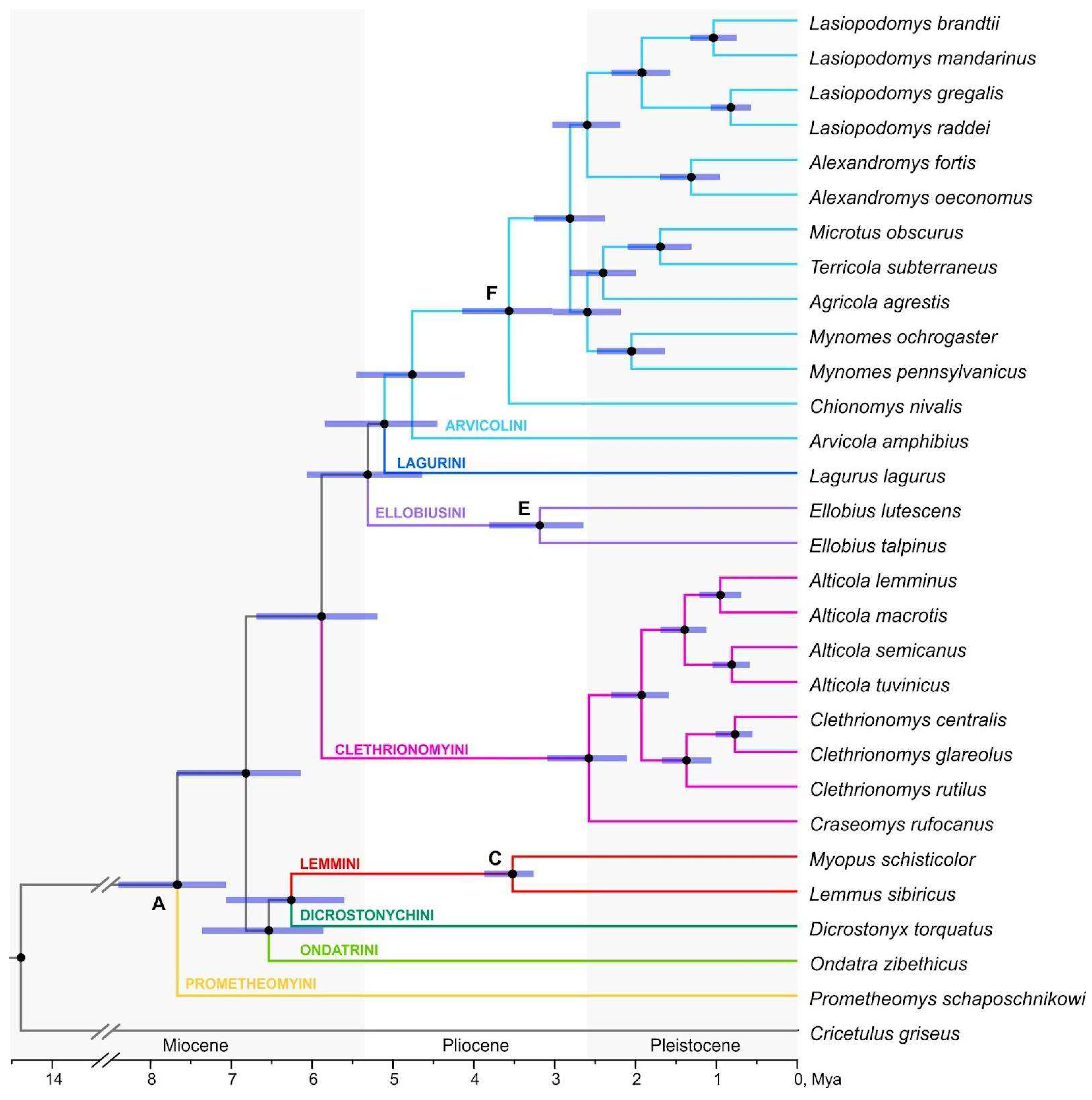
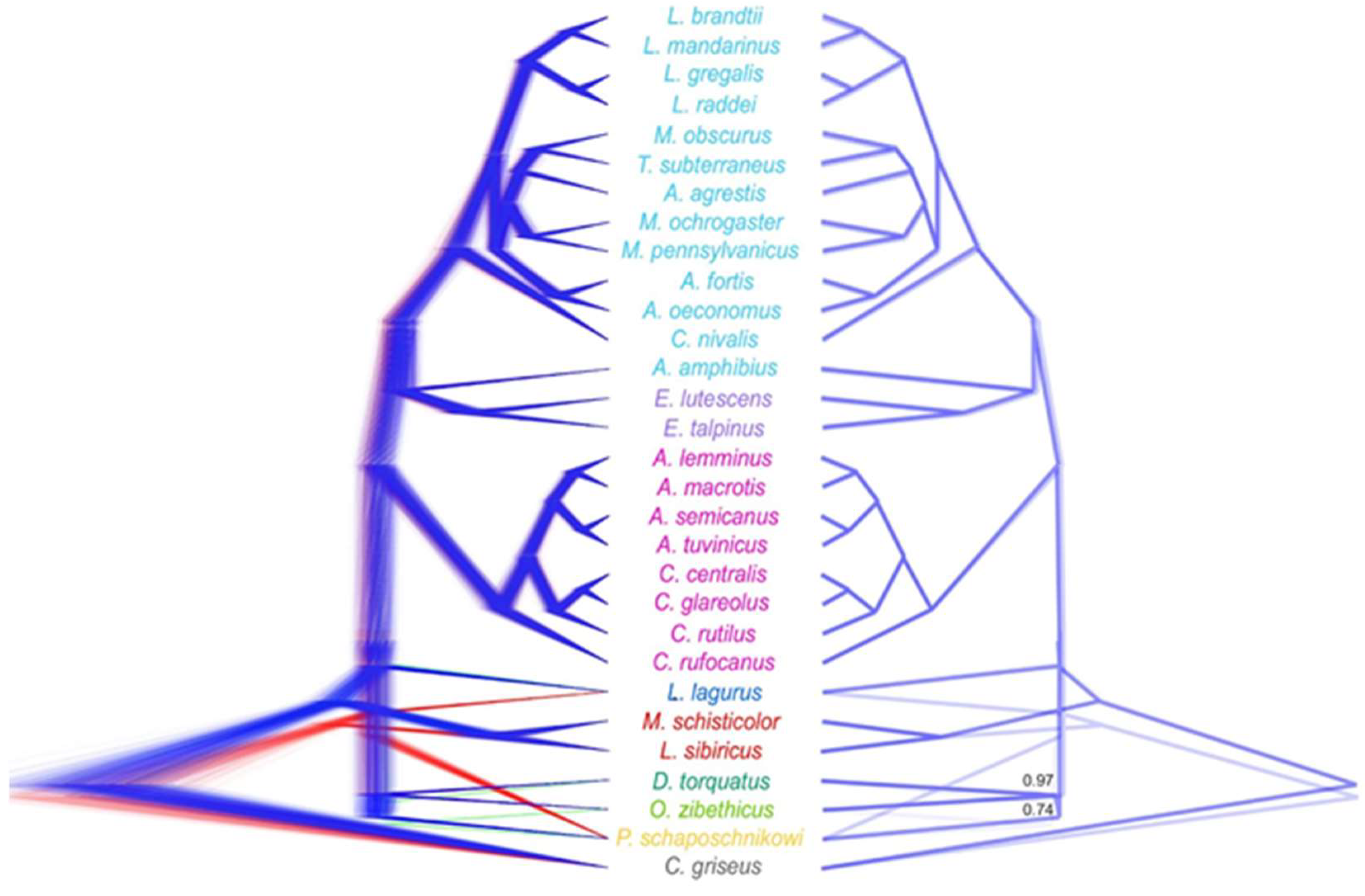
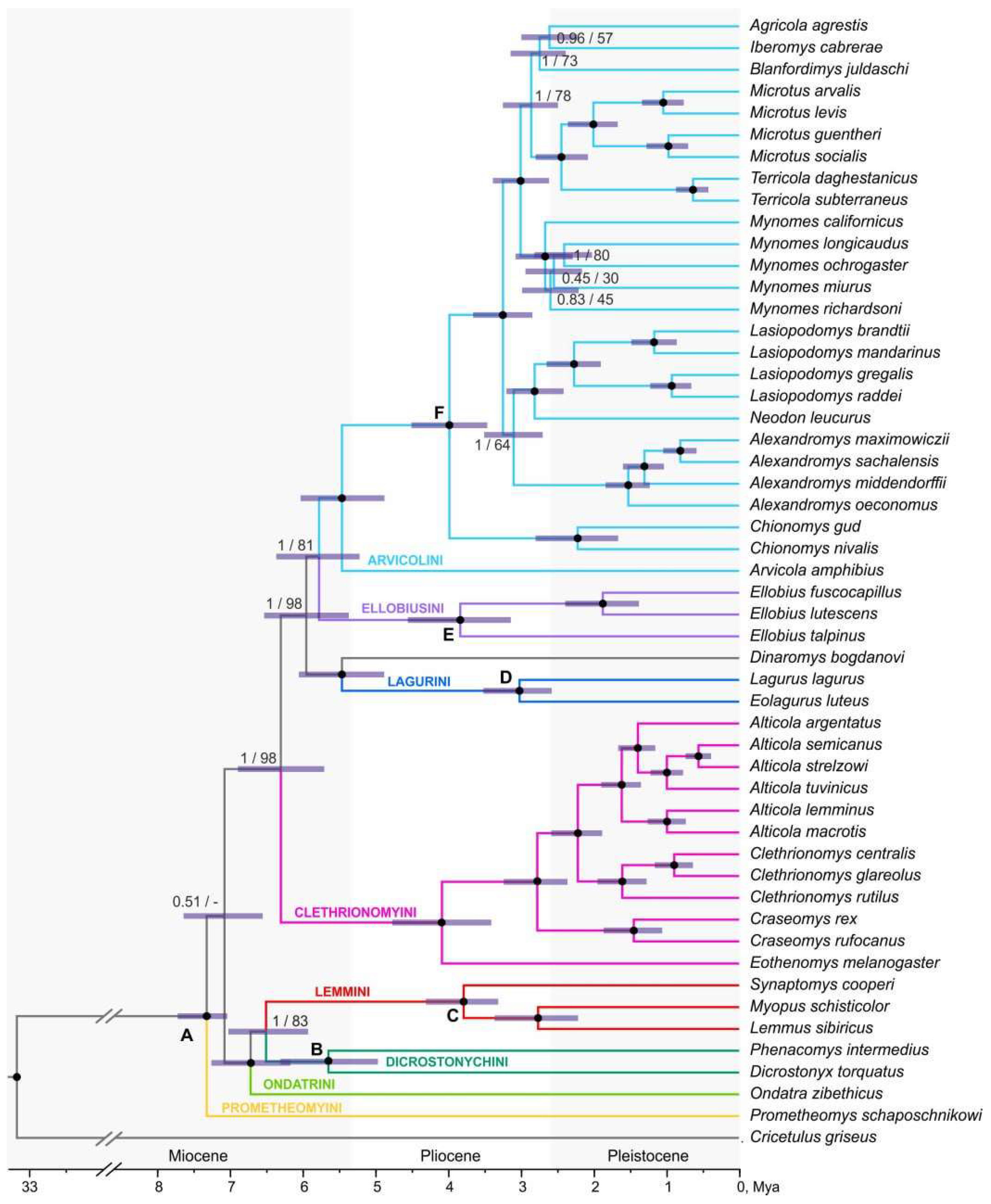

| TMRCA | RNA-seq | ddRADseq | mt complete [5] | mt RY-masked [5] |
|---|---|---|---|---|
| Arvicolinae | 7.67 (7.07-8.53) | 7.33 (7.05-7.73) | 7.36 (7.04–7.78) | 7.33 (7.05–7.73) |
| Ondatrini / (Dicrostonychini + Lemmini) | 6.54 (5.86-7.36) | 6.73 (6.18-7.27) | n/a | n/a |
| Dicrostonychini / Lemmini | 6.26 (5.6-7.07) | 6.51 (5.94-7.03) | n/a | n/a |
| Dicrostonychini | n/a | 5.66 (4.97-6.32) | 4.89 (4.08–5.7) | 4.49 (3.23–5.86) |
| Lemmini | 3.52 (3.26-3.87) | 3.79 (3.32-4.32) | 4.81 (3.68–5.97) | 4.37 (3.31–5.71) |
| Clethrionomyini | 2.58 (2.11-3.09) | 4.09 (3.41-4.78) | 4.02 (3.33–4.72) | 4.46 (3.35–5.64) |
| Third radiation (Arvicolini, Ellobiusini,Lagurini and Dinaromys*) | 5.31 (4.64-6.07) | 5.96 (5.37-6.54) | 6.2 (5.65–6.76) | 6.11 (5.17–6.92) |
| Lagurini and Dinaromys | n/a | 5.47 (4.89-6.06) | n/a | n/a |
| Arvicolini | 4.76 (4.11-5.46) | 5.47 (4.88-6.04) | n/a | n/a |
| Arvicolini s. str.* | 3.56 (3.03-4.14) | 3.99 (3.47-4.51) | 4.9 (4.33–5.47) | 5.02 (4.12–5.89) |
| Lagurini and Arvicolini | 5.11 (4.45-5.85) | n/a | 6.04 (5.5-6.61) | 6.03 (5.12-6.86) |
| Ellobiusini and Arvicolini | n/a | 5.78 (5.22-6.38) | n/a | n/a |
| Ellobiusini | 3.18 (2.54-3.81) | 3.84 (3.14-4.56) | 4.97 (4.21–5.69) | 4.58 (3.42–5.68) |
| Lagurini | n/a | 3.02 (2.58-3.52) | 3.1 (2.59–3.75) | 3.05 (2.56–3.75) |
| Chionomys | n/a | 2.22 (1.66-2.8) | 3.29 (2.5–4.04) | 3.45 (2.13–4.67) |
| Microtus** (Microtus, Terricola, Agricola,Blanfordimys*, Iberomys*) | 2.4 (2-2.81) | 2.86 (2.49-3.25) | 3.8 (3.31–4.3) | 3.87 (3.07–4.63) |
| Mynomes | 2.05 (1.64-2.48) | 2.67 (2.29-3.08) | 3.41 (2.89–3.91) | 3.32 (2.48–4.11) |
| Microtus + Terricola | 1.69 (1.31-2.1) | 2.45 (2.08-2.81) | 2.96 (2.46–3.5) | 3.18 (2.35–3.95) |
| Microtus | n/a | 2.01 (1.67-2.36) | 1.87 (1.43–2.33) | 2.06 (1.31–2.8) |
| Terricola | n/a | 0.64 (0.42-0.87) | 1.38 (0.89–1.93) | 1.46 (0.7–2.32) |
| Iberomys + Agricola + Blanfordimys | n/a | 2.75 (2.39-3.15) | 3.18 (2.66–3.71) | 3.11 (2.23–3.99) |
| Alexandromys, Lasiopodomys and Neodon* | 2.6 (2.19-3.03) | 3.11 (2.71-3.51) | 3.92 (3.4–4.4) | 4.12 (3.31–4.9) |
| Lasiopodomys | 1.92 (1.57-2.3) | 2.27 (1.91-2.65) | 3.09 (2.59–3.56) | 3.07 (2.27–3.85) |
| Alexandromys | 1.31 (0.95-1.7) | 1.53 (1.23-1.84) | 2.16 (1.55–2.81) | 2.2 (1.27–3.22) |
Disclaimer/Publisher’s Note: The statements, opinions and data contained in all publications are solely those of the individual author(s) and contributor(s) and not of MDPI and/or the editor(s). MDPI and/or the editor(s) disclaim responsibility for any injury to people or property resulting from any ideas, methods, instructions or products referred to in the content. |
© 2024 by the authors. Licensee MDPI, Basel, Switzerland. This article is an open access article distributed under the terms and conditions of the Creative Commons Attribution (CC BY) license (http://creativecommons.org/licenses/by/4.0/).


